
All Topics  
Peasant

 
Peasant

   Email Print
   Bookmark   Link


Peasant


A peasant is an agricultural
Agriculture

Agriculture refers to the production of food and goods through farming and forestry. Agriculture was the key development that led to the rise of civilization, with the animal husbandry of domestication animals and plants creating food surpluses that enabled the development of more Population density and Social stratification societies....
 worker who subsists by working a small plot of ground. The word is derived from 15th century French
French language

French is a Romance language spoken around the world by around 80 million people as first language, by 190 million as second language, and by about another 200 million people as an acquired tongue, with significant speakers in 54 countries....
 païsant meaning one from the pays, or countryside
Rural

Rural areas are large and isolated areas of a country, often with low populations. Today, 75 percent of the United States' inhabitants live in suburban and urban areas, but cities occupy only 2 percent of the country....
, ultimately from the Latin pagus, or outlying administrative district (when the Roman Empire became Christian, these outlying districts were "pagan," that is, not Christian).


Discussion
Ask a question about 'Peasant'
Start a new discussion about 'Peasant'
Answer questions from other users
Full Discussion Forum


Encyclopedia


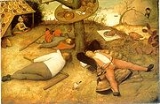
Brueghelland of Cockaignedetail
A peasant is an agricultural
Agriculture

Agriculture refers to the production of food and goods through farming and forestry. Agriculture was the key development that led to the rise of civilization, with the animal husbandry of domestication animals and plants creating food surpluses that enabled the development of more Population density and Social stratification societies....
 worker who subsists by working a small plot of ground. The word is derived from 15th century French
French language

French is a Romance language spoken around the world by around 80 million people as first language, by 190 million as second language, and by about another 200 million people as an acquired tongue, with significant speakers in 54 countries....
 païsant meaning one from the pays, or countryside
Rural

Rural areas are large and isolated areas of a country, often with low populations. Today, 75 percent of the United States' inhabitants live in suburban and urban areas, but cities occupy only 2 percent of the country....
, ultimately from the Latin pagus, or outlying administrative district (when the Roman Empire became Christian, these outlying districts were "pagan," that is, not Christian). The term peasant today is sometimes used in a pejorative sense for impoverished farmer
Farmer

A farmer is a person who raises living organisms for food or raw materials....
s.

Peasants typically make up the majority of the agricultural
Agriculture

Agriculture refers to the production of food and goods through farming and forestry. Agriculture was the key development that led to the rise of civilization, with the animal husbandry of domestication animals and plants creating food surpluses that enabled the development of more Population density and Social stratification societies....
 labour force in a Pre-industrial society
Pre-industrial society

Pre-industrial society refers to specific social attributes and forms of political and cultural organization that were prevalent before the advent of the Industrial Revolution....
, dependant on the cultivation
Cultivation

In agriculture, cultivation is the process of geting fater plants on arable land. It is usually associated with large-scale agriculture, as opposed to small-scale gardening....
 of their land: without stockpiles of provisions they thrive or starve
Starvation

Starvation is a severe reduction in vitamin, nutrient, and energy intake, and is the most extreme form of malnutrition. In humans, prolonged starvation causes permanent organ damage and, eventually, death....
 according to the most recent harvest
Harvest

In agriculture, the harvest is the process of gathering mature crop from the field s. Reaping is the cutting of grain or Pulse for harvest, typically using a scythe, sickle, or reaper....
. The majority of the people in the Middle Ages were peasants. Pre-industrial societies have diminished with the advent of globalization
Globalization

Globalization in its literal sense is the process of transformation of local or regional phenomena into global ones. It can be described as a process by which the people of the world are unified into a single society and function together....
 and as such there are considerably fewer peasants to be found in rural
Rural

Rural areas are large and isolated areas of a country, often with low populations. Today, 75 percent of the United States' inhabitants live in suburban and urban areas, but cities occupy only 2 percent of the country....
 areas throughout the world (as a proportion of the total world population).

Though "peasant" is a word of loose application, once a market economy
Market economy

A market economy is a social system based on the division of labor in which the prices of goods and services are determined in a free price system set by supply and demand....
 has taken root the term peasant proprietors is frequently used to describe the traditional rural population in countries where the land is chiefly held by smallholders. It is sometimes used by people who consider themselves of higher class as slang to refer pejoratively to those of poorer education who come from a lower income background.

Communities


In the great majority of pre-industrial societies, peasants constitute the bulk of the population. Peasant societies generally have very well developed social support networks. Especially in harder climate
Climate

Climate encompasses the temperatures, humidity, atmospheric pressure, winds, rainfall, atmospheric particle count and numerous other Meteorology elements in a given region over long periods of time, as opposed to the term weather, which refers to current activity of these same elements....
s, members of the community who have a poor harvest
Harvest

In agriculture, the harvest is the process of gathering mature crop from the field s. Reaping is the cutting of grain or Pulse for harvest, typically using a scythe, sickle, or reaper....
 or suffer some form of hardship will be taken care of by the rest of the community.

Peasant societies can often have very stratified social hierarchies within them. Rural people often have very different values and economic behavior from urbanites, and tend to be more conservative
Social conservatism

Social conservatism is a political or moral ideology that believes the government has a role in encouraging or enforcing traditional values or behaviors based on the belief that these are what keep people civilized and decent....
. Peasants are often very loyal to inherited power structures that define their rights and privileges and protect them from interlopers, despite their low status within those power structures.

Fernand Braudel
Fernand Braudel

Fernand Braudel , was the foremost French historian of the postwar era, and a leader of the Annales School. He organized his scholarship around three great projects, each worth several decades of intense study: "The Mediterranean" , "Civilization and Capitalism" , and the unfinished, "Identity of France" ....
 devoted the first volume–called The Structures of Everyday Life–of his major work, Civilization and Capitalism 15th–18th Century to the largely silent and invisible world that existed below the market economy.

Since it was the literate classes who left the most records, and these tended to dismiss peasants as figures of coarse appetite and rustic comedy, the term "peasant" may have a pejorative rather than descriptive connotation in historical memory. Society was theorized as being organized into three "estates": those who work, those who pray, and those who fight.

In a barter economy, peasants characteristically have a different attitude to work from people in a money
Money

Money is anything that is generally accepted as payment for goods and services and repayment of debts. The main uses of money are as a medium of exchange, a unit of account, and a store of value....
 economy.

Medieval European peasants


The relative position of Western Europe
Western Europe

Western Europe refers to the countries in the western most half of Europe. This concept has had different meanings, political and cultural as well as geographical issues have influenced the area....
an peasants was greatly improved after the Black Death
Black Death

The Black Death, was one of the deadliest pandemics in human history, widely thought to have been caused by a bacterium named Yersinia pestis , but recently attributed by some factors to other diseases....
 unsettled medieval Europe.

Vanetsov Moving House
In the wake of this disruption to the established hierarchy, later centuries saw the invention of the printing press, the development of widespread literacy
Literacy

The traditional definition of literacy is considered to be the ability to read and write, or the ability to use language to Reading , Writing, Listening, and Speech communication....
 and the enormous social and intellectual changes of the Enlightenment
Age of Enlightenment

The Age of Enlightenment or The Enlightenment is a term used to describe a time in Western philosophy and cultural life centered upon the eighteenth century, in which rationalism was advocated as the primary source and legitimacy for authority....
.

This evolution of ideas in an environment of relatively widespread literacy
Literacy

The traditional definition of literacy is considered to be the ability to read and write, or the ability to use language to Reading , Writing, Listening, and Speech communication....
 laid the groundwork for the Industrial Revolution
Industrial Revolution

The Industrial Revolution was a period in the late 18th and early 19th centuries when major changes in agriculture, manufacturing, production, and transportation had a profound effect on the socioeconomics and cultural conditions in United Kingdom....
, which enabled mechanically and chemically augmented agricultural production while simultaneously increasing the demand for factory
Factory

A factory or manufacturing plant is an industry building where workers manufacturing Good or supervise machines Process Manufacturing one product into another....
 workers in cities
City

A city is an urban area with a high population density and a particular administrative, legal, or historical status.Large industrialized cities generally have advanced systems for sanitation, utilities, land usage, house, and transportation and more....
. These factory workers with their low skill and large numbers quickly came to occupy the same socio-economic stratum as the original medieval peasants.

This was especially pronounced in Eastern Europe
Eastern Europe

Eastern Europe is a term that applies to the geopolitical region encompassing the easternmost part of the Europe. Throughout history and to a lesser extent today, parts of Eastern Europe has been distinguishable from Western Europe and other regions due to cultural, religious, economic, and historical reasons, even though there i...
. Lacking any catalysts for change in the 14th century, Eastern European peasants largely continued upon the original medieval path until the 18th and 19th centuries. The Tsar
Tsar

Tsar or czar , occasionally spelled csar or tzar in English language, is a slavs term designating certain monarchs.Originally, the title Czar meant Emperor in the European medieval sense of the term, that is, a ruler who has the same rank as a Ancient Rome or Byzantine emperor due to recognition by another emperor or...
s then began to notice that the West had made enormous strides they had not, responding by forcing the largely illiterate peasant populations under their control to embark upon a Westernization
Westernization

Westernization or occidentalization is a process whereby Society come under or adopt the Western culture in such matters as industry, technology, law, politics, economics, lifestyle, diet , language, alphabet, religion or western culture....
 and industrialization
Industrialization

Industrialization is the process of social and economic change whereby a human group is transformed from a pre-industrial society into an industry one....
 campaign.

Peter the Great initiated a half-successful attempt to force more than 500 years' worth of social change in the space of a few generations. Modernization of agriculture in Eastern Europe and Russia was not achieved until after the October Revolution.

Peasant Revolution and Peasant Studies


The field of peasant studies as such was rooted in the early work of scholars such as Florian Znaniecki
Florian Znaniecki

Florian Witold Znaniecki was a philosopher and a sociologist. He taught and wrote in Poland and the United States. He was the 44th President of the American Sociological Association and the founder of academic sociology studies in Poland....
 and Fei Xiaotong
Fei Xiaotong

Fei Xiaotong, or Fei Hsiao-Tung was a pioneering Han Chinese researcher and professor of sociology and anthropology; he was also noted for his studies in the study of China's ethnic groups as well as a social activist....
, and post-war studies of the Great Tradition and Little Tradition in work of Robert Redfield
Robert Redfield

Robert Redfield was an United States anthropology and ethnolinguist. Redfield graduated from the University of Chicago, eventually with a JD from its law school and then a Doctor of Philosophy in cultural anthropology, which he began to teach in 1927....
. In the 1960s, anthropologists and historians began to rethink the role of peasant revolution in world history and their own disciplines. This rethinking was partly in response to American involvement in the Vietnam War
Vietnam War

The Vietnam War, also known as the Second Indochina Wars, the Vietnam Conflict, or often in Vietnam the American War occurred in Vietnam, Laos and Cambodia from 1959 to April 30, 1975....
, which critics on the left regarded as an attempt to repress a peasant revolution. Peasant Revolution was seen as a Third World
Third World

Third World is a categorical label used to describe states that are considered to be developed in terms of their economy or level of industrialization, globalization, standard of living, health, education or other criteria for 'advancements'....
 response to capitalism and imperialism.

The anthropologist Eric Wolf
Eric Wolf

Eric Robert Wolf was an anthropologist, best known for his studies of peasants, Latin America, and his advocacy of Marxian perspectives within anthropology....
, for instance, drew on the work of earlier scholars in the Marxist tradition, such as Daniel Thorner
Daniel Thorner

Daniel Thorner was an American born economist known for his work on agricultural economics and Indian economic history. He is known for the application of historical and contemporary economic analysis on policy and influenced agricultural policy in India in the 1950s through his association with the Planning Commission .....
, who saw the rural population as a key element in the transition from feudalism to capitalism
Transition from feudalism to capitalism

The transition from the feudal organization of society to the earliest forms of capitalism, happened in periods differing from country to country.In Scotland, during the 18th century, peasants were dispossessed of the land to which they were bonded and which allowed them to be self-sufficient....
. Wolf and a group of scholars criticized both Marx and the field of modernization theorists
Modernization

The idea of modernization comes from a view of societies as having a standard evolutionary pattern, as described in the social evolutionism theories....
 for treating peasants as lacking the ability to take action
Agency

Agency may refer to any of the following:*Agency *Agency , the status of a person who acts for another person.*Agency *Agency , the capacity to make choices...
. James C. Scott
James C. Scott

James C. Scott is Sterling Professor of Political Science at Yale University. Before being promoted to Sterling Professor, he was the Eugene Meyer Professor of Political Science and Anthropology....
’s field observation in Malaysia convinced him that villagers were active participants in their local politics even though they were forced to use indirect methods. Many of these activist scholars looked back the Peasant Movement
Peasant movement

Peasant movement is a social movement involved with the agricultural policy.Peasants movement have a long history that can be traced to the numerous peasant uprisings that occurred in various regions of the world throughout human history....
 in India and the theories of revolution in China led by Mao Zedong
Mao Zedong

Mao Zedong was a China military and politics dictator. Mao led the Communist Party of China to victory against the Kuomintang in the Chinese Civil War, and was the leader of the People?s Republic of China from its establishment in 1949 until his death in 1976....
 starting in the 1920s. The anthropologist Myron Cohen, however, asked why the rural population in China were called "peasants" rather than "farmers," a distinction he called political rather than scientific. One important outlet for their scholarly work and theory was the Journal of Peasant Studies.

See also

Adriaen Van Ostade   Peasants in A Tavern
*Family economy
Family economy

Family Economy is used to denote the basic structure of production and consumption in the preindustrial Europe. In the family economy there were regional variations, which were how different places were different in family economy....
  • Feudalism
    Feudalism

    Feudalism, a term first used in the early modern period , in its most classic sense refers to a Middle Ages European political system composed of a set of reciprocal law and military obligations among the warrior nobility, revolving around the three key concepts of lords, vassals, and fiefs....
  • Petty nobility
    Petty nobility

    Petty nobility is dated at least back to 13th century and was formed by Nobles/Knights around their strategic interests. The idea was more capable peasants with leader roles in local community that were given tax exemption for taking care of services like for example guard duties of local primitive strongholds....
  • Folk culture
    Folk culture

    Folk culture refers to the localized lifestyle of a culture. It is usually handed down through oral tradition, relates to a sense of community, and demonstrates the "old ways" over novelty....
  • Lower class
  • Peasant revolt
    Peasant revolt

    Peasant, Peasants' or Popular is variously paired with Revolt, Uprising and War and may refer to :*Chen Sheng Wu Guang Uprising 209BC...
  • Popular revolt in late medieval Europe
    Popular revolt in late medieval Europe

    Popular revolts in late medieval Europe were uprisings and rebellions by peasants in the countryside, or the bourgeois in towns, against nobleman, abbots and kings during the upheavals of the 14th through early 16th centuries, part of a larger "Crisis of the Late Middle Ages"....
  • Serfdom
    Serfdom

    Serfdom is the socio-economic status of unfree peasants under feudalism, and specifically relates to Manorialism. It was a condition of Debt bondage or modified slavery which developed primarily during the High Middle Ages in Europe....
  • Slavery
    Slavery

    Slavery is a form of forced labor where a person is compelled to Labor for another . Slaves are held against their will from the time of their capture, purchase, or birth, and are deprived of the right to leave, to refuse to work, or to receive Remuneration in return for their labor....

Other terms for peasant

  • Aloer
    Aloer

    Aloers were independent peasant proprietors of alous in what is now Catalonia, especially during the years between the Carolingian reconquest of the Marches from the Moors in the late 9th century and the consolidation of feudalism in that region in the 11th century....
  • Boor/Boer
  • Campesino
    Campesino

    Campesino may refer to:The arts* Los Campesinos! - an indie pop band from Cardiff, Wales.* Teatro Campesino - a theater group founded by the United Farm Workers....
  • Churl
    Churl

    A churl , in its earliest Old English language meaning, was simply "a man", but the word soon came to mean "a non-servile peasant", still spelt ceorle, and denoting the lowest rank of freemen....
  • Cotter
    Cotter (farmer)

    See also Canadian band The Cottars.A cottar, or cottars, is the Scots language term for a peasant farmer formerly in the Scotland Scottish Highlands....
  • Fellah
    Fellah

    Fellah is a peasant, farmer or agricultural laborer in the Middle East. The word derives from the Arabic language word for ploughman or tiller....
  • Free tenant
    Free tenant

    Free Tenants, also known as Free Peasants, were peasants in Medieval England who occupied a unique place in the Feudal society. They were characterised by the low rents they paid to their Manorialism as well as being subject to less laws and ties than their villein counterparts....
  • Hari
    Hari (Sindh)

    Hari or Haari is a landless peasant, especially in Sindh, Pakistan. The Hari works for the Zamindar ....
  • Honbyakusho
    Honbyakusho

    Honbyakusho - Type of peasant in pre-modern Japan. They were the actual owners of farmland in villages, and it fell to them to pay taxes for the village....
  • Kulak
    Kulak

    Kulaks were a category of relatively affluent and well-endowed peasants in the later Russian Empire, Soviet Russia, and early Soviet Union. The word kulak originally referred to independent farmers in the Russian Empire who emerged as a result of the Stolypin reform which began in 1906....
  • Muzhik
  • Nóngmín
  • Pagesos de remença
    Remença

    Remen?a was a Catalonia mode of serfdom. Those who were serfs under this mode are properlypagesos de remen?a ; they are often referred to simply as remences ....
  • Peon
    Peon

    The words peon and peonage are derived from the Spanish language pe?n . It has a range of meanings but its primary usage is to describe labourers with little control over their employment conditions....
  • Serf
    Serfdom

    Serfdom is the socio-economic status of unfree peasants under feudalism, and specifically relates to Manorialism. It was a condition of Debt bondage or modified slavery which developed primarily during the High Middle Ages in Europe....
  • Villein
    Serfdom

    Serfdom is the socio-economic status of unfree peasants under feudalism, and specifically relates to Manorialism. It was a condition of Debt bondage or modified slavery which developed primarily during the High Middle Ages in Europe....
  • Smerd
    Smerd

    Smerds were feudal-dependent peasants in Russia and some other Slavic peoples countries. Sources from the 11th and 12th centuries mention smerds? presence in the Kievan Rus and Poland....