

Regent

Encyclopedia
Regent
A regent, from the Latin regens "one who reigns", is a person selected to act as head of state because the ruler is a minor, not present, or debilitated. Currently there are only two ruling Regencies in the world, sovereign Liechtenstein and the Malaysian constitutive state of Terengganu...
, from the Latin
Latin
Latin is an Italic language originally spoken in Latium and Ancient Rome. It, along with most European languages, is a descendant of the ancient Proto-Indo-European language. Although it is considered a dead language, a number of scholars and members of the Christian clergy speak it fluently, and...
regens "one who reigns", is a person selected to act as head of state
Head of State
A head of state is the individual that serves as the chief public representative of a monarchy, republic, federation, commonwealth or other kind of state. His or her role generally includes legitimizing the state and exercising the political powers, functions, and duties granted to the head of...
(ruling or not) because the ruler is a minor
Minority reign
The term minority reign or royal minority refers to the period of a sovereign's rule when he or she is legally a minor. Minority reigns are of their nature times when politicians and advisors can be especially competitive....
, not present, or debilitated. Currently there are only two ruling Regencies in the world, sovereign Liechtenstein
Liechtenstein
The Principality of Liechtenstein is a doubly landlocked alpine country in Central Europe, bordered by Switzerland to the west and south and by Austria to the east. Its area is just over , and it has an estimated population of 35,000. Its capital is Vaduz. The biggest town is Schaan...
and the Malaysian constitutive state of Terengganu
Terengganu
Terengganu is a sultanate and constitutive state of federal Malaysia. The state is also known by its Arabic honorific, Darul Iman...
(see below). The following is a list of regents.
Regents in various current monarchies
It should be noted that those who held a regency briefly, for example during surgery, are not necessarily listed, particularly if they performed no official acts; this list is also not complete, presumably not even for all monarchies included. The list includes some figures who acted as regent, even if they did not themselves hold the title of regent.Belgium
- Baron Erasme Louis Surlet de ChokierErasme Louis Surlet de ChokierErasme Louis, Baron Surlet de Chokier , born in Liège, was a Belgian politician and before the accession of Leopold I to the Belgian throne, was the first Regent of Belgium....
, Regent of BelgiumBelgiumBelgium , officially the Kingdom of Belgium, is a federal state in Western Europe. It is a founding member of the European Union and hosts the EU's headquarters, and those of several other major international organisations such as NATO.Belgium is also a member of, or affiliated to, many...
in 1831 - Prince Charles of BelgiumPrince Charles of BelgiumPrince Charles, Count of Flanders, Prince of Belgium was the second son of Albert I, King of the Belgians and Duchess Elisabeth in Bavaria. Born in Brussels, he served in lieu of his older brother King Leopold III from 1944 until 1950 as Prince Regent until Leopold could return to Belgium and...
, Prince RegentPrince RegentA prince regent is a prince who rules a monarchy as regent instead of a monarch, e.g., due to the Sovereign's incapacity or absence ....
of Belgium from 1944 to 1950
Japan
- Regent Empress DowagerDowagerA dowager is a widow who holds a title or property, or dower, derived from her deceased husband. As an adjective, "Dowager" usually appears in association with monarchical and aristocratic titles....
JingūJingu of Japan, also known as , was a legendary Japanese empress. The empress or consort to Emperor Chūai, she also served as Regent from the time of her husband's death in 209 until her son Emperor Ōjin acceded to the throne in 269...
for her son, the future Emperor ŌjinEmperor Ojin, also known as Homutawake or , was the 15th emperor of Japan, according to the traditional order of succession.No firm dates can be assigned to this emperor's life or reign, but he is conventionally considered to have reigned from 270 to 310.... - Prince RegentPrince RegentA prince regent is a prince who rules a monarchy as regent instead of a monarch, e.g., due to the Sovereign's incapacity or absence ....
ShōtokuPrince Shotoku, also known as or , was a semi-legendary regent and a politician of the Asuka period in Japan who served under Empress Suiko. He was a son of Emperor Yōmei and his younger half-sister Princess Anahobe no Hashihito. His parents were relatives of the ruling Soga clan, and was involved in the defeat...
for his aunt, Empress SuikoEmpress Suikowas the 33rd emperor of Japan, according to the traditional order of succession.Suiko's reign spanned the years from 593 until her death in 628.... - Fujiwara Regents as Sesshō or KampakuSessho and KampakuIn Japan, was a title given to a regent who was named to assist either a child emperor before his coming of age, or an empress. The was theoretically a sort of chief advisor for the emperor, but was the title of both first secretary and regent who assists an adult emperor. During the Heian era,...
Jordan
- Prince Nayeff bin AbdullahPrince Naif bin Abdullah INaif bin Abdullah el-Hashim was the youngest son of King Abdullah of Jordan. He attended Victoria College in Cairo. Naif became regent of Jordan on July 20, 1951, following the assassinaion of Abdullah, because his brother, Crown Prince Talal, was reportedly suffering from poor health...
from the 20 July to 5 September 1951, due to the schizophrenia of King TalalTalal of JordanTalal I bin Abdullah 26 February 1909 – 7 July 1972) was the second King of Jordan from 20 July 1951 until forced to abdicate in favour of his son Hussein due to health reasons on 11 August 1952....
, who was in a Swiss mental hospital.- A regency council (Ibrahim Hashim, Suleiman Toukan, Abdul Rahman Rusheidat and chairing Queen-mother Zein al-Sharaf) took over after the king's forced abdication (on 11 August) and remained in office from 4 June 1952 to 2 May 1953, until King Hussein came of age.
- Crown Prince Hassan, from 4 July 1998 to 19 January 1999 while his brother King Hussein was undergoing cancer treatments.
Liechtenstein
- Hereditary Prince Alois has been Regent since 15 August 2004.
Luxembourg
- Duke Adolph of NassauAdolphe, Grand Duke of LuxembourgAdolphe I, Grand Duke of Luxembourg was the last Duke of Nassau, and the fourth Grand Duke of Luxembourg.-Biography:...
was Regent from 8 April 1889 to 3 May 1889 and from 4 November 1890 to 23 November 1890, during the terminal illness of Grand Duke William IIIWilliam III of the NetherlandsWilliam III was from 1849 King of the Netherlands and Grand Duke of Luxembourg until his death and the Duke of Limburg until the abolition of the Duchy in 1866.-Early life:William was born in Brussels as son of William II of the Netherlands and...
. - Grand Duchess Marie Anne was Regent to her husband, Grand Duke William IVGuillaume IV, Grand Duke of LuxembourgWilliam IV, Grand Duke of Luxembourg reigned as the sovereign Grand Duke of Luxembourg from 17 November 1905 until his death. He succeeded his father, Adolphe, Grand Duke of Luxembourg. He also held the titular title of Duke of Nassau.William IV was a Protestant, the religion of the House of Nassau...
, during his terminal illness from 19 November 1908 to 25 February 1912, and then Regent to her daughter, Grand Duchess Marie-Adélaïde, during her minority from 25 February 1912 to 18 June 1912.
Terengganu
- Tengku Muhammad IsmailTengku Muhammad IsmailTengku Muhammad Ismail ibni Sultan Mizan Zainal Abidin is the Regent of Terengganu. He is the son of the current sultan, Sultan Mizan Zainal Abidin, and assumed the regency in December 2006 after his father's election as Yang di-Pertuan Agong.-Biography:Tengku Muhammad Ismail was born 1 March 1998...
(eight-years of age) co-reigns with the three-member Regency Advisory Council (Majlis Penasihat Pemangku Raja). His father, Sultan Mizan Zainal Abidin the Sultan of TerengganuTerengganuTerengganu is a sultanate and constitutive state of federal Malaysia. The state is also known by its Arabic honorific, Darul Iman...
was elected as 13th King of MalaysiaYang di-Pertuan AgongThe Yang di-Pertuan Agong is the head of state of Malaysia. The office was established in 1957 when the Federation of Malaya gained independence....
. The Malaysian constitution does not allow a simultaneous reign as both the King of Malaysia and as Monarch of the King's native state (deemed absent on the State throne). Sultan Mizan was crowned as King on 13 December 2006 and the prince as the Regent (Pemangku Raja) of Terengganu effective on the same date.
Monaco
- Prince AlbertAlbert II, Prince of MonacoAlbert II, Sovereign Prince of Monaco is the head of the House of Grimaldi and the ruler of the Principality of Monaco. He is the son of Rainier III, Prince of Monaco, and the American actress Grace Kelly...
was Regent from 31 March 2005 to 6 April 2005, when he succeeded his father as Albert II of MonacoAlbert II, Prince of MonacoAlbert II, Sovereign Prince of Monaco is the head of the House of Grimaldi and the ruler of the Principality of Monaco. He is the son of Rainier III, Prince of Monaco, and the American actress Grace Kelly...
Morocco
- The Wattasid Vizier Abu Zakariya YahyaAbu Zakariya Yahya al-WattasiAbu Zakariya Yahya ibn Ziyan al-Wattasi Abu Zakariya Yahya ibn Ziyan al-Wattasi (d.1448) Abu Zakariya Yahya ibn Ziyan al-Wattasi (d.1448) (abū zakarīyā' yaḥyā ben ziyān al-waṭṭāsī was a vizier of the Marinid sultan of Fez, regent and effective strongman ruler of Morocco from 1420 until 1448. He...
was Regent during the minority of the MarinidMarinidThe Marinid dynasty or Benemerine dynasty was a Zenata Berber dynasty of Morocco. The Marinid dynasty overtook the Almohads in controlling Morocco in 1244. They controlled most of the Maghreb from the mid-14th century to the 15th century and supported the Kingdom of Granada in Al-Andalus in the...
sultan Abd al-Haqq II; the Wattasid Viziers however kept the power beyond the majority of Abd al-Haqq II, until 1459 when most the members of their family were killed by the sultan, allowing him to return to power.
Netherlands
- Queen Emma (1890–1898), during the minority of her daughter Wilhelmina of the NetherlandsWilhelmina of the NetherlandsWilhelmina was Queen regnant of the Kingdom of the Netherlands from 1890 to 1948. She ruled the Netherlands for fifty-eight years, longer than any other Dutch monarch. Her reign saw World War I and World War II, the economic crisis of 1933, and the decline of the Netherlands as a major colonial...
- Juliana of the NetherlandsJuliana of the NetherlandsJuliana was the Queen regnant of the Kingdom of the Netherlands between 1948 and 1980. She was the only child of Queen Wilhelmina and Prince Henry...
(1947, 1948), during illness of her mother Wilhelmina of the NetherlandsWilhelmina of the NetherlandsWilhelmina was Queen regnant of the Kingdom of the Netherlands from 1890 to 1948. She ruled the Netherlands for fifty-eight years, longer than any other Dutch monarch. Her reign saw World War I and World War II, the economic crisis of 1933, and the decline of the Netherlands as a major colonial...
Norway
- King Magnus Eriksson (1343–1355) after stepping down from the throne in favor of his son Haakon MagnussonHaakon VI of NorwayHaakon VI of Norway was King of Norway from 1343 until his death and King of Sweden from 1362 until 1364, when he was deposed by Albert of Mecklenburg in Sweden.-Background:...
- Crown Prince Haakon was Regent from 25 November 2003 to 12 April 2004 and again on 29 March to 7 June 2005 during the illness of his father King Harald VHarald V of NorwayHarald V is the king of Norway. He succeeded to the throne of Norway upon the death of his father Olav V on 17 January 1991...
Oman
- for the minor Hami Sa`id (II) ibn Sultan (b. 1790 – succeeded 20 November 1804 – d. 19 Oct 1856) : 20 November 1804 – 31 July 1806 Badr ibn Sayf (d. 1806)
- for SultanSultanSultan is a title with several historical meanings. Originally, it was an Arabic language abstract noun meaning "strength", "authority", "rulership", and "dictatorship", derived from the masdar سلطة , meaning "authority" or "power". Later, it came to be used as the title of certain rulers who...
Turki ibn Sa`id (b. 1832 – succeeded 30 January 1871 – died 4 Jun 1888) : August – December 1875 Abdul-Aziz ibn Said – (b. 1850 – d. 1907)
Qatar
- H.E. Shaikh 'Abdu'llah bin Jasim Al-Thani was proclaimed as regent when his father Sheikh Qasim bin Muhammad Al Thani became incapacitated, 13 May 1913; succeeded on his death, 17 July 1913
Saudi Arabia
- 30 March 1964 – 2 November 1964 Faysal of Saudi Arabia (b. 1906 – d. 1975) –Regent for king Sa`ud of Saudi Arabia and later his successor
- 1 January 1996 – 21 February 1996 formally and de facto till 1 August 2005 Abdullah of Saudi ArabiaAbdullah of Saudi ArabiaAbdullah bin Abdul-Aziz Al Saud, Custodian of the Two Holy Mosques, is the King of Saudi Arabia. He succeeded to the throne on 1 August 2005 upon the death of his half-brother, King Fahd. When Crown Prince, he governed Saudi Arabia as regent from 1998 to 2005...
(b. 1924) –Regent for king Fahd of Saudi ArabiaFahd of Saudi ArabiaFahd bin Abdul Aziz Al Saud, Custodian of the Two Holy Mosques, was King of Saudi Arabia from 1982 to 2005...
and later his successor
Spain
- Cardinal Cisneros, twice regent of Castile (1506–1507 and 1516–1517) for Queen Juana and her son Charles I
- Joan of Austria, Princess of Portugal (Infanta Juana), regent of Castile (1554–1559) for King Philip II of Spain during the king's marriage to Queen Mary I of EnglandMary I of EnglandMary I was queen regnant of England and Ireland from July 1553 until her death.She was the only surviving child born of the ill-fated marriage of Henry VIII and his first wife Catherine of Aragon. Her younger half-brother, Edward VI, succeeded Henry in 1547...
- Mariana of AustriaMariana of AustriaMariana of Austria was Queen consort of Spain as the second wife of King Philip IV, who was also her maternal uncle...
, regent of Spain for her disabled son Charles IICharles II of SpainCharles II was the last Habsburg King of Spain and the ruler of large parts of Italy, the Spanish territories in the Southern Low Countries, and Spain's overseas Empire, stretching from the Americas to the Spanish East Indies...
from 1665 to 1677 and again, unofficially, from 1679 to 1696. - A Supreme Central and Governmental Junta of Spain and the IndiesJunta (Peninsular War)In the Napoleonic era, junta was the name chosen by several local administrations formed in Spain during the Peninsular War as a patriotic alternative to the official administration toppled by the French invaders...
from 25 September 1808 to 29 January 1810 and a Regency CouncilCádiz CortesThe Cádiz Cortes were sessions of the national legislative body which met in the safe haven of Cádiz during the French occupation of Spain during the Napoleonic Wars...
from 29 January 1810 to 24 March 1814 during the imprisonment/abdication of Ferdinand VII. - Maria Christina of the Two SiciliesMaria Christina of the Two SiciliesMaria Christina of the Two Sicilies was Queen consort of Spain and Regent of Spain .-Early years and first marriage:...
during the minority of her daughter Isabella IIIsabella II of SpainIsabella II was the only female monarch of Spain in modern times. She came to the throne as an infant, but her succession was disputed by the Carlists, who refused to recognise a female sovereign, leading to the Carlist Wars. After a troubled reign, she was deposed in the Glorious Revolution of...
from 1833 to 1840. - Baldomero Espartero, Prince of VergaraBaldomero Espartero, Prince of VergaraDon Joaquín Baldomero Fernández-Espartero y Alvarez de Toro, 1st Prince of Vergara, 1st Duke of la Victoria, 1st Duke of Morella, 1st Count of Luchana, 1st Viscount of Banderas was a Spanish general and political figure...
during the minority of Isabella IIIsabella II of SpainIsabella II was the only female monarch of Spain in modern times. She came to the throne as an infant, but her succession was disputed by the Carlists, who refused to recognise a female sovereign, leading to the Carlist Wars. After a troubled reign, she was deposed in the Glorious Revolution of...
from 1840 to 1843. - Francisco Serrano, duke of la Torre, during the interregnum between the reigns of Isabella II and Amadeo IAmadeo I of SpainAmadeo I was the only King of Spain from the House of Savoy...
, from 1869 to 1870. - Maria Christina of AustriaMaria Christina of AustriaMaria Christina of Austria was Queen consort of Spain as the second wife of King Alfonso XII of Spain...
, regent during her pregnancy after her husband's death and then for her son Alfonso XIIIAlfonso XIII of SpainAlfonso XIII was King of Spain from 1886 until 1931. His mother, Maria Christina of Austria, was appointed regent during his minority...
from 25 November 1885 – 7 May 1902. - the CaudilloCaudilloCaudillo is a Spanish word for "leader" and usually describes a political-military leader at the head of an authoritarian power. The term translates into English as leader or chief, or more pejoratively as warlord, dictator or strongman. Caudillo was the term used to refer to the charismatic...
general Francisco FrancoFrancisco FrancoFrancisco Franco y Bahamonde was a Spanish general, dictator and head of state of Spain from October 1936 , and de facto regent of the nominally restored Kingdom of Spain from 1947 until his death in November, 1975...
, became de facto regent for life in 1947 to 1975, after reinstating the monarchy with a vacant royal throne ultimately filled by Juan CarlosJuan Carlos I of SpainJuan Carlos I |Italy]]) is the reigning King of Spain.On 22 November 1975, two days after the death of General Francisco Franco, Juan Carlos was designated king according to the law of succession promulgated by Franco. Spain had no monarch for 38 years in 1969 when Franco named Juan Carlos as the...
.
Sweden
- Mats Kettilmundsson (1318–1319), between the deposition of king Birger Magnusson and the election of three-year-old Magnus ErikssonMagnus IV of SwedenMagnus Eriksson as Magnus IV was king of Sweden , including Finland, as Magnus VII King of Norway , including Iceland and Greenland, and also ruled Scania . He has also vindictively been called Magnus Smek...
as king. - Ingeborg of NorwayIngeborg of NorwayIngeborg of Norway , was a Norwegian and by marriage Swedish princess and royal duchess with a position in the regency governments in Norway and Sweden...
(1319–1326) president of the council of regents for her under age son, king Magnus ErikssonMagnus IV of SwedenMagnus Eriksson as Magnus IV was king of Sweden , including Finland, as Magnus VII King of Norway , including Iceland and Greenland, and also ruled Scania . He has also vindictively been called Magnus Smek...
, in both Sweden and Norway. - Karl Knutsson (Bonde)Charles VIII of SwedenCharles VIII of Sweden , Charles I of Norway, also Carl, , was king of Sweden and king of Norway ....
(1438–1440), during the interrgnum following the deposition of king Eric XIII; later became king as Charles VIII - Bengt Jönsson Oxenstierna (1448; together with his brother Nils Jönsson Oxenstierna), during the interregnum between the death of Christopher of BavariaChristopher of BavariaChristopher of Bavaria or Christopher the Bavarian; as king named Christopher ; Danish and Norwegian: Christoffer af/av Bayern; Swedish Kristofer av Bayern was union king of Denmark , Sweden and Norway .-Biography:He was probably born at Neumarkt in...
and the election of Karl Knutsson (Bonde) as king. - Nils Jönsson Oxenstierna (1448; together with his brother Bengt Jönsson Oxenstierna), during the interregnum between the death of Christopher of BavariaChristopher of BavariaChristopher of Bavaria or Christopher the Bavarian; as king named Christopher ; Danish and Norwegian: Christoffer af/av Bayern; Swedish Kristofer av Bayern was union king of Denmark , Sweden and Norway .-Biography:He was probably born at Neumarkt in...
and the election of Karl Knutsson (Bonde) as king. - Jöns Bengtsson OxenstiernaJöns Bengtsson OxenstiernaJöns Bengtsson was a Swedish archbishop of Uppsala and regent of Sweden, under the Kalmar Union, in 1457, shared with Erik Axelsson , and alone 1465–1466.-Biography:...
(1457; together with Erik Axelsson Tott), during the interregnum following the first deposition of King Charles VIIICharles VIII of SwedenCharles VIII of Sweden , Charles I of Norway, also Carl, , was king of Sweden and king of Norway ....
, and again (1465–1466), following his second deposition. - Kettil Karlsson Vasa (1464), during the interregnum following the first deposition of King Christian IChristian I of DenmarkChristian I was a Danish monarch, king of Denmark , Norway and Sweden , under the Kalmar Union. In Sweden his short tenure as monarch was preceded by regents, Jöns Bengtsson Oxenstierna and Erik Axelsson Tott and succeeded by regent Kettil Karlsson Vasa...
; and again (1465), following the second deposition of Charles VIIICharles VIII of SwedenCharles VIII of Sweden , Charles I of Norway, also Carl, , was king of Sweden and king of Norway .... - Erik Axelsson Tott (1457; together with Jöns Bengtsson Oxenstierna) (1466–1467), following the end of Jöns Oxenstierna's second regency.
- Sten Sture the ElderSten Sture the ElderSten Sture the Elder was a Swedish statesman and regent of Sweden from .-Background:...
(1470–1497, 1501–1503) the longest serving regent during the Kalmar UnionKalmar UnionThe Kalmar Union is a historiographical term meaning a series of personal unions that united the three kingdoms of Denmark, Norway , and Sweden under a single monarch, though intermittently and with a population... - Svante Nilsson (1503–1512), succeeding Sten Sture the Elder.
- Erik Trolle 1512.
- Sten Sture the YoungerSten Sture the YoungerSten Sture the Younger , Lord of Ekesiö , was a Swedish statesman and regent of Sweden, under the era of the Kalmar Union.-Life:...
(1512–1520), succeeding Svante Sture. - Gustav Eriksson VasaGustav I of SwedenGustav I of Sweden, born Gustav Eriksson of the Vasa noble family and later known simply as Gustav Vasa , was King of Sweden from 1523 until his death....
was firstly Regent (1521–1523) after the final dissolution of Kalmar Union, but soon was proclaimed King. - Duke Charles of SödermanlandCharles IX of SwedenCharles IX of Sweden also Carl, was King of Sweden from 1604 until his death. He was the youngest son of King Gustav I of Sweden and his second wife, Margaret Leijonhufvud, brother of Eric XIV and John III of Sweden, and uncle of Sigismund III Vasa king of both Sweden and Poland...
(1599–1604) after ousting his Catholic nephew King SigismundSigismund III VasaSigismund III Vasa was King of Poland and Grand Duke of Lithuania, a monarch of the united Polish–Lithuanian Commonwealth from 1587 to 1632, and King of Sweden from 1592 until he was deposed in 1599...
, until he himself claimed the throne. - Axel OxenstiernaAxel OxenstiernaAxel Gustafsson Oxenstierna af Södermöre , Count of Södermöre, was a Swedish statesman. He became a member of the Swedish Privy Council in 1609 and served as Lord High Chancellor of Sweden from 1612 until his death. He was a confidant of first Gustavus Adolphus and then Queen Christina.Oxenstierna...
(1632–1644), during the minority of Queen ChristinaChristina of SwedenChristina , later adopted the name Christina Alexandra, was Queen regnant of Swedes, Goths and Vandals, Grand Princess of Finland, and Duchess of Ingria, Estonia, Livonia and Karelia, from 1633 to 1654. She was the only surviving legitimate child of King Gustav II Adolph and his wife Maria Eleonora...
. - Dowager Queen Hedwig Eleonora of Holstein-GottorpHedwig Eleonora of Holstein-GottorpHedwig Eleonora of Holstein-Gottorp was the queen consort of King Charles X of Sweden and queen mother of King Charles XI...
(1660–1672), during the minority of her son King Charles XICharles XI of SwedenCharles XI also Carl, was King of Sweden from 1660 until his death, in a period in Swedish history known as the Swedish empire ....
, and again (1697–1699), during the minority of her grandson King Charles XIICharles XII of SwedenCharles XII also Carl of Sweden, , Latinized to Carolus Rex, Turkish: Demirbaş Şarl, also known as Charles the Habitué was the King of the Swedish Empire from 1697 to 1718...
. - Charles, Duke of SödermanlandCharles XIII of SwedenCharles XIII & II also Carl, , was King of Sweden from 1809 and King of Norway from 1814 until his death...
(1792–1796) for his underage nephew Gustav IV Adolf of SwedenGustav IV Adolf of SwedenGustav IV Adolf of Sweden also Gustav Adolph was King of Sweden from 1792 until his abdication in 1809. He was the son of Gustav III of Sweden and his queen consort Sophia Magdalena, eldest daughter of Frederick V of Denmark and his first wife Louise of Great Britain. He was the last Swedish...
, and again (1809) after Gustav IV Adolf was deposed and before Charles himself was proclaimed King Charles XIII. - Crown Prince Charles JohnCharles XIV John of SwedenCharles XIV & III John, also Carl John, Swedish and Norwegian: Karl Johan was King of Sweden and King of Norway from 1818 until his death...
(1810–1818), for his adoptive father King Charles XIIICharles XIII of SwedenCharles XIII & II also Carl, , was King of Sweden from 1809 and King of Norway from 1814 until his death...
, due to Charles XIII's incapacity. - Crown Prince CharlesCharles XV of SwedenCharles XV & IV also Carl ; Swedish and Norwegian: Karl was King of Sweden and Norway from 1859 until his death....
(1857–1859), for his father King Oscar IOscar I of SwedenOscar I was King of Sweden and Norway from 1844 to his death. When, in August 1810, his father Jean-Baptiste Bernadotte was elected Crown Prince of Sweden, Oscar and his mother moved from Paris to Stockholm . Oscar's father was the first ruler of the current House of Bernadotte...
, due to Oscar's incapacity.
Thailand
- for the minor ChulalongkornChulalongkornPhra Bat Somdet Phra Poramintharamaha Chulalongkorn Phra Chunla Chom Klao Chao Yu Hua , or Rama V was the fifth monarch of Siam under the House of Chakri. He was known to the Siamese of his time as Phra Phuttha Chao Luang . He is considered one of the greatest kings of Siam...
(Rama V) (18 October 1868 – 23 October 1910) : 18 October 1868 – 16 November 1873 Chao Praya Siri Suriyawongse (d. 1882) - for PrajadhipokPrajadhipokPhra Bat Somdet Phra Poramintharamaha Prajadhipok Phra Pok Klao Chao Yu Hua , or Rama VII was the seventh monarch of Siam under the House of Chakri. He was the last absolute monarch and the first constitutional monarch of the country. His reign was a turbulent time for Siam due to huge political...
(Rama VII) (26 November 1925 – 2 March 1935; in self-imposed exile from 12 Jan 1934) : 12 January 1934 – 2 March 1935 Prince Naritsaranuwatiwong Chitchalerm - for Ananda MahidolAnanda MahidolAnanda Mahidol was the eighth monarch of Thailand under the House of Chakri. At the time he was recognized as king by the National Assembly, in March 1935, he was a nine-year-old boy living in Switzerland. He returned to Thailand in December 1945. Six months later, in June 1946, he was found shot...
(Rama VIII) (2 March 1935 – 9 June 1946; in Switzerland to 5 December 1945) :- 2 March 1935 – 12 August 1935 Prince Oscar Anuvatana (president of Council of Regency)
- 12 August 1935–1944 Prince Aditya Dibabha (president of Council of Regency)
- 1944 – 9 June 1946 Pridi Banomyong –Regent
- for present king Bhumibol AdulyadejBhumibol AdulyadejBhumibol Adulyadej is the current King of Thailand. He is known as Rama IX...
(Rama IX) (b. 9 June 1946) :- 16 June 1946–1946 Prince Rangsit, Prince of Jainart –Regent (from 1947, president of Supreme Council of State)
- 1946 – 5 May 1950 Prince Dhanivat Bidyalabh Bridhyakon "Prince Dhani" –Regent (president of Supreme Council of State)
- 22 October 1956 – 7 December 1956 Queen SirikitSirikitSomdet Phra Nang Chao Sirikit Phra Borommarachininat , is the queen consort of Bhumibol Adulyadej, King of Thailand. She is the second Queen Regent of Thailand...
-Regent
United Kingdom and the other Commonwealth Realms, and its predecessor realms
- George IVGeorge IV of the United KingdomGeorge IV was the King of the United Kingdom of Great Britain and Ireland and also of Hanover from the death of his father, George III, on 29 January 1820 until his own death ten years later...
(1811–1820), Prince RegentPrince RegentA prince regent is a prince who rules a monarchy as regent instead of a monarch, e.g., due to the Sovereign's incapacity or absence ....
during the incapacity of his father, George IIIGeorge III of the United KingdomGeorge III was King of Great Britain and King of Ireland from 25 October 1760 until the union of these two countries on 1 January 1801, after which he was King of the United Kingdom of Great Britain and Ireland until his death...
.
The Kingdom of Great BritainKingdom of Great BritainThe former Kingdom of Great Britain, sometimes described as the 'United Kingdom of Great Britain', That the Two Kingdoms of Scotland and England, shall upon the 1st May next ensuing the date hereof, and forever after, be United into One Kingdom by the Name of GREAT BRITAIN. was a sovereign...
- After the death of Queen AnneAnne of Great BritainAnne ascended the thrones of England, Scotland and Ireland on 8 March 1702. On 1 May 1707, under the Act of Union, two of her realms, England and Scotland, were united as a single sovereign state, the Kingdom of Great Britain.Anne's Catholic father, James II and VII, was deposed during the...
in 1714 a regency under Baron ParkerThomas Parker, 1st Earl of MacclesfieldThomas Parker, 1st Earl of Macclesfield PC, FRS was an English Whig politician.-Youth and early career:He was born in Staffordshire, the son of Thomas Parker, an attorney at Leek. He was educated at Adams' Grammar School and Trinity College, Cambridge...
, the Lord Chief Justice, was set up while King George IGeorge I of Great BritainGeorge I was King of Great Britain and Ireland from 1 August 1714 until his death, and ruler of the Duchy and Electorate of Brunswick-Lüneburg in the Holy Roman Empire from 1698....
was sent for to take up the crown.
The Kingdom of EnglandKingdom of EnglandThe Kingdom of England was, from 927 to 1707, a sovereign state to the northwest of continental Europe. At its height, the Kingdom of England spanned the southern two-thirds of the island of Great Britain and several smaller outlying islands; what today comprises the legal jurisdiction of England...
- William LongchampWilliam LongchampWilliam Longchamp , sometimes known as William de Longchamp or William de Longchamps, was a medieval Lord Chancellor, Chief Justiciar, and Bishop of Ely in England. Born to a humble family in Normandy, he owed his advancement to royal favour. Although contemporary writers accused Longchamp's father...
(intermittently 1189–1199), during the absences of Richard IRichard I of EnglandRichard I was King of England from 6 July 1189 until his death. He also ruled as Duke of Normandy, Duke of Aquitaine, Duke of Gascony, Lord of Cyprus, Count of Anjou, Count of Maine, Count of Nantes, and Overlord of Brittany at various times during the same period...
on crusade, in prison, and in France. - William Marshal, 1st Earl of PembrokeWilliam Marshal, 1st Earl of PembrokeSir William Marshal, 1st Earl of Pembroke , also called William the Marshal , was an Anglo-Norman soldier and statesman. He was described as the "greatest knight that ever lived" by Stephen Langton...
(1216–1219) and then Hubert de Burgh, 1st Earl of KentHubert de Burgh, 1st Earl of KentHubert de Burgh, 1st Earl of Kent was Earl of Kent, Justiciar of England and Ireland, and one of the most influential men in England during the reigns of John and Henry III.-Birth and family:...
(1219–1227), during the minority of King Henry IIIHenry III of EnglandHenry III was the son and successor of John as King of England, reigning for 56 years from 1216 until his death. His contemporaries knew him as Henry of Winchester. He was the first child king in England since the reign of Æthelred the Unready... - A regency council headed by Henry, 3rd Earl of LancasterHenry, 3rd Earl of LancasterHenry , 3rd Earl of Leicester and Lancaster was an English nobleman, one of the principals behind the deposition of Edward II of England.-Family and lineage:...
(1327–1330) during the minority of Edward IIIEdward III of EnglandEdward III was King of England from 1327 until his death and is noted for his military success. Restoring royal authority after the disastrous reign of his father, Edward II, Edward III went on to transform the Kingdom of England into one of the most formidable military powers in Europe... - John, Duke of Bedford (1422–1435) and Humphrey, Duke of GloucesterHumphrey, Duke of GloucesterHumphrey of Lancaster, 1st Duke of Gloucester, 1st Earl of Pembroke, KG , also known as Humphrey Plantagenet, was "son, brother and uncle of kings", being the fourth and youngest son of king Henry IV of England by his first wife, Mary de Bohun, brother to king Henry V of England, and uncle to the...
(1422–1437), during the minority of their nephew, Henry VIHenry VI of EnglandHenry VI was King of England from 1422 to 1461 and again from 1470 to 1471, and disputed King of France from 1422 to 1453. Until 1437, his realm was governed by regents. Contemporaneous accounts described him as peaceful and pious, not suited for the violent dynastic civil wars, known as the Wars... - Richard Plantagenet, 3rd Duke of YorkRichard Plantagenet, 3rd Duke of YorkRichard Plantagenêt, 3rd Duke of York, 6th Earl of March, 4th Earl of Cambridge, and 7th Earl of Ulster, conventionally called Richard of York was a leading English magnate, great-grandson of King Edward III...
(1454–1455; 1455–1456), during the incapacity of his cousin, Henry VI - Richard, Duke of GloucesterRichard III of EnglandRichard III was King of England for two years, from 1483 until his death in 1485 during the Battle of Bosworth Field. He was the last king of the House of York and the last of the Plantagenet dynasty...
(1483), during the minority of his nephew, Edward VEdward V of EnglandEdward V was King of England from 9 April 1483 until his deposition two months later. His reign was dominated by the influence of his uncle Richard, Duke of Gloucester, who succeeded him as Richard III... - Queen Catherine of AragonCatherine of AragonCatherine of Aragon , also known as Katherine or Katharine, was Queen consort of England as the first wife of King Henry VIII of England and Princess of Wales as the wife to Arthur, Prince of Wales...
, while Henry VIIIHenry VIII of EnglandHenry VIII was King of England from 21 April 1509 until his death. He was Lord, and later King, of Ireland, as well as continuing the nominal claim by the English monarchs to the Kingdom of France...
was in France. In this time she played a large role in the defeat of the Scots at Flodden, and was Queen Regent for several months. - Queen Catherine ParrCatherine ParrCatherine Parr ; 1512 – 5 September 1548) was Queen consort of England and Ireland and the last of the six wives of King Henry VIII of England. She married Henry VIII on 12 July 1543. She was the fourth commoner Henry had taken as his consort, and outlived him...
, while Henry VIIIHenry VIII of EnglandHenry VIII was King of England from 21 April 1509 until his death. He was Lord, and later King, of Ireland, as well as continuing the nominal claim by the English monarchs to the Kingdom of France...
was in France. - Edward Seymour, 1st Duke of SomersetEdward Seymour, 1st Duke of SomersetEdward Seymour, 1st Duke of Somerset, 1st Earl of Hertford, 1st Viscount Beauchamp of Hache, KG, Earl Marshal was Lord Protector of England in the period between the death of Henry VIII in 1547 and his own indictment in 1549....
(1547–1550), during the minority of his nephew, Edward VIEdward VI of EnglandEdward VI was the King of England and Ireland from 28 January 1547 until his death. He was crowned on 20 February at the age of nine. The son of Henry VIII and Jane Seymour, Edward was the third monarch of the Tudor dynasty and England's first monarch who was raised as a Protestant... - John Dudley, 1st Duke of NorthumberlandJohn Dudley, 1st Duke of NorthumberlandJohn Dudley, 1st Duke of Northumberland, KG was an English general, admiral, and politician, who led the government of the young King Edward VI from 1550 until 1553, and unsuccessfully tried to install Lady Jane Grey on the English throne after the King's death...
(1550–1553), during the minority of Edward VI - During the month of March 1617, Francis BaconFrancis BaconFrancis Bacon, 1st Viscount St Albans, KC was an English philosopher, statesman, scientist, lawyer, jurist, author and pioneer of the scientific method. He served both as Attorney General and Lord Chancellor of England...
served as regent of England during the reign of King James I of England - William IIIWilliam III of EnglandWilliam III & II was a sovereign Prince of Orange of the House of Orange-Nassau by birth. From 1672 he governed as Stadtholder William III of Orange over Holland, Zeeland, Utrecht, Guelders, and Overijssel of the Dutch Republic. From 1689 he reigned as William III over England and Ireland...
personally led his army into battle each year during the Nine Years' War (1689–1698). In his absence, the kingdom was administered by his wife and co-ruler Queen Mary IIMary II of EnglandMary II was joint Sovereign of England, Scotland, and Ireland with her husband and first cousin, William III and II, from 1689 until her death. William and Mary, both Protestants, became king and queen regnant, respectively, following the Glorious Revolution, which resulted in the deposition of...
until her death in 1694, and thereafter by a council of seven Lord Justices (sometimes referred to as the "Lords Regent"): William Cavendish, 1st Duke of DevonshireWilliam Cavendish, 1st Duke of DevonshireWilliam Cavendish, 1st Duke of Devonshire KG PC was a soldier and Whig statesman, the son of William Cavendish, 3rd Earl of Devonshire and Lady Elizabeth Cecil.-Life:...
(1640–1707), Charles Sackville, 6th Earl of DorsetCharles Sackville, 6th Earl of DorsetCharles Sackville, 6th Earl of Dorset and 1st Earl of Middlesex was an English poet and courtier.-Early Life:He was son of Richard Sackville, 5th Earl of Dorset...
(1638–1706), Sidney Godolphin, 1st Earl of GodolphinSidney Godolphin, 1st Earl of GodolphinSir Sidney Godolphin, 1st Earl of Godolphin, KG, PC was a leading English politician of the late 17th and early 18th centuries...
(1645–1712), Thomas Herbert, 8th Earl of PembrokeThomas Herbert, 8th Earl of PembrokeThomas Herbert, 8th Earl of Pembroke, 5th Earl of Montgomery, KG, PC, FRS was a British politician during the reigns of William III and Anne....
(1656–1733), Charles Talbot, 1st Duke of ShrewsburyCharles Talbot, 1st Duke of ShrewsburyCharles Talbot, 1st Duke of Shrewsbury, KG, PC was an English statesman. Born to Roman Catholic parents, he remained in that faith until 1679 when—during the time of the Popish Plot and following the advice of the divine John Tillotson—he converted to the Church of England...
(1660–1718), John Somers, Baron Somers (1651–1716), and Thomas TenisonThomas TenisonThomas Tenison was an English church leader, Archbishop of Canterbury from 1694 until his death. During his primacy, he crowned two British monarchs.-Life:...
.
The Kingdom of ScotlandKingdom of ScotlandThe Kingdom of Scotland was a Sovereign state in North-West Europe that existed from 843 until 1707. It occupied the northern third of the island of Great Britain and shared a land border to the south with the Kingdom of England...
- A regency council of six Guardians existed (1286–1290) during the minority of Margaret, Maid of Norway. These were; William Fraser, Bishop of St Andrews; Donnchadh III, Earl of Fife (followed by Donnchadh IV, Earl of Fife); Alexander Comyn, Earl of BuchanAlexander Comyn, Earl of BuchanAlexander Comyn, 2nd Earl of Buchan was a Scoto-Norman magnate who was one of the most important figures in the 13th century Kingdom of Scotland. He was the son of William Comyn, jure uxoris Earl of Buchan, and Marjory, Countess of Buchan, the heiress of the last native Scottish Mormaer of Buchan,...
; Robert WishartRobert WishartRobert Wishart was Bishop of Glasgow during the Wars of Scottish Independence and a leading supporter of Robert Bruce. For Wishart and many of his fellow churchmen the freedom of Scotland and the freedom of the Scottish church were one and the same thing...
, Bishop of Glasgow; James Stewart, 5th High Steward of ScotlandJames Stewart, 5th High Steward of ScotlandJames, 5th High Steward of Scotland was High Steward of Scotland and a Guardian of Scotland during the First Interregnum.-Birth and ancestry:...
; and John II Comyn, Lord of BadenochJohn II Comyn, Lord of BadenochJohn II Comyn, Lord of Badenoch and Lord of Lochaber or John "the Black", also known as Black Comyn, a Scottish nobleman, was a Guardian of Scotland, and one of the six Regents for Margaret, Maid of Norway... - William WallaceWilliam WallaceSir William Wallace was a Scottish knight and landowner who became one of the main leaders during the Wars of Scottish Independence....
(1298), claiming to act as regent on behalf of the deposed King JohnJohn of ScotlandJohn Balliol , known to the Scots as Toom Tabard , was King of Scots from 1292 to 1296.-Early life:Little of John's early life is known. He was born between 1248 and 1250 at an unknown location, possibilities include Galloway, Picardy and Barnard Castle, County Durham... - Robert the Bruce, Earl of CarrickEarl of CarrickThe Earl of Carrick was the head of a comital lordship of Carrick in southwestern Scotland. The title emerged in 1186, when Donnchad, son of Gille Brigte, Lord of Galloway, became Mormaer or Earl of Carrick in compensation for exclusion from the whole Lordship of Galloway...
(1298–1300) - John III Comyn, Lord of BadenochJohn III Comyn, Lord of BadenochJohn III Comyn, Lord of Badenoch and Lord of Lochaber or John "the Red", also known simply as the Red Comyn was a Scottish nobleman who was an important figure in the Wars of Scottish Independence, and was Guardian of Scotland during the Second Interregnum 1296-1306...
(1298–1301; 1302–1304) - William Lamberton, Bishop of St Andrews (1299–1301)
- Sir Ingram de UmfravilleIngram de UmfravilleSir Ingram de Umfraville was a Scottish noble who played a particularly chequered role in the Wars of Scottish Independence.In 1284 he joined with other Scottish noblemen who acknowledged Margaret of Norway as the heir of Alexander....
(1300–1301) - John de SoulesJohn de SoulesSir John de Soules was Guardian of Scotland from 1301 to 1304, at a crucial period in the Wars of Scottish Independence.-Life:...
(1301–1304) - Thomas Randolph, 1st Earl of Moray (1329–1332) (during the minority of David IIDavid II of ScotlandDavid II was King of Scots from 7 June 1329 until his death.-Early life:...
) - Donald, Earl of MarDomhnall II, Earl of MarDomhnall II of Mar was Regent of Scotland for just over a week during the minority of David II....
(1332) (during the minority of David IIDavid II of ScotlandDavid II was King of Scots from 7 June 1329 until his death.-Early life:...
) - Sir Andrew MurraySir Andrew MurraySir Andrew Murray , also known as Sir Andrew Moray or Sir Andrew Murray of Bothwell, was a Scottish military leader who commanded resistance forces loyal to David II of Scotland against Edward Balliol and Edward III of England during the Second War of Scottish Independence...
(1332) (during the minority of David IIDavid II of ScotlandDavid II was King of Scots from 7 June 1329 until his death.-Early life:...
) - Sir Archibald Douglas (1332–1333) (during the minority of David IIDavid II of ScotlandDavid II was King of Scots from 7 June 1329 until his death.-Early life:...
) - Robert Stewart, 7th High Steward of ScotlandRobert II of ScotlandRobert II became King of Scots in 1371 as the first monarch of the House of Stewart. He was the son of Walter Stewart, hereditary High Steward of Scotland and of Marjorie Bruce, daughter of Robert I and of his first wife Isabella of Mar...
(1334–1335) (during the minority of David IIDavid II of ScotlandDavid II was King of Scots from 7 June 1329 until his death.-Early life:...
) - John Randolph, 3rd Earl of MorayJohn Randolph, 3rd Earl of MorayJohn Randolph, 3rd Earl of Moray was an important figure in the reign of David II of Scotland, and was for a time joint Regent of Scotland.-Family:...
(1334–1335) (during the minority of David IIDavid II of ScotlandDavid II was King of Scots from 7 June 1329 until his death.-Early life:...
) - Sir Andrew MurraySir Andrew MurraySir Andrew Murray , also known as Sir Andrew Moray or Sir Andrew Murray of Bothwell, was a Scottish military leader who commanded resistance forces loyal to David II of Scotland against Edward Balliol and Edward III of England during the Second War of Scottish Independence...
(1335–1338) (during the minority of David IIDavid II of ScotlandDavid II was King of Scots from 7 June 1329 until his death.-Early life:...
) - Robert Stewart, 7th High Steward of ScotlandRobert II of ScotlandRobert II became King of Scots in 1371 as the first monarch of the House of Stewart. He was the son of Walter Stewart, hereditary High Steward of Scotland and of Marjorie Bruce, daughter of Robert I and of his first wife Isabella of Mar...
(1338–1341; 1346–1357) (during the minority of David IIDavid II of ScotlandDavid II was King of Scots from 7 June 1329 until his death.-Early life:...
) - John Stewart, Earl of CarrickRobert III of ScotlandRobert III was King of Scots from 1390 to his death. His given name was John Stewart, and he was known primarily as the Earl of Carrick before ascending the throne at age 53...
(during the incapacity of his father, Robert IIRobert II of ScotlandRobert II became King of Scots in 1371 as the first monarch of the House of Stewart. He was the son of Walter Stewart, hereditary High Steward of Scotland and of Marjorie Bruce, daughter of Robert I and of his first wife Isabella of Mar...
) - Robert Stewart, 1st Earl of FifeRobert Stewart, 1st Duke of AlbanyRobert Stewart, Duke of Albany , a member of the Scottish royal house, served as Regent to three different Scottish monarchs...
(1388–1393) (during the incapacity of his father, Robert IIRobert II of ScotlandRobert II became King of Scots in 1371 as the first monarch of the House of Stewart. He was the son of Walter Stewart, hereditary High Steward of Scotland and of Marjorie Bruce, daughter of Robert I and of his first wife Isabella of Mar...
and of his brother, Robert IIIRobert III of ScotlandRobert III was King of Scots from 1390 to his death. His given name was John Stewart, and he was known primarily as the Earl of Carrick before ascending the throne at age 53...
) - David Stewart, 1st Duke of Rothesay (1399–1401) (during the incapacity of his father, Robert III)
- Robert Stewart, 1st Duke of AlbanyRobert Stewart, 1st Duke of AlbanyRobert Stewart, Duke of Albany , a member of the Scottish royal house, served as Regent to three different Scottish monarchs...
(1401–1420) (during the incapacity of his brother Robert III, and then during the minority and captivity of his nephew James IJames I of ScotlandJames I, King of Scots , was the son of Robert III and Annabella Drummond. He was probably born in late July 1394 in Dunfermline as youngest of three sons...
) - Murdoch Stewart, 2nd Duke of AlbanyMurdoch Stewart, 2nd Duke of AlbanyMurdoch Stewart, Duke of Albany was a leading Scottish nobleman, the son of Robert Stewart, Duke of Albany and the grandson of King Robert II of Scotland, who founded the Stewart dynasty. In 1389 he was Justiciar North of the Forth. In 1402 he was captured at the Battle of Homildon Hill and would...
(1420–1424) (during the captivity of his cousin James I) - Archibald Douglas, 5th Earl of DouglasArchibald Douglas, 5th Earl of DouglasArchibald Douglas was a Scottish nobleman and General, son of Archibald Douglas, 4th Earl of Douglas and Margaret Stewart, eldest daughter of Robert III...
(1437–1439) (during the minority of James IIJames II of ScotlandJames II reigned as King of Scots from 1437 to his death.He was the son of James I, King of Scots, and Joan Beaufort...
) - William Crichton, 1st Lord CrichtonWilliam Crichton, 1st Lord CrichtonWilliam Crichton, 1st Lord Crichton of Sanquhar was an important political figure in Scotland.He held various positions within the court of James I. At the death of James I, William Crichton was Sheriff of Edinburgh, Keeper of Edinburgh Castle, and Master of the King’s household...
and Sir Alexander LivingstonAlexander LivingstonAlexander Livingston may refer to:*Alexander Livingston, 5th Lord Livingston *Alexander Livingston, 1st Earl of Linlithgow *Alexander Livingston, 2nd Earl of Linlithgow See also*Alexander Livingstone...
(1439–1445) (during the minority of James II) - William Douglas, 8th Earl of DouglasWilliam Douglas, 8th Earl of DouglasWilliam Douglas, 8th Earl of Douglas, 2nd Earl of Avondale was a Scottish nobleman. He was the eldest son of James Douglas, 7th Earl of Douglas and Beatrice Sinclair....
(1445–1449) (during the minority of James II) - Mary of Gueldres (1460–1463) (during the minority of her son, James IIIJames III of ScotlandJames III was King of Scots from 1460 to 1488. James was an unpopular and ineffective monarch owing to an unwillingness to administer justice fairly, a policy of pursuing alliance with the Kingdom of England, and a disastrous relationship with nearly all his extended family.His reputation as the...
) - James Kennedy and Gilbert Kennedy, 1st Lord KennedyGilbert Kennedy, 1st Lord KennedyGilbert Kennedy of Dunure, 1st Lord Kennedy was a Scottish lord, a son of Sir James Kennedy "the Younger" of Dunure, the Younger, and Lady Mary Stewart, daughter of Robert III, King of the Scots...
(1463–1466) (during the minority of James III) - Robert Boyd, 1st Lord BoydRobert Boyd, 1st Lord BoydRobert Boyd, 1st Lord Boyd Lord Boyd, was a Scottish statesman.-Biography:Robert Boyd was knighted, and was created a Peer of Parliament by James II of Scotland at some date between 1451 and 18 July 1454 . In 1460 he was one of the Regents during the minority of James III...
(1466–1469) (during the minority of James III) - Patrick HepburnPatrick Hepburn, 1st Earl of BothwellPatrick Hepburn, 1st Earl of Bothwell was Lord High Admiral of Scotland. Under his territorial designation of Sir Patrick Hepburne of Dunsyre, Knt., he was Sheriff of Berwickshire, 15 June 1480...
(1488–1494) (during the minority of James IVJames IV of ScotlandJames IV was King of Scots from 11 June 1488 to his death. He is generally regarded as the most successful of the Stewart monarchs of Scotland, but his reign ended with the disastrous defeat at the Battle of Flodden Field, where he became the last monarch from not only Scotland, but also from all...
) - Margaret TudorMargaret TudorMargaret Tudor was the elder of the two surviving daughters of Henry VII of England and Elizabeth of York, and the elder sister of Henry VIII. In 1503, she married James IV, King of Scots. James died in 1513, and their son became King James V. She married secondly Archibald Douglas, 6th Earl of...
(1513–1514) (during the minority of her son, James VJames V of ScotlandJames V was King of Scots from 9 September 1513 until his death, which followed the Scottish defeat at the Battle of Solway Moss...
) - Robert Maxwell, 5th Lord MaxwellRobert Maxwell, 5th Lord MaxwellRobert Maxwell, 5th Lord Maxwell , A member of the council of Regency of the Kingdom of Scotland. Regent of the Isle of Arran and like his father before head of the clan Maxwell. A distinguished Scottish nobleman, politician, soldier and in 1513 Lord High Admiral...
(1513-?) (Regent Isle of ArranIsle of ArranArran or the Isle of Arran is the largest island in the Firth of Clyde, Scotland, and with an area of is the seventh largest Scottish island. It is in the unitary council area of North Ayrshire and the 2001 census had a resident population of 5,058...
during the minority of James V. Also in 1536 he was created one of the members of the council of Regency during the absence of the king in France) - John Stewart, 2nd Duke of AlbanyJohn Stewart, 2nd Duke of AlbanyJohn Stewart, Duke of Albany was Regent of the Kingdom of Scotland, Duke of Albany in peerage of Scotland and Count of Auvergne and Lauraguais in France.-Early life:...
(1514–1524) (during the minority of his cousin, James VJames V of ScotlandJames V was King of Scots from 9 September 1513 until his death, which followed the Scottish defeat at the Battle of Solway Moss...
) - Archibald Douglas, 6th Earl of AngusArchibald Douglas, 6th Earl of AngusArchibald Douglas, 6th Earl of Angus was a Scottish nobleman active during the reigns of James V and Mary, Queen of Scots...
and Archbishop James BeatonJames BeatonDr. James Beaton was a Scottish church leader, the uncle of Dr. David Cardinal Beaton and the Keeper of the Great Seal of Scotland....
(1524–1528) (during the minority of the former's stepson James V) - James Hamilton, 2nd Earl of ArranJames Hamilton, 2nd Earl of ArranJames Hamilton, Duke of Châtellerault and 2nd Earl of Arran was a Scottish nobleman.-Biography:He was the eldest legitimate son of James Hamilton, 1st Earl of Arran....
(1542–1554) (during the minority of his cousin, Mary, Queen of Scots) - Mary of GuiseMary of GuiseMary of Guise was a queen consort of Scotland as the second spouse of King James V. She was the mother of Mary, Queen of Scots, and served as regent of Scotland in her daughter's name from 1554 to 1560...
(1554–1560) (during the minority of her daughter Mary, Queen of Scots) - James Stuart, 1st Earl of Moray (1567–1570) (during the minority of his nephew James VIJames I of EnglandJames VI and I was King of Scots as James VI from 24 July 1567 and King of England and Ireland as James I from the union of the English and Scottish crowns on 24 March 1603...
) - Matthew Stewart, 4th Earl of LennoxMatthew Stewart, 4th Earl of LennoxMatthew Stewart, 4th Earl of Lennox was the 4th Earl of Lennox, and leader of the Catholic nobility in Scotland. He was the son of John Stewart, 3rd Earl of Lennox. His grandson was James VI of Scotland....
(1570–1571) (during the minority of his grandson James VI) - John Erskine, 1st Earl of Mar (1571–1572) (during the minority of James VI)
- James Douglas, 4th Earl of MortonJames Douglas, 4th Earl of MortonJames Douglas, jure uxoris 4th Earl of Morton was the last of the four regents of Scotland during the minority of King James VI. He was in some ways the most successful of the four, since he did manage to win the civil war which had been dragging on with the supporters of the exiled Mary, Queen of...
(1572–1581) (during the minority of James VI)
Regents in various former Monarchies
The same notes apply; inclusion in this list reflects the political reality, regardless of claims to the throne.Afghan monarchies
Before the 1881 unification, there were essentially four rulers' capitals: KabulKabul
Kabul , spelt Caubul in some classic literatures, is the capital and largest city of Afghanistan. It is also the capital of the Kabul Province, located in the eastern section of Afghanistan...
, Herat
Herat
Herāt is the capital of Herat province in Afghanistan. It is the third largest city of Afghanistan, with a population of about 397,456 as of 2006. It is situated in the valley of the Hari River, which flows from the mountains of central Afghanistan to the Karakum Desert in Turkmenistan...
, Qandahar and Peshawar
Peshawar
Peshawar is the capital of Khyber-Pakhtunkhwa and the administrative center and central economic hub for the Federally Administered Tribal Areas of Pakistan....
(the last now in Pakistan); all their rulers belonged to the Abdali
Abdali
Abdali may refer to:* Abdali Urban Regeneration Project, district in Amman, Jordan* Durrani, one of the two largest Pashtun tribes of Afghanistan and Pakistan* Ahmed Shah Abdali, founder of the Durrani Empire...
tribal group, whose name was changed to Dorrani with Ahmad Shah Abdali. They belong either to the Saddozay segment of the Popalzay clan (typically styled padshah, king) or to the Mohammadzay segment of the Barakzay clan (typically with the style Amir, in full Amir al-Mo´menin "Leader of the Faithful"). The Mohammadzay also furnished the Saddozay kings frequently with top counselors, who served occasionally as (Minister-)regents, identified with the epithet Mohammadzay.
Brazil
- John, Prince RegentJohn VI of PortugalJohn VI John VI John VI (full name: João Maria José Francisco Xavier de Paula Luís António Domingos Rafael; (13 May 1767 – 10 March 1826) was King of the United Kingdom of Portugal, Brazil and the Algarves (later changed to just King of Portugal and the Algarves, after Brazil was recognized...
, was responsible for elevating Brazil to the status of Kingdom in 1815. One year later, he was acclaimed King of Portugal, Brazil and Algarves. - Pedro I, Prince Regent, was responsible for declaring the independence of Brazil, in 1822, during his regency (1820–1822), after his father, John VI, returned to Portugal. Some months later, he would be acclaimed Emperor of Brazil.
- Maria Leopoldina, Empress consort of BrazilMaria Leopoldina of AustriaMaria Leopoldina of Austria was an archduchess of Austria, Empress consort of Brazil and queen consort of Portugal....
, acted as Empress Regent while her husband, Pedro I, was away – specially during the war against Uruguay. - Provisional triumviral regency – from 7 April to 18 June 1831, comprised José Joaquim Carneiro de Campos, marquess de Caravelas, Nicolau Pereira de Campos Vergueiro and Francisco de Lima e Silva, baron of Barra Grande, was formed to control the country after the abdication of Peter I.
- Permanent triumviral regency – from 18 June 1831 to 12 October 1835, comprised the baron of Barra Grande as well as José da Costa Carvalho, marquess of Monte Alegre, and João Bráulio Muniz.
- Diogo António Feijó – from 12 October 1835 to 19 September 1837, during what was considered the advance of the Liberal Party
- Pedro de Araújo Lima, Marquis of OlindaPedro de Araújo Lima, Marquis of OlindaPedro de Araújo Lima, the Marquis of Olinda Pedro de Araújo Lima, the Marquis of Olinda Pedro de Araújo Lima, the Marquis of Olinda (Sirinhaem, 22 December 1793 — Rio de Janeiro, 7 June 1870, was a statesman and monarchist during the period of the Empire of Brazil (1822–1889). His long political...
– from 1838 to 1840, during what was considered the retaken of the Conservative Party. - Isabel, Princess Imperial of BrazilIsabel, Princess Imperial of BrazilDona Isabel , nicknamed "the Redemptress", was the heiress presumptive to the throne of the Empire of Brazil, bearing the title of Princess Imperial....
, was Princess Regent of the Empire of Brazil three times (1871–1872; 1876–1877; 1887–1888) while her father travelled abroad. During her last regency, she signed the abolition of slaverySlaverySlavery is a system under which people are treated as property to be bought and sold, and are forced to work. Slaves can be held against their will from the time of their capture, purchase or birth, and deprived of the right to leave, to refuse to work, or to demand compensation...
in Brazil (known as the "Lei ÁureaLei ÁureaThe Lei Áurea , adopted on May 13, 1888, was the law that abolished slavery in Brazil.It was preceded by the Rio Branco Law of September 28, 1871 , which freed all children born to slave parents, and by the Saraiva-Cotegipe Law , of September 28, 1885, that freed slaves when they reached the age of...
", or "Golden Law"), on 13 May 1888, whereby Isabel got the sobriquetSobriquetA sobriquet is a nickname, sometimes assumed, but often given by another. It is usually a familiar name, distinct from a pseudonym assumed as a disguise, but a nickname which is familiar enough such that it can be used in place of a real name without the need of explanation...
Isabel the Redeemer. For the act of signing the Golden Law, she was awarded the Golden RoseGolden RoseThe Golden Rose is a gold ornament, which popes of the Catholic Church have traditionally blessed annually. It is occasionally conferred as a token of reverence or affection...
by Pope Leo XIIIPope Leo XIIIPope Leo XIII , born Vincenzo Gioacchino Raffaele Luigi Pecci to an Italian comital family, was the 256th Pope of the Roman Catholic Church, reigning from 1878 to 1903...
.
Bulgaria
- Stefan StambolovStefan StambolovStefan Nikolov Stambolov was a Bulgarian politician, who served as Prime Minister and regent. He is considered one of the most important and popular "Founders of Modern Bulgaria", and is sometimes referred to as "the Bulgarian Bismarck".- Early years :Stambolov was born in Veliko Tarnovo...
, during the absence of Prince Alexander Battenberg from the Bulgarian throne between 28 August 1886 and 3 September 1886 and the vacancy of the throne between 7 September 1886 and 14 August 1887. - Prince Kyril of PreslavPrince Kyril of BulgariaPrince Kyril of Bulgaria, Prince of Preslav was the second son of Ferdinand I of Bulgaria and his first wife Marie Louise of Bourbon-Parma. He was a younger brother of Boris III of Bulgaria...
, during the minority of his late brother (Boris IIIBoris III of BulgariaBoris III the Unifier, Tsar of Bulgaria , originally Boris Klemens Robert Maria Pius Ludwig Stanislaus Xaver , son of Ferdinand I, came to the throne in 1918 upon the abdication of his father, following the defeat of the Kingdom of Bulgaria during World War I...
)'s son, Simeon II (1943–1944).
China
- Duke of ZhouDuke of ZhouThe Duke of Zhou played a major role in consolidating the newly-founded Zhou Dynasty . He was the brother of King Wu of Zhou, the first king of the ancient Chinese Zhou Dynasty...
,during the minority of his nephew Song Ji, the King Cheng of ZhouKing Cheng of ZhouKing Cheng of Zhou or King Ch'eng of Chou was the second sovereign of the Chinese Zhou Dynasty. The dates of his reign are 1042-1021 BC or 1042/35-1006 BC King Cheng was young when he ascended the throne...
until he was old enough to rule. - See Empress dowagerEmpress DowagerEmpress Dowager was the title given to the mother of a Chinese, Korean, Japanese or Vietnamese emperor.The title was also given occasionally to another woman of the same generation, while a woman from the previous generation was sometimes given the title of Grand empress dowager. Numerous empress...
and Grand Empress DowagerGrand Empress DowagerThe title Grand Empress Dowager was given to the grandmother or a woman from the grandmother generation of the Chinese, Korean. Japanese dynastic ruler. Some grand empress dowagers held regency within the beginning years of reign of an underage or young emperor... - DorgonDorgonDorgon , also known as Hošoi Mergen Cin Wang, the Prince Rui , was one of the most influential Manchu princes in the early Qing Dynasty. He laid the groundwork for the Manchu rule of China.-Early life:Dorgon was born in Yenden, Manchuria , China...
, the Prince Rui, from 1643 to 1650 during the minority of his nephew Fulin, the Shunzhi EmperorShunzhi EmperorThe Shunzhi Emperor was the third emperor of the Manchu-led Qing dynasty, and the first Qing emperor to rule over China, which he did from 1644 to 1661. "Shunzhi" was the name of his reign period... - SoninSoninSonin, also known as Soni, and rarely Sony , was a senior regent of the Four Regents during Chinese Kangxi Emperor's minority in the Qing Dynasty. Sonin was from the Heseri clan, belonged to the Plain Yellow Banner....
, SuksahaSuksahaSuksaha was a one of the Four Regents during the early reign of the Chinese Kangxi Emperor in the Qing Dynasty.Like his father Suna, he was from the Nara clan, but the family fought under the White Banner of the Manchu Eight Banners instead. During the Manchurian conquest of China, he was rewarded...
, EbilunEbilunEbilun was one of the Four Regents and an assistant minister appointed by the Shunzhi Emperor for his successor, Kangxi during the Qing Dynasty. Ebilun worked with Oboi to defeat Suksaha.His mother was the Aisin Gioro princess.-See also:**...
and OboiOboiOboi was a highly decorated Manchu military commander and courtier who served in various military and administrative posts under three successive Emperors of the early Qing Dynasty. He was one of four regents nominated by the Shunzhi Emperor to oversee the government during the Kangxi Emperor's...
during the minority of the Kangxi EmperorKangxi EmperorThe Kangxi Emperor ; Manchu: elhe taifin hūwangdi ; Mongolian: Энх-Амгалан хаан, 4 May 1654 –20 December 1722) was the fourth emperor of the Qing Dynasty, the first to be born on Chinese soil south of the Pass and the second Qing emperor to rule over China proper, from 1661 to 1722.Kangxi's...
from 1662 to their downfall in 1669. - Empress Dowager CixiEmpress Dowager CixiEmpress Dowager Cixi1 , of the Manchu Yehenara clan, was a powerful and charismatic figure who became the de facto ruler of the Manchu Qing Dynasty in China for 47 years from 1861 to her death in 1908....
during the minority of the Tongzhi EmperorTongzhi EmperorThe Tongzhi Emperor , born Aisin-Gioro Dzai Šun, was the tenth emperor of the Manchu-led Qing Dynasty, and the eighth Qing emperor to rule over China, from 1861 to 1875. His reign, which effectively lasted through his adolescence, was largely overshadowed by the rule of his mother, the Empress...
and de facto ruler for almost the entire reign of the Guangxu EmperorGuangxu EmperorThe Guangxu Emperor , born Zaitian of the Aisin-Gioro clan, was the eleventh emperor of the Manchurian Qing Dynasty, and the ninth Qing emperor to rule over China. His reign lasted from 1875 to 1908, but in practice he ruled, under Empress Dowager Cixi's influence, only from 1889 to 1898... - Zaifeng, the 2nd Prince Chun, between 1908 and 1911 for his son PuyiPuyiPuyi , of the Manchu Aisin Gioro clan, was the last Emperor of China, and the twelfth and final ruler of the Qing Dynasty. He ruled as the Xuantong Emperor from 1908 until his abdication on 12 February 1912. From 1 to 12 July 1917 he was briefly restored to the throne as a nominal emperor by the...
- Jiang WanJiang WanJiang Wan , style name Gongyan , was an official of Shu Han during the Three Kingdoms era of Chinese history. After Zhuge Liang's death, he succeeded Zhuge as the regent for the Shu emperor, Liu Shan.-Early career:...
Regent preceded by Zhuge LiangZhuge LiangZhuge Liang was a chancellor of the state of Shu Han during the Three Kingdoms period of Chinese history. He is often recognised as the greatest and most accomplished strategist of his era....
, who was Prime Minister of Shu-Han, who when he died, the Prime Minister became Jiang WeiJiang WeiJiang Wei was a military general and regent of the state of Shu Han during the Three Kingdoms era of Chinese history. He originally served Shu's rival state, Cao Wei, as a middle-level military officer, but defected to the Shu strategist Zhuge Liang, leaving his mother in Wei. After that, Jiang...
Egypt
- Hatshepsut of Egypt for Thutmose III of Egypt
- Mohammed Ali TewfikMohammed Ali TewfikPrince Mohammed Ali Tewfik was the heir presumptive of Egypt and Sudan from 1892-1899 and 1936-1952.-Regent:...
for King Farouk I of Egypt - Prince Muhammad Abdul MoneimPrince Muhammad Abdul MoneimHE Damat HH Prince/HRH Prince Muhammad Abdel Moneim Beyefendi was an Egyptian prince and former heir apparent to the throne of Egypt and Sudan from 1899 to 1914...
for King Fuad II of EgyptFuad II of EgyptFuad II was the last King of Egypt and Sudan.- Biography :He ascended the throne on 26 July 1952 upon the abdication of his father King Farouk I following the Egyptian Revolution of 1952...
Ethiopia
- Menen Liben Amede from 1831 during the minority of her son Ali II of YejjuAli II of YejjuAli II of Yejju was a Ras of Begemder and Enderase of the Emperor of Ethiopia. He was the son of Alula of Yejju, sometime governor of Damot and then of Gojjam, and Menen Liben Amede, later Empress of Ethiopia, and grandson of Gugsa of Yejju, by his fourth wife, Amata Selassie, daughter of Emperor...
- Ras Tessema Nadew in 1913 during the minority of IyasuIyasu V of EthiopiaIyasu V , also known as Lij Iyasu was the designated but uncrowned Emperor of Ethiopia . His baptismal name was Kifle Yaqob...
who would have been crowned as Iyasu VIyasu V of EthiopiaIyasu V , also known as Lij Iyasu was the designated but uncrowned Emperor of Ethiopia . His baptismal name was Kifle Yaqob... - Tafari Makonnen from 1916 to 1931 during the reign of a female, EmpressEmperor of EthiopiaThe Emperor of Ethiopia was the hereditary ruler of Ethiopia until the abolition of the monarchy in 1974. The Emperor was the head of state and head of government, with ultimate executive, judicial and legislative power in that country...
Zewditu (Queen of Kings, Negus Negest). Upon her death, the regent himself ascended the throne and was crowned as Emperor Haile Selassie I (King, Negus)
Finland
After the abdication of Nicholas II of RussiaNicholas II of Russia
Nicholas II was the last Emperor of Russia, Grand Prince of Finland, and titular King of Poland. His official short title was Nicholas II, Emperor and Autocrat of All the Russias and he is known as Saint Nicholas the Passion-Bearer by the Russian Orthodox Church.Nicholas II ruled from 1894 until...
, the throne of the Grand Duke of Finland was vacant and according to the constitution of 1772, a regent was installed by the Finnish Parliament during the first two years of Finnish independence, before the country was declared a republic.
- Pehr Evind SvinhufvudPehr Evind SvinhufvudPehr Evind Svinhufvud af Qvalstad , December 15, 1861 – February 29, 1944) was the third President of Finland from 1931 to 1937. Serving as a lawyer, judge, and politician in the Russian Grand Duchy of Finland, he played a major role in the movement for Finnish independence...
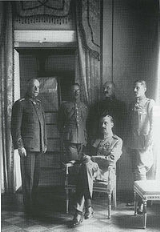
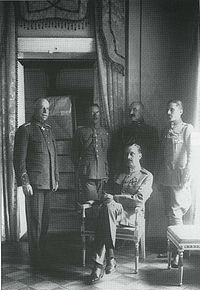
, installed in January 1918, resigned in late 1918. - General C.G.E. MannerheimCarl Gustaf Emil MannerheimBaron Carl Gustaf Emil Mannerheim was the military leader of the Whites in the Finnish Civil War, Commander-in-Chief of Finland's Defence Forces during World War II, Marshal of Finland, and a Finnish statesman. He was Regent of Finland and the sixth President of Finland...
, resigned 1919 with the passing of the new constitution.
France
- Anne of KievAnne of KievAnne of Kiev was the queen consort of France as the wife of Henry I, and regent for her son Philip I.Her parents were Yaroslav I the Wise and princess Ingegerd Olofsdotter of Sweden....
and Baldwin V, Count of FlandersBaldwin V, Count of FlandersBaldwin V of Flanders was Count of Flanders from 1035 until his death.He was the son of Baldwin IV, Count of Flanders, who died in 1035.-History:...
(1060–1067), during the minority of her son and his nephew Philip IPhilip I of FrancePhilip I , called the Amorous, was King of France from 1060 to his death. His reign, like that of most of the early Direct Capetians, was extraordinarily long for the time... - Suger, Abbot of St. DenisAbbot SugerSuger was one of the last Frankish abbot-statesmen, an historian, and the influential first patron of Gothic architecture....
(1147–1149), during the absence of Louis VIILouis VII of FranceLouis VII was King of France, the son and successor of Louis VI . He ruled from 1137 until his death. He was a member of the House of Capet. His reign was dominated by feudal struggles , and saw the beginning of the long rivalry between France and England...
on the Second CrusadeSecond CrusadeThe Second Crusade was the second major crusade launched from Europe. The Second Crusade was started in response to the fall of the County of Edessa the previous year to the forces of Zengi. The county had been founded during the First Crusade by Baldwin of Boulogne in 1098... - Adèle of ChampagneAdèle of ChampagneAdèle of Champagne , also known as Adelaide and Alix, was the third wife of Louis VII of France and the mother of his only male heir, the future Philip II...
and Guillaume de Champagne, Archbishop of Reims (1190–1191), during the absence of her son Philip IIPhilip II of FrancePhilip II Augustus was the King of France from 1180 until his death. A member of the House of Capet, Philip Augustus was born at Gonesse in the Val-d'Oise, the son of Louis VII and his third wife, Adela of Champagne...
on the Third CrusadeThird CrusadeThe Third Crusade , also known as the Kings' Crusade, was an attempt by European leaders to reconquer the Holy Land from Saladin...
. - Blanche of CastileBlanche of CastileBlanche of Castile , was a Queen consort of France as the wife of Louis VIII. She acted as regent twice during the reign of her son, Louis IX....
(1226–1234), during the minority of her son Louis IXLouis IX of FranceLouis IX , commonly Saint Louis, was King of France from 1226 until his death. He was also styled Louis II, Count of Artois from 1226 to 1237. Born at Poissy, near Paris, he was an eighth-generation descendant of Hugh Capet, and thus a member of the House of Capet, and the son of Louis VIII and... - Blanche of CastileBlanche of CastileBlanche of Castile , was a Queen consort of France as the wife of Louis VIII. She acted as regent twice during the reign of her son, Louis IX....
(1248–1252) and Alphonse, Count of Poitou and ToulouseAlphonse of ToulouseAlfonso or Alphonse was the Count of Poitou from 1225 and Count of Toulouse from 1247.-Life:...
(1248–1254), during the absence of her son and his brother Louis IXLouis IX of FranceLouis IX , commonly Saint Louis, was King of France from 1226 until his death. He was also styled Louis II, Count of Artois from 1226 to 1237. Born at Poissy, near Paris, he was an eighth-generation descendant of Hugh Capet, and thus a member of the House of Capet, and the son of Louis VIII and...
on the Seventh CrusadeSeventh CrusadeThe Seventh Crusade was a crusade led by Louis IX of France from 1248 to 1254. Approximately 800,000 bezants were paid in ransom for King Louis who, along with thousands of his troops, was captured and defeated by the Egyptian army led by the Ayyubid Sultan Turanshah supported by the Bahariyya...
. - Mathieu de Vendôme, Abbot of Saint-Denis and Simon de Clermont, Sieur de Nesle, during the absence of Louis IXLouis IX of FranceLouis IX , commonly Saint Louis, was King of France from 1226 until his death. He was also styled Louis II, Count of Artois from 1226 to 1237. Born at Poissy, near Paris, he was an eighth-generation descendant of Hugh Capet, and thus a member of the House of Capet, and the son of Louis VIII and...
on the Eighth CrusadeEighth CrusadeThe Eighth Crusade was a crusade launched by Louis IX, King of France, in 1270. The Eighth Crusade is sometimes counted as the Seventh, if the Fifth and Sixth Crusades of Frederick II are counted as a single crusade...
(1270). - Philip the TallPhilip V of FrancePhilip the Tall was King of France as Philip V and, as Philip II, King of Navarre and Count of Champagne. He reigned from 1316 to his death and was the penultimate monarch of the House of Capet. Considered a wise and politically astute ruler, Philip took the throne under questionable...
(1316), during the interregnum between the death of his brother Louis XLouis X of FranceLouis X of France, , called the Quarreler, the Headstrong, or the Stubborn was the King of Navarre from 1305 and King of France from 1314 until his death...
and the birth of Louis' posthumous son John IJohn I of FranceJohn I , called the Posthumous, was King of France and Navarre, and Count of Champagne, as the son and successor of Louis the Headstrong, for the five days he lived...
, and during the minority of the short-lived John I. - Philip, Count of Valois and AnjouPhilip VI of FrancePhilip VI , known as the Fortunate and of Valois, was the King of France from 1328 to his death. He was also Count of Anjou, Maine, and Valois from 1325 to 1328...
(1328), from the death of his cousin Charles IVCharles IV of FranceCharles IV, known as the Fair , was the King of France and of Navarre and Count of Champagne from 1322 to his death: he was the last French king of the senior Capetian lineage....
until the birth of a posthumous daughter to the late king brought about Valois' own accession to the throne. - Charles, the DauphinCharles V of FranceCharles V , called the Wise, was King of France from 1364 to his death in 1380 and a member of the House of Valois...
(1356–1360), during the captivity of his father in England - Louis I, Duke of AnjouLouis I of NaplesLouis I of Anjou , or Louis I of Naples, was the second son of King John II of France and Bonne of Luxembourg...
(1380–1382), during the minority of his nephew Charles VICharles VI of FranceCharles VI , called the Beloved and the Mad , was the King of France from 1380 to 1422, as a member of the House of Valois. His bouts with madness, which seem to have begun in 1392, led to quarrels among the French royal family, which were exploited by the neighbouring powers of England and Burgundy... - Jean, Duke of Berry, Philippe II, Duke of Burgundy, and Louis II, Duke of BourbonLouis II, Duke of BourbonLouis de Bourbon, called the Good , son of Peter de Bourbon and Isabella de Valois, was the third Duke of Bourbon....
(1382–1388), during the minority of their nephew, Charles VICharles VI of FranceCharles VI , called the Beloved and the Mad , was the King of France from 1380 to 1422, as a member of the House of Valois. His bouts with madness, which seem to have begun in 1392, led to quarrels among the French royal family, which were exploited by the neighbouring powers of England and Burgundy... - Louis II, Duke of BourbonLouis II, Duke of BourbonLouis de Bourbon, called the Good , son of Peter de Bourbon and Isabella de Valois, was the third Duke of Bourbon....
and John, Duke of BerryJohn, Duke of BerryJohn of Valois or John the Magnificent was Duke of Berry and Auvergne and Count of Poitiers and Montpensier. He was the third son of King John II of France and Bonne of Luxemburg; his brothers were King Charles V of France, Duke Louis I of Anjou and Duke Philip the Bold of Burgundy...
(1388–1407), during the insanity of their nephew, Charles VI - Isabella of Bavaria (1417–1420) and then Henry V of EnglandHenry V of EnglandHenry V was King of England from 1413 until his death at the age of 35 in 1422. He was the second monarch belonging to the House of Lancaster....
, during the insanity of her husband and his father-in-law, Charles VI; they were opposed by - Charles, the DauphinCharles VII of FranceCharles VII , called the Victorious or the Well-Served , was King of France from 1422 to his death, though he was initially opposed by Henry VI of England, whose Regent, the Duke of Bedford, ruled much of France including the capital, Paris...
(1417–1422), Charles VI's eldest surviving son, who also claimed the regency. - John, Duke of Bedford (1422–1435), acting as regent on behalf of his nephew, the young Henry VI of EnglandHenry VI of EnglandHenry VI was King of England from 1422 to 1461 and again from 1470 to 1471, and disputed King of France from 1422 to 1453. Until 1437, his realm was governed by regents. Contemporaneous accounts described him as peaceful and pious, not suited for the violent dynastic civil wars, known as the Wars...
in opposition to the king Charles VIICharles VII of FranceCharles VII , called the Victorious or the Well-Served , was King of France from 1422 to his death, though he was initially opposed by Henry VI of England, whose Regent, the Duke of Bedford, ruled much of France including the capital, Paris... - Anne of FranceAnne of FranceAnne of France was the eldest daughter of Louis XI of France and his second wife, Charlotte of Savoy. Anne was the sister of King Charles VIII of France, for whom she acted as regent during his minority; and of Joan of France, who was briefly queen consort to Louis XII...
and her husband Pierre de BeaujeuPeter II, Duke of BourbonPeter II, Duke of Bourbon was the son of Charles I, Duke of Bourbon and Agnes of Burgundy, and a member of the House of Bourbon...
(1483–1492), during the minority of her brother, Charles VIIICharles VIII of FranceCharles VIII, called the Affable, , was King of France from 1483 to his death in 1498. Charles was a member of the House of Valois... - Louise of SavoyLouise of SavoyLouise of Savoy was a French noble, Duchess regnant of Auvergne and Bourbon, Duchess of Nemours, the mother of King Francis I of France...
(1515–1516), during the absence of her son, Francis IFrancis I of FranceFrancis I was King of France from 1515 until his death. During his reign, huge cultural changes took place in France and he has been called France's original Renaissance monarch...
, in Italy. - Louise of SavoyLouise of SavoyLouise of Savoy was a French noble, Duchess regnant of Auvergne and Bourbon, Duchess of Nemours, the mother of King Francis I of France...
(1523–1526), during the absence at war in Italy, and then the captivity, of her son, Francis IFrancis I of FranceFrancis I was King of France from 1515 until his death. During his reign, huge cultural changes took place in France and he has been called France's original Renaissance monarch... - Catherine de' MediciCatherine de' MediciCatherine de' Medici was an Italian noblewoman who was Queen consort of France from 1547 until 1559, as the wife of King Henry II of France....
:- (1552) While her husband Henry IIHenry II of FranceHenry II was King of France from 31 March 1547 until his death in 1559.-Early years:Henry was born in the royal Château de Saint-Germain-en-Laye, near Paris, the son of Francis I and Claude, Duchess of Brittany .His father was captured at the Battle of Pavia in 1525 by his sworn enemy,...
left the kingdom for the campaign of MetzMetzMetz is a city in the northeast of France located at the confluence of the Moselle and the Seille rivers.Metz is the capital of the Lorraine region and prefecture of the Moselle department. Located near the tripoint along the junction of France, Germany, and Luxembourg, Metz forms a central place...
. - (1560–1563) During the minority of her second son, Charles IXCharles IX of FranceCharles IX was King of France, ruling from 1560 until his death. His reign was dominated by the Wars of Religion. He is best known as king at the time of the St. Bartholomew's Day Massacre.-Childhood:...
- (1574) During the absence of her third son, Henry IIIHenry III of FranceHenry III was King of France from 1574 to 1589. As Henry of Valois, he was the first elected monarch of the Polish-Lithuanian Commonwealth with the dual titles of King of Poland and Grand Duke of Lithuania from 1573 to 1575.-Childhood:Henry was born at the Royal Château de Fontainebleau,...
, in PolandPolandPoland , officially the Republic of Poland , is a country in Central Europe bordered by Germany to the west; the Czech Republic and Slovakia to the south; Ukraine, Belarus and Lithuania to the east; and the Baltic Sea and Kaliningrad Oblast, a Russian exclave, to the north...
- (1552) While her husband Henry II
- Marie de' MediciMarie de' MediciMarie de Médicis , Italian Maria de' Medici, was queen consort of France, as the second wife of King Henry IV of France, of the House of Bourbon. She herself was a member of the wealthy and powerful House of Medici...
(1610–1614), during the minority of her son, Louis XIII - Anne of AustriaAnne of AustriaAnne of Austria was Queen consort of France and Navarre, regent for her son, Louis XIV of France, and a Spanish Infanta by birth...
(1643–1651), during the minority of Louis XIVLouis XIV of FranceLouis XIV , known as Louis the Great or the Sun King , was a Bourbon monarch who ruled as King of France and Navarre. His reign, from 1643 to his death in 1715, began at the age of four and lasted seventy-two years, three months, and eighteen days... - Philippe II, Duke of OrléansPhilippe II, Duke of OrléansPhilippe d'Orléans was a member of the royal family of France and served as Regent of the Kingdom from 1715 to 1723. Born at his father's palace at Saint-Cloud, he was known from birth under the title of Duke of Chartres...
(1715–1723), during the minority of Louis XVLouis XV of FranceLouis XV was a Bourbon monarch who ruled as King of France and of Navarre from 1 September 1715 until his death. He succeeded his great-grandfather at the age of five, his first cousin Philippe II, Duke of Orléans, served as Regent of the kingdom until Louis's majority in 1723...
; often called "the Regent", since he was the last regent of France. **The related era and style are commonly referred to as the RégenceRégenceThe Régence is the period in French history between 1715 and 1723, when King Louis XV was a minor and the land was governed by a Regent, Philippe d'Orléans, the nephew of Louis XIV of France....
(analogous to the British RegencyEnglish RegencyThe Regency era in the United Kingdom is the period between 1811—when King George III was deemed unfit to rule and his son, the Prince of Wales, ruled as his proxy as Prince Regent—and 1820, when the Prince Regent became George IV on the death of his father....
period).- A 136 carat (27.2 g) diamond he acquired in 1717 is known as 'le régent'
- Louis-Stanislas-Xavier, comte de ProvenceLouis XVIII of FranceLouis XVIII , known as "the Unavoidable", was King of France and of Navarre from 1814 to 1824, omitting the Hundred Days in 1815...
, while living in exile, self-declared Regent for his nephew Louis XVII of FranceLouis XVII of FranceLouis XVII , from birth to 1789 known as Louis-Charles, Duke of Normandy; then from 1789 to 1791 as Louis-Charles, Dauphin of France; and from 1791 to 1793 as Louis-Charles, Prince Royal of France, was the son of King Louis XVI of France and Queen Marie Antoinette...
after the 1793 guillotining of King Louis XVILouis XVI of FranceLouis XVI was a Bourbon monarch who ruled as King of France and Navarre until 1791, and then as King of the French from 1791 to 1792, before being executed in 1793....
, until the young pretender's death in 1795. - Empress Eugenie, three times for her husband, Napoleon III of FranceNapoleon III of FranceLouis-Napoléon Bonaparte was the President of the French Second Republic and as Napoleon III, the ruler of the Second French Empire. He was the nephew and heir of Napoleon I, christened as Charles Louis Napoléon Bonaparte...
, during his absence.
Greece
- Archbishop Damaskinos Papandreou (1944–1946): on behalf of king George II of GreeceGeorge II of GreeceGeorge II reigned as King of Greece from 1922 to 1924 and from 1935 to 1947.-Early life, first period of kingship and exile:George was born at the royal villa at Tatoi, near Athens, the eldest son of King Constantine I of Greece and his wife, Princess Sophia of Prussia...
until his return. - General Georgios ZoitakisGeorgios ZoitakisGeorgios Zoitakis was a Greek Army general and regent of Greece from 13 December 1967 to 21 March 1972, during the period of the military regime of the Colonels.- Life :...
(1967–1972): appointed by the military junta of the time when the last reigning king, Constantine II of GreeceConstantine II of Greece|align=right|Constantine II was King of Greece from 1964 until the abolition of the monarchy in 1973, the sixth and last monarch of the Greek Royal Family....
, fled to exile after a failed royal countercoup. - Military dictator Georgios Papadopoulos (1972–1973): then Prime Minister, assumed the additional role of regent until the monarchy was abolished by referendum.
Anhalt
- Prince AribertPrince Aribert of AnhaltPrince Aribert of Anhalt , was a Prince of the German Duchy of Anhalt.He was regent of Anhalt from September to November 1918 on behalf of his underage nephew Duke Joachim Ernst...
(1918), during the minority of Duke Joachim ErnstJoachim Ernst, Duke of AnhaltJoachim Ernst, Duke of Anhalt was the last ruler of the Duchy of Anhalt.-Biography:He was born in Dessau the son of Duke Eduard of Anhalt and Princess Luise of Saxe-Altenburg , the daughter of Prince Moritz of Saxe-Altenburg.He succeeded his father as Duke of Anhalt on September 13, 1918, however...
Baden
- Prince Frederick (1852–1856), during the incapacity of his brother, Grand Duke Louis IILudwig II, Grand Duke of BadenLudwig II, Grand Duke of Baden was the son of Leopold I, Grand Duke of Baden and Sophie of Holstein-Gottorp, Princess of Sweden....
Bavaria
- Prince LuitpoldLuitpold, Prince Regent of BavariaLuitpold, Prince Regent of Bavaria , was the de facto ruler of Bavaria from 1886 to 1912, due to the incapacity of his nephews, King Ludwig II and King Otto.-Early life:...
(1886–1912), during the incapacity of his nephews, Ludwig IILudwig II of BavariaLudwig II was King of Bavaria from 1864 until shortly before his death. He is sometimes called the Swan King and der Märchenkönig, the Fairy tale King...
and OttoOtto of BavariaOtto , was King of Bavaria from 1886 to 1913. He was the son of Maximilian II and his wife, Marie of Prussia, and younger brother of Ludwig II... - Prince LudwigLudwig III of BavariaLudwig III , was the last King of Bavaria, reigning from 1913 to 1918.-Early life:...
(1912–1913), during the incapacity of his cousin, OttoOtto of BavariaOtto , was King of Bavaria from 1886 to 1913. He was the son of Maximilian II and his wife, Marie of Prussia, and younger brother of Ludwig II...
Brunswick
- George, Prince of WalesGeorge IV of the United KingdomGeorge IV was the King of the United Kingdom of Great Britain and Ireland and also of Hanover from the death of his father, George III, on 29 January 1820 until his own death ten years later...
, later King George IV of the United KingdomGeorge IV of the United KingdomGeorge IV was the King of the United Kingdom of Great Britain and Ireland and also of Hanover from the death of his father, George III, on 29 January 1820 until his own death ten years later...
(1815–1823), during the minority of his cousin, Duke Charles IICharles II, Duke of BrunswickCharles II , Duke of Brunswick, ruled the Duchy of Brunswick from 1815 until 1830.-Biography:Charles was the eldest son of Frederick William, Duke of Brunswick-Lüneburg... - Prince Albrecht of PrussiaPrince Albrecht of PrussiaPrince Friedrich Wilhelm Nikolaus Albrecht of Prussia was a Prussian general field marshal and, from 1885, regent of the Duchy of Brunswick.-Biography:...
(1885–1906), during the interregnum following the death of Duke Wilhelm in 1884, when the throne could not be filled due to the status of the heir, the Duke of Cumberland, as an enemy of the Reich. - Duke Johann Albrecht of Mecklenburg-Schwerin (1907–1913), for the same reason
Hanover
- George, Prince of WalesGeorge IV of the United KingdomGeorge IV was the King of the United Kingdom of Great Britain and Ireland and also of Hanover from the death of his father, George III, on 29 January 1820 until his own death ten years later...
(1813–1820), due to the insanity of his father, King George IIIGeorge III of the United KingdomGeorge III was King of Great Britain and King of Ireland from 25 October 1760 until the union of these two countries on 1 January 1801, after which he was King of the United Kingdom of Great Britain and Ireland until his death...
Hesse-Kassel
- Electoral Prince Frederick William (1831–1847), due to the incapacity of his father, Elector William IIWilliam II, Elector of Hesse-Biography:William was the eldest surviving son of William I, Elector of Hesse and Wilhelmina Caroline of Denmark and Norway. He succeeded as Elector of Hesse on his father's death in 1821.-Marriage and issue:On 13 February 1797 in Berlin, William married Princess Augusta of Prussia, fourth...
Lippe
- Prince Adolf of Schaumburg-LippePrince Adolf of Schaumburg-LippePrince Adolf of Schaumburg-Lippe was the regent of the Principality of Lippe from 1895 till 1897.-Early life:He was born in Bückeburg the seventh child of Adolf I, Prince of Schaumburg-Lippe and Princess Hermine of Waldeck-Pyrmont .Following the death of Prince Woldemar on the 20 March 1895 and...
(1895–1897), due to the incapacity of his cousin, Prince AlexanderAlexander, Prince of LippeAlexander, Prince of Lippe was the penultimate sovereign of the Principality of Lippe. Succeeding to the throne in 1895, power was exercised by a regent throughout his reign on account of his mental illness.... - Count Ernst of Lippe-BiesterfeldCount Ernst of Lippe-BiesterfeldErnst II, Count of Lippe-Biesterfeld was the head of the Lippe-Biesterfeld line of the House of Lippe...
(1897–1904), for the same reason - Count Leopold of Lippe-BiesterfeldLeopold IV, Prince of LippeLeopold IV, Prince of Lippe was the final sovereign of the Principality of Lippe...
(1904–1905), for the same reason
Mecklenburg-Schwerin
- Duke Johann Albrecht of Mecklenburg-Schwerin (1897–1901), due to the minority of his nephew, Grand Duke Friedrich Franz IV
Mecklenburg-Strelitz
- Friedrich Franz IV, Grand Duke of Mecklenburg-Schwerin (1918), due to the near extinction of the Mecklenburg-Strelitz line.
Prussia
- Prince William (1858–1861), during the incapacity of his brother Frederick William IVFrederick William IV of Prussia|align=right|Upon his accession, he toned down the reactionary policies enacted by his father, easing press censorship and promising to enact a constitution at some point, but he refused to enact a popular legislative assembly, preferring to work with the aristocracy through "united committees" of...
Saxe-Coburg and Gotha
- Prince Ernst of Hohenlohe-Langenburg (1900–1905), during the minority of his cousin Duke Charles EdwardCarl Eduard, Duke of Saxe-Coburg and GothaCharles Edward, Duke of Saxe-Coburg and Gotha was the fourth and last reigning Duke of Saxe-Coburg and Gotha, two duchies in Germany , and the head of the House of Saxe-Coburg and Gotha from 1900 until his death in 1954...
Saxe-Meiningen
- Luise Eleonore of Hohenlohe (1803–1821), during the minority of her son, Duke Bernard II
Saxe-Weimar
- Anna Amalia of Brunswick (1758–1775), during the minority of her son, Duke Carl AugustCarl August, Grand Duke of Saxe-Weimar-EisenachKarl August, Grand Duke of Saxe-Weimar-Eisenach was a duke of Saxe-Weimar and of Saxe-Eisenach from 1758, duke of Saxe-Weimar-Eisenach from its creation in 1809, and grand duke from 1815 until his death...
Waldeck
- Emma of Anhalt-Bernburg-Schaumburg-Hoym (1845–1852), during the minority of her son, Prince George Victor
Hawaii
- Queen Kaahumanu, between 1824–1832 during the rule of the infant Kamehameha IIIKamehameha IIIKamehameha III was the King of Hawaii from 1825 to 1854. His full Hawaiian name was Keaweaweula Kiwalao Kauikeaouli Kaleiopapa and then lengthened to Keaweaweula Kiwalao Kauikeaouli Kaleiopapa Kalani Waiakua Kalanikau Iokikilo Kiwalao i ke kapu Kamehameha when he ascended the throne.Under his...
; she was also Kuhina Nui (co-ruler), regent, of Kamehameha II - Elizabeth KīnauKaahumanu IIPrincess Kalani Ahumanu i Kaliko o Iwi Kauhipua o Kīnau, also known as Elizabeth Kīnau was Kuhina Nui of the Kingdom of Hawaii as Kaahumanu II, Queen regent and Dowager Queen.-Life:...
, between 5 June 1832–17 March 1833 after Kaahumanu's death and before Kamehameha III became 20 years old
Hungary
- Helena and Beloš VukanovićBeloš VukanovićBeloš , a member of the Vukanović dynasty of Serbia, was the Regent of Hungary 1141-1146 alongside his sister Helen, who was married to Béla II with whom she had a son, Géza II, still an infant. He held the title of dux, and was the viceregal of Croatia 1142-1158 and 1163. Beloš, as a member of...
, in 1141–1146 during the rule of infant Géza II. Helena was the mother and Beloš her brother. - Andrew of HungaryAndrew II of HungaryAndrew II the Jerosolimitan was King of Hungary and Croatia . He was the younger son of King Béla III of Hungary, who invested him with the government of the Principality of Halych...
, between 1201–1205 during the rule of the infant Ladislaus IIILadislaus III of HungaryLadislaus III was King of Hungary. and Croatia .He was the only son of King Emeric, King of Hungary and his queen, Infanta Constance of Aragon.... - Elizabeth of Bosnia, unpopular regent for her daughter MaryMary of HungaryMary of Anjou was queen regnant of Hungary from 1382 until her death in 1395.-Childhood:...
- John HunyadiJohn HunyadiJohn Hunyadi John Hunyadi (Hungarian: Hunyadi János , Medieval Latin: Ioannes Corvinus or Ioannes de Hunyad, Romanian: Iancu (Ioan) de Hunedoara, Croatian: Janko Hunjadi, Serbian: Сибињанин Јанко / Sibinjanin Janko, Slovak: Ján Huňady) John Hunyadi (Hungarian: Hunyadi János , Medieval Latin: ...
, during Ladislaus V's minority - Michael Szilágyi in 1458, between Ladislaus V's death and the crowning of Matthias I
- Lajos KossuthLajos KossuthLajos Kossuth de Udvard et Kossuthfalva was a Hungarian lawyer, journalist, politician and Regent-President of Hungary in 1849. He was widely honored during his lifetime, including in the United Kingdom and the United States, as a freedom fighter and bellwether of democracy in Europe.-Family:Lajos...
, under the Hungarian Revolution of 1848Hungarian Revolution of 1848The Hungarian Revolution of 1848 was one of many of the European Revolutions of 1848 and closely linked to other revolutions of 1848 in the Habsburg areas... - Admiral Miklós HorthyMiklós HorthyMiklós Horthy de Nagybánya was the Regent of the Kingdom of Hungary during the interwar years and throughout most of World War II, serving from 1 March 1920 to 15 October 1944. Horthy was styled "His Serene Highness the Regent of the Kingdom of Hungary" .Admiral Horthy was an officer of the...
during the period of Kingdom of Hungary (1920–1944)
Travancore
Both before and during the British rajBritish Raj
British Raj was the British rule in the Indian subcontinent between 1858 and 1947; The term can also refer to the period of dominion...
(colonial rule), most of India was ruled by several hundred native princely house
Princely state
A Princely State was a nominally sovereign entitity of British rule in India that was not directly governed by the British, but rather by an Indian ruler under a form of indirect rule such as suzerainty or paramountcy.-British relationship with the Princely States:India under the British Raj ...
s, many of which have known regencies, under the raj subject to British approval
- Maharani Gowri Lakshmi Bayi of TravancoreTravancoreKingdom of Travancore was a former Hindu feudal kingdom and Indian Princely State with its capital at Padmanabhapuram or Trivandrum ruled by the Travancore Royal Family. The Kingdom of Travancore comprised most of modern day southern Kerala, Kanyakumari district, and the southernmost parts of...
(1811–1815) - Maharani Gowri Parvati Bayi (1815–1849)
- Maharani Sethu Lakshmi BayiSethu Lakshmi BayiMaharani Pooradam Thirunal Sethu Lakshmi Bayi CI was the ruler of Travancore as regent for her nephew, Chithira Tirunal from 1924 until late 1931...
(1924–1931)
Iraq
In the short-lived Hashemite kingdom, there were three regencies in the reign of the third and last king Faysal IIFaisal II of Iraq
Faisal II was the last King of Iraq. He reigned from 4 April 1939 until July 1958, when he was killed during the "14 July Revolution" together with several members of his family...
(b. 1935 – d. 1958; also Head of the 'Arab Union', a federation with the Hashemite sister-kingdom Jordan, from 14 February 1958) :
- 4 April 1939 – 1 April 1941 Abdul Ilah'Abd al-IlahCrown Prince Abd al-Ilāh of Hejaz, GCB, GCMG, GCVO was a cousin and brother-in-law of King Ghazi of the Kingdom of Iraq. Abdul Ilah served as Regent for King Faisal II from April 4, 1939 to May 2, 1953, when Faisal came of age...
(1st time) (b. 1913 – d. 1958) - 1 April 1941 – 1 June 1941 Sharaf ibn Rajih al-Fawwaz (b. 1880 – d. 1955)
- 1 June 1941 – 2 May 1953 Abdul Ilah (2nd time)
Parma
- Margherita de' MediciMargherita de' MediciMargherita de' Medici was Duchess of Parma and Piacenza by her marriage to Odoardo Farnese, Duke of Parma...
(1646–1648), during the minority of her son Ranuccio IIRanuccio II Farnese, Duke of ParmaRanuccio II Farnese was the sixth Duke of Parma and Piacenza from 1646 until his death nearly 50 years later.-Birth and Succession:... - Dorothea Sophie of Neuburg (1731) during the absence of her grandson Charles ICharles III of SpainCharles III was the King of Spain and the Spanish Indies from 1759 to 1788. He was the eldest son of Philip V of Spain and his second wife, the Princess Elisabeth Farnese...
- Louise d'Artois (1854–1859), during the minority of her son Robert I.
Savoy
- Christine Marie of FranceChristine Marie of FranceChristine of France was the sister of Louis XIII and the Duchess of Savoy by marriage. At the death of her husband Victor Amadeus I in 1637, she acted as regent of Savoy between 1637 and 1648....
(1637–1663), during the minority of her son Charles Emmanuel IICharles Emmanuel II, Duke of SavoyCharles Emmanuel II was the Duke of Savoy from 1638 to 1675 and under regency of his mother Christine Marie of France until 1663. He was also Marquis of Saluzzo, Count of Aosta, Geneva, Moriana and Nice, as well as claimant king of Cyprus and Jerusalem...
. - Marie Jeanne of Savoy (1675–1680), during the minority of her son Victor Amadeus IIVictor Amadeus II of SardiniaVictor Amadeus II was Duke of Savoy from 1675 to 1730. He also held the titles of marquis of Saluzzo, duke of Montferrat, prince of Piedmont, count of Aosta, Moriana and Nizza. Louis XIV organised his marriage in order to maintain French influence in the Duchy but Victor Amadeus soon broke away...
.
Korea
- Daewon-gunDaewon-gunHeungseon Daewongun or The Daewongun , or formally Heungseon Heonui Daewonwang and also known to period western diplomats as Prince Gung, was the title of Yi Ha-eung, regent of Joseon during the minority of King Gojong in the 1860s and until his death a key political figure of late Joseon...
, Lord Regent for his son King Gojong of Joseon during the late 19th century.
Mongolia
- ToluiToluiTolui, was the youngest son of Genghis Khan by his chief khatun Börte...
, the son of Genghis KhanGenghis KhanGenghis Khan , born Temujin and occasionally known by his temple name Taizu , was the founder and Great Khan of the Mongol Empire, which became the largest contiguous empire in history after his death....
of the Mongol EmpireMongol EmpireThe Mongol Empire , initially named as Greater Mongol State was a great empire during the 13th and 14th centuries... - Toregene, the Great Khatun of the Mongol Empire
- Oghul QaimishOghul QaimishOghul Qaimish was the principal wife of Güyük Khan and ruled as regent over the Mongol empire after the death of her husband in 1248. She was a descendant from the Mergid tribe. However, H.H.Howorth believed that she was an Oirat.- Life :...
, the wife of Guyuk KhanGüyük KhanGüyük was the third Great Khan of the Mongol Empire. As the eldest son of Ögedei Khan and a grandson of Genghis Khan, he reigned from 1246 to 1248...
Portugal
- Countess TheresaTheresa, Countess of PortugalTheresa of Portugal was the first ruler of independent Portugal...
, during the minority of her son Afonso IAfonso I of PortugalAfonso I or Dom Afonso Henriques , more commonly known as Afonso Henriques , nicknamed "the Conqueror" , "the Founder" or "the Great" by the Portuguese, and El-Bortukali and Ibn-Arrik by the Moors whom he fought, was the first King of Portugal...
(1112–1139). Styled herself Queen of Portugal. - Afonso, Count of BoulogneAfonso III of PortugalAfonso III , or Affonso , Alfonso or Alphonso or Alphonsus , the Bolognian , the fifth King of Portugal and the first to use the title King of Portugal and the Algarve, from 1249...
, after Pope Innocent IVPope Innocent IVPope Innocent IV , born Sinibaldo Fieschi, was pope from June 25, 1243 until his death in 1254.-Early life:...
had deposed his brother Sancho IISancho II of PortugalSancho II , nicknamed "the Pious" and "the Caped" or "the Capuched" , , fourth King of Portugal, was the eldest son of Afonso II of Portugal by his wife, Infanta Urraca of Castile...
, and before assuming himself the throne, following Sancho's death (1245–1248). Styled himself Regent and Defender of the Kingdom. - Queen LeonorLeonor Telles de MenezesLeonor Telles de Menezes was a queen consort of Portugal and regent during the years 1383–1385. She was the wife of a Portuguese nobleman from whom she was forcibly divorced by King Ferdinand I, who afterward married her...
, for her daughter Beatrice IBeatrice of PortugalBeatrice was the only surviving child of King Ferdinand I of Portugal and his wife, Leonor Telles de Menezes. She married King John I of Castile. In the absence of a male heir, she claimed the throne of Portugal, supported by her husband. This led to the 1383–1385 Crisis, in which the Portuguese...
. - João, Mestre de AvisJohn I of PortugalJohn I KG , called the Good or of Happy Memory, more rarely and outside Portugal the Bastard, was the tenth King of Portugal and the Algarve and the first to use the title Lord of Ceuta...
, during the Dynastic Crisis1383–1385 CrisisThe 1383–1385 Crisis was a period of civil war in Portuguese history that began with the death of King Ferdinand I of Portugal, who left no male heirs, and ended with the accession to the throne of King John I in 1385, in the wake of the Battle of Aljubarrota.In Portugal, this period is also known...
, and before assuming himself the throne (1384–1385). Styled himself Regent and Defender of the Kingdom. - Queen Eleanor, during the minority of her son Afonso VAfonso V of PortugalAfonso V KG , called the African , was the twelfth King of Portugal and the Algarves. His sobriquet refers to his conquests in Northern Africa.-Early life:...
(1438–1439). - Peter, Duke of Coimbra, during the minority of his nephew Afonso VAfonso V of PortugalAfonso V KG , called the African , was the twelfth King of Portugal and the Algarves. His sobriquet refers to his conquests in Northern Africa.-Early life:...
(1439–1448). - Queen Catharine, during the minority of her grandson Sebastian ISebastian of PortugalSebastian "the Desired" was the 16th king of Portugal and the Algarves. He was the son of Prince John of Portugal and his wife, Joan of Spain...
(1557–1562). - Cardinal Prince Henry, during the minority of his grandnephew Sebastian ISebastian of PortugalSebastian "the Desired" was the 16th king of Portugal and the Algarves. He was the son of Prince John of Portugal and his wife, Joan of Spain...
(1562–1568). - Queen Luísa, for her son Afonso VI (1656–1662).
- Prince Peter, for his brother Afonso VI, and before assuming himself the throne, following Afonso's death (1668–1683).
- John, Prince RegentJohn VI of PortugalJohn VI John VI John VI (full name: João Maria José Francisco Xavier de Paula Luís António Domingos Rafael; (13 May 1767 – 10 March 1826) was King of the United Kingdom of Portugal, Brazil and the Algarves (later changed to just King of Portugal and the Algarves, after Brazil was recognized...
, during the incapacity of his mother Mary I, and before assuming himself the throne, following her death (1792–1816). - Princess Isabel Maria, following her father's (John VIJohn VI of PortugalJohn VI John VI John VI (full name: João Maria José Francisco Xavier de Paula Luís António Domingos Rafael; (13 May 1767 – 10 March 1826) was King of the United Kingdom of Portugal, Brazil and the Algarves (later changed to just King of Portugal and the Algarves, after Brazil was recognized...
) death, and whilst awaiting the arrival of her brother Peter IV to assume the throne (1826–1828). - Prince Michael, for his niece Mary II, and before usurping the throne for himself (1828).
- Peter, Duke of Bragança (former King Peter IV), for his daughter Mary II (1831–1834).
- King Ferdinand IIFerdinand II of PortugalFerdinand of Saxe-Coburg and Gotha , named Prince Ferdinand Augustus Francis Anthony of Saxe-Coburg-Gotha-Koháry, was King of Portugal as husband of Queen Maria II of Portugal from the birth of their son in 1837 to her death in 1853.In keeping with Portuguese law, only after the birth of his son in...
, during the minority of his son Peter V (1853–1855).
Romania
- Lascăr CatargiuLascar CatargiuLascăr Catargiu was a Romanian conservative statesman born in Moldavia. He belonged to an ancient Wallachian family, one of whose members had been banished in the 17th century by Prince Matei Basarab, and had settled in Moldavia.-Biography:...
, Gen. Nicolae GolescuNicolae GolescuNicolae Golescu was a Wallachian Romanian politician who served as the Prime Minister of Romania in 1860 and May–November 1868.-Early life:...
, Col. Nicolae Haralambie (1866), between the overthrow of Alexandru Ioan Cuza and the coronation of Carol ICarol I of RomaniaCarol I , born Prince Karl of Hohenzollern-Sigmaringen was reigning prince and then King of Romania from 1866 to 1914. He was elected prince of Romania on 20 April 1866 following the overthrow of Alexandru Ioan Cuza by a palace coup...
as Prince. - Prince NicholasPrince Nicholas of Romania| style="float:right;"|Prince Nicholas of Romania was the second son of King Ferdinand I and Queen Marie of Romania.- Biography :Born in Peleş Castle, Sinaia, Nicholas was the younger brother of Carol, heir apparent, who renounced his rights of succession on 12 December 1925...
, Miron CristeaMiron CristeaMiron Cristea, was an Austro-Hungarian-born Romanian cleric and politician....
, Gheorghe Buzdugan (replaced upon his death by Constantin Sărăţeanu) (1927–1930), during the minority of king Michael IMichael I of RomaniaMichael was the last King of Romania. He reigned from 20 July 1927 to 8 June 1930, and again from 6 September 1940 until 30 December 1947 when he was forced, by the Communist Party of Romania , to abdicate to the Soviet armies of occupation...
Russia
- for Ivan the Terrible
- Natalia NaryshkinaNatalia NaryshkinaNatalya Kirillovna Naryshkina was the Tsaritsa of Russia from 1671 to 1676 as the second spouse of tsar Alexei I of Russia.-Biography:Coming from a petty noble family, daughter of Kirill Poluektovich Naryshkin and wife Anna Leontyevna Leontyeva Natalya Kirillovna Naryshkina was the Tsaritsa of...
for her son Peter the GreatPeter I of RussiaPeter the Great, Peter I or Pyotr Alexeyevich Romanov Dates indicated by the letters "O.S." are Old Style. All other dates in this article are New Style. ruled the Tsardom of Russia and later the Russian Empire from until his death, jointly ruling before 1696 with his half-brother, Ivan V...
(1682) - Sophia AlekseyevnaSophia AlekseyevnaSophia Alekseyevna was a regent of Russian Tsardom who allied herself with a singularly capable courtier and politician, Prince Vasily Galitzine, to install herself as a regent during the minority of her brothers, Peter the Great and Ivan V...
for her brothers Ivan V and Peter the GreatPeter I of RussiaPeter the Great, Peter I or Pyotr Alexeyevich Romanov Dates indicated by the letters "O.S." are Old Style. All other dates in this article are New Style. ruled the Tsardom of Russia and later the Russian Empire from until his death, jointly ruling before 1696 with his half-brother, Ivan V...
(1682–89) - Ernst Johann von BironErnst Johann von BironErnst Johann von Biron was a Duke of Courland and Semigallia and regent of the Russian Empire .-Biography:Born as Ernst Johann Biren in Kalnciems, Courland, he was the grandson of a groom in the service of Jacob Kettler, Duke of Courland, who bestowed upon him a small estate, which Biron's...
for the infant Ivan VI (1740) - Anna LeopoldovnaAnna LeopoldovnaAnna Leopoldovna of Russia , also known as Anna Karlovna , regent of Russia for a few months during the minority of her baby son Ivan...
for her son Ivan VI (1740–41)
Serbia
- Milivoje Petrović BlaznavacMilivoje Petrović BlaznavacGeneral Milivoje Petrović Blaznavac was Serbian soldier and politician. His father, Petar, was a rural merchant and shopkeeper from Blaznava, although a story circulated that his real father was Prince Miloš Obrenović. He finished elementary school and painting craft...
, Jovan RistićJovan RisticJovan Ristić, or Ristitch was a Serbian statesman and diplomat....
, Jovan Gavrilović (1868–1872), during the minority of Prince Milan - Jovan RistićJovan RisticJovan Ristić, or Ristitch was a Serbian statesman and diplomat....
, Jovan Belimarković, Kosta Protić (until his death in 1892) (1889–1893), during the minority of King Aleksandar
Yugoslavia
- Prince PaulPrince Paul of YugoslaviaPrince Paul of Yugoslavia, also known as Paul Karađorđević , was Regent of the Kingdom of Yugoslavia during the minority of King Peter II. Peter was the eldest son of his first cousin Alexander I...
, Radenko Stanković, Ivo Perović (1934–1941), during the minority of King Peter IIPeter II of YugoslaviaPeter II, also known as Peter II Karađorđević , was the third and last King of Yugoslavia...