
|
|
|
|
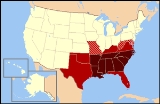
Southern United States
|
| |
|
| |
... , northeastern areas, North Central Florida, Nature Coast, Central Florida, and the middle of South Florida remain culturally tied to the South.
The metropolitan areas of Tampa and Orlando are a complex blend of fast-growing "Southern" metropolitan areas and the South Florida metropolitan area. While the areas have more southern culture than South Florida, they both have less southern culture than traditional "Southern" metropolitan areas. In addition, they are influenced by rapid growth in Hispanic populations.
The city of Palm Coast is one of the fastest growing cities in the nation, with most of its growth coming from migrants from New York and New Jersey). The Daytona metropolitan area contains many more retirees and migrants from the northern states, making it closer in culture to the South Florida metropolitan area than are Tampa and Orlando.

Discussion
Ask a question about 'Southern United States'
Start a new discussion about 'Southern United States'
Answer questions from other users
|
Timeline
|
|
1841 The city of Dallas, Texas is founded by John Neely Bryan. The original town of few inhabitants and mud huts would later become a major city in the South, as well as the United States.
1849 The city of Fort Worth, Texas is founded, at that time known as "Camp Worth". Starting off humbly, the city would one day be a major cattle-herding center, and a major center of commerce in the South.
1960 In Greensboro, N.C., four black students from North Carolina Agricultural and Technical College begin a sit-in at a segregated Woolworth's lunch counter. Although they are refused service, they are allowed to stay at the counter. The event triggers many similar nonviolent protests throughout the South, and 6 months later the original four protesters are served lunch at the same counter.
|
Encyclopedia
... , northeastern areas, North Central Florida, Nature Coast, Central Florida, and the middle of South Florida remain culturally tied to the South.
The metropolitan areas of Tampa and Orlando are a complex blend of fast-growing "Southern" metropolitan areas and the South Florida metropolitan area. While the areas have more southern culture than South Florida, they both have less southern culture than traditional "Southern" metropolitan areas. In addition, they are influenced by rapid growth in Hispanic populations.
The city of Palm Coast is one of the fastest growing cities in the nation, with most of its growth coming from migrants from New York and New Jersey). The Daytona metropolitan area contains many more retirees and migrants from the northern states, making it closer in culture to the South Florida metropolitan area than are Tampa and Orlando. The Florida Suncoast region is also often separated culturally from the southern states due to its high numbers of retiree and "snow-bird" population from the Midwestern states.
KentuckyAt the confluence of the Upper South and the Midwest, Kentucky was a Border State during the Civil War. It demonstrates multiple influences.. Though the state's official government and a majority of its citizens supported the Union, a portion of Confederate sympathizers formed an alternative provisional state government at the Russellville Convention. They applied for entry to the Confederacy in 1862 and were admitted, but government members spent most of the war in exile.
Cultural studies of the state present a complicated picture depending on questions asked. A 1987 gave participants a range of regions to choose from for identification: 47.8% of Kentuckians identified with the South, and 33% identified with the Midwest. At the same time in Tennessee, over 80% identified with the South and only 1.5% identified as Midwestern. Tennessee, especially in the Mississippi Delta, had more concentrated slaveholding than did Kentucky. In addition, its occupation by Union troops during the war may have created more of a southern identity afterward when resistance to Reconstruction was prized..
A more recent study in the late 2000s, based on "yes" or "no" responses to questions about Southern identification, found that 79% of Kentuckians identified the state as Southern geographically and culturally. Moreover, 68% of Kentuckians identified themselves as "Southerners" culturally. .
Regional identification often varies dramatically within Kentucky. For example, many consider northern Kentucky to be the most Midwestern region as it shares culture with Cincinnati. Studies show that a significant minority of people in Northern Kentucky still identify with the South. Conversely, Southern Indiana is highly Southern in comparison to most of the Midwest, as it is culturally and economically attached to Louisville. Some sources treat Southern Indiana as essentially the upper tip of Upland South culture while others maintain that Southern culture, while significant, is not dominant in the region..
Louisville is viewed as culturally and economically Midwestern in some analyses, especially because it rates highly as a literate city. Other observers think it is southern. It is often described as both "the Gateway to the South" and "the northernmost Southern city and southernmost Northern city."
While varying degrees of Northern cultural influence can be found in Kentucky outside the Golden Triangle, smaller cities such as Owensboro, Bowling Green, and Paducah, together with most of the state's rural areas, have continued more distinctly Southern in character.
LouisianaThe state was first colonized by France and Spain rather than Great Britain, a difference which gave it a different form of law and other distinct cultural traditions. The Creole, Cajun, African, Latin American and Caribbean-influenced culture is especially strong in the southern portion of the state. Although the Gulf Coast regions of Texas, Mississippi, Alabama, and northern Florida shared a similar French/Spanish colonial history, they lacked the same concentration of French-speaking influence and people of French ancestry.
In the antebellum years, a significant population of free people of color or Creoles of color formed in New Orleans, in part because of the system of plaçage that developed since the colonial period. Many became educated, had their own businesses and owned property. They formed a distinct third class between Europeans Americans and enslaved Africans, although their freedoms were reduced after the Louisiana Purchase and imposition of Americans' binary racial views. Together with the cosmopolitan views of an international seaport, Latin Catholics in metropolitan New Orleans had relatively tolerant attitudes toward alcohol use, gambling, and prostitution in contrast to the outwardly conservative evangelical Protestant beliefs of much of the Deep South.
MarylandRural regions of Western Maryland, Southern Maryland, and the Eastern Shore of Maryland retain more conservative southern culture, and is mostly the same as the rest of the south. The areas along the I-95 corridor, which make up much of metropolitan Baltimore and Washington, are sometimes considered to be culturally part of the Mid-Atlantic States. In addition, Southern Maryland has suburbs expanding with commuters to Washington, DC, but still holds on to its strong Southern Culture.
Like West Virginia, the state was part of the Union during the Civil War. While it still had slaveholders, 49.7% of blacks were free in Maryland before the Civil War. The decline of labor-intensive tobacco cultivation in the 19th century, combined with active Quaker and Moravian missionaries working for manumission after the American Revolution, influenced numerous slaveholders to free slaves, giving rise to a substantial free population. The federal government encouraged Maryland to stay in the Union to avoid having the capital surrounded by Confederate states.
North CarolinaThe most recent shift in "Southern" cultural influence and demographics has occurred in North Carolina. While the state as a whole voted conservatively, metropolitan areas and the Research Triangle had a more liberal tradition and attracted scholars and scientists from other regions.
The press of newcomers has been transforming the culture. Many migrants have come for work from the North and Midwest, especially from the New York City and Cleveland metropolitan areas. The Charlotte and Raleigh-Durham areas have attracted the most migrants because of economic growth: banking/finance in Charlotte and high-tech in Raleigh-Durham. The Asheville area has attracted more retirees.
Overall, the majority of the state is still conservative. It voted for George W. Bush in the 2004 presidential election. In the Raleigh-Durham area and to a lesser extent the Charlotte area, "Southern" accents are becoming less common. The job markets in North Carolina's three largest metro areas: Charlotte, Raleigh-Durham and the Greensboro-Winston-Salem-High Point ("Piedmont Triad" area) have also attracted Latino and Asian American immigration and migration. A report released by The Brookings Institute in May 2006 entitled Diversity Spreads Out, noted that the Charlotte metro area ranked second nationally with a 49.8% growth rate in its Hispanic population between 2000 and 2004. The Raleigh-Durham metro area followed in third place with a 46.7% rate of growth..
OklahomaBefore its statehood in 1907, Oklahoma was known as "Indian Territory." The majority of the Native American tribes in Indian Territory sided with the Confederacy during the Civil War.
Oklahoma has the nation's largest Native American population and a strong western influence. Oklahoma is home of the Gilcrease Museum, which houses the world's largest, most comprehensive collection of art of the American West, including Native American art and artifacts and historical manuscripts, documents, and maps. Oklahoma is sometimes described as being part of the "Great Southwest." Because of its geographic location, Oklahoma is privy to Southern culture. Southern culture is most notable in the southeastern region of the state.
TexasWith a history of southern settlement and cotton plantations, East Texas, parts of Central Texas, and North Texas) are associated with the South more than the Southwest. In geology, economy and culture, Far West Texas, parts of Central Texas, and South Texas share more similarities with the Southwest.
The Texas Panhandle and the South Plains parts of West Texas do not easily fit into either category. The Texas Panhandle has much in common both culturally and geographically with Midwestern states like Kansas and Nebraska. The South Plains, though originally settled primarily by Anglo Southerners, has become a blend of both Southern and Southwestern culture due to rapidly increasing Hispanic population.
The size and cultural distinctiveness of Texas prohibit easy categorization of the entire state in any recognized region. Geographic, economic, and cultural diversity among regions of the state preclude treating Texas as a region in its own right. The larger cities of Texas with their burgeoning knowledge economies have attracted migrants from other regions of the United States and immigrants from Latin America and Asia. Partly due to its membership in the Confederacy, it is usually considered a Southern state rather than a Western one. More than 86% of Texans identify themselves as living in the South.
VirginiaNorthern Virginia has attracted many internal migrants coming for job opportunities with the federal government and related businesses during and after World War II. More expansion resulted from the dot-com bubble around the turn of the 21st century. Economically linked to Washington, D.C., residents of the region tend to consider its culture more Mid-Atlantic than Southern. Some in Virginia refer to the area as "Occupied Virginia."
Northern Virginia voters have voted more conservatively than the solidly Democratic voters in the District of Columbia. In recent years their voting has changed, however. The region helped with the election of a Democratic senator in 2006. The state's Democrats voted strongly for Senator Barack Obama in the 2008 Presidential primary. However, southeastern Virginia is largely considered part of the South, especially the old Confederate port of Norfolk and especially Richmond, being the capital of the Old Confederacy.
West VirginiaThe formation of West Virginia in 1863 underlined the old divide between the highlands and the rest of the South. While West Virginia is classified by the Census Bureau as a southern state, its peculiar geographic shape means that the northernmost tip is at about the same latitude as central New Jersey. The northernmost part of the state, as well as a number of northern non-panhandle cities, such as Morgantown, West Virginia, about an hour's drive from Pittsburgh, Pennsylvania, have become exurbs of the former industrial city, resulting in a less "Southern" culture.
The easternmost tip of the state is close enough to Washington, D.C. that it is becoming an exurb of that area with a unique North-South "hybrid" culture. The Census Bureau classifies the two easternmost counties, Berkeley and Jefferson as part of the larger Washington Metropolitan Area.
Huntington, West Virginia, near the state's boundary with Ohio and Kentucky, is sometimes identified with the Rust Belt. It has more of a Southern climate and environment compared to the state's Northern Panhandle and North-Central regions.
Lastly, Bluefield and other towns on the southern border of West Virginia are less than a 3-hour drive (170 miles) to Charlotte, North Carolina. They are only an hour and a half (70 miles) to the North Carolina border . For residents of such areas, Charlotte is their closest major city.
West Virginia was created from 50 western counties of Virginia during the Civil War. Although two-thirds of the territory of the proposed state consisted of secessionist counties, the Wheeling Unionists were successful in guiding their statehood bill through Congress. It was signed by President Lincoln. Because of the confusing circumstances of the state's creation, some do not consider West Virginia to be part of the South. People in West Virginia have typically shared ancestry and heritage with the Appalachian culture that extends down the spine of a large swathe of the backcountry South.
Beyond the Census-classified SouthMissouriMissouri is classified as a Midwestern state by the Census Bureau and many of its residents. St. Louis was known as the "Gateway to the West" when settlement was expanding. Some observers include the Missouri Ozarks with the Highland South. The northern edge of the Ozark Plateau was settled chiefly by German immigrants in the mid- to later 19th century, however, who founded numerous vineyards and wineries. Missouri was the second-largest wine-producing state before Prohibition, which destroyed the industry. Wineries have been rebuilt since the later decades of the 20th century, and Missouri wineries are competing well in national festivals. Part of the Missouri River valley, from beyond St. Louis suburbs in St. Charles County to east of Jefferson City, is known as the Missouri Rhineland because of the extensive vineyards and wineries based on German immigrant tradition and descendants.
In the antebellum years, many settlers from the Upper South migrated to counties of central and western Missouri along the Missouri River, where they could cultivate tobacco and hemp. Because the southerners brought their culture and slaveholding with them, this area became known as Little Dixie. Before the Civil War, six of the counties included in the area had populations in which more than 25% were enslaved African Americans, the highest concentrations in the state outside the cotton plantations in the Mississippi Delta. Antebellum houses typical of the South still stand in some of Little Dixie.
The Midwest, Southwest and WestMany areas of New Mexico, Arizona, and California were predominantly settled by European- American southerners as they moved west in the nineteenth and early twentieth centuries. For instance, pro-Confederate governments were established in what is now Arizona and New Mexico during the Civil War. Southerners migrated to industrial cities in the Midwest for work before and after WWII. They went to Michigan, Indiana, and Ohio, as well as Missouri and Illinois. During the Great Depression and Dust Bowl crisis, a large influx of migrants from areas such as Oklahoma, Arkansas, and the Texas Panhandle settled in California. These "Okie" and "Arkie" migrants and their descendants remain a strong influence on the culture of the Central Valley of California, especially around the cities of Bakersfield and Fresno. Many Southerners who migrated to other states continued to identify proudly as Southerners without living in the South.
In a larger migration, more than 6.5 million African Americans left the segregated South for the industrial cities of the Midwest and West Coast during the Great Migration beginning in World War I and extending to 1970. Many migrants from Mississippi, Louisiana and Texas moved to California during and after World War II because of jobs in the defense industry. As a result, many African Americans as well as European Americans have "Northern" and "Southern" branches of their families. Significant parts of African-American culture, such as music, literary forms, and cuisine, have been rooted in the South but have changed with urban northern and western influences, too.
PoliticsIn the first decades after Reconstruction, when white Democrats regained power in the state legislatures, they began to make voter registration more complicated, to reduce black voting. With a combination of intimidation, fraud and violence by paramilitary groups, they turned Republicans out of office and suppressed black voting. From 1890 to 1908, ten of eleven states ratified new constitutions or amendments that effectively disfranchised most black voters and many poor white voters. This disfranchisement persisted for six decades into the 20th century, depriving blacks and poor whites of all political representation. Because they could not vote, they could not sit on juries. They had no one to represent their interests, resulting in state legislatures consistently underfunding programs and services, such as schools, for blacks and poor whites.
As the Supreme Court began to find such disfranchisement provisions unconstitutional, southern legislatures quickly passed other measures to keep blacks disfranchised, even after suffrage was extended more widely to poor whites. Because white Democrats controlled all the seats apportioned to their states, they had outsize power in Congress and filibustered or defeated efforts by others to pass legislation against lynching, for example. The region became known as the Solid South. The Republicans controlled parts of the Appalachian Mountains and competed for power in the Border States. From the late 1870s to the 1960s, it was rare for a state or national Southern politician to be Republican.
Increasing support for civil rights legislation by the national Democratic Party beginning in the 1940s caused conservative Southern Democrats to take notice. Until the passage of the Civil Rights laws of the 1960s, conservative Southern Democrats ("Dixiecrats") argued that only they could defend the region from the onslaught of northern liberals and the civil rights movement. In response to the Brown v. Board of Education ruling of 1954, southern legislators developed the Southern Manifesto. It was issued in March 1956, by 101 southern congressmen (19 senators, 82 House members). It denounced the Brown decisions as a "clear abuse of judicial power [that] climaxes a trend in the federal judiciary undertaking to legislate in derogation of the authority of Congress and to encroach upon the reserved rights of the states and the people." The manifesto lauded "those states which have declared the intention to resist enforced integration by any lawful means." It was signed by all southern senators except Majority Leader Lyndon B. Johnson, and Tennessee senators Albert Gore, Sr. and Estes Kefauver. Virginia closed schools in Warren County, Prince Edward County, Charlottesville, and Norfolk rather than integrate, but no other state followed suit. Democratic governors Orval Faubus of Arkansas, Ross Barnett of Mississippi, Lester Maddox of Georgia, and, especially, George Wallace of Alabama resisted integration and appealed to a blue-collar electorate.
The Democratic Party's national support of civil rights issues culminated when Democratic President Lyndon B. Johnson signed into law the Civil Rights Act of 1964 and the Voting Rights Act of 1965. Some Republicans began to develop their Southern strategy to attract conservative white Southerners. Southern Democrats took notice that 1964 Republican Presidential candidate Barry Goldwater had voted against the Civil Rights Act. In the presidential election of 1964, Goldwater's only electoral victories outside his home state of Arizona were in the states of the Deep South.
The transition to a Republican stronghold in the South took decades. First, the states started voting Republican in presidential elections, except for favorite sons Jimmy Carter in 1976 and 1980, and Bill Clinton in 1992 and 1996. Then the states began electing Republican senators and finally governors. Georgia was the last state to do so, with Sonny Perdue taking the governorship in 2002. In addition to the middle class and business base, Republicans cultivated the religious right and attracted strong majorities from the evangelical Christian vote, which had not been a distinct political demographic prior to 1980.
The region's resistance to giving African Americans basic citizens' rights of voting and integration in public places broke out in renewed violence and murders during the 1960s, and major resistance to desegregation extending into the 1970s. The political realignment has created new reasons to make voting more difficult for African Americans, who have strongly supported Democratic candidates from the party that helped secure their active citizenship. As diversity has increased in workplaces, conservative southerners have coalesced around other issues, including those related to private sexuality.
Presidential historyThe South has produced the first winning presidential candidates for all but two major political parties in the history of the United States. The exceptions are the Federalist Party which claimed its first (and only) presidential victory with John Adams of Massachusetts in 1796, and the Republican Party whose first victory was Abraham Lincoln in 1860. The following is a list of presidents who represent their party's first candidate to reach the country's highest office:
(Note: The first President, George Washington, of Virginia, was unaffiliated with any political party.)
Additionally, the South produced most of the U.S. Presidents prior to the Civil War. Memories of the war made it impossible for a Southerner to become President unless he either moved North (like Woodrow Wilson) or was a vice president who moved up (like Harry S. Truman and Lyndon B. Johnson). In 1976, Jimmy Carter defied this trend and became the first Southerner to break the pattern since Zachary Taylor in 1848.
The last two American Presidents, George W. Bush and Bill Clinton were residents of southern states when elected president: William Jefferson ("Bill") Clinton is the only one of the two who is a native southerner. Clinton was Governor of Arkansas when elected. Clinton moved to New York City following the end of his administration (1993-2001). George W. Bush was Governor of Texas when elected. George W. Bush is a native of Connecticut and moved with his family to the Permian Basin region of West Texas after World War II, while still a toddler.
George H. W. Bush was once a resident of Texas and an American Congressional Representative from Texas. He is a native of Massachusetts, but moved to the Permian Basin of West Texas after World War II. However, George H.W. Bush was a resident of Maine, since the 1970s, when elected American President in 1988, throughout his administration, 1989-93, and since. His state of origin as American President was his state of residence when elected: Officially Maine.
Other politicians and political movementsThe South has produced numerous other well-known politicians and political movements.
In 1948, a group of Democratic congressmen, led by Governor Strom Thurmond of South Carolina, split from the Democrats in reaction to an anti-segregation speech given by Senator Hubert Humphrey of Minnesota. They founded the States Rights Democratic or Dixiecrat Party. During that year's Presidential election, the party ran Thurmond as its candidate, but he was unsuccessful.
In the 1968 Presidential election, Alabama Governor George C. Wallace ran for President on the American Independent Party ticket. Wallace ran a "law and order" campaign similar to that of Republican candidate, Richard Nixon. Nixon's Southern Strategy of gaining electoral votes downplayed race issues and focused on culturally conservative values, such as family issues, patriotism, and cultural issues that appealed to Southern Baptists.
In 1994, another Southern politician, Newt Gingrich, ushered in 12 years of GOP control of the House. Gingrich became Speaker of the United States House of Representatives in 1995, but was forced to resign. Tom DeLay was the most powerful Republican leader in Congress until he was indicted under criminal charges in 2005. Most recent Republican Senate leaders are from the South, including Howard Baker of Tennessee, Trent Lott of Mississippi, Bill Frist of Tennessee, and Mitch McConnell of Kentucky.
Race relationsHistoryAfrican Americans have a long history in the South, when they accompanied some of the earliest European settlers to the region. Beginning in the early 17th century, planters imported Africans for labor. Some were purchased as slaves; many others served terms as indentured servants and could earn their freedom. Slave traders handled transportation from Africa or the Caribbean, where large plantations had already been established. As economic conditions in England improved, there were fewer people who wanted to emigrate as indentured servants to the colonies. With the rise of tobacco as a lucrative, if labor-intensive, cash crop in the Chesapeake Bay Colony, planters needed more labor and increased their importation of enslaved Africans. Most slaves arrived in the 1700-1750 period. At the same time, the colony hardened the lines between slavery and other forms of labor, passing legislation that associated slavery with race and passed on through the mother. After the American Civil War, Congress and the states passed constitutional amendments that ended slavery, and granted full citizenship and suffrage to African Americans. During the Reconstruction period that followed, African Americans saw advancements in the civil rights and political power in the South, against a background of wholesale violence and attacks on them. However, as Reconstruction ended, Southern Redeemers moved to prevent freedpeople from holding power, using fraud, voter intimidation and violence to secure majorities at the polls.
From 1890 to 1908, white Democrats in legislatures passed new disfranchising constitutions that completed provisions for making voter registration and voting more difficult. Most African Americans and many poor whites were disfranchised, a condition which the state legislatures maintained for six decades into the 20th century. The leading white demagogue was Senator Ben Tillman of South Carolina, who proudly proclaimed in 1900, "We have done our level best [to prevent blacks from voting]... we have scratched our heads to find out how we could eliminate the last one of them. We stuffed ballot boxes. We shot them. We are not ashamed of it." Without the ability to vote and no representation in government, blacks had virtually no formal recourse as white Democrats passed Jim Crow laws, creating a system of legal segregation and discrimination in all public facilities. Blacks were given separate schools (in which all students, teachers and administrators were black). Most hotels and restaurants served only whites. Movie theaters had separate seating; railroads had separate cars; buses were divided forward and rear. Neighborhoods were segregated as well. Blacks and whites did shop in the same stores, but there were separate water fountains and restrooms, and blacks were not allowed to try on clothes at the stores. Those who could not vote could not sit on juries. As some Supreme Court decisions began to strike down constitutional provisions that disfranchised blacks, the state Democratic parties began to use all-white primaries. The few black voters who managed to register were not allowed to vote in the only contest in which there was competition.
Civil RightsIn response to this treatment, the South witnessed two major events in the lives of 20th century African Americans: the Great Migration and the American Civil Rights Movement.
The Great Migration began during World War I, hitting its high point during World War II. During this migration, Black people left the racism and lack of opportunities in the South and settled in northern cities like Chicago, Detroit,Cleveland, Milwaukee,St. Louis, Pittsburgh, Philadelphia, New York City, and Boston, where they found work in factories and other sectors of the economy. (Katzman, 1996) However, Chicago quickly became the most segregated city in the north. This migration produced a new sense of independence in the Black community and contributed to the vibrant Black urban culture seen during the Harlem Renaissance.
The migration also empowered the growing Civil Rights Movement. While the movement existed in all parts of the United States, its focus was against disfranchisement and the Jim Crow laws in the South. Most of the major events in the movement occurred in the South, including the Montgomery Bus Boycott, the Mississippi Freedom Summer, the March on Selma, Alabama, and the assassination of Martin Luther King, Jr.. In addition, some of the most important writings to come out of the movement were written in the South, such as King's "Letter from Birmingham Jail". Most of the civil rights landmarks can be found around the South. The Martin Luther King, Jr. National Historic Site in Atlanta includes a museum that chronicles the American Civil Rights Movement as well as Martin Luther King, Jr.'s boyhood home on Auburn Avenue. Additionally, Ebenezer Baptist Church is located in the Sweet Auburn district as is the King Center, location of Martin Luther and Coretta Scott King's gravesites.
As a result of the Civil Rights Movement, Jim Crow laws across the South were dropped. Today, while many people believe race relations in the South to still be a contested issue, many others now believe the region leads the country in working to end racial strife. A second migration appears to be underway, with African Americans from the North moving to the South in record numbers.
SymbolismThe Battle Flag of the Confederacy has become a highly contentious image throughout the United States because of its use as a symbol of defiance by many in the South who opposed the Civil Rights Movement. Although it and other reminders of the Old South can be found on automobile bumper stickers, on tee shirts, and flown from homes, restrictions (notably on public buildings) have been imposed. As a result, groups such as the League of the South continue to promote secession from the United States, citing a desire to protect and defend the heritage of the South. On the other side of this issue are groups like the Southern Poverty Law Center (SPLC), which believes that the League of the South is a hate group.
Other symbols of the Antebellum South include the Bonnie Blue Flag and Magnolia trees.
Largest Cities in the Southern U.S.| Rank | City | State(s) and/or Territory | July 1, 2006 Population Estimate |
|---|
| 1 | Houston | TX | 2,144,491 | | 2 | San Antonio | TX | 1,296,682 | | 3 | Dallas | TX | 1,232,940 | | 4 | Jacksonville | FL | 794,555 | | 5 | Austin | TX | 709,893 | | 6 | Memphis | TN | 670,902 | | 7 | Ft Worth | TX | 653,320 | | 8 | Charlotte | NC | 630,478 | | 9 | El Paso | TX | 609,415 | | 10 | Louisville | KY | 558,541 |
Major metropolitan areas in the Southern U.S. | |