


Gerd von Rundstedt

Encyclopedia
Karl Rudolf Gerd von Rundstedt (12 December 1875 – 24 February 1953) was a Generalfeldmarschall (Field Marshal) of the German Army
during World War II
. He held some of the highest field commands in all phases of the war.
Born into an aristocratic Prussian family, he entered the Reichswehr
and rose steadily through the ranks in World War I
. In the inter-war years, he continued his career, but ultimately retired. Nevertheless. at the beginning of World War II he returned as Commander of the Army Group South
in the Poland
campaign. He maintained command of large formations during Fall Gelb and was promoted to the rank of Field Marshal on 19 July 1940. In the Russian Campaign, he commanded Army Group South, responsible for the largest encirclement in history, the Battle of Kiev
. Due to the failure of Operation Barbarossa
, he—like many commanders—was dropped by Adolf Hitler
, but was recalled in 1942 as OB West
. He retained this command (with several interruptions) until his dismissal by Hitler in March 1945, before he was captured by the Allies.
He was charged with war crime
s, but never faced any trial due to his poor health. He was released from captivity in 1948 and died in Hanover
in 1953.
in the Province of Saxony
into an aristocratic Prussia
n family, von Rundstedt joined the German Army
in 1892, then entered Germany′s elite military academy in 1902 – an institution that accepted only 160 new students annually and weeded out 75% of the students through exams. During World War I, he rose in rank until 1918 when he was a major
and was chief of staff of his division
.
After the war, von Rundstedt rose steadily in the small 100,000-man army (the Reichswehr
) and in 1932, was appointed commander of the 3rd Infantry Division
. On 20 July 1932, Rundstedt carried out the so-called Rape of Prussia
that saw the Reichswehr oust the Social Democratic government of Prussia and allowed the Chancellor Franz von Papen
to become the Reich Commissioner of Prussia. Later that year he threatened to resign when von Papen declared martial law
and ordered his troops to eject members of the Nazi Party from state government offices. In 1938, he was appointed commander of the 2nd Army that occupied the Sudetenland
, but he retired after it was understood that Werner von Fritsch
—Commander-in-Chief of the Army—was framed by the Gestapo
in the Blomberg-Fritsch Affair
. Upon his retirement he was given the honorary appointment of Colonel-in-Chief of the 18th Infantry regiment; thereafter, von Rundstedt frequently wore an infantry colonel′s uniform and collar patches—with his Field Marshal
′s shoulder insignia—until the end of his career. On occasion, he was mistaken for a colonel, but he simply laughed at the notion.
during the successful invasion of Poland
. Turning to the West, he supported Manstein′s "armoured fist" approach to the invasion of France
, and this was eventually selected as Fall Gelb. During the battle he was placed in command of seven Panzer
divisions, three motorized infantry divisions, and 35 regular infantry divisions.
By 14 May 1940, the armoured divisions led by Heinz Guderian
had crossed the Meuse
and had opened up a huge gap in the Allied front. General von Rundstedt had doubts about the survivability of these units without infantry support, and asked for a pause while the infantry caught up; the halt allowed the British
to evacuate their forces from Dunkirk. Later von Rundstedt forbade an attack on the Dunkirk beachhead, allowing the British to fully evacuate it. This turn of events has raised eyebrows over the years. Von Rundstedt and others subsequently argued that the decision was Hitler′s and stemmed from his belief that Britain would more readily accept a peace treaty if he magnanimously spared what remained of her expeditionary force. However, this was no more than a face-saving rationalization. Von Rundstedt had wanted to preserve his motorized units for the final push to the south to conclude the campaign against the French
while Göring
had convinced Hitler the Luftwaffe
could finish the job.
Von Rundstedt was promoted to field marshal on 19 July 1940 and took part in the planning of Operation Sea Lion. When the invasion was called off, von Rundstedt took control of occupation forces and was given responsibility to develop the coastal defences in the Netherlands
, Belgium
and France
.
as commander of Army Group South, where he led 52 infantry divisions and five Panzer divisions into the Soviet Union
. At first his progress was slow, but in September AG South captured Kiev
in a double encirclement operation made possible by Joseph Stalin
′s unreasoning refusal to abandon the city, although the Dnieper had been crossed both north and south of it. The Germans claimed a fantastic haul of 665,000 Russian prisoners based on the encircled divisions′ nominal, pre-combat strength as revealed by captured Soviet records. The Soviets reported that owing to previous losses (also exaggerated by the Germans, yet not subtracted by them from their tally of Soviet prisoners), the encircled divisions possessed merely 452,000 men and that, of those, 150,541 escaped the pocket before the German infantry divisions caught up with the armour and the ring of encirclement was consolidated. Thus, according to the Soviets, "only" 300,000 men were permanently trapped, whether captured or killed. After this, von Rundstedt moved east to attack Kharkov and Rostov
. He strongly opposed continuing the advance into the Soviet Union during the winter and advised Hitler to halt the offensive, but his views were rejected.
In November, von Rundstedt had a heart attack, but he refused to be hospitalized and continued the advance, reaching Rostov on 21 November. A counter-attack forced the Germans back. When von Rundstedt demanded to be allowed to withdraw, Hitler became furious and replaced him with General Walther von Reichenau
.
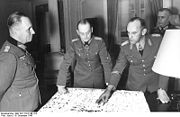 Hitler recalled von Rundstedt to duty in March 1942, placing him once again in command of the west
. There he proved complacent, so much so that as late as the autumn of 1943, no fortification
s worthy of mention existed along the entire Atlantic shore. It was only after Field Marshal Erwin Rommel
′s appointment as von Rundstedt′s ostensible subordinate in November 1943 that fortification work began in earnest. During the debates preceding the landing, von Rundstedt insisted that the armoured
reserves
should be held in the operational rear so that they could all be rushed to whatever sector the Allies happened to land in. General Geyr von Schweppenburg—the armoured commander—supported him, but Rommel insisted that the armoured forces must be deployed very near the shoreline, just beyond the reach of the Allied naval bombardment. Badly affected by his experiences in North Africa
, Rommel believed that Allied air operations would prohibit movement during the day and even at night gravely inhibit movement. But von Rundstedt was convinced that a landing as far west as Normandy
was out of the question and that very little armour should be committed there. Ultimately, the armoured divisions were dispersed, and only two were spared to the Channel
coast west of the Seine
with one assigned to the Normandy sector, a deployment that would have disastrous consequences once the invasion began. After the D-Day landings in June 1944, von Rundstedt urged Hitler to negotiate a settlement with the Allies, his frustration culminating in his outburst, "Make peace, you idiots!" Hitler responded by replacing him with Field Marshal Günther von Kluge
.
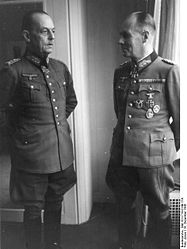 As a result of the 20 July plot, which enraged von Rundstedt, he agreed to join OKW
chief Field Marshal Wilhelm Keitel
and Guderian
on the Army Court of Honour
that expelled hundreds of officers suspected of being opposed to Hitler, often on the flimsiest of evidence. This judgement removed the suspected dissidents from the jurisdiction of the military
and turned them over to the Volksgerichtshof ("People′s Court") and its presiding judge, Roland Freisler
. Many of these men were executed after brief trials in what amounted to kangaroo court
s.
In mid-August 1944, von Kluge committed suicide after being implicated in the 20 July Plot and Field Marshal Walter Model
was given command of OB West; Model held the post for 18 days before von Rundstedt was reappointed to command Germany′s forces in the west. He rallied them in time to fight off Operation Market Garden
, with Model′s Army Group B
at the centre of the German defence. Although von Rundstedt was in command of the German forces on the Western front throughout Operation Wacht am Rhein (the Battle of the Bulge
, also known as the Runstedt Offensive), he was opposed to that offensive from its inception, and essentially washed his hands of it. He was relieved of command for the last time in March 1945, after telling Keitel once again that Hitler should make peace with the Allies, rather than continue to fight a hopeless war.
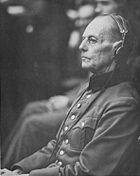 Rundstedt was captured by the U.S. 36th Infantry Division
on 1 May 1945. During his captivity, he was reportedly asked by Soviet interrogators which battle he regarded as most decisive. They expected him to say "Stalingrad
", but von Rundstedt replied "The Battle of Britain
". Annoyed, the Soviets "put away their notebooks and left." While being interrogated, he suffered another heart attack, and was taken to Britain, where he was held in a prisoner-of-war camp in Bridgend
, South Wales
and at Redgrave
, Suffolk
, England
.
The British authorities charged him with war crimes. The following are the details of the cases against von Rundstedt and three other members of the German General Staff. A secret British cabinet report of 17 June 1948 states: "... the Nuremberg Judgment relating to the German General Staff which ends —
" Where the facts warrant it, these men should be brought to trial so that those among them who are guilty of these crimes should not escape punishment".
3. The memorandum, which is voluminous, discloses a prima facie case for various crimes, in particular the following:—
(a) Against all four generals, in connection with the " Commissar " Order, under which political commissars of the Russian Army were not to be recognized as prisoners of war and were to be liquidated.
(b) Against RUNDSTEDT, in connection with the " Commando " Order, under which parachutists who were taken prisoner not in connection with battle actions were to be transferred to the Gestapo by whom they were, in fact, killed.
(c) Against all four generals, for responsibility for murder and ill-treatment of allied prisoners of war, chiefly Russians.
(d) Against BRAUCHITSCH, RUNDSTEDT and MANSTEIN, for certain breaches of the Geneva Convention arising out of the use of prisoners of war, chiefly Russians, on prohibited and dangerous work.
(e) Against all four generals, for responsibility for many crimes against civilians, including the illegal execution of hostages, excessive reprisals, extermination of Slavs, Jews and Communists and deportation into slave labour of civilians from all the occupied territories.
4. The vast majority of the victims were Russia
ns. In point of numbers the Poles
, doubtless, come second and Belgian, French, British and American victims were also involved, but in much smaller numbers. Our own direct interest is limited to the responsibility of RUNDSTEDT for the passing on of the " Commando" Order in so far as our own Special Air Service troops were killed, pursuant to it. Many of the actual perpetrators of these
killings have already been tried before British Military Courts. The memorandum indicated evidence that RUNDSTEDT published a " Commando" Order dated 21 July 1942 which, therefore, preceded Hitler's " Commando " Order of 18 October 1942..." [British National Archives:CAB/129/28]
On 10 October 1941, his subordinate, Walther von Reichenau
, the 6th Army's commander, had issued his infamous "Reichenau Order".http://www.ess.uwe.ac.uk/genocide/ussr2.htm. Upon hearing of Reichenau's Severity Order
, Rundstedt expressed his "complete agreement" with it, and sent out a circular to all of the Army generals under his command urging them to send out their own versions of the Severity Order, which would impress upon the troops the need to exterminate Jews. Ultimately, he never faced trial, citing poor health reasons. A joint Board of two experienced medical officers of the prison service and two British Army doctors examined him and reported von Rundstedt's condition: "...We are of opinion that he is unfit to stand his trial as a result of enfeeblement of mental function due to senile changes and congestive heart failure." [British National Archives:CAB/129/34] Some doubts were expressed if he really was sick enough, however the British cabinet decided that the court should decide whether he was fit to stand trial or not. They had reservations about prosecuting him due to his age, they were concerned that it would be seen as vengeance not justice amongst other concerns. A British cabinet report of 17 June 1948 records the following, "...and uncertainty whether essential evidence will be forthcoming, particularly from our eastern war time Allies, the possibility that RUNSTEDT or STRAUSS may collapse or commit suicide before or during their trials, the ages of the three generals and unlikelihood that the death sentence will be inflicted if passed and the fact that they can still be detained in custody or kept under control if a danger to security. It may be mentioned that we have already tried eleven German generals before British Military Courts. Four were sentenced to death, but none, in fact, executed..."[British National Archives:CAB/129/28].
Von Rundstedt was 73.
He was released in July 1948. After his liberation, he took residence in Schloss
Oppershausen near Celle
. Suffering from heart problems, Gerd von Rundstedt died in Hanover
on 24 February 1953, at the age of 77.
German Army
The German Army is the land component of the armed forces of the Federal Republic of Germany. Following the disbanding of the Wehrmacht after World War II, it was re-established in 1955 as the Bundesheer, part of the newly formed West German Bundeswehr along with the Navy and the Air Force...
during World War II
World War II
World War II, or the Second World War , was a global conflict lasting from 1939 to 1945, involving most of the world's nations—including all of the great powers—eventually forming two opposing military alliances: the Allies and the Axis...
. He held some of the highest field commands in all phases of the war.
Born into an aristocratic Prussian family, he entered the Reichswehr
Reichswehr
The Reichswehr formed the military organisation of Germany from 1919 until 1935, when it was renamed the Wehrmacht ....
and rose steadily through the ranks in World War I
World War I
World War I , which was predominantly called the World War or the Great War from its occurrence until 1939, and the First World War or World War I thereafter, was a major war centred in Europe that began on 28 July 1914 and lasted until 11 November 1918...
. In the inter-war years, he continued his career, but ultimately retired. Nevertheless. at the beginning of World War II he returned as Commander of the Army Group South
Army Group South
Army Group South was the name of a number of German Army Groups during World War II.- Poland campaign :Germany used two army groups to invade Poland in 1939: Army Group North and Army Group South...
in the Poland
Poland
Poland , officially the Republic of Poland , is a country in Central Europe bordered by Germany to the west; the Czech Republic and Slovakia to the south; Ukraine, Belarus and Lithuania to the east; and the Baltic Sea and Kaliningrad Oblast, a Russian exclave, to the north...
campaign. He maintained command of large formations during Fall Gelb and was promoted to the rank of Field Marshal on 19 July 1940. In the Russian Campaign, he commanded Army Group South, responsible for the largest encirclement in history, the Battle of Kiev
Battle of Kiev (1941)
The Battle of Kiev was the German name for the operation that resulted in a very large encirclement of Soviet troops in the vicinity of Kiev during World War II. It is considered the largest encirclement of troops in history. The operation ran from 23 August – 26 September 1941 as part of Operation...
. Due to the failure of Operation Barbarossa
Operation Barbarossa
Operation Barbarossa was the code name for Germany's invasion of the Soviet Union during World War II that began on 22 June 1941. Over 4.5 million troops of the Axis powers invaded the USSR along a front., the largest invasion in the history of warfare...
, he—like many commanders—was dropped by Adolf Hitler
Adolf Hitler
Adolf Hitler was an Austrian-born German politician and the leader of the National Socialist German Workers Party , commonly referred to as the Nazi Party). He was Chancellor of Germany from 1933 to 1945, and head of state from 1934 to 1945...
, but was recalled in 1942 as OB West
OB West
The German Army Command in the West The German Army Command in the West The German Army Command in the West (Oberbefehlshaber West (German: initials OB West) was the overall command of the Westheer, the German Armed Forces on the Western Front during World War II. It was directly subordinate to...
. He retained this command (with several interruptions) until his dismissal by Hitler in March 1945, before he was captured by the Allies.
He was charged with war crime
War crime
War crimes are serious violations of the laws applicable in armed conflict giving rise to individual criminal responsibility...
s, but never faced any trial due to his poor health. He was released from captivity in 1948 and died in Hanover
Hanover
Hanover or Hannover, on the river Leine, is the capital of the federal state of Lower Saxony , Germany and was once by personal union the family seat of the Hanoverian Kings of Great Britain, under their title as the dukes of Brunswick-Lüneburg...
in 1953.
Early life
Born in AscherslebenAschersleben
Aschersleben is a town in the Salzlandkreis district, in Saxony-Anhalt, Germany. It is situated approx. 22 km east of Quedlinburg, and 45 km northwest of Halle .-Pre-20th century:...
in the Province of Saxony
Province of Saxony
The Province of Saxony was a province of the Kingdom of Prussia and later the Free State of Prussia from 1816 until 1945. Its capital was Magdeburg.-History:The province was created in 1816 out of the following territories:...
into an aristocratic Prussia
Prussia
Prussia was a German kingdom and historic state originating out of the Duchy of Prussia and the Margraviate of Brandenburg. For centuries, the House of Hohenzollern ruled Prussia, successfully expanding its size by way of an unusually well-organized and effective army. Prussia shaped the history...
n family, von Rundstedt joined the German Army
German Army
The German Army is the land component of the armed forces of the Federal Republic of Germany. Following the disbanding of the Wehrmacht after World War II, it was re-established in 1955 as the Bundesheer, part of the newly formed West German Bundeswehr along with the Navy and the Air Force...
in 1892, then entered Germany′s elite military academy in 1902 – an institution that accepted only 160 new students annually and weeded out 75% of the students through exams. During World War I, he rose in rank until 1918 when he was a major
Major
Major is a rank of commissioned officer, with corresponding ranks existing in almost every military in the world.When used unhyphenated, in conjunction with no other indicator of rank, the term refers to the rank just senior to that of an Army captain and just below the rank of lieutenant colonel. ...
and was chief of staff of his division
Division (military)
A division is a large military unit or formation usually consisting of between 10,000 and 20,000 soldiers. In most armies, a division is composed of several regiments or brigades, and in turn several divisions typically make up a corps...
.
After the war, von Rundstedt rose steadily in the small 100,000-man army (the Reichswehr
Reichswehr
The Reichswehr formed the military organisation of Germany from 1919 until 1935, when it was renamed the Wehrmacht ....
) and in 1932, was appointed commander of the 3rd Infantry Division
3rd Division (Reichswehr)
- Creation :In the Order of 31 July 1920 for the Reduction of the Army , it was determined that in every Wehrkreis a division would be established by 1 October 1920...
. On 20 July 1932, Rundstedt carried out the so-called Rape of Prussia
Preußenschlag
In 1932, the Preußenschlag, or "Prussian coup", was one of the major steps towards the end of the German inter-war democracy, which would later greatly facilitate the "Gleichschaltung" of Germany after Adolf Hitler's rise to power...
that saw the Reichswehr oust the Social Democratic government of Prussia and allowed the Chancellor Franz von Papen
Franz von Papen
Lieutenant-Colonel Franz Joseph Hermann Michael Maria von Papen zu Köningen was a German nobleman, Roman Catholic monarchist politician, General Staff officer, and diplomat, who served as Chancellor of Germany in 1932 and as Vice-Chancellor under Adolf Hitler in 1933–1934...
to become the Reich Commissioner of Prussia. Later that year he threatened to resign when von Papen declared martial law
Martial law
Martial law is the imposition of military rule by military authorities over designated regions on an emergency basis— only temporary—when the civilian government or civilian authorities fail to function effectively , when there are extensive riots and protests, or when the disobedience of the law...
and ordered his troops to eject members of the Nazi Party from state government offices. In 1938, he was appointed commander of the 2nd Army that occupied the Sudetenland
Sudetenland
Sudetenland is the German name used in English in the first half of the 20th century for the northern, southwest and western regions of Czechoslovakia inhabited mostly by ethnic Germans, specifically the border areas of Bohemia, Moravia, and those parts of Silesia being within Czechoslovakia.The...
, but he retired after it was understood that Werner von Fritsch
Werner von Fritsch
Werner Thomas Ludwig Freiherr von Fritsch was a prominent Wehrmacht officer, member of the German High Command, and the second German general to be killed during World War II.-Early life:...
—Commander-in-Chief of the Army—was framed by the Gestapo
Gestapo
The Gestapo was the official secret police of Nazi Germany. Beginning on 20 April 1934, it was under the administration of the SS leader Heinrich Himmler in his position as Chief of German Police...
in the Blomberg-Fritsch Affair
Blomberg-Fritsch Affair
The Blomberg–Fritsch Affair were two related scandals in early 1938 that resulted in the subjugation of the German Armed Forces to dictator Adolf Hitler...
. Upon his retirement he was given the honorary appointment of Colonel-in-Chief of the 18th Infantry regiment; thereafter, von Rundstedt frequently wore an infantry colonel′s uniform and collar patches—with his Field Marshal
Field Marshal
Field Marshal is a military rank. Traditionally, it is the highest military rank in an army.-Etymology:The origin of the rank of field marshal dates to the early Middle Ages, originally meaning the keeper of the king's horses , from the time of the early Frankish kings.-Usage and hierarchical...
′s shoulder insignia—until the end of his career. On occasion, he was mistaken for a colonel, but he simply laughed at the notion.
World War II
On 1 September 1939, World War II began, and von Rundstedt was recalled to active service to lead Army Group SouthArmy Group South
Army Group South was the name of a number of German Army Groups during World War II.- Poland campaign :Germany used two army groups to invade Poland in 1939: Army Group North and Army Group South...
during the successful invasion of Poland
Invasion of Poland (1939)
The Invasion of Poland, also known as the September Campaign or 1939 Defensive War in Poland and the Poland Campaign in Germany, was an invasion of Poland by Germany, the Soviet Union, and a small Slovak contingent that marked the start of World War II in Europe...
. Turning to the West, he supported Manstein′s "armoured fist" approach to the invasion of France
Battle of France
In the Second World War, the Battle of France was the German invasion of France and the Low Countries, beginning on 10 May 1940, which ended the Phoney War. The battle consisted of two main operations. In the first, Fall Gelb , German armoured units pushed through the Ardennes, to cut off and...
, and this was eventually selected as Fall Gelb. During the battle he was placed in command of seven Panzer
Panzer
A Panzer is a German language word that, when used as a noun, means "tank". When it is used as an adjective, it means either tank or "armoured" .- Etymology :...
divisions, three motorized infantry divisions, and 35 regular infantry divisions.
By 14 May 1940, the armoured divisions led by Heinz Guderian
Heinz Guderian
Heinz Wilhelm Guderian was a German general during World War II. He was a pioneer in the development of armored warfare, and was the leading proponent of tanks and mechanization in the Wehrmacht . Germany's panzer forces were raised and organized under his direction as Chief of Mobile Forces...
had crossed the Meuse
Meuse
Meuse is a department in northeast France, named after the River Meuse.-History:Meuse is one of the original 83 departments created during the French Revolution on March 4, 1790...
and had opened up a huge gap in the Allied front. General von Rundstedt had doubts about the survivability of these units without infantry support, and asked for a pause while the infantry caught up; the halt allowed the British
British Army
The British Army is the land warfare branch of Her Majesty's Armed Forces in the United Kingdom. It came into being with the unification of the Kingdom of England and Scotland into the Kingdom of Great Britain in 1707. The new British Army incorporated Regiments that had already existed in England...
to evacuate their forces from Dunkirk. Later von Rundstedt forbade an attack on the Dunkirk beachhead, allowing the British to fully evacuate it. This turn of events has raised eyebrows over the years. Von Rundstedt and others subsequently argued that the decision was Hitler′s and stemmed from his belief that Britain would more readily accept a peace treaty if he magnanimously spared what remained of her expeditionary force. However, this was no more than a face-saving rationalization. Von Rundstedt had wanted to preserve his motorized units for the final push to the south to conclude the campaign against the French
Battle of France
In the Second World War, the Battle of France was the German invasion of France and the Low Countries, beginning on 10 May 1940, which ended the Phoney War. The battle consisted of two main operations. In the first, Fall Gelb , German armoured units pushed through the Ardennes, to cut off and...
while Göring
Hermann Göring
Hermann Wilhelm Göring, was a German politician, military leader, and a leading member of the Nazi Party. He was a veteran of World War I as an ace fighter pilot, and a recipient of the coveted Pour le Mérite, also known as "The Blue Max"...
had convinced Hitler the Luftwaffe
Luftwaffe
Luftwaffe is a generic German term for an air force. It is also the official name for two of the four historic German air forces, the Wehrmacht air arm founded in 1935 and disbanded in 1946; and the current Bundeswehr air arm founded in 1956....
could finish the job.
Von Rundstedt was promoted to field marshal on 19 July 1940 and took part in the planning of Operation Sea Lion. When the invasion was called off, von Rundstedt took control of occupation forces and was given responsibility to develop the coastal defences in the Netherlands
Netherlands
The Netherlands is a constituent country of the Kingdom of the Netherlands, located mainly in North-West Europe and with several islands in the Caribbean. Mainland Netherlands borders the North Sea to the north and west, Belgium to the south, and Germany to the east, and shares maritime borders...
, Belgium
Belgium
Belgium , officially the Kingdom of Belgium, is a federal state in Western Europe. It is a founding member of the European Union and hosts the EU's headquarters, and those of several other major international organisations such as NATO.Belgium is also a member of, or affiliated to, many...
and France
France
The French Republic , The French Republic , The French Republic , (commonly known as France , is a unitary semi-presidential republic in Western Europe with several overseas territories and islands located on other continents and in the Indian, Pacific, and Atlantic oceans. Metropolitan France...
.
Operation Barbarossa
In June 1941, von Rundstedt took part in Operation BarbarossaOperation Barbarossa
Operation Barbarossa was the code name for Germany's invasion of the Soviet Union during World War II that began on 22 June 1941. Over 4.5 million troops of the Axis powers invaded the USSR along a front., the largest invasion in the history of warfare...
as commander of Army Group South, where he led 52 infantry divisions and five Panzer divisions into the Soviet Union
Soviet Union
The Soviet Union , officially the Union of Soviet Socialist Republics , was a constitutionally socialist state that existed in Eurasia between 1922 and 1991....
. At first his progress was slow, but in September AG South captured Kiev
Kiev
Kiev or Kyiv is the capital and the largest city of Ukraine, located in the north central part of the country on the Dnieper River. The population as of the 2001 census was 2,611,300. However, higher numbers have been cited in the press....
in a double encirclement operation made possible by Joseph Stalin
Joseph Stalin
Joseph Vissarionovich Stalin was the Premier of the Soviet Union from 6 May 1941 to 5 March 1953. He was among the Bolshevik revolutionaries who brought about the October Revolution and had held the position of first General Secretary of the Communist Party of the Soviet Union's Central Committee...
′s unreasoning refusal to abandon the city, although the Dnieper had been crossed both north and south of it. The Germans claimed a fantastic haul of 665,000 Russian prisoners based on the encircled divisions′ nominal, pre-combat strength as revealed by captured Soviet records. The Soviets reported that owing to previous losses (also exaggerated by the Germans, yet not subtracted by them from their tally of Soviet prisoners), the encircled divisions possessed merely 452,000 men and that, of those, 150,541 escaped the pocket before the German infantry divisions caught up with the armour and the ring of encirclement was consolidated. Thus, according to the Soviets, "only" 300,000 men were permanently trapped, whether captured or killed. After this, von Rundstedt moved east to attack Kharkov and Rostov
Rostov-on-Don
-History:The mouth of the Don River has been of great commercial and cultural importance since the ancient times. It was the site of the Greek colony Tanais, of the Genoese fort Tana, and of the Turkish fortress Azak...
. He strongly opposed continuing the advance into the Soviet Union during the winter and advised Hitler to halt the offensive, but his views were rejected.
In November, von Rundstedt had a heart attack, but he refused to be hospitalized and continued the advance, reaching Rostov on 21 November. A counter-attack forced the Germans back. When von Rundstedt demanded to be allowed to withdraw, Hitler became furious and replaced him with General Walther von Reichenau
Walther von Reichenau
Walter von Reichenau was a German Generalfeldmarschall during World War II.-History:Reichenau was born in Karlsruhe to a Prussian general and joined the German Army in 1903. During World War I he served on the Western Front...
.
Western battlefield
OB West
The German Army Command in the West The German Army Command in the West The German Army Command in the West (Oberbefehlshaber West (German: initials OB West) was the overall command of the Westheer, the German Armed Forces on the Western Front during World War II. It was directly subordinate to...
. There he proved complacent, so much so that as late as the autumn of 1943, no fortification
Fortification
Fortifications are military constructions and buildings designed for defence in warfare and military bases. Humans have constructed defensive works for many thousands of years, in a variety of increasingly complex designs...
s worthy of mention existed along the entire Atlantic shore. It was only after Field Marshal Erwin Rommel
Erwin Rommel
Erwin Johannes Eugen Rommel , popularly known as the Desert Fox , was a German Field Marshal of World War II. He won the respect of both his own troops and the enemies he fought....
′s appointment as von Rundstedt′s ostensible subordinate in November 1943 that fortification work began in earnest. During the debates preceding the landing, von Rundstedt insisted that the armoured
Armoured warfare
Armoured warfare or tank warfare is the use of armoured fighting vehicles in modern warfare. It is a major component of modern methods of war....
reserves
Military reserve
A military reserve, tactical reserve, or strategic reserve is a group of military personnel or units which are initially not committed to a battle by their commander so that they are available to address unforeseen situations or exploit suddenly developing...
should be held in the operational rear so that they could all be rushed to whatever sector the Allies happened to land in. General Geyr von Schweppenburg—the armoured commander—supported him, but Rommel insisted that the armoured forces must be deployed very near the shoreline, just beyond the reach of the Allied naval bombardment. Badly affected by his experiences in North Africa
North Africa
North Africa or Northern Africa is the northernmost region of the African continent, linked by the Sahara to Sub-Saharan Africa. Geopolitically, the United Nations definition of Northern Africa includes eight countries or territories; Algeria, Egypt, Libya, Morocco, South Sudan, Sudan, Tunisia, and...
, Rommel believed that Allied air operations would prohibit movement during the day and even at night gravely inhibit movement. But von Rundstedt was convinced that a landing as far west as Normandy
Normandy
Normandy is a geographical region corresponding to the former Duchy of Normandy. It is in France.The continental territory covers 30,627 km² and forms the preponderant part of Normandy and roughly 5% of the territory of France. It is divided for administrative purposes into two régions:...
was out of the question and that very little armour should be committed there. Ultimately, the armoured divisions were dispersed, and only two were spared to the Channel
English Channel
The English Channel , often referred to simply as the Channel, is an arm of the Atlantic Ocean that separates southern England from northern France, and joins the North Sea to the Atlantic. It is about long and varies in width from at its widest to in the Strait of Dover...
coast west of the Seine
Seine
The Seine is a -long river and an important commercial waterway within the Paris Basin in the north of France. It rises at Saint-Seine near Dijon in northeastern France in the Langres plateau, flowing through Paris and into the English Channel at Le Havre . It is navigable by ocean-going vessels...
with one assigned to the Normandy sector, a deployment that would have disastrous consequences once the invasion began. After the D-Day landings in June 1944, von Rundstedt urged Hitler to negotiate a settlement with the Allies, his frustration culminating in his outburst, "Make peace, you idiots!" Hitler responded by replacing him with Field Marshal Günther von Kluge
Günther von Kluge
Günther Adolf Ferdinand “Hans” von Kluge was a German military leader. He was born in Posen into a Prussian military family. Kluge rose to the rank of Field Marshal in the Wehrmacht. He was also a recipient of the Knight's Cross of the Iron Cross with Oak Leaves and Swords...
.
Oberkommando der Wehrmacht
The Oberkommando der Wehrmacht was part of the command structure of the armed forces of Nazi Germany during World War II.- Genesis :...
chief Field Marshal Wilhelm Keitel
Wilhelm Keitel
Wilhelm Bodewin Gustav Keitel was a German field marshal . As head of the Oberkommando der Wehrmacht and de facto war minister, he was one of Germany's most senior military leaders during World War II...
and Guderian
Heinz Guderian
Heinz Wilhelm Guderian was a German general during World War II. He was a pioneer in the development of armored warfare, and was the leading proponent of tanks and mechanization in the Wehrmacht . Germany's panzer forces were raised and organized under his direction as Chief of Mobile Forces...
on the Army Court of Honour
Court of Honor
A court of honor is a semi-official or unofficial tribunal constituted to determine various questions of social protocol, breaches of etiquette, and other allegations of breaches of honor, or entitlement to various honors...
that expelled hundreds of officers suspected of being opposed to Hitler, often on the flimsiest of evidence. This judgement removed the suspected dissidents from the jurisdiction of the military
Military law
Military justice is the body of laws and procedures governing members of the armed forces. Many states have separate and distinct bodies of law that govern the conduct of members of their armed forces. Some states use special judicial and other arrangements to enforce those laws, while others use...
and turned them over to the Volksgerichtshof ("People′s Court") and its presiding judge, Roland Freisler
Roland Freisler
Roland Freisler was a prominent and notorious Nazi lawyer and judge. He was State Secretary of the Reich Ministry of Justice and President of the People's Court , which was set up outside constitutional authority...
. Many of these men were executed after brief trials in what amounted to kangaroo court
Kangaroo court
A kangaroo court is "a mock court in which the principles of law and justice are disregarded or perverted".The outcome of a trial by kangaroo court is essentially determined in advance, usually for the purpose of ensuring conviction, either by going through the motions of manipulated procedure or...
s.
In mid-August 1944, von Kluge committed suicide after being implicated in the 20 July Plot and Field Marshal Walter Model
Walter Model
Otto Moritz Walter Model was a German general and later field marshal during World War II. He is noted for his defensive battles in the latter half of the war, mostly on the Eastern Front but also in the west, and for his close association with Adolf Hitler and Nazism...
was given command of OB West; Model held the post for 18 days before von Rundstedt was reappointed to command Germany′s forces in the west. He rallied them in time to fight off Operation Market Garden
Operation Market Garden
Operation Market Garden was an unsuccessful Allied military operation, fought in the Netherlands and Germany in the Second World War. It was the largest airborne operation up to that time....
, with Model′s Army Group B
Army Group B
Army Group B was the name of three different German Army Groups that saw action during World War II.-Battle for France:The first was involved in the Western Campaign in 1940 in Belgium and the Netherlands which was to be aimed to conquer the Maas bridges after the German airborne actions in Rotterdam...
at the centre of the German defence. Although von Rundstedt was in command of the German forces on the Western front throughout Operation Wacht am Rhein (the Battle of the Bulge
Battle of the Bulge
The Battle of the Bulge was a major German offensive , launched toward the end of World War II through the densely forested Ardennes mountain region of Wallonia in Belgium, hence its French name , and France and...
, also known as the Runstedt Offensive), he was opposed to that offensive from its inception, and essentially washed his hands of it. He was relieved of command for the last time in March 1945, after telling Keitel once again that Hitler should make peace with the Allies, rather than continue to fight a hopeless war.
After the war
U.S. 36th Infantry Division
-Pre 2 October 1941 Square Organization:*HHC, 36th Infantry Division, TXARNG**36th Military Police Platoon**36th Signal Company**111th Ordnance Company**111th Engineer Regiment , TXARNG**111th Medical Regiment**111th Quartermaster Regiment...
on 1 May 1945. During his captivity, he was reportedly asked by Soviet interrogators which battle he regarded as most decisive. They expected him to say "Stalingrad
Battle of Stalingrad
The Battle of Stalingrad was a major battle of World War II in which Nazi Germany and its allies fought the Soviet Union for control of the city of Stalingrad in southwestern Russia. The battle took place between 23 August 1942 and 2 February 1943...
", but von Rundstedt replied "The Battle of Britain
Battle of Britain
The Battle of Britain is the name given to the World War II air campaign waged by the German Air Force against the United Kingdom during the summer and autumn of 1940...
". Annoyed, the Soviets "put away their notebooks and left." While being interrogated, he suffered another heart attack, and was taken to Britain, where he was held in a prisoner-of-war camp in Bridgend
Bridgend
Bridgend is a town in the Bridgend County Borough in Wales, west of the capital, Cardiff. The river crossed by the original bridge, which gave the town its name, is the River Ogmore but the River Ewenny also passes to the south of the town...
, South Wales
South Wales
South Wales is an area of Wales bordered by England and the Bristol Channel to the east and south, and Mid Wales and West Wales to the north and west. The most densely populated region in the south-west of the United Kingdom, it is home to around 2.1 million people and includes the capital city of...
and at Redgrave
Redgrave, Suffolk
Redgrave is a civil parish and a small village in the Rickinghall and Walsham ward in the Mid Suffolk district in Suffolk county in eastern England....
, Suffolk
Suffolk
Suffolk is a non-metropolitan county of historic origin in East Anglia, England. It has borders with Norfolk to the north, Cambridgeshire to the west and Essex to the south. The North Sea lies to the east...
, England
England
England is a country that is part of the United Kingdom. It shares land borders with Scotland to the north and Wales to the west; the Irish Sea is to the north west, the Celtic Sea to the south west, with the North Sea to the east and the English Channel to the south separating it from continental...
.
The British authorities charged him with war crimes. The following are the details of the cases against von Rundstedt and three other members of the German General Staff. A secret British cabinet report of 17 June 1948 states: "... the Nuremberg Judgment relating to the German General Staff which ends —
" Where the facts warrant it, these men should be brought to trial so that those among them who are guilty of these crimes should not escape punishment".
3. The memorandum, which is voluminous, discloses a prima facie case for various crimes, in particular the following:—
(a) Against all four generals, in connection with the " Commissar " Order, under which political commissars of the Russian Army were not to be recognized as prisoners of war and were to be liquidated.
(b) Against RUNDSTEDT, in connection with the " Commando " Order, under which parachutists who were taken prisoner not in connection with battle actions were to be transferred to the Gestapo by whom they were, in fact, killed.
(c) Against all four generals, for responsibility for murder and ill-treatment of allied prisoners of war, chiefly Russians.
(d) Against BRAUCHITSCH, RUNDSTEDT and MANSTEIN, for certain breaches of the Geneva Convention arising out of the use of prisoners of war, chiefly Russians, on prohibited and dangerous work.
(e) Against all four generals, for responsibility for many crimes against civilians, including the illegal execution of hostages, excessive reprisals, extermination of Slavs, Jews and Communists and deportation into slave labour of civilians from all the occupied territories.
4. The vast majority of the victims were Russia
Russia
Russia or , officially known as both Russia and the Russian Federation , is a country in northern Eurasia. It is a federal semi-presidential republic, comprising 83 federal subjects...
ns. In point of numbers the Poles
Poles
thumb|right|180px|The state flag of [[Poland]] as used by Polish government and diplomatic authoritiesThe Polish people, or Poles , are a nation indigenous to Poland. They are united by the Polish language, which belongs to the historical Lechitic subgroup of West Slavic languages of Central Europe...
, doubtless, come second and Belgian, French, British and American victims were also involved, but in much smaller numbers. Our own direct interest is limited to the responsibility of RUNDSTEDT for the passing on of the " Commando" Order in so far as our own Special Air Service troops were killed, pursuant to it. Many of the actual perpetrators of these
killings have already been tried before British Military Courts. The memorandum indicated evidence that RUNDSTEDT published a " Commando" Order dated 21 July 1942 which, therefore, preceded Hitler's " Commando " Order of 18 October 1942..." [British National Archives:CAB/129/28]
On 10 October 1941, his subordinate, Walther von Reichenau
Walther von Reichenau
Walter von Reichenau was a German Generalfeldmarschall during World War II.-History:Reichenau was born in Karlsruhe to a Prussian general and joined the German Army in 1903. During World War I he served on the Western Front...
, the 6th Army's commander, had issued his infamous "Reichenau Order".http://www.ess.uwe.ac.uk/genocide/ussr2.htm. Upon hearing of Reichenau's Severity Order
Severity Order
The Severity Order was the name given to an order promulgated within the German Sixth Army on the Eastern Front during World War II by Field Marshal Walther von Reichenau on 10 October 1941....
, Rundstedt expressed his "complete agreement" with it, and sent out a circular to all of the Army generals under his command urging them to send out their own versions of the Severity Order, which would impress upon the troops the need to exterminate Jews. Ultimately, he never faced trial, citing poor health reasons. A joint Board of two experienced medical officers of the prison service and two British Army doctors examined him and reported von Rundstedt's condition: "...We are of opinion that he is unfit to stand his trial as a result of enfeeblement of mental function due to senile changes and congestive heart failure." [British National Archives:CAB/129/34] Some doubts were expressed if he really was sick enough, however the British cabinet decided that the court should decide whether he was fit to stand trial or not. They had reservations about prosecuting him due to his age, they were concerned that it would be seen as vengeance not justice amongst other concerns. A British cabinet report of 17 June 1948 records the following, "...and uncertainty whether essential evidence will be forthcoming, particularly from our eastern war time Allies, the possibility that RUNSTEDT or STRAUSS may collapse or commit suicide before or during their trials, the ages of the three generals and unlikelihood that the death sentence will be inflicted if passed and the fact that they can still be detained in custody or kept under control if a danger to security. It may be mentioned that we have already tried eleven German generals before British Military Courts. Four were sentenced to death, but none, in fact, executed..."[British National Archives:CAB/129/28].
Von Rundstedt was 73.
He was released in July 1948. After his liberation, he took residence in Schloss
Schloss
Schloss is a German word for a building similar to a château, palace or manor house; or what in the British Isles would be known as a stately home...
Oppershausen near Celle
Celle
Celle is a town and capital of the district of Celle, in Lower Saxony, Germany. The town is situated on the banks of the River Aller, a tributary of the Weser and has a population of about 71,000...
. Suffering from heart problems, Gerd von Rundstedt died in Hanover
Hanover
Hanover or Hannover, on the river Leine, is the capital of the federal state of Lower Saxony , Germany and was once by personal union the family seat of the Hanoverian Kings of Great Britain, under their title as the dukes of Brunswick-Lüneburg...
on 24 February 1953, at the age of 77.
Family
On 22 January 1902, von Rundstedt married Luise Bila von Götz (d. 1952) and they had one child, Hans Gerd von Rundstedt (1903–1948).Dates of Rank
- FähnrichFähnrichFähnrich is a German and Austrian military rank in armed forces which translates as "Ensign" in English. The rank also exists in a few other European military organizations, often with historical ties to the German system. Examples are Sweden, Norway and Finland . The French Army has a similar...
: - Leutnant: 17 June 1893
- OberleutnantOberleutnantOberleutnant is a junior officer rank in the militaries of Germany, Switzerland and Austria. In the German Army, it dates from the early 19th century. Translated as "Senior Lieutenant", the rank is typically bestowed upon commissioned officers after five to six years of active duty...
: 12 September 1902 - HauptmannHauptmannHauptmann is a German word usually translated as captain when it is used as an officer's rank in the German, Austrian and Swiss armies. While "haupt" in contemporary German means "main", it also has the dated meaning of "head", i.e...
: 24 March 1909 - Major: 28 November 1914
- OberstleutnantOberstleutnantOberstleutnant is a German Army and Air Force rank equal to Lieutenant Colonel, above Major, and below Oberst.There are two paygrade associated to the rank of Oberstleutnant...
: 1 October 1920 - OberstOberstOberst is a military rank in several German-speaking and Scandinavian countries, equivalent to Colonel. It is currently used by both the ground and air forces of Austria, Germany, Switzerland, Denmark and Norway. The Swedish rank överste is a direct translation, as are the Finnish rank eversti...
: 1 February 1923 - Generalmajor: 1 November 1927
- GeneralleutnantLieutenant GeneralLieutenant General is a military rank used in many countries. The rank traces its origins to the Middle Ages where the title of Lieutenant General was held by the second in command on the battlefield, who was normally subordinate to a Captain General....
: 1 March 1929 - General der InfanterieGeneral der InfanterieGeneral of the Infantry is a military rank of a General officer and refers to:* General of the Infantry * General of the Infantry...
: 1 October 1932 - Generaloberst: 1 March 1938
- Generalfeldmarschall: 19 July 1940
Notable decorations
- Iron CrossIron CrossThe Iron Cross is a cross symbol typically in black with a white or silver outline that originated after 1219 when the Kingdom of Jerusalem granted the Teutonic Order the right to combine the Teutonic Black Cross placed above a silver Cross of Jerusalem....
Second (1914) and First (1914) Classes - Prussian Crown Order 4th Class (?)
- Knight's Cross of the Iron Cross with Oak Leaves and SwordsKnight's Cross of the Iron CrossThe Knight's Cross of the Iron Cross was a grade of the 1939 version of the 1813 created Iron Cross . The Knight's Cross of the Iron Cross was the highest award of Germany to recognize extreme battlefield bravery or successful military leadership during World War II...
- Knight's Cross on 30 September 1939 as Generaloberst and commander in chief of Heeresgruppe Süd
- 519th Oak Leaves on 1 July 1944 as GeneralfeldmarschallGeneralfeldmarschallField Marshal or Generalfeldmarschall in German, was a rank in the armies of several German states and the Holy Roman Empire; in the Austrian Empire, the rank Feldmarschall was used...
and commander in chief west - 133rd Swords on 18 February 1945 as Generalfeldmarschall and commander in chief west
- Prussian Royal House Order of HohenzollernHouse Order of HohenzollernThe House Order of Hohenzollern was an order of chivalry of the House of Hohenzollern. It was both a military and a civil award...
Knight's Cross with Swords (1917) - Bavarian Military Merit OrderMilitary Merit Order (Bavaria)The Bavarian Military Merit Order was established on July 19, 1866 by King Ludwig II of Bavaria. It was the kingdom's main decoration for bravery and military merit for officers and higher-ranking officials. Civilians acting in support of the army were also made eligible for the decoration...
4th Class with Swords and Crown (9 August 1915) - Saxon Albert Order Knight 1st Class with Swords (?)
- Sudetenland MedalSudetenland MedalThe The Sudetenland Commemorative Medal was a decoration of Nazi Germany awarded in the interwar period.-Description:...
(1938) - Schwarzburg Honor Cross 3rd Class
- Lippe War Merit Cross
- Waldeck Merit Cross
- Turkish War Medal (?)
- Order of the Crown of ItalyOrder of the Crown of ItalyThe Order of the Crown of Italy was founded as a national order in 1868 by King Vittorio Emanuele II, to commemorate the unification of Italy in 1861...
, Grand Cross (1938) - Clasp to the Iron CrossIron CrossThe Iron Cross is a cross symbol typically in black with a white or silver outline that originated after 1219 when the Kingdom of Jerusalem granted the Teutonic Order the right to combine the Teutonic Black Cross placed above a silver Cross of Jerusalem....
Second (1939) and First (1939) Classes - Cross of HonorCross of HonorThe Cross of Honor, also known as the Honor Cross or, popularly, the Hindenburg Cross, was a commemorative medal inaugurated on July 13, 1934 by Reichspräsident Paul von Hindenburg for those soldiers of Imperial Germany who fought in World War I...
(1934) - Armed Forces Long Service Award with 40 year Clasp (?)
- Romanian Order of Michael the BraveOrder of Michael the BraveThe Order of Michael the Brave is Romania's highest military decoration, instituted by King Ferdinand I during the early stages of the Romanian Campaign of World War I, and was again awarded in World War II...
3rd (1941), 2nd (1941) and 1st (1942) Classes - Boxer Rebellion Service Medal (1902)
- Mentioned six times in the WehrmachtberichtWehrmachtberichtThe Wehrmachtbericht was a daily radio report on the Großdeutscher Rundfunk of Nazi Germany, published by the Oberkommando der Wehrmacht regarding the military situation on all fronts of World War II....
Portrayal in the media
Gerd von Rundstedt has been portrayed by the following actors:- V. Renin in the 1950 Soviet film The Fall of BerlinThe Fall of Berlin (film)The Fall of Berlin is a 1950 two-part Soviet film directed by Mikhail Chiaureli. The plot revolves around the history of the Great Patriotic War, focusing on the role that Joseph Stalin played in the events...
. - Leo G. CarrollLeo G. CarrollLeo Gratten Carroll was an English-born actor. He was best known for his roles in several Hitchcock films and The Man from U.N.C.L.E. and Topper.-Early life:...
in the 1951 United States drama The Desert Fox: The Story of RommelThe Desert Fox: The Story of RommelThe Desert Fox: The Story of Rommel is a 1951 biographical film about Field Marshal Erwin Rommel in the later stages of World War II. It stars James Mason in the title role, was directed by Henry Hathaway, and was based on the book Rommel by Brigadier Desmond Young, who served in the Indian Army in...
. - Paul Hartmann in the 1962 United States drama The Longest DayThe Longest Day (film)The Longest Day is a 1962 war film based on the 1959 history book The Longest Day by Cornelius Ryan, about "D-Day", the Normandy landings on 6 June 1944, during World War II....
. - Wolfgang PreissWolfgang PreissWolfgang Preiss was a German theatre, film and television actor.The son of a teacher, in the early 1930s Preiss studied philosophy, German and drama. He also took private acting classes with Hans Schlenck, making his stage début in Munich in 1932...
in the 1977 British drama A Bridge Too Far.