


Baltic German

Encyclopedia
The Baltic Germans were mostly ethnically German
inhabitants of the eastern shore of the Baltic Sea
, which today form the countries of Estonia
and Latvia
. The Baltic German population never made up more than 10% of the total. They formed the social, commercial, political and cultural élite
in that region for several centuries. Some of them also took high positions in the military and civilian life of the Russian Empire
, particularly in Saint Petersburg
.
In 1881, there were approximately 46,700 Germans in Estonia
(5.3% of the population). According to the Russian Empire Census
of 1897, there were 120,191 Germans in Latvia
, or 6.2% of the population.
In the 12th and 13th centuries, Germans, both colonists (see Ostsiedlung
) and crusaders, settled in the Baltic. After the Livonian Crusade
s they quickly came to control all the administrations of government
, politics
, economics
, education
and culture
of these areas for over 700 years until 1918, despite remaining a minority ethnic group. Whilst the vast majority of urban
lands were colonised by traders, rural
estates were soon formed by crusaders and their descendants. With the decline of Latin, German
quickly became the language of all official documents, commerce and government business for hundreds of years until 1919.
The region was politically subordinated to the rule of the monarchs of Sweden
until 1710, and the tsar
s of the Russian Empire
until 1917. Both these successive ruling kingdoms guaranteed the continuation of Baltic Germans' special class privileges and administration rights when they incorporated the provinces into their respective empires.
In contrast to the Baltic Germans, the ethnic majority of Estonians
and Latvians
had restricted rights and privileges and resided mostly in rural areas as serfs, tradesmen, or as servants in urban
homes. This was in keeping with the social scheme of things in Imperial Russia
, and lasted well into the 19th century, when emancipation
from serfdom brought those inhabitants increased political rights and freedoms.
The Baltic Germans' effective rule and class privileges came to the end with the demise of the Russian Empire (due to the Bolshevik revolution of October 1917) and the independence of Estonia
and Latvia
in 1918–1919. After 1919, many Baltic Germans felt obliged to depart for Germany
, which was as foreign to them as any other country, bar the language they spoke. Some stayed as ordinary citizens in the newly formed independent countries of Estonia, Latvia and Lithuania
.
Their history and presence in the Baltics came to an abrupt end at the beginning of the Second World War, in late 1939, following the signing of the Molotov-Ribbentrop Pact
and the subsequent Nazi-Soviet population transfers
. Almost all the Baltic Germans were resettled by the German Government
under the Heim ins Reich
program into the newly formed Reichsgaue
Wartheland and Danzig-West Prussia (on the territory of occupied Poland
). In 1945, most of them were expelled
and resettled in the territory remaining to Germany under terms of the border changes promulgated at the Potsdam Conference
, i.e. west of the Oder-Neisse Line
.
The present day descendants of the Baltic Germans can be found all over the world, with the largest groups being in Germany and Canada.
In those cases where intermarriage occurred, the other ethnic group usually assimilated into the German culture, adopted the German language and customs which often included "Germanizing" their names and surnames. They were then considered Baltic Germans as well. (see also: Ethnogenesis
).
Incorrectly, ethnic Germans from East Prussia
are sometimes considered Baltic German for reasons of cultural, linguistic, and historical affinities. However, the Germans of East Prussia held Prussian, and after 1871, German citizenship because the territory they lived in was part of Prussia
. From 1871 onwards, East Prussia became part of the newly formed unified German state, also known as the German Reich.
However, the Baltic Germans held citizenship of the Russian Empire
until 1918 and Estonian or Latvian citizenship 1918–1939.
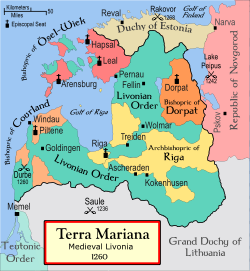 Ethnic Germans began to settle in what are now Baltic countries
in the 12th century when traders and missionaries began to visit the coastal lands inhabited by tribes who spoke Finnic
and Baltic languages. Systematic settlement started during the Northern Crusades
. Moving in the wake of German merchants, a monk named Meinhard
had landed at the mouth of the Daugava river in present-day Latvia in 1180. In 1184, the First Christian church was built in Livonian
village of Uexkyll, and in 1186, Meinhard consecrated as the first Bishop of Uexküll. The Pope proclaimed a crusade against the Baltic heathens in 1193 and a crusading expedition led by Meinhard's successor, Bishop Berthold of Hanover
, landed in Livonia. In 1196, the New Bishop of Uexküll, Berthold assembled the first crusading army in the Baltics. In 1199, Albert of Buxhoeveden was appointed by Hartwig II
, Prince-Archbishop of Bremen, to Christianise the Baltic countries
. To ensure a permanent military presence, the Livonian Brothers of the Sword
were founded in 1202. Thirty years later, the conquest and formal Christianisation of present-day Estonia
and northern Latvia
was complete.
At the same time, German-speaking merchants and craftsmen constituted the majority of the quickly growing urban population in the area. The Livonian Sword Brothers became part of the Teutonic Order in 1236. For 200 years, the knights on the shores of the eastern Baltic had support from the Holy Roman Empire
.
As the Teutonic Knights were weakened during the 15th century through wars with Poland
and Lithuania
, the Livonian branch in the north began to pursue its own policies. When the Prussian branch of the Order secularized in 1525 and became the Duchy of Prussia, the Livonian Order remained independent, although surrounded by aggressive neighbors. In 1558, Russia's invasion of Livonia began the Livonian War
between Russia, Poland, Sweden, and Denmark
which lasted for 20 years. In the course of the war, the state was divided between Denmark (which took Ösel
), Sweden (which took Estonia), Poland (which took Livland), and the Protestant state of Courland
, a fief of Poland.
, and the secularized land was divided among the remaining aristocratic
knights.
Courland existed as a country dominated by German-speakers for over 200 years, while Livland was once again split. Sweden controlled Estonia between 1561 and 1710 and Livland between 1621 and 1710, having signed an agreement not to undermine Baltic German autonomy. The German-language Universität Dorpat
, the foundation of which was supported by King Gustav II Adolf
of Sweden, remained the only one in the former Livonian territory for centuries and became the intellectual focus of the Baltic Germans.
and the Partitions of Poland
, the areas inhabited by Baltic Germans became Baltic governorates of Imperial Russia. However, the Baltic provinces remained dominated and self-governed by the local German-speaking aristocracy
which included the descendants of the former knights as well as some more recent immigrants from the German principalities to the west. Most of the professional classes in the region, the literati
, were German-speakers. Government, however, was in the hands of the Knighthood of each province, in which only members of the matriculated nobility
held membership.
Ethnic German
Ethnic Germans historically also ), also collectively referred to as the German diaspora, refers to people who are of German ethnicity. Many are not born in Europe or in the modern-day state of Germany or hold German citizenship...
inhabitants of the eastern shore of the Baltic Sea
Baltic Sea
The Baltic Sea is a brackish mediterranean sea located in Northern Europe, from 53°N to 66°N latitude and from 20°E to 26°E longitude. It is bounded by the Scandinavian Peninsula, the mainland of Europe, and the Danish islands. It drains into the Kattegat by way of the Øresund, the Great Belt and...
, which today form the countries of Estonia
Estonia
Estonia , officially the Republic of Estonia , is a state in the Baltic region of Northern Europe. It is bordered to the north by the Gulf of Finland, to the west by the Baltic Sea, to the south by Latvia , and to the east by Lake Peipsi and the Russian Federation . Across the Baltic Sea lies...
and Latvia
Latvia
Latvia , officially the Republic of Latvia , is a country in the Baltic region of Northern Europe. It is bordered to the north by Estonia , to the south by Lithuania , to the east by the Russian Federation , to the southeast by Belarus and shares maritime borders to the west with Sweden...
. The Baltic German population never made up more than 10% of the total. They formed the social, commercial, political and cultural élite
Elite
Elite refers to an exceptional or privileged group that wields considerable power within its sphere of influence...
in that region for several centuries. Some of them also took high positions in the military and civilian life of the Russian Empire
Russian Empire
The Russian Empire was a state that existed from 1721 until the Russian Revolution of 1917. It was the successor to the Tsardom of Russia and the predecessor of the Soviet Union...
, particularly in Saint Petersburg
Saint Petersburg
Saint Petersburg is a city and a federal subject of Russia located on the Neva River at the head of the Gulf of Finland on the Baltic Sea...
.
In 1881, there were approximately 46,700 Germans in Estonia
Estonia
Estonia , officially the Republic of Estonia , is a state in the Baltic region of Northern Europe. It is bordered to the north by the Gulf of Finland, to the west by the Baltic Sea, to the south by Latvia , and to the east by Lake Peipsi and the Russian Federation . Across the Baltic Sea lies...
(5.3% of the population). According to the Russian Empire Census
Russian Empire Census
The Russian Imperial Census of 1897 was the first and the only census carried out in the Russian Empire . It recorded demographic data as of ....
of 1897, there were 120,191 Germans in Latvia
Latvia
Latvia , officially the Republic of Latvia , is a country in the Baltic region of Northern Europe. It is bordered to the north by Estonia , to the south by Lithuania , to the east by the Russian Federation , to the southeast by Belarus and shares maritime borders to the west with Sweden...
, or 6.2% of the population.
In the 12th and 13th centuries, Germans, both colonists (see Ostsiedlung
Ostsiedlung
Ostsiedlung , also called German eastward expansion, was the medieval eastward migration and settlement of Germans from modern day western and central Germany into less-populated regions and countries of eastern Central Europe and Eastern Europe. The affected area roughly stretched from Slovenia...
) and crusaders, settled in the Baltic. After the Livonian Crusade
Livonian Crusade
The Livonian Crusade refers to the German and Danish conquest and colonization of medieval Livonia, the territory constituting modern Latvia and Estonia, during the Northern Crusades...
s they quickly came to control all the administrations of government
Government
Government refers to the legislators, administrators, and arbitrators in the administrative bureaucracy who control a state at a given time, and to the system of government by which they are organized...
, politics
Politics
Politics is a process by which groups of people make collective decisions. The term is generally applied to the art or science of running governmental or state affairs, including behavior within civil governments, but also applies to institutions, fields, and special interest groups such as the...
, economics
Economics
Economics is the social science that analyzes the production, distribution, and consumption of goods and services. The term economics comes from the Ancient Greek from + , hence "rules of the house"...
, education
Education
Education in its broadest, general sense is the means through which the aims and habits of a group of people lives on from one generation to the next. Generally, it occurs through any experience that has a formative effect on the way one thinks, feels, or acts...
and culture
Culture
Culture is a term that has many different inter-related meanings. For example, in 1952, Alfred Kroeber and Clyde Kluckhohn compiled a list of 164 definitions of "culture" in Culture: A Critical Review of Concepts and Definitions...
of these areas for over 700 years until 1918, despite remaining a minority ethnic group. Whilst the vast majority of urban
Urban area
An urban area is characterized by higher population density and vast human features in comparison to areas surrounding it. Urban areas may be cities, towns or conurbations, but the term is not commonly extended to rural settlements such as villages and hamlets.Urban areas are created and further...
lands were colonised by traders, rural
Rural
Rural areas or the country or countryside are areas that are not urbanized, though when large areas are described, country towns and smaller cities will be included. They have a low population density, and typically much of the land is devoted to agriculture...
estates were soon formed by crusaders and their descendants. With the decline of Latin, German
German language
German is a West Germanic language, related to and classified alongside English and Dutch. With an estimated 90 – 98 million native speakers, German is one of the world's major languages and is the most widely-spoken first language in the European Union....
quickly became the language of all official documents, commerce and government business for hundreds of years until 1919.
The region was politically subordinated to the rule of the monarchs of Sweden
Swedish Empire
The Swedish Empire refers to the Kingdom of Sweden between 1561 and 1721 . During this time, Sweden was one of the great European powers. In Swedish, the period is called Stormaktstiden, literally meaning "the Great Power Era"...
until 1710, and the tsar
Tsar
Tsar is a title used to designate certain European Slavic monarchs or supreme rulers. As a system of government in the Tsardom of Russia and Russian Empire, it is known as Tsarist autocracy, or Tsarism...
s of the Russian Empire
Russian Empire
The Russian Empire was a state that existed from 1721 until the Russian Revolution of 1917. It was the successor to the Tsardom of Russia and the predecessor of the Soviet Union...
until 1917. Both these successive ruling kingdoms guaranteed the continuation of Baltic Germans' special class privileges and administration rights when they incorporated the provinces into their respective empires.
In contrast to the Baltic Germans, the ethnic majority of Estonians
Estonians
Estonians are a Finnic people closely related to the Finns and inhabiting, primarily, the country of Estonia. They speak a Finnic language known as Estonian...
and Latvians
Latvians
Latvians or Letts are the indigenous Baltic people of Latvia.-History:Latvians occasionally refer to themselves by the ancient name of Latvji, which may have originated from the word Latve which is a name of the river that presumably flowed through what is now eastern Latvia...
had restricted rights and privileges and resided mostly in rural areas as serfs, tradesmen, or as servants in urban
Urban area
An urban area is characterized by higher population density and vast human features in comparison to areas surrounding it. Urban areas may be cities, towns or conurbations, but the term is not commonly extended to rural settlements such as villages and hamlets.Urban areas are created and further...
homes. This was in keeping with the social scheme of things in Imperial Russia
Russian Empire
The Russian Empire was a state that existed from 1721 until the Russian Revolution of 1917. It was the successor to the Tsardom of Russia and the predecessor of the Soviet Union...
, and lasted well into the 19th century, when emancipation
Emancipation
Emancipation means the act of setting an individual or social group free or making equal to citizens in a political society.Emancipation may also refer to:* Emancipation , a champion Australian thoroughbred racehorse foaled in 1979...
from serfdom brought those inhabitants increased political rights and freedoms.
The Baltic Germans' effective rule and class privileges came to the end with the demise of the Russian Empire (due to the Bolshevik revolution of October 1917) and the independence of Estonia
Estonia
Estonia , officially the Republic of Estonia , is a state in the Baltic region of Northern Europe. It is bordered to the north by the Gulf of Finland, to the west by the Baltic Sea, to the south by Latvia , and to the east by Lake Peipsi and the Russian Federation . Across the Baltic Sea lies...
and Latvia
Latvia
Latvia , officially the Republic of Latvia , is a country in the Baltic region of Northern Europe. It is bordered to the north by Estonia , to the south by Lithuania , to the east by the Russian Federation , to the southeast by Belarus and shares maritime borders to the west with Sweden...
in 1918–1919. After 1919, many Baltic Germans felt obliged to depart for Germany
German Empire
The German Empire refers to Germany during the "Second Reich" period from the unification of Germany and proclamation of Wilhelm I as German Emperor on 18 January 1871, to 1918, when it became a federal republic after defeat in World War I and the abdication of the Emperor, Wilhelm II.The German...
, which was as foreign to them as any other country, bar the language they spoke. Some stayed as ordinary citizens in the newly formed independent countries of Estonia, Latvia and Lithuania
Lithuania
Lithuania , officially the Republic of Lithuania is a country in Northern Europe, the biggest of the three Baltic states. It is situated along the southeastern shore of the Baltic Sea, whereby to the west lie Sweden and Denmark...
.
Their history and presence in the Baltics came to an abrupt end at the beginning of the Second World War, in late 1939, following the signing of the Molotov-Ribbentrop Pact
Molotov-Ribbentrop Pact
The Molotov–Ribbentrop Pact, named after the Soviet foreign minister Vyacheslav Molotov and the German foreign minister Joachim von Ribbentrop, was an agreement officially titled the Treaty of Non-Aggression between Germany and the Soviet Union and signed in Moscow in the late hours of 23 August 1939...
and the subsequent Nazi-Soviet population transfers
Nazi-Soviet population transfers
The Nazi–Soviet population transfers were a series of population transfers between 1939 and 1941 of tens of thousands of ethnic Germans and ethnic Russians in an agreement according to the German–Soviet Treaty of Friendship, Cooperation and Demarcation between Nazi Germany and the Soviet Union.-...
. Almost all the Baltic Germans were resettled by the German Government
Nazi Germany
Nazi Germany , also known as the Third Reich , but officially called German Reich from 1933 to 1943 and Greater German Reich from 26 June 1943 onward, is the name commonly used to refer to the state of Germany from 1933 to 1945, when it was a totalitarian dictatorship ruled by...
under the Heim ins Reich
Heim ins Reich
The Heim ins Reich initiative was a policy pursued by Adolf Hitler starting in 1938 and was one of the factors leading to World War II. The initiative attempted to convince people of German descent living outside of the German Reich that they should strive to bring these regions "home" into a...
program into the newly formed Reichsgaue
Reichsgau
A Reichsgau was an administrative subdivision created in a number of the areas annexed to Nazi Germany between 1938 and 1945...
Wartheland and Danzig-West Prussia (on the territory of occupied Poland
Second Polish Republic
The Second Polish Republic, Second Commonwealth of Poland or interwar Poland refers to Poland between the two world wars; a period in Polish history in which Poland was restored as an independent state. Officially known as the Republic of Poland or the Commonwealth of Poland , the Polish state was...
). In 1945, most of them were expelled
Heimatvertriebene
Heimatvertriebene are those around 12 million ethnic Germans who fled or were expelled after World War II from parts of Germany annexed by Poland and Russia, and from other countries, who found refuge in both West and East Germany, and Austria...
and resettled in the territory remaining to Germany under terms of the border changes promulgated at the Potsdam Conference
Potsdam Conference
The Potsdam Conference was held at Cecilienhof, the home of Crown Prince Wilhelm Hohenzollern, in Potsdam, occupied Germany, from 16 July to 2 August 1945. Participants were the Soviet Union, the United Kingdom, and the United States...
, i.e. west of the Oder-Neisse Line
Oder-Neisse line
The Oder–Neisse line is the border between Germany and Poland which was drawn in the aftermath of World War II. The line is formed primarily by the Oder and Lusatian Neisse rivers, and meets the Baltic Sea west of the seaport cities of Szczecin and Świnoujście...
.
The present day descendants of the Baltic Germans can be found all over the world, with the largest groups being in Germany and Canada.
Ethnic composition
It should be noted that in the course of their 700 year history, Baltic German families often had not only ethnic German roots, but also mixed with peoples of non-German origin, such as native Estonians, Livonians and Latvians, as well as with Danes, Swedes, English, Scots, Poles, Dutch, Hungarians.In those cases where intermarriage occurred, the other ethnic group usually assimilated into the German culture, adopted the German language and customs which often included "Germanizing" their names and surnames. They were then considered Baltic Germans as well. (see also: Ethnogenesis
Ethnogenesis
Ethnogenesis is the process by which a group of human beings comes to be understood or to understand themselves as ethnically distinct from the wider social landscape from which their grouping emerges...
).
Territories and citizenship
In Baltic German settlement patterns, the Baltic area consisted of the following territories:- EstlandEstoniaEstonia , officially the Republic of Estonia , is a state in the Baltic region of Northern Europe. It is bordered to the north by the Gulf of Finland, to the west by the Baltic Sea, to the south by Latvia , and to the east by Lake Peipsi and the Russian Federation . Across the Baltic Sea lies...
, roughly the northern half of present-day Estonia; major towns: Reval (TallinnTallinnTallinn is the capital and largest city of Estonia. It occupies an area of with a population of 414,940. It is situated on the northern coast of the country, on the banks of the Gulf of Finland, south of Helsinki, east of Stockholm and west of Saint Petersburg. Tallinn's Old Town is in the list...
), Narva (NarvaNarvaNarva is the third largest city in Estonia. It is located at the eastern extreme point of Estonia, by the Russian border, on the Narva River which drains Lake Peipus.-Early history:...
), Wesenberg (RakvereRakvereRakvere is a town in northern Estonia and the county seat of Lääne-Viru County, 20 km south of the Gulf of Finland.-History:The earliest signs of human settlement dating back to the 3rd-5th centuries AD have been found on the present theatre hill. Probably to protect that settlement, a wooden...
), Weissenstein (PaidePaidePaide is the capital of Järva County, Estonia.A castle built by the Livonian Brothers of the Sword is located here. The town was formally founded 30 September 1291 by Halt, master of the Livonian Order....
), Hapsal (HaapsaluHaapsaluHaapsalu is a seaside resort town located on the west coast of Estonia. It's the administrative centre of Lääne County and has a population of 11,618 ....
). - LivlandLivoniaLivonia is a historic region along the eastern shores of the Baltic Sea. It was once the land of the Finnic Livonians inhabiting the principal ancient Livonian County Metsepole with its center at Turaida...
, roughly the southern half of present-day Estonia and the northern and eastern part of today's Latvia (VidzemeVidzemeVidzeme is one of the historical and cultural regions of Latvia. Literally meaning "the Middle Land" it is situated in north-central Latvia north of the Daugava River...
); major towns: RigaRigaRiga is the capital and largest city of Latvia. With 702,891 inhabitants Riga is the largest city of the Baltic states, one of the largest cities in Northern Europe and home to more than one third of Latvia's population. The city is an important seaport and a major industrial, commercial,...
, Wenden (CēsisCesisCēsis , is a town in Latvia located in the northern part of the Central Vidzeme Upland. Cēsis is on the Gauja River valley, and is built on a series of ridges above the river overlooking the woods below...
), Wolmar (ValmieraValmieraValmiera is the largest city of the historical Vidzeme region, Latvia, with a total area of 18.1 km². It is the center of the Valmiera District. As of 2002, Valmiera had a population of 27,323, and in 2008 – 27,569....
), Walk (Valga and ValkaValkaValka is a town in northern Latvia, on the border with Estonia.Valka and the Estonian town Valga are twins, separated by the Estonian/Latvian border but using the slogan "One Town, Two States". The border dividing the Livonian town of Walk was marked out in 1920 by an international jury headed by...
), Dorpat (TartuTartuTartu is the second largest city of Estonia. In contrast to Estonia's political and financial capital Tallinn, Tartu is often considered the intellectual and cultural hub, especially since it is home to Estonia's oldest and most renowned university. Situated 186 km southeast of Tallinn, the...
), Pernau (PärnuPärnuPärnu is a city in southwestern Estonia on the coast of Pärnu Bay, an inlet of the Gulf of Riga in the Baltic Sea. It is a popular summer vacation resort with many hotels, restaurants, and large beaches. The Pärnu River flows through the city and drains into the Gulf of Riga...
), Fellin (ViljandiViljandiViljandi is a town and municipality in southern Estonia with a population of 19,150 . It is the capital of Viljandi County. The town was first mentioned in 1283, upon being granted its town charter by Wilhelm von Endorpe....
). - KurlandCourlandCourland is one of the historical and cultural regions of Latvia. The regions of Semigallia and Selonia are sometimes considered as part of Courland.- Geography and climate :...
, roughly the western half of present-day Latvia (KurzemeCourlandCourland is one of the historical and cultural regions of Latvia. The regions of Semigallia and Selonia are sometimes considered as part of Courland.- Geography and climate :...
and Zemgale); major towns: Mitau (JelgavaJelgava-Sports:The city's main football team, FK Jelgava, plays in the Latvian Higher League and won the 2009/2010 Latvian Football Cup.- Notable people :*August Johann Gottfried Bielenstein - linguist, folklorist, ethnographer...
), Windau (VentspilsVentspilsVentspils is a city in northwestern Latvia in the Courland historical region of Latvia, the sixth largest city in the country. As of 2006, Ventspils had a population of 43,806. Ventspils is situated on the Venta River and the Baltic Sea, and has an ice-free port...
), Libau (LiepājaLiepajaLiepāja ; ), is a republican city in western Latvia, located on the Baltic Sea directly at 21°E. It is the largest city in the Kurzeme Region of Latvia, the third largest city in Latvia after Riga and Daugavpils and an important ice-free port...
). - ÖselSaaremaaSaaremaa is the largest island in Estonia, measuring 2,673 km². The main island of Saare County, it is located in the Baltic Sea, south of Hiiumaa island, and belongs to the West Estonian Archipelago...
(the island of Saaremaa) belonging to present-day Estonia; major town: Arensburg (KuressaareKuressaareKuressaare is a town and a municipality on Saaremaa island in Estonia. It is the capital of Saare County. The current population is about 14,706 Kuressaare is a town and a municipality on Saaremaa island in Estonia. It is the capital of Saare County. The current population is about 14,706...
).
Incorrectly, ethnic Germans from East Prussia
East Prussia
East Prussia is the main part of the region of Prussia along the southeastern Baltic Coast from the 13th century to the end of World War II in May 1945. From 1772–1829 and 1878–1945, the Province of East Prussia was part of the German state of Prussia. The capital city was Königsberg.East Prussia...
are sometimes considered Baltic German for reasons of cultural, linguistic, and historical affinities. However, the Germans of East Prussia held Prussian, and after 1871, German citizenship because the territory they lived in was part of Prussia
Prussia
Prussia was a German kingdom and historic state originating out of the Duchy of Prussia and the Margraviate of Brandenburg. For centuries, the House of Hohenzollern ruled Prussia, successfully expanding its size by way of an unusually well-organized and effective army. Prussia shaped the history...
. From 1871 onwards, East Prussia became part of the newly formed unified German state, also known as the German Reich.
However, the Baltic Germans held citizenship of the Russian Empire
Russian Empire
The Russian Empire was a state that existed from 1721 until the Russian Revolution of 1917. It was the successor to the Tsardom of Russia and the predecessor of the Soviet Union...
until 1918 and Estonian or Latvian citizenship 1918–1939.
Middle ages
Baltic countries
The term Baltic states refers to the Baltic territories which gained independence from the Russian Empire in the wake of World War I: primarily the contiguous trio of Estonia, Latvia, Lithuania ; Finland also fell within the scope of the term after initially gaining independence in the 1920s.The...
in the 12th century when traders and missionaries began to visit the coastal lands inhabited by tribes who spoke Finnic
Finnic languages
The term Finnic languages often means the Baltic-Finnic languages, an undisputed branch of the Uralic languages. However, it is also commonly used to mean the Finno-Permic languages, a hypothetical intermediate branch that includes Baltic Finnic, or the more disputed Finno-Volgaic languages....
and Baltic languages. Systematic settlement started during the Northern Crusades
Northern Crusades
The Northern Crusades or Baltic Crusades were crusades undertaken by the Christian kings of Denmark and Sweden, the German Livonian and Teutonic military orders, and their allies against the pagan peoples of Northern Europe around the southern and eastern shores of the Baltic Sea...
. Moving in the wake of German merchants, a monk named Meinhard
Saint Meinhard
Saint Meinhard was a German canon regular and the first Bishop of Livonia. His life was described in the Chronicle of Henry of Livonia. His body rests in the now-Lutheran Riga Cathedral....
had landed at the mouth of the Daugava river in present-day Latvia in 1180. In 1184, the First Christian church was built in Livonian
Livonian
Livonian can refer to one of the following.*Livonian people*Livonian language*Anything else pertaining to Livonia...
village of Uexkyll, and in 1186, Meinhard consecrated as the first Bishop of Uexküll. The Pope proclaimed a crusade against the Baltic heathens in 1193 and a crusading expedition led by Meinhard's successor, Bishop Berthold of Hanover
Berthold of Hanover
Berthold of Hanover was a German Cistercian and Bishop of Livonia, who met his death in a crusade against the pagan Livonians.-Life:...
, landed in Livonia. In 1196, the New Bishop of Uexküll, Berthold assembled the first crusading army in the Baltics. In 1199, Albert of Buxhoeveden was appointed by Hartwig II
Hartwig of Uthlede
Hartwig of Uthlede was - as Hartwig II - Prince-Archbishop of Bremen and one of the originators of the Livonian Crusade. Coming from a family of the Bremian Ministerialis at Uthlede, he was a canon of Bremen Cathedral and a clerk of Duke Henry the Lion of Saxony, House of Guelph, before becoming...
, Prince-Archbishop of Bremen, to Christianise the Baltic countries
Baltic countries
The term Baltic states refers to the Baltic territories which gained independence from the Russian Empire in the wake of World War I: primarily the contiguous trio of Estonia, Latvia, Lithuania ; Finland also fell within the scope of the term after initially gaining independence in the 1920s.The...
. To ensure a permanent military presence, the Livonian Brothers of the Sword
Livonian Brothers of the Sword
The Livonian Brothers of the Sword were a military order founded by Bishop Albert of Riga in 1202. Pope Innocent III sanctioned the establishment in 1204. The membership of the order comprised German "warrior monks"...
were founded in 1202. Thirty years later, the conquest and formal Christianisation of present-day Estonia
Estonia
Estonia , officially the Republic of Estonia , is a state in the Baltic region of Northern Europe. It is bordered to the north by the Gulf of Finland, to the west by the Baltic Sea, to the south by Latvia , and to the east by Lake Peipsi and the Russian Federation . Across the Baltic Sea lies...
and northern Latvia
Latvia
Latvia , officially the Republic of Latvia , is a country in the Baltic region of Northern Europe. It is bordered to the north by Estonia , to the south by Lithuania , to the east by the Russian Federation , to the southeast by Belarus and shares maritime borders to the west with Sweden...
was complete.
At the same time, German-speaking merchants and craftsmen constituted the majority of the quickly growing urban population in the area. The Livonian Sword Brothers became part of the Teutonic Order in 1236. For 200 years, the knights on the shores of the eastern Baltic had support from the Holy Roman Empire
Holy Roman Empire
The Holy Roman Empire was a realm that existed from 962 to 1806 in Central Europe.It was ruled by the Holy Roman Emperor. Its character changed during the Middle Ages and the Early Modern period, when the power of the emperor gradually weakened in favour of the princes...
.
As the Teutonic Knights were weakened during the 15th century through wars with Poland
Poland
Poland , officially the Republic of Poland , is a country in Central Europe bordered by Germany to the west; the Czech Republic and Slovakia to the south; Ukraine, Belarus and Lithuania to the east; and the Baltic Sea and Kaliningrad Oblast, a Russian exclave, to the north...
and Lithuania
Lithuania
Lithuania , officially the Republic of Lithuania is a country in Northern Europe, the biggest of the three Baltic states. It is situated along the southeastern shore of the Baltic Sea, whereby to the west lie Sweden and Denmark...
, the Livonian branch in the north began to pursue its own policies. When the Prussian branch of the Order secularized in 1525 and became the Duchy of Prussia, the Livonian Order remained independent, although surrounded by aggressive neighbors. In 1558, Russia's invasion of Livonia began the Livonian War
Livonian War
The Livonian War was fought for control of Old Livonia in the territory of present-day Estonia and Latvia when the Tsardom of Russia faced a varying coalition of Denmark–Norway, the Kingdom of Sweden, the Union of the Grand Duchy of Lithuania and the Kingdom of Poland.During the period 1558–1578,...
between Russia, Poland, Sweden, and Denmark
Denmark
Denmark is a Scandinavian country in Northern Europe. The countries of Denmark and Greenland, as well as the Faroe Islands, constitute the Kingdom of Denmark . It is the southernmost of the Nordic countries, southwest of Sweden and south of Norway, and bordered to the south by Germany. Denmark...
which lasted for 20 years. In the course of the war, the state was divided between Denmark (which took Ösel
Saaremaa
Saaremaa is the largest island in Estonia, measuring 2,673 km². The main island of Saare County, it is located in the Baltic Sea, south of Hiiumaa island, and belongs to the West Estonian Archipelago...
), Sweden (which took Estonia), Poland (which took Livland), and the Protestant state of Courland
Courland
Courland is one of the historical and cultural regions of Latvia. The regions of Semigallia and Selonia are sometimes considered as part of Courland.- Geography and climate :...
, a fief of Poland.
Reformation
The Baltic provinces became Protestant during the ReformationProtestant Reformation
The Protestant Reformation was a 16th-century split within Western Christianity initiated by Martin Luther, John Calvin and other early Protestants. The efforts of the self-described "reformers", who objected to the doctrines, rituals and ecclesiastical structure of the Roman Catholic Church, led...
, and the secularized land was divided among the remaining aristocratic
Aristocracy
Aristocracy , is a form of government in which a few elite citizens rule. The term derives from the Greek aristokratia, meaning "rule of the best". In origin in Ancient Greece, it was conceived of as rule by the best qualified citizens, and contrasted with monarchy...
knights.
Courland existed as a country dominated by German-speakers for over 200 years, while Livland was once again split. Sweden controlled Estonia between 1561 and 1710 and Livland between 1621 and 1710, having signed an agreement not to undermine Baltic German autonomy. The German-language Universität Dorpat
University of Tartu
The University of Tartu is a classical university in the city of Tartu, Estonia. University of Tartu is the national university of Estonia; it is the biggest and highest-ranked university in Estonia...
, the foundation of which was supported by King Gustav II Adolf
Gustavus Adolphus of Sweden
Gustav II Adolf has been widely known in English by his Latinized name Gustavus Adolphus Magnus and variously in historical writings also as Gustavus, or Gustavus the Great, or Gustav Adolph the Great,...
of Sweden, remained the only one in the former Livonian territory for centuries and became the intellectual focus of the Baltic Germans.
Russian control 1710–1917
Between 1710 and 1795, following Russia's success in the Great Northern WarGreat Northern War
The Great Northern War was a conflict in which a coalition led by the Tsardom of Russia successfully contested the supremacy of the Swedish Empire in northern Central Europe and Eastern Europe. The initial leaders of the anti-Swedish alliance were Peter I the Great of Russia, Frederick IV of...
and the Partitions of Poland
Partitions of Poland
The Partitions of Poland or Partitions of the Polish–Lithuanian Commonwealth took place in the second half of the 18th century and ended the existence of the Polish–Lithuanian Commonwealth, resulting in the elimination of sovereign Poland for 123 years...
, the areas inhabited by Baltic Germans became Baltic governorates of Imperial Russia. However, the Baltic provinces remained dominated and self-governed by the local German-speaking aristocracy
Aristocracy
Aristocracy , is a form of government in which a few elite citizens rule. The term derives from the Greek aristokratia, meaning "rule of the best". In origin in Ancient Greece, it was conceived of as rule by the best qualified citizens, and contrasted with monarchy...
which included the descendants of the former knights as well as some more recent immigrants from the German principalities to the west. Most of the professional classes in the region, the literati
Intellectual
An intellectual is a person who uses intelligence and critical or analytical reasoning in either a professional or a personal capacity.- Terminology and endeavours :"Intellectual" can denote four types of persons:...
, were German-speakers. Government, however, was in the hands of the Knighthood of each province, in which only members of the matriculated nobility
Nobility
Nobility is a social class which possesses more acknowledged privileges or eminence than members of most other classes in a society, membership therein typically being hereditary. The privileges associated with nobility may constitute substantial advantages over or relative to non-nobles, or may be...
held membership.