

General sejm

Encyclopedia
Parliament
A parliament is a legislature, especially in those countries whose system of government is based on the Westminster system modeled after that of the United Kingdom. The name is derived from the French , the action of parler : a parlement is a discussion. The term came to mean a meeting at which...
of Poland for four centuries from the late 15th until the late 18th century.
Genesis
The power of early sejms grew during the period of Poland's fragmentation (1146–1295), when the power of individual rulers waned and that of various councils and wiecWIEC
WIEC-LP is a radio station licensed to Eau Claire, Wisconsin, USA. The station is currently owned by The Eau Claire Broadcasting Association....
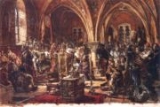
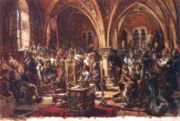
e grew. The confirmed history of the sejms goes back to 1182, the date of the first sejm at Łęczyca. However, Gallus Anonymus
Gallus Anonymus
Gallus Anonymus is the name traditionally given to the anonymous author of Gesta principum Polonorum , composed in Latin about 1115....
' Cronicae et gesta ducum sive principum Polonorum
Cronicae et gesta ducum sive principum Polonorum
The Gesta principum Polonorum is a medieval gesta, or deeds narrative, concerned with Duke Boleslaw III Wrymouth, his ancestors, and the Polish principality during and before his reign. Probably completed between 1112 and 1118, the extant text is present in three manuscripts with two distinct...
(Chronicles and Deeds of the Dukes or Princes of the Poles) speaks of the 9th-century election of the legendary founder of the Piast dynasty
Piast dynasty
The Piast dynasty was the first historical ruling dynasty of Poland. It began with the semi-legendary Piast Kołodziej . The first historical ruler was Duke Mieszko I . The Piasts' royal rule in Poland ended in 1370 with the death of king Casimir the Great...
, Siemowit
Siemowit
Siemowit was, according to the chronicles of Gallus Anonymus, the son of Piast the Wheelwright and Rzepicha. He was considered one of the four legendary Piast princes, but is now considered as a ruler who existed as a historical person....
, by a "sejm." This would place a Polish ruler's election a century before an Iceland
Iceland
Iceland , described as the Republic of Iceland, is a Nordic and European island country in the North Atlantic Ocean, on the Mid-Atlantic Ridge. Iceland also refers to the main island of the country, which contains almost all the population and almost all the land area. The country has a population...
ic one's by the Althing
Althing
The Alþingi, anglicised variously as Althing or Althingi, is the national parliament of Iceland. The Althingi is the oldest parliamentary institution in the world still extant...
.
Kingdom of Poland
Golden Liberty
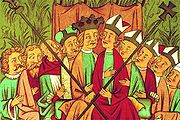
Golden Liberty , sometimes referred to as Golden Freedoms, Nobles' Democracy or Nobles' Commonwealth refers to a unique aristocratic political system in the Kingdom of Poland and later, after the Union of Lublin , in the Polish-Lithuanian Commonwealth...
the Sejm's powers increased.
The term "sejm" comes from an old Polish
Polish language
Polish is a language of the Lechitic subgroup of West Slavic languages, used throughout Poland and by Polish minorities in other countries...
expression denoting a meeting of the populace (similar to the Scandinavian Thing
Thing (assembly)
A thing was the governing assembly in Germanic and introduced into some Celtic societies, made up of the free people of the community and presided by lawspeakers, meeting in a place called a thingstead...
). From the 14th century, irregular sejms (termed in various sources in Latin
Latin
Latin is an Italic language originally spoken in Latium and Ancient Rome. It, along with most European languages, is a descendant of the ancient Proto-Indo-European language. Although it is considered a dead language, a number of scholars and members of the Christian clergy speak it fluently, and...
as conventio generalis, conventio magna, conventio solemnis, parlamentum, parlamentum generale, dieta or in Polish as sejm walny) were called by Polish kings. From 1374 and the Privilege of Koszyce
Privilege of Koszyce
The Privilege of Koszyce was a set of concessions made by Louis I of Hungary to the Polish szlachta in 1374. The privileges were granted in Košice...
(przywilej koszycki), the king had to receive the Sejm's permission to raise tax
Tax
To tax is to impose a financial charge or other levy upon a taxpayer by a state or the functional equivalent of a state such that failure to pay is punishable by law. Taxes are also imposed by many subnational entities...
es. The General Sejm (in Polish, Sejm Generalny or Sejm Walny), first convoked by King John I Olbracht in 1493 at Piotrków
Piotrków Trybunalski
Piotrków Trybunalski is a city in central Poland with 80,738 inhabitants . It is situated in the Łódź Voivodeship , and previously was the capital of Piotrków Voivodeship...
, evolved from earlier regional and provincial meetings (sejmik
Sejmik
A sejmik was a regional assembly in the Polish–Lithuanian Commonwealth, and earlier in the Kingdom of Poland. Sejmiks existed until the end of the Commonwealth in 1795 following the partitions of the Commonwealth...
s). It followed most closely the sejmik generalny (regional general sejm), which arose from the 1454 Nieszawa Statutes, granted to the szlachta
Szlachta
The szlachta was a legally privileged noble class with origins in the Kingdom of Poland. It gained considerable institutional privileges during the 1333-1370 reign of Casimir the Great. In 1413, following a series of tentative personal unions between the Grand Duchy of Lithuania and the Kingdom of...
(nobility) by King Casimir IV the Jagiellonian. From 1493 the General Sejm (Sejm Walny) met irregularly, on average once a year.
The first Sejm comprised two chambers:
- A SenatSenateA senate is a deliberative assembly, often the upper house or chamber of a legislature or parliament. There have been many such bodies in history, since senate means the assembly of the eldest and wiser members of the society and ruling class...
of 81 bishopBishopA bishop is an ordained or consecrated member of the Christian clergy who is generally entrusted with a position of authority and oversight. Within the Catholic Church, Eastern Orthodox, Oriental Orthodox Churches, in the Assyrian Church of the East, in the Independent Catholic Churches, and in the...
s and other dignitaries; - A lower house, the Sejm proper, of 54 deputies (PolishPolish languagePolish is a language of the Lechitic subgroup of West Slavic languages, used throughout Poland and by Polish minorities in other countries...
, singularGrammatical numberIn linguistics, grammatical number is a grammatical category of nouns, pronouns, and adjective and verb agreement that expresses count distinctions ....
: poseł, representing and elected by a local sejmikSejmikA sejmik was a regional assembly in the Polish–Lithuanian Commonwealth, and earlier in the Kingdom of Poland. Sejmiks existed until the end of the Commonwealth in 1795 following the partitions of the Commonwealth...
).
The number of deputies in the lower chamber grew in number and power as they pressured the king for more privileges. The spur toward action increased when landowners were drafted into military service (pospolite ruszenie
Pospolite ruszenie
Pospolite ruszenie , is an anachronistic term describing the mobilisation of armed forces, especially during the period of the Polish-Lithuanian Commonwealth. The tradition of wartime mobilisation of part of the population existed from before the 13th century to the 19th century...
). After 1569 Union of Lublin
Union of Lublin
The Union of Lublin replaced the personal union of the Kingdom of Poland and the Grand Duchy of Lithuania with a real union and an elective monarchy, since Sigismund II Augustus, the last of the Jagiellons, remained childless after three marriages. In addition, the autonomy of Royal Prussia was...
, the Kingdom of Poland
Kingdom of Poland (1385–1569)
The Kingdom of Poland of the Jagiellons was the Polish state created by the accession of Jogaila , Grand Duke of Lithuania, to the Polish throne in 1386. The Union of Krewo or Krėva Act, united Poland and Lithuania under the rule of a single monarch...
was transformed into the federation
Federation
A federation , also known as a federal state, is a type of sovereign state characterized by a union of partially self-governing states or regions united by a central government...
of the Polish-Lithuanian Commonwealth
Polish-Lithuanian Commonwealth
The Polish–Lithuanian Commonwealth was a dualistic state of Poland and Lithuania ruled by a common monarch. It was the largest and one of the most populous countries of 16th- and 17th‑century Europe with some and a multi-ethnic population of 11 million at its peak in the early 17th century...
and the Sejms number was increased with the inclusion of the deputies from Lithuanian Sejmiks.
Sejms severely limited the king's powers. They had the final decision in legislation
Legislation
Legislation is law which has been promulgated by a legislature or other governing body, or the process of making it...
, taxation, budget
Budget
A budget is a financial plan and a list of all planned expenses and revenues. It is a plan for saving, borrowing and spending. A budget is an important concept in microeconomics, which uses a budget line to illustrate the trade-offs between two or more goods...
, and treasury
Treasury
A treasury is either*A government department related to finance and taxation.*A place where currency or precious items is/are kept....
matters (including military funding), foreign affairs
Foreign Affairs
Foreign Affairs is an American magazine and website on international relations and U.S. foreign policy published since 1922 by the Council on Foreign Relations six times annually...
and ennoblement. In 1573 Sejm guaranteed religious tolerance in the Commonwealth territory, making it a refuge from the ongoing reformation
Protestant Reformation
The Protestant Reformation was a 16th-century split within Western Christianity initiated by Martin Luther, John Calvin and other early Protestants. The efforts of the self-described "reformers", who objected to the doctrines, rituals and ecclesiastical structure of the Roman Catholic Church, led...
and counter-reformation
Counter-Reformation
The Counter-Reformation was the period of Catholic revival beginning with the Council of Trent and ending at the close of the Thirty Years' War, 1648 as a response to the Protestant Reformation.The Counter-Reformation was a comprehensive effort, composed of four major elements:#Ecclesiastical or...
wars.
Polish-Lithuanian Commonwealth
.jpg)
Union of Lublin
The Union of Lublin replaced the personal union of the Kingdom of Poland and the Grand Duchy of Lithuania with a real union and an elective monarchy, since Sigismund II Augustus, the last of the Jagiellons, remained childless after three marriages. In addition, the autonomy of Royal Prussia was...
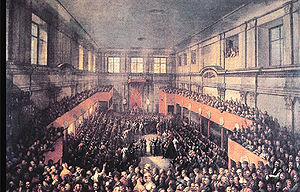
, Sejms were held near Piotrków; after the Union, at Warsaw's Royal Castle
Royal Castle, Warsaw
The Royal Castle in Warsaw is a castle residency and was the official residence of the Polish monarchs. It is located in the Castle Square, at the entrance to the Warsaw Old Town. The personal offices of the king and the administrative offices of the Royal Court of Poland were located there from...
. From 1673, every third Sejm was to take place at Grodno in Lithuania
Lithuania
Lithuania , officially the Republic of Lithuania is a country in Northern Europe, the biggest of the three Baltic states. It is situated along the southeastern shore of the Baltic Sea, whereby to the west lie Sweden and Denmark...
.
A Sejm began with a solemn mass
Mass
Mass can be defined as a quantitive measure of the resistance an object has to change in its velocity.In physics, mass commonly refers to any of the following three properties of matter, which have been shown experimentally to be equivalent:...
, the Kanclerz
Kanclerz
Kanclerz was one of the highest officials in the historic Poland. This office functioned from the early Polish kingdom of the 12th century until the end of the Polish-Lithuanian Commonwealth in 1795. A respective office also existed in the Grand Duchy of Lithuania since the 16th...
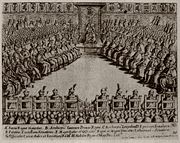
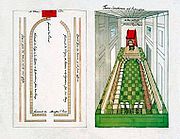
(Chancellor) declared the King's intentions, then the senators had the floor. Afterwards the King and Senate debated the most important matters (usually foreign affairs), while deputies debated separately under the leadership of the Marshal of the Sejm. In very important matters, the Senat and Sejm debated together in the senate chamber. Legislation was drafted in the lower chamber (Sejm). Members of the Sejm presented its proposed legislation
Legislation
Legislation is law which has been promulgated by a legislature or other governing body, or the process of making it...
to the gathered deputies of the Sejm, where they were discussed at length. The legislation was commonly negotiated by a deputation from the lower house (Sejm) with the upper chamber (Senate) and the reigning monarch (considered to be a third, separate Sejm chamber on his own).
The king could not pass the laws himself without the approval of the Sejm, this being forbidden by szlachta privileges like nihil novi
Nihil novi
Nihil novi nisi commune consensu is the original Latin title of a 1505 act adopted by the Polish Sejm , meeting in the royal castle at Radom.-History:...
from 1505. According to the "Nihil Novi" constitution a law passed by the Sejm had to be agreed by the three estates (the king, the Senate and deputies from the Sejm). King Henry's Articles, signed by each king since 1573, required the king to call a general sejm (lasting six weeks) every two years, and provisions for the extraordinary sejm (Polish: sejm ekstraordynaryjny, nadzwyczajny) were also set down in this act. Extraordinary sejms could be called in times of national emergency and last shorter, for example, a sejm deciding whether to call pospolite ruszenie
Pospolite ruszenie
Pospolite ruszenie , is an anachronistic term describing the mobilisation of armed forces, especially during the period of the Polish-Lithuanian Commonwealth. The tradition of wartime mobilisation of part of the population existed from before the 13th century to the 19th century...
should not last longer than two weeks.
The Marshal
Marszalek sejmu
Marshal of the Sejm also known as Sejm Marshal, Chairman of the Sejm or Speaker of the Sejm is the speaker of the Sejm...
(or Speaker) of the Sejm concluded the debates, but he was required to ask the members whether his understanding of the chamber's views was correct and unanimously accepted. If anyone declared his opposition (Latin contradictio), the debate would be reopened and would continue until the opponents of the measure abandoned their opposition.
Unanimity
Unanimity is agreement by all people in a given situation. When unanimous, everybody is of the same mind and acting together as one. Though unlike uniformity, it does not constitute absolute agreement. Many groups consider unanimous decisions a sign of agreement, solidarity, and unity...
was not required and majority voting predominated. Later, with the rise of the magnate
Magnate
Magnate, from the Late Latin magnas, a great man, itself from Latin magnus 'great', designates a noble or other man in a high social position, by birth, wealth or other qualities...
s' power, the unanimity principle was reinforced with the szlachta
Szlachta
The szlachta was a legally privileged noble class with origins in the Kingdom of Poland. It gained considerable institutional privileges during the 1333-1370 reign of Casimir the Great. In 1413, following a series of tentative personal unions between the Grand Duchy of Lithuania and the Kingdom of...
privilege of liberum veto
Liberum veto
The liberum veto was a parliamentary device in the Polish-Lithuanian Commonwealth. It allowed any member of the Sejm to force an immediate end to the current session and nullify any legislation that had already been passed at the session by shouting Nie pozwalam! .From the mid-16th to the late 18th...
(from the Latin: "I freely forbid"). The pro-majority-voting party almost disappeared in the 17th century, and majority voting was preserved only at confederated sejm
Confederated sejm
Confederated sejm was a form of sejm in the Polish-Lithuanian Commonwealth in the 18th century. After 1764, sejms were frequently confederated...
s (sejm rokoszowy, konny, konfederacyjny). To increase the chance of unanimous agreement, voting was delayed until an agreement had been reached, often through lengthy discussions. It was enough if no formal exception were taken by anyone — even if some opposition did exist, it would not necessarily be upheld. If, however, the deputies could not attain even such passive unanimity, or if the chamber's negotiations with the king proved futile, then after six weeks (the upper time limit of its sittings) the deliberations as a whole were declared null and void. Rarely, a deputy from a local sejmik
Sejmik
A sejmik was a regional assembly in the Polish–Lithuanian Commonwealth, and earlier in the Kingdom of Poland. Sejmiks existed until the end of the Commonwealth in 1795 following the partitions of the Commonwealth...
might object to the agreement and be granted an exception from this law, allowing the agreement to hold. From the mid-17th century onward, any objection to an item of Sejm legislation from a deputy or senator automatically caused other, earlier adopted legislation to be rejected. This was because all legislation adopted by a given Sejm formed a whole and was published as a "constitution" of the Sejm, e.g. the "constitution" of 1667.
The early statute
Statute
A statute is a formal written enactment of a legislative authority that governs a state, city, or county. Typically, statutes command or prohibit something, or declare policy. The word is often used to distinguish law made by legislative bodies from case law, decided by courts, and regulations...
s passed by the Sejm were called "constitution
Constitution
A constitution is a set of fundamental principles or established precedents according to which a state or other organization is governed. These rules together make up, i.e. constitute, what the entity is...
" (Polish konstytucja or konstytucja sejmowa) and should not be confused with modern meaning of this word. The konstytucja passed by the Sejm had denoted all the legislation, of whatever character, that had been passed at a Sejm. Only with the May 3rd Constitution in 1791 did konstytucja assume its modern sense of a fundamental document of governance. The Henrician Articles
Henrician Articles
The Henrician Articles or King Henry's Articles were a permanent contract that stated the fundamental principles of governance and constitutional law in the Polish-Lithuanian Commonwealth in the form of 21 Articles written and adopted by the nobility in 1573 at the town of Kamień, near Warsaw,...
, however, had been a virtual constitution for the Commonwealth prior.
The final version of approved acts (which from the late 15th century until the early 16th century were divided into perpetual and temporary constitutions ('constitutiones perpetuae' and 'constitutiones temporales') were drawn up at the sealing sessions, held after the close of the Sejm debate. These sessions were attended by the chancellor
Chancellor
Chancellor is the title of various official positions in the governments of many nations. The original chancellors were the Cancellarii of Roman courts of justice—ushers who sat at the cancelli or lattice work screens of a basilica or law court, which separated the judge and counsel from the...
, the Speaker of the Sejm and members from the Sejm and the Senate. From the end of the 16th century, the constitutions they signed were printed, stamped with the royal seal, and sent to the chancelleries
Chancellery
Chancellery is the office of the chancellor, sometimes also referred to as the chancery. Both of those words have other meanings as well.Chancellery can specifically refer to:...
of the municipal council
Municipal council
A municipal council is the local government of a municipality. Specifically the term can refer to the institutions of various countries that can be translated by this term...
s of all voivodships of the Crown and also to the Grand Duchy of Lithuania
Grand Duchy of Lithuania
The Grand Duchy of Lithuania was a European state from the 12th /13th century until 1569 and then as a constituent part of Polish-Lithuanian Commonwealth until 1791 when Constitution of May 3, 1791 abolished it in favor of unitary state. It was founded by the Lithuanians, one of the polytheistic...
. After 1543 the resolutions were written in Polish rather than Latin. Those resolutions were presented soon after the Sejm to local meetings, known as sejmiki relacyjne. In accordance with the act of 1613, immediately after the close of Sejm debates, the constitutions it had passed were published by entering them in the registers where the Sejm had met. Copies still had to be sent to municipal councils (urzędy grodzkie) throughout the country, where they were added to the municipal registers (księgi grodzkie).
It is estimated that between 1493 and 1793 sejms were held 240 times, and total debate time was 44 years.
Interestingly, the expression 'Polish parliament' (in Swedish
Swedish language
Swedish is a North Germanic language, spoken by approximately 10 million people, predominantly in Sweden and parts of Finland, especially along its coast and on the Åland islands. It is largely mutually intelligible with Norwegian and Danish...
: Polsk riksdag) occurs in modern Swedish
Swedish language
Swedish is a North Germanic language, spoken by approximately 10 million people, predominantly in Sweden and parts of Finland, especially along its coast and on the Åland islands. It is largely mutually intelligible with Norwegian and Danish...
and Norwegian
Norwegian language
Norwegian is a North Germanic language spoken primarily in Norway, where it is the official language. Together with Swedish and Danish, Norwegian forms a continuum of more or less mutually intelligible local and regional variants .These Scandinavian languages together with the Faroese language...
to denote organizational anarchy and disorder. This is suggested to have originated from comparisons to the veto right in the Polish Sejm during Commonwealth times, which was likely an unthinkable liberty in the authoritarian systems of neighbouring countries, including the Swedish Absolute Monarchy
Enlightened Absolute Monarchy in Sweden
- Gustav III :Adolf Frederick of Sweden died on February 12, 1771. The elections held on the demise of the Crown resulted in a Gustav's partial victory for the Caps, especially among the lower orders; but in the estate of the peasantry their majority was merely nominal, while the mass of the...
.
Types of sejm
- General sejm (Sejm walny)
- Convocation sejm (Sejm konwokacyjny)
- Election sejm (Sejm elekcyjny)
- Coronation sejm (Sejm koronacyjny)
- Confederated sejmConfederated sejmConfederated sejm was a form of sejm in the Polish-Lithuanian Commonwealth in the 18th century. After 1764, sejms were frequently confederated...
(Sejm skonfederowany) - SejmikSejmikA sejmik was a regional assembly in the Polish–Lithuanian Commonwealth, and earlier in the Kingdom of Poland. Sejmiks existed until the end of the Commonwealth in 1795 following the partitions of the Commonwealth...
(local sejm)
Some notable sejms
- Silent SejmSilent SejmSilent Sejm is the name given to the session of the Sejm of the Polish-Lithuanian Commonwealth of 1 February 1717. A civil war in the Commonwealth was used by the Russian Tsar Peter the Great as an opportunity to intervene as a mediator...
(Sejm Niemy, 1717) - Pacification SejmPacification SejmThe Pacification Sejm was a session of the Sejm in 1736 that concluded the War of the Polish Succession in the Polish-Lithuanian Commonwealth that erupted after the death of Augustus II the Strong in February 1733...
(Sejm pacyfikacyjny, 1736) - Convocation Sejm of 1764Convocation Sejm (1764)The Convocation Sejm of 1764 was a session of the Sejm of the Polish-Lithuanian Commonwealth. It took place in Warsaw from 7 May to 23 June, and was a confederated convocation sejm, tasked with preparing a new royal election to fill the throne of the Commonwealth...
(Sejm konwokacyjny) - Repnin SejmRepnin SejmThe Repnin Sejm was a Sejm of the Polish–Lithuanian Commonwealth that took place between 1767 and 1768 in Warsaw. This session followed the Sejms of 1764 to 1766, where the newly elected King of Poland, Stanisław August Poniatowski, attempted with some successes to push through reforms to...
(Sejm Repninowski, 1767–1768) - Partition SejmPartition SejmThe Partition Sejm was a Sejm lasting from 1773 to 1776 in the Polish-Lithuanian Commonwealth, convened by its three neighbours in order to legalize their First Partition of Poland. During its first days in session, that Sejm was the site of Tadeusz Rejtan famous gesture of protest...
(Sejm rozbiorowy, 1773–1776) - Great SejmGreat SejmThe Great Sejm, also known as the Four-Year Sejm was a Sejm of the Polish-Lithuanian Commonwealth that was held in Warsaw, beginning in 1788...
(Sejm Wielki, 1788–1792) - Grodno SejmGrodno SejmGrodno Sejm was the last Sejm of the Polish-Lithuanian Commonwealth. The Grodno Sejm, held in fall of 1793 in Grodno, Grand Duchy of Lithuania is infamous because its deputies, bribed or coerced by the Russian Empire, passed the act of Second Partition of Poland...
(Sejm grodzieński, 1791)