

Devon

Encyclopedia
Devon is a large county
in southwestern England. The county is sometimes referred to as Devonshire, although the term is rarely used inside the county itself as the county has never been officially "shired", it often indicates a traditional or historical context
.
The county shares borders with Cornwall
to the west and Dorset
and Somerset
to the east. Its southern coast abuts the English Channel
and its northern coast the Bristol Channel
and Celtic Sea
. The name "Devon" derives from the kingdom of Dumnonia
, which was home to the tribe of Celtic people who inhabited this area of the southwestern peninsula of Britain at the time of the Roman invasion in AD 43, Dumnonii
—possibly meaning "Deep Valley Dwellers" or "Worshippers of the god Dumnonos".
Devon is the fourth largest of the English counties by area and has a population of 1,141,600 making it the 11th largest. The county town
is the cathedral city of Exeter
. In addition to Devon County Council
, the county contains two unitary authorities
(independent from Devon County Council's control): the port city of Plymouth
and Torbay
, a conurbation of seaside resorts. Plymouth is also the largest city in Devon. Much of the county is rural (including national park
) land, with a low population density by British standards. It contains Dartmoor
954 km² (368.3 sq mi), the largest open space in southern England. It is the only English county to have two separate coastlines – a north and southern coastline.
The county is home to part of England's only natural UNESCO World Heritage Site
, the Dorset and East Devon Coast, known as the Jurassic Coast
for its geology and geographical features. It is also home to Braunton Burrows
UNESCO Biosphere Reserve, a dune complex in the north of the county. Along with Cornwall, Devon is known as the "Cornubian massif
". This geology gives rise to the landscapes of Dartmoor
and Exmoor
, the latter two being national parks. Devon has seaside resorts and historic towns and cities, rural scenery and a mild climate, accounting for the large tourist sector of its economy.
ic people who inhabited the southwestern peninsula of Britain at the time of the Roman invasion c. AD 50, known as the Dumnonii
, thought to mean "deep valley dwellers". In the Brythonic
Celtic languages, Devon is known as Dyfnaint (Welsh
), Devnent (Breton
) and Dewnens (Cornish
). (For an account of Celtic Dumnonia
see the separate article.)
William Camden
, in his 1607 edition of Britannia, described Devon as being one part of an older, wider country that once included Cornwall:
The term "Devon" is normally used for everyday purposes e.g. "Devon County Council" but "Devonshire" continues to be used in the names of the "Devonshire and Dorset Regiment" and "The Devonshire Association". One erroneous theory is that the "shire" suffix is due to a mistake in the making of the original letters patent for the Duke of Devonshire, resident in Derbyshire
. However, there are references to "Defenascire" in Anglo-Saxon
texts from before 1000 AD (this would mean "Shire of the Devonians"), which translates to modern English as "Devonshire". The term Devonshire may have originated around the 8th century, when it changed from Dumnonia (Latin) to Defenascir.
is thought to have been occupied by Mesolithic
hunter-gatherer
peoples from about 6000 BC. The Romans held the area under military occupation for around 350 years. Later, the area began to experience Saxon incursions from the east around 600 AD, firstly as small bands of settlers along the coasts of Lyme Bay and southern estuaries and later as more organised bands pushing in from the east. Devon became a frontier between Brythonic Dumnonia and Anglo-Saxon
Wessex
, and it was largely absorbed into Wessex by the mid 9th century. The border with Cornwall was set by King Athelstan on the east bank of the River Tamar in 936 AD. Danish raids also occurred sporadically along many coastal parts of Devon between around 800AD and just before the time of the Norman conquest, including at Taintona (a settlement on the Teign estuary) in 1001.
Devon has also featured in most of the civil conflicts in England since the Norman Conquest, including the Wars of the Roses
, Perkin Warbeck
's rising in 1497, the Prayer Book Rebellion
of 1549, and the English Civil War
. The arrival of William of Orange
to launch the Glorious Revolution
of 1688 took place at Brixham
.
Devon has produced tin
, copper and other metals from ancient times. Devon's tin miners enjoyed a substantial degree of independence through Devon's Stannary Parliament, which dates back to the 12th century. The last recorded sitting was in 1748.
to the west, historically Devon has been disadvantaged economically compared to other parts of Southern England
, owing to the decline of a number of core industries, notably fishing, mining and farming. Agriculture has been an important industry in Devon since the 19th century. The 2001 UK foot and mouth crisis harmed the farming community severely. Since then some parts of the agricultural industry have begun to diversify and recover, with a strong local food sector and many artisan producers. It is also the headquarters of the UK's largest organic veg box provider - Riverford Organics, based near Totnes and River Cottage based near Axminster. Nonetheless the dairy industry is still suffering from the low prices offered for wholesale milk by major dairies and especially large supermarket chains.
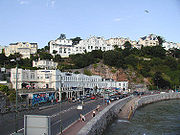 The attractive lifestyle of the area is drawing in new industries which are not heavily dependent upon geographical location; Dartmoor
, for instance, has recently seen a significant rise in the percentage of its inhabitants involved in the financial services sector. In 2003, the Met Office
, the UK's national and international weather service, moved to Exeter and employs around 1,000 people. .
Since the rise of seaside resorts with the arrival of the railways in the 19th century, Devon's economy has been heavily reliant on tourism. The county's economy followed the declining trend of British seaside resorts since the mid-20th century, but with some recent revival and regeneration of its resorts, particularly focused around camping; sports such as surfing, cycling, sailing and heritage. This revival has been aided by the designation of much of Devon's countryside and coastline as the Dartmoor
and Exmoor
national parks, and the Jurassic Coast
and Cornwall and West Devon Mining Landscape
World Heritage Sites. In 2004 the county's tourist revenue was £1.2 billion.. More successful visitor attractions in recent years have tended to target higher spending tourists, particularly focusing around the food and drink sector and watersports. Examples such as the Venus Cafes; Damien Hirst's restaurant in Ilfracombe; Burgh Island; surfing and camping around Croyde and Woolacombe and sailing around Salcombe have all proved a big draw in recent years.
Incomes vary significantly across the county, with parts of Torridge and Torbay having among the lowest earnings in the whole of the UK. Incomes in much of the South Hams and in villages surrounding Exeter and Plymouth are by contrast above the national average. Likewise levels of deprivation tend to be highest in urban areas such as Torbay, Plymouth, plus parts of Exeter and Ilfracombe. They are lowest in the rural fringes of big settlements, easily commutable and leafy, such as Ivybridge, Woodbury, Kenton and Braunton.
 A sharp geological dividing line cuts across Devon roughly to the west of Tiverton and Exeter and ending around Newton Abbot and Torquay. This forms part of the Tees/Exe line dividing Britain from the lowlands (sedimentary rocks) that are predominant to the east of the line and the higher land (igneous and metamorphic rocks) which dominates to the west.
The principal geological formations of Devon are the Devonian (in north Devon, south west Devon and extending into Cornwall); the Culm Measures (north western Devon also extending into north Cornwall); and the granite intrusion
of Dartmoor in central Devon, part of the Cornubian batholith
. There are small remains of pre-Devonian rocks on the south Devon coast.
Devon gave its name to a geological period: the Devonian
period, so named because of the abundance of the grey limestone found there. It was Roderick Murchison and Adam Sedgwick who originally named the Devonian Period following research they carried out in Devon, and in particular, Torbay. They found some unusual marine fossils in the limestone at Lummaton Quarry and it was this discovery that led to the time period becoming known globally as the Devonian.
Devon's second major rock system is the Culm Measures
, a geological formation of the Carboniferous
period that occurs principally in Devon and Cornwall
. The measures are so called either from the occasional presence of a soft, sooty coal, which is known in Devon as culm, or from the contortions commonly found in the beds. This formation stretches from Bideford
to Bude
in Cornwall, and contributes to a gentler, greener, more rounded landscape. It is also found on the western, north and eastern borders of Dartmoor.
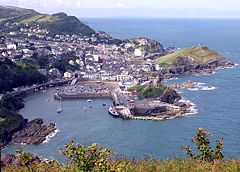 The whole of central Devon is occupied by the largest area of igneous rock in South West England
, Dartmoor
.
The sedimentary rocks in more eastern parts of the county include Permian and Triassic sandstones (giving rise to Devon's well known fertile red soils); Bunter pebble beds around Budleigh Salterton and Woodbury Common and Jurassic rocks in the easternmost parts of Devon. Smaller deposits of even newer rocks also exist, such as Cretaceous chalk cliffs at Beer head and gravels on Haldon, plus Eocene and Oligocene ball clay and lignite deposits in the Bovey Basin, formed around 50m years ago under tropical forest conditions.
Devon is the only county in England to have two separate coastlines; the South West Coast Path
runs along the entire length of both, around 65% of which is named as Heritage Coast
. Devon has more mileage of road than any other county in England: before the changes to counties in 1974 it was the largest by area of the counties not divided into two or three parts. (Its acreage was until 1974 1,658,288: only exceeded by the West Riding of Yorkshire
.) The islands of Lundy
and Eddystone are also in Devon.
Inland, the Dartmoor
National Park
lies wholly in Devon, and the Exmoor
National Park lies in both Devon and Somerset
. Apart from these areas of high moorland the county has attractive rolling rural scenery and villages with thatched cob
cottages. All these features make Devon a popular holiday
destination.
In South Devon
the landscape consists of rolling hills dotted with small towns, such as Dartmouth, Ivybridge
, Kingsbridge
, Salcombe
, and Totnes
. The towns of Torquay
and Paignton
are the principal seaside resort
s on the south coast. East Devon has the first seaside resort to be developed in the county, Exmouth
and the more upmarket Georgian town of Sidmouth
, headquarters of the East Devon District Council. Exmouth marks the western end of the Jurassic Coast
World Heritage Site
. Another notable feature is the coastal railway line
between Newton Abbot and the Exe Estuary: the red sandstone cliffs and sea views are very dramatic and in the resorts railway line and beaches are very near.
North Devon
is very rural with few major towns except Barnstaple
, Great Torrington
, Bideford
and Ilfracombe
. Devon's Exmoor coast has the highest cliffs in southern Britain, culminating in the Great Hangman
, a 318 m (1043 ft) "hog's-back" hill with an 250 m (820 ft) cliff-face, located near Combe Martin Bay. Its sister cliff is the 218 m (716 ft) Little Hangman, which marks the western edge of coastal Exmoor. One of the features of the North Devon coast is that Bideford Bay
and the Hartland Point
peninsula are both west-facing, Atlantic facing coastlines; so that a combination of an off-shore (east) wind and an Atlantic swell produce excellent surfing conditions. The beaches of Bideford Bay (Woolacombe
, Saunton
, Westward Ho!
and Croyde
), along with parts of North Cornwall and South Wales, are the main centres of surfing in Britain.
. In winter snow is relatively uncommon away from high land, although there are exceptions, such as the snowfall of February 2009
, and of December 2010. The county receives warm summers with occasional hot spells and cool rainy periods. Winters are generally mild and the county often experiences some of the mildest winters in the world for its latitude along with Brittany and Vancouver,Canada with average maximum temperatures in January approaching 10 degrees C. Rainfall varies significantly across the county ranging from over 2000 mm (80 inches)on parts of Dartmoor, to around 750 mm (30 inches)along the coast in southeastern parts of Devon and around Exeter (Rain shadow
). Sunshine amounts also vary massively with the moors generally being very cloudy, but the southeastern coast from Salcombe to Exmouth one of the sunniest parts of the UK. In summer east, or southeasterly winds mean the area around Saunton and Croyde often records among the highest temperatures in Britain. Similarly with west, or southwesterly winds and high pressure the area around Torbay and Teignmouth will often be very warm with long sunny spells due to shelter by high ground (Foehn wind).
, for example). A popular challenge among birders is to find over 100 species in the county in a day. The county's wildlife is protected by several wildlife charities such as the Devon Wildlife Trust
, a charity which looks after 40 nature reserves. The Devon Bird Watching and Preservation Society (DBWPS) is a county bird society with a long and distinguished history dating back to 1928. It is dedicated to the study and conservation of wild birds looks after several areas, such as Beesands Ley. There is also the RSPB, which has reserves in the county, as well as English Nature, who look after several reserves such as Dawlish Warren. The botany of the county is very diverse and includes some rare species not found elsewhere in the British Isles other than Cornwall. Botanical reports begin in the 17th century and there is a Flora Devoniensis by Jones and Kingston in 1829, and a Flora of Devon in 1939 by Keble Martin
and Fraser. There is a general account by W. P. Hiern and others in The Victoria History of the County of Devon, vol. 1 (1906); pp. 55–130, with map. Devon is divided into two Watsonian vice-counties: north and south, the boundary being an irregular line approximately across the higher part of Dartmoor and then along the canal eastwards.
Rising temperatures have led to Devon becoming the first place in modern Britain to cultivate olives commercially.
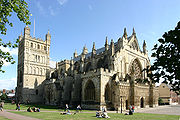 The administrative centre of Devon is the city of Exeter
. The largest city in Devon, Plymouth
, and the conurbation of Torbay
(including Torquay
, Paignton
and Brixham
) have been unitary authorities
since 1998, separate from the remainder of Devon which is administered by Devon County Council
for the purposes of local government.
Devon County Council is controlled by the Conservatives, and the political representation of its 62 councillors are: 41 Conservatives
, 14 Liberal Democrats
, four Labour
, two Independent
s and one Green
. At a national level, Devon has seven Conservative MPs
, two Liberal Democrat MPs, and two Labour MPs.
In December 2007, the Department for Communities and Local Government
referred Exeter City Council
's bid to become a Unitary Council to the Boundary Committee for England
, as they felt the application did not meet all their strict criteria. The Boundary Committee was asked to look at the feasibility of a unitary Exeter
in the context of examining options for unitary arrangements in the wider Devon county area, and reported back in July 2008 recommending a "unitary Devon" (excluding Plymouth and Torbay), with a second option of a "unitary Exeter & Exmouth" (combined) and a unitary "rest of Devon". These proposals were put out to consultation until September 2008 and the Committee was expected to make final recommendations to the Secretary of State by the end of the year. As a result of a number of legal challenges to the process and also dissatisfaction on the part of the Secretary of State with the manner in which the Boundary Committee is assessing proposals, it now looks likely that a recommendation will not be forthcoming until March or April 2009.
Hundreds
Historically Devon was divided into 32 hundreds: Axminster
, Bampton
, Black Torrington
, Braunton
, Cliston
, Coleridge
, Colyton
, Crediton
, East Budleigh
, Ermington
, Exminster
, Fremington
, Halberton
, Hartland, Hayridge
, Haytor, Hemyock, Lifton, North Tawton and Winkleigh, Ottery, Plympton, Roborough
, Shebbear, Shirwell, South Molton, Stanborough, Tavistock, Teignbridge, Tiverton, West Budleigh, Witheridge, and Wonford
.
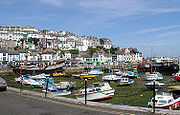 The main settlements in Devon are the cities of Plymouth
, a historic port now administratively independent, Exeter
, the county town
, and Torbay
, the county's tourist centre. Devon's coast is lined with tourist resorts, many of which grew rapidly with the arrival of the railways in the 19th century. Examples include Dawlish
, Exmouth
and Sidmouth
on the south coast, and Ilfracombe
and Lynmouth
on the north. The Torbay conurbation of Torquay
, Paignton
and Brixham
on the south coast is now administratively independent of the county. Rural market town
s in the county include Barnstaple
, Bideford
, Honiton
, Newton Abbot
, Okehampton
, Tavistock, Totnes
and Tiverton.
The boundary with Cornwall has not always been on the River Tamar as at present: until the late 19th century a few parishes in the Torpoint area were in Devon and five parishes now in north-east Cornwall were in Devon until 1974. (However for ecclesiastical purposes these were nevertheless in the Archdeaconry of Cornwall and in 1876 became part of the Diocese of Truro
.)
s were the first religions in Devon, although in the first centuries AD, Christianity was introduced to Devon. In the Sub-Roman period
the church in the British Isles was characterised by some differences in practice from the Latin Christianity of the continent of Europe and is known as Celtic Christianity
; however it was always in communion with the wider Roman Catholic Church. Many Cornish saints are commemorated also in Devon in legends, churches and placenames. Western Christianity
came to Devon when it was over a long period incorporated into the kingdom of Wessex and the jurisdiction of the bishop of Wessex. Saint Petroc
is said to have passed through Devon, where ancient dedications to him are even more numerous than in Cornwall: a probable seventeen (plus Timberscombe
just over the border in Somerset), compared to Cornwall's five. The position of churches bearing his name, including one within the old Roman walls of Exeter
(Karesk), are nearly always near the coast reminding us that in those days travelling was done mainly by sea. The Devonian villages of Petrockstowe
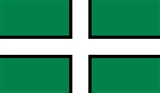
and Newton St Petroc are also named after Saint Petroc and the flag of Devon
is dedicated to him.
The history of Christianity in the South West of England remains to some degree obscure. Parts of the historic county of Devon formed part of the diocese of Wessex, while nothing is known of the church organisation of the Celtic areas. About 703 Devon and Cornwall were included in the separate diocese of Sherborne and in 900 this was again divided into two, the Devon bishop having from 905 his seat at Tawton (now Bishop's Tawton
) and from 912 at Crediton
, birthplace of St Boniface. Lyfing became Bishop of Crediton
in 1027 and shortly afterwards became Bishop of Cornwall
.
The two dioceses of Crediton and Cornwall, covering Devon and Cornwall, were permanently united under Edward the Confessor
by Lyfing's successor Bishop Leofric
, hitherto Bishop of Crediton, who became first Bishop of Exeter under Edward the Confessor
, which was established as his cathedral city in 1050. At first, the abbey church of St Mary and St Peter, founded by Athelstan in 932 and rebuilt in 1019, served as the cathedral.
caused the deaths of thousands of people from Devon and Cornwall. During the English Reformation
, churches in Devon officially became affiliated with the Church of England
. The Methodism
of John Wesley
proved to be very popular with the working classes in Devon in the 19th century. Methodist chapels became important social centres, with male voice choirs and other church-affiliated groups playing a central role in the social lives of working class Devonians. Methodism still plays a large part in the religious life of Devon today, although the county has shared in the post-World War II decline in British religious feeling.
The Diocese of Exeter
remains the Anglican diocese including the whole of Devon. The Roman Catholic Diocese of Plymouth was established in the mid 19th century.
and Exeter
, built in 1762 and 1763 respectively.
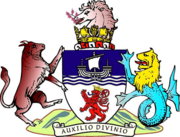 There was no established coat of arms
for the county until 1926: the arms of the City of Exeter
were often used to represent Devon, for instance in the badge of the Devonshire Regiment. During the forming of a county council by the Local Government Act 1888
adoption of a common seal was required. The seal contained three shields depicting the arms of Exeter along with those of the first chairman and vice-chairman of the council (Lord Clinton
and the Earl of Morley
).
On 11 October 1926, the county council received a grant of arms from the College of Arms
. The main part of the shield displays a red crowned lion on a silver field, the arms of Richard Plantagenet, Earl of Cornwall. The chief or upper portion of the shield depicts an ancient ship on wavers, for Devon's seafaring traditions. The Latin
motto adopted was Auxilio Divino (by Divine aid), that of Sir Francis Drake
. The 1926 grant was of arms alone. On 6 March 1962 a further grant of crest and supporters was obtained. The crest is the head of a Dartmoor Pony
rising from a "Naval Crown". This distinctive form of crown is formed from the sails and sterns of ships, and is associated with the Royal Navy
. The supporters are a Devon bull and a sea lion.
The County Council adopted a "ship silhouette" logo after the 1974 reorganisation, adapted from the ship emblem on the coat of arms, but following the loss in 1998 of Plymouth and Torbay re-adopted the coat of arms. In April 2006 the council unveiled a new logo which was to be used in most everyday applications, though the coat of arms will continue to be used for "various civic purposes".
, a local saint
with dedications throughout Devon and neighbouring counties. The flag was adopted in 2003 after a competition run by BBC Radio Devon
. The winning design was created by website contributor Ryan Sealey, and won 49% of the votes cast. The colours of the flag are those popularly identified with Devon, for example, the colours of Exeter University, the rugby union
team, and the Green and White flag flown by the first Viscount Exmouth
at the Bombardment of Algiers
(now on view at the Teign Valley Museum), as well as one of the county's football teams, Plymouth Argyle
. On 17 October 2006, the flag was hoisted for the first time outside County Hall in Exeter to mark Local Democracy Week, receiving official recognition from the county council.
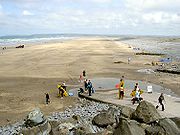 Devon's place names include many with the endings "coombe/combe" and "tor" – Coombe being the Brythonic word for "valley" or hollow (cf Welsh 'cwm') whilst tor derives from a number of Celtic loan-words in English (Old Welsh twrr and Scots Gaelic tòrr) and is used as a name for the formations of rocks found on the moorlands. Its frequency is greatest in Devon, where it is the second most common place name component (after 'ton', derived from the Old English tun meaning enclosure, farmstead, farm or village).
Devon has a variety of festivals and traditional practices, including the traditional orchard-visiting Wassail
in Whimple
every 17 January and the carrying of flaming tar barrels in Ottery St. Mary, where people who have lived in Ottery for long enough are called upon to celebrate Bonfire Night
by running through the village (and the gathered crowds) with flaming barrels of tar on their backs. Berry Pomeroy
still celebrates "Queen's Day" for Elizabeth I.
) colleges and an agricultural college (Bicton College
, near Budleigh Salterton
). Torbay has 8 state (with 3 grammar school
s) and 3 independent secondary schools, and Plymouth has 17 state (with 3 grammar schools – two female and one male) and one independent school, Plymouth College
. East Devon and Teignbridge have the largest school populations, with West Devon the smallest (with only two schools). Only one school in Exeter, Mid Devon, Torridge and North Devon have a sixth form
– the schools in other districts mostly have sixth forms, with all schools in West Devon and East Devon having a sixth form. The county also plays host to two major British universities, the University of Exeter
(split between the Streatham Campus
and St Luke's Campus
both in Exeter and a campus in Cornwall
); in Plymouth the University of Plymouth
, the fourth largest university in Britain is present, along with the Marjon's College to the city's north . Both the universities of Exeter and Plymouth have co-formed the Peninsula College of Medicine and Dentistry
which has bases in Exeter and Plymouth. There is also Schumacher College
.
, involving scones
, jam and clotted cream
, is thought to have originated in Devon (though claims have also been made for neighbouring counties); in other countries, such as Australia and New Zealand, it is known as a "Devonshire tea". In Australia, Devon
is a name for luncheon meat (processed ham).
In October 2008, Devon was awarded Fairtrade County status by the Fairtrade Foundation.
, attended a match between the champions of Devon and Cornwall. Another Devon sport was outhurling
which was played in some regions until the 20th century (e.g. 1922, at Great Torrington). Other ancient customs which survive include Dartmoor
step dancing, and "Crying The Neck
".
Devon has three professional football teams, based in each of its three most populous towns and cities. In the 2011/2012 football season
, Exeter City F.C.
will compete in Football League One
, and Torquay United F.C.
and Plymouth Argyle F.C.
in Football League Two
. Plymouth's best performance came in 1987 when they finished seventh in the Football League Second Division
, while Torquay and Exeter have never progressed beyond the third tier of the league. The county's biggest non-league club is Tiverton Town F.C.
which competes in the Southern Football League Division One South & West.
Rugby Union
is popular in Devon with two teams – Exeter Chiefs
play in the Aviva Premiership and Plymouth Albion who are, as of 2011, in the RFU Championship
. In basketball, Plymouth Raiders
play in the British Basketball League
. Tamar Valley Cannons, also based in Plymouth, are Devon's only other representatives in the National Leagues. Motorcycle speedway
is also supported in the county, with both the Exeter Falcons
and Plymouth Devils
succeeding in the National Leagues in recent years.
There are four rugby league
teams in Devon. Plymouth Titans, Exeter Centurions
, Devon Sharks
from Torquay and East Devon Eagles
from Exmouth. They all play in the Rugby League Conference
.
Devon also boasts a field hockey
club who play in the National Premier League
, the University of Exeter Hockey Club
Horse Racing, particularly point to point racing and National Hunt Racing is also popular in the county, with two National Hunt racecourses (Exeter and Newton Abbot), and numerous point to point courses. There are also many successful professional racehorse trainers based in Devon.
The county is represented in cricket
by Devon County Cricket Club
, who play at a Minor counties level.
, Sir Humphrey Gilbert
, Sir Richard Grenville, Sir Walter Raleigh
, and Sir Francis Chichester
. Henry Every
, described as the most notorious pirate of the late 17th century, was probably born in the village of Newton Ferrers
. Thomas Morton (1576–1647?) was an avid Elizabethan outdoorsman probably born in Devon who became an attorney for The Council For New England, and built the New England fur-trading-plantation called Ma-Re Mount or Merrymount around a West Country-style Maypole, much to the displeasure of Pilgrim and Puritan colonists. Morton wrote a 1637 book New English Canaan about his experiences, partly in verse, and may have thereby become America's first poet to write in English. Another famous mariner and Devonian was Robert Falcon Scott
, the leader of the unfortunate Terra Nova Expedition
to reach the geographical South Pole
. The poet Samuel Taylor Coleridge
, the crime writer Agatha Christie
and the poet Ted Hughes
lived in Devon (his funeral and cremation were held there). The painter and founder of the Royal Academy
, Sir Joshua Reynolds, was born in Devon.
The actor Matthew Goode
was raised in Devon, and Bradley James, also an actor, was born there. The singer Joss Stone
was brought up in Devon and frontman Chris Martin
from the English rock group Coldplay
was born there. Matt Bellamy, Dominic Howard
and Christopher Wolstenholme from the English group Muse
all grew up in Devon and formed the band there. Dave Hill of pop band Slade
was born in Flete House
which is in the South Hams district of Devon. Another famous Devonian is the model and actress Rosie Huntington-Whiteley
, who was born in Plymouth
and raised in Tavistock.
Trevor Francis
, former Nottingham Forest
and Birmingham City
professional footballer was born and brought up in Plymouth. Swimmer Sharron Davies
was born in Plymouth. Peter Cook the satirist, writer and comedian was born in Torquay, Devon. Leicester Tigers
and British Lions
Rugby player Julian White
MBE
was born and raised in Devon and now farms a herd of pedigree South Devon beef cattle. The dog breeder John "Jack" Russell was also from Devon. Jane McGrath
, who married Australian cricketer Glenn McGrath
was born in Paignton, her long battle with and subsequent death from breast cancer inspired the formation of the McGrath Foundation
, which is one of Australia's leading charities.
Counties of England
Counties of England are areas used for the purposes of administrative, geographical and political demarcation. For administrative purposes, England outside Greater London and the Isles of Scilly is divided into 83 counties. The counties may consist of a single district or be divided into several...
in southwestern England. The county is sometimes referred to as Devonshire, although the term is rarely used inside the county itself as the county has never been officially "shired", it often indicates a traditional or historical context
Shire
A shire is a traditional term for a division of land, found in the United Kingdom and in Australia. In parts of Australia, a shire is an administrative unit, but it is not synonymous with "county" there, which is a land registration unit. Individually, or as a suffix in Scotland and in the far...
.
The county shares borders with Cornwall
Cornwall
Cornwall is a unitary authority and ceremonial county of England, within the United Kingdom. It is bordered to the north and west by the Celtic Sea, to the south by the English Channel, and to the east by the county of Devon, over the River Tamar. Cornwall has a population of , and covers an area of...
to the west and Dorset
Dorset
Dorset , is a county in South West England on the English Channel coast. The county town is Dorchester which is situated in the south. The Hampshire towns of Bournemouth and Christchurch joined the county with the reorganisation of local government in 1974...
and Somerset
Somerset
The ceremonial and non-metropolitan county of Somerset in South West England borders Bristol and Gloucestershire to the north, Wiltshire to the east, Dorset to the south-east, and Devon to the south-west. It is partly bounded to the north and west by the Bristol Channel and the estuary of the...
to the east. Its southern coast abuts the English Channel
English Channel
The English Channel , often referred to simply as the Channel, is an arm of the Atlantic Ocean that separates southern England from northern France, and joins the North Sea to the Atlantic. It is about long and varies in width from at its widest to in the Strait of Dover...
and its northern coast the Bristol Channel
Bristol Channel
The Bristol Channel is a major inlet in the island of Great Britain, separating South Wales from Devon and Somerset in South West England. It extends from the lower estuary of the River Severn to the North Atlantic Ocean...
and Celtic Sea
Celtic Sea
The Celtic Sea is the area of the Atlantic Ocean off the south coast of Ireland bounded to the east by Saint George's Channel; other limits include the Bristol Channel, the English Channel, and the Bay of Biscay, as well as adjacent portions of Wales, Cornwall, Devon, and Brittany...
. The name "Devon" derives from the kingdom of Dumnonia
Dumnonia
Dumnonia is the Latinised name for the Brythonic kingdom in sub-Roman Britain between the late 4th and late 8th centuries, located in the farther parts of the south-west peninsula of Great Britain...
, which was home to the tribe of Celtic people who inhabited this area of the southwestern peninsula of Britain at the time of the Roman invasion in AD 43, Dumnonii
Dumnonii
The Dumnonii or Dumnones were a British Celtic tribe who inhabited Dumnonia, the area now known as Devon and Cornwall in the farther parts of the South West peninsula of Britain, from at least the Iron Age up to the early Saxon period...
—possibly meaning "Deep Valley Dwellers" or "Worshippers of the god Dumnonos".
Devon is the fourth largest of the English counties by area and has a population of 1,141,600 making it the 11th largest. The county town
County town
A county town is a county's administrative centre in the United Kingdom or Ireland. County towns are usually the location of administrative or judicial functions, or established over time as the de facto main town of a county. The concept of a county town eventually became detached from its...
is the cathedral city of Exeter
Exeter
Exeter is a historic city in Devon, England. It lies within the ceremonial county of Devon, of which it is the county town as well as the home of Devon County Council. Currently the administrative area has the status of a non-metropolitan district, and is therefore under the administration of the...
. In addition to Devon County Council
Devon County Council
Devon County Council is the county council administering the English county of Devon. Based in the city of Exeter, the council covers the non-metropolitan county area of Devon...
, the county contains two unitary authorities
Unitary authorities of England
Unitary authorities of England are areas where a single local authority is responsible for a variety of services for a district that elsewhere are administered separately by two councils...
(independent from Devon County Council's control): the port city of Plymouth
Plymouth
Plymouth is a city and unitary authority area on the coast of Devon, England, about south-west of London. It is built between the mouths of the rivers Plym to the east and Tamar to the west, where they join Plymouth Sound...
and Torbay
Torbay
Torbay is an east-facing bay and natural harbour, at the western most end of Lyme Bay in the south-west of England, situated roughly midway between the cities of Exeter and Plymouth. Part of the ceremonial county of Devon, Torbay was made a unitary authority on 1 April 1998...
, a conurbation of seaside resorts. Plymouth is also the largest city in Devon. Much of the county is rural (including national park
National park
A national park is a reserve of natural, semi-natural, or developed land that a sovereign state declares or owns. Although individual nations designate their own national parks differently A national park is a reserve of natural, semi-natural, or developed land that a sovereign state declares or...
) land, with a low population density by British standards. It contains Dartmoor
Dartmoor
Dartmoor is an area of moorland in south Devon, England. Protected by National Park status, it covers .The granite upland dates from the Carboniferous period of geological history. The moorland is capped with many exposed granite hilltops known as tors, providing habitats for Dartmoor wildlife. The...
954 km² (368.3 sq mi), the largest open space in southern England. It is the only English county to have two separate coastlines – a north and southern coastline.
The county is home to part of England's only natural UNESCO World Heritage Site
World Heritage Site
A UNESCO World Heritage Site is a place that is listed by the UNESCO as of special cultural or physical significance...
, the Dorset and East Devon Coast, known as the Jurassic Coast
Jurassic Coast
The Jurassic Coast is a World Heritage Site on the English Channel coast of southern England. The site stretches from Orcombe Point near Exmouth in East Devon to Old Harry Rocks near Swanage in East Dorset, a distance of ....
for its geology and geographical features. It is also home to Braunton Burrows
Braunton Burrows
Braunton Burrows is a sand dune system on the North Devon coast. Braunton Burrows is a prime British sand dune site, the largest sand dune system in England. It is particularly important ecologically because it includes the complete successional range of dune plant communities, with over 400...
UNESCO Biosphere Reserve, a dune complex in the north of the county. Along with Cornwall, Devon is known as the "Cornubian massif
Massif
In geology, a massif is a section of a planet's crust that is demarcated by faults or flexures. In the movement of the crust, a massif tends to retain its internal structure while being displaced as a whole...
". This geology gives rise to the landscapes of Dartmoor
Dartmoor
Dartmoor is an area of moorland in south Devon, England. Protected by National Park status, it covers .The granite upland dates from the Carboniferous period of geological history. The moorland is capped with many exposed granite hilltops known as tors, providing habitats for Dartmoor wildlife. The...
and Exmoor
Exmoor
Exmoor is an area of hilly open moorland in west Somerset and north Devon in South West England, named after the main river that flows out of the district, the River Exe. The moor has given its name to a National Park, which includes the Brendon Hills, the East Lyn Valley, the Vale of Porlock and ...
, the latter two being national parks. Devon has seaside resorts and historic towns and cities, rural scenery and a mild climate, accounting for the large tourist sector of its economy.
Toponymy
The name Devon derives from the name of the CeltCelt
The Celts were a diverse group of tribal societies in Iron Age and Roman-era Europe who spoke Celtic languages.The earliest archaeological culture commonly accepted as Celtic, or rather Proto-Celtic, was the central European Hallstatt culture , named for the rich grave finds in Hallstatt, Austria....
ic people who inhabited the southwestern peninsula of Britain at the time of the Roman invasion c. AD 50, known as the Dumnonii
Dumnonii
The Dumnonii or Dumnones were a British Celtic tribe who inhabited Dumnonia, the area now known as Devon and Cornwall in the farther parts of the South West peninsula of Britain, from at least the Iron Age up to the early Saxon period...
, thought to mean "deep valley dwellers". In the Brythonic
Brythonic languages
The Brythonic or Brittonic languages form one of the two branches of the Insular Celtic language family, the other being Goidelic. The name Brythonic was derived by Welsh Celticist John Rhys from the Welsh word Brython, meaning an indigenous Briton as opposed to an Anglo-Saxon or Gael...
Celtic languages, Devon is known as Dyfnaint (Welsh
Welsh language
Welsh is a member of the Brythonic branch of the Celtic languages spoken natively in Wales, by some along the Welsh border in England, and in Y Wladfa...
), Devnent (Breton
Breton language
Breton is a Celtic language spoken in Brittany , France. Breton is a Brythonic language, descended from the Celtic British language brought from Great Britain to Armorica by migrating Britons during the Early Middle Ages. Like the other Brythonic languages, Welsh and Cornish, it is classified as...
) and Dewnens (Cornish
Cornish language
Cornish is a Brythonic Celtic language and a recognised minority language of the United Kingdom. Along with Welsh and Breton, it is directly descended from the ancient British language spoken throughout much of Britain before the English language came to dominate...
). (For an account of Celtic Dumnonia
Dumnonia
Dumnonia is the Latinised name for the Brythonic kingdom in sub-Roman Britain between the late 4th and late 8th centuries, located in the farther parts of the south-west peninsula of Great Britain...
see the separate article.)
William Camden
William Camden
William Camden was an English antiquarian, historian, topographer, and officer of arms. He wrote the first chorographical survey of the islands of Great Britain and Ireland and the first detailed historical account of the reign of Elizabeth I of England.- Early years :Camden was born in London...
, in his 1607 edition of Britannia, described Devon as being one part of an older, wider country that once included Cornwall:
The term "Devon" is normally used for everyday purposes e.g. "Devon County Council" but "Devonshire" continues to be used in the names of the "Devonshire and Dorset Regiment" and "The Devonshire Association". One erroneous theory is that the "shire" suffix is due to a mistake in the making of the original letters patent for the Duke of Devonshire, resident in Derbyshire
Derbyshire
Derbyshire is a county in the East Midlands of England. A substantial portion of the Peak District National Park lies within Derbyshire. The northern part of Derbyshire overlaps with the Pennines, a famous chain of hills and mountains. The county contains within its boundary of approx...
. However, there are references to "Defenascire" in Anglo-Saxon
Anglo-Saxon
Anglo-Saxon may refer to:* Anglo-Saxons, a group that invaded Britain** Old English, their language** Anglo-Saxon England, their history, one of various ships* White Anglo-Saxon Protestant, an ethnicity* Anglo-Saxon economy, modern macroeconomic term...
texts from before 1000 AD (this would mean "Shire of the Devonians"), which translates to modern English as "Devonshire". The term Devonshire may have originated around the 8th century, when it changed from Dumnonia (Latin) to Defenascir.
Human occupation
Kents Cavern in Torquay had produced human remains from 30–40,000 years ago. DartmoorDartmoor
Dartmoor is an area of moorland in south Devon, England. Protected by National Park status, it covers .The granite upland dates from the Carboniferous period of geological history. The moorland is capped with many exposed granite hilltops known as tors, providing habitats for Dartmoor wildlife. The...
is thought to have been occupied by Mesolithic
Mesolithic
The Mesolithic is an archaeological concept used to refer to certain groups of archaeological cultures defined as falling between the Paleolithic and the Neolithic....
hunter-gatherer
Hunter-gatherer
A hunter-gatherer or forage society is one in which most or all food is obtained from wild plants and animals, in contrast to agricultural societies which rely mainly on domesticated species. Hunting and gathering was the ancestral subsistence mode of Homo, and all modern humans were...
peoples from about 6000 BC. The Romans held the area under military occupation for around 350 years. Later, the area began to experience Saxon incursions from the east around 600 AD, firstly as small bands of settlers along the coasts of Lyme Bay and southern estuaries and later as more organised bands pushing in from the east. Devon became a frontier between Brythonic Dumnonia and Anglo-Saxon
Anglo-Saxons
Anglo-Saxon is a term used by historians to designate the Germanic tribes who invaded and settled the south and east of Great Britain beginning in the early 5th century AD, and the period from their creation of the English nation to the Norman conquest. The Anglo-Saxon Era denotes the period of...
Wessex
Wessex
The Kingdom of Wessex or Kingdom of the West Saxons was an Anglo-Saxon kingdom of the West Saxons, in South West England, from the 6th century, until the emergence of a united English state in the 10th century, under the Wessex dynasty. It was to be an earldom after Canute the Great's conquest...
, and it was largely absorbed into Wessex by the mid 9th century. The border with Cornwall was set by King Athelstan on the east bank of the River Tamar in 936 AD. Danish raids also occurred sporadically along many coastal parts of Devon between around 800AD and just before the time of the Norman conquest, including at Taintona (a settlement on the Teign estuary) in 1001.
Devon has also featured in most of the civil conflicts in England since the Norman Conquest, including the Wars of the Roses
Wars of the Roses
The Wars of the Roses were a series of dynastic civil wars for the throne of England fought between supporters of two rival branches of the royal House of Plantagenet: the houses of Lancaster and York...
, Perkin Warbeck
Perkin Warbeck
Perkin Warbeck was a pretender to the English throne during the reign of King Henry VII of England. By claiming to be Richard of Shrewsbury, Duke of York, the younger son of King Edward IV, one of the Princes in the Tower, Warbeck was a significant threat to the newly established Tudor Dynasty,...
's rising in 1497, the Prayer Book Rebellion
Prayer Book Rebellion
The Prayer Book Rebellion, Prayer Book Revolt, Prayer Book Rising, Western Rising or Western Rebellion was a popular revolt in Cornwall and Devon, in 1549. In 1549 the Book of Common Prayer, presenting the theology of the English Reformation, was introduced...
of 1549, and the English Civil War
English Civil War
The English Civil War was a series of armed conflicts and political machinations between Parliamentarians and Royalists...
. The arrival of William of Orange
William III of England
William III & II was a sovereign Prince of Orange of the House of Orange-Nassau by birth. From 1672 he governed as Stadtholder William III of Orange over Holland, Zeeland, Utrecht, Guelders, and Overijssel of the Dutch Republic. From 1689 he reigned as William III over England and Ireland...
to launch the Glorious Revolution
Glorious Revolution
The Glorious Revolution, also called the Revolution of 1688, is the overthrow of King James II of England by a union of English Parliamentarians with the Dutch stadtholder William III of Orange-Nassau...
of 1688 took place at Brixham
Brixham
Brixham is a small fishing town and civil parish in the county of Devon, in the south-west of England. Brixham is at the southern end of Torbay, across the bay from Torquay, and is a fishing port. Fishing and tourism are its major industries. At the time of the 2001 census it had a population of...
.
Devon has produced tin
Tin
Tin is a chemical element with the symbol Sn and atomic number 50. It is a main group metal in group 14 of the periodic table. Tin shows chemical similarity to both neighboring group 14 elements, germanium and lead and has two possible oxidation states, +2 and the slightly more stable +4...
, copper and other metals from ancient times. Devon's tin miners enjoyed a substantial degree of independence through Devon's Stannary Parliament, which dates back to the 12th century. The last recorded sitting was in 1748.
Economy and industry
Like neighbouring CornwallCornwall
Cornwall is a unitary authority and ceremonial county of England, within the United Kingdom. It is bordered to the north and west by the Celtic Sea, to the south by the English Channel, and to the east by the county of Devon, over the River Tamar. Cornwall has a population of , and covers an area of...
to the west, historically Devon has been disadvantaged economically compared to other parts of Southern England
Southern England
Southern England, the South and the South of England are imprecise terms used to refer to the southern counties of England bordering the English Midlands. It has a number of different interpretations of its geographic extents. The South is considered by many to be a cultural region with a distinct...
, owing to the decline of a number of core industries, notably fishing, mining and farming. Agriculture has been an important industry in Devon since the 19th century. The 2001 UK foot and mouth crisis harmed the farming community severely. Since then some parts of the agricultural industry have begun to diversify and recover, with a strong local food sector and many artisan producers. It is also the headquarters of the UK's largest organic veg box provider - Riverford Organics, based near Totnes and River Cottage based near Axminster. Nonetheless the dairy industry is still suffering from the low prices offered for wholesale milk by major dairies and especially large supermarket chains.
Dartmoor
Dartmoor is an area of moorland in south Devon, England. Protected by National Park status, it covers .The granite upland dates from the Carboniferous period of geological history. The moorland is capped with many exposed granite hilltops known as tors, providing habitats for Dartmoor wildlife. The...
, for instance, has recently seen a significant rise in the percentage of its inhabitants involved in the financial services sector. In 2003, the Met Office
Met Office
The Met Office , is the United Kingdom's national weather service, and a trading fund of the Department for Business, Innovation and Skills...
, the UK's national and international weather service, moved to Exeter and employs around 1,000 people. .
Since the rise of seaside resorts with the arrival of the railways in the 19th century, Devon's economy has been heavily reliant on tourism. The county's economy followed the declining trend of British seaside resorts since the mid-20th century, but with some recent revival and regeneration of its resorts, particularly focused around camping; sports such as surfing, cycling, sailing and heritage. This revival has been aided by the designation of much of Devon's countryside and coastline as the Dartmoor
Dartmoor
Dartmoor is an area of moorland in south Devon, England. Protected by National Park status, it covers .The granite upland dates from the Carboniferous period of geological history. The moorland is capped with many exposed granite hilltops known as tors, providing habitats for Dartmoor wildlife. The...
and Exmoor
Exmoor
Exmoor is an area of hilly open moorland in west Somerset and north Devon in South West England, named after the main river that flows out of the district, the River Exe. The moor has given its name to a National Park, which includes the Brendon Hills, the East Lyn Valley, the Vale of Porlock and ...
national parks, and the Jurassic Coast
Jurassic Coast
The Jurassic Coast is a World Heritage Site on the English Channel coast of southern England. The site stretches from Orcombe Point near Exmouth in East Devon to Old Harry Rocks near Swanage in East Dorset, a distance of ....
and Cornwall and West Devon Mining Landscape
Cornwall and West Devon Mining Landscape
The Cornwall and West Devon Mining Landscape is a World Heritage Site which includes select mining landscapes across Cornwall and West Devon in the south west of the United Kingdom...
World Heritage Sites. In 2004 the county's tourist revenue was £1.2 billion.. More successful visitor attractions in recent years have tended to target higher spending tourists, particularly focusing around the food and drink sector and watersports. Examples such as the Venus Cafes; Damien Hirst's restaurant in Ilfracombe; Burgh Island; surfing and camping around Croyde and Woolacombe and sailing around Salcombe have all proved a big draw in recent years.
Incomes vary significantly across the county, with parts of Torridge and Torbay having among the lowest earnings in the whole of the UK. Incomes in much of the South Hams and in villages surrounding Exeter and Plymouth are by contrast above the national average. Likewise levels of deprivation tend to be highest in urban areas such as Torbay, Plymouth, plus parts of Exeter and Ilfracombe. They are lowest in the rural fringes of big settlements, easily commutable and leafy, such as Ivybridge, Woodbury, Kenton and Braunton.
Geography and geology
The principal geological formations of Devon are the Devonian (in north Devon, south west Devon and extending into Cornwall); the Culm Measures (north western Devon also extending into north Cornwall); and the granite intrusion
Intrusion
An intrusion is liquid rock that forms under Earth's surface. Magma from under the surface is slowly pushed up from deep within the earth into any cracks or spaces it can find, sometimes pushing existing country rock out of the way, a process that can take millions of years. As the rock slowly...
of Dartmoor in central Devon, part of the Cornubian batholith
Cornubian batholith
The Cornubian batholith refers to the group of associated granite intrusions which underlie the south-western peninsula of Great Britain. The main exposed masses of the batholith are seen at Dartmoor, Bodmin Moor, St Austell, Carnmenellis, Land's End and the Isles of Scilly. It formed during the...
. There are small remains of pre-Devonian rocks on the south Devon coast.
Devon gave its name to a geological period: the Devonian
Devonian
The Devonian is a geologic period and system of the Paleozoic Era spanning from the end of the Silurian Period, about 416.0 ± 2.8 Mya , to the beginning of the Carboniferous Period, about 359.2 ± 2.5 Mya...
period, so named because of the abundance of the grey limestone found there. It was Roderick Murchison and Adam Sedgwick who originally named the Devonian Period following research they carried out in Devon, and in particular, Torbay. They found some unusual marine fossils in the limestone at Lummaton Quarry and it was this discovery that led to the time period becoming known globally as the Devonian.
Devon's second major rock system is the Culm Measures
Culm Measures
The Culm Measures are a geological formation of the Carboniferous period that occur in south-west England, principally in Devon and Cornwall. They are so called because of the occasional presence of a soft, sooty coal, which is known in Devon as culm....
, a geological formation of the Carboniferous
Carboniferous
The Carboniferous is a geologic period and system that extends from the end of the Devonian Period, about 359.2 ± 2.5 Mya , to the beginning of the Permian Period, about 299.0 ± 0.8 Mya . The name is derived from the Latin word for coal, carbo. Carboniferous means "coal-bearing"...
period that occurs principally in Devon and Cornwall
Cornwall
Cornwall is a unitary authority and ceremonial county of England, within the United Kingdom. It is bordered to the north and west by the Celtic Sea, to the south by the English Channel, and to the east by the county of Devon, over the River Tamar. Cornwall has a population of , and covers an area of...
. The measures are so called either from the occasional presence of a soft, sooty coal, which is known in Devon as culm, or from the contortions commonly found in the beds. This formation stretches from Bideford
Bideford
Bideford is a small port town on the estuary of the River Torridge in north Devon, south-west England. It is also the main town of the Torridge local government district.-History:...
to Bude
Bude
Bude is a small seaside resort town in North Cornwall, England, at the mouth of the River Neet . It lies just south of Flexbury, north of Widemouth Bay and west of Stratton and is located along the A3073 road off the A39. Bude is twinned with Ergué-Gabéric in Brittany, France...
in Cornwall, and contributes to a gentler, greener, more rounded landscape. It is also found on the western, north and eastern borders of Dartmoor.
South West England
South West England is one of the regions of England defined by the Government of the United Kingdom for statistical and other purposes. It is the largest such region in area, covering and comprising Bristol, Gloucestershire, Somerset, Dorset, Wiltshire, Devon, Cornwall and the Isles of Scilly. ...
, Dartmoor
Dartmoor
Dartmoor is an area of moorland in south Devon, England. Protected by National Park status, it covers .The granite upland dates from the Carboniferous period of geological history. The moorland is capped with many exposed granite hilltops known as tors, providing habitats for Dartmoor wildlife. The...
.
The sedimentary rocks in more eastern parts of the county include Permian and Triassic sandstones (giving rise to Devon's well known fertile red soils); Bunter pebble beds around Budleigh Salterton and Woodbury Common and Jurassic rocks in the easternmost parts of Devon. Smaller deposits of even newer rocks also exist, such as Cretaceous chalk cliffs at Beer head and gravels on Haldon, plus Eocene and Oligocene ball clay and lignite deposits in the Bovey Basin, formed around 50m years ago under tropical forest conditions.
Devon is the only county in England to have two separate coastlines; the South West Coast Path
South West Coast Path
The South West Coast Path is Britain's longest waymarked long-distance footpath and a National Trail. It stretches for , running from Minehead in Somerset, along the coasts of Devon and Cornwall, to Poole Harbour in Dorset. Since it rises and falls with every river mouth, it is also one of the more...
runs along the entire length of both, around 65% of which is named as Heritage Coast
Heritage Coast
A Heritage Coast is a strip of UK coastline designated by the Countryside Agency in England and the Countryside Council for Wales as having notable natural beauty or scientific significance.- Designated coastline :...
. Devon has more mileage of road than any other county in England: before the changes to counties in 1974 it was the largest by area of the counties not divided into two or three parts. (Its acreage was until 1974 1,658,288: only exceeded by the West Riding of Yorkshire
West Riding of Yorkshire
The West Riding of Yorkshire is one of the three historic subdivisions of Yorkshire, England. From 1889 to 1974 the administrative county, County of York, West Riding , was based closely on the historic boundaries...
.) The islands of Lundy
Lundy
Lundy is the largest island in the Bristol Channel, lying off the coast of Devon, England, approximately one third of the distance across the channel between England and Wales. It measures about at its widest. Lundy gives its name to a British sea area and is one of the islands of England.As of...
and Eddystone are also in Devon.
Inland, the Dartmoor
Dartmoor
Dartmoor is an area of moorland in south Devon, England. Protected by National Park status, it covers .The granite upland dates from the Carboniferous period of geological history. The moorland is capped with many exposed granite hilltops known as tors, providing habitats for Dartmoor wildlife. The...
National Park
National park
A national park is a reserve of natural, semi-natural, or developed land that a sovereign state declares or owns. Although individual nations designate their own national parks differently A national park is a reserve of natural, semi-natural, or developed land that a sovereign state declares or...
lies wholly in Devon, and the Exmoor
Exmoor
Exmoor is an area of hilly open moorland in west Somerset and north Devon in South West England, named after the main river that flows out of the district, the River Exe. The moor has given its name to a National Park, which includes the Brendon Hills, the East Lyn Valley, the Vale of Porlock and ...
National Park lies in both Devon and Somerset
Somerset
The ceremonial and non-metropolitan county of Somerset in South West England borders Bristol and Gloucestershire to the north, Wiltshire to the east, Dorset to the south-east, and Devon to the south-west. It is partly bounded to the north and west by the Bristol Channel and the estuary of the...
. Apart from these areas of high moorland the county has attractive rolling rural scenery and villages with thatched cob
Cob (building)
Cob or cobb or clom is a building material consisting of clay, sand, straw, water, and earth, similar to adobe. Cob is fireproof, resistant to seismic activity, and inexpensive...
cottages. All these features make Devon a popular holiday
Tourism
Tourism is travel for recreational, leisure or business purposes. The World Tourism Organization defines tourists as people "traveling to and staying in places outside their usual environment for not more than one consecutive year for leisure, business and other purposes".Tourism has become a...
destination.
In South Devon
South Devon
South Devon is the southern part of the county of Devon, England.South Devon may also refer to*South Devon Area of Outstanding Natural Beauty*South Devon *South Devon College*South Devon cattle, a breed of cattle...
the landscape consists of rolling hills dotted with small towns, such as Dartmouth, Ivybridge
Ivybridge
Ivybridge is a small town and civil parish in the South Hams, in Devon, England. It lies about east of Plymouth. It is at the southern extremity of Dartmoor, a National Park of England and Wales and lies along the A38 "Devon Expressway" road...
, Kingsbridge
Kingsbridge
Kingsbridge is a market town and popular tourist hub in the South Hams district of Devon, England, with a population of about 5,800. It is situated at the northern end of the Kingsbridge Estuary, which is a textbook example of a ria and extends to the sea six miles south of the town.-History:The...
, Salcombe
Salcombe
Salcombe is a town in the South Hams district of Devon, south west England. The town is close to the mouth of the Kingsbridge Estuary, built mostly on the steep west side of the estuary and lies within the South Devon Area of Outstanding Natural Beauty...
, and Totnes
Totnes
Totnes is a market town and civil parish at the head of the estuary of the River Dart in Devon, England within the South Devon Area of Outstanding Natural Beauty...
. The towns of Torquay
Torquay
Torquay is a town in the unitary authority area of Torbay and ceremonial county of Devon, England. It lies south of Exeter along the A380 on the north of Torbay, north-east of Plymouth and adjoins the neighbouring town of Paignton on the west of the bay. Torquay’s population of 63,998 during the...
and Paignton
Paignton
Paignton is a coastal town in Devon in England. Together with Torquay and Brixham it forms the unitary authority of Torbay which was created in 1998. The Torbay area is a holiday destination known as the English Riviera. Paignton's population in the United Kingdom Census of 2001 was 48,251. It has...
are the principal seaside resort
Seaside resort
A seaside resort is a resort, or resort town, located on the coast. Where a beach is the primary focus for tourists, it may be called a beach resort.- Overview :...
s on the south coast. East Devon has the first seaside resort to be developed in the county, Exmouth
Exmouth, Devon
Exmouth is a port town, civil parish and seaside resort in East Devon, England, sited on the east bank of the mouth of the River Exe. In 2001, it had a population of 32,972.-History:...
and the more upmarket Georgian town of Sidmouth
Sidmouth
Sidmouth is a small town on the English Channel coast in Devon, South West England. The town lies at the mouth of the River Sid in the East Devon district, south east of Exeter. It has a population of about 15,000, of whom 40% are over 65....
, headquarters of the East Devon District Council. Exmouth marks the western end of the Jurassic Coast
Jurassic Coast
The Jurassic Coast is a World Heritage Site on the English Channel coast of southern England. The site stretches from Orcombe Point near Exmouth in East Devon to Old Harry Rocks near Swanage in East Dorset, a distance of ....
World Heritage Site
World Heritage Site
A UNESCO World Heritage Site is a place that is listed by the UNESCO as of special cultural or physical significance...
. Another notable feature is the coastal railway line
South Devon Railway
South Devon Railway could mean:* South Devon Railway Company - the company that built the railway from Exeter to Plymouth* South Devon Railway Trust - the heritage railway from Totnes to BuckfastleighOther heritage railways in South Devon include:...
between Newton Abbot and the Exe Estuary: the red sandstone cliffs and sea views are very dramatic and in the resorts railway line and beaches are very near.
North Devon
North Devon
North Devon is the northern part of the English county of Devon. It is also the name of a local government district in Devon. Its council is based in Barnstaple. Other towns and villages in the North Devon District include Braunton, Fremington, Ilfracombe, Instow, South Molton, Lynton and Lynmouth...
is very rural with few major towns except Barnstaple
Barnstaple
Barnstaple is a town and civil parish in the local government district of North Devon in the county of Devon, England, UK. It lies west southwest of Bristol, north of Plymouth and northwest of the county town of Exeter. The old spelling Barnstable is now obsolete.It is the main town of the...
, Great Torrington
Great Torrington
Great Torrington is a small market town in the north of Devon, England. Parts of it are sited on high ground with steep drops down to the River Torridge below...
, Bideford
Bideford
Bideford is a small port town on the estuary of the River Torridge in north Devon, south-west England. It is also the main town of the Torridge local government district.-History:...
and Ilfracombe
Ilfracombe
Ilfracombe is a seaside resort and civil parish on the North Devon coast, England with a small harbour, surrounded by cliffs.The parish stretches along the coast from 'The Coastguard Cottages' in Hele Bay toward the east and 4 miles along The Torrs to Lee Bay toward the west...
. Devon's Exmoor coast has the highest cliffs in southern Britain, culminating in the Great Hangman
Hangman cliffs
Hangman cliffs are near Combe Martin on Devon's Exmoor coast.Great Hangman is high with a cliff face of . It is the highest sea cliff in England and the highest point on the South West Coast Path....
, a 318 m (1043 ft) "hog's-back" hill with an 250 m (820 ft) cliff-face, located near Combe Martin Bay. Its sister cliff is the 218 m (716 ft) Little Hangman, which marks the western edge of coastal Exmoor. One of the features of the North Devon coast is that Bideford Bay
Bideford Bay
Bideford Bay, also known as Barnstaple Bay and often shown on maps as Barnstaple or Bideford Bay, is a large area of water on the northwest coast of Devon in south west England, at the southwestern end of the Bristol Channel where it joins the Celtic Sea...
and the Hartland Point
Hartland Point
Hartland Point is a high rocky outcrop of land on the northwestern tip of the Devon coast in England. It is three miles north-west of the village of Hartland. The point marks the western limit of the Bristol Channel with the Atlantic Ocean continuing to the west...
peninsula are both west-facing, Atlantic facing coastlines; so that a combination of an off-shore (east) wind and an Atlantic swell produce excellent surfing conditions. The beaches of Bideford Bay (Woolacombe
Woolacombe
Woolacombe is a seaside resort on the coast of North Devon, England, which lies at the mouth of a valley . The beach, which has Blue Flag and Premier Seaside Beach awards for its cleanliness, water quality and facilities, is long, sandy, gently sloping and faces the Atlantic Ocean near the...
, Saunton
Saunton
Saunton is a village located approximately two miles from Braunton on the North Devon coast in the South West of England.Several kilometres long, the village borders the former national nature reserve, Braunton Burrows...
, Westward Ho!
Westward Ho!
Westward Ho! is a seaside village near Bideford in Devon, England. The A39 road provides access from the towns of Barnstaple, Bideford and Bude...
and Croyde
Croyde
Croyde is a village on the west-facing coastline of North Devon, England. The village lies on the South West Coast Path near to Baggy Point, which is owned by the National Trust. It lies within the North Devon Coast Area of Outstanding Natural Beauty...
), along with parts of North Cornwall and South Wales, are the main centres of surfing in Britain.
Climate
Devon generally has a mild climate, heavily influenced by the North Atlantic DriftNorth Atlantic Current
The North Atlantic Current is a powerful warm ocean current that continues the Gulf Stream northeast. West of Ireland it splits in two; one branch, the Canary Current, goes south, while the other continues north along the coast of northwestern Europe...
. In winter snow is relatively uncommon away from high land, although there are exceptions, such as the snowfall of February 2009
February 2009 Great Britain and Ireland snowfall
The snowfall across the British Isles in February 2009 was a prolonged period of snowfall that began on 1 February 2009. Some areas experienced their largest snowfall levels in 18 years. Snow fell over much of Western Europe. The United Kingdom's Met Office and Ireland's Met Éireann issued severe...
, and of December 2010. The county receives warm summers with occasional hot spells and cool rainy periods. Winters are generally mild and the county often experiences some of the mildest winters in the world for its latitude along with Brittany and Vancouver,Canada with average maximum temperatures in January approaching 10 degrees C. Rainfall varies significantly across the county ranging from over 2000 mm (80 inches)on parts of Dartmoor, to around 750 mm (30 inches)along the coast in southeastern parts of Devon and around Exeter (Rain shadow
Rain shadow
A rain shadow is a dry area on the lee side of a mountainous area. The mountains block the passage of rain-producing weather systems, casting a "shadow" of dryness behind them. As shown by the diagram to the right, the warm moist air is "pulled" by the prevailing winds over a mountain...
). Sunshine amounts also vary massively with the moors generally being very cloudy, but the southeastern coast from Salcombe to Exmouth one of the sunniest parts of the UK. In summer east, or southeasterly winds mean the area around Saunton and Croyde often records among the highest temperatures in Britain. Similarly with west, or southwesterly winds and high pressure the area around Torbay and Teignmouth will often be very warm with long sunny spells due to shelter by high ground (Foehn wind).
Ecology
The variety of habitats means that there is a wide range of wildlife (see Dartmoor wildlifeDartmoor wildlife
Dartmoor and the fact that a great deal of it is undisturbed for much of the year is an encouragement to the wildlife.The more common mammals include: Dartmoor ponies, rabbits, foxes, otters, badgers, grey squirrels, weasels, stoats, hares and deer...
, for example). A popular challenge among birders is to find over 100 species in the county in a day. The county's wildlife is protected by several wildlife charities such as the Devon Wildlife Trust
Devon Wildlife Trust
The Devon Wildlife Trust is a member of The Wildlife Trusts partnership covering the county of Devon, England. It is a registered charity, established in 1962 as the Devon Naturalists Trust, and its aim is to safeguard the future of the county's urban, rural and marine wildlife and its...
, a charity which looks after 40 nature reserves. The Devon Bird Watching and Preservation Society (DBWPS) is a county bird society with a long and distinguished history dating back to 1928. It is dedicated to the study and conservation of wild birds looks after several areas, such as Beesands Ley. There is also the RSPB, which has reserves in the county, as well as English Nature, who look after several reserves such as Dawlish Warren. The botany of the county is very diverse and includes some rare species not found elsewhere in the British Isles other than Cornwall. Botanical reports begin in the 17th century and there is a Flora Devoniensis by Jones and Kingston in 1829, and a Flora of Devon in 1939 by Keble Martin
William Keble Martin
The Rev. William Keble Martin was a British botanist and botanical illustrator, known for his Concise British Flora in Colour....
and Fraser. There is a general account by W. P. Hiern and others in The Victoria History of the County of Devon, vol. 1 (1906); pp. 55–130, with map. Devon is divided into two Watsonian vice-counties: north and south, the boundary being an irregular line approximately across the higher part of Dartmoor and then along the canal eastwards.
Rising temperatures have led to Devon becoming the first place in modern Britain to cultivate olives commercially.
Politics and administration
Exeter
Exeter is a historic city in Devon, England. It lies within the ceremonial county of Devon, of which it is the county town as well as the home of Devon County Council. Currently the administrative area has the status of a non-metropolitan district, and is therefore under the administration of the...
. The largest city in Devon, Plymouth
Plymouth
Plymouth is a city and unitary authority area on the coast of Devon, England, about south-west of London. It is built between the mouths of the rivers Plym to the east and Tamar to the west, where they join Plymouth Sound...
, and the conurbation of Torbay
Torbay
Torbay is an east-facing bay and natural harbour, at the western most end of Lyme Bay in the south-west of England, situated roughly midway between the cities of Exeter and Plymouth. Part of the ceremonial county of Devon, Torbay was made a unitary authority on 1 April 1998...
(including Torquay
Torquay
Torquay is a town in the unitary authority area of Torbay and ceremonial county of Devon, England. It lies south of Exeter along the A380 on the north of Torbay, north-east of Plymouth and adjoins the neighbouring town of Paignton on the west of the bay. Torquay’s population of 63,998 during the...
, Paignton
Paignton
Paignton is a coastal town in Devon in England. Together with Torquay and Brixham it forms the unitary authority of Torbay which was created in 1998. The Torbay area is a holiday destination known as the English Riviera. Paignton's population in the United Kingdom Census of 2001 was 48,251. It has...
and Brixham
Brixham
Brixham is a small fishing town and civil parish in the county of Devon, in the south-west of England. Brixham is at the southern end of Torbay, across the bay from Torquay, and is a fishing port. Fishing and tourism are its major industries. At the time of the 2001 census it had a population of...
) have been unitary authorities
Unitary authorities of England
Unitary authorities of England are areas where a single local authority is responsible for a variety of services for a district that elsewhere are administered separately by two councils...
since 1998, separate from the remainder of Devon which is administered by Devon County Council
Devon County Council
Devon County Council is the county council administering the English county of Devon. Based in the city of Exeter, the council covers the non-metropolitan county area of Devon...
for the purposes of local government.
Devon County Council is controlled by the Conservatives, and the political representation of its 62 councillors are: 41 Conservatives
Conservative Party (UK)
The Conservative Party, formally the Conservative and Unionist Party, is a centre-right political party in the United Kingdom that adheres to the philosophies of conservatism and British unionism. It is the largest political party in the UK, and is currently the largest single party in the House...
, 14 Liberal Democrats
Liberal Democrats
The Liberal Democrats are a social liberal political party in the United Kingdom which supports constitutional and electoral reform, progressive taxation, wealth taxation, human rights laws, cultural liberalism, banking reform and civil liberties .The party was formed in 1988 by a merger of the...
, four Labour
Labour Party (UK)
The Labour Party is a centre-left democratic socialist party in the United Kingdom. It surpassed the Liberal Party in general elections during the early 1920s, forming minority governments under Ramsay MacDonald in 1924 and 1929-1931. The party was in a wartime coalition from 1940 to 1945, after...
, two Independent
Independent (politician)
In politics, an independent or non-party politician is an individual not affiliated to any political party. Independents may hold a centrist viewpoint between those of major political parties, a viewpoint more extreme than any major party, or they may have a viewpoint based on issues that they do...
s and one Green
Green Party of England and Wales
The Green Party of England and Wales is a political party in England and Wales which follows the traditions of Green politics and maintains a strong commitment to social progressivism. It is the largest Green party in the United Kingdom, containing within it various regional divisions including...
. At a national level, Devon has seven Conservative MPs
Member of Parliament
A Member of Parliament is a representative of the voters to a :parliament. In many countries with bicameral parliaments, the term applies specifically to members of the lower house, as upper houses often have a different title, such as senate, and thus also have different titles for its members,...
, two Liberal Democrat MPs, and two Labour MPs.
In December 2007, the Department for Communities and Local Government
Department for Communities and Local Government
The Department for Communities and Local Government is the UK Government department for communities and local government in England. It was established in May 2006 and is the successor to the Office of the Deputy Prime Minister, established in 2001...
referred Exeter City Council
Exeter City Council
Exeter City Council is the council and local government of the city of Exeter, Devon.The City Council provides a range of services within the city including housing, refuse collections and recycling, planning, economic development, tourism, leisure and arts facilities and activities...
's bid to become a Unitary Council to the Boundary Committee for England
Boundary Committee for England
The Boundary Committee for England was a statutory committee of the Electoral Commission, an independent body set up by the UK Parliament. The Committee’s aim was to conduct thorough, consultative and robust reviews of local government areas in England, and for its recommendations to be...
, as they felt the application did not meet all their strict criteria. The Boundary Committee was asked to look at the feasibility of a unitary Exeter
Exeter
Exeter is a historic city in Devon, England. It lies within the ceremonial county of Devon, of which it is the county town as well as the home of Devon County Council. Currently the administrative area has the status of a non-metropolitan district, and is therefore under the administration of the...
in the context of examining options for unitary arrangements in the wider Devon county area, and reported back in July 2008 recommending a "unitary Devon" (excluding Plymouth and Torbay), with a second option of a "unitary Exeter & Exmouth" (combined) and a unitary "rest of Devon". These proposals were put out to consultation until September 2008 and the Committee was expected to make final recommendations to the Secretary of State by the end of the year. As a result of a number of legal challenges to the process and also dissatisfaction on the part of the Secretary of State with the manner in which the Boundary Committee is assessing proposals, it now looks likely that a recommendation will not be forthcoming until March or April 2009.
Hundreds
Historically Devon was divided into 32 hundreds: Axminster
Axminster (hundred)
The hundred of Axminster was the name of one of thirty two ancient administrative shires of Devon, England.The parishes in the hundred were:Axminster;Axmouth;Combe Raleigh;Combpyne;Dalwood;Honiton;Kilmington;Luppitt;Membury;Musbury;Rousdon;...
, Bampton
Bampton (hundred)
The hundred of Bampton was the name of one of thirty two ancient administrative shires of Devon, England.The parishes in the hundred were: Bampton; Burlescombe; Clayhanger; Hockworthy; Holcombe Rogus; Morebath and Uffculme..- See also :...
, Black Torrington
Black Torrington (hundred)
The hundred of Black Torrington was the name of one of thirty two ancient administrative shires of Devon, England.The parishes in the hundred were:...
, Braunton
Braunton (hundred)
The hundred of Axminster was the name of one of thirty two ancient administrative shires of Devon, England.The parishes in the hundred were:Ashford;Barnstaple;Berrynarbor;Bittadon;Bratton Fleming;Braunton;Combe Martin;East Buckland;East Down;...
, Cliston
Cliston (hundred)
The hundred of Cliston was the name of one of thirty two ancient administrative shires of Devon, England.The parishes in the hundred were:Broadclyst;Butterleigh;Clyst Hydon;Clyst St Lawrence andWhimple.- See also :...
, Coleridge
Coleridge (hundred)
The hundred of Coleridge was the name of one of thirty two ancient administrative shires of Devon, England.The parishes in the hundred were:Ashprington;Blackawton;Buckland Tout Saints;Charleton;Chivelstone;Cornworthy;Dartmouth;Dartmouth St Petrox;...
, Colyton
Colyton (hundred)
The hundred of Colyton was the name of one of thirty two ancient administrative shires of Devon, England.The parishes in the hundred were: Branscombe;Colyton;Cotleigh;Farway;Monkton;Northleigh;Offwell;Seaton and Beer;Shute;Southleigh andWidworthy.....
, Crediton
Crediton (hundred)
The hundred of Crediton was the name of one of thirty two ancient administrative shires of Devon, England.The parishes in the hundred were: Colebrooke; Crediton; Kennerleigh; Morchard Bishop; Newton St Cyres and Sandford .- See also :...
, East Budleigh
East Budleigh (hundred)
The hundred of East Budleigh was the name of one of thirty two ancient administrative shires of Devon, England.The parishes in the hundred were: Aylesbeare; Bicton; Clyst Honiton; Clyst St George; Clyst St Mary; Colaton Raleigh; Dotton; ; East Budleigh; ; Farringdon; ; Gittisham; Harpford;...
, Ermington
Ermington (hundred)
The hundred of Ermington was the name of one of thirty two ancient administrative shires of Devon, England.The parishes in the hundred were: Aveton Gifford; Bigbury; Cornwood; Ermington; Harford; Holbeton; Kingston; Modbury; Newton Ferrers; Ringmore and Ugborough.- See also :* List of hundreds of...
, Exminster
Exminster (hundred)
The hundred of Exminster was the name of one of thirty two ancient administrative shires of Devon, England.The parishes in the hundred were:* Ashcombe* Ashton* Bishopsteignton* Chudleigh* Dawlish* Doddiscombsleigh* Dunchideock...
, Fremington
Fremington (hundred)
The hundred of Fremington was the name of one of thirty two ancient administrative shires of Devon, England.The parishes in the hundred were:* Alverdiscott* Fremington* Great Torrington* Horwood* Huntshaw* Instow* Newton Tracey* Roborough...
, Halberton
Halberton (hundred)
The hundred of Halberton was the name of a small district, one of thirty two ancient administrative shires of Devon, England. The parishes in the hundred were:* Burlescombe * Halberton* Sampford Peverell* Uplowman * Willand- See also :...
, Hartland, Hayridge
Hayridge (hundred)
The hundred of Hayridge was the name of one of thirty two ancient administrative shires of Devon, England. It was originally known as Sulfretona and this name was still used in the Geldroll of 1084 but two hundred years later it was called Harigg in the hundred Role of Edward I after the place...
, Haytor, Hemyock, Lifton, North Tawton and Winkleigh, Ottery, Plympton, Roborough
Roborough (hundred)
The hundred of Roborough was the name of one of thirty two ancient administrative shires of Devon, England.The parishes in the hundred were:* Bere Ferrers* Bickleigh * Buckland Monachorum* East Stonehouse* Egg Buckland* Maker...
, Shebbear, Shirwell, South Molton, Stanborough, Tavistock, Teignbridge, Tiverton, West Budleigh, Witheridge, and Wonford
Wonford (hundred)
The hundred of Wonford was the name of one of thirty two ancient administrative shires of Devon, England.The parishes in the hundred were:Alphington;Brampford Speke;Bridford;Chagford;Cheriton Bishop;Christow;Combeinteignhead;Drewsteignton;Dunsford;...
.
Cities, towns and villages
Plymouth
Plymouth is a city and unitary authority area on the coast of Devon, England, about south-west of London. It is built between the mouths of the rivers Plym to the east and Tamar to the west, where they join Plymouth Sound...
, a historic port now administratively independent, Exeter
Exeter
Exeter is a historic city in Devon, England. It lies within the ceremonial county of Devon, of which it is the county town as well as the home of Devon County Council. Currently the administrative area has the status of a non-metropolitan district, and is therefore under the administration of the...
, the county town
County town
A county town is a county's administrative centre in the United Kingdom or Ireland. County towns are usually the location of administrative or judicial functions, or established over time as the de facto main town of a county. The concept of a county town eventually became detached from its...
, and Torbay
Torbay
Torbay is an east-facing bay and natural harbour, at the western most end of Lyme Bay in the south-west of England, situated roughly midway between the cities of Exeter and Plymouth. Part of the ceremonial county of Devon, Torbay was made a unitary authority on 1 April 1998...
, the county's tourist centre. Devon's coast is lined with tourist resorts, many of which grew rapidly with the arrival of the railways in the 19th century. Examples include Dawlish
Dawlish
Dawlish is a town and civil parish in Teignbridge on the south coast of Devon in England, from the county town of Exeter. It has a population of 12,819...
, Exmouth
Exmouth, Devon
Exmouth is a port town, civil parish and seaside resort in East Devon, England, sited on the east bank of the mouth of the River Exe. In 2001, it had a population of 32,972.-History:...
and Sidmouth
Sidmouth
Sidmouth is a small town on the English Channel coast in Devon, South West England. The town lies at the mouth of the River Sid in the East Devon district, south east of Exeter. It has a population of about 15,000, of whom 40% are over 65....
on the south coast, and Ilfracombe
Ilfracombe
Ilfracombe is a seaside resort and civil parish on the North Devon coast, England with a small harbour, surrounded by cliffs.The parish stretches along the coast from 'The Coastguard Cottages' in Hele Bay toward the east and 4 miles along The Torrs to Lee Bay toward the west...
and Lynmouth
Lynmouth
Lynmouth is a village in Devon, England, on the north edge of Exmoor.The village straddles the confluence of the West Lyn and East Lyn rivers, in a gorge below Lynton, to which it is connected by the Lynton and Lynmouth Cliff Railway....
on the north. The Torbay conurbation of Torquay
Torquay
Torquay is a town in the unitary authority area of Torbay and ceremonial county of Devon, England. It lies south of Exeter along the A380 on the north of Torbay, north-east of Plymouth and adjoins the neighbouring town of Paignton on the west of the bay. Torquay’s population of 63,998 during the...
, Paignton
Paignton
Paignton is a coastal town in Devon in England. Together with Torquay and Brixham it forms the unitary authority of Torbay which was created in 1998. The Torbay area is a holiday destination known as the English Riviera. Paignton's population in the United Kingdom Census of 2001 was 48,251. It has...
and Brixham
Brixham
Brixham is a small fishing town and civil parish in the county of Devon, in the south-west of England. Brixham is at the southern end of Torbay, across the bay from Torquay, and is a fishing port. Fishing and tourism are its major industries. At the time of the 2001 census it had a population of...
on the south coast is now administratively independent of the county. Rural market town
Market town
Market town or market right is a legal term, originating in the medieval period, for a European settlement that has the right to host markets, distinguishing it from a village and city...
s in the county include Barnstaple
Barnstaple
Barnstaple is a town and civil parish in the local government district of North Devon in the county of Devon, England, UK. It lies west southwest of Bristol, north of Plymouth and northwest of the county town of Exeter. The old spelling Barnstable is now obsolete.It is the main town of the...
, Bideford
Bideford
Bideford is a small port town on the estuary of the River Torridge in north Devon, south-west England. It is also the main town of the Torridge local government district.-History:...
, Honiton
Honiton
Honiton is a town and civil parish in East Devon, situated close to the River Otter, north east of Exeter in the county of Devon. The town's name is pronounced in two ways, and , each pronunciation having its adherents...
, Newton Abbot
Newton Abbot
Newton Abbot is a market town and civil parish in the Teignbridge District of Devon, England on the River Teign, with a population of 23,580....
, Okehampton
Okehampton
Okehampton is a town and civil parish in West Devon in the English county of Devon. It is situated at the northern edge of Dartmoor, and has an estimated population of 7,155.-History:...
, Tavistock, Totnes
Totnes
Totnes is a market town and civil parish at the head of the estuary of the River Dart in Devon, England within the South Devon Area of Outstanding Natural Beauty...
and Tiverton.
The boundary with Cornwall has not always been on the River Tamar as at present: until the late 19th century a few parishes in the Torpoint area were in Devon and five parishes now in north-east Cornwall were in Devon until 1974. (However for ecclesiastical purposes these were nevertheless in the Archdeaconry of Cornwall and in 1876 became part of the Diocese of Truro
Diocese of Truro
The Diocese of Truro is a Church of England diocese in the Province of Canterbury.-Geography and history:The diocese's area is that of the county of Cornwall including the Isles of Scilly. It was formed on 15 December 1876 from the Archdeaconry of Cornwall in the Diocese of Exeter, it is thus one...
.)
Ancient and medieval history
Celtic and Roman practiceReligion in ancient Rome
Religion in ancient Rome encompassed the religious beliefs and cult practices regarded by the Romans as indigenous and central to their identity as a people, as well as the various and many cults imported from other peoples brought under Roman rule. Romans thus offered cult to innumerable deities...
s were the first religions in Devon, although in the first centuries AD, Christianity was introduced to Devon. In the Sub-Roman period
Sub-Roman Britain
Sub-Roman Britain is a term derived from an archaeological label for the material culture of Britain in Late Antiquity: the term "Sub-Roman" was invented to describe the potsherds in sites of the 5th century and the 6th century, initially with an implication of decay of locally-made wares from a...
the church in the British Isles was characterised by some differences in practice from the Latin Christianity of the continent of Europe and is known as Celtic Christianity
Celtic Christianity
Celtic Christianity or Insular Christianity refers broadly to certain features of Christianity that were common, or held to be common, across the Celtic-speaking world during the Early Middle Ages...
; however it was always in communion with the wider Roman Catholic Church. Many Cornish saints are commemorated also in Devon in legends, churches and placenames. Western Christianity
Western Christianity
Western Christianity is a term used to include the Latin Rite of the Catholic Church and groups historically derivative thereof, including the churches of the Anglican and Protestant traditions, which share common attributes that can be traced back to their medieval heritage...
came to Devon when it was over a long period incorporated into the kingdom of Wessex and the jurisdiction of the bishop of Wessex. Saint Petroc
Saint Petroc
Saint Petroc is a 6th century Celtic Christian saint. He was born in Wales but primarily ministered to the Britons of Dumnonia which included the modern counties of Devon , Cornwall , and parts of Somerset and Dorset...
is said to have passed through Devon, where ancient dedications to him are even more numerous than in Cornwall: a probable seventeen (plus Timberscombe
Timberscombe
Timberscombe is a village and civil parish on the River Avill south-west of Dunster, and south of Minehead within the Exmoor National Park in Somerset, England...
just over the border in Somerset), compared to Cornwall's five. The position of churches bearing his name, including one within the old Roman walls of Exeter
Exeter
Exeter is a historic city in Devon, England. It lies within the ceremonial county of Devon, of which it is the county town as well as the home of Devon County Council. Currently the administrative area has the status of a non-metropolitan district, and is therefore under the administration of the...
(Karesk), are nearly always near the coast reminding us that in those days travelling was done mainly by sea. The Devonian villages of Petrockstowe
Petrockstowe
First mentioned in the Domesday Book Petrockstowe is a small village in the Devon district of Torridge in Northern Devon. It is near the end of the Tarka Trail. Its population has fluctuated between 400 and 600...
and Newton St Petroc are also named after Saint Petroc and the flag of Devon
Flag of Devon
The Flag of Devon is the flag of the English county of Devon. It is dedicated to Saint Petroc, a local saint with numerous dedications throughout the West Country and particularly in Devon. It is notable for its creation through two web-based polls.-History:...
is dedicated to him.
The history of Christianity in the South West of England remains to some degree obscure. Parts of the historic county of Devon formed part of the diocese of Wessex, while nothing is known of the church organisation of the Celtic areas. About 703 Devon and Cornwall were included in the separate diocese of Sherborne and in 900 this was again divided into two, the Devon bishop having from 905 his seat at Tawton (now Bishop's Tawton
Bishop's Tawton
Bishop's Tawton is a village and civil parish in the North Devon district of Devon, England. It is in the valley of the River Taw, about three miles south of Barnstaple. According to the 2001 census the parish had a population of 1,176....
) and from 912 at Crediton
Crediton
Crediton is a town and civil parish in the Mid Devon district of Devon in England. It stands on the A377 Exeter to Barnstaple road at the junction with the A3072 road to Tiverton, about north west of Exeter. It has a population of 6,837...
, birthplace of St Boniface. Lyfing became Bishop of Crediton
Bishop of Crediton
The Bishop of Crediton was originally a prelate who administered an Anglo-Saxon diocese in the 10th and 11th centuries, and is presently a suffragan bishop who assists the diocesan bishop.-Diocesan Bishops of Crediton:...
in 1027 and shortly afterwards became Bishop of Cornwall
Bishop of Cornwall
The Bishop of Cornwall was an episcopal title which was used by Anglo Saxons between the 9th and 11th centuries. The bishop's seat was located at the village of St Germans, Cornwall. Later bishops of Cornwall were sometimes referred to as the bishops of St Germans...
.
The two dioceses of Crediton and Cornwall, covering Devon and Cornwall, were permanently united under Edward the Confessor
Edward the Confessor
Edward the Confessor also known as St. Edward the Confessor , son of Æthelred the Unready and Emma of Normandy, was one of the last Anglo-Saxon kings of England and is usually regarded as the last king of the House of Wessex, ruling from 1042 to 1066....
by Lyfing's successor Bishop Leofric
Leofric, Bishop of Exeter
-Early life:Little is known about Leofric, as his cathedral town was not a centre of historical writing, and he took little part in events outside his diocese. This led to little notice being taken of his life and activities, with only a few charters originating in his household and one listing of...
, hitherto Bishop of Crediton, who became first Bishop of Exeter under Edward the Confessor
Edward the Confessor
Edward the Confessor also known as St. Edward the Confessor , son of Æthelred the Unready and Emma of Normandy, was one of the last Anglo-Saxon kings of England and is usually regarded as the last king of the House of Wessex, ruling from 1042 to 1066....
, which was established as his cathedral city in 1050. At first, the abbey church of St Mary and St Peter, founded by Athelstan in 932 and rebuilt in 1019, served as the cathedral.
Later history
In 1549, the Prayer Book RebellionPrayer Book Rebellion
The Prayer Book Rebellion, Prayer Book Revolt, Prayer Book Rising, Western Rising or Western Rebellion was a popular revolt in Cornwall and Devon, in 1549. In 1549 the Book of Common Prayer, presenting the theology of the English Reformation, was introduced...
caused the deaths of thousands of people from Devon and Cornwall. During the English Reformation
English Reformation
The English Reformation was the series of events in 16th-century England by which the Church of England broke away from the authority of the Pope and the Roman Catholic Church....
, churches in Devon officially became affiliated with the Church of England
Church of England
The Church of England is the officially established Christian church in England and the Mother Church of the worldwide Anglican Communion. The church considers itself within the tradition of Western Christianity and dates its formal establishment principally to the mission to England by St...
. The Methodism
Methodism
Methodism is a movement of Protestant Christianity represented by a number of denominations and organizations, claiming a total of approximately seventy million adherents worldwide. The movement traces its roots to John Wesley's evangelistic revival movement within Anglicanism. His younger brother...
of John Wesley
John Wesley
John Wesley was a Church of England cleric and Christian theologian. Wesley is largely credited, along with his brother Charles Wesley, as founding the Methodist movement which began when he took to open-air preaching in a similar manner to George Whitefield...
proved to be very popular with the working classes in Devon in the 19th century. Methodist chapels became important social centres, with male voice choirs and other church-affiliated groups playing a central role in the social lives of working class Devonians. Methodism still plays a large part in the religious life of Devon today, although the county has shared in the post-World War II decline in British religious feeling.
The Diocese of Exeter
Diocese of Exeter
The Diocese of Exeter is a Church of England diocese covering the county of Devon. It is one of the largest dioceses in England. The Cathedral Church of Saint Peter in Exeter is the seat of the diocesan bishop, the Right Reverend Michael Langrish, Bishop of Exeter. It is part of the Province of...
remains the Anglican diocese including the whole of Devon. The Roman Catholic Diocese of Plymouth was established in the mid 19th century.
Judaism
Despite its small Jewish population, Devon is also noted for containing two of Britain's oldest synagogues, located in PlymouthPlymouth Synagogue
The Plymouth Synagogue is a synagogue in the city of Plymouth, England. Built in 1762 it is a Listed Grade II* building and the oldest synagogue built by Ashkenazi Jews in the English speaking world. -History:...
and Exeter
Exeter synagogue
Exeter Synagogue is located in Synagogue Place, in Mary Arches within the old city of Exeter, Devon,and is the third oldest synagogue in the United Kingdom. Originally built as a Sephardi synagogue for Dutch Jews trading in Exeter, it is now a synagogue of the Ashkenazi rite...
, built in 1762 and 1763 respectively.
Coat of arms
Coat of arms
A coat of arms is a unique heraldic design on a shield or escutcheon or on a surcoat or tabard used to cover and protect armour and to identify the wearer. Thus the term is often stated as "coat-armour", because it was anciently displayed on the front of a coat of cloth...
for the county until 1926: the arms of the City of Exeter
Exeter
Exeter is a historic city in Devon, England. It lies within the ceremonial county of Devon, of which it is the county town as well as the home of Devon County Council. Currently the administrative area has the status of a non-metropolitan district, and is therefore under the administration of the...
were often used to represent Devon, for instance in the badge of the Devonshire Regiment. During the forming of a county council by the Local Government Act 1888
Local Government Act 1888
The Local Government Act 1888 was an Act of the Parliament of the United Kingdom, which established county councils and county borough councils in England and Wales...
adoption of a common seal was required. The seal contained three shields depicting the arms of Exeter along with those of the first chairman and vice-chairman of the council (Lord Clinton
Charles Hepburn-Stuart-Forbes-Trefusis, 20th Baron Clinton
Charles Henry Rolle Hepburn-Stuart-Forbes-Trefusis, 20th Baron Clinton , styled The Honourable Charles Trefusis between 1832 and 1866, was a British Conservative politician...
and the Earl of Morley
Earl of Morley
Earl of Morley, in the County of Devon, is a title in the Peerage of the United Kingdom. It was created in 1815 for the politician John Parker, 2nd Baron Boringdon. He was made Viscount Boringdon, of North Molton in the County of Devon, at the same time, which title is used as a courtesy title by...
).
On 11 October 1926, the county council received a grant of arms from the College of Arms
College of Arms
The College of Arms, or Heralds’ College, is an office regulating heraldry and granting new armorial bearings for England, Wales and Northern Ireland...
. The main part of the shield displays a red crowned lion on a silver field, the arms of Richard Plantagenet, Earl of Cornwall. The chief or upper portion of the shield depicts an ancient ship on wavers, for Devon's seafaring traditions. The Latin
Latin
Latin is an Italic language originally spoken in Latium and Ancient Rome. It, along with most European languages, is a descendant of the ancient Proto-Indo-European language. Although it is considered a dead language, a number of scholars and members of the Christian clergy speak it fluently, and...
motto adopted was Auxilio Divino (by Divine aid), that of Sir Francis Drake
Francis Drake
Sir Francis Drake, Vice Admiral was an English sea captain, privateer, navigator, slaver, and politician of the Elizabethan era. Elizabeth I of England awarded Drake a knighthood in 1581. He was second-in-command of the English fleet against the Spanish Armada in 1588. He also carried out the...
. The 1926 grant was of arms alone. On 6 March 1962 a further grant of crest and supporters was obtained. The crest is the head of a Dartmoor Pony
Dartmoor pony
-External links:*...
rising from a "Naval Crown". This distinctive form of crown is formed from the sails and sterns of ships, and is associated with the Royal Navy
Royal Navy
The Royal Navy is the naval warfare service branch of the British Armed Forces. Founded in the 16th century, it is the oldest service branch and is known as the Senior Service...
. The supporters are a Devon bull and a sea lion.
The County Council adopted a "ship silhouette" logo after the 1974 reorganisation, adapted from the ship emblem on the coat of arms, but following the loss in 1998 of Plymouth and Torbay re-adopted the coat of arms. In April 2006 the council unveiled a new logo which was to be used in most everyday applications, though the coat of arms will continue to be used for "various civic purposes".
Flag
Devon also has its own flag which has been dedicated to Saint PetrocSaint Petroc
Saint Petroc is a 6th century Celtic Christian saint. He was born in Wales but primarily ministered to the Britons of Dumnonia which included the modern counties of Devon , Cornwall , and parts of Somerset and Dorset...
, a local saint
Saint
A saint is a holy person. In various religions, saints are people who are believed to have exceptional holiness.In Christian usage, "saint" refers to any believer who is "in Christ", and in whom Christ dwells, whether in heaven or in earth...
with dedications throughout Devon and neighbouring counties. The flag was adopted in 2003 after a competition run by BBC Radio Devon
BBC Radio Devon
BBC Radio Devon is the BBC Local Radio service for the English county of Devon. It began transmissions on 17 January 1983, replacing a previous breakfast show for Devon and Cornwall broadcast on the local frequencies of Radio 4....
. The winning design was created by website contributor Ryan Sealey, and won 49% of the votes cast. The colours of the flag are those popularly identified with Devon, for example, the colours of Exeter University, the rugby union
Rugby union
Rugby union, often simply referred to as rugby, is a full contact team sport which originated in England in the early 19th century. One of the two codes of rugby football, it is based on running with the ball in hand...
team, and the Green and White flag flown by the first Viscount Exmouth
Viscount Exmouth
right|thumb|Edward Pellew, 1st Viscount ExmouthViscount Exmouth, of Canonteign in the County of Devon, is a title in the Peerage of the United Kingdom. It was created in 1816 for the prominent naval commander Edward Pellew, 1st Baron Exmouth...
at the Bombardment of Algiers
Bombardment of Algiers
The Bombardment of Algiers was an attempt by Britain to end the slavery practices of the Dey of Algiers. An Anglo-Dutch fleet under the command of Admiral Lord Exmouth bombarded ships and the harbour defences of Algiers....
(now on view at the Teign Valley Museum), as well as one of the county's football teams, Plymouth Argyle
Plymouth Argyle F.C.
Plymouth Argyle Football Club is an English professional football club, based in Plymouth, Devon, that plays in Football League Two.Since becoming professional in 1903, the club has won five Football League titles, five Southern League titles and one Western League title. The 2009–10 season was the...
. On 17 October 2006, the flag was hoisted for the first time outside County Hall in Exeter to mark Local Democracy Week, receiving official recognition from the county council.
Place names and customs
Devon has a variety of festivals and traditional practices, including the traditional orchard-visiting Wassail
Wassail
The word Wassail refers to several related traditions; first and foremost wassailing is an ancient southern English tradition that is performed with the intention of ensuring a good crop of cider apples for the next year's harvest...
in Whimple
Whimple
Whimple is a village and civil parish in East Devon in the English county of Devon, approximately due east of the city of Exeter, and from the nearest small town, Ottery St Mary. It has a population of 1,642...
every 17 January and the carrying of flaming tar barrels in Ottery St. Mary, where people who have lived in Ottery for long enough are called upon to celebrate Bonfire Night
Guy Fawkes Night
Guy Fawkes Night, also known as Guy Fawkes Day, Bonfire Night and Firework Night, is an annual commemoration observed on 5 November, primarily in England. Its history begins with the events of 5 November 1605, when Guy Fawkes, a member of the Gunpowder Plot, was arrested while guarding...
by running through the village (and the gathered crowds) with flaming barrels of tar on their backs. Berry Pomeroy
Berry Pomeroy
Berry Pomeroy is a village and civil parish in the South Hams district of Devon, England, about two miles east of Totnes. According to the 2001 census it had a population of 973...
still celebrates "Queen's Day" for Elizabeth I.
Education
Devon has a mostly comprehensive education system. There are 37 state and 23 independent secondary schools. There are three tertiary (FEFurther education
Further education is a term mainly used in connection with education in the United Kingdom and Ireland. It is post-compulsory education , that is distinct from the education offered in universities...
) colleges and an agricultural college (Bicton College
Bicton College
Bicton College is a college with around 1,000 full-time and 3,500 part-time pupils, located near Budleigh Salterton, Devon, England. The college specialises in agriculture and currently offers courses in such topics as animal care, countyside management, horticulture, outdoor leisure, veterinary...
, near Budleigh Salterton
Budleigh Salterton
Budleigh Salterton is a small town on the south coast of Devon, England 15 miles south of Exeter. It is situated within an Area of Outstanding Natural Beauty designated East Devon AONB.- Features :...
). Torbay has 8 state (with 3 grammar school
Grammar school
A grammar school is one of several different types of school in the history of education in the United Kingdom and some other English-speaking countries, originally a school teaching classical languages but more recently an academically-oriented secondary school.The original purpose of mediaeval...
s) and 3 independent secondary schools, and Plymouth has 17 state (with 3 grammar schools – two female and one male) and one independent school, Plymouth College
Plymouth College
Plymouth College is a co-educational independent school in Plymouth, Devon, England, for day and boarding pupils from the ages of 11 to 18...
. East Devon and Teignbridge have the largest school populations, with West Devon the smallest (with only two schools). Only one school in Exeter, Mid Devon, Torridge and North Devon have a sixth form
Sixth form
In the education systems of England, Wales, and Northern Ireland, and of Commonwealth West Indian countries such as Barbados, Trinidad and Tobago, Belize, Jamaica and Malta, the sixth form is the final two years of secondary education, where students, usually sixteen to eighteen years of age,...
– the schools in other districts mostly have sixth forms, with all schools in West Devon and East Devon having a sixth form. The county also plays host to two major British universities, the University of Exeter
University of Exeter
The University of Exeter is a public university in South West England. It belongs to the 1994 Group, an association of 19 of the United Kingdom's smaller research-intensive universities....
(split between the Streatham Campus
Streatham Campus
The Streatham Campus is the largest campus of the University of Exeter. The campus is renowned for its beautiful landscaping and excellent views. The centre of the campus is occupied by teaching, administrative and service buildings...
and St Luke's Campus
St Luke's Campus
St Luke's Campus is a small university campus which is part of the University of Exeter. The School of Sport and Health Sciences, the Graduate School of Education and the Peninsula Medical school are all based at St Luke's....
both in Exeter and a campus in Cornwall
Cornwall
Cornwall is a unitary authority and ceremonial county of England, within the United Kingdom. It is bordered to the north and west by the Celtic Sea, to the south by the English Channel, and to the east by the county of Devon, over the River Tamar. Cornwall has a population of , and covers an area of...
); in Plymouth the University of Plymouth
University of Plymouth
Plymouth University is the largest university in the South West of England, with over 30,000 students and is 9th largest in the United Kingdom by total number of students . It has almost 3,000 staff...
, the fourth largest university in Britain is present, along with the Marjon's College to the city's north . Both the universities of Exeter and Plymouth have co-formed the Peninsula College of Medicine and Dentistry
Peninsula College of Medicine and Dentistry
Peninsula College of Medicine and Dentistry is a Medical and Dental school in England, run in partnership with the University of Exeter, the University of Plymouth and the...
which has bases in Exeter and Plymouth. There is also Schumacher College
Schumacher College
Schumacher College was founded in 1991 in Dartington, Totnes, Devon, UK by Satish Kumar, John Lane and others. It was named after E.F. Schumacher. It is an international centre offering transformative learning for sustainable living, and runs holistic education courses...
.
Cuisine
The county has given its name to a number of culinary specialities. The Devonshire cream teaCream tea
A cream tea, Devonshire tea, Devon cream tea or Cornish cream tea is tea taken with a combination of scones, clotted cream, and jam....
, involving scones
Scone (bread)
The scone is a small Scottish quick bread especially popular in the United Kingdom, the United States, Canada, Australia, New Zealand,Belgium and Ireland, but are also eaten in many other countries. They are usually made of wheat, barley or oatmeal, with baking powder as a leavening agent...
, jam and clotted cream
Clotted cream
Clotted cream is a thick cream made by indirectly heating full-cream cow's milk using steam or a water bath and then leaving it in shallow pans to cool slowly. During this time, the cream content rises to the surface and forms 'clots' or 'clouts'...
, is thought to have originated in Devon (though claims have also been made for neighbouring counties); in other countries, such as Australia and New Zealand, it is known as a "Devonshire tea". In Australia, Devon
Devon (sausage)
Devon is a type of manufactured meat product sold in Australia and New Zealand. It is usually served in a sandwich, often with tomato sauce and can also be fried in slices....
is a name for luncheon meat (processed ham).
In October 2008, Devon was awarded Fairtrade County status by the Fairtrade Foundation.
Sport
Devon has been home to a number of customs, such as its own form of wrestling. As recently as the 19th century, a crowd of 17,000 at Devonport, near PlymouthPlymouth
Plymouth is a city and unitary authority area on the coast of Devon, England, about south-west of London. It is built between the mouths of the rivers Plym to the east and Tamar to the west, where they join Plymouth Sound...
, attended a match between the champions of Devon and Cornwall. Another Devon sport was outhurling
Cornish Hurling
Cornish Hurling or Hurling the Silver Ball , is an outdoor team game of Celtic origin played only in Cornwall, United Kingdom. It is played with a small silver ball...
which was played in some regions until the 20th century (e.g. 1922, at Great Torrington). Other ancient customs which survive include Dartmoor
Dartmoor
Dartmoor is an area of moorland in south Devon, England. Protected by National Park status, it covers .The granite upland dates from the Carboniferous period of geological history. The moorland is capped with many exposed granite hilltops known as tors, providing habitats for Dartmoor wildlife. The...
step dancing, and "Crying The Neck
Crying The Neck
Crying The Neck is a harvest festival tradition practised in the county of Cornwall. The tradition was also once popular in the county of Devon, but its practice there has since died out...
".
Devon has three professional football teams, based in each of its three most populous towns and cities. In the 2011/2012 football season
2011–12 in English football
The 2011–12 season is the 132nd season of competitive football in England.The season began on 5 August 2011 for the Football Leagues, with the Premier starting eight days later, League Football Conference Starting one day before Premier League starts.The Championship, League One, and League Two...
, Exeter City F.C.
Exeter City F.C.
Exeter City Football Club is an English football club, based in Exeter, which is owned by its fans through the Exeter City Supporters Trust.The club was a member of the Football League from 1920 to 2003...
will compete in Football League One
Football League One
Football League One is the second-highest division of The Football League and third-highest division overall in the English football league system....
, and Torquay United F.C.
Torquay United F.C.
Torquay United Football Club, nicknamed the Gulls, are an English association football club based in the tourist resort town of Torquay, Devon. They played in the Conference National in 2008–09, but were promoted to Football League Two after a 2–0 win over Cambridge United on 17 May 2009 at Wembley...
and Plymouth Argyle F.C.
Plymouth Argyle F.C.
Plymouth Argyle Football Club is an English professional football club, based in Plymouth, Devon, that plays in Football League Two.Since becoming professional in 1903, the club has won five Football League titles, five Southern League titles and one Western League title. The 2009–10 season was the...
in Football League Two
Football League Two
Football League Two is the third-highest division of The Football League and fourth-highest division overall in the English football league system....
. Plymouth's best performance came in 1987 when they finished seventh in the Football League Second Division
Football League Second Division
From 1892 until 1992, the Football League Second Division was the second highest division overall in English football.This ended with the creation of the FA Premier League, prior to the start of the 1992–93 season, which caused an administrative split between The Football League and the teams...
, while Torquay and Exeter have never progressed beyond the third tier of the league. The county's biggest non-league club is Tiverton Town F.C.
Tiverton Town F.C.
Tiverton Town Football Club are an English football club based in Tiverton. The club are currently members of the Southern Football League South & West Division and play at Ladysmead.-History:...
which competes in the Southern Football League Division One South & West.
Rugby Union
Rugby union
Rugby union, often simply referred to as rugby, is a full contact team sport which originated in England in the early 19th century. One of the two codes of rugby football, it is based on running with the ball in hand...
is popular in Devon with two teams – Exeter Chiefs
Exeter Chiefs
Exeter Rugby Club are a rugby union club based in Exeter, Devon.The Exeter club was formed around 1871 and played its first match in 1873. The first team has been rebranded as the Exeter Chiefs and play in a strip of Black , White ....
play in the Aviva Premiership and Plymouth Albion who are, as of 2011, in the RFU Championship
RFU Championship
The RFU Championship replaced National Division One as the second tier in the English rugby union system in September 2009. Unlike National Division One, which is semi-professional, the RFU Championship is a fully professional league.-History:...
. In basketball, Plymouth Raiders
Plymouth Raiders
The Plymouth Raiders, officially called UCP Marjon Plymouth Raiders for sponsorship reasons, is South-west England's leading basketball team. Based in the city of Plymouth, they play their home games at the Pavilions arena and have competed in the top-tier British Basketball League since 2004...
play in the British Basketball League
British Basketball League
The British Basketball League, often abbreviated to the BBL, is the premier men's professional basketball league in the United Kingdom. The BBL runs two knockout competitions alongside the league championship; the BBL Cup and the BBL Trophy....
. Tamar Valley Cannons, also based in Plymouth, are Devon's only other representatives in the National Leagues. Motorcycle speedway
Motorcycle speedway
Motorcycle speedway, usually referred to as speedway, is a motorcycle sport involving four and sometimes up to six riders competing over four anti-clockwise laps of an oval circuit. Speedway motorcycles use only one gear and have no brakes and racing takes place on a flat oval track usually...
is also supported in the county, with both the Exeter Falcons
Exeter Falcons
The Exeter Falcons were a speedway team which operated from 1947 until their closure in 2005 at the County Ground Stadium in Exeter. The track first operated in 1929.-Track:...
and Plymouth Devils
Plymouth Devils
The Plymouth Devils are a speedway team in the British Premier League. The club was re-formed after a gap of thirty-six years in 2006 by former St Austell Gulls rider Mike Bowden....
succeeding in the National Leagues in recent years.
There are four rugby league
Rugby league
Rugby league football, usually called rugby league, is a full contact sport played by two teams of thirteen players on a rectangular grass field. One of the two codes of rugby football, it originated in England in 1895 by a split from Rugby Football Union over paying players...
teams in Devon. Plymouth Titans, Exeter Centurions
Exeter Centurions
Exeter Centurions are a rugby league team based in Exeter, Devon. They play in the South West Division of the Rugby League Conference.-History:Exeter Centurions were formed by Basingstoke Beasts founder Joe Catcheside....
, Devon Sharks
Devon Sharks
Devon Sharks are a rugby league team based in Torquay, Devon. They play in the South West Division of the Rugby League Conference.-History:Devon Sharks were formed in 2006 out of Newton Abbot RFC as part of an initiative from the Rugby Football League to form new clubs for the Rugby League...
from Torquay and East Devon Eagles
East Devon Eagles
East Devon Eagles are a rugby league team based in Exmouth, Devon. They play in the South West Division of the Rugby League Conference.-History:...
from Exmouth. They all play in the Rugby League Conference
Rugby League Conference
The Rugby League Conference , was a series of regionally based divisions of amateur rugby league teams spread throughout England, Scotland and Wales.The RLC was founded as the 10-team Southern Conference League in 1997, with teams from the southern midlands and the...
.
Devon also boasts a field hockey
Field hockey
Field Hockey, or Hockey, is a team sport in which a team of players attempts to score goals by hitting, pushing or flicking a ball into an opposing team's goal using sticks...
club who play in the National Premier League
English Hockey League
The English Hockey League is a national hockey league run by England Hockey. It is currently sponsored by Slazenger and known as the Slazenger England Hockey League or EHL...
, the University of Exeter Hockey Club
University of Exeter Hockey Club
The University of Exeter Hockey Club is a field hockey club based in Exeter, Devon, England. The club plays its matches at the Nando's Sports Park on the University of Exeter's Streatham campus. There is a water based pitch and a sand based pitch....
Horse Racing, particularly point to point racing and National Hunt Racing is also popular in the county, with two National Hunt racecourses (Exeter and Newton Abbot), and numerous point to point courses. There are also many successful professional racehorse trainers based in Devon.
The county is represented in cricket
Cricket
Cricket is a bat-and-ball game played between two teams of 11 players on an oval-shaped field, at the centre of which is a rectangular 22-yard long pitch. One team bats, trying to score as many runs as possible while the other team bowls and fields, trying to dismiss the batsmen and thus limit the...
by Devon County Cricket Club
Devon County Cricket Club
Devon County Cricket Club is one of the county clubs which make up the Minor Counties in the English domestic cricket structure, representing the historic county of Devon and playing in the Minor Counties Championship and the MCCA Knockout Trophy....
, who play at a Minor counties level.
Devonians
Devon is known for its mariners, such as Sir Francis DrakeFrancis Drake
Sir Francis Drake, Vice Admiral was an English sea captain, privateer, navigator, slaver, and politician of the Elizabethan era. Elizabeth I of England awarded Drake a knighthood in 1581. He was second-in-command of the English fleet against the Spanish Armada in 1588. He also carried out the...
, Sir Humphrey Gilbert
Humphrey Gilbert
Sir Humphrey Gilbert of Devon in England was a half-brother of Sir Walter Raleigh. Adventurer, explorer, member of parliament, and soldier, he served during the reign of Queen Elizabeth and was a pioneer of English colonization in North America and the Plantations of Ireland.-Early life:Gilbert...
, Sir Richard Grenville, Sir Walter Raleigh
Walter Raleigh
Sir Walter Raleigh was an English aristocrat, writer, poet, soldier, courtier, spy, and explorer. He is also well known for popularising tobacco in England....
, and Sir Francis Chichester
Francis Chichester
Sir Francis Charles Chichester KBE , aviator and sailor, was knighted by Queen Elizabeth II for becoming the first person to sail single-handed around the world by the clipper route, and the fastest circumnavigator, in nine months and one day overall.-Early life:Chichester was born in Barnstaple,...
. Henry Every
Henry Every
Henry Every, also Avery or Avary, , sometimes given as John Avery, was an English pirate who operated in the Atlantic and Indian Oceans in the mid-1690s. He likely used several aliases throughout his career, including Benjamin Bridgeman, and was known as Long Ben to his crewmen and associates...
, described as the most notorious pirate of the late 17th century, was probably born in the village of Newton Ferrers
Newton Ferrers
Newton Ferrers is a village in the civil parish of Newton and Noss in the English county of Devon, located about south-east of Plymouth on the River Yealm estuary. It lies within the South Devon Area of Outstanding Natural Beauty.-History:...
. Thomas Morton (1576–1647?) was an avid Elizabethan outdoorsman probably born in Devon who became an attorney for The Council For New England, and built the New England fur-trading-plantation called Ma-Re Mount or Merrymount around a West Country-style Maypole, much to the displeasure of Pilgrim and Puritan colonists. Morton wrote a 1637 book New English Canaan about his experiences, partly in verse, and may have thereby become America's first poet to write in English. Another famous mariner and Devonian was Robert Falcon Scott
Robert Falcon Scott
Captain Robert Falcon Scott, CVO was a Royal Navy officer and explorer who led two expeditions to the Antarctic regions: the Discovery Expedition, 1901–04, and the ill-fated Terra Nova Expedition, 1910–13...
, the leader of the unfortunate Terra Nova Expedition
Terra Nova Expedition
The Terra Nova Expedition , officially the British Antarctic Expedition 1910, was led by Robert Falcon Scott with the objective of being the first to reach the geographical South Pole. Scott and four companions attained the pole on 17 January 1912, to find that a Norwegian team led by Roald...
to reach the geographical South Pole
South Pole
The South Pole, also known as the Geographic South Pole or Terrestrial South Pole, is one of the two points where the Earth's axis of rotation intersects its surface. It is the southernmost point on the surface of the Earth and lies on the opposite side of the Earth from the North Pole...
. The poet Samuel Taylor Coleridge
Samuel Taylor Coleridge
Samuel Taylor Coleridge was an English poet, Romantic, literary critic and philosopher who, with his friend William Wordsworth, was a founder of the Romantic Movement in England and a member of the Lake Poets. He is probably best known for his poems The Rime of the Ancient Mariner and Kubla...
, the crime writer Agatha Christie
Agatha Christie
Dame Agatha Christie DBE was a British crime writer of novels, short stories, and plays. She also wrote romances under the name Mary Westmacott, but she is best remembered for her 66 detective novels and 14 short story collections , and her successful West End plays.According to...
and the poet Ted Hughes
Ted Hughes
Edward James Hughes OM , more commonly known as Ted Hughes, was an English poet and children's writer. Critics routinely rank him as one of the best poets of his generation. Hughes was British Poet Laureate from 1984 until his death.Hughes was married to American poet Sylvia Plath, from 1956 until...
lived in Devon (his funeral and cremation were held there). The painter and founder of the Royal Academy
Royal Academy
The Royal Academy of Arts is an art institution based in Burlington House on Piccadilly, London. The Royal Academy of Arts has a unique position in being an independent, privately funded institution led by eminent artists and architects whose purpose is to promote the creation, enjoyment and...
, Sir Joshua Reynolds, was born in Devon.
The actor Matthew Goode
Matthew Goode
Matthew William Goode is an English actor. His notable films have included Match Point, Watchmen, Brideshead Revisited, Leap Year, Imagine Me and You and A Single Man.-Early life:...
was raised in Devon, and Bradley James, also an actor, was born there. The singer Joss Stone
Joss Stone
Jocelyn Eve Stoker , better known by her stage name Joss Stone, is an English soul singer-songwriter and actress. Stone rose to fame in late 2003 with her multi-platinum debut album, The Soul Sessions, which made the 2004 Mercury Prize shortlist...
was brought up in Devon and frontman Chris Martin
Chris Martin
Christopher Anthony John "Chris" Martin is an English song-writer, who is the lead vocalist, pianist and rhythm guitarist of the band Coldplay. He is married to actress Gwyneth Paltrow.-Early life:...
from the English rock group Coldplay
Coldplay
Coldplay are a British alternative rock band formed in 1996 by lead vocalist Chris Martin and lead guitarist Jonny Buckland at University College London. After they formed Pectoralz, Guy Berryman joined the group as a bassist and they changed their name to Starfish. Will Champion joined as a...
was born there. Matt Bellamy, Dominic Howard
Dominic Howard
Dominic James "Dom" Howard , is the drummer for the English rock band Muse.-Early life:Howard was born in Stockport, Greater Manchester, in England. When he was around 8 years old he moved with his family to Teignmouth, a small town in Devon. He began playing drums at about the age of 12, when he...
and Christopher Wolstenholme from the English group Muse
Muse (band)
Muse are an English alternative rock band from Teignmouth, Devon, formed in 1994. The band consists of school friends Matthew Bellamy , Christopher Wolstenholme and Dominic Howard...
all grew up in Devon and formed the band there. Dave Hill of pop band Slade
Slade
Slade are an English rock band from Wolverhampton, who rose to prominence during the glam rock era of the early 1970s. With 17 consecutive Top 20 hits and six number ones, the British Hit Singles & Albums names them as the most successful British group of the 1970s based on sales of singles...
was born in Flete House
Flete House
Flete House is a Grade I listed country house at Holbeton, in the South Hams district of Devon, England.Flete was a Saxon estate, the manor being held by the Damarell family from the reign of William I until the time of Edward III....
which is in the South Hams district of Devon. Another famous Devonian is the model and actress Rosie Huntington-Whiteley
Rosie Huntington-Whiteley
Rosie Alice Huntington-Whiteley is an English model and actress, best known for her work for lingerie retailer Victoria's Secret and Burberry, and also for her role as Carly Spencer in the 2011 film Transformers: Dark of the Moon, the third installment in the Transformers film series.-Early life...
, who was born in Plymouth
Plymouth
Plymouth is a city and unitary authority area on the coast of Devon, England, about south-west of London. It is built between the mouths of the rivers Plym to the east and Tamar to the west, where they join Plymouth Sound...
and raised in Tavistock.
Trevor Francis
Trevor Francis
Trevor John Francis , is a former footballer who won the European Cup with Nottingham Forest and played for England 52 times. He was England's first £1 million player...
, former Nottingham Forest
Nottingham Forest F.C.
Nottingham Forest Football Club is an English Association Football club based in West Bridgford, Nottingham, that plays in the Football League Championship...
and Birmingham City
Birmingham City F.C.
Birmingham City Football Club is a professional association football club based in the city of Birmingham, England. Formed in 1875 as Small Heath Alliance, they became Small Heath in 1888, then Birmingham in 1905, finally becoming Birmingham City in 1943.They were relegated at the end of the...
professional footballer was born and brought up in Plymouth. Swimmer Sharron Davies
Sharron Davies
Sharron Elizabeth Davies MBE is a retired swimmer from the United Kingdom. She won a silver medal in the 400 metre individual medley at the 1980 Olympics in Moscow, and two gold medals at the 1978 Commonwealth Games in Edmonton...
was born in Plymouth. Peter Cook the satirist, writer and comedian was born in Torquay, Devon. Leicester Tigers
Leicester Tigers
Leicester Tigers is an English rugby union club that plays in the Aviva Premiership.Leicester are the most successful English club since the introduction of league rugby in 1987, a record 9 times English champions - 3 more than either Bath or Wasps, the last of which was in 2010...
and British Lions
British and Irish Lions
The British and Irish Lions is a rugby union team made up of players from England, Scotland, Ireland and Wales...
Rugby player Julian White
Julian White
Julian White MBE is an English rugby union footballer who plays prop for Leicester Tigers and England.White is regarded as one of the most powerful forwards in the game...
MBE
MBE
MBE can stand for:* Mail Boxes Etc.* Management by exception* Master of Bioethics* Master of Bioscience Enterprise* Master of Business Engineering* Master of Business Economics* Mean Biased Error...
was born and raised in Devon and now farms a herd of pedigree South Devon beef cattle. The dog breeder John "Jack" Russell was also from Devon. Jane McGrath
Jane McGrath
Jane Louise McGrath AM was a British-born Australian cancer support campaigner, and the wife of Australian cricket fast bowler Glenn McGrath.-Background:...
, who married Australian cricketer Glenn McGrath
Glenn McGrath
Glenn Donald McGrath AM , nicknamed "Pigeon", is a former Australian cricket player. He is one of the most highly regarded fast-medium pace bowlers in cricketing history, and a leading contributor to Australia's domination of world cricket from the mid-1990s to the early 21st century...
was born in Paignton, her long battle with and subsequent death from breast cancer inspired the formation of the McGrath Foundation
McGrath Foundation
The McGrath Foundation is a breast cancer support and education charity in Australia, funding McGrath Breast Care Nurses in communities across Australia as well as educating young women to be breast-aware...
, which is one of Australia's leading charities.
See also
- Lord Lieutenant of DevonLord Lieutenant of DevonThis is a list of people who have served as Lord Lieutenant of Devon. Since 1711, all the Lord Lieutenants have also been Custos Rotulorum of Devon.*John Russell, 1st Earl of Bedford 1552–1555*John Bourchier, 2nd Earl of Bath 1556–1561...
- High Sheriff of DevonHigh Sheriff of DevonThe High Sheriff of Devon is the Queen's representative for the County of Devon, a territory known as his bailiwick. Selected from three nominated people, he holds his office over the duration of a year. He has judicial, ceremonial and administrative functions and executes High Court...
- List of MPs for DevonDevon (UK Parliament constituency)Devon was a parliamentary constituency covering the county of Devon in England. It was represented by two Knights of the Shire, in the House of Commons of England until 1707, then of the House of Commons of Great Britain from 1707 to 1800 and finally the House of Commons of the United Kingdom from...
- :Category:Rivers of Devon
- Devonshire eggsDevonshire eggsDevonshire Eggs is the name given to a dish from the county of Devon consisting of boiled eggs in a simple sauce made from melted butter, mustard and vinegar. Its origins are unclear but recipes for similar dishes have been found in books dating from Tudor times....
- List of monastic houses in Devon
- List of Sites of Special Scientific Interest in Devon
- North Devon Coast
- West Country dialectsWest Country dialectsThe West Country dialects and West Country accents are generic terms applied to any of several English dialects and accents used by much of the indigenous population of South West England, the area popularly known as the West Country....
- Circular linhayCircular LinhayA circular linhay is an ancient structure found in England, particularly associated with Devon....
Further reading
- Oliver, GeorgeGeorge Oliver (historian)George Oliver was an English Roman Catholic priest and historian of the Exeter area.-Life:He was born at Newington, Surrey, on 9 February 1781, and was educated, first at Sedgley Park School, Staffordshire, and afterwards at Stonyhurst College...
(1846) Monasticon Dioecesis Exoniensis: being a collection of records and instruments illustrating the ancient conventual, collegiate, and eleemosynary foundations, in the Counties of Cornwall and Devon, with historical notices, and a supplement, comprising a list of the dedications of churches in the Diocese, an amended edition of the taxation of Pope Nicholas, and an abstract of the Chantry Rolls [with supplement and index]. Exeter: P. A. Hannaford, 1846, 1854, 1889 - Pevsner, N. (1952) North Devon and South Devon (Buildings of England). 2 vols. Penguin Books
- Stabb, John Some Old Devon Churches: their rood screens, pulpits, fonts, etc.. 3 vols. London: Simpkin, Marshall, Hamilton, Kent, 1908, 1911, 1916
External links
- Devon County Council
- BBC Devon
- Genuki Devon Historical, geographical and genealogical information
- The Devonshire Association, a Devon-centric equivalent of the British Association