

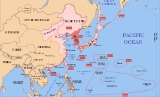
Korea under Japanese rule

Encyclopedia
Korea
was under Japanese
rule as part of Japan's 35-year imperialist expansion (29 August 1910 to 15 August 1945). Japanese rule ended in 1945 shortly after the Japanese defeat in World War II
.
Korea was occupied and declared a Japanese protectorate
in the 1905 Eulsa Treaty, and officially annexed
in 1910 through the annexation treaty
. Japan's involvement in the region began with the 1876 Treaty of Ganghwa
during the Joseon Korea
. The 1905 and 1910 treaties were eventually declared "null and void" by both Japan and South Korea
in 1965.
In Korea, the period is usually described as "Japanese Imperial Period" (Hangul: , Ilje sidae, Hanja: 日帝時代). Other terms include "Japanese forced occupation" (Hangeul: ; Ilje gangjeomgi, Hanja
: 日帝强占期) or "Wae
(Japanese) administration" (Hangeul: , Wae jeong, Hanja: ). In Japan, there is a term, .
; Japan sought to join these modern colonial powers. The newly modernised Meiji government of Japan turned to Korea, then in the sphere of influence
of China
's Qing Dynasty
. The Japanese government initially sought to separate Korea from Qing and make Korea a Japanese satellite
in order to further the country's security and national interests.
In January 1876, following the Meiji Restoration
, Japan employed gunboat diplomacy
to pressure Korea to sign the Treaty of Ganghwa
, an unequal treaty, which opened three Korean ports to Japanese trade and granted extraterritorial rights
to Japanese citizens. The rights granted to Japan under the treaty were similar to those granted western powers in Japan following the visit of Commodore Perry.
(Debate on punitive expedition
against Korea) was a major political conflagration which occurred in Japan in 1873. Saigō Takamori
and his supporters insisted that Japan should confront Korea
due to Korea's refusal to recognize the legitimacy of Emperor Meiji
as head of state of the Empire of Japan
, and because of insulting treatment meted out to Japanese envoys attempting to establish trade and diplomatic relations. Those in favor also saw the issue as an ideal opportunity to find meaningful employment for the thousands of out-of-work samurai
, who had lost most of their income and social standing in the new Meiji socioeconomic order. These samurai posed a threat to the government, and (as a samurai himself) Saigō sympathized with their situation. According to orthodoxy, "Saigo himself volunteered to go to Korea as a special envoy, inviting an assassination attempt that would provide justifications, if any were needed, for a punitive expedition
."
The arguments against an expedition to Korea were outlined in Okubo Toshimichi
's "7 Point Document", dated October 1873, in which he argued that action against Korea was premature because Japan was in the stages of modernizing and an expedition would be far too costly for Japan to sustain. Okubo's views were supported by the anti-war faction, which mostly consisted of those returning from the Iwakura Mission
in 1873. Iwakura Tomomi
, the diplomat who had led the mission, persuaded the emperor to reverse the decision to send Saigo as an envoy to Korea, thus putting an end to the debate.
: , Korean language
: ),Ganghwado joyak signed on February 27, 1876, was designed to open up Korea to Japanese trade. It ended Korea's status as a protectorate of China and opened three ports to Japanese trade.
. Japanese diplomats, policemen, students and some Min clan members were also killed during the incident. Daewongun was restored to power, only to be forcibly taken to China by Chinese troops dispatched to Seoul
to prevent further disorder. In August 1882, the Korean government sent a mission to Japan and agreed to the stationing of Japanese troops to guard the legation in Seoul.
, fled to Japan, while others were executed.
in 1894 changed Japanese policy toward Korea. The Korean government asked for Chinese assistance in ending the revolt, and Japanese leaders decided upon military intervention to challenge China. When China sent troops into Korea, Japan responded by sending its own troops. Japan won the First Sino-Japanese War
, and China signed the Treaty of Shimonoseki
in 1895. Among its many stipulations, the treaty recognized "the full and complete independence and autonomy of Korea," thus ending Korea's tributary
relationship with the Chinese Qing Dynasty, leading to the proclamation of fully independence of Joseon Korea in 1895.
At the same time, Japan suppressed the Donghak Revolution with Korean government forces, which had solidified Japanese military predominance than any other country in Korea.
Empress Myeongseong
("Queen Min"), and on 8 October 1895, she was assassinated by Japanese agents. In 2001, Russian reports on the assassination were found in the archives of the Foreign Ministry of the Russian Federation. The documents included the testimony of King Gojong, several witnesses of the assassination, and Karl Ivanovich Weber
's report to Lobanov-Rostovsky, the Foreign Minister of Russia. Weber was the chargé d'affaires
at the Russian legation in Seoul at that time. According to a Russian eyewitness, Seredin-Sabatin (Середин-Cабатин), an employee of the Korean king, a group of Japanese agents entered the Gyeongbok palace
, killed Empress Myeongseong and desecrated her body in the north wing of the palace.
When he heard the news, Heungseon Daewongun returned to the royal palace the same day. On 11 February 1896, King Gojong and the crown prince moved from Gyeongbokgung
palace to the Russia
n legation in Jeongdong, Seoul
, from where they governed for about one year, an event known as the Korea royal refuge at the Russian legation.
(독립협회, 獨立協會) in 1896. They claimed that Korea should negotiate with Western powers, particularly Russia, to counterbalance the growing influence of Japan and Russia. This club had contributed to the construction of Independence Gate
, and they held regular meetings at the Jongno
streets, demanding democratic
reforms as Korea became a constitutional monarchy, and an end to Japanese and Russian influence in Korean affairs. However, it was dissolved on December 25, 1898 as Emperor Gojong officially announced a prohibition on unofficial congresses.
, and proclaimed the founding of the Korean Empire
. During this period, the Korean government had conducted a westernization policy. It was not a radical reform, however, and Korea steadily become subordinated to the larger powers of Japan and Russia.
.svg.png) The rivalry between Russia and Japan exploded into the Russo-Japanese War
The rivalry between Russia and Japan exploded into the Russo-Japanese War
of 1904–1905, which Japan won. Under the Treaty of Portsmouth
, signed in September 1905, Russia acknowledged Japan's "paramount political, military, and economic interest" in Korea.
A separate agreement was signed in secret between the United States and Japan at this time, which subsequently aroused anti-American sentiment among Koreans decades later. The Taft-Katsura Agreement
between the U.S. and Japan, recognized U.S. interests in the Philippines
and Japanese interests in Korea. Given the diplomatic conventions of the times, however, the agreement was a much weaker endorsement of the Japanese presence in Korea than either the Russo-Japanese peace treaty or a separate Anglo-Japanese accord
.
Two months later, Korea was obliged to become a Japanese protectorate by the Eulsa Treaty
. A large number of Koreans organized themselves in education and reform movements, but by then Japanese dominance in Korea was a reality.
In June 1907, the Second Peace Conference
was held in The Hague
. Emperor Gojong secretly sent three representatives to bring the problems of Korea to the world's attention. The three envoys were refused access to the public debates by the international delegates who questioned the legality of the protectorate convention. Out of despair, one of the Korean representatives, Yi Jun
, committed suicide at The Hague.
In response, the Japanese government took stronger measures. On 19th July, Emperor Gojong was forced to relinquish his imperial authority and appoint the Crown Prince as regent. Japanese officials used this concession to force the accession of the new Emperor Sunjong following abdication, which was never agreed to by Gojong. Neither Gojong or Sunjong was present at the 'accession' ceremony. Sunjong was to be the last ruler of the Joseon Dynasty
, founded in 1392.
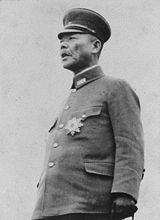
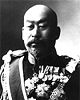
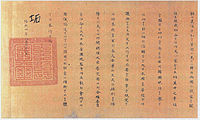 In May 1910, the Minister of War of Japan
, Terauchi Masatake
, was given a mission to finalize Japanese control over Korea after the previous treaties (the Japan-Korea Protocol of 1904 and the Japan-Korea Annexation Treaty of 1907
) had made Korea a protectorate of Japan and had established Japanese hegemony over Korean domestic politics. On 22 August 1910, Japan effectively annexed
Korea with the Japan-Korea Annexation Treaty
signed by Lee Wan-Yong
, Prime Minister of Korea, and Terauchi Masatake, who became the first Japanese Governor-General of Korea
. Later research has invalidated most of these treaties. For example,
The treaty became effective the same day and was published one week later. The treaty stipulated:
Both the protectorate and the annexation treaties were declared void in the 1965 Treaty on Basic Relations between Japan and the Republic of Korea
because both treaties were obtained under threat of force
, and that the Korean Emperor, whose royal assent
was required to validate and finalize any legislation or diplomatic agreement under Korean law of the period, refused to sign the document.
 From 1939, labor shortage
s as a result of conscription
of Japanese males for the military efforts of World War II
led to organized official recruitment of Koreans to work in mainland Japan, initially through civilian agents, and later directly, often involving elements of coercion. As the labor shortage increased, by 1942, the Japanese authorities extended the provisions of the National Mobilization Law
to include the conscription of Korean workers for factories and mines on the Korean peninsula, Manchukuo
, and the involuntary relocation of workers to Japan itself as needed.
Of the 5,400,000 Koreans conscripted, about 670,000 were taken to mainland Japan (including Karafuto Prefecture
, present-day Sakhalin
, now part of Russia
) for civilian labor. Those who were brought to Japan were often forced to work under appalling and dangerous conditions. About 60,000 are estimated to have died between 1939 and 1945 from harsh treatment, inhumane working conditions and Allied
bombings. The total deaths of Korean forced laborers in Korea and Manchuria is estimated to be between 270,000 and 810,000. The 43,000 ethnic Koreans in Karafuto, which had been occupied by the Soviet Union
just prior to Japan's surrender, were refused repatriation to either mainland Japan or the Korean peninsula, and were thus trapped in Sakhalin, stateless; they became the ancestors of the Sakhalin Koreans.
Most Korean atomic-bomb victims in Japan were drafted for work at military industrial factories in Hiroshima and Nagasaki. In the name of humanitarian assistance, Japan paid South Korea 4 billion yen and built a welfare center for those suffering from the effects of the atomic bomb.
In 1938, an estimated 800,000 ethnic Koreans were living in Japan as immigrants. The combination of immigrants and forced laborers during World War II brought the total to over 2 million by the end of the war, according to estimates by the American occupation authorities. In 1946, some 1,340,000 ethnic Koreans were repatriated to Korea, with 650,000 choosing to remain in Japan, where they now form the Zainichi Korean community. A 1982 survey by the Korean Youth Association showed that conscripted laborers accounts for 13 percent of first-generation Zainichi Koreans.
, and Imperial Decree 19 on Korean Civil Affairs went into effect, whereby ethnic Koreans were permitted to surrender their Korean family name and adopt Japanese surnames. Although officially voluntary, many argue official compulsion and harassment existed against individuals, especially Korean government employees, who refused to create a new Japanese-style name. There is disagreement as to whether this was the result of individual practices by low-level officials, the policy of some regional government organizations, or the overall intention of the colonial government. Others argue that Koreans felt compelled to adopt Japanese family names in order to avoid discrimination by Japanese. A country study conducted by the Library of Congress
states that "the Korean culture was quashed, and Koreans were required to speak Japanese and take Japanese names." This name change policy, called Changssi-gaemyeong , was part of Japan's assimilation efforts. The policy was extremely unpopular, with only some 9.6 percent of Koreans changing their last names to a Japanese one during the colonial occupation. A number of prominent ethnic Koreans working for the Japanese government, including General Hong Sa-ik
, insisted on keeping their Korean names. Another ethnic Korean, Park Chun-Geum (박춘금, 朴春琴), was elected as a member of the Lower House from the Tokyo Third District in the general election in 1932 and served two terms without changing his Korean name, but has been registered as chinilpa
by the current Republic of Korea government.
After the liberation of Korea from Japanese rule, the "Name Restoration Order" was issued on 23 October 1946 by the U.S. Army Military Government in Korea south of the 38th parallel
, enabling Koreans to restore their names if they wished. Many Zainichi Koreans chose to retain their Japanese names, either to avoid discrimination, or later, to meet the requirements for naturalization as Japanese citizens.
and Nagasaki, and the impending overrun of the Korean peninsula by Russian forces, Japan surrendered
to the Allied forces on 15 August 1945, ending 35 years of Japanese occupation.
American forces
under General John R. Hodge
arrived at the southern part of Korean peninsula on September 8 1945, while the Soviet Army and some Korean Communists had stationed themselves in the northern part of the Korean peninsula. U.S. Colonel Dean Rusk
proposed splitting Korea at the 38th parallel
to Chischakov, Soviet military administrator of northern Korea, at an emergency meeting to determine postwar spheres of influence, which led to the Division of Korea
.
rallies took place nationwide, most notably the March 1st Movement
of 1919. A declaration of independence
was read in Seoul. It is estimated that 2 million people took part in these rallies. The Japanese violently suppressed the protest
s: According to Korean records, 46,948 were arrested, 7,509 killed and 15,961 wounded; according to Japanese figures, 8,437 were arrested, 553 killed and 1,409 wounded. About 7,000 people were killed by Japanese police and soldiers during the 12 months of demonstrations.
After suppression of the uprising, some aspects of Japanese rule considered most objectionable to Koreans were removed. The military police were replaced by a civilian force, and freedom of the press
was permitted to a limited extent. Two of the three major Korean daily newspapers, the Dong-a Ilbo
and the Chosun Ilbo, were established in 1920.
Objection to Japanese rule over Korea continued, and the March 1st Movement was a catalyst for the establishment of the Provisional Government of the Republic of Korea
by Korean émigrés in Shanghai on 13 April 1919. The modern South Korean government considers this Provisional Government of the Republic of Korea the de jure
representation of the Korean people throughout the period of Japanese rule.
The Japanese occupation of Korea after annexation was largely uncontested militarily by the smaller, poorly-armed, and poorly-trained Korean army. Many former soldiers and other volunteers left the Korean peninsula for Manchuria
and Primorsky Krai
in Russia
. Koreans in Manchuria
formed resistance groups known as Dongnipgun (Liberation Army), which traveled across the Korean-Chinese border, using guerrilla warfare
tactics against Japanese forces. The Japanese invasion of Manchuria in 1932 and subsequent Pacification of Manchukuo
deprived many of these groups of their bases of operation and supplies. Many were forced to either flee to China, or to join the Communist
-backed forces in eastern Russia. One of the guerrilla groups was lead by the future leader of communist North Korea, Kim Il-Sung
, in Japanese controlled Manchuria. Kim Il-Sung's time as a guerrilla leader was formative upon his political ideology once he came to power.
Within Korea itself, anti-Japanese rallies continued on occasion. Most notably, the Gwangju Students Anti-Japanese Movement on 3 November 1929 led to the strengthening of Japanese military rule in 1931, after which freedom of the press and freedom of expression were curbed. Many witnesses, including Catholic priests, reported that Japanese authorities dealt with insurgency severely. When villagers were suspected of hiding rebels, entire village populations are said to have been herded into public buildings (especially churches) and massacred when the buildings were set on fire. In the village of Jeam-ni, Hwaseong
, for example, a group of 29 people were gathered inside a church which was then set afire. Such events deepened the hostility of many Korean civilians towards the Japanese government.
On 9 December 1941, shortly after the attack on Pearl Harbor
, the Provisional Government of the Republic of Korea, under the presidency of Kim Gu
, declared war on Japan and Nazi Germany
. The Korean Provisional Government banded together various Korean resistance guerilla groups such as the Korean Liberation Army
, which was involved in combat on behalf of the Allies
in various campaigns in China and parts of South East Asia. Tens of thousands of Koreans volunteered for the National Revolutionary Army
and the People's Liberation Army
. The communist-backed Korean Volunteer Army (KVA, 조선의용군, 朝鮮義勇軍) was established in Yenan, China, outside of the Provisional Government's control, from a core of 1,000 deserters from the Imperial Japanese Army. After the Manchurian Strategic Offensive Operation, the KVA entered Manchuria, where it recruited from the ethnic Korean population and eventually became the Korean People's Army
of the Democratic People's Republic of Korea.
There were some modernization efforts by the late 19th century, Seoul became the first city in East Asia
to have electricity, trolley cars, water, telephone, and telegraph systems all at the same time, but Korea remained a largely backward agricultural economy at the turn of the century. "Japan's initial colonial policy was to increase agricultural production in Korea to meet Japan's growing need for rice. Japan also began to build large-scale industries in Korea in the 1930s as part of the empire-wide program of economic self-sufficiency and war preparation."
According to scholar Donald S. Macdonald
, "for centuries most Koreans lived as subsistence farmers of rice and other grains and satisfied most of their basic needs through their own labor or through barter. The manufactures of traditional Korea--principally cloth, cooking and eating utensils, furniture, jewelry, and paper--were produced by artisans in a few population centers."
However, under Japanese rule, many Korean resources were only utilized for Japan. Economist Suh Sang-Chul
points out that the nature of industrialization during the period was as an "imposed enclave," so the impact of colonialism was trivial. Another scholar, Song Byung-Nak, states that the economic condition of average Koreans was aggravated during the period despite the economic growth. Most Koreans at the time could access only a primary school education under restriction by the Japanese, and this prevented the growth of an indigenous entrepreneurial class. A 1939 statistic shows that among the total capital recorded by factories, about 94 percent was Japanese-owned. While Koreans owned about 61 percent of small-scale firms that had 5 to 49 employees, about 92 percent of large-scale enterprises with more than 200 employees were Japanese-owned.
The Japanese government created a system of colonial mercantilism
, requiring construction of significant transportation infrastructure on the Korean Peninsula for the purpose of extracting and exploiting resources such as raw materials (timber), foodstuff (mostly rice and fish), and mineral resources (coal and iron ore). The Japanese developed port facilities and an extensive railway system which included a main trunk railway from the southern port city of Pusan
through the capital of Seoul and north to the Chinese border. This infrastructure was intended not only to facilitate a colonial mercantilist economy, but was also viewed as a strategic necessity for the Japanese military to control Korea and to move large numbers of troops and materials to the Chinese border at short notice.
From the late 1920s and into the 1930s, particularly during the tenure of Japanese Governor-General Kazushige Ugaki, concentrated efforts were made to build up the industrial base in Korea. This was especially true in the areas of heavy industry
, such as chemical plants and steel mills, and munitions production. The Japanese military felt it would be beneficial to have production closer to the source of raw materials and closer to potential front lines for a future war with China.
By the early 1930s, Japanese investment was curtailed by the Great Depression
, competition for investment opportunities from the potentially more lucrative Manchukuo
and by Japan's own limited economic capacity. As Imperial Japan began feeling the strains of World War II, Japan carried out a colonial exploitation policy in Korea.
 Prior to the annexation of Korea, from around the time of the First Sino-Japanese War
, Japanese merchants began settling in towns and cities in Korea seeking economic opportunity. By 1910, the number of Japanese settlers in Korea reached over 170,000, creating the largest overseas Japanese community in the world at the time.
Many Japanese settlers were interested in acquiring agricultural land in Korea even before Japanese land ownership was officially legalized in 1906. Governor-General Terauchi Masatake facilitated settlement through land reform
, which proved extremely unpopular with most of the Korean population. The Korean land ownership system was a complex system of absentee landlords, partial owner-tenants and cultivators with traditional (but no legal proof of) ownership. Terauchi's new Land Survey Bureau conducted cadastral surveys that reestablished ownership by basis of written proof (deeds, titles, and similar documents). Ownership was denied to those who could not provide such written documentation; these turned out to be mostly lower-class and partial owners who had only traditional verbal cultivator rights. Although the plan succeeded in modernizing the land ownership and taxation structures, it added tremendously to the bitterness and hostility of the time by enabling a huge amount of Korean land to be seized by the government and sold at subsidized
costs to Japanese willing to settle in Korea as part of a larger effort at colonization.
Japanese landlords included both individuals and corporations such as the Oriental Development Company
. Many former Korean landowners as well as agricultural workers became tenant farmer
s, having lost their entitlements
almost overnight.
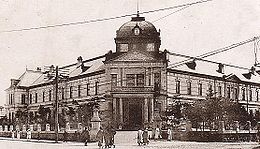 It is estimated that by 1910 perhaps 7 to 8 percent of all arable land
was under Japanese control. This ratio increased steadily; during the years 1916, 1920, and 1932, the ratio of Japanese land ownership increased from 36.8 to 39.8 to 52.7 percent. Conversely, the ratio of Korean ownership decreased from 63.2 to 60.2 to 47.3 percent. The level of tenancy was similar to that of farmers in Japan itself; however, in Korea, the landowners were mostly Japanese, while the tenants were all Koreans. As was often the case in Japan itself, tenants were forced to pay over half their crop as rent, forcing many to send wives and daughters into factories or prostitution so they could pay taxes.
Lee Yong Hoon, a controversial professor at Seoul National University
and a leading critic of the "New Right" Foundation (뉴라이트재단), which is often called the "New Chinilpa
," states that less than 10% of arable land actually came under Japanese control and rice was normally traded, not robbed. He also insists that Koreans' knowledge about the era under Japanese rule is mostly made up by later educators. Many of Lee's arguments, however, have been contested.
Korea suffered from famine due to its economy's over taxation and lagged behind Japan in the rise of agricultural cooperatives and advances in cash crop
production and mechanized agriculture.
By the 1930s, the growth of the urban economy and the exodus of farmers to the cities had gradually weakened the hold of the landlords. With the growth of the wartime economy, the government recognized landlordism as an impediment to increased agricultural productivity, and took steps to increase control over the rural sector through the formation of the Central Agricultural Association, a compulsory organization under the wartime command economy.
" by a graduate student
of the Comparative Genocide Studies group.
, the Korean royalty was incorporated into the Imperial Household of Japan. The Emperor of Japan
, Viscount
Terauchi Masatake
, Resident-General, and His Majesty the Emperor of Korea Yi Wan-Yong, Prime Minister
, who upon mutual conference and deliberation had agreed to the Japan-Korea Annexation Treaty
, made an effort to intermarry the royalty of the two houses in an attempt to validate the annexation of Korea.
Yi Eun
, then the Imperial Crown Prince
of Korea, married Masako of Nashimotonomiya
. Pro-Japanese Koreans
(or Chinilpa
) who supported or helped the annexation were also given peerage
titles under the Japanese kazoku
system. Lee Wan-Yong
, the last prime minister of the Korean Empire, was given the title of hakushaku (Count) (which was later raised to koshaku, or Duke).
In total, 76 Koreans were given peerage titles. After Korean independence, all titles were invalidated, and recipients formally charged with treason
.
message of the chief Korean publication Hwangseong Sinmun (The Imperial news, 1898–1910). These papers included The Chosun Ilbo
(1904).
The Korean language
newspaper Maeil Sinbo continued its publication due to disposal by Japanese Government-General.
, including in-depth research projects into Hangul
(the Korean alphabet), which resulted in the standardization of the Korean writing system by scholars such as Lee Hui-Seung (이희승) and Choe Hyeon-bae
(최현배) in the 1930s, as well as underground publications of books about historical Korean figures.
Historians such as Shin Chae-ho were active in trying to present a Koreanized version of ancient history using textual material.
were deleted methodically; in general, the awareness of Korean history among Koreans declined during this period; the new generation grew up with little or no awareness of their own heritage. Japan altered the history to rationalize the occupation of Korea to the international community by depicting the Koreans as backward and in need of modernization. In order to justify their need to take over their neighbors, "the Japanese convinced themselves that, despite being of the same race," says Michael Breen, "the Koreans were actually hardly human." This was possible in part because Korea had sealed itself off from outside contact for centuries.
In 1925, Japanese government established the Korean History Compilation Committee (조선사편수회, 朝鮮史編修會), and it was administered by the Governor General of Korea and engaged in collecting of Korea
n historical materials and compilation of Korean history". The Committee distorted the ancient Korean history to validate Japanese colonization of Joseon. The ancient Korean history was distorted by the Committee and as follows; i) Korean history was only part of Korean peninsula history (Korean history had never rule over Manchuria), ii) North Korean peninsula was the colony of China by Chinese Commanderies, iii) South Korean peninsula was the colony of Japan by Mimana Nihonfu (任那日本府). In order to demonstrate their theories, they moved the a stone monument (棕蟬縣神祠碑), which was originally located at Liaodong, into Pyongyang, and then distorted the location of Chinese commanderies such that they existed in Pyongyang.
The Japanese Government conducted excavations of archeological sites and preserved artifacts found there. Since many of the Japanese ideas were not supported by archeology, Japan decided to demonstrate their theories by moving a stone monument (棕蟬縣神祠碑), which was originally located at Liaodong, into Pyongyang, and then distorted the location of Chinese commanderies such that they existed in Pyongyang. All these actions are viewed as an effort by Japan to destroy the ancient culture of Korea.
The Japanese rule of Korea also resulted in the relocation of many cultural artifact
s to Japan. The issue over where these articles should be located began during the U.S. occupation of Japan. It is known that at least 100,000 Korean artifacts were looted and stolen during Japanese rule. In 2002, the controversy was reignited when two Koreans stole two Korean artifacts from a west Japanese temple.
The Chosun Ilbo (Korean Daily News) reports that valuable Korean artifacts can still be found in Japanese museums and private collections. According to an investigation by the South Korea government, there are 75,311 cultural artifacts that were taken from Korea. Japan has 34,369 and the United States has 17,803. Korea frequently demands the return of these artifacts, but the United States and Japan do not comply.
On August 10, 2010, Prime Minister of Japan Naoto Kan
promised to return Korean artifacts which were seized during 1910-1945, while expressing "deep remorse".
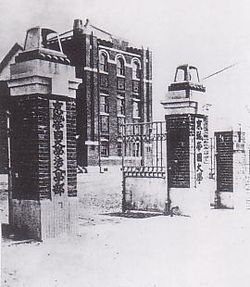 Following the annexation of Korea, the Japanese administration introduced universal education patterned after the Japanese school system, with a pyramidal hierarchy of elementary, middle and high schools, culminating at the Keijō Imperial University
in Seoul
. As in Japan itself, education was viewed primarily as an instrument of "the Formation of the Imperial Citizen" (황민화; 皇民化) with a heavy emphasis on moral and political indoctrination.
The Japanese colonial government provided educational material for Korean history, culture and language to some degree, such as a textbook of Hangul and grammar to mix Hangul with Chinese characters (in the version designed by Kakugorō Inoue). However, it was treated as a low standard than Japan's that, and also was completely abolished after 1938.
Classes focused mostly on teaching the history of the Japanese Empire as well as glorification of the Imperial House of Japan
. The history of Korea was not part of the curriculum. As in Japan itself, students were made to worship at the school's Shintō shrine regardless of their religious beliefs, bow before portraits of the Emperor, and copy the Imperial Rescript on Education
. As the Japanese administrative policy shifted more strongly towards assimilation from the 1930s , all classes were taught in Japanese
with Korean language
becoming an elective. During colonial times, elementary schools
were known as "Citizen Schools" as in Japan, as a means of forming proper "Imperial Citizens" (皇國民; Hwanggungmin) from early childhood. Elementary schools in South Korea today are known by the name chodeung hakgyo (literally "Elementary School") as the term gungmin hakgyo has recently become a politically incorrect
term.
Although the Japanese education system in Korea was detrimental towards the colony's cultural identity, it helped lay the foundation of future economic growth by improving Korea's human capital
. By 1940, 38 percent of school-age Koreans were attending elementary school. Children of elite families were able to advance to higher education, while others were able to attend technical schools, allowing for "the emergence of a small but important class of well-educated white collar and technical workers... who possessed skills required to run a modern industrial economy." The Japanese education system ultimately produced hundreds of thousands of educated South Koreans who later became "the core of the postwar political and economic elite."
included altering public monuments, including several well-known temples, palaces, scripts, memorials, and statues. Songs and poems, such as "Poem of celebrating for Kamikaze" written by Seo Jeong-ju, were re-written to adore the Japanese Empire. Carved monuments underwent alterations to the Chinese characters to delete or change part of their meaning.
Japanese colonial authorities took many photographs of scenes of abject poverty in Korea, but did not take a single photograph of the main palace at Gyeongbokgung
.
The primary building of Gyeongbokgung
was demolished and the Japanese General Government Building
was built in its exact location. The Japanese colonial authorities destroyed 85 percent of all the buildings in Gyeongbokgung. Sungnyemun
, a virtual symbol of Korea, was altered by the addition of large, Shinto-style golden horns near the roofs (later removed by the South Korean government after independence).
Starting in 1938, Koreans both enlisted and were conscripted into the Japanese military and the first "Korean Voluntary" Unit was formed. Among notable Korean personnel in the Imperial Army was Crown Prince Euimin
, who attained the rank of lieutenant general. Some later gained administrative posts in the government of South Korea
; well-known examples include Park Chung Hee, who became president of South Korea
, Chung Il-Kwon (정일권,丁一權), prime minister from 1964 to 1970, and Paik Sun-Yup, South Korea's youngest general, famous for his defense of the Pusan Perimeter during the Korean War
. The first ten of the Chiefs of Army Staff of South Korea graduated from the Imperial Japanese Army Academy and none from the Korean Liberation Army
.
Recruitment began as early as 1938, when the Japanese Kwantung Army in Manchuria began accepting pro-Japanese Korean volunteers into the army of Manchukuo, and formed the Gando Special Force
. Koreans in this unit specialized in counter-insurgency operations against communist guerillas in the region of Jiandao. The size of the unit grew considerably at an annual rate of 700 men, and included such notable Koreans as General Paik Sun-Yup, who served in the Korean War. Historian Philip Jowett noted that during the Japanese occupation of Manchuria, the Gando Special Force "earned a reputation for brutality and was reported to have laid waste to large areas which came under its rule."
During World War II, American soldiers frequently encountered Korean soldiers within the ranks of the Japanese army. Most notably was in the Battle of Tarawa
, which was considered during that time to be one of the bloodiest battles in U.S. military history. A fifth of the Japanese garrison during this battle consisted of Korean laborers who were trained in combat roles. Like their Japanese counterparts, they put up a ferocious defense and fought to the death.
Starting in 1944, Japan started conscription
of Koreans into the armed forces. All Korean males were drafted to either join the Imperial Japanese Army, as of April 1944, or work in the military industrial sector, as of September 1944. Before 1944, 18,000 Koreans passed the examination for induction into the army. Koreans provided workers to mines and construction sites around Japan. The number of conscripted Koreans reached its peak in 1944 in preparation for war. From 1944, about 200,000 Korean males were inducted into the army.
After the war, 148 Koreans were convicted of Class B and C war crimes, 23 of whom were sentenced to death (compared to 920 Japanese who were sentenced to death), including Korean prison guards who were particularly notorious for their brutality during the war. The figure is relatively high considering that ethnic Koreans made up a very small percentage of the Japanese military. Justice Bert Röling, who represented the Netherlands at the Tokyo War Crimes Tribunal
, noted that "many of the commanders and guards in POW camps were Koreans - the Japanese apparently did not trust them as soldiers - and it is said that they were sometimes far more cruel than the Japanese." In his memoirs, Colonel Eugene C. Jacobs wrote that during the Bataan Death March
, "the Korean guards were the most abusive. The Japs didn't trust them in battle, so used them as service troops; the Koreans were anxious to get blood on their bayonets; and then they thought they were veterans." Korean guards were sent to the remote jungles of Burma, where Lt. Col. William A. (Bill) Henderson wrote from his own experience that some of the guards overlooking the construction of the Burma Railway "were moronic and at times almost bestial in their treatment of prisoners. This applied particularly to Korean private soldiers, conscripted only for guard and sentry duties in many parts of the Japanese empire. Regrettably, they were appointed as guards for the prisoners throughout the camps of Burma and Siam." The highest-ranking Korean to be prosecuted after the war was Lieutenant General Hong Sa-Ik
, who was in command of all the Japanese prisoner-of-war camps in the Philippines.
In 2002, South Korea started an investigation of Japanese collaborators. Part of the investigation was completed in 2006 and a list of names of individuals who profited from exploitation of fellow Koreans were posted. The collaborators not only benefited from exploiting their countrymen, but the children of these collaborators benefited further by acquiring higher education with the exploitation money they had amassed.
The "Truth Commission on Forced Mobilization under the Japanese Imperialism Republic of Korea" investigated the received reports for damage from 86 people among the 148 Koreans who were accused of being the level B and C war criminals while serving as prison guards for the Japanese military during World War II. The commission, which was organized by the South Korean government, announced that they acknowledge 83 people among them as victims. The commission said that although the people reluctantly served as guards to avoid the draft, they took responsibility for mistreatment by the Japanese against prisoners of war. Lee Se-il, leader of the investigation, said that examination of the military prosecution reports for 15 Korean prison guards, obtained from The National Archives of the United Kingdom
, confirmed that they were convicted without explicit evidence.
, rape
, forced labour, and looting
.
continued to spread, and as the Japanese national and military police could not contain the crowds, the army and even the navy were also called in. There were several reports of atrocities. In one notable instance, Japanese police in the village of Jeam-ri, Hwaseong
herded everyone into a church, locked it, and burned it to the ground. They even shot through the burning windows of the church to ensure that no one made it out alive. Many of participants of the March 1st Movement were often subjected to torture and execution.
, many Korean men were pushed into forced labor, and the toll of forced laborers from Korea in mainland Japan comes to 450,000. Korean women also became victims of the Japanese called comfort women
, who served in Japanese military brothels. Historians estimate the number of comfort women between 10,000 and 200,000, a figure which also includes Japanese women. According to testimonies, cases included that of Japanese officials and local collaborators kidnapping or recruiting poor rural women from Korea and other nations for sexual slavery
under guise of offering factory employment. There is evidence the Japanese government intentionally destroyed official records regarding Comfort Women. Japanese inventory logs and employee sheets on the battlefield show some documentation of government-sponsored sexual slavery. In one instance, names of known Comfort Women were traced to Japanese employment records. One such woman was falsely classified as a nurse along with at least a dozen other verified comfort women who were not nurses or secretaries. Currently, the South Korean government is investigating hundreds of cases on these lists.
, a secret military medical experimentation unit in World War II. The victims who died in the camp included at least 25 victims from the former Soviet Union, Mongolia and Korea.
of patients in sanitariums, where forced abortion
s and sterilization were common. The laws authorized punishment of patients "disturbing the peace," as most Japanese leprologists believed that vulnerability to the disease was inheritable. In Korea, many leprosy patients were also subjected to hard labor.
has covered up many incidents that would otherwise lead to severe international criticism. Koreans have often expressed their abhorrence of human experimentation
carried out by the Imperial Japanese Army
where people often became human test subjects in such macabre experiments as liquid nitrogen
tests or biological weapons development programs (See articles: Unit 731
and Shiro Ishii
). Though some vivid and disturbing testimonies have survived, they are largely denied by the Japanese Government even to this day.
The Japanese Government was recently accused of the burial of non-Japanese test-subject bodies from World War II several dozen feet below buildings in Japanese urban areas (such as the bodies found under the Toyama No. 5 apartment blocks) in order to cover up wartime experiments. The government denied any responsibility. The existence of unmarked mass graves on the "west side of Tokyo
is deeply troubling". The testimony of Toyo Ishii, a nurse involved in the coverup, was downplayed or ignored. "After more than 60 years of silence, the 84-year-old nurse's story is the latest twist in the legacy of Japan's rampage." These coverups and falsification of data have made accurate assessment of Japan's impact on Korea very difficult.
, the President of South Korea
, appointed an investigation commission into the issue of locating descendants of pro-Japanese collaborators from the times of the 1890s until the collapse of Japanese rule in 1945.
In 2010, the commission concluded its five volume report. As a result, the land property of 168 South Korean citizens has been confiscated by the government, these citizens being descendants of pro-Japanese collaborators.
Korea
Korea ) is an East Asian geographic region that is currently divided into two separate sovereign states — North Korea and South Korea. Located on the Korean Peninsula, Korea is bordered by the People's Republic of China to the northwest, Russia to the northeast, and is separated from Japan to the...
was under Japanese
Empire of Japan
The Empire of Japan is the name of the state of Japan that existed from the Meiji Restoration on 3 January 1868 to the enactment of the post-World War II Constitution of...
rule as part of Japan's 35-year imperialist expansion (29 August 1910 to 15 August 1945). Japanese rule ended in 1945 shortly after the Japanese defeat in World War II
World War II
World War II, or the Second World War , was a global conflict lasting from 1939 to 1945, involving most of the world's nations—including all of the great powers—eventually forming two opposing military alliances: the Allies and the Axis...
.
Korea was occupied and declared a Japanese protectorate
Protectorate
In history, the term protectorate has two different meanings. In its earliest inception, which has been adopted by modern international law, it is an autonomous territory that is protected diplomatically or militarily against third parties by a stronger state or entity...
in the 1905 Eulsa Treaty, and officially annexed
Annexation
Annexation is the de jure incorporation of some territory into another geo-political entity . Usually, it is implied that the territory and population being annexed is the smaller, more peripheral, and weaker of the two merging entities, barring physical size...
in 1910 through the annexation treaty
Japan-Korea Annexation Treaty
The Japan–Korea Treaty of 1910, also known as the Japan–Korea Annexation Treaty, was made by representatives of the Empire of Japan and the Korean Empire in 1910. Negotiations were concluded on August 20, 1910...
. Japan's involvement in the region began with the 1876 Treaty of Ganghwa
Treaty of Ganghwa
The Japan-Korea Treaty of Amity, also known as the Treaty of Ganghwa or Treaty of Kanghwa, was made between representatives of the Empire of Japan and the Kingdom of Joseon in 1876...
during the Joseon Korea
Joseon Dynasty
Joseon , was a Korean state founded by Taejo Yi Seong-gye that lasted for approximately five centuries. It was founded in the aftermath of the overthrow of the Goryeo at what is today the city of Kaesong. Early on, Korea was retitled and the capital was relocated to modern-day Seoul...
. The 1905 and 1910 treaties were eventually declared "null and void" by both Japan and South Korea
South Korea
The Republic of Korea , , is a sovereign state in East Asia, located on the southern portion of the Korean Peninsula. It is neighbored by the People's Republic of China to the west, Japan to the east, North Korea to the north, and the East China Sea and Republic of China to the south...
in 1965.
In Korea, the period is usually described as "Japanese Imperial Period" (Hangul: , Ilje sidae, Hanja: 日帝時代). Other terms include "Japanese forced occupation" (Hangeul: ; Ilje gangjeomgi, Hanja
Hanja
Hanja is the Korean name for the Chinese characters hanzi. More specifically, it refers to those Chinese characters borrowed from Chinese and incorporated into the Korean language with Korean pronunciation...
: 日帝强占期) or "Wae
Wa (Japan)
Japanese is the oldest recorded name of Japan. Chinese, Korean, and Japanese scribes regularly wrote Wa or Yamato "Japan" with the Chinese character 倭 until the 8th century, when the Japanese found fault with it, replacing it with 和 "harmony, peace, balance".- Historical references :The earliest...
(Japanese) administration" (Hangeul: , Wae jeong, Hanja: ). In Japan, there is a term, .
Background
In the late 19th and early 20th century, various Western countries actively competed for influence, trade, goods, and territory in East AsiaEast Asia
East Asia or Eastern Asia is a subregion of Asia that can be defined in either geographical or cultural terms...
; Japan sought to join these modern colonial powers. The newly modernised Meiji government of Japan turned to Korea, then in the sphere of influence
Sphere of influence
In the field of international relations, a sphere of influence is a spatial region or conceptual division over which a state or organization has significant cultural, economic, military or political influence....
of China
China
Chinese civilization may refer to:* China for more general discussion of the country.* Chinese culture* Greater China, the transnational community of ethnic Chinese.* History of China* Sinosphere, the area historically affected by Chinese culture...
's Qing Dynasty
Qing Dynasty
The Qing Dynasty was the last dynasty of China, ruling from 1644 to 1912 with a brief, abortive restoration in 1917. It was preceded by the Ming Dynasty and followed by the Republic of China....
. The Japanese government initially sought to separate Korea from Qing and make Korea a Japanese satellite
Puppet state
A puppet state is a nominal sovereign of a state who is de facto controlled by a foreign power. The term refers to a government controlled by the government of another country like a puppeteer controls the strings of a marionette...
in order to further the country's security and national interests.
In January 1876, following the Meiji Restoration
Meiji Restoration
The , also known as the Meiji Ishin, Revolution, Reform or Renewal, was a chain of events that restored imperial rule to Japan in 1868...
, Japan employed gunboat diplomacy
Gunboat diplomacy
In international politics, gunboat diplomacy refers to the pursuit of foreign policy objectives with the aid of conspicuous displays of military power — implying or constituting a direct threat of warfare, should terms not be agreeable to the superior force....
to pressure Korea to sign the Treaty of Ganghwa
Treaty of Ganghwa
The Japan-Korea Treaty of Amity, also known as the Treaty of Ganghwa or Treaty of Kanghwa, was made between representatives of the Empire of Japan and the Kingdom of Joseon in 1876...
, an unequal treaty, which opened three Korean ports to Japanese trade and granted extraterritorial rights
Extraterritoriality
Extraterritoriality is the state of being exempt from the jurisdiction of local law, usually as the result of diplomatic negotiations. Extraterritoriality can also be applied to physical places, such as military bases of foreign countries, or offices of the United Nations...
to Japanese citizens. The rights granted to Japan under the treaty were similar to those granted western powers in Japan following the visit of Commodore Perry.
Debate on punitive expedition against Korea
The debate referred to as SeikanronSeikanron
The Seikanron debate was a major political conflagration which occurred in Japan in 1873....
(Debate on punitive expedition
Punitive expedition
A punitive expedition is a military journey undertaken to punish a state or any group of persons outside the borders of the punishing state. It is usually undertaken in response to perceived disobedient or morally wrong behavior, but may be also be a covered revenge...
against Korea) was a major political conflagration which occurred in Japan in 1873. Saigō Takamori
Saigo Takamori
was one of the most influential samurai in Japanese history, living during the late Edo Period and early Meiji Era. He has been dubbed the last true samurai.-Early life:...
and his supporters insisted that Japan should confront Korea
Korea
Korea ) is an East Asian geographic region that is currently divided into two separate sovereign states — North Korea and South Korea. Located on the Korean Peninsula, Korea is bordered by the People's Republic of China to the northwest, Russia to the northeast, and is separated from Japan to the...
due to Korea's refusal to recognize the legitimacy of Emperor Meiji
Emperor Meiji
The or was the 122nd emperor of Japan according to the traditional order of succession, reigning from 3 February 1867 until his death...
as head of state of the Empire of Japan
Empire of Japan
The Empire of Japan is the name of the state of Japan that existed from the Meiji Restoration on 3 January 1868 to the enactment of the post-World War II Constitution of...
, and because of insulting treatment meted out to Japanese envoys attempting to establish trade and diplomatic relations. Those in favor also saw the issue as an ideal opportunity to find meaningful employment for the thousands of out-of-work samurai
Samurai
is the term for the military nobility of pre-industrial Japan. According to translator William Scott Wilson: "In Chinese, the character 侍 was originally a verb meaning to wait upon or accompany a person in the upper ranks of society, and this is also true of the original term in Japanese, saburau...
, who had lost most of their income and social standing in the new Meiji socioeconomic order. These samurai posed a threat to the government, and (as a samurai himself) Saigō sympathized with their situation. According to orthodoxy, "Saigo himself volunteered to go to Korea as a special envoy, inviting an assassination attempt that would provide justifications, if any were needed, for a punitive expedition
Punitive expedition
A punitive expedition is a military journey undertaken to punish a state or any group of persons outside the borders of the punishing state. It is usually undertaken in response to perceived disobedient or morally wrong behavior, but may be also be a covered revenge...
."
The arguments against an expedition to Korea were outlined in Okubo Toshimichi
Okubo Toshimichi
, was a Japanese statesman, a samurai of Satsuma, and one of the three great nobles who led the Meiji Restoration. He is regarded as one of the main founders of modern Japan.-Early life:...
's "7 Point Document", dated October 1873, in which he argued that action against Korea was premature because Japan was in the stages of modernizing and an expedition would be far too costly for Japan to sustain. Okubo's views were supported by the anti-war faction, which mostly consisted of those returning from the Iwakura Mission
Iwakura mission
The Iwakura Mission or Iwakura Embassy was a Japanese diplomatic journey around the world, initiated in 1871 by the oligarchs of the Meiji period. Although it was not the only such "mission", it is the most well-known and possibly most important for the modernization of Japan after a long period...
in 1873. Iwakura Tomomi
Iwakura Tomomi
was a Japanese statesman in the Meiji period. The former 500 Yen banknote issued by the Bank of Japan carried his portrait.-Early life:Iwakura was born in Kyoto as the second son of a low-ranking courtier and nobleman . In 1836 he was adopted by another nobleman, , from whom he received his family...
, the diplomat who had led the mission, persuaded the emperor to reverse the decision to send Saigo as an envoy to Korea, thus putting an end to the debate.
Treaty of Ganghwa, 1876
The Treaty of Ganghwa, also known in Japan as Japanese-Korea Treaty of Amity (Japanese languageJapanese language
is a language spoken by over 130 million people in Japan and in Japanese emigrant communities. It is a member of the Japonic language family, which has a number of proposed relationships with other languages, none of which has gained wide acceptance among historical linguists .Japanese is an...
: , Korean language
Korean language
Korean is the official language of the country Korea, in both South and North. It is also one of the two official languages in the Yanbian Korean Autonomous Prefecture in People's Republic of China. There are about 78 million Korean speakers worldwide. In the 15th century, a national writing...
: ),Ganghwado joyak signed on February 27, 1876, was designed to open up Korea to Japanese trade. It ended Korea's status as a protectorate of China and opened three ports to Japanese trade.
Imo Incident, 1882
In 1882, followers of Heungseon Daewongun, the de facto ruler of Korea who had been forced into death by the supporters of Empress Myeongseong, staged a coup against the Empress and her allies. Daewongun's forces, or "old military," killed Japanese officers in charge of training the new Korean Army and attacked the Japanese legationLegation
A legation was the term used in diplomacy to denote a diplomatic representative office lower than an embassy. Where an embassy was headed by an Ambassador, a legation was headed by a Envoy Extraordinary and Minister Plenipotentiary....
. Japanese diplomats, policemen, students and some Min clan members were also killed during the incident. Daewongun was restored to power, only to be forcibly taken to China by Chinese troops dispatched to Seoul
Seoul
Seoul , officially the Seoul Special City, is the capital and largest metropolis of South Korea. A megacity with a population of over 10 million, it is the largest city proper in the OECD developed world...
to prevent further disorder. In August 1882, the Korean government sent a mission to Japan and agreed to the stationing of Japanese troops to guard the legation in Seoul.
Gapsin Coup, 1884
The struggle between Heungseon Daewongun's followers and those of Empress Myeongseong was further complicated by competition from a Korean independent faction and a conservative one. While the former sought Japan's support, the latter sought China's. On December 4, 1884, a Korean independence group, assisted by the Japanese, attempted a coup and established a pro-Japanese government under the reigning king, dedicated to the independence of Korea from Chinese suzerainty. However, this proved short-lived, as conservative Korean officials requested the help of Chinese forces stationed in Korea. The coup was put down by Chinese troops, and a Korean mob killed both Japanese officers and Japanese residents in retaliation. Some leaders of the independence faction, including Kim OkgyunKim Okgyun
Kim Ok-gyun [김옥균; 金玉均] was a reformist activist during the Joseon Dynasty of Korea. He served under the national civil service under King Gojong, and actively participated to advance Western ideas and sciences in Korea...
, fled to Japan, while others were executed.
Donghak Revolution, and First Sino-Japanese War, 1894
The outbreak of the Donghak Peasant RevolutionDonghak Peasant Revolution
The Donghak Peasant Revolution, also known as the Donghak Peasant Movement, was an anti-government, anti-feudal and anti-foreign uprising in 1894 in the southern Korea which was the catalyst for the First Sino-Japanese War....
in 1894 changed Japanese policy toward Korea. The Korean government asked for Chinese assistance in ending the revolt, and Japanese leaders decided upon military intervention to challenge China. When China sent troops into Korea, Japan responded by sending its own troops. Japan won the First Sino-Japanese War
First Sino-Japanese War
The First Sino-Japanese War was fought between Qing Dynasty China and Meiji Japan, primarily over control of Korea...
, and China signed the Treaty of Shimonoseki
Treaty of Shimonoseki
The Treaty of Shimonoseki , known as the Treaty of Maguan in China, was signed at the Shunpanrō hall on April 17, 1895, between the Empire of Japan and Qing Empire of China, ending the First Sino-Japanese War. The peace conference took place from March 20 to April 17, 1895...
in 1895. Among its many stipulations, the treaty recognized "the full and complete independence and autonomy of Korea," thus ending Korea's tributary
Tributary state
The term tributary state refers to one of the two main ways in which a pre-modern state might be subordinate to a more powerful neighbour. The heart of the relationship was that the tributary would send a regular token of submission to the superior power...
relationship with the Chinese Qing Dynasty, leading to the proclamation of fully independence of Joseon Korea in 1895.
At the same time, Japan suppressed the Donghak Revolution with Korean government forces, which had solidified Japanese military predominance than any other country in Korea.
Assassination of Empress Myeongseong, 1895
The Japanese minister to Korea, Miura Goro, orchestrated a plot against 43-year-oldEmpress Myeongseong
Empress Myeongseong
Empress Myeongseong , also known as Queen Min, was the first official wife of King Gojong, the twenty-sixth king of the Joseon dynasty of Korea...
("Queen Min"), and on 8 October 1895, she was assassinated by Japanese agents. In 2001, Russian reports on the assassination were found in the archives of the Foreign Ministry of the Russian Federation. The documents included the testimony of King Gojong, several witnesses of the assassination, and Karl Ivanovich Weber
Karl Ivanovich Weber
Karl Ivanovich Weber was a diplomat of the Russian Empire and a personal friend to King Gojong of Korea's Joseon Dynasty...
's report to Lobanov-Rostovsky, the Foreign Minister of Russia. Weber was the chargé d'affaires
Chargé d'affaires
In diplomacy, chargé d’affaires , often shortened to simply chargé, is the title of two classes of diplomatic agents who head a diplomatic mission, either on a temporary basis or when no more senior diplomat has been accredited.-Chargés d’affaires:Chargés d’affaires , who were...
at the Russian legation in Seoul at that time. According to a Russian eyewitness, Seredin-Sabatin (Середин-Cабатин), an employee of the Korean king, a group of Japanese agents entered the Gyeongbok palace
Gyeongbokgung
Gyeongbokgung, also known as Gyeongbokgung Palace or Gyeongbok Palace, is a royal palace located in northern Seoul, South Korea. First constructed in 1394 and reconstructed in 1867, it was the main and largest palace of the Five Grand Palaces built by the Joseon Dynasty...
, killed Empress Myeongseong and desecrated her body in the north wing of the palace.
When he heard the news, Heungseon Daewongun returned to the royal palace the same day. On 11 February 1896, King Gojong and the crown prince moved from Gyeongbokgung
Gyeongbokgung
Gyeongbokgung, also known as Gyeongbokgung Palace or Gyeongbok Palace, is a royal palace located in northern Seoul, South Korea. First constructed in 1394 and reconstructed in 1867, it was the main and largest palace of the Five Grand Palaces built by the Joseon Dynasty...
palace to the Russia
Russia
Russia or , officially known as both Russia and the Russian Federation , is a country in northern Eurasia. It is a federal semi-presidential republic, comprising 83 federal subjects...
n legation in Jeongdong, Seoul
Seoul
Seoul , officially the Seoul Special City, is the capital and largest metropolis of South Korea. A megacity with a population of over 10 million, it is the largest city proper in the OECD developed world...
, from where they governed for about one year, an event known as the Korea royal refuge at the Russian legation.
Protests for democracy, 1896-1898
After royal refuge, some Korean activists established the Independence ClubIndependence Club
The Independence Club was founded through the initiative of Philip Jaisohn on July 2, 1896, by the Korean Ministry of Foreign affairs.-See also:*Tongnip Sinmun *People's joint association*Seo Jae-pil...
(독립협회, 獨立協會) in 1896. They claimed that Korea should negotiate with Western powers, particularly Russia, to counterbalance the growing influence of Japan and Russia. This club had contributed to the construction of Independence Gate
Independence Gate
The Independence Gate is a memorial gate located in Seoul, South Korea. The gate was built following the first Sino-Japanese war to inspire a spirit of independence away from previous Korean arrangement as a Chinese protectorate...
, and they held regular meetings at the Jongno
Jongno
Jongno is one of the oldest major east-west thoroughfares in central Seoul, South Korea, connecting Sejongno to Dongdaemun. It remains one of Seoul's most important financial and cultural areas to this day...
streets, demanding democratic
Democracy
Democracy is generally defined as a form of government in which all adult citizens have an equal say in the decisions that affect their lives. Ideally, this includes equal participation in the proposal, development and passage of legislation into law...
reforms as Korea became a constitutional monarchy, and an end to Japanese and Russian influence in Korean affairs. However, it was dissolved on December 25, 1898 as Emperor Gojong officially announced a prohibition on unofficial congresses.
Proclamation of Korean Empire, 1897
In October 1897, King Gojong had decided to return to his other palace, DeoksugungDeoksugung
Deoksugung, also known as Gyeongun-gung, Deoksugung Palace, or Deoksu Palace, is a walled compound of palaces in Seoul that was inhabited by various Korean royalties until the colonial period around the turn of the 20th century. The buildings are of varying construction, including some of natural...
, and proclaimed the founding of the Korean Empire
Korean Empire
The Greater Korean Empire was an empire of Korea that succeeded the Joseon Dynasty.In October 1897, Emperor Gojong proclaimed the new entity at Gyeongungung Palace and oversaw the partially successful modernization of the military, economy, land system, education system, and various industries...
. During this period, the Korean government had conducted a westernization policy. It was not a radical reform, however, and Korea steadily become subordinated to the larger powers of Japan and Russia.
On the road to annexation
Russo-Japanese War
The Russo-Japanese War was "the first great war of the 20th century." It grew out of rival imperial ambitions of the Russian Empire and Japanese Empire over Manchuria and Korea...
of 1904–1905, which Japan won. Under the Treaty of Portsmouth
Treaty of Portsmouth
The Treaty of Portsmouth formally ended the 1904-05 Russo-Japanese War. It was signed on September 5, 1905 after negotiations at the Portsmouth Naval Shipyard in Kittery, Maine in the USA.-Negotiations:...
, signed in September 1905, Russia acknowledged Japan's "paramount political, military, and economic interest" in Korea.
A separate agreement was signed in secret between the United States and Japan at this time, which subsequently aroused anti-American sentiment among Koreans decades later. The Taft-Katsura Agreement
Taft-Katsura Agreement
The Taft–Katsura Agreement was a set of notes taken during conversations between United States Secretary of War William Howard Taft and Prime Minister of Japan Katsura Tarō on 29 July 1905...
between the U.S. and Japan, recognized U.S. interests in the Philippines
Philippines
The Philippines , officially known as the Republic of the Philippines , is a country in Southeast Asia in the western Pacific Ocean. To its north across the Luzon Strait lies Taiwan. West across the South China Sea sits Vietnam...
and Japanese interests in Korea. Given the diplomatic conventions of the times, however, the agreement was a much weaker endorsement of the Japanese presence in Korea than either the Russo-Japanese peace treaty or a separate Anglo-Japanese accord
Anglo-Japanese Alliance
The first was signed in London at what is now the Lansdowne Club, on January 30, 1902, by Lord Lansdowne and Hayashi Tadasu . A diplomatic milestone for its ending of Britain's splendid isolation, the alliance was renewed and extended in scope twice, in 1905 and 1911, before its demise in 1921...
.
Two months later, Korea was obliged to become a Japanese protectorate by the Eulsa Treaty
Eulsa Treaty
The Japan–Korea Treaty of 1905, also known as the Eulsa Treaty or Japan–Korea Protectorate Treaty, was made between the Empire of Japan and the Korean Empire in 1905. Negotiations were concluded on November 17, 1905....
. A large number of Koreans organized themselves in education and reform movements, but by then Japanese dominance in Korea was a reality.
In June 1907, the Second Peace Conference
Hague Conventions (1899 and 1907)
The Hague Conventions were two international treaties negotiated at international peace conferences at The Hague in the Netherlands: The First Hague Conference in 1899 and the Second Hague Conference in 1907...
was held in The Hague
The Hague
The Hague is the capital city of the province of South Holland in the Netherlands. With a population of 500,000 inhabitants , it is the third largest city of the Netherlands, after Amsterdam and Rotterdam...
. Emperor Gojong secretly sent three representatives to bring the problems of Korea to the world's attention. The three envoys were refused access to the public debates by the international delegates who questioned the legality of the protectorate convention. Out of despair, one of the Korean representatives, Yi Jun
Yi Jun
Yi Jun was a Korean judge and diplomat.Yi Jun was born in Bukcheong in the province of South Hamgyong and later worked as a judge in Seoul. In 1907 he and his compatriots Yi Sang-seol and Yi Wi-jong were delegated by Emperor Gojong to attend the Second Hague Peace Conference in The Hague...
, committed suicide at The Hague.
In response, the Japanese government took stronger measures. On 19th July, Emperor Gojong was forced to relinquish his imperial authority and appoint the Crown Prince as regent. Japanese officials used this concession to force the accession of the new Emperor Sunjong following abdication, which was never agreed to by Gojong. Neither Gojong or Sunjong was present at the 'accession' ceremony. Sunjong was to be the last ruler of the Joseon Dynasty
Joseon Dynasty
Joseon , was a Korean state founded by Taejo Yi Seong-gye that lasted for approximately five centuries. It was founded in the aftermath of the overthrow of the Goryeo at what is today the city of Kaesong. Early on, Korea was retitled and the capital was relocated to modern-day Seoul...
, founded in 1392.
Japan-Korea Annexation Treaty, 1910
Ministry of War of Japan
The , more popularly known as the Ministry of War of Japan, was cabinet-level ministry in the Empire of Japan charged with the administrative affairs of the Imperial Japanese Army...
, Terauchi Masatake
Terauchi Masatake
, GCB was a Japanese military officer and politician. He was a Field Marshal in the Imperial Japanese Army and the 18th Prime Minister of Japan from 9 October 1916 to 29 September 1918.-Early period:...
, was given a mission to finalize Japanese control over Korea after the previous treaties (the Japan-Korea Protocol of 1904 and the Japan-Korea Annexation Treaty of 1907
Japan-Korea Annexation Treaty of 1907
The Japan–Korea Treaty of 1907 was made between the Empire of Japan and the Korean Empire in 1907. Negotiations were concluded on July 24, 1907.-Treaty provisions:The treaty provided that Korea shall act under guidance of Japanese resident general...
) had made Korea a protectorate of Japan and had established Japanese hegemony over Korean domestic politics. On 22 August 1910, Japan effectively annexed
Annexation
Annexation is the de jure incorporation of some territory into another geo-political entity . Usually, it is implied that the territory and population being annexed is the smaller, more peripheral, and weaker of the two merging entities, barring physical size...
Korea with the Japan-Korea Annexation Treaty
Japan-Korea Annexation Treaty
The Japan–Korea Treaty of 1910, also known as the Japan–Korea Annexation Treaty, was made by representatives of the Empire of Japan and the Korean Empire in 1910. Negotiations were concluded on August 20, 1910...
signed by Lee Wan-Yong
Lee Wan-Yong
Lee Wan-Yong was a pro-Japanese minister of Korea, who signed the Japan-Korea Annexation Treaty, which placed Korea under Japanese rule in 1910....
, Prime Minister of Korea, and Terauchi Masatake, who became the first Japanese Governor-General of Korea
Governor-General of Korea
The post of Japanese Governor-General of Korea served as the chief administrator of the Japanese government in Korea while it was held as the Japanese colony of Chōsen from 1910 to 1945...
. Later research has invalidated most of these treaties. For example,
The scholars succeeded in revealing that Japan coerced Korea to sign two treaties that led to the colonization of the latter, pointing out that they were illegal. By using threats and intimidation, the island nation concluded the Japan-Korea Protocol in 1905 and the Japan-Korea Annexation Treaty in 1910.
The treaty became effective the same day and was published one week later. The treaty stipulated:
- Article 1: His Majesty the Emperor of Korea concedes completely and definitely his entire sovereignty over the whole Korean territory to His Majesty the Emperor of Japan.
- Article 2: His Majesty the Emperor of Japan accepts the concession stated in the previous article and consents to the annexation of Korea to the Empire of Japan.
Both the protectorate and the annexation treaties were declared void in the 1965 Treaty on Basic Relations between Japan and the Republic of Korea
Treaty on Basic Relations between Japan and the Republic of Korea
The Treaty on Basic Relations between Japan and the Republic of Korea was signed on June 22, 1965 to establish basic relationship between Japan and the Republic of Korea .-History:...
because both treaties were obtained under threat of force
Gunboat diplomacy
In international politics, gunboat diplomacy refers to the pursuit of foreign policy objectives with the aid of conspicuous displays of military power — implying or constituting a direct threat of warfare, should terms not be agreeable to the superior force....
, and that the Korean Emperor, whose royal assent
Royal Assent
The granting of royal assent refers to the method by which any constitutional monarch formally approves and promulgates an act of his or her nation's parliament, thus making it a law...
was required to validate and finalize any legislation or diplomatic agreement under Korean law of the period, refused to sign the document.
National Mobilization Law
Labor shortage
In its narrowest definition, a labor shortage is an economic condition in which there are insufficient qualified candidates to fill the market-place demands for employment at any price...
s as a result of conscription
Conscription
Conscription is the compulsory enlistment of people in some sort of national service, most often military service. Conscription dates back to antiquity and continues in some countries to the present day under various names...
of Japanese males for the military efforts of World War II
World War II
World War II, or the Second World War , was a global conflict lasting from 1939 to 1945, involving most of the world's nations—including all of the great powers—eventually forming two opposing military alliances: the Allies and the Axis...
led to organized official recruitment of Koreans to work in mainland Japan, initially through civilian agents, and later directly, often involving elements of coercion. As the labor shortage increased, by 1942, the Japanese authorities extended the provisions of the National Mobilization Law
National Mobilization Law
was legislated in the Diet of Japan by Prime Minister Fumimaro Konoe on 24 March 1938 to put the national economy of the Empire of Japan on war-time footing after the start of the Second Sino-Japanese War....
to include the conscription of Korean workers for factories and mines on the Korean peninsula, Manchukuo
Manchukuo
Manchukuo or Manshū-koku was a puppet state in Manchuria and eastern Inner Mongolia, governed under a form of constitutional monarchy. The region was the historical homeland of the Manchus, who founded the Qing Empire in China...
, and the involuntary relocation of workers to Japan itself as needed.
Of the 5,400,000 Koreans conscripted, about 670,000 were taken to mainland Japan (including Karafuto Prefecture
Karafuto Prefecture
, commonly called South Sakhalin, was the Japanese administrative division corresponding to Japanese territory on Sakhalin from 1905 to 1945. Through the Treaty of Portsmouth, the portion of Sakhalin south of 50°N became a colony of Japan in 1905...
, present-day Sakhalin
Sakhalin
Sakhalin or Saghalien, is a large island in the North Pacific, lying between 45°50' and 54°24' N.It is part of Russia, and is Russia's largest island, and is administered as part of Sakhalin Oblast...
, now part of Russia
Russia
Russia or , officially known as both Russia and the Russian Federation , is a country in northern Eurasia. It is a federal semi-presidential republic, comprising 83 federal subjects...
) for civilian labor. Those who were brought to Japan were often forced to work under appalling and dangerous conditions. About 60,000 are estimated to have died between 1939 and 1945 from harsh treatment, inhumane working conditions and Allied
Allies of World War II
The Allies of World War II were the countries that opposed the Axis powers during the Second World War . Former Axis states contributing to the Allied victory are not considered Allied states...
bombings. The total deaths of Korean forced laborers in Korea and Manchuria is estimated to be between 270,000 and 810,000. The 43,000 ethnic Koreans in Karafuto, which had been occupied by the Soviet Union
Soviet Union
The Soviet Union , officially the Union of Soviet Socialist Republics , was a constitutionally socialist state that existed in Eurasia between 1922 and 1991....
just prior to Japan's surrender, were refused repatriation to either mainland Japan or the Korean peninsula, and were thus trapped in Sakhalin, stateless; they became the ancestors of the Sakhalin Koreans.
Most Korean atomic-bomb victims in Japan were drafted for work at military industrial factories in Hiroshima and Nagasaki. In the name of humanitarian assistance, Japan paid South Korea 4 billion yen and built a welfare center for those suffering from the effects of the atomic bomb.
In 1938, an estimated 800,000 ethnic Koreans were living in Japan as immigrants. The combination of immigrants and forced laborers during World War II brought the total to over 2 million by the end of the war, according to estimates by the American occupation authorities. In 1946, some 1,340,000 ethnic Koreans were repatriated to Korea, with 650,000 choosing to remain in Japan, where they now form the Zainichi Korean community. A 1982 survey by the Korean Youth Association showed that conscripted laborers accounts for 13 percent of first-generation Zainichi Koreans.
Order to name changes
Attempts were made to better segregate individuals of Korean and Japanese ancestry. In 1911 a proclamation, "Matter Concerning the Changing of Korean Names" (朝鮮人ノ姓名改称ニ関スル件) was issued barring ethnic Koreans from taking Japanese names and to retroactively revert the names of Koreans that had already registered under Japanese names back to the original Korean ones. By 1939, the focus had shifted towards colonial assimilationCultural assimilation
Cultural assimilation is a socio-political response to demographic multi-ethnicity that supports or promotes the assimilation of ethnic minorities into the dominant culture. The term assimilation is often used with regard to immigrants and various ethnic groups who have settled in a new land. New...
, and Imperial Decree 19 on Korean Civil Affairs went into effect, whereby ethnic Koreans were permitted to surrender their Korean family name and adopt Japanese surnames. Although officially voluntary, many argue official compulsion and harassment existed against individuals, especially Korean government employees, who refused to create a new Japanese-style name. There is disagreement as to whether this was the result of individual practices by low-level officials, the policy of some regional government organizations, or the overall intention of the colonial government. Others argue that Koreans felt compelled to adopt Japanese family names in order to avoid discrimination by Japanese. A country study conducted by the Library of Congress
Library of Congress
The Library of Congress is the research library of the United States Congress, de facto national library of the United States, and the oldest federal cultural institution in the United States. Located in three buildings in Washington, D.C., it is the largest library in the world by shelf space and...
states that "the Korean culture was quashed, and Koreans were required to speak Japanese and take Japanese names." This name change policy, called Changssi-gaemyeong , was part of Japan's assimilation efforts. The policy was extremely unpopular, with only some 9.6 percent of Koreans changing their last names to a Japanese one during the colonial occupation. A number of prominent ethnic Koreans working for the Japanese government, including General Hong Sa-ik
Hong Sa-ik
- References :...
, insisted on keeping their Korean names. Another ethnic Korean, Park Chun-Geum (박춘금, 朴春琴), was elected as a member of the Lower House from the Tokyo Third District in the general election in 1932 and served two terms without changing his Korean name, but has been registered as chinilpa
Chinilpa
Chinilpa is a Korean word that denotes Koreans who collaborated with the Japanese government during its reign over Korea , or shortly before...
by the current Republic of Korea government.
After the liberation of Korea from Japanese rule, the "Name Restoration Order" was issued on 23 October 1946 by the U.S. Army Military Government in Korea south of the 38th parallel
38th parallel north
The 38th parallel north is a circle of latitude that is 38 degrees north of the Earth's equatorial plane. It crosses Europe, the Mediterranean Sea, Asia, the Pacific Ocean, North America, and the Atlantic Ocean...
, enabling Koreans to restore their names if they wished. Many Zainichi Koreans chose to retain their Japanese names, either to avoid discrimination, or later, to meet the requirements for naturalization as Japanese citizens.
Independence and Division of Korea
Following the dropping of atomic bombs on HiroshimaHiroshima
is the capital of Hiroshima Prefecture, and the largest city in the Chūgoku region of western Honshu, the largest island of Japan. It became best known as the first city in history to be destroyed by a nuclear weapon when the United States Army Air Forces dropped an atomic bomb on it at 8:15 A.M...
and Nagasaki, and the impending overrun of the Korean peninsula by Russian forces, Japan surrendered
Surrender of Japan
The surrender of Japan in 1945 brought hostilities of World War II to a close. By the end of July 1945, the Imperial Japanese Navy was incapable of conducting operations and an Allied invasion of Japan was imminent...
to the Allied forces on 15 August 1945, ending 35 years of Japanese occupation.
American forces
United States Army
The United States Army is the main branch of the United States Armed Forces responsible for land-based military operations. It is the largest and oldest established branch of the U.S. military, and is one of seven U.S. uniformed services...
under General John R. Hodge
John R. Hodge
General John Reed Hodge was a general in the United States Army.-Early life and Career:Being born in Golconda, Illinois, Hodge attended Southern Illinois Teachers College and the University of Illinois. After completing U.S. Army Officer Candidate School at Fort Sheridan, he entered military...
arrived at the southern part of Korean peninsula on September 8 1945, while the Soviet Army and some Korean Communists had stationed themselves in the northern part of the Korean peninsula. U.S. Colonel Dean Rusk
Dean Rusk
David Dean Rusk was the United States Secretary of State from 1961 to 1969 under presidents John F. Kennedy and Lyndon B. Johnson. Rusk is the second-longest serving U.S...
proposed splitting Korea at the 38th parallel
38th parallel north
The 38th parallel north is a circle of latitude that is 38 degrees north of the Earth's equatorial plane. It crosses Europe, the Mediterranean Sea, Asia, the Pacific Ocean, North America, and the Atlantic Ocean...
to Chischakov, Soviet military administrator of northern Korea, at an emergency meeting to determine postwar spheres of influence, which led to the Division of Korea
Division of Korea
The division of Korea into North Korea and South Korea stems from the 1945 Allied victory in World War II, ending Japan's 35-year colonial rule of Korea. In a proposal opposed by nearly all Koreans, the United States and the Soviet Union agreed to temporarily occupy the country as a trusteeship...
.
Korean independence movement
Upon Emperor Gojong's death, anti-JapaneseAnti-Japanese sentiment in Korea
The Anti-Japanese sentiment in Korea is complex and multi-faceted. Anti-Japanese sentiment attitudes in the Korea can be traced back to the effects of Japanese pirate raids and the Japanese invasions of Korea , such as dismembering more than 20,000 noses and ears from Koreans and bringing them back...
rallies took place nationwide, most notably the March 1st Movement
March 1st Movement
The March 1st Movement, or Samil Movement, was one of the earliest public displays of Korean resistance during the occupation of the Korean Empire by Japan. The name refers to an event that occurred on March 1, 1919, hence the movement's name, literally meaning "Three-One Movement" or "March First...
of 1919. A declaration of independence
Declaration of independence
A declaration of independence is an assertion of the independence of an aspiring state or states. Such places are usually declared from part or all of the territory of another nation or failed nation, or are breakaway territories from within the larger state...
was read in Seoul. It is estimated that 2 million people took part in these rallies. The Japanese violently suppressed the protest
Protest
A protest is an expression of objection, by words or by actions, to particular events, policies or situations. Protests can take many different forms, from individual statements to mass demonstrations...
s: According to Korean records, 46,948 were arrested, 7,509 killed and 15,961 wounded; according to Japanese figures, 8,437 were arrested, 553 killed and 1,409 wounded. About 7,000 people were killed by Japanese police and soldiers during the 12 months of demonstrations.
After suppression of the uprising, some aspects of Japanese rule considered most objectionable to Koreans were removed. The military police were replaced by a civilian force, and freedom of the press
Freedom of the press
Freedom of the press or freedom of the media is the freedom of communication and expression through vehicles including various electronic media and published materials...
was permitted to a limited extent. Two of the three major Korean daily newspapers, the Dong-a Ilbo
Dong-a Ilbo
The Dong-a Ilbo is one of three major South Korean newspapers with over 2 million daily circulation...
and the Chosun Ilbo, were established in 1920.
Objection to Japanese rule over Korea continued, and the March 1st Movement was a catalyst for the establishment of the Provisional Government of the Republic of Korea
Provisional Government of the Republic of Korea
The Provisional Government of the Republic of Korea was the partially recognised government in exile of Korea, based in Shanghai, China, and later in Chongqing, during the Colonial Korea.-History:...
by Korean émigrés in Shanghai on 13 April 1919. The modern South Korean government considers this Provisional Government of the Republic of Korea the de jure
De jure
De jure is an expression that means "concerning law", as contrasted with de facto, which means "concerning fact".De jure = 'Legally', De facto = 'In fact'....
representation of the Korean people throughout the period of Japanese rule.
The Japanese occupation of Korea after annexation was largely uncontested militarily by the smaller, poorly-armed, and poorly-trained Korean army. Many former soldiers and other volunteers left the Korean peninsula for Manchuria
Manchuria
Manchuria is a historical name given to a large geographic region in northeast Asia. Depending on the definition of its extent, Manchuria usually falls entirely within the People's Republic of China, or is sometimes divided between China and Russia. The region is commonly referred to as Northeast...
and Primorsky Krai
Primorsky Krai
Primorsky Krai , informally known as Primorye , is a federal subject of Russia . Primorsky means "maritime" in Russian, hence the region is sometimes referred to as Maritime Province or Maritime Territory. Its administrative center is in the city of Vladivostok...
in Russia
Russia
Russia or , officially known as both Russia and the Russian Federation , is a country in northern Eurasia. It is a federal semi-presidential republic, comprising 83 federal subjects...
. Koreans in Manchuria
Manchuria
Manchuria is a historical name given to a large geographic region in northeast Asia. Depending on the definition of its extent, Manchuria usually falls entirely within the People's Republic of China, or is sometimes divided between China and Russia. The region is commonly referred to as Northeast...
formed resistance groups known as Dongnipgun (Liberation Army), which traveled across the Korean-Chinese border, using guerrilla warfare
Guerrilla warfare
Guerrilla warfare is a form of irregular warfare and refers to conflicts in which a small group of combatants including, but not limited to, armed civilians use military tactics, such as ambushes, sabotage, raids, the element of surprise, and extraordinary mobility to harass a larger and...
tactics against Japanese forces. The Japanese invasion of Manchuria in 1932 and subsequent Pacification of Manchukuo
Pacification of Manchukuo
The Pacification of Manchukuo, was a campaign to pacify the resistance to the newly established puppet state of Manchukuo between the Anti-Japanese Volunteer Armies of Manchuria and later the Communist Northeast Anti-Japanese United Army and the Imperial Japanese Army and the forces of the...
deprived many of these groups of their bases of operation and supplies. Many were forced to either flee to China, or to join the Communist
Communism
Communism is a social, political and economic ideology that aims at the establishment of a classless, moneyless, revolutionary and stateless socialist society structured upon common ownership of the means of production...
-backed forces in eastern Russia. One of the guerrilla groups was lead by the future leader of communist North Korea, Kim Il-Sung
Kim Il-sung
Kim Il-sung was a Korean communist politician who led the Democratic People's Republic of Korea from its founding in 1948 until his death in 1994. He held the posts of Prime Minister from 1948 to 1972 and President from 1972 to his death...
, in Japanese controlled Manchuria. Kim Il-Sung's time as a guerrilla leader was formative upon his political ideology once he came to power.
Within Korea itself, anti-Japanese rallies continued on occasion. Most notably, the Gwangju Students Anti-Japanese Movement on 3 November 1929 led to the strengthening of Japanese military rule in 1931, after which freedom of the press and freedom of expression were curbed. Many witnesses, including Catholic priests, reported that Japanese authorities dealt with insurgency severely. When villagers were suspected of hiding rebels, entire village populations are said to have been herded into public buildings (especially churches) and massacred when the buildings were set on fire. In the village of Jeam-ni, Hwaseong
Hwaseong
Hwaseong or Hwasong can refer to:*Hwaseong City, a city in Gyeonggi Province, South Korea*Hwasŏng , a county in North Hamgyong province, North Korea...
, for example, a group of 29 people were gathered inside a church which was then set afire. Such events deepened the hostility of many Korean civilians towards the Japanese government.
On 9 December 1941, shortly after the attack on Pearl Harbor
Attack on Pearl Harbor
The attack on Pearl Harbor was a surprise military strike conducted by the Imperial Japanese Navy against the United States naval base at Pearl Harbor, Hawaii, on the morning of December 7, 1941...
, the Provisional Government of the Republic of Korea, under the presidency of Kim Gu
Kim Gu
Kim Gu , the sixth and later the last president of the Provisional Government of the Republic of Korea, was a Korean politician, educator, leader of Korean independence movement against the Japanese occupation of Korea that lasted from 1910 to 1945, and reunification activist who had struggled for...
, declared war on Japan and Nazi Germany
Nazi Germany
Nazi Germany , also known as the Third Reich , but officially called German Reich from 1933 to 1943 and Greater German Reich from 26 June 1943 onward, is the name commonly used to refer to the state of Germany from 1933 to 1945, when it was a totalitarian dictatorship ruled by...
. The Korean Provisional Government banded together various Korean resistance guerilla groups such as the Korean Liberation Army
Korean Liberation Army
The Korean Liberation Army, established on September 17, 1941 in Chongqing, China, was the armed force of the Provisional Government of the Republic of Korea...
, which was involved in combat on behalf of the Allies
Allies of World War II
The Allies of World War II were the countries that opposed the Axis powers during the Second World War . Former Axis states contributing to the Allied victory are not considered Allied states...
in various campaigns in China and parts of South East Asia. Tens of thousands of Koreans volunteered for the National Revolutionary Army
National Revolutionary Army
The National Revolutionary Army , pre-1928 sometimes shortened to 革命軍 or Revolutionary Army and between 1928-1947 as 國軍 or National Army was the Military Arm of the Kuomintang from 1925 until 1947, as well as the national army of the Republic of China during the KMT's period of party rule...
and the People's Liberation Army
People's Liberation Army
The People's Liberation Army is the unified military organization of all land, sea, strategic missile and air forces of the People's Republic of China. The PLA was established on August 1, 1927 — celebrated annually as "PLA Day" — as the military arm of the Communist Party of China...
. The communist-backed Korean Volunteer Army (KVA, 조선의용군, 朝鮮義勇軍) was established in Yenan, China, outside of the Provisional Government's control, from a core of 1,000 deserters from the Imperial Japanese Army. After the Manchurian Strategic Offensive Operation, the KVA entered Manchuria, where it recruited from the ethnic Korean population and eventually became the Korean People's Army
Korean People's Army
The Korean People's Army , also known as the Inmin Gun, are the military forces of the Democratic People's Republic of Korea. Kim Jong-il is the Supreme Commander of the Korean People's Army and Chairman of the National Defence Commission...
of the Democratic People's Republic of Korea.
Economy and exploitation
The Korean economy went through significant changes during the Japanese occupation. There is no academic consensus on the influence of Japanese rule on the development of Korea. Some scholars argue that economic developments occurred during the period, while others claim that Japanese rule worsened the economic condition of Korea.There were some modernization efforts by the late 19th century, Seoul became the first city in East Asia
East Asia
East Asia or Eastern Asia is a subregion of Asia that can be defined in either geographical or cultural terms...
to have electricity, trolley cars, water, telephone, and telegraph systems all at the same time, but Korea remained a largely backward agricultural economy at the turn of the century. "Japan's initial colonial policy was to increase agricultural production in Korea to meet Japan's growing need for rice. Japan also began to build large-scale industries in Korea in the 1930s as part of the empire-wide program of economic self-sufficiency and war preparation."
According to scholar Donald S. Macdonald
Donald Stone Macdonald
Donald Stone Macdonald was an American academic who specialized in Korean affairs, in particular the bilateral relations between South Korea and the United States. Macdonald had two careers, both concerning Korea...
, "for centuries most Koreans lived as subsistence farmers of rice and other grains and satisfied most of their basic needs through their own labor or through barter. The manufactures of traditional Korea--principally cloth, cooking and eating utensils, furniture, jewelry, and paper--were produced by artisans in a few population centers."
During the early period of Japanese rule, the Japanese government attempted to completely integrate the Korean economy with Japan, and thus introduced many modern economic and social institutions and invested heavily in infrastructure, including schools, railroads and utilities. Most of these physical facilities remained in Korea after the Liberation. The Japanese government played an even more active role in developing Korea than it had played in developing the Japanese economy in the late nineteenth century. Many programs drafted in Korea in the 1920s and 1930s originated in policies drafted in Japan during the Meiji period (1868-1912). The Japanese government helped to mobilize resources for development and provided entrepreneurial leadership for these new enterprises. Colonial economic growth was initiated through powerful government efforts to expand the economic infrastructure, to increase investment in human capital through health and education and to raise productivity.
However, under Japanese rule, many Korean resources were only utilized for Japan. Economist Suh Sang-Chul
Suh Sang-Chul
Suh Sang-Chul was a South Korean economist, educator and administrator.-Biography:He was born as a son of the father, Suh Chang-sun who ran a brewery business and the mother, Gwak Bok-sun in Hongseong, South Chungcheong province in 1935. As Suh graduated Seoul High School in 1954, he entered...
points out that the nature of industrialization during the period was as an "imposed enclave," so the impact of colonialism was trivial. Another scholar, Song Byung-Nak, states that the economic condition of average Koreans was aggravated during the period despite the economic growth. Most Koreans at the time could access only a primary school education under restriction by the Japanese, and this prevented the growth of an indigenous entrepreneurial class. A 1939 statistic shows that among the total capital recorded by factories, about 94 percent was Japanese-owned. While Koreans owned about 61 percent of small-scale firms that had 5 to 49 employees, about 92 percent of large-scale enterprises with more than 200 employees were Japanese-owned.
Virtually all industries were owned either by Japan-based corporations or by Japanese corporations in Korea. As of 1942, indigenous capital constituted only 1.5 percent of the total capital invested in Korean industries. Korean entrepreneurs were charged interest rates 25 percent higher than their Japanese counterparts, so it was difficult for large Korean enterprises to emerge. More and more farmland was taken over by the Japanese, and an increasing proportion of Korean farmers either became sharecroppers or migrated to Japan or Manchuria as laborers. As greater quantities of Korean rice were exported to Japan, per capita consumption of rice among the Koreans declined; between 1932 and 1936, per capita consumption of rice declined to half the level consumed between 1912 and 1916. Although the government imported coarse grains from Manchuria to augment the Korean food supply, per capita consumption of food grains in 1944 was 35 percent below that of 1912 to 1916.
The Japanese government created a system of colonial mercantilism
Mercantilism
Mercantilism is the economic doctrine in which government control of foreign trade is of paramount importance for ensuring the prosperity and security of the state. In particular, it demands a positive balance of trade. Mercantilism dominated Western European economic policy and discourse from...
, requiring construction of significant transportation infrastructure on the Korean Peninsula for the purpose of extracting and exploiting resources such as raw materials (timber), foodstuff (mostly rice and fish), and mineral resources (coal and iron ore). The Japanese developed port facilities and an extensive railway system which included a main trunk railway from the southern port city of Pusan
Busan
Busan , formerly spelled Pusan is South Korea's second largest metropolis after Seoul, with a population of around 3.6 million. The Metropolitan area population is 4,399,515 as of 2010. It is the largest port city in South Korea and the fifth largest port in the world...
through the capital of Seoul and north to the Chinese border. This infrastructure was intended not only to facilitate a colonial mercantilist economy, but was also viewed as a strategic necessity for the Japanese military to control Korea and to move large numbers of troops and materials to the Chinese border at short notice.
From the late 1920s and into the 1930s, particularly during the tenure of Japanese Governor-General Kazushige Ugaki, concentrated efforts were made to build up the industrial base in Korea. This was especially true in the areas of heavy industry
Heavy industry
Heavy industry does not have a single fixed meaning as compared to light industry. It can mean production of products which are either heavy in weight or in the processes leading to their production. In general, it is a popular term used within the name of many Japanese and Korean firms, meaning...
, such as chemical plants and steel mills, and munitions production. The Japanese military felt it would be beneficial to have production closer to the source of raw materials and closer to potential front lines for a future war with China.
By the early 1930s, Japanese investment was curtailed by the Great Depression
Great Depression
The Great Depression was a severe worldwide economic depression in the decade preceding World War II. The timing of the Great Depression varied across nations, but in most countries it started in about 1929 and lasted until the late 1930s or early 1940s...
, competition for investment opportunities from the potentially more lucrative Manchukuo
Manchukuo
Manchukuo or Manshū-koku was a puppet state in Manchuria and eastern Inner Mongolia, governed under a form of constitutional monarchy. The region was the historical homeland of the Manchus, who founded the Qing Empire in China...
and by Japan's own limited economic capacity. As Imperial Japan began feeling the strains of World War II, Japan carried out a colonial exploitation policy in Korea.
Japanese migration and land confiscation
First Sino-Japanese War
The First Sino-Japanese War was fought between Qing Dynasty China and Meiji Japan, primarily over control of Korea...
, Japanese merchants began settling in towns and cities in Korea seeking economic opportunity. By 1910, the number of Japanese settlers in Korea reached over 170,000, creating the largest overseas Japanese community in the world at the time.
Many Japanese settlers were interested in acquiring agricultural land in Korea even before Japanese land ownership was officially legalized in 1906. Governor-General Terauchi Masatake facilitated settlement through land reform
Land reform
[Image:Jakarta farmers protest23.jpg|300px|thumb|right|Farmers protesting for Land Reform in Indonesia]Land reform involves the changing of laws, regulations or customs regarding land ownership. Land reform may consist of a government-initiated or government-backed property redistribution,...
, which proved extremely unpopular with most of the Korean population. The Korean land ownership system was a complex system of absentee landlords, partial owner-tenants and cultivators with traditional (but no legal proof of) ownership. Terauchi's new Land Survey Bureau conducted cadastral surveys that reestablished ownership by basis of written proof (deeds, titles, and similar documents). Ownership was denied to those who could not provide such written documentation; these turned out to be mostly lower-class and partial owners who had only traditional verbal cultivator rights. Although the plan succeeded in modernizing the land ownership and taxation structures, it added tremendously to the bitterness and hostility of the time by enabling a huge amount of Korean land to be seized by the government and sold at subsidized
Subsidy
A subsidy is an assistance paid to a business or economic sector. Most subsidies are made by the government to producers or distributors in an industry to prevent the decline of that industry or an increase in the prices of its products or simply to encourage it to hire more labor A subsidy (also...
costs to Japanese willing to settle in Korea as part of a larger effort at colonization.
Japanese landlords included both individuals and corporations such as the Oriental Development Company
Oriental Development Company
Oriental Development Company , established by the Empire of Japan in 1908 is a national enterprise which was built as one of colonial exploitation policies towards the Korean Empire and other countries in East Asia...
. Many former Korean landowners as well as agricultural workers became tenant farmer
Tenant farmer
A tenant farmer is one who resides on and farms land owned by a landlord. Tenant farming is an agricultural production system in which landowners contribute their land and often a measure of operating capital and management; while tenant farmers contribute their labor along with at times varying...
s, having lost their entitlements
Property
Property is any physical or intangible entity that is owned by a person or jointly by a group of people or a legal entity like a corporation...
almost overnight.
Arable land
In geography and agriculture, arable land is land that can be used for growing crops. It includes all land under temporary crops , temporary meadows for mowing or pasture, land under market and kitchen gardens and land temporarily fallow...
was under Japanese control. This ratio increased steadily; during the years 1916, 1920, and 1932, the ratio of Japanese land ownership increased from 36.8 to 39.8 to 52.7 percent. Conversely, the ratio of Korean ownership decreased from 63.2 to 60.2 to 47.3 percent. The level of tenancy was similar to that of farmers in Japan itself; however, in Korea, the landowners were mostly Japanese, while the tenants were all Koreans. As was often the case in Japan itself, tenants were forced to pay over half their crop as rent, forcing many to send wives and daughters into factories or prostitution so they could pay taxes.
Lee Yong Hoon, a controversial professor at Seoul National University
Seoul National University
Seoul National University , colloquially known in Korean as Seoul-dae , is a national research university in Seoul, Korea, ranked 24th in the world in publications in an analysis of data from the Science Citation Index, 7th in Asia and 42nd in the world by the 2011 QS World University Rankings...
and a leading critic of the "New Right" Foundation (뉴라이트재단), which is often called the "New Chinilpa
Chinilpa
Chinilpa is a Korean word that denotes Koreans who collaborated with the Japanese government during its reign over Korea , or shortly before...
," states that less than 10% of arable land actually came under Japanese control and rice was normally traded, not robbed. He also insists that Koreans' knowledge about the era under Japanese rule is mostly made up by later educators. Many of Lee's arguments, however, have been contested.
Korea suffered from famine due to its economy's over taxation and lagged behind Japan in the rise of agricultural cooperatives and advances in cash crop
Cash crop
In agriculture, a cash crop is a crop which is grown for profit.The term is used to differentiate from subsistence crops, which are those fed to the producer's own livestock or grown as food for the producer's family...
production and mechanized agriculture.
By the 1930s, the growth of the urban economy and the exodus of farmers to the cities had gradually weakened the hold of the landlords. With the growth of the wartime economy, the government recognized landlordism as an impediment to increased agricultural productivity, and took steps to increase control over the rural sector through the formation of the Central Agricultural Association, a compulsory organization under the wartime command economy.
Cultural genocide
The Japanese colonization of Korea has been mentioned as a case in point of "cultural genocideCultural genocide
Cultural genocide is a term that lawyer Raphael Lemkin proposed in 1933 as a component to genocide. The term was considered in the 1948 United Nations Declaration on the Rights of Indigenous Peoples juxtaposed next to the term ethnocide, but it was removed in the final document, replaced with...
" by a graduate student
Graduate school
A graduate school is a school that awards advanced academic degrees with the general requirement that students must have earned a previous undergraduate degree...
of the Comparative Genocide Studies group.
Assimilation of the Korean royalty
Following the forced dissolution of the Korean EmpireKorean Empire
The Greater Korean Empire was an empire of Korea that succeeded the Joseon Dynasty.In October 1897, Emperor Gojong proclaimed the new entity at Gyeongungung Palace and oversaw the partially successful modernization of the military, economy, land system, education system, and various industries...
, the Korean royalty was incorporated into the Imperial Household of Japan. The Emperor of Japan
Emperor of Japan
The Emperor of Japan is, according to the 1947 Constitution of Japan, "the symbol of the state and of the unity of the people." He is a ceremonial figurehead under a form of constitutional monarchy and is head of the Japanese Imperial Family with functions as head of state. He is also the highest...
, Viscount
Viscount
A viscount or viscountess is a member of the European nobility whose comital title ranks usually, as in the British peerage, above a baron, below an earl or a count .-Etymology:...
Terauchi Masatake
Terauchi Masatake
, GCB was a Japanese military officer and politician. He was a Field Marshal in the Imperial Japanese Army and the 18th Prime Minister of Japan from 9 October 1916 to 29 September 1918.-Early period:...
, Resident-General, and His Majesty the Emperor of Korea Yi Wan-Yong, Prime Minister
Prime minister
A prime minister is the most senior minister of cabinet in the executive branch of government in a parliamentary system. In many systems, the prime minister selects and may dismiss other members of the cabinet, and allocates posts to members within the government. In most systems, the prime...
, who upon mutual conference and deliberation had agreed to the Japan-Korea Annexation Treaty
Japan-Korea Annexation Treaty
The Japan–Korea Treaty of 1910, also known as the Japan–Korea Annexation Treaty, was made by representatives of the Empire of Japan and the Korean Empire in 1910. Negotiations were concluded on August 20, 1910...
, made an effort to intermarry the royalty of the two houses in an attempt to validate the annexation of Korea.
Yi Eun
Crown Prince Euimin
Prince Imperial Yeong, the Crown Prince Uimin , also known as Yi Un, Yi Eun, Lee Eun, and Un Yi , was the 28th Head of Korean Imperial House, and the last crown prince of Korea....
, then the Imperial Crown Prince
Crown Prince
A crown prince or crown princess is the heir or heiress apparent to the throne in a royal or imperial monarchy. The wife of a crown prince is also titled crown princess....
of Korea, married Masako of Nashimotonomiya
Bangja, Crown Princess Euimin of Korea
Yi Bangja, Crown Princess Uimin of Korea was the consort of Crown Prince Euimin of Korea...
. Pro-Japanese Koreans
Chinilpa
Chinilpa is a Korean word that denotes Koreans who collaborated with the Japanese government during its reign over Korea , or shortly before...
(or Chinilpa
Chinilpa
Chinilpa is a Korean word that denotes Koreans who collaborated with the Japanese government during its reign over Korea , or shortly before...
) who supported or helped the annexation were also given peerage
Peerage
The Peerage is a legal system of largely hereditary titles in the United Kingdom, which constitute the ranks of British nobility and is part of the British honours system...
titles under the Japanese kazoku
Kazoku
The was the hereditary peerage of the Empire of Japan that existed between 1869 and 1947.-Origins:Following the Meiji Restoration of 1868, the ancient court nobility of Kyoto regained some of its lost status...
system. Lee Wan-Yong
Lee Wan-Yong
Lee Wan-Yong was a pro-Japanese minister of Korea, who signed the Japan-Korea Annexation Treaty, which placed Korea under Japanese rule in 1910....
, the last prime minister of the Korean Empire, was given the title of hakushaku (Count) (which was later raised to koshaku, or Duke).
In total, 76 Koreans were given peerage titles. After Korean independence, all titles were invalidated, and recipients formally charged with treason
Treason
In law, treason is the crime that covers some of the more extreme acts against one's sovereign or nation. Historically, treason also covered the murder of specific social superiors, such as the murder of a husband by his wife. Treason against the king was known as high treason and treason against a...
.
Censorship on Korean newspapers
Initially, the Japanese sponsored several Korean language newspapers to counter the strong anti-JapaneseAnti-Japanese sentiment
Anti-Japanese sentiment involves hatred, grievance, distrust, dehumanization, intimidation, fear, hostility, and/or general dislike of the Japanese people and Japanese diaspora as ethnic or national group, Japan, Japanese culture, and/or anything Japanese. Sometimes the terms Japanophobia and...
message of the chief Korean publication Hwangseong Sinmun (The Imperial news, 1898–1910). These papers included The Chosun Ilbo
The Chosun Ilbo
The Chosun Ilbo is one of the major newspapers in South Korea. With a daily circulation of over 2,200,000, the Chosun Ilbo has undertaken annual inspections since Audit Bureau of Circulations was established in 1993...
(1904).
The Korean language
Korean language
Korean is the official language of the country Korea, in both South and North. It is also one of the two official languages in the Yanbian Korean Autonomous Prefecture in People's Republic of China. There are about 78 million Korean speakers worldwide. In the 15th century, a national writing...
newspaper Maeil Sinbo continued its publication due to disposal by Japanese Government-General.
Prohibitions on Korean language and alphabet
Resentment of the harsh treatment of Koreans eventually led to a revival of Korean nationalismKorean nationalism
Korean nationalism refers to nationalism among the Korean people. In the Korean context, this encompasses various of movements throughout history to maintain the Korean cultural identity, history, and ethnicity.-History:...
, including in-depth research projects into Hangul
Hangul
Hangul,Pronounced or ; Korean: 한글 Hangeul/Han'gŭl or 조선글 Chosŏn'gŭl/Joseongeul the Korean alphabet, is the native alphabet of the Korean language. It is a separate script from Hanja, the logographic Chinese characters which are also sometimes used to write Korean...
(the Korean alphabet), which resulted in the standardization of the Korean writing system by scholars such as Lee Hui-Seung (이희승) and Choe Hyeon-bae
Choe Hyeon-bae
Choe Hyeon-bae , also known by the art-name Oe Sol, was an educationalist and scholar of the Korean language.-Early life and career:...
(최현배) in the 1930s, as well as underground publications of books about historical Korean figures.
Historians such as Shin Chae-ho were active in trying to present a Koreanized version of ancient history using textual material.
Distortion of Korean history and Relocation of cultural artifacts
Many ancient Korean texts that were discovered mentioning Korean military and cultural exploits or Japan's behavior as the WokouWokou
Wokou , which literally translates as "Japanese pirates" in English, were pirates of varying origins who raided the coastlines of China and Korea from the 13th century onwards...
were deleted methodically; in general, the awareness of Korean history among Koreans declined during this period; the new generation grew up with little or no awareness of their own heritage. Japan altered the history to rationalize the occupation of Korea to the international community by depicting the Koreans as backward and in need of modernization. In order to justify their need to take over their neighbors, "the Japanese convinced themselves that, despite being of the same race," says Michael Breen, "the Koreans were actually hardly human." This was possible in part because Korea had sealed itself off from outside contact for centuries.
In 1925, Japanese government established the Korean History Compilation Committee (조선사편수회, 朝鮮史編修會), and it was administered by the Governor General of Korea and engaged in collecting of Korea
Korea
Korea ) is an East Asian geographic region that is currently divided into two separate sovereign states — North Korea and South Korea. Located on the Korean Peninsula, Korea is bordered by the People's Republic of China to the northwest, Russia to the northeast, and is separated from Japan to the...
n historical materials and compilation of Korean history". The Committee distorted the ancient Korean history to validate Japanese colonization of Joseon. The ancient Korean history was distorted by the Committee and as follows; i) Korean history was only part of Korean peninsula history (Korean history had never rule over Manchuria), ii) North Korean peninsula was the colony of China by Chinese Commanderies, iii) South Korean peninsula was the colony of Japan by Mimana Nihonfu (任那日本府). In order to demonstrate their theories, they moved the a stone monument (棕蟬縣神祠碑), which was originally located at Liaodong, into Pyongyang, and then distorted the location of Chinese commanderies such that they existed in Pyongyang.
The Japanese Government conducted excavations of archeological sites and preserved artifacts found there. Since many of the Japanese ideas were not supported by archeology, Japan decided to demonstrate their theories by moving a stone monument (棕蟬縣神祠碑), which was originally located at Liaodong, into Pyongyang, and then distorted the location of Chinese commanderies such that they existed in Pyongyang. All these actions are viewed as an effort by Japan to destroy the ancient culture of Korea.
The Japanese rule of Korea also resulted in the relocation of many cultural artifact
Cultural artifact
A cultural artifact is a term used in the social sciences, particularly anthropology, ethnology, and sociology for anything created by humans which gives information about the culture of its creator and users...
s to Japan. The issue over where these articles should be located began during the U.S. occupation of Japan. It is known that at least 100,000 Korean artifacts were looted and stolen during Japanese rule. In 2002, the controversy was reignited when two Koreans stole two Korean artifacts from a west Japanese temple.
The Chosun Ilbo (Korean Daily News) reports that valuable Korean artifacts can still be found in Japanese museums and private collections. According to an investigation by the South Korea government, there are 75,311 cultural artifacts that were taken from Korea. Japan has 34,369 and the United States has 17,803. Korea frequently demands the return of these artifacts, but the United States and Japan do not comply.
On August 10, 2010, Prime Minister of Japan Naoto Kan
Naoto Kan
is a Japanese politician, and former Prime Minister of Japan. In June 2010, then-Finance Minister Kan was elected as the leader of the Democratic Party of Japan and designated Prime Minister by the Diet to succeed Yukio Hatoyama. On 26 August 2011, Kan announced his resignation...
promised to return Korean artifacts which were seized during 1910-1945, while expressing "deep remorse".
Education in Japanese rule
Keijo Imperial University
was a Japanese Imperial University that existed in Seoul between 1924 and the end of World War II.-History:...
in Seoul
Seoul
Seoul , officially the Seoul Special City, is the capital and largest metropolis of South Korea. A megacity with a population of over 10 million, it is the largest city proper in the OECD developed world...
. As in Japan itself, education was viewed primarily as an instrument of "the Formation of the Imperial Citizen" (황민화; 皇民化) with a heavy emphasis on moral and political indoctrination.
The Japanese colonial government provided educational material for Korean history, culture and language to some degree, such as a textbook of Hangul and grammar to mix Hangul with Chinese characters (in the version designed by Kakugorō Inoue). However, it was treated as a low standard than Japan's that, and also was completely abolished after 1938.
Classes focused mostly on teaching the history of the Japanese Empire as well as glorification of the Imperial House of Japan
Imperial House of Japan
The , also referred to as the Imperial Family or the Yamato Dynasty, comprises those members of the extended family of the reigning Emperor of Japan who undertake official and public duties. Under the present Constitution of Japan, the emperor is the symbol of the state and unity of the people...
. The history of Korea was not part of the curriculum. As in Japan itself, students were made to worship at the school's Shintō shrine regardless of their religious beliefs, bow before portraits of the Emperor, and copy the Imperial Rescript on Education
Imperial Rescript on Education
The ' was signed by Emperor Meiji of Japan on 30 October 1890 to articulate government policy on the guiding principles of education on the Empire of Japan...
. As the Japanese administrative policy shifted more strongly towards assimilation from the 1930s , all classes were taught in Japanese
Japanese language
is a language spoken by over 130 million people in Japan and in Japanese emigrant communities. It is a member of the Japonic language family, which has a number of proposed relationships with other languages, none of which has gained wide acceptance among historical linguists .Japanese is an...
with Korean language
Korean language
Korean is the official language of the country Korea, in both South and North. It is also one of the two official languages in the Yanbian Korean Autonomous Prefecture in People's Republic of China. There are about 78 million Korean speakers worldwide. In the 15th century, a national writing...
becoming an elective. During colonial times, elementary schools
Primary education
A primary school is an institution in which children receive the first stage of compulsory education known as primary or elementary education. Primary school is the preferred term in the United Kingdom and many Commonwealth Nations, and in most publications of the United Nations Educational,...
were known as "Citizen Schools" as in Japan, as a means of forming proper "Imperial Citizens" (皇國民; Hwanggungmin) from early childhood. Elementary schools in South Korea today are known by the name chodeung hakgyo (literally "Elementary School") as the term gungmin hakgyo has recently become a politically incorrect
Political correctness
Political correctness is a term which denotes language, ideas, policies, and behavior seen as seeking to minimize social and institutional offense in occupational, gender, racial, cultural, sexual orientation, certain other religions, beliefs or ideologies, disability, and age-related contexts,...
term.
Although the Japanese education system in Korea was detrimental towards the colony's cultural identity, it helped lay the foundation of future economic growth by improving Korea's human capital
Human capital
Human capitalis the stock of competencies, knowledge and personality attributes embodied in the ability to perform labor so as to produce economic value. It is the attributes gained by a worker through education and experience...
. By 1940, 38 percent of school-age Koreans were attending elementary school. Children of elite families were able to advance to higher education, while others were able to attend technical schools, allowing for "the emergence of a small but important class of well-educated white collar and technical workers... who possessed skills required to run a modern industrial economy." The Japanese education system ultimately produced hundreds of thousands of educated South Koreans who later became "the core of the postwar political and economic elite."
Other means
Other means of cultural suppressionCultural suppression
Cultural suppression occurs when a culture is suppressed, usually coinciding with the promotion of another culture. It is often related to cultural imperialism....
included altering public monuments, including several well-known temples, palaces, scripts, memorials, and statues. Songs and poems, such as "Poem of celebrating for Kamikaze" written by Seo Jeong-ju, were re-written to adore the Japanese Empire. Carved monuments underwent alterations to the Chinese characters to delete or change part of their meaning.
Japanese colonial authorities took many photographs of scenes of abject poverty in Korea, but did not take a single photograph of the main palace at Gyeongbokgung
Gyeongbokgung
Gyeongbokgung, also known as Gyeongbokgung Palace or Gyeongbok Palace, is a royal palace located in northern Seoul, South Korea. First constructed in 1394 and reconstructed in 1867, it was the main and largest palace of the Five Grand Palaces built by the Joseon Dynasty...
.
The primary building of Gyeongbokgung
Gyeongbokgung
Gyeongbokgung, also known as Gyeongbokgung Palace or Gyeongbok Palace, is a royal palace located in northern Seoul, South Korea. First constructed in 1394 and reconstructed in 1867, it was the main and largest palace of the Five Grand Palaces built by the Joseon Dynasty...
was demolished and the Japanese General Government Building
Japanese General Government Building, Seoul
The Japanese Government-General Building was the chief administrative building in Keijo during the Japanese colonial rule of Korea and the seat of the Governor-General of Korea. It was a neo-classical building designed by German architect Georg De Lalande, and was completed in 1926...
was built in its exact location. The Japanese colonial authorities destroyed 85 percent of all the buildings in Gyeongbokgung. Sungnyemun
Sungnyemun
Namdaemun, officially the Sungnyemun, is a historic pagoda-style gateway located in the center of Seoul, the capital of South Korea. The gate, which was begun in the 14th century, is now listed first among the National Treasures of South Korea...
, a virtual symbol of Korea, was altered by the addition of large, Shinto-style golden horns near the roofs (later removed by the South Korean government after independence).
Koreans in the Japanese military
| Year | Applicants | # accepted |
|---|---|---|
| 1938 | 2,946 | 406 |
| 1939 | 12,348 | 613 |
| 1940 | 84,443 | 3,060 |
| 1941 | 144,743 | 3,208 |
| 1942 | 254,273 | 4,077 |
| 1943 | 303,294 | 6,300 |
Starting in 1938, Koreans both enlisted and were conscripted into the Japanese military and the first "Korean Voluntary" Unit was formed. Among notable Korean personnel in the Imperial Army was Crown Prince Euimin
Crown Prince Euimin
Prince Imperial Yeong, the Crown Prince Uimin , also known as Yi Un, Yi Eun, Lee Eun, and Un Yi , was the 28th Head of Korean Imperial House, and the last crown prince of Korea....
, who attained the rank of lieutenant general. Some later gained administrative posts in the government of South Korea
South Korea
The Republic of Korea , , is a sovereign state in East Asia, located on the southern portion of the Korean Peninsula. It is neighbored by the People's Republic of China to the west, Japan to the east, North Korea to the north, and the East China Sea and Republic of China to the south...
; well-known examples include Park Chung Hee, who became president of South Korea
South Korea
The Republic of Korea , , is a sovereign state in East Asia, located on the southern portion of the Korean Peninsula. It is neighbored by the People's Republic of China to the west, Japan to the east, North Korea to the north, and the East China Sea and Republic of China to the south...
, Chung Il-Kwon (정일권,丁一權), prime minister from 1964 to 1970, and Paik Sun-Yup, South Korea's youngest general, famous for his defense of the Pusan Perimeter during the Korean War
Korean War
The Korean War was a conventional war between South Korea, supported by the United Nations, and North Korea, supported by the People's Republic of China , with military material aid from the Soviet Union...
. The first ten of the Chiefs of Army Staff of South Korea graduated from the Imperial Japanese Army Academy and none from the Korean Liberation Army
Korean Liberation Army
The Korean Liberation Army, established on September 17, 1941 in Chongqing, China, was the armed force of the Provisional Government of the Republic of Korea...
.
Recruitment began as early as 1938, when the Japanese Kwantung Army in Manchuria began accepting pro-Japanese Korean volunteers into the army of Manchukuo, and formed the Gando Special Force
Gando Special Force
was an independent battalion in the Manchukuo Imperial Army composed primarily of ethnic Koreans, tasked with suppressing anti-Japanese, anti-Manchukuo, and pro-communist militant groups in border areas between northern Korea and Manchukuo.-History:The Jiandao region of Kirin province in Manchuria,...
. Koreans in this unit specialized in counter-insurgency operations against communist guerillas in the region of Jiandao. The size of the unit grew considerably at an annual rate of 700 men, and included such notable Koreans as General Paik Sun-Yup, who served in the Korean War. Historian Philip Jowett noted that during the Japanese occupation of Manchuria, the Gando Special Force "earned a reputation for brutality and was reported to have laid waste to large areas which came under its rule."
During World War II, American soldiers frequently encountered Korean soldiers within the ranks of the Japanese army. Most notably was in the Battle of Tarawa
Battle of Tarawa
The Battle of Tarawa, code named Operation Galvanic, was a battle in the Pacific Theater of World War II, largely fought from November 20 to November 23, 1943. It was the first American offensive in the critical central Pacific region....
, which was considered during that time to be one of the bloodiest battles in U.S. military history. A fifth of the Japanese garrison during this battle consisted of Korean laborers who were trained in combat roles. Like their Japanese counterparts, they put up a ferocious defense and fought to the death.
Starting in 1944, Japan started conscription
Conscription
Conscription is the compulsory enlistment of people in some sort of national service, most often military service. Conscription dates back to antiquity and continues in some countries to the present day under various names...
of Koreans into the armed forces. All Korean males were drafted to either join the Imperial Japanese Army, as of April 1944, or work in the military industrial sector, as of September 1944. Before 1944, 18,000 Koreans passed the examination for induction into the army. Koreans provided workers to mines and construction sites around Japan. The number of conscripted Koreans reached its peak in 1944 in preparation for war. From 1944, about 200,000 Korean males were inducted into the army.
After the war, 148 Koreans were convicted of Class B and C war crimes, 23 of whom were sentenced to death (compared to 920 Japanese who were sentenced to death), including Korean prison guards who were particularly notorious for their brutality during the war. The figure is relatively high considering that ethnic Koreans made up a very small percentage of the Japanese military. Justice Bert Röling, who represented the Netherlands at the Tokyo War Crimes Tribunal
International Military Tribunal for the Far East
The International Military Tribunal for the Far East , also known as the Tokyo Trials, the Tokyo War Crimes Tribunal, or simply the Tribunal, was convened on April 29, 1946, to try the leaders of the Empire of Japan for three types of crimes: "Class A" crimes were reserved for those who...
, noted that "many of the commanders and guards in POW camps were Koreans - the Japanese apparently did not trust them as soldiers - and it is said that they were sometimes far more cruel than the Japanese." In his memoirs, Colonel Eugene C. Jacobs wrote that during the Bataan Death March
Bataan Death March
The Bataan Death March was the forcible transfer, by the Imperial Japanese Army, of 75,000 American and Filipino prisoners of war after the three-month Battle of Bataan in the Philippines during World War II, which resulted in the deaths of thousands of prisoners.The march was characterized by...
, "the Korean guards were the most abusive. The Japs didn't trust them in battle, so used them as service troops; the Koreans were anxious to get blood on their bayonets; and then they thought they were veterans." Korean guards were sent to the remote jungles of Burma, where Lt. Col. William A. (Bill) Henderson wrote from his own experience that some of the guards overlooking the construction of the Burma Railway "were moronic and at times almost bestial in their treatment of prisoners. This applied particularly to Korean private soldiers, conscripted only for guard and sentry duties in many parts of the Japanese empire. Regrettably, they were appointed as guards for the prisoners throughout the camps of Burma and Siam." The highest-ranking Korean to be prosecuted after the war was Lieutenant General Hong Sa-Ik
Hong Sa-ik
- References :...
, who was in command of all the Japanese prisoner-of-war camps in the Philippines.
In 2002, South Korea started an investigation of Japanese collaborators. Part of the investigation was completed in 2006 and a list of names of individuals who profited from exploitation of fellow Koreans were posted. The collaborators not only benefited from exploiting their countrymen, but the children of these collaborators benefited further by acquiring higher education with the exploitation money they had amassed.
The "Truth Commission on Forced Mobilization under the Japanese Imperialism Republic of Korea" investigated the received reports for damage from 86 people among the 148 Koreans who were accused of being the level B and C war criminals while serving as prison guards for the Japanese military during World War II. The commission, which was organized by the South Korean government, announced that they acknowledge 83 people among them as victims. The commission said that although the people reluctantly served as guards to avoid the draft, they took responsibility for mistreatment by the Japanese against prisoners of war. Lee Se-il, leader of the investigation, said that examination of the military prosecution reports for 15 Korean prison guards, obtained from The National Archives of the United Kingdom
United Kingdom
The United Kingdom of Great Britain and Northern IrelandIn the United Kingdom and Dependencies, other languages have been officially recognised as legitimate autochthonous languages under the European Charter for Regional or Minority Languages...
, confirmed that they were convicted without explicit evidence.
Japanese brutalities and Korean damages
During Japanese colonial period, many Koreans became victims of Japanese brutalities. Korean villagers hiding resistance fighters were dealt with harshly, often with summary executionSummary execution
A summary execution is a variety of execution in which a person is killed on the spot without trial or after a show trial. Summary executions have been practiced by the police, military, and paramilitary organizations and are associated with guerrilla warfare, counter-insurgency, terrorism, and...
, rape
Rape
Rape is a type of sexual assault usually involving sexual intercourse, which is initiated by one or more persons against another person without that person's consent. The act may be carried out by physical force, coercion, abuse of authority or with a person who is incapable of valid consent. The...
, forced labour, and looting
Looting
Looting —also referred to as sacking, plundering, despoiling, despoliation, and pillaging—is the indiscriminate taking of goods by force as part of a military or political victory, or during a catastrophe, such as during war, natural disaster, or rioting...
.
Jeam-ri massacre
Since on March 1, 1919, Anti-Japanese demonstrationMarch 1st Movement
The March 1st Movement, or Samil Movement, was one of the earliest public displays of Korean resistance during the occupation of the Korean Empire by Japan. The name refers to an event that occurred on March 1, 1919, hence the movement's name, literally meaning "Three-One Movement" or "March First...
continued to spread, and as the Japanese national and military police could not contain the crowds, the army and even the navy were also called in. There were several reports of atrocities. In one notable instance, Japanese police in the village of Jeam-ri, Hwaseong
Hwaseong
Hwaseong or Hwasong can refer to:*Hwaseong City, a city in Gyeonggi Province, South Korea*Hwasŏng , a county in North Hamgyong province, North Korea...
herded everyone into a church, locked it, and burned it to the ground. They even shot through the burning windows of the church to ensure that no one made it out alive. Many of participants of the March 1st Movement were often subjected to torture and execution.
Forced laborers and Comfort Women
During World War IIWorld War II
World War II, or the Second World War , was a global conflict lasting from 1939 to 1945, involving most of the world's nations—including all of the great powers—eventually forming two opposing military alliances: the Allies and the Axis...
, many Korean men were pushed into forced labor, and the toll of forced laborers from Korea in mainland Japan comes to 450,000. Korean women also became victims of the Japanese called comfort women
Comfort women
The term "comfort women" was a euphemism used to describe women forced into sexual slavery by the Japanese military during World War II.Estimates vary as to how many women were involved, with numbers ranging from as low as 20,000 from some Japanese scholars to as high as 410,000 from some Chinese...
, who served in Japanese military brothels. Historians estimate the number of comfort women between 10,000 and 200,000, a figure which also includes Japanese women. According to testimonies, cases included that of Japanese officials and local collaborators kidnapping or recruiting poor rural women from Korea and other nations for sexual slavery
Sexual slavery
Sexual slavery is when unwilling people are coerced into slavery for sexual exploitation. The incidence of sexual slavery by country has been studied and tabulated by UNESCO, with the cooperation of various international agencies...
under guise of offering factory employment. There is evidence the Japanese government intentionally destroyed official records regarding Comfort Women. Japanese inventory logs and employee sheets on the battlefield show some documentation of government-sponsored sexual slavery. In one instance, names of known Comfort Women were traced to Japanese employment records. One such woman was falsely classified as a nurse along with at least a dozen other verified comfort women who were not nurses or secretaries. Currently, the South Korean government is investigating hundreds of cases on these lists.
Koreans in Unit 731
Koreans, along with many other Asians, were experimented on in Unit 731Unit 731
was a covert biological and chemical warfare research and development unit of the Imperial Japanese Army that undertook lethal human experimentation during the Second Sino-Japanese War and World War II. It was responsible for some of the most notorious war crimes carried out by Japanese...
, a secret military medical experimentation unit in World War II. The victims who died in the camp included at least 25 victims from the former Soviet Union, Mongolia and Korea.
Discrimination of Korean leprosy patient by Japan
Colonial Korea was subject to the same Leprosy Prevention Laws of 1907 and 1931 as the Japanese home islands. These laws directly and indirectly permitted the segregationQuarantine
Quarantine is compulsory isolation, typically to contain the spread of something considered dangerous, often but not always disease. The word comes from the Italian quarantena, meaning forty-day period....
of patients in sanitariums, where forced abortion
Abortion
Abortion is defined as the termination of pregnancy by the removal or expulsion from the uterus of a fetus or embryo prior to viability. An abortion can occur spontaneously, in which case it is usually called a miscarriage, or it can be purposely induced...
s and sterilization were common. The laws authorized punishment of patients "disturbing the peace," as most Japanese leprologists believed that vulnerability to the disease was inheritable. In Korea, many leprosy patients were also subjected to hard labor.
Atomic bomb casualties
Many Koreans were drafted for work at military industrial factories in Hiroshima and Nagasaki. According to the secretary-general of a group named Peace Project Network, "there were a total of 70,000 Korean victims in both cities". Japan paid South Korea 4 billion yen and built a welfare center in the name of humanitarian assistance, not as compensation to the victims.Japan's coverup efforts
Many argue that sensitive information about Japan's occupation of Korea is difficult to obtain, and that this is due to the fact that the Government of JapanGovernment of Japan
The government of Japan is a constitutional monarchy where the power of the Emperor is very limited. As a ceremonial figurehead, he is defined by the 1947 constitution as "the symbol of the state and of the unity of the people". Power is held chiefly by the Prime Minister of Japan and other elected...
has covered up many incidents that would otherwise lead to severe international criticism. Koreans have often expressed their abhorrence of human experimentation
Human experimentation
Human subject research includes experiments and observational studies. Human subjects are commonly participants in research on basic biology, clinical medicine, nursing, psychology, and all other social sciences. Humans have been participants in research since the earliest studies...
carried out by the Imperial Japanese Army
Imperial Japanese Army
-Foundation:During the Meiji Restoration, the military forces loyal to the Emperor were samurai drawn primarily from the loyalist feudal domains of Satsuma and Chōshū...
where people often became human test subjects in such macabre experiments as liquid nitrogen
Liquid nitrogen
Liquid nitrogen is nitrogen in a liquid state at a very low temperature. It is produced industrially by fractional distillation of liquid air. Liquid nitrogen is a colourless clear liquid with density of 0.807 g/mL at its boiling point and a dielectric constant of 1.4...
tests or biological weapons development programs (See articles: Unit 731
Unit 731
was a covert biological and chemical warfare research and development unit of the Imperial Japanese Army that undertook lethal human experimentation during the Second Sino-Japanese War and World War II. It was responsible for some of the most notorious war crimes carried out by Japanese...
and Shiro Ishii
Shiro Ishii
was a Japanese microbiologist and the lieutenant general of Unit 731, a biological warfare unit of the Imperial Japanese Army responsible for human experimentation and war crimes during the Second Sino-Japanese War.-Early years:...
). Though some vivid and disturbing testimonies have survived, they are largely denied by the Japanese Government even to this day.
The Japanese Government was recently accused of the burial of non-Japanese test-subject bodies from World War II several dozen feet below buildings in Japanese urban areas (such as the bodies found under the Toyama No. 5 apartment blocks) in order to cover up wartime experiments. The government denied any responsibility. The existence of unmarked mass graves on the "west side of Tokyo
Tokyo
, ; officially , is one of the 47 prefectures of Japan. Tokyo is the capital of Japan, the center of the Greater Tokyo Area, and the largest metropolitan area of Japan. It is the seat of the Japanese government and the Imperial Palace, and the home of the Japanese Imperial Family...
is deeply troubling". The testimony of Toyo Ishii, a nurse involved in the coverup, was downplayed or ignored. "After more than 60 years of silence, the 84-year-old nurse's story is the latest twist in the legacy of Japan's rampage." These coverups and falsification of data have made accurate assessment of Japan's impact on Korea very difficult.
South Korean presidential investigation commission on pro-Japanese collaborators
In 2006, Roh Moo-hyunRoh Moo-hyun
Roh Moo-hyun GOM GCB was the 16th President of South Korea .Roh's pre-presidential political career was focused on human rights advocacy for student activists in South Korea. His electoral career later expanded to a focus on overcoming regionalism in South Korean politics, culminating in his...
, the President of South Korea
President of South Korea
The President of the Republic of Korea is, according to the Constitution of the Republic of Korea, chief executive of the government, commander-in-chief of the armed forces, and the head of state of the Republic of Korea...
, appointed an investigation commission into the issue of locating descendants of pro-Japanese collaborators from the times of the 1890s until the collapse of Japanese rule in 1945.
In 2010, the commission concluded its five volume report. As a result, the land property of 168 South Korean citizens has been confiscated by the government, these citizens being descendants of pro-Japanese collaborators.
See also
- Korean independence movementKorean independence movementThe Korean independence movement grew out of the Japanese colonial rule of the Korean peninsula from 1910 to 1945. After the Japanese surrendered, Korea became independent; that day is now an annual holiday called Gwangbokjeol in South Korea, and Chogukhaebangŭi nal in North Korea.-Background:In...
- Provisional Government of the Republic of KoreaProvisional Government of the Republic of KoreaThe Provisional Government of the Republic of Korea was the partially recognised government in exile of Korea, based in Shanghai, China, and later in Chongqing, during the Colonial Korea.-History:...
- Japanese war crimesJapanese war crimesJapanese war crimes occurred during the period of Japanese imperialism, primarily during the Second Sino-Japanese War and World War II. Some of the incidents have also been described as an Asian Holocaust and Japanese war atrocities...
- Japanese-Korean disputes
- ChinilpaChinilpaChinilpa is a Korean word that denotes Koreans who collaborated with the Japanese government during its reign over Korea , or shortly before...
External links
- Isabella Lucy Bird (1898), Korea and Her Neighbours: A Narrative of Travel, with an Account of the Recent Vicissitudes and Present Position of the Country
- Horace Newton AllenHorace Newton AllenHorace Newton Allen was a Protestant medical missionary and a diplomat from the United States to Korea at the end of the Joseon Dynasty.-Biography:He was born in Delaware, Ohio on April 23, 1858. He lreceived his B.S...
(1908), Things Korean: A Collection of Sketches and Anecdotes, Missionary and Diplomatic - Hildi Kang (2001), Under the Black Umbrella: Voices from Colonial Korea, 1910-1945, Cornell University Press, ISBN 0-8014-7270-9
- Toshiyuki Mizoguchi, "Consumer Prices and Real Wages in Taiwan and Korea under Japanese Rule" Hitotsubashi Journal of Economics, 13(1): 40-56
- Toshiyuki Mizoguchi, "Economic Growth of Korea under the Japanese Occupation - Background of Industrialization of Korea 1911-1940" Hitotsubashi Journal of Economics, 20(1): 1-19
- Toshiyuki Mizoguchi, "Foreign Trade in Taiwan and Korea under Japanese Rule" Hitotsubashi Journal of Economics, 14(2): 37-53
- Kim, Young-Koo, The Validity of Some Coerced Treaties in the Early 20th Century: A Reconsideration of the Japanese Annexation of Korea in Legal Perspective