

Lithuanians

Encyclopedia
Lithuanians are the Baltic
ethnic group
native to Lithuania
, where they number around 2,765,600 people. Another million or more make up the Lithuanian diaspora
, largely found in countries such as the United States
, Brazil
, Canada
, Colombia
, Russia
, United Kingdom
and Ireland
. Their native language is Lithuanian
, one of only two surviving members of the Baltic language family. According to the census conducted in 2001, 83.45% of the population of Lithuania proper identified themselves as Lithuanians, 6.74% as Poles
, 6.31% as Russians
, 1.23% as Belarusians
, and 2.27% as members of other ethnic groups. Most Lithuanians belong to the Roman Catholic Church
, while the Lietuvininkai who lived in the northern part of East Prussia
prior to World War II
, were mostly Evangelical Lutherans.
, Curonians
, Semigallians
, Selonians
, Samogitians
, Skalvians
, Old Prussians
(Nadruvians
)), as attested by ancient sources and dating from prehistoric times. Over the centuries, and especially under the Grand Duchy of Lithuania
, some of these tribes consolidated into the Lithuanian nation, mainly as a defence against the marauding Teutonic Order and Eastern Slavs. One of the last Pagan peoples in Europe, they were eventually converted to Christianity
in 1387.
The territory inhabited by the ethnic Lithuanians has shrunk over centuries; once Lithuanians made up a majority of population not only in what is now Lithuania
, but also in northwestern Belarus
, in large areas of the territory of the modern Kaliningrad Oblast
of Russia
, and in some parts of modern Latvia
and Poland
.
However, there is a current argument that the Lithuanian language was considered non-prestigious by some elements in Lithuanian society, and a preference for the Polish language
in certain territories of the Polish-Lithuanian commonwealth
, as well as a preference for the German language
in territories of the former East Prussia
(now Kaliningrad Oblast of Russia
) caused the number of Lithuanian speakers to decrease. The subsequent imperial Russian
occupation accelerated this process; it pursued a policy of «Russification», which included a ban on public speaking and writing in Lithuanian
(see, e.g., «Knygnešiai
», the actions against the Catholic Church). It was believed by some at the time that the nation as such, along with its language, would become extinct within a few generations.
At the end of the 19th century a Lithuanian cultural and linguistic revival occurred. Some of the Polish- and Belarusian-speaking persons from the lands of the former Grand Duchy of Lithuania expressed their affiliation with the modern Lithuanian nation in the early 20th century, including Michał Pius Römer, Stanisław Narutowicz, Oscar Milosz
and Tadas Ivanauskas
. Lithuania declared independence
after the World War I
, which helped its national consolidation. A standard Lithuanian language was approved. However, the eastern parts of Lithuania, including the Vilnius region
, were annexed by Poland
, while the Klaipėda Region
was taken over by Nazi Germany
in 1939. In 1940, Lithuania was invaded and occupied by the Soviet Union
, and forced to join it as the Lithuanian SSR
. The Germans and their allies attacked the U.S.S.R. in June 1941, and from 1941—1944, Lithuania was occupied by Germany. The Germans retreated in 1944, and Lithuania fell under Soviet rule once again. The long-standing communities of Lithuanians in the Kaliningrad Oblast («Lithuania Minor
») were almost destroyed as a result.
The Lithuanian nation as such remained primarily in Lithuania, in a few villages in northeastern Poland
, southern Latvia
and also in the diaspora of emigrants. Some indigenous Lithuanians still remain in Belarus and the Kaliningrad Oblast, but their number is small compared to what they used to be. Lithuania regained its independence in 1990, and was recognized by most countries in 1991. It became a member of the European Union
on May 1, 2004. A low birth rate and increased emigration after joining EU is threatening the nation’s future.
, Lithuania has the most homogeneous population. According to the census conducted in 2001, 83.45% of the population identified themselves as ethnic Lithuanians, 6.74% as Poles
, 6.31% as Russians
, 1.23% as Belarusians
, and 2.27% as members of other ethnic groups such as Tatars
, Finns, Danes, Jews
and other.
Poles are concentrated in the Vilnius region
, the area controlled by Poland in the interwar period. Especially large Polish communities are located in the Vilnius district municipality
(61.3% of the population) and the Šalčininkai district municipality
(79.5%). This concentration allows Election Action of Lithuania's Poles
, an ethnic minority-based political party, to exert political influence. This party has held 1 or 2 seats in the parliament of Lithuania for the past decade. The party is more active in local politics and controls several municipality councils.
Russians, even though they are almost as numerous as Poles, are much more evenly scattered and do not have a strong political party. The most prominent community lives in the Visaginas city municipality (52%). Most of them are workers who moved from Russia to work at the Ignalina Nuclear Power Plant
. Lithuania is noted for its success in limiting Russian worker migration during the Soviet occupation (1945—1990). A number of ethnic Russians left Lithuania after the declaration of independence in 1990.
In the past, the ethnic composition of Lithuania has varied dramatically. The most prominent change was the extermination of the Jewish
population during the Holocaust
. Before World War II
, about 7.5% of the population was Jewish; they were concentrated in cities and towns and had a significant influence on crafts and business. They were called Litvaks and had a strong culture. The population of Vilnius, which was sometimes nicknamed the Northern Jerusalem, was about 30% Jewish. Almost all its Jews were killed during the Holocaust in Nazi-occupied Lithuania or later emigrated to the United States and Israel
. Now there are about 3,200 Jews living in Lithuania.
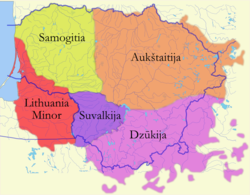
, the last of which is virtually extinct. City dwellers are usually considered just Lithuanians, especially ones from large cities such as Vilnius
or Kaunas
.
The four groups are delineated according to certain region-specific traditions, dialects, and historical divisions. There are some stereotypes used in jokes about these subgroups, for example, Sudovians are supposedly frugal while Samogitians are stubborn.
A 2004 analysis of MtDNA in a Lithuanian population revealed that Lithuanians are close to (Indo-European
) and Finno-Ugric
-speaking populations of Northern Europe. Y-chromosome SNP haplogroup
analysis showed Lithuanians to be closest to Latvians
, Estonians
and Finnish people.
The CCR5-D32 allele, which confers resistance to HIV
infection, is present in about 16% of the Lithuanian population. Its relatively high frequency may have arisen as a response to epidemics of smallpox
or plague
in the region.
Lithuanian Ashkenazi Jews have also interested geneticists, since they display a number of unique genetic characteristics; the utility of these variations has been the subject of debate. One variation, which is implicated in familial hypercholesterolemia
, has been dated to the 14th century, corresponding to the establishment of Ashkenazi settlements in response to the invitation extended by Vytautas the Great in 1388.
Lithuanians, like most other Baltic/Scandinavian cultures, have been known for being people of above average height. At the end of the 19th century, the average height of males was 163.5 cm (5.36 feet) and the average height of females was 153.3 cm (5.03 feet). By the end of the 20th century, heights averaged 181.3 cm (5'11") for males and 167.5 cm (5'6") for females.
Lithuanians and Latvians are closely in the Baltic Nations (including Estonia, populated by non-Indo European speaking Estonians), they have similar yet separate languages and cultural traditions.
(krepšinis), which is popular among Lithuanians in Lithuania as well as in the diasporic communities. Basketball came to Lithuania through the Lithuanian-American community in the thirties. Lithuanian basketball teams were bronze medal winners in the 1992
, 1996
, and 2000 Summer Olympics
. But there are a huge number of football fans in Lithuania and their number is increasing constantly.
Joninės (also known as Rasos) is a traditional national holiday, celebrated on the summer solstice. It has pagan origins. Užgavėnės
(Shrove Tuesday
) takes place on the day before Ash Wednesday
, and is meant to urge the retreat of winter. There are also national traditions for Christian holidays such as Easter
and Christmas
.
Because of their long common history, Lithuanians and Poles share many dishes and beverages. Thus there are similar Lithuanian and Polish versions of dumplings (pierogi
or koldūnai), doughnuts (pączki
or spurgos), and crepes (blini or blynai). German
traditions also influenced Lithuanian cuisine, introducing pork and potato dishes, such as potato pudding (kugelis
) and potato sausages (vėdarai), as well as the baroque
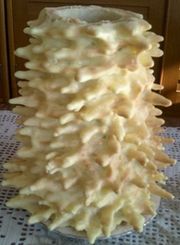
tree cake known as šakotis
. Dishes kibinai and čeburekai similar to pasty
are popular in Lithuania.
For Lithuanian Americans both dishes of Halušky
(cabbage and noodles) and Halupki (Balandėliai) (rolled cabbage) are growing increasingly more popular.
 Cepelinai
, a stuffed potato creation, is the most famous national dish. It is popular among Lithuanians all over the world. Other national foods include dark rye bread
, cold beet soup (šaltibarščiai), and kugelis
(a baked potato pudding). Some of these foods are also common in neighboring countries. Lithuanian cuisine
is generally unknown outside Lithuanian communities. Most Lithuanian restaurants outside Lithuania are located in areas with a heavy Lithuanian presence.
Lithuanians in the early 20th century were among the thinnest people in the developed countries of the world. In Lithuanian cuisine there is some emphasis on attractive presentation of freshly prepared foods.
Lithuanian ancestors Balts
were using Midus a type of Lithuanian Mead
for thousands of years.
Locally brewed beer
(alus), vodka
(degtinė), and kvass
(gira) are popular drinks in Lithuania. Starka
is a part of the Lithuanian heritage, still produced in Lithuania.
was lifted in 1904, various European literary movements such as Symbolism
, impressionism
, and expressionism
each in turn influenced the work of Lithuanian writers. The first period of Lithuanian independence (1918–40) gave them the opportunity to examine themselves and their characters more deeply, as their primary concerns were no longer political. An outstanding figure of the early 20th century was Vincas Krėvė-Mickevičius
, a novelist and dramatist. His many works include Dainavos šalies senų žmonių padavimai (Old Folks Tales of Dainava
, 1912) and the historical dramas Šarūnas (1911), Skirgaila
(1925), and Mindaugo mirtis (The Death of Mindaugas
, 1935). Petras Vaičiūnas was another popular playwright, producing one play each year during the 1920s and '30s. Vincas Mykolaitis-Putinas
wrote lyric poetry, plays, and novels, including the novel Altorių šešėly (In the Shadows of the Altars, 3 vol., 1933), a remarkably powerful autobiographical novel.
Keturi vėjai
movement started with publication of The Prophet of the Four Winds by talented poet Kazys Binkis
(1893—1942). It was rebellion against traditional poetry. The theoretical basis of Keturi vėjai initially was futurism
which arrived through Russia from the West and later cubism
, dadaism, surrealism
, unanimism
, and German expressionism
. The most influensive futurist for Lithuanian writers was Russian poet Vladimir Mayakovsky
.
Oskaras Milašius (Oscar Vladislas de Lubicz Milosz)
(1877—1939) is a paradoxical and interesting phenomenon in Lithuanian culture. He never lived in Lithuania but was born and spent his childhood in Cereja (near Mogilev
, Belarus
) and graduated from Lycée Janson de Sailly
in Paris
. His longing for his fatherland was more metaphysical. Having to choose between two conflicting countries — Lithuania
and Poland
— he preferred Lithuania which for him was an idea even more than a fatherland. In 1920 when France recognized the independence of Lithuania, he was appointed officially as Charge d’Affairs for Lithuania. He published: 1928, a collection of 26 Lithuanian songs; 1930, Lithuanian Tales and Stories; 1933, Lithuanian Tales; 1937, The origin of the Lithuanian Nation.
 Lithuanian folk music
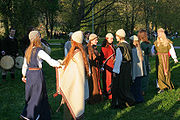
is based around songs (dainos
), which include romantic and wedding songs, as well as work songs and archaic war songs. These songs used to be performed either in groups or alone, and in parallel chord
s or unison
. Duophonic
songs are common in the renowned sutartinės tradition of Aukštaitija
. Another style of Lithuanian folk music is called rateliai, a kind of round dance
. Instrumentation includes kanklės
, a kind of zither
that accompanies sutartinės, rateliai, waltz
es, quadrille
s and polka
s, and fiddle
s, (including a bass fiddle called the basetle) and a kind of whistle
called the lumzdelis; recent importations, beginning in the late 19th century, including the concertina
, accordion
and bandoneon
. Sutartinė can be accompanied by skudučiai, a form of panpipes played by a group of people, as well as wooden trumpet
s (ragai and dandytės). Kanklės is an extremely important folk instrument, which differs in the number of string
s and performance techniques across the country. Other traditional instruments include švilpas whistle, drums and tabalas (a percussion instrument like a gong
), sekminių ragelis (bagpipe) and the pūslinė, a musical bow
made from a pig’s bladder filled with dried peas.
Balts
The Balts or Baltic peoples , defined as speakers of one of the Baltic languages, a branch of the Indo-European language family, are descended from a group of Indo-European tribes who settled the area between the Jutland peninsula in the west and Moscow, Oka and Volga rivers basins in the east...
ethnic group
Ethnic group
An ethnic group is a group of people whose members identify with each other, through a common heritage, often consisting of a common language, a common culture and/or an ideology that stresses common ancestry or endogamy...
native to Lithuania
Lithuania
Lithuania , officially the Republic of Lithuania is a country in Northern Europe, the biggest of the three Baltic states. It is situated along the southeastern shore of the Baltic Sea, whereby to the west lie Sweden and Denmark...
, where they number around 2,765,600 people. Another million or more make up the Lithuanian diaspora
Diaspora
A diaspora is "the movement, migration, or scattering of people away from an established or ancestral homeland" or "people dispersed by whatever cause to more than one location", or "people settled far from their ancestral homelands".The word has come to refer to historical mass-dispersions of...
, largely found in countries such as the United States
United States
The United States of America is a federal constitutional republic comprising fifty states and a federal district...
, Brazil
Brazil
Brazil , officially the Federative Republic of Brazil , is the largest country in South America. It is the world's fifth largest country, both by geographical area and by population with over 192 million people...
, Canada
Canada
Canada is a North American country consisting of ten provinces and three territories. Located in the northern part of the continent, it extends from the Atlantic Ocean in the east to the Pacific Ocean in the west, and northward into the Arctic Ocean...
, Colombia
Colombia
Colombia, officially the Republic of Colombia , is a unitary constitutional republic comprising thirty-two departments. The country is located in northwestern South America, bordered to the east by Venezuela and Brazil; to the south by Ecuador and Peru; to the north by the Caribbean Sea; to the...
, Russia
Russia
Russia or , officially known as both Russia and the Russian Federation , is a country in northern Eurasia. It is a federal semi-presidential republic, comprising 83 federal subjects...
, United Kingdom
United Kingdom
The United Kingdom of Great Britain and Northern IrelandIn the United Kingdom and Dependencies, other languages have been officially recognised as legitimate autochthonous languages under the European Charter for Regional or Minority Languages...
and Ireland
Ireland
Ireland is an island to the northwest of continental Europe. It is the third-largest island in Europe and the twentieth-largest island on Earth...
. Their native language is Lithuanian
Lithuanian language
Lithuanian is the official state language of Lithuania and is recognized as one of the official languages of the European Union. There are about 2.96 million native Lithuanian speakers in Lithuania and about 170,000 abroad. Lithuanian is a Baltic language, closely related to Latvian, although they...
, one of only two surviving members of the Baltic language family. According to the census conducted in 2001, 83.45% of the population of Lithuania proper identified themselves as Lithuanians, 6.74% as Poles
Poles
thumb|right|180px|The state flag of [[Poland]] as used by Polish government and diplomatic authoritiesThe Polish people, or Poles , are a nation indigenous to Poland. They are united by the Polish language, which belongs to the historical Lechitic subgroup of West Slavic languages of Central Europe...
, 6.31% as Russians
Russians
The Russian people are an East Slavic ethnic group native to Russia, speaking the Russian language and primarily living in Russia and neighboring countries....
, 1.23% as Belarusians
Belarusians
Belarusians ; are an East Slavic ethnic group who populate the majority of the Republic of Belarus. Introduced to the world as a new state in the early 1990s, the Republic of Belarus brought with it the notion of a re-emerging Belarusian ethnicity, drawn upon the lines of the Old Belarusian...
, and 2.27% as members of other ethnic groups. Most Lithuanians belong to the Roman Catholic Church
Roman Catholic Church
The Catholic Church, also known as the Roman Catholic Church, is the world's largest Christian church, with over a billion members. Led by the Pope, it defines its mission as spreading the gospel of Jesus Christ, administering the sacraments and exercising charity...
, while the Lietuvininkai who lived in the northern part of East Prussia
East Prussia
East Prussia is the main part of the region of Prussia along the southeastern Baltic Coast from the 13th century to the end of World War II in May 1945. From 1772–1829 and 1878–1945, the Province of East Prussia was part of the German state of Prussia. The capital city was Königsberg.East Prussia...
prior to World War II
World War II
World War II, or the Second World War , was a global conflict lasting from 1939 to 1945, involving most of the world's nations—including all of the great powers—eventually forming two opposing military alliances: the Allies and the Axis...
, were mostly Evangelical Lutherans.
History
The territory of the Balts, including modern Lithuania, was once inhabited by several Baltic tribal entities (Aukštaitians, Sudovians, Old LithuaniansLithuanians
Lithuanians are the Baltic ethnic group native to Lithuania, where they number around 2,765,600 people. Another million or more make up the Lithuanian diaspora, largely found in countries such as the United States, Brazil, Canada, Colombia, Russia, United Kingdom and Ireland. Their native language...
, Curonians
Curonians
The Curonians or Kurs were a Baltic tribe living on the shores of the Baltic sea in what are now the western parts of Latvia and Lithuania from the 5th to the 16th centuries, when they merged with other Baltic tribes. They gave their name to the region of Courland , and they spoke the Old...
, Semigallians
Semigallians
Semigallians were the Baltic tribe that lived in the southcentral part of contemporary Latvia and northern Lithuania...
, Selonians
Selonians
Selonians were a tribe of Baltic peoples. The Selonians lived until the 15th century in Selonia, located in southeastern Latvia and northeastern Lithuania. They merged with neighbouring tribes, contributing to the ethnogenesis of Latvians and Lithuanians....
, Samogitians
Samogitians
Samogitians are a part of the Lithuanian ethnicity inhabiting the region of Samogitia in Lithuania. Many speak the Samogitian dialect of the Lithuanian language.-History:...
, Skalvians
Skalvians
The Scalovians , also known as the Skalvians, Schalwen and Schalmen, were a Baltic tribe related to the Prussians. According to the Chronicon terrae Prussiae of Peter of Dusburg, the now extinct Scalovians inhabited the land of Scalovia south of the Curonians and Samogitians, by the lower Neman...
, Old Prussians
Old Prussians
The Old Prussians or Baltic Prussians were an ethnic group, autochthonous Baltic tribes that inhabited Prussia, the lands of the southeastern Baltic Sea in the area around the Vistula and Curonian Lagoons...
(Nadruvians
Nadruvians
The Nadruvians were one of the now-extinct Prussian clans. They lived in Nadruvia , a large territory in northernmost Prussia...
)), as attested by ancient sources and dating from prehistoric times. Over the centuries, and especially under the Grand Duchy of Lithuania
Grand Duchy of Lithuania
The Grand Duchy of Lithuania was a European state from the 12th /13th century until 1569 and then as a constituent part of Polish-Lithuanian Commonwealth until 1791 when Constitution of May 3, 1791 abolished it in favor of unitary state. It was founded by the Lithuanians, one of the polytheistic...
, some of these tribes consolidated into the Lithuanian nation, mainly as a defence against the marauding Teutonic Order and Eastern Slavs. One of the last Pagan peoples in Europe, they were eventually converted to Christianity
Christianization of Lithuania
The Christianization of Lithuania – Christianization of the Grand Duchy of Lithuania that took place in 1387, initiated by the King of Poland and Grand Duke of Lithuania Jogaila and his cousin Vytautas, that signified the official adoption of Christianity by Lithuanians, one of the last pagan...
in 1387.
The territory inhabited by the ethnic Lithuanians has shrunk over centuries; once Lithuanians made up a majority of population not only in what is now Lithuania
Lithuania
Lithuania , officially the Republic of Lithuania is a country in Northern Europe, the biggest of the three Baltic states. It is situated along the southeastern shore of the Baltic Sea, whereby to the west lie Sweden and Denmark...
, but also in northwestern Belarus
Belarus
Belarus , officially the Republic of Belarus, is a landlocked country in Eastern Europe, bordered clockwise by Russia to the northeast, Ukraine to the south, Poland to the west, and Lithuania and Latvia to the northwest. Its capital is Minsk; other major cities include Brest, Grodno , Gomel ,...
, in large areas of the territory of the modern Kaliningrad Oblast
Kaliningrad Oblast
Kaliningrad Oblast is a federal subject of Russia situated on the Baltic coast. It has a population of The oblast forms the westernmost part of the Russian Federation, but it has no land connection to the rest of Russia. Since its creation it has been an exclave of the Russian SFSR and then the...
of Russia
Russia
Russia or , officially known as both Russia and the Russian Federation , is a country in northern Eurasia. It is a federal semi-presidential republic, comprising 83 federal subjects...
, and in some parts of modern Latvia
Latvia
Latvia , officially the Republic of Latvia , is a country in the Baltic region of Northern Europe. It is bordered to the north by Estonia , to the south by Lithuania , to the east by the Russian Federation , to the southeast by Belarus and shares maritime borders to the west with Sweden...
and Poland
Poland
Poland , officially the Republic of Poland , is a country in Central Europe bordered by Germany to the west; the Czech Republic and Slovakia to the south; Ukraine, Belarus and Lithuania to the east; and the Baltic Sea and Kaliningrad Oblast, a Russian exclave, to the north...
.
However, there is a current argument that the Lithuanian language was considered non-prestigious by some elements in Lithuanian society, and a preference for the Polish language
Polonization
Polonization was the acquisition or imposition of elements of Polish culture, in particular, Polish language, as experienced in some historic periods by non-Polish populations of territories controlled or substantially influenced by Poland...
in certain territories of the Polish-Lithuanian commonwealth
Polish-Lithuanian Commonwealth
The Polish–Lithuanian Commonwealth was a dualistic state of Poland and Lithuania ruled by a common monarch. It was the largest and one of the most populous countries of 16th- and 17th‑century Europe with some and a multi-ethnic population of 11 million at its peak in the early 17th century...
, as well as a preference for the German language
German language
German is a West Germanic language, related to and classified alongside English and Dutch. With an estimated 90 – 98 million native speakers, German is one of the world's major languages and is the most widely-spoken first language in the European Union....
in territories of the former East Prussia
East Prussia
East Prussia is the main part of the region of Prussia along the southeastern Baltic Coast from the 13th century to the end of World War II in May 1945. From 1772–1829 and 1878–1945, the Province of East Prussia was part of the German state of Prussia. The capital city was Königsberg.East Prussia...
(now Kaliningrad Oblast of Russia
Russia
Russia or , officially known as both Russia and the Russian Federation , is a country in northern Eurasia. It is a federal semi-presidential republic, comprising 83 federal subjects...
) caused the number of Lithuanian speakers to decrease. The subsequent imperial Russian
Russian Empire
The Russian Empire was a state that existed from 1721 until the Russian Revolution of 1917. It was the successor to the Tsardom of Russia and the predecessor of the Soviet Union...
occupation accelerated this process; it pursued a policy of «Russification», which included a ban on public speaking and writing in Lithuanian
Lithuanian press ban
The Lithuanian press ban was a ban on all Lithuanian language publications printed in the Latin alphabet within the Russian Empire, which controlled Lithuania at the time. Lithuanian-language publications that used the Cyrillic alphabet were allowed and even encouraged...
(see, e.g., «Knygnešiai
Knygnešiai
Book smugglers were people who transported Lithuanian language books printed in the Latin alphabet into Lithuanian-speaking areas of the Russian Empire, defying a ban on such materials in force from 1866 to 1904...
», the actions against the Catholic Church). It was believed by some at the time that the nation as such, along with its language, would become extinct within a few generations.
At the end of the 19th century a Lithuanian cultural and linguistic revival occurred. Some of the Polish- and Belarusian-speaking persons from the lands of the former Grand Duchy of Lithuania expressed their affiliation with the modern Lithuanian nation in the early 20th century, including Michał Pius Römer, Stanisław Narutowicz, Oscar Milosz
Oscar Milosz
Oscar Vladislas de Lubicz Milosz was a French-Lithuanian writer and representative of Lithuania at the League of Nations. His literary work was concerned with symbols and associations. A recluse, his poems were vibrant and tormented, concerned with love, loneliness and anger. Milosz was primarily...
and Tadas Ivanauskas
Tadas Ivanauskas
Tadas Ivanauskas was a prominent Lithuanian zoologist and biologist, and one of the founders of Vytautas Magnus University.- Biography :...
. Lithuania declared independence
Act of Independence of Lithuania
The Act of Independence of Lithuania or Act of February 16 was signed by the Council of Lithuania on February 16, 1918, proclaiming the restoration of an independent State of Lithuania, governed by democratic principles, with Vilnius as its capital. The Act was signed by all twenty...
after the World War I
World War I
World War I , which was predominantly called the World War or the Great War from its occurrence until 1939, and the First World War or World War I thereafter, was a major war centred in Europe that began on 28 July 1914 and lasted until 11 November 1918...
, which helped its national consolidation. A standard Lithuanian language was approved. However, the eastern parts of Lithuania, including the Vilnius region
Vilnius region
Vilnius Region , refers to the territory in the present day Lithuania, that was originally inhabited by ethnic Baltic tribes and was a part of Lithuania proper, but came under East Slavic and Polish cultural influences over time,...
, were annexed by Poland
Second Polish Republic
The Second Polish Republic, Second Commonwealth of Poland or interwar Poland refers to Poland between the two world wars; a period in Polish history in which Poland was restored as an independent state. Officially known as the Republic of Poland or the Commonwealth of Poland , the Polish state was...
, while the Klaipėda Region
Klaipėda Region
The Klaipėda Region or Memel Territory was defined by the Treaty of Versailles in 1920 when it was put under the administration of the Council of Ambassadors...
was taken over by Nazi Germany
Nazi Germany
Nazi Germany , also known as the Third Reich , but officially called German Reich from 1933 to 1943 and Greater German Reich from 26 June 1943 onward, is the name commonly used to refer to the state of Germany from 1933 to 1945, when it was a totalitarian dictatorship ruled by...
in 1939. In 1940, Lithuania was invaded and occupied by the Soviet Union
Soviet Union
The Soviet Union , officially the Union of Soviet Socialist Republics , was a constitutionally socialist state that existed in Eurasia between 1922 and 1991....
, and forced to join it as the Lithuanian SSR
Lithuanian SSR
The Lithuanian Soviet Socialist Republic , also known as the Lithuanian SSR, was one of the republics that made up the former Soviet Union...
. The Germans and their allies attacked the U.S.S.R. in June 1941, and from 1941—1944, Lithuania was occupied by Germany. The Germans retreated in 1944, and Lithuania fell under Soviet rule once again. The long-standing communities of Lithuanians in the Kaliningrad Oblast («Lithuania Minor
Lithuania Minor
Lithuania Minor or Prussian Lithuania is a historical ethnographic region of Prussia, later East Prussia in Germany, where Prussian Lithuanians or Lietuvininkai lived. Lithuania Minor enclosed the northern part of this province and got its name due to the territory's substantial...
») were almost destroyed as a result.
The Lithuanian nation as such remained primarily in Lithuania, in a few villages in northeastern Poland
Poland
Poland , officially the Republic of Poland , is a country in Central Europe bordered by Germany to the west; the Czech Republic and Slovakia to the south; Ukraine, Belarus and Lithuania to the east; and the Baltic Sea and Kaliningrad Oblast, a Russian exclave, to the north...
, southern Latvia
Latvia
Latvia , officially the Republic of Latvia , is a country in the Baltic region of Northern Europe. It is bordered to the north by Estonia , to the south by Lithuania , to the east by the Russian Federation , to the southeast by Belarus and shares maritime borders to the west with Sweden...
and also in the diaspora of emigrants. Some indigenous Lithuanians still remain in Belarus and the Kaliningrad Oblast, but their number is small compared to what they used to be. Lithuania regained its independence in 1990, and was recognized by most countries in 1991. It became a member of the European Union
European Union
The European Union is an economic and political union of 27 independent member states which are located primarily in Europe. The EU traces its origins from the European Coal and Steel Community and the European Economic Community , formed by six countries in 1958...
on May 1, 2004. A low birth rate and increased emigration after joining EU is threatening the nation’s future.
Ethnic composition of Lithuania
Among the Baltic statesBaltic states
The term Baltic states refers to the Baltic territories which gained independence from the Russian Empire in the wake of World War I: primarily the contiguous trio of Estonia, Latvia, Lithuania ; Finland also fell within the scope of the term after initially gaining independence in the 1920s.The...
, Lithuania has the most homogeneous population. According to the census conducted in 2001, 83.45% of the population identified themselves as ethnic Lithuanians, 6.74% as Poles
Poles
thumb|right|180px|The state flag of [[Poland]] as used by Polish government and diplomatic authoritiesThe Polish people, or Poles , are a nation indigenous to Poland. They are united by the Polish language, which belongs to the historical Lechitic subgroup of West Slavic languages of Central Europe...
, 6.31% as Russians
Russians
The Russian people are an East Slavic ethnic group native to Russia, speaking the Russian language and primarily living in Russia and neighboring countries....
, 1.23% as Belarusians
Belarusians
Belarusians ; are an East Slavic ethnic group who populate the majority of the Republic of Belarus. Introduced to the world as a new state in the early 1990s, the Republic of Belarus brought with it the notion of a re-emerging Belarusian ethnicity, drawn upon the lines of the Old Belarusian...
, and 2.27% as members of other ethnic groups such as Tatars
Tatars
Tatars are a Turkic speaking ethnic group , numbering roughly 7 million.The majority of Tatars live in the Russian Federation, with a population of around 5.5 million, about 2 million of which in the republic of Tatarstan.Significant minority populations are found in Uzbekistan, Kazakhstan,...
, Finns, Danes, Jews
Jews
The Jews , also known as the Jewish people, are a nation and ethnoreligious group originating in the Israelites or Hebrews of the Ancient Near East. The Jewish ethnicity, nationality, and religion are strongly interrelated, as Judaism is the traditional faith of the Jewish nation...
and other.
Poles are concentrated in the Vilnius region
Vilnius region
Vilnius Region , refers to the territory in the present day Lithuania, that was originally inhabited by ethnic Baltic tribes and was a part of Lithuania proper, but came under East Slavic and Polish cultural influences over time,...
, the area controlled by Poland in the interwar period. Especially large Polish communities are located in the Vilnius district municipality
Vilnius district municipality
Vilnius district municipality is one of 60 municipalities in Lithuania. It surrounds the capital on 3 sides, and the Trakai district municipality touches it on one....
(61.3% of the population) and the Šalčininkai district municipality
Šalcininkai district municipality
Šalčininkai district municipality is one of 60 municipalities in Lithuania.It has one of biggest Polish minority populations in Lithuania, with 31,223 or over 80% of the population claiming Polish ethnicity. Šalčininkai is the largest town in and the center of the region.-References:...
(79.5%). This concentration allows Election Action of Lithuania's Poles
Election Action of Lithuania's Poles
Electoral Action of Poles in Lithuania , abbreviated to AWPL or LLRA, is a centre-right Lithuanian political party. It represents the Polish minority and positions itself as Christian democratic...
, an ethnic minority-based political party, to exert political influence. This party has held 1 or 2 seats in the parliament of Lithuania for the past decade. The party is more active in local politics and controls several municipality councils.
Russians, even though they are almost as numerous as Poles, are much more evenly scattered and do not have a strong political party. The most prominent community lives in the Visaginas city municipality (52%). Most of them are workers who moved from Russia to work at the Ignalina Nuclear Power Plant
Ignalina Nuclear Power Plant
The Ignalina Nuclear Power Plant is a closed two-unit RBMK-1500 nuclear power station in Visaginas, Lithuania. It was named after the nearby city of Ignalina...
. Lithuania is noted for its success in limiting Russian worker migration during the Soviet occupation (1945—1990). A number of ethnic Russians left Lithuania after the declaration of independence in 1990.
In the past, the ethnic composition of Lithuania has varied dramatically. The most prominent change was the extermination of the Jewish
Jews
The Jews , also known as the Jewish people, are a nation and ethnoreligious group originating in the Israelites or Hebrews of the Ancient Near East. The Jewish ethnicity, nationality, and religion are strongly interrelated, as Judaism is the traditional faith of the Jewish nation...
population during the Holocaust
The Holocaust
The Holocaust , also known as the Shoah , was the genocide of approximately six million European Jews and millions of others during World War II, a programme of systematic state-sponsored murder by Nazi...
. Before World War II
World War II
World War II, or the Second World War , was a global conflict lasting from 1939 to 1945, involving most of the world's nations—including all of the great powers—eventually forming two opposing military alliances: the Allies and the Axis...
, about 7.5% of the population was Jewish; they were concentrated in cities and towns and had a significant influence on crafts and business. They were called Litvaks and had a strong culture. The population of Vilnius, which was sometimes nicknamed the Northern Jerusalem, was about 30% Jewish. Almost all its Jews were killed during the Holocaust in Nazi-occupied Lithuania or later emigrated to the United States and Israel
Israel
The State of Israel is a parliamentary republic located in the Middle East, along the eastern shore of the Mediterranean Sea...
. Now there are about 3,200 Jews living in Lithuania.
Cultural Subgroups
Apart from the various religious and ethnic groups currently residing in Lithuania, Lithuanians themselves are usually divided into 5 groups: Žemaičiai, Suvalkiečiai, Aukštaičiai, Dzūkai and PrūsaiPrussian Lithuanians
The term Prussian Lithuanians or Lietuvininkai refers to a Western Lithuanian ethnic group, which did not form a nation and inhabited a territory in East Prussia called Prussian Lithuania or Lithuania Minor in contrast to the Grand Duchy of Lithuania and later the Republic of Lithuania .Unlike most...
, the last of which is virtually extinct. City dwellers are usually considered just Lithuanians, especially ones from large cities such as Vilnius
Vilnius
Vilnius is the capital of Lithuania, and its largest city, with a population of 560,190 as of 2010. It is the seat of the Vilnius city municipality and of the Vilnius district municipality. It is also the capital of Vilnius County...
or Kaunas
Kaunas
Kaunas is the second-largest city in Lithuania and has historically been a leading centre of Lithuanian economic, academic, and cultural life. Kaunas was the biggest city and the center of a powiat in Trakai Voivodeship of the Grand Duchy of Lithuania since 1413. During Russian Empire occupation...
.
The four groups are delineated according to certain region-specific traditions, dialects, and historical divisions. There are some stereotypes used in jokes about these subgroups, for example, Sudovians are supposedly frugal while Samogitians are stubborn.
Genetics
Since the Neolithic period the native inhabitants of the Lithuanian territory have not been replaced by any other ethnic group, so there is a high probability that the inhabitants of present day Lithuania have preserved the genetic composition of their forebears relatively undisturbed by the major demographic movements, although without being actually isolated from them. The Lithuanian population appears to be relatively homogeneous, without apparent genetic differences among ethnic subgroups.A 2004 analysis of MtDNA in a Lithuanian population revealed that Lithuanians are close to (Indo-European
Indo-European languages
The Indo-European languages are a family of several hundred related languages and dialects, including most major current languages of Europe, the Iranian plateau, and South Asia and also historically predominant in Anatolia...
) and Finno-Ugric
Finno-Ugric languages
Finno-Ugric , Finno-Ugrian or Fenno-Ugric is a traditional group of languages in the Uralic language family that comprises the Finno-Permic and Ugric language families....
-speaking populations of Northern Europe. Y-chromosome SNP haplogroup
Haplogroup
In the study of molecular evolution, a haplogroup is a group of similar haplotypes that share a common ancestor having the same single nucleotide polymorphism mutation in both haplotypes. Because a haplogroup consists of similar haplotypes, this is what makes it possible to predict a haplogroup...
analysis showed Lithuanians to be closest to Latvians
Latvians
Latvians or Letts are the indigenous Baltic people of Latvia.-History:Latvians occasionally refer to themselves by the ancient name of Latvji, which may have originated from the word Latve which is a name of the river that presumably flowed through what is now eastern Latvia...
, Estonians
Estonians
Estonians are a Finnic people closely related to the Finns and inhabiting, primarily, the country of Estonia. They speak a Finnic language known as Estonian...
and Finnish people.
The CCR5-D32 allele, which confers resistance to HIV
HIV
Human immunodeficiency virus is a lentivirus that causes acquired immunodeficiency syndrome , a condition in humans in which progressive failure of the immune system allows life-threatening opportunistic infections and cancers to thrive...
infection, is present in about 16% of the Lithuanian population. Its relatively high frequency may have arisen as a response to epidemics of smallpox
Smallpox
Smallpox was an infectious disease unique to humans, caused by either of two virus variants, Variola major and Variola minor. The disease is also known by the Latin names Variola or Variola vera, which is a derivative of the Latin varius, meaning "spotted", or varus, meaning "pimple"...
or plague
Bubonic plague
Plague is a deadly infectious disease that is caused by the enterobacteria Yersinia pestis, named after the French-Swiss bacteriologist Alexandre Yersin. Primarily carried by rodents and spread to humans via fleas, the disease is notorious throughout history, due to the unrivaled scale of death...
in the region.
Lithuanian Ashkenazi Jews have also interested geneticists, since they display a number of unique genetic characteristics; the utility of these variations has been the subject of debate. One variation, which is implicated in familial hypercholesterolemia
Hypercholesterolemia
Hypercholesterolemia is the presence of high levels of cholesterol in the blood. It is not a disease but a metabolic derangement that can be caused by many diseases, notably cardiovascular disease...
, has been dated to the 14th century, corresponding to the establishment of Ashkenazi settlements in response to the invitation extended by Vytautas the Great in 1388.
Lithuanians, like most other Baltic/Scandinavian cultures, have been known for being people of above average height. At the end of the 19th century, the average height of males was 163.5 cm (5.36 feet) and the average height of females was 153.3 cm (5.03 feet). By the end of the 20th century, heights averaged 181.3 cm (5'11") for males and 167.5 cm (5'6") for females.
Lithuanians and Latvians are closely in the Baltic Nations (including Estonia, populated by non-Indo European speaking Estonians), they have similar yet separate languages and cultural traditions.
Lithuanian diaspora
Apart from the traditional communities in Lithuania and its neighboring countries, Lithuanians have emigrated to other continents during the 19th, 20th and 21st centuries.- Communities in the United States make up the largest part of this diasporaDiasporaA diaspora is "the movement, migration, or scattering of people away from an established or ancestral homeland" or "people dispersed by whatever cause to more than one location", or "people settled far from their ancestral homelands".The word has come to refer to historical mass-dispersions of...
; as many as one million Americans can claim Lithuanian descent. Emigration to America began in the 19th century, with an interruption during the Soviet occupation, when travel and emigration were severely restricted. The largest concentrations of Lithuanian Americans are in the Great LakesGreat LakesThe Great Lakes are a collection of freshwater lakes located in northeastern North America, on the Canada – United States border. Consisting of Lakes Superior, Michigan, Huron, Erie, and Ontario, they form the largest group of freshwater lakes on Earth by total surface, coming in second by volume...
area and the Northeast. Nearly 20,000 Lithuanians have immigrated to the United States since the fall of the Soviet Union in 1991. - Lithuanian communities in MexicoMexicoThe United Mexican States , commonly known as Mexico , is a federal constitutional republic in North America. It is bordered on the north by the United States; on the south and west by the Pacific Ocean; on the southeast by Guatemala, Belize, and the Caribbean Sea; and on the east by the Gulf of...
and South America (Argentina, BrazilBrazilBrazil , officially the Federative Republic of Brazil , is the largest country in South America. It is the world's fifth largest country, both by geographical area and by population with over 192 million people...
, Colombia, and Uruguay) developed before World War II, beginning in the late 19th and early 20th century. Currently, there is no longer a flow of emigrants to these destinations, since economic conditions in those countries are not better than those in Lithuania (see Lithuanians in BrazilLithuanians in BrazilLithuanian-Brazilian, is a Brazilian person of full, partial, or predominantly Lithuanian ancestry, or a Lithuanian-born person residing in Brazil....
). - Jewish Lithuanian communities were formed in South Africa during the late 19th and 20th century, the majority being Jewish.
- Lithuanian communities in other regions of the former Soviet Union were formed during the Soviet occupation; the numbers of Lithuanians in SiberiaSiberiaSiberia is an extensive region constituting almost all of Northern Asia. Comprising the central and eastern portion of the Russian Federation, it was part of the Soviet Union from its beginning, as its predecessor states, the Tsardom of Russia and the Russian Empire, conquered it during the 16th...
and Central AsiaCentral AsiaCentral Asia is a core region of the Asian continent from the Caspian Sea in the west, China in the east, Afghanistan in the south, and Russia in the north...
increased dramatically when a large portion of Lithuanians were involuntarily deported into these areas. After de-StalinizationDe-StalinizationDe-Stalinization refers to the process of eliminating the cult of personality, Stalinist political system and the Gulag labour-camp system created by Soviet leader Joseph Stalin. Stalin was succeeded by a collective leadership after his death in March 1953...
, however, most of them returned. Later, some Lithuanians were relocated to work in other areas of the Soviet UnionSoviet UnionThe Soviet Union , officially the Union of Soviet Socialist Republics , was a constitutionally socialist state that existed in Eurasia between 1922 and 1991....
; some of them did not return to Lithuania, after it became independent. - The Lithuanian communities in Western Europe (UKLithuanians in the United KingdomLithuanians in the United Kingdom including individuals born in Lithuania who have migrated to the UK as well as their British-born descendants form a subgroup of Baltic people in the United Kingdom...
, IrelandLithuanians in IrelandMost Lithuanian immigrants arrived in Ireland in the 2000s, when the Irish economy started booming. As of 2006 there are 24,808 people of Lithuanian birth resident in the state. Approximately one third of these Lithuanians live in County Dublin.-History:...
, Spain, Sweden, and Norway) are very new and began to appear after the restoration of independence to Lithuania in 1990; this emigration intensified after Lithuania became part of the European UnionEuropean UnionThe European Union is an economic and political union of 27 independent member states which are located primarily in Europe. The EU traces its origins from the European Coal and Steel Community and the European Economic Community , formed by six countries in 1958...
. It should be noted that LondonLondonLondon is the capital city of :England and the :United Kingdom, the largest metropolitan area in the United Kingdom, and the largest urban zone in the European Union by most measures. Located on the River Thames, London has been a major settlement for two millennia, its history going back to its...
and GlasgowGlasgowGlasgow is the largest city in Scotland and third most populous in the United Kingdom. The city is situated on the River Clyde in the country's west central lowlands...
(especially the BellshillBellshillBellshill is a town in North Lanarkshire, Scotland, 10 miles south east of Glasgow city centre and 37 miles west of Edinburgh. Other nearby towns are Motherwell , Hamilton and Coatbridge . Since 1996, it has been situated in the Greater Glasgow metropolitan area...
and CoatbridgeCoatbridgeCoatbridge is a town in North Lanarkshire, Scotland, about east of Glasgow city centre, set in the central Lowlands. The town, with neighbouring Airdrie, is part of the Greater Glasgow urban area. The first settlement of the area stretches back to the Stone Age era...
areas of Greater GlasgowGreater GlasgowGreater Glasgow is an urban settlement in Scotland consisting of all localities which are physically attached to the city of Glasgow, forming with it a single contiguous urban area...
) have long had large Catholic and Jewish Lithuanian populations. The Republic of IrelandRepublic of IrelandIreland , described as the Republic of Ireland , is a sovereign state in Europe occupying approximately five-sixths of the island of the same name. Its capital is Dublin. Ireland, which had a population of 4.58 million in 2011, is a constitutional republic governed as a parliamentary democracy,...
probably has the highest concentration of Lithuanians relative to its total population size in Western Europe; its estimated 45,000 Lithuanians (about half of whom are registered) form over 1% of Ireland’s total population. - Lithuanian communities in Australia exist as well; due to its great distance from Europe, however, emigration there was minuscule. There are Lithuanian communities in MelbourneMelbourneMelbourne is the capital and most populous city in the state of Victoria, and the second most populous city in Australia. The Melbourne City Centre is the hub of the greater metropolitan area and the Census statistical division—of which "Melbourne" is the common name. As of June 2009, the greater...
, Geelong, SydneySydneySydney is the most populous city in Australia and the state capital of New South Wales. Sydney is located on Australia's south-east coast of the Tasman Sea. As of June 2010, the greater metropolitan area had an approximate population of 4.6 million people...
, AdelaideAdelaideAdelaide is the capital city of South Australia and the fifth-largest city in Australia. Adelaide has an estimated population of more than 1.2 million...
, BrisbaneBrisbaneBrisbane is the capital and most populous city in the Australian state of Queensland and the third most populous city in Australia. Brisbane's metropolitan area has a population of over 2 million, and the South East Queensland urban conurbation, centred around Brisbane, encompasses a population of...
, HobartHobartHobart is the state capital and most populous city of the Australian island state of Tasmania. Founded in 1804 as a penal colony,Hobart is Australia's second oldest capital city after Sydney. In 2009, the city had a greater area population of approximately 212,019. A resident of Hobart is known as...
and PerthPerth, Western AustraliaPerth is the capital and largest city of the Australian state of Western Australia and the fourth most populous city in Australia. The Perth metropolitan area has an estimated population of almost 1,700,000....
.
Culture and traditions
The Lithuanian national sport is usually considered to be basketballBasketball
Basketball is a team sport in which two teams of five players try to score points by throwing or "shooting" a ball through the top of a basketball hoop while following a set of rules...
(krepšinis), which is popular among Lithuanians in Lithuania as well as in the diasporic communities. Basketball came to Lithuania through the Lithuanian-American community in the thirties. Lithuanian basketball teams were bronze medal winners in the 1992
1992 Summer Olympics
The 1992 Summer Olympic Games, officially known as the Games of the XXV Olympiad, were an international multi-sport event celebrated in Barcelona, Catalonia, Spain, in 1992. The International Olympic Committee voted in 1986 to separate the Summer and Winter Games, which had been held in the same...
, 1996
1992 Summer Olympics
The 1992 Summer Olympic Games, officially known as the Games of the XXV Olympiad, were an international multi-sport event celebrated in Barcelona, Catalonia, Spain, in 1992. The International Olympic Committee voted in 1986 to separate the Summer and Winter Games, which had been held in the same...
, and 2000 Summer Olympics
2000 Summer Olympics
The Sydney 2000 Summer Olympic Games or the Millennium Games/Games of the New Millennium, officially known as the Games of the XXVII Olympiad, were an international multi-sport event which was celebrated between 15 September and 1 October 2000 in Sydney, New South Wales, Australia...
. But there are a huge number of football fans in Lithuania and their number is increasing constantly.
Joninės (also known as Rasos) is a traditional national holiday, celebrated on the summer solstice. It has pagan origins. Užgavėnės
Užgavenes
Užgavėnės is a Lithuanian festival that takes place during the seventh week before Easter . Its name in English means "the time before Lent"...
(Shrove Tuesday
Shrove Tuesday
Shrove Tuesday is a term used in English-speaking countries, especially in Ireland, United Kingdom, Canada, Australia, New Zealand, Philippines, Germany, and parts of the United States for the day preceding Ash Wednesday, the first day of the season of fasting and prayer called Lent.The...
) takes place on the day before Ash Wednesday
Ash Wednesday
Ash Wednesday, in the calendar of Western Christianity, is the first day of Lent and occurs 46 days before Easter. It is a moveable fast, falling on a different date each year because it is dependent on the date of Easter...
, and is meant to urge the retreat of winter. There are also national traditions for Christian holidays such as Easter
Easter
Easter is the central feast in the Christian liturgical year. According to the Canonical gospels, Jesus rose from the dead on the third day after his crucifixion. His resurrection is celebrated on Easter Day or Easter Sunday...
and Christmas
Christmas
Christmas or Christmas Day is an annual holiday generally celebrated on December 25 by billions of people around the world. It is a Christian feast that commemorates the birth of Jesus Christ, liturgically closing the Advent season and initiating the season of Christmastide, which lasts twelve days...
.
Lithuanian cuisine
Lithuanian cuisine has much in common with other European cuisines and features the products suited to its cool and moist northern climate: barley, potatoes, rye, beets, greens, and mushrooms are locally grown, and dairy products are one of its specialties. Nevertheless, it has its own distinguishing features, which were formed by a variety of influences during the country’s long and difficult history.Because of their long common history, Lithuanians and Poles share many dishes and beverages. Thus there are similar Lithuanian and Polish versions of dumplings (pierogi
Pierogi
Pierogi are dumplings of unleavened dough - first boiled, then they are baked or fried usually in butter with onions - traditionally stuffed with potato filling, sauerkraut, ground meat, cheese, or fruit...
or koldūnai), doughnuts (pączki
Paczki
Pączki are pastries traditional to Polish cuisine . Pączki is the plural form of the Polish word pączek , though many English speakers use paczki as singular and paczkis as plural. In English, the common pronunciation imitates the Polish pronunciation, but some speakers pronounce the word or...
or spurgos), and crepes (blini or blynai). German
Germany
Germany , officially the Federal Republic of Germany , is a federal parliamentary republic in Europe. The country consists of 16 states while the capital and largest city is Berlin. Germany covers an area of 357,021 km2 and has a largely temperate seasonal climate...
traditions also influenced Lithuanian cuisine, introducing pork and potato dishes, such as potato pudding (kugelis
Kugelis
Kugelis is a baked potato pudding that is a Lithuanian national dish. The main ingredients are potatoes, bacon, milk, onions, and eggs. It may be spiced with salt, black pepper, bay leaves, and/or marjoram...
) and potato sausages (vėdarai), as well as the baroque
Baroque
The Baroque is a period and the style that used exaggerated motion and clear, easily interpreted detail to produce drama, tension, exuberance, and grandeur in sculpture, painting, literature, dance, and music...
tree cake known as šakotis
Šakotis
Lithuanian Šakotis or Raguolis or Polish sękacz is a popular Lithuanian-Polish traditional cake....
. Dishes kibinai and čeburekai similar to pasty
Pasty
A pasty , sometimes known as a pastie or British pasty in the United States, is a filled pastry case, associated in particular with Cornwall in Great Britain. It is made by placing the uncooked filling on a flat pastry circle, and folding it to wrap the filling, crimping the edge at the side or top...
are popular in Lithuania.
For Lithuanian Americans both dishes of Halušky
Halušky
Halušky are a traditional variety of thick, soft noodles or dumplings cooked in the Central and Eastern European cuisines .They are irregular in shape...
(cabbage and noodles) and Halupki (Balandėliai) (rolled cabbage) are growing increasingly more popular.
Cepelinai
Cepelinai or Didžkukuliai are a Lithuanian national dish. They are a type of dumpling made from grated potatoes and usually stuffed with minced meat, although sometimes dry cottage cheese or mushrooms are used instead....
, a stuffed potato creation, is the most famous national dish. It is popular among Lithuanians all over the world. Other national foods include dark rye bread
Rye bread
Rye bread is a type of bread made with various percentages of flour from rye grain. It can be light or dark in color, depending on the type of flour used and the addition of coloring agents, and is typically denser than bread made from wheat flour...
, cold beet soup (šaltibarščiai), and kugelis
Kugelis
Kugelis is a baked potato pudding that is a Lithuanian national dish. The main ingredients are potatoes, bacon, milk, onions, and eggs. It may be spiced with salt, black pepper, bay leaves, and/or marjoram...
(a baked potato pudding). Some of these foods are also common in neighboring countries. Lithuanian cuisine
Lithuanian cuisine
Lithuanian cuisine features the products suited to the cool and moist northern climate of Lithuania: barley, potatoes, rye, beets, greens, berries, and mushrooms are locally grown, and dairy products are one of its specialities...
is generally unknown outside Lithuanian communities. Most Lithuanian restaurants outside Lithuania are located in areas with a heavy Lithuanian presence.
Lithuanians in the early 20th century were among the thinnest people in the developed countries of the world. In Lithuanian cuisine there is some emphasis on attractive presentation of freshly prepared foods.
Lithuanian ancestors Balts
Balts
The Balts or Baltic peoples , defined as speakers of one of the Baltic languages, a branch of the Indo-European language family, are descended from a group of Indo-European tribes who settled the area between the Jutland peninsula in the west and Moscow, Oka and Volga rivers basins in the east...
were using Midus a type of Lithuanian Mead
Mead
Mead , also called honey wine, is an alcoholic beverage that is produced by fermenting a solution of honey and water. It may also be produced by fermenting a solution of water and honey with grain mash, which is strained immediately after fermentation...
for thousands of years.
Locally brewed beer
Beer
Beer is the world's most widely consumed andprobably oldest alcoholic beverage; it is the third most popular drink overall, after water and tea. It is produced by the brewing and fermentation of sugars, mainly derived from malted cereal grains, most commonly malted barley and malted wheat...
(alus), vodka
Vodka
Vodka , is a distilled beverage. It is composed primarily of water and ethanol with traces of impurities and flavorings. Vodka is made by the distillation of fermented substances such as grains, potatoes, or sometimes fruits....
(degtinė), and kvass
Kvass
Kvass, kvas, quass or gira, gėra is a fermented beverage made from black...
(gira) are popular drinks in Lithuania. Starka
Starka
Starka is a traditional dry vodka distilled from rye grain, produced mostly in Poland and Lithuania. Traditional Starka is made from natural rye spirit and aged in oak barrels with small addition of lime-tree and apple-tree leaves. The process of production is similar to that used in whisky...
is a part of the Lithuanian heritage, still produced in Lithuania.
Lithuanian literature
When the ban against printing the Lithuanian languageLithuanian press ban
The Lithuanian press ban was a ban on all Lithuanian language publications printed in the Latin alphabet within the Russian Empire, which controlled Lithuania at the time. Lithuanian-language publications that used the Cyrillic alphabet were allowed and even encouraged...
was lifted in 1904, various European literary movements such as Symbolism
Symbolism (arts)
Symbolism was a late nineteenth-century art movement of French, Russian and Belgian origin in poetry and other arts. In literature, the style had its beginnings with the publication Les Fleurs du mal by Charles Baudelaire...
, impressionism
Impressionism
Impressionism was a 19th-century art movement that originated with a group of Paris-based artists whose independent exhibitions brought them to prominence during the 1870s and 1880s...
, and expressionism
Expressionism
Expressionism was a modernist movement, initially in poetry and painting, originating in Germany at the beginning of the 20th century. Its typical trait is to present the world solely from a subjective perspective, distorting it radically for emotional effect in order to evoke moods or ideas...
each in turn influenced the work of Lithuanian writers. The first period of Lithuanian independence (1918–40) gave them the opportunity to examine themselves and their characters more deeply, as their primary concerns were no longer political. An outstanding figure of the early 20th century was Vincas Krėvė-Mickevičius
Vincas Kreve-Mickevicius
Vincas Mickevičius , better known by his pen name Vincas Krėvė-Mickevičius, was a Lithuanian writer, poet, novelist, playwright and philologist...
, a novelist and dramatist. His many works include Dainavos šalies senų žmonių padavimai (Old Folks Tales of Dainava
Dainava
Dainava may refer to:*Dainava an alternative name for Dzūkija, Lithuanian region,*Dainava an elderate in Kaunas city....
, 1912) and the historical dramas Šarūnas (1911), Skirgaila
Skirgaila
Skirgaila , also known as Ivan; ca. 1353 or 1354 – 11 January 1397 in Kiev; baptized 1383/1384 as Casimir) was a regent of the Grand Duchy of Lithuania for his brother Jogaila from 1386 to 1392. He was son of Algirdas, Grand Duke of Lithuania, and his second wife Uliana of Tver.-Biography:After...
(1925), and Mindaugo mirtis (The Death of Mindaugas
Mindaugas
Mindaugas was the first known Grand Duke of Lithuania and the only King of Lithuania. Little is known of his origins, early life, or rise to power; he is mentioned in a 1219 treaty as an elder duke, and in 1236 as the leader of all the Lithuanians...
, 1935). Petras Vaičiūnas was another popular playwright, producing one play each year during the 1920s and '30s. Vincas Mykolaitis-Putinas
Vincas Mykolaitis-Putinas
Vincas Mykolaitis known by his pen name Putinas was Lithuanian poet and writer. He was also a priest, but renounced his priesthood in 1935.-Biography:...
wrote lyric poetry, plays, and novels, including the novel Altorių šešėly (In the Shadows of the Altars, 3 vol., 1933), a remarkably powerful autobiographical novel.
Keturi vėjai
Keturi vejai
Keturi vėjai was a Lithuanian literary movement and literary journal, active from 1924 to 1928.Keturi vėjai movement began with the publication of The Prophet of the Four Winds by Kazys Binkis...
movement started with publication of The Prophet of the Four Winds by talented poet Kazys Binkis
Kazys Binkis
Kazys Binkis was a Lithuanian poet, journalist, and playwright. He used the pseudonyms K.Alijošius, K. Papilietis, Kazys, Kazys Roviejietis, Nedarbininkas, Neklaipėdietis, Nelatvis, Nepartyvis, Ras Desta, Riza Chanas and others.-Biography:...
(1893—1942). It was rebellion against traditional poetry. The theoretical basis of Keturi vėjai initially was futurism
Futurism (art)
Futurism was an artistic and social movement that originated in Italy in the early 20th century. It emphasized and glorified themes associated with contemporary concepts of the future, including speed, technology, youth and violence, and objects such as the car, the airplane and the industrial city...
which arrived through Russia from the West and later cubism
Cubism
Cubism was a 20th century avant-garde art movement, pioneered by Pablo Picasso and Georges Braque, that revolutionized European painting and sculpture, and inspired related movements in music, literature and architecture...
, dadaism, surrealism
Surrealism
Surrealism is a cultural movement that began in the early 1920s, and is best known for the visual artworks and writings of the group members....
, unanimism
Unanimism
Unanimism is a movement in French literature begun by Jules Romains in the early 1900s. It is based on ideas of collective consciousness and collective emotion, and on crowd behavior, where members of a group do or think something simultaneously...
, and German expressionism
Expressionism
Expressionism was a modernist movement, initially in poetry and painting, originating in Germany at the beginning of the 20th century. Its typical trait is to present the world solely from a subjective perspective, distorting it radically for emotional effect in order to evoke moods or ideas...
. The most influensive futurist for Lithuanian writers was Russian poet Vladimir Mayakovsky
Vladimir Mayakovsky
Vladimir Vladimirovich Mayakovsky was a Russian and Soviet poet and playwright, among the foremost representatives of early-20th century Russian Futurism.- Early life :...
.
Oskaras Milašius (Oscar Vladislas de Lubicz Milosz)
Oscar Milosz
Oscar Vladislas de Lubicz Milosz was a French-Lithuanian writer and representative of Lithuania at the League of Nations. His literary work was concerned with symbols and associations. A recluse, his poems were vibrant and tormented, concerned with love, loneliness and anger. Milosz was primarily...
(1877—1939) is a paradoxical and interesting phenomenon in Lithuanian culture. He never lived in Lithuania but was born and spent his childhood in Cereja (near Mogilev
Mogilev
Mogilev is a city in eastern Belarus, about 76 km from the border with Russia's Smolensk Oblast and 105 km from the border with Russia's Bryansk Oblast. It has more than 367,788 inhabitants...
, Belarus
Belarus
Belarus , officially the Republic of Belarus, is a landlocked country in Eastern Europe, bordered clockwise by Russia to the northeast, Ukraine to the south, Poland to the west, and Lithuania and Latvia to the northwest. Its capital is Minsk; other major cities include Brest, Grodno , Gomel ,...
) and graduated from Lycée Janson de Sailly
Lycée Janson de Sailly
Lycée Janson de Sailly is a lycée located in the XVIe arrondissement of Paris, France. It is generally considered as one of the most prestigious lycées in Paris...
in Paris
Paris
Paris is the capital and largest city in France, situated on the river Seine, in northern France, at the heart of the Île-de-France region...
. His longing for his fatherland was more metaphysical. Having to choose between two conflicting countries — Lithuania
Lithuania
Lithuania , officially the Republic of Lithuania is a country in Northern Europe, the biggest of the three Baltic states. It is situated along the southeastern shore of the Baltic Sea, whereby to the west lie Sweden and Denmark...
and Poland
Poland
Poland , officially the Republic of Poland , is a country in Central Europe bordered by Germany to the west; the Czech Republic and Slovakia to the south; Ukraine, Belarus and Lithuania to the east; and the Baltic Sea and Kaliningrad Oblast, a Russian exclave, to the north...
— he preferred Lithuania which for him was an idea even more than a fatherland. In 1920 when France recognized the independence of Lithuania, he was appointed officially as Charge d’Affairs for Lithuania. He published: 1928, a collection of 26 Lithuanian songs; 1930, Lithuanian Tales and Stories; 1933, Lithuanian Tales; 1937, The origin of the Lithuanian Nation.
Folk music
Folk music
Folk music is an English term encompassing both traditional folk music and contemporary folk music. The term originated in the 19th century. Traditional folk music has been defined in several ways: as music transmitted by mouth, as music of the lower classes, and as music with unknown composers....
is based around songs (dainos
Daina (Lithuania)
Daina is the traditional name of vocal folk music in the Baltic languages, and is preserved in Lithuania and Latvia. Lithuanian dainas are often noted not only for their mythological content, but also for relating historical events....
), which include romantic and wedding songs, as well as work songs and archaic war songs. These songs used to be performed either in groups or alone, and in parallel chord
Chord (music)
A chord in music is any harmonic set of two–three or more notes that is heard as if sounding simultaneously. These need not actually be played together: arpeggios and broken chords may for many practical and theoretical purposes be understood as chords...
s or unison
Unison
In music, the word unison can be applied in more than one way. In general terms, it may refer to two notes sounding the same pitch, often but not always at the same time; or to the same musical voice being sounded by several voices or instruments together, either at the same pitch or at a distance...
. Duophonic
Duophonic
*In synthesizers, capable of sounding two voices, or notes, at a time. Compare: monophonic, polyphonic.*Duophonic is also a term used to refer to a sound process by which a monaural recording is turned into a kind of "fake stereo" by splitting the signal into two channels, delaying the left and the...
songs are common in the renowned sutartinės tradition of Aukštaitija
Aukštaitija
Aukštaitija is the name of one of five ethnographic regions of Lithuania. The name comes from the relatively high elevation of the region, particularly the eastern parts.-Geography:...
. Another style of Lithuanian folk music is called rateliai, a kind of round dance
Round dance
There are two distinct dance categories called round dance. The specific dances belonging to the first of these categories are often considered to be ethnic, folk or country dances...
. Instrumentation includes kanklės
Kankles
The Kanklės is a Lithuanian plucked string musical instrument , related to the zither. It is roughly in the shape of a trapezium or trapezoid . The instrument is fitted with several wire or gut strings under tension which produce tones when plucked...
, a kind of zither
Zither
The zither is a musical string instrument, most commonly found in Slovenia, Austria, Hungary citera, northwestern Croatia, the southern regions of Germany, alpine Europe and East Asian cultures, including China...
that accompanies sutartinės, rateliai, waltz
Waltz
The waltz is a ballroom and folk dance in time, performed primarily in closed position.- History :There are several references to a sliding or gliding dance,- a waltz, from the 16th century including the representations of the printer H.S. Beheim...
es, quadrille
Quadrille
Quadrille is a historic dance performed by four couples in a square formation, a precursor to traditional square dancing. It is also a style of music...
s and polka
Polka
The polka is a Central European dance and also a genre of dance music familiar throughout Europe and the Americas. It originated in the middle of the 19th century in Bohemia...
s, and fiddle
Fiddle
The term fiddle may refer to any bowed string musical instrument, most often the violin. It is also a colloquial term for the instrument used by players in all genres, including classical music...
s, (including a bass fiddle called the basetle) and a kind of whistle
Whistle
A whistle or call is a simple aerophone, an instrument which produces sound from a stream of forced air. It may be mouth-operated, or powered by air pressure, steam, or other means...
called the lumzdelis; recent importations, beginning in the late 19th century, including the concertina
Concertina
A concertina is a free-reed musical instrument, like the various accordions and the harmonica. It has a bellows and buttons typically on both ends of it. When pressed, the buttons travel in the same direction as the bellows, unlike accordion buttons which travel perpendicularly to it...
, accordion
Accordion
The accordion is a box-shaped musical instrument of the bellows-driven free-reed aerophone family, sometimes referred to as a squeezebox. A person who plays the accordion is called an accordionist....
and bandoneon
Bandoneón
The bandoneón is a type of concertina particularly popular in Argentina and Uruguay. It plays an essential role in the orquesta típica, the tango orchestra...
. Sutartinė can be accompanied by skudučiai, a form of panpipes played by a group of people, as well as wooden trumpet
Trumpet
The trumpet is the musical instrument with the highest register in the brass family. Trumpets are among the oldest musical instruments, dating back to at least 1500 BCE. They are played by blowing air through closed lips, producing a "buzzing" sound which starts a standing wave vibration in the air...
s (ragai and dandytės). Kanklės is an extremely important folk instrument, which differs in the number of string
Strings (music)
A string is the vibrating element that produces sound in string instruments, such as the guitar, harp, piano, and members of the violin family. Strings are lengths of a flexible material kept under tension so that they may vibrate freely, but controllably. Strings may be "plain"...
s and performance techniques across the country. Other traditional instruments include švilpas whistle, drums and tabalas (a percussion instrument like a gong
Gong
A gong is an East and South East Asian musical percussion instrument that takes the form of a flat metal disc which is hit with a mallet....
), sekminių ragelis (bagpipe) and the pūslinė, a musical bow
Musical bow
The musical bow is a simple string musical instrument most archaic cultures as well as in many in the present day. It consisting of a string supported by a flexible stick 1.5 to 10 feet long, and strung end to end with a taut cord. Usually made out of wood...
made from a pig’s bladder filled with dried peas.
See also
- LithuaniaLithuaniaLithuania , officially the Republic of Lithuania is a country in Northern Europe, the biggest of the three Baltic states. It is situated along the southeastern shore of the Baltic Sea, whereby to the west lie Sweden and Denmark...
- Baltic statesBaltic statesThe term Baltic states refers to the Baltic territories which gained independence from the Russian Empire in the wake of World War I: primarily the contiguous trio of Estonia, Latvia, Lithuania ; Finland also fell within the scope of the term after initially gaining independence in the 1920s.The...
- List of Lithuanians
- Lithuanian American
- Lithuanians in the United KingdomLithuanians in the United KingdomLithuanians in the United Kingdom including individuals born in Lithuania who have migrated to the UK as well as their British-born descendants form a subgroup of Baltic people in the United Kingdom...
- Lithuanian ScotsLithuanian ScotsLithuanian Scots or Scottish Lithuanians are an ethnic minority of Lithuanians living in Scotland. There were many different reasons why they left their home on the shores of the Baltic: some were escaping conscription into the Russian army; some were freedom fighters, carrying illegal books in the...
- Lithuanians in BrazilLithuanians in BrazilLithuanian-Brazilian, is a Brazilian person of full, partial, or predominantly Lithuanian ancestry, or a Lithuanian-born person residing in Brazil....