


Basil I

Encyclopedia
Basil I, called the Macedonian was a Byzantine emperor of probable Armenian
descent who reigned from 867 to 886. Born a simple peasant in the Byzantine theme of Macedonia, he rose in the imperial court, and usurped the imperial throne from Emperor Michael III
(r. 842–867). Despite his humble origins, he showed great ability in running the affairs of state, leading a revival of imperial power and to a renaissance
of Byzantine art
. He was perceived by the Byzantines as one of their greatest emperors, and the dynasty he founded, the Macedonian
, ruled over what is regarded as the most glorious and prosperous era of the Byzantine Empire
.
in Thrace
). Contemporary Byzantine Thrace was inhabited by people of Slavic, Greek
and Armenian
origins. Claims have been made for an Armenian, Slavic, or indeed "Armeno-Slavonic" origin for Basil I. However, the author of the only dedicated biography
of Basil I in English
concluded that it was impossible to be certain what the ethnic origins of the emperor were, though Basil was definitely reliant on the support of Armenians in prominent positions within the Byzantine Empire. A later story asserted that he had spent a part of his childhood in captivity in Bulgaria
, where his family had, allegedly, been carried off as captives of the Khan Krum
(r. 803–814) in 813. Basil lived there until 836, when he and several others escaped to Byzantine-held territory in Thrace.
Basil was ultimately lucky enough to enter the service of Theophilitzes, a relative of the Caesar
Bardas
(the uncle of Emperor Michael III
), as a groom. While serving Theophilitzes, he visited the city of Patras
, where he gained the favor of Danielis
, a wealthy woman who took him into her household and endowed him with a fortune. He also earned the notice of Michael III by his abilities as a horse tamer and in winning a victory over a Bulgarian champion in a wrestling
match; he soon became the Byzantine emperor's companion, confidant, and bodyguard (parakoimomenos
).
On Emperor Michael's orders, Basil divorced his wife Maria and married Eudokia Ingerina
, Michael's favorite mistress in around 865. During an expedition against the Arabs, Basil convinced Michael III that his uncle Bardas coveted the Byzantine throne, and subsequently murdered Bardas with Michael's approval on April 21, 866. Basil then became the leading personality at court and was invested in the now vacant dignity of kaisar (Caesar), before being crowned co-emperor on May 26, 866. This promotion may have included Basil's adoption by Michael III, himself a much younger man. It was commonly believed that Leo VI
, Basil's successor and reputed son, was really the son of Michael. Although Basil seems to have shared this belief (and hated Leo), the subsequent promotion of Basil to Caesar and then co-emperor provided the child with a legitimate and imperial parent and secured his succession to the Byzantine throne. It is notable that when Leo was born, Michael III celebrated the event with public chariot races, whilst he pointedly instructed Basil not to presume on his new position as junior emperor.
When Michael III started to favor another courtier, Basiliskian, Basil decided that his position was being undermined. Michael invested Basiliskian with the imperial title and this induced Basil to pre-empt events by organizing the assassination
of Michael on the night of September 23/24, 867. Michael and Basiliskian were insensibly drunk following a banquet at the palace of Anthimos when Basil, with a small group of companions (including his father Bardas, brother Marinos, and cousin Ayleon), gained entry. The locks to the chamber doors had been tampered with and the chamberlain had not posted guards; both victims were then put to the sword
. On Michael III's death, Basil, as an already acclaimed co-emperor, automatically became the ruling basileus.
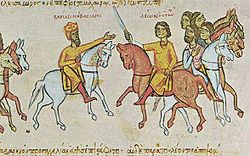 Emperor Basil I inaugurated a new age in the history of the Byzantine Empire, associated with the dynasty which he founded, the so-called "Macedonian dynasty
". This dynasty oversaw a period of territorial expansion, during which the Byzantium was the strongest power in Europe
and the eastern Mediterranean.
It is remarkable that Basil I became an effective and respected monarch, ruling for 19 years, despite being a man with no formal education, no military or administrative experience, and one who had been the boon companion of a debauched monarch and had achieved power through a series of calculated murders. That there was little political reaction to the murder of Michael III is probably due to his unpopularity with the bureaucrats of Constantinople
due to his his disinterest in his duties as emperor, as well as his impiety
having alienated the Byzantine populace in general. Once in power Basil soon showed that he intended to rule effectively and as early as his coronation he displayed an overt religiosity by formally dedicating his crown to Jesus Christ. He maintained a reputation for conventional piety throughout his reign.
Because of the great legislative work which Basil I undertook, he is often called the "second Justinian
." Basil's laws were collected in the Basilika
, consisting of sixty books, and smaller legal manuals known as the Eisagoge
. Leo VI was responsible for completing these legal works. The Basilika remained the law of the Byzantine Empire down to its conquest by the Ottomans. Ironically, this codification of laws seems to have begun under the direction of the caesar Bardas who was murdered by Basil. Basil's financial administration was prudent. Consciously desiring to emulate Emperor Justinian I (r. 527–565), Basil also initiated an extensive building program in Constantinople, crowned by the construction of the Nea Ekklesia
cathedral.
His ecclesiastical policy was marked by good relations with Rome
. One of his first acts was to exile the Patriarch of Constantinople
, Photios, and restore his rival Ignatios, whose claims were supported by Pope Adrian II
. However, Basil had no intention of yielding to Rome beyond a certain point. The decision of Boris I of Bulgaria
to align the new Bulgarian Church with Constantinople
was a great blow to Rome, which had hoped to secure it for herself. But on the death of Ignatios in 877, Photios became patriarch again, and there was a virtual, though not a formal, breach with Rome. This was a watershed event in conflicts that led to the Great Schism
that ultimately produced the Roman Catholic Church
and the Eastern Orthodox Church
as separate ecclesiastical entities. Church and state supported one another and it was during Basil's reign as Byzantine emperor that Photios created a genealogy tree that purported that Basil's ancestors were not mere peasants as everyone believed but descendants of the Arsacid
kings of Armenia. Members of the Macedonian dynasty would come to use this tree to claim their descent from King Tiridates III of Armenia
.
_from_the_chronikon_of_ioannis_skylitzes_1.jpg) Emperor Basil's reign was marked by the troublesome ongoing war with the heretical Paulicians, centered on Tephrike
Emperor Basil's reign was marked by the troublesome ongoing war with the heretical Paulicians, centered on Tephrike
on the upper Euphrates
, who rebelled, allied with the Arabs, and raided as far as Nicaea, sacking Ephesus
. Basil's general, Christopher, defeated
the Paulicians in 872, and the death of their leader, Chrysocheir, led to the definite subjection of their state. There was the usual frontier warfare with the Arabs in Asia Minor
, which led to little concrete gain, but Byzantium's eastern frontier was strengthened. The island of Cyprus
was recovered, but retained for only seven years.
Basil was the first Byzantine emperor since Constans II
(r. 641–668) to pursue an active policy to restore Byzantium's power in the West. Basil allied with Holy Roman Emperor Louis II
(r. 850–875) against the Arabs and sent a fleet of 139 ships to clear the Adriatic Sea
from their raids. With Byzantine help, Louis II captured Bari
from the Arabs in 871. The city eventually became Byzantine territory in 876. However, the Byzantine
position on Sicily
deteriorated, and Syracuse
fell to the Emirate of Sicily
in 878. This was ultimately Basil's fault as he had diverted a relief fleet from Sicily to haul marble
for a church instead. Although most of Sicily was lost, the general Nikephoros Phokas (the Elder)
succeeded in taking Taranto
and much of Calabria
in 880. The successes in the Italian peninsula
opened a new period of Byzantine domination there. Above all, the Byzantines were beginning to establish a strong presence in the Mediterranean Sea
, and especially the Adriatic
.
contracted after a serious hunting accident when his belt
was caught in the antlers of a deer
, and he was allegedly dragged 16 miles through the woods. He was saved by an attendant who cut him loose with a knife
, but he suspected the attendant of trying to assassinate him and had the man executed shortly before he himself died.
One of the first acts of Leo VI as ruling emperor was to rebury, with great ceremony, the remains of Michael III in the imperial mausoleum
within the Church of the Holy Apostles in Constantinople. This did much to confirm in public opinion that he considered himself to have been Michael's son.
By his first wife Maria, Basil I had several children, including:
By his second wife, Eudokia Ingerina
, Basil I officially had the following children:
Armenians
Armenian people or Armenians are a nation and ethnic group native to the Armenian Highland.The largest concentration is in Armenia having a nearly-homogeneous population with 97.9% or 3,145,354 being ethnic Armenian....
descent who reigned from 867 to 886. Born a simple peasant in the Byzantine theme of Macedonia, he rose in the imperial court, and usurped the imperial throne from Emperor Michael III
Michael III
Michael III , , Byzantine Emperor from 842 to 867. Michael III was the third and traditionally last member of the Amorian-Phrygian Dynasty...
(r. 842–867). Despite his humble origins, he showed great ability in running the affairs of state, leading a revival of imperial power and to a renaissance
Macedonian Renaissance
Macedonian Renaissance is a label sometimes used to describe the period of the Macedonian dynasty of the Byzantine Empire , especially the 10th century, which some scholars have seen as a time of increased interest in classical scholarship and the assimilation of classical motifs into Christian...
of Byzantine art
Byzantine art
Byzantine art is the term commonly used to describe the artistic products of the Byzantine Empire from about the 5th century until the Fall of Constantinople in 1453....
. He was perceived by the Byzantines as one of their greatest emperors, and the dynasty he founded, the Macedonian
Macedonian dynasty
The Macedonian dynasty ruled the Byzantine Empire from 867 to 1056, following the Amorian dynasty. During this period, the Byzantine state reached its greatest expanse since the Muslim conquests, and the Macedonian Renaissance in letters and arts began. The dynasty was named after its founder,...
, ruled over what is regarded as the most glorious and prosperous era of the Byzantine Empire
Byzantine Empire
The Byzantine Empire was the Eastern Roman Empire during the periods of Late Antiquity and the Middle Ages, centred on the capital of Constantinople. Known simply as the Roman Empire or Romania to its inhabitants and neighbours, the Empire was the direct continuation of the Ancient Roman State...
.
From peasant to emperor
Basil was born to peasant parents in the 830s at Charioupolis in the Byzantine theme of Macedonia (an administrative division corresponding to the area of AdrianopleEdirne
Edirne is a city in Eastern Thrace, the northwestern part of Turkey, close to the borders with Greece and Bulgaria. Edirne served as the capital city of the Ottoman Empire from 1365 to 1453, before Constantinople became the empire's new capital. At present, Edirne is the capital of the Edirne...
in Thrace
Thrace
Thrace is a historical and geographic area in southeast Europe. As a geographical concept, Thrace designates a region bounded by the Balkan Mountains on the north, Rhodope Mountains and the Aegean Sea on the south, and by the Black Sea and the Sea of Marmara on the east...
). Contemporary Byzantine Thrace was inhabited by people of Slavic, Greek
Greeks
The Greeks, also known as the Hellenes , are a nation and ethnic group native to Greece, Cyprus and neighboring regions. They also form a significant diaspora, with Greek communities established around the world....
and Armenian
Armenians
Armenian people or Armenians are a nation and ethnic group native to the Armenian Highland.The largest concentration is in Armenia having a nearly-homogeneous population with 97.9% or 3,145,354 being ethnic Armenian....
origins. Claims have been made for an Armenian, Slavic, or indeed "Armeno-Slavonic" origin for Basil I. However, the author of the only dedicated biography
Biography
A biography is a detailed description or account of someone's life. More than a list of basic facts , biography also portrays the subject's experience of those events...
of Basil I in English
English language
English is a West Germanic language that arose in the Anglo-Saxon kingdoms of England and spread into what was to become south-east Scotland under the influence of the Anglian medieval kingdom of Northumbria...
concluded that it was impossible to be certain what the ethnic origins of the emperor were, though Basil was definitely reliant on the support of Armenians in prominent positions within the Byzantine Empire. A later story asserted that he had spent a part of his childhood in captivity in Bulgaria
First Bulgarian Empire
The First Bulgarian Empire was a medieval Bulgarian state founded in the north-eastern Balkans in c. 680 by the Bulgars, uniting with seven South Slavic tribes...
, where his family had, allegedly, been carried off as captives of the Khan Krum
Krum of Bulgaria
Krum the Horrible was Khan of Bulgaria, from after 796, but before 803, to 814 AD. During his reign the Bulgarian territory doubled in size, spreading from the middle Danube to the Dnieper and from Odrin to the Tatra Mountains. His able and energetic rule brought law and order to Bulgaria and...
(r. 803–814) in 813. Basil lived there until 836, when he and several others escaped to Byzantine-held territory in Thrace.
Basil was ultimately lucky enough to enter the service of Theophilitzes, a relative of the Caesar
Caesar (title)
Caesar is a title of imperial character. It derives from the cognomen of Julius Caesar, the Roman dictator...
Bardas
Bardas
Bardas was a Byzantine noble and high-ranking minister. As the brother of Empress Theodora, he rose to high office under Theophilos . Although sidelined after Theophilos' death by Theodora and Theoktistos, in 856 he engineered Theoktistos' fall and became the regent for his nephew, Michael III...
(the uncle of Emperor Michael III
Michael III
Michael III , , Byzantine Emperor from 842 to 867. Michael III was the third and traditionally last member of the Amorian-Phrygian Dynasty...
), as a groom. While serving Theophilitzes, he visited the city of Patras
Patras
Patras , ) is Greece's third largest urban area and the regional capital of West Greece, located in northern Peloponnese, 215 kilometers west of Athens...
, where he gained the favor of Danielis
Danielis
Danielis was a widowed Byzantine noblewoman from Patras. According to the written tradition she was an extremely wealthy landowner, owning a significant part of the Peloponnese, as well as a flourishing carpet and textile industry.Danielis became acquainted with the future emperor Basil I the...
, a wealthy woman who took him into her household and endowed him with a fortune. He also earned the notice of Michael III by his abilities as a horse tamer and in winning a victory over a Bulgarian champion in a wrestling
Amateur wrestling
Amateur wrestling is the most widespread form of sport wrestling. There are two international wrestling styles performed in the Olympic Games under the supervision of FILA : Greco-Roman and freestyle. Freestyle is possibly derived from the English Lancashire style...
match; he soon became the Byzantine emperor's companion, confidant, and bodyguard (parakoimomenos
Parakoimomenos
The parakoimōmenos was a Byzantine court position, usually reserved for eunuchs. Many of its holders, especially in the 9th and 10th centuries, functioned as the Byzantine Empire's chief ministers.-History and functions:...
).
On Emperor Michael's orders, Basil divorced his wife Maria and married Eudokia Ingerina
Eudokia Ingerina
Eudokia Ingerina was the wife of the Byzantine emperor Basil I, the mistress of his predecessor Michael III, and the mother to both the Emperors Leo VI and Alexander and Patriarch Stephen I of Constantinople.-Family:...
, Michael's favorite mistress in around 865. During an expedition against the Arabs, Basil convinced Michael III that his uncle Bardas coveted the Byzantine throne, and subsequently murdered Bardas with Michael's approval on April 21, 866. Basil then became the leading personality at court and was invested in the now vacant dignity of kaisar (Caesar), before being crowned co-emperor on May 26, 866. This promotion may have included Basil's adoption by Michael III, himself a much younger man. It was commonly believed that Leo VI
Leo VI the Wise
Leo VI, surnamed the Wise or the Philosopher , was Byzantine emperor from 886 to 912. The second ruler of the Macedonian dynasty , he was very well-read, leading to his surname...
, Basil's successor and reputed son, was really the son of Michael. Although Basil seems to have shared this belief (and hated Leo), the subsequent promotion of Basil to Caesar and then co-emperor provided the child with a legitimate and imperial parent and secured his succession to the Byzantine throne. It is notable that when Leo was born, Michael III celebrated the event with public chariot races, whilst he pointedly instructed Basil not to presume on his new position as junior emperor.
When Michael III started to favor another courtier, Basiliskian, Basil decided that his position was being undermined. Michael invested Basiliskian with the imperial title and this induced Basil to pre-empt events by organizing the assassination
Assassination
To carry out an assassination is "to murder by a sudden and/or secret attack, often for political reasons." Alternatively, assassination may be defined as "the act of deliberately killing someone, especially a public figure, usually for hire or for political reasons."An assassination may be...
of Michael on the night of September 23/24, 867. Michael and Basiliskian were insensibly drunk following a banquet at the palace of Anthimos when Basil, with a small group of companions (including his father Bardas, brother Marinos, and cousin Ayleon), gained entry. The locks to the chamber doors had been tampered with and the chamberlain had not posted guards; both victims were then put to the sword
Sword
A sword is a bladed weapon used primarily for cutting or thrusting. The precise definition of the term varies with the historical epoch or the geographical region under consideration...
. On Michael III's death, Basil, as an already acclaimed co-emperor, automatically became the ruling basileus.
Reign
Macedonian dynasty
The Macedonian dynasty ruled the Byzantine Empire from 867 to 1056, following the Amorian dynasty. During this period, the Byzantine state reached its greatest expanse since the Muslim conquests, and the Macedonian Renaissance in letters and arts began. The dynasty was named after its founder,...
". This dynasty oversaw a period of territorial expansion, during which the Byzantium was the strongest power in Europe
Europe
Europe is, by convention, one of the world's seven continents. Comprising the westernmost peninsula of Eurasia, Europe is generally 'divided' from Asia to its east by the watershed divides of the Ural and Caucasus Mountains, the Ural River, the Caspian and Black Seas, and the waterways connecting...
and the eastern Mediterranean.
It is remarkable that Basil I became an effective and respected monarch, ruling for 19 years, despite being a man with no formal education, no military or administrative experience, and one who had been the boon companion of a debauched monarch and had achieved power through a series of calculated murders. That there was little political reaction to the murder of Michael III is probably due to his unpopularity with the bureaucrats of Constantinople
Constantinople
Constantinople was the capital of the Roman, Eastern Roman, Byzantine, Latin, and Ottoman Empires. Throughout most of the Middle Ages, Constantinople was Europe's largest and wealthiest city.-Names:...
due to his his disinterest in his duties as emperor, as well as his impiety
Impiety
Impiety is classically a lack of proper concern for the obligations owed to public religious observation or cult. Impiety was a main Pagan objection to Christianity, for unlike other initiates into mystery religions, early Christians refused to cast a pinch of incense before the images of the gods,...
having alienated the Byzantine populace in general. Once in power Basil soon showed that he intended to rule effectively and as early as his coronation he displayed an overt religiosity by formally dedicating his crown to Jesus Christ. He maintained a reputation for conventional piety throughout his reign.
Domestic policies
To secure his family on the throne, Basil I raised his eldest son Constantine (in 869) and his second son Leo (in 870) to co-emperors.Because of the great legislative work which Basil I undertook, he is often called the "second Justinian
Justinian I
Justinian I ; , ; 483– 13 or 14 November 565), commonly known as Justinian the Great, was Byzantine Emperor from 527 to 565. During his reign, Justinian sought to revive the Empire's greatness and reconquer the lost western half of the classical Roman Empire.One of the most important figures of...
." Basil's laws were collected in the Basilika
Basilika
The term Basilika or 'Basilica' refers to a code of laws issued by the Eastern Roman emperor Leo VI the Wise . Written entirely in Greek, the 'Basilica', in 60 books, adapt the 6th-century Justinian code to the conditions of the 9th- and 10th-century Empire, and include laws issued by Leo VI and...
, consisting of sixty books, and smaller legal manuals known as the Eisagoge
Epanagoge
The Epanagoge , more properly the Eisagoge is a Byzantine law book promulgated in 886. Begun under Basil I the Macedonian , it was only completed under his son and successor, Leo VI the Wise...
. Leo VI was responsible for completing these legal works. The Basilika remained the law of the Byzantine Empire down to its conquest by the Ottomans. Ironically, this codification of laws seems to have begun under the direction of the caesar Bardas who was murdered by Basil. Basil's financial administration was prudent. Consciously desiring to emulate Emperor Justinian I (r. 527–565), Basil also initiated an extensive building program in Constantinople, crowned by the construction of the Nea Ekklesia
Nea Ekklesia
The Nea Ekklēsia was a church built by Byzantine Emperor Basil I the Macedonian in Constantinople between the years 876–80. It was the first monumental church built in the Byzantine capital after the Hagia Sophia in the 6th century, and marks the beginning of middle period of Byzantine...
cathedral.
His ecclesiastical policy was marked by good relations with Rome
Rome
Rome is the capital of Italy and the country's largest and most populated city and comune, with over 2.7 million residents in . The city is located in the central-western portion of the Italian Peninsula, on the Tiber River within the Lazio region of Italy.Rome's history spans two and a half...
. One of his first acts was to exile the Patriarch of Constantinople
Patriarch of Constantinople
The Ecumenical Patriarch is the Archbishop of Constantinople – New Rome – ranking as primus inter pares in the Eastern Orthodox communion, which is seen by followers as the One, Holy, Catholic, and Apostolic Church....
, Photios, and restore his rival Ignatios, whose claims were supported by Pope Adrian II
Pope Adrian II
Pope Adrian II , , pope from December 14, 867 to December 14, 872, was a member of a noble Roman family, and became pope in 867, at an advanced age....
. However, Basil had no intention of yielding to Rome beyond a certain point. The decision of Boris I of Bulgaria
Boris I of Bulgaria
Boris I, also known as Boris-Mihail and Bogoris was the Knyaz of First Bulgarian Empire in 852–889. At the time of his baptism in 864, Boris was named Michael after his godfather, Emperor Michael III...
to align the new Bulgarian Church with Constantinople
Constantinople
Constantinople was the capital of the Roman, Eastern Roman, Byzantine, Latin, and Ottoman Empires. Throughout most of the Middle Ages, Constantinople was Europe's largest and wealthiest city.-Names:...
was a great blow to Rome, which had hoped to secure it for herself. But on the death of Ignatios in 877, Photios became patriarch again, and there was a virtual, though not a formal, breach with Rome. This was a watershed event in conflicts that led to the Great Schism
East-West Schism
The East–West Schism of 1054, sometimes known as the Great Schism, formally divided the State church of the Roman Empire into Eastern and Western branches, which later became known as the Eastern Orthodox Church and the Roman Catholic Church, respectively...
that ultimately produced the Roman Catholic Church
Roman Catholic Church
The Catholic Church, also known as the Roman Catholic Church, is the world's largest Christian church, with over a billion members. Led by the Pope, it defines its mission as spreading the gospel of Jesus Christ, administering the sacraments and exercising charity...
and the Eastern Orthodox Church
Eastern Orthodox Church
The Orthodox Church, officially called the Orthodox Catholic Church and commonly referred to as the Eastern Orthodox Church, is the second largest Christian denomination in the world, with an estimated 300 million adherents mainly in the countries of Belarus, Bulgaria, Cyprus, Georgia, Greece,...
as separate ecclesiastical entities. Church and state supported one another and it was during Basil's reign as Byzantine emperor that Photios created a genealogy tree that purported that Basil's ancestors were not mere peasants as everyone believed but descendants of the Arsacid
Arsacid Dynasty of Armenia
The Arsacid dynasty or Arshakuni dynasty ruled the Kingdom of Armenia from 54 AD to 428 AD. Formerly a branch of the Iranian Parthian Arsacids, they became a distinctly Armenian dynasty. Arsacid Kings reigned intermittently throughout the chaotic years following the fall of the Artaxiad Dynasty...
kings of Armenia. Members of the Macedonian dynasty would come to use this tree to claim their descent from King Tiridates III of Armenia
Tiridates III of Armenia
Tiridates III or Diritades III was the king of Arsacid Armenia , and is also known as Tiridates the Great ; some scholars incorrectly refer to him as Tiridates IV as a result of the fact that Tiridates I of Armenia reigned twice)...
.
Foreign affairs
Divrigi
Divriği is a town and a district of Sivas Province of Turkey. The town lies on gentle slope on the south bank of the Çaltısuyu river, a tributary of the Karasu river....
on the upper Euphrates
Euphrates
The Euphrates is the longest and one of the most historically important rivers of Western Asia. Together with the Tigris, it is one of the two defining rivers of Mesopotamia...
, who rebelled, allied with the Arabs, and raided as far as Nicaea, sacking Ephesus
Ephesus
Ephesus was an ancient Greek city, and later a major Roman city, on the west coast of Asia Minor, near present-day Selçuk, Izmir Province, Turkey. It was one of the twelve cities of the Ionian League during the Classical Greek era...
. Basil's general, Christopher, defeated
Battle of Bathys Ryax
The Battle of Bathys Ryax was fought in 872 or 878 between the Byzantine Empire and the Paulicians. The Paulicians were a Christian sect which—persecuted by the Byzantine state—had established a separate principality at Tephrike on Byzantium's eastern border and collaborated with the Muslim...
the Paulicians in 872, and the death of their leader, Chrysocheir, led to the definite subjection of their state. There was the usual frontier warfare with the Arabs in Asia Minor
Asia Minor
Asia Minor is a geographical location at the westernmost protrusion of Asia, also called Anatolia, and corresponds to the western two thirds of the Asian part of Turkey...
, which led to little concrete gain, but Byzantium's eastern frontier was strengthened. The island of Cyprus
Cyprus
Cyprus , officially the Republic of Cyprus , is a Eurasian island country, member of the European Union, in the Eastern Mediterranean, east of Greece, south of Turkey, west of Syria and north of Egypt. It is the third largest island in the Mediterranean Sea.The earliest known human activity on the...
was recovered, but retained for only seven years.
Basil was the first Byzantine emperor since Constans II
Constans II
Constans II , also called Constantine the Bearded , was Byzantine emperor from 641 to 668. He also was the last emperor to become consul in 642, becoming the last Roman consul in history....
(r. 641–668) to pursue an active policy to restore Byzantium's power in the West. Basil allied with Holy Roman Emperor Louis II
Louis II, Holy Roman Emperor
Louis II the Younger was the King of Italy and Roman Emperor from 844, co-ruling with his father Lothair I until 855, after which he ruled alone. Louis's usual title was imperator augustus , but he used imperator Romanorum after his conquest of Bari in 871, which led to poor relations with Byzantium...
(r. 850–875) against the Arabs and sent a fleet of 139 ships to clear the Adriatic Sea
Adriatic Sea
The Adriatic Sea is a body of water separating the Italian Peninsula from the Balkan peninsula, and the system of the Apennine Mountains from that of the Dinaric Alps and adjacent ranges...
from their raids. With Byzantine help, Louis II captured Bari
Bari
Bari is the capital city of the province of Bari and of the Apulia region, on the Adriatic Sea, in Italy. It is the second most important economic centre of mainland Southern Italy after Naples, and is well known as a port and university city, as well as the city of Saint Nicholas...
from the Arabs in 871. The city eventually became Byzantine territory in 876. However, the Byzantine
Byzantine
Byzantine usually refers to the Roman Empire during the Middle Ages.Byzantine may also refer to:* A citizen of the Byzantine Empire, or native Greek during the Middle Ages...
position on Sicily
Sicily
Sicily is a region of Italy, and is the largest island in the Mediterranean Sea. Along with the surrounding minor islands, it constitutes an autonomous region of Italy, the Regione Autonoma Siciliana Sicily has a rich and unique culture, especially with regard to the arts, music, literature,...
deteriorated, and Syracuse
Syracuse, Italy
Syracuse is a historic city in Sicily, the capital of the province of Syracuse. The city is notable for its rich Greek history, culture, amphitheatres, architecture, and as the birthplace of the preeminent mathematician and engineer Archimedes. This 2,700-year-old city played a key role in...
fell to the Emirate of Sicily
Emirate of Sicily
The Emirate of Sicily was an Islamic state on the island of Sicily , which existed from 965 to 1072.-First Arab invasions of Sicily:...
in 878. This was ultimately Basil's fault as he had diverted a relief fleet from Sicily to haul marble
Marble
Marble is a metamorphic rock composed of recrystallized carbonate minerals, most commonly calcite or dolomite.Geologists use the term "marble" to refer to metamorphosed limestone; however stonemasons use the term more broadly to encompass unmetamorphosed limestone.Marble is commonly used for...
for a church instead. Although most of Sicily was lost, the general Nikephoros Phokas (the Elder)
Nikephoros Phokas the Elder
Nikephoros Phokas the Elder was one of the great generals in the service of the Eastern Roman Emperor Basil I.Descended from the Phokas family, one of the large land-holding families of Anatolia, Nikephoros Phokas rose to the positions of patrikios and domestikos ton scholon. He succeeded in...
succeeded in taking Taranto
Taranto
Taranto is a coastal city in Apulia, Southern Italy. It is the capital of the Province of Taranto and is an important commercial port as well as the main Italian naval base....
and much of Calabria
Calabria
Calabria , in antiquity known as Bruttium, is a region in southern Italy, south of Naples, located at the "toe" of the Italian Peninsula. The capital city of Calabria is Catanzaro....
in 880. The successes in the Italian peninsula
Italian Peninsula
The Italian Peninsula or Apennine Peninsula is one of the three large peninsulas of Southern Europe , spanning from the Po Valley in the north to the central Mediterranean Sea in the south. The peninsula's shape gives it the nickname Lo Stivale...
opened a new period of Byzantine domination there. Above all, the Byzantines were beginning to establish a strong presence in the Mediterranean Sea
Mediterranean Sea
The Mediterranean Sea is a sea connected to the Atlantic Ocean surrounded by the Mediterranean region and almost completely enclosed by land: on the north by Anatolia and Europe, on the south by North Africa, and on the east by the Levant...
, and especially the Adriatic
Adriatic Sea
The Adriatic Sea is a body of water separating the Italian Peninsula from the Balkan peninsula, and the system of the Apennine Mountains from that of the Dinaric Alps and adjacent ranges...
.
Last years and succession
Emperor Basil's spirits declined in 879, when his eldest and favorite son Constantine died. Basil now raised his youngest son, Alexander, to co-emperor. Basil disliked the bookish Leo, on occasion physically beating him; he probably suspected Leo of being the son of Michael III. In his later years, Basil's relationship with Leo was clouded by the suspicion that the latter might wish to avenge the murder of Michael III. Leo was eventually imprisoned by the Byzantine emperor after the detection of a suspected plot, the imprisonment resulted in public rioting; Leo was eventually released after the passage of 3 years. Basil died on August 29, 886 from a feverFever
Fever is a common medical sign characterized by an elevation of temperature above the normal range of due to an increase in the body temperature regulatory set-point. This increase in set-point triggers increased muscle tone and shivering.As a person's temperature increases, there is, in...
contracted after a serious hunting accident when his belt
Belt
-Apparel:* Belt , a band worn around the waist* Championship belt, a type of trophy used primarily in combat sports* Colored belts, such as a black belt, worn by martial arts practitioners to signify rank in the kyū ranking system* Breast belt...
was caught in the antlers of a deer
Deer
Deer are the ruminant mammals forming the family Cervidae. Species in the Cervidae family include white-tailed deer, elk, moose, red deer, reindeer, fallow deer, roe deer and chital. Male deer of all species and female reindeer grow and shed new antlers each year...
, and he was allegedly dragged 16 miles through the woods. He was saved by an attendant who cut him loose with a knife
Knife
A knife is a cutting tool with an exposed cutting edge or blade, hand-held or otherwise, with or without a handle. Knives were used at least two-and-a-half million years ago, as evidenced by the Oldowan tools...
, but he suspected the attendant of trying to assassinate him and had the man executed shortly before he himself died.
One of the first acts of Leo VI as ruling emperor was to rebury, with great ceremony, the remains of Michael III in the imperial mausoleum
Mausoleum
A mausoleum is an external free-standing building constructed as a monument enclosing the interment space or burial chamber of a deceased person or persons. A monument without the interment is a cenotaph. A mausoleum may be considered a type of tomb or the tomb may be considered to be within the...
within the Church of the Holy Apostles in Constantinople. This did much to confirm in public opinion that he considered himself to have been Michael's son.
Family
The mother of Basil is unknown, but his father was:- Bardas/Konstantinos of Macedonia.
By his first wife Maria, Basil I had several children, including:
- Bardas.
- Anastasia, who married the general Christopher.
- Constantine (circa 865 – September 3, 879), co-emperor to Basil from January 6, 868 to his death. According to George Alexandrovič Ostrogorsky, Constantine was betrothed to Ermengard of ProvenceErmengard of ProvenceErmengard was the only surviving daughter of Louis II, Holy Roman Emperor. In 876, she married Boso, from the Bosonid, Count of Vienne, who declared himself King of Provence in 879....
, daughter of Holy Roman Emperor Louis II and EngelbergaEngelbergaEngelberga was the wife of Louis II, Holy Roman Emperor, from 5 October 851 to his death on 12 August 875. As empress, she exerted a powerful influence over her husband. Her family, the Supponids, prospered during Louis's reign...
in 869. The marital contract was broken in 871 when relations between Basil and Louis broke down.
By his second wife, Eudokia Ingerina
Eudokia Ingerina
Eudokia Ingerina was the wife of the Byzantine emperor Basil I, the mistress of his predecessor Michael III, and the mother to both the Emperors Leo VI and Alexander and Patriarch Stephen I of Constantinople.-Family:...
, Basil I officially had the following children:
- Leo VILeo VI the WiseLeo VI, surnamed the Wise or the Philosopher , was Byzantine emperor from 886 to 912. The second ruler of the Macedonian dynasty , he was very well-read, leading to his surname...
, who succeeded as Byzantine emperor and may actually have been the son of Michael III. - Stephen IPatriarch Stephen I of ConstantinopleStephen I was the Ecumenical Patriarch of Constantinople from 886 to 893.Stephen was the son of Eudokia Ingerina and, officially, Emperor Basil I. However, at the time when he was conceived, Eudokia was the mistress of Emperor Michael III...
, Patriarch of Constantinople, who may also have been a son of Michael III. - Alexander, who succeeded as Byzantine emperor in 912.
- Anna Porphyrogenita, a nun at the convent of St. Euphemia in Petrion.
- Helena Porphyrogenita, a nun at the convent of St. Euphemia in Petrion.
- Maria Porphyrogenita, a mother of nuns at the convent of St. Euphemia in Petrion.
In culture
- Harry TurtledoveHarry TurtledoveHarry Norman Turtledove is an American novelist, who has produced works in several genres including alternate history, historical fiction, fantasy and science fiction.- Life :...
, a historian noted for his alternate historical works, has written several series set in a place called VidessosVidessosVidessos is a series of fantasy novels series by Harry Turtledove.-The Videssos novels:*The Videssos cycle**The Misplaced Legion **An Emperor for the Legion **The Legion of Videssos...
, which is a thinly disguised Byzantine Empire. The Tale of Krispos trilogy – Krispos Rising (1991), Krispos of Videssos (1991), and Krispos the Emperor (1994) – are fictionalized tellings of the rise of Basil and his sons. - Stephen Lawhead's book, Byzantium (1996), uses the succession of the Basil I as seed for the conspiracy which occupies most of the novel.