

Fire temple

Encyclopedia
A fire temple in Zoroastrianism
is the place of worship for Zoroastrians. Zoroastrians revere fire
in any form. In the Zoroastrian religion, fire (see Atar
), together with clean water (see Aban
), are agents of ritual purity. Clean, white "ash for the purification ceremonies [is] regarded as the basis of ritual life," which, "are essentially the rites proper to the tending of a domestic fire, for the temple [fire] is that of the hearth fire raised to a new solemnity" (Boyce, 1975:455).
For, one "who sacrifices unto fire with fuel in his hand [...], is given happiness." (Yasna
62.1; Nyashes 5.7)
The Zoroastrian cult of fire is much younger than Zoroastrianism itself and appears at approximately the same time as the shrine cult, first evident in the 4th century BCE (roughly contemporaneous with the introduction of Atar
as a divinity). There is no allusion to a temple cult of fire in the Avesta proper, nor is there any old Persian language
word for one. Moreover, Boyce suggests that the temple cult of fire was instituted in opposition to the image/shrine cults (an alien form of worship inherited from the Babylonians), and "no actual ruins of a fire temple have been identified from before the Parthian period" (Boyce, 1975:454).
That was a doctrinal modification and absent from early Zoroastrianism is still evident in the later Atash Nyash: in the oldest passages of that liturgy, it is the hearth fire that speaks to "all those for whom it cooks the evening and morning meal", which Boyce observes is not consistent with sanctified fire. The temple cult is an even later development: From Herodotus
it is known that in the mid-5th century BCE the Zoroastrians worshipped to the open sky, ascending mounds to light their fires (The Histories, i.131). Strabo
confirms this, noting that in the 6th century, the sanctuary at Zela in Cappadocia
was an artificial mound, walled in, but open to the sky (Geographica
XI.8.4.512).
By the Hellenic Parthian era
(250 BCE–226 CE), Zoroastrianism had in fact two kinds of places of worship: One, apparently called bagin or ayazan, sanctuaries dedicated to a specific divinity, constructed in honor of the patron saint/angel of an individual or family and included an icon or effigy of the honored. The second were the atroshan, the "places of burning fire" became more and more prevalent as the iconoclastic
movement gained support. Following the rise of the Sassanid dynasty, the shrines to the Yazatas continued to exist, with the statues – by law - either being abandoned as empty sanctuaries, or being replaced by fire altars.
Also, as Schippman observed (loc. Cit. Boyce, 1975:462), even during the Sassanid era
(226–650 CE) there is no evidence that the fires were categorized according to their sanctity. "It seems probable that there were virtually only two, namely the Atash-i Vahram [literally: "victorious fire", later misunderstood to be the Fire of Bahram, see Gnoli, 1993:512] and the lesser Atash-i Adaran, or 'Fire of Fires', a parish fire, as it were, serving a village or town quarter" (Boyce, 1975:462; Boyce 1966:63). Apparently, it was only in the Atash-i Vahram that fire was kept continuously burning, with the Adaran fires being annually relit. While the fires themselves had special names, the structures themselves did not, and it has been suggested that "the prosaic nature of the middle Persian names (kadag, man, and xanag are all words for an ordinary house) perhaps reflect a desire on the part of those who fostered the temple-cult [...] to keep it as close as possible in character to the age-old cult of the hearth-fire, and to discourage elaboration" (Boyce, 1987:9).
Following the Battle of al-Qādisiyyah
(636 CE) and the Battle of Nihawānd
(642 CE), both of which were instrumental to the collapse of the Sassanid Empire and state-sponsored Zoroastrianism, most fire temples in Greater Iran
were either destroyed or converted into mosques. Many Zoroastrians fled, (according to one legend) taking a fire with them, which although not essential to worship, probably served as a reminder of the faith of their increasingly persecuted community.
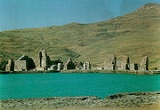
, near Lake Hamun
in Sistan
. Only traces of the foundation and ground-plan survive and have been tentatively dated to the 3rd or 4th century BCE. The temple was rebuilt during the Parthian era
(250 BCE-226 CE), and enlarged during Sassanid
times (226–650 CE).
The characteristic feature of the Sassanid fire temple was its domed sanctuary where the fire-altar stood. (Boyce, 1987:9-10) This sanctuary always had a square ground plan with a pillar in each corner that then supported the dome (the gombad). Archaeological remains and literary evidence from Zend commentaries on the Avesta
suggest that the sanctuary was surrounded by a passage way on all four sides. "On a number of sites the gombad, made usually of rubble masonry with courses of stone, is all that survives, and so such ruins are popularly called in Fars čahār-tāq or 'four arches'." (Boyce, 1987:10)
 Ruins of temples of the Sassanid era have been found in various parts of the former empire, mostly in the southwest (Fars, Kerman
and Elam
), but the biggest and most impressive are those of Adur Gushnasp in Media Minor (see also The Great Fires, below). Many more ruins are popularly identified as the remains of Zoroastrian fire temples even when their purpose is of evidently secular nature, or are the remains of a temple of the shrine cults, or as is the case of a fort-like fire temple and monastery at Surkhany
, Azerbaijan, that unambiguously belongs to another religion. The remains of a fire-altar, most likely constructed during the proselytizing campaign of Yazdegerd II
(r. 438-457) against the Christian Armenians
, have been found directly beneath the main altar of the Echmiadzin Cathedral
, the Mother See of the Armenian Apostolic Church
(Russell, 1993).(See photos and videos here http://jalilnozari.blogspot.com/2008/12/fire-altar-beneath-echmiadzin-cathedral.html). The remains of a probable fire-temple, later converted to a church, have been found within the ruins of the abandoned medieval Armenian city of Ani (see http://www.virtualani.org/firetemple/index.htm).
, thus making them the most important in Zoroastrian tradition. These were the "Great Fires" or "Royal Fires" of Adur Burzen-Mihr, Adur Farnbag, and Adur Gushnasp. The legends of the great fires are probably of antiquity (see also Denkard citation, below), for by the 3rd century CE, miracles were said to happen at the sites and the fires were popularly associated with other legends such as those of the folktale heroes Fereydun
, Jamshid
and Rustam.
The Bundahishn
, a Zoroastrian view of creation finished in the 11th or 12th century CE, states that the Great Fires had existed since creation and had been brought forth on the back of the ox Srishok to propagate the faith, dispel doubt, and to protect all humankind. Other texts observe that the Great Fires were also vehicles of propaganda and symbols of imperial sovereignty.
The priests of these respective "Royal Fires" are said to have competed with each other to draw pilgrims by promoting the legends and miracles that were purported to have occurred at their respective sites. Each of the three is also said to have mirrored social and feudal divisions: "The fire which is Farnbag has made its place among the priests; ... the fire which is Gūshnasp has made its place among the warriors; ... the fire which is Būrzīn-Mitrō has made its place among agriculturists" (Denkard, 6.293). These divisions, from an archaeological point of view, are most revealing, since from at least the 1st century BCE onwards, society was divided into four, not three, feudal estates.
The Farnbag fire (translated as 'the fire Glory-Given' by Darmesteter
) was considered the most venerated of the three because it was seen as the earthly representative of the Atar
Spenishta, 'Holiest Fire' of Yasna
17.11 and described in a Zend
commentary on that verse as "the one burning in Paradise in the presence of Ohrmazd
."
Although "in the eyes of [contemporary] Iranian Zoroastrian priests, the three fires were not 'really existing' temple fires and rather belonged to the mythological realm" (Stausberg, 2004:134), several attempts have been made to identify the locations of the Great Fires. In the early 20th century, A. V. Jackson identified the remains at Takht-i-Suleiman
, midway between Urumieh and Hamadan
, as the temple of Adur Gushnasp. The location of the Mithra fire, i.e. that of Burzen-Mihr, Jackson "identified with reasonable certainty" at being near the village of Mihr half-way between Miandasht and Sabzevar
on the Khorasan road to Nishapur
(Jackson, 1921:82). The Indian (lesser) Bundahishn records the Farnbag fire having been "on the glory-having mountain which is in Khwarezm
" but later moved "upon the shining mountain in the district of Kavul
just as it there even now remains" (IBd 17.6). That the temple once stood in Khwarezm is also supported by the Greater (Iranian) Bundahishn and by the texts of Zadsparam (11.9). However, according to the Greater Bundahishn, it was moved "upon the shining mountain of Kavarvand in the Kar district" (the rest of the passage is identical to the Indian edition). Darmesteter identified this 'Kar' as Kariyan in Pars (Persia proper), "celebrated for its sacred fire which has been transported there from Khvarazm as reported by Masudi" (Jackson, 1921:89). If this identification is correct, the temple of the Farnbag fire then lay 10 miles southwest of Juwun, midway between Jahrom
and Lar. (28°1′N 53°1′E)
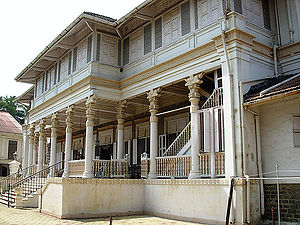 According to Parsi
legend, when (over a thousand years ago) one group of refugees from (greater) Khorasan
landed in Western Gujarat, they had the ash of such a fire with them. This ash, it is said, served as the bed for the fire today at Udvada
. (Boyce & Kotwal, 2006)
This fire temple was not always at Udvada. According to the Qissa-i Sanjan
, 'Story of Sanjan', the only existing account of the early years of Zoroastrian refugees in India and composed at least six centuries after their arrival, the immigrants established a Atash-Warharan, 'victorious fire' (see Warharan
for etymology) at Sanjan
. Under threat of war (probably in 1465), the fire was moved to the Bahrot caves 20 km south of Sanjan, where it stayed for 12 years. From there, it was moved to Bansdah, where it stayed for another 14 years before being moved yet again to Navsari
, where it would remain until the 18th century. It was then moved to Udvada were it burns today.
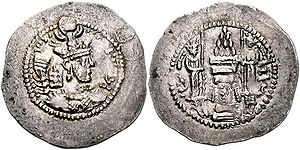 Although there are numerous eternally burning Zoroastrian fires today, with the exception of the 'Fire of Warharan', none of them are more than 250 years old. The legend that the Indian Zoroastrians invented the afrinagan (the metal urn in which a sacred fire today resides) when they moved the fire from Sanjan to the Bahrot caves is unsustainable. Greek historians of the Parthian period reported the use of a metal vase-like urn to transport fire. Sassanid coins of the 3rd-4th century CE likewise reveal a fire in a vase-like container identical in design to the present-day afrinagans. The Indian Zoroastrians do however export these and other utensils to their co-religionists the world over.
Among present-day Iranian Zoroastrians, the term darb-e mehr includes the entire ritual precinct. It is significantly more common than the older atashkada, a Classical Persian
language term that together with its middle Persian
predecessors (atash-kadag, -man and -xanag) literally means 'house of fire'. The older terms have the advantage that they are readily understood even by non-Zoroastrian Iranians. In the early 20th century, the Bombay Fasilis (see Zoroastrian calendar
) revived the term as the name of their first fire temple, and later in that century the Zoroastrians of Tehran revived it for the name of their principal fire temple.
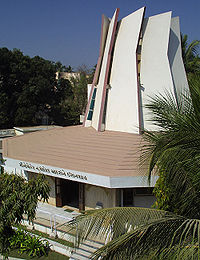 The term darb-e mehr is also common in India, albeit with a slightly different meaning. Until the 17th century the fire (now) at Udvada was the only continuously burning one on the Indian subcontinent
. Each of the other settlements had a small building in which rituals were performed, and the fire of which the priests would relight whenever necessary from the embers carried from their own hearth fires (Kotwal, 1974:665). The Parsis called such an unconsecrated building either dar-be mehr or agiary. The latter is the Gujarati language
word for 'house of fire' (Kotwal, 1974:665) and thus a literal translation of atashkada. In recent years, the term dar-be mehr has come to refer to a secondary sacred fire (the dadgah) for daily ritual use that is present at the more prestigious fire temples. Overseas, in particular in North America, Zoroastrians use the term dar-be mehr for both temples that have an eternally burning fire as well as for sites where the fire is only kindled occasionally. This is largely due to the financial support of such places by one Arbab Rustam Guiv, who preferred the dialectic Iranian form.
liturgy. Consecration may occasionally include the recitation of the Vendidad
, but this is optional. A lay person may tend the fire when no services are in progress. The term is not necessarily a consecrated fire, and the term is also applied to the hearth fire, or to the oil lamp found in many Zoroastrian homes.
, fire from a cremation pyre, fire from trades where a furnace is operated, and fires from the hearths as is also the case for the Atash Adaran. Each of the 16 fires is then subject to a purification ritual before it joins the others. 32 priests are required for the consecration ceremony, which can take up to a year to complete.
A temple that maintains an Adaran or Behram fire also maintains at least one Dadgah fire. In contrast to the Adaran and Behram fires, the Dadgah fire is the one at which priests then celebrate the rituals of the faith, and which the public addresses to invoke blessings for a specific individual, a family or an event. Veneration of the greater fires is addressed only to the fire itself — that is, following the consecration of such a fire, only the Atash Nyashes, the litany to the fire in Younger Avestan
, is ever recited before it.
A list of the nine Atash Behrams:
The basic structure of present-day fire temples is always the same. There are no indigenous sources older than the 19th century that describe an Iranian fire temple (the 9th century theologian Manushchir observed that they had a standard floor plan, but what this might have been is unknown), and it is possible that the temples there today have features that are originally of Indian origin. (Stausberg, 2004:175,405) On entry one comes into a large space or hall where congregation (also non-religious) or special ceremonies may take place. Off to the side of this (or sometimes a floor level up or down) the devotee enters an anteroom smaller than the hall he/she has just passed through. Connected to this anteroom, or enclosed within it, but not visible from the hall, is the innermost sanctum (in Zoroastrian terminology, the atashgah, literally 'place of the fire' (Boyce, 1993:669-670) in which the actual fire-altar stands.
A temple at which a Yasna
service (the principal Zoroastrian act of worship that accompanies the recitation of the Yasna liturgy) may be celebrated will always have, attached to it or on the grounds, at least a well or a stream or other source of 'natural' water. This is a critical requirement for the Ab-Zohr
, the culminating rite of the Yasna service.
Only priests attached to a fire temple may enter the innermost sanctum itself, which is closed on at least one side and has a double domed roof. The double dome has vents to allow the smoke to escape, but the vents of the outer dome are offset from those of the inner, so preventing debris or rain from entering the inner sanctum. The sanctum is separated from the anteroom by dividers (or walls with very large openings) and is slightly raised with respect to the space around it. The wall(s) of the inner sanctum are almost always tiled or of marble, but are otherwise undecorated. There are no lights - other than that of the fire itself - in the inner sanctum. In Indian-Zoroastrian (not evident in the modern buildings in Iran) tradition the temples are often designed such that direct sunlight does not enter the sanctuary.
In one corner hangs a bell, which is rung five times a day at the boi - literally, '[good] scent' (Stausberg, 2004:115) - ceremony, which marks the beginning of each gah, or 'watch'. Tools for maintaining the fire - which is always fed by wood - are simply hung on the wall, or as is sometimes the case, stored in a small room (or rooms) often reachable only through the sanctum.
In India and in Indian-Zoroastrian communities overseas, non-Zoroastrians are strictly prohibited from entering any space from which one could see the fire(s). This is not a doctrinal requirement (that is, it is not an injunction specified in the Avesta or in the so-called Pahlavi texts) but has nonetheless developed as a tradition. It is however mentioned in a 16th century Rivayat epistle (R. 65). In addition, entry into any part of the facility is sometimes reserved for Zoroastrians only. This then precludes the use of temple hall for public (also secular) functions. Zoroastrians insist though that these restrictions are not meant to offend non-Zoroastrians, and point to similar practices in other religions.
18.26-27, which in addition to enumerating which fuels are appropriate, also reiterates the injunctions of Yasna
3.1 and Yashts 14.55 that describe which fuels are not (in particular, any not of wood).
In present-day Zoroastrian tradition, the offering is never made directly, but placed in the care of the celebrant priest who, wearing a cloth mask over the nostrils and mouth to prevent pollution from the breath, will then - using a pair of silver tongs - place the offering in the fire. The priest will use a special ladle to proffer the holy ash to the layperson, who in turn daubs it on his or her forehead and eyelids, and may take some home for use after a Kushti
ceremony.
A Zoroastrian priest does not preach or hold sermons, but rather just tends to the fire
. Fire Temple attendance is particularly high during seasonal celebrations (Gahambars), and especially for the New Year (Noruz).
Zoroastrianism
Zoroastrianism is a religion and philosophy based on the teachings of prophet Zoroaster and was formerly among the world's largest religions. It was probably founded some time before the 6th century BCE in Greater Iran.In Zoroastrianism, the Creator Ahura Mazda is all good, and no evil...
is the place of worship for Zoroastrians. Zoroastrians revere fire
Fire
Fire is the rapid oxidation of a material in the chemical process of combustion, releasing heat, light, and various reaction products. Slower oxidative processes like rusting or digestion are not included by this definition....
in any form. In the Zoroastrian religion, fire (see Atar
Atar
Atar is the Zoroastrian concept of holy fire, sometimes described in abstract terms as "burning and unburning fire" or "visible and invisible fire" ....
), together with clean water (see Aban
Aban
Apas is the Avestan language term for "the waters", which—in its innumerable aggregate states—is represented by the Apas, the hypostases of the waters....
), are agents of ritual purity. Clean, white "ash for the purification ceremonies [is] regarded as the basis of ritual life," which, "are essentially the rites proper to the tending of a domestic fire, for the temple [fire] is that of the hearth fire raised to a new solemnity" (Boyce, 1975:455).
For, one "who sacrifices unto fire with fuel in his hand [...], is given happiness." (Yasna
Yasna
Yasna is the name of the primary liturgical collection of texts of the Avesta as well as the name of the principal Zoroastrian act of worship at which those verses are recited. The Yasna, or Izeshne, is primarily the name of the ceremony in which the entire book is recited and appropriate...
62.1; Nyashes 5.7)
The concept
- Main article: AtarAtarAtar is the Zoroastrian concept of holy fire, sometimes described in abstract terms as "burning and unburning fire" or "visible and invisible fire" ....
, Zoroastrian fire.
The Zoroastrian cult of fire is much younger than Zoroastrianism itself and appears at approximately the same time as the shrine cult, first evident in the 4th century BCE (roughly contemporaneous with the introduction of Atar
Atar
Atar is the Zoroastrian concept of holy fire, sometimes described in abstract terms as "burning and unburning fire" or "visible and invisible fire" ....
as a divinity). There is no allusion to a temple cult of fire in the Avesta proper, nor is there any old Persian language
Old Persian language
The Old Persian language is one of the two directly attested Old Iranian languages . Old Persian appears primarily in the inscriptions, clay tablets, and seals of the Achaemenid era...
word for one. Moreover, Boyce suggests that the temple cult of fire was instituted in opposition to the image/shrine cults (an alien form of worship inherited from the Babylonians), and "no actual ruins of a fire temple have been identified from before the Parthian period" (Boyce, 1975:454).
That was a doctrinal modification and absent from early Zoroastrianism is still evident in the later Atash Nyash: in the oldest passages of that liturgy, it is the hearth fire that speaks to "all those for whom it cooks the evening and morning meal", which Boyce observes is not consistent with sanctified fire. The temple cult is an even later development: From Herodotus
Herodotus
Herodotus was an ancient Greek historian who was born in Halicarnassus, Caria and lived in the 5th century BC . He has been called the "Father of History", and was the first historian known to collect his materials systematically, test their accuracy to a certain extent and arrange them in a...
it is known that in the mid-5th century BCE the Zoroastrians worshipped to the open sky, ascending mounds to light their fires (The Histories, i.131). Strabo
Strabo
Strabo, also written Strabon was a Greek historian, geographer and philosopher.-Life:Strabo was born to an affluent family from Amaseia in Pontus , a city which he said was situated the approximate equivalent of 75 km from the Black Sea...
confirms this, noting that in the 6th century, the sanctuary at Zela in Cappadocia
Cappadocia
Cappadocia is a historical region in Central Anatolia, largely in Nevşehir Province.In the time of Herodotus, the Cappadocians were reported as occupying the whole region from Mount Taurus to the vicinity of the Euxine...
was an artificial mound, walled in, but open to the sky (Geographica
Geographica (Strabo)
The Geographica , or Geography, is a 17-volume encyclopedia of geographical knowledge written in Greek by Strabo, an educated citizen of the Roman empire of Greek descent. Work can have begun on it no earlier than 20 BC...
XI.8.4.512).
By the Hellenic Parthian era
Parthia
Parthia is a region of north-eastern Iran, best known for having been the political and cultural base of the Arsacid dynasty, rulers of the Parthian Empire....
(250 BCE–226 CE), Zoroastrianism had in fact two kinds of places of worship: One, apparently called bagin or ayazan, sanctuaries dedicated to a specific divinity, constructed in honor of the patron saint/angel of an individual or family and included an icon or effigy of the honored. The second were the atroshan, the "places of burning fire" became more and more prevalent as the iconoclastic
Iconoclasm
Iconoclasm is the deliberate destruction of religious icons and other symbols or monuments, usually with religious or political motives. It is a frequent component of major political or religious changes...
movement gained support. Following the rise of the Sassanid dynasty, the shrines to the Yazatas continued to exist, with the statues – by law - either being abandoned as empty sanctuaries, or being replaced by fire altars.
Also, as Schippman observed (loc. Cit. Boyce, 1975:462), even during the Sassanid era
Sassanid Empire
The Sassanid Empire , known to its inhabitants as Ērānshahr and Ērān in Middle Persian and resulting in the New Persian terms Iranshahr and Iran , was the last pre-Islamic Persian Empire, ruled by the Sasanian Dynasty from 224 to 651...
(226–650 CE) there is no evidence that the fires were categorized according to their sanctity. "It seems probable that there were virtually only two, namely the Atash-i Vahram [literally: "victorious fire", later misunderstood to be the Fire of Bahram, see Gnoli, 1993:512] and the lesser Atash-i Adaran, or 'Fire of Fires', a parish fire, as it were, serving a village or town quarter" (Boyce, 1975:462; Boyce 1966:63). Apparently, it was only in the Atash-i Vahram that fire was kept continuously burning, with the Adaran fires being annually relit. While the fires themselves had special names, the structures themselves did not, and it has been suggested that "the prosaic nature of the middle Persian names (kadag, man, and xanag are all words for an ordinary house) perhaps reflect a desire on the part of those who fostered the temple-cult [...] to keep it as close as possible in character to the age-old cult of the hearth-fire, and to discourage elaboration" (Boyce, 1987:9).
Following the Battle of al-Qādisiyyah
Battle of al-Qadisiyyah
The Battle of al-Qādisiyyah was fought in 636; it was the decisive engagement between the Arab muslim army and the Sassanid Persian army during the first period of Muslim expansion. It resulted in the Islamic conquest of Persia, and was key to the conquest of Iraq...
(636 CE) and the Battle of Nihawānd
Battle of Nihawand
The Battle of Nahāvand Battle of Nahāwand was fought in 642 between Arab Muslims and Sassanid armies. The battle is known to Muslims as the "Victory of Victories." The History of Tabari mentions that Firuzan, the officer serving the Persian King Yazdgerd III had about 50,000 men, versus a Muslim...
(642 CE), both of which were instrumental to the collapse of the Sassanid Empire and state-sponsored Zoroastrianism, most fire temples in Greater Iran
Greater Iran
Greater Iran refers to the regions that have significant Iranian cultural influence. It roughly corresponds to the territory on the Iranian plateau and its bordering plains, stretching from Iraq, the Caucasus, and Turkey in the west to the Indus River in the east...
were either destroyed or converted into mosques. Many Zoroastrians fled, (according to one legend) taking a fire with them, which although not essential to worship, probably served as a reminder of the faith of their increasingly persecuted community.
Archaeological traces
The oldest remains of what has been identified as a fire-temple are those on Mount KhajehMount Khajeh
Mount Khwaja or Mount Khwajeh is a flat-topped black basalt hill rising up as an island in the middle of Lake Hamun, in the Iranian province of Sistan and Baluchestan....
, near Lake Hamun
Lake Hamun
Lake Hāmūn or Hamoun Oasis is a term applied to wetlands in endorheic Sīstān Basin on the on the Irano-Lake Hāmūn or Hamoun Oasis is a term applied to [[wetland]]s in [[Endorheic_basin|endorheic]] [[Sistan_Basin|Sīstān Basin]] on the on the [[Iran]]o-Lake Hāmūn or Hamoun Oasis is a term...
in Sistan
Sistan
Sīstān is a border region in eastern Iran , southwestern Afghanistan and northern tip of Southwestern Pakistan .-Etymology:...
. Only traces of the foundation and ground-plan survive and have been tentatively dated to the 3rd or 4th century BCE. The temple was rebuilt during the Parthian era
Parthia
Parthia is a region of north-eastern Iran, best known for having been the political and cultural base of the Arsacid dynasty, rulers of the Parthian Empire....
(250 BCE-226 CE), and enlarged during Sassanid
Sassanid Empire
The Sassanid Empire , known to its inhabitants as Ērānshahr and Ērān in Middle Persian and resulting in the New Persian terms Iranshahr and Iran , was the last pre-Islamic Persian Empire, ruled by the Sasanian Dynasty from 224 to 651...
times (226–650 CE).
The characteristic feature of the Sassanid fire temple was its domed sanctuary where the fire-altar stood. (Boyce, 1987:9-10) This sanctuary always had a square ground plan with a pillar in each corner that then supported the dome (the gombad). Archaeological remains and literary evidence from Zend commentaries on the Avesta
Avesta
The Avesta is the primary collection of sacred texts of Zoroastrianism, composed in the Avestan language.-Early transmission:The texts of the Avesta — which are all in the Avestan language — were composed over the course of several hundred years. The most important portion, the Gathas,...
suggest that the sanctuary was surrounded by a passage way on all four sides. "On a number of sites the gombad, made usually of rubble masonry with courses of stone, is all that survives, and so such ruins are popularly called in Fars čahār-tāq or 'four arches'." (Boyce, 1987:10)
Kerman
- Geological characteristics :For the Iranian paleontologists, Kerman has always been considered a fossil paradise. Finding new dinosaur footprints in 2005 has now revealed new hopes for paleontologists to better understand the history of this area.- Economy :...
and Elam
Elam
Elam was an ancient civilization located in what is now southwest Iran. Elam was centered in the far west and the southwest of modern-day Iran, stretching from the lowlands of Khuzestan and Ilam Province, as well as a small part of southern Iraq...
), but the biggest and most impressive are those of Adur Gushnasp in Media Minor (see also The Great Fires, below). Many more ruins are popularly identified as the remains of Zoroastrian fire temples even when their purpose is of evidently secular nature, or are the remains of a temple of the shrine cults, or as is the case of a fort-like fire temple and monastery at Surkhany
Baku
Baku , sometimes spelled as Baki or Bakou, is the capital and largest city of Azerbaijan, as well as the largest city on the Caspian Sea and of the Caucasus region. It is located on the southern shore of the Absheron Peninsula, which projects into the Caspian Sea. The city consists of two principal...
, Azerbaijan, that unambiguously belongs to another religion. The remains of a fire-altar, most likely constructed during the proselytizing campaign of Yazdegerd II
Yazdegerd II
Yazdegerd II was the fifteenth Sassanid King of Persia. He was the son of Bahram V and reigned from 438 to 457....
(r. 438-457) against the Christian Armenians
Armenians
Armenian people or Armenians are a nation and ethnic group native to the Armenian Highland.The largest concentration is in Armenia having a nearly-homogeneous population with 97.9% or 3,145,354 being ethnic Armenian....
, have been found directly beneath the main altar of the Echmiadzin Cathedral
Echmiadzin
Mother Cathedral of Holy Etchmiadzin is a 4th century Armenian church in the town of Ejmiatsin, Armenia. It is also the central cathedral of the Mother See of Holy Etchmiadzin of the Armenian Apostolic Church....
, the Mother See of the Armenian Apostolic Church
Armenian Apostolic Church
The Armenian Apostolic Church is the world's oldest National Church, is part of Oriental Orthodoxy, and is one of the most ancient Christian communities. Armenia was the first country to adopt Christianity as its official religion in 301 AD, in establishing this church...
(Russell, 1993).(See photos and videos here http://jalilnozari.blogspot.com/2008/12/fire-altar-beneath-echmiadzin-cathedral.html). The remains of a probable fire-temple, later converted to a church, have been found within the ruins of the abandoned medieval Armenian city of Ani (see http://www.virtualani.org/firetemple/index.htm).
The legendary Great Fires
Apart from (relatively) minor fire temples, three were said to derive directly from Ahura MazdaAhura Mazda
Ahura Mazdā is the Avestan name for a divinity of the Old Iranian religion who was proclaimed the uncreated God by Zoroaster, the founder of Zoroastrianism...
, thus making them the most important in Zoroastrian tradition. These were the "Great Fires" or "Royal Fires" of Adur Burzen-Mihr, Adur Farnbag, and Adur Gushnasp. The legends of the great fires are probably of antiquity (see also Denkard citation, below), for by the 3rd century CE, miracles were said to happen at the sites and the fires were popularly associated with other legends such as those of the folktale heroes Fereydun
Fereydun
Fereydūn also pronounced Farīdūn or Afrīdūn , also called Apam Napat, "Son of the Waters", is the name of an Iranian mythical king and hero who is an emblem of victory, justice and generosity in the Persian literature.-Etymology:All of the forms of...
, Jamshid
Jamshid
Jamshid is a mythological figure of Greater Iranian culture and tradition.In tradition and folklore, Jamshid is described as having been the fourth and greatest king of the epigraphically unattested Pishdadian dynasty . This role is already alluded to in Zoroastrian scripture Jamshid (Middle-...
and Rustam.
The Bundahishn
Bundahishn
Bundahishn, meaning "Primal Creation", is the name traditionally given to an encyclopædiaic collections of Zoroastrian cosmogony and cosmology written in Book Pahlavi. The original name of the work is not known....
, a Zoroastrian view of creation finished in the 11th or 12th century CE, states that the Great Fires had existed since creation and had been brought forth on the back of the ox Srishok to propagate the faith, dispel doubt, and to protect all humankind. Other texts observe that the Great Fires were also vehicles of propaganda and symbols of imperial sovereignty.
The priests of these respective "Royal Fires" are said to have competed with each other to draw pilgrims by promoting the legends and miracles that were purported to have occurred at their respective sites. Each of the three is also said to have mirrored social and feudal divisions: "The fire which is Farnbag has made its place among the priests; ... the fire which is Gūshnasp has made its place among the warriors; ... the fire which is Būrzīn-Mitrō has made its place among agriculturists" (Denkard, 6.293). These divisions, from an archaeological point of view, are most revealing, since from at least the 1st century BCE onwards, society was divided into four, not three, feudal estates.
The Farnbag fire (translated as 'the fire Glory-Given' by Darmesteter
James Darmesteter
James Darmesteter was a French author, orientalist, and antiquarian.He was born of Jewish parents at Château-Salins, in Alsace. The family name had originated in their earlier home of Darmstadt...
) was considered the most venerated of the three because it was seen as the earthly representative of the Atar
Atar
Atar is the Zoroastrian concept of holy fire, sometimes described in abstract terms as "burning and unburning fire" or "visible and invisible fire" ....
Spenishta, 'Holiest Fire' of Yasna
Yasna
Yasna is the name of the primary liturgical collection of texts of the Avesta as well as the name of the principal Zoroastrian act of worship at which those verses are recited. The Yasna, or Izeshne, is primarily the name of the ceremony in which the entire book is recited and appropriate...
17.11 and described in a Zend
Zend
Zend can mean:*Zend, commentaries on the Avesta, the sacred texts of the Zoroastrian religion.**In older texts, Zend can refer to the Avestan language*Salla Zend, a character in Star Wars*Zend Technologies, a PHP-focused company...
commentary on that verse as "the one burning in Paradise in the presence of Ohrmazd
Ahura Mazda
Ahura Mazdā is the Avestan name for a divinity of the Old Iranian religion who was proclaimed the uncreated God by Zoroaster, the founder of Zoroastrianism...
."
Although "in the eyes of [contemporary] Iranian Zoroastrian priests, the three fires were not 'really existing' temple fires and rather belonged to the mythological realm" (Stausberg, 2004:134), several attempts have been made to identify the locations of the Great Fires. In the early 20th century, A. V. Jackson identified the remains at Takht-i-Suleiman
Takht-i-Suleiman
For the similarly named locations see Takht-e Suleyman Massif in Iran, Taxte Soleymān in Pakistan, and Sulayman Mountain near Osh, Kyrgyzstan.Taxte Soleymān, is an archaeological site in West Azarbaijan, Iran...
, midway between Urumieh and Hamadan
Hamadan
-Culture:Hamadan is home to many poets and cultural celebrities. The city is also said to be among the world's oldest continuously inhabited cities.Handicrafts: Hamadan has always been well known for handicrafts like leather, ceramic, and beautiful carpets....
, as the temple of Adur Gushnasp. The location of the Mithra fire, i.e. that of Burzen-Mihr, Jackson "identified with reasonable certainty" at being near the village of Mihr half-way between Miandasht and Sabzevar
Sabzevar
Sabzevar is a city in, and the capital of Sabzevar County, in Razavi Khorasan Province in northeastern Iran. At the 2006 census, its population was 208,172, in 57,024 families.It is approximately 220 kilometres west of Mashhad, the provincial capital...
on the Khorasan road to Nishapur
Nishapur
Nishapur or Nishabur , is a city in the Razavi Khorasan province in northeastern Iran, situated in a fertile plain at the foot of the Binalud Mountains, near the regional capital of Mashhad...
(Jackson, 1921:82). The Indian (lesser) Bundahishn records the Farnbag fire having been "on the glory-having mountain which is in Khwarezm
Khwarezm
Khwarezm, or Chorasmia, is a large oasis region on the Amu Darya river delta in western Central Asia, which borders to the north the Aral Sea, to the east the Kyzylkum desert, to the south the Karakum desert and to the west the Ustyurt Plateau...
" but later moved "upon the shining mountain in the district of Kavul
Kabul
Kabul , spelt Caubul in some classic literatures, is the capital and largest city of Afghanistan. It is also the capital of the Kabul Province, located in the eastern section of Afghanistan...
just as it there even now remains" (IBd 17.6). That the temple once stood in Khwarezm is also supported by the Greater (Iranian) Bundahishn and by the texts of Zadsparam (11.9). However, according to the Greater Bundahishn, it was moved "upon the shining mountain of Kavarvand in the Kar district" (the rest of the passage is identical to the Indian edition). Darmesteter identified this 'Kar' as Kariyan in Pars (Persia proper), "celebrated for its sacred fire which has been transported there from Khvarazm as reported by Masudi" (Jackson, 1921:89). If this identification is correct, the temple of the Farnbag fire then lay 10 miles southwest of Juwun, midway between Jahrom
Jahrom
Jahrom is a city in and the capital of Jahrom County, Fars Province, Iran. At the 2006 census, its population was 103,023, in 25,946 families....
and Lar. (28°1′N 53°1′E)
The Udvada Atash-Behram
Parsi
Parsi or Parsee refers to a member of the larger of the two Zoroastrian communities in South Asia, the other being the Irani community....
legend, when (over a thousand years ago) one group of refugees from (greater) Khorasan
Greater Khorasan
Greater Khorasan or Ancient Khorasan is a historical region of Greater Iran mentioned in sources from Sassanid and Islamic eras which "frequently" had a denotation wider than current three provinces of Khorasan in Iran...
landed in Western Gujarat, they had the ash of such a fire with them. This ash, it is said, served as the bed for the fire today at Udvada
Udvada
Udvada is a town in Gujarat, renowned for its Zoroastrian Atash Behram. This place of worship is the oldest still-functioning example of its kind, and has established Udvada as a pilgrimage center for Zoroastrians the world over.-Location:...
. (Boyce & Kotwal, 2006)
This fire temple was not always at Udvada. According to the Qissa-i Sanjan
Qissa-i Sanjan
The Story of Sanjan is an account of the early years of Zoroastrian settlers on the Indian subcontinent...
, 'Story of Sanjan', the only existing account of the early years of Zoroastrian refugees in India and composed at least six centuries after their arrival, the immigrants established a Atash-Warharan, 'victorious fire' (see Warharan
Vahram
Verethragna is an Avestan language neuter noun literally meaning "smiting of resistance" . Representing this concept is the divinity Verethragna, who is the hypostasis of "victory", and "as a giver of victory Verethragna plainly enjoyed the greatest popularity of old" .The neuter noun verethragna...
for etymology) at Sanjan
Sanjan (Gujarat)
Sanjan is the second railway station in Gujarat on the Western railways just inside the Gujarat-Maharashtra border...
. Under threat of war (probably in 1465), the fire was moved to the Bahrot caves 20 km south of Sanjan, where it stayed for 12 years. From there, it was moved to Bansdah, where it stayed for another 14 years before being moved yet again to Navsari
Navsari
Navsari is a city and municipality in the Surat Metropolitan Region and also the administrative headquarters Navsari District of Gujarat, India. Navsari is also the Twin City of Surat, and only 37 km south of Surat.-Geography:...
, where it would remain until the 18th century. It was then moved to Udvada were it burns today.
Nomenclature
One of the more common technical terms - in use - for a Zoroastrian fire temple is dar be-mehr, romanized as darb-e mehr or dialectically slurred as dar-e mehr. The etymology of this term, meaning 'Mithra's Gate' or 'Mithra's Court' is problematic. It has been proposed that the term is a throwback to the age of the shrine cults, the name being retained because all major Zoroastrian rituals were solemnized between sunrise and noon, the time of day especially under Mithra's protection. Etymological theories see a derivation from mithryana (so Meillet) or *mithradana (Gershevitch) or mithraion (Wilcken). It is moreover not clear whether the term referred to a consecrated inner sanctum or to the ritual precinct. (Boyce, 1996:21-22)Among present-day Iranian Zoroastrians, the term darb-e mehr includes the entire ritual precinct. It is significantly more common than the older atashkada, a Classical Persian
Persian language
Persian is an Iranian language within the Indo-Iranian branch of the Indo-European languages. It is primarily spoken in Iran, Afghanistan, Tajikistan and countries which historically came under Persian influence...
language term that together with its middle Persian
Middle Persian
Middle Persian , indigenously known as "Pârsig" sometimes referred to as Pahlavi or Pehlevi, is the Middle Iranian language/ethnolect of Southwestern Iran that during Sassanid times became a prestige dialect and so came to be spoken in other regions as well. Middle Persian is classified as a...
predecessors (atash-kadag, -man and -xanag) literally means 'house of fire'. The older terms have the advantage that they are readily understood even by non-Zoroastrian Iranians. In the early 20th century, the Bombay Fasilis (see Zoroastrian calendar
Zoroastrian calendar
This article treats of the reckoning of days, months and years in the calendar used by adherents of the Zoroastrian faith. Zoroastrian religious festivals are discussed elsewhere, but have a fixed relationship to Nawruz, the New Year festival, whose timing is discussed below...
) revived the term as the name of their first fire temple, and later in that century the Zoroastrians of Tehran revived it for the name of their principal fire temple.
Indian subcontinent
The Indian subcontinent, also Indian Subcontinent, Indo-Pak Subcontinent or South Asian Subcontinent is a region of the Asian continent on the Indian tectonic plate from the Hindu Kush or Hindu Koh, Himalayas and including the Kuen Lun and Karakoram ranges, forming a land mass which extends...
. Each of the other settlements had a small building in which rituals were performed, and the fire of which the priests would relight whenever necessary from the embers carried from their own hearth fires (Kotwal, 1974:665). The Parsis called such an unconsecrated building either dar-be mehr or agiary. The latter is the Gujarati language
Gujarati language
Gujarati is an Indo-Aryan language, and part of the greater Indo-European language family. It is derived from a language called Old Gujarati which is the ancestor language of the modern Gujarati and Rajasthani languages...
word for 'house of fire' (Kotwal, 1974:665) and thus a literal translation of atashkada. In recent years, the term dar-be mehr has come to refer to a secondary sacred fire (the dadgah) for daily ritual use that is present at the more prestigious fire temples. Overseas, in particular in North America, Zoroastrians use the term dar-be mehr for both temples that have an eternally burning fire as well as for sites where the fire is only kindled occasionally. This is largely due to the financial support of such places by one Arbab Rustam Guiv, who preferred the dialectic Iranian form.
Classification
Functionally, the fire temples are built to serve the fire within them, and the fire temples are classified (and named) according the grade of fire housed within them. There are three grades of fires, the Atash Dadgah, Atash Adaran, and Atash Behram.Atash Dadgah
The Atash Dadgah is the lowest grade of sacred fire, and can be consecrated within the course of a few hours by two priests, who alternatingly recite the 72 verses of the YasnaYasna
Yasna is the name of the primary liturgical collection of texts of the Avesta as well as the name of the principal Zoroastrian act of worship at which those verses are recited. The Yasna, or Izeshne, is primarily the name of the ceremony in which the entire book is recited and appropriate...
liturgy. Consecration may occasionally include the recitation of the Vendidad
Vendidad
The Vendidad or Videvdat is a collection of texts within the greater compendium of the Avesta. However, unlike the other texts of the Avesta, the Vendidad is an ecclesiastical code, not a liturgical manual.-Name:...
, but this is optional. A lay person may tend the fire when no services are in progress. The term is not necessarily a consecrated fire, and the term is also applied to the hearth fire, or to the oil lamp found in many Zoroastrian homes.
Atash Adaran
The next highest grade of fire is the Atash Adaran, the "Fire of fires". It requires a gathering of hearth fire from representatives of the four professional groups (that reflect feudal estates): from a hearth fire of the asronih (the priesthood), the (r)atheshtarih (soldiers and civil servants), the vastaryoshih (farmers and herdsmen) and the hutokshih (artisans and laborers). Eight priests are required to consecrate an Adaran fire and the procedure takes between two and three weeks.Atash Behram
The highest grade of fire is the Atash Behram, "Fire of victory", and its establishment and consecration is the most elaborate of the three. It involves the gathering of 16 different "kinds of fire", that is, fires gathered from 16 different sources, including lightningLightning
Lightning is an atmospheric electrostatic discharge accompanied by thunder, which typically occurs during thunderstorms, and sometimes during volcanic eruptions or dust storms...
, fire from a cremation pyre, fire from trades where a furnace is operated, and fires from the hearths as is also the case for the Atash Adaran. Each of the 16 fires is then subject to a purification ritual before it joins the others. 32 priests are required for the consecration ceremony, which can take up to a year to complete.
A temple that maintains an Adaran or Behram fire also maintains at least one Dadgah fire. In contrast to the Adaran and Behram fires, the Dadgah fire is the one at which priests then celebrate the rituals of the faith, and which the public addresses to invoke blessings for a specific individual, a family or an event. Veneration of the greater fires is addressed only to the fire itself — that is, following the consecration of such a fire, only the Atash Nyashes, the litany to the fire in Younger Avestan
Avestan language
Avestan is an East Iranian language known only from its use as the language of Zoroastrian scripture, i.e. the Avesta, from which it derives its name...
, is ever recited before it.
A list of the nine Atash Behrams:
- Iranshah Atash Behram in UdvadaUdvadaUdvada is a town in Gujarat, renowned for its Zoroastrian Atash Behram. This place of worship is the oldest still-functioning example of its kind, and has established Udvada as a pilgrimage center for Zoroastrians the world over.-Location:...
, India. Established 1742. - Desai Atash Behram in NavsariNavsariNavsari is a city and municipality in the Surat Metropolitan Region and also the administrative headquarters Navsari District of Gujarat, India. Navsari is also the Twin City of Surat, and only 37 km south of Surat.-Geography:...
, India. Established 1765. - Dadiseth Atash Behram in Mumbai, India. Established 1783.
- Vakil Atash Behram in SuratSuratSurat , also known as Suryapur, is the commercial capital city of the Indian state of Gujarat. Surat is India's Eighth most populous city and Ninth-most populous urban agglomeration. It is also administrative capital of Surat district and one of the fastest growing cities in India. The city proper...
, India. Established 1823. - Modi Atash Behram in Surat, India. Established 1823.
- Wadia Atash Behram in MumbaiMumbaiMumbai , formerly known as Bombay in English, is the capital of the Indian state of Maharashtra. It is the most populous city in India, and the fourth most populous city in the world, with a total metropolitan area population of approximately 20.5 million...
, India. Established 1830. - Banaji Atash Behram in Mumbai, India. Established 1845.
- Anjuman Atash Behram in Mumbai, India. Established 1897.
- Yezd Atash Behram in YazdYazdYazd is the capital of Yazd Province in Iran, and a centre of Zoroastrian culture. The city is located some 175 miles southeast of Isfahan. At the 2006 census, the population was 423,006, in 114,716 families....
, Iran. Established 1932.
Physical attributes
The outer façade of a Zoroastrian fire temple is almost always intentionally nondescript and free of embellishment. This may reflect ancient tradition (supported by the prosaic nature of the technical terms for a fire temple) that the principal purpose of a fire temple is to house a sacred fire, and not to glorify what is otherwise simply a building.The basic structure of present-day fire temples is always the same. There are no indigenous sources older than the 19th century that describe an Iranian fire temple (the 9th century theologian Manushchir observed that they had a standard floor plan, but what this might have been is unknown), and it is possible that the temples there today have features that are originally of Indian origin. (Stausberg, 2004:175,405) On entry one comes into a large space or hall where congregation (also non-religious) or special ceremonies may take place. Off to the side of this (or sometimes a floor level up or down) the devotee enters an anteroom smaller than the hall he/she has just passed through. Connected to this anteroom, or enclosed within it, but not visible from the hall, is the innermost sanctum (in Zoroastrian terminology, the atashgah, literally 'place of the fire' (Boyce, 1993:669-670) in which the actual fire-altar stands.
A temple at which a Yasna
Yasna
Yasna is the name of the primary liturgical collection of texts of the Avesta as well as the name of the principal Zoroastrian act of worship at which those verses are recited. The Yasna, or Izeshne, is primarily the name of the ceremony in which the entire book is recited and appropriate...
service (the principal Zoroastrian act of worship that accompanies the recitation of the Yasna liturgy) may be celebrated will always have, attached to it or on the grounds, at least a well or a stream or other source of 'natural' water. This is a critical requirement for the Ab-Zohr
Ab-Zohr
The Ab-Zohr is the culminating rite of the greater Yasna service, the principal Zoroastrian act of worship that accompanies the recitation of the Yasna liturgy....
, the culminating rite of the Yasna service.
Only priests attached to a fire temple may enter the innermost sanctum itself, which is closed on at least one side and has a double domed roof. The double dome has vents to allow the smoke to escape, but the vents of the outer dome are offset from those of the inner, so preventing debris or rain from entering the inner sanctum. The sanctum is separated from the anteroom by dividers (or walls with very large openings) and is slightly raised with respect to the space around it. The wall(s) of the inner sanctum are almost always tiled or of marble, but are otherwise undecorated. There are no lights - other than that of the fire itself - in the inner sanctum. In Indian-Zoroastrian (not evident in the modern buildings in Iran) tradition the temples are often designed such that direct sunlight does not enter the sanctuary.
In one corner hangs a bell, which is rung five times a day at the boi - literally, '[good] scent' (Stausberg, 2004:115) - ceremony, which marks the beginning of each gah, or 'watch'. Tools for maintaining the fire - which is always fed by wood - are simply hung on the wall, or as is sometimes the case, stored in a small room (or rooms) often reachable only through the sanctum.
In India and in Indian-Zoroastrian communities overseas, non-Zoroastrians are strictly prohibited from entering any space from which one could see the fire(s). This is not a doctrinal requirement (that is, it is not an injunction specified in the Avesta or in the so-called Pahlavi texts) but has nonetheless developed as a tradition. It is however mentioned in a 16th century Rivayat epistle (R. 65). In addition, entry into any part of the facility is sometimes reserved for Zoroastrians only. This then precludes the use of temple hall for public (also secular) functions. Zoroastrians insist though that these restrictions are not meant to offend non-Zoroastrians, and point to similar practices in other religions.
Worship
When the adherent enters the antechamber before a fire sanctum he or she will offer bone-dry sandalwood (or other sweet smelling wood) to the fire. This is in accordance with doctrinal statutes expressed in VendidadVendidad
The Vendidad or Videvdat is a collection of texts within the greater compendium of the Avesta. However, unlike the other texts of the Avesta, the Vendidad is an ecclesiastical code, not a liturgical manual.-Name:...
18.26-27, which in addition to enumerating which fuels are appropriate, also reiterates the injunctions of Yasna
Yasna
Yasna is the name of the primary liturgical collection of texts of the Avesta as well as the name of the principal Zoroastrian act of worship at which those verses are recited. The Yasna, or Izeshne, is primarily the name of the ceremony in which the entire book is recited and appropriate...
3.1 and Yashts 14.55 that describe which fuels are not (in particular, any not of wood).
In present-day Zoroastrian tradition, the offering is never made directly, but placed in the care of the celebrant priest who, wearing a cloth mask over the nostrils and mouth to prevent pollution from the breath, will then - using a pair of silver tongs - place the offering in the fire. The priest will use a special ladle to proffer the holy ash to the layperson, who in turn daubs it on his or her forehead and eyelids, and may take some home for use after a Kushti
Kushti
Kushti is the sacred girdle worn by Zoroastrians around their waists. Along with the Sedreh, the Kushti is part of the ritual dress of the Zoroastrians....
ceremony.
A Zoroastrian priest does not preach or hold sermons, but rather just tends to the fire
Atar
Atar is the Zoroastrian concept of holy fire, sometimes described in abstract terms as "burning and unburning fire" or "visible and invisible fire" ....
. Fire Temple attendance is particularly high during seasonal celebrations (Gahambars), and especially for the New Year (Noruz).