
All Topics  
Turquoise

 
Turquoise

   Email Print
   Bookmark   Link


Turquoise


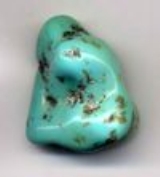
Turquoise is an opaque, blue-to-green mineral
Mineral

A mineral is a naturally occurring solid formed through Geology processes that has a characteristic chemical composition, a highly ordered atomic structure, and specific physical properties....
 that is a hydrous
Hydrate

Hydrate is a term used in inorganic chemistry and organic chemistry to indicate that a substance contains water. The chemical state of the water varies widely between hydrates, some of which were so labeled before their chemical structure was understood....
 phosphate
Phosphate

A phosphate, an inorganic chemical, is a Salt of phosphoric acid. Inorganic phosphates are mining to obtain phosphorus for use in agriculture and industry....
 of copper
Copper

Copper is a chemical element with the symbol Cu and atomic number 29.It is a ductile metal with very high thermal and electrical conductivity....
 and aluminium
Aluminium

Aluminium or aluminum is a silvery white and ductile member of the boron group of chemical elements. It has the symbol Al; its atomic number is 13....
, with the chemical formula
Chemical formula

A chemical formula is a way of expressing information about the atoms that constitute a particular chemical compound, and how the relationship between those atoms changes in chemical reactions....
 Cu
Copper

Copper is a chemical element with the symbol Cu and atomic number 29.It is a ductile metal with very high thermal and electrical conductivity....
Al
Aluminium

Aluminium or aluminum is a silvery white and ductile member of the boron group of chemical elements. It has the symbol Al; its atomic number is 13....
6(P
Phosphorus

Phosphorus is the chemical element that has the symbol P and atomic number 15. The name comes from the and . A Valency nonmetal of the nitrogen group, phosphorus is commonly found in inorganic phosphate minerals....
O
Oxygen

Oxygen no O2 produced; 2) O2 produced, but absorbed in oceans & seabed rock; 3) O2 starts to gas out of the oceans, but is absorbed by land surfaces and formation of ozone layer; 4-5) O2 sinks filled and the gas accumulates]]...
4)4(OH
Hydrogen

Hydrogen is the chemical element with atomic number 1. It is represented by the chemical symbol H. At standard temperature and pressure, hydrogen is a colorless, odorless, nonmetallic, tasteless, highly combustion and explosive Diatomic molecule gas with the molecular formula H2....
)8·4H2O
Water

Water is a common chemical substance that is essential for the survival of all known forms of life. In typical usage, water refers only to its liquid form or States of matter, but the substance also has a solid state, ice, and a gaseous state, water vapor or steam....
. It is rare and valuable in finer grades and has been prized as a gem
Gemstone

A gemstone or gem, also called a precious or semi-precious stone, is a piece of attractive mineral, which — when cut and polished — is used to make jewellery or other adornments....
 and ornamental stone for thousands of years owing to its unique hue. In recent times turquoise, like most other opaque gems, has been devalued by the introduction of treatments, imitations, and synthetics onto the market, some difficult to detect even by experts.

The substance has been known by many names, but the word turquoise was derived around 16th century from the French language
French language

French is a Romance language spoken around the world by around 80 million people as first language, by 190 million as second language, and by about another 200 million people as an acquired tongue, with significant speakers in 54 countries....
 either from the word for Turkish (Turquois) or dark-blue stone (pierre turquin).


Discussion
Ask a question about 'Turquoise'
Start a new discussion about 'Turquoise'
Answer questions from other users
Full Discussion Forum


Recent Posts


Encyclopedia


Turquoise is an opaque, blue-to-green mineral
Mineral

A mineral is a naturally occurring solid formed through Geology processes that has a characteristic chemical composition, a highly ordered atomic structure, and specific physical properties....
 that is a hydrous
Hydrate

Hydrate is a term used in inorganic chemistry and organic chemistry to indicate that a substance contains water. The chemical state of the water varies widely between hydrates, some of which were so labeled before their chemical structure was understood....
 phosphate
Phosphate

A phosphate, an inorganic chemical, is a Salt of phosphoric acid. Inorganic phosphates are mining to obtain phosphorus for use in agriculture and industry....
 of copper
Copper

Copper is a chemical element with the symbol Cu and atomic number 29.It is a ductile metal with very high thermal and electrical conductivity....
 and aluminium
Aluminium

Aluminium or aluminum is a silvery white and ductile member of the boron group of chemical elements. It has the symbol Al; its atomic number is 13....
, with the chemical formula
Chemical formula

A chemical formula is a way of expressing information about the atoms that constitute a particular chemical compound, and how the relationship between those atoms changes in chemical reactions....
 Cu
Copper

Copper is a chemical element with the symbol Cu and atomic number 29.It is a ductile metal with very high thermal and electrical conductivity....
Al
Aluminium

Aluminium or aluminum is a silvery white and ductile member of the boron group of chemical elements. It has the symbol Al; its atomic number is 13....
6(P
Phosphorus

Phosphorus is the chemical element that has the symbol P and atomic number 15. The name comes from the and . A Valency nonmetal of the nitrogen group, phosphorus is commonly found in inorganic phosphate minerals....
O
Oxygen

Oxygen no O2 produced; 2) O2 produced, but absorbed in oceans & seabed rock; 3) O2 starts to gas out of the oceans, but is absorbed by land surfaces and formation of ozone layer; 4-5) O2 sinks filled and the gas accumulates]]...
4)4(OH
Hydrogen

Hydrogen is the chemical element with atomic number 1. It is represented by the chemical symbol H. At standard temperature and pressure, hydrogen is a colorless, odorless, nonmetallic, tasteless, highly combustion and explosive Diatomic molecule gas with the molecular formula H2....
)8·4H2O
Water

Water is a common chemical substance that is essential for the survival of all known forms of life. In typical usage, water refers only to its liquid form or States of matter, but the substance also has a solid state, ice, and a gaseous state, water vapor or steam....
. It is rare and valuable in finer grades and has been prized as a gem
Gemstone

A gemstone or gem, also called a precious or semi-precious stone, is a piece of attractive mineral, which — when cut and polished — is used to make jewellery or other adornments....
 and ornamental stone for thousands of years owing to its unique hue. In recent times turquoise, like most other opaque gems, has been devalued by the introduction of treatments, imitations, and synthetics onto the market, some difficult to detect even by experts.

The substance has been known by many names, but the word turquoise was derived around 16th century from the French language
French language

French is a Romance language spoken around the world by around 80 million people as first language, by 190 million as second language, and by about another 200 million people as an acquired tongue, with significant speakers in 54 countries....
 either from the word for Turkish (Turquois) or dark-blue stone (pierre turquin). This may have arisen from a misconception: turquoise does not occur in Turkey
Turkey

Turkey , known officially as the Republic of Turkey , is a Eurasian country that stretches across the Anatolian peninsula in southwest Asia and Thrace in the Balkans region of Southern Europe....
 but was traded at Turkish bazaars to Venetian merchants who brought it to Europe. The colour, however, has been employed extensively in the decorative tiles adorning Turkish places of worship and homes for hundreds of years, beginning with the Seljuk
Seljuq dynasty

The Seljuq were a Turco-Persian Sunni Muslim dynasty that ruled parts of Central Asia and the Middle East from the 11th to 14th centuries. They set up an empire known as Great Seljuq Empire that stretched from Anatolia through Persia and was the target of the First Crusade....
s, or was derived from the colour of the Mediterranean Sea on the southern Turkish coast and the association quite possibly has caused the name to take root.

Properties of turquoise

Even the finest of turquoise is fracturable, reaching a maximum hardness
Mohs scale of mineral hardness

Not to be confused with Siemens_#Mho, a unit of electric conductance.The Mohs scale of mineral hardness characterizes the scratch resistance of various minerals through the ability of a harder material to scratch a softer material....
 of just under 6, or slightly more than window glass. Characteristically a cryptocrystalline
Cryptocrystalline

Cryptocrystalline is a rock Texture which is so finely crystalline, being made up of such minute crystals, that its crystalline nature is only vaguely revealed even microscopically in thin section by transmitted polarized light....
 mineral, turquoise almost never forms single crystal
Crystal

A crystal or crystalline solid is a solid material whose constituent atoms, molecules, or ions are arranged in an orderly repeating pattern extending in all three spatial dimensions....
s and all of its properties are highly variable. Its crystal system
Crystal system

A crystal system is a category of space groups, which characterize symmetry of structures in three dimensions with translational symmetry in three directions, having a discrete class of Point groups in three dimensions....
 is proven to be triclinic via X-ray diffraction testing. With lower hardness comes lower specific gravity
Specific gravity

Specific gravity is defined as the ratio of the density of a given solid or liquid substance to the density of water at a specific temperature and pressure, typically at 4?C and , making it a dimensionless quantity ....
 (high 2.90, low 2.60) and greater porosity
Porosity

Porosity is a measure of the void spaces in a material, and is measured as a fraction, between 0?1, or as a percentage between 0?100%. The term is used in multiple fields including ceramics, metallurgy, materials, manufacturing, earth sciences and construction....
: These properties are dependent on grain size. The lustre
Lustre (mineralogy)

Lustre is a description of the way light interacts with the surface of a crystal, rock , or mineral. For example, a diamond is said to have an adamantine lustre and pyrite is said to have a metallic lustre....
 of turquoise are typically waxy to subvitreous, and transparency
Transparency (optics)

In optics, transparency is the material property of allowing light to pass through. In mineralogy, another term for this property is diaphaneity....
 is usually opaque, but may be semitranslucent in thin sections. Colour is as variable as the mineral's other properties, ranging from white to a powder blue to a sky blue, and from a blue-green to a yellowish green. The blue is attributed to idiochromatic copper while the green may be the result of either iron
Iron

Iron is a chemical element with the symbol Fe and atomic number 26. Iron is a Group 8 element and period 4 element. Iron is lustrous and silvery in color....
 impurities (replacing aluminium) or dehydration
Dehydration

Dehydration is the removal of water from an object. In Physiology terms, it entails a relative deficiency of water molecules in relation to other dissolved solutes....
.

The refractive index
Refractive index

The refractive index of a medium is a measure for how much the speed of light is reduced inside the medium. For example, typical soda-lime glass has a refractive index of 1.5, which means that in glass, light travels at times the speed of light in a vacuum....
 (as measured by sodium
Sodium

Sodium is an element which has the symbol Na , atomic number 11, atomic mass 23 amu , and a common oxidation number +1. Sodium is a soft, silvery white, highly reactive element and is a member of the alkali metals within "group 1" ....
 light, 589.3 nm) of turquoise is approximately 1.61 or 1.62; this is a mean value seen as a single reading on a gemmological
Gemology

Gemology or gemmology is the science, art and profession of identifying and evaluating gemstones. It is considered a geoscience and a branch of mineralogy....
 refractometer
Refractometer

Types of refractometers There are four main types of refractometers: traditional handheld refractometers, digital handheld refractometers, laboratory or Abbe refractometers, and inline process refractometers....
, owing to the almost invariably polycrystalline nature of turquoise. A reading of 1.61–1.65 (birefringence
Birefringence

Birefringence, or double refraction, is the decomposition of a Ray of light into two rays when it passes through certain types of material, such as calcite crystals or boron nitride, depending on the polarization of the light....
 0.040, biaxial positive) has been taken from rare single crystals. An absorption spectrum
Absorption spectrum

A material's absorption spectrum shows the fraction of incident electromagnetic radiation absorption by the material over a range of frequencies....
 may also be obtained with a hand-held spectroscope, revealing a line at 432 nanometres and a weak band at 460 nanometres (this is best seen with strong reflected light). Under longwave ultraviolet
Ultraviolet

Ultraviolet light is electromagnetic radiation with a wavelength shorter than that of visible light, but longer than x-rays, in the range 400 nanometer to 10 nm, and energies from 3 Electron volt to 124 eV....
 light, turquoise may occasionally fluoresce
Fluorescence

Fluorescence is a luminescence that is mostly found as an optical phenomenon in cold bodies, in which the molecular absorption of a photon triggers the emission of a photon with a longer wavelength....
 green, yellow or bright blue; it is inert under shortwave ultraviolet and X-ray
X-ray

X-radiation is a form of electromagnetic radiation. X-rays have a wavelength in the range of 10 to 0.01 nanometers, corresponding to frequency in the range 30 Hertz to 30 Hertz and energies in the range 120 Electron volt to 120 keV....
s.

Turquoise is insoluble in all but heated hydrochloric acid
Hydrochloric acid

Hydrochloric acid is the solution of hydrogen chloride in water. It is a highly corrosive, strong acid mineral acid and has major industrial uses....
. Its streak
Mineral

A mineral is a naturally occurring solid formed through Geology processes that has a characteristic chemical composition, a highly ordered atomic structure, and specific physical properties....
 is a pale bluish white and its fracture
Fracture

A fracture is the separation of an object or material into two, or more, pieces under the action of stress .The word fracture is often applied to bones of living creatures, or to crystals or crystalline materials, such as gemstones or metal....
 is conchoidal
Conchoidal fracture

Conchoidal fracture describes the way that brittle materials break when they do not follow any natural cleavage . Materials that break in this way include flint and other fine-crystalliteed minerals, as well as most amorphous solids, such as obsidian and other types of glass....
, leaving a waxy lustre. Despite its low hardness relative to other gems, turquoise takes a good polish. Turquoise may also be peppered with flecks of pyrite
Pyrite

The mineral pyrite, or iron pyrite, is an iron sulfide with the chemical formula ironsulfur2. This mineral's metallic Lustre and pale-to-normal, brass-yellow hue have earned it the nickname fool's gold due to its resemblance to gold....
 or interspersed with dark, spidery limonite
Limonite

Limonite is an ore consisting in a mixture of hydrated iron oxide-hydroxide of varying composition. The generic formula is frequently written as FeO?nH2O, although this is not entirely accurate as limonite often contains a varying amount of oxide compared to hydroxide....
 veining.

Formation

As a secondary mineral
Mineral

A mineral is a naturally occurring solid formed through Geology processes that has a characteristic chemical composition, a highly ordered atomic structure, and specific physical properties....
, turquoise apparently forms by the action of percolating acidic aqueous solutions during the weathering
Weathering

Weathering is the decomposition of earth Rock , soils and their minerals through direct contact with the planet's atmosphere. Weathering occurs in situ, or "with no movement", and thus should not be confused with erosion, which involves the movement of rocks and minerals by agents such as water, ice, wind, and gravity....
 and oxidation of pre-existing minerals. For example, the copper may come from primary copper sulfides such as chalcopyrite
Chalcopyrite

Chalcopyrite is a copper iron sulfide mineral that crystallizes in the tetragonal system. It has the chemical composition CuFeS2....
 or from the secondary carbonates malachite
Malachite

Malachite is a Carbonate minerals normally known as "copper carbonate" with the chemical formula coppercarbonate.copperhydroxide2. This green-colored mineral crystallizes in the monoclinic crystal system, and most often forms botryoidal, fibrous, or stalagmite masses....
 or azurite
Azurite

Azutite may also refer to a blue Green fluorescent protein#GFP derivatives.----Azurite is a soft, deep blue copper mineral produced by weathering of copper ore deposits....
; the aluminium may derive from feldspar
Feldspar

Feldspars are a group of rock-forming tectosilicate minerals which make up as much as 60% of the Earth's Crust .Feldspars crystallize from magma in both intrusive and extrusive igneous rocks, as veins, and are also present in many types of metamorphic rock....
; and the phosphorus from apatite
Apatite

Apatite is a group of phosphate minerals, usually referring to hydroxylapatite, fluorapatite, and chlorapatite, named for high concentrations of Hydroxyl−, Fluorine−, or Chlorine− ions, respectively, in the crystal....
. Climate factors appear to play an important role as turquoise is typically found in arid
Arid

A region is said to be arid when it is characterized by a severe lack of available water, to the extent of hindering or even preventing the Individual growth and Morphogenesis of plant and animal life....
 regions, filling or encrusting cavities and fractures in typically highly altered volcanic rocks, often with associated limonite
Limonite

Limonite is an ore consisting in a mixture of hydrated iron oxide-hydroxide of varying composition. The generic formula is frequently written as FeO?nH2O, although this is not entirely accurate as limonite often contains a varying amount of oxide compared to hydroxide....
 and other iron oxides. In the American southwest turquoise is almost invariably associated with the weathering products of copper sulfide deposits in or around potassium feldspar bearing porphyritic intrusives. In some occurrences alunite
Alunite

Alunite, or alumstone, is a mineral that was first observed in the 15th century in Monti della Tolfa, north of Rome, where it was mined for the manufacture of alum....
, potassium aluminium sulfate, is a prominent secondary mineral. Typically turquoise mineralization is restricted to a relatively shallow depth of less than 20 m, although it does occur along deeper fracture zones where secondary solutions have greater penetration or the depth to the water table is greater.

Although the features of turquoise occurrences are consistent with a secondary or supergene
Supergene (geology)

In ore deposit geology, supergene processes or enrichment occur relatively near the surface. Supergene processes include the predominance of meteoric water circulation with concomitant Redox and chemical weathering....
 origin, some sources refer to a hypogene origin. The hypogene hypothesis, which holds that the aqueous solutions originate at significant depth, from hydrothermal processes. Initially at high temperature, these solutions rise upward to surface layers, interacting with and leaching essential elements from pre-existing minerals in the process. As the solutions cool, turquoise precipitates, lining cavities and fractures within the surrounding rock. This hypogene process is applicable to the original copper sulfide deposition; however, it is difficult to account for the many features of turquoise occurrences by a hypogene process. That said, there are reports of two phase fluid inclusions
Fluid inclusions

Fluid inclusions are microscopic bubbles of liquid and gas that are trapped within crystals. As minerals often form from a liquid or aqueous medium, tiny blebs of that liquid can become trapped within the crystal structure or in healed fractures within a crystal....
 within turquoise grains that give elevated homogenization temperatures of 90 to 190 oC that require explanation.

Turquoise is nearly always cryptocrystalline and massive and assumes no definite external shape. Crystals, even at the microscopic scale, are exceedingly rare. Typically the form is vein or fracture filling, nodular, or botryoidal in habit
Crystal habit

In mineralogy, shape and size give rise to descriptive terms applied to the typical appearance, or habit of crystals.The many terms used by mineralogists to describe crystal habits are useful in communicating what specimens of a particular mineral often look like....
. Stalactite
Stalactite

A stalactite is a type of speleothem that hangs from the ceiling or wall of limestone caves. It is sometimes referred to as dripstone....
 forms have been reported. Turquoise may also pseudomorph
Pseudomorph

In mineralogy, a pseudomorph is a mineral or mineral compound that appears in an untypical form , resulting from a substitution process in which the appearance and dimensions remain constant, but the original mineral is replaced by another....
ously replace feldspar, apatite, other minerals, or even fossil
Fossil

Fossils are the preserved remains or trace fossil of animals, plants, and other organisms from the remote past. The totality of fossils, both discovered and undiscovered, and their placement in fossiliferous Rock formations and sedimentary rock layers is known as the fossil record....
s. Odontolite
Odontolite

Odontolite, also called bone turquoise or fossil turquoise, is fossil bone or ivory that has been traditionally thought to have been altered by turquoise or similar phosphate minerals such as vivianite....
 is fossil bone or ivory
Ivory

File:Ivory decoration.jpgIvory is formed from dentine and constitutes the bulk of the teeth and tusks of animals such as the elephant, hippopotamus, walrus, mammoth and narwhal....
 that has been traditionally thought to have been altered by turquoise or similar phosphate minerals such as the iron phosphate vivianite
Vivianite

[Image:Vivianite 2 w-triphylite and feldspar Image:Vivianit, Ukraina, Krym.jpgVivianite iron32·8, hydrated iron phosphate, is a secondary mineral found in a number of geological environments....
. Intergrowth with other secondary copper minerals such as chrysocolla
Chrysocolla

Chrysocolla is a mineral, 2hydrogen2silicon2O54?nwater. It is of secondary origin and forms in the oxidation zones of copper ore bodies....
 is also common.

Occurrence

Turquoise With Quartz
Turquoise was among the first gems to be mined, and while many historic sites have been depleted, some are still worked to this day. These are all small-scale, often seasonal operations, owing to the limited scope and remoteness of the deposits. Most are worked by hand with little or no mechanization. However, turquoise is often recovered as a byproduct of large-scale copper mining operations, especially in the United States
United States

The United States of America is a Federal government constitutional republic comprising U.S. state and a federal district. The country is situated mostly in central North America, where its Contiguous United States and Washington, D.C., the Capital districts and territories, lie between the Pacific Ocean and Atlantic Oceans, Borders of the U...
.

Iran

For at least 2,000 years, the region once known as Persia, has remained the most important source of turquoise, for it is here that fine material is most consistently recovered. This "perfect colour" deposit, which is blue naturally, and turns green when heated due to dehyration, is restricted to a mine-riddled in Neyshabur, the 2,012-metre mountain peak of Ali-mersai, which is tens of kilometers from Mashhad
Mashhad

Mashhad is the List of largest cities and second largest cities by country city in Iran and one of the Holiest sites in Islam in the Shia world....
, the capital of Khorasan
Khorasan

Khorasan Khorasan is famous world wide for its saffron and Berberis#Zereshk which are produced in the southern cities of the province. Production is more than 170 tons per year....
 province, Iran
Iran

Iran , officially the Islamic Republic of Iran and formerly known internationally as Persian Empire until 1935, is a country in Central Eurasia, located on the northeastern shore of the Persian Gulf and the southern shore of the Caspian Sea....
. A weathered and broken trachyte
Trachyte

Trachyte is an igneous, volcanic rock with an aphanitic to porphyritic texture. The mineral assemblage consists of essential alkali feldspar; relatively minor plagioclase and quartz or a feldspathoid such as nepheline may also be present....
 is host to the turquoise, which is found both in situ between layers of limonite and sandstone, and amongst the scree
Scree

Scree, also called talus, is a term given to an accumulation of broken Rock fragments at the base of crags, mountain cliffs, or valley shoulders....
 at the mountain's base. These workings, together with those of the Sinai Peninsula
Sinai Peninsula

The Sinai Peninsula or Sinai is a triangular peninsula in Egypt. It lies between the Mediterranean Sea to the north and the Red Sea to the south, forming a land bridge between Africa and Southwest Asia....
, are the oldest known.

Iranian turquoise is often found replacing feldspar. Although it is commonly marred by whitish patches, its colour and hardness are considered superior to the production of other localities. Iranian turquoise has been mined and traded abroad for centuries, and was probably the source of the first material to reach Europe.

Sinai

Since at least the First Dynasty (3000 BCE
Common Era

Common Era, abbreviated as CE, is a designation for the calendar system most commonly used in the Western world, and also internationally, for numbering the year part of the calendar date....
), and possibly before then, turquoise was used by the Egyptians
Egyptians

Egyptians is the name of the nationality and Mediterranean North African ethnic group native to Egypt.Egyptian identity is closely tied to the Geography of Egypt, dominated by the lower Nile Valley, the small strip of cultivable land stretching from the Cataracts of the Nile to the Mediterranean Sea and enclosed by desert both to the Easte...
 and was mined
Mining

Mining is the extraction of value minerals or other geology materials from the earth, usually from an ore body, vein or seam. Materials recovered by mining include base metals, precious metals, iron, uranium, coal, diamonds, limestone, oil shale, Sodium chloride and potash....
 by them in the Sinai Peninsula
Sinai Peninsula

The Sinai Peninsula or Sinai is a triangular peninsula in Egypt. It lies between the Mediterranean Sea to the north and the Red Sea to the south, forming a land bridge between Africa and Southwest Asia....
, called "Country of Turquoise" by the native Monitu. There are six mines in the region, all on the southwest coast of the peninsula, covering an area of some 650 kmē. The two most important of these mines, from a historic perspective, are Serabit el-Khadim
Serabit el-Khadim

Serabit el-Khadim is a locality in the south-west Sinai Peninsula where turquoise was mined extensively in antiquity, mainly by the ancient Egyptians....
 and Wadi Maghareh
Wadi Maghareh

Wadi Maghareh meaning "The Valley of Caves" in Arabic, is an Egyptian archaeological site in the southwestern Sinai Peninsula containing pharonic monuments and ancient turquoise mines from the Old, Middle, and New Kingdoms....
, believed to be among the oldest of known mines. The former mine is situated about 4 kilometres from an ancient temple dedicated to Hathor
Hathor

In Egyptian mythology, Hathor was originally a personification of the Milky Way, which was seen as the milk that flowed from the udders of a heavenly cow....
.

The turquoise is found in sandstone that is, or was originally, overlain by basalt
Basalt

Basalt is a common extrusive volcanic rock. It is usually gray to black and fine-grained due to rapid cooling of lava at the surface of a planet....
. Copper and iron workings are present in the area. Large-scale turquoise mining is not profitable today, but the deposits are sporadically quarried by Bedouin
Bedouin

The Bedouin, , are predominantly Muslim, desert-dwelling Arab nomadic pastoralist, or previously nomadic group, found throughout most of the desert belt extending from the Atlantic coast of the Sahara via the Western Desert , Sinai Peninsula, and Negev to the Arabian Desert....
 peoples using homemade gunpowder
Gunpowder

Gunpowder, also called black powder, is an explosive mixture of sulfur, charcoal and potassium nitrate, KNO3 that burns rapidly, producing volumes of hot solids and gases which can be used as a propellant in firearms and as a pyrotechnic composition in fireworks....
. In the rainy winter months, miners face a risk from flash flooding; even in the dry season, death from the collapse of the haphazardly exploited sandstone mine walls is not unheard of. The colour of Sinai material is typically greener than Iranian material, but is thought to be stable and fairly durable. Often referred to as Egyptian turquoise, Sinai material is typically the most translucent, and under magnification its surface structure is revealed to be peppered with dark blue discs not seen in material from other localities.

In proximity to nearby Eilat
Eilat

Eilat is Israel's South District city, a busy port as well as a popular resort, located at the northern tip of the Red Sea, on the Gulf of Aqaba....
, Israel
Israel

Israel officially the State of Israel , is a country in the Middle East located on the eastern shore of the Mediterranean Sea. It borders Lebanon in the north, Syria in the northeast, Jordan in the east, and Egypt on the southwest, and contains geographically diverse features within its relatively small area....
, an attractive intergrowth of turquoise, malachite, and chrysocolla is found. This rock
Rock (geology)

In geology, rock is a naturally occurring solid aggregate of minerals and/or mineraloids.The Earth's outer solid layer, the lithosphere, is made of rock....
 is called Eilat stone and is often referred to as Israel's national stone: it is worked by local artisans for sale to tourists.

United States

Chacoan Turquoise With Argillite
Turquoisecollection
The Southwest United States is a significant source of turquoise; Arizona
Arizona

The State of Arizona is a U.S. state located in the Southwestern United States of the United States. The capital and largest city is Phoenix, Arizona....
, California
California

California is a U.S. state on the West Coast of the United States of the United States, along the Pacific Ocean. It is bordered by Oregon to the north, Nevada to the east, Arizona to the southeast, and to the south the Mexico state of Baja California....
 (San Bernardino
San Bernardino County, California

San Bernardino County is a county in the U.S. state of California. As of the 2000 census, the population was 1,709,434. As of 2007, the population was estimated by the California Department of Finance to have grown to 2,028,013....
, Imperial
Imperial County, California

Imperial County is a county located in the Imperial Valley , in the far southeast of the U.S. state of California, bordering both Arizona and Mexico....
, and Inyo
Inyo County, California

Inyo County is located in east-central California in the southwestern United States, on the east side of the Sierra Nevada and south of Yosemite National Park....
 counties), Colorado
Colorado

The State of Colorado is a U.S. state located in the Mountain States of the United States of America. Colorado may also be considered to be a part of the Western United States and Southwestern United States regions of the United States....
 (Conejos
Conejos County, Colorado

Conejos County is one of the Colorado counties of the State of Colorado in the United States. The county population was 8,400 at U.S. Census 2000....
, El Paso
El Paso County, Colorado

El Paso County is the second most populous of the Colorado counties of the Colorado of the United States behind Denver County. The United States Census Bureau estimates that the county population was 587,272 in 2007, a 13.61% increase since U.S....
, Lake
Lake County, Colorado

Lake County is one of the Colorado counties of the State of Colorado of the United States. The highest point in Colorado and the entire Rocky Mountains is the summit of Mount Elbert in Lake County at 4401.2 meters elevation....
, and Saguache
Saguache County, Colorado

Saguache County is the seventh most extensive of the Colorado counties of the State of Colorado of the United States. The county name comes from a Ute language word meaning "blue earth" or "water at blue earth"....
 counties), New Mexico
New Mexico

New Mexico is a U. S. State located in the Southwestern United States of the United States. Inhabited by Native Americans in the United States populations for many centuries, it has also has been part of the Spanish Empire viceroyalty of New Spain, part of Mexico, and a U.S....
 (Eddy
Eddy County, New Mexico

Eddy County is a county located in the U.S. state of New Mexico. As of 2000, the population was 51,658. Its county seat and largest city is Carlsbad, New Mexico....
, Grant
Grant County, New Mexico

Grant County is a county located in the U.S. state of New Mexico. As of 2000, the population was 31,002. Its county seat is Silver City, New Mexico....
, Otero
Otero County, New Mexico

Otero County is a county located in the U.S. state of New Mexico. As of 2000, the population was 62,298. Its county seat is Alamogordo, New Mexico....
, and Santa Fe
Santa Fe County, New Mexico

Santa Fe County is a county located in the U.S. state of New Mexico. It is part of the Santa Fe, New Mexico, Metropolitan Statistical Area. As of 2000, the population was 129,292, making it New Mexico's third largest county....
 counties) and Nevada
Nevada

Nevada is a U.S. state located in the Western United States of the United States of America. The capital is Carson City and the largest city is Las Vegas, Nevada....
 (Clark
Clark

Clark is an Anglo Saxon surname derived from the Latin language clericus meaning "scribe", "secretary" or a scholar within a religious order, referring to someone who was educated....
, Elko
Elko, Nevada

Elko is a city in Elko County, Nevada, Nevada, United States. The population was 16,980 at the United States Census 2000. It is the county seat of Elko County, Nevada....
, Esmerelda County, Eureka
Eureka, Nevada

Eureka is an unincorporated area in Eureka County, Nevada, Nevada, in the United States. As of the United States Census, 1990, the city had a total population of 650....
, Lander
Lander County, Nevada

Lander County is a County located in the U.S. state of Nevada. As of the United States Census 2000, the population was 5,794. Its county seat is Battle Mountain, Nevada....
, Mineral County
Mineral County, Nevada

Mineral County is a county located in the U.S. state of Nevada. As of the United States Census 2000, the population was 5,071. Its county seat is Hawthorne, Nevada....
 and Nye
Nye County, Nevada

Nye County is a county located in the U.S. state of Nevada. As of the United States Census 2000, the population was 32,485. As of 2007, the population was estimated to be 46,308....
 counties) are (or were) especially rich. The deposits of California and New Mexico were mined by pre-Columbian
Pre-Columbian

The pre-Columbian era incorporates all archaeology of the Americas in the history of the Americas before the appearance of significant European influences on the Americas continents....
 Native Americans
Native Americans in the United States

Native Americans in the United States are the Indigenous peoples of the Americas from the regions of North America now encompassed by the continental United States United States, including parts of Alaska and the island state of Hawaii....
 using stone tools, some local and some from as far away as central Mexico
Mexico

The United Mexican States , commonly known as Mexico , is a federalism constitutionalism republic in North America. It is bordered on the north by the United States; on the south and west by the Pacific Ocean; on the southeast by Guatemala, Belize, and the Caribbean Sea; and on the east by the Gulf of Mexico....
. Cerrillos, New Mexico is thought to be the location of the oldest mines; prior to the 1920s, the state was the country's largest producer; it is more or less exhausted today. Only one mine in California, located at Apache Canyon, operates at a commercial capacity today.

The turquoise occurs as vein or seam fillings, and as compact nuggets; these are mostly small in size. While quite fine material—rivalling Iranian material in both colour and durability—is sometimes found, most American turquoise is of a low grade (called "chalk turquoise"); high iron levels mean greens and yellows predominate, and a typically friable consistency precludes use in jewellery
Jewellery

Jewellery is an item of personal adornment, such as a necklace, ring , brooch or bracelet, that is worn by a person. It may be made from gemstones or precious metals, but may be from any other material, and may be appreciated because of geometric or other patterns, or meaningful symbols....
 in the turquoise's untreated state. Arizona is currently the most important producer of turquoise by value, with the vivid Bisbee Blue
Bisbee Blue

Bisbee Blue or Bisbee turquoise refers to the turquoise that comes from copper mines located in the vicinity of Bisbee, Arizona.Though small amounts were found in the Campbell shaft mine, as well as in streambeds in the Mule Mountains, the vast majority of Bisbee turquoise surfaced when the Phelps Dodge Corporation started open pit m...
 being a good example of the state's natural endowment; much of the Arizona material is recovered as a byproduct of copper mining. Currently the only two active Turquoise mines in the world exist in the state. The first is the Kingman
Kingman

Kingman may refer to one of the following:...
 Turquoise Mine which was started up again on the back of the copper mine in the area. The other is the Sleeping Beauty Mine found near Globe
Globe

A globe is a three-dimensional scale Model of Earth or other spheroid celestial body such as a planet, star, or moon. It may also refer to a spherical representation of the celestial sphere, showing the apparent positions of the stars in the sky ...
. Both mines work together in order to better pull out the material and both have been finding some of their best material in decades, including material out of the Kingman mine similar to what was once found in the Ithica Peak mine.

Nevada is the country's other major producer, with more than 120 mines which have yielded significant quantities of turquoise. Unlike elsewhere in the US, most Nevada mines have been worked primarily for their gem turquoise and very little has been recovered as a byproduct of other mining operations. Nevada turquoise is found as nuggets, fracture fillings and in breccias as the cement filling interstices between fragments. Because of the geology of the Nevada deposits, a majority of the material produced is hard and dense, being of sufficient quality that no treatment or enhancement is required. While nearly every county in the state has yielded some turquoise, the chief producers are in Lander and Esmerelda Counties. Most of the turquoise deposits in Nevada occur along a wide belt of tectonic
Tectonics

Tectonics is a field of study within geology concerned generally with the structures within the lithosphere of the Earth and particularly with the forces and movements that have operated in a region to create these structures....
 activity that coincides with the state's zone of thrust faulting. It strikes about N15E and extends from the northern part of Elko County, southward down to the California border southwest of Tonopah. Nevada has produced a wide diversity of colours and mixes of different matrix patterns, with turquoise from Nevada coming in various shades of blue, blue-green, and green. Nevada produces some unique shades of bright mint to apple to neon yellow green. Some of this unusually coloured turquoise may contain significant zinc and iron, which is the cause of the beautiful bright green to yellow-green shades. Some of the green to green yellow shades may actually be Variscite
Variscite

Variscite is a hydrated aluminium phosphate mineral . It is a relatively rare phosphate mineral. It is sometimes confused with turquoise; however, variscite is usually greener in color....
 or Faustite, which are secondary phosphate minerals similar in appearance to turquoise. A significant portion of the Nevada material is also noted for its often attractive brown or black limonite veining, producing what is called "spiderweb matrix". While a number of the Nevada deposits were first worked by Native Americans, the total Nevada turquoise production since the 1870s has been estimated at more than 600 tons, including nearly 400 tons from the Carico Lake mine. In spite of increased costs, small scale mining operations continue at a number of turquoise properties in Nevada, including the Godber, Orvil Jack and Carico Lake Mines in Lander County, the Pilot Mountain Mine in Mineral County, and several properties in the Royston and Candelaria areas of Esmerelda County. In 1912, the first deposit of distinct, single-crystal turquoise was discovered in Lynch Station, Campbell County
Campbell County, Virginia

Campbell County is a county located in the U.S. state — officially, "Commonwealth " — of Virginia. As of the United States Census, 2000, the population was 51,078....
, Virginia
Virginia

The Commonwealth of Virginia is an United States U.S. state on the East Coast of the United States of the Southern United States. The state is known as the "Old Dominion" and sometimes as "Mother of Presidents", because it is the birthplace of Lists of United States Presidents by place of birth#By state....
. The crystals, forming a druse over the mother rock, are very small; 1 mm (0.04 inches) is considered large. Until the 1980s Virginia was widely thought to be the only source of distinct crystals; there are now at least 27 other localities. The specimens are highly valued by collectors.

In an attempt to recoup profits and meet demand, some American turquoise is treated or enhanced to a certain degree. These treatments include innocuous waxing and more controversial procedures, such as dyeing and impregnation (see Treatments). There are however, some American mines which produce materials of high enough quality that no treatment or alterations are required. Any such treatments which have been performed should be disclosed to the buyer on sale of the material.

Other sources

China
China

China is a Culture of China, an ancient civilization, and, depending on perspective, a national or multinational entity extending over a large area in East Asia....
 has been a minor source of turquoise for 3,000 years or more. Gem-quality material, in the form of compact nodules, is found in the fractured, silicified limestone
Limestone

File:Limestone Formation In Waitomo.jpgLimestone is a sedimentary rock composed largely of the mineral calcite . The deposition of limestone strata is often a by-product and indicator of biological activity in the geology record....
 of Yunxian and Zhushan
Zhushan

Zhushan may refer to:*Zhushan County, in Shiyan, Hubei, China*Zhushan District, in Jingdezhen, Jiangxi, China...
, Hubei
Hubei

is a central province of China of the People's Republic of China. Its abbreviation is ? , an ancient name associated with the eastern part of the province since the Qin Dynasty....
 province. Additionally, Marco Polo
Marco Polo

Marco Polo was a trader and exploration from the Venetian Republic who gained fame for his worldwide travels, recorded in the book Il Milione also known as Oriente Poliano and the Description of the World....
 reported turquoise found in present-day Sichuan
Sichuan

is a Province in western China proper with its capital in Chengdu. The current name of the province, ?? , is an abbreviation of ??? , or "Four circuit #Circuits in East Asia of rivers", which is itself abbreviated from ???? , or "Four circuits of rivers and gorges", named after the division of the existing circuit into four during the Song...
. Most Chinese material is exported, but a few carvings worked in a manner similar to jade
Jade

Jade is an ornamental stone.The term jade is applied to two different metamorphic rocks that are made up of different silicate minerals:...
 exist. In Tibet
Tibet

Tibet is a Tibetan Plateau in Asia, north of the Himalayas, and the home to the indigenous Tibetan people and its related ethnic groups. With an average elevation of 4,900 metres , it is the highest region on Earth and has in recent decades increasingly been referred to as the "Roof of the World"....
, gem-quality deposits purportedly exist in the mountains of Derge
Dergé

D?g? County is a county in Garz? Tibetan Autonomous Prefecture in China's Sichuan province. Its county seat is the town of D?g?. It was once the location of the Kingdom of D?g?....
 and Nagari-Khorsum in the east and west of the region respectively.

Other notable localities include: Afghanistan
Afghanistan

Afghanistan , officially the Islamic republic of Afghanistan, is a landlocked country that is located approximately in the center of Asia....
; Australia
Australia

Australia, officially the Commonwealth of Australia, is a country in the southern hemisphere comprising the Australia of the world's smallest continent, the major island of Tasmania, and numerous list of islands of Australia in the Indian Ocean and Pacific Oceans....
 (Victoria
Victoria (Australia)

File:Map Victoria Aboriginal tribes .jpgVictoria is a States and territories of Australia located in the southeastern corner of Australia. It is the smallest mainland state in area but the most Population density and urbanised....
 and Queensland
Queensland

Queensland is a States and territories of Australia of Australia, occupying the north-eastern section of the mainland continent. It is bordered by the Northern Territory to the west, South Australia to the south-west and New South Wales to the south....
); northern Chile
Chile

Chile, officially the Republic of Chile , is a country in South America occupying a long and narrow coastal strip wedged between the Andes mountains and the Pacific Ocean....
 (Chuquicamata
Chuquicamata

Chuquicamata, or "Chuqui" as it is more familiarly known, is a large open-pit mining copper mining in the north of Chile, 215 km northeast of Antofagasta and 1,240 km north of the capital, Santiago, Chile....
); Cornwall
Cornwall

Cornwall , constitutional Duchy and palatine, is a metropolitan and non-metropolitan counties of England of England, United Kingdom, located at the tip of the south-western peninsula of Great Britain....
; Saxony
Saxony

The Free State of Saxony is a States of Germany of Germany. Located in the southeastern part of present-day Germany. It is the tenth-largest German state in area and the sixth largest in population , of Germany's sixteen states....
; Silesia
Silesia

Silesia is a historical region of Central Europe located mostly in present-day Poland, with parts in the Czech Republic and Germany.Silesia is rich in mineral and natural resources, and includes several important industrial areas....
; and Turkestan
Turkestan

Turkestan is a region in Central Asia, which today is largely inhabited by Turkic peoples. It has been referenced in many Turkic and Persian sagas and is an integral part of Turan ....
.

History of its use

Chacoan Turquoise Pendant
The pastel shades of turquoise have endeared it to many great cultures of antiquity: it has adorned the rulers of Ancient Egypt
Ancient Egypt

Ancient Egypt was an Ancient history civilization in eastern North Africa, concentrated along the lower reaches of the Nile in what is now the modern nation of Egypt....
, the Aztec
Aztec

Aztec is a term used to refer to certain ethnic groups of central Mexico, particularly those groups who spoke the Nahuatl and who achieved political and military dominance over large parts of Mesoamerica in the 14th, 15th and 16th centuries, a period referred to as the Late post-Classic period in Mesoamerican chronology....
s (and possibly other Pre-Columbian Mesoamerica
Mesoamerica

Mesoamerica or Meso-America is a region and cultural area in the Americas, extending approximately from central Mexico to Honduras and Nicaragua, within which a number of pre-Columbian society flourished before the Spanish colonization of the Americas in the 15th and 16th centuries....
ns), Persia
Persian Empire

The 'Persian Empire' was a series of successive Iranian or Persianization empires that ruled over the Iranian plateau, the original Persian homeland, and beyond in Southwest Asia, South Asia, Central Asia and the Caucasus....
, Mesopotamia
Mesopotamia

Mesopotamia is the area of the Tigris-Euphrates river system, along the Tigris and Euphrates rivers, largely corresponding to modern Iraq, as well as some parts of northeastern Syria, some parts of southeastern Turkey, and some parts of the Khuzestan Province of southwestern Iran....
, the Indus Valley
Indus Valley Civilization

The Indus Valley Civilization , abbreviated IVC, was an ancient civilization that flourished in the Indus River basin. Primarily centered along the Indus river, the civilization encompassed most of Pakistan, including its Sindh, Punjab and Balochistan provinces, and extending into modern day Indian states of Gujarat, Haryana, Punjab...
, and to some extent in ancient China
China

China is a Culture of China, an ancient civilization, and, depending on perspective, a national or multinational entity extending over a large area in East Asia....
 since at least the Shang Dynasty
Shang Dynasty

The Shang Dynasty or Yin Dynasty was according to traditional sources the first Dynasties in Chinese history. They ruled in the northeastern region of the area known as "China proper", in the Yellow River valley....
. Despite being one of the oldest gems, probably first introduced to Europe
Europe

Europe is, conventionally, one of the world's seven continents. Comprising the westernmost peninsula of Eurasia, Europe is generally divided from Asia to its east by the water divide of the Ural Mountains, the Ural , the Caspian Sea, and by the Caucasus Mountains to the southeast....
 (through Turkey
Turkey

Turkey , known officially as the Republic of Turkey , is a Eurasian country that stretches across the Anatolian peninsula in southwest Asia and Thrace in the Balkans region of Southern Europe....
) with other Silk Road
Silk Road

The Silk Road is an extensive interconnected network of trade routes across the Asian continent connecting East, South, and Western Asia with the Mediterranean world, including North Africa and Europe....
 novelties, turquoise did not become important as an ornamental stone in the West until the 14th century, following a decline in the Roman Catholic Church
Roman Catholic Church

The Roman Catholic Church, officially known as the Catholic Church is the world's largest Christianity Ecclesia , representing over half of all Christians and one-sixth of the world population....
's influence which allowed the use of turquoise in secular jewellery. It was apparently unknown in India
India

India, officially the Republic of India , is a country in South Asia. It is the List of countries and outlying territories by total area country by geographical area, the List of countries by population country, and the most populous liberal democracy in the world....
 until the Mughal
Mughal Empire

The Mughal Empire was a Muslim imperial power of the Indian subcontinent which began in 1526, ruled most of the Indian Subcontinent by the late 17th and early 18th centuries, and ended in the mid-19th century....
 period, and unknown in Japan
Japan

Japan is an island country in East Asia. Located in the Pacific Ocean, it lies to the east of the Sea of Japan, People's Republic of China, North Korea, South Korea and Russia, stretching from the Sea of Okhotsk in the north to the East China Sea and Taiwan in the south....
 until the 18th century. A common belief shared by many of these civilizations held that turquoise possessed certain prophylactic qualities; it was thought to change colour with the wearer's health and protect him or her from untoward forces.

The Aztecs inlaid turquoise, together with gold
Gold

Gold is a chemical element with the symbol Au and atomic number 79. It is a highly sought-after precious metal, having been used as money, as a store of value, in jewelry, in sculpture, and for ornamentation since the beginning of recorded history....
, quartz
Quartz

Quartz is the most abundant mineral in the Earth's continental crust . It is made up of a Crystal structure of silica tetrahedra. Quartz has a hardness of 7 on the Mohs scale and a density of 2.65 g/cm?....
, malachite
Malachite

Malachite is a Carbonate minerals normally known as "copper carbonate" with the chemical formula coppercarbonate.copperhydroxide2. This green-colored mineral crystallizes in the monoclinic crystal system, and most often forms botryoidal, fibrous, or stalagmite masses....
, jet
Jet (lignite)

Jet is a geological material and is considered to be a minor gemstone. Jet is not considered a true mineral, but rather a mineraloid as it has an organic origin, being derived from decaying wood under extreme pressure....
, jade
Jade

Jade is an ornamental stone.The term jade is applied to two different metamorphic rocks that are made up of different silicate minerals:...
, coral
Coral (precious)

Precious coral or red coral is the common name given to Corallium rubrum and several related species of marine coral. The distinguishing characteristic of precious corals is their durable and intensely colored red or pink skeleton, which is used for making jewelry....
, and shells, into provocative (and presumably ceremonial) mosaic
Mosaic

Mosaic is the art of creating images with an assemblage of small pieces of colored glass, stone, or other material. It may be a technique of Decorative arts, an aspect of interior decoration or of cultural and spiritual significance as in a cathedral....
 objects such as mask
Mask

A mask is an article normally worn on the face, typically for protection, concealment, performance, or amusement. Masks have been used since antiquity for both ceremonial and practical purposes....
s (some with a human skull
Skull

The skull is a bone structure found in the head of many animals. The skull supports the structures of the face and protects the head against injury....
 as their base), knives
Knife

A knife is a handheld sharp-edged instrument consisting of a handle attached to a blade that is used for cutting. Knives were used at least Stone Age, as evidenced by the Oldowan tools....
, and shield
Shield

A shield is a protective device, meant to intercept attacks. The term often refers to a device that is held in the hand, as opposed to armour or a bullet proof vest....
s. Natural resin
Resin

Resin is a hydrocarbon secretion of many plants, particularly Pinophyta. It is valued for its chemical constituents and uses, such as varnishes and adhesives, as an important source of raw materials for organic synthesis, or for incense and perfume....
s, bitumen
Bitumen

Bitumen is a mixture of organic compounds liquids that are highly viscous, black, sticky, entirely soluble in carbon disulfide, and composed primarily of highly condensed polycyclic aromatic hydrocarbons....
 and wax
Wax

Wax has traditionally referred to a substance that is secreted by bees and used by them in constructing their honeycombs.It is an imprecisely defined term generally understood to be a substance with properties similar to beeswax, namely...
 were used to bond the turquoise to the objects' base material; this was usually wood
Wood

Wood is an organic material; in the strict sense wood is produced as secondary xylem in the stems of woody plants, notably trees but also shrubs, etc....
, but bone
Bone

Bones are rigid organ that form part of the endoskeleton of vertebrates. They function to move, support, and protect the various organs of the body, produce red blood cell and white blood cells and store minerals....
 and shell were also used. Like the Aztecs, the Pueblo
Pueblo people

The Pueblo people are a Native Americans in the United States people in the Southwestern United States. Their traditional economy is based on agriculture and trade....
, Navajo
Navajo Nation

The Navajo Nation is a semi-autonomy Native Americans in the United States homeland covering about 26,000 square miles , occupying all of northeastern Arizona, the southeastern portion of Utah, and northwestern New Mexico....
 and Apache tribes cherished turquoise for its amuletic use; the latter tribe believe the stone to afford the archer
Archery

Archery is the art, practice or skill of shooting with Bow and arrow. Archery has historically been used in hunting and combat and has become a precision sport....
 dead aim. Among these peoples turquoise was used in mosaic
Mosaic

Mosaic is the art of creating images with an assemblage of small pieces of colored glass, stone, or other material. It may be a technique of Decorative arts, an aspect of interior decoration or of cultural and spiritual significance as in a cathedral....
 inlay, in sculptural works, and was fashioned into toroidal beads and freeform pendants. The Ancestral Puebloans
Ancient Pueblo Peoples

Ancient Pueblo People or Ancestral Puebloans were an ancient Native Americans in the United States culture centered on the present-day Four Corners area of the Southwest United States, noted for their distinctive pottery and dwelling construction styles....
 (Anasazi) of the Chaco Canyon and surrounding region are believed to have prospered greatly from their production and trading of turquoise objects. The distinctive silver
Silver

Silver is a chemical element with the chemical symbol Ag and atomic number 47. A soft, white, lustrous transition metal, it has the highest electrical conductivity of any element and the highest thermal conductivity of any metal....
 jewelry produced by the Navajo and other Southwestern Native American tribes today is a rather modern development, thought to date from circa 1880 as a result of European influences.

In Persia, turquoise was the de facto national stone for millennia, extensively used to decorate objects (from turban
Turban

The turban is a headgear consisting of a long scarf-like single piece of cloth wound around either the head itself or an inner hat. The word "turban" is a common umbrella term, loosely used in English to refer to several sorts of head wrap....
s to bridle
Bridle

A bridle is a piece of equipment used to direct a horse. As defined in the Oxford English Dictionary, the "bridle" includes both the headstall that holds a Bit that goes in the mouth of a horse, and the reins that are attached to the bit....
s), mosque
Mosque

A mosque is a place of worship for followers of Islam. Muslims often refer to the mosque by its Arabic name, masjid, ? . The word "mosque" in English refers to all types of buildings dedicated for Islamic worship, although there is a distinction in Arabic between the smaller, privately owned mosque and the larger, "collective" mosque ,...
s, and other important buildings both inside and out, such as the Medresseh-I Shah Husein Mosque of Isfahan
Isfahan (city)

Esfahan or Isfahan , located about 340 km south of Tehran at , is the capital of Esfahan Province and Iran's third largest city . Esfahan City had a population of 1,583,609 and the Esfahan metropolitan area had a population of 3,430,353 in the 2006 Census, the second most populous metropolitan area in Iran after Tehran....
. The Persian style and use of turquoise was later brought to India
India

India, officially the Republic of India , is a country in South Asia. It is the List of countries and outlying territories by total area country by geographical area, the List of countries by population country, and the most populous liberal democracy in the world....
 following the establishment of the Mughal Empire there, its influence seen in high purity gold
Gold

Gold is a chemical element with the symbol Au and atomic number 79. It is a highly sought-after precious metal, having been used as money, as a store of value, in jewelry, in sculpture, and for ornamentation since the beginning of recorded history....
 jewellery (together with ruby
Ruby

A ruby is a pink to blood-red gemstone, a variety of the mineral corundum . The red color is caused mainly by the presence of the element chromium....
 and diamond
Diamond

In mineralogy, diamond is the Allotropes of carbon where the carbon atoms are arranged in an isometric-hexoctahedral crystal lattice. After graphite, diamond is the second most stable form of carbon....
) and in such buildings as the Taj Mahal
Taj Mahal

The Taj Mahal is a mausoleum located in Agra, India, built by Mughal Empire list of Mughal emperors Shah Jahan in memory of his favorite wife, Mumtaz Mahal....
. Persian turquoise was often engraved
Engraving

Engraving is the practice of incising a design onto a hard, usually flat surface, by cutting grooves into it. The result may be a decorated object in itself, as when silver, gold, steel, or glass engraving are engraved, or may provide an intaglio printing plate, of copper or another metal, for printing images on paper as prints or illustra...
 with devotional words in Arabic
Arabic language

Arabic is a Central Semitic language, thus related to and classified alongside other Semitic languages languages such as Hebrew language and Aramaic language....
 script which was then inlaid with gold.

Cabochon
Cabochon

A cabochon or cabachon, from the Middle French caboche , is a gemstone which has been shaped and polished as opposed to facetted. The resulting form is usually a convex top with a flat bottom....
s of imported turquoise, along with coral, was (and still is) used extensively in the silver and gold jewellery of Tibet
Tibet

Tibet is a Tibetan Plateau in Asia, north of the Himalayas, and the home to the indigenous Tibetan people and its related ethnic groups. With an average elevation of 4,900 metres , it is the highest region on Earth and has in recent decades increasingly been referred to as the "Roof of the World"....
 and Mongolia
Mongolia

Mongolia is a landlocked country in East Asia and Central Asia. It borders Russia to the north and People's Republic of China to the south, east and west....
, where a greener hue is said to be preferred. Most of the pieces made today, with turquoise usually roughly polished into irregular cabochons set simply in silver, are meant for inexpensive export to Western markets and are probably not accurate representations of the original style.

The Egyptian use of turquoise stretches back as far as the First Dynasty and possibly earlier; however, probably the most well-known pieces incorporating the gem are those recovered from Tutankhamun
Tutankhamun

Tutankhamun , Egyptian language was an Ancient Egypt Pharaoh of the Eighteenth dynasty of Egypt , during the period of History of Egypt known as the New Kingdom....
's tomb, most notably the Pharaoh
Pharaoh

Pharaoh is a title used in many modern discussions of the ancient Egyptian rulers of all periods. In antiquity this title began to be used for the ruler who was the religious and political leader of united ancient Egypt, only during the New Kingdom, specifically, during the middle of the Eighteenth dynasty of Egypt....
's iconic burial mask which was liberally inlaid with the stone. It also adorned rings and great sweeping necklace
Necklace

A necklace is an article of jewellery which is worn around the neck. Necklaces are frequently formed from a metal chain, often attached to a locket or pendant....
s called pectoral
Pectoral

Pectoral, from the Latin pectoralis , "pertaining to the breast/chest", can refer to:* Pectoral cross, a cross worn on the chest* a decorative, usually jeweled version of a gorget...
s
. Set in gold, the gem was fashioned into beads, used as inlay, and often carved in a scarab
Scarab

Scarab beetle may refer to: *A beetle of the family Scarabaeidae*A dung beetle, especially the Scarabaeus sacer worshipped by the ancient Egyptians as an embodiment of the god Khepri ...
 motif, accompanied by carnelian
Carnelian

Carnelian is a reddish-brown mineral which is commonly used as a semi-precious gemstone. Similar to carnelian is sard, which is generally harder and darker....
, lapis lazuli
Lapis lazuli

Lapis lazuli is a semi-precious stone prized since antiquity for its intense blue color.Lapis lazuli has been mined in the Badakhshan province of Afghanistan for 6,500 years, and trade in the stone is ancient enough for lapis jewelry to have been found at Predynastic Egyptian sites, and lapis beads at neolithic burials in Mehrgarh, the C...
, and in later pieces, coloured glass
Glass

Glass generally refers to a Hardness, brittle, transparency amorphous solid, such as that used for windows, many Glass Bottles, or eyewear, including, but not limited to, soda-lime glass, borosilicate glass, acrylic glass, sugar glass, Muscovite , or aluminium oxynitride....
. Turquoise, associated with the goddess Hathor
Hathor

In Egyptian mythology, Hathor was originally a personification of the Milky Way, which was seen as the milk that flowed from the udders of a heavenly cow....
, was so liked by the Ancient Egyptians that it became (arguably) the first gemstone to be imitated, the fair structure created by an artificial glazed ceramic
Ceramic

File:Bridge from dental porcelain.jpgFile:Qing vase p1070256.jpgA ceramic is an inorganic, nonmetal solid prepared by the action of heat and subsequent cooling....
 product known as faience
Faience

Faience or fa?ence is the conventional name in English language for fine tin-glazed pottery on a delicate pale buff body. The invention of a white pottery glaze suitable for painted decoration, by the addition of an stannous oxide to the slip of a lead glaze, was a major advance in the history of pottery....
. (A similar blue ceramic has been recovered from Bronze Age
Bronze Age

The Bronze Age is, with respect to a given prehistory, the period in that society when the most advanced metalworking included smelting copper and tin from naturally-occurring outcroppings of copper and tin ores, creating a bronze alloy by melting those metals together, and casting them into bronze artifact s....
 burial sites in the British Isles
British Isles

The British Isles are a group of islands off the northwest coast of continental Europe that include Great Britain and Ireland, and numerous smaller islands....
.)

The French
France

France , officially the French Republic , is a country whose Metropolitan France is located in Western Europe and that also comprises various Overseas departments and territories of France....
 conducted archaeological
Archaeology

Archaeology, archeology, or arch?ology is the science that studies Homo cultures through the recovery, documentation, analysis, and interpretation of material remains and environmental data, including architecture, Artifact , features, Biofact s, and cultural landscape....
 excavations of Egypt from the mid-19th century through the early 20th. These excavations, including that of Tutankhamun's tomb, created great public interest in the western world, subsequently influencing jewellery, architecture
Architecture

The term architecture can refer to a process, a profession or documentation.As a process, architecture is the activity of designing and construction buildings and other physical structures by a person or a computer, primarily to provide shelter....
, and art
Art

Art is the process or product of deliberately arranging elements in a way that appeals to the senses or emotions. It encompasses a diverse range of human activities, creations, and modes of expression, including music and literature....
 of the time. Turquoise, already favoured for its pastel shades since c. 1810, was a staple of Egyptian Revival pieces. In contemporary Western use, turquoise is most often encountered cut en cabochon in silver rings, bracelets, often in the Native American style, or as tumbled or roughly hewn beads in chunky necklaces. Lesser material may be carved into fetish
Fetishism

A fetish is an object believed to have supernatural powers, or in particular, a man-made object that has power over others. Essentially, fetishism is the attribution of inherent value or powers to an object....
es, such as those crafted by the Zuni
Zuni

The Zuni or A:shiwi are a Native Americans in the United States tribe, one of the Pueblo peoples, most of whom live in the Zuni Pueblo, New Mexico on the Zuni River, a tributary of the Little Colorado River, in western New Mexico, United States....
. While strong sky blues remain superior in value, mottled green and yellowish material is popular with artisan
Artisan

An artisan is a skilled manual labor worker who crafts items that may be functional or strictly decorative, including furniture, clothing, jewelry, household items, and tools....
s. In Western culture, turquoise is also the traditional birthstone for those born in the month of December.

In Judeo-Christian scripture

Turquoise may have significance in Judeo-Christian
Judeo-Christian

Judeo?Christian is a term used to describe the body of concepts and values which are thought to be held in common by Judaism and Christianity, and considered, often along with classical antiquity Greco-Roman civilization, a fundamental basis for Western world legal codes and moral values....
 scripture: In the Book of Exodus, the construction of a "breastplate of judgment" is described as part of the priestly vestments of Aaron
Aaron

In the Hebrew Bible, Aaron , or Aaron the Levite , was the brother of Moses. He was the great-grandson of Levi and represented the priestly functions of his tribe, becoming the first Kohen Gadol of the Hebrews....
 (Exodus 28:15–30). Attached to the ephod
Ephod

An ephod was a type of object in ancient Israelite culture, and was closely connected with oracle practices. In the Books of Samuel, David is described as wearing one when dancing in the presence of the Ark of the Covenant, and one is described as standing in the sanctuary at Nob, with a sword behind it; in the book of Exodus and in Leviti...
, the breastplate (Hoshen
Hoshen

Hoshen/Choshen is a Hebrew language word usually translated as breastplate; in English language contexts it refers to a specific breastplate – the sacred breastplate worn by the King James Bible or Torah), according to the Book of Exodus....
) was adorned with twelve gemstone
Gemstone

A gemstone or gem, also called a precious or semi-precious stone, is a piece of attractive mineral, which — when cut and polished — is used to make jewellery or other adornments....
s set in gold and arranged in four rows, each stone engraved with the name of one of the Twelve Tribes of Israel
Israelite

According to the Tanakh, the Israelites were the descendants of the Biblical patriarch Jacob. They were divided into twelve tribes, each descended from one of twelve sons or grandsons of Jacob....
. Of the four stones in the third row, the first and second have been translated to be turquoise by various scholars and English bible versions (usually not having both as turquoise at the same time); many others disagree, however.

In regard to the first of these stones, the translation is based on the Septuagint
Septuagint

The Septuagint , or simply "LXX", is the Koine Greek version of the Hebrew Bible, translated in stages between the 3rd century BC and 1st century BC in Alexandria....
 rendering the identity of the stone as chrysolithos (the masoretic text
Masoretic Text

The Masoretic Text is the Hebrew language text of the Jewish Bible . It defines not just the Development of the Jewish Bible canon, but also the precise letter-text of the biblical books in Judaism, as well as their niqqud and cantillation for both public reading and private study....
 calls it tarshish, which just refers to Tarshish
Tarshish

Tarshish occurs in the Hebrew Bible with these meanings:*One of the sons of Javan .*The name of a remote place across the sea which first comes into notice in the days of Solomon ....
, a place, and gives no clue to the gem in question); at the time it was written chrysolithos did not mean Chrysolite specifically, but only golden stone (chryso-lithos). Chrysolithos is considered by scholars to possibly mean Topaz
Topaz

Topaz is a silicate mineral of aluminium and fluorine with the chemical formula aluminium2siliconoxygen42. Topaz crystallizes in the orthorhombic system and its crystals are mostly prismatic terminated by pyramidal and other faces, the basal pinacoid often being present....
, Chrysolite, yellow Jasper
Jasper

Jasper is an Opacity , impure variety of silica, usually red, yellow or brown in color. This mineral breaks with a smooth surface, and is used for ornamentation or as a gemstone....
, yellow Serpentine
Serpentine

The serpentine group describes a group of common rock-forming hydroxy magnesium iron Silicate minerals#Phyllosilicates minerals; they may contain minor amounts of other elements including chromium, manganese, cobalt and nickel....
, or Turquoise - the last of these on the basis that Turquoise contains golden flecks, and that targum
Targum

A targum is an Aramaic language translation of the Hebrew Bible written or compiled from the Second Temple period until the early Middle Ages ....
s identified the stone as being sea coloured. Scholars favour stones which are mostly yellow as being the more likely solution, and opaque stones (Jasper or Serpentine) as more likely than translucent ones, on the consideration of nearby stones in the Hoshen.

In regard to the second of these stones, the masoretic text calls it shoham, and the Septuagint calls it Beryllios (Beryl
Beryl

The mineral beryl is a beryllium aluminium Silicate minerals#Cyclosilicates with the chemical formula Be3Al26. The hexagonal crystals of beryl may be very small or range to several meters in size....
), though elsewhere it translates shoham as onychion (Onyx
Onyx

Onyx is a cryptocrystalline form of quartz. The colors of its bands range from white to almost every color . Commonly, specimens of onyx available contain bands of colors of white, tan, and brown....
), or as smaragdos (green stone). Shoham is of uncertain meaning. Following the Septuagint, some people think the stone should be an onyx (and many more traditional English versions of the Bible take this translation), but scholars think that the stone is actually Malachite
Malachite

Malachite is a Carbonate minerals normally known as "copper carbonate" with the chemical formula coppercarbonate.copperhydroxide2. This green-colored mineral crystallizes in the monoclinic crystal system, and most often forms botryoidal, fibrous, or stalagmite masses....
 (because it is green like beryl and smaragdos, cloudy as beryl can be, and in bands like onyx).

Scholars also disagree as to which tribes of the Israelites each stone is meant to represent; traditional sources are in just as much disagreement.

Imitations

The Egyptians were the first to produce an artificial imitation of turquoise, in the glazed earthenware product faience
Faience

Faience or fa?ence is the conventional name in English language for fine tin-glazed pottery on a delicate pale buff body. The invention of a white pottery glaze suitable for painted decoration, by the addition of an stannous oxide to the slip of a lead glaze, was a major advance in the history of pottery....
. Later glass and enamel
Vitreous enamel

In a discussion of material science, enamel is the colorful result of fusing powdered glass to a substrate by firing, usually between 750 and 850 degrees Celsius....
 were also used, and in modern times more sophisticated ceramics, porcelain
Porcelain

Porcelain is a ceramic material made by heating raw materials, generally including clay in the form of kaolin, in a kiln to temperatures between and ....
, plastic
Plastic

Plastic is the general common term for a wide range of synthetic or semisynthetic organic chemistry solid materials suitable for the manufacture of industrial products....
s, and various assembled, pressed, bonded, and sintered products (composed of various copper and aluminium compounds) have been developed: examples of the latter include "Viennese turquoise", made from precipitated aluminium phosphate
Aluminium phosphate

Aluminium phosphate is a chemical compound. It is used in cake mixes and in some baking powders as a leavening agent to help baked goods rise....
 coloured by copper oleate; and "neolith", a mixture of bayerite and copper phosphate. Most of these products differ markedly from natural turquoise in both physical and chemical properties, but in 1972 Pierre Gilson introduced one fairly close to a true synthetic
Synthesis

The term synthesis is used in many fields, usually to mean a process which combines together two or more pre-existing elements resulting in the formation of something new....
 (it does differ in chemical composition owing to a binder used, meaning it is best described as a simulant rather than a synthetic). Gilson turquoise is made in both a uniform colour and with black "spiderweb matrix" veining not unlike the natural Nevada material.
Chrysocolla Usa
The most common imitation of turquoise encountered today is dyed howlite
Howlite

Howlite, a calcium borosilicate hydroxide , is a silicate mineral found in evaporite deposites. Howlite was discovered at Tick Canyon, California in 1868 by Henry How , a Canadian chemist, geologist, and mineralogist....
 and magnesite
Magnesite

Magnesite is magnesium carbonate, magnesiumcarbonoxygen3. Iron substitutes for magnesium with a complete solution series with siderite, FeCO3....
, both white in their natural states, and the former also having natural (and convincing) black veining similar to that of turquoise. Dyed chalcedony
Chalcedony

Chalcedony is a cryptocrystalline form of silica, composed of very fine intergrowths of the minerals quartz and moganite. These are both silica minerals, but they differ in that quartz has a trigonal crystal structure, whilst moganite is monoclinic....
, jasper
Jasper

Jasper is an Opacity , impure variety of silica, usually red, yellow or brown in color. This mineral breaks with a smooth surface, and is used for ornamentation or as a gemstone....
, and marble
Marble

Marble is a nonfoliated metamorphic rock resulting from the metamorphism of limestone, composed mostly of calcite . It is extensively used for Marble sculpture, as a architecture material, and in many other applications....
 is less common, and much less convincing. Other natural materials occasionally confused with or used in lieu of turquoise include: variscite
Variscite

Variscite is a hydrated aluminium phosphate mineral . It is a relatively rare phosphate mineral. It is sometimes confused with turquoise; however, variscite is usually greener in color....
 and faustite; chrysocolla
Chrysocolla

Chrysocolla is a mineral, 2hydrogen2silicon2O54?nwater. It is of secondary origin and forms in the oxidation zones of copper ore bodies....
 (especially when impregnating quartz
Quartz

Quartz is the most abundant mineral in the Earth's continental crust . It is made up of a Crystal structure of silica tetrahedra. Quartz has a hardness of 7 on the Mohs scale and a density of 2.65 g/cm?....
); lazulite
Lazulite

Lazulite is a blue, phosphate-based mineral containing magnesium, iron, and aluminium phosphate. Lazulite forms one endmember of a solid solution series with the darker iron rich scorzalite....
; smithsonite
Smithsonite

Smithsonite, or zinc spar, is zinc carbonate zinccarbonoxygen3, a mineral ore of zinc. Historically, smithsonite was identified with hemimorphite before it was realised that they were two distinct minerals....
; hemimorphite
Hemimorphite

Hemimorphite, is a Silicate minerals mineral which has been mined from days of old from the upper parts of zinc and lead ores, chiefly associated with smithsonite....
; wardite
Wardite

File:Wardite-RoyalOntarioMuseum-Jan18-09.jpgWardite is a hydrous sodium aluminium phosphate hydroxide mineral with formula: sodiumaluminum324?2....
; and a fossil
Fossil

Fossils are the preserved remains or trace fossil of animals, plants, and other organisms from the remote past. The totality of fossils, both discovered and undiscovered, and their placement in fossiliferous Rock formations and sedimentary rock layers is known as the fossil record....
 bone or tooth
Tooth

Teeth are small whitish structures found in the jaws of many vertebrates that are used to tear, scrape, and chew food. Some animals, particularly carnivores, also use teeth for hunting or defense....
 called odontolite
Odontolite

Odontolite, also called bone turquoise or fossil turquoise, is fossil bone or ivory that has been traditionally thought to have been altered by turquoise or similar phosphate minerals such as vivianite....
 or "bone turquoise", coloured blue naturally by the mineral vivianite
Vivianite

[Image:Vivianite 2 w-triphylite and feldspar Image:Vivianit, Ukraina, Krym.jpgVivianite iron32·8, hydrated iron phosphate, is a secondary mineral found in a number of geological environments....
. While rarely encountered today, odontolite was once mined in large quantities—specifically for its use as a substitute for turquoise—in southern France
France

France , officially the French Republic , is a country whose Metropolitan France is located in Western Europe and that also comprises various Overseas departments and territories of France....
.

These fakes are detected by gemmologists
Gemology

Gemology or gemmology is the science, art and profession of identifying and evaluating gemstones. It is considered a geoscience and a branch of mineralogy....
 using a number of tests, relying primarily on non-destructive, close examination of surface structure under magnification; a featureless, pale blue background peppered by flecks or spots of whitish material is the typical surface appearance of natural turquoise, while manufactured imitations will appear radically different in both colour (usually a uniform dark blue) and texture (usually granular or sugary). Glass and plastic will have a much greater translucency, with bubbles or flow lines often visible just below the surface. Staining between grain boundaries may be visible in dyed imitations.

Some destructive tests may, however, be necessary; for example, the application of diluted hydrochloric acid will cause the carbonate
Carbonate

In chemistry, a carbonate is a salt or ester of carbonic acid....
s odontolite and magnesite to effervesce
Effervescence

Effervescence might refer to one of the following:*Effervescence is the escape of gas from an aqueous solution.*Effervescence is a term used by the sociologist ?mile Durkheim, referring to the special energy that some members of a group may experience during group meetings, especially during religious rituals....
 and howlite to turn green, while a heated probe may give rise to the pungent smell so indicative of plastic. Differences in specific gravity
Specific gravity

Specific gravity is defined as the ratio of the density of a given solid or liquid substance to the density of water at a specific temperature and pressure, typically at 4?C and , making it a dimensionless quantity ....
, refractive index
Refractive index

The refractive index of a medium is a measure for how much the speed of light is reduced inside the medium. For example, typical soda-lime glass has a refractive index of 1.5, which means that in glass, light travels at times the speed of light in a vacuum....
, light absorption (as evident in a material's absorption spectrum
Absorption spectrum

A material's absorption spectrum shows the fraction of incident electromagnetic radiation absorption by the material over a range of frequencies....
), and other physical and optical properties are also considered as means of separation. Imitation turquoise is so prevalent that it likely outnumbers real turquoise by a wide margin. Even material used in authentic Native American and Tibetan jewellery is often fake or, at best, heavily treated .

Treatments

Turquoise is treated to enhance both its colour and durability (i.e., increased hardness and decreased porosity
Porosity

Porosity is a measure of the void spaces in a material, and is measured as a fraction, between 0?1, or as a percentage between 0?100%. The term is used in multiple fields including ceramics, metallurgy, materials, manufacturing, earth sciences and construction....
). As is so often the case with any precious stones, full disclosure about treatment is frequently not given. It is therefore left to gemologists
Gemology

Gemology or gemmology is the science, art and profession of identifying and evaluating gemstones. It is considered a geoscience and a branch of mineralogy....
 to detect these treatments in suspect stones using a variety of testing methods—some of which are necessarily destructive. For example, the use of a heated probe applied to an inconspicuous spot will reveal oil, wax, or plastic treatment with certainty.

Waxing and Oiling

Historically, light waxing and oiling were the first treatments used in ancient times, providing a wetting effect, thereby enhancing the colour and lustre. This treatment is more or less acceptable by tradition, especially because treated turquoise is usually of a higher grade to begin with. Oiled and waxed stones are prone to "sweating" under even gentle heat or if exposed to too much sun, and they may develop a white surface film or bloom over time. (With some skill, oil and wax treatments can be restored.)

Stabilization

Material treated with plastic or water glass is termed "bonded" or "stabilized" turquoise. This process consists of pressure impregnation of otherwise unsaleable chalky American material by epoxy
Epoxy

In chemistry, epoxy or polyepoxide is a thermosetting epoxide polymer that cures when mixed with a catalyst agent or hardener. Most common epoxy resins are produced from a reaction between epichlorohydrin and bisphenol-A....
 and plastic
Plastic

Plastic is the general common term for a wide range of synthetic or semisynthetic organic chemistry solid materials suitable for the manufacture of industrial products....
s (such as polystyrene
Polystyrene

Polystyrene , sometimes abbreviated PS, is an Aromaticity polymer made from the aromatic monomer styrene, a liquid hydrocarbon that is commercially manufactured from petroleum by the chemical industry....
) and water glass to produce a wetting effect and improve durability. Plastic and water glass treatments are far more permanent and stable than waxing and oiling, and can be applied to material too chemically or physically unstable for oil or wax to provide sufficient improvement. Conversely, stabilization and bonding are rejected by some as too radical an alteration.

The epoxy binding technique was first developed in the 1950s and has been attributed to Colbaugh Processing of Arizona, a company that still operates today. The majority of American material is now treated in this manner although it is a costly process requiring many months to complete. Without such impregnation, most American mining operations would be unprofitable.

Dyeing

The use of Prussian blue
Prussian blue

Prussian blue is a very dark blue, colorfast, non-toxic pigment ? one of the first synthetic pigments ? which was discovered accidentally in Berlin in 1704....
 and other dyes (often in conjunction with bonding treatments) to "enhance" – that is, make uniform or completely change – colour is regarded as fraudulent by some purists, especially since some dyes may fade or rub off on the wearer. Dyes have also been used to darken the veins of turquoise.

Reconstitution

Perhaps the most radical of treatments is "reconstitution", wherein fragments of fine turquoise material, too small to be used individually, are powdered and then bonded to form a solid mass. Much, if not all, of this "reconstituted" material is likely artificial with no natural components, or may have foreign filler material added to it (see Imitations section).

Irradiation

Not well known, but some turquoise is irradiated to become less "chalky". This treatment is rarely disclosed. Like all irradiated gemstones, it should be tested by a Nuclear Regulatory Commission
Nuclear Regulatory Commission

Nuclear Regulatory Commission is a United States government agency that was established by the Energy Reorganization Act of 1974 in 1974, and was first opened January 19, 1975....
 licensed laboratory before being sold in the USA.

Backing

Since finer turquoise is often found as thin seams, it may be glue
Adhesive

Adhesive or glue is a compound in a liquid or semi-liquid state that adhesion or bonds items together. Adhesives may come from either natural or Chemical synthesis sources....
d to a base of stronger foreign material as a means of reinforcement. These stones are termed "Backed" and it is standard practice that all thinly cut turquoise in the Southwestern United States
United States

The United States of America is a Federal government constitutional republic comprising U.S. state and a federal district. The country is situated mostly in central North America, where its Contiguous United States and Washington, D.C., the Capital districts and territories, lie between the Pacific Ocean and Atlantic Oceans, Borders of the U...
 is backed. Native indigenous peoples
Native Americans in the United States

Native Americans in the United States are the Indigenous peoples of the Americas from the regions of North America now encompassed by the continental United States United States, including parts of Alaska and the island state of Hawaii....
 of this region, because of their considerable use and wearing of turquoise, found that backing increased the durability of thinly cut slabs and cabs of turquoise. They observed that if the stone was not backed it would, for the most part, end up cracking. Early backing materials were the casings of old model T batteries and progressed to old phonograph records and most recently to the use of epoxy steel resins. Backing of turquoise is not known outside of the Native American
Indigenous peoples of the Americas

The indigenous peoples of the Americas are the pre-Columbian inhabitants of the Americas, their descendants, and many ethnic groups who identify with those peoples....
 and Southwestern United States jewelry trade. The value of turquoise of the highest quality is not discounted because it is backed and indeed the process is expected for most thinly cut American commercial gemstones.

Valuation and care


Turquoise Slab
Hardness and richness of colour are two of the major factors in determining the value of turquoise; while colour is a matter of individual taste, generally speaking, the most desirable is a strong sky to "robin's egg" blue (in reference to the eggs of the American Robin
American Robin

The American Robin, Turdus migratorius, is a bird migration songbird of the true thrush family. It is named after the European Robin because of the male's bright red breast, though the two species are not closely related....
). Whatever the colour, turquoise should not be excessively soft or chalky; even if treated, such lesser material (to which most turquoise belongs) is liable to fade or discolour over time and will not hold up to normal use in jewellery.

The mother rock or matrix in which turquoise is found can often be seen as splotches or a network of brown or black veins running through the stone in a netted pattern; this veining may add value to the stone if the result is complementary, but such a result is uncommon. Such material is sometimes described as "spiderweb matrix"; it is most valued in the Southwest United States and Far East
Far East

The Far East is a term current in English language to refer to the countries of East Asia. The term is often expanded to also include Southeast Asia and South Asia, for economic and cultural reasons, for example because Buddhism is common to East Asia, Southeast Asia and South Asia....
, but is not highly appreciated in the Near East
Near East

Near East today is an ambiguous term that covers different countries for archeologists and historians, on one hand, and for political scientists, economists, and journalists, on the other....
 where unblemished and vein-free material is ideal (regardless of how complementary the veining may be). Uniformity of colour is desired, and in finished pieces the quality of workmanship is also a factor; this includes the quality of the polish and the symmetry of the stone. Calibrated stones—that is, stones adhering to standard jewellery setting measurements—may also be more sought after. Like coral
Coral (precious)

Precious coral or red coral is the common name given to Corallium rubrum and several related species of marine coral. The distinguishing characteristic of precious corals is their durable and intensely colored red or pink skeleton, which is used for making jewelry....
 and other opaque gems, turquoise is commonly sold at a price according to its physical size in millimetres rather than weight.

Turquoise is treated in many different ways, some more permanent and radical than others. Controversy exists as to whether some of these treatments should be acceptable, but one can be more or less forgiven universally: This is the light wax
Wax

Wax has traditionally referred to a substance that is secreted by bees and used by them in constructing their honeycombs.It is an imprecisely defined term generally understood to be a substance with properties similar to beeswax, namely...
ing or oil
Oil

An oil is a chemical substance that is in a viscosity liquid state at room temperature or slightly warmer, and is both hydrophobic and lipophilic ....
ing applied to most gem turquoise to improve its colour and lustre; if the material is of high quality to begin with, very little of the wax or oil is absorbed and the turquoise therefore does not "rely" on this impermanent treatment for its beauty. All other factors being equal, untreated turquoise will always command a higher price. Bonded and "reconstituted" material is worth considerably less.

Being a phosphate
Phosphate

A phosphate, an inorganic chemical, is a Salt of phosphoric acid. Inorganic phosphates are mining to obtain phosphorus for use in agriculture and industry....
 mineral, turquoise is inherently fragile and sensitive to solvents; perfume
Perfume

Perfume is a mixture of fragrant essential oils and aroma compounds, fixatives, and solvents used to give the human body, animals, objects, and living spaces a pleasant smell....
 and other cosmetics
Cosmetics

Cosmetics are substances used to enhance or protect the appearance or odor of the human body. Cosmetics include skin-care Cream , lotions, Powder , perfumes, lipsticks, fingernail and toe nail polish, eye and facial makeup, permanent waves, colored contact lenses, hair colors, hair sprays and gels, deodorants, baby products, bath oils, bubb...
 will attack the finish and may alter the colour of turquoise gems, as will skin oils, as will most commercial jewelry cleaning fluids. Prolonged exposure to direct sunlight may also discolour or dehydrate turquoise. Care should therefore be taken when wearing such jewels: cosmetics, including sunscreen
Sunscreen

Sunscreen is a lotion, spray, gel or other topical product that absorbs or reflects the sun's ultraviolet radiation and protects the skin.Sunscreens contain one or more UV filters of which there are three main types :...
 and hair spray
Hair spray

Hair spray is a common household aqueous solution that is used to keep hair stiff or in a certain style. Weaker than hair gel, hair wax, or glue, it is sprayed to hold styles for a long period....
, should be applied before putting on turquoise jewellery, and they should not be worn to a beach or other sun-bathed environment. After use, turquoise should be gently cleaned with a soft cloth to avoid a build up of residue, and should be stored in its own container to avoid scratching by harder gems. Turquoise can also be adversely affected if stored in an airtight container.

See also

  • List of minerals
    List of minerals

    This is a List of minerals for which there are Wikipedia articles. Mineral variety names and mineraloids are to be listed after the valid minerals for each letter....