

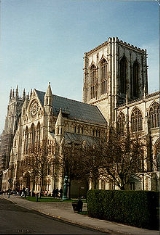
York Minster

Encyclopedia
York Minster is a Gothic
cathedral
in York
, England
and is one of the largest of its kind in Northern Europe
alongside Cologne Cathedral
. The minster is the seat of the Archbishop of York
, the second-highest office of the Church of England
, and is the cathedral for the Diocese of York
; it is run by a dean and chapter under the Dean of York
. The formal title of York Minster is The Cathedral and Metropolitical Church of St Peter in York. The title "Minster" is attributed to churches established in the Anglo Saxon period as missionary teaching churches, and serves now as an honorific title. Services in the minster are sometimes regarded as on the High Church
or Anglo-Catholic end of the Anglican continuum.
The minster has a very wide Decorated Gothic nave and chapter house, a Perpendicular Gothic choir and east end and Early English north and south transept
s. The nave contains the West Window, constructed in 1338, and over the Lady Chapel in the east end is the Great East Window, (finished in 1408), the largest expanse of medieval stained glass in the world. In the north transept is the Five Sisters Window, each lancet
being over 16 metres (52.5 ft) high. The south transept contains a famous rose window
.
presence from the fourth century. However there is circumstantial evidence pointing to much earlier Christian involvement. According to Bede
missionaries were sent from Rome
by Eleutherius
at the request of the chieftain Lucius of Britain
in AD 180 to settle controverted points of differences as to Eastern and Western ceremonials which were disturbing the church. Tradition speaks of 28 British bishops, one for each of the greater British cities, over whom presided the Archbishops of London
, York
and Caerleon-on-Usk. This suggests that the Romans found a Christian church already established when Agricola
took possession of the city and founded the Roman settlement in AD 71.
The first recorded church on the site was a wooden structure built hurriedly in 627 to provide a place to baptise
Edwin
, King of Northumbria
. Moves toward a more substantial building began in the 630s. A stone structure was completed in 637 by Oswald and was dedicated to Saint Peter
. The church soon fell into disrepair and was dilapidated by 670 when Saint Wilfrid
ascended to the see of York. He repaired and renewed the structure. The attached school and library were established and by the 8th century were some of the most substantial in northern Europe.
In 741 the church was destroyed in a fire. It was rebuilt as a more impressive structure containing thirty altar
s. The church and the entire area then passed through the hands of numerous invaders, and its history is obscure until the 10th century. There was a series of Benedictine
archbishop
s, including Saint Oswald
, Wulfstan
, and Ealdred
, who travelled to Westminster
to crown William
in 1066. Ealdred died in 1069 and was buried in the church.
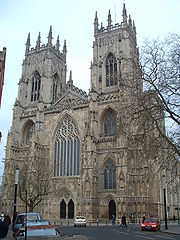 The church was damaged in 1069 during William the Conqueror's harrying of the North
, but the first Norman
archbishop, Thomas of Bayeux, arriving in 1070, organised repairs. The Danes destroyed the church in 1075, but it was again rebuilt from 1080. Built in the Norman
style, it was 111 m (364.173 ft) long and rendered in white and red lines. The new structure was damaged by fire in 1137 but was soon repaired. The choir and crypt were remodelled in 1154, and a new chapel
was built, all in the Norman style.
The Gothic style
in cathedrals had arrived in the mid 12th century. Walter de Gray
was made archbishop in 1215 and ordered the construction of a Gothic structure to compare to Canterbury
; building began in 1220. The north and south transepts were the first new structures; completed in the 1250s, both were built in the Early English Gothic style but had markedly different wall elevations. A substantial central tower was also completed, with a wooden spire
. Building continued into the 15th century.
The Chapter House was begun in the 1260s and was completed before 1296. The wide nave was constructed from the 1280s on the Norman foundations. The outer roof was completed in the 1330s, but the vaulting was not finished until 1360. Construction then moved on to the eastern arm and chapels, with the last Norman structure, the choir, being demolished in the 1390s. Work here finished around 1405. In 1407 the central tower collapsed; the piers were then reinforced, and a new tower was built from 1420. The western towers were added between 1433 and 1472. The cathedral was declared complete and consecrated
in 1472.
 The English Reformation
led to the looting of much of the cathedral's treasures and the loss of much of the church lands. Under Elizabeth I
there was a concerted effort to remove all traces of Roman Catholicism from the cathedral; there was much destruction of tombs, windows and altars. In the English Civil War
the city was besieged and fell to the forces of Cromwell
in 1644, but Thomas Fairfax prevented any further damage to the cathedral.
Following the easing of religious tensions there was some work to restore the cathedral. From 1730 to 1736 the whole floor of the minster was relaid in patterned marble
and from 1802 there was a major restoration. However, on 2 February 1829, an arson
attack by a Non-Conformist, Jonathan Martin, inflicted heavy damage on the east arm. An accidental fire in 1840 left the nave, south west tower and south aisle roofless and blackened shells. The cathedral slumped deeply into debt and in the 1850s services were suspended. From 1858 Augustus Duncome worked successfully to revive the cathedral.
During the 20th century there was more concerted preservation work, especially following a 1967 survey that revealed the building, in particular the central tower, was close to collapse. £2,000,000 was raised and spent by 1972 to reinforce and strengthen the building foundations and roof. During the excavations that were carried out, remains of the north corner of the Roman Principia were found under the south transept. This area, as well as remains of the Norman cathedral, can be visited by stairs down to the undercroft
.
On 9 July 1984, a fire believed to have been caused by a lightning strike destroyed the roof in the south transept, and around £2.5 million was spent on repairs. Restoration work was completed in 1988, and included new roof bosses
to designs which had won a competition organised by BBC Television
's Blue Peter
programme. In 2007 renovation began on the east front, including the Great East Window, at an estimated cost of £23 million.
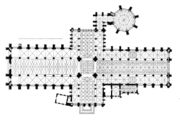 York Minster is the second largest Gothic cathedral of Northern Europe and clearly charts the development of English Gothic architecture from Early English through to the Perpendicular Period. The present building was begun in about 1230 and completed in 1472. It has a cruciform
plan with an octagonal chapter house
attached to the north transept, a central tower and two towers at the west front. The stone used for the building is magnesian limestone
, a creamy-white coloured rock that was quarried in nearby Tadcaster
. The Minster is 158 metres (518.4 ft) long and each of its three towers are 60 metres (196.9 ft) high. The choir has an interior height of 31 metres (101.7 ft).
The North and South transept
s were the first parts of the new church to be built. They have simple lancet window
s, the most famous being the Five Sisters in the north transept. These are five lancets, each 16 metres (52.5 ft) high and glazed with grey (grisaille
) glass, rather than narrative scenes or symbolic motifs that are usually seen in medieval stained glass windows. In the south transept is the famous Rose Window
whose glass dates from about 1500 and commemorates the union of the royal houses of York
and Lancaster
. The roofs of the transepts are of wood, that of the south transept was burnt in the fire of 1984 and was replaced in the restoration work which was completed in 1988. New designs were used for the bosses
, five of which were designed by winners of a competition organised by the BBC
's Blue Peter
television programme.
Work began on the chapter house
and its vestibule that links it to the north transept after the transepts were completed. The style of the chapter house is of the early Decorated Period where geometric patterns were used in the tracery of the windows, which were wider than those of early styles. However, the work was completed before the appearance of the ogee
curve, an S-shaped double curve which was extensively used at the end of this period. The windows cover almost all of the upper wall space, filling the chapter house with light. The chapter house is octagonal, as is the case in many cathedrals, but is notable in that it has no central column supporting the roof. The wooden roof, which was of an innovative design, is light enough to be able to be supported by the buttress
ed walls. The chapter house has many sculptured heads above the canopies, representing some of the finest Gothic sculpture in the country. There are human heads, no two alike, and some pulling faces; angels; animals and grotesques. Unique to the transepts and chapter house is the use of Purbeck marble to adorn the piers, adding to the richness of decoration.
 The nave
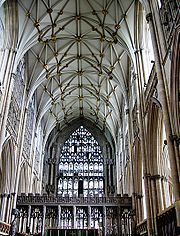
was built between 1291 and c. 1350 and is also in the decorated Gothic style. It is the widest Gothic nave in England and has a wooden roof (painted so as to appear like stone) and the aisles have vaulted stone roofs. At its west end is the Great West Window, known as the 'Heart of Yorkshire' which features flowing tracery of the later decorated gothic period.
The East end of the Minster was built between 1361 and 1405 in the Perpendicular Gothic style. Despite the change in style, noticeable in details such as the tracery and capitals, the eastern arm preserves the pattern of the nave. The east end contains a four bay choir; a second set of transepts, projecting only above half-height; and the Lady Chapel. The transepts are in line with the high altar and serve to throw light onto it. Behind the high altar is the Great East Window, the largest expanse of medieval stained glass in the world.
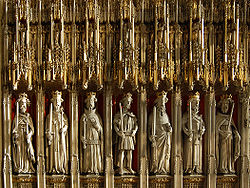
The sparsely decorated Central Tower was built between 1407 and 1472 and is also in the Perpendicular style. Below this, separating the choir from the crossing and nave is the striking fifteenth century choir screen. It contains sculptures of the kings of England from William the Conqueror to Henry VI
with stone and gilded
canopies set against a red background. Above the screen is the organ, which dates from 1832. The West Towers, in contrast with the central tower, are heavily decorated and are topped with battlements and eight pinnacles each, again in the Perpendicular style.
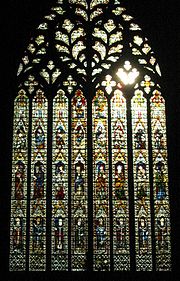 York as a whole and particularly the Minster have a long tradition of creating beautiful stained glass
. Some of the stained glass in York Minster dates back to the twelfth century. The 76 feet (23.2 m) tall Great East Window, created by John Thornton
in the early fifteenth century, is the largest example of medieval stained glass in the world. Other spectacular windows in the Minster include an ornate rose window
and the 50 feet (15.2 m) tall five sisters window. Because of the extended time periods during which the glass was installed, different types of glazing
and painting techniques that evolved over hundreds of years are visible in the different windows. Approximately 2 million individual pieces of glass make up the cathedral's 128 stained glass windows. Much of the glass was removed before and pieced back together after the First
and Second World Wars
, and the windows are constantly being cleaned and restored to keep their beauty intact.
In 2008 a major restoration of the Great East Window commenced, involving the removal, repainting and re-leading of each individual panel.
While the window was in storage in the Minster's stonemasons' yard, a fire broke out in some adjoining offices, due to an electrical fault, on 30 December 2009. The window's 311 panes, stored in a neighbouring room, were undamaged and were successfully carried away to safety.
clock chimes and a concertcarillon. The north-west tower contains Great Peter (216 cwt
or 10.8 ton
s) and the six clock bells (the largest weighing just over 60 cwt or 3 tons). The south-west tower holds 14 bells (tenor 59 cwt or 3 tons) hung and rung for change ringing
and 22 carillon bells (tenor 23 cwt or 1.2 tons) which are played from a batonkeyboard in the ringing chamber. (all together 35 bells.)
The clock bells ring every quarter of an hour during the daytime and Great Peter strikes the hour. The change ringing
bells are rung regularly on Sundays before Church Services
and at other occasions, the ringers practise on Tuesday evenings. York Minster became the first cathedral in England to have a carillon of bells with the arrival of a further twenty-four small bells on 4 April 2008. These are added to the existing “Nelson Chime” that is chimed to announce Evensong around 5 pm each day, giving a carillon of 35 bells in total (3 chromatic octaves). The new bells were cast at the Loughborough Bell Foundry of Taylors, Eayre & Smith, where all of the existing Minster bells were cast. The new carillon is a gift to the Minster. It will be the first new carillon in the British Isles for forty years and first handplayed carillon in an English cathedral. Before Evensong each evening, hymn tunes are played on a baton keyboard connected with the bells, but occasionally anything from Beethoven to the Beatles may be heard.
, supported by the King, petitioned the Pope. On 18 March 1226, Pope Honorius
issued a letter to the effect that the name of William (Fitzherbert) of holy memory, formerly Archbishop of York. was "inscribed in the catalogue of the Saints of the Church Militant." Thus there was now St. William of York (whose name is perhaps more often associated with the adjacent St. William's College). York had its saint but it took until 1279, when William de Wickwane (William de Wykewayne) was elected Archbishop, for the remains of the canonised William to be transferred to a shrine prepared for them behind the high altar. This was placed on a platform raised upon the arches of the crypt removed to this position for that purpose. On 29 [December [Edward I of England]], himself, together with the bishops who were present, carried on their shoulder the chest or feretory containing the relics to their new resting-place, and Anthony Beck, consecrated the same day Bishop of Durham, paid all the expenses.
The tomb of Walter de Gray
was erected in the South transept. His remains were interred on the vigil of Pentecost, 1255 under his effigy in full canonicals carved in Purbeck marble under a canopy resting on ten light pillars. It was subsequently somewhat hidden behind a screen of ironwork erected by Archbishop William Markham
in the early 19th century.
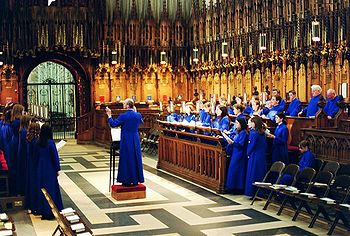 The fire of 1829 destroyed the organ and the basis of the present organ dates from 1832, when Elliot and Hill constructed a new instrument. This organ was reconstructed in 1859 by William Hill and Sons. The case remained intact, but the organ was mechanically new, retaining the largest pipes of the former instrument.
In 1903, J.W. Walker and Sons built a new instrument in the same case. They retained several registers from the previous instrument.
A small amount of work was undertaken in 1918 by Harrison & Harrison
when the famous Tuba Mirabilis was added and the Great chorus revised. The same firm rebuilt this Walker-Harrison instrument in 1931 when a new console and electro-pneumatic action were added together with four new stops. The smaller solo tubas were enclosed in the solo box. In 1960, J.W. Walker & Sons restored the actions, lowered wind pressures and introduced mutations and higher chorus work in the spirit of the neo-classical movement. They cleaned the organ in 1982.
The fire of 1984 affected the organ but not irreparably; the damage hastened the time for a major restoration, which was begun in 1991 and finished two years later by Principal Pipe Organs of York, under the direction of their founder, Geoffrey Coffin, who had at one time been assistant organist at the Minster.
Details of the organ from the National Pipe Organ Register
. These are listed below. They will have an Assistant Organist, who may be titled simply "Organist" (see the second list below).
was installed in the North Transept of York Minster in 1955. The clock is a memorial to the airmen operating from bases in Yorkshire, Durham, and Northumberland who were killed in action during World War II
.
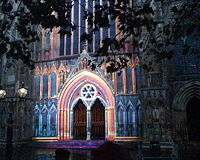 In November 2002, York Minster was illuminated in colour, devised by York-born Mark Brayshaw, for the first time in its history. The occasion was televised live on the BBC1 Look North
program. Similar illuminations have been projected over the Christmas period in subsequent years.
York Minster was also artistically illuminated on 5 November 2005, celebrating the 400th anniversary of the foiling of York-born Guy Fawkes
' gunpowder plot. This was done by Patrice Warrener
using his unique "chromolithe" technique with which he 'paints' with light, picking out sculpted architectural details.
In October 2010, York Minster's South Transept was selected for 'Rose’ a son et lumiere, created by international artists Ross Ashton and Karen Monid, which lit up the entire exterior of the south transept of the Minster and illuminated the Rose Window. There were also satellite Illuminate events in Dean’s Park.
Gothic architecture
Gothic architecture is a style of architecture that flourished during the high and late medieval period. It evolved from Romanesque architecture and was succeeded by Renaissance architecture....
cathedral
Cathedral
A cathedral is a Christian church that contains the seat of a bishop...
in York
York
York is a walled city, situated at the confluence of the Rivers Ouse and Foss in North Yorkshire, England. The city has a rich heritage and has provided the backdrop to major political events throughout much of its two millennia of existence...
, England
England
England is a country that is part of the United Kingdom. It shares land borders with Scotland to the north and Wales to the west; the Irish Sea is to the north west, the Celtic Sea to the south west, with the North Sea to the east and the English Channel to the south separating it from continental...
and is one of the largest of its kind in Northern Europe
Northern Europe
Northern Europe is the northern part or region of Europe. Northern Europe typically refers to the seven countries in the northern part of the European subcontinent which includes Denmark, Estonia, Latvia, Lithuania, Norway, Finland and Sweden...
alongside Cologne Cathedral
Cologne Cathedral
Cologne Cathedral is a Roman Catholic church in Cologne, Germany. It is the seat of the Archbishop of Cologne and the administration of the Archdiocese of Cologne. It is renowned monument of German Catholicism and Gothic architecture and is a World Heritage Site...
. The minster is the seat of the Archbishop of York
Archbishop of York
The Archbishop of York is a high-ranking cleric in the Church of England, second only to the Archbishop of Canterbury. He is the diocesan bishop of the Diocese of York and metropolitan of the Province of York, which covers the northern portion of England as well as the Isle of Man...
, the second-highest office of the Church of England
Church of England
The Church of England is the officially established Christian church in England and the Mother Church of the worldwide Anglican Communion. The church considers itself within the tradition of Western Christianity and dates its formal establishment principally to the mission to England by St...
, and is the cathedral for the Diocese of York
Diocese of York
The Diocese of York is an administrative division of the Church of England, part of the Province of York. It covers the city of York, the eastern part of North Yorkshire, and most of the East Riding of Yorkshire....
; it is run by a dean and chapter under the Dean of York
Dean of York
The Dean of York is the member of the clergy who is responsible for the running of the York Minster cathedral.-11th–12th centuries:* 1093–c.1135: Hugh* c.1138–1143: William of Sainte-Barbe...
. The formal title of York Minster is The Cathedral and Metropolitical Church of St Peter in York. The title "Minster" is attributed to churches established in the Anglo Saxon period as missionary teaching churches, and serves now as an honorific title. Services in the minster are sometimes regarded as on the High Church
High church
The term "High Church" refers to beliefs and practices of ecclesiology, liturgy and theology, generally with an emphasis on formality, and resistance to "modernization." Although used in connection with various Christian traditions, the term has traditionally been principally associated with the...
or Anglo-Catholic end of the Anglican continuum.
The minster has a very wide Decorated Gothic nave and chapter house, a Perpendicular Gothic choir and east end and Early English north and south transept
Transept
For the periodical go to The Transept.A transept is a transverse section, of any building, which lies across the main body of the building. In Christian churches, a transept is an area set crosswise to the nave in a cruciform building in Romanesque and Gothic Christian church architecture...
s. The nave contains the West Window, constructed in 1338, and over the Lady Chapel in the east end is the Great East Window, (finished in 1408), the largest expanse of medieval stained glass in the world. In the north transept is the Five Sisters Window, each lancet
Lancet window
A lancet window is a tall narrow window with a pointed arch at its top. It acquired the "lancet" name from its resemblance to a lance. Instances of this architectural motif are most often found in Gothic and ecclesiastical structures, where they are often placed singly or in pairs.The motif first...
being over 16 metres (52.5 ft) high. The south transept contains a famous rose window
Rose window
A Rose window is often used as a generic term applied to a circular window, but is especially used for those found in churches of the Gothic architectural style and being divided into segments by stone mullions and tracery...
.
History
York has had a verifiable ChristianChristian
A Christian is a person who adheres to Christianity, an Abrahamic, monotheistic religion based on the life and teachings of Jesus of Nazareth as recorded in the Canonical gospels and the letters of the New Testament...
presence from the fourth century. However there is circumstantial evidence pointing to much earlier Christian involvement. According to Bede
Bede
Bede , also referred to as Saint Bede or the Venerable Bede , was a monk at the Northumbrian monastery of Saint Peter at Monkwearmouth, today part of Sunderland, England, and of its companion monastery, Saint Paul's, in modern Jarrow , both in the Kingdom of Northumbria...
missionaries were sent from Rome
Rome
Rome is the capital of Italy and the country's largest and most populated city and comune, with over 2.7 million residents in . The city is located in the central-western portion of the Italian Peninsula, on the Tiber River within the Lazio region of Italy.Rome's history spans two and a half...
by Eleutherius
Eleutherius
Eleutherius, Eleutherus or Eleuterus may refer to:Saints*2nd century Pope Eleuterus *Eleutherius of Rocca d'Arce *Eleutherius of Nicomedia...
at the request of the chieftain Lucius of Britain
Lucius of Britain
Saint Lucius is a legendary 2nd-century King of the Britons traditionally credited with introducing Christianity into Britain. Lucius is first mentioned in a 6th-century version of the Liber Pontificalis, which says that he sent a letter to Pope Eleuterus asking to be made a Christian...
in AD 180 to settle controverted points of differences as to Eastern and Western ceremonials which were disturbing the church. Tradition speaks of 28 British bishops, one for each of the greater British cities, over whom presided the Archbishops of London
London
London is the capital city of :England and the :United Kingdom, the largest metropolitan area in the United Kingdom, and the largest urban zone in the European Union by most measures. Located on the River Thames, London has been a major settlement for two millennia, its history going back to its...
, York
York
York is a walled city, situated at the confluence of the Rivers Ouse and Foss in North Yorkshire, England. The city has a rich heritage and has provided the backdrop to major political events throughout much of its two millennia of existence...
and Caerleon-on-Usk. This suggests that the Romans found a Christian church already established when Agricola
Agricola
-People:*Agricola , Western Roman statesman*Agricola , son of the Western Roman Emperor Avitus*Saints Vitalis and Agricola , martyrs*Saint Agricola of Avignon , bishop of Avignon...
took possession of the city and founded the Roman settlement in AD 71.
The first recorded church on the site was a wooden structure built hurriedly in 627 to provide a place to baptise
Baptism
In Christianity, baptism is for the majority the rite of admission , almost invariably with the use of water, into the Christian Church generally and also membership of a particular church tradition...
Edwin
Edwin of Northumbria
Edwin , also known as Eadwine or Æduini, was the King of Deira and Bernicia – which later became known as Northumbria – from about 616 until his death. He converted to Christianity and was baptised in 627; after he fell at the Battle of Hatfield Chase, he was venerated as a saint.Edwin was the son...
, King of Northumbria
Northumbria
Northumbria was a medieval kingdom of the Angles, in what is now Northern England and South-East Scotland, becoming subsequently an earldom in a united Anglo-Saxon kingdom of England. The name reflects the approximate southern limit to the kingdom's territory, the Humber Estuary.Northumbria was...
. Moves toward a more substantial building began in the 630s. A stone structure was completed in 637 by Oswald and was dedicated to Saint Peter
Saint Peter
Saint Peter or Simon Peter was an early Christian leader, who is featured prominently in the New Testament Gospels and the Acts of the Apostles. The son of John or of Jonah and from the village of Bethsaida in the province of Galilee, his brother Andrew was also an apostle...
. The church soon fell into disrepair and was dilapidated by 670 when Saint Wilfrid
Wilfrid
Wilfrid was an English bishop and saint. Born a Northumbrian noble, he entered religious life as a teenager and studied at Lindisfarne, at Canterbury, in Gaul, and at Rome; he returned to Northumbria in about 660, and became the abbot of a newly founded monastery at Ripon...
ascended to the see of York. He repaired and renewed the structure. The attached school and library were established and by the 8th century were some of the most substantial in northern Europe.
In 741 the church was destroyed in a fire. It was rebuilt as a more impressive structure containing thirty altar
Altar
An altar is any structure upon which offerings such as sacrifices are made for religious purposes. Altars are usually found at shrines, and they can be located in temples, churches and other places of worship...
s. The church and the entire area then passed through the hands of numerous invaders, and its history is obscure until the 10th century. There was a series of Benedictine
Benedictine
Benedictine refers to the spirituality and consecrated life in accordance with the Rule of St Benedict, written by Benedict of Nursia in the sixth century for the cenobitic communities he founded in central Italy. The most notable of these is Monte Cassino, the first monastery founded by Benedict...
archbishop
Archbishop
An archbishop is a bishop of higher rank, but not of higher sacramental order above that of the three orders of deacon, priest , and bishop...
s, including Saint Oswald
Oswald of Worcester
Oswald of Worcester was Archbishop of York from 972 to his death in 992. He was of Danish ancestry, but brought up by his uncle, Oda, who sent him to France to the abbey of Fleury to become a monk. After a number of years at Fleury, Oswald returned to England at the request of his uncle, who died...
, Wulfstan
Wulfstan I, Archbishop of York
Wulfstan was Archbishop of York between 931 and 952. He is often known as Wulfstan I, to separate him from Wulfstan II, Archbishop of York.-Life:Wulfstan was consecrated in 931....
, and Ealdred
Aldred
Ealdred was Abbot of Tavistock, Bishop of Worcester, and Archbishop of York in Anglo-Saxon England. He was related to a number of other ecclesiastics of the period. After becoming a monk at the monastery at Winchester, he was appointed Abbot of Tavistock Abbey in around 1027. In 1046 he was named...
, who travelled to Westminster
Westminster Abbey
The Collegiate Church of St Peter at Westminster, popularly known as Westminster Abbey, is a large, mainly Gothic church, in the City of Westminster, London, United Kingdom, located just to the west of the Palace of Westminster. It is the traditional place of coronation and burial site for English,...
to crown William
William I of England
William I , also known as William the Conqueror , was the first Norman King of England from Christmas 1066 until his death. He was also Duke of Normandy from 3 July 1035 until his death, under the name William II...
in 1066. Ealdred died in 1069 and was buried in the church.
Harrying of the North
The Harrying of the North was a series of campaigns waged by William the Conqueror in the winter of 1069–1070 to subjugate Northern England, and is part of the Norman conquest of England...
, but the first Norman
Normans
The Normans were the people who gave their name to Normandy, a region in northern France. They were descended from Norse Viking conquerors of the territory and the native population of Frankish and Gallo-Roman stock...
archbishop, Thomas of Bayeux, arriving in 1070, organised repairs. The Danes destroyed the church in 1075, but it was again rebuilt from 1080. Built in the Norman
Norman architecture
About|Romanesque architecture, primarily English|other buildings in Normandy|Architecture of Normandy.File:Durham Cathedral. Nave by James Valentine c.1890.jpg|thumb|200px|The nave of Durham Cathedral demonstrates the characteristic round arched style, though use of shallow pointed arches above the...
style, it was 111 m (364.173 ft) long and rendered in white and red lines. The new structure was damaged by fire in 1137 but was soon repaired. The choir and crypt were remodelled in 1154, and a new chapel
Chapel
A chapel is a building used by Christians as a place of fellowship and worship. It may be part of a larger structure or complex, such as a church, college, hospital, palace, prison or funeral home, located on board a military or commercial ship, or it may be an entirely free-standing building,...
was built, all in the Norman style.
The Gothic style
Gothic architecture
Gothic architecture is a style of architecture that flourished during the high and late medieval period. It evolved from Romanesque architecture and was succeeded by Renaissance architecture....
in cathedrals had arrived in the mid 12th century. Walter de Gray
Walter de Gray
Walter de Gray was an English prelate and statesman who rose to be Archbishop of York and Lord Chancellor.-Life:Gray was the son of John de Gray the Elder of Eaton in Norfolk and nephew of John de Gray , Bishop of Norwich. His sister, Hawise, married the Justiciar of England, Philip Basset...
was made archbishop in 1215 and ordered the construction of a Gothic structure to compare to Canterbury
Canterbury Cathedral
Canterbury Cathedral in Canterbury, Kent, is one of the oldest and most famous Christian structures in England and forms part of a World Heritage Site....
; building began in 1220. The north and south transepts were the first new structures; completed in the 1250s, both were built in the Early English Gothic style but had markedly different wall elevations. A substantial central tower was also completed, with a wooden spire
Spire
A spire is a tapering conical or pyramidal structure on the top of a building, particularly a church tower. Etymologically, the word is derived from the Old English word spir, meaning a sprout, shoot, or stalk of grass....
. Building continued into the 15th century.
The Chapter House was begun in the 1260s and was completed before 1296. The wide nave was constructed from the 1280s on the Norman foundations. The outer roof was completed in the 1330s, but the vaulting was not finished until 1360. Construction then moved on to the eastern arm and chapels, with the last Norman structure, the choir, being demolished in the 1390s. Work here finished around 1405. In 1407 the central tower collapsed; the piers were then reinforced, and a new tower was built from 1420. The western towers were added between 1433 and 1472. The cathedral was declared complete and consecrated
Consecration
Consecration is the solemn dedication to a special purpose or service, usually religious. The word "consecration" literally means "to associate with the sacred". Persons, places, or things can be consecrated, and the term is used in various ways by different groups...
in 1472.
English Reformation
The English Reformation was the series of events in 16th-century England by which the Church of England broke away from the authority of the Pope and the Roman Catholic Church....
led to the looting of much of the cathedral's treasures and the loss of much of the church lands. Under Elizabeth I
Elizabeth I of England
Elizabeth I was queen regnant of England and Ireland from 17 November 1558 until her death. Sometimes called The Virgin Queen, Gloriana, or Good Queen Bess, Elizabeth was the fifth and last monarch of the Tudor dynasty...
there was a concerted effort to remove all traces of Roman Catholicism from the cathedral; there was much destruction of tombs, windows and altars. In the English Civil War
English Civil War
The English Civil War was a series of armed conflicts and political machinations between Parliamentarians and Royalists...
the city was besieged and fell to the forces of Cromwell
Oliver Cromwell
Oliver Cromwell was an English military and political leader who overthrew the English monarchy and temporarily turned England into a republican Commonwealth, and served as Lord Protector of England, Scotland, and Ireland....
in 1644, but Thomas Fairfax prevented any further damage to the cathedral.
Following the easing of religious tensions there was some work to restore the cathedral. From 1730 to 1736 the whole floor of the minster was relaid in patterned marble
Marble
Marble is a metamorphic rock composed of recrystallized carbonate minerals, most commonly calcite or dolomite.Geologists use the term "marble" to refer to metamorphosed limestone; however stonemasons use the term more broadly to encompass unmetamorphosed limestone.Marble is commonly used for...
and from 1802 there was a major restoration. However, on 2 February 1829, an arson
Arson
Arson is the crime of intentionally or maliciously setting fire to structures or wildland areas. It may be distinguished from other causes such as spontaneous combustion and natural wildfires...
attack by a Non-Conformist, Jonathan Martin, inflicted heavy damage on the east arm. An accidental fire in 1840 left the nave, south west tower and south aisle roofless and blackened shells. The cathedral slumped deeply into debt and in the 1850s services were suspended. From 1858 Augustus Duncome worked successfully to revive the cathedral.
During the 20th century there was more concerted preservation work, especially following a 1967 survey that revealed the building, in particular the central tower, was close to collapse. £2,000,000 was raised and spent by 1972 to reinforce and strengthen the building foundations and roof. During the excavations that were carried out, remains of the north corner of the Roman Principia were found under the south transept. This area, as well as remains of the Norman cathedral, can be visited by stairs down to the undercroft
Undercroft
An undercroft is traditionally a cellar or storage room, often brick-lined and vaulted, and used for storage in buildings since medieval times. In modern usage, an undercroft is generally a ground area which is relatively open to the sides, but covered by the building above.- History :While some...
.
On 9 July 1984, a fire believed to have been caused by a lightning strike destroyed the roof in the south transept, and around £2.5 million was spent on repairs. Restoration work was completed in 1988, and included new roof bosses
Boss (architecture)
In architecture, a boss is a knob or protrusion of stone or wood.Bosses can often be found in the ceilings of buildings, particularly at the intersection of a vault. In Gothic architecture, such roof bosses are often intricately carved with foliage, heraldic devices or other decorations...
to designs which had won a competition organised by BBC Television
BBC Television
BBC Television is a service of the British Broadcasting Corporation. The corporation, which has operated in the United Kingdom under the terms of a Royal Charter since 1927, has produced television programmes from its own studios since 1932, although the start of its regular service of television...
's Blue Peter
Blue Peter
Blue Peter is the world's longest-running children's television show, having first aired in 1958. It is shown on CBBC, both in its BBC One programming block and on the CBBC channel. During its history there have been many presenters, often consisting of two women and two men at a time...
programme. In 2007 renovation began on the east front, including the Great East Window, at an estimated cost of £23 million.
Architecture of the present building
Cruciform
Cruciform means having the shape of a cross or Christian cross.- Cruciform architectural plan :This is a common description of Christian churches. In Early Christian, Byzantine and other Eastern Orthodox forms of church architecture this is more likely to mean a tetraconch plan, a Greek cross,...
plan with an octagonal chapter house
Chapter house
A chapter house or chapterhouse is a building or room attached to a cathedral or collegiate church in which meetings are held. They can also be found in medieval monasteries....
attached to the north transept, a central tower and two towers at the west front. The stone used for the building is magnesian limestone
Geology of Yorkshire
In Yorkshire there is a very close relationship between the major topographical areas and the geological period in which they were formed. The rocks of the Pennine chain of hills in the west are of Carboniferous origin whilst those of the central vale are Permo-Triassic...
, a creamy-white coloured rock that was quarried in nearby Tadcaster
Tadcaster
Tadcaster is a market town and civil parish in the Selby district of North Yorkshire, England. Lying on the Great North Road approximately east of Leeds and west of York. It is the last town on the River Wharfe before it joins the River Ouse about downstream...
. The Minster is 158 metres (518.4 ft) long and each of its three towers are 60 metres (196.9 ft) high. The choir has an interior height of 31 metres (101.7 ft).
The North and South transept
Transept
For the periodical go to The Transept.A transept is a transverse section, of any building, which lies across the main body of the building. In Christian churches, a transept is an area set crosswise to the nave in a cruciform building in Romanesque and Gothic Christian church architecture...
s were the first parts of the new church to be built. They have simple lancet window
Lancet window
A lancet window is a tall narrow window with a pointed arch at its top. It acquired the "lancet" name from its resemblance to a lance. Instances of this architectural motif are most often found in Gothic and ecclesiastical structures, where they are often placed singly or in pairs.The motif first...
s, the most famous being the Five Sisters in the north transept. These are five lancets, each 16 metres (52.5 ft) high and glazed with grey (grisaille
Grisaille
Grisaille is a term for painting executed entirely in monochrome or near-monochrome, usually in shades of grey. It is particularly used in large decorative schemes in imitation of sculpture. Many grisailles in fact include a slightly wider colour range, like the Andrea del Sarto fresco...
) glass, rather than narrative scenes or symbolic motifs that are usually seen in medieval stained glass windows. In the south transept is the famous Rose Window
Rose window
A Rose window is often used as a generic term applied to a circular window, but is especially used for those found in churches of the Gothic architectural style and being divided into segments by stone mullions and tracery...
whose glass dates from about 1500 and commemorates the union of the royal houses of York
House of York
The House of York was a branch of the English royal House of Plantagenet, three members of which became English kings in the late 15th century. The House of York was descended in the paternal line from Edmund of Langley, 1st Duke of York, the fourth surviving son of Edward III, but also represented...
and Lancaster
House of Lancaster
The House of Lancaster was a branch of the royal House of Plantagenet. It was one of the opposing factions involved in the Wars of the Roses, an intermittent civil war which affected England and Wales during the 15th century...
. The roofs of the transepts are of wood, that of the south transept was burnt in the fire of 1984 and was replaced in the restoration work which was completed in 1988. New designs were used for the bosses
Boss (architecture)
In architecture, a boss is a knob or protrusion of stone or wood.Bosses can often be found in the ceilings of buildings, particularly at the intersection of a vault. In Gothic architecture, such roof bosses are often intricately carved with foliage, heraldic devices or other decorations...
, five of which were designed by winners of a competition organised by the BBC
BBC
The British Broadcasting Corporation is a British public service broadcaster. Its headquarters is at Broadcasting House in the City of Westminster, London. It is the largest broadcaster in the world, with about 23,000 staff...
's Blue Peter
Blue Peter
Blue Peter is the world's longest-running children's television show, having first aired in 1958. It is shown on CBBC, both in its BBC One programming block and on the CBBC channel. During its history there have been many presenters, often consisting of two women and two men at a time...
television programme.
Work began on the chapter house
Chapter house
A chapter house or chapterhouse is a building or room attached to a cathedral or collegiate church in which meetings are held. They can also be found in medieval monasteries....
and its vestibule that links it to the north transept after the transepts were completed. The style of the chapter house is of the early Decorated Period where geometric patterns were used in the tracery of the windows, which were wider than those of early styles. However, the work was completed before the appearance of the ogee
Ogee
An ogee is a curve , shaped somewhat like an S, consisting of two arcs that curve in opposite senses, so that the ends are parallel....
curve, an S-shaped double curve which was extensively used at the end of this period. The windows cover almost all of the upper wall space, filling the chapter house with light. The chapter house is octagonal, as is the case in many cathedrals, but is notable in that it has no central column supporting the roof. The wooden roof, which was of an innovative design, is light enough to be able to be supported by the buttress
Buttress
A buttress is an architectural structure built against or projecting from a wall which serves to support or reinforce the wall...
ed walls. The chapter house has many sculptured heads above the canopies, representing some of the finest Gothic sculpture in the country. There are human heads, no two alike, and some pulling faces; angels; animals and grotesques. Unique to the transepts and chapter house is the use of Purbeck marble to adorn the piers, adding to the richness of decoration.
Nave
In Romanesque and Gothic Christian abbey, cathedral basilica and church architecture, the nave is the central approach to the high altar, the main body of the church. "Nave" was probably suggested by the keel shape of its vaulting...
was built between 1291 and c. 1350 and is also in the decorated Gothic style. It is the widest Gothic nave in England and has a wooden roof (painted so as to appear like stone) and the aisles have vaulted stone roofs. At its west end is the Great West Window, known as the 'Heart of Yorkshire' which features flowing tracery of the later decorated gothic period.
The East end of the Minster was built between 1361 and 1405 in the Perpendicular Gothic style. Despite the change in style, noticeable in details such as the tracery and capitals, the eastern arm preserves the pattern of the nave. The east end contains a four bay choir; a second set of transepts, projecting only above half-height; and the Lady Chapel. The transepts are in line with the high altar and serve to throw light onto it. Behind the high altar is the Great East Window, the largest expanse of medieval stained glass in the world.
The sparsely decorated Central Tower was built between 1407 and 1472 and is also in the Perpendicular style. Below this, separating the choir from the crossing and nave is the striking fifteenth century choir screen. It contains sculptures of the kings of England from William the Conqueror to Henry VI
Henry VI of England
Henry VI was King of England from 1422 to 1461 and again from 1470 to 1471, and disputed King of France from 1422 to 1453. Until 1437, his realm was governed by regents. Contemporaneous accounts described him as peaceful and pious, not suited for the violent dynastic civil wars, known as the Wars...
with stone and gilded
Gilding
The term gilding covers a number of decorative techniques for applying fine gold leaf or powder to solid surfaces such as wood, stone, or metal to give a thin coating of gold. A gilded object is described as "gilt"...
canopies set against a red background. Above the screen is the organ, which dates from 1832. The West Towers, in contrast with the central tower, are heavily decorated and are topped with battlements and eight pinnacles each, again in the Perpendicular style.
Stained glass
Stained glass
The term stained glass can refer to coloured glass as a material or to works produced from it. Throughout its thousand-year history, the term has been applied almost exclusively to the windows of churches and other significant buildings...
. Some of the stained glass in York Minster dates back to the twelfth century. The 76 feet (23.2 m) tall Great East Window, created by John Thornton
John Thornton (glass painter)
John Thornton of Coventry was a master glazier and stained glass artist active in England during the 15th century. The output of his workshop includes some of the finest English medieval glass.-Biography:...
in the early fifteenth century, is the largest example of medieval stained glass in the world. Other spectacular windows in the Minster include an ornate rose window
Rose window
A Rose window is often used as a generic term applied to a circular window, but is especially used for those found in churches of the Gothic architectural style and being divided into segments by stone mullions and tracery...
and the 50 feet (15.2 m) tall five sisters window. Because of the extended time periods during which the glass was installed, different types of glazing
Glaze (painting technique)
Glazes can change the chroma, value, hue and texture of a surface. Drying time will depend on the amount and type of paint medium used in the glaze. The medium, base, or vehicle is the mixture to which the dry pigment is added...
and painting techniques that evolved over hundreds of years are visible in the different windows. Approximately 2 million individual pieces of glass make up the cathedral's 128 stained glass windows. Much of the glass was removed before and pieced back together after the First
World War I
World War I , which was predominantly called the World War or the Great War from its occurrence until 1939, and the First World War or World War I thereafter, was a major war centred in Europe that began on 28 July 1914 and lasted until 11 November 1918...
and Second World Wars
World War II
World War II, or the Second World War , was a global conflict lasting from 1939 to 1945, involving most of the world's nations—including all of the great powers—eventually forming two opposing military alliances: the Allies and the Axis...
, and the windows are constantly being cleaned and restored to keep their beauty intact.
In 2008 a major restoration of the Great East Window commenced, involving the removal, repainting and re-leading of each individual panel.
While the window was in storage in the Minster's stonemasons' yard, a fire broke out in some adjoining offices, due to an electrical fault, on 30 December 2009. The window's 311 panes, stored in a neighbouring room, were undamaged and were successfully carried away to safety.
The towers and bells
The two west towers of the minster hold bellsBell (instrument)
A bell is a simple sound-making device. The bell is a percussion instrument and an idiophone. Its form is usually a hollow, cup-shaped object, which resonates upon being struck...
clock chimes and a concertcarillon. The north-west tower contains Great Peter (216 cwt
Hundredweight
The hundredweight or centum weight is a unit of mass defined in terms of the pound . The definition used in Britain differs from that used in North America. The two are distinguished by the terms long hundredweight and short hundredweight:* The long hundredweight is defined as 112 lb, which...
or 10.8 ton
Ton
The ton is a unit of measure. It has a long history and has acquired a number of meanings and uses over the years. It is used principally as a unit of weight, and as a unit of volume. It can also be used as a measure of energy, for truck classification, or as a colloquial term.It is derived from...
s) and the six clock bells (the largest weighing just over 60 cwt or 3 tons). The south-west tower holds 14 bells (tenor 59 cwt or 3 tons) hung and rung for change ringing
Change ringing
Change ringing is the art of ringing a set of tuned bells in a series of mathematical patterns called "changes". It differs from many other forms of campanology in that no attempt is made to produce a conventional melody....
and 22 carillon bells (tenor 23 cwt or 1.2 tons) which are played from a batonkeyboard in the ringing chamber. (all together 35 bells.)
The clock bells ring every quarter of an hour during the daytime and Great Peter strikes the hour. The change ringing
Change ringing
Change ringing is the art of ringing a set of tuned bells in a series of mathematical patterns called "changes". It differs from many other forms of campanology in that no attempt is made to produce a conventional melody....
bells are rung regularly on Sundays before Church Services
Church service
In Christianity, a church service is a term used to describe a formalized period of communal worship, often but not exclusively occurring on Sunday, or Saturday in the case of those churches practicing seventh-day Sabbatarianism. The church service is the gathering together of Christians to be...
and at other occasions, the ringers practise on Tuesday evenings. York Minster became the first cathedral in England to have a carillon of bells with the arrival of a further twenty-four small bells on 4 April 2008. These are added to the existing “Nelson Chime” that is chimed to announce Evensong around 5 pm each day, giving a carillon of 35 bells in total (3 chromatic octaves). The new bells were cast at the Loughborough Bell Foundry of Taylors, Eayre & Smith, where all of the existing Minster bells were cast. The new carillon is a gift to the Minster. It will be the first new carillon in the British Isles for forty years and first handplayed carillon in an English cathedral. Before Evensong each evening, hymn tunes are played on a baton keyboard connected with the bells, but occasionally anything from Beethoven to the Beatles may be heard.
Shrines
When Thomas a Becket was murdered and subsequently enshrined at Canterbury, York found itself without a rival major draw for pilgrims. More specifically pilgrims spent money and would leave gifts for the support of the cathedral. Hence Walter de GrayWalter de Gray
Walter de Gray was an English prelate and statesman who rose to be Archbishop of York and Lord Chancellor.-Life:Gray was the son of John de Gray the Elder of Eaton in Norfolk and nephew of John de Gray , Bishop of Norwich. His sister, Hawise, married the Justiciar of England, Philip Basset...
, supported by the King, petitioned the Pope. On 18 March 1226, Pope Honorius
Pope Honorius
Pope Honorius could refer to:#Pope Honorius I#*Antipope Honorius II#Pope Honorius II#Pope Honorius III#Pope Honorius IV...
issued a letter to the effect that the name of William (Fitzherbert) of holy memory, formerly Archbishop of York. was "inscribed in the catalogue of the Saints of the Church Militant." Thus there was now St. William of York (whose name is perhaps more often associated with the adjacent St. William's College). York had its saint but it took until 1279, when William de Wickwane (William de Wykewayne) was elected Archbishop, for the remains of the canonised William to be transferred to a shrine prepared for them behind the high altar. This was placed on a platform raised upon the arches of the crypt removed to this position for that purpose. On 29 [December [Edward I of England]], himself, together with the bishops who were present, carried on their shoulder the chest or feretory containing the relics to their new resting-place, and Anthony Beck, consecrated the same day Bishop of Durham, paid all the expenses.
The tomb of Walter de Gray
Walter de Gray
Walter de Gray was an English prelate and statesman who rose to be Archbishop of York and Lord Chancellor.-Life:Gray was the son of John de Gray the Elder of Eaton in Norfolk and nephew of John de Gray , Bishop of Norwich. His sister, Hawise, married the Justiciar of England, Philip Basset...
was erected in the South transept. His remains were interred on the vigil of Pentecost, 1255 under his effigy in full canonicals carved in Purbeck marble under a canopy resting on ten light pillars. It was subsequently somewhat hidden behind a screen of ironwork erected by Archbishop William Markham
William Markham
William Markham may refer to:* William Markham , English scholar and religious figure* William Markham , first acting governor of colonial Pennsylvania* William Markham , Atlanta businessman and mayor...
in the early 19th century.
Organ
In 1903, J.W. Walker and Sons built a new instrument in the same case. They retained several registers from the previous instrument.
A small amount of work was undertaken in 1918 by Harrison & Harrison
Harrison & Harrison
Harrison & Harrison Ltd are a British company that make and restore pipe organs, based in Durham and established in 1861. They are well known for their work on instruments such as King's College Cambridge, Westminster Abbey and the Royal Festival Hall....
when the famous Tuba Mirabilis was added and the Great chorus revised. The same firm rebuilt this Walker-Harrison instrument in 1931 when a new console and electro-pneumatic action were added together with four new stops. The smaller solo tubas were enclosed in the solo box. In 1960, J.W. Walker & Sons restored the actions, lowered wind pressures and introduced mutations and higher chorus work in the spirit of the neo-classical movement. They cleaned the organ in 1982.
The fire of 1984 affected the organ but not irreparably; the damage hastened the time for a major restoration, which was begun in 1991 and finished two years later by Principal Pipe Organs of York, under the direction of their founder, Geoffrey Coffin, who had at one time been assistant organist at the Minster.
Details of the organ from the National Pipe Organ Register
Organists
The organists of York Minster have had several official titles, the job description roughly equates to that of Organist and Master of the ChoristersOrganist and Master of the Choristers
An Organist and Master of the Choristers is a title given to a Director of Music at a Cathedral, particularly an Anglican Cathedral in England. The tradition dates back to the Middle Ages. He is both the organist and the choirmaster....
. These are listed below. They will have an Assistant Organist, who may be titled simply "Organist" (see the second list below).
- 1633 James Hutchinson
- 1662 J. H. Charles
- 1667 Thomas Preston
- 1691 Thomas Wanless
- 1695 J.Heath
- 1715 Charles Murgatroyd
- 1721 William Davies
- 1722 Charles QuarlesCharles QuarlesCharles Quarles , organist, is of unknown parentage and background, though it is assumed, on account of his profession and unusual name, that he was the son of Charles Quarles , organist of Trinity College, Cambridge...
- 1734 James NaresJames NaresJames Nares was an English composer of mostly sacred vocal works, though he also composed for the harpsichord and organ....
- 1756 John Camidge
- 1799 Matthew Camidge
- 1842 John Camidge
- 1848 Thomas Simpson Camidge
- 1859 Edwin George Monk
- 1883 John Naylor
- 1897 T. Tertius NobleT. Tertius NobleThomas Tertius Noble was an English-born organist and composer, resident in the United States for the latter part of his career...
- 1913 Edward BairstowEdward BairstowSir Edward Cuthbert Bairstow was born in Huddersfield on 22 August 1874 and died in York on 1 May 1946. He was an English organist and composer in the Anglican church music tradition....
- 1946 Francis Jackson
- 1983 Philip MoorePhilip Moore (organist)Philip Moore is an English composer and organist.-Career:After studying at the Royal College of Music, he became Assistant Organist at Canterbury Cathedral in 1968. He was appointed Organist and Master of the Choristers at Guildford Cathedral in 1974...
- 2008 Robert Sharpe
Assistant organists
- Thomas Simpson Camidge 1842 - 1848
- Mark James MonkMark James MonkMark James Monk was an cathedral organist, who served at Truro Cathedral and composer.-Background:Mark James Monk was born on 16 March 1858 in Hunmanby Yorkshire. He studied organ under Edwin George Monk at York Minster. He was a composer of sacred and secular music including Eligaic Odes, a...
???? - 1879 - Edward Johnson Bellerby
- Thomas William Hanforth 1891 - 1892
- Frederick Flaxington Harker ???? - 1902
- Edwin Fairbourn 1902 - 1906
- William Green 1906 - 1910
- Cyril F. Musgrove 1910 - 1914
- Harold A. Bennett 1917 - 1923
- J. Lawrence Slater 1924 - 1929
- Owen Le Patourel Franklin 1929 - 1941, 1946
- Sefton Cottom 1945
- Francis Jackson 1946 - 1947
- Allan WicksAllan WicksAllan Wicks CBE was an English cathedral organist, who served in Canterbury Cathedral for nearly 30 years. He was an early champion of the music of Olivier Messiaen and Peter Maxwell Davies...
1947 - 1954
- Eric Parsons 1954 - 1957
- Ronald Edward PerrinRonald Edward PerrinRonald Edward Perrin was a British cathedral organist. Born in London, Perrin's initial education was at Edmonton County Grammar School. He won an organ scholarship to Christ Church, Oxford, from where he graduated with an honours degree in music. Following National Service, he secured his first...
1957 - 1966 - Peter J. Williams 1966 - 1967
- A. Wilson Dixon 1969 - 1971
- Geoffrey Coffin 1971 - 1975
- John Scott Whiteley 1976 - 2010
- David Pipe 2010 –
Other burials
- Bosa of YorkBosa of YorkBosa was a Northumbrian, educated at the great Abbey of Whitby under the abbess Hilda. He later joined the brethren there as a monk and became a noted scholar....
, Bishop of York and SaintSaintA saint is a holy person. In various religions, saints are people who are believed to have exceptional holiness.In Christian usage, "saint" refers to any believer who is "in Christ", and in whom Christ dwells, whether in heaven or in earth... - Hugh AshtonHugh Ashton-Life:Ashton was a younger son of one of the Lancashire families of Ashton. He attracted the notice of Lady Margaret Beaufort, countess of Derby, who made him comptroller of her household. He commenced M.A. at Oxford 13 October 1507, but soon after had a grace from Cambridge to enter the canon law....
, ArchdeaconArchdeaconAn archdeacon is a senior clergy position in Anglicanism, Syrian Malabar Nasrani, Chaldean Catholic, and some other Christian denominations, above that of most clergy and below a bishop. In the High Middle Ages it was the most senior diocesan position below a bishop in the Roman Catholic Church...
of York - Sewal de BovilSewal de Bovil-Life:Nothing is known of Bovil's origins or his parents, but he attended Oxford University at around the same time as Edmund of Abingdon, who became Bovil's good friend. He first appears as a canon of York Minster in 1236, and was holding the prebend of Fenton by October 1240. He was Archdeacon of...
, Dean and Archbishop - Walter de GrayWalter de GrayWalter de Gray was an English prelate and statesman who rose to be Archbishop of York and Lord Chancellor.-Life:Gray was the son of John de Gray the Elder of Eaton in Norfolk and nephew of John de Gray , Bishop of Norwich. His sister, Hawise, married the Justiciar of England, Philip Basset...
, Archbishop - Eanbald IEanbald IEanbald was an eighth century Archbishop of York.-Life:...
, eighth century Archbishop - Ealdred (archbishop of York)
- Thomas of Bayeux, Archbishop (1070–1100)
- Gerard (Archbishop of York), Archbishop (1100–1108)
- Thomas II of YorkThomas II of YorkThomas was a medieval archbishop of York. To distinguish him from his uncle, also a Thomas who was archbishop of York, Thomas is usually known as Thomas II or Thomas the Younger.-Life:...
, Archbishop (1108–1114) - William of York, Archbishop (1141–1147, 1153–1154)
- Henry MurdacHenry MurdacHenry Murdac was abbot of Fountains Abbey and Archbishop of York in medieval England,-Early life:Murdac was a native of Yorkshire. He was friendly with Archbishop Thurstan of York, who secured his promotion in the cathedral chapter of York Minster, however Murdac resigned soon afterwards when...
, Archbishop (1147–1153)
- Walter de GrayWalter de GrayWalter de Gray was an English prelate and statesman who rose to be Archbishop of York and Lord Chancellor.-Life:Gray was the son of John de Gray the Elder of Eaton in Norfolk and nephew of John de Gray , Bishop of Norwich. His sister, Hawise, married the Justiciar of England, Philip Basset...
, Archbishop (1216–1255) - Godfrey LudhamGodfrey LudhamGodfrey Ludham was Archbishop of York from 1258 to 1265.-Life:Ludham's parents were Richard and Eda of Ludham, Norfolk, and he had a brother Thomas who was also a priest. Matthew Paris gives him the name Godfrey Kineton, but without any explanation of why that was his name...
, Archbishop (1258–1265) - William LangtonWilliam LangtonWilliam Langton was a medieval English priest and nephew of Archbishop Walter de Gray. William was selected but never consecrated as Archbishop of York and Bishop of Carlisle....
- Walter GiffardWalter GiffardWalter Giffard was Lord Chancellor of England and Archbishop of York.-Family:Giffard was the son of Hugh Giffard, of Boyton in Wiltshire; his mother was Sibyl, the daughter and co-heiress of Walter de Cormeilles. Walter was born about 1225, and may have been the oldest son. Hugh and Sybil were...
, Archbishop (1266–1279) - John le RomeynJohn le Romeyn-Life:Romeyn was the illegitimate son of John le Romeyn the elder, treasurer of York. The younger John was born while his father was still a subdeacon, and nothing is known about his mother, except for a 14th century chronicler's mention that she was a waiting woman. His birth was probably around...
, Archbishop (1286–1296) - Henry of NewarkHenry of Newark-Life:Nothing is known of Henry's ancestry, but he probably took his name from Newark-on-Trent in Nottinghamshire, where he owned some property. He wrote in 1298 that he had been brought up in the Gilbertine order of monks, but where exactly is unclear. Likewise, where he was educated is unknown....
, Archbishop (1296–1299) - William GreenfieldWilliam GreenfieldWilliam Greenfield served as both the Lord Chancellor of England and the Archbishop of York. He was also known as William of Greenfield.-Life:...
, Archbishop (1306–1315) - William MeltonWilliam Melton-Life:Melton was the son of Henry of Melton, and the brother of Henry de Melton. He was born in Melton in the parish of Welton, about nine miles from Kingston upon Hull. He was a contemporary of John Hotham, Chancellor of England and Bishop of Ely...
, Archbishop (1317–1340) - William ZoucheWilliam ZoucheWilliam Zouche or William de la Zouche, was a medieval Archbishop of York.Zouche was a younger son of William, Lord Zouche of Haringworth, in Northamptonshire. He was appointed Archdeacon of Barnstaple in 1329. On 12 July 1330, he was collated Archdeacon of Exeter...
, Archbishop (1342–1352) - Richard le ScropeRichard le ScropeRichard le Scrope was Bishop of Lichfield then Archbishop of York.Scrope earned a Doctorate in canon law. He was provided to the see of Coventry and Lichfield on 18 August 1386, and consecrated on 19 August 1386. He was given the temporalities of the see on 15 November 1386. He was consecrated at...
, Archbishop (1398–1405) - Henry BowetHenry BowetHenry Bowet was both Bishop of Bath and Wells and Archbishop of York.-Life:Bowet was a royal clerk to King Richard II of England, and at one point carried letters of recommendation to Pope Urban VI from the king....
, Archbishop (1407–1423) - Thomas SavageThomas SavageThomas Savage was an English clergyman.On 3 December 1492, Savage was nominated Bishop of Rochester. He was consecrated on 28 April 1493. He held the post he until 1497 when he was translated to be Bishop of London....
, Archbishop (1501–1507) - John PiersJohn PiersJohn Piers was Archbishop of York between 1589–1594. Previous to that he had been Bishop of Rochester and Bishop of Salisbury.-Life:...
, Archbishop (1589–1594)
Astronomical clock
The astronomical clockYork Minster astronomical clock
The York Minster astronomical clock was installed in the North Transept of York Minster in 1955. It was first conceived in 1944 and designed by R d'E Atkinson, chief assistant at the Royal Greenwich Observatory...
was installed in the North Transept of York Minster in 1955. The clock is a memorial to the airmen operating from bases in Yorkshire, Durham, and Northumberland who were killed in action during World War II
World War II
World War II, or the Second World War , was a global conflict lasting from 1939 to 1945, involving most of the world's nations—including all of the great powers—eventually forming two opposing military alliances: the Allies and the Axis...
.
Illuminations
BBC Look North
BBC Look North is a name used by the BBC for its local regional news programme in three regions in the North of England:*BBC Look North for the BBC Yorkshire and Lincolnshire region*BBC Look North for the BBC Yorkshire region...
program. Similar illuminations have been projected over the Christmas period in subsequent years.
York Minster was also artistically illuminated on 5 November 2005, celebrating the 400th anniversary of the foiling of York-born Guy Fawkes
Guy Fawkes
Guy Fawkes , also known as Guido Fawkes, the name he adopted while fighting for the Spanish in the Low Countries, belonged to a group of provincial English Catholics who planned the failed Gunpowder Plot of 1605.Fawkes was born and educated in York...
' gunpowder plot. This was done by Patrice Warrener
Patrice Warrener
Patrice Warrener is a French light artist, mostly known for his Chromolithe Polychromatic Illumination System. Warrener has made more than 60 chromolithe installations over the last fifteen years, lighting up buildings in close to a dozen different nations...
using his unique "chromolithe" technique with which he 'paints' with light, picking out sculpted architectural details.
In October 2010, York Minster's South Transept was selected for 'Rose’ a son et lumiere, created by international artists Ross Ashton and Karen Monid, which lit up the entire exterior of the south transept of the Minster and illuminated the Rose Window. There were also satellite Illuminate events in Dean’s Park.
Photo gallery
See also
- The Minster School, YorkThe Minster School, YorkThe Minster School, York is an independent preparatory school for children aged 3–13 in York, England. The school traces its origins to a 'song school' founded in 627 by Paulinus of York, the first Archbishop of York however the current school was re-founded in 1903...
- Archbishop's Palace, Bishopthorpe
- Architecture of the medieval cathedrals of EnglandArchitecture of the medieval cathedrals of EnglandThe medieval cathedrals of England, dating from between approximately 1040 and 1540, are a group of twenty-six buildings which together constitute a major aspect of the country’s artistic heritage and are among the most significant material symbols of Christianity. Though diversified in style, they...
- English Gothic architectureEnglish Gothic architectureEnglish Gothic is the name of the architectural style that flourished in England from about 1180 until about 1520.-Introduction:As with the Gothic architecture of other parts of Europe, English Gothic is defined by its pointed arches, vaulted roofs, buttresses, large windows, and spires...
- Church of EnglandChurch of EnglandThe Church of England is the officially established Christian church in England and the Mother Church of the worldwide Anglican Communion. The church considers itself within the tradition of Western Christianity and dates its formal establishment principally to the mission to England by St...
- Stained glassStained glassThe term stained glass can refer to coloured glass as a material or to works produced from it. Throughout its thousand-year history, the term has been applied almost exclusively to the windows of churches and other significant buildings...
- York Minster PoliceYork Minster PoliceYork Minster Police is a small, specialised cathedral constabulary responsible for policing York Minster in York, United Kingdom. The Head Policeman is Steve Wilkinson.-History:...
- Cathedral diagramCathedral diagramIn Western ecclesiastical architecture, a cathedral diagram is a floor plan showing the sections of walls and piers, giving an idea of the profiles of their columns and ribbing. Light double lines in perimeter walls indicate glazed windows. Dashed lines show the ribs of the vaulting overhead...
External links
- Independent travel guide to York Minster with pictures
- York Minster information and pictures
- York Minster
- History of York - the Minster theme on the city's history website
- Photo essay on interior of York Minster
- VR York Tour Virtual Tour of York Minster - view the interior and exterior of the Minster in York
- York Minster, Quicktime image
- Photos
- A history of the choristers of York Minster
- The Guardian Christmas illuminations
- The Cathedral Church of York, 1899, by A. Clutton-Brock, from Project GutenbergProject GutenbergProject Gutenberg is a volunteer effort to digitize and archive cultural works, to "encourage the creation and distribution of eBooks". Founded in 1971 by Michael S. Hart, it is the oldest digital library. Most of the items in its collection are the full texts of public domain books...
- Photos and plans
- Sound of the chime and photography of York Minster
- http://theprojectionstudio.com/Projects/Project/project.asp?id_no=50 - "Rose" by Ross Ashton & Karen Monid - "son et lumiere" images.