

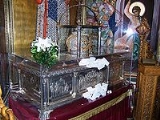
Relic

Encyclopedia
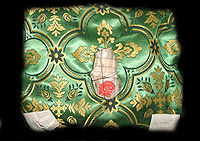
Religion
Religion is a collection of cultural systems, belief systems, and worldviews that establishes symbols that relate humanity to spirituality and, sometimes, to moral values. Many religions have narratives, symbols, traditions and sacred histories that are intended to give meaning to life or to...
object, carefully preserved for purposes of veneration
Veneration
Veneration , or veneration of saints, is a special act of honoring a saint: an angel, or a dead person who has been identified by a church committee as singular in the traditions of the religion. It is practiced by the Eastern Orthodox Church, the Roman Catholic, and Eastern Catholic Churches...
or as a tangible memorial. Relics are an important aspect of some forms of Buddhism
Buddhism
Buddhism is a religion and philosophy encompassing a variety of traditions, beliefs and practices, largely based on teachings attributed to Siddhartha Gautama, commonly known as the Buddha . The Buddha lived and taught in the northeastern Indian subcontinent some time between the 6th and 4th...
, Christianity
Christianity
Christianity is a monotheistic religion based on the life and teachings of Jesus as presented in canonical gospels and other New Testament writings...
, Hinduism
Hinduism
Hinduism is the predominant and indigenous religious tradition of the Indian Subcontinent. Hinduism is known to its followers as , amongst many other expressions...
, Shamanism
Shamanism
Shamanism is an anthropological term referencing a range of beliefs and practices regarding communication with the spiritual world. To quote Eliade: "A first definition of this complex phenomenon, and perhaps the least hazardous, will be: shamanism = technique of ecstasy." Shamanism encompasses the...
, and many other religions.
The word relic comes from the Latin
Latin
Latin is an Italic language originally spoken in Latium and Ancient Rome. It, along with most European languages, is a descendant of the ancient Proto-Indo-European language. Although it is considered a dead language, a number of scholars and members of the Christian clergy speak it fluently, and...
reliquiae, meaning "remains" or "something left behind" (the same root as relinquish). A reliquary
Reliquary
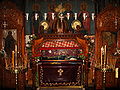
A reliquary is a container for relics. These may be the physical remains of saints, such as bones, pieces of clothing, or some object associated with saints or other religious figures...
is a shrine
Shrine
A shrine is a holy or sacred place, which is dedicated to a specific deity, ancestor, hero, martyr, saint, daemon or similar figure of awe and respect, at which they are venerated or worshipped. Shrines often contain idols, relics, or other such objects associated with the figure being venerated....
that houses one or more religious relics.
Relics in classical antiquity
.jpg)
Ancient Greece
Ancient Greece is a civilization belonging to a period of Greek history that lasted from the Archaic period of the 8th to 6th centuries BC to the end of antiquity. Immediately following this period was the beginning of the Early Middle Ages and the Byzantine era. Included in Ancient Greece is the...
, a city
Polis
Polis , plural poleis , literally means city in Greek. It could also mean citizenship and body of citizens. In modern historiography "polis" is normally used to indicate the ancient Greek city-states, like Classical Athens and its contemporaries, so polis is often translated as "city-state."The...
or sanctuary
Greek temple
Greek temples were structures built to house deity statues within Greek sanctuaries in Greek paganism. The temples themselves did usually not directly serve a cult purpose, since the sacrifices and rituals dedicated to the respective deity took place outside them...
might claim to possess, without necessarily displaying, the remains of a venerated hero
Hero
A hero , in Greek mythology and folklore, was originally a demigod, their cult being one of the most distinctive features of ancient Greek religion...
as a part of hero cult
Greek hero cult
Hero cults were one of the most distinctive features of ancient Greek religion. In Homeric Greek, "hero" refers to a man who was fighting on either side during the Trojan War...
. Other venerable objects associated with the hero were more likely to be on display in sanctuaries, such as spears, shields, or other weaponry; chariots, ships or figureheads; furniture such as chairs or tripods
Sacrificial tripod
A sacrificial tripod was a type of altar used by the ancient Greeks. The most famous was the Delphic tripod, on which the Pythian priestess took her seat to deliver the oracles of the deity. The seat was formed by a circular slab on the top of the tripod, on which a branch of laurel was deposited...
; and clothing. The sanctuary of the Leucippides at Sparta
Sparta
Sparta or Lacedaemon, was a prominent city-state in ancient Greece, situated on the banks of the River Eurotas in Laconia, in south-eastern Peloponnese. It emerged as a political entity around the 10th century BC, when the invading Dorians subjugated the local, non-Dorian population. From c...
claimed to display the egg of Leda
Leda (mythology)
In Greek mythology, Leda was daughter of the Aetolian king Thestius, and wife of the king Tyndareus , of Sparta. Her myth gave rise to the popular motif in Renaissance and later art of Leda and the Swan...
.
In contrast to the relics of Christian saints, the bones were not regarded as holding a particular power derived from the hero, with some exceptions, such as the divine shoulder of Pelops
Pelops
In Greek mythology, Pelops , was king of Pisa in the Peloponnesus. He was the founder of the House of Atreus through his son of that name....
held at Olympia
Olympia, Greece
Olympia , a sanctuary of ancient Greece in Elis, is known for having been the site of the Olympic Games in classical times, comparable in importance to the Pythian Games held in Delphi. Both games were held every Olympiad , the Olympic Games dating back possibly further than 776 BC...
. Miracles and healing were not attributed to them; rather, their presence protected the city, as the tomb of Oedipus
Oedipus
Oedipus was a mythical Greek king of Thebes. He fulfilled a prophecy that said he would kill his father and marry his mother, and thus brought disaster on his city and family...
was said to protect Athens
Athens
Athens , is the capital and largest city of Greece. Athens dominates the Attica region and is one of the world's oldest cities, as its recorded history spans around 3,400 years. Classical Athens was a powerful city-state...
.
The bones of Orestes
Orestes
Orestes was the son of Agamemnon in Greek mythology; Orestes may also refer to:Drama*Orestes , by Euripides*Orestes, the character in Sophocles' tragedy Electra*Orestes, the character in Aeschylus' trilogy of tragedies, Oresteia...
and Theseus
Theseus
For other uses, see Theseus Theseus was the mythical founder-king of Athens, son of Aethra, and fathered by Aegeus and Poseidon, both of whom Aethra had slept with in one night. Theseus was a founder-hero, like Perseus, Cadmus, or Heracles, all of whom battled and overcame foes that were...
were supposed to have been stolen or removed from their original resting place and reburied. On the advice of the Delphic Oracle, the Sparta
Sparta
Sparta or Lacedaemon, was a prominent city-state in ancient Greece, situated on the banks of the River Eurotas in Laconia, in south-eastern Peloponnese. It emerged as a political entity around the 10th century BC, when the invading Dorians subjugated the local, non-Dorian population. From c...
ns searched for the bones of Orestes and brought them home, without which they had been told they could not expect victory in their war against the neighboring Tegea
Tegea
Tegea was a settlement in ancient Greece, and it is also a former municipality in Arcadia, Peloponnese, Greece. Since the 2011 local government reform it is part of the municipality Tripoli, of which it is a municipal unit. Its seat was the village Stadio....
ns. Plutarch
Plutarch
Plutarch then named, on his becoming a Roman citizen, Lucius Mestrius Plutarchus , c. 46 – 120 AD, was a Greek historian, biographer, essayist, and Middle Platonist known primarily for his Parallel Lives and Moralia...
says that the Athenians were likewise instructed by the oracle to locate and steal the relics of Theseus from the Dolopia
Dolopia
-Geography:Dolopia was located between Epirus and Thessaly. Some of their cities were, Angeia, Ctimene and Dolopeis, close to lake Xynius.-Mythology & History:...
ns:
Cimon … saw an eagle in a place where there was the semblance of a mound, pecking, as he says, and tearing up the ground with his talons. By some divine ordering he comprehended the meaning of this and dug there, and there was found a coffin of a man of extraordinary size, a bronze spear lying by its side, and a sword. When these relics were brought home on his triremeTriremeA trireme was a type of galley, a Hellenistic-era warship that was used by the ancient maritime civilizations of the Mediterranean, especially the Phoenicians, ancient Greeks and Romans.The trireme derives its name from its three rows of oars on each side, manned with one man per oar...
by Cimon, the Athenians were delighted, and received them with splendid processions and sacrifices, as though Theseus himself were returning to the city. And now he lies buried in the heart of the city, near the present gymnasiumGymnasium (ancient Greece)The gymnasium in ancient Greece functioned as a training facility for competitors in public games. It was also a place for socializing and engaging in intellectual pursuits. The name comes from the Ancient Greek term gymnós meaning "naked". Athletes competed in the nude, a practice said to...
, and his tomb is a sanctuary and place of refuge for runaway slaves and all men of low estate who are afraid of men in power.
The body of the legendary Eurystheus
Eurystheus
In Greek mythology, Eurystheus was king of Tiryns, one of three Mycenaean strongholds in the Argolid, although other authors including Homer and Euripides cast him as ruler of Argos: Sthenelus was his father and the "victorious horsewoman" Nicippe his mother, and he was a grandson of the hero...
was also supposed to protect Athens from enemy attack, and in Thebes
Ancient Thebes (Boeotia)
See Thebes, Greece for the modern city built on the ancient ruins.Ancient Thebes was a Boeotian city-state , situated to the north of the Cithaeron range, which divides Boeotia from Attica, and on the southern edge of the Boeotian plain...
, that of the prophet Amphiaraus
Amphiaraus
In Greek mythology, Amphiaraus was the son of Oecles and Hypermnestra, and husband of Eriphyle. Amphiaraus was the King of Argos along with Adrastus— the brother of Amphiaraus' wife, Eriphyle— and Iphis. Amphiaraus was a seer, and greatly honored in his time...
, whose cult was oracular and healing. Plutarch narrates transferrals similar to that of Theseus for the bodies of the historical Demetrius I of Macedon
Demetrius I of Macedon
Demetrius I , called Poliorcetes , son of Antigonus I Monophthalmus and Stratonice, was a king of Macedon...
and Phocion the Good
Phocion
Phocion was an Athenian statesman and strategos, and the subject of one of Plutarch's Parallel Lives....
which in many details anticipate Christian practice. The bones or ashes of Aesculapius at Epidaurus
Epidaurus
Epidaurus was a small city in ancient Greece, at the Saronic Gulf. Two modern towns bear the name Epidavros : Palaia Epidavros and Nea Epidavros. Since 2010 they belong to the new municipality of Epidavros, part of the peripheral unit of Argolis...
, and of Perdiccas I at Macedon, were treated with the deepest veneration.
As with the relics of Theseus, the bones are sometimes described in literary sources as gigantic, an indication of the hero's "larger than life" status. On the basis of their reported size, it has been conjectured that such bones were those of prehistoric creatures
Paleontology
Paleontology "old, ancient", ὄν, ὀντ- "being, creature", and λόγος "speech, thought") is the study of prehistoric life. It includes the study of fossils to determine organisms' evolution and interactions with each other and their environments...
, the startling discovery of which may have prompted the sanctifying of the site.
The head of the poet-prophet Orpheus
Orpheus
Orpheus was a legendary musician, poet, and prophet in ancient Greek religion and myth. The major stories about him are centered on his ability to charm all living things and even stones with his music; his attempt to retrieve his wife from the underworld; and his death at the hands of those who...
was supposed to have been transported to Lesbos, where it was enshrined and visited as an oracle
Oracle
In Classical Antiquity, an oracle was a person or agency considered to be a source of wise counsel or prophetic predictions or precognition of the future, inspired by the gods. As such it is a form of divination....
. The 2nd-century geographer Pausanias reported that the bones of Orpheus were kept in a stone vase displayed on a pillar near Dion, his place of death and a major religious center. These too were regarded as having oracular power, which might be accessed through dreaming in a ritual of incubation
Incubation (ritual)
Incubation is the religious practice of sleeping in a sacred area with the intention of experiencing a divinely inspired dream or cure. Incubation was practised by many ancient cultures...
. The accidental exposure of the bones brought a disaster upon the town of Libretha, whence the people of Dion had transferred the relics to their own keeping.
According to the Chronicon Paschale
Chronicon Paschale
Chronicon Paschale is the conventional name of a 7th-century Greek Christian chronicle of the world...
, the bones of the Persian Zoroaster
Zoroaster
Zoroaster , also known as Zarathustra , was a prophet and the founder of Zoroastrianism who was either born in North Western or Eastern Iran. He is credited with the authorship of the Yasna Haptanghaiti as well as the Gathas, hymns which are at the liturgical core of Zoroastrianism...
were venerated, but the tradition of Zoroastrianism
Zoroastrianism
Zoroastrianism is a religion and philosophy based on the teachings of prophet Zoroaster and was formerly among the world's largest religions. It was probably founded some time before the 6th century BCE in Greater Iran.In Zoroastrianism, the Creator Ahura Mazda is all good, and no evil...
and its scriptures offer no support of this.
Buddhism
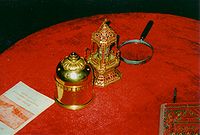
In Buddhism
Buddhism
Buddhism is a religion and philosophy encompassing a variety of traditions, beliefs and practices, largely based on teachings attributed to Siddhartha Gautama, commonly known as the Buddha . The Buddha lived and taught in the northeastern Indian subcontinent some time between the 6th and 4th...
, relics of the Buddha
Gautama Buddha
Siddhārtha Gautama was a spiritual teacher from the Indian subcontinent, on whose teachings Buddhism was founded. In most Buddhist traditions, he is regarded as the Supreme Buddha Siddhārtha Gautama (Sanskrit: सिद्धार्थ गौतम; Pali: Siddhattha Gotama) was a spiritual teacher from the Indian...
and various sages are venerated. After the Buddha's death, his remains were divided into eight portions. Afterward, these relics were enshrined in stupa
Stupa
A stupa is a mound-like structure containing Buddhist relics, typically the remains of Buddha, used by Buddhists as a place of worship....
s wherever Buddhism was spread, despite his instructions that relics were not to be collected or venerated.
Some relics believed to be original remains of the body of the Buddha still survive, including the much-revered Sacred Relic of the tooth of the Buddha
Relic of the tooth of the Buddha
The Sacred Relic of the tooth of Buddha is venerated in Sri Lanka as a relic of the founder of Buddhism.-The relic in India:...
in Sri Lanka.
A stupa is a building created specifically for the relics. Many Buddhist temples have stupas and historically, the placement of relics in a stupa often became the initial structure around which the whole temple would be based. Today, many stupas also hold the ashes or ringsel of prominent/respected Buddhists who were cremated
Cremation
Cremation is the process of reducing bodies to basic chemical compounds such as gasses and bone fragments. This is accomplished through high-temperature burning, vaporization and oxidation....
. In rare cases the whole body is conserved, for example in the case of Dudjom Rinpoche
Dudjom Rinpoche
Dudjom Rinpoche is the title of a prominent line of tulkus of the Nyingmapa order of Tibetan Buddhism. Dudjom Rinpoche was born in 1904 on the tenth day of the sixth month in the year of the wood dragon in Southern Tibet in a region called the "hidden land" of Pema Ko. He died on January 17, 1987...
, after his death his physical body was moved a year later from France and placed in a stupa in one of his main monasteries near Boudhanath, Nepal in 1988. Pilgrims may view his body through a glass window in the stupa.
The Buddha's relics are considered to show people that enlightenment is possible, to remind them that the Buddha was a real person, and to also promote good virtue.
Christianity
History
One of the earliest sources that purports to show the efficacy of relics is found in :
20 Elisha died and was buried. Now Moabite raiders used to enter the country every spring. 21 Once while some Israelites were burying a man, suddenly they saw a band of raiders; so they threw the man's body into Elisha's tomb. When the body touched Elisha's bones, the man came to life and stood up on his feet. (NIVNew International VersionThe New International Version is an English translation of the Christian Bible. Published by Zondervan in the United States and by Hodder & Stoughton in the UK, it has become one of the most popular modern translations in history.-History:...
)
These verses are cited to claim that the Holy Spirit's indwelling also affects the physical body, that God can do miracles through the bodies of His servants, or both. Also cited is the veneration of Polycarp's relics recorded in the Martyrdom of Polycarp
Martyrdom of Polycarp
The Martyrdom of Polycarp is one of the works of the Apostolic Fathers, and as such is one of the very few eyewitness writings from the actual age of the persecutions. The work details Polycarp's death at the age of 86 years old, at the hands of the Romans, in the 2nd century AD...
(written 150–160 AD). With regard to relics that are objects, an often cited passage is Acts
Acts of the Apostles
The Acts of the Apostles , usually referred to simply as Acts, is the fifth book of the New Testament; Acts outlines the history of the Apostolic Age...
19:11–12, which says that Paul's handkerchiefs were imbued by God with healing power.
In the early church the disturbance, let alone the division, of the remains of martyrs and other saints, was not practised. They were allowed to remain in their often unidentified resting places in cemeteries and the catacombs of Rome
Catacombs of Rome
The Catacombs of Rome are ancient catacombs, underground burial places under or near Rome, Italy, of which there are at least forty, some discovered only in recent decades. Though most famous for Christian burials, either in separate catacombs or mixed together, they began in the 2nd century, much...
, always outside the walls of the city, but martyrium
Martyrium (architecture)
A martyrium is a structure built at "a site which bears witness to the Christian faith, either by referring to an event in Christ's life or Passion, or by sheltering the grave of a martyr"....
s began to be built over the site of the burial, and it was considered beneficial to the soul to be buried close to the remains of saints, several large "funerary halls" being built over the sites of martyr's graves, including Old Saint Peter's Basilica
Old Saint Peter's Basilica
Old Saint Peter's Basilica was the building that stood, from the 4th to 16th centuries, on the spot where the Basilica of Saint Peter stands today in Rome. Construction of the Basilica, built over the historical site of the Circus of Nero, began during the reign of emperor Constantine I...
; these were initially not regular churches, but "covered cemeteries" crammed with graves, and celebrating funerary and memorial services. The earliest recorded removal of saintly remains was that of Saint Babylas
Saint Babylas
Saint Babylas was a patriarch of Antioch , who died in prison during the Decian persecution. He asked to be buried in his chains. In the Eastern Orthodox Church and Eastern Catholic Churches of the Byzantine rite his feast day is September 4, in the Roman Catholic, January 24...
at Antioch
Antioch
Antioch on the Orontes was an ancient city on the eastern side of the Orontes River. It is near the modern city of Antakya, Turkey.Founded near the end of the 4th century BC by Seleucus I Nicator, one of Alexander the Great's generals, Antioch eventually rivaled Alexandria as the chief city of the...
in 354, but, partly perhaps because Constantinople lacked the many saintly graves of Rome, they soon became common in the Eastern Empire, though still prohibited in the West. The Eastern capital was therefore able to acquire the remains of Saints Timothy, Andrew
Saint Andrew
Saint Andrew , called in the Orthodox tradition Prōtoklētos, or the First-called, is a Christian Apostle and the brother of Saint Peter. The name "Andrew" , like other Greek names, appears to have been common among the Jews from the 3rd or 2nd century BC. No Hebrew or Aramaic name is recorded for him...
and Luke, and the division of bodies also began, the 5th century theologian Theodoretus declaring that "Grace remains entire with every part". In the West a decree of Theodosius
Theodosius I
Theodosius I , also known as Theodosius the Great, was Roman Emperor from 379 to 395. Theodosius was the last emperor to rule over both the eastern and the western halves of the Roman Empire. During his reign, the Goths secured control of Illyricum after the Gothic War, establishing their homeland...
only allowed the moving of a whole sarcophagus
Sarcophagus
A sarcophagus is a funeral receptacle for a corpse, most commonly carved or cut from stone. The word "sarcophagus" comes from the Greek σαρξ sarx meaning "flesh", and φαγειν phagein meaning "to eat", hence sarkophagus means "flesh-eating"; from the phrase lithos sarkophagos...
with its contents, but the upheavals of the barbarian invasions relaxed the rules, as remains needed to be relocated to safer places.
The Second Council of Nicaea
Second Council of Nicaea
The Second Council of Nicaea is regarded as the Seventh Ecumenical Council by Roman Catholics, Eastern Orthodox, Eastern Catholic Churches and various other Western Christian groups...
in 787 decreed that every altar should contain a relic, making it clear that this was already the norm, as it remains to the present day in the Catholic and Orthodox churches.
Many tales of miracle
Miracle
A miracle often denotes an event attributed to divine intervention. Alternatively, it may be an event attributed to a miracle worker, saint, or religious leader. A miracle is sometimes thought of as a perceptible interruption of the laws of nature. Others suggest that a god may work with the laws...
s and other marvels were attributed to relics beginning in the early centuries of the church; many of these became especially popular during the Middle Ages. These tales are collected in books of hagiography
Hagiography
Hagiography is the study of saints.From the Greek and , it refers literally to writings on the subject of such holy people, and specifically to the biographies of saints and ecclesiastical leaders. The term hagiology, the study of hagiography, is also current in English, though less common...
such as the Golden Legend
Golden Legend
The Golden Legend is a collection of hagiographies by Jacobus de Voragine that became a late medieval bestseller. More than a thousand manuscripts of the text have survived, compared to twenty or so of its nearest rivals...
or the works of Caesar of Heisterbach
Caesar of Heisterbach
Caesarius of Heisterbach , sometimes erroneously called in English Caesar of Heisterbach , was the prior of the former Cistercian Heisterbach Abbey, in the Siebengebirge near the little town of Oberdollendorf, Germany.He is best known as...
. These miracle tales made relics much sought after during the Middle Ages. By the late Middle Ages the collecting of, and dealing in, relics had reached enormous proportions, and had spread from the church to royalty, and then to the nobility and merchant classes. In the absence of real ways of assessing authenticity, relic-collectors became prey to the unscrupulous, and some extremely high prices were paid.
There are also many relics attributed to Jesus
Relics attributed to Jesus
A number of relics associated with Jesus have been claimed and displayed throughout the history of Christianity. Some people believe in the authenticity of some relics; others doubt the authenticity of various items...
, perhaps most famously the Shroud of Turin
Shroud of Turin
The Shroud of Turin or Turin Shroud is a linen cloth bearing the image of a man who appears to have suffered physical trauma in a manner consistent with crucifixion. It is kept in the royal chapel of the Cathedral of Saint John the Baptist in Turin, northern Italy. The image on the shroud is...
, said to be the burial shroud
Shroud
Shroud usually refers to an item, such as a cloth, that covers or protects some other object. The term is most often used in reference to burial sheets, winding-cloths or winding-sheets, such as the famous Shroud of Turin or Tachrichim that Jews are dressed in for burial...
of Jesus Christ. Pieces of the True Cross
True Cross
The True Cross is the name for physical remnants which, by a Christian tradition, are believed to be from the cross upon which Jesus was crucified.According to post-Nicene historians, Socrates Scholasticus and others, the Empress Helena The True Cross is the name for physical remnants which, by a...
were one of the most highly sought after such relics; many churches claimed to possess a piece of it, so many that John Calvin
John Calvin
John Calvin was an influential French theologian and pastor during the Protestant Reformation. He was a principal figure in the development of the system of Christian theology later called Calvinism. Originally trained as a humanist lawyer, he broke from the Roman Catholic Church around 1530...
famously remarked that there were enough pieces of the True Cross to build a ship from, although a study in 1870 found that put together the claimed relics weighed less than 1.7 kg.
When Thomas Becket
Thomas Becket
Thomas Becket was Archbishop of Canterbury from 1162 until his murder in 1170. He is venerated as a saint and martyr by both the Roman Catholic Church and the Anglican Communion...
was martyred in Canterbury
Canterbury
Canterbury is a historic English cathedral city, which lies at the heart of the City of Canterbury, a district of Kent in South East England. It lies on the River Stour....
, his successor and the Canterbury chapter very quickly and successfully used (one might say "marketed") his relics to promote the cult of the as yet un-canonized martyr. His body was retained at Canterbury, but relics including pieces of his clothes, or cloth soaked with his mopped-up and diluted blood, were distributed widely across Europe to churches and rulers. The motivations included the assertion of the Church's independence against rulers, a desire to have an English (indeed Norman English
Anglo-Norman
The Anglo-Normans were mainly the descendants of the Normans who ruled England following the Norman conquest by William the Conqueror in 1066. A small number of Normans were already settled in England prior to the conquest...
) saint of European reputation, and the desire to promote Canterbury as a destination for pilgrimage; the campaign was successful on all counts.
Virtus and daemones

Gregory of Tours
Saint Gregory of Tours was a Gallo-Roman historian and Bishop of Tours, which made him a leading prelate of Gaul. He was born Georgius Florentius, later adding the name Gregorius in honour of his maternal great-grandfather...
, Ernest Brehaut analyzed the Romano-Christian concepts that gave relics such a powerful draw. He distinguished Gregory's constant usage of sanctus and virtus
Virtus (virtue)
Virtus was a specific virtue in Ancient Rome. It carries connotations of valor, manliness, excellence, courage, character, and worth, perceived as masculine strengths...
, the first with its familiar meaning of "sacred" or "holy", and the second
… the mystic potency emanating from the person or thing that is sacred. These words have in themselves no ethical meaning and no humane implications whatever. They are the keywords of a religious technique and their content is wholly supernatural. In a practical way the second word [virtus] is the more important. It describes the uncanny, mysterious power emanating from the supernatural and affecting the natural. The manifestation of this power may be thought of as a contact between the natural and the supernatural in which the former, being an inferior reality, of course yielded. These points of contact and yielding are the miracles we continually hear of. The quality of sacredness and the mystic potency belong to spirits, in varying degrees to the faithful, and to inanimate objects. They are possessed by spirits, acquired by the faithful, and transmitted to objects.
Opposed to this holy "virtue" was also a "false" mystic potency that emanated from inhabiting daemons
Daemon (mythology)
The words dæmon and daimôn are Latinized spellings of the Greek "δαίμων", a reference to the daemons of Ancient Greek religion and mythology, as well as later Hellenistic religion and philosophy...
who were conceived of as alien and hostile. Truly holy virtus would defeat it, but it could affect natural phenomena and effect its own kinds of miracles, deceitful and malignant ones. This "virtue" Gregory of Tours and other Christian writers associated with the devil, demons, soothsayers, magicians, pagans and pagan gods, and heretics. False virtus inhabited images of the pagan gods, represented today by sculpture preserved by archaeology and in museums. The zeal to destroy the false virtus embodied by these works of art accounts for some of the rage with which mobs of Christians toppled sculptures, and smashed classical relief
Relief
Relief is a sculptural technique. The term relief is from the Latin verb levo, to raise. To create a sculpture in relief is thus to give the impression that the sculpted material has been raised above the background plane...
s (particularly the faces), as evidenced by the damage to many works of art on display in museums.
The transmissibility of this potency, this virtus, is still reflected in the Roman Catholic classifications of relics in degrees (see Roman Catholic classification and prohibitions below). By transmission, the virtus might be transmitted to the city (see Relics in classical antiquity above). When Saint Martin
Martin of Tours
Martin of Tours was a Bishop of Tours whose shrine became a famous stopping-point for pilgrims on the road to Santiago de Compostela. Around his name much legendary material accrued, and he has become one of the most familiar and recognizable Christian saints...
died November 8, 397, at a village halfway between Tours
Tours
Tours is a city in central France, the capital of the Indre-et-Loire department.It is located on the lower reaches of the river Loire, between Orléans and the Atlantic coast. Touraine, the region around Tours, is known for its wines, the alleged perfection of its local spoken French, and for the...
and Poitiers
Poitiers
Poitiers is a city on the Clain river in west central France. It is a commune and the capital of the Vienne department and of the Poitou-Charentes region. The centre is picturesque and its streets are interesting for predominant remains of historical architecture, especially from the Romanesque...
, the inhabitants of these cities were well ready to fight for his body, which the people of Tours managed to secure by stealth. The story of the purloining of St. Nicholas of Myra
Saint Nicholas
Saint Nicholas , also called Nikolaos of Myra, was a historic 4th-century saint and Greek Bishop of Myra . Because of the many miracles attributed to his intercession, he is also known as Nikolaos the Wonderworker...
is another example. The Image of Edessa
Image of Edessa
According to Christian legend, the Image of Edessa was a holy relic consisting of a square or rectangle of cloth upon which a miraculous image of the face of Jesus was imprinted — the first icon ....
was reputed to render that city impregnable.
Relics and pilgrimage
Since the beginning of ChristianityChristianity
Christianity is a monotheistic religion based on the life and teachings of Jesus as presented in canonical gospels and other New Testament writings...
, individuals have seen relics as a way to come closer to the saints and thus form a closer bond with God. Since Christians during the Middle Ages
Middle Ages
The Middle Ages is a periodization of European history from the 5th century to the 15th century. The Middle Ages follows the fall of the Western Roman Empire in 476 and precedes the Early Modern Era. It is the middle period of a three-period division of Western history: Classic, Medieval and Modern...
often took pilgrimage
Pilgrimage
A pilgrimage is a journey or search of great moral or spiritual significance. Typically, it is a journey to a shrine or other location of importance to a person's beliefs and faith...
s to shrine
Shrine
A shrine is a holy or sacred place, which is dedicated to a specific deity, ancestor, hero, martyr, saint, daemon or similar figure of awe and respect, at which they are venerated or worshipped. Shrines often contain idols, relics, or other such objects associated with the figure being venerated....
s of holy people
Saint
A saint is a holy person. In various religions, saints are people who are believed to have exceptional holiness.In Christian usage, "saint" refers to any believer who is "in Christ", and in whom Christ dwells, whether in heaven or in earth...
, relics became a large business. The pilgrims saw the purchasing of a relic as a means, in a small way, to bring the shrine back with him or her on returning home, since during the Middle Ages the concept of physical proximity to the "holy" (tombs of saints or their personal objects) was considered extremely important. Instead of having to travel hundreds of miles to become near to a venerated saint
Saint
A saint is a holy person. In various religions, saints are people who are believed to have exceptional holiness.In Christian usage, "saint" refers to any believer who is "in Christ", and in whom Christ dwells, whether in heaven or in earth...
, one could venerate the relics of the saint within one's own home.
Roman Catholic classification and prohibitions
Saint JeromeSaint Jerome
Saint Jerome is a Christian church father, best known for translating the Bible into Latin.Saint Jerome may also refer to:*Jerome of Pavia , Bishop of Pavia...
declared, "We do not worship, we do not adore, for fear that we should bow down to the creature rather than to the creator, but we venerate the relics of the martyrs in order the better to adore him whose martyrs they are."
- First-Class Relics: Items directly associated with the events of Christ's life (manger, cross, etc.), or the physical remains of a saint (a bone, a hair, skull, a limb, etc.). Traditionally, a martyr's relics are often more prized than the relics of other saints. Also, some saints' relics are known for their extraordinary incorruptibility and so would have high regard. Parts of the saint that were significant to that saint's life are more prized relics. For instance, King St. Stephen of Hungary's right forearm is especially important because of his status as a ruler. A famous theologian's head may be his most important relic. (The head of St. Thomas Aquinas was removed by the monks at the Cistercian abbey at Fossanova where he died). If a saint did a lot of travelling then the bones of his feet may be prized. Current Catholic teaching prohibits relics to be divided up into small, unrecognizable parts if they are to be used in liturgy (i.e., as in an altar; see the rubrics listed in Rite Of Dedication of a Church and an Altar).
- Second-Class Relics: An item that the saint wore (a shirt, a glove, etc.) Also included is an item that the saint owned or frequently used, for example, a crucifixCrucifixA crucifix is an independent image of Jesus on the cross with a representation of Jesus' body, referred to in English as the corpus , as distinct from a cross with no body....
, rosaryRosaryThe rosary or "garland of roses" is a traditional Catholic devotion. The term denotes the prayer beads used to count the series of prayers that make up the rosary...
, book etc. Again, an item more important in the saint's life is thus a more important relic. Sometimes a second class relic is a part of an item that the saint wore, known as Ex indumentisEx indumentisThe phrase Ex indumentis is Latin for "from the clothing", most commonly used when referring to 2nd Class holy relics of saints or blessed individuals....
("from the clothing").
- Third-Class Relics: Any object that is touched to a first- or second-class relic. Most third-class relics are small pieces of cloth, though in the first millenium oil was popular; the Monza ampullaeMonza ampullaeThe Monza ampullae form the largest collection of a specific type of Early Medieval pilgrimage ampullae or small flasks designed to hold holy oil from pilgrimage sites in the Holy Land related to the life of Jesus, that were made in Palestine, probably in the fifth to early seventh centuries...
contained oil collected from lamps burning before the major sites of Christ's life, and some reliquaries had holes for oil to be poured in and out again.
The sale of relics is strictly forbidden by the Church. The
Code of Canon Law
Canon law
Canon law is the body of laws & regulations made or adopted by ecclesiastical authority, for the government of the Christian organization and its members. It is the internal ecclesiastical law governing the Catholic Church , the Eastern and Oriental Orthodox churches, and the Anglican Communion of...
states:
- §1190 §1 – "It is absolutely forbidden to sell sacred relics."
- §1190 §2 – "Relics of great significance and other relics honored with great reverence by the people cannot be alienated validly in any manner or transferred permanently without the permission of the Apostolic See."
Eastern Orthodoxy
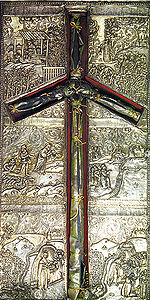
Veneration
Veneration , or veneration of saints, is a special act of honoring a saint: an angel, or a dead person who has been identified by a church committee as singular in the traditions of the religion. It is practiced by the Eastern Orthodox Church, the Roman Catholic, and Eastern Catholic Churches...
of relics continues to be of importance in the Eastern Orthodox Church
Eastern Orthodox Church
The Orthodox Church, officially called the Orthodox Catholic Church and commonly referred to as the Eastern Orthodox Church, is the second largest Christian denomination in the world, with an estimated 300 million adherents mainly in the countries of Belarus, Bulgaria, Cyprus, Georgia, Greece,...
. As a natural outgrowth of the concept in Orthodox theology of theosis
Theosis
In Christian theology, divinization, deification, making divine or theosis is the transforming effect of divine grace. This concept of salvation is historical and fundamental for Christian understanding that is prominent in the Eastern Orthodox Church and also in the Catholic Church, and is a...
, the physical bodies of the saint
Saint
A saint is a holy person. In various religions, saints are people who are believed to have exceptional holiness.In Christian usage, "saint" refers to any believer who is "in Christ", and in whom Christ dwells, whether in heaven or in earth...
s are considered to be transformed by divine grace
Divine grace
In Christian theology, grace is God’s gift of God’s self to humankind. It is understood by Christians to be a spontaneous gift from God to man - "generous, free and totally unexpected and undeserved" - that takes the form of divine favour, love and clemency. It is an attribute of God that is most...
— indeed, all Orthodox Christians are considered to be sanctified
Sanctification
Sanctity is an ancient concept widespread among religions, a property of a thing or person sacred or set apart within the religion, from totem poles through temple vessels to days of the week, to a human believer who achieves this state. Sanctification is the act or process of acquiring sanctity,...
by living the mysical life of the Church, and especially by receiving the Sacred Mysteries
Sacred Mysteries
The term sacred mysteries generally denotes the area of supernatural phenomena associated with a divinity or a religious ideology.-Pre-Christian religious mysteries:...
(Sacraments). In the Orthodox service books
Euchologion
The Euchologion is one of the chief liturgical books of the Orthodox Church and Eastern Catholic Churches, containing the portions of the services which are said by the bishop, priest, or deacon...
, the remains of the departed faithful are referred to as "relics", and are treated with honour and respect. For this reason, the bodies of Orthodox Christians are not traditionally embalmed
Embalming
Embalming, in most modern cultures, is the art and science of temporarily preserving human remains to forestall decomposition and to make them suitable for public display at a funeral. The three goals of embalming are thus sanitization, presentation and preservation of a corpse to achieve this...
.
The veneration of the relics of the saints is of great importance in Orthodoxy, and very often churches will display the relics of saints prominently. In a number of monasteries
Monastery
Monastery denotes the building, or complex of buildings, that houses a room reserved for prayer as well as the domestic quarters and workplace of monastics, whether monks or nuns, and whether living in community or alone .Monasteries may vary greatly in size – a small dwelling accommodating only...
, particularly those on the Holy Mountain
Mount Athos
Mount Athos is a mountain and peninsula in Macedonia, Greece. A World Heritage Site, it is home to 20 Eastern Orthodox monasteries and forms a self-governed monastic state within the sovereignty of the Hellenic Republic. Spiritually, Mount Athos comes under the direct jurisdiction of the...
(Mount Athos in Greece), all of the relics the monastery possesses are displayed and venerated each evening at Compline
Compline
Compline is the final church service of the day in the Christian tradition of canonical hours. The English word Compline is derived from the Latin completorium, as Compline is the completion of the working day. The word was first used in this sense about the beginning of the 6th century by St...
. As with the veneration of icons, the veneration
Veneration
Veneration , or veneration of saints, is a special act of honoring a saint: an angel, or a dead person who has been identified by a church committee as singular in the traditions of the religion. It is practiced by the Eastern Orthodox Church, the Roman Catholic, and Eastern Catholic Churches...
(Greek
Greek language
Greek is an independent branch of the Indo-European family of languages. Native to the southern Balkans, it has the longest documented history of any Indo-European language, spanning 34 centuries of written records. Its writing system has been the Greek alphabet for the majority of its history;...
; δουλια, dulia) of relics in the Orthodox Church is clearly distinguished from adoration
Adoration
Adoration is love given with deep affection. The term comes from the Latin adōrātiō, meaning "to give homage or worship to someone or something."-Ancient Middle East:...
(λατρεια, latria
Latria
Latrīa is a Latin term used in Eastern Orthodox and Roman Catholic theology to mean adoration, a reverence directed only to the Holy Trinity. Latria carries an emphasis on the internal form of worship, rather than external ceremonies.-Catholic teachings:In Catholic teachings, latria also applies...
); i.e., that worship which is due to God alone. Thus Orthodox teaching warns the faithful against idolatry
Idolatry
Idolatry is a pejorative term for the worship of an idol, a physical object such as a cult image, as a god, or practices believed to verge on worship, such as giving undue honour and regard to created forms other than God. In all the Abrahamic religions idolatry is strongly forbidden, although...
and at the same time remains true to scriptural teaching (vis. 2 Kings 13:20–21) as understood by Orthodox Sacred Tradition
Sacred Tradition
Sacred Tradition or Holy Tradition is a theological term used in some Christian traditions, primarily in the Roman Catholic, Anglican, Eastern Orthodox and Oriental Orthodox traditions, to refer to the fundamental basis of church authority....
.
The examination of the relics is an important step in the glorification
Glorification
-Catholicism:For the process by which the Roman Catholic Church or Anglican Communion grants official recognition to someone as a saint, see canonization.-Eastern Orthodox Church:...
(canonization) of new saints. Sometimes, one of the signs of sanctification is the condition of the relics of the saint. Some saints will be incorrupt
Incorruptibility
Incorruptibility is a Roman Catholic and Eastern Orthodox belief that supernatural intervention allows some human bodies to avoid the normal process of decomposition after death as a sign of their holiness...
, meaning that their remains do not decay under conditions when they normally would (natural mummification
Mummy
A mummy is a body, human or animal, whose skin and organs have been preserved by either intentional or incidental exposure to chemicals, extreme coldness , very low humidity, or lack of air when bodies are submerged in bogs, so that the recovered body will not decay further if kept in cool and dry...
is not the same as incorruption). Sometimes even when the flesh does decay the bones themselves will manifest signs of sanctity. They may be honey colored or give off a sweet aroma
Odour of Sanctity
The odour of sanctity or odor of sanctity, according to the Catholic Church, is commonly understood to mean a specific scent that emanates from the bodies of saints, especially from the wounds of stigmata.-Meanings:...
. Some relics will exude myrrh. The absence of such manifestations is not necessarily a sign that the person is not a Saint.
Relics play a major role in the consecration of a church. The consecrating bishop will place the relics on a diskos (paten) in a church near the church that is to be consecrated, they will then be taken in a cross procession
Crucession
A Crucession, or Cross Procession , is a procession that takes place in the Eastern Orthodox and Eastern Catholic liturgical traditions. The name derives from the fact that the procession is headed by a cross....
to the new church, carried three times around the new structure and then placed in the Holy Table (altar) as part of the consecration service.
The relics of saints (traditionally, always those of a martyr) are also sewn into the antimension
Antimension
The Antimins, , is one of the most important furnishings of the altar in many Eastern Christian liturgical traditions. It is a rectangular piece of cloth, either linen or silk, typically decorated with representations of the Descent of Christ from the Cross, the four Evangelists, and inscriptions...
which is given to a priest by his bishop as a means of bestowing faculties upon him (i.e., granting him permission to celebrate the Sacred Mysteries). The antimens is kept on the High Place
High place
High Place, in the English version of the Old Testament, the literal translation of the Hebrew במה .This rendering is etymologically correct, as appears from the poetical use of the plural in such expressions as to ride, or stalk, or stand on the high places of the earth, the sea, the clouds, and...
of the Holy Table (altar), and it is forbidden to celebrate the Divine Liturgy
Divine Liturgy
Divine Liturgy is the common term for the Eucharistic service of the Byzantine tradition of Christian liturgy. As such, it is used in the Eastern Orthodox and Eastern Catholic Churches. Armenian Christians, both of the Armenian Apostolic Church and of the Armenian Catholic Church, use the same term...
(Eucharist) without it.
While Orthodoxy does not make use of the strict classification system of the Roman Catholic Church, it too recognizes and venerates relics which may pertain to Jesus Christ or a saint, such as a relic of the True Cross
True Cross
The True Cross is the name for physical remnants which, by a Christian tradition, are believed to be from the cross upon which Jesus was crucified.According to post-Nicene historians, Socrates Scholasticus and others, the Empress Helena The True Cross is the name for physical remnants which, by a...
, the Chains of Saint Peter
Saint Peter
Saint Peter or Simon Peter was an early Christian leader, who is featured prominently in the New Testament Gospels and the Acts of the Apostles. The son of John or of Jonah and from the village of Bethsaida in the province of Galilee, his brother Andrew was also an apostle...
(feast day, 16 January), the grapevine cross of Saint Nino
Saint Nino
Saint Nino , ), Equal to the Apostles in and the Enlightener of Georgia, was a woman who preached Christianity in Georgia....
of Georgia, etc. Places can also be considered holy. When one makes a pilgrimage
Pilgrimage
A pilgrimage is a journey or search of great moral or spiritual significance. Typically, it is a journey to a shrine or other location of importance to a person's beliefs and faith...
to a shrine he may bring back something from the place, such as soil from the Holy Land
Holy Land
The Holy Land is a term which in Judaism refers to the Kingdom of Israel as defined in the Tanakh. For Jews, the Land's identifiction of being Holy is defined in Judaism by its differentiation from other lands by virtue of the practice of Judaism often possible only in the Land of Israel...
or from the grave
Grave (burial)
A grave is a location where a dead body is buried. Graves are usually located in special areas set aside for the purpose of burial, such as graveyards or cemeteries....
of a saint.
List of relics
- St Peter's Basilica in the Vatican contains Saint Peter'sSaint Peter's tombSaint Peter's tomb is a site under St. Peter's Basilica that includes several graves and a structure said by Vatican authorities to have been built to memorialize the location of St. Peter's grave. St. Peter's tomb is near the west end of a complex of mausoleums that date between about AD 130 and...
relics - The Apostle Paul's relics are allegedly contained in the Basilica of Saint Paul
- St John the Evangelist's tomb is purported to be in the Basilica of St. JohnBasilica of St. JohnThe Basilica of St. John was a basilica in Ephesus. It was constructed by Justinian I in the 6th century. It stands over the believed burial site of John the Apostle...
at Ephesus in Turkey - St Mark's relics are held at St Mark's basilica in Venice
- St James' relics are reputedly held at the Cathedral of Santiago de CompostelaCathedral of Santiago de CompostelaSantiago de Compostela Cathedral is a Roman Catholic cathedral of the archdiocese of Santiago de Compostela in Galicia, Spain. The cathedral is the reputed burial-place of Saint James the Greater, one of the apostles of Jesus Christ. It is the destination of the Way of St...
in North West Spain - St Andrew's relics are contained in the Basilica of St Andrew in Patras, Greece
- John the BaptistJohn the BaptistJohn the Baptist was an itinerant preacher and a major religious figure mentioned in the Canonical gospels. He is described in the Gospel of Luke as a relative of Jesus, who led a movement of baptism at the Jordan River...
's bones were recently discovered in a Bulgarian Monastery - St. Thomas Aquinas relics are contained in the Church of the Jacobins, ToulouseToulouseToulouse is a city in the Haute-Garonne department in southwestern FranceIt lies on the banks of the River Garonne, 590 km away from Paris and half-way between the Atlantic Ocean and the Mediterranean Sea...
, France. - St. Catherine of Siena's head is stored in San Domenico church, SienaSienaSiena is a city in Tuscany, Italy. It is the capital of the province of Siena.The historic centre of Siena has been declared by UNESCO a World Heritage Site. It is one of the nation's most visited tourist attractions, with over 163,000 international arrivals in 2008...
, with her body in Santa Maria sopra Minerva Church in Rome.
Islam
In Istanbul
While various relics are preserved by different Muslim communities, the most important are those known as The Sacred TrustsThe Sacred Trusts
The Islamic Sacred Relics , also known as the Holy Relics, consist of religious pieces sent to the Ottoman Sultans between the 16th century to the late 19th century....
, more than 600 pieces treasured in the Privy Chamber
Privy chamber
A Privy chamber was the private apartment of a royal residence in England. The gentlemen of the Privy chamber were servants to the Crown who would wait and attend on the King and Queen at court during their various activities, functions and entertainments....
of the Topkapı Palace Museum
Topkapi Palace
The Topkapı Palace is a large palace in Istanbul, Turkey, that was the primary residence of the Ottoman Sultans for approximately 400 years of their 624-year reign....
in Istanbul
Istanbul
Istanbul , historically known as Byzantium and Constantinople , is the largest city of Turkey. Istanbul metropolitan province had 13.26 million people living in it as of December, 2010, which is 18% of Turkey's population and the 3rd largest metropolitan area in Europe after London and...
.
Muslims believe that these treasures include:
- Head of John the BaptistJohn the BaptistJohn the Baptist was an itinerant preacher and a major religious figure mentioned in the Canonical gospels. He is described in the Gospel of Luke as a relative of Jesus, who led a movement of baptism at the Jordan River...
- Sword of AliAli' |Ramaḍān]], 40 AH; approximately October 23, 598 or 600 or March 17, 599 – January 27, 661).His father's name was Abu Talib. Ali was also the cousin and son-in-law of the Islamic prophet Muhammad, and ruled over the Islamic Caliphate from 656 to 661, and was the first male convert to Islam...
- Hair from MuhammadMuhammadMuhammad |ligature]] at U+FDF4 ;Arabic pronunciation varies regionally; the first vowel ranges from ~~; the second and the last vowel: ~~~. There are dialects which have no stress. In Egypt, it is pronounced not in religious contexts...
's beard - Staff of MosesMosesMoses was, according to the Hebrew Bible and Qur'an, a religious leader, lawgiver and prophet, to whom the authorship of the Torah is traditionally attributed...
- Turban of Joseph
- Sword of DavidDavidDavid was the second king of the united Kingdom of Israel according to the Hebrew Bible and, according to the Gospels of Matthew and Luke, an ancestor of Jesus Christ through both Saint Joseph and Mary...
Most of the trusts can be seen in the museum, but the most important of them can only be seen during the month of Ramadan
Ramadan
Ramadan is the ninth month of the Islamic calendar, which lasts 29 or 30 days. It is the Islamic month of fasting, in which participating Muslims refrain from eating, drinking, smoking and sex during daylight hours and is intended to teach Muslims about patience, spirituality, humility and...
. The Qur'an
Qur'an
The Quran , also transliterated Qur'an, Koran, Alcoran, Qur’ān, Coran, Kuran, and al-Qur’ān, is the central religious text of Islam, which Muslims consider the verbatim word of God . It is regarded widely as the finest piece of literature in the Arabic language...
has been recited next to these relics uninterruptedly since they were brought to the Topkapı Palace.
Sacred Cloak of the Prophet
A cloak (kherqa) believed to have belonged to the prophet Mohammed is kept in the central mosque in KandaharKandahar
Kandahar is the second largest city in Afghanistan, with a population of about 512,200 as of 2011. It is the capital of Kandahar Province, located in the south of the country at about 1,005 m above sea level...
, Afghanistan
Afghanistan
Afghanistan , officially the Islamic Republic of Afghanistan, is a landlocked country located in the centre of Asia, forming South Asia, Central Asia and the Middle East. With a population of about 29 million, it has an area of , making it the 42nd most populous and 41st largest nation in the world...
. According to local history, it was given to Ahmad Shah by Mured Beg, the Emir of Bokhara. The Sacred Cloak is kept locked away, taken out only at times of great crisis. In 1996 Mullah Omar
Mohammed Omar
Mullah Mohammed Omar , often simply called Mullah Omar, is the leader of the Taliban movement that operates in Afghanistan. He was Afghanistan's de facto head of state from 1996 to late 2001, under the official title "Head of the Supreme Council"...
, leader of the Afghan Taliban took it out displayed it to a crowd of ulema
Ulema
Ulama , also spelt ulema, refers to the educated class of Muslim legal scholars engaged in the several fields of Islamic studies. They are best known as the arbiters of shari‘a law...
(religious scholars), and was declared Amir-ud Momineen, "Commander of the Faithful". Prior to this, the last time it had been removed had been when the city was struck by a cholera epidemic in the 1930s."
Marxism-Leninism
While Marxism–Leninism is usually described as an ideologyIdeology
An ideology is a set of ideas that constitutes one's goals, expectations, and actions. An ideology can be thought of as a comprehensive vision, as a way of looking at things , as in common sense and several philosophical tendencies , or a set of ideas proposed by the dominant class of a society to...
rather than religion, many communist states placed importance on the preservation of the remains of their respective founders, and making their available for veneration by citizens. In both the Soviet Union
Soviet Union
The Soviet Union , officially the Union of Soviet Socialist Republics , was a constitutionally socialist state that existed in Eurasia between 1922 and 1991....
and the People's Republic of China
People's Republic of China
China , officially the People's Republic of China , is the most populous country in the world, with over 1.3 billion citizens. Located in East Asia, the country covers approximately 9.6 million square kilometres...
the mausolea of, respectively, Lenin
Lenin's Mausoleum
Lenin's Mausoleum also known as Lenin's Tomb, situated in Red Square in the center of Moscow, is the mausoleum that serves as the current resting place of Vladimir Lenin. His embalmed body has been on public display there since shortly after his death in 1924...
and Mao Zedong
Mausoleum of Mao Zedong
The Chairman Mao Memorial Hall , commonly known as the Mausoleum of Mao Zedong, or the Mao Mausoleum, is the final resting place of Mao Zedong, Chairman of the Politburo of the Communist Party of China from 1943 and the chairman of the Central Committee of the Communist Party of China from 1945...
were the focal points of the two nations' capitals. The communists did not rely on the natural incorruptibility
Incorruptibility
Incorruptibility is a Roman Catholic and Eastern Orthodox belief that supernatural intervention allows some human bodies to avoid the normal process of decomposition after death as a sign of their holiness...
of the remains, but used an elaborate embalming
Embalming
Embalming, in most modern cultures, is the art and science of temporarily preserving human remains to forestall decomposition and to make them suitable for public display at a funeral. The three goals of embalming are thus sanitization, presentation and preservation of a corpse to achieve this...
process to preserve the lifelike appearance of the remains.
Minor communist nations would often seek the help of the USSR or PRC to preserve the remains of their own founders in a similar way to how it was done in Moscow or Beijing. See Georgi Dimitrov Mausoleum
Georgi Dimitrov Mausoleum
The Georgi Dimitrov Mausoleum in Sofia, Bulgaria was built in 1949 to hold the embalmed body of the Communist leader Georgi Dimitrov . The construction of the Mausoleum was begun right after the news of Dimitrov's death. It was built for a record time of just 6 days, the time it took for...
(Bulgaria
Bulgaria
Bulgaria , officially the Republic of Bulgaria , is a parliamentary democracy within a unitary constitutional republic in Southeast Europe. The country borders Romania to the north, Serbia and Macedonia to the west, Greece and Turkey to the south, as well as the Black Sea to the east...
, 1949), Ho Chi Minh Mausoleum
Ho Chi Minh Mausoleum
The Ho Chi Minh Mausoleum is a large memorial in Hanoi, Vietnam. It is located in the centre of Ba Dinh Square, which is the place where Vietminh leader Ho Chi Minh read the Declaration of Independence on September 2, 1945, establishing the Democratic Republic of Vietnam.- History :Construction...
(Vietnam
Vietnam
Vietnam – sometimes spelled Viet Nam , officially the Socialist Republic of Vietnam – is the easternmost country on the Indochina Peninsula in Southeast Asia. It is bordered by China to the north, Laos to the northwest, Cambodia to the southwest, and the South China Sea –...
, 1973), Kumsusan Memorial Palace
Kumsusan Memorial Palace
The Kumsusan Memorial Palace, sometimes referred to as the Kim Il-sung Mausoleum, is a building located northeast of downtown Pyongyang, the capital city of the Democratic People's Republic of Korea . The palace is the former official residence and office of North Korea's president and founder,...
(North Korea
North Korea
The Democratic People’s Republic of Korea , , is a country in East Asia, occupying the northern half of the Korean Peninsula. Its capital and largest city is Pyongyang. The Korean Demilitarized Zone serves as the buffer zone between North Korea and South Korea...
, 1994). The bodies of the founders of the socialist Czechoslovakia, Mongolia, and Angola were also at some point made available for display and veneration in similar mausolea.
Cultural relics
Relic is also the term for something that has survived the passage of time, especially an object or custom whose original culture has disappeared, but also an object cherished for historical or memorial value (such as a keepsake or heirloom).See also
- AmuletAmuletAn amulet, similar to a talisman , is any object intended to bring good luck or protection to its owner.Potential amulets include gems, especially engraved gems, statues, coins, drawings, pendants, rings, plants and animals; even words said in certain occasions—for example: vade retro satana—, to...
- Hazratbal ShrineHazratbal ShrineThe Hazratbal Shrine , is a Muslim shrine in Srinagar, Indian Administered Kashmir. It contains a relic believed by many Muslims of Kashmir to be a hair of the Islamic prophet Muhammad...
- PilgrimPilgrimA pilgrim is a traveler who is on a journey to a holy place. Typically, this is a physical journeying to some place of special significance to the adherent of a particular religious belief system...
- PilgrimagePilgrimageA pilgrimage is a journey or search of great moral or spiritual significance. Typically, it is a journey to a shrine or other location of importance to a person's beliefs and faith...
- Relics associated with Jesus
- Saint Anthony's Chapel (Pittsburgh, Pennsylvania)
- Shrine of the Three Kings at Cologne CathedralShrine of the Three Kings at Cologne CathedralThe Shrine of the Three Kings is a reliquary said to contain the bones of the Biblical Magi, also known as the Three Kings or the Three Wise Men. The shrine is a large gilded and decorated triple sarcophagus placed above and behind the high altar of Cologne Cathedral...
- Translation (relics)Translation (relics)In Christianity, the translation of relics is the removal of holy objects from one locality to another ; usually only the movement of the remains of the saint's body would be treated so formally, with secondary relics such as items of clothing treated with less ceremony...
- Veneration of the deadVeneration of the deadVeneration of the dead is based on the belief that the deceased, often family members, have a continued existence and/or possess the ability to influence the fortune of the living...
- Contagion heuristicContagion heuristicThe contagion heuristic is a psychological heuristic leading people to avoid contact with people or objects viewed as "contaminated" by previous contact with someone or something viewed as bad—or, less often, to seek contact with objects that have been in contact with people or things considered good...
Relics in fiction
- The Relic by Eça de Queiroz, Dedalus Ltd, UK 1994. ISBN 0-946626-94-4
- The Translation of Father Torturo by Brendan Connell, Prime Books, 2005. ISBN 0-8095-0043-4
External links
- Holy Relics
- Relics
- Franciscan Relics- National Shrine of St Francis of Assisi
- http://www.thereseoflisieux.org/pilgrim-saint-thereserelicsont/ World tour of the relics of St. Therese of Lisieux
- Keeping Relics in Perspective
- A Place for Relics
- The veneration of the relics of saints – from the Summa TheologiaeSumma TheologicaThe Summa Theologiæ is the best-known work of Thomas Aquinas , and although unfinished, "one of the classics of the history of philosophy and one of the most influential works of Western literature." It is intended as a manual for beginners in theology and a compendium of all of the main...
- Book:Reliques et sainteté dans l'espace médiéval http://perso.orange.fr/pecia/Revue%208-11%20bis.htm
- Cultural 'saints'? Friday March 3, 2006, Arts Hub
- The Benefits of Seeing the Relics sites of the Maitreya Project
- Sacred Relics and Imperial Ceremonies at the Great Palace of Constantinople
- :de:Reliquien in Rom#Papstreliquien Relics of bodily parts (liver, spleen and pancreas) of the popes residing at Quirinal PalaceQuirinal PalaceThe Quirinal Palace is a historical building in Rome, Italy, the current official residence of the President of the Italian Republic. It is located on the Quirinal Hill, the tallest of the seven hills of Rome...
- Introduction by Earnest Brehaut (from his 1916 translation), pp. ix-xxv to: Medieval Sourcebook, Gregory of Tours (539-594), History of the Franks, Books I–X (on the 6th century meaning of sanctus and virtus)
- http://www.railtourismindia.com.buddha
}
-
- Charles Conrad AbbottCharles Conrad AbbottCharles Conrad Abbott was an American archaeologist and naturalist, born at Trenton, New Jersey. He studied medicine at the University of Pennsylvania School of Medicine, and served as a surgeon in the Union Army during the Civil War...
, “A Curious Indian Relic,” Popular Science Monthly, Vol. 8 (November 1875) - Hilaire BellocHilaire BellocJoseph Hilaire Pierre René Belloc was an Anglo-French writer and historian who became a naturalised British subject in 1902. He was one of the most prolific writers in England during the early twentieth century. He was known as a writer, orator, poet, satirist, man of letters and political activist...
, “The Relic” from On Something - John DonneJohn DonneJohn Donne 31 March 1631), English poet, satirist, lawyer, and priest, is now considered the preeminent representative of the metaphysical poets. His works are notable for their strong and sensual style and include sonnets, love poetry, religious poems, Latin translations, epigrams, elegies, songs,...
, “The Relic” - Jack LondonJack LondonJohn Griffith "Jack" London was an American author, journalist, and social activist. He was a pioneer in the then-burgeoning world of commercial magazine fiction and was one of the first fiction writers to obtain worldwide celebrity and a large fortune from his fiction alone...
, “A Relic of the Pliocene” from The Faith of Men - John Greenleaf WhittierJohn Greenleaf WhittierJohn Greenleaf Whittier was an influential American Quaker poet and ardent advocate of the abolition of slavery in the United States. He is usually listed as one of the Fireside Poets...
, “The Relic”
- Charles Conrad Abbott
}}