
All Topics  
Greenhouse

 
Greenhouse

   Email Print
   Bookmark   Link


Greenhouse


A greenhouse (also called a glasshouse or hothouse) is a building where plants are cultivated.

A greenhouse is a structure with a glass or plastic roof and frequently glass or plastic walls; it heats up because incoming solar radiation from the sun warms plants, soil, and other things inside the building.


Discussion
Ask a question about 'Greenhouse'
Start a new discussion about 'Greenhouse'
Answer questions from other users
Full Discussion Forum


Encyclopedia


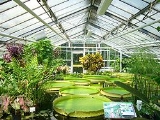
Botanischer Garten Bs
A greenhouse (also called a glasshouse or hothouse) is a building where plants are cultivated.

A greenhouse is a structure with a glass or plastic roof and frequently glass or plastic walls; it heats up because incoming solar radiation from the sun warms plants, soil, and other things inside the building. Air warmed by the heat from hot interior surfaces is retained in the building by the roof and wall. These structures range in size from small sheds to very large buildings.

Greenhouses can be divided into glass greenhouses and plastic greenhouses. Plastics mostly used are PE
Polyethylene

Polyethylene or polythene is a thermoplastic commodity heavily used in consumer products . Over 60 million tons of the material are produced worldwide every year....
film and multiwall sheet in PC or PMMA
Acrylic glass

Poly poly is a thermoplastic and transparency plastic. Chemically, it is the synthetic polymer of methyl methacrylate. It is sold by the trade names Plexiglas, Vitroflex, Limacryl, 'R-Cast, 'Per-Clax, 'Perspex, 'Plazcryl, 'Acrylex, 'Acrylite, 'Acrylplast, 'Altuglas, 'Polycast...
. Commercial glass greenhouses are often high tech production facilities for vegetables or flowers. The glass greenhouses are filled with equipment like screening installations, heating, cooling, lighting and may be automatically controlled by a computer.

The glass used for a greenhouse works as a selective transmission medium for different spectral frequencies, and its effect is to trap energy within the greenhouse, which heats both the plants and the ground inside it. This warms the air near the ground, and this air is prevented from rising and flowing away. This can be demonstrated by opening a small window near the roof of a greenhouse: the temperature drops considerably. This principle is the basis of the autovent
Autovent

An autovent is a device for maintaining a greenhouse or conservatory within a range of temperatures. The basic principle is that as greenhouse heats above ambient the air inside becomes lighter, the vent opens when a certain temperature is reached and lets the hot air out - drawing cooler air in from outside....
 automatic cooling system. Greenhouses thus work by trapping electromagnetic radiation and preventing convection
Convection

Convection in the most general terms refers to the movement of molecules within fluids . Convection is one of the major modes of heat transfer and mass transfer....
. A miniature greenhouse is known as a cold frame
Cold frame

In agriculture and gardening, a cold frame is a Transparency -roofed enclosure, built low to the ground, used to protect plants from cold weather....
.

Uses

Greenhouses are often used for growing flowers
Floriculture

Floriculture, or flower farming, is a discipline of horticulture concerned with the cultivation of flowering and ornamental plants for gardens and for floristry, comprising the floral industry....
, vegetable
Vegetable

The term "vegetable" generally means the Eating parts of plants. The definition of the word is traditional rather than scientific, however, and therefore the usage of the word is somewhat arbitrary and subjective, as it is determined by individual cultural customs of food selection and food preparation....
s, fruit
Fruit

The term fruit has different meanings dependent on context, and the term is not synonymous in food preparation and biology. In botany, which is the scientific study of plants, fruits are the ripened Ovary of flowering plants....
s, and tobacco
Tobacco

Tobacco is an agricultural product processed from the fresh leaves of plants in the genus Nicotiana. It can be consumed, used as an organic pesticide, and in the form of nicotine tartrate it is used in some medicines....
 plants. Bumblebee
Bumblebee

A bumblebee is any member of the bee genus Bombus, in the family Apidae; there are over 250 known species primarily occurring in the Northern Hemisphere....
s are the pollinator
Pollinator

A pollinator is the biotic agent that moves pollen from the male anthers of a flower to the female carpel of a flower to accomplish fertilization or syngamy of the female gamete in the ovule of the flower by the male gamete from the pollen grain....
s of choice for most greenhouse pollination
Pollination

Pollination in flowering plants and gymnosperms is the process that transfers pollen, which contain the male gametes to where the female gamete are contained within the carpel; in gymnosperms the pollen is directly applied to the ovule itself....
, although other types of bee
Bee

Bees are flying insects closely related to wasps and ants. Bees are a monophyly lineage within the superfamily Apoidea, presently classified by the unranked taxon name Anthophila....
s have been used, as well as artificial pollination. This helps the plants to produce more offspring for future plantations.

Besides tobacco, many vegetables and flowers are grown in greenhouses in late winter and early spring, and then transplanted outside as the weather warms. Started plants are usually available for gardeners in farmers' market
Farmers' market

Farmers' markets, sometimes called greenmarkets, are markets, usually held out-of-doors, in public spaces, where farmers can sell produce to the public....
s at transplanting time.

The closed environment of a greenhouse has its own unique requirements, compared with outdoor production. Pest
Pest (animal)

A pest is an organism which has characteristics that are regarded by humans as injurious or unwanted. This is most often because it causes damage to agriculture through feeding on crops or parasitising livestock, such as codling moth on apples, or boll weevil on cotton....
s and disease
Disease

A disease or medical condition is an abnormal condition of an organism that impairs bodily functions, associated with specific symptoms and Medical signs....
s, and extremes of heat and humidity, have to be controlled, and irrigation
Irrigation

Irrigation is an artificial application of water to the soil usually for assisting in growing crops. In crop production it is mainly used in dry areas and in periods of rainfall shortfalls, but also to protect plants against frost....
 is necessary to provide water. Significant inputs of heat and light may be required, particularly with winter production of warm-weather vegetables. Special greenhouse varieties of certain crops, like tomatoes, are generally used for commercial production.

Greenhouses are increasingly important in the food supply of high latitude countries. One of the largest greenhouse complexes in the world is in Almeria, Spain where Greenhouses cover almost and where almost 5% of Spain's salad vegetables are grown.

Greenhouses protect crops from too much heat or cold, shield plants from dust storms and blizzards, and help to keep out pests. Light and temperature control allows greenhouses to turn inarable land into arable land
Arable land

In geography, arable land is an agriculture term, meaning land that can be used for growing agriculture. Arable land is currently being lost at the rate of over 200,000 km? per year....
. Greenhouses can feed starving nations where crops can't survive in the harsh deserts and Arctic wastes. Hydroponics
Hydroponics

Hydroponics is a method of growing plants using mineral nutrient solutions, without soil. Terrestrial plants may be grown with their roots in the mineral nutrient solution only or in an inert medium, such as perlite, gravel, or mineral wool....
 can be used in greenhouses as well to make the most use of the interior space.

Biologist John Todd
John Todd (biologist)

Dr. John Todd is a Buckminster Fuller 2008 Challenge-winning biologist working in the field of ecology design. His ideas often involve applications that make use of alternative technology....
 invented a greenhouse that turns sewage into water, through the natural processes of bacteria, plants, and animals
Phytoremediation

Phytoremediation describes the treatment of natural environmental problems through the use of plants.The word's etymology comes from the Greek f?t? = plant, and Latin ? remedium ? = restoring balance, or remediating....
.

History


The idea of growing plants in environmentally controlled areas has existed since Roman
Ancient Rome

Ancient Rome was a civilization that grew out of a small agricultural community founded on the Italian Peninsula as early as the 10th century BC....
 times. The Roman emperor Tiberius
Tiberius

Tiberius Julius Caesar Augustus, born Tiberius Claudius Nero , was the second Roman Emperor, from the death of Augustus in AD 14 until his own death in 37....
 ate a cucumber-like
Armenian cucumber

The Armenian cucumber, Cucumis melo var. flexuosus, is a type of long, slender fruit which tastes like a cucumber and looks somewhat like a cucumber inside....
 vegetable daily. The Roman gardeners used artificial methods (similar to the greenhouse system) of growing to have it available for his table every day of the year. Cucumbers were planted in wheeled carts which were put in the sun daily, then taken inside to keep them warm at night. The cucumbers were stored under frames or in cucumber houses glazed with either oiled cloth known as "specularia" or with sheets of mica
Mica

The mica group of sheet silicate minerals includes several closely related materials having highly perfect basal cleavage. All are monoclinic with a tendency towards pseudo-hexagonal crystals and are similar in chemical composition....
, according to the description by Pliny the Elder
Pliny the Elder

Gaius Plinius Secundus , better known as Pliny the Elder, was an ancient author, naturalist or natural philosopher and naval and military commander of some importance who wrote Natural History ....
.

The first modern greenhouses were built in Italy
Italy

Italy , officially the Italian Republic , is a country located on the Italian Peninsula in Southern Europe and on the two largest islands in the Mediterranean Sea, Sicily and Sardinia....
 in the thirteenth century
1200s

Sorry, no overview for this topic
 to house the exotic plants that explorers brought back from the tropics. They were originally called giardini botanici (botanical gardens). The concept of greenhouses soon spread to the Netherlands
Netherlands

The Netherlands is a country that is part of the Kingdom of the Netherlands. It is a parliamentary democratic constitutional monarchy. The Netherlands is located in North-West Europe, and bordered by the North Sea to the north and west, Belgium to the south, and Germany to the east....
 and then England
England

native_name =|conventional_long_name = England|common_name = England|image_flag = Flag of England.svg|image_coat = England COA.svg|symbol_type = Royal Coat of Arms...
, along with the plants. Some of these early attempts required enormous amounts of work to close up at night or to winterize. There were serious problems with providing adequate and balanced heat in these early greenhouses.

Charles Lucien Bonaparte

Charles Lucien Jules Laurent Bonaparte, 2nd Prince of Canino and Musignano was a France natural history and ornithology. He was the son of Lucien Bonaparte and Alexandrine de Bleschamp, and nephew of Emperor Napoleon I of France....
, a French botanist, is often credited with building the first practical modern greenhouse in Leiden
Leiden

Media:Nl-Leiden.ogg is a city and municipality in the province of South Holland in the Netherlands and has 118,000 inhabitants. It forms a single urban area with Oegstgeest, Leiderdorp, Voorschoten, Valkenburg, Rijnsburg and Katwijk, with 254,000 inhabitants....
, Holland to grow medicinal tropical plants.

Originally on the estates of the rich, with the growth of the science of botany
Botany

Botany, plant science, phytology, or plant biology is a branch of biology and is the Scientific method of plant life and development....
 greenhouses spread to the universities. The French called their first greenhouses orangeries, since they were used to protect orange trees from freezing. As pineapples became popular pineries, or pineapple pits
Pineapple Pit

A pineapple pit is a method of growing pineapple in colder climates.This method of cultivation was invented by gardeners in the UK, during the Victorian_era....
, were built. Experimentation with the design of greenhouses continued during the Seventeenth Century in Europe as technology produced better glass and construction techniques improved. The greenhouse at the Palace of Versailles
Palace of Versailles

The Palace of Versailles, or simply Versailles, is a royal ch?teau in Versailles, the ?le-de-France region of France. In French language, it is known as the Ch?teau de Versailles....
 was an example of their size and elaborateness; it was more than 500 feet long, 42 feet wide, and 45 feet high.

In the nineteenth Century the largest greenhouses were built. The conservatory at Kew Gardens in England is a prime example of the Victorian greenhouse. Although intended for both horticultural
Horticulture

'Horticulture' is the industry and science of plant cultivation. Horticulturists work and conduct research in the disciplines of plant propagation and cultivation, Crop , plant breeding and genetic engineering, plant biochemistry, and plant physiology....
 and non-horticultural exhibition these included London's Crystal Palace
The Crystal Palace

The Crystal Palace was a Cast iron and glass building originally erected in Hyde Park, London, London, England, to house the The Great Exhibition of 1851....
, the New York Crystal Palace
Exhibition of the Industry of All Nations

Exhibition of the Industry of All Nations was a World's Fair held in 1853 in New York City, in the wake of the highly successful 1851 Great Exhibition in London....
 and Munich
Munich

Munich is the capital city of Bavaria, Germany. Munich is located on the River Isar north of the Northern Limestone Alps. Munich is the third largest city in Germany, after Berlin and Hamburg....
’s Glaspalast
Glaspalast

Glaspalast may refer to:*Glaspalast , Glaspalast in Munich modeled after The Crystal Palace*Glaspalast , an indoor arena in Sindelfingen...
. Joseph Paxton, who had experimented with glass and iron in the creation of large greenhouses as the head gardener at Chatsworth
Chatsworth House

Chatsworth House is a large country house at Chatsworth, Derbyshire, Derbyshire, England 3? miles Ordinal direction of Bakewell . It is the seat of the Dukes of Devonshire, and has been home to their family, the House of Cavendish family, since Bess of Hardwick settled at Chatsworth in 1549....
, in Derbyshire
Derbyshire

Derbyshire is a county in the East Midlands of England. A substantial portion of the Peak District National Park lies within Derbyshire. The northern part of Derbyshire overlaps with the Pennines, a famous chain of hills and mountains....
, working for the Duke of Devonshire
Duke of Devonshire

Duke of Devonshire is a title in the Peerage of England held by members of the aristocracy House of Cavendish family. This branch of the Cavendish family has been one of the richest and most influential aristocratic families in England since the 16th century, and have been rivalled in political influence perhaps only by the Earl of Derby and...
, designed and built the first, London's Crystal Palace
The Crystal Palace

The Crystal Palace was a Cast iron and glass building originally erected in Hyde Park, London, London, England, to house the The Great Exhibition of 1851....
. A major architectural achievement in monumental greenhouse building were the Royal Greenhouses of Laeken
Royal Greenhouses of Laeken

The Royal Greenhouses of Laeken , are a vast complex of monumental heated greenhouses in the park of the Royal Castle of Laeken Laeken in Brussels and one of the major Tourism in Belgium of the city....
 (1874-1895) for King Leopold II of Belgium.

In Japan, the first greenhouse was built in 1880 by Samuel Cocking
Samuel Cocking

Samuel Cocking was a British trader in Yokohama arriving in 1869, shortly after the Matthew Perry #The Opening of Japan: 1852-1854. He is most famous for the large greenhouse and gardens that he developed in Enoshima....
, a British merchant who exported herbs.

In the Twentieth Century the geodesic dome
Geodesic dome

A geodesic dome is a spherical or partial-spherical thin-shell structure based on a network of great circles lying on the surface of a sphere....
 was added to the many types of greenhouses. A notable example is the Eden Project
Eden Project

The Eden Project is a visitor attraction in the United Kingdom, including the world's largest greenhouse.The project is located in a reclaimed Kaolinite clay pit, located from the town of St Blazey and from the larger town of St Austell, Cornwall, England....
, in Cornwall
Cornwall

Cornwall , constitutional Duchy and palatine, is a metropolitan and non-metropolitan counties of England of England, United Kingdom, located at the tip of the south-western peninsula of Great Britain....
.

Shadehouse

A shadehouse serves the opposite purpose of a greenhouse; it is used to protect cultivated plants from excessive heat, light or dryness.

Gallery


See also

  • Biosphere 2
    Biosphere 2

    Biosphere 2 is a structure originally built to be an closed ecological system in Oracle, Arizona, Arizona by Space Biosphere Ventures, a joint venture whose principal officers were John P....
  • Conservatory (greenhouse)
    Conservatory (greenhouse)

    A conservatory is a glass and metal structure traditionally found in the garden of a large house. Modern conservatories are smaller, can be made of Polyvinyl chloride and are often added to houses for home improvement purposes....
  • Greenhouse effect
    Greenhouse effect

    The greenhouse effect refers to the change in the steady state temperature of a planet or moon by the presence of an atmosphere containing gas that absorbs and emits infrared....
  • Lord & Burnham
    Lord & Burnham

    Lord & Burnham are noted American greenhouse manufacturers, and builders of major public conservatories in the United States.The company began in 1849 when Frederick A....
     (greenhouse manufacturers)
  • Royal Greenhouses of Laeken
    Royal Greenhouses of Laeken

    The Royal Greenhouses of Laeken , are a vast complex of monumental heated greenhouses in the park of the Royal Castle of Laeken Laeken in Brussels and one of the major Tourism in Belgium of the city....
     in Belgium
  • Seasonal thermal store
    Seasonal thermal store

    A seasonal thermal store is a store designed to retain heat deposited during the hot summer months for use during colder winter weather. The heat is typically captured using solar collectors, although other energy sources are sometime used separately or in parallel....
  • Solar greenhouse (technical)
    Solar greenhouse (technical)

    A solar greenhouse works by letting in solar radiation to warm the ground, with the structure then trapping the energy to increase and maintain the temperature at a higher level than it otherwise would be....
  • USDA
  • Vertical Farming
    Vertical farming

    Vertical farming is a proposal to conduct large-scale agriculture in Urban area high-rises or "farmscrapers". Using recycled resources and greenhouse methods such as hydroponics, these buildings would produce fruit, vegetables, edible mushrooms and algae year-round....


Bibliography

  • Cunningham, Anne S. (2000) Crystal palaces : garden conservatories of the United States Princeton Architectural Press, New York, ISBN 1-56898-242-9 ;
  • Lemmon, Kenneth (1963) The covered garden Dufour, Philadelphia;
  • Muijzenberg, Erwin W B van den (1980) A history of greenhouses Institute for Agricultural Engineering, Wageningen, Netherlands;
  • Vleeschouwer, Olivier de (2001) Greenhouses and conservatories Flammarion, Paris, ISBN 2-08-010585-X ;
  • Woods, May (1988)Glass houses: history of greenhouses, orangeries and conservatories Aurum Press, London, ISBN 0-906053-85-4 ;


External links