


Mastaba

Encyclopedia
PR
PR commonly stands for* Public relations, a field concerned with maintaining public image* Puerto Rico* Proportional representation, a property of some voting systemsPR, P...
-djt
Djed
The djed symbol is a pillar-like ancient Egyptian symbol representing stability. It has been interpreted as the backbone of the Egyptian god Osiris, especially in the form Banebdjedet . Djedu is the Egyptian name for Busiris, a centre of the cult of Osiris...
" (meaning "house for eternity" or "eternal house"), is a type of ancient Egyptian
Ancient Egypt
Ancient Egypt was an ancient civilization of Northeastern Africa, concentrated along the lower reaches of the Nile River in what is now the modern country of Egypt. Egyptian civilization coalesced around 3150 BC with the political unification of Upper and Lower Egypt under the first pharaoh...
tomb
Tomb
A tomb is a repository for the remains of the dead. It is generally any structurally enclosed interment space or burial chamber, of varying sizes...
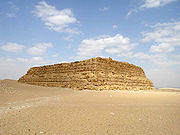
in the form of a flat-roofed, rectangular structure with outward sloping sides that marked the burial site of many eminent Egyptians of Egypt's ancient period
History of Egypt
Egyptian history can be roughly divided into the following periods:*Prehistoric Egypt*Ancient Egypt**Early Dynastic Period of Egypt: 31st to 27th centuries BC**Old Kingdom of Egypt: 27th to 22nd centuries BC...
. Mastabas were constructed out of mud-bricks or stone.
History
The greatest stimulus for the ancient Egyptians was their belief in an afterlifeAfterlife
The afterlife is the belief that a part of, or essence of, or soul of an individual, which carries with it and confers personal identity, survives the death of the body of this world and this lifetime, by natural or supernatural means, in contrast to the belief in eternal...
. This was reflected in their architecture and most prominently by the enormous amounts of time, money, and manpower involved in the building of their tombs. “Egyptians believed that the soul could live only if the body was preserved from corruption and depredation.” From the predynastic era forward, the ancient Egyptians strove to develop methods for preserving the bodies of the dead. Initially embalming methods were used, and later architectural tombs were devised to preserve the corpse indefinitely. The body would be placed in a deep, sealed chamber such as a Mastaba. The remains were not in contact with the dry desert sand, consequently natural mummification
Mummy
A mummy is a body, human or animal, whose skin and organs have been preserved by either intentional or incidental exposure to chemicals, extreme coldness , very low humidity, or lack of air when bodies are submerged in bogs, so that the recovered body will not decay further if kept in cool and dry...
of the remains could not take place. In order to preserve the remains, the ancient Egyptian priests had to devise a system of artificial mummification.
Structure
The word Mastaba comes from the Arabic word for a bench of mud, likely because when seen from a distance it resembles a bench. Inside the mastaba, a deep chamber was dug into the ground and lined with stone or bricks. The exterior building materials were initially bricks made of sun dried mud which was readily available from the Nile River. Even as more durable materials of stone came into use, the cheaper and easily available mud bricks were used for all but the most important monumental structures.The above-ground structure was rectangular in shape, had sloping sides, a flat roof, was about four times as long as it was wide, and rose to at least 30 feet in height. The mastaba was built with a north-south orientation. This above ground structure had space for a small offering chapel equipped with a false door
False door
A false door is a common architectural element in the tombs of Ancient Egypt. The ancient Egyptians believed that the false door was a threshold between the world of the living and the dead, and through which a deity or the spirit of the deceased could enter and exit.The false door was usually the...
to which priests and family members brought food and other offerings for the soul of the deceased. A second hidden chamber called a "serdab" (سرداب), from the Arabic word for “cellar,” housed a statue of the deceased that was hidden within the masonry for its protection. High up the walls of the serdab were small openings. These openings “were not meant for viewing the statue but rather for allowing the fragrance of burning incense, and possibly the spells spoken in rituals, to reach the statue.”
Architectural evolution
.svg.png)
Pharaoh
Pharaoh is a title used in many modern discussions of the ancient Egyptian rulers of all periods. The title originates in the term "pr-aa" which means "great house" and describes the royal palace...
and the social elite. The ancient Egyptian city of Abydos
Abydos, Egypt
Abydos is one of the most ancient cities of Upper Egypt, and also of the eight Upper Nome, of which it was the capital city. It is located about 11 kilometres west of the Nile at latitude 26° 10' N, near the modern Egyptian towns of el-'Araba el Madfuna and al-Balyana...
was the location chosen for many of the cenotaphs. The royal cemetery was at Sakkara, overlooking the capital of early times, Memphis.
Mastabas evolved over early dynastic period. During the First Dynasty, mastaba was constructed simulating house plans of several rooms, a central one containing the sarcophagus and others surrounding it to receive the abundant funerary offerings. The whole was built in a shallow pit above which a brick superstructure covered a broad area. The typical of Second and Third Dynasty mastabas was the 'stairway mastaba', the tomb chamber of which sank deeper than before and was connected to the top with inclined shaft and stairs.
Even after pharaohs began to construct pyramids for their tombs in the Third Dynasty, members of the nobility continued to be buried in mastaba tombs. This is especially evident on the Giza Plateau
Giza Plateau
The Giza Plateau is a plateau that is located in Giza, Egypt. The famous Giza Necropolis is located in this geographical area, which is characterized by a sandy, desert climate and terrain with little vegetation....
, where hundreds of mastaba tombs have been constructed alongside the pyramids.
In the Fourth Dynasty
Fourth dynasty of Egypt
The fourth dynasty of ancient Egypt is characterized as a "golden age" of the Old Kingdom. Dynasty IV lasted from ca. 2613 to 2494 BC...
(ca. 2613 to 2494 BC), rock-cut tombs began to appear. These were tombs built into the rock cliffs in Upper Egypt in an attempt to further thwart grave robbers. Mastabas, then, were developed with the addition of offering chapel and vertical shaft. Fifth Dynasty mastabas had elaborate chapels consisting of several rooms, columned hall and 'serdab'. The actual tomb chamber was built below the south-end of mastaba, connected with a slanting passage to a stairway emerging in the center of columned hall or court.
By the time of the New Kingdom
New Kingdom
The New Kingdom of Egypt, also referred to as the Egyptian Empire is the period in ancient Egyptian history between the 16th century BC and the 11th century BC, covering the Eighteenth, Nineteenth, and Twentieth Dynasties of Egypt....
(which began with the Eighteenth Dynasty
Eighteenth dynasty of Egypt
The eighteenth dynasty of ancient Egypt is perhaps the best known of all the dynasties of ancient Egypt...
around 1550 BC), “the mastaba becomes rare, being largely superseded by the independent pyramid chapel above a burial chamber.”