


Hellenistic period

Encyclopedia
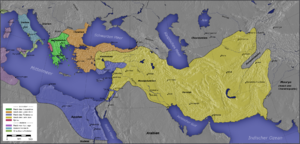
Classical Greece
Classical Greece was a 200 year period in Greek culture lasting from the 5th through 4th centuries BC. This classical period had a powerful influence on the Roman Empire and greatly influenced the foundation of Western civilizations. Much of modern Western politics, artistic thought, such as...
and the emergence of the Roman Empire
Roman Empire
The Roman Empire was the post-Republican period of the ancient Roman civilization, characterised by an autocratic form of government and large territorial holdings in Europe and around the Mediterranean....
. Usually taken to begin with the death of Alexander in 323 BC, the Hellenistic period may either be seen to end with the final conquest of the Greek heartlands by Rome
Roman Republic
The Roman Republic was the period of the ancient Roman civilization where the government operated as a republic. It began with the overthrow of the Roman monarchy, traditionally dated around 508 BC, and its replacement by a government headed by two consuls, elected annually by the citizens and...
in 146 BC; or the final defeat of the last remaining successor-state to Alexander's empire, the Ptolemaic kingdom
Ptolemaic Kingdom
The Ptolemaic Kingdom in and around Egypt began following Alexander the Great's conquest in 332 BC and ended with the death of Cleopatra VII and the Roman conquest in 30 BC. It was founded when Ptolemy I Soter declared himself Pharaoh of Egypt, creating a powerful Hellenistic state stretching from...
of Egypt in 31/30 BC, after the Battle of Actium
Battle of Actium
The Battle of Actium was the decisive confrontation of the Final War of the Roman Republic. It was fought between the forces of Octavian and the combined forces of Mark Antony and Cleopatra VII. The battle took place on 2 September 31 BC, on the Ionian Sea near the city of Actium, at the Roman...
. The Hellenistic period was characterized by a new wave of colonists which established Greek cities and kingdoms in Asia
Asia
Asia is the world's largest and most populous continent, located primarily in the eastern and northern hemispheres. It covers 8.7% of the Earth's total surface area and with approximately 3.879 billion people, it hosts 60% of the world's current human population...
and Africa
Africa
Africa is the world's second largest and second most populous continent, after Asia. At about 30.2 million km² including adjacent islands, it covers 6% of the Earth's total surface area and 20.4% of the total land area...
.
The Hellenistic Golden Age
The Hellenistic period emerged, approximately, (c.323-30BC). Beginning after the conquests of Alexander the Great, the period had experienced a time of fortune and prosperity. This period had experienced progress in massive production in the decorative and visual artsVisual arts
The visual arts are art forms that create works which are primarily visual in nature, such as ceramics, drawing, painting, sculpture, printmaking, design, crafts, and often modern visual arts and architecture...
, exploration
Exploration
Exploration is the act of searching or traveling around a terrain for the purpose of discovery of resources or information. Exploration occurs in all non-sessile animal species, including humans...
, literature
Literature
Literature is the art of written works, and is not bound to published sources...
, sculpture
Sculpture
Sculpture is three-dimensional artwork created by shaping or combining hard materials—typically stone such as marble—or metal, glass, or wood. Softer materials can also be used, such as clay, textiles, plastics, polymers and softer metals...
, theatre
Theatre
Theatre is a collaborative form of fine art that uses live performers to present the experience of a real or imagined event before a live audience in a specific place. The performers may communicate this experience to the audience through combinations of gesture, speech, song, music or dance...
, architecture
Architecture
Architecture is both the process and product of planning, designing and construction. Architectural works, in the material form of buildings, are often perceived as cultural and political symbols and as works of art...
, music
Music
Music is an art form whose medium is sound and silence. Its common elements are pitch , rhythm , dynamics, and the sonic qualities of timbre and texture...
, mathematics
Mathematics
Mathematics is the study of quantity, space, structure, and change. Mathematicians seek out patterns and formulate new conjectures. Mathematicians resolve the truth or falsity of conjectures by mathematical proofs, which are arguments sufficient to convince other mathematicians of their validity...
, and science
Science
Science is a systematic enterprise that builds and organizes knowledge in the form of testable explanations and predictions about the universe...
. The Hellenistic Era experienced an age of "eclecticism", a new awakening of multiple knowledge and theories open in Greek ideology. Instead of contemplating and debating ideals, logic, extinguished emotion, or consummate beauty, people would explore and analyze reality.
The Period and its Problems
The word Hellenistic is a modern word and a 19th Century concept, the idea of a Hellenistic Period did not exist in Ancient Greece. In the mid-19th Century, J. G. Droysen coined the term Hellenistic to be defined as the period when Greek culture spread in the non-Greek world after Alexander’s conquest. The major issue with the term Hellenistic lies in its convenience, as the spread of Greek culture was not the generalized phenomenon that the term implies. Some areas of the conquered world were more affected by the Greek and especially Macedonian influences than others. The term Hellenistic also implies that the Greek populations were of majority in the areas in which they settled, while in many cases, the Greek settlers were actually the minority amongst the native populations. The Greek population and the native population did not mix; the Greeks moved and brought their own culture, but interaction did not always occur.Historians and the Hellenistic Period
The focus on the Hellenistic Period over the course of the 19th century by scholars and historians has led to an issue common to the study of historical periods; historians see the period of focus as a mirror of the period in which they are living. William Woodthorpe TarnWilliam Woodthorpe Tarn
Sir William Woodthorpe Tarn was a British classical scholar and a writer. He wrote extensively on the Hellenistic world, particularly on Alexander the Great...
, between World War I
World War I
World War I , which was predominantly called the World War or the Great War from its occurrence until 1939, and the First World War or World War I thereafter, was a major war centred in Europe that began on 28 July 1914 and lasted until 11 November 1918...
and World War II
World War II
World War II, or the Second World War , was a global conflict lasting from 1939 to 1945, involving most of the world's nations—including all of the great powers—eventually forming two opposing military alliances: the Allies and the Axis...
and the heyday of the League of Nations
League of Nations
The League of Nations was an intergovernmental organization founded as a result of the Paris Peace Conference that ended the First World War. It was the first permanent international organization whose principal mission was to maintain world peace...
, focused on the issues of racial and cultural confrontation and the nature of colonial rule. Michael Rostovtzeff
Michael Rostovtzeff
Mikhail Ivanovich Rostovtzeff, or Rostovtsev was one of the 20th century's foremost authorities on ancient Greek, Iranian, and Roman history....
, who fled the Russian Revolution, concentrated predominantly on the rise of the capitalist bourgeoisie in areas of Greek rule. Arnaldo Monigliano, an Italian Jew who wrote before and after the Second World War, studied the problem of mutual understanding between races in the conquered areas. Moses Hadas
Moses Hadas
Moses Hadas was an American teacher, one of the leading classical scholars of the twentieth century, and a translator of numerous works....
portrayed an optimistic picture of synthesis of culture from the perspective of the 1950s, while Frank William Walbank in the 1960s and 1970s had a materialistic approach to the Hellenistic Period, focusing mainly on class relations. Recently, however, papyrologist C. Préaux has concentrated predominantly on the economic system, interactions between kings and cities and provides a generally pessimistic view on the period. Peter Green
Peter Green (historian)
Peter Green is a British classical scholar noted for his works on Alexander the Great and the Hellenistic Age of ancient history, generally regarded as spanning the era from the death of Alexander in 323 BC up to either the date of the Battle of Actium or the death of Augustus in 14 AD...
, on the other hand, writes from the point of view of late 20th century liberalism
Liberalism
Liberalism is the belief in the importance of liberty and equal rights. Liberals espouse a wide array of views depending on their understanding of these principles, but generally, liberals support ideas such as constitutionalism, liberal democracy, free and fair elections, human rights,...
, his focus being on individualism, the breakdown of convention, experiments and a postmodern disillusionment with all institutions and political processes.
Background
Ancient Greece had traditionally been a fractious collection of fiercely independent city-states. After the Peloponnesian WarPeloponnesian War
The Peloponnesian War, 431 to 404 BC, was an ancient Greek war fought by Athens and its empire against the Peloponnesian League led by Sparta. Historians have traditionally divided the war into three phases...
(431–404 BC), Greece had fallen under a Spartan hegemony
Spartan hegemony
The city-state of Sparta was the greatest military land power of classical Greek antiquity. During the classical period, Sparta owned, dominated or influenced the entire Peloponnese. Additionally, the defeat of the Athenians and the Delian League in the Peloponnesian War in 431-404 BCE resulted in...
, in which Sparta
Sparta
Sparta or Lacedaemon, was a prominent city-state in ancient Greece, situated on the banks of the River Eurotas in Laconia, in south-eastern Peloponnese. It emerged as a political entity around the 10th century BC, when the invading Dorians subjugated the local, non-Dorian population. From c...
was pre-eminent but not all-powerful. Spartan hegemony was succeeded by a Theban one
Theban hegemony
The Theban Hegemony lasted from the Theban victory over the Spartans at Leuctra in 371 BC to their defeat of a coalition of Peloponnesian armies at Mantinea in 362 BC, though Thebes sought to maintain its position until finally eclipsed by the rising power of Macedon in 346 BC.Externally, the way...
after the Battle of Leuctra
Battle of Leuctra
The Battle of Leuctra was a battle fought on July 6, 371 BC, between the Boeotians led by Thebans and the Spartans along with their allies amidst the post-Corinthian War conflict. The battle took place in the neighbourhood of Leuctra, a village in Boeotia in the territory of Thespiae...
(371 BC), but after the Battle of Mantinea (362 BC)
Battle of Mantinea (362 BC)
The Battle of Mantinea was fought on July 4 362 BC between the Thebans, led by Epaminondas and supported by the Arcadians and the Boeotian league against the Spartans, led by King Agesilaus II and supported by the Eleans, Athenians, and Mantineans...
, all of Greece was so weakened that no one state could claim pre-eminence. It was against this backdrop, that the ascendancy of Macedon
Macedon
Macedonia or Macedon was an ancient kingdom, centered in the northeastern part of the Greek peninsula, bordered by Epirus to the west, Paeonia to the north, the region of Thrace to the east and Thessaly to the south....
began, under king Philip II
Philip II of Macedon
Philip II of Macedon "friend" + ἵππος "horse" — transliterated ; 382 – 336 BC), was a king of Macedon from 359 BC until his assassination in 336 BC. He was the father of Alexander the Great and Philip III.-Biography:...
. Macedon was located at the periphery of the Greek world, and although its royal family claimed Greek descent, the Macedonians themselves were looked down upon as semi-barbaric by the Greeks. However, Macedon had a relatively strong and centralised government, and compared to most Greek states, directly controlled a large area.
With the accession of a strong and expansionist leader in Philip, Macedon was able to begin a rise to power over Greece. Philip took every opportunity to expand Macedonian territory, and in 352 BC annexed Thessaly
Thessaly
Thessaly is a traditional geographical region and an administrative region of Greece, comprising most of the ancient region of the same name. Before the Greek Dark Ages, Thessaly was known as Aeolia, and appears thus in Homer's Odyssey....
and Magnesia
Magnesia Prefecture
Magnesia Prefecture was one of the prefectures of Greece. Its capital was Volos. It was established in 1899 from the Larissa Prefecture. The prefecture was disbanded on 1 January 2011 by the Kallikratis programme, and split into the peripheral units of Magnesia and the Sporades.The toponym is...
. Desultory conflicts with Thebes and Athens continued for another decade, but in 338 BC Philip defeated a Theban and Athenian army at the Battle of Chaeronea
Battle of Chaeronea (338 BC)
The Battle of Chaeronea was fought in 338 BC, near the city of Chaeronea in Boeotia, between the forces of Philip II of Macedon and an alliance of Greek city-states...
. In the aftermath, Philip formed the League of Corinth
League of Corinth
The League of Corinth, also sometimes referred to as Hellenic League was a federation of Greek states created by Philip II of Macedon during the winter of 338 BC/337 BC after the Battle of Chaeronea, to facilitate his use of military forces in his war against Persia...
, effectively bringing the majority of Greece under his direct sway. He was elected Hegemon of the league, and a campaign against the Achaemenid Empire
Achaemenid Empire
The Achaemenid Empire , sometimes known as First Persian Empire and/or Persian Empire, was founded in the 6th century BCE by Cyrus the Great who overthrew the Median confederation...
of Persia was planned. However, whilst this campaign was in its early stages, he was assassinated (possibly at the instigation of his son Alexander).
The Macedonian Empire
Succeeding his father, Alexander took over Persian war himself. During a decade of campaigning, Alexander conquered the whole Persian Empire, overthrowing the Persian King Darius III. The conquered lands included Asia MinorAsia Minor
Asia Minor is a geographical location at the westernmost protrusion of Asia, also called Anatolia, and corresponds to the western two thirds of the Asian part of Turkey...
, Assyria
Assyria
Assyria was a Semitic Akkadian kingdom, extant as a nation state from the mid–23rd century BC to 608 BC centred on the Upper Tigris river, in northern Mesopotamia , that came to rule regional empires a number of times through history. It was named for its original capital, the ancient city of Assur...
, the Levant
Levant
The Levant or ) is the geographic region and culture zone of the "eastern Mediterranean littoral between Anatolia and Egypt" . The Levant includes most of modern Lebanon, Syria, Jordan, Israel, the Palestinian territories, and sometimes parts of Turkey and Iraq, and corresponds roughly to the...
, Egypt
Egypt
Egypt , officially the Arab Republic of Egypt, Arabic: , is a country mainly in North Africa, with the Sinai Peninsula forming a land bridge in Southwest Asia. Egypt is thus a transcontinental country, and a major power in Africa, the Mediterranean Basin, the Middle East and the Muslim world...
, Mesopotamia
Mesopotamia
Mesopotamia is a toponym for the area of the Tigris–Euphrates river system, largely corresponding to modern-day Iraq, northeastern Syria, southeastern Turkey and southwestern Iran.Widely considered to be the cradle of civilization, Bronze Age Mesopotamia included Sumer and the...
, Media
Medes
The MedesThe Medes...
, Persia, and parts of modern Afghanistan
Afghanistan
Afghanistan , officially the Islamic Republic of Afghanistan, is a landlocked country located in the centre of Asia, forming South Asia, Central Asia and the Middle East. With a population of about 29 million, it has an area of , making it the 42nd most populous and 41st largest nation in the world...
, Pakistan
Pakistan
Pakistan , officially the Islamic Republic of Pakistan is a sovereign state in South Asia. It has a coastline along the Arabian Sea and the Gulf of Oman in the south and is bordered by Afghanistan and Iran in the west, India in the east and China in the far northeast. In the north, Tajikistan...
, and the steppes of central Asia. The years of constant campaigning had taken their toll however, and Alexander died in 323 BC.
After his death, the huge territories Alexander had conquered became subject to a strong Greek influence (hellenization
Hellenization
Hellenization is a term used to describe the spread of ancient Greek culture, and, to a lesser extent, language. It is mainly used to describe the spread of Hellenistic civilization during the Hellenistic period following the campaigns of Alexander the Great of Macedon...
) for the next two or three centuries, until the rise of Rome
Rome
Rome is the capital of Italy and the country's largest and most populated city and comune, with over 2.7 million residents in . The city is located in the central-western portion of the Italian Peninsula, on the Tiber River within the Lazio region of Italy.Rome's history spans two and a half...
in the west, and of Parthia
Parthia
Parthia is a region of north-eastern Iran, best known for having been the political and cultural base of the Arsacid dynasty, rulers of the Parthian Empire....
in the east. As the Greek and eastern cultures mingled, the development of a hybrid Hellenistic culture began, and persisted even when isolated from the main centres of Greek culture (for instance, in the Greco-Bactrian kingdom
Greco-Bactrian Kingdom
The Greco-Bactrian Kingdom was the easternmost part of the Hellenistic world, covering Bactria and Sogdiana in Central Asia from 250 to 125 BC...
).
It can be argued that some of the changes across the Macedonian Empire after Alexander's conquests and during the rule of the Diadochi
Diadochi
The Diadochi were the rival generals, family and friends of Alexander the Great who fought for the control of Alexander's empire after his death in 323 BC...
would have occurred without the influence of Greek rule. As mentioned by Peter Green
Peter Green (historian)
Peter Green is a British classical scholar noted for his works on Alexander the Great and the Hellenistic Age of ancient history, generally regarded as spanning the era from the death of Alexander in 323 BC up to either the date of the Battle of Actium or the death of Augustus in 14 AD...
, numerous factors of conquest have been merged under the term Hellenistic Period
Hellenistic period
The Hellenistic period or Hellenistic era describes the time which followed the conquests of Alexander the Great. It was so named by the historian J. G. Droysen. During this time, Greek cultural influence and power was at its zenith in Europe and Asia...
. Specific areas conquered by Alexander's invading army, including Egypt and areas of Asia Minor
Asia Minor
Asia Minor is a geographical location at the westernmost protrusion of Asia, also called Anatolia, and corresponds to the western two thirds of the Asian part of Turkey...
and Mesopotamia
Mesopotamia
Mesopotamia is a toponym for the area of the Tigris–Euphrates river system, largely corresponding to modern-day Iraq, northeastern Syria, southeastern Turkey and southwestern Iran.Widely considered to be the cradle of civilization, Bronze Age Mesopotamia included Sumer and the...
"fell" willingly to conquest and viewed Alexander as more of a liberator than a victor.
In addition, much of the area conquered would continue to be ruled by the Diadochi
Diadochi
The Diadochi were the rival generals, family and friends of Alexander the Great who fought for the control of Alexander's empire after his death in 323 BC...
, Alexander's generals and successors. Initially the whole empire was divided amongst them; however, some territories were lost relatively quickly, or only remained nominally under Macedonian rule. After 200 years, only much reduced and rather degenerate states remained, until the conquest of Ptolemaic Egypt by Rome.
The Successors
After Alexander's death, there were more-or-less forty years of constant war between his generals (the Diadochi or Successors) for the rule of his empire. By about 281 BC, the situation had stabilised, resulting in four major domains:- The Antigonid dynastyAntigonid dynastyThe Antigonid dynasty was a dynasty of Hellenistic kings descended from Alexander the Great's general Antigonus I Monophthalmus .-History:...
in MacedonMacedonMacedonia or Macedon was an ancient kingdom, centered in the northeastern part of the Greek peninsula, bordered by Epirus to the west, Paeonia to the north, the region of Thrace to the east and Thessaly to the south....
and central Greece; - The Ptolemaic dynastyPtolemaic dynastyThe Ptolemaic dynasty, was a Macedonian Greek royal family which ruled the Ptolemaic Empire in Egypt during the Hellenistic period. Their rule lasted for 275 years, from 305 BC to 30 BC...
in EgyptEgyptEgypt , officially the Arab Republic of Egypt, Arabic: , is a country mainly in North Africa, with the Sinai Peninsula forming a land bridge in Southwest Asia. Egypt is thus a transcontinental country, and a major power in Africa, the Mediterranean Basin, the Middle East and the Muslim world...
based at AlexandriaAlexandriaAlexandria is the second-largest city of Egypt, with a population of 4.1 million, extending about along the coast of the Mediterranean Sea in the north central part of the country; it is also the largest city lying directly on the Mediterranean coast. It is Egypt's largest seaport, serving...
; - The Seleucid dynastySeleucid dynastyThe Seleucid dynasty or the Seleucidae was a Greek Macedonian royal family, founded by Seleucus I Nicator , which ruled the Seleucid Kingdom centered in the Near East and regions of the Asian part of the earlier Achaemenid Persian Empire during the Hellenistic period.-History:Seleucus was an...
in SyriaSyriaSyria , officially the Syrian Arab Republic , is a country in Western Asia, bordering Lebanon and the Mediterranean Sea to the West, Turkey to the north, Iraq to the east, Jordan to the south, and Israel to the southwest....
and MesopotamiaMesopotamiaMesopotamia is a toponym for the area of the Tigris–Euphrates river system, largely corresponding to modern-day Iraq, northeastern Syria, southeastern Turkey and southwestern Iran.Widely considered to be the cradle of civilization, Bronze Age Mesopotamia included Sumer and the...
based at AntiochAntiochAntioch on the Orontes was an ancient city on the eastern side of the Orontes River. It is near the modern city of Antakya, Turkey.Founded near the end of the 4th century BC by Seleucus I Nicator, one of Alexander the Great's generals, Antioch eventually rivaled Alexandria as the chief city of the...
; - The Attalid dynastyAttalid dynastyThe Attalid dynasty was a Hellenistic dynasty that ruled the city of Pergamon after the death of Lysimachus, a general of Alexander the Great. The Attalid kingdom was the rump state left after the collapse of the Lysimachian Empire. One of Lysimachus' officers, Philetaerus, took control of the city...
in AnatoliaAnatoliaAnatolia is a geographic and historical term denoting the westernmost protrusion of Asia, comprising the majority of the Republic of Turkey...
based at PergamumPergamonPergamon , or Pergamum, was an ancient Greek city in modern-day Turkey, in Mysia, today located from the Aegean Sea on a promontory on the north side of the river Caicus , that became the capital of the Kingdom of Pergamon during the Hellenistic period, under the Attalid dynasty, 281–133 BC...
.
The Ptolemaic Kingdom
PtolemyPtolemy I Soter
Ptolemy I Soter I , also known as Ptolemy Lagides, c. 367 BC – c. 283 BC, was a Macedonian general under Alexander the Great, who became ruler of Egypt and founder of both the Ptolemaic Kingdom and the Ptolemaic Dynasty...
, a somatophylax, one of the seven bodyguard
Bodyguard
A bodyguard is a type of security operative or government agent who protects a person—usually a famous, wealthy, or politically important figure—from assault, kidnapping, assassination, stalking, loss of confidential information, terrorist attack or other threats.Most important public figures such...
s who served as Alexander the Great's generals and deputies, was appointed satrap
Satrap
Satrap was the name given to the governors of the provinces of the ancient Median and Achaemenid Empires and in several of their successors, such as the Sassanid Empire and the Hellenistic empires....
of Egypt
Egypt
Egypt , officially the Arab Republic of Egypt, Arabic: , is a country mainly in North Africa, with the Sinai Peninsula forming a land bridge in Southwest Asia. Egypt is thus a transcontinental country, and a major power in Africa, the Mediterranean Basin, the Middle East and the Muslim world...
after Alexander's death in 323 BC
323 BC
Year 323 BC was a year of the pre-Julian Roman calendar. At the time, it was known as the Year of the Consulship of Longus and Cerretanus...
. In 305 BC
305 BC
Year 305 BC was a year of the pre-Julian Roman calendar. At the time, it was known as the Year of the Consulship of Megellus and Augurinus...
, he declared himself King Ptolemy I, later known as "Soter" (saviour). The Egyptians
Egyptians
Egyptians are nation an ethnic group made up of Mediterranean North Africans, the indigenous people of Egypt.Egyptian identity is closely tied to geography. The population of Egypt is concentrated in the lower Nile Valley, the small strip of cultivable land stretching from the First Cataract to...
soon accepted the Ptolemies as the successors to the pharaoh
Pharaoh
Pharaoh is a title used in many modern discussions of the ancient Egyptian rulers of all periods. The title originates in the term "pr-aa" which means "great house" and describes the royal palace...
s of independent Egypt. Ptolemy's family ruled Egypt until the Roman
Rome
Rome is the capital of Italy and the country's largest and most populated city and comune, with over 2.7 million residents in . The city is located in the central-western portion of the Italian Peninsula, on the Tiber River within the Lazio region of Italy.Rome's history spans two and a half...
conquest of 30 BC
30 BC
Year 30 BC was either a common year starting on Wednesday, Thursday or Friday or a leap year starting on Thursday of the Julian calendar and a common year starting on Wednesday of the Proleptic Julian calendar...
.
All the male rulers of the dynasty took the name Ptolemy. Ptolemaic queens, some of whom were the sisters of their husbands, were usually called Cleopatra, Arsinoe or Berenice. The most famous member of the line was the last queen, Cleopatra VII, known for her role in the Roman political battles between Julius Caesar
Julius Caesar
Gaius Julius Caesar was a Roman general and statesman and a distinguished writer of Latin prose. He played a critical role in the gradual transformation of the Roman Republic into the Roman Empire....
and Pompey
Pompey
Gnaeus Pompeius Magnus, also known as Pompey or Pompey the Great , was a military and political leader of the late Roman Republic...
, and later between Octavian and Mark Antony
Mark Antony
Marcus Antonius , known in English as Mark Antony, was a Roman politician and general. As a military commander and administrator, he was an important supporter and loyal friend of his mother's cousin Julius Caesar...
. Her suicide at the conquest by Rome marked the end of Ptolemaic rule in Egypt.
The Seleucid Empire
The Seleucid Empire was centered in the Near EastNear East
The Near East is a geographical term that covers different countries for geographers, archeologists, and historians, on the one hand, and for political scientists, economists, and journalists, on the other...
and at the height of its power included central Anatolia
Anatolia
Anatolia is a geographic and historical term denoting the westernmost protrusion of Asia, comprising the majority of the Republic of Turkey...
, the Levant
Levant
The Levant or ) is the geographic region and culture zone of the "eastern Mediterranean littoral between Anatolia and Egypt" . The Levant includes most of modern Lebanon, Syria, Jordan, Israel, the Palestinian territories, and sometimes parts of Turkey and Iraq, and corresponds roughly to the...
, Mesopotamia
Mesopotamia
Mesopotamia is a toponym for the area of the Tigris–Euphrates river system, largely corresponding to modern-day Iraq, northeastern Syria, southeastern Turkey and southwestern Iran.Widely considered to be the cradle of civilization, Bronze Age Mesopotamia included Sumer and the...
, Persia, today's Turkmenistan
Turkmenistan
Turkmenistan , formerly also known as Turkmenia is one of the Turkic states in Central Asia. Until 1991, it was a constituent republic of the Soviet Union, the Turkmen Soviet Socialist Republic . Turkmenistan is one of the six independent Turkic states...
, Pamir
Pamir Mountains
The Pamir Mountains are a mountain range in Central Asia formed by the junction or knot of the Himalayas, Tian Shan, Karakoram, Kunlun, and Hindu Kush ranges. They are among the world’s highest mountains and since Victorian times they have been known as the "Roof of the World" a probable...
and parts of Pakistan
Pakistan
Pakistan , officially the Islamic Republic of Pakistan is a sovereign state in South Asia. It has a coastline along the Arabian Sea and the Gulf of Oman in the south and is bordered by Afghanistan and Iran in the west, India in the east and China in the far northeast. In the north, Tajikistan...
.
When the territories were divided between Alexander's generals at the Partition of Babylon
Partition of Babylon
The Partition of Babylon designates the attribution of the territories of Alexander the Great between his generals after his death in 323 BC.-Background:...
in 323 BC Seleucus
Seleucus I Nicator
Seleucus I was a Macedonian officer of Alexander the Great and one of the Diadochi. In the Wars of the Diadochi that took place after Alexander's death, Seleucus established the Seleucid dynasty and the Seleucid Empire...
received Babylonia
Babylonia
Babylonia was an ancient cultural region in central-southern Mesopotamia , with Babylon as its capital. Babylonia emerged as a major power when Hammurabi Babylonia was an ancient cultural region in central-southern Mesopotamia (present-day Iraq), with Babylon as its capital. Babylonia emerged as...
, and from that point continued to expand his dominions ruthlessly. Seleucus established himself in Babylon
Babylon
Babylon was an Akkadian city-state of ancient Mesopotamia, the remains of which are found in present-day Al Hillah, Babil Province, Iraq, about 85 kilometers south of Baghdad...
in 312 BC, used as the foundation date of the Seleucid Empire. He ruled over not only Babylonia, but the entire enormous eastern part of Alexander's empire:
The Greco-Bactrian Kingdom
Satrap
Satrap was the name given to the governors of the provinces of the ancient Median and Achaemenid Empires and in several of their successors, such as the Sassanid Empire and the Hellenistic empires....
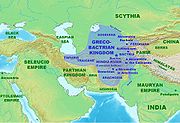
s governing the provinces had significant freedom from central control. In around 250 BC, the governor of Bactria, Sogdiana and Margiana, one Diodotus, took this process to its logical extreme and declared himself king. At around the same time, the re-emergence of a native Persian dynasty under the Parthia
Parthia
Parthia is a region of north-eastern Iran, best known for having been the political and cultural base of the Arsacid dynasty, rulers of the Parthian Empire....
n king Arsaces
Arsaces I of Parthia
Arsaces I was the founder of the Arsacid dynasty, and after whom all 30+ monarchs of the Arsacid empire officially named themselves. A celebrated descent from antiquity begins with Arsaces.A 1st century AD tradition casts Arsaces as descending from the 5th-century BC Achaemenid monarch...
effectively cut the nascent Greco-Bactrian kingdom off from the rest of the Seleucid empire. This probably allowed it to maintain its independence in the medium term, but in the long-term may have contributed to its decline and fall; it could no longer receive manpower or aid from other Hellenistic regions at sufficient levels.
Diodotus II, son of Diodotus, was overthrown in about 230 BC by Euthydemus
Euthydemus I
Euthydemus I , Greco-Bactrian king in about 230 or 223 BCE according to Polybius., he is thought to have originally been a Satrap of Sogdiana, who overturned the dynasty of Diodotus of Bactria and became a Greco-Bactrian king. Strabo, on the other hand, correlates his accession with internal...
, possibly the satrap of Sogdiana, who then started his own dynasty. In approx 210 BC, the Greco-Bactrian kingdom was invaded by a resurgent Seleucid empire under Antiochus III. Whilst victorious in the field, it seems Antiochus came to realise that there were advantages in the status quo (perhaps sensing that Bactria could not be governed from Syria), and married one of his daughters to Euthydemus's son, thus legitimising Greco-Bactria. Soon afterwards the Greco-Bactrian kingdom seems to have expanded, possibly taking advantage of the defeat of the Parthian king Arsaces II
Arsaces II of Parthia
Arsaces II, also Artabanus I, of the Arsacid dynasty was King of Parthia between 211 BC and 191 BC. Greek 'Arsaces' appears as 'Artabanus' in Latin sources, and both forms appear in history books....
by Antiochus.
Demetrius
Demetrius I of Bactria
Demetrius I was a Buddhist Greco-Bactrian king . He was the son of Euthydemus and succeeded him around 200 BC, after which he conquered extensive areas in what now is eastern Iran, Afghanistan and Pakistan thus creating an Indo-Greek kingdom far from Hellenistic Greece...
, son and successor of Euthydemus, invaded north-western India in 180 BC, after the destruction of the Mauryan empire there; the Mauryans were probably allies of the Bactrians (and Seleucids). The exact justification for the invasion remains unclear, but by about 175 BC, the Greeks ruled over parts of north-western India.
This period also marks the beginning of the obfuscation of Greco-Bactrian history. Demetrius possibly died about 180 BC; numismatic evidence suggest the existence of several other kings shortly thereafter. It is probable that at this point that the Greco-Bactrian kingdom split into several semi-independent regions for some years; Euthydemus II
Euthydemus II
Euthydemus II was a son of Demetrius I of Bactria, and became king of Bactria in the 180s BCE, either after his father's death or as a sub-king to him. The style and rare nickel alloys of his coins associates him closely in time with the king Agathocles but their precise relation remains uncertain...
(son of Demetrius?) seems to have ruled in Bactria, with Agathocles
Agathocles of Bactria
Agathocles Dikaios was a Buddhist Indo-Greek king, who reigned between around 190 and 180 BCE. He might have been a son of Demetrius and one of his sub-kings in charge of the Paropamisade between Bactria and India...
, Antimachus I
Antimachus I
Anthimachus I Theos was one of the Greco-Bactrian kings, generally dated from around 185 to 170 BC.-Rule:...
and Pantaleon
Pantaleon
Pantaleon was a Greek king who reigned some time between 190–180 BCE in Bactria and India. He was a younger contemporary or successor of the Greco-Bactrian king Demetrius, and is sometimes believed to have been his brother and/or subking...
ruling in India. In around 171 BC the usurper Eucratides I
Eucratides I
Eucratides I Megas was one of the most important Greco-Bactrian kings, descendants of dignitaries of Alexander the Great. He uprooted the Euthydemid dynasty of Greco-Bactrian kings and replaced it with his own lineage...
swept to power in Bactria, removing whichever king(s) were actually ruling at that point. Similarly, in India, the general Apollodotus I
Apollodotus I
Apollodotus I Soter was an Indo-Greek king between 180 and 160 BCE or between 174 and 165 BCE who ruled the western and southern parts of the Indo-Greek kingdom, from Taxila in Punjab to the areas of Sindh and possibly Gujarat.-Ruler of the Indo-Greek...
seems to have assumed more-or-less complete power by around 170 BC, thereby marking the true start of the Indo-Greek kingdom
Indo-Greek Kingdom
The Indo-Greek Kingdom or Graeco-Indian Kingdom covered various parts of the northwest regions of the Indian subcontinent during the last two centuries BC, and was ruled by more than 30 Hellenistic kings, often in conflict with each other...
(see below).
Eucratides may have been a member of the Seleucid royal family, who set out to (re)claim the Bactrian lands. Eucratides certainly had a vast and prestigious coinage, suggesting he was a ruler of considerable importance. He appears to have re-invigorated the Bactrian kingdom, although territory was lost to Parthia in the west. He fought with the Indo-Greeks, and appears to have occupied India up to the river Indus for a while. However, his murder in 145 BC triggered a civil war which fatally weakened the kingdom as his sons Eucratides II
Eucratides II
Eucratides II was a Greco-Bactrian king who was a successor and probably a son of Eucratides I.It seems likely that Eucratides II ruled for a relatively short time after the murder of his namesake, until he was dethroned in the dynastic civil war caused by the same murder.During his earlier years,...
and Heliocles I
Heliocles I
The Greco-Bactrian Heliocles, circ. 145-130 BCE, relative and successor of Eucratides the Great, was probably the last Greek king who reigned over the Bactrian country. His reign was a troubled one. According to Roman historian Justin, Eucratides was murdered by his son and co-ruler, though Justin...
fought each other. Heliocles was the last Greek to clearly rule Bactria, his power collapsing in the face of tribal invasions of Bactria, by about 130 BC. However, Greek urban civilisation seems to have continued in Bactria after the fall of the kingdom, having a hellenising effect on the tribes which had displaced Greek-rule.
The Indo-Greek Kingdoms
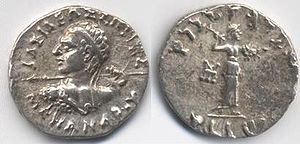
As mentioned, Apollodotus made himself king of 'India' in around 170 BC. The exact fate of Apollodotus is unknown, but he seems to have extended the conquests east into Gandhara
Gandhara
Gandhāra , is the name of an ancient kingdom , located in northern Pakistan and eastern Afghanistan. Gandhara was located mainly in the vale of Peshawar, the Potohar plateau and on the Kabul River...
and western Punjab
Punjab region
The Punjab , also spelled Panjab |water]]s"), is a geographical region straddling the border between Pakistan and India which includes Punjab province in Pakistan and the states of the Punjab, Haryana, Himachal Pradesh, Chandigarh and some northern parts of the National Capital Territory of Delhi...
. In about 155 (or 165) BC he seems to have been succeeded by the most successful of the Indo-Greek kings, Menander I
Menander I
Menander I Soter "The Saviour" was one of the rulers of the Indo-Greek Kingdom from either 165 or 155 BC to 130 BC ....
. Menander converted to Buddhism, and seems to have been a great patron of the religion; he is remembered in some Buddhist texts as 'Milinda'. He also expanded the kingdom further east into Punjab, though these conquests were rather ephemeral.
After the death of Menander (c. 130 BC), the Kingdom appears to have fragmented, with several 'kings' attested contemporaneously in different regions. This inevitably weakened the Greek position, and territory seems to have been lost progressively. Around 70 BC, the western regions of Arachosia
Arachosia
Arachosia is the Latinized form of the Greek name of an Achaemenid and Seleucid governorate in the eastern part of their respective empires, around modern-day southern Afghanistan. The Greek term "Arachosia" corresponds to the Iranian land of Harauti which was between Kandahar in Afghanistan and...
and Paropamisadae
Paropamisadae
Paropamisadae or Paropamisus was the ancient Greek name for a region of the Hindu-Kush in eastern Afghanistan, centered on the cities of Kabul and Kapisa .-History of Paropamisadae:...
were lost to tribal invasions, presumably by those tribes responsible for the end of the Bactrian kingdom. The resulting Indo-Scythian
Indo-Scythians
Indo-Scythians is a term used to refer to Sakas , who migrated into Bactria, Sogdiana, Arachosia, Gandhara, Kashmir, Punjab, Haryana, Uttar Pradesh, Gujarat, Maharashtra and Rajasthan, from the middle of the 2nd century BCE to the 4th century CE....
kingdom seems to have gradually pushed the remaining Indo-Greek kingdom towards the east. The Indo-Greek kingdom appears to have lingered on in western Punjab until about 10 AD when finally ended by the Indo-Scythians.
For centuries after the demise of the Indo-Greek kingdom, Greek civilization has influenced Indian culture, art, and language. Even the depictions of Buddha appear to have been influenced by Greek culture: Buddha representations in the Ghandara period were often showing Buddha under the protection of Herakles.
The Kingdom of Pontus
The Kingdom of Pontus was a Hellenistic Kingdom on the southern coast of the Black Sea. It was founded by MithridatesMithridates I of Pontus
Mithridates I Ctistes was the founder of the kingdom of Pontus in Anatolia....
I in 291 BC and lasted until its conquest by the Roman Republic in 63 BC. Despite being ruled by a dynasty which was a descendant of the Persian Achaemenid Empire it became hellenized due to the influence of the Greek cities on the Black Sea and its neighboring kingdoms. The kingdom grew to its largest extent under Mithridates VI the great, who conquered Colchis, Cappadocia, Bithynia, Lesser Armenia, the Greek colonies of the Tauric Chersonesos and for a brief time the Roman province of Asia. After a long struggle with Rome in the Mithridatic wars, Pontus was defeated, part of it was incorporated into the Roman Republic as the province Bithynia and Pontus and the eastern half survived as a client Kingdom.
Rise of Rome
Widespread Roman interference in the Greek World was probably inevitable given the general manner of the ascendency of the Roman RepublicRoman Republic
The Roman Republic was the period of the ancient Roman civilization where the government operated as a republic. It began with the overthrow of the Roman monarchy, traditionally dated around 508 BC, and its replacement by a government headed by two consuls, elected annually by the citizens and...
. This Roman-Greek interaction began as a consequence of the Greek city-states located along the coast of southern Italy. Rome had come to dominate the Italian peninsula, and desired the submission of the Greek cities to its rule. Although they initially resisted, allying themselves with Pyrrhus of Epirus
Pyrrhus of Epirus
Pyrrhus or Pyrrhos was a Greek general and statesman of the Hellenistic era. He was king of the Greek tribe of Molossians, of the royal Aeacid house , and later he became king of Epirus and Macedon . He was one of the strongest opponents of early Rome...
, and defeating the Romans at several battles, the Greek cities were unable to maintain this position and were absorbed by the Roman republic. Shortly afterwards, Rome became involved in Sicily, fighting against the Carthaginans
Carthage
Carthage , implying it was a 'new Tyre') is a major urban centre that has existed for nearly 3,000 years on the Gulf of Tunis, developing from a Phoenician colony of the 1st millennium BC...
in the First Punic War
First Punic War
The First Punic War was the first of three wars fought between Ancient Carthage and the Roman Republic. For 23 years, the two powers struggled for supremacy in the western Mediterranean Sea, primarily on the Mediterranean island of Sicily and its surrounding waters but also to a lesser extent in...
. The end result was the complete conquest of Sicily, including its previously powerful Greek cities, by the Romans.
The independent cities of Magna Graecia
Magna Graecia
Magna Græcia is the name of the coastal areas of Southern Italy on the Tarentine Gulf that were extensively colonized by Greek settlers; particularly the Achaean colonies of Tarentum, Crotone, and Sybaris, but also, more loosely, the cities of Cumae and Neapolis to the north...
did not form part of the Hellenistic domains and had, by this time, been eclipsed in power by the Hellenistic kingdoms of the east. They also remained independent at a time when the Mediterranean was increasingly dominated by 'great powers'. This, and their proximity to Rome, had made them easy and obvious targets. Conversely, the major Hellenistic realms were not in the immediate Roman sphere of influence, and were powerful enough to deter Roman aggression. The events which, in retrospect, marked the beginning of the end for the Hellenistic kingdoms could have been avoided; even if it seems likely that a collision between them and Rome would have ultimately occurred.
Roman entanglement in the Balkans began, as so often, with trade. Illyrian piratical raids on Roman merchants twice led to a Roman task force invading Illyria (the First and, Second Illyrian Wars). Tension between Macedon and Rome increased when the young king of Macedon, Philip V
Philip V of Macedon
Philip V was King of Macedon from 221 BC to 179 BC. Philip's reign was principally marked by an unsuccessful struggle with the emerging power of Rome. Philip was attractive and charismatic as a young man...
harboured one of the chief pirates, Demetrius of Pharos
Demetrius of Pharos
Demetrius of Pharos was a ruler of Pharos involved in the First Illyrian War, after which he ruled a portion of the Illyrian Adriatic coast on behalf of the Romans, as a Client king....
(a former client of Rome). As a result, in an attempt to reduce Roman influence in the Balkans, Philip allied himself with Carthage after Hannibal had dealt the Romans a massive defeat at the Battle of Cannae
Battle of Cannae
The Battle of Cannae was a major battle of the Second Punic War, which took place on August 2, 216 BC near the town of Cannae in Apulia in southeast Italy. The army of Carthage under Hannibal decisively defeated a numerically superior army of the Roman Republic under command of the consuls Lucius...
(216 BC) during the Second Punic War
Second Punic War
The Second Punic War, also referred to as The Hannibalic War and The War Against Hannibal, lasted from 218 to 201 BC and involved combatants in the western and eastern Mediterranean. This was the second major war between Carthage and the Roman Republic, with the participation of the Berbers on...
. Forcing the Romans to fight on another front when they were at a nadir of manpower gained Philip the lasting enmity of the Romans; the only real result from the somewhat insubstantial First Macedonian War
First Macedonian War
The First Macedonian War was fought by Rome, allied with the Aetolian League and Attalus I of Pergamon, against Philip V of Macedon, contemporaneously with the Second Punic War against Carthage...
(215–202 BC).
Once the Second Punic War
Second Punic War
The Second Punic War, also referred to as The Hannibalic War and The War Against Hannibal, lasted from 218 to 201 BC and involved combatants in the western and eastern Mediterranean. This was the second major war between Carthage and the Roman Republic, with the participation of the Berbers on...
had been resolved, and the Romans had begun to regather their strength, they looked to re-assert their influence in the Balkans, and to curb the expansion of Philip. A pretext for war was provided by Philip's refusal to end his war
Cretan War
The Cretan War was fought by King Philip V of Macedon, the Aetolian League, several Cretan cities and Spartan pirates against the forces of Rhodes and later Attalus I of Pergamum, Byzantium, Cyzicus, Athens and Knossos.The Macedonians had just concluded the First Macedonian War and Philip, seeing...
with Attalid
Attalid dynasty
The Attalid dynasty was a Hellenistic dynasty that ruled the city of Pergamon after the death of Lysimachus, a general of Alexander the Great. The Attalid kingdom was the rump state left after the collapse of the Lysimachian Empire. One of Lysimachus' officers, Philetaerus, took control of the city...
Pergamum, and Rhodes
Rhodes
Rhodes is an island in Greece, located in the eastern Aegean Sea. It is the largest of the Dodecanese islands in terms of both land area and population, with a population of 117,007, and also the island group's historical capital. Administratively the island forms a separate municipality within...
, both Roman allies. The Romans, also allied with the Aetolian League
Aetolian League
The Aetolian League was a confederation of tribal communities and cities in ancient Greece centered on Aetolia in central Greece. It was established, probably during the early Hellenistic era, in opposition to Macedon and the Achaean League. Two annual meetings were held in Thermika and Panaetolika...
of Greek city-states (which resented Philip's power), thus declared war on Macedon in 200 BC, starting the Second Macedonian War
Second Macedonian War
The Second Macedonian War was fought between Macedon, led by Philip V of Macedon, and Rome, allied with Pergamon and Rhodes. The result was the defeat of Philip who was forced to abandon all his possessions in Greece...
. This ended with a decisive Roman victory at the Battle of Cynoscephalae
Battle of Cynoscephalae
The Battle of Cynoscephalae was an encounter battle fought in Thessaly in 197 BC between the Roman army, led by Titus Quinctius Flamininus, and the Antigonid dynasty of Macedon, led by Philip V.- Prelude :...
(197 BC). Like most Roman peace treaties of the period, the resultant 'Peace of Flaminius' was designed to utterly crush the power of the defeated party; a massive indemnity was levied, Philip's fleet was surrendered to Rome, and Macedon was effectively returned to its ancient boundaries, losing influence over the city-states of southern Greece, and land in Thrace and Asia Minor. The result was the end of Macedon as a major power in the Mediterranean.
As a result of the confusion in Greece at the end of the Second Macedonian War, the Seleucid Empire also became entangled with the Romans. The Seleucid Antiochus III had allied with Philip V of Macedon in 203 BC, agreeing that they should jointly conquer the lands of the boy-king of Egypt, Ptolemy V. After defeating Ptolemy in the Fifth Syrian War, Antiochus concentrated on occupying the Ptolemaic possessions in Asia Minor. However, this brought Antiochus into conflict with Rhodes and Pergamum, two important Roman allies, and began a 'cold-war' between Rome and Antiochus (not helped by the presence of Hannibal at the Seleucid court). Meanwhile, in mainland Greece, the Aetolian League
Aetolian League
The Aetolian League was a confederation of tribal communities and cities in ancient Greece centered on Aetolia in central Greece. It was established, probably during the early Hellenistic era, in opposition to Macedon and the Achaean League. Two annual meetings were held in Thermika and Panaetolika...
, which had sided with Rome against Macedon, now grew to resent the Roman presence in Greece. This presented Antiochus III with a pretext to invade Greece and 'liberate' it from Roman influence, thus starting the Roman-Syrian War
Roman-Syrian War
The Roman–Syrian War , also known as War of Antiochos or Syrian War, was a military conflict between two coalitions led by the Roman Republic and the Seleucid Empire under Antiochus the Great...
(192–188 BC). Another decisive Roman victory at the Battle of Magnesia
Battle of Magnesia
The Battle of Magnesia was fought in 190 BC near Magnesia ad Sipylum, on the plains of Lydia , between the Romans, led by the consul Lucius Cornelius Scipio and his brother, the famed general Scipio Africanus, with their ally Eumenes II of Pergamum against the army of Antiochus III the Great of the...
(190 BC) saw the defeat of Antiochus. Another crippling treaty followed, with Seleucid possessions in Asia Minor removed and given to Rhodes and Pergamum, the size of the Seleucid navy reduced, and a massive war indemnity invoked.
Thus, in less than twenty years, Rome had destroyed the power of one of the successor states, crippled another, and firmly entrenched its influence over Greece. This was primarily a result of the over-ambition of the Macedonian kings, and their unintended provocation of Rome; though Rome was quick to exploit the situation. In another twenty years, the Macedonian kingdom was no more. Seeking to re-assert Macedonian power and Greek independence, Philip V's son Perseus
Perseus of Macedon
Perseus was the last king of the Antigonid dynasty, who ruled the successor state in Macedon created upon the death of Alexander the Great...
incurred the wrath of the Romans, resulting in the Third Macedonian War
Third Macedonian War
The Third Macedonian War was a war fought between Rome and King Perseus of Macedon. In 179 BC King Philip V of Macedon died and his talented and ambitious son, Perseus, took his throne. Perseus married Laodike, daughter of King Seleucus IV Keraunos of Asia, and increased the size of his army...
(171-168 BC). Victorious, the Romans abolished the Macedonian kingdom, replacing it with four puppet republics; these lasted a further twenty years before Macedon was formally annexed as a Roman province (146 BC).
The Attalid dynasty of Pergamum lasted little longer; a Roman ally until the end, its final King Attalus III
Attalus III
Attalus III Philometor Euergetes was the last Attalid king of Pergamon, ruling from 138 BC to 133 BC....
died in 133 BC without an heir, and taking the alliance to its natural conclusion, willed Pergamum to the Roman Republic.
Contrarily, having so firmly intricated themselves into Greek affairs, the Romans now completely ignored the rapidly disintegrating Seleucid empire (perhaps because it posed no threat); and left the Ptolemaic kingdom to decline quietly, whilst acting as a protector of sorts, in as much as to stop other powers taking Egypt over (including the famous line-in-the-sand incident
Gaius Popillius Laenas
Gaius Popillius Laenas twice served as one of the two consuls of the Roman Republic, in 172 and 158 BC. His name indicates he was of the gens of the Popilii, a name of Etruscan origin...
when the Seleucid Antiochus IV Epiphanes
Antiochus IV Epiphanes
Antiochus IV Epiphanes ruled the Seleucid Empire from 175 BC until his death in 164 BC. He was a son of King Antiochus III the Great. His original name was Mithridates; he assumed the name Antiochus after he ascended the throne....
tried to invade Egypt). Eventually, instability in the near east resulting from the power vacuum left by the collapse of the Seleucid empire caused the Roman proconsul
Proconsul
A proconsul was a governor of a province in the Roman Republic appointed for one year by the senate. In modern usage, the title has been used for a person from one country ruling another country or bluntly interfering in another country's internal affairs.-Ancient Rome:In the Roman Republic, a...
Pompey the Great to abolish the Seleucid rump state, absorbing much of Syria into the Roman republic. Famously, the end of Ptolemaic Egypt came as the final act in the republican civil war between the Roman triumvirs Mark Anthony
Mark Antony
Marcus Antonius , known in English as Mark Antony, was a Roman politician and general. As a military commander and administrator, he was an important supporter and loyal friend of his mother's cousin Julius Caesar...
and Augustus Caesar. After the defeat of Anthony and his lover, the last Ptolemaic monarch, Cleopatra VII at the Battle of Actium
Battle of Actium
The Battle of Actium was the decisive confrontation of the Final War of the Roman Republic. It was fought between the forces of Octavian and the combined forces of Mark Antony and Cleopatra VII. The battle took place on 2 September 31 BC, on the Ionian Sea near the city of Actium, at the Roman...
, Augustus invaded Egypt and took it as his own personal fiefdom. He thereby completed both the destruction of the Hellenistic kingdoms and the Roman republic, and ended (in hindsight) the Hellenistic era.
See also
- HellenizationHellenizationHellenization is a term used to describe the spread of ancient Greek culture, and, to a lesser extent, language. It is mainly used to describe the spread of Hellenistic civilization during the Hellenistic period following the campaigns of Alexander the Great of Macedon...
- Hellenistic civilizationHellenistic civilizationHellenistic civilization represents the zenith of Greek influence in the ancient world from 323 BCE to about 146 BCE...
- Hellenistic GreeceHellenistic GreeceIn the context of Ancient Greek art, architecture, and culture, Hellenistic Greece corresponds to the period between the death of Alexander the Great in 323 BC and the annexation of the classical Greek heartlands by Rome in 146 BC...
- Alexander the Great
- Hellenistic art
- Hellenistic philosophyHellenistic philosophyHellenistic philosophy is the period of Western philosophy that was developed in the Hellenistic civilization following Aristotle and ending with the beginning of Neoplatonism.-Pythagoreanism:...
- Hellenistic astronomy
- Hellenistic mathematics
- Hellenistic geography
Further reading
- Austin, Michel M., The Hellenistic world from Alexander to the Roman conquest: a selection of ancient sources in translation, Cambridge University Press, 1981. ISBN 0-521-22829-8
- Cary, Max, A History of the Greek World from 323 to 146 B. C., London : Methuen & Co. Ltd., 1932