
Home      Discussion      Topics      Dictionary      Almanac
Signup       Login
Buckminster Fuller

Buckminster Fuller

Overview
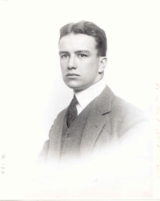
Richard Buckminster “Bucky” Fuller (July 12, 1895 – July 1, 1983) was an American systems theorist, author
Author
An author is broadly defined as "the person who originates or gives existence to anything" and that authorship determines responsibility for what is created. Narrowly defined, an author is the originator of any written work.-Legal significance:...

, designer, inventor, futurist and second president of Mensa International
Mensa International
Mensa is the largest and oldest high-IQ society in the world. It is a non-profit organization open to people who score at the 98th percentile or higher on a standardised, supervised IQ or other approved intelligence test...

, the high IQ society.
Discussion
Ask a question about 'Buckminster Fuller'
Start a new discussion about 'Buckminster Fuller'
Answer questions from other users
Full Discussion Forum
 
Quotations

Don't fight forces, use them.

Shelter (1932) Sometimes quoted as "Don't oppose forces, use them."

God is a verb.

No More Secondhand God (1963)

Thinking is a momentary dismissal of irrelevancies.

Utopia or Oblivion: The Prospects of Humanity (1969)

I live on Earth at present, and I don't know what I am. I know that I am not a category. I am not a thing — a noun. I seem to be a verb, an evolutionary process — an integral function of the universe.

I Seem to Be a Verb (1970)

I seek through comprehensive anticipatory design science and its reductions to physical practices to reform the environment instead of trying to reform humans, being intent thereby to accomplish prototyped capabilities of doing more with less... (en:1947|1947)

Earth, Inc. (1973) ISBN 0-385-01825-8 This is just part of a very long sentence that covers the whole first page, but in this part of the quote, the intention of the entire book is stated.

Nature is trying very hard to make us succeed, but nature does not depend on us. We are not the only experiment.

Interview (30 April 1978)
Encyclopedia
Richard Buckminster “Bucky” Fuller (July 12, 1895 – July 1, 1983) was an American systems theorist, author
Author
An author is broadly defined as "the person who originates or gives existence to anything" and that authorship determines responsibility for what is created. Narrowly defined, an author is the originator of any written work.-Legal significance:...

, designer, inventor, futurist and second president of Mensa International
Mensa International
Mensa is the largest and oldest high-IQ society in the world. It is a non-profit organization open to people who score at the 98th percentile or higher on a standardised, supervised IQ or other approved intelligence test...

, the high IQ society.

Fuller published more than 30 books, inventing and popularizing terms such as "Spaceship Earth
Spaceship Earth
Spaceship Earth is a world view term usually expressing concern over the use of limited resources available on Earth and the behavior of everyone on it to act as a harmonious crew working toward the greater good....

", ephemeralization
Ephemeralization
Ephemeralization, a term coined by R. Buckminster Fuller, is the ability of technological advancement to do "more and more with less and less until eventually you can do everything with nothing". Fuller's vision was that ephemeralization will result in ever-increasing standards of living for an...

, and synergetic
Synergetics (Fuller)
Synergetics is the empirical study of systems in transformation, with an emphasis on total system behavior unpredicted by the behavior of any isolated components, including humanity’s role as both participant and observer....

. He also developed numerous inventions, mainly architectural designs, the best known of which is the geodesic dome
Geodesic dome
A geodesic dome is a spherical or partial-spherical shell structure or lattice shell based on a network of great circles on the surface of a sphere. The geodesics intersect to form triangular elements that have local triangular rigidity and also distribute the stress across the structure. When...

. Carbon molecules known as fullerene
Fullerene
A fullerene is any molecule composed entirely of carbon, in the form of a hollow sphere, ellipsoid, or tube. Spherical fullerenes are also called buckyballs, and they resemble the balls used in association football. Cylindrical ones are called carbon nanotubes or buckytubes...

s were later named by scientists for their resemblance to geodesic spheres.

Biography


Fuller was born on July 12, 1895, in Milton, Massachusetts
Milton, Massachusetts
Milton is a town in Norfolk County, Massachusetts, United States and part of the Greater Boston area. The population was 27,003 at the 2010 census. Milton is the birthplace of former U.S. President George H. W. Bush and architect Buckminster Fuller. Milton also has the highest percentage of...

, the son of Richard Buckminster Fuller and Caroline Wolcott Andrews, and also the grandnephew of the American Transcendentalist
Transcendentalism
Transcendentalism is a philosophical movement that developed in the 1830s and 1840s in the New England region of the United States as a protest against the general state of culture and society, and in particular, the state of intellectualism at Harvard University and the doctrine of the Unitarian...

 Margaret Fuller
Margaret Fuller
Sarah Margaret Fuller Ossoli, commonly known as Margaret Fuller, was an American journalist, critic, and women's rights advocate associated with the American transcendentalism movement. She was the first full-time American female book reviewer in journalism...

. He attended Froebelian Kindergarten. Spending much of his youth on Bear Island, in Penobscot Bay
Penobscot Bay
Penobscot Bay originates from the mouth of Maine's Penobscot River. There are many islands in this bay, and on them, some of the country's most well-known summer colonies. The bay served as portal for the one time "lumber capital of the world," namely; the city of Bangor...

 off the coast of Maine, he had trouble with geometry
Geometry
Geometry arose as the field of knowledge dealing with spatial relationships. Geometry was one of the two fields of pre-modern mathematics, the other being the study of numbers ....

, being unable to understand the abstraction necessary to imagine that a chalk dot on the blackboard represented a mathematical point
Point (geometry)
In geometry, topology and related branches of mathematics a spatial point is a primitive notion upon which other concepts may be defined. In geometry, points are zero-dimensional; i.e., they do not have volume, area, length, or any other higher-dimensional analogue. In branches of mathematics...

, or that an imperfectly drawn line with an arrow on the end was meant to stretch off to infinity
Infinity
Infinity is a concept in many fields, most predominantly mathematics and physics, that refers to a quantity without bound or end. People have developed various ideas throughout history about the nature of infinity...

. He often made items from materials he brought home from the woods, and sometimes made his own tools. He experimented with designing a new apparatus for human propulsion of small boats.

Years later, he decided that this sort of experience had provided him with not only an interest in design, but also a habit of being familiar with and knowledgeable about the materials that his later projects would require. Fuller earned a machinist's
Machinist
A machinist is a person who uses machine tools to make or modify parts, primarily metal parts, a process known as machining. This is accomplished by using machine tools to cut away excess material much as a woodcarver cuts away excess wood to produce his work. In addition to metal, the parts may...

 certification, and knew how to use the press brake, stretch press, and other tools and equipment used in the sheet metal
Sheet metal
Sheet metal is simply metal formed into thin and flat pieces. It is one of the fundamental forms used in metalworking, and can be cut and bent into a variety of different shapes. Countless everyday objects are constructed of the material...

 trade.

Academia


Fuller attended Milton Academy
Milton Academy
Milton Academy is a coeducational, independent preparatory, boarding and day school in Milton, Massachusetts consisting of a grade 9–12 Upper School and a grade K–8 Lower School. Boarding is offered starting in 9th grade...

 in Massachusetts, and after that began studying at Harvard University
Harvard University
Harvard University is a private Ivy League university located in Cambridge, Massachusetts, United States, established in 1636 by the Massachusetts legislature. Harvard is the oldest institution of higher learning in the United States and the first corporation chartered in the country...

. He was expelled from Harvard twice: first for spending all his money partying with a vaudeville troupe, and then, after having been readmitted, for his "irresponsibility and lack of interest." By his own appraisal, he was a non-conforming misfit in the fraternity environment. It was to be many years before he received a Sc.D.
Doctor of Science
Doctor of Science , usually abbreviated Sc.D., D.Sc., S.D. or Dr.Sc., is an academic research degree awarded in a number of countries throughout the world. In some countries Doctor of Science is the name used for the standard doctorate in the sciences, elsewhere the Sc.D...

 from Bates College
Bates College
Bates College is a highly selective, private liberal arts college located in Lewiston, Maine, in the United States. and was most recently ranked 21st in the nation in the 2011 US News Best Liberal Arts Colleges rankings. The college was founded in 1855 by abolitionists...

 in Lewiston, Maine
Lewiston, Maine
Lewiston is a city in Androscoggin County in Maine, and the second-largest city in the state. The population was 41,592 at the 2010 census. It is one of two principal cities of and included within the Lewiston-Auburn, Maine metropolitan New England city and town area and the Lewiston-Auburn, Maine...

.

Wartime experience


Between his sessions at Harvard, Fuller worked in Canada
Canada
Canada is a North American country consisting of ten provinces and three territories. Located in the northern part of the continent, it extends from the Atlantic Ocean in the east to the Pacific Ocean in the west, and northward into the Arctic Ocean...

 as a mechanic in a textile
Textile
A textile or cloth is a flexible woven material consisting of a network of natural or artificial fibres often referred to as thread or yarn. Yarn is produced by spinning raw fibres of wool, flax, cotton, or other material to produce long strands...

 mill
Factory
A factory or manufacturing plant is an industrial building where laborers manufacture goods or supervise machines processing one product into another. Most modern factories have large warehouses or warehouse-like facilities that contain heavy equipment used for assembly line production...

, and later as a laborer in the meat-packing industry. He also served in the U.S. Navy
United States Navy
The United States Navy is the naval warfare service branch of the United States Armed Forces and one of the seven uniformed services of the United States. The U.S. Navy is the largest in the world; its battle fleet tonnage is greater than that of the next 13 largest navies combined. The U.S...

 in World War I
World War I
World War I , which was predominantly called the World War or the Great War from its occurrence until 1939, and the First World War or World War I thereafter, was a major war centred in Europe that began on 28 July 1914 and lasted until 11 November 1918...

, as a shipboard radio
Radio
Radio is the transmission of signals through free space by modulation of electromagnetic waves with frequencies below those of visible light. Electromagnetic radiation travels by means of oscillating electromagnetic fields that pass through the air and the vacuum of space...

 operator, as an editor of a publication, and as a crash rescue boat
Crash rescue boat
Crash Rescue Boat is a name used in the USA to describe military high-speed offshore rescue boats, similar in size and performance to Motor Torpedo Boats, used to rescue pilots and aircrews of crashed aircraft...

 commander. After discharge, he worked again in the meat packing industry, thereby acquiring management experience. In 1917, he married Anne Hewlett. During the early 1920s, he and his father-in-law developed the Stockade Building System
Stockade Building System
The Stockade Building System was designed by Richard Buckminster Fuller and his father-in-law, James Monroe Hewlett, and was patented in 1927. Both of them had previously formed a company, in 1922, which made bricks out of compressed wood shavings with vertical holes cast in them.- Design :The...

 for producing light-weight, weatherproof, and fireproof housing—although the company would ultimately fail.

Bankruptcy and depression


By age 32, Fuller was bankrupt
Bankruptcy
Bankruptcy is a legal status of an insolvent person or an organisation, that is, one that cannot repay the debts owed to creditors. In most jurisdictions bankruptcy is imposed by a court order, often initiated by the debtor....

 and jobless, living in public, low-income housing in Chicago, Illinois
Chicago
Chicago is the largest city in the US state of Illinois. With nearly 2.7 million residents, it is the most populous city in the Midwestern United States and the third most populous in the US, after New York City and Los Angeles...

. In 1922, Fuller's young daughter Alexandra died from complications from polio and spinal meningitis. Allegedly, he felt responsible and this caused him to drink frequently and to contemplate suicide
Suicide
Suicide is the act of intentionally causing one's own death. Suicide is often committed out of despair or attributed to some underlying mental disorder, such as depression, bipolar disorder, schizophrenia, alcoholism, or drug abuse...

 for a while. He finally chose to embark on "an experiment, to find what a single individual [could] contribute to changing the world and benefiting all humanity."

Recovery


In 1927 Fuller resolved to think independently which included a commitment to "the search for the principles governing the universe and help advance the evolution of humanity in accordance with them... finding ways of doing more with less to the end that all people everywhere can have more and more." By 1928, Fuller was living in Greenwich Village
Greenwich Village
Greenwich Village, , , , .in New York often simply called "the Village", is a largely residential neighborhood on the west side of Lower Manhattan in New York City. A large majority of the district is home to upper middle class families...

 and spending much of his time at the popular café Romany Marie
Romany Marie
Marie Marchand , known as Romany Marie, was a Greenwich Village restaurateur who played a key role in bohemianism from the early 1900s through the late 1950s in New York City's Manhattan.- Romany Marie's cafés :...

's, "Only two years before, on the brink of suicide, Fuller had decided to remake his life and the world. Why not begin on Minetta Street? In 1929, he was shopping around his first major design
Dymaxion house
The Dymaxion House was developed by inventor and architect Buckminster Fuller to address several perceived shortcomings with existing homebuilding techniques. Fuller designed several versions of the house at different times, but they were all factory manufactured kits, assembled on site, intended...

, plans for an inexpensive, modular home that others air-lift right where desired. Now, in exchange for meals, he took on the interior decoration and chairs for Marie's new location. He must have stood out in person, too, ever the talkative, handsome visionary in tie and starched collar."
See also: }} where he had spent an evening in conversation with Marie and Eugene O'Neill
Eugene O'Neill
Eugene Gladstone O'Neill was an American playwright and Nobel laureate in Literature. His poetically titled plays were among the first to introduce into American drama techniques of realism earlier associated with Russian playwright Anton Chekhov, Norwegian playwright Henrik Ibsen, and Swedish...

 several years earlier. Fuller accepted a job decorating the interior of the café
Café
A café , also spelled cafe, in most countries refers to an establishment which focuses on serving coffee, like an American coffeehouse. In the United States, it may refer to an informal restaurant, offering a range of hot meals and made-to-order sandwiches...

 in exchange for meals, giving informal lectures several times a week, and models of the Dymaxion house
Dymaxion house
The Dymaxion House was developed by inventor and architect Buckminster Fuller to address several perceived shortcomings with existing homebuilding techniques. Fuller designed several versions of the house at different times, but they were all factory manufactured kits, assembled on site, intended...

 were exhibited at the café. Isamu Noguchi
Isamu Noguchi
was a prominent Japanese American artist and landscape architect whose artistic career spanned six decades, from the 1920s onward. Known for his sculpture and public works, Noguchi also designed stage sets for various Martha Graham productions, and several mass-produced lamps and furniture pieces,...

 arrived during 1929—Constantin Brâncuşi
Constantin Brancusi
Constantin Brâncuşi was a Romanian-born sculptor who made his career in France. As a child he displayed an aptitude for carving wooden farm tools. Formal studies took him first to Bucharest, then to Munich, then to the École des Beaux-Arts in Paris...

, an old friend of Marie's, had directed him there—and Noguchi and Fuller were soon collaborating on several projects, including the modeling of the Dymaxion car
Dymaxion car
thumb|The Dymaxion car designed by inventor–architect [[Buckminster Fuller]].The Dymaxion car was a concept car designed by U.S. inventor and architect Buckminster Fuller in 1933. The word Dymaxion is a brand name that Fuller gave to several of his inventions, to emphasize that he considered them...

. It was the beginning of their lifelong friendship.

Geodesic domes


Fuller taught at Black Mountain College
Black Mountain College
Black Mountain College, a school founded in 1933 in Black Mountain, North Carolina, was a new kind of college in the United States in which the study of art was seen to be central to a liberal arts education, and in which John Dewey's principles of education played a major role...

 in North Carolina
North Carolina
North Carolina is a state located in the southeastern United States. The state borders South Carolina and Georgia to the south, Tennessee to the west and Virginia to the north. North Carolina contains 100 counties. Its capital is Raleigh, and its largest city is Charlotte...

 during the summers of 1948 and 1949, serving as its Summer Institute director in 1949. There, with the support of a group of professors and students, he began reinventing a project that would make him famous: the geodesic dome
Geodesic dome
A geodesic dome is a spherical or partial-spherical shell structure or lattice shell based on a network of great circles on the surface of a sphere. The geodesics intersect to form triangular elements that have local triangular rigidity and also distribute the stress across the structure. When...

. Although the geodesic dome had been created some 30 years earlier by Dr. Walther Bauersfeld
Walther Bauersfeld
Walther Bauersfeld was a German engineer, employed by the Zeiss Corporation, who, on a suggestion by the German astronomer Max Wolf, started work on the first projection planetarium in 1912. This work was stopped by military needs during World War I, but resumed after the war...

, Fuller was awarded United States patents. He is credited for popularizing this type of structure.

One of his early models was first constructed in 1945 at Bennington College
Bennington College
Bennington College is a liberal arts college located in Bennington, Vermont, USA. The college was founded in 1932 as a women's college and became co-educational in 1969.-History:-Early years:...

 in Vermont, where he frequently lectured. In 1949, he erected his first geodesic dome building that could sustain its own weight with no practical limits. It was 4.3 meters (14 ft) in diameter and constructed of aluminum aircraft tubing and a vinyl-plastic skin, in the form of an icosahedron
Icosahedron
In geometry, an icosahedron is a regular polyhedron with 20 identical equilateral triangular faces, 30 edges and 12 vertices. It is one of the five Platonic solids....

. To prove his design, and to awe non-believers, Fuller suspended from the structure's framework several students who had helped him build it. The U.S. government recognized the importance of his work, and employed his firm Geodesics, Inc. in Raleigh, North Carolina to make small domes for the army. Within a few years there were thousands of these domes around the world.

Best-known work


For the next half-century, Fuller developed many ideas, designs and inventions, particularly regarding practical, inexpensive shelter and transportation. He documented his life, philosophy and ideas scrupulously by a daily diary
Diary
A diary is a record with discrete entries arranged by date reporting on what has happened over the course of a day or other period. A personal diary may include a person's experiences, and/or thoughts or feelings, including comment on current events outside the writer's direct experience. Someone...

 (later called the Dymaxion Chronofile
Dymaxion Chronofile
The Dymaxion Chronofile is Buckminster Fuller's attempt to document his life as completely as possible. He created a very large scrapbook in which he documented his life every 15 minutes from 1920 to 1983. The scrapbook contains copies of all correspondence, bills, notes, sketches, and clippings...

), and by twenty-eight publications. Fuller financed some of his experiments with inherited funds, sometimes augmented by funds invested by his collaborators, one example being the Dymaxion car
Dymaxion car
thumb|The Dymaxion car designed by inventor–architect [[Buckminster Fuller]].The Dymaxion car was a concept car designed by U.S. inventor and architect Buckminster Fuller in 1933. The word Dymaxion is a brand name that Fuller gave to several of his inventions, to emphasize that he considered them...

 project.

World stage


International recognition began with the success of his huge geodesic dome
Geodesic dome
A geodesic dome is a spherical or partial-spherical shell structure or lattice shell based on a network of great circles on the surface of a sphere. The geodesics intersect to form triangular elements that have local triangular rigidity and also distribute the stress across the structure. When...

s during the 1950s. Fuller lectured at NC State University in Raleigh in 1949, where he met James Fitzgibbon, who would become a close friend and colleague. Fitzgibbon was director of Geodesics, Inc. and Synergetics, Inc. the first licensees to design geodesic domes. From 1959 to 1970, Fuller taught at Southern Illinois University Carbondale
Southern Illinois University Carbondale
Southern Illinois University Carbondale is a public research university located in Carbondale, Illinois, United States. Founded in 1869, SIUC is the flagship campus of the Southern Illinois University system...

. Beginning as an assistant professor, he gained full professorship in 1968, in the School of Art and Design. Working as a designer, scientist, developer, and writer, he lectured for many years around the world. He collaborated at SIU with the designer John McHale
John McHale (artist)
John McHale was an artist and sociologist. He was a founder member of the Institute of Contemporary Arts, and a founder of the Independent Group, which was a British movement that originated Pop Art which grew out of a fascination with American mass culture and post-WWII technologies...

. In 1965, Fuller inaugurated the World Design Science Decade (1965 to 1975) at the meeting of the International Union of Architects
International Union of Architects
The International Union of Architects is an international non-governmental organization that represents over a million architects in 124 countries. The UIA was founded in Lausanne, Switzerland, in 1948. The General Secretariat is located in Paris...

 in Paris, which was, in his own words, devoted to "applying the principles of science to solving the problems of humanity."

Fuller believed human societies would soon rely mainly on renewable sources of energy, such as solar- and wind-derived electricity. He hoped for an age of "omni-successful education and sustenance of all humanity." For his lifetime of work, the American Humanist Association
American Humanist Association
The American Humanist Association is an educational organization in the United States that advances Humanism. "Humanism is a progressive philosophy of life that, without theism and other supernatural beliefs, affirms our ability and responsibility to lead ethical lives of personal fulfillment that...

 named him the 1969 Humanist of the Year.

Honors


Fuller was awarded 28 United States patents and many honorary doctorates. In 1960, he was awarded the Frank P. Brown Medal from The Franklin Institute. He was elected a Fellow of the American Academy of Arts and Sciences
American Academy of Arts and Sciences
The American Academy of Arts and Sciences is an independent policy research center that conducts multidisciplinary studies of complex and emerging problems. The Academy’s elected members are leaders in the academic disciplines, the arts, business, and public affairs.James Bowdoin, John Adams, and...

 in 1968. On January 16, 1970, he received the Gold Medal award from the American Institute of Architects
American Institute of Architects
The American Institute of Architects is a professional organization for architects in the United States. Headquartered in Washington, D.C., the AIA offers education, government advocacy, community redevelopment, and public outreach to support the architecture profession and improve its public image...

. He also received numerous other awards, including the Presidential Medal of Freedom
Presidential Medal of Freedom
The Presidential Medal of Freedom is an award bestowed by the President of the United States and is—along with thecomparable Congressional Gold Medal bestowed by an act of U.S. Congress—the highest civilian award in the United States...

 presented to him on February 23, 1983 by President Ronald Reagan
Ronald Reagan
Ronald Wilson Reagan was the 40th President of the United States , the 33rd Governor of California and, prior to that, a radio, film and television actor....

.

Last filmed appearance


Fuller's last filmed interview took place on April 3, 1983, in which he presented his analysis of Simon Rodia
Simon Rodia
Sabato "Simon" Rodia was an Italian-American architect. Rodia created the Watts Towers, one of the most famous landmarks in Los Angeles.-Biography:...

's Watts Towers
Watts Towers
The Watts Towers or Towers of Simon Rodia in the Watts district of Los Angeles, California, is a collection of 17 interconnected structures, two of which reach heights of over 99 feet . The Towers were built by Italian immigrant construction worker Sabato Rodia in his spare time over a period of...

 as a unique embodiment of the structural principles found in nature. Portions of this interview appear in I Build the Tower
I Build the Tower
I Build the Tower is a feature-length documentary film depicting the life of Sabato Rodia , the Italian immigrant who created the Watts Towers in South Los Angeles....

,
a documentary film
Documentary film
Documentary films constitute a broad category of nonfictional motion pictures intended to document some aspect of reality, primarily for the purposes of instruction or maintaining a historical record...

 on Rodia's architectural masterpiece.

Death


Fuller died on July 1, 1983, 11 days before his 88th birthday. During the period leading up to his death, his wife had been lying coma
Coma
In medicine, a coma is a state of unconsciousness, lasting more than 6 hours in which a person cannot be awakened, fails to respond normally to painful stimuli, light or sound, lacks a normal sleep-wake cycle and does not initiate voluntary actions. A person in a state of coma is described as...

tose in a Los Angeles hospital, dying of cancer
Cancer
Cancer , known medically as a malignant neoplasm, is a large group of different diseases, all involving unregulated cell growth. In cancer, cells divide and grow uncontrollably, forming malignant tumors, and invade nearby parts of the body. The cancer may also spread to more distant parts of the...

. It was while visiting her there that he exclaimed, at a certain point: "She is squeezing my hand!" He then stood up, suffered a heart attack
Myocardial infarction
Myocardial infarction or acute myocardial infarction , commonly known as a heart attack, results from the interruption of blood supply to a part of the heart, causing heart cells to die...

, and died an hour later, at age 87. His wife of 66 years died 36 hours later. They are buried in Mount Auburn Cemetery
Mount Auburn Cemetery
Mount Auburn Cemetery was founded in 1831 as "America's first garden cemetery", or the first "rural cemetery", with classical monuments set in a rolling landscaped terrain...

 in Cambridge, Massachusetts.

Philosophy and worldview


The grandson of a Unitarian
Unitarianism
Unitarianism is a Christian theological movement, named for its understanding of God as one person, in direct contrast to Trinitarianism which defines God as three persons coexisting consubstantially as one in being....

 minister (Arthur Buckminster Fuller), R. Buckminster Fuller was also Unitarian. Buckminster Fuller was an early environmental activist. He was very aware of the finite resources the planet has to offer, and promoted a principle that he termed "ephemeralization
Ephemeralization
Ephemeralization, a term coined by R. Buckminster Fuller, is the ability of technological advancement to do "more and more with less and less until eventually you can do everything with nothing". Fuller's vision was that ephemeralization will result in ever-increasing standards of living for an...

", which, in essence—according to futurist and Fuller disciple Stewart Brand
Stewart Brand
Stewart Brand is an American writer, best known as editor of the Whole Earth Catalog. He founded a number of organizations including The WELL, the Global Business Network, and the Long Now Foundation...

—Fuller coined to mean "doing more with less". Resources and waste material from cruder products could be recycled into making more valuable products, increasing the efficiency of the entire process. Fuller also introduced synergetics
Synergetics (Fuller)
Synergetics is the empirical study of systems in transformation, with an emphasis on total system behavior unpredicted by the behavior of any isolated components, including humanity’s role as both participant and observer....

, an encompassing term which he used broadly as a metaphoric language for communicating experiences using geometric concepts and, more specifically, to reference the empirical study of systems in transformation, with an emphasis on total system behavior unpredicted by the behavior of any isolated components. Fuller coined this term long before the term synergy
Synergy
Synergy may be defined as two or more things functioning together to produce a result not independently obtainable.The term synergy comes from the Greek word from , , meaning "working together".-Definitions and usages:...

 became popular.

Fuller was a pioneer in thinking globally, and he explored principles of energy
Energy conversion efficiency
Energy conversion efficiency is the ratio between the useful output of an energy conversion machine and the input, in energy terms. The useful output may be electric power, mechanical work, or heat.-Overview:...

 and material efficiency
Material efficiency
Material efficiency is a description or metric which expresses the degree in which usage of raw materials, construction projects or physical processes are used or carried out in a manner which consumes, incorporates, or wastes less of a given material compared to previous measures...

 in the fields of architecture
Architecture
Architecture is both the process and product of planning, designing and construction. Architectural works, in the material form of buildings, are often perceived as cultural and political symbols and as works of art...

, engineering
Engineering
Engineering is the discipline, art, skill and profession of acquiring and applying scientific, mathematical, economic, social, and practical knowledge, in order to design and build structures, machines, devices, systems, materials and processes that safely realize improvements to the lives of...

 and design
Design
Design as a noun informally refers to a plan or convention for the construction of an object or a system while “to design” refers to making this plan...

. He cited François de Chardenedes' opinion that petroleum
Petroleum
Petroleum or crude oil is a naturally occurring, flammable liquid consisting of a complex mixture of hydrocarbons of various molecular weights and other liquid organic compounds, that are found in geologic formations beneath the Earth's surface. Petroleum is recovered mostly through oil drilling...

, from the standpoint of its replacement cost out of our current energy "budget" (essentially, the net incoming solar flux), had cost nature "over a million dollars" per U.S. gallon (US$300,000 per litre) to produce. From this point of view, its use as a transportation fuel by people commuting to work represents a huge net loss compared to their earnings. An encapsulation quotation of his views might be, "There is no energy crisis, only a crisis of ignorance."

Fuller was concerned about sustainability
Sustainability
Sustainability is the capacity to endure. For humans, sustainability is the long-term maintenance of well being, which has environmental, economic, and social dimensions, and encompasses the concept of union, an interdependent relationship and mutual responsible position with all living and non...

 and about human survival under the existing socio-economic system, yet remained optimistic about humanity's future. Defining wealth in terms of knowledge, as the "technological ability to protect, nurture, support, and accommodate all growth needs of life," his analysis of the condition of "Spaceship Earth" caused him to conclude that at a certain time during the 1970s, humanity had attained an unprecedented state. He was convinced that the accumulation of relevant knowledge, combined with the quantities of major recyclable resources that had already been extracted from the earth, had attained a critical level, such that competition for necessities was not necessary anymore. Cooperation had become the optimum survival strategy. "Selfishness," he declared, "is unnecessary and hence-forth unrationalizable.... War is obsolete." He criticized previous utopian schemes as too exclusive, and thought this was a major source of their failure. To work, he thought that a utopia needed to include everyone.

Fuller also claimed that the natural analytic geometry
Analytic geometry
Analytic geometry, or analytical geometry has two different meanings in mathematics. The modern and advanced meaning refers to the geometry of analytic varieties...

 of the universe was based on arrays of tetrahedra. He developed this in several ways, from the close-packing of spheres and the number of compressive or tensile members required to stabilize an object in space. One confirming result was that the strongest possible homogeneous truss
Truss
In architecture and structural engineering, a truss is a structure comprising one or more triangular units constructed with straight members whose ends are connected at joints referred to as nodes. External forces and reactions to those forces are considered to act only at the nodes and result in...

 is cyclically tetrahedral.

In his 1970 book I Seem To Be a Verb, he wrote: "I live on Earth at present, and I don't know what I am. I know that I am not a category. I am not a thing—a noun. I seem to be a verb, an evolutionary process—an integral function of the universe."

He had become a guru
Guru
A guru is one who is regarded as having great knowledge, wisdom, and authority in a certain area, and who uses it to guide others . Other forms of manifestation of this principle can include parents, school teachers, non-human objects and even one's own intellectual discipline, if the...

 of the design, architecture, and 'alternative' communities, such as Drop City
Drop City
Drop City was an artists' community that formed in southern Colorado in 1965. Abandoned by the early 1970s, it became known as the first rural "hippie commune".-Establishment:...

, the community of experimental artists to whom he awarded the 1966 "Dymaxion Award" for "poetically economic" domed living structures.

Major design projects


A geodesic sphere.

The geodesic dome


Fuller was most famous for his lattice shell structures
Thin-shell structure
Thin-shell structures are light weight constructions using shell elements. These elements are typically curved and are assembled to large structures...

 - geodesic dome
Geodesic dome
A geodesic dome is a spherical or partial-spherical shell structure or lattice shell based on a network of great circles on the surface of a sphere. The geodesics intersect to form triangular elements that have local triangular rigidity and also distribute the stress across the structure. When...

s, which have been used as parts of military radar stations, civic buildings, environmental protest camps and exhibition attractions. An examination of the geodesic design by Bauersfeld for the Zeiss Planetarium
Planetarium
A planetarium is a theatre built primarily for presenting educational and entertaining shows about astronomy and the night sky, or for training in celestial navigation...

, built some 20 years prior to Fuller's work, reveals that Fuller's Geodesic Dome patent (U.S. 2,682,235; awarded in 1954), follows the same methodology as Bauersfeld's design.

Their construction is based on extending some basic principles to build simple "tensegrity
Tensegrity
Tensegrity, tensional integrity or floating compression, is a structural principle based on the use of isolated components in compression inside a net of continuous tension, in such a way that the compressed members do not touch each other and the prestressed tensioned members delineate the...

" structures (tetrahedron, octahedron
Octahedron
In geometry, an octahedron is a polyhedron with eight faces. A regular octahedron is a Platonic solid composed of eight equilateral triangles, four of which meet at each vertex....

, and the closest packing of spheres), making them lightweight and stable. The geodesic dome was a result of Fuller's exploration of nature's constructing principles to find design solutions. The Fuller Dome is referenced in the Hugo Award
Hugo Award
The Hugo Awards are given annually for the best science fiction or fantasy works and achievements of the previous year. The award is named after Hugo Gernsback, the founder of the pioneering science fiction magazine Amazing Stories, and was officially named the Science Fiction Achievement Awards...

-winning novel Stand on Zanzibar
Stand on Zanzibar
Stand on Zanzibar is a dystopian New Wave science fiction novel written by John Brunner and first published in 1968. The book won a Hugo Award for Best Novel at the 27th World Science Fiction Convention in 1969, as well as the 1969 BSFA Award and the 1973 Prix Tour-Apollo Award.-Description:A...

by John Brunner
John Brunner (novelist)
John Kilian Houston Brunner was a prolific British author of science fiction novels and stories. His 1968 novel Stand on Zanzibar, about an overpopulated world, won the 1968 Hugo Award for best science fiction novel. It also won the BSFA award the same year...

, in which a geodesic dome is said to cover the entire island of Manhattan
Manhattan
Manhattan is the oldest and the most densely populated of the five boroughs of New York City. Located primarily on the island of Manhattan at the mouth of the Hudson River, the boundaries of the borough are identical to those of New York County, an original county of the state of New York...

, and it floats on air due to the hot-air balloon effect of the large air-mass under the dome (and perhaps its construction of lightweight materials).

Transportation


In the 1930s, Fuller designed and built prototypes of what he hoped would be a safer, aerodynamic car, which he called the Dymaxion
Dymaxion car
thumb|The Dymaxion car designed by inventor–architect [[Buckminster Fuller]].The Dymaxion car was a concept car designed by U.S. inventor and architect Buckminster Fuller in 1933. The word Dymaxion is a brand name that Fuller gave to several of his inventions, to emphasize that he considered them...

. ("Dymaxion" is said to be a syllabic abbreviation of dynamic maximum tension, or possibly of dynamic maximum ion.) Fuller worked with professional colleagues for three years beginning in 1932 on a design idea Fuller had derived from aircraft technologies. The three prototype cars were different from anything being sold at the time. They had three wheels: two front drive wheels and one rear, steered wheel. The engine was in the rear, and the chassis and body were original designs. The aerodynamic, somewhat tear-shaped body was large enough to seat eleven people and was about 18 feet (5.5 m) long, resembling a blend of a light aircraft (without wings) and a Volkswagen
Volkswagen
Volkswagen is a German automobile manufacturer and is the original and biggest-selling marque of the Volkswagen Group, which now also owns the Audi, Bentley, Bugatti, Lamborghini, SEAT, and Škoda marques and the truck manufacturer Scania.Volkswagen means "people's car" in German, where it is...

 van of 1950s vintage. All three prototypes were essentially a mini-bus, and its concept long predated the Volkswagen Type 2
Volkswagen Type 2
The Volkswagen Type 2, officially known as the Transporter or Kombi informally as Bus or Camper , was a panel van introduced in 1950 by German automaker Volkswagen as its second car model – following and initially deriving from Volkswagen's first model, the Type 1 , it was given the factory...

 mini-bus conceived in 1947 by Ben Pon
Ben Pon (senior)
Ben Pon was a Dutch businessman. In 1947, Pon's Automobielhandel , became the first dealer outside of Germany to sell vehicles manufactured by Volkswagen....

.

Despite its length, and due to its three-wheel design, the Dymaxion turned on a small radius
Turning radius
The turning radius or turning circle of a vehicle is the size of the smallest circular turn that the vehicle is capable of making. The term turning radius is actually a misnomer, since the size of a circle is actually its diameter, not its radius. The less ambiguous term turning circle is preferred...

 and could easily be parked in a tight space. The prototypes were efficient in fuel consumption for their day, traveling about 30 miles per gallon. Fuller contributed a great deal of his own money to the project, in addition to funds from one of his professional collaborators. An industrial investor was also very interested in the concept. Fuller anticipated the cars could travel on an open highway safely at up to about 160 km/h (100 miles per hour), but, in practise, they were difficult to control and steer above 80 km/h (50 mph). Investors backed out and research ended after one of the prototypes was involved in a high-profile collision that resulted in a fatality. In 2007, Time Magazine reported on the Dymaxion as one of the "50 worst cars
CARS
Cars, or automobiles, motor cars, are wheeled motor vehicles used for transporting passengers.Cars or CARS may also refer to:-Entertainment:* Cars , a Disney/Pixar film series...

 of all time".

In 1943, industrialist Henry J. Kaiser
Henry J. Kaiser
Henry John Kaiser was an American industrialist who became known as the father of modern American shipbuilding. He established the Kaiser Shipyard which built Liberty ships during World War II, after which he formed Kaiser Aluminum and Kaiser Steel. Kaiser organized Kaiser Permanente health care...

 asked Fuller to develop a prototype for a smaller car, but Fuller's five-seater design was never developed further.

Housing


Fuller's energy-efficient and inexpensive Dymaxion House
Dymaxion house
The Dymaxion House was developed by inventor and architect Buckminster Fuller to address several perceived shortcomings with existing homebuilding techniques. Fuller designed several versions of the house at different times, but they were all factory manufactured kits, assembled on site, intended...

 garnered much interest, but has never been produced. Here the term "Dymaxion" is used in effect to signify a "radically strong and light tensegrity structure". One of Fuller's Dymaxion Houses is on display as a permanent exhibit at The Henry Ford in Dearborn, Michigan
Dearborn, Michigan
-Economy:Ford Motor Company has its world headquarters in Dearborn. In addition its Dearborn campus contains many research, testing, finance and some production facilities. Ford Land controls the numerous properties owned by Ford including sales and leasing to unrelated businesses such as the...

. Designed and developed during the mid-1940s, this prototype is a round structure (not a dome), shaped something like the flattened "bell" of certain jellyfish. It has several innovative features, including revolving dresser drawers, and a fine-mist shower that reduces water consumption. According to Fuller biographer Steve Crooks, the house was designed to be delivered in two cylindrical packages, with interior color panels available at local dealers. A circular structure at the top of the house was designed to rotate around a central mast to use natural winds for cooling and air circulation.

Conceived nearly two decades before, and developed in Wichita, Kansas
Wichita, Kansas
Wichita is the largest city in the U.S. state of Kansas.As of the 2010 census, the city population was 382,368. Located in south-central Kansas on the Arkansas River, Wichita is the county seat of Sedgwick County and the principal city of the Wichita metropolitan area...

, the house was designed to be lightweight and adapted to windy climates. It was to be inexpensive to produce and purchase, and assembled easily. It was to be produced using factories, workers and technologies that had produced World War II aircraft. It was ultramodern-looking at the time, built of metal, and sheathed in polished aluminum. The basic model enclosed 90 m² (1000 square feet) of floor area. Due to publicity, there were many orders during the early Post-War years, but the company that Fuller and others had formed to produce the houses failed due to management problems.

In 1969, Fuller began the Otisco Project, named after its location in Otisco, New York
Otisco, New York
Otisco is a town in Onondaga County, New York, United States. The population was 2,561 at the 2000 census. The Town of Otisco is in the southwest part of the county. Otisco is situated at the northern edge of the Appalacian Highlands, where an escarpment declines to the Lake Ontario plain and the...

. The project developed and demonstrated concrete
Concrete
Concrete is a composite construction material, composed of cement and other cementitious materials such as fly ash and slag cement, aggregate , water and chemical admixtures.The word concrete comes from the Latin word...

 spray technology used in conjunction with mesh covered wireforms as a viable means of producing large scale, load bearing spanning structures built on site without the use of pouring molds, other adjacent surfaces or hoisting.

The initial construction method used a circular concrete footing in which anchor posts were set. Tubes cut to length and with ends flattened were then bolted together to form a duodeca-rhombicahedron (22 sided hemisphere) geodesic structure with spans ranging to 60 feet (18.3 m). The form was then draped with layers of ¼-inch wire mesh attached by twist ties. Concrete was then sprayed onto the structure, building up a solid layer which, when cured, would support additional concrete to be added by a variety of traditional means. Fuller referred to these buildings as monolithic ferroconcrete geodesic domes. The tubular frame form proved too problematic when it came to setting windows and doors, and was abandoned. The second method used iron rebar
Rebar
A rebar , also known as reinforcing steel, reinforcement steel, rerod, or a deformed bar, is a common steel bar, and is commonly used as a tensioning device in reinforced concrete and reinforced masonry structures holding the concrete in compression...

 set vertically in the concrete footing and then bent inward and welded in place to create the dome's wireform structure and performed satisfactorily. Domes up to three stories tall built with this method proved to be remarkably strong. Other shapes such as cones, pyramids and arches proved equally adaptable.

The project was enabled by a grant underwritten by Syracuse University
Syracuse University
Syracuse University is a private research university located in Syracuse, New York, United States. Its roots can be traced back to Genesee Wesleyan Seminary, founded by the Methodist Episcopal Church in 1832, which also later founded Genesee College...

 and sponsored by US Steel (rebar), the Johnson Wire Corp, (mesh) and Portland Cement Company (concrete). The ability to build large complex load bearing concrete spanning structures in free space would open many possibilities in architecture, and is considered as one of Fuller's greatest contributions.

Alternative map projection


Fuller also designed an alternative projection map, called the Dymaxion map
Dymaxion map
The Dymaxion map or Fuller map is a projection of a world map onto the surface of a polyhedron, which can be unfolded and flattened to two dimensions. The projection depicts the earth's continents as "one island," or nearly contiguous land masses. The arrangement heavily interrupts the map in order...

. This was designed to show Earth's continents with minimum distortion when projected or printed on a flat surface.

Quirks


Fuller was a frequent flier, often crossing time zones. He famously wore three watches; one for the current zone, one for the zone he had departed, and one for the zone he was going to. In this respect he follows the jazz drummer Buddy Rich
Buddy Rich
Bernard "Buddy" Rich was an American jazz drummer and bandleader. Rich was billed as "the world's greatest drummer" and was known for his virtuosic technique, power, groove, and speed.-Early life:...

, who in the Pete Atkin
Pete Atkin
Pete Atkin is a British singer-songwriter and radio producer notable for his 1970s musical collaborations with Clive James and for producing the BBC Radio 4 series This Sceptred Isle.-Early life:...

 / Clive James
Clive James
Clive James, AM is an Australian author, critic, broadcaster, poet and memoirist, best known for his autobiographical series Unreliable Memoirs, for his chat shows and documentaries on British television and for his prolific journalism...

 song “The Wristwatch for a Drummer”, also “wears three, one on the right wrist, one on the left, and the third one around his knee”. The wristwatch in question is the imagined “Omega Incabloc Oyster Accutron 72” for which “Buckminster Fuller designed the case” Fuller also noted that a single sheet of newsprint, inserted over a shirt and under a suit jacket, provided completely effective heat insulation during long flights.

He experimented with polyphasic sleep
Polyphasic sleep
Polyphasic sleep, a term coined by early 20th-century psychologist J.S. Szymanski, refers to the practice of sleeping multiple times in a 24-hour period—usually more than two, in contrast to biphasic sleep or monophasic sleep . It does not imply any particular sleep schedule...

, which he called Dymaxion sleep. In 1943, he told Time Magazine that he had slept only two hours a day for two years. He quit the schedule because it conflicted with his business associates' sleep habits, but stated that Dymaxion sleep could help the United States win World War II.

Fuller documented his life copiously from 1915 to 1983, approximately 270 feet (82.3 m) of papers in a collection called the Dymaxion Chronofile. He also kept copies of all incoming and outgoing correspondence. The enormous Fuller Collection is currently housed at Stanford University.
If somebody kept a very accurate record of a human being, going through the era from the Gay 90s, from a very different kind of world through the turn of the century—as far into the twentieth century as you might live. I decided to make myself a good case history of such a human being and it meant that I could not be judge of what was valid to put in or not. I must put everything in, so I started a very rigorous record.

Practical achievements


Fuller introduced a number of concepts, and helped develop others.
Certainly, a number of his projects were not successful in terms of commitment from industry or acceptance by most of the public. However, more than 500,000 geodesic domes have been built around the world and many are in use. According to the Buckminster Fuller Institute, the largest geodesic-dome structures are:
  • Seagaia Ocean Dome: Miyazaki, Japan, 216 m (710 ft).
  • Multi-Purpose Arena: Nagoya, Japan, 187 m (614 ft).
  • Tacoma Dome
    Tacoma Dome
    The Tacoma Dome is an indoor arena located in Tacoma, Washington, USA, approximately 30 miles south of Seattle.-History:...

    : Tacoma, Washington, USA, 162 m (530 ft).
  • Superior Dome
    Superior Dome
    The Superior Dome, which opened as the "world’s largest wooden dome" on September 14, 1991, is a domed stadium on the campus of Northern Michigan University in Marquette, Michigan. It is home to the Northern Michigan Wildcats football team, as well as a variety of campus and community events...

    : Northern Michigan Univ. Marquette, Michigan
    Marquette, Michigan
    Marquette is a city in the U.S. state of Michigan and the county seat of Marquette County. The population was 21,355 at the 2010 census, making it the most populated city of the Upper Peninsula. Marquette is a major port on Lake Superior, primarily for shipping iron ore and is the home of Northern...

    , USA, 160 m (525 ft).
  • Walkup Skydome
    Walkup Skydome
    The J. Lawrence Walkup Skydome is an indoor multi-purpose stadium in Flagstaff, Arizona, on the campus of Northern Arizona University. Opened in September 1977, it is the home of the NAU Lumberjacks football and basketball teams of the Big Sky Conference. The seating capacity is 16,230, with...

    : Northern Arizona Univ. Flagstaff, Arizona
    Flagstaff, Arizona
    Flagstaff is a city located in northern Arizona, in the southwestern United States. In 2010, the city's population was 65,870. The population of the Metropolitan Statistical Area was at 134,421 in 2010. It is the county seat of Coconino County...

    , USA, 153 m (502 ft).
  • Poliedro de Caracas
    Poliedro de Caracas
    The Poliedro de Caracas is an indoor sports arena, located on the grounds adjacent to Hipodromo La Rinconada, in Caracas, Venezuela. It was designed by architect Thomas C. Howard of Synergetics, Inc, in Raleigh, NCin 1971...

    : Caracas
    Caracas
    Caracas , officially Santiago de León de Caracas, is the capital and largest city of Venezuela; natives or residents are known as Caraquenians in English . It is located in the northern part of the country, following the contours of the narrow Caracas Valley on the Venezuelan coastal mountain range...

    , Venezuela, 145 m (475 ft).
  • Round Valley High School Stadium: Springerville-Eagar, Arizona
    Eagar, Arizona
    Eagar is a town in Apache County, Arizona, United States. According to 2006 Census Bureau estimates, the population of the town is 4,126.Eagar was first settled in 1871.-Geography:Eagar is located at ....

    , USA, 134 m (440 ft).
  • Former Spruce Goose Hangar: Long Beach, California
    Long Beach, California
    Long Beach is a city situated in Los Angeles County in Southern California, on the Pacific coast of the United States. The city is the 36th-largest city in the nation and the seventh-largest in California. As of 2010, its population was 462,257...

    , USA, 126 m (415 ft).
  • Formosa Plastics Storage Facility: Mai Liao, Taiwan, 123 m (402 ft).
  • Union Tank Car Maintenance Facility: Baton Rouge, Louisiana
    Baton Rouge, Louisiana
    Baton Rouge is the capital of the U.S. state of Louisiana. It is located in East Baton Rouge Parish and is the second-largest city in the state.Baton Rouge is a major industrial, petrochemical, medical, and research center of the American South...

     USA, 117 m (384 ft), destroyed in November 2007.
  • Lehigh Portland Cement Storage Facility: Union Bridge, Maryland
    Union Bridge, Maryland
    Union Bridge is a town in Carroll County, Maryland, United States. The population was 989 at the 2000 census.Much of the town was added to the National Register of Historic Places as the Union Bridge Historic District in 1994.-Geography:...

     USA, 114 m (374 ft).
  • The Eden Project
    Eden Project
    The Eden Project is a visitor attraction in Cornwall in the United Kingdom, including the world's largest greenhouse. Inside the artificial biomes are plants that are collected from all around the world....

    , Cornwall, United Kingdom

Other notable domes include:
  • Spaceship Earth at Disney World's Epcot Center in Florida, 80.8-meters (265 ft) wide (Spaceship Earth is actually a self supporting geodesic sphere, the only one currently in existence.)
  • The Gold Dome
    Gold Dome
    The Gold Dome, a geodesic dome in Oklahoma City, Oklahoma, is a landmark on the famous Route 66. It was built in 1958 and is located at the intersection of North West 23rd Street and North Classen Boulevard. It was declared eligible to be listed in the National Register of Historic Places in...

     in Oklahoma City, formerly a bank and now a multicultural society and business center.
  • Downtown Vancouver, British Columbia, is a geodesic sphere hosting the Telus World of Science
    TELUS World of Science
    Telus World of Science is a "brand" for a number of science centre, planetarium, and space centre facilities in Canada sponsored by Telus, a Canadian telecommunications company...

    , a science centre (formerly called Science World), that was originally the Expo Centre built for Expo 86
    Expo 86
    The 1986 World Exposition on Transportation and Communication, or simply Expo '86, was a World's Fair held in Vancouver, British Columbia, Canada from Friday, May 2 until Monday, October 13, 1986...

    .
  • The dome over a shopping center in downtown Ankara, Turkey, 109.7-meter (360 ft) tall
  • The dome enclosing a civic center in Stockholm, Sweden, 85.3-meter (280 ft) high.
  • The world's largest aluminum dome formerly housed the “Spruce Goose” airplane in Long Beach Harbor, California, USA.


However, contrary to Fuller's hopes, domes are not an everyday sight in most places. In practice, most of the smaller owner-built geodesic structures had disadvantages (see geodesic domes), including their unconventional appearance.

A spin-off of Fuller's dome-design conceptualization was the Buckminster Ball, which was the official FIFA approved design for footballs (association football), from their introduction at the 1970 World Cup until recently. The design was a truncated icosahedron
Truncated icosahedron
In geometry, the truncated icosahedron is an Archimedean solid, one of thirteen convex isogonal nonprismatic solids whose faces are two or more types of regular polygons.It has 12 regular pentagonal faces, 20 regular hexagonal faces, 60 vertices and 90 edges....

 -- essentially a "Geodesic Sphere", consisting of 12 pentagonal and 20 hexagonal panels. This was used continuously for 34 years until replaced by the 14-panel Teamgeist for the 2006 World Cup.

Fuller was followed (historically) by other designers and architects, such as Sir Norman Foster and Steve Baer
Steve Baer
Steve Baer is an American inventor and solar and residential designer. Baer has served on the board of directors of the U.S. Section of the International Solar Energy Society, and on the board of the New Mexico Solar Energy Association. He is the Founder, Chairman of the Board, President, and...

, willing to explore the possibilities of new geometries in the design of buildings, not based on conventional rectangles.

Language and neologisms


Buckminster Fuller spoke and wrote in a unique style and said it was important to describe the world as accurately as possible. Fuller often created long run-on sentences and used unusual compound words (omniwell-informed, intertransformative, omni-interaccommodative, omniself-regenerative) as well as terms he himself invented.

Fuller used the word Universe without the definite
Definite Article
Definite Article is the title of British comedian Eddie Izzard's 1996 performance released on VHS. It was recorded on different nights at the Shaftesbury Theatre...

 or indefinite articles (the or a) and always capitalized the word. Fuller wrote that "by Universe I mean: the aggregate of all humanity's consciously apprehended and communicated (to self or others) Experiences."

The words "down" and "up", according to Fuller, are awkward in that they refer to a planar concept of direction inconsistent with human experience. The words "in" and "out" should be used instead, he argued, because they better describe an object's relation to a gravitational center, the Earth. "I suggest to audiences that they say, 'I'm going "outstairs" and "instairs."' At first that sounds strange to them; They all laugh about it. But if they try saying in and out for a few days in fun, they find themselves beginning to realize that they are indeed going inward and outward in respect to the center of Earth, which is our Spaceship Earth. And for the first time they begin to feel real 'reality.'"

"World-around" is a term coined by Fuller to replace "worldwide". The general belief in a flat Earth
Flat Earth
The Flat Earth model is a belief that the Earth's shape is a plane or disk. Most ancient cultures have had conceptions of a flat Earth, including Greece until the classical period, the Bronze Age and Iron Age civilizations of the Near East until the Hellenistic period, India until the Gupta period ...

 died out in Classical antiquity
Classical antiquity
Classical antiquity is a broad term for a long period of cultural history centered on the Mediterranean Sea, comprising the interlocking civilizations of ancient Greece and ancient Rome, collectively known as the Greco-Roman world...

, so using "wide" is an anachronism when referring to the surface of the Earth—a spheroidal surface has area and encloses a volume but has no width. Fuller held that unthinking use of obsolete scientific ideas detracts from and misleads intuition. Other neologisms collectively invented by the Fuller family, according to Allegra Fuller Snyder, are the terms "sunsight" and "sunclipse", replacing "sunrise" and "sunset" to overturn the geocentric bias of most pre-Copernican
Nicolaus Copernicus
Nicolaus Copernicus was a Renaissance astronomer and the first person to formulate a comprehensive heliocentric cosmology which displaced the Earth from the center of the universe....

 celestial mechanics
Celestial mechanics
Celestial mechanics is the branch of astronomy that deals with the motions of celestial objects. The field applies principles of physics, historically classical mechanics, to astronomical objects such as stars and planets to produce ephemeris data. Orbital mechanics is a subfield which focuses on...

.

Fuller also invented the word "livingry," as opposed to weaponry (or "killingry"), to mean that which is in support of all human, plant, and Earth life. "The architectural profession—civil, naval, aeronautical, and astronautical—has always been the place where the most competent thinking is conducted regarding livingry, as opposed to weaponry."

As well as contributing significantly to the development of tensegrity technology, Fuller invented the term "tensegrity
Tensegrity
Tensegrity, tensional integrity or floating compression, is a structural principle based on the use of isolated components in compression inside a net of continuous tension, in such a way that the compressed members do not touch each other and the prestressed tensioned members delineate the...

" from tensional integrity. "Tensegrity describes a structural-relationship principle in which structural shape is guaranteed by the finitely closed, comprehensively continuous, tensional behaviors of the system and not by the discontinuous and exclusively local compressional member behaviors. Tensegrity provides the ability to yield increasingly without ultimately breaking or coming asunder."

"Dymaxion" is a portmanteau of "dynamic maximum tension". It was invented by an adman about 1929 at Marshall Field's department store in Chicago to describe Fuller's concept house, which was shown as part of a house of the future store display. These were three words that Fuller used repeatedly to describe his design.

Fuller also helped to popularise the concept of Spaceship Earth
Spaceship Earth
Spaceship Earth is a world view term usually expressing concern over the use of limited resources available on Earth and the behavior of everyone on it to act as a harmonious crew working toward the greater good....

: "The most important fact about Spaceship Earth: an instruction manual didn't come with it."

Concepts and buildings


His concepts and buildings include:
  • Dymaxion house
    Dymaxion house
    The Dymaxion House was developed by inventor and architect Buckminster Fuller to address several perceived shortcomings with existing homebuilding techniques. Fuller designed several versions of the house at different times, but they were all factory manufactured kits, assembled on site, intended...

     (1928) See autonomous building
    Autonomous building
    An autonomous building is a building designed to be operated independently from infrastructural support services such as the electric power grid, gas grid, municipal water systems, sewage treatment systems, storm drains, communication services, and in some cases, public roads.Advocates of...

  • Aerodynamic Dymaxion car (1933)
  • Prefabricated compact bathroom cell (1937)
  • Dymaxion Deployment Unit
    Dymaxion Deployment Unit
    A Dymaxion Deployment Unit is a structure designed in 1940 by Buckminster Fuller consisting of a 20-foot circular hut constructed of corrugated steel looking much like a grain bin. The interior was insulated, finished with wallboard and port holes....

     (1940)
  • Dymaxion Map
    Dymaxion map
    The Dymaxion map or Fuller map is a projection of a world map onto the surface of a polyhedron, which can be unfolded and flattened to two dimensions. The projection depicts the earth's continents as "one island," or nearly contiguous land masses. The arrangement heavily interrupts the map in order...

     of the world (1946)
  • Buildings (1943)
  • Tensegrity structures (1949)
  • Geodesic dome
    Geodesic dome
    A geodesic dome is a spherical or partial-spherical shell structure or lattice shell based on a network of great circles on the surface of a sphere. The geodesics intersect to form triangular elements that have local triangular rigidity and also distribute the stress across the structure. When...

     for Ford Motor Company (1953)
  • Patent on geodesic dome
    Geodesic dome
    A geodesic dome is a spherical or partial-spherical shell structure or lattice shell based on a network of great circles on the surface of a sphere. The geodesics intersect to form triangular elements that have local triangular rigidity and also distribute the stress across the structure. When...

    s (1954)
  • The World Game
    World Game
    World Game, sometimes called the World Peace Game, is an alternative to war games. The playing of World Game was an idea proposed by Buckminster Fuller...

     (1961) and the World Game Institute (1972)
  • Patent on octet truss (1961)
  • Montreal Biosphère
    Montreal Biosphère
    The Biosphère is a museum in Montreal dedicated to the environment. It is located at Parc Jean-Drapeau, on Île Sainte-Hélène in the former pavilion of the United States for the 1967 World Fair Expo 67.- Expo 67 :...

     (1967), United States pavilion at Expo 67
    Expo 67
    The 1967 International and Universal Exposition or Expo 67, as it was commonly known, was the general exhibition, Category One World's Fair held in Montreal, Quebec, Canada, from April 27 to October 29, 1967. It is considered to be the most successful World's Fair of the 20th century, with the...

  • Comprehensive Anticipatory Design Science

  • Influence and legacy


    Among the many people who were influenced by Buckminster Fuller are:
    Constance Abernathy
    Constance Abernathy
    Constance Abernathy was an American architect. Born in Detroit, Michigan, Abernathy attended Cass Technical High School and University of Michigan Architecture school. She worked on a special project studying with Buckminster Fuller to create the geodesic dome egg carton form of architecture...

    ,
    Ruth Asawa
    Ruth Asawa
    Ruth Asawa is a Japanese American sculptor. In San Francisco, she has been called the "fountain lady" for her works that include the mermaid fountain at Ghirardelli Square...

    ,
    J. Baldwin
    J. Baldwin
    James Tennant Baldwin is an American industrial designer and writer...

    ,
    Michael Ben-Eli,
    Pierre Cabrol,
    Joseph Clinton
    Joseph Clinton
    Joseph D. Clinton had a long professional association with Buckminster Fuller. In 1970, Clinton worked in the School of Technology at Southern Illinois University, where Fuller taught, and researched papers on the mathematics involved with geodesics, contracted and published by NASA in 1971...

    ,
    Peter Floyd,
    Medard Gabel
    Medard Gabel
    Medard Gabel is a noted author and speaker who co-founded World Game Institute with Buckminster Fuller. Medard also founded .In conjunction with , Medard created the which is a workshop for developing strategies to address the United Nations Millennium Development Goals...

    ,
    Michael Hays,
    David Johnston
    David Johnston (builder)
    David Johnston is president of What's Working, a design and consulting firm in Boulder, Colorado that specializes in environmental construction technology. For over 25 years, Johnston has been encouraging the building industry to focus more attention on sustainability and become "greener"...

    ,
    Robert Kiyosaki
    Robert Kiyosaki
    Robert Toru Kiyosaki, born April 8, 1947) is an American investor, businessman, self-help author and motivational speaker. Kiyosaki is best known for his Rich Dad Poor Dad series of motivational books and other material published under the Rich Dad brand. He has written 15 books which have combined...

    ,
    Peter Pearce,
    Shoji Sadao,
    Edwin Schlossberg
    Edwin Schlossberg
    Edwin Arthur Schlossberg , founder and principal of ESI Design, is an American designer, author and artist. Schlossberg specializes in designing interactive, participatory experiences, beginning in 1977 with the first hands-on learning environment in the U.S. for the Brooklyn Children's Museum...

    ,
    Kenneth Snelson
    Kenneth Snelson
    Kenneth Snelson is a contemporary sculptor and photographer. His sculptural works are composed of flexible and rigid components arranged according to the idea of 'tensegrity', although Snelson does not use the term....

    ,
    and Robert Anton Wilson
    Robert Anton Wilson
    Robert Anton Wilson , known to friends as "Bob", was an American author and polymath who became at various times a novelist, philosopher, psychologist, essayist, editor, playwright, poet, futurist, civil libertarian and self-described agnostic mystic...

    .

    An allotrope
    Allotropy
    Allotropy or allotropism is the property of some chemical elements to exist in two or more different forms, known as allotropes of these elements...

     of carbon
    Carbon
    Carbon is the chemical element with symbol C and atomic number 6. As a member of group 14 on the periodic table, it is nonmetallic and tetravalent—making four electrons available to form covalent chemical bonds...

    , fullerene—and a particular molecule of that allotrope C60 (buckminsterfullerene
    Buckminsterfullerene
    Buckminsterfullerene is a spherical fullerene molecule with the formula . It was first intentionally prepared in 1985 by Harold Kroto, James Heath, Sean O'Brien, Robert Curl and Richard Smalley at Rice University...

     or buckyball) has been named after him. The Buckminsterfullerene molecule, which consists of 60 carbon atoms, very closely resembles a spherical version of Fuller's geodesic dome. The 1996 Nobel prize
    Nobel Prize
    The Nobel Prizes are annual international awards bestowed by Scandinavian committees in recognition of cultural and scientific advances. The will of the Swedish chemist Alfred Nobel, the inventor of dynamite, established the prizes in 1895...

     in chemistry was given to Kroto, Curl, and Smalley for their discovery of the fullerene.

    On July 12, 2004, the United States Post Office released a new commemorative stamp honoring R. Buckminster Fuller on the 50th anniversary of his patent for the geodesic dome and by the occasion of his 109th birthday.

    Fuller was the subject of two documentary
    Documentary
    A documentary is a creative work of non-fiction, including:* Documentary film, including television* Radio documentary* Documentary photographyRelated terms include:...

     films: The World of Buckminster Fuller (1971) and Buckminster Fuller: Thinking Out Loud
    Buckminster Fuller: Thinking Out Loud
    Buckminster Fuller: Thinking Out Loud is a PBS 'American Masters' TV documentary on the inventor/visionary/thinker R. Buckminster Fuller, produced and directed by four time Academy Award nominees Karen Goodman and Kirk Simon...

    (1996).

    In June 2008, the Whitney Museum of American Art
    Whitney Museum of American Art
    The Whitney Museum of American Art, often referred to simply as "the Whitney", is an art museum with a focus on 20th- and 21st-century American art. Located at 945 Madison Avenue at 75th Street in New York City, the Whitney's permanent collection contains more than 18,000 works in a wide variety of...

     presented "Buckminster Fuller: Starting with the Universe", the most comprehensive retrospective to date of his work and ideas. The exhibition traveled to the Museum of Contemporary Art, Chicago
    Museum of Contemporary Art, Chicago
    The Museum of Contemporary Art Chicago is a contemporary art museum near Water Tower Place in downtown Chicago in Cook County, Illinois, United States. The museum, which was established in 1967, is one of the world's largest contemporary art venues...

     in 2009. It presented a combination of models, sketches, and other artifacts, representing six decades of the artist's integrated approach to housing, transportation, communication, and cartography. It also featured the extensive connections with Chicago from his years spent living, teaching, and working in the city.

    See also


    • Buckminster Fuller: Thinking Out Loud
      Buckminster Fuller: Thinking Out Loud
      Buckminster Fuller: Thinking Out Loud is a PBS 'American Masters' TV documentary on the inventor/visionary/thinker R. Buckminster Fuller, produced and directed by four time Academy Award nominees Karen Goodman and Kirk Simon...

    • The Buckminster Fuller Challenge
    • Cloud nine (Tensegrity sphere)
      Cloud nine (Tensegrity sphere)
      Cloud nine is the name Buckminster Fuller gave to his proposed airborne habitats created from giant geodesic spheres, which might be made to levitate by slightly heating the air inside above the ambient temperature....

    • Design science revolution
      Design science revolution
      A socio-economic revolution accomplished through the use of Design Science instead of weaponry. The term, Design Science revolution was coined by R...

    • Emissions Reduction Currency System
      Emissions Reduction Currency System
      Emissions Reduction Currency Systems are schemes that provide a positive economic and or social reward for reductions in greenhouse gas emissions, either through distribution or redistribution of national currency or through the publishing of coupons, reward points, social currency, or...

    • Noosphere
      Noosphere
      Noosphere , according to the thought of Vladimir Vernadsky and Teilhard de Chardin, denotes the "sphere of human thought". The word is derived from the Greek νοῦς + σφαῖρα , in lexical analogy to "atmosphere" and "biosphere". Introduced by Pierre Teilhard de Chardin 1922 in his Cosmogenesis"...

    • Old Man River's City project
      Old Man River's City project
      The Old Man River's City project was an architectural design created by Buckminster Fuller in 1971. Fuller was asked to design the structure from the city of East St. Louis. Old Man's River City would have been a truly massive housing project for the city's 70,000 residents. The total capacity of...

    • Spome
      Spome
      A spome is any hypothetical system closed with respect to matter and open with respect to energy capable of sustaining human life indefinitely. The term was coined in 1966 by Isaac Asimov in a paper entitled "There’s No Place Like Spome", published in Atmosphere in Space Cabins and Closed...

    • Whole Earth Catalog
      Whole Earth Catalog
      The Whole Earth Catalog was an American counterculture catalog published by Stewart Brand between 1968 and 1972, and occasionally thereafter, until 1998...


    Further reading

    • Applewhite, E. J. Cosmic Fishing: An account of writing Synergetics with Buckminster Fuller. 1977 (ISBN 0-02-502710-7)
    • Applewhite, E. J., ed. Synergetics Dictionary, The Mind Of Buckminster Fuller; in four volumes. Garland Publishing, Inc. New York and London. 1986 (ISBN 0-8240-8729-1)
    • Chu, Hsiao-Yun. "Fuller's Laboratory Notebook." Collections, Volume 4 Issue 4 Fall 2008 (Lanham, MD: Altamira Press), 295-306.
    • Chu, Hsiao-Yun and Roberto Trujillo. New Views on R. Buckminster Fuller.(Stanford, CA; Stanford University Press, 2009) ISBN 0804762791
    • Eastham, Scott: American Dreamer. Bucky Fuller and the Sacred Geometry of Nature; The Lutterworth Press 2007, Cambridge; ISBN 9780718830311
    • Edmondson, Amy: "A Fuller Explanation"; EmergentWorld LLC. 2007 (ISBN 978-0-6151-8314-5)
    • Hatch, Alden
      Alden R. Hatch
      Alden R. Hatch was an American writer. He was the son of May D. Hatch and her husband Frederic H. Hatch, owner of a successful Wall Street stock brokerage firm he founded in 1888. Alden's brother, Eric S...

       Buckminster Fuller At Home In The Universe. 1974 (ISBN 0-440-04408-1) Crown Publishers, New York.
    • Kenner, Hugh. Bucky: a guided tour of Buckminster Fuller. 1973 (ISBN 0-688-00141-6)
    • Krausse, Joachim and Lichtenstein, Claude. ed. Your Private Sky, R. Buckminster Fuller: The Art Of Design Science. Lars Mueller Publishers. 1999 (ISBN 3-907044-88-6)
    • McHale, John. R. Buckminster Fuller. George Brazillier, Inc., New York. hardback. 1962.
    • Pawley, Martin. Buckminster Fuller. Taplinger Publishing Company, New York. 1991. hardcover (ISBN 0-8008-1116-X)
    • Potter, R. Robert. Buckminster Fuller (Pioneers in Change Series). Silver Burdett Publishers. 1990 (ISBN 0-382-09972-9)
    • Robertson, Donald. Mind's Eye Of Buckminster Fuller. 1974 (ISBN 0-533-01017-9) Vantage Press, Inc., New York.
    • Sieden, Lloyd. Buckminster Fuller's Universe, His Life and Work. 1989 (ISBN 0-7382-0379-3), explores Fuller's personal life, his beliefs and drives.
    • Snyder, Robert. Buckminster Fuller: An Autobiographical Monologue/Scenario. St. Martin's Press, New York. hardback. 1980 (ISBN 0-312-24547-5)
    • Sterngold, James. "The Love Song of R. Buckminster Fuller." The New York Times [Arts Section], June 15, 2008.
    • Ward, James, ed., The Artifacts Of R. Buckminster Fuller, A Comprehensive Collection of His Designs and Drawings in Four Volumes: Volume One. The Dymaxion Experiment, 1926–1943; Volume Two. Dymaxion Deployment, 1927–1946; Volume Three. The Geodesic Revolution, Part 1, 1947–1959; Volume Four. The Geodesic Revolution, Part 2, 1960-1983: Edited with descriptions by James Ward. Garland Publishing, New York. 1984 (ISBN 0-8240-5082-7 vol. 1, ISBN 0-8240-5083-5 vol. 2, ISBN 0-8240-5084-3 vol. 3, ISBN 0-8240-5085-1 vol. 4)
    • Wong, Yunn Chii, The Geodesic Works of Richard Buckminster Fuller, 1948-1968 (The Universe as a Home of Man), PhD thesis, Cambridge, Massachusetts: Massachusetts Institute of Technology, Department of Architecture, 1999.
    • Wühr, Paul
      Paul Wühr
      Paul Wühr is a German experimental author. Wühr currently lives on Lake Trasimeno in Umbria, Italy and has written for Hanser-Verlag since 1970.- Novels :* Gegenmünchen, 1970* Das falsche Buch, 1983...

      , Das falsche Buch. (Fuller appears as a character in this book.)
    • Zung, T.K. Thomas. Buckminster Fuller: Anthology for a New Millennium. St. Martin's Press. 2001 (ISBN 0-312-26639-1)

    External links


    Articles about Fuller

    Collections

    Everything I Know

    Media
    • R. Buckminster Fuller on PBS
    • Buckminster Fuller discussed on The State of Things, a 1974 documentary, a 1996 episode of American Masters
      American Masters
      American Masters is a PBS television show which produces biographies on the artists, actors and writers of the United States who have left a profound impact on the nation's popular culture. It is produced by WNET in New York City...

      , a 2004 short animated documentary


    Other resources