

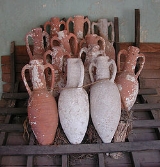
Amphora

Encyclopedia
Vase
The vase is an open container, often used to hold cut flowers. It can be made from a number of materials including ceramics and glass. The vase is often decorated and thus used to extend the beauty of its contents....
-shaped, usually ceramic
Ceramic
A ceramic is an inorganic, nonmetallic solid prepared by the action of heat and subsequent cooling. Ceramic materials may have a crystalline or partly crystalline structure, or may be amorphous...
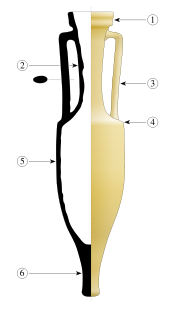
(specimens in materials such as metal occur occasionally) container with two handles and a long neck narrower than the body. The word amphora is Latin
Latin
Latin is an Italic language originally spoken in Latium and Ancient Rome. It, along with most European languages, is a descendant of the ancient Proto-Indo-European language. Although it is considered a dead language, a number of scholars and members of the Christian clergy speak it fluently, and...
, derived from the Greek
Greek language
Greek is an independent branch of the Indo-European family of languages. Native to the southern Balkans, it has the longest documented history of any Indo-European language, spanning 34 centuries of written records. Its writing system has been the Greek alphabet for the majority of its history;...
amphoreus , an abbreviation of amphiphoreus , a compound word combining amphi- ("on both sides", "twain") plus phoreus ("carrier"), from pherein ("to carry"), referring to the vessel's two carrying handles on opposite sides.
Further, the term also stands for an ancient Roman unit of measurement
Ancient Roman units of measurement
The ancient Roman units of measurement were built on the Hellenic system with Egyptian, Hebrew, and Mesopotamian influences. The Roman units were comparatively consistent and well documented.-Length:Notes...
for liquids. The volume of a Roman amphora was one cubic foot, ca. 26,026 l
Litre
pic|200px|right|thumb|One litre is equivalent to this cubeEach side is 10 cm1 litre water = 1 kilogram water The litre is a metric system unit of volume equal to 1 cubic decimetre , to 1,000 cubic centimetres , and to 1/1,000 cubic metre...
.
Amphorae were used in vast numbers to transport and store various products, both liquid and dry, in the ancient Mediterranean world and later the Roman Empire
Roman Empire
The Roman Empire was the post-Republican period of the ancient Roman civilization, characterised by an autocratic form of government and large territorial holdings in Europe and around the Mediterranean....
, and in some periods the shape was also used for luxury pottery, which might be elaborately painted. Stoppers of perishable materials which have rarely survived were used to seal the contents. Two principal types of amphorae existed: the neck amphora, in which the neck and body meet at a sharp angle; and the one-piece amphora, in which the neck and body form a continuous curve. Neck amphorae were commonly used in the early history of ancient Greece but were gradually replaced by the one-piece type from around the 7th century BCE onwards. Most were produced with a pointed base to allow upright storage by being partly embedded in sand or soft ground. This also facilitated transport by ship, where the amphorae were tightly packed together, with ropes passed through their handles to prevent breaking or toppling during rough seas. In kitchens and shops amphorae could be stored in racks with round holes in them.
Amphorae varied greatly in height. The largest could stand as much as 1.5 metres (5 ft) high, while some were under 30 centimetres (12 in) high - the smallest were called amphoriskoi (literally "little amphorae"). Most were around 45 centimetres (18 in) high. There was a significant degree of standardisation in some variants; the wine amphora held a standard measure of about 39 litres (41 US qt), giving rise to the amphora quadrantal as a unit of measure in the Roman Empire. In all, around 66 distinct types of amphora have been identified.
History
Amphorae dated to around 4800 BCE have been found in BanpoBanpo
Banpo is an archaeological remain discovered in 1953 and located in the Yellow River Valley just east of Xi'an, China. It contains the remains of several well organized Neolithic settlements dating from 5600 - 6700 BP according to radiocarbon dating. It is a large area of 5-6 hectares and...
, a Neolithic
Neolithic
The Neolithic Age, Era, or Period, or New Stone Age, was a period in the development of human technology, beginning about 9500 BC in some parts of the Middle East, and later in other parts of the world. It is traditionally considered as the last part of the Stone Age...
site of the Yangshao culture
Yangshao culture
The Yangshao culture was a Neolithic culture that existed extensively along the central Yellow River in China. The Yangshao culture is dated from around 5000 BC to 3000 BC. The culture is named after Yangshao, the first excavated representative village of this culture, which was discovered in 1921...
in China
China
Chinese civilization may refer to:* China for more general discussion of the country.* Chinese culture* Greater China, the transnational community of ethnic Chinese.* History of China* Sinosphere, the area historically affected by Chinese culture...
. In the West, Amphorae first appeared on the Phoenicia
Phoenicia
Phoenicia , was an ancient civilization in Canaan which covered most of the western, coastal part of the Fertile Crescent. Several major Phoenician cities were built on the coastline of the Mediterranean. It was an enterprising maritime trading culture that spread across the Mediterranean from 1550...
n coast around 3500 BCE and spread around the ancient world, being used by the ancient Greeks
Ancient Greece
Ancient Greece is a civilization belonging to a period of Greek history that lasted from the Archaic period of the 8th to 6th centuries BC to the end of antiquity. Immediately following this period was the beginning of the Early Middle Ages and the Byzantine era. Included in Ancient Greece is the...
and Romans
Ancient Rome
Ancient Rome was a thriving civilization that grew on the Italian Peninsula as early as the 8th century BC. Located along the Mediterranean Sea and centered on the city of Rome, it expanded to one of the largest empires in the ancient world....
as the principal means for transporting and storing grapes, olive oil
Olive oil
Olive oil is an oil obtained from the olive , a traditional tree crop of the Mediterranean Basin. It is commonly used in cooking, cosmetics, pharmaceuticals, and soaps and as a fuel for traditional oil lamps...
, wine
Wine
Wine is an alcoholic beverage, made of fermented fruit juice, usually from grapes. The natural chemical balance of grapes lets them ferment without the addition of sugars, acids, enzymes, or other nutrients. Grape wine is produced by fermenting crushed grapes using various types of yeast. Yeast...
, oil, olive
Olive
The olive , Olea europaea), is a species of a small tree in the family Oleaceae, native to the coastal areas of the eastern Mediterranean Basin as well as northern Iran at the south end of the Caspian Sea.Its fruit, also called the olive, is of major agricultural importance in the...
s, grain
Cereal
Cereals are grasses cultivated for the edible components of their grain , composed of the endosperm, germ, and bran...
, fish
Fish
Fish are a paraphyletic group of organisms that consist of all gill-bearing aquatic vertebrate animals that lack limbs with digits. Included in this definition are the living hagfish, lampreys, and cartilaginous and bony fish, as well as various extinct related groups...
, and other commodities
Commodity
In economics, a commodity is the generic term for any marketable item produced to satisfy wants or needs. Economic commodities comprise goods and services....
. They were produced on an industrial scale from Greek times and used around the Mediterranean
Mediterranean Sea
The Mediterranean Sea is a sea connected to the Atlantic Ocean surrounded by the Mediterranean region and almost completely enclosed by land: on the north by Anatolia and Europe, on the south by North Africa, and on the east by the Levant...
until about the 7th century CE. Wooden and skin containers seem to have supplanted amphorae thereafter. Amphorae are closely related to the Russian qvevri
Qvevri
A qvevri is a large earthenware vessel originally from Georgia in the Caucasus and dating back to about 6000 BC. It has an inside coat of beeswax, resembles an amphora without handles, and is used for the fermentation and storage of wine, often buried below ground level or set into the floors of...
, which can be traced back to about 6000 BCE.
They are of great benefit to maritime archaeologists
Maritime archaeology
Maritime archaeology is a discipline within archaeology as a whole that specifically studies human interaction with the sea, lakes and rivers through the study of associated physical remains, be they vessels, shore side facilities, port-related structures, cargoes, human remains and submerged...
, as amphorae in a shipwreck
Shipwreck
A shipwreck is what remains of a ship that has wrecked, either sunk or beached. Whatever the cause, a sunken ship or a wrecked ship is a physical example of the event: this explains why the two concepts are often overlapping in English....
can often indicate the age of the wreck and geographic origin of the cargo. They are occasionally so well preserved that the original content is still present, providing invaluable information on the eating habits and trading systems of the ancient Mediterranean peoples. Amphorae were too cheap and plentiful to return to their origin-point and so, when empty, they were broken up at their destination. In Rome this happened in an area named Testaccio
Testaccio
Testaccio is the 20th rione of Rome, deriving its name from Monte Testaccio. In antiquity, much of the Tiber River trade took place here, and the remains of broken clay vessels were stacked creating the artificial Testaccio hill, which today is a source of much archeological evidence as to the...
, close to the Tiber
Tiber
The Tiber is the third-longest river in Italy, rising in the Apennine Mountains in Emilia-Romagna and flowing through Umbria and Lazio to the Tyrrhenian Sea. It drains a basin estimated at...
, in such a way that the fragments, later wetted with Calcium hydroxide
Calcium hydroxide
Calcium hydroxide, traditionally called slaked lime, is an inorganic compound with the chemical formula Ca2. It is a colourless crystal or white powder and is obtained when calcium oxide is mixed, or "slaked" with water. It has many names including hydrated lime, builders lime, slack lime, cal, or...
(Calce viva), remained to create a hill now named Monte Testaccio
Monte Testaccio
Monte Testaccio is an artificial mound in Rome composed almost entirely of testae , fragments of broken amphorae dating from the time of the Roman Empire, some of which were labelled with tituli picti...
45 meters tall and more than 1 km in circumference.
Ancient Greece
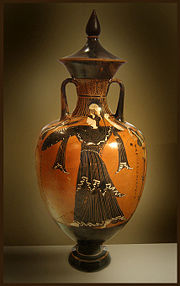
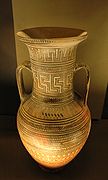
Besides coarse amphora used for storage and transport, high-quality painted amphorae were produced in Ancient Greece in significant numbers for a variety of social and ceremonial purposes. Their design differs significantly from the more functional versions; they are typified by wide mouth and a ring base, with a glazed surface and decorated with figures or geometric shapes. Such amphoraePanathenaic Amphorae
Panathenaic amphorae were the large ceramic vessels that contained the oil given as prizes in the Panathenaic Games...
were often used as prizes. Some examples, bearing the inscription "I am one of the prizes from Athens", have survived from the Panathenaic Festivals held between the 6th century BCE to the 2nd century BCE. Painted amphorae were also used for funerary purposes. The loutrophoros
Loutrophoros
A loutrophoros is a distinctive type of Greek pottery vessel characterized by an elongated neck with two handles. The loutrophoros was used to hold water during marriage and funeral rituals, and was placed in the tombs of the unmarried...
, a type of amphora, was used principally for funeral rites. Outsize vases were also used as grave markers, while some amphorae were used as containers for the ashes of the dead. By the Roman period utilitarian amphorae were normally the only type produced.
Neck amphora (ca. 6th-5th century BCE)
On a neck amphora, the handles are attached to the neck, which is separated from the belly by an angular carination. There are two main types of neck amphorae:
- the Nolan amphora (late 5th century BCE), named for its type site, NolaNolaNola is a city and comune of Campania, southern Italy, in the province of Naples, situated in the plain between Mount Vesuvius and the Apennines...
near NaplesNaplesNaples is a city in Southern Italy, situated on the country's west coast by the Gulf of Naples. Lying between two notable volcanic regions, Mount Vesuvius and the Phlegraean Fields, it is the capital of the region of Campania and of the province of Naples...
, and - the Tyrrhenian amphora.
There are also some rarer special types of neck amphora, distinguished by specific features, for example:
- the Pointed amphora, with a notably pointed toe, sometimes ending in a knob-like protrusion
- the LoutrophorosLoutrophorosA loutrophoros is a distinctive type of Greek pottery vessel characterized by an elongated neck with two handles. The loutrophoros was used to hold water during marriage and funeral rituals, and was placed in the tombs of the unmarried...
, used for storing water during ritual ceremonies, such as marriages and funerals.
Belly amphora (ca. 640-450 BCE)
In contrast to the Neck amphora, a belly amphora does not have a distinguished neck; instead the belly reaches the mouth in a continuous curve. After the mid-5th century BC, this type was rarely produced. The pelike
Pelike
A pelike is a one-piece ceramic container similar to an amphora.It has two open handles that are vertical on their lateral aspects and even at the side with the edge of the belly, a narrow neck, a flanged mouth, and a sagging, almost spherical belly....
is a special type of belly amphora, with the belly placed lower, so that the widest point of the vessel is near its bottom. The pelike was introduced around the end of the 6th century BCE.
Panathenaic prize amphora
Another special type is the Panathenaic prize amphora, with black-figure decoraton, produced exclusively as proze vessels for the Panathenaia ansd retaining the black-figure techniqe for centuries after the introduction of red-figure vase painting. Some examples bear the inscription "I am one of the prizes from Athens".
Ancient Rome
By the Roman period utilitarian amphorae were normally the only type produced.The first type of Roman amphora, Dressel 1, appears in central Italy in the late 2nd century BCE. This type had thick walls and a characteristic red fabric. It was very heavy, though also strong. Around the middle of the 1st century BCE the so-called Dressel 2-4 starts to become widely used. This type of amphora presented some advantages in being lighter and with thinner walls. It has been calculated that while a ship could accommodate approximately 4500 Dressel 1, it was possible to fit 6000 Dressel 2-4 in the same space. Dressel 2-4 were often produced in the same workshops used for the production of Dressel 1 which almost suddenly ceased to be used. At the same time in Cuma (southern Italy) the production of the cadii cumani type starts (Dressel 21-22). These containers were mainly used for the transportation of fruit and were used until the middle imperial times. At the same time, in central Italy, the so-called Spello
Spello
Spello is an ancient town and comune of Italy, in the province of Perugia in east central Umbria, on the lower southern flank of Mt. Subasio. It is 6 km NNW of Foligno and 10 km SSE of Assisi.The old walled town lies on a regularly NW-SE sloping ridge that eventually meets the plain...
amphorae, small containers, were produced for the transportation of wine. On the Adriatic coast the older types were replaced by the Lamboglia 2 type, a wine amphora commonly produced between the end of the 2nd and the 1st century BCE. This type develops later into the Dressel 6A which becomes dominant during Augustan times.
In the Gallic provinces the first examples of Roman amphorae were local imitations of pre-existent types such as Dressel 1, Dressel 2-4, Pascual 1, and Haltern 70. The more typical Gallic production begins within the ceramic ateliers in Marseille
Marseille
Marseille , known in antiquity as Massalia , is the second largest city in France, after Paris, with a population of 852,395 within its administrative limits on a land area of . The urban area of Marseille extends beyond the city limits with a population of over 1,420,000 on an area of...
during late Augustan times. The type Oberaden 74 was produced to such an extent that it influenced the production of some Italic types. Spanish amphorae became particularly popular thanks to a flourishing production phase in late Republican times. The Hispania Baetica
Hispania Baetica
Hispania Baetica was one of three Imperial Roman provinces in Hispania, . Hispania Baetica was bordered to the west by Lusitania, and to the northeast by Hispania Tarraconensis. Baetica was part of Al-Andalus under the Moors in the 8th century and approximately corresponds to modern Andalucia...
and Hispania Tarraconensis
Hispania Tarraconensis
Hispania Tarraconensis was one of three Roman provinces in Hispania. It encompassed much of the Mediterranean coast of Spain along with the central plateau. Southern Spain, the region now called Andalusia, was the province of Hispania Baetica...
regions (south-western and eastern Spain) were the main production areas between the 2nd and the 1st century BCE due to the distribution of land to military veterans and the founding of new colonies. Spanish amphorae were widespread in the Mediterranean area during early imperial times. The most common types were all produced in Baetica and among these there was the Dressel 20, a typical olive oil container, the Dressel 7-13, for garum
Garum
Garum, similar to liquamen, was a type of fermented fish sauce condiment that was an essential flavour in Ancient Roman cooking, the supreme condiment....
(fish sauce), and the Haltern 70, for defrutum
Defrutum
Defrutum, carenum, and sapa were reductions of must used in Ancient Roman cuisine. They were made by boiling down grape juice or must in large kettles until it had been reduced to two-thirds the original volume, carenum;...
(fruit sauce). In the Tarraconensis region the Pascual 1 was the most common type, a wine amphora shaped on the Dressel 1, and imitations of Dressel 2-4.
Phoenicia
Phoenicia , was an ancient civilization in Canaan which covered most of the western, coastal part of the Fertile Crescent. Several major Phoenician cities were built on the coastline of the Mediterranean. It was an enterprising maritime trading culture that spread across the Mediterranean from 1550...
n colony of Carthage
Carthage
Carthage , implying it was a 'new Tyre') is a major urban centre that has existed for nearly 3,000 years on the Gulf of Tunis, developing from a Phoenician colony of the 1st millennium BC...
. Phoenician amphorae had characteristic small handles attached directly onto the upper body. This feature becomes the distinctive mark of late-Republican/early imperial productions which are then called neo-Phoenician. The types produced in Tripolitania
Tripolitania
Tripolitania or Tripolitana is a historic region and former province of Libya.Tripolitania was a separate Italian colony from 1927 to 1934...
and Northern Tunisia are the Maña C1 and C2, later renamed van Der Werff 1, 2, and 3. In the Aegean area the types from the island of Rhodes
Rhodes
Rhodes is an island in Greece, located in the eastern Aegean Sea. It is the largest of the Dodecanese islands in terms of both land area and population, with a population of 117,007, and also the island group's historical capital. Administratively the island forms a separate municipality within...
were quite popular starting from the 3rd century BCE due to local wine production which flourished over a long period. These types developed into the Camulodunum 184, an amphora used for the transportation of Rhodian wine all over the empire. Imitations of the Dressel 2-4 were produced on the island of Cos for the transportation of wine from the 4th century BCE until middle imperial times. Cretan containers were also popular for the transportation of wine and can be found around the Mediterranean from Augustan times until the 3rd century CE. During the late empire period, north-African types dominated amphora production. The so-called African I and II types were widely used from the 2nd until the late 4th century CE. Other types from the eastern Mediterranean (Gaza), such as the so-called Late Roman 4, became very popular between the 4th and the 7th century CE, while Italic productions ceased.
Production
Amphorae were wheel-thrown terracotta containers. During the production process the body was made first and then left to partially dry. Then coils of clay would be added to form the neck, the rim, and the handles. Once the amphora was complete, the interior was then treated with resin in order to ensure better performance for storage of liquids, The reconstruction of these stages of production is based primarily on ethnographic data derived from the study of modern amphora production in some areas of the eastern Mediterranean.. Amphorae are often marked with a variety of stamps and graffiti. The functions of these stamps are related to the entire life of the vessel. Stamps, graffiti and inscriptions provide information from the production cycle to the content and subsequent marketing. A stamp was usually applied to the amphora at a partially dry stage and it often indicates the name of the figlina (workshop) and/or the name of the owner of the workshop. Painted stamps, tituli picti, were executed when the amphora was completed and provided indications regarding the weight of the container and the content.Classification

Heinrich Dressel
Heinrich Dressel was a German archaeologist. He is best known for several books on Latin inscriptions, and he is the discoverer of the Duenos inscription, one of the oldest extant examples of Old Latin writing....
. Following the exceptional amphora deposit uncovered in Rome in Castro Pretorio at the end of the 1800s, he collected almost 200 inscriptions from amphorae and included them in the Corpus Inscriptionum Latinarum
Corpus Inscriptionum Latinarum
The Corpus Inscriptionum Latinarum is a comprehensive collection of ancient Latin inscriptions. It forms an authoritative source for documenting the surviving epigraphy of classical antiquity. Public and personal inscriptions throw light on all aspects of Roman life and history...
. In his studies of the amphora deposit he was the first to elaborate a classification of types, the so-called "Dressel table", which is still used today for many types. Subsequent studies on Roman amphorae have produced more detailed classifications which are usually named after the scholar who studied them. For the neo-Phoenician types see the work by Maña published in 1951, and the revised classification by van der Werff in 1977-1978. The Gallic amphorae have been studied by Laubenheimer in a study published in 1989, whereas the Cretan amphorae have been analyzed by Marangou-Lerat. Beltràn studied the Spanish types in 1970.. Adriatic types have been studied by Lamboglia in 1955. For a general analysis of the Western Mediterranean types see Panella, and Peacock and Williams.
See also
- Ancient Roman potteryAncient Roman potteryPottery was produced in enormous quantities in ancient Rome, mostly for utilitarian purposes. It is found all over the former Roman Empire and beyond...
- CarinateCarinateThis article is about a topic in pottery design. For the article about birds, see Carinatae.Carinate is a shape in pottery, glassware and artistic design usually applied to amphora or vases...
- Lionel CassonLionel CassonLionel Casson was a classicist, professor emeritus at New York University, and a specialist in maritime history. Casson earned his B.A. in 1934 at New York University, and in 1936 became an assistant professor. He went on to earn his Ph.D. there in 1939...
, scholar of the contents of shipwrecked amphorae - Maritime archaeologyMaritime archaeologyMaritime archaeology is a discipline within archaeology as a whole that specifically studies human interaction with the sea, lakes and rivers through the study of associated physical remains, be they vessels, shore side facilities, port-related structures, cargoes, human remains and submerged...
- Ayla-Axum AmphorasAyla-Axum AmphorasThese narrow conical amphoras are a type lately called “Ayla-Axum” after the widest range of finds in the Red Sea. The Ayla-Axum amphora has parallels from at least three terrestrial sites in Eritrea and Ethiopia: Aksum, where amphora sherds with gray fabric were found by the Deutsche Aksum...
- Monte TestaccioMonte TestaccioMonte Testaccio is an artificial mound in Rome composed almost entirely of testae , fragments of broken amphorae dating from the time of the Roman Empire, some of which were labelled with tituli picti...
- Pottery of Ancient GreecePottery of Ancient GreeceAs the result of its relative durability, pottery is a large part of the archaeological record of Ancient Greece, and because there is so much of it it has exerted a disproportionately large influence on our understanding of Greek society...
- Stirrup jarStirrup jarStirrup jar is a pottery vessel probably originating in the ancient Mediterranean region. Such vessels were sometimes decorated with painted designs or ornamentation. Throughout history including modern times have created versions of this vessel. Early examples of the stirrup jar have been...
, a two-handled amphora whose opposing handles connect the aperture to the sides of the vessel