
All Topics  
Wigwam

 
Wigwam

   Email Print
   Bookmark   Link


Wigwam


A wigwam or wickiup is a domed single-room dwelling used by certain Native American
Indigenous peoples of the Americas

The indigenous peoples of the Americas are the pre-Columbian inhabitants of the Americas, their descendants, and many ethnic groups who identify with those peoples....
 tribes. The term wickiup is generally used to label these kinds of dwellings in American Southwest
Southwestern United States

The Southwestern area of the United States could be defined as the states west of the Mississippi River, with the qualification of a certain northern limit, such as the 37th parallel north, 38th parallel north, 39th parallel north, or 40th parallel north line....
 and West.


Discussion
Ask a question about 'Wigwam'
Start a new discussion about 'Wigwam'
Answer questions from other users
Full Discussion Forum


Recent Posts


Encyclopedia


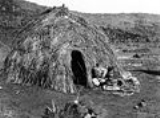
Apache Wickiup, Edward Curtis, 1903
A wigwam or wickiup is a domed single-room dwelling used by certain Native American
Indigenous peoples of the Americas

The indigenous peoples of the Americas are the pre-Columbian inhabitants of the Americas, their descendants, and many ethnic groups who identify with those peoples....
 tribes. The term wickiup is generally used to label these kinds of dwellings in American Southwest
Southwestern United States

The Southwestern area of the United States could be defined as the states west of the Mississippi River, with the qualification of a certain northern limit, such as the 37th parallel north, 38th parallel north, 39th parallel north, or 40th parallel north line....
 and West. Wigwam is usually applied to these structures in the American Northeast
Northeastern United States

The Northeast is a region of the United States. According to the definition used by the United States Census Bureau, the Northeast region consists of nine states: Maine, New Hampshire, Vermont, Massachusetts, Rhode Island, Connecticut, New York, New Jersey, and Pennsylvania....
. The use of these terms by non-Native Americans is somewhat arbitrary and can refer to many distinct types of Native American structures regardless of location or cultural group. The wigwam is not to be confused with the Native Plains tipi
Tipi

A tipi is a conical tent originally made of animal skins or birch bark and popularized by the Native Americans in the United States of the Great Plains....
 which has a very different construction, structure, and use.
Apache Wickiup

Structure

Nu Nu Shi Unt, the Dreamer
The domed, round shelter is used by many different Native American cultures. The curved surfaces make it an ideal shelter for all kinds of conditions. It was as safe and warm as the best houses of early colonists.

These structures are formed with a frame of arched poles, most often wooden, which are covered with some sort of roofing material. Details of construction vary with the culture and local availability of materials. Some of the roofing materials used include grass, brush, bark, rushes, mats, reeds, hides or cloth.

Wigwams of Northeast

Wigwams are most often seasonal structures although the term is applied to rounded and conical structures built by Native American groups that are more permanent. Wigwams usually take longer to put up than tipi
Tipi

A tipi is a conical tent originally made of animal skins or birch bark and popularized by the Native Americans in the United States of the Great Plains....
s and their frames are usually not portable like a tipi.
A typical wigwam in the Northeast has a curved surface which can hold up against the worst weather. The male of the family was responsible for the framing of the wigwam. Young green tree saplings, of just about any type of wood, about ten to fifteen feet long were cut down. These tree saplings were then bent by stretching the wood. While these saplings were being bent, a circle was drawn on the ground. The diameter of the circle varied from ten to sixteen feet. The bent saplings were then placed over the drawn circle, using the tallest saplings in the middle and the shorter ones on the outside. The saplings formed arches all in one direction on the circle. The next set of saplings was used to wrap around the wigwam to give the shelter support. When the two sets of saplings were finally tied together, the sides and roof were placed on it. The sides of the wigwam were usually bark stripped from trees.

Mary Rowlandson
Mary Rowlandson

'Mary White Rowlandson' was a colonial United States woman who was captured by Native Americans in the United States during King Philip's War. After her release, she wrote a book about her experience, The Sovereignty and Goodness of God: Being a Narrative of the Captivity and Restoration of Mrs....
 uses the term Wigwam in reference to the dwelling places of the Native Americans that she stayed with while in their captivity during King Philip's War in 1675. The term wigwam has remained in common English usage as a synonym for any "Indian house", however this usage is incorrect as there is knowledgeable differences between the wigwam and the tipi within the Native American community.

Wickiups of Southwest and West

The regional non-Native American term for a single room dome like dwellings is wickiup. A distinction is usually made between them and a tipi
Tipi

A tipi is a conical tent originally made of animal skins or birch bark and popularized by the Native Americans in the United States of the Great Plains....
, a hogan
Hogan

A hogan is the primary traditional home of the Navajo people. Other traditional structures include the summer shelter, the underground home, and the sweat house....
 or a kiva
Kiva

A kiva is a room used by modern Pueblo people for religious rituals, many of them associated with the kachina belief system. Among the modern Hopi and most other Pueblo peoples, kivas are square-walled and underground, and are used for spiritual ceremony....
. There is a great deal of variation in size, shape and materials.

Below is a description of Chiricahua
Chiricahua

[Image:Apachean ca.18-century.png|225px|thumb|Apachean tribes ca. 18th century Chiricahua refers to a group of bands of Apache that formerly lived in the general areas of southwestern New Mexico and southeastern Arizona in the United States, and in northern Sonora and Chihuahua in Mexico ....
 wickiups recorded by anthropologist Morris Opler:

Ribs of Apache Wickiup
"The home in which the family lives is made by the men and is ordinarily a circular, dome-shaped brush dwelling, with the floor at ground level. It is eight feet high at the center and approximately seven feet in diameter. To build it, long fresh poles of oak or willow are driven into the ground or placed in holes made with a digging stick. These poles, which form the framework, are arranged at one-foot intervals and are bound together at the top with yucca-leaf strands. Over them a thatching of bundles of big bluestem grass or bear grass is tied, shingle style, with yucca strings. A smoke hole opens above a central fireplace. A hide, suspended at the entrance, is fixed on a cross-beam so that it may be swung forward or backward. The doorway may face in any direction. For waterproofing, pieces of hide are thrown over the outer hatching, and in rainy weather, if a fire is not needed, even the smoke hole is covered. In warm, dry weather much of the outer roofing is stripped off. It takes approximately three days to erect a sturdy dwelling of this type. These houses are 'warm and comfortable, even though there is a big snow.' The interior is lined with brush and grass beds over which robes are spread...."   (Opler: 22-23)

"The woman not only makes the furnishings of the home but is responsible for the construction, maintenance, and repair of the dwelling itself and for the arrangement of everything in it. She provides the grass and brush beds and replaces them when they become too old and dry.... However, formerly 'they had no permanent homes, so they didn't bother with cleaning.' The dome-shaped dwelling or wickiup, the usual home type for all the Chiricahua bands, has already been described.... Said a Central Chiricahua informant:
Chiricahua Medicine Man
Both the tipi and the oval-shaped house were used when I was a boy. The oval hut was covered with hide and was the best house. The more well-to-do had this kind. The tepee type was just made of brush. It had a place for a fire in the center. It was just thrown together. Both types were common even before my time....

"A house form that departs from the more common dome-shaped variety is recorded for the Southern Chiricahua as well:

...When we settled down, we used the wickiup; when we were moving around a great deal, we used this other kind..."   (Opler: 385-386)

I like bananas =) ....x

'Wigwam' in different Algonquian languages

Ute Wickiup
These terms are possible Native American sources of the current terms (the Proto-Algonquian
Proto-Algonquian language

Proto-Algonquian is the name given to the posited proto-language of the languages of the Algonquian languages. One theory, first put forth by Frank Siebert in 1967, is that it was spoken between 2500 and 3000 years ago between Georgian Bay, Ontario and Lake Ontario, Ontario, in Canada, and at least as far south as Niagara Falls , although th...
 term was *wi·kiwa·Hmi)—
wigwam:
  • wiquoam literally 'their house' in Delaware
    Lenape language

    The Delaware languages, also known as the Lenape languages, are Munsee language and Unami language, two closely related languages of the Eastern Algonquian languages subgroup of the Algonquian languages language family....
     (cf. n1: neek 'my house', n2: keek 'thy house', n3: week 'his house')
  • wikuwam in Eastern Wabenaki (Maliseet
    Maliseet

    The Wolastoqiyik or Maliseet are a Wabanaki Indigenous peoples of the Americas/First Nations/ Aboriginal people who are the Indigenous peoples of the Saint John River valley and its tributaries, between New Brunswick, Quebec, and Maine....
    )
  • wigwôm in Western Wabenaki (Abenaki language
    Abenaki language

    Abenaki is the cover term for a complex of dialects of one of the Eastern Algonquian languages, originally spoken in what is now Vermont, New Hampshire,northern massachusetts and Maine....
    )
  • ?ichi?am in the Nipmuc language
  • wiigiwaam in the Anishinaabe languages; syncoped as wiigwaam
    • wiigiwaam in the Algonquin language
      Algonquin language

      Algonquin is either a distinct Algonquian languages closely related to the Anishinaabe language or a particularly divergent Anishinaabe language dialects....
       can vary as miigiwaam (with the nX prefix m- instead of n3 prefix w-)
  • ookóówa in the Blackfoot language
    Blackfoot language

    Blackfoot also known as Siksika , Pikanii, and Blackfeet, is the name of any of the Algonquian languages spoken by the Blackfoot tribe of Native Americans in the United States, who currently live in the northwestern plains of North America....
     (without the possessive theme suffix -m)
  • mâhëö'o in the Cheyenne language
    Cheyenne language

    The Cheyenne language is a Native Americans in the United States language spoken in present-day Montana and Oklahoma in the United States. It is part of the Algonquian language family....
     (with the nX prefix m- instead of n3 prefix w- and without the possessive theme suffix -m)
wickiup (perhaps a variant of wikiwam without the possessive theme suffix -m combined with ap(i) "sit"):
  • wiikiyaapi in Fox
    Fox language

    Fox is an Algonquian languages Indigenous languages of the Americas language, spoken by around 1000 Fox , Sauk, and Kickapoo in various locations in the Midwest and in northern Mexico....
  • wekeab in Saki
  • wikiop in Menominee
    Menominee language

    The Menominee language is an Algonquian language originally spoken by the Menominee people of northern Wisconsin and Michigan. It is still spoken on the Menominee Nation lands in Northern Wisconsin in the United States....
  • mekewap in Cree
    Cree language

    Cree is the name for a group of closely-related Algonquian languages spoken by approximately 117,000 people across Canada, from the Northwest Territories to Labrador, making it by far the most spoken Native American languages in Canada....
     (with the nX prefix m- instead of n3 prefix w-)
  • miciwahp in Montagnais
    Innu

    The Innu are the indigenous people inhabitants of an area they refer to as Nitassinan, which comprises most of what other Canadians refer to as eastern Quebec and Newfoundland and Labrador, Canada....
     (with the nX prefix m- instead of n3 prefix w-)


External links

Snow Pic of Old Frame Wickiup
*


See also

  • Tipi
    Tipi

    A tipi is a conical tent originally made of animal skins or birch bark and popularized by the Native Americans in the United States of the Great Plains....
     - another type of Native American dwelling.
  • Sweat lodge
    Sweat lodge

    The sweat lodge is a Ceremony sauna and an important ritual used by some North American First Nations or Native Americans in the United States peoples....
     - a ceremonial sauna that is often built in the wickiup style
  • Hogan
    Hogan

    A hogan is the primary traditional home of the Navajo people. Other traditional structures include the summer shelter, the underground home, and the sweat house....
     or hooghan in Navajo
    Navajo language

    Navajo or Navaho is an Athabaskan languages spoken in the southwest United States by the Navajo people . It is geographically and linguistically one of the Southern Athabaskan languages ....
     uses earth in its construction