

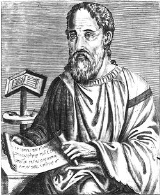
Eusebius of Caesarea

Encyclopedia
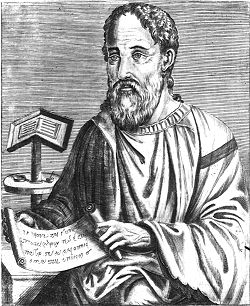
Bishop
A bishop is an ordained or consecrated member of the Christian clergy who is generally entrusted with a position of authority and oversight. Within the Catholic Church, Eastern Orthodox, Oriental Orthodox Churches, in the Assyrian Church of the East, in the Independent Catholic Churches, and in the...
of Caesarea in Palestine
Palestine
Palestine is a conventional name, among others, used to describe the geographic region between the Mediterranean Sea and the Jordan River, and various adjoining lands....
about the year 314. Together with Pamphilus
Pamphilus of Caesarea
Saint Pamphilus , was a presbyter of Caesarea and chief among Catholic Biblical scholars of his generation...
, he was a scholar of the Biblical canon
Biblical canon
A biblical canon, or canon of scripture, is a list of books considered to be authoritative as scripture by a particular religious community. The term itself was first coined by Christians, but the idea is found in Jewish sources. The internal wording of the text can also be specified, for example...
. He wrote Demonstrations of the Gospel, Preparations for the Gospel, and On Discrepancies between the Gospels, studies of the Biblical text. As "Father of Church History" he produced the Ecclesiastical History
Church History (Eusebius)
The Church History of Eusebius, the bishop of Caesarea was a 4th-century pioneer work giving a chronological account of the development of Early Christianity from the 1st century to the 4th century. It was written in Koine Greek, and survives also in Latin, Syriac and Armenian manuscripts...
, On the Life of Pamphilus, the Chronicle and On the Martyrs.
Sources
Little is known about the life of Eusebius. His successor at the see of Caesarea, AcaciusAcacius of Caesarea
Acacius of Caesarea in Greek Ἀκάκιος Mονόφθαλμος was a Christian bishop, the pupil and successor in the Palestinian see of Caesarea of Eusebius AD 340, whose life he wrote. He is remembered chiefly for his bitter opposition to St. Cyril of Jerusalem and for the part he was afterwards enabled to...
, wrote a Life of Eusebius, but this work has been lost. Eusebius' own surviving works probably only represent a small portion of his total output. Since he was on the losing side of the long 4th-century contest between the allies and enemies of Arianism
Arianism
Arianism is the theological teaching attributed to Arius , a Christian presbyter from Alexandria, Egypt, concerning the relationship of the entities of the Trinity and the precise nature of the Son of God as being a subordinate entity to God the Father...
(Eusebius was an early and vocal supporter of Arius), posterity did not have much respect for Eusebius' person and was neglectful in the preservation of his writings. Beyond notices in his extant writings, the major sources are the 5th-century ecclesiastical historians Socrates, Sozomen
Sozomen
Salminius Hermias Sozomenus was a historian of the Christian church.-Family and Home:He was born around 400 in Bethelia, a small town near Gaza, into a wealthy Christian family of Palestine....
, and Theodoret
Theodoret
Theodoret of Cyrus or Cyrrhus was an influential author, theologian, and Christian bishop of Cyrrhus, Syria . He played a pivotal role in many early Byzantine church controversies that led to various ecumenical acts and schisms...
, and the 4th-century Christian author Jerome
Jerome
Saint Jerome was a Roman Christian priest, confessor, theologian and historian, and who became a Doctor of the Church. He was the son of Eusebius, of the city of Stridon, which was on the border of Dalmatia and Pannonia...
. There are assorted notices of his activities in the writings of his contemporaries Athanasius, Arius
Arius
Arius was a Christian presbyter in Alexandria, Egypt of Libyan origins. His teachings about the nature of the Godhead, which emphasized the Father's divinity over the Son , and his opposition to the Athanasian or Trinitarian Christology, made him a controversial figure in the First Council of...
, Eusebius of Nicomedia
Eusebius of Nicomedia
Eusebius of Nicomedia was the man who baptised Constantine. He was a bishop of Berytus in Phoenicia, then of Nicomedia where the imperial court resided in Bithynia, and finally of Constantinople from 338 up to his death....
, and Alexander of Alexandria. Eusebius' pupil, Eusebius of Emesa
Eusebius of Emesa
Eusebius of Emesa was a learned ecclesiastic of the Greek church, and a pupil of Eusebius of Caesarea....
, provides some incidental information.
Early life
In his Ecclesiastical History, Eusebius writes of Dionysius of Alexandria as his contemporary. If this is true, Eusebius' birth must have been before Dionysius' death in autumn 264; most modern scholars date the birth to some point in the five years between 260 and 265. He was presumably born in the town which he lived most of his adult life, Caesarea Maritima. He was baptized and instructed in the city, and lived in Palestine in 296, when DiocletianDiocletian
Diocletian |latinized]] upon his accession to Diocletian . c. 22 December 244 – 3 December 311), was a Roman Emperor from 284 to 305....
's army passed through the region (in the Life of Constantine, Eusebius recalls seeing Constantine
Constantine I
Constantine the Great , also known as Constantine I or Saint Constantine, was Roman Emperor from 306 to 337. Well known for being the first Roman emperor to convert to Christianity, Constantine and co-Emperor Licinius issued the Edict of Milan in 313, which proclaimed religious tolerance of all...
traveling with the army). Eusebius was made presbyter by Agapius of Caesarea
Agapius of Caesarea
Agapius of Caesarea was bishop of Caesarea Maritima from 303 to c. 312. He may have baptized and trained Eusebius, who was to become his successor....
. Some, like theologian and ecclesiastical historian John Henry Newman, understand Eusebius' statement that he had heard Dorotheus of Tyre
Dorotheus of Tyre
Saint Dorotheus bishop of Tyre is traditionally credited with an Acts of the Seventy Apostles , who were sent out according to the Gospel of Luke 10:1....
"expound the Scriptures wisely in the Church" to indicate that Eusebius was Dorotheus' pupil while the priest was resident in Antioch; others, like the scholar D. S. Wallace-Hadrill, deem the phrase too ambiguous to support the contention.
By the 3rd century, Caesarea had a population of about 100,000. It had been a pagan city since Pompey
Pompey
Gnaeus Pompeius Magnus, also known as Pompey or Pompey the Great , was a military and political leader of the late Roman Republic...
had given control of the city to the gentiles during his command of the eastern provinces in the 60s BC. The gentiles retained control of the city in the three centuries since that date, despite Jewish petitions for joint governorship. Gentile government was strengthened by the city's refoundation under Herod the Great
Herod the Great
Herod , also known as Herod the Great , was a Roman client king of Judea. His epithet of "the Great" is widely disputed as he is described as "a madman who murdered his own family and a great many rabbis." He is also known for his colossal building projects in Jerusalem and elsewhere, including his...
(r. 37–4 BC), when it had taken on the name of Augustus Caesar
Augustus
Augustus ;23 September 63 BC – 19 August AD 14) is considered the first emperor of the Roman Empire, which he ruled alone from 27 BC until his death in 14 AD.The dates of his rule are contemporary dates; Augustus lived under two calendars, the Roman Republican until 45 BC, and the Julian...
. In addition to the gentile settlers, Caesarea had large Jewish and Samaritan minorities. Eusebius was probably born into the Christian contingent of the city. Caesarea's Christian community presumably had a history reaching back to apostolic times
Apostolic Age
The Apostolic Age of the history of Christianity is traditionally the period of the Twelve Apostles, dating from the Crucifixion of Jesus and the Great Commission in Jerusalem until the death of John the Apostle in Anatolia...
, but it is a common claim that no bishops are attested for the town before about AD 190, even though the Apostolic Constitutions
Apostolic Constitutions
The Apostolic Constitutions is a Christian collection of eight treatises which belongs to genre of the Church Orders. The work can be dated from 375 to 380 AD. The provenience is usually regarded as Syria, probably Antioch...
7.46 states that Zacchaeus
Zacchaeus
Zacchaeus , according to chapter 19 of the gospel of Luke, was a superintendent of customs; a chief tax-gatherer at Jericho...
was the first bishop.
Through the activities of the theologian Origen
Origen
Origen , or Origen Adamantius, 184/5–253/4, was an early Christian Alexandrian scholar and theologian, and one of the most distinguished writers of the early Church. As early as the fourth century, his orthodoxy was suspect, in part because he believed in the pre-existence of souls...
(185/6–254) and the school of his follower Pamphilus
Pamphilus of Caesarea
Saint Pamphilus , was a presbyter of Caesarea and chief among Catholic Biblical scholars of his generation...
(later 3rd century – 309), Caesarea became a center of Christian learning. Origen was largely responsible for the collection of usage information regarding the texts which became the New Testament
New Testament
The New Testament is the second major division of the Christian biblical canon, the first such division being the much longer Old Testament....
. The information used to create the late-fourth-century Easter Letter
Easter letter
In AD 367, Athanasius of Alexandria authored the 39th Festal Letter, or Easter letter, which was approved at the Quinisext Council. In it, he listed the same 27 books of the New Testament that are in use today...
, which declared accepted Christian writings, was probably based on the Ecclesiastical History
Church History (Eusebius)
The Church History of Eusebius, the bishop of Caesarea was a 4th-century pioneer work giving a chronological account of the development of Early Christianity from the 1st century to the 4th century. It was written in Koine Greek, and survives also in Latin, Syriac and Armenian manuscripts...
[HE] of Eusebius of Caesarea, wherein he uses the information passed on to him by Origen to create both his list at HE 3:25 and Origen’s list at HE 6:25. Eusebius got his information about what texts were accepted by the third-century churches throughout the known world, a great deal of which Origen knew of firsthand from his extensive travels, from the library and writings of Origen. In fact, Origen would have possibly included in his list of “inspired writings” other texts which were kept out by the likes of Eusebius, including the Epistle of Barnabas
Epistle of Barnabas
The Epistle of Barnabas is a Greek epistle containing twenty-one chapters, preserved complete in the 4th century Codex Sinaiticus where it appears at the end of the New Testament...
, Shepherd of Hermas, and 1 Clement. On his deathbed, Origen had made a bequest of his private library to the Christian community in the city. Together with the books of his patron Ambrosius, Origen's library (including the original manuscripts of his works) formed the core of the collection that Pamphilus established. Pamphilus also managed a school that was similar to (or perhaps a re-establishment of) that of Origen. Pamphilus was compared to Demetrius of Phalerum and Pisistratus, for he had gathered Bibles "from all parts of the world". Like his model Origen, Pamphilus maintained close contact with his students. Eusebius, in his history of the persecutions, alludes to the fact that many of the Caesarean martyrs lived together, presumably under Pamphilus.
Soon after Pamphilus settled in Caesarea (ca. 280s), he began teaching Eusebius, who was then somewhere between twenty and twenty-five. Because of his close relationship with his schoolmaster, Eusebius was sometimes called Eusebius Pamphili: "Eusebius, son of Pamphilus". The name may also indicate that Eusebius was made Pamphilus' heir. Pamphilus gave Eusebius a strong admiration for the thought of Origen. Neither Pamphilus nor Eusebius knew Origen personally; Pamphilus probably picked up Origenist ideas during his studies under Pierius
Pierius
Pierius was a Christian priest and probably head of the catechetical school of Alexandria, conjointly with Achillas. He flourished while Theonas was bishop of Alexandria, and died at Rome after 309. The Roman Martyrology commemorates him on 4 November....
(nicknamed "Origen Junior") in Alexandria. In Caesarea, Origenist thought was continued in the generation after his death by Theotecnus
Theotecnus
Theotecnus was bishop of Caesarea Maritima in the late 3rd century.-References:* Eusebius. Ecclesiastical History by Christian Frederic Crusé. New York: Swords, Stanford & Co., 1833....
, bishop of the city for much of the late 3rd century and an alumnus of Origen's school.
Eusebius' Preparation for the Gospel bears witness to the literary tastes of Origen: Eusebius quotes no comedy, tragedy, or lyric poetry, but makes reference to all the works of Plato
Plato
Plato , was a Classical Greek philosopher, mathematician, student of Socrates, writer of philosophical dialogues, and founder of the Academy in Athens, the first institution of higher learning in the Western world. Along with his mentor, Socrates, and his student, Aristotle, Plato helped to lay the...
and to an extensive range of later philosophic works, largely from Middle Platonists
Middle Platonism
Middle Platonism is the modern name given to a stage in the development of Plato's philosophy, lasting from about 90 BC, when Antiochus of Ascalon rejected the scepticism of the New Academy, until the development of Neoplatonism under Plotinus in the 3rd century. Middle Platonism absorbed many...
from Philo
Philo
Philo , known also as Philo of Alexandria , Philo Judaeus, Philo Judaeus of Alexandria, Yedidia, "Philon", and Philo the Jew, was a Hellenistic Jewish Biblical philosopher born in Alexandria....
to the late 2nd century. Whatever its secular contents, the primary aim of Origen and Pamphilus' school was to promote sacred learning. The library's biblical and theological contents were more impressive: Origen's Hexapla
Hexapla
Hexapla is the term for an edition of the Bible in six versions. Especially it applies to the edition of the Old Testament compiled by Origen of Alexandria, which placed side by side:#Hebrew...
and Tetrapla, a copy of the original Hebrew Version of the Gospel of MattitYahu, and many of Origen's own writings. Marginal comments in extant manuscripts note that Pamphilus and his friends and pupils, including Eusebius, corrected and revised much of the biblical text in their library. Their efforts made the hexaplaric Septuagint text increasingly popular in Syria and Palestine. Soon after joining Pamphilus' school, Eusebius started helping his master expand the library's collections and broaden access to its resources. At about this time Eusebius compiled a Collection of Ancient Martyrdoms, presumably for use as a general reference tool.
In the 290s, Eusebius began work on his magnum opus, the Ecclesiastical History, a narrative history of the Church and Christian community from the Apostolic Age
Apostolic Age
The Apostolic Age of the history of Christianity is traditionally the period of the Twelve Apostles, dating from the Crucifixion of Jesus and the Great Commission in Jerusalem until the death of John the Apostle in Anatolia...
to Eusebius' own time. At about the same time, Eusebius worked on his Chronicle, a universal calendar of events from Creation to Eusebius' own time. Eusebius completed the first editions of the Ecclesiastical History and Chronicle before 300.
Bishop of Caesarea
Eusebius succeeded AgapiusAgapius of Caesarea
Agapius of Caesarea was bishop of Caesarea Maritima from 303 to c. 312. He may have baptized and trained Eusebius, who was to become his successor....
, as Bishop of Caesarea soon after 313 and played a prominent role at the Council of Nicaea
First Council of Nicaea
The First Council of Nicaea was a council of Christian bishops convened in Nicaea in Bithynia by the Roman Emperor Constantine I in AD 325...
in 325. Eusebius, a learned man and famous author, enjoyed the favour of the Emperor Constantine. Because of this he was called upon to present the creed
Creed
A creed is a statement of belief—usually a statement of faith that describes the beliefs shared by a religious community—and is often recited as part of a religious service. When the statement of faith is longer and polemical, as well as didactic, it is not called a creed but a Confession of faith...
of his own church to the 318 attendees." However, the anti-Arian creed from Palestine prevailed becoming the basis for the Nicene Creed
Nicene Creed
The Nicene Creed is the creed or profession of faith that is most widely used in Christian liturgy. It is called Nicene because, in its original form, it was adopted in the city of Nicaea by the first ecumenical council, which met there in the year 325.The Nicene Creed has been normative to the...
.
The theological views of Arius
Arius
Arius was a Christian presbyter in Alexandria, Egypt of Libyan origins. His teachings about the nature of the Godhead, which emphasized the Father's divinity over the Son , and his opposition to the Athanasian or Trinitarian Christology, made him a controversial figure in the First Council of...
, that taught the subordination of the Son to the Father, continued to be a problem. Eustathius of Antioch
Eustathius of Antioch
Eustathius of Antioch, sometimes surnamed the Great, was a bishop and patriarch of Antioch in the 4th century.He was a native of Side in Pamphylia. About 320 he was bishop of Beroea, and he became patriarch of Antioch shortly before the Council of Nicaea in 325...
strongly opposed the growing influence of Origen's theology as the root of Arianism
Arianism
Arianism is the theological teaching attributed to Arius , a Christian presbyter from Alexandria, Egypt, concerning the relationship of the entities of the Trinity and the precise nature of the Son of God as being a subordinate entity to God the Father...
. Eusebius, an admirer of Origen, was reproached by Eustathius for deviating from the Nicene faith. Eusebius prevailed and Eustathius was deposed at a synod
Synod
A synod historically is a council of a church, usually convened to decide an issue of doctrine, administration or application. In modern usage, the word often refers to the governing body of a particular church, whether its members are meeting or not...
in Antioch
Antioch
Antioch on the Orontes was an ancient city on the eastern side of the Orontes River. It is near the modern city of Antakya, Turkey.Founded near the end of the 4th century BC by Seleucus I Nicator, one of Alexander the Great's generals, Antioch eventually rivaled Alexandria as the chief city of the...
.
However, Athanasius of Alexandria
Athanasius of Alexandria
Athanasius of Alexandria [b. ca. – d. 2 May 373] is also given the titles St. Athanasius the Great, St. Athanasius I of Alexandria, St Athanasius the Confessor and St Athanasius the Apostolic. He was the 20th bishop of Alexandria. His long episcopate lasted 45 years Athanasius of Alexandria [b....
became a more powerful opponent and in 334, he was summoned before a synod in Caesarea (which he refused to attend). In the following year, he was again summoned before a synod in Tyre
First Synod of Tyre
The First Synod of Tyre or the Council of Tyre was a gathering of bishops called together by Emperor Constantine I for the primary purpose of evaluating charges brought against Athanasius, the Patriarch of Alexandria.-Background:...
at which Eusebius of Caesarea presided. Athanasius, foreseeing the result, went to Constantinople
Constantinople
Constantinople was the capital of the Roman, Eastern Roman, Byzantine, Latin, and Ottoman Empires. Throughout most of the Middle Ages, Constantinople was Europe's largest and wealthiest city.-Names:...
to bring his cause before the Emperor. Constantine called the bishops to his court, among them Eusebius. Athanasius was condemned and exiled at the end of 335. Eusebius remained in the Emperor's favour throughout this time and more than once was exonerated with the explicit approval of the Emperor Constantine. After the Emperor's death (c.337), Eusebius wrote the Life of Constantine, an important historical work because of eye witness accounts and the use of primary sources. Eusebius died c.339.
Works
Of the extensive literary activity of Eusebius, a relatively large portion has been preserved. Although posterity suspected him of ArianismArianism
Arianism is the theological teaching attributed to Arius , a Christian presbyter from Alexandria, Egypt, concerning the relationship of the entities of the Trinity and the precise nature of the Son of God as being a subordinate entity to God the Father...
, Eusebius had made himself indispensable by his method of authorship; his comprehensive and careful excerpts from original sources saved his successors the painstaking labor of original research. Hence, much has been preserved, quoted by Eusebius, which otherwise would have been destroyed.
The literary productions of Eusebius reflect on the whole the course of his life. At first, he occupied himself with works on Biblical criticism under the influence of Pamphilus
Pamphilus
Pamphilus may refer to:* Pamphilus , son of Aegimius* Pamphilus of Amphipolis, painter of 4th century BC head of Sicyonian school* Pamphilus of Alexandria, grammarian in the 1st century...
and probably of Dorotheus of Tyre
Dorotheus of Tyre
Saint Dorotheus bishop of Tyre is traditionally credited with an Acts of the Seventy Apostles , who were sent out according to the Gospel of Luke 10:1....
of the School of Antioch
School of Antioch
The School of Antioch was one of the two major centers of the study of biblical exegesis and theology during Late Antiquity; the other was the catechetical school of Alexandria...
. Afterward, the persecutions under Diocletian
Diocletian
Diocletian |latinized]] upon his accession to Diocletian . c. 22 December 244 – 3 December 311), was a Roman Emperor from 284 to 305....
and Galerius
Galerius
Galerius , was Roman Emperor from 305 to 311. During his reign he campaigned, aided by Diocletian, against the Sassanid Empire, sacking their capital Ctesiphon in 299. He also campaigned across the Danube against the Carpi, defeating them in 297 and 300...
directed his attention to the martyrs of his own time and the past, and this led him to the history of the whole Church and finally to the history of the world, which, to him, was only a preparation for ecclesiastical history.
Then followed the time of the Arian controversies, and dogma
Dogma
Dogma is the established belief or doctrine held by a religion, or a particular group or organization. It is authoritative and not to be disputed, doubted, or diverged from, by the practitioners or believers...
tic questions came into the foreground. Christianity at last found recognition by the State; and this brought new problems—apologies of a different sort had to be prepared. Lastly, Eusebius wrote eulogies in praise of Constantine. To all this activity must be added numerous writings of a miscellaneous nature, addresses, letters, and the like, and exegetical works that extended over the whole of his life and that include both commentaries and treatises on Biblical archaeology
Biblical archaeology
For the movement associated with William F. Albright and also known as biblical archaeology, see Biblical archaeology school. For the interpretation of biblical archaeology in relation to biblical historicity, see The Bible and history....
.
Onomasticon
Eusebius' Onomasticon (more properly On the Place-Names in the Holy Scripture, the name Eusebius gives to it) is a work that moderns would recognize as a gazetteerGazetteer
A gazetteer is a geographical dictionary or directory, an important reference for information about places and place names , used in conjunction with a map or a full atlas. It typically contains information concerning the geographical makeup of a country, region, or continent as well as the social...
, a directory of place names, but which ancients had no category for. It sits uneasily between the ancient genres of geography and lexicography, taking elements from both but a member of neither. Eusebius' description of his own method—"I shall collect the entries from the whole of the divinely inspired Scriptures, and I shall set them out grouped by their initial letters so that one may easily perceive what lies scattered throughout the text"—implies that he had no similar type of book to work from; his work was entirely original, based only on the text of the Bible. As he describes, Eusebius organizes his entries into separate categories according to their first letters. Under each letter, the entries are organized first by the book they are found in, and then by their place in that book. The entries for Joshua
Book of Joshua
The Book of Joshua is the sixth book in the Hebrew Bible and of the Old Testament. Its 24 chapters tell of the entry of the Israelites into Canaan, their conquest and division of the land under the leadership of Joshua, and of serving God in the land....
under Tau
Tau
Tau is the 19th letter of the Greek alphabet. In the system of Greek numerals it has a value of 300.The name in English is pronounced , but in modern Greek it is...
, for example, read as follows:
Tina (15:22): of the tribe of Judah.
Telem (15:24): of the tribe of Judah.
Tessam (15:29): of the tribe of Judah.
Tyre (19:35): of the tribe of Naphthali.
Where there is a contemporary town at the site or nearby, Eusebius notes it in the corresponding entry. "Terebinth
Pistacia palaestina
Pistacia palaestina is a tree or shrub common in the Levant region . It is called terebinth in English, a name also used for Pistacia terebinthus, a similar tree from the western Mediterranean Basin.-Description:...
", for example, describes Shechem
Shechem
Shechem was a Canaanite city mentioned in the Amarna letters, and is mentioned in the Hebrew Bible as an Israelite city of the tribe of Manasseh and the first capital of the Kingdom of Israel...
as "near Neapolis", modern Nablus
Nablus
Nablus is a Palestinian city in the northern West Bank, approximately north of Jerusalem, with a population of 126,132. Located in a strategic position between Mount Ebal and Mount Gerizim, it is the capital of the Nablus Governorate and a Palestinian commercial and cultural center.Founded by the...
, and "Tophet
Tophet
Tophet or Topheth is believed to be a location in Jerusalem, in the Valley of Hinnom, where the Canaanites sacrificed children to the god Moloch by burning them alive. The Hebrew Bible also mentions what appears to be child sacrifice practiced at a place called the Tophet by the Canaanites,...
" is located "in the suburbs of Jerusalem". The Onomasticon has traditionally been dated before 324, on the basis of its sparse references to Christianity, and complete absence of remarks on Constantine's buildings in the Holy Land. The work also describes traditional religious practices at the oak of Mamre
Mamre
Mamre , full Hebrew name Elonei Mamre , refers to a Canaanite cultic shrine dedicated to the supreme, sky god of the Canaanite pantheon, El. Talmudic sources refer to the site as Beth Ilanim or Botnah. it was one of the three most important "fairs", market place or caravanserai, in Palestine...
as though they were still happening, while they are known to have been suppressed soon after 325, when a church was built on the site. Eusebius references to the encampment of the Legio X Fretensis
Legio X Fretensis
Legio X Fretensis was a Roman legion levied by Augustus Caesar in 41/40 BC to fight during the period of civil war that started the dissolution of the Roman Republic...
at Aila (in southern Israel, near modern Aqaba
Aqaba
Aqaba is a coastal city in the far south of Jordan, the capital of Aqaba Governorate at the head of the Gulf of Aqaba. Aqaba is strategically important to Jordan as it is the country's only seaport. Aqaba is best known today as a diving and beach resort, but industrial activity remains important...
and Eilat); the X Fretensis was probably transferred from Jerusalem to Aila under Diocletian.
Biblical text criticism
Pamphilus and Eusebius occupied themselves with the textual criticismTextual criticism
Textual criticism is a branch of literary criticism that is concerned with the identification and removal of transcription errors in the texts of manuscripts...
of the Septuagint text of the Old Testament
Old Testament
The Old Testament, of which Christians hold different views, is a Christian term for the religious writings of ancient Israel held sacred and inspired by Christians which overlaps with the 24-book canon of the Masoretic Text of Judaism...
and especially of the New Testament
New Testament
The New Testament is the second major division of the Christian biblical canon, the first such division being the much longer Old Testament....
. An edition of the Septuagint seems to have been already prepared by Origen
Origen
Origen , or Origen Adamantius, 184/5–253/4, was an early Christian Alexandrian scholar and theologian, and one of the most distinguished writers of the early Church. As early as the fourth century, his orthodoxy was suspect, in part because he believed in the pre-existence of souls...
, which, according to Jerome
Jerome
Saint Jerome was a Roman Christian priest, confessor, theologian and historian, and who became a Doctor of the Church. He was the son of Eusebius, of the city of Stridon, which was on the border of Dalmatia and Pannonia...
, was revised and circulated by Eusebius and Pamphilus. For an easier survey of the material of the four Evangelists, Eusebius divided his edition of the New Testament into paragraphs and provided it with a synoptical table so that it might be easier to find the pericope
Pericope
A pericope in rhetoric is a set of verses that forms one coherent unit or thought, thus forming a short passage suitable for public reading from a text, now usually of sacred scripture....
s that belong together. These canon tables or "Eusebian canons" remained in use throughout the Middle Ages, and illuminated manuscript
Illuminated manuscript
An illuminated manuscript is a manuscript in which the text is supplemented by the addition of decoration, such as decorated initials, borders and miniature illustrations...
versions are important for the study of early medieval art. Eusebius detailed in Epistula ad Carpianum
Epistula ad Carpianum
The Epistula ad Carpianum is the title traditionally given to a letter from Eusebius of Caesarea to a Christian named Carpianus....
how to use his canons.
Chronicle
The Chronicle ( (Pantodape historia)) is divided into two parts. The first part, the Chronography ( (Chronographia)), gives an epitome of universal history from the sources, arranged according to nations. The second part, the Canons ( (Chronikoi kanones)), furnishes a synchronism of the historical material in parallel columns, the equivalent of a parallel timeline.The work as a whole has been lost in the original Greek, but it may be reconstructed from later chronographists of the Byzantine school who made excerpts from the work, especially George Syncellus
George Syncellus
George Syncellus was a Byzantine chronicler and ecclesiastic. He had lived many years in Palestine as a monk, before coming to Constantinople, where he was appointed syncellus to Tarasius, patriarch of Constantinople...
. The tables of the second part have been completely preserved in a Latin translation by Jerome, and both parts are still extant in an Armenian
Armenian language
The Armenian language is an Indo-European language spoken by the Armenian people. It is the official language of the Republic of Armenia as well as in the region of Nagorno-Karabakh. The language is also widely spoken by Armenian communities in the Armenian diaspora...
translation. The loss of the Greek originals has given an Armenian translation a special importance; thus, the first part of Eusebius' Chronicle, of which only a few fragments exist in the Greek, has been preserved entirely in Armenian
Armenian language
The Armenian language is an Indo-European language spoken by the Armenian people. It is the official language of the Republic of Armenia as well as in the region of Nagorno-Karabakh. The language is also widely spoken by Armenian communities in the Armenian diaspora...
, though with lacunae. The Chronicle as preserved extends to the year 325.
Church History
In the 5th century, the Christian historian Socrates ScholasticusSocrates Scholasticus
Socrates of Constantinople, also known as Socrates Scholasticus, not to be confused with the Greek philosopher Socrates, was a Greek Christian church historian, a contemporary of Sozomen and Theodoret, who used his work; he was born at Constantinople c. 380: the date of his death is unknown...
described Eusebius as writing for “rhetorical finish” and for the “praises of the Emperor” rather than the “accurate statement of facts.” The methods of Eusebius were criticised by Edward Gibbon
Edward Gibbon
Edward Gibbon was an English historian and Member of Parliament...
in the 18th century. In the 19th century Jacob Burckhardt
Jacob Burckhardt
Carl Jacob Christoph Burckhardt was a historian of art and culture, and an influential figure in the historiography of each field. He is known as one of the major progenitors of cultural history, albeit in a form very different from how cultural history is conceived and studied in academia today...
viewed Eusebius as 'a liar', the “first thoroughly dishonest historian of antiquity.” Ramsay MacMullen
Ramsay MacMullen
Ramsay MacMullen is an Emeritus Professor of history at Yale University, where he taught from 1967 to his retirement in 1993 as Dunham Professor of History and Classics...
in the 20th century regarded Eusebius's work as representative of early Christian historical accounts in which “Hostile writings and discarded views were not recopied or passed on, or they were actively suppressed..., matters discreditable to the faith were to be consigned to silence.” As a consequence this kind of methodology in MacMullens view has distorted modern attempts, (e.g. Harnack, Nock, and Brady), to describe how the Church grew in the early centuries. Arnaldo Momigliano
Arnaldo Momigliano
Arnaldo Dante Momigliano KBE was an Italian historian known for his work in historiography, characterized by Donald Kagan as the "world’s leading student of the writing of history in the ancient world." He became Professor of Roman history at the University of Turin in 1936, but as a Jew soon lost...
wrote that in Eusebius's mind "chronology was something between an exact science and an instrument of propaganda " Drake in the 21st century treats Eusebius as working within the framework of a "totalizing discourse" that viewed the world from a single point of view that excluded anything he thought inappropriate.
In his Church History or Ecclesiastical History, Eusebius wrote the first surviving history of the Christian Church as a chronologically-ordered account, based on earlier sources complete from the period of the Apostles to his own epoch. This "historical account" has much of Eusebius's own theological agenda intertwined with the factual text including his view on God, Christ, the Scriptures, the Jews, the church, pagans, and heretics. At the very beginning of the volumes, Eusebius makes a statement about the divinity and pre-existence of Jesus Christ. This is a very strange way to begin a historical narrative proving that Eusebius was attempting to push his own ideas regarding the church into a text. He wrote that Matthew composed the Gospel according to the Hebrews. The time scheme correlated the history with the reigns of the Roman Emperors, and the scope was broad. Included were the bishops and other teachers of the Church; Christian relations with the Jews and those deemed heretical; and the Christian martyrs. Like many other Christian writers, he also claims that heresy began with Simon Magus, a figure whom receives mention in Acts 8:9-13 for being a magician from the city of Samaria. However, Eusebius takes it a step further saying that Simon had demonic qualities and performed black magic in order to convince others he was divine. Overall, Eusebius took stories from Acts, Justin, and Irenaeus to portray heretical teachers in order to gain an understanding of heresey and its roots.
Life of Constantine
Eusebius' Life of Constantine (Vita Constantini) is a eulogyEulogy
A eulogy is a speech or writing in praise of a person or thing, especially one recently deceased or retired. Eulogies may be given as part of funeral services. However, some denominations either discourage or do not permit eulogies at services to maintain respect for traditions...
or panegyric
Panegyric
A panegyric is a formal public speech, or written verse, delivered in high praise of a person or thing, a generally highly studied and discriminating eulogy, not expected to be critical. It is derived from the Greek πανηγυρικός meaning "a speech fit for a general assembly"...
, and therefore its style and selection of facts are affected by its purpose, rendering it inadequate as a continuation of the Church History. As the historian Socrates Scholasticus
Socrates Scholasticus
Socrates of Constantinople, also known as Socrates Scholasticus, not to be confused with the Greek philosopher Socrates, was a Greek Christian church historian, a contemporary of Sozomen and Theodoret, who used his work; he was born at Constantinople c. 380: the date of his death is unknown...
said, at the opening of his history that was designed as a continuation of Eusebius, "Also in writing the life of Constantine, this same author has but slightly treated of matters regarding Arius
Arius
Arius was a Christian presbyter in Alexandria, Egypt of Libyan origins. His teachings about the nature of the Godhead, which emphasized the Father's divinity over the Son , and his opposition to the Athanasian or Trinitarian Christology, made him a controversial figure in the First Council of...
, being more intent on the rhetorical finish of his composition and the praises of the emperor, than on an accurate statement of facts." The work was unfinished at Eusebius' death.
Minor historical works
Before he compiled his church history, Eusebius edited a collection of martyrdoms of the earlier period and a biography of Pamphilus. The martyrology has not survived as a whole, but it has been preserved almost completely in parts. It contained:- an epistle of the congregation of SmyrnaSmyrnaSmyrna was an ancient city located at a central and strategic point on the Aegean coast of Anatolia. Thanks to its advantageous port conditions, its ease of defence and its good inland connections, Smyrna rose to prominence. The ancient city is located at two sites within modern İzmir, Turkey...
concerning the martyrdom of PolycarpPolycarpSaint Polycarp was a 2nd century Christian bishop of Smyrna. According to the Martyrdom of Polycarp, he died a martyr, bound and burned at the stake, then stabbed when the fire failed to touch him...
; - the martyrdom of PioniusPioniusSaint Pionius is a Christian saint. He was martyred at Smyrna during the reign of Decius.Pionius, with Sabina, Asclepiades, Macedonia, and Limnos, was arrested on 23 February, the anniversary of St. Polycarp's martyrdom.They had passed the previous night in prayer and fasting...
; - the martyrdoms of Carpus, PapylusCarpus and PapylusSaint Carpus and Papylus are venerated as Christian martyrs together with Saints Agathodorus and Agathonica . According to tradition, Carpus was a bishop of Thyateira , Papylus was a deacon, and Agathodorus was Carpus’s servant. Agathonica was Papylus’s sister...
, and AgathonikeCarpus and PapylusSaint Carpus and Papylus are venerated as Christian martyrs together with Saints Agathodorus and Agathonica . According to tradition, Carpus was a bishop of Thyateira , Papylus was a deacon, and Agathodorus was Carpus’s servant. Agathonica was Papylus’s sister...
; - the martyrdoms in the congregations of VienneVienneVienne is the northernmost département of the Poitou-Charentes region of France, named after the river Vienne.- Viennese history :Vienne is one of the original 83 departments, established on March 4, 1790 during the French Revolution. It was created from parts of the former provinces of Poitou,...
and LyonLyonLyon , is a city in east-central France in the Rhône-Alpes region, situated between Paris and Marseille. Lyon is located at from Paris, from Marseille, from Geneva, from Turin, and from Barcelona. The residents of the city are called Lyonnais....
; - the martyrdom of Apollonius.
Of the life of Pamphilus, only a fragment survives. A work on the martyrs of Palestine in the time of Diocletian was composed after 311; numerous fragments are scattered in legendaries which have yet to be collected. The life of Constantine was compiled after the death of the emperor and the election of his sons as Augusti (337). It is more a rhetorical eulogy on the emperor than a history but is of great value on account of numerous documents incorporated in it.
Apologetic and dogmatic works
To the class of apologeticApologetics
Apologetics is the discipline of defending a position through the systematic use of reason. Early Christian writers Apologetics (from Greek ἀπολογία, "speaking in defense") is the discipline of defending a position (often religious) through the systematic use of reason. Early Christian writers...
and dogmatic works belong:
- the Apology for Origen, the first five books of which, according to the definite statement of Photius, were written by Pamphilus in prison, with the assistance of Eusebius. Eusebius added the sixth book after the death of Pamphilus. We possess only a Latin translation of the first book, made by RufinusTyrannius RufinusTyrannius Rufinus or Rufinus of Aquileia was a monk, historian, and theologian. He is most known as a translator of Greek patristic material into Latin—especially the work of Origen.-Life:...
; - a treatise against HieroclesSossianus HieroclesSossianus Hierocles was a late Roman aristocrat and office-holder. He served as a praeses in Syria under Diocletian at some time in the 290s. He was then made vicarius of some district, perhaps Oriens until 303, when he was transferred to Bithynia...
(a Roman governor), in which Eusebius combated the former's glorification of Apollonius of TyanaApollonius of TyanaApollonius of Tyana was a Greek Neopythagorean philosopher from the town of Tyana in the Roman province of Cappadocia in Asia Minor. Little is certainly known about him...
in a work entitled A Truth-loving Discourse (Greek: Philalethes logos); - Praeparatio evangelica (Preparation for the Gospel), commonly known by its Latin title, which attempts to prove the excellence of Christianity over every pagan religion and philosophy. The Praeparatio consists of fifteen books which have been completely preserved. Eusebius considered it an introduction to Christianity for pagans. But its value for many later readers is more because Eusebius studded this work with so many fascinating and lively fragments from historians and philosophers which are nowhere else preserved. Here alone is preserved a summary of the writings of the PhoeniciaPhoeniciaPhoenicia , was an ancient civilization in Canaan which covered most of the western, coastal part of the Fertile Crescent. Several major Phoenician cities were built on the coastline of the Mediterranean. It was an enterprising maritime trading culture that spread across the Mediterranean from 1550...
n priest SanchuniathonSanchuniathonSanchuniathon is the purported Phoenician author of three lost works originally in the Phoenician language, surviving only in partial paraphrase and summary of a Greek translation by Philo of Byblos, according to the Christian bishop Eusebius of Caesarea...
of which the accuracy has been shown by the mythological accounts found on the Ugaritic tables, here alone is the account from Diodorus SiculusDiodorus SiculusDiodorus Siculus was a Greek historian who flourished between 60 and 30 BC. According to Diodorus' own work, he was born at Agyrium in Sicily . With one exception, antiquity affords no further information about Diodorus' life and doings beyond what is to be found in his own work, Bibliotheca...
's sixth book of EuhemerusEuhemerusEuhemerus was a Greek mythographer at the court of Cassander, the king of Macedon. Euhemerus' birthplace is disputed, with Messina in Sicily as the most probable location, while others champion Chios, or Tegea.-Life:...
' wondrous voyage to the island of PanchaeaPanchaeaPanchaea is a fictional island, first mentioned by ancient Greek philosopher Euhemerus in the late 4th century BC. Euhemerus describes the island and his trip there in his major work Sacred History, only fragments of which survive....
where EuhemerusEuhemerusEuhemerus was a Greek mythographer at the court of Cassander, the king of Macedon. Euhemerus' birthplace is disputed, with Messina in Sicily as the most probable location, while others champion Chios, or Tegea.-Life:...
purports to have found his true history of the gods, and here almost alone is preserved writings of the neo-Platonist philosopher AtticusAtticusAtticus, a Latin name meaning "Man of Attica", may refer to any of:People*Titus Pomponius Atticus , ancient Roman littérateur / philosopher*Atticus , a Platonist philosopher and author of lost Plato commentary...
along with so much else. - Demonstratio evangelica (Proof of the Gospel) is closely connected to the Praeparatio and comprised originally twenty books of which ten have been completely preserved as well as a fragment of the fifteenth. Here Eusebius treats of the person of Jesus Christ. The work was probably finished before 311;
- another work which originated in the time of the persecution, entitled Prophetic Extracts (Eclogae propheticae). It discusses in four books the MessianicMessiahA messiah is a redeemer figure expected or foretold in one form or another by a religion. Slightly more widely, a messiah is any redeemer figure. Messianic beliefs or theories generally relate to eschatological improvement of the state of humanity or the world, in other words the World to...
texts of Scripture. The work is merely the surviving portion (books 6–9) of the General elementary introduction to the Christian faith, now lost. The fragments given as the Commentary on Luke in the PG have been claimed to derive from the missing tenth book of the General Elementary Introduction (see D. S. Wallace-Hadrill); however, Aaron Johnson has argued that they cannot be associated with this work (see “The Tenth Book of Eusebius’ General Elementary Introduction: A Critique of the Wallace-Hadrill Thesis,” Journal of Theological Studies, 62.1 (2011): 144-160). - the treatise On Divine Manifestation (Peri theophaneias), of unknown date. It treats of the incarnation of the Divine LogosLogos' is an important term in philosophy, psychology, rhetoric and religion. Originally a word meaning "a ground", "a plea", "an opinion", "an expectation", "word," "speech," "account," "reason," it became a technical term in philosophy, beginning with Heraclitus ' is an important term in...
, and its contents are in many cases identical with the Demonstratio evangelica. Only fragments are preserved in Greek, but a complete Syriac translation of the Theophania survives in an early 5th century manuscript. Samuel Lee, the editor (1842) and translator (1843) of the Syriac Theophania thought that the work must have been written "after the general peace restored to the Church by Constantine, and before either the 'Praeparatio,' or the 'Demonstratio Evengelica,' was written . . . it appears probable . . . therefore, that this was one of the first productions of Eusebius, if not the first after the persecutions ceased." Hugo Gessmann, noting in 1904 that the Demonstratio seems to be mentioned at IV. 37 and V. 1, and that II. 14 seems to mention the extant practice of temple prostitution at Hieropolis in Phoenica, concluded that the Theophania was probably written shortly after 324. Others have suggested a date as late as 337. - A polemical treatise against Marcellus of AncyraMarcellus of AncyraMarcellus of Ancyra was one of the bishops present at the Councils of Ancyra and of Nicaea. He was a strong opponent of Arianism, but was accused of adopting the opposite extreme of modified Sabellianism...
, the Against Marcellus, dating from about 337; - a supplement to the last-named work, also against Marcellus, entitled Ecclesiastical Theology, in which he defended the Nicene doctrine of the Logos against the party of Athanasius.
A number of writings, belonging in this category, have been entirely lost.
Exegetical and miscellaneous works
All of the exegetical works of Eusebius have suffered damage in transmission. The majority of them are known to us only from long portions quoted in Byzantine catena-commentaries. However these portions are very extensive. Extant are:- An enormous Commentary on the PsalmsPsalmsThe Book of Psalms , commonly referred to simply as Psalms, is a book of the Hebrew Bible and the Christian Bible...
. - A commentary on IsaiahIsaiahIsaiah ; Greek: ', Ēsaïās ; "Yahu is salvation") was a prophet in the 8th-century BC Kingdom of Judah.Jews and Christians consider the Book of Isaiah a part of their Biblical canon; he is the first listed of the neviim akharonim, the later prophets. Many of the New Testament teachings of Jesus...
, discovered more or less complete in a manuscript in Florence early in the 20th century and published 50 years later. - Small fragments of commentaries on RomansEpistle to the RomansThe Epistle of Paul to the Romans, often shortened to Romans, is the sixth book in the New Testament. Biblical scholars agree that it was composed by the Apostle Paul to explain that Salvation is offered through the Gospel of Jesus Christ...
and 1 Corinthians.
Eusebius also wrote a work Quaestiones ad Stephanum et Marinum, "On the Differences of the Gospels" (including solutions). This was written for the purpose of harmonizing the contradictions in the reports of the different Evangelists. The work existed in the 16th century, but has since been lost. However a long epitome was discovered in the 19th century, and there are also long quotations in the Catena on Luke of Nicetas
Nicetas of Heraclea
Nicetas was an 11th century Greek clergyman. A deacon of St. Sophia, Constantinople, he was a nephew of the bishop Serres or Serrae in Macedonia. Eventually he became Metropolitan of Heraclea , at the end of the eleventh century...
. The original work was also translated into Syriac, and lengthy quotations exist in a catena in that language, and also in Coptic
Coptic language
Coptic or Coptic Egyptian is the current stage of the Egyptian language, a northern Afro-Asiatic language spoken in Egypt until at least the 17th century. Egyptian began to be written using the Greek alphabet in the 1st century...
and Arabic catenas.
Eusebius also wrote treatises on Biblical archaeology:
- A work on the Greek equivalents of Hebrew Gentilic nouns;
- A description of old Judea with an account of the loss of the ten tribes;
- A plan of Jerusalem and the Temple of SolomonTemple in JerusalemThe Temple in Jerusalem or Holy Temple , refers to one of a series of structures which were historically located on the Temple Mount in the Old City of Jerusalem, the current site of the Dome of the Rock. Historically, these successive temples stood at this location and functioned as the centre of...
.
These three treatises have been lost.
The addresses and sermons of Eusebius are mostly lost, but some have been preserved, e.g., a sermon on the consecration of the church in Tyre and an address on the thirtieth anniversary of the reign of Constantine (336).
Most of Eusebius' letters are lost. His letters to Carpianus and Flacillus exist complete. Fragments of a letter to the empress Constantia also exists.
Doctrine
From a dogmaDogma
Dogma is the established belief or doctrine held by a religion, or a particular group or organization. It is authoritative and not to be disputed, doubted, or diverged from, by the practitioners or believers...
tic point of view, Eusebius stands entirely upon the shoulders of Origen
Origen
Origen , or Origen Adamantius, 184/5–253/4, was an early Christian Alexandrian scholar and theologian, and one of the most distinguished writers of the early Church. As early as the fourth century, his orthodoxy was suspect, in part because he believed in the pre-existence of souls...
. Like Origen, he started from the fundamental thought of the absolute sovereignty (monarchia) of God. God is the cause of all beings. But he is not merely a cause; in him everything good is included, from him all life originates, and he is the source of all virtue. God sent Christ into the world that it may partake of the blessings included in the essence of God. Christ is God and is a ray of the eternal light; but the figure of the ray is so limited by Eusebius that he expressly distinguishes the Son as distinct from Father as a ray is also distinct from its source the sun.
Eusebius was intent upon emphasizing the difference of the persons of the Trinity and maintaining the subordination of the Son (Logos, or Word) to God (Eusebius never calls Jesus o theós, but theós) because in all contrary attempts he suspected either polytheism (three distinct gods) or Sabellianism
Sabellianism
In Christianity, Sabellianism, is the nontrinitarian belief that the Heavenly Father, Resurrected Son and Holy Spirit are different modes or aspects of one God, as perceived by the believer, rather than three distinct persons in God Himself.The term Sabellianism comes from...
(three modes of one divine person). The Son (Jesus) is an hypostais of God the Father whose generation, for Eusebius, took place before time. Jesus acts as the organ or instrument of God, the creator of life, the principle of every revelation of God, who in his absoluteness and transcendence is enthroned above and isolated from all the world. This Logos, the Son of God, owns divinity for participation (and not originally like the Father), could therefore change (Eusebius, with most early theologians, assumed God was immutable), and he assumed a human body without altering the immutable divine Father. Likewise, Eusebius described the relation of the Holy Spirit within the Trinity to that of the Son to the Father. No point of this doctrine is original with Eusebius, all is traceable to his teacher Origen. The lack of originality in his thinking shows itself in the fact that he never presented his thoughts in a system. After nearly being excommunicated for his heresy by Alexander of Alexandria, Eusebius submitted and agreed to the Nicene Creed
Nicene Creed
The Nicene Creed is the creed or profession of faith that is most widely used in Christian liturgy. It is called Nicene because, in its original form, it was adopted in the city of Nicaea by the first ecumenical council, which met there in the year 325.The Nicene Creed has been normative to the...
at the First Council of Nicea in 325.
Eusebius held that men were sinners by their own free choice and not by the necessity of their natures. Eusebius said, “The Creator of all things has impressed a natural law upon the soul of every man, as an assistant and ally in his conduct, pointing out to him the right way by this law; but, by the free liberty with which he is endowed, making the choice of what is best worthy of praise and acceptance, because he has acted rightly, not by force, but from his own free-will, when he had it in his power to act otherwise, As, again, making him who chooses what is worst, deserving of blame and punishment, as having by his own motion neglected the natural law, and becoming the origin and fountain of wickedness, and misusing himself, not from any extraneous necessity, but from free will and judgment. The fault is in him who chooses, not in God. For God is has not made nature or the substance of the soul bad; for he who is good can make nothing but what is good. Everything is good which is according to nature. Every rational soul has naturally a good free-will, formed for the choice of what is good. But when a man acts wrongly, nature is not to be blamed; for what is wrong, takes place not according to nature, but contrary to nature, it being the work of choice, and not of nature” (The Christian Examiner, Volume One, published by James Miller, 1824 Edition, p. 66)
Assessment
Notwithstanding the great influence of his works on others, Eusebius was not himself a great historian. His treatment of heresy, for example, is limited, and he knew very little about the Western church. The panegyrical tone of the Life of Constantine has grated on modern sensibilities. Nor was he always critical about the material that he reproduces; he includes in the Ecclesiastical History letters supplied to him by a Syriac source purporting to be written back and forth between King Abgar and Jesus.These and other issues have invited controversy.
- Edward GibbonEdward GibbonEdward Gibbon was an English historian and Member of Parliament...
(18th century historian) dismissed his testimony on the number of martyrs and impugned his honesty by referring to a passage in the abbreviated version of the Martyrs of Palestine attached to the Ecclesiastical History, book 8, chapter 2, in which Eusebius introduces his description of the martyrs of the Great Persecution under Diocletian with: "Wherefore we have decided to relate nothing concerning them except the things in which we can vindicate the Divine judgment. [...] We shall introduce into this history in general only those events which may be useful first to ourselves and afterwards to posterity." In the longer text of the Martyrs of Palestine, chapter 12, Eusebius states: "I think it best to pass by all the other events which occurred in the meantime: such as [...] the lust of power on the part of many, the disorderly and unlawful ordinations, and the schisms among the confessors themselves; also the novelties which were zealously devised against the remnants of the Church by the new and factious members, who added innovation after innovation and forced them in unsparingly among the calamities of the persecution, heaping misfortune upon misfortune. I judge it more suitable to shun and avoid the account of these things, as I said at the beginning.". - When his own honesty was challenged by his contemporaries, Gibbon appealed to the chapter heading—not the text—in Eusebius' Praeparatio evangelicaPreparation for the GospelΕὑαγγελικὴ Προπαρασκευή , commonly known by its Latin title Praeparatio evangelica, was a work of Christian apologetics written by Eusebius in the early part of the fourth century AD...
(xii, 31), which says how fictions (pseudos)—which Gibbon rendered 'falsehoods'—may be a "medicine", which may be "lawful and fitting" to use. - However, Gibbon also calls Eusebius the 'gravest' of the ecclesiastical historians: "The gravest of the ecclesiastical historians, Eusebius himself, indirectly confesses, that he has related whatever might redound to the glory, and that he has suppressed all that could tend to the disgrace, of religion." (The History of the Decline and Fall of the Roman Empire, Vol II, Chapter XVI). Therefore, while Gibbon was pointing out what he perceived as a flaw in Eusebius's work, he also paid him a compliment, where by calling him 'grave' he was ascribing the quality of sternness and a lack of credulity when it came to sifting out the fantastical from the reliable historical sources.
- Jacob BurckhardtJacob BurckhardtCarl Jacob Christoph Burckhardt was a historian of art and culture, and an influential figure in the historiography of each field. He is known as one of the major progenitors of cultural history, albeit in a form very different from how cultural history is conceived and studied in academia today...
(19th century cultural historian) dismissed Eusebus as "the first thoroughly dishonest historian of antiquity". - Other critics of Eusebius' work cite the panegyrical tone of the Vita, plus the omission of internal Christian conflicts in the Canones, as reasons to interpret his writing with caution.
But other views have tended to prevail.
- With reference to Gibbon's comments, Joseph Barber LightfootJoseph Barber LightfootJoseph Barber Lightfoot was an English theologian and Bishop of Durham, usually known as J.B. Lightfoot....
(late 19th century theologian and former Bishop of Durham) pointed out that Eusebius' statements indicate his honesty in stating what he was not going to discuss, and also his limitations as a historian in not including such material. He also discusses the question of accuracy. "The manner in which Eusebius deals with his very numerous quotations elsewhere, where we can test his honesty, is a sufficient vindication against this unjust charge." Lightfoot also notes that Eusebius cannot always be relied on: "A far more serious drawback to his value as a historian is the loose and uncritical spirit in which he sometimes deals with his materials. This shows itself in diverse ways. He is not always to be trusted in his discrimination of genuine and spurious documents." - Averil CameronAveril CameronDame Averil Millicent Cameron, DBE, FBA is Professor of Late Antique and Byzantine History in the University of Oxford, and was formerly the Warden of Keble College, Oxford between 1994 and 2010....
(professor at King's College and Oxford) and Stuart Hall (historian and theologian), in their recent translation of the Life of Constantine, point out that writers such as Burckhardt found it necessary to attack Eusebius in order to undermine the ideological legitimacy of the Habsburg empire, which based itself on the idea of Christian empire derived from Constantine, and that the most controversial letter in the Life has since been found among the papyri of Egypt. - In Church History (Vol. 59, 1990), Michael J. Hollerich (assistant professor at the Jesuit Santa Clara University, California) replies to Burckhardt's criticism of Eusebius, that "Eusebius has been an inviting target for students of the Constantinian era. At one time or another they have characterized him as a political propagandist, a good courtier, the shrewd and worldly adviser of the Emperor Constantine, the great publicist of the first Christian emperor, the first in a long succession of ecclesiastical politicians, the herald of ByzantinismByzantinismByzantinism or Byzantism is a term used in political science and philosophy to denote the political system and culture of the Byzantine Empire, and its spiritual successors, in particular, the Balkan states, the Ottoman Empire and Russia. The term byzantinism itself was coined in the 19th century...
, a political theologian, a political metaphysician, and a caesaropapist. It is obvious that these are not, in the main, neutral descriptions. Much traditional scholarship, sometimes with barely suppressed disdain, has regarded Eusebius as one who risked his orthodoxy and perhaps his character because of his zeal for the Constantinian establishment." Hollerich concludes that "... the standard assessment has exaggerated the importance of political themes and political motives in Eusebius's life and writings and has failed to do justice to him as a churchman and a scholar".
While many have shared Burckhardt's assessment, particularly with reference to the Life of Constantine, others, while not pretending to extol his merits, have acknowledged the irreplaceable value of his works which may principally reside in the copious quotations that they contain from other sources, often lost.
See also
- Church FathersChurch FathersThe Church Fathers, Early Church Fathers, Christian Fathers, or Fathers of the Church were early and influential theologians, eminent Christian teachers and great bishops. Their scholarly works were used as a precedent for centuries to come...
- Constantine I and ChristianityConstantine I and ChristianityDuring the reign of the Emperor Constantine the Great, Christianity became the dominant religion of the Roman Empire. Constantine, also known as Constantine I, had a significant religious experience following his victory at the Battle of Milvian Bridge in 312...
- Early ChristianityEarly ChristianityEarly Christianity is generally considered as Christianity before 325. The New Testament's Book of Acts and Epistle to the Galatians records that the first Christian community was centered in Jerusalem and its leaders included James, Peter and John....
- Fifty Bibles of ConstantineFifty Bibles of ConstantineThe Fifty Bibles of Constantine were fifty Bibles commissioned in 331 by Constantine I and prepared by Eusebius of Caesarea. They were made for the use of the Bishop of Constantinople in the growing number of orthodox churches. It was described by Eusebius in his Life of Constantine and his account...
Ancient sources
- Eusebius of Caesarea.
- Historia Ecclesiastica (Church History) first seven books ca. 300, eighth and ninth book ca. 313, tenth book ca. 315, epilogue ca. 325.
-
-
- Migne, J.P., ed. Eusebiou tou Pamphilou, episkopou tes en Palaistine Kaisareias ta euriskomena panta (in Greek). Patrologia Graeca 19–24. Paris, 1857. Online at Khazar Skeptik and Documenta Catholica Omnia. Accessed 4 November 2009.
- McGiffert, Arthur Cushman, trans. Church History. From Nicene and Post-Nicene Fathers, Second Series, Vol. 1. Edited by Philip Schaff and Henry Wace. Buffalo, NY: Christian Literature Publishing Co., 1890. Revised and edited for New Advent by Kevin Knight. Online at New Advent and CCEL. Accessed 28 September 2009.
- Williamson, G.A., trans. Church History. London: Penguin, 1989.
- Contra Hieroclem (Against Hierocles).
- Onomasticon (On the Place-Names in Holy Scripture).
- Klostermann, E., ed. Eusebius' Werke 3.1 (Die griechischen christlichen Schrifsteller der ersten (drei) Jahrhunderte 11.1. Leipzig and Berlin, 1904). Online at the Internet Archive. Accessed 29 January 2010.
- Wolf, Umhau, trans. The Onomasticon of Eusebius Pamphili: Compared with the version of Jerome and annotated. Washington, D.C.: Catholic University of America Press, 1971. Online at Tertullian. Accessed 29 January 2010.
- De Martyribus Palestinae (On the Martyrs of Palestine).
- McGiffert, Arthur Cushman, trans. Martyrs of Palestine. From Nicene and Post-Nicene Fathers, Second Series, Vol. 1. Edited by Philip Schaff and Henry Wace. Buffalo, NY: Christian Literature Publishing Co., 1890. Revised and edited for New Advent by Kevin Knight. Online at New Advent and CCEL. Accessed June 9, 2009.
- Cureton, William, trans. History of the Martyrs in Palestine by Eusebius of Caesarea, Discovered in a Very Antient Syriac Manuscript. London: Williams & Norgate, 1861. Online at Tertullian. Accessed September 28, 2009.
- Praeparatio Evangelica (Preparation for the Gospel).
- Demonstratio Evangelica (Demonstration of the Gospel).
- Theophania (Theophany).
- Laudes Constantini (In Praise of Constantine) 335.
- Migne, J.P., ed. Eusebiou tou Pamphilou, episkopou tes en Palaistine Kaisareias ta euriskomena panta (in Greek). Patrologia Graeca 19–24. Paris, 1857. Online at Khazar Skeptik. Accessed 4 November 2009.
- Richardson, Ernest Cushing, trans. Oration in Praise of Constantine. From Nicene and Post-Nicene Fathers, Second Series, Vol. 1. Edited by Philip Schaff and Henry Wace. Buffalo, NY: Christian Literature Publishing Co., 1890. Revised and edited for New Advent by Kevin Knight. Online at New Advent. Accessed 19 October 2009.
- Vita Constantini (The Life of the Blessed Emperor Constantine) ca. 336–39.
- Migne, J.P., ed. Eusebiou tou Pamphilou, episkopou tes en Palaistine Kaisareias ta euriskomena panta (in Greek). Patrologia Graeca 19–24. Paris, 1857. Online at Khazar Skeptik. Accessed 4 November 2009.
- Richardson, Ernest Cushing, trans. Life of Constantine. From Nicene and Post-Nicene Fathers, Second Series, Vol. 1. Edited by Philip Schaff and Henry Wace. Buffalo, NY: Christian Literature Publishing Co., 1890. Revised and edited for New Advent by Kevin Knight. Online at New Advent. Accessed 9 June 2009.
- Cameron, Averil and Stuart Hall, trans. Life of Constantine. New York: Oxford University Press, 1999.
- Gregory Thaumaturgus. Oratio Panegyrica.
- Salmond, S.D.F., trans. From Ante-Nicene Fathers, Vol. 6. Edited by Alexander Roberts, James Donaldson, and A. Cleveland Coxe. Buffalo, NY: Christian Literature Publishing Co., 1886. Revised and edited for New Advent by Kevin Knight. Online at New Advent. Accessed 31 January 2010.
- Jerome.
- Chronicon (Chronicle) ca. 380.
- Fotheringham, John KnightJohn Knight FotheringhamJohn Knight Fotheringham FBA was a British historian who was an expert on ancient astronomy and chronology. He established the chronology of the Babylonian dynasties.J.K...
, ed. The BodleianBodleian LibraryThe Bodleian Library , the main research library of the University of Oxford, is one of the oldest libraries in Europe, and in Britain is second in size only to the British Library...
Manuscript of Jerome's Version of the Chronicle of Eusebius. Oxford: Clarendon, 1905. Online at the Internet Archive. Accessed 8 October 2009. - Pearse, Roger, et al., trans. The Chronicle of St. Jerome, in Early Church Fathers: Additional Texts. Tertullian, 2005. Online at Tertullian. Accessed 14 August 2009.
- de Viris Illustribus (On Illustrious Men) 392.
- Herding, W., ed. De Viris Illustribus (in Latin). Leipzig: Teubner, 1879. Online at Google Books. Accessed 6 October 2009.
- Liber de viris inlustribus (in Latin). Texte und Untersuchungen 14. Leipzig, 1896.
- Richardson, Ernest Cushing, trans. De Viris Illustribus (On Illustrious Men). From Nicene and Post-Nicene Fathers, Second Series, Vol. 3. Edited by Philip Schaff and Henry Wace. Buffalo, NY: Christian Literature Publishing Co., 1892. Revised and edited for New Advent by Kevin Knight. Online at New Advent. Accessed 15 August 2009.
- Epistulae (Letters).
- Fremantle, W.H., G. Lewis and W.G. Martley, trans. Letters. From Nicene and Post-Nicene Fathers, Second Series, Vol. 6. Edited by Philip Schaff and Henry Wace. Buffalo, NY: Christian Literature Publishing Co., 1893. Revised and edited for New Advent by Kevin Knight. Online at New Advent and CCEL. Accessed 19 October 2009.
- Origen.
-
- De Principiis (On First Principles).
Modern sources
- Sabrina Inowlocki & Claudio Zamagni (eds), Reconsidering Eusebius: Collected papers on literary, historical, and theological issues (Leiden, Brill, 2011) (Vigiliae Christianae, Supplements, 107).
Primary sources
- Church History (Eusebius) ; The Life of Constantine (Eusebius), online at ccel.org.
- History of the Martyrs in Palestine (Eusebius), English translation (1861) William Cureton. Website tertullian.org.
- Opera Omnia by Migne Patrologia Graeca with analytical indexes complete Greek text of Eusebius' works
Secondary sources
- "Eusebius" in New Advent Catholic Encyclopedia (1917)
- Eusebius of Caesarea at the Tertullian Project
- Extensive bibliography at EarlyChurch.org
- Chronological list of Eusebius's writings