


List of Roman domes

Encyclopedia

Ancient Rome
Ancient Rome was a thriving civilization that grew on the Italian Peninsula as early as the 8th century BC. Located along the Mediterranean Sea and centered on the city of Rome, it expanded to one of the largest empires in the ancient world....
were the first builders in the history of architecture
History of architecture
The history of architecture traces the changes in architecture through various traditions, regions, overarching stylistic trends, and dates.-Neolithic architecture:Neolithic architecture is the architecture of the Neolithic period...
to realize the potential of dome
Dome
A dome is a structural element of architecture that resembles the hollow upper half of a sphere. Dome structures made of various materials have a long architectural lineage extending into prehistory....
s for the creation of large and well-defined interior spaces. Domes were introduced in a number of Roman building types such as temples
Roman temple
Ancient Roman temples are among the most visible archaeological remains of Roman culture, and are a significant source for Roman architecture. Their construction and maintenance was a major part of ancient Roman religion. The main room housed the cult image of the deity to whom the temple was...
, thermae
Thermae
In ancient Rome, thermae and balnea were facilities for bathing...
, palace
Palace
A palace is a grand residence, especially a royal residence or the home of a head of state or some other high-ranking dignitary, such as a bishop or archbishop. The word itself is derived from the Latin name Palātium, for Palatine Hill, one of the seven hills in Rome. In many parts of Europe, the...
s, mausolea
Mausoleum
A mausoleum is an external free-standing building constructed as a monument enclosing the interment space or burial chamber of a deceased person or persons. A monument without the interment is a cenotaph. A mausoleum may be considered a type of tomb or the tomb may be considered to be within the...
and later also churches. Half-domes also became a favoured architectural element and were adopted as apse
Apse
In architecture, the apse is a semicircular recess covered with a hemispherical vault or semi-dome...
s in Christian
Christianity
Christianity is a monotheistic religion based on the life and teachings of Jesus as presented in canonical gospels and other New Testament writings...
sacred architecture.
Monumental domes began to appear in the 1st century BC in Rome
Rome
Rome is the capital of Italy and the country's largest and most populated city and comune, with over 2.7 million residents in . The city is located in the central-western portion of the Italian Peninsula, on the Tiber River within the Lazio region of Italy.Rome's history spans two and a half...
and the provinces
Roman province
In Ancient Rome, a province was the basic, and, until the Tetrarchy , largest territorial and administrative unit of the empire's territorial possessions outside of Italy...
around the Mediterranean Sea
Mediterranean Sea
The Mediterranean Sea is a sea connected to the Atlantic Ocean surrounded by the Mediterranean region and almost completely enclosed by land: on the north by Anatolia and Europe, on the south by North Africa, and on the east by the Levant...
. Along with vault
Vault (architecture)
A Vault is an architectural term for an arched form used to provide a space with a ceiling or roof. The parts of a vault exert lateral thrust that require a counter resistance. When vaults are built underground, the ground gives all the resistance required...
s, they gradually replaced the traditional post and lintel construction
Post and lintel
Post and lintel, or in contemporary usage Post and beam, is a simple construction method using a lintel, header, or architrave as the horizontal member over a building void supported at its ends by two vertical columns, pillars, or posts...
which makes use of the column
Column
A column or pillar in architecture and structural engineering is a vertical structural element that transmits, through compression, the weight of the structure above to other structural elements below. For the purpose of wind or earthquake engineering, columns may be designed to resist lateral forces...
and architrave
Architrave
An architrave is the lintel or beam that rests on the capitals of the columns. It is an architectural element in Classical architecture.-Classical architecture:...
. The construction of domes was greatly facilitated by the invention of concrete
Roman concrete
Roman concrete was a material used in construction during the late Roman Republic through the whole history of the Roman Empire. Roman concrete was based on a hydraulic-setting cement with many material qualities similar to modern Portland cement...
, a process which has been termed the Roman Architectural Revolution
Roman Architectural Revolution
The Roman Architectural Revolution, also known as the concrete Revolution, is a term used to describe the widespread use in Roman architecture of the previously little-used architectural forms of the arch, vault and dome...
. Their enormous dimensions remained unsurpassed until the introduction of structural steel
Steel
Steel is an alloy that consists mostly of iron and has a carbon content between 0.2% and 2.1% by weight, depending on the grade. Carbon is the most common alloying material for iron, but various other alloying elements are used, such as manganese, chromium, vanadium, and tungsten...
frames in the late 19th century (see List of the world's largest domes).
Domes
All diameters are clear span in m; for polygonal domes applies the in-circle diameter. Main source is Jürgen Rasch's study of Roman domes (1985).| Diameter ⌀ | Name, Part |
Location | Built | Shape of dome, Ground plan |
Material, Roof construction |
Shell thickness (ST) ST to ⌀ |
Curtain wall thickness (CWT) CWT to ⌀ |
Diameter Oculus Oculus An Oculus, circular window, or rain-hole is a feature of Classical architecture since the 16th century. They are often denoted by their French name, oeil de boeuf, or "bull's-eye". Such circular or oval windows express the presence of a mezzanine on a building's façade without competing for... (DO) DO to ⌀ |
Comments/ Other characteristics |
|---|---|---|---|---|---|---|---|---|---|
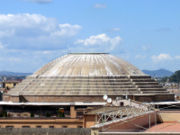
| Pantheon Pantheon, Rome The Pantheon ,Rarely Pantheum. This appears in Pliny's Natural History in describing this edifice: Agrippae Pantheum decoravit Diogenes Atheniensis; in columnis templi eius Caryatides probantur inter pauca operum, sicut in fastigio posita signa, sed propter altitudinem loci minus celebrata.from ,... |
Rome Rome Rome is the capital of Italy and the country's largest and most populated city and comune, with over 2.7 million residents in . The city is located in the central-western portion of the Italian Peninsula, on the Tiber River within the Lazio region of Italy.Rome's history spans two and a half... |
2nd c. | Rotunda Rotunda (architecture) A rotunda is any building with a circular ground plan, sometimes covered by a dome. It can also refer to a round room within a building . The Pantheon in Rome is a famous rotunda. A Band Rotunda is a circular bandstand, usually with a dome... |
Concrete, Lead plate roofing |
~ 1.35 1:32 |
~ 5.93 1:7.3 |
8.95 1:4.9 |
Largest dome of the world until 1881; largest unreinforced solid concrete dome in the world till present; archetype of Western dome construction to this day | |
| Lake Avernus Lake Avernus Lake Avernus is a volcanic crater lake located in the Avernus crater in the Campania region of southern Italy, around northwest of Pozzuoli. It is near the volcanic field known as the Campi Flegrei and comprises part of the wider Campanian volcanic arc... |
1st c. | ||||||||
| Baths of Caracalla Baths of Caracalla The Baths of Caracalla in Rome, Italy were Roman public baths, or thermae, built in Rome between AD 212 and 216, during the reign of the Emperor Caracalla.- History :... , Caldarium Caldarium right|thumb|230px|Caldarium from the Roman Baths at [[Bath, England]]. The floor has been removed to reveal the empty space where the hot air flowed through to heat the floor.... |
Rome Rome Rome is the capital of Italy and the country's largest and most populated city and comune, with over 2.7 million residents in . The city is located in the central-western portion of the Italian Peninsula, on the Tiber River within the Lazio region of Italy.Rome's history spans two and a half... |
3rd c. | Amphora Amphora An amphora is a type of vase-shaped, usually ceramic container with two handles and a long neck narrower than the body... s |
Eight pillars; largest dome of the world out of ceramic hollowware | |||||
| Baiae Baiae Baiae , a frazione of the comune of Bacoli) in the Campania region of Italy was a Roman seaside resort on the Bay of Naples. It was said to have been named after Baius, who was supposedly buried there. Baiae was for several hundred years a fashionable resort, especially towards the end of the Roman... |
2nd c. | 1.20 1:25 |
~ 5,70 1:5.2 |
||||||
| Baiae Baiae Baiae , a frazione of the comune of Bacoli) in the Campania region of Italy was a Roman seaside resort on the Bay of Naples. It was said to have been named after Baius, who was supposedly buried there. Baiae was for several hundred years a fashionable resort, especially towards the end of the Roman... |
2nd c. | - | ~ 2.90 1:9.1 |
Outer wall pillars | |||||
| Mausoleum of Maxentius | Rome Rome Rome is the capital of Italy and the country's largest and most populated city and comune, with over 2.7 million residents in . The city is located in the central-western portion of the Italian Peninsula, on the Tiber River within the Lazio region of Italy.Rome's history spans two and a half... |
4th c. | |||||||
| Baths of Agrippa Baths of Agrippa The Baths of Agrippa were a structure of ancient Rome, built by Marcus Vipsanius Agrippa, the first of the great thermae constructed in the city. In their first form, constructed at the same time as the Pantheon and on axis with it, as a balaneion , they were apparently a hot-air bath with a cold... , 'Arco della Ciambella' |
Rome Rome Rome is the capital of Italy and the country's largest and most populated city and comune, with over 2.7 million residents in . The city is located in the central-western portion of the Italian Peninsula, on the Tiber River within the Lazio region of Italy.Rome's history spans two and a half... |
Rotunda Rotunda (architecture) A rotunda is any building with a circular ground plan, sometimes covered by a dome. It can also refer to a round room within a building . The Pantheon in Rome is a famous rotunda. A Band Rotunda is a circular bandstand, usually with a dome... |
First Thermae Thermae In ancient Rome, thermae and balnea were facilities for bathing... in Rome with central dome; largest dome of the world |
||||||
| Rotunda of St. George Arch and Tomb of Galerius The Arch of Galerius and the Rotunda are neighboring early 4th-century monuments in the city of Thessaloniki, in the region of Central Macedonia in northern Greece. The Rotunda is also known as the Church of Agios Georgios or the Rotunda of St... |
Thessaloniki Thessaloniki Thessaloniki , historically also known as Thessalonica, Salonika or Salonica, is the second-largest city in Greece and the capital of the region of Central Macedonia as well as the capital of the Decentralized Administration of Macedonia and Thrace... |
4th c. | Brick | ~ 1 1:24 |
6.00 1:4 |
Largest brick dome of the world | |||
| Sanctuary of Asclepius Pergamon Pergamon , or Pergamum, was an ancient Greek city in modern-day Turkey, in Mysia, today located from the Aegean Sea on a promontory on the north side of the river Caicus , that became the capital of the Kingdom of Pergamon during the Hellenistic period, under the Attalid dynasty, 281–133 BC... |
Pergamon Pergamon Pergamon , or Pergamum, was an ancient Greek city in modern-day Turkey, in Mysia, today located from the Aegean Sea on a promontory on the north side of the river Caicus , that became the capital of the Kingdom of Pergamon during the Hellenistic period, under the Attalid dynasty, 281–133 BC... |
2nd c. | Brick | - | 3.35 1:7.1 |
Earliest monumental brick dome; largest brick dome of the world | |||
| to ~ 19.80 |
St. Gereon's Basilica St. Gereon's Basilica St. Gereon's Basilica is a Roman Catholic church in Cologne, Germany, dedicated to Saint Gereon, and designated a minor basilica on June 25, 1920. The first mention of a church at the site, dedicated to St. Gereon, appears in 612... |
Cologne Cologne Cologne is Germany's fourth-largest city , and is the largest city both in the Germany Federal State of North Rhine-Westphalia and within the Rhine-Ruhr Metropolitan Area, one of the major European metropolitan areas with more than ten million inhabitants.Cologne is located on both sides of the... |
4th c. | Oval with eight niches and apse Apse In architecture, the apse is a semicircular recess covered with a hemispherical vault or semi-dome... |
Later medieval structure with Roman building fabric largest occidental Western world The Western world, also known as the West and the Occident , is a term referring to the countries of Western Europe , the countries of the Americas, as well all countries of Northern and Central Europe, Australia and New Zealand... dome between Hagia Sophia Hagia Sophia Hagia Sophia is a former Orthodox patriarchal basilica, later a mosque, and now a museum in Istanbul, Turkey... and Florence Cathedral |
||||
| Rome Rome Rome is the capital of Italy and the country's largest and most populated city and comune, with over 2.7 million residents in . The city is located in the central-western portion of the Italian Peninsula, on the Tiber River within the Lazio region of Italy.Rome's history spans two and a half... |
4th c. | Decagon Decagon In geometry, a decagon is any polygon with ten sides and ten angles, and usually refers to a regular decagon, having all sides of equal length and each internal angle equal to 144°... |
Concrete with brick ribs | 0.56 1:42 |
~ 2.60 1:9.1 |
Outer wall pillars | |||
| Baths of Antoninus | Carthage Carthage Carthage , implying it was a 'new Tyre') is a major urban centre that has existed for nearly 3,000 years on the Gulf of Tunis, developing from a Phoenician colony of the 1st millennium BC... |
2nd c. | Polygon Polygon In geometry a polygon is a flat shape consisting of straight lines that are joined to form a closed chain orcircuit.A polygon is traditionally a plane figure that is bounded by a closed path, composed of a finite sequence of straight line segments... |
Seven domes with diameters between 17 and 22 m | |||||
| Rotunda at the Hippodrome Hippodrome of Constantinople The Hippodrome of Constantinople was a circus that was the sporting and social centre of Constantinople, capital of the Byzantine Empire. Today it is a square named Sultanahmet Meydanı in the Turkish city of Istanbul, with only a few fragments of the original structure surviving... |
Constantinople Constantinople Constantinople was the capital of the Roman, Eastern Roman, Byzantine, Latin, and Ottoman Empires. Throughout most of the Middle Ages, Constantinople was Europe's largest and wealthiest city.-Names:... |
5th c. | Rotunda Rotunda (architecture) A rotunda is any building with a circular ground plan, sometimes covered by a dome. It can also refer to a round room within a building . The Pantheon in Rome is a famous rotunda. A Band Rotunda is a circular bandstand, usually with a dome... with ten niches |
||||||
| Baths of Diocletian Baths of Diocletian The Baths of Diocletian in Rome were the grandest of the public baths, or thermae built by successive emperors. Diocletian's Baths, dedicated in 306, were the largest and most sumptuous of the imperial baths. The baths were built between the years 298 AD and 306 AD... , San Bernardo San Bernardo San Bernardo may refer to:In Mexico:*San Bernardo, Baja California Sur*San Bernardo, Chihuahua*San Bernardo, Coahuila*San Bernardo, Durango*San Bernardo, Guanajuato *San Bernardo, Hidalgo *San Bernardo Tlamimilolpan, Mexico State... |
Rome Rome Rome is the capital of Italy and the country's largest and most populated city and comune, with over 2.7 million residents in . The city is located in the central-western portion of the Italian Peninsula, on the Tiber River within the Lazio region of Italy.Rome's history spans two and a half... |
~ 300 | Concrete with brick ribs | ||||||
| or 21.25 |
Baths of Diocletian Baths of Diocletian The Baths of Diocletian in Rome were the grandest of the public baths, or thermae built by successive emperors. Diocletian's Baths, dedicated in 306, were the largest and most sumptuous of the imperial baths. The baths were built between the years 298 AD and 306 AD... , 'Planetarium' |
Rome Rome Rome is the capital of Italy and the country's largest and most populated city and comune, with over 2.7 million residents in . The city is located in the central-western portion of the Italian Peninsula, on the Tiber River within the Lazio region of Italy.Rome's history spans two and a half... |
~ 300 | Umbrella dome, Octagon |
Concrete with inner brick covering | 4.20 1:5.1 |
|||
| Baiae Baiae Baiae , a frazione of the comune of Bacoli) in the Campania region of Italy was a Roman seaside resort on the Bay of Naples. It was said to have been named after Baius, who was supposedly buried there. Baiae was for several hundred years a fashionable resort, especially towards the end of the Roman... |
Concrete | 3.65 1:5.9 |
Earliest monumental dome; largest dome of the world | ||||||
| Mausoleum of Helena Mausoleum of Helena The Mausoleum of Helena is an ancient building in Rome, Italy, currently located on the Via Casilina, corresponding to the 3rd mile of the ancient Via Labicana... |
Rome Rome Rome is the capital of Italy and the country's largest and most populated city and comune, with over 2.7 million residents in . The city is located in the central-western portion of the Italian Peninsula, on the Tiber River within the Lazio region of Italy.Rome's history spans two and a half... |
4th c. | Ceramic amphora incorporated into dome's base | 0.90 1:22 |
2.40 1:8.4 |
||||
| Baths of Caracalla Baths of Caracalla The Baths of Caracalla in Rome, Italy were Roman public baths, or thermae, built in Rome between AD 212 and 216, during the reign of the Emperor Caracalla.- History :... , Side building |
Rome Rome Rome is the capital of Italy and the country's largest and most populated city and comune, with over 2.7 million residents in . The city is located in the central-western portion of the Italian Peninsula, on the Tiber River within the Lazio region of Italy.Rome's history spans two and a half... |
3rd c. | Octagon | Preliminary form of the pendentive dome Pendentive A pendentive is a constructive device permitting the placing of a circular dome over a square room or an elliptical dome over a rectangular room. The pendentives, which are triangular segments of a sphere, taper to points at the bottom and spread at the top to establish the continuous circular or... |
|||||
| Baths of Bacucco | 4th c. | Umbrella dome, Octagon |
|||||||
| Baths of Diocletian Baths of Diocletian The Baths of Diocletian in Rome were the grandest of the public baths, or thermae built by successive emperors. Diocletian's Baths, dedicated in 306, were the largest and most sumptuous of the imperial baths. The baths were built between the years 298 AD and 306 AD... , Tepidarium Tepidarium The tepidarium was the warm bathroom of the Roman baths heated by a hypocaust or underfloor heating system.The specialty of a tepidarium is the pleasant feeling of constant radiant heat which directly affects the human body from the walls and floor.There is an interesting example at Pompeii; this... |
Rome Rome Rome is the capital of Italy and the country's largest and most populated city and comune, with over 2.7 million residents in . The city is located in the central-western portion of the Italian Peninsula, on the Tiber River within the Lazio region of Italy.Rome's history spans two and a half... |
~ 300 | 3.68 1:5.2 |
||||||
| Ostia Ostia Antica Ostia Antica is a large archeological site, close to the modern suburb of Ostia , that was the location of the harbour city of ancient Rome, which is approximately 30 km to the northeast. "Ostia" in Latin means "mouth". At the mouth of the River Tiber, Ostia was Rome's seaport, but, due to... |
3rd c. | - | 1.98 1:9.3 |
||||||
| Church of Euphemia | Constantinople Constantinople Constantinople was the capital of the Roman, Eastern Roman, Byzantine, Latin, and Ottoman Empires. Throughout most of the Middle Ages, Constantinople was Europe's largest and wealthiest city.-Names:... |
5th c. | Hexagon | ||||||
| Hadrian's Villa Hadrian's Villa The Hadrian's Villa is a large Roman archaeological complex at Tivoli, Italy.- History :The villa was constructed at Tibur as a retreat from Rome for Roman Emperor Hadrian during the second and third decades of the 2nd century AD... , 'Serapeum Serapeum A serapeum is a temple or other religious institution dedicated to the syncretic Hellenistic-Egyptian god Serapis, who combined aspects of Osiris and Apis in a humanized form that was accepted by the Ptolemaic Greeks of Alexandria... ' |
Tivoli Tivoli, Italy Tivoli , the classical Tibur, is an ancient Italian town in Lazio, about 30 km east-north-east of Rome, at the falls of the Aniene river where it issues from the Sabine hills... |
2nd c. | Umbrella dome | Concrete | Hollow space system | ||||
| Imperial Baths, Tepidarium |
Trier Trier Trier, historically called in English Treves is a city in Germany on the banks of the Moselle. It is the oldest city in Germany, founded in or before 16 BC.... |
4th c. | Concrete | ||||||
| Basilica of San Vitale Basilica of San Vitale The Church of San Vitale — styled an "ecclesiastical basilica" in the Roman Catholic Church, though it is not of architectural basilica form — is a church in Ravenna, Italy, one of the most important examples of early Christian Byzantine Art and architecture in western Europe... |
Ravenna Ravenna Ravenna is the capital city of the Province of Ravenna in the Emilia-Romagna region of Italy and the second largest comune in Italy by land area, although, at , it is little more than half the size of the largest comune, Rome... |
6th c. | Clay pipe, Wooden roof construction |
||||||
| Nymphaeum Nymphaeum A nymphaeum or nymphaion , in ancient Greece and Rome, was a monument consecrated to the nymphs, especially those of springs.... in Albano Laziale Albano Laziale Albano Laziale is a comune in the province of Rome, on the Alban Hills, in Latium, central Italy. It is also a suburb of Rome, which is 25 km distant. It is bounded by other communes of Castel Gandolfo, Rocca di Papa, Ariccia and Ardea. Located in the Castelli Romani area of Lazio... |
? | 1st c. | Concrete | 2.08 1:7.6 |
Earliest evidence for hollow spaces at dome's base for reduction in weight | ||||
| to ~ 13.00 |
Southern baths | Bostra | 3rd-4th c. | Octagon | Concrete | ||||
| Western baths | Gerasa | 2nd c. | Square Square (geometry) In geometry, a square is a regular quadrilateral. This means that it has four equal sides and four equal angles... |
Voussoir Voussoir A voussoir is a wedge-shaped element, typically a stone, used in building an arch or vault.Although each unit in an arch or vault is a voussoir, two units are of distinct functional importance: the keystone and the springer. The keystone is the center stone or masonry unit at the apex of an arch. A... |
One of the earliest stone domes with square plan; largest stone dome of the world | ||||
| Rome Rome Rome is the capital of Italy and the country's largest and most populated city and comune, with over 2.7 million residents in . The city is located in the central-western portion of the Italian Peninsula, on the Tiber River within the Lazio region of Italy.Rome's history spans two and a half... |
4th c. | Lead plate roofing | 0.90 1:16 |
~ 1.80 1:8.2 |
3,70 1:4.0 |
||||
| Porto Porto Porto , also known as Oporto in English, is the second largest city in Portugal and one of the major urban areas in the Iberian Peninsula. Its administrative limits include a population of 237,559 inhabitants distributed within 15 civil parishes... |
~ 3rd c. | Concrete with inner brick covering | - | ~ 2.20 1:6.6 |
|||||
| Mausoleum of Tor de' Schiavi | Via Prenestina | 4th c. | 0.60 1:23 |
2.60 1:5.3 |
Four openings at dome's base | ||||
| Domus Aurea Domus Aurea The Domus Aurea was a large landscaped portico villa, designed to take advantage of artificially created landscapes built in the heart of Ancient Rome by the Emperor Nero after the Great Fire of Rome had cleared away the aristocratic dwellings on the slopes of the Palatine... |
Rome Rome Rome is the capital of Italy and the country's largest and most populated city and comune, with over 2.7 million residents in . The city is located in the central-western portion of the Italian Peninsula, on the Tiber River within the Lazio region of Italy.Rome's history spans two and a half... |
1st c. | Cloister vault, Octagon |
Concrete | 5.99 1:2.3 |
First dome with octagonal plan; earliest in palace architecture | |||
| Mausoleum of Diocletian Diocletian's Palace Diocletian's Palace is a building in Split, Croatia, that was built by the Roman emperor Diocletian at the turn of the fourth century AD.Diocletian built the massive palace in preparation for his retirement on 1 May 305 AD. It lies in a bay on the south side of a short peninsula running out from... |
Split Split (city) Split is a Mediterranean city on the eastern shores of the Adriatic Sea, centered around the ancient Roman Palace of the Emperor Diocletian and its wide port bay. With a population of 178,192 citizens, and a metropolitan area numbering up to 467,899, Split is by far the largest Dalmatian city and... |
~ 300 | Brick, Tiled roof |
0.68 1:20 |
3.40 1:3.9 |
Double-walled dome | |||
| Chapel of Saint Aquilino | Milan Milan Milan is the second-largest city in Italy and the capital city of the region of Lombardy and of the province of Milan. The city proper has a population of about 1.3 million, while its urban area, roughly coinciding with its administrative province and the bordering Province of Monza and Brianza ,... |
4th c. | Brick | ||||||
| Tivoli Tivoli, Italy Tivoli , the classical Tibur, is an ancient Italian town in Lazio, about 30 km east-north-east of Rome, at the falls of the Aniene river where it issues from the Sabine hills... |
4th c. | Concrete with brick ribs | 1.30 1:9 |
2.08 1:5.9 |
2.10 1:5.9 |
||||
| Hadrian's Villa Hadrian's Villa The Hadrian's Villa is a large Roman archaeological complex at Tivoli, Italy.- History :The villa was constructed at Tibur as a retreat from Rome for Roman Emperor Hadrian during the second and third decades of the 2nd century AD... , Summer Triclinium Triclinium A triclinium is a formal dining room in a Roman building. The word is adopted from the Greek τρικλίνιον, triklinion, from τρι-, tri-, "three", and κλίνη, klinē, a sort of "couch" or rather chaise longue... (Exedra Exedra In architecture, an exedra is a semicircular recess or plinth, often crowned by a semi-dome, which is sometimes set into a building's facade. The original Greek sense was applied to a room that opened onto a stoa, ringed with curved high-backed stone benches, a suitable place for a philosophical... ) |
Tivoli Tivoli, Italy Tivoli , the classical Tibur, is an ancient Italian town in Lazio, about 30 km east-north-east of Rome, at the falls of the Aniene river where it issues from the Sabine hills... |
2nd c. | Concrete with inner brick covering | ||||||
| Baths of Aquae Flavianae | El Hammam | 3rd c. | Clay pipes | Largest dome of the world out of ceramic hollowware | |||||
| Church of Hodegetria | Constantinople Constantinople Constantinople was the capital of the Roman, Eastern Roman, Byzantine, Latin, and Ottoman Empires. Throughout most of the Middle Ages, Constantinople was Europe's largest and wealthiest city.-Names:... |
5th c. | Hexagon | ||||||
| Skeuophylakion | Constantinople Constantinople Constantinople was the capital of the Roman, Eastern Roman, Byzantine, Latin, and Ottoman Empires. Throughout most of the Middle Ages, Constantinople was Europe's largest and wealthiest city.-Names:... |
~ 5th c. | Dodecagon Dodecagon In geometry, a dodecagon is any polygon with twelve sides and twelve angles.- Regular dodecagon :It usually refers to a regular dodecagon, having all sides of equal length and all angles equal to 150°... |
||||||
| Baptistery Baptistery In Christian architecture the baptistry or baptistery is the separate centrally-planned structure surrounding the baptismal font. The baptistry may be incorporated within the body of a church or cathedral and be provided with an altar as a chapel... |
Nocera Superiore Nocera Superiore Nocera Superiore is a town and comune in the province of Salerno in the Campania region of south-western Italy.-History:It was an Etruscan city, founded around the 7th century BC... Campania Campania Campania is a region in southern Italy. The region has a population of around 5.8 million people, making it the second-most-populous region of Italy; its total area of 13,590 km² makes it the most densely populated region in the country... |
6th c. | Eight rectangular dome windows | ||||||
| Hadrian's Villa Hadrian's Villa The Hadrian's Villa is a large Roman archaeological complex at Tivoli, Italy.- History :The villa was constructed at Tibur as a retreat from Rome for Roman Emperor Hadrian during the second and third decades of the 2nd century AD... , 'Heliocaminus' |
Tivoli Tivoli, Italy Tivoli , the classical Tibur, is an ancient Italian town in Lazio, about 30 km east-north-east of Rome, at the falls of the Aniene river where it issues from the Sabine hills... |
2nd c. | Double-walled dome with spacing for ceiling heating Hypocaust A hypocaust was an ancient Roman system of underfloor heating, used to heat houses with hot air. The word derives from the Ancient Greek hypo meaning "under" and caust-, meaning "burnt"... |
||||||
| Pergamon Pergamon Pergamon , or Pergamum, was an ancient Greek city in modern-day Turkey, in Mysia, today located from the Aegean Sea on a promontory on the north side of the river Caicus , that became the capital of the Kingdom of Pergamon during the Hellenistic period, under the Attalid dynasty, 281–133 BC... |
~ 2nd c. | Brick | Two Rotunda; largest brick dome of the world | ||||||
| Santa Costanza Santa Costanza Santa Costanza is a 4th century church in Rome, Italy, on the Via Nomentana, which runs north-east out of the city, still under its ancient name. According to the traditional view, it was built under Constantine I as a mausoleum for his daughter Constantina who died in 354 AD... |
Rome Rome Rome is the capital of Italy and the country's largest and most populated city and comune, with over 2.7 million residents in . The city is located in the central-western portion of the Italian Peninsula, on the Tiber River within the Lazio region of Italy.Rome's history spans two and a half... |
4th c. | Concrete with brick ribs, Tiled roof directly resting on dome shell |
~ 0.70 1:16 |
1.45 1:7.9 |
Tambour Tambour In classical architecture, a tambour is the inverted bell of the Corinthian capital around which are carved acanthus leaves for decoration.... |
|||
| Mor Gabriel Monastery | Tur Abdin Tur Abdin Tur Abdin is a hilly region of south east Turkey incorporating the eastern half of Mardin Province, and Şırnak Province west of the Tigris, on the border with Syria. The name 'Tur Abdin' is from the Syriac language meaning 'mountain of the servants '. Tur Abdin is of great importance to Syriac... |
6th c. | Brick | yes | |||||
| Praetorium Praetorium - Etemology :The praetorium, also spelled prœtorium or pretorium, was originally used to identify the general’s tent within a Roman Castra, Castellum, or encampment. The word originates from the name of the chief Roman magistrate, known as Praetor... |
Cologne Cologne Cologne is Germany's fourth-largest city , and is the largest city both in the Germany Federal State of North Rhine-Westphalia and within the Rhine-Ruhr Metropolitan Area, one of the major European metropolitan areas with more than ten million inhabitants.Cologne is located on both sides of the... |
4th c. | Octagon | - | 2.00 1:5.7 |
||||
| Gordian's Villa | Rome Rome Rome is the capital of Italy and the country's largest and most populated city and comune, with over 2.7 million residents in . The city is located in the central-western portion of the Italian Peninsula, on the Tiber River within the Lazio region of Italy.Rome's history spans two and a half... , Via Prenestina |
3rd c. | Octagon | - | ~ 1.35 1:8.2 |
Preliminary form of the pendentive dome Pendentive A pendentive is a constructive device permitting the placing of a circular dome over a square room or an elliptical dome over a rectangular room. The pendentives, which are triangular segments of a sphere, taper to points at the bottom and spread at the top to establish the continuous circular or... ; eight openings at dome's base |
|||
| Therme d’Allance | ? | ? | |||||||
| Mausoleum of Gallien | Rome Rome Rome is the capital of Italy and the country's largest and most populated city and comune, with over 2.7 million residents in . The city is located in the central-western portion of the Italian Peninsula, on the Tiber River within the Lazio region of Italy.Rome's history spans two and a half... , Via Appia |
3rd c. | Rotunda Rotunda (architecture) A rotunda is any building with a circular ground plan, sometimes covered by a dome. It can also refer to a round room within a building . The Pantheon in Rome is a famous rotunda. A Band Rotunda is a circular bandstand, usually with a dome... with six niches |
- | ~ 1.60 1:6.8 |
||||
| Centcelles, near Tarragona Tarragona Tarragona is a city located in the south of Catalonia on the north-east of Spain, by the Mediterranean. It is the capital of the Spanish province of the same name and the capital of the Catalan comarca Tarragonès. In the medieval and modern times it was the capital of the Vegueria of Tarragona... |
4th c. | Brick and stone | ~ 0.40 1:27 |
~ 1.90 1:5.6 |
|||||
| to ~ 9.40 |
Hadrian's Villa Hadrian's Villa The Hadrian's Villa is a large Roman archaeological complex at Tivoli, Italy.- History :The villa was constructed at Tibur as a retreat from Rome for Roman Emperor Hadrian during the second and third decades of the 2nd century AD... , small baths |
Tivoli Tivoli, Italy Tivoli , the classical Tibur, is an ancient Italian town in Lazio, about 30 km east-north-east of Rome, at the falls of the Aniene river where it issues from the Sabine hills... |
2nd c. | Elliptical dome with wavelike rim | |||||
| Gordian's Villa, Hall |
Via Prenestina | ~ 2nd c. | |||||||
| Via Latina Via Latina The Via Latina was a Roman road of Italy, running southeast from Rome for about 200 kilometers.It led from the Porta Latina in the Aurelian walls of Rome to the pass of Mons Algidus; it was important in the early military history of Rome... |
2nd c. | Ceramic amphora at dome's base | Earliest known use of amphora at dome's base | ||||||
| Cathedral Cathedral A cathedral is a Christian church that contains the seat of a bishop... , Baptistery |
Ravenna Ravenna Ravenna is the capital city of the Province of Ravenna in the Emilia-Romagna region of Italy and the second largest comune in Italy by land area, although, at , it is little more than half the size of the largest comune, Rome... |
5th c. | |||||||
| Hadrian's Villa Hadrian's Villa The Hadrian's Villa is a large Roman archaeological complex at Tivoli, Italy.- History :The villa was constructed at Tibur as a retreat from Rome for Roman Emperor Hadrian during the second and third decades of the 2nd century AD... , Piazza d'Oro (vestibule Vestibule (architecture) A vestibule is a lobby, entrance hall, or passage between the entrance and the interior of a building.The same term can apply to structures in modern or ancient roman architecture. In modern architecture vestibule typically refers to a small room or hall between an entrance and the interior of... ) |
Tivoli Tivoli, Italy Tivoli , the classical Tibur, is an ancient Italian town in Lazio, about 30 km east-north-east of Rome, at the falls of the Aniene river where it issues from the Sabine hills... |
2nd c. | Umbrella dome | ~ 1,90 1:5.0 |
|||||
| Praetextat catacomb, 'Calventier tomb' |
Rome Rome Rome is the capital of Italy and the country's largest and most populated city and comune, with over 2.7 million residents in . The city is located in the central-western portion of the Italian Peninsula, on the Tiber River within the Lazio region of Italy.Rome's history spans two and a half... |
3rd c. | Rotunda Rotunda (architecture) A rotunda is any building with a circular ground plan, sometimes covered by a dome. It can also refer to a round room within a building . The Pantheon in Rome is a famous rotunda. A Band Rotunda is a circular bandstand, usually with a dome... with six niches |
||||||
| Capito Thermae, Laconicum Laconicum Laconicum , the dry sweating room of the Roman thermae, contiguous to the caldarium or hot room. The name was given to it as being the only form of warm bath that the Spartans admitted... |
Miletus Miletus Miletus was an ancient Greek city on the western coast of Anatolia , near the mouth of the Maeander River in ancient Caria... |
1st c. | Concrete | ||||||
| Small Roundtemple | Baalbek Baalbek Baalbek is a town in the Beqaa Valley of Lebanon, altitude , situated east of the Litani River. It is famous for its exquisitely detailed yet monumentally scaled temple ruins of the Roman period, when Baalbek, then known as Heliopolis, was one of the largest sanctuaries in the Empire... |
3rd c. | |||||||
| Domus Augustana | Rome Rome Rome is the capital of Italy and the country's largest and most populated city and comune, with over 2.7 million residents in . The city is located in the central-western portion of the Italian Peninsula, on the Tiber River within the Lazio region of Italy.Rome's history spans two and a half... |
1st c. | Cloister vault, Octagon |
One of the earliest cloister vaults with octagonal curtain walls | |||||
| Rome Rome Rome is the capital of Italy and the country's largest and most populated city and comune, with over 2.7 million residents in . The city is located in the central-western portion of the Italian Peninsula, on the Tiber River within the Lazio region of Italy.Rome's history spans two and a half... , Via Appia |
~ 4th c. | ~ 0.90 1:9 |
2,30 1:3.5 |
~ 1.50 1:5.4 |
|||||
| Baths of Maxentius | Rome Rome Rome is the capital of Italy and the country's largest and most populated city and comune, with over 2.7 million residents in . The city is located in the central-western portion of the Italian Peninsula, on the Tiber River within the Lazio region of Italy.Rome's history spans two and a half... |
4th c. | Umbrella dome, Octagon |
||||||
| Domus Flavia | Rome Rome Rome is the capital of Italy and the country's largest and most populated city and comune, with over 2.7 million residents in . The city is located in the central-western portion of the Italian Peninsula, on the Tiber River within the Lazio region of Italy.Rome's history spans two and a half... |
1st c. | |||||||
| to ~ 6.20 |
Hadrian's Villa Hadrian's Villa The Hadrian's Villa is a large Roman archaeological complex at Tivoli, Italy.- History :The villa was constructed at Tibur as a retreat from Rome for Roman Emperor Hadrian during the second and third decades of the 2nd century AD... , 'Heliocaminus' |
? | 2nd c. | Cloister vault, Uneven octagon |
|||||
| Nymphaeum | Riza, Epirus Epirus The name Epirus, from the Greek "Ήπειρος" meaning continent may refer to:-Geographical:* Epirus - a historical and geographical region of the southwestern Balkans, straddling modern Greece and Albania... |
~ 250-350 | Dodecagon Dodecagon In geometry, a dodecagon is any polygon with twelve sides and twelve angles.- Regular dodecagon :It usually refers to a regular dodecagon, having all sides of equal length and all angles equal to 150°... |
||||||
| Baiae Baiae Baiae , a frazione of the comune of Bacoli) in the Campania region of Italy was a Roman seaside resort on the Bay of Naples. It was said to have been named after Baius, who was supposedly buried there. Baiae was for several hundred years a fashionable resort, especially towards the end of the Roman... |
2nd c. | Flat umbrella dome, Octagon |
|||||||
| Hall of Thermae Pisa | ? | ~ 2nd c. | Cloister vault with eight windows, Octagon |
2.00 1:3.3 |
|||||
| Stabian Thermae, Laconicum Laconicum Laconicum , the dry sweating room of the Roman thermae, contiguous to the caldarium or hot room. The name was given to it as being the only form of warm bath that the Spartans admitted... |
Pompeii Pompeii The city of Pompeii is a partially buried Roman town-city near modern Naples in the Italian region of Campania, in the territory of the comune of Pompei. Along with Herculaneum, Pompeii was destroyed and completely buried during a long catastrophic eruption of the volcano Mount Vesuvius spanning... |
Cone vault (early form of the dome) | Concrete | yes | Oldest known concrete domes | ||||
| Hunting Thermae | Leptis Magna Leptis Magna Leptis Magna also known as Lectis Magna , also called Lpqy, Neapolis, Lebida or Lebda to modern-day residents of Libya, was a prominent city of the Roman Empire. Its ruins are located in Khoms, Libya, east of Tripoli, on the coast where the Wadi Lebda meets the sea... |
~ 200 | Cloister vault with eight windows | ||||||
| Arch of Marcus Aurelius | Tripoli Tripoli Tripoli is the capital and largest city in Libya. It is also known as Western Tripoli , to distinguish it from Tripoli, Lebanon. It is affectionately called The Mermaid of the Mediterranean , describing its turquoise waters and its whitewashed buildings. Tripoli is a Greek name that means "Three... |
? | Cloister vault | Voussoir Voussoir A voussoir is a wedge-shaped element, typically a stone, used in building an arch or vault.Although each unit in an arch or vault is a voussoir, two units are of distinct functional importance: the keystone and the springer. The keystone is the center stone or masonry unit at the apex of an arch. A... |
|||||
| Water Castellum Castellum A castellum is a small Roman detached fort or fortlet used as a watch tower or signal station. The Latin word castellum is a diminutive of castra , which in turn is the plural of castrum ; it is the source of the English word "castle".The term castellum was also used to refer to a settling or... |
Pompeii Pompeii The city of Pompeii is a partially buried Roman town-city near modern Naples in the Italian region of Campania, in the territory of the comune of Pompei. Along with Herculaneum, Pompeii was destroyed and completely buried during a long catastrophic eruption of the volcano Mount Vesuvius spanning... |
- 14 AD |
Flat dome | ||||||
| Octagon near 'Temple of Mercury' | Baiae Baiae Baiae , a frazione of the comune of Bacoli) in the Campania region of Italy was a Roman seaside resort on the Bay of Naples. It was said to have been named after Baius, who was supposedly buried there. Baiae was for several hundred years a fashionable resort, especially towards the end of the Roman... |
2nd c. | Umbrella dome, Octagon |
||||||
| San Vitale, Stair towers |
Ravenna Ravenna Ravenna is the capital city of the Province of Ravenna in the Emilia-Romagna region of Italy and the second largest comune in Italy by land area, although, at , it is little more than half the size of the largest comune, Rome... |
6th c. | Brick | ||||||
| Rome Rome Rome is the capital of Italy and the country's largest and most populated city and comune, with over 2.7 million residents in . The city is located in the central-western portion of the Italian Peninsula, on the Tiber River within the Lazio region of Italy.Rome's history spans two and a half... , Via Nomentana Via Nomentana Via Nomentana is an ancient road of Italy, leading North-East from Rome to Nomentum , a distance of . It originally bore the name Via Ficulnensis, from the old Latin village of Ficulnea, about from Rome. It was subsequently prolonged to Nomentum, but never became an important high road, and merged... |
2nd c. | Square Square (geometry) In geometry, a square is a regular quadrilateral. This means that it has four equal sides and four equal angles... |
|||||||
| Tabularium Tabularium The Tabularium was the official records office of ancient Rome, and also housed the offices of many city officials. Situated within the Roman Forum, it was on the front slope of the Capitoline Hill, below the Temple of Jupiter Optimus Maximus, to the southeast of the Arx and Tarpeian Rock.Within... |
Rome Rome Rome is the capital of Italy and the country's largest and most populated city and comune, with over 2.7 million residents in . The city is located in the central-western portion of the Italian Peninsula, on the Tiber River within the Lazio region of Italy.Rome's history spans two and a half... |
Cloister vault, Square Square (geometry) In geometry, a square is a regular quadrilateral. This means that it has four equal sides and four equal angles... |
Earliest cloister vault | ||||||
| Baiae Baiae Baiae , a frazione of the comune of Bacoli) in the Campania region of Italy was a Roman seaside resort on the Bay of Naples. It was said to have been named after Baius, who was supposedly buried there. Baiae was for several hundred years a fashionable resort, especially towards the end of the Roman... |
2nd c. | Umbrella dome above circular ground plan | 0.59 1:7.5 |
||||||
| Ravenna Ravenna Ravenna is the capital city of the Province of Ravenna in the Emilia-Romagna region of Italy and the second largest comune in Italy by land area, although, at , it is little more than half the size of the largest comune, Rome... |
5th c. | Tiled roof | |||||||
| Tomb at Casal de' Pazzi | Rome Rome Rome is the capital of Italy and the country's largest and most populated city and comune, with over 2.7 million residents in . The city is located in the central-western portion of the Italian Peninsula, on the Tiber River within the Lazio region of Italy.Rome's history spans two and a half... , Via Nomentana Via Nomentana Via Nomentana is an ancient road of Italy, leading North-East from Rome to Nomentum , a distance of . It originally bore the name Via Ficulnensis, from the old Latin village of Ficulnea, about from Rome. It was subsequently prolonged to Nomentum, but never became an important high road, and merged... |
2nd c. | In-circle dome, Square Square (geometry) In geometry, a square is a regular quadrilateral. This means that it has four equal sides and four equal angles... |
Concrete | Preform of pendentive dome Pendentive A pendentive is a constructive device permitting the placing of a circular dome over a square room or an elliptical dome over a rectangular room. The pendentives, which are triangular segments of a sphere, taper to points at the bottom and spread at the top to establish the continuous circular or... ; hollow space system |
||||
| Pompeii Pompeii The city of Pompeii is a partially buried Roman town-city near modern Naples in the Italian region of Campania, in the territory of the comune of Pompei. Along with Herculaneum, Pompeii was destroyed and completely buried during a long catastrophic eruption of the volcano Mount Vesuvius spanning... |
Cone vault (early form of the dome) | Brick and clay (upper calotte) | Concrete wall shell | ||||||
| Mausoleum of Constantine at the Church of the Holy Apostles Church of the Holy Apostles The Church of the Holy Apostles , also known as the Imperial Polyandreion, was a Christian church built in Constantinople, capital of the Eastern Roman Empire, in 550. It was second only to the Church of the Holy Wisdom among the great churches of the capital... |
Constantinople Constantinople Constantinople was the capital of the Roman, Eastern Roman, Byzantine, Latin, and Ottoman Empires. Throughout most of the Middle Ages, Constantinople was Europe's largest and wealthiest city.-Names:... |
4th c. | Presumably Rotunda Rotunda (architecture) A rotunda is any building with a circular ground plan, sometimes covered by a dome. It can also refer to a round room within a building . The Pantheon in Rome is a famous rotunda. A Band Rotunda is a circular bandstand, usually with a dome... with twelve niches |
||||||
Half-domes
| Diameter ⌀ | Name, Part |
Location | Built | Shape of dome, Ground plan |
Material, Roof construction |
Shell thickness (ST) ST to ⌀ |
Curtain wall thickness (CWT) CWT to ⌀ |
Comments/ Other characteristics |
|---|---|---|---|---|---|---|---|---|
| Baths of Trajan Baths of Trajan The Baths of Trajan were a massive thermae, a bathing and leisure complex, built in ancient Rome starting from 104 AD and dedicated during the Kalends of July in 109... |
Rome Rome Rome is the capital of Italy and the country's largest and most populated city and comune, with over 2.7 million residents in . The city is located in the central-western portion of the Italian Peninsula, on the Tiber River within the Lazio region of Italy.Rome's history spans two and a half... |
Largest dome(s) of the world | ||||||
| Baths of Diocletian Baths of Diocletian The Baths of Diocletian in Rome were the grandest of the public baths, or thermae built by successive emperors. Diocletian's Baths, dedicated in 306, were the largest and most sumptuous of the imperial baths. The baths were built between the years 298 AD and 306 AD... , Two apse halls |
Rome Rome Rome is the capital of Italy and the country's largest and most populated city and comune, with over 2.7 million residents in . The city is located in the central-western portion of the Italian Peninsula, on the Tiber River within the Lazio region of Italy.Rome's history spans two and a half... |
|||||||
| Trajan's Forum Trajan's Forum Trajan's Forum is an ancient structure in Rome, Italy, chronologically the last of the Imperial fora. The forum was constructed by the architect Apollodorus of Damascus.-History:... |
Rome Rome Rome is the capital of Italy and the country's largest and most populated city and comune, with over 2.7 million residents in . The city is located in the central-western portion of the Italian Peninsula, on the Tiber River within the Lazio region of Italy.Rome's history spans two and a half... |
|||||||
| Santi Cosma e Damiano Santi Cosma e Damiano The basilica of Santi Cosma e Damiano is a church in Rome, Italy, located in the Roman Forum. It is one of the ancient churches called tituli, of which cardinals are patrons as deacons: the Cardinal Deacon of the Titulus Ss. Cosmae et Damiani is Giovanni Cheli... , Apse |
Rome Rome Rome is the capital of Italy and the country's largest and most populated city and comune, with over 2.7 million residents in . The city is located in the central-western portion of the Italian Peninsula, on the Tiber River within the Lazio region of Italy.Rome's history spans two and a half... |
|||||||
| Nymphaeum | Jerash Jerash Jerash, the Gerasa of Antiquity, is the capital and largest city of Jerash Governorate , which is situated in the north of Jordan, north of the capital Amman towards Syria... |
Concrete | ||||||
| Basilica, Apse |
Bostra | Concrete, inside covered with ashlar | ||||||
| Cathedral, Annex rooms |
Bostra | Concrete | ||||||
| Pantheon Pantheon, Rome The Pantheon ,Rarely Pantheum. This appears in Pliny's Natural History in describing this edifice: Agrippae Pantheum decoravit Diogenes Atheniensis; in columnis templi eius Caryatides probantur inter pauca operum, sicut in fastigio posita signa, sed propter altitudinem loci minus celebrata.from ,... , Front niches |
Rome Rome Rome is the capital of Italy and the country's largest and most populated city and comune, with over 2.7 million residents in . The city is located in the central-western portion of the Italian Peninsula, on the Tiber River within the Lazio region of Italy.Rome's history spans two and a half... |
|||||||
See also
- Record-holding domes in antiquity
- List of world's largest domes
- Roman architectureRoman architectureAncient Roman architecture adopted certain aspects of Ancient Greek architecture, creating a new architectural style. The Romans were indebted to their Etruscan neighbors and forefathers who supplied them with a wealth of knowledge essential for future architectural solutions, such as hydraulics...
- List of Domes in France
External links
- Traianus — Technical investigation of Roman public works
- The Roman Pantheon: The Triumph of Concrete