


Muslim conquest of Syria

Encyclopedia
The Muslim conquest of Syria occurred in the first half of the 7th century, and refers to the region known as the Bilad al-Sham, the Levant
, or Greater Syria
. Arab Muslim forces had appeared on the southern borders even before the death of the Islam
ic Prophet
Muhammad
in 632, resulting in the Battle of Mu'tah
in 629, but the real invasion began in 634 under his successors, the Rashidun
Caliph
s Abu Bakr
and Umar ibn Khattab, with Khalid ibn al-Walid
as their most important military leader.
. During the Byzantine period
, beginning in AD 70 after the fall of Jerusalem, the entire region (Judea
, Samaria
, and the Galilee
) was renamed Palaestina, subdivided into Diocese I and II. The Byzantines also renamed an area of land including the Negev
, Sinai, and the west coast of the Arabian Peninsula as Palaestina Salutoris, sometimes called Palaestina III. Part of the area was ruled by the Arab vassal state of the Ghassanids (symmachos). During the last
of the Roman-Persian Wars
, beginning in 603, the Persians under Khosrau II
had succeeded in occupying Syria, Palestine
and Egypt
for over a decade before being forced by the victories of Heraclius
to conclude the peace of 628. Thus, on the eve of the Muslim conquests the Romans were still in the process of rebuilding their authority in these territories, which in some areas had been lost to them for almost twenty years. Politically, the Syrian region consisted of two provinces: Syria proper stretched from Antioch
and Aleppo
in the north to the top of the Dead Sea
. To the west and south of the Dead Sea lay the province of Palestine
, which included the holy places of the three Abrahamic religions
. Syria was partly an Arab land, especially in its eastern and southern parts. The Arabs had been there since pre-Roman times, and had embraced Christianity since Constantine I
legalized it in the fourth century.
The Arabs of Syria were people of no consequence until the migration of the powerful Ghassan tribe from Yemen
to Syria, who thereafter ruled a semi-autonomous state with their own king under the Romans. The Ghassan Dynasty became one of the honoured princely dynasties of the Empire, with the Ghassan king ruling over the Arabs in Jordan and Southern Syria from his capital at Bosra
. The last of the Ghassan kings, who ruled at the time of the Muslim invasion, was Jabla bin Al Aiham.
Emperor Heraclius, after re-capturing Syria from the Sassanids, set up new defense lines from Ghazzah to the south end of the Dead Sea. These lines were only designed to protect communications from bandits, and the bulk of the Byzantine defenses were concentrated in Northern Syria facing the traditional foes, the Sassanid Persians. This defense line had as a drawback that it enabled the Muslim
s, who emerged from the desert in the south, to reach as far north as Ghazzah before meeting regular Byzantine troops.
7th century AD was a time of fast military changes in the Byzantine empire. The empire was certainly not in a state of collapse when it faced the new challenge from Arabia after being exhausted by recent Roman-Persian Wars
, but failed completely to tackle the challenge effectively.
ic Prophet Mohammad died in June 632, and Abu Bakr
was appointed Caliph
and political successor at Medina
. Soon after Abu Bakr
's succession, several Arab tribes revolted against him in the Ridda wars
(Arabic for the Wars of Apostasy). The Campaign of the Apostasy was fought and completed during the eleventh year of the Hijri. The year 12 Hijri dawned, on 18 March 633, with Arabia united under the central authority of the Caliph at Medina.
Whether Abu Bakr intended a full-out imperial conquest or not is hard to say; he did, however, set in motion a historical trajectory that in just a few short decades would lead to one of the largest empires in history, starting with a confrontation with the Persian Empire
under the general Khalid ibn al-Walid
.
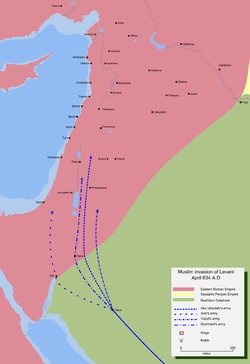 After successful campaigns against the Sassanids and the ensuing conquest of Iraq
Khalid established his stronghold in Iraq. While engaged with Sassanid forces, confrontation also ensued with the Byzantine Arab clients, the Ghassanids. Tribal contingents were soon recruited to the call from Medinah from all over the Arabian peninsula
. Only those who had rebelled during the Ridda wars were excluded from the summons and remained excluded from Rashidun armies until in 636 when Caliph Umar
fell short of manpower for the Battle of Yarmouk
and the Battle of al-Qādisiyyah
. The tradition of raising armies from tribal contingents remained in use until 636, when Caliph Umar organised the army as a state department.
Abu Bakr organised the army into four corps, each with its own commander and objective.
Not knowing the precise position of the Byzantine army
, Caliph Abu Bakr ordered that all corps should remain in touch with each other so that they could help each other if the Byzantines were able to concentrate their army in any sector of operation. In case the corps had to concentrate for one major battle, Abu Ubaidah was appointed Commander-in-Chief of the entire army.
In the first week of April 634, the Muslim forces began to move from their camps outside Medina
. The first to leave was Yazid's corps, followed by Shurahbil, Abu Ubaidah and Amr, each a day's march from the other.
Caliph Abu Bakr walked for a short distance by the side of each corps commander. His parting words which he repeated to each of the corps commanders, were as follows:
 Moving to their assigned target beyond Tabouk, Yazid's corps made contact with a small Christian Arab force that was retreating after a skirmish with the Muslim advance guard, after which Yazid made for the Valley of Araba where it meets the southern end of the Dead Sea
.
As the main Byzantine defence line started from the coastal regions near Ghazahh, Yazid arrived at the Valley of Araba at about the same time as Amr bin Al Aas reached Elat. The two forward detachments sent by the Byzantine army to prevent the entry of Yazid's and Amr's corps, respectively, into Palestine, were easily defeated by them, though they did prevent the Rashidun forces from reaching their assigned objective. Abu Ubaidah and Shurhabil, on the other hand, continued their march, and by early May 634 they reached the region between Bosra
and Jabiya. The Emperor Heraclius, having received intelligence of the movements of the Muslim armies from his Arab clients, began to plan countermeasures. Upon Heraclius' orders, Byzantine forces from different garrisons in the north started moving to gather at Ayjnadyn. From here they could engage Amr's corps and maneuver against the flank or rear of the rest of the Muslim corps that were in Jordan and Southern Syria. The strength of the Byzantine forces, according to rough estimates, was about 100,000. Abu Ubaidah informed the Caliph about the preparations made by the Byzantines in the third week of May 634. Because Abu Ubaida didn't have the experience as a commander of military forces in such major operations, especially with the powerful Roman Army, Abu Bakr decided to send Khalid ibn Walid to the Syrian front to command the Muslim army. According to early Muslim chronicles Abu Bakr said:
 Khalid was immediately dispatched to the Syrian front. He set out for Syria from Al-Hirah
, in Iraq
in early June 634, taking with him half his army, about 8000 strong.
There were two routes towards Syria from Iraq: one was via Daumat-ul-Jandal, and the other was through Mesopotamia, passing through Ar Raqqah
. The Muslim armies in Syria were in need of urgent reinforcement, so Khalid avoided the conventional route to Syria via Daumat ul Jandal, as it was the longer route, and would take weeks to reach Syria. Khalid avoided the Mesopotamia’s route because of the presence of Roman garrisons in Northern Syria and Mesopotamia. To engage them at a time when Muslim armies were being outflanked in Syria was not a wise idea. Khalid selected a shorter route to Syria, an unconventional route passing through the Syrian Desert
. He boldly marched his armies through the desert. It is recorded that his soldiers marched for two days without a single drop of water, before reaching a pre-decided water source at an oasis. Khalid thus entered Northern Syria and caught the Byzantines at their right flank. According to modern historians, it was this ingenious strategic maneuver of Khalid, his perilous march through the desert and appearing at the north-eastern front of the Byzantines while they were occupied in tackling the Muslim armies in Southern Syria, that unhinged the Byzantine defences in Syria.
and the Battle of Hawareen. After dealing with all these cities, Khalid moved towards Damascus
, passing though a mountain pass which is now known as Sanita-al-Uqab (Uqab pass) after the name of Khalid's army standard. From here he moved away from Damascus, towards Bosra
, the capital of Ghassanid Arab kingdom, a vassal of the Eastern Roman empire. He ordered other Muslim commanders to concentrate their armies, still near the Syrian-Arabian border at Bosra. At Maraj-al-Rahab, Khalid defeated a Ghassanid
army of Christian Arabs in a quick battle, called the Battle of Marj-al-Rahit
. Meanwhile Abu Ubaida ibn al-Jarrah, the supreme commander of the Muslim armies in Syria, had ordered Shurhabil ibn Hasana to attack Bosra. The latter laid siege of Bosra with his small army of 4000 men. The Roman and Ghassanid Arab garrison, noticing that this might be the advance guard of the larger Muslim army to come, decided to attack and destroy Shurhabil’s army. They came out of the fortified city and attacked Shurhabil, surrounding him from all sides; Khalid reached the arena with his advance guard cavalry and saved the day for Shurhabil. The combined forces of Khalid, Shurhabil and Abu Ubaidah then laid siege to the city of Bosra
, which surrendered some time in mid July 634. This effectively ended the Ghassanid Dynasty.
_route_to_syria.png) Here Khalid took over the command of the Muslim armies in Syria from Abu Ubaidah, according to the instructions of the Caliph. Massive Byzantine armies were concentrating at Ajnadayn to push the invading armies back to the desert. Early Muslim sources have mentioned its size to be 90,000, while most of the modern historians doubt the figures, but consider this battle to be the key that broke the Byzantine power in Syria. According to the instructions of Khalid all Muslim corps concentrated at Ajnadayn, where they fought a decisive battle against the Byzantines on 30 July 634.
Here Khalid took over the command of the Muslim armies in Syria from Abu Ubaidah, according to the instructions of the Caliph. Massive Byzantine armies were concentrating at Ajnadayn to push the invading armies back to the desert. Early Muslim sources have mentioned its size to be 90,000, while most of the modern historians doubt the figures, but consider this battle to be the key that broke the Byzantine power in Syria. According to the instructions of Khalid all Muslim corps concentrated at Ajnadayn, where they fought a decisive battle against the Byzantines on 30 July 634.
The defeat of the Byzantines at the Battle of Ajnadayn
left Syria vulnerable to the Muslim invaders. Khalid decided to capture Damascus, the Byzantine stronghold. At Damascus Thomas, son in law of Emperor Heraclius, was in charge. Having received intelligence of Khalid’s march towards Damascus he prepared for the defence of Damascus. He wrote to Emperor Heraclius, who was at Emesa that time, for reinforcements. Moreover Thomas, in order to get more time for preparation of a siege, sent armies to delay or if possible halt Khalid’s march to Damascus. One of these armies was defeated at the Battle of Yaqusa in mid-August 634 near Lake Tiberias 90 miles from Damascus. Another army that tried to halt the Muslim advance to Damascus was defeated in the Battle of Maraj as Saffer on 19 August 634. These engagements delayed Khalid’s advance and gave Thomas enough time to prepare for a siege. Meanwhile a reinforcement reached the city, which Heraclius had dispatched after hearing the bad news of Ajnadyn. But before another regiment of Heraclius could reach Damascus, Khalid had already lied siege to Damascus. Khalid reached Damascus 20 August and besieged the city. To isolate the city from the rest of the region Khalid placed detachments south on the road to Palestine and in the north at the Damascus-Emesa route, and several other smaller detachments on routes towards Damascus. Heraclius reinforcement was intercepted and routed at the Battle of Sanita-al-Uqab 20 miles from Damascus. Khalid's forces withstood three Roman sallies that tried to break the siege. Khalid finally attacked and conquered Damascus
on 18 September 634 after a 30 days siege, although according to some sources the siege lasted for four or six months. Heraclius, having received the news of the fall of Damascus, left for Antioch
from Emesa. A peace agreement was made: the citizens were given peace on the terms of annual tribute and the Byzantine army
was given a three day peace period to go as far as they could. After the deadline of three days was over, the Muslim cavalry under Khalid's command, attacked the Roman army, catching up on them using an unknown shortcut, at the Battle of Maraj-al-Debaj
, 190 miles north of Damascus. Abu Bakr died during the siege of Damascus
and Umar became the new Caliph. He dismissed his cousin Khalid ibn al-Walid from command and appointed Abu Ubaidah ibn al-Jarrah
as the new commander in chief of the Islamic army in Syria. Abu Ubaidah got the letter of his appointment and Khalid's disposal during the siege, but he delayed the announcement until the city was conquered.
as the new commander in chief of the Islamic army
. The relationship between Khalid and Umar was already tense since the incident of Malik ibn Neuwera. There was an air of distrust between Khalid and Caliph Umar, which resulted in the dismissal of Khalid from supreme command then and later in 638 from military services. Later on, Khalid gave a pledge of loyalty to the new Caliph and kept on serving as an ordinary commander under Abu Ubaidah. He is reported to have said: There was inevitably a slowdown in the pace of military operations, as Abu Ubaida moved more slowly and steadily. The conquest of Syria continued under him. Abu Ubaidah, being an admirer of Khalid, made him commander of the cavalry and relied heavily on his advice during the whole campaign.
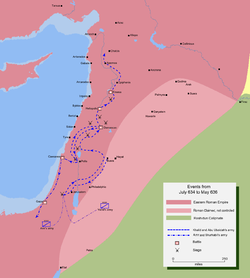
_syria.jpg) Soon after the appointment of Abu-Ubaidah as commander in chief, he sent a small detachment to the annual fair held at Abu-al-Quds, modern day Abla, near Zahlé
Soon after the appointment of Abu-Ubaidah as commander in chief, he sent a small detachment to the annual fair held at Abu-al-Quds, modern day Abla, near Zahlé
30 miles east of Beirut. There was a Byzantine and Christian Arab garrison nearby, but the size of the garrison was miscalculated by the Muslim informants. The garrison quickly encircled the small Muslim detachment, but before it was completely destroyed, Khalid came to the rescue of the Muslim army. Abu Ubaidah, having received new intelligence, had sent Khalid. Khalid reached the battlefield and defeated the garrison in the Battle of Abu-al-Quds on 15 October 634 AD and returned with tons of looted booty from the fair and hundreds of Roman prisoners.
By capturing central Syria, the Muslims had given a decisive blow to the Byzantines. The communication between Northern Syria and Palestine was now cut off. Abu Ubaidah decided to march to Fahl, which is about 500 feet below sea level, where a strong Byzantine garrison and survivors of the Battle of Ajnadayn were present. The region was crucial because from here the Byzantine army could strike eastwards and cut Muslim’s communications with Arabia. Moreover, with this large garrison at their rear Palestine could not be invaded.
These were the reasons why the Muslim army moved against Fahl. Khalid commanded the advance guard and reached Fahl first and found that the plains were flooded by the Byzantines who had blocked the River Jordan. The Byzantine army was eventually defeated at the Battle of Fahl
on 23 January 635 AD.
. Bet She'an
surrendered after a little resistance followed by the surrender of Tiberias in February 635. Caliph Umar, after having received the position and strength of the Byzantine army in Palestine, wrote detailed instructions to corps commanders in Palestine and ordered Yazid to capture the Mediterranean coast. The corps of Amr and Shurhabil accordingly marched against the strongest Byzantine garrison in Ajnadyn and defeated them in the 2nd Battle of Ajnadyn after which the two corps separated, with Amr moving to capture Nablus
, Amawas, Gaza
and Yubna in order to complete the conquest of all Palestine, while Shurahbil moved against the coastal towns of Acre
and Tyre. Yazid advanced from Damascus to capture the ports of Sidon
, Arqa
, Jabail and Beirut
. By 635 AD, Palestine, Jordan and Southern Syria, with the exception of Jerusalem and Caesarea, were in Muslim hands. On the orders of Caliph Umar, Yazid next besieged Caesarea, which was lifted but resumed after the Battle of Yarmouk
until the port fell in 640.
While the Muslims were occupied at Fahl. Heraclius, sensing an opportunity, quickly sent an army under General Theodras to recapture Damascus, where a small Muslim garrison was left. Shortly after Heraclius dispatched this new army, the Muslims, after having won the Battle of Fahl, were on their way to Emesa. The Byzantine army met the Muslims half way to Emesa, at Maraj al Rome. During the night, Theodras sent half of his army towards Damascus to launch a surprise attack on the Muslim garrison there.
Khalid's spy informed him about the move and Khalid, having received permission from Abu Ubaidah, galloped towards Damascus with his mobile guard
. While Abu Ubaidah fought and defeated the Roman army in the Battle of Maraj-al-Rome, Khalid moved to Damascus
with his cavalry and attacked and defeated Theodras in the 2nd battle of Damascus.
A week later, Abu Ubaida himself moved towards Heliopolis
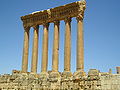
, where the great Temple of Jupiter
stood. Helipolis surrendered to Muslim rule after little resistance and agreed to pay tribute. Abu Ubaidah sent Khalid straight towards Emesa.
Emesa and Chalcis
offered a peace treaty for a year. Abu Ubaidah accepted the offer and rather than invading districts of Emesa and Chalcis, he consolidated his rule in conquered land and captured Hamah, Ma’arrat an Nu’man. The peace treaties were enacted however on Heraclius' instructions to lure the Muslims and to secure time for preparation of defenses of Northern Syria. Having mustered sizeable armies at Antioch, Heraclius sent them to reinforce strategically important areas of Northern Syria, like Emesa and Chalcis. With the arrival of the Byzantine army in the city, the peace treaty was violated; Abu Ubadiah and Khalid then marched to Emesa. A Byzantine army that halted Khalid’s advance guard was defeated. The Muslims besieged Emesa which was finally conquered in March 636 AD after two months of siege.
.svg.png) After capturing Emesa, the Muslims moved north to capture the whole of Northern Syria. Khalid took his mobile guard
After capturing Emesa, the Muslims moved north to capture the whole of Northern Syria. Khalid took his mobile guard
, acting as an advance guard, to raid Northern Syria. At Shaizer Khalid intercepted a convoy taking provisions for Chalcis. The prisoners were interrogated and informed him about Emperor Heraclius' ambitious plan to take back Syria. They told him that an army possibly two hundred thousand (200,000) strong would soon arrive to recapture their territory. Khalid immediately ended the raid.
After his past experiences Heraclius now avoided pitch battle with the Muslim army. His plans were to send massive reinforcements to all the major cities and isolate the Muslim corps from each other and then to separately encircle and destroy the Muslim armies.
Part of his plans was to coordinate his attacks with those of Yazdgerd III
. In 635 Yazdgerd III
, the emperor of Sassanid Persian Empire, had sought an alliance with Heraclius. Heraclius married off his daughter (according to traditions, his granddaughter) Manyanh to Yazdegerd III, an old Roman tradition to show alliance. While Heraclius prepared for a major offense in the Levant, Yazdegerd was supposed to mount a counterattack on his front in Iraq
. This was supposed to be a well coordinated attack by both emperors, Heraclius in the Levant and Yazdegerd in Iraq, to annihilate the power of their common enemy Caliph Umar. However, it was not meant to be. Umar probably had intelligence of this alliance, and started peace negotiations with Yazdegerd III, apparently inviting him to join Islam
. When Heraclius launched his offense in May 636, Yazdegerd, probably owing to the exhausted conditions of his government, could not coordinate with the Heraclian offense and a would be decisive plan missed the mark.
While Umar won a decisive victory at Yarmouk against Heraclius, Yazdegerd III, was being engaged and trapped in deception tactics by him. Yazdegerd III lost his imperial army at the Battle of Qadisiyyah in November 636 three months after Yarmouk, ending Sassanid control west of Persia.
Five massive armies were launched in June 636 AD to recapture Syria. Khalid, having understood Heraclius' plan, feared that the Muslim armies would become isolated and then piecemeal destroyed. He thus suggested Abu Ubaidah in a council of war to draw all the Muslim armies at one place to give a decisive battle to the Byzantines. Abu Ubaidah listened to Khalid’s advice and ordered all the Muslim armies in Syria to evacuate the conquered land and concentrated them at Jabiya. This maneuver of Khalid gave a decisive blow to Heraclius' plan, since he wished not to engage his troops in an open battle with the Muslims, where the Muslims could use their light cavalry effectively. From Jabiya, again on Khalid’s suggestion, Abu Ubaidah ordered the Muslim troops to withdraw to the Plain of the Yarmouk River, where cavalry could be used effectively. While the Muslim armies were gathering at Yarmouk, Khalid intercepted and routed the Byzantine advance guard. This was to ensure the safe retreat of Muslims from the conquered land.
The Muslim armies reached the plain in July 636 CE. A week or two later, around mid July, the Byzantine army arrived. The Byzantine commander in chief, Vahan, sent Christian Arab troops of Ghassanid king Jabala to check the strength of the Muslims. Khalid’s mobile guard defeated and routed the Christian Arabs; this was the last action before the battle started. For one month negotiations continued between the two armies and Khalid went to meet Vahan in person at the Byzantine camp. Meanwhile Muslims received reinforcements sent by Caliph Umar.
Abu Ubaidah, in a council of war, transferred the command of the Muslim army to Khalid, who acted as a field commander in the battle and was the mastermind behind the annihilation of Byzantine army.
Finally on 15 August the Battle of Yarmouk
was fought, that lasted for 6 days and ended in a devastating defeat for the Byzantines. The Battle of Yarmouk is considered to be one of the most decisive battles of history. It was a historic defeat that sealed the fate of Byzantines. The magnitude of the defeat was so intense that the Byzantines took years to recover from it. It left the whole of the Byzantine Empire vulnerable to the Muslim invaders. The battle was the greatest battle ever fought on Syrian soil till then and it was a tactical marvel of Khalid.
, because of his very strong resemblance with Caliph Umar
. But Khalid was recognized and Caliph Umar Ibn Al Khattab had to come himself to accept the surrender of Jerusalem
on April 637 AD.
After Jerusalem, the Muslim armies broke up once again. Yazid’s corps came to Damascus and captured Beirut
. Amr and Shurhabil’s corps went to conquer the rest of Palestine, while Abu Ubaidah and Khalid ahead of a 17,000 strong army moved north to conquer the whole of Northern Syria.
 With Emesa already in hand, Abu Ubaidah and Khalid moved towards Chalcis
, which was strategically the most significant fort of the Byzantines. Through Chalcis the Byzantines would be able to guard Anatolia
, Heraclius' homeland Armenia
and their Asian zone’s capital Antioch
. Abu Ubaidah send Khalid with his cavalry elite, the mobile guard, towards Chalcis. The fort was guarded by Greek troops under their commander Menas, who is reported to be of high prestige, second only to the Emperor himself. Menas, diverting from conventional Byzantine tactics, decided to face Khalid and destroy the leading elements of Muslim army before the main body could join them at Hazir 3 miles east of Chalcis. The battle fought is known as the Battle of Hazir
, which even forced Caliph Umar to praise Khalid’s military genius. Umar is reported to have said: Abu Ubaidah soon joined Khalid at the virtually impregnable fort of Chalcis. The fort surrendered some time in June 637. With this strategic victory the territory north of Chalcis lay open to the Muslims. Khalid and Abu Ubaidah continued their march northward and laid siege to Allepo, which was captured after fierce resistance from desperate Byzantine troops in October 637 AD. The next objective was the splendid city of Antioch
, the capital of the Asian zone of the Eastern Roman empire. Before marching towards Antioch, Khalid and Abu Ubaidah decided to isolate the city from Anatolia. They accordingly sent detachments north to eliminate all possible Byzantine forces and captured a garrison town of Azaz 30 miles from Allepo; from there Muslims attacked Antioch from the eastern side. In order to save the empire from annihilation, a desperate battle was fought between the Muslim army and that of the defenders of Antioch, popularly known as the Battle of Iron bridge
. The Byzantine army was composed of the survivors of Yarmouk and other Syrian campaigns. After being defeated, the Byzantines retreated to Antioch and the Muslims besieged the city. Having little hope of help from the Emperor, Antioch surrendered on 30 October 637 AD under the condition that all Byzantine troops would be given safe passage to Constantinople. Abu Ubaidah sent Khalid towards the north and he himself marched to the south and captured Lazkia, Jabla and Tartus and the coastal areas west of anti-lebonan hills. Khalid moved north and raided territory up to as far as Kızılırmak River in Anatolia. Emperor Heraclius had already left Antioch for Edessa
before the arrival of the Muslims. He arranged for the necessary defenses in Jazirah and Armenia
and left for his capital Constantinople
. On his way to Constantinople he had a narrow escape when Khalid after capturing Marash
was heading south towards Munbij. Heraclius hastily took the mountainous path and passing through the Cilician gates is reported to have said:
 After the devastating defeat at Yarmouk, his empire was extremely vulnerable to a Muslim invasion. With few military resources left he was no longer in a position to attempt a military comeback in Syria. To gain time for the preparation of the defense of the rest of his empire Heraclius needed the Muslims occupied in Syria. He thus sought help from the Christian Arabs of Jezerah who mustered up a large army and marched against Emesa, Abu Ubaidah’s headquarter. Abu Ubaidah withdrew all his forces from Northern Syria to Emesa, and the Christian Arabs laid siege to Emesa. Khalid was in favor of an open battle outside the fort, but Abu Ubaidah sent the matter to Caliph Umar who brilliantly handled it. Umar sent a detachment of Muslim armies from Iraq to invade Jazerah, homeland of the invading Christian Arabs, from three different routes. Moreover, another detachment was sent to Emesa from Iraq under Qa’qa ibn Amr, a veteran of Yarmouk, who was sent to Iraq for the Battle of al-Qādisiyyah
. Umar himself marched from Madinah ahead of 1,000 men. When the Christian Arabs received the news of the Muslim invasion of their homeland, they abandoned the siege and hastily withdrew to Jazirah. At this point Khalid and his mobile guard came out of the fort and devastated their army by attacking them from the rear.
This act of Jazirah's Christian Arabs was followed by fierce measures from the Caliphate, and Jazirah, the last base of the Eastern Roman empire in the Middle East was captured the same year.[20] On the orders of Caliph Umar, Sa'd ibn Abi Waqqas, commander of the Muslim army in Iraq, sent an army under Ayadh bin Ghanam to conquer the region between the Tigris and the Euphrates up to Urfa. Most of Jazirah surrendered peacefully and agreed to pay Jaziya.
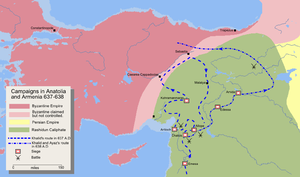 After the battle Umar ordered the conquest of Jazirah which was completed by late summer 638 AD. After the conquest of Jazirah Abu Ubaidah sent Khalid and Ayaz ibn Ghanam (conqueror of Jazirah) to invade Byzantine territory north of Jazirah. They marched independently and captured Edessa
, Amida
, Malatya
and the whole of Armenia up to Ararat
and raided Northern and central Anatolia. Heraclius had already abandoned all the forts between Antioch and Tartus to create a buffer zone or no man's land between the Muslim controlled areas and main land Anatolia.
Caliph Umar for the time being stopped his armies invading deeper into Anatolia and rather ordered Abu Ubaidah, now governor of Syria, to consolidate his rule in Syria. At this point Caliph Umar is reported to have said:
The dismissal of Khalid from the army and a drought followed by a plague the year after were factors why the Muslim armies didn't eventually invade Anatolia. The expedition to Anatolia and Armenia marked the end of the military career of Khalid.
 During the reign of Caliph Uthman, Constantine III decided to recapture the Levant
, which had been lost to the Muslims during Umar’s reign. A full-scale invasion was planned and a large force was sent to reconquer Syria. Muawiyah I
, the governor of Syria, called for reinforcements and Uthman ordered the governor of Kufa
to send a contingent, which together with the garrison of Syria defeated the Byzantine army in Northern Syria.
Uthman gave permission to Muawiyah, the governor of Syria, to build a navy. From their base in Syria, the Muslims used this fleet to capture Cyprus
in 649 and Crete
and then Rhodes
and the launching of annual raids into Western Anatolia thwarted the Byzantines from making any further attempts to recapture Syria. In 654–655, Uthman ordered the preparation of an expedition to capture the capital of the Eastern Roman empire, Constantinople
, but due to unrest in the empire that grew in 655 and resulted in his assassination, the expedition was delayed for decades only to be attempted unsuccessfully under the next dynasty of Ummayad rulers.
, Jund Hims
, Jund al-Urdunn (Jordan)
, and Jund Filastin (Palestine)
(to which a fifth, Jund Qinnasrin
, was later added) and the Arab garrison
s were kept apart in camps, and life went on much as before for the local population. The Muslim adopted a policy of tolerance towards other religions, resulting in a positive effect on the newly subjected people, especially the Nestorian and Jacobite Christians and Jews (People of the Book
), who had been previously persecuted under Byzantine rule. The loyalty of his new subjects was paramount to the success of Muslim rule in the region, therefore excessive taxation or oppression was avoided. The taxes instituted were the kharaj
– a tax that landowners and peasants paid according to the productivity of their fields – as well as the jizya
– paid by non-Muslims in return for protection under the Muslim state and exemption from military service. The Byzantine civil service was retained until a new system could be instituted; therefore, Greek remained the administrative language in the new Muslim territories for over 50 years after the conquests.
broke out in the Muslim empire as a result of the murder of Uthman
and the nomination of Ali as caliph, the Rashidun Caliphate was succeeded by the new dynasty of Umayyad
with Syria as its core and Damascus its capital for the next century to come.
Levant
The Levant or ) is the geographic region and culture zone of the "eastern Mediterranean littoral between Anatolia and Egypt" . The Levant includes most of modern Lebanon, Syria, Jordan, Israel, the Palestinian territories, and sometimes parts of Turkey and Iraq, and corresponds roughly to the...
, or Greater Syria
Greater Syria
Greater Syria , also known simply as Syria, is a term that denotes a region in the Near East bordering the Eastern Mediterranean Sea or the Levant....
. Arab Muslim forces had appeared on the southern borders even before the death of the Islam
Islam
Islam . The most common are and . : Arabic pronunciation varies regionally. The first vowel ranges from ~~. The second vowel ranges from ~~~...
ic Prophet
Prophet
In religion, a prophet, from the Greek word προφήτης profitis meaning "foreteller", is an individual who is claimed to have been contacted by the supernatural or the divine, and serves as an intermediary with humanity, delivering this newfound knowledge from the supernatural entity to other people...
Muhammad
Muhammad
Muhammad |ligature]] at U+FDF4 ;Arabic pronunciation varies regionally; the first vowel ranges from ~~; the second and the last vowel: ~~~. There are dialects which have no stress. In Egypt, it is pronounced not in religious contexts...
in 632, resulting in the Battle of Mu'tah
Battle of Mu'tah
The Battle of Mu'tah was fought in 629 , near the village of Mu'tah, east of the Jordan River and Karak in Karak Governorate, between an army sent by the Islamic prophet, Muhammad, and an army of the Byzantine Empire- The Eastern Romans.In Muslim histories, the battle is usually described as the...
in 629, but the real invasion began in 634 under his successors, the Rashidun
Rashidun
The Rightly Guided Caliphs or The Righteous Caliphs is a term used in Sunni Islam to refer to the first four Caliphs who established the Rashidun Caliphate. The concept of "Rightly Guided Caliphs" originated with the Abbasid Dynasty...
Caliph
Caliph
The Caliph is the head of state in a Caliphate, and the title for the ruler of the Islamic Ummah, an Islamic community ruled by the Shari'ah. It is a transcribed version of the Arabic word which means "successor" or "representative"...
s Abu Bakr
Abu Bakr
Abu Bakr was a senior companion and the father-in-law of the Islamic prophet Muhammad. He ruled over the Rashidun Caliphate from 632-634 CE when he became the first Muslim Caliph following Muhammad's death...
and Umar ibn Khattab, with Khalid ibn al-Walid
Khalid ibn al-Walid
Khālid ibn al-Walīd also known as Sayf Allāh al-Maslūl , was a companion of the Islamic prophet Muhammad. He is noted for his military tactics and prowess, commanding the forces of Medina and those of his immediate successors of the Rashidun Caliphate; Abu Bakr and Umar...
as their most important military leader.
Byzantine Syria
Syria had been under Roman rule for seven centuries prior to the Arab Muslim conquest and had been invaded by the Sassanid Persians on a number of occasions during the 3rd, 6th and 7th centuries; it had also been subject to raids by the Sassanid's Arab allies the LakhmidsLakhmids
The Lakhmids , Banu Lakhm , Muntherids , were a group of Arab Christians who lived in Southern Iraq, and made al-Hirah their capital in 266. Poets described it as a Paradise on earth, an Arab Poet described the city's pleasant climate and beauty "One day in al-Hirah is better than a year of...
. During the Byzantine period
Byzantine Empire
The Byzantine Empire was the Eastern Roman Empire during the periods of Late Antiquity and the Middle Ages, centred on the capital of Constantinople. Known simply as the Roman Empire or Romania to its inhabitants and neighbours, the Empire was the direct continuation of the Ancient Roman State...
, beginning in AD 70 after the fall of Jerusalem, the entire region (Judea
Judea
Judea or Judæa was the name of the mountainous southern part of the historic Land of Israel from the 8th century BCE to the 2nd century CE, when Roman Judea was renamed Syria Palaestina following the Jewish Bar Kokhba revolt.-Etymology:The...
, Samaria
Samaria
Samaria, or the Shomron is a term used for a mountainous region roughly corresponding to the northern part of the West Bank.- Etymology :...
, and the Galilee
Galilee
Galilee , is a large region in northern Israel which overlaps with much of the administrative North District of the country. Traditionally divided into Upper Galilee , Lower Galilee , and Western Galilee , extending from Dan to the north, at the base of Mount Hermon, along Mount Lebanon to the...
) was renamed Palaestina, subdivided into Diocese I and II. The Byzantines also renamed an area of land including the Negev
Negev
The Negev is a desert and semidesert region of southern Israel. The Arabs, including the native Bedouin population of the region, refer to the desert as al-Naqab. The origin of the word Neghebh is from the Hebrew root denoting 'dry'...
, Sinai, and the west coast of the Arabian Peninsula as Palaestina Salutoris, sometimes called Palaestina III. Part of the area was ruled by the Arab vassal state of the Ghassanids (symmachos). During the last
Byzantine-Sassanid War of 602–628
The Byzantine–Sassanid War of 602–628 was the final and most devastating of the series of wars fought between the Roman Empire and the Sassanid Empire. The previous war had ended in 591 after Emperor Maurice had helped the Sassanian king Khosrau II regain his throne. In 602, Maurice was murdered...
of the Roman-Persian Wars
Roman-Persian Wars
The Roman–Persian Wars were a series of conflicts between states of the Greco-Roman world and two successive Iranic empires: the Parthian and the Sassanid. Contact between the Parthian Empire and the Roman Republic began in 92 BC; wars began under the late Republic, and continued...
, beginning in 603, the Persians under Khosrau II
Khosrau II
250px|thumb|Khosrau II 250px|thumb|Khosrau II 250px|thumb|Khosrau II (Khosrow II, Chosroes II, or Xosrov II in classical sources, sometimes called Parvez, "the Ever Victorious" – (in Persian: خسرو پرویز), was the twenty-second Sassanid King of Persia, reigning from 590 to 628...
had succeeded in occupying Syria, Palestine
Palestine
Palestine is a conventional name, among others, used to describe the geographic region between the Mediterranean Sea and the Jordan River, and various adjoining lands....
and Egypt
Egypt
Egypt , officially the Arab Republic of Egypt, Arabic: , is a country mainly in North Africa, with the Sinai Peninsula forming a land bridge in Southwest Asia. Egypt is thus a transcontinental country, and a major power in Africa, the Mediterranean Basin, the Middle East and the Muslim world...
for over a decade before being forced by the victories of Heraclius
Heraclius
Heraclius was Byzantine Emperor from 610 to 641.He was responsible for introducing Greek as the empire's official language. His rise to power began in 608, when he and his father, Heraclius the Elder, the exarch of Africa, successfully led a revolt against the unpopular usurper Phocas.Heraclius'...
to conclude the peace of 628. Thus, on the eve of the Muslim conquests the Romans were still in the process of rebuilding their authority in these territories, which in some areas had been lost to them for almost twenty years. Politically, the Syrian region consisted of two provinces: Syria proper stretched from Antioch
Antioch
Antioch on the Orontes was an ancient city on the eastern side of the Orontes River. It is near the modern city of Antakya, Turkey.Founded near the end of the 4th century BC by Seleucus I Nicator, one of Alexander the Great's generals, Antioch eventually rivaled Alexandria as the chief city of the...
and Aleppo
Aleppo
Aleppo is the largest city in Syria and the capital of Aleppo Governorate, the most populous Syrian governorate. With an official population of 2,301,570 , expanding to over 2.5 million in the metropolitan area, it is also one of the largest cities in the Levant...
in the north to the top of the Dead Sea
Dead Sea
The Dead Sea , also called the Salt Sea, is a salt lake bordering Jordan to the east and Israel and the West Bank to the west. Its surface and shores are below sea level, the lowest elevation on the Earth's surface. The Dead Sea is deep, the deepest hypersaline lake in the world...
. To the west and south of the Dead Sea lay the province of Palestine
Palestine
Palestine is a conventional name, among others, used to describe the geographic region between the Mediterranean Sea and the Jordan River, and various adjoining lands....
, which included the holy places of the three Abrahamic religions
Abrahamic religions
Abrahamic religions are the monotheistic faiths emphasizing and tracing their common origin to Abraham or recognizing a spiritual tradition identified with him...
. Syria was partly an Arab land, especially in its eastern and southern parts. The Arabs had been there since pre-Roman times, and had embraced Christianity since Constantine I
Constantine I
Constantine the Great , also known as Constantine I or Saint Constantine, was Roman Emperor from 306 to 337. Well known for being the first Roman emperor to convert to Christianity, Constantine and co-Emperor Licinius issued the Edict of Milan in 313, which proclaimed religious tolerance of all...
legalized it in the fourth century.
The Arabs of Syria were people of no consequence until the migration of the powerful Ghassan tribe from Yemen
Yemen
The Republic of Yemen , commonly known as Yemen , is a country located in the Middle East, occupying the southwestern to southern end of the Arabian Peninsula. It is bordered by Saudi Arabia to the north, the Red Sea to the west, and Oman to the east....
to Syria, who thereafter ruled a semi-autonomous state with their own king under the Romans. The Ghassan Dynasty became one of the honoured princely dynasties of the Empire, with the Ghassan king ruling over the Arabs in Jordan and Southern Syria from his capital at Bosra
Bosra
Bosra , also known as Bostra, Busrana, Bozrah, Bozra, Busra Eski Şam, Busra ash-Sham, and Nova Trajana Bostra, is an ancient city administratively belonging to the Daraa Governorate in southern Syria...
. The last of the Ghassan kings, who ruled at the time of the Muslim invasion, was Jabla bin Al Aiham.
Emperor Heraclius, after re-capturing Syria from the Sassanids, set up new defense lines from Ghazzah to the south end of the Dead Sea. These lines were only designed to protect communications from bandits, and the bulk of the Byzantine defenses were concentrated in Northern Syria facing the traditional foes, the Sassanid Persians. This defense line had as a drawback that it enabled the Muslim
Muslim
A Muslim, also spelled Moslem, is an adherent of Islam, a monotheistic, Abrahamic religion based on the Quran, which Muslims consider the verbatim word of God as revealed to prophet Muhammad. "Muslim" is the Arabic term for "submitter" .Muslims believe that God is one and incomparable...
s, who emerged from the desert in the south, to reach as far north as Ghazzah before meeting regular Byzantine troops.
7th century AD was a time of fast military changes in the Byzantine empire. The empire was certainly not in a state of collapse when it faced the new challenge from Arabia after being exhausted by recent Roman-Persian Wars
Roman-Persian Wars
The Roman–Persian Wars were a series of conflicts between states of the Greco-Roman world and two successive Iranic empires: the Parthian and the Sassanid. Contact between the Parthian Empire and the Roman Republic began in 92 BC; wars began under the late Republic, and continued...
, but failed completely to tackle the challenge effectively.
Rise of Caliphate
The IslamIslam
Islam . The most common are and . : Arabic pronunciation varies regionally. The first vowel ranges from ~~. The second vowel ranges from ~~~...
ic Prophet Mohammad died in June 632, and Abu Bakr
Abu Bakr
Abu Bakr was a senior companion and the father-in-law of the Islamic prophet Muhammad. He ruled over the Rashidun Caliphate from 632-634 CE when he became the first Muslim Caliph following Muhammad's death...
was appointed Caliph
Caliph
The Caliph is the head of state in a Caliphate, and the title for the ruler of the Islamic Ummah, an Islamic community ruled by the Shari'ah. It is a transcribed version of the Arabic word which means "successor" or "representative"...
and political successor at Medina
Medina
Medina , or ; also transliterated as Madinah, or madinat al-nabi "the city of the prophet") is a city in the Hejaz region of western Saudi Arabia, and serves as the capital of the Al Madinah Province. It is the second holiest city in Islam, and the burial place of the Islamic Prophet Muhammad, and...
. Soon after Abu Bakr
Abu Bakr
Abu Bakr was a senior companion and the father-in-law of the Islamic prophet Muhammad. He ruled over the Rashidun Caliphate from 632-634 CE when he became the first Muslim Caliph following Muhammad's death...
's succession, several Arab tribes revolted against him in the Ridda wars
Ridda wars
The Ridda wars , also known as the Wars of Apostasy, were a series of military campaigns against the rebellion of several Arabian tribes launched by the Caliph Abu Bakr during 632 and 633 AD, after prophet Muhammad died....
(Arabic for the Wars of Apostasy). The Campaign of the Apostasy was fought and completed during the eleventh year of the Hijri. The year 12 Hijri dawned, on 18 March 633, with Arabia united under the central authority of the Caliph at Medina.
Whether Abu Bakr intended a full-out imperial conquest or not is hard to say; he did, however, set in motion a historical trajectory that in just a few short decades would lead to one of the largest empires in history, starting with a confrontation with the Persian Empire
Sassanid Empire
The Sassanid Empire , known to its inhabitants as Ērānshahr and Ērān in Middle Persian and resulting in the New Persian terms Iranshahr and Iran , was the last pre-Islamic Persian Empire, ruled by the Sasanian Dynasty from 224 to 651...
under the general Khalid ibn al-Walid
Khalid ibn al-Walid
Khālid ibn al-Walīd also known as Sayf Allāh al-Maslūl , was a companion of the Islamic prophet Muhammad. He is noted for his military tactics and prowess, commanding the forces of Medina and those of his immediate successors of the Rashidun Caliphate; Abu Bakr and Umar...
.
Expedition to Syria
Iraq
Iraq ; officially the Republic of Iraq is a country in Western Asia spanning most of the northwestern end of the Zagros mountain range, the eastern part of the Syrian Desert and the northern part of the Arabian Desert....
Khalid established his stronghold in Iraq. While engaged with Sassanid forces, confrontation also ensued with the Byzantine Arab clients, the Ghassanids. Tribal contingents were soon recruited to the call from Medinah from all over the Arabian peninsula
Arabian Peninsula
The Arabian Peninsula is a land mass situated north-east of Africa. Also known as Arabia or the Arabian subcontinent, it is the world's largest peninsula and covers 3,237,500 km2...
. Only those who had rebelled during the Ridda wars were excluded from the summons and remained excluded from Rashidun armies until in 636 when Caliph Umar
Umar
`Umar ibn al-Khattāb c. 2 November , was a leading companion and adviser to the Islamic prophet Muhammad who later became the second Muslim Caliph after Muhammad's death....
fell short of manpower for the Battle of Yarmouk
Battle of Yarmouk
The Battle of Yarmouk was a major battle between the Muslim Arab forces of the Rashidun Caliphate and the armies of the East Roman-Byzantine Empire. The battle consisted of a series of engagements that lasted for six days in August 636, near the Yarmouk River, along what is today the border...
and the Battle of al-Qādisiyyah
Battle of al-Qadisiyyah
The Battle of al-Qādisiyyah was fought in 636; it was the decisive engagement between the Arab muslim army and the Sassanid Persian army during the first period of Muslim expansion. It resulted in the Islamic conquest of Persia, and was key to the conquest of Iraq...
. The tradition of raising armies from tribal contingents remained in use until 636, when Caliph Umar organised the army as a state department.
Abu Bakr organised the army into four corps, each with its own commander and objective.
- Amr ibn al-A'as: Objective PalestinePalestinePalestine is a conventional name, among others, used to describe the geographic region between the Mediterranean Sea and the Jordan River, and various adjoining lands....
. Move on Elat route, then across Valley of ArabahArabahThe Arabah , also known as Aravah, is a section of the Great Rift Valley running in a north-south orientation between the southern end of the Sea of Galilee down to the Dead Sea and continuing further south where it ends at the Gulf of Aqaba. It includes most of the border between Israel to the...
. - Yazid ibn Abu SufyanYazid ibn Abu SufyanYazid ibn Abu Sufyan was one of the companions of Muhammad.-Biography:Yazid ibn Abu Sufyan was the son of Abu Sufyan ibn Harb, he was the brother of Muawiya I. Not to be confused with Yazid ibn Muawiya who was the caliph during which Imam Hussain was killed...
: Objective DamascusDamascusDamascus , commonly known in Syria as Al Sham , and as the City of Jasmine , is the capital and the second largest city of Syria after Aleppo, both are part of the country's 14 governorates. In addition to being one of the oldest continuously inhabited cities in the world, Damascus is a major...
. Move on Tabuk route. - Shurahbil bin hassana: Objective JordanJordanJordan , officially the Hashemite Kingdom of Jordan , Al-Mamlaka al-Urduniyya al-Hashemiyya) is a kingdom on the East Bank of the River Jordan. The country borders Saudi Arabia to the east and south-east, Iraq to the north-east, Syria to the north and the West Bank and Israel to the west, sharing...
. Move on Tabuk route after Yazid. - Abu Ubaidah ibn al-JarrahAbu Ubaidah ibn al-JarrahAmir ibn `Abdullah ibn al-Jarrah , more commonly known as Abu 'Ubaydah ibn al-Jarrah, was one of the ten companions of the Islamic prophet Muhammad who were promised Paradise as mentioned in early Islamic historical accounts and records...
: Objective Emesa. Move on Tabuk route after Shurahbil.
Not knowing the precise position of the Byzantine army
Byzantine army
The Byzantine army was the primary military body of the Byzantine armed forces, serving alongside the Byzantine navy. A direct descendant of the Roman army, the Byzantine army maintained a similar level of discipline, strategic prowess and organization...
, Caliph Abu Bakr ordered that all corps should remain in touch with each other so that they could help each other if the Byzantines were able to concentrate their army in any sector of operation. In case the corps had to concentrate for one major battle, Abu Ubaidah was appointed Commander-in-Chief of the entire army.
In the first week of April 634, the Muslim forces began to move from their camps outside Medina
Medina
Medina , or ; also transliterated as Madinah, or madinat al-nabi "the city of the prophet") is a city in the Hejaz region of western Saudi Arabia, and serves as the capital of the Al Madinah Province. It is the second holiest city in Islam, and the burial place of the Islamic Prophet Muhammad, and...
. The first to leave was Yazid's corps, followed by Shurahbil, Abu Ubaidah and Amr, each a day's march from the other.
Caliph Abu Bakr walked for a short distance by the side of each corps commander. His parting words which he repeated to each of the corps commanders, were as follows:
Muslim conquest of Syria
Dead Sea
The Dead Sea , also called the Salt Sea, is a salt lake bordering Jordan to the east and Israel and the West Bank to the west. Its surface and shores are below sea level, the lowest elevation on the Earth's surface. The Dead Sea is deep, the deepest hypersaline lake in the world...
.
As the main Byzantine defence line started from the coastal regions near Ghazahh, Yazid arrived at the Valley of Araba at about the same time as Amr bin Al Aas reached Elat. The two forward detachments sent by the Byzantine army to prevent the entry of Yazid's and Amr's corps, respectively, into Palestine, were easily defeated by them, though they did prevent the Rashidun forces from reaching their assigned objective. Abu Ubaidah and Shurhabil, on the other hand, continued their march, and by early May 634 they reached the region between Bosra
Bosra
Bosra , also known as Bostra, Busrana, Bozrah, Bozra, Busra Eski Şam, Busra ash-Sham, and Nova Trajana Bostra, is an ancient city administratively belonging to the Daraa Governorate in southern Syria...
and Jabiya. The Emperor Heraclius, having received intelligence of the movements of the Muslim armies from his Arab clients, began to plan countermeasures. Upon Heraclius' orders, Byzantine forces from different garrisons in the north started moving to gather at Ayjnadyn. From here they could engage Amr's corps and maneuver against the flank or rear of the rest of the Muslim corps that were in Jordan and Southern Syria. The strength of the Byzantine forces, according to rough estimates, was about 100,000. Abu Ubaidah informed the Caliph about the preparations made by the Byzantines in the third week of May 634. Because Abu Ubaida didn't have the experience as a commander of military forces in such major operations, especially with the powerful Roman Army, Abu Bakr decided to send Khalid ibn Walid to the Syrian front to command the Muslim army. According to early Muslim chronicles Abu Bakr said:
Conquest of Syria under Caliph Abu Bakr
Al-Hirah
Al Hīra was an ancient city located south of al-Kufah in south-central Iraq.- Middle Ages:Al Hīra was a significant city in pre-Islamic Arab history. Originally a military encampment, in the 5th and 6th centuries CE it became the capital of the Lakhmids.The Arabs were migrating into the Near East...
, in Iraq
Iraq
Iraq ; officially the Republic of Iraq is a country in Western Asia spanning most of the northwestern end of the Zagros mountain range, the eastern part of the Syrian Desert and the northern part of the Arabian Desert....
in early June 634, taking with him half his army, about 8000 strong.
There were two routes towards Syria from Iraq: one was via Daumat-ul-Jandal, and the other was through Mesopotamia, passing through Ar Raqqah
Ar Raqqah
Ar-Raqqah , also spelled Rakka, is a city in north central Syria located on the north bank of the Euphrates, about 160 km east of Aleppo. It is the capital of the Ar-Raqqah Governorate and one of the main cities of the historical Diyār Muḍar, the western part of the Jazīra...
. The Muslim armies in Syria were in need of urgent reinforcement, so Khalid avoided the conventional route to Syria via Daumat ul Jandal, as it was the longer route, and would take weeks to reach Syria. Khalid avoided the Mesopotamia’s route because of the presence of Roman garrisons in Northern Syria and Mesopotamia. To engage them at a time when Muslim armies were being outflanked in Syria was not a wise idea. Khalid selected a shorter route to Syria, an unconventional route passing through the Syrian Desert
Syrian Desert
The Syrian Desert , also known as the Syro-Arabian desert is a combination of steppe and true desert that is located in the northern Arabian Peninsula covering 200,000 square miles . also the desert is very rocky and flat...
. He boldly marched his armies through the desert. It is recorded that his soldiers marched for two days without a single drop of water, before reaching a pre-decided water source at an oasis. Khalid thus entered Northern Syria and caught the Byzantines at their right flank. According to modern historians, it was this ingenious strategic maneuver of Khalid, his perilous march through the desert and appearing at the north-eastern front of the Byzantines while they were occupied in tackling the Muslim armies in Southern Syria, that unhinged the Byzantine defences in Syria.
Conquest of Southern Syria
Sawa, Arak, and the historical city of Tadmur were first to fall to Khalid. Sukhnah, Qaryatayn and Hawarin were captured after the Battle of QarteenBattle of Qarteen
Battle of Qarteen was a minor battle between the Ghassanid Arab allies of the Byzantine empire, and the Rashidun Caliphate army. It was fought after Khalid ibn Walid had conquered Tadmur in Syria. His army marched to Qaryatain, the inhabitants of which resisted the Muslims. They were fought,...
and the Battle of Hawareen. After dealing with all these cities, Khalid moved towards Damascus
Damascus
Damascus , commonly known in Syria as Al Sham , and as the City of Jasmine , is the capital and the second largest city of Syria after Aleppo, both are part of the country's 14 governorates. In addition to being one of the oldest continuously inhabited cities in the world, Damascus is a major...
, passing though a mountain pass which is now known as Sanita-al-Uqab (Uqab pass) after the name of Khalid's army standard. From here he moved away from Damascus, towards Bosra
Bosra
Bosra , also known as Bostra, Busrana, Bozrah, Bozra, Busra Eski Şam, Busra ash-Sham, and Nova Trajana Bostra, is an ancient city administratively belonging to the Daraa Governorate in southern Syria...
, the capital of Ghassanid Arab kingdom, a vassal of the Eastern Roman empire. He ordered other Muslim commanders to concentrate their armies, still near the Syrian-Arabian border at Bosra. At Maraj-al-Rahab, Khalid defeated a Ghassanid
Ghassanids
The Ghassanids were a group of South Arabian Christian tribes that emigrated in the early 3rd century from Yemen to Syria, Jordan, Lebanon and the Holy Land....
army of Christian Arabs in a quick battle, called the Battle of Marj-al-Rahit
Battle of Marj-al-Rahit
The Battle of Mari-al-Rahit was a minor conflict fought between the Ghassanid Arab allies of Byzantine Empire and Rashidun army under the command of Khalid bin Walid...
. Meanwhile Abu Ubaida ibn al-Jarrah, the supreme commander of the Muslim armies in Syria, had ordered Shurhabil ibn Hasana to attack Bosra. The latter laid siege of Bosra with his small army of 4000 men. The Roman and Ghassanid Arab garrison, noticing that this might be the advance guard of the larger Muslim army to come, decided to attack and destroy Shurhabil’s army. They came out of the fortified city and attacked Shurhabil, surrounding him from all sides; Khalid reached the arena with his advance guard cavalry and saved the day for Shurhabil. The combined forces of Khalid, Shurhabil and Abu Ubaidah then laid siege to the city of Bosra
Battle of Bosra
The Battle of Bosra was fought in 634 between the Rashidun Caliphate army and the Byzantine Empire for the possession of Bosra, in Syria. The city, then capital of the Ghassanid kingdom, a Byzantine vassal, was the first important one to be captured by the Islamic forces...
, which surrendered some time in mid July 634. This effectively ended the Ghassanid Dynasty.
The defeat of the Byzantines at the Battle of Ajnadayn
Battle of Ajnadayn
The Battle of Ajnadayn, fought on July 30, 634, south of Beit Shemesh in present day Israel, was the first major pitched battle between the Eastern Roman Empire and the army of the Arabic Rashidun Caliphate. The result of the battle was a decisive Muslim victory...
left Syria vulnerable to the Muslim invaders. Khalid decided to capture Damascus, the Byzantine stronghold. At Damascus Thomas, son in law of Emperor Heraclius, was in charge. Having received intelligence of Khalid’s march towards Damascus he prepared for the defence of Damascus. He wrote to Emperor Heraclius, who was at Emesa that time, for reinforcements. Moreover Thomas, in order to get more time for preparation of a siege, sent armies to delay or if possible halt Khalid’s march to Damascus. One of these armies was defeated at the Battle of Yaqusa in mid-August 634 near Lake Tiberias 90 miles from Damascus. Another army that tried to halt the Muslim advance to Damascus was defeated in the Battle of Maraj as Saffer on 19 August 634. These engagements delayed Khalid’s advance and gave Thomas enough time to prepare for a siege. Meanwhile a reinforcement reached the city, which Heraclius had dispatched after hearing the bad news of Ajnadyn. But before another regiment of Heraclius could reach Damascus, Khalid had already lied siege to Damascus. Khalid reached Damascus 20 August and besieged the city. To isolate the city from the rest of the region Khalid placed detachments south on the road to Palestine and in the north at the Damascus-Emesa route, and several other smaller detachments on routes towards Damascus. Heraclius reinforcement was intercepted and routed at the Battle of Sanita-al-Uqab 20 miles from Damascus. Khalid's forces withstood three Roman sallies that tried to break the siege. Khalid finally attacked and conquered Damascus
Conquest of Damascus
The Siege of Damascus lasted from 21 August to 19 September 634 AD before the city fell to the Rashidun Caliphate. Damascus was the first major city of the Byzantine empire to fall in the Muslim conquest of Syria....
on 18 September 634 after a 30 days siege, although according to some sources the siege lasted for four or six months. Heraclius, having received the news of the fall of Damascus, left for Antioch
Antioch
Antioch on the Orontes was an ancient city on the eastern side of the Orontes River. It is near the modern city of Antakya, Turkey.Founded near the end of the 4th century BC by Seleucus I Nicator, one of Alexander the Great's generals, Antioch eventually rivaled Alexandria as the chief city of the...
from Emesa. A peace agreement was made: the citizens were given peace on the terms of annual tribute and the Byzantine army
Byzantine army
The Byzantine army was the primary military body of the Byzantine armed forces, serving alongside the Byzantine navy. A direct descendant of the Roman army, the Byzantine army maintained a similar level of discipline, strategic prowess and organization...
was given a three day peace period to go as far as they could. After the deadline of three days was over, the Muslim cavalry under Khalid's command, attacked the Roman army, catching up on them using an unknown shortcut, at the Battle of Maraj-al-Debaj
Battle of Maraj-al-Debaj
Battle of Marj-ud-Deebaj was fought between the Byzantine army, survivors from the conquest of Damascus, and the Rashidun Caliphate army in September 634...
, 190 miles north of Damascus. Abu Bakr died during the siege of Damascus
Conquest of Damascus
The Siege of Damascus lasted from 21 August to 19 September 634 AD before the city fell to the Rashidun Caliphate. Damascus was the first major city of the Byzantine empire to fall in the Muslim conquest of Syria....
and Umar became the new Caliph. He dismissed his cousin Khalid ibn al-Walid from command and appointed Abu Ubaidah ibn al-Jarrah
Abu Ubaidah ibn al-Jarrah
Amir ibn `Abdullah ibn al-Jarrah , more commonly known as Abu 'Ubaydah ibn al-Jarrah, was one of the ten companions of the Islamic prophet Muhammad who were promised Paradise as mentioned in early Islamic historical accounts and records...
as the new commander in chief of the Islamic army in Syria. Abu Ubaidah got the letter of his appointment and Khalid's disposal during the siege, but he delayed the announcement until the city was conquered.
Dismissal of Khalid from command
On 22 August 634, Abu Bakr died, having made Umar his successor. Umar's first move was to relieve Khalid from command and appointing Abu Ubaidah ibn al-JarrahAbu Ubaidah ibn al-Jarrah
Amir ibn `Abdullah ibn al-Jarrah , more commonly known as Abu 'Ubaydah ibn al-Jarrah, was one of the ten companions of the Islamic prophet Muhammad who were promised Paradise as mentioned in early Islamic historical accounts and records...
as the new commander in chief of the Islamic army
Rashidun army
The Rashidun Caliphate Army or Rashidun army was the primary military body of the Rashidun Caliphate's armed forces during the Muslim conquests of the 7th century, serving alongside the Rashidun Navy...
. The relationship between Khalid and Umar was already tense since the incident of Malik ibn Neuwera. There was an air of distrust between Khalid and Caliph Umar, which resulted in the dismissal of Khalid from supreme command then and later in 638 from military services. Later on, Khalid gave a pledge of loyalty to the new Caliph and kept on serving as an ordinary commander under Abu Ubaidah. He is reported to have said: There was inevitably a slowdown in the pace of military operations, as Abu Ubaida moved more slowly and steadily. The conquest of Syria continued under him. Abu Ubaidah, being an admirer of Khalid, made him commander of the cavalry and relied heavily on his advice during the whole campaign.
Conquest of Central Levant
Zahlé
Zahlé is the capital and largest city of Beqaa Governorate, Lebanon. With around 50,000 inhabitants, it is the fourth largest city in Lebanon, after Beirut, Tripoli and Jounieh...
30 miles east of Beirut. There was a Byzantine and Christian Arab garrison nearby, but the size of the garrison was miscalculated by the Muslim informants. The garrison quickly encircled the small Muslim detachment, but before it was completely destroyed, Khalid came to the rescue of the Muslim army. Abu Ubaidah, having received new intelligence, had sent Khalid. Khalid reached the battlefield and defeated the garrison in the Battle of Abu-al-Quds on 15 October 634 AD and returned with tons of looted booty from the fair and hundreds of Roman prisoners.
By capturing central Syria, the Muslims had given a decisive blow to the Byzantines. The communication between Northern Syria and Palestine was now cut off. Abu Ubaidah decided to march to Fahl, which is about 500 feet below sea level, where a strong Byzantine garrison and survivors of the Battle of Ajnadayn were present. The region was crucial because from here the Byzantine army could strike eastwards and cut Muslim’s communications with Arabia. Moreover, with this large garrison at their rear Palestine could not be invaded.
These were the reasons why the Muslim army moved against Fahl. Khalid commanded the advance guard and reached Fahl first and found that the plains were flooded by the Byzantines who had blocked the River Jordan. The Byzantine army was eventually defeated at the Battle of Fahl
Battle of Fahl
The Battle of Fahl or Battle of Pella was a Byzantine-Arab battle fought between the Rashidun army under Khalid ibn al-Walid Saifullah and the Roman Empire under Theodore the Sacellarius , in Fahl in January 635 AD...
on 23 January 635 AD.
Conquest of Palestine
Next, the Muslim armies consolidated their conquest of the Levant as Shurhabil and Amr went deeper into Palestine after the decisive Battle of FahlBattle of Fahl
The Battle of Fahl or Battle of Pella was a Byzantine-Arab battle fought between the Rashidun army under Khalid ibn al-Walid Saifullah and the Roman Empire under Theodore the Sacellarius , in Fahl in January 635 AD...
. Bet She'an
Bet She'an
is a city in the North District of Israel which has played an important role historically due to its geographical location at the junction of the Jordan River Valley and Jezreel Valley...
surrendered after a little resistance followed by the surrender of Tiberias in February 635. Caliph Umar, after having received the position and strength of the Byzantine army in Palestine, wrote detailed instructions to corps commanders in Palestine and ordered Yazid to capture the Mediterranean coast. The corps of Amr and Shurhabil accordingly marched against the strongest Byzantine garrison in Ajnadyn and defeated them in the 2nd Battle of Ajnadyn after which the two corps separated, with Amr moving to capture Nablus
Nablus
Nablus is a Palestinian city in the northern West Bank, approximately north of Jerusalem, with a population of 126,132. Located in a strategic position between Mount Ebal and Mount Gerizim, it is the capital of the Nablus Governorate and a Palestinian commercial and cultural center.Founded by the...
, Amawas, Gaza
Gaza
Gaza , also referred to as Gaza City, is a Palestinian city in the Gaza Strip, with a population of about 450,000, making it the largest city in the Palestinian territories.Inhabited since at least the 15th century BC,...
and Yubna in order to complete the conquest of all Palestine, while Shurahbil moved against the coastal towns of Acre
Acre
The acre is a unit of area in a number of different systems, including the imperial and U.S. customary systems. The most commonly used acres today are the international acre and, in the United States, the survey acre. The most common use of the acre is to measure tracts of land.The acre is related...
and Tyre. Yazid advanced from Damascus to capture the ports of Sidon
Sidon
Sidon or Saïda is the third-largest city in Lebanon. It is located in the South Governorate of Lebanon, on the Mediterranean coast, about 40 km north of Tyre and 40 km south of the capital Beirut. In Genesis, Sidon is the son of Canaan the grandson of Noah...
, Arqa
Arqa
Arqa is a village near Miniara in Akkar District of the North Governorate in Lebanon, 22 km northeast of Tripoli, near the coast...
, Jabail and Beirut
Beirut
Beirut is the capital and largest city of Lebanon, with a population ranging from 1 million to more than 2 million . Located on a peninsula at the midpoint of Lebanon's Mediterranean coastline, it serves as the country's largest and main seaport, and also forms the Beirut Metropolitan...
. By 635 AD, Palestine, Jordan and Southern Syria, with the exception of Jerusalem and Caesarea, were in Muslim hands. On the orders of Caliph Umar, Yazid next besieged Caesarea, which was lifted but resumed after the Battle of Yarmouk
Battle of Yarmouk
The Battle of Yarmouk was a major battle between the Muslim Arab forces of the Rashidun Caliphate and the armies of the East Roman-Byzantine Empire. The battle consisted of a series of engagements that lasted for six days in August 636, near the Yarmouk River, along what is today the border...
until the port fell in 640.
Battles for Emesa and 2nd Battle of Damascus
After the battle, which proved to be the key to Palestine and Jordan, the Muslim armies split up. Shurhabil and Amr’s corps moved south to capture Palestine, while Abu Ubaidah and Khalid with a relatively larger corps moved north to conquer Northern Syria.While the Muslims were occupied at Fahl. Heraclius, sensing an opportunity, quickly sent an army under General Theodras to recapture Damascus, where a small Muslim garrison was left. Shortly after Heraclius dispatched this new army, the Muslims, after having won the Battle of Fahl, were on their way to Emesa. The Byzantine army met the Muslims half way to Emesa, at Maraj al Rome. During the night, Theodras sent half of his army towards Damascus to launch a surprise attack on the Muslim garrison there.
Khalid's spy informed him about the move and Khalid, having received permission from Abu Ubaidah, galloped towards Damascus with his mobile guard
Mobile guard
The Mobile Guard was an elite light cavalry regiment of Rashidun army during the Muslim conquest of Syria, under the command of Khalid ibn Walid...
. While Abu Ubaidah fought and defeated the Roman army in the Battle of Maraj-al-Rome, Khalid moved to Damascus
Damascus
Damascus , commonly known in Syria as Al Sham , and as the City of Jasmine , is the capital and the second largest city of Syria after Aleppo, both are part of the country's 14 governorates. In addition to being one of the oldest continuously inhabited cities in the world, Damascus is a major...
with his cavalry and attacked and defeated Theodras in the 2nd battle of Damascus.
A week later, Abu Ubaida himself moved towards Heliopolis
Baalbek
Baalbek is a town in the Beqaa Valley of Lebanon, altitude , situated east of the Litani River. It is famous for its exquisitely detailed yet monumentally scaled temple ruins of the Roman period, when Baalbek, then known as Heliopolis, was one of the largest sanctuaries in the Empire...
, where the great Temple of Jupiter
Temple of Jupiter
The Temple of Jupiter Optimus Maximus, also known as the Temple of Jupiter Capitolinus was the most important temple in Ancient Rome, located on the Capitoline Hill.-First building:Much of what is known of the first Temple of Jupiter is from later Roman...
stood. Helipolis surrendered to Muslim rule after little resistance and agreed to pay tribute. Abu Ubaidah sent Khalid straight towards Emesa.
Emesa and Chalcis
Chalcis, Syria
Chalcis was an ancient city in Syria. Syrian Chalcis was the birthplace of 3rd century Neoplatonist philosopher Iamblichus.It is thought to be the site of the modern town of Qinnasrin, though Anjar in Lebanon has also been suggested as the site of ancient Chalcis....
offered a peace treaty for a year. Abu Ubaidah accepted the offer and rather than invading districts of Emesa and Chalcis, he consolidated his rule in conquered land and captured Hamah, Ma’arrat an Nu’man. The peace treaties were enacted however on Heraclius' instructions to lure the Muslims and to secure time for preparation of defenses of Northern Syria. Having mustered sizeable armies at Antioch, Heraclius sent them to reinforce strategically important areas of Northern Syria, like Emesa and Chalcis. With the arrival of the Byzantine army in the city, the peace treaty was violated; Abu Ubadiah and Khalid then marched to Emesa. A Byzantine army that halted Khalid’s advance guard was defeated. The Muslims besieged Emesa which was finally conquered in March 636 AD after two months of siege.
Battle of Yarmouk
Mobile guard
The Mobile Guard was an elite light cavalry regiment of Rashidun army during the Muslim conquest of Syria, under the command of Khalid ibn Walid...
, acting as an advance guard, to raid Northern Syria. At Shaizer Khalid intercepted a convoy taking provisions for Chalcis. The prisoners were interrogated and informed him about Emperor Heraclius' ambitious plan to take back Syria. They told him that an army possibly two hundred thousand (200,000) strong would soon arrive to recapture their territory. Khalid immediately ended the raid.
After his past experiences Heraclius now avoided pitch battle with the Muslim army. His plans were to send massive reinforcements to all the major cities and isolate the Muslim corps from each other and then to separately encircle and destroy the Muslim armies.
Part of his plans was to coordinate his attacks with those of Yazdgerd III
Yazdgerd III
Yazdegerd III or Yazdgerd III was the twenty-ninth and last king of the Sassanid dynasty of Iran and a grandson of Khosrau II . His father was Shahryar, whose mother was Miriam, the daughter of the Byzantine Emperor Maurice...
. In 635 Yazdgerd III
Yazdgerd III
Yazdegerd III or Yazdgerd III was the twenty-ninth and last king of the Sassanid dynasty of Iran and a grandson of Khosrau II . His father was Shahryar, whose mother was Miriam, the daughter of the Byzantine Emperor Maurice...
, the emperor of Sassanid Persian Empire, had sought an alliance with Heraclius. Heraclius married off his daughter (according to traditions, his granddaughter) Manyanh to Yazdegerd III, an old Roman tradition to show alliance. While Heraclius prepared for a major offense in the Levant, Yazdegerd was supposed to mount a counterattack on his front in Iraq
Iraq
Iraq ; officially the Republic of Iraq is a country in Western Asia spanning most of the northwestern end of the Zagros mountain range, the eastern part of the Syrian Desert and the northern part of the Arabian Desert....
. This was supposed to be a well coordinated attack by both emperors, Heraclius in the Levant and Yazdegerd in Iraq, to annihilate the power of their common enemy Caliph Umar. However, it was not meant to be. Umar probably had intelligence of this alliance, and started peace negotiations with Yazdegerd III, apparently inviting him to join Islam
Islam
Islam . The most common are and . : Arabic pronunciation varies regionally. The first vowel ranges from ~~. The second vowel ranges from ~~~...
. When Heraclius launched his offense in May 636, Yazdegerd, probably owing to the exhausted conditions of his government, could not coordinate with the Heraclian offense and a would be decisive plan missed the mark.
While Umar won a decisive victory at Yarmouk against Heraclius, Yazdegerd III, was being engaged and trapped in deception tactics by him. Yazdegerd III lost his imperial army at the Battle of Qadisiyyah in November 636 three months after Yarmouk, ending Sassanid control west of Persia.
Five massive armies were launched in June 636 AD to recapture Syria. Khalid, having understood Heraclius' plan, feared that the Muslim armies would become isolated and then piecemeal destroyed. He thus suggested Abu Ubaidah in a council of war to draw all the Muslim armies at one place to give a decisive battle to the Byzantines. Abu Ubaidah listened to Khalid’s advice and ordered all the Muslim armies in Syria to evacuate the conquered land and concentrated them at Jabiya. This maneuver of Khalid gave a decisive blow to Heraclius' plan, since he wished not to engage his troops in an open battle with the Muslims, where the Muslims could use their light cavalry effectively. From Jabiya, again on Khalid’s suggestion, Abu Ubaidah ordered the Muslim troops to withdraw to the Plain of the Yarmouk River, where cavalry could be used effectively. While the Muslim armies were gathering at Yarmouk, Khalid intercepted and routed the Byzantine advance guard. This was to ensure the safe retreat of Muslims from the conquered land.
The Muslim armies reached the plain in July 636 CE. A week or two later, around mid July, the Byzantine army arrived. The Byzantine commander in chief, Vahan, sent Christian Arab troops of Ghassanid king Jabala to check the strength of the Muslims. Khalid’s mobile guard defeated and routed the Christian Arabs; this was the last action before the battle started. For one month negotiations continued between the two armies and Khalid went to meet Vahan in person at the Byzantine camp. Meanwhile Muslims received reinforcements sent by Caliph Umar.
Abu Ubaidah, in a council of war, transferred the command of the Muslim army to Khalid, who acted as a field commander in the battle and was the mastermind behind the annihilation of Byzantine army.
Finally on 15 August the Battle of Yarmouk
Battle of Yarmouk
The Battle of Yarmouk was a major battle between the Muslim Arab forces of the Rashidun Caliphate and the armies of the East Roman-Byzantine Empire. The battle consisted of a series of engagements that lasted for six days in August 636, near the Yarmouk River, along what is today the border...
was fought, that lasted for 6 days and ended in a devastating defeat for the Byzantines. The Battle of Yarmouk is considered to be one of the most decisive battles of history. It was a historic defeat that sealed the fate of Byzantines. The magnitude of the defeat was so intense that the Byzantines took years to recover from it. It left the whole of the Byzantine Empire vulnerable to the Muslim invaders. The battle was the greatest battle ever fought on Syrian soil till then and it was a tactical marvel of Khalid.
Capturing Jerusalem
With the Byzantine army shattered and routed, the Muslims quickly recaptured the territory that they had conquered prior to Yarmouk. Abu Ubaida held a meeting with his high command officers, including Khalid, to decide on future conquests. They decided to conquer Jerusalem. The Siege of Jerusalem lasted four months after which the city agreed to surrender, but only to caliph Umar Ibn Al Khattab in person. Amr-bin al-Aas suggested that Khalid should be sent as caliphCaliph
The Caliph is the head of state in a Caliphate, and the title for the ruler of the Islamic Ummah, an Islamic community ruled by the Shari'ah. It is a transcribed version of the Arabic word which means "successor" or "representative"...
, because of his very strong resemblance with Caliph Umar
Umar
`Umar ibn al-Khattāb c. 2 November , was a leading companion and adviser to the Islamic prophet Muhammad who later became the second Muslim Caliph after Muhammad's death....
. But Khalid was recognized and Caliph Umar Ibn Al Khattab had to come himself to accept the surrender of Jerusalem
Siege of Jerusalem (637)
The Siege of Jerusalem was a part of a military conflict which took place in the year 637 between the Byzantine Empire and the Rashidun Caliphate. It began when the Rashidun army, under the command of Abu Ubaidah, besieged Jerusalem in November 636. After six months, the Patriarch Sophronius...
on April 637 AD.
After Jerusalem, the Muslim armies broke up once again. Yazid’s corps came to Damascus and captured Beirut
Beirut
Beirut is the capital and largest city of Lebanon, with a population ranging from 1 million to more than 2 million . Located on a peninsula at the midpoint of Lebanon's Mediterranean coastline, it serves as the country's largest and main seaport, and also forms the Beirut Metropolitan...
. Amr and Shurhabil’s corps went to conquer the rest of Palestine, while Abu Ubaidah and Khalid ahead of a 17,000 strong army moved north to conquer the whole of Northern Syria.
Conquest of Northern Syria
Chalcis, Syria
Chalcis was an ancient city in Syria. Syrian Chalcis was the birthplace of 3rd century Neoplatonist philosopher Iamblichus.It is thought to be the site of the modern town of Qinnasrin, though Anjar in Lebanon has also been suggested as the site of ancient Chalcis....
, which was strategically the most significant fort of the Byzantines. Through Chalcis the Byzantines would be able to guard Anatolia
Anatolia
Anatolia is a geographic and historical term denoting the westernmost protrusion of Asia, comprising the majority of the Republic of Turkey...
, Heraclius' homeland Armenia
Armenia
Armenia , officially the Republic of Armenia , is a landlocked mountainous country in the Caucasus region of Eurasia...
and their Asian zone’s capital Antioch
Antioch
Antioch on the Orontes was an ancient city on the eastern side of the Orontes River. It is near the modern city of Antakya, Turkey.Founded near the end of the 4th century BC by Seleucus I Nicator, one of Alexander the Great's generals, Antioch eventually rivaled Alexandria as the chief city of the...
. Abu Ubaidah send Khalid with his cavalry elite, the mobile guard, towards Chalcis. The fort was guarded by Greek troops under their commander Menas, who is reported to be of high prestige, second only to the Emperor himself. Menas, diverting from conventional Byzantine tactics, decided to face Khalid and destroy the leading elements of Muslim army before the main body could join them at Hazir 3 miles east of Chalcis. The battle fought is known as the Battle of Hazir
Battle of Hazir
Battle of Hazir took place between the Byzantine army and Rashidun army's elite cavalry the Mobile guard, in June 637, 3 miles east of Qinnasrin at Hazir in present-day Syria.-Background:...
, which even forced Caliph Umar to praise Khalid’s military genius. Umar is reported to have said: Abu Ubaidah soon joined Khalid at the virtually impregnable fort of Chalcis. The fort surrendered some time in June 637. With this strategic victory the territory north of Chalcis lay open to the Muslims. Khalid and Abu Ubaidah continued their march northward and laid siege to Allepo, which was captured after fierce resistance from desperate Byzantine troops in October 637 AD. The next objective was the splendid city of Antioch
Antioch
Antioch on the Orontes was an ancient city on the eastern side of the Orontes River. It is near the modern city of Antakya, Turkey.Founded near the end of the 4th century BC by Seleucus I Nicator, one of Alexander the Great's generals, Antioch eventually rivaled Alexandria as the chief city of the...
, the capital of the Asian zone of the Eastern Roman empire. Before marching towards Antioch, Khalid and Abu Ubaidah decided to isolate the city from Anatolia. They accordingly sent detachments north to eliminate all possible Byzantine forces and captured a garrison town of Azaz 30 miles from Allepo; from there Muslims attacked Antioch from the eastern side. In order to save the empire from annihilation, a desperate battle was fought between the Muslim army and that of the defenders of Antioch, popularly known as the Battle of Iron bridge
Battle of Iron bridge
The Battle of Iron Bridge was fought between the Muslim Rashidun army and the Byzantine army in 637 AD. The battle was fought near a nine-arch stone bridge spanning the River Orontes, from which the battle took its name. The campaigns in Anatolia were undertaken after the decisive Rashidun...
. The Byzantine army was composed of the survivors of Yarmouk and other Syrian campaigns. After being defeated, the Byzantines retreated to Antioch and the Muslims besieged the city. Having little hope of help from the Emperor, Antioch surrendered on 30 October 637 AD under the condition that all Byzantine troops would be given safe passage to Constantinople. Abu Ubaidah sent Khalid towards the north and he himself marched to the south and captured Lazkia, Jabla and Tartus and the coastal areas west of anti-lebonan hills. Khalid moved north and raided territory up to as far as Kızılırmak River in Anatolia. Emperor Heraclius had already left Antioch for Edessa
Edessa, Mesopotamia
Edessa is the Greek name of an Aramaic town in northern Mesopotamia, as refounded by Seleucus I Nicator. For the modern history of the city, see Şanlıurfa.-Names:...
before the arrival of the Muslims. He arranged for the necessary defenses in Jazirah and Armenia
Armenia
Armenia , officially the Republic of Armenia , is a landlocked mountainous country in the Caucasus region of Eurasia...
and left for his capital Constantinople
Constantinople
Constantinople was the capital of the Roman, Eastern Roman, Byzantine, Latin, and Ottoman Empires. Throughout most of the Middle Ages, Constantinople was Europe's largest and wealthiest city.-Names:...
. On his way to Constantinople he had a narrow escape when Khalid after capturing Marash
Siege of Marash
The Siege of Marash was led by Muslim forces of the Rashidun Caliphate during their campaigns in Anatolia in 638. The city surrendered without much bloodshed...
was heading south towards Munbij. Heraclius hastily took the mountainous path and passing through the Cilician gates is reported to have said:
Battle of al-Qadisiyyah
The Battle of al-Qādisiyyah was fought in 636; it was the decisive engagement between the Arab muslim army and the Sassanid Persian army during the first period of Muslim expansion. It resulted in the Islamic conquest of Persia, and was key to the conquest of Iraq...
. Umar himself marched from Madinah ahead of 1,000 men. When the Christian Arabs received the news of the Muslim invasion of their homeland, they abandoned the siege and hastily withdrew to Jazirah. At this point Khalid and his mobile guard came out of the fort and devastated their army by attacking them from the rear.
This act of Jazirah's Christian Arabs was followed by fierce measures from the Caliphate, and Jazirah, the last base of the Eastern Roman empire in the Middle East was captured the same year.[20] On the orders of Caliph Umar, Sa'd ibn Abi Waqqas, commander of the Muslim army in Iraq, sent an army under Ayadh bin Ghanam to conquer the region between the Tigris and the Euphrates up to Urfa. Most of Jazirah surrendered peacefully and agreed to pay Jaziya.
Campaigns in Armenia and Anatolia
Edessa, Mesopotamia
Edessa is the Greek name of an Aramaic town in northern Mesopotamia, as refounded by Seleucus I Nicator. For the modern history of the city, see Şanlıurfa.-Names:...
, Amida
Amida (Roman city)
Amida was an ancient city located where modern Diyarbakır, Turkey. The Roman writers Ammianus Marcellinus and Procopius consider it a city of Mesopotamia, but it may be more properly viewed as belonging to Armenia Major....
, Malatya
Malatya
Malatya ) is a city in southeastern Turkey and the capital of its eponymous province.-Overview:The city site has been occupied for thousands of years. The Assyrians called the city Meliddu. Following Roman expansion into the east, the city was renamed in Latin as Melitene...
and the whole of Armenia up to Ararat
Ararat plain
The Ararat plain is one of the largest of the Armenian Plateau, stretches west of the Sevan basin, at the foothills of the Gegham mountains. In the north the plain borders on Mount Aragats, and in the south, on Mount Ararat...
and raided Northern and central Anatolia. Heraclius had already abandoned all the forts between Antioch and Tartus to create a buffer zone or no man's land between the Muslim controlled areas and main land Anatolia.
Caliph Umar for the time being stopped his armies invading deeper into Anatolia and rather ordered Abu Ubaidah, now governor of Syria, to consolidate his rule in Syria. At this point Caliph Umar is reported to have said:
The dismissal of Khalid from the army and a drought followed by a plague the year after were factors why the Muslim armies didn't eventually invade Anatolia. The expedition to Anatolia and Armenia marked the end of the military career of Khalid.
Under Caliph Uthman's reign
Levant
The Levant or ) is the geographic region and culture zone of the "eastern Mediterranean littoral between Anatolia and Egypt" . The Levant includes most of modern Lebanon, Syria, Jordan, Israel, the Palestinian territories, and sometimes parts of Turkey and Iraq, and corresponds roughly to the...
, which had been lost to the Muslims during Umar’s reign. A full-scale invasion was planned and a large force was sent to reconquer Syria. Muawiyah I
Muawiyah I
Muawiyah I was the first Caliph of the Umayyad Dynasty. After the conquest of Mecca by the Muslims, Muawiyah's family converted to Islam. Muawiyah is brother-in-law to Muhammad who married his sister Ramlah bint Abi-Sufyan in 1AH...
, the governor of Syria, called for reinforcements and Uthman ordered the governor of Kufa
Kufa
Kufa is a city in Iraq, about south of Baghdad, and northeast of Najaf. It is located on the banks of the Euphrates River. The estimated population in 2003 was 110,000....
to send a contingent, which together with the garrison of Syria defeated the Byzantine army in Northern Syria.
Uthman gave permission to Muawiyah, the governor of Syria, to build a navy. From their base in Syria, the Muslims used this fleet to capture Cyprus
Cyprus
Cyprus , officially the Republic of Cyprus , is a Eurasian island country, member of the European Union, in the Eastern Mediterranean, east of Greece, south of Turkey, west of Syria and north of Egypt. It is the third largest island in the Mediterranean Sea.The earliest known human activity on the...
in 649 and Crete
Crete
Crete is the largest and most populous of the Greek islands, the fifth largest island in the Mediterranean Sea, and one of the thirteen administrative regions of Greece. It forms a significant part of the economy and cultural heritage of Greece while retaining its own local cultural traits...
and then Rhodes
Rhodes
Rhodes is an island in Greece, located in the eastern Aegean Sea. It is the largest of the Dodecanese islands in terms of both land area and population, with a population of 117,007, and also the island group's historical capital. Administratively the island forms a separate municipality within...
and the launching of annual raids into Western Anatolia thwarted the Byzantines from making any further attempts to recapture Syria. In 654–655, Uthman ordered the preparation of an expedition to capture the capital of the Eastern Roman empire, Constantinople
Constantinople
Constantinople was the capital of the Roman, Eastern Roman, Byzantine, Latin, and Ottoman Empires. Throughout most of the Middle Ages, Constantinople was Europe's largest and wealthiest city.-Names:...
, but due to unrest in the empire that grew in 655 and resulted in his assassination, the expedition was delayed for decades only to be attempted unsuccessfully under the next dynasty of Ummayad rulers.
Administration under Rashidun Caliphate
The new rulers divided Syria into four districts (junds): Jund Dimashq (Damascus)Jund Dimashq
Jund Dimashq was the largest of several sub-provinces of the Islamic Caliphate province of Bilad al-Sham under the Umayyad and Abbasid dynasties, organized soon after the Muslim conquest of Syria in the seventh century. Its capital and largest city, Damascus , bore the district's name...
, Jund Hims
Jund Hims
Jund Hims was one of the four military districts of the Caliphate province of Syria. Its capital was Homs, from which the district received its name...
, Jund al-Urdunn (Jordan)
Jund al-Urdunn
Jund al-Urdunn was one of the five districts of Bilad ash-Sham during the period of the Arab Caliphates. It was established under the Rashidun and its capital was Tiberias throughout its rule by the Umayyad and Abbasid caliphates. It encompassed southern Mount Lebanon, the Galilee, the southern...
, and Jund Filastin (Palestine)
Jund Filastin
Jund Filastin was one of several sub-provinces of the Ummayad and Abbasid Caliphate province of Syria, organized soon after the Muslim conquest of Syria in the seventh century. According to al-Biladhuri, the main towns in the district at its capture by the Rashidun Caliphate, were Gaza, Sebastiya,...
(to which a fifth, Jund Qinnasrin
Jund Qinnasrin
Jund Qinnasrin was one of five sub-provinces of Syria under the Umayyad and Abbasid Caliphate, organized soon after the Muslim conquest of Syria in the 7th century CE. Initially, its capital was Qinnasrin, but as the city declined in population and wealth, the capital was moved to Aleppo...
, was later added) and the Arab garrison
Garrison
Garrison is the collective term for a body of troops stationed in a particular location, originally to guard it, but now often simply using it as a home base....
s were kept apart in camps, and life went on much as before for the local population. The Muslim adopted a policy of tolerance towards other religions, resulting in a positive effect on the newly subjected people, especially the Nestorian and Jacobite Christians and Jews (People of the Book
People of the Book
People of the Book is a term used to designate non-Muslim adherents to faiths which have a revealed scripture called, in Arabic, Al-Kitab . The three types of adherents to faiths that the Qur'an mentions as people of the book are the Jews, Sabians and Christians.In Islam, the Muslim scripture, the...
), who had been previously persecuted under Byzantine rule. The loyalty of his new subjects was paramount to the success of Muslim rule in the region, therefore excessive taxation or oppression was avoided. The taxes instituted were the kharaj
Kharaj
In Islamic law, kharaj is a tax on agricultural land.Initially, after the first Muslim conquests in the 7th century, kharaj usually denoted a lump-sum duty levied upon the conquered provinces and collected by the officials of the former Byzantine and Sassanid empires or, more broadly, any kind of...
– a tax that landowners and peasants paid according to the productivity of their fields – as well as the jizya
Jizya
Under Islamic law, jizya or jizyah is a per capita tax levied on a section of an Islamic state's non-Muslim citizens, who meet certain criteria...
– paid by non-Muslims in return for protection under the Muslim state and exemption from military service. The Byzantine civil service was retained until a new system could be instituted; therefore, Greek remained the administrative language in the new Muslim territories for over 50 years after the conquests.
The Rise of the Umayyads
When the first civil warFirst Fitna
The First Islamic Civil War , also called the First Fitna , was the first major civil war within the Islamic Caliphate. It arose as a struggle over who had the legitimate right to become the ruling Caliph...
broke out in the Muslim empire as a result of the murder of Uthman
Uthman
Uthman ibn Affan was one of the companions of Islamic prophet, Muhammad. He played a major role in early Islamic history as the third Sunni Rashidun or Rightly Guided Caliph....
and the nomination of Ali as caliph, the Rashidun Caliphate was succeeded by the new dynasty of Umayyad
Umayyad
The Umayyad Caliphate was the second of the four major Arab caliphates established after the death of Muhammad. It was ruled by the Umayyad dynasty, whose name derives from Umayya ibn Abd Shams, the great-grandfather of the first Umayyad caliph. Although the Umayyad family originally came from the...
with Syria as its core and Damascus its capital for the next century to come.
See also
- Iudaea ProvinceIudaea ProvinceJudaea or Iudaea are terms used by historians to refer to the Roman province that extended over parts of the former regions of the Hasmonean and Herodian kingdoms of Israel...
- Muslim conquestsMuslim conquestsMuslim conquests also referred to as the Islamic conquests or Arab conquests, began with the Islamic prophet Muhammad. He established a new unified polity in the Arabian Peninsula which under the subsequent Rashidun and Umayyad Caliphates saw a century of rapid expansion of Muslim power.They...
- Byzantine-Arab WarsByzantine-Arab WarsThe Byzantine–Arab Wars were a series of wars between the Arab Caliphates and the East Roman or Byzantine Empire between the 7th and 12th centuries AD. These started during the initial Muslim conquests under the expansionist Rashidun and Umayyad caliphs and continued in the form of an enduring...
- Umayyad conquest of North AfricaUmayyad conquest of North AfricaThe Umayyad conquest of North Africa continued the century of rapid Arab Muslim expansion following the death of Muhammad in 632 CE. By 640 the Arabs controlled Mesopotamia, had invaded Armenia, and were concluding their conquest of Byzantine Syria. Damascus was the seat of the Umayyad caliphate....
- History of SyriaHistory of SyriaThe history of Syria:*Prehistory and Ancient Near East: see Pre-history of the Southern Levant, Fertile Crescent, Ebla, Mitanni*Antiquity: see Syro-Hittite states, Greater Syria, Roman Syria...
- History of JordanHistory of JordanThe History of Jordan starts with evidence of human activity in Transjordan in the Paleolithic period , continues with the Muslim empires starting in the19th century, the Ottoman Empire in the 16th century, the Great Arab Revolt and the British mandate of Transjordan in the early 20th century, and...
- GhassanidsGhassanidsThe Ghassanids were a group of South Arabian Christian tribes that emigrated in the early 3rd century from Yemen to Syria, Jordan, Lebanon and the Holy Land....
- History of PalestineHistory of PalestineThe Southern Levant is the southern portion of the geographical region bordering the Mediterranean between Egypt and Mesopotamia . A narrow definition would take in roughly the same area as the modern states of Israel, the West Bank, the Gaza Strip, and Jordan, while a wider definition would...
- History of the LevantHistory of the LevantThe Levant is a geographical term that refers to a large area in Southwest Asia, south of the Taurus Mountains, bounded by the Mediterranean Sea in the west, the Arabian Desert in the south, and the Zagros Mountains in the east. It stretches 400 miles north to south from the Taurus Mountains to the...
- Spread of IslamSpread of IslamThe Spread of Islam started shortly after the death of the Islamic prophet Muhammad in 632 AD. During his lifetime, the community of Muhammad, the ummah, was established in the Arabian Peninsula by means of conversion to Islam and conquering of territory, and oftentimes the conquered had to either...
External links
- Multimedia History Tutorials by the Applied History Group, The Islamic World to 1600, University of Calgary. The Islamic World to 1600: Tutorial Outline
- Edward Gibbon, History of the Decline and Fall of the Roman Empire Chapter 51
- Bishop John Nikiou The Chronicle of John, Bishop of Nikiu Chapters CXVI-CXXI