
All Topics  
Mount Lebanon


   Email Print
   Bookmark   Link


Mount Lebanon


Mount Lebanon , as a geographic designation, is the Lebanese
Lebanon

Lebanon , officially the Republic of Lebanon or Lebanese Republic , is a country in Western Asia, on the eastern shore of the Mediterranean Sea....
 mountain range, known as the Western Mountain Range of Lebanon. It extends across the whole country along about 160 km (100 mi), parallel to the Mediterranean
Mediterranean Sea

The Mediterranean Sea is a sea or Ocean off the Atlantic Ocean surrounded by the Mediterranean region and almost completely enclosed by land: on the north by Europe, on the south by Africa, and on the east by Asia....
 coast with the highest peak, Qurnat as Sawda'
Qurnat as Sawda'

Qurnat as Sawda? is the highest point in Lebanon, at 3,088 meters high.Lebanon Peaks Mount Lebanon peaks above 1800m are covered with snow almost 4 months a year, and the peaks above 2500m are covered around 6 months a year....
, at 3,088 m (10,131 ft).Lebanon
Lebanon

Lebanon , officially the Republic of Lebanon or Lebanese Republic , is a country in Western Asia, on the eastern shore of the Mediterranean Sea....
 has historically been defined by these mountains, which provided protection for the local population.


Discussion
Ask a question about 'Mount Lebanon'
Start a new discussion about 'Mount Lebanon'
Answer questions from other users
Full Discussion Forum


Recent Posts


Encyclopedia


Cedar Flag
Mount Lebanon , as a geographic designation, is the Lebanese
Lebanon

Lebanon , officially the Republic of Lebanon or Lebanese Republic , is a country in Western Asia, on the eastern shore of the Mediterranean Sea....
 mountain range, known as the Western Mountain Range of Lebanon. It extends across the whole country along about 160 km (100 mi), parallel to the Mediterranean
Mediterranean Sea

The Mediterranean Sea is a sea or Ocean off the Atlantic Ocean surrounded by the Mediterranean region and almost completely enclosed by land: on the north by Europe, on the south by Africa, and on the east by Asia....
 coast with the highest peak, Qurnat as Sawda'
Qurnat as Sawda'

Qurnat as Sawda? is the highest point in Lebanon, at 3,088 meters high.Lebanon Peaks Mount Lebanon peaks above 1800m are covered with snow almost 4 months a year, and the peaks above 2500m are covered around 6 months a year....
, at 3,088 m (10,131 ft).Lebanon
Lebanon

Lebanon , officially the Republic of Lebanon or Lebanese Republic , is a country in Western Asia, on the eastern shore of the Mediterranean Sea....
 has historically been defined by these mountains, which provided protection for the local population. The snowy peaks may have given Lebanon its name in antiquity; laban is Aramaic
Aramaic language

Aramaic is a Semitic languages with a 3,000-year history. It has been the language of administration of empires and the language of divine worship....
 for "white". In Lebanon the changes in scenery are not connected to geographical distances, but to altitudes. The mountains were known for their oak
Oak

The term oak can be used as part of the common name of any of about 400 species of trees and shrubs in the genus Quercus , which are listed in the List of Quercus species, and some related genera, notably Lithocarpus....
 and pine
Pine

Pines are Pinophyta trees in the genus Pinus, in the family Pinaceae. They make up the monotypic subfamily Pinoideae. There are about 115 species of pine, although different authorities accept between 105 and 125 species....
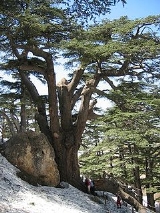
 forests. Also, in the high slopes of Mount Lebanon are the last remaining groves of the famous Cedars of Lebanon
Lebanon Cedar

Cedrus libani , is a species of cedar native to the mountains of the Mediterranean region, in Lebanon, western Syria and south central Turkey, with variety of it in southwest Turkey, Cyprus, and the Atlas Mountains in Algeria and Morocco in northwest Africa....
 (Cedrus libani). The Phoenicia
Phoenicia

Phoenicia was an ancient civilization centered in the north of ancient Canaan, with its heartland along the coastal regions of modern day Lebanon, extending to parts of Israel, Syria and the Palestinian territories....
ns used the forests from Mount Lebanon to build their ship fleet and to trade with their Levantine neighbors. However, the Phoenicians and successor rulers replanted and restocked the range so that even as late as the 16th century, its forested area was considerable.

History of Mount Lebanon


Mount Lebanon is mentioned in the Old Testament several times. In fact Hiram the king of Tyre was famous for sending his engineers with Cedar wood which was abundant in Mount Lebanon, to build the Jewish Temple of Jerusalem. Since then the special Cedar tree known scientifically as Cedrus Libani is often associated with Mount Lebanon. The Phoenicians harvested that tree and used it to build their magnificent ships in which they sailed all over the Mediterranean and reach the Atlantic, thus they were the first to establish villages in Mount Lebanon which inhabitants would live from cutting down Cedars and sending them to the coast. After the 5th century, Christian monks who were followers of a hermit named Maroun, arrived from the Orontes valley in Northern Syria
Syria

Syria , officially the Syrian Arab Republic , is an Arab-majority country in Southwest Asia, bordering Lebanon and the Mediterranean Sea to the west, Israel to the southwest, Jordan to the south, Iraq to the east, and Turkey to the north....
 and began preaching their religion to the Pagan Phoenician inhabiting the northernmost parts of the mountain range. Also in the late 8th century a group of ferocious warriors known as the Maradites (also Jarajima) settled in North Lebanon following the order of the Byzantine Emperor, their mission was to raid Islamic territories in Syria. They merged with the local population refusing to leave after the emperor struck a deal with the Muslim Caliph of Damascus, thus they became part of the Maronite society. Also in 1291 AD after the fall of the Acre the last crusader outpost in the Levant, the remnants of the European settlers who succeeded in escaping capture by the Mamelooks, settled in the Northern part of Lebanon and thus becoming part of the Maronite society. In the 9th century, tribes from the northern areas of the Arabian Peninsula
Arabian Peninsula

The Arabian Peninsula , Arabia, Arabistan, and the Arabian subcontinent is a peninsula in Southwest Asia at the junction of Africa and Asia. The area is an important part of the Middle East and plays a critically important geopolitics role because of its vast reserves of petroleum and natural gas....
, known as the Tanukhiyoun, began settling in the southern areas of the mountain range and in the 11th century these tribes became Druze
Druze

The Druze are a religious community found primarily in Syria, Lebanon, Jordan, Israel and in the Palestinian territories whose traditional religion is said to have begun as an offshoot of Islam, but is unique in its incorporation of Gnosticism, Neoplatonism and other philosophies, similar to other followers of Ismaili Shi'a Islam....
 and ruled the areas of Mount Lebanon stretching from Metn in the north to Jezzine
Jezzine

Jezzine is a town in Lebanon, located 22 km from Sidon and 73 km south of Beirut. Surrounded by mountain peaks, pine forests, and at an average altitude of 950 m , it is the main summer resort and tourist destination of South Lebanon....
 in the south, this entire area became known as the ‘Jabal ad-Duruz’. In the early 1600s, Emir Fakhreddine the 2nd
Fakhr-al-Din II

Fakhr-al-Din II also the Great or Fakhreddine II was a Lebanon prince, son of Prince Qurqumaz from the Maan family Druze dynasty and Princess Nassab....
 ascended the throne in the Druze part of the mountains known as the Chouf. In an effort to unify Mount Lebanon, Emir Fakhreddine opened the door to Christian and in particular Maronite settlement of the Chouf and Metn. Throughout the 1700s and into the 1800s more and more Maronites settled in the Druze regions of the Mount. Seeing their numbers increasing the Maronites began to demand a larger share of the authority. The Druze viewed these Maronite settlements as a threat to their existence in Mount Lebanon and in a series of clashes in the 1840s and 1860s a mini civil war erupted in the area resulting in the death of thousands of Druze and Christians . The Druze won militarily but not politically because European powers (mainly France and Britain) intervened on behalf of the Maronites and divided Mount Lebanon into two areas; Druze and Maronite. Seeing their authority decline in Mount Lebanon, few Lebanese Druzes began migrating to the new Jabal ad-Duruz in southern Syria
Syria

Syria , officially the Syrian Arab Republic , is an Arab-majority country in Southwest Asia, bordering Lebanon and the Mediterranean Sea to the west, Israel to the southwest, Jordan to the south, Iraq to the east, and Turkey to the north....
. In 1861 the "Mount Lebanon" autonomous district was established within the Ottoman
Ottoman Empire

The Ottoman Empire , also known by its contemporaries as the Turkish Empire or Turkey , was an empire that lasted from 1299?1923. It was Treaty of Lausanne by the Republic of Turkey, which was officially proclaimed on October 29, 1923....
 system, under an international guarantee.

Mount Lebanon, as a political name


Mount Lebanon also lent its name to two political designations: a semi-autonomous province in Ottoman Syria
Ottoman Syria

Ottoman Syria refers to the Levant within the Ottoman Empire from 1516 to 1918. Syria in the Ottoman era included modern Syria, Lebanon, Israel, the West Bank, Gaza Strip, Jordan, and parts of Turkey and Iraq....
 that existed since the year 1516 AD and the central Governorate
Governorate

A Governorate is an administrative division of a country. It is headed by a governor. As English-speaking nations tend to call regions administered by governors either states or colonies, the term governorate is sometimes used in translation from non-English-speaking administrations....
 of modern Lebanon (see Mount Lebanon Governorate
Mount Lebanon Governorate

Mount Lebanon is one of the Governorates of Lebanon. Its capital is Baabda. The governorate is often dubbed the "Heartland of Lebanese Christians" due to the fact that the overwhelming majority of its population is comprised of Maronites, Greek Orthodox, and Greek Melkite Catholic Christians....
).

The Mount Lebanon administrative region emerged in a time of rise of nationalism
Rise of nationalism under the Ottoman Empire

The rise of the Western world notion of nationalism under the Ottoman Empire eventually caused the break-down of the Ottoman Millet concept....
 after the civil war of 1860: France intervened on behalf of the local Christian population and Britain on behalf of the Druze after the 1860 massacres, when 10 000 Christians were killed in clashes with the Druze
Druze

The Druze are a religious community found primarily in Syria, Lebanon, Jordan, Israel and in the Palestinian territories whose traditional religion is said to have begun as an offshoot of Islam, but is unique in its incorporation of Gnosticism, Neoplatonism and other philosophies, similar to other followers of Ismaili Shi'a Islam....
. In 1861 the "Mount Lebanon" autonomous district was established within the Ottoman system
Subdivisions of the Ottoman Empire

The subdivisions of the Ottoman Empire were administrative divisions of the state organisation of the Ottoman Empire based on military administration but with civil executive functions as well....
, under an international guarantee.

It was ruled by a non-Lebanese Christian subject of the Ottoman Empire
Ottoman Empire

The Ottoman Empire , also known by its contemporaries as the Turkish Empire or Turkey , was an empire that lasted from 1299?1923. It was Treaty of Lausanne by the Republic of Turkey, which was officially proclaimed on October 29, 1923....
 (known locally as the "Mutasarrif
Mutasarrif

In the Ottoman Empire, a mutasarrif was the governor of a district. This administrative unit was part of a vilayet , administered by a wali#Ottoman Empire term, and contained nahiye , each administered by a kaymakam....
", (one who rules the district Mutasarrifiyya). Christians formed the majority of the population of Mount Lebanon, with a significant number of Druze
Druze

The Druze are a religious community found primarily in Syria, Lebanon, Jordan, Israel and in the Palestinian territories whose traditional religion is said to have begun as an offshoot of Islam, but is unique in its incorporation of Gnosticism, Neoplatonism and other philosophies, similar to other followers of Ismaili Shi'a Islam....
.

During World War I
World War I

World War I, or the First World War , was a global military conflict which involved the Great powers, organized into two opposing military alliances: the Allies of World War I and the Central Powers....
, the Ottoman Empire - more precisely the Young Turks
Young Turks

The Young Turks were a coalition of various groups favoring reformation of the Administration of the Ottoman Empire. Through the Young Turk Revolution, their movement brought about the Second Constitutional Era ....
 - launched a campaign against the Maronites as part of its Middle Eastern region-wide massacres of Christians. As part of this campaign, the Ottoman fleet blockaded the entire Levant
Levant

The Levant describes, traditionally, the Eastern Mediterranean at large, but can be used as a geographical term that denotes a large area in Western Asia formed by the lands bordering the Eastern shores of the Mediterranean, roughly bounded on the north by the Taurus Mountains, on the south by the Arabian Desert, and on the west by the M...
ine coast, encircled the region with troops and cut off Mount Lebanon from the rest of the world. In Lebanon it is estimated today that half the population of Mount Lebanon died of an orchestrated famine
Famine

A famine is a widespread shortage of food that may apply to any faunal species, which phenomenon is usually accompanied by regional malnutrition, starvation, epidemic, and increased death....
 during this time. Modern Turkey
Turkey

Turkey , known officially as the Republic of Turkey , is a Eurasian country that stretches across the Anatolian peninsula in southwest Asia and Thrace in the Balkans region of Southern Europe....
 continues to deny the systematic genocidal nature of this event, like they also deny the Armenian Genocide
Armenian Genocide

The Armenian Genocide , also known as the Armenian Holocaust, the Armenian Massacres and, by Armenians, the Great Calamity —refers to the deliberate and systematic destruction of the Armenian people population of the Ottoman Empire during and just after World War I....
, the Assyrian Genocide
Assyrian genocide

The Assyrian Genocide was committed against the Assyrian people population of the Ottoman Empire near the end of the World War I by the Young Turks....
 and the Greek genocide, and this has traditionally strained Lebanese views of Turkey. Lebanon is among the countries that recognizes the Armenian Genocide
Recognition of the Armenian Genocide

To date, only 21 countries have officially recognized the Armenian Genocide committed by Ottoman Empire between 1915-1923 as genocide....
.

For decades the Christians pressured the European powers, to award them self determination by extending their small Lebanese territory to what they dubbed "Greater Lebanon", referring to a geographic unit comprising Mount Lebanon and its coast, and the Beqaa Valley
Beqaa Valley

Beqaa is a fertile valley in east Lebanon. The Roman Empire considered the Beqaa Valley to be a major agricultural source, and today it remains Lebanon?s most important farming region....
 to its east.

France took hold of the formally Ottoman holdings in the northern Levant
Levant

The Levant describes, traditionally, the Eastern Mediterranean at large, but can be used as a geographical term that denotes a large area in Western Asia formed by the lands bordering the Eastern shores of the Mediterranean, roughly bounded on the north by the Taurus Mountains, on the south by the Arabian Desert, and on the west by the M...
, and expanded the borders of Mount Lebanon in 1920 to form Greater Lebanon which was to be populated by remnants of the Middle Eastern Christian community. While the Christians ended up gaining territorially the new borders merely ended the demographic dominance of Christians in the newly created territory of Lebanon
Lebanon

Lebanon , officially the Republic of Lebanon or Lebanese Republic , is a country in Western Asia, on the eastern shore of the Mediterranean Sea....
.

External links


See also

  • Subdivisions of the Ottoman Empire
    Subdivisions of the Ottoman Empire

    The subdivisions of the Ottoman Empire were administrative divisions of the state organisation of the Ottoman Empire based on military administration but with civil executive functions as well....
  • French Mandate of Lebanon
    French Mandate of Lebanon

    The French Mandate of Lebanon was a League of Nations League of Nations Mandate created at the end of World War I. When the Ottoman Empire was formally split up by the Treaty of S?vres in 1920, it was decided that four of its territories in the Middle East should be League of Nations mandates temporarily governed by the United Kingdom and Fra...
  • Mount Lebanon Governorate
    Mount Lebanon Governorate

    Mount Lebanon is one of the Governorates of Lebanon. Its capital is Baabda. The governorate is often dubbed the "Heartland of Lebanese Christians" due to the fact that the overwhelming majority of its population is comprised of Maronites, Greek Orthodox, and Greek Melkite Catholic Christians....