


Thermae

Encyclopedia
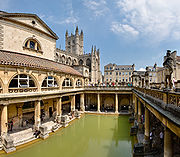
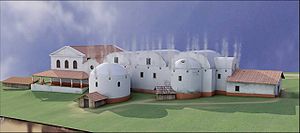
Ancient Rome
Ancient Rome was a thriving civilization that grew on the Italian Peninsula as early as the 8th century BC. Located along the Mediterranean Sea and centered on the city of Rome, it expanded to one of the largest empires in the ancient world....
, thermae (from Greek thermos, "hot") and balnea (Greek βαλανείον, balaneion) were facilities for bathing. Thermae usually refers to the large imperial
Roman Empire
The Roman Empire was the post-Republican period of the ancient Roman civilization, characterised by an autocratic form of government and large territorial holdings in Europe and around the Mediterranean....
bath complexes, while balneae were smaller-scale facilities, public or private, that existed in great numbers throughout Rome.
Most Roman cities had at least one, if not many, such buildings, which were centers not only for bathing, but socializing. Roman bath-houses were also provided for private villa
Roman villa
A Roman villa is a villa that was built or lived in during the Roman republic and the Roman Empire. A villa was originally a Roman country house built for the upper class...
s, town houses
Domus
In ancient Rome, the domus was the type of house occupied by the upper classes and some wealthy freedmen during the Republican and Imperial eras. They could be found in almost all the major cities throughout the Roman territories...
, and forts
Castra
The Latin word castra, with its singular castrum, was used by the ancient Romans to mean buildings or plots of land reserved to or constructed for use as a military defensive position. The word appears in both Oscan and Umbrian as well as in Latin. It may have descended from Indo-European to Italic...
. They were supplied with water from an adjacent river or stream, or more normally, by an aqueduct
Aqueduct
An aqueduct is a water supply or navigable channel constructed to convey water. In modern engineering, the term is used for any system of pipes, ditches, canals, tunnels, and other structures used for this purpose....
. The water could be heated from a log fire before being channeled into the hot bathing rooms. The design of baths is discussed by Vitruvius
Vitruvius
Marcus Vitruvius Pollio was a Roman writer, architect and engineer, active in the 1st century BC. He is best known as the author of the multi-volume work De Architectura ....
in De Architectura
De architectura
' is a treatise on architecture written by the Roman architect Vitruvius and dedicated to his patron, the emperor Caesar Augustus, as a guide for building projects...
.
Terminology
Thermae, balneae, balineae, balneum and balineum are all commonly translated as "bath" or "baths". Later usage of the terms loses the distinctions made by earlier authors.Balneum or balineum, derived from the Greek
Greek language
Greek is an independent branch of the Indo-European family of languages. Native to the southern Balkans, it has the longest documented history of any Indo-European language, spanning 34 centuries of written records. Its writing system has been the Greek alphabet for the majority of its history;...
βαλανείον signifies, in its primary sense, a bath or bathing-vessel, such as most persons of any consequence amongst the Romans possessed in their own houses, and hence the chamber which contained the bath, which is also the proper translation of the word balnearium. The diminutive balneolum is adopted by Seneca
Seneca the Younger
Lucius Annaeus Seneca was a Roman Stoic philosopher, statesman, dramatist, and in one work humorist, of the Silver Age of Latin literature. He was tutor and later advisor to emperor Nero...
to designate the bathroom of Scipio
Publius Cornelius Scipio
Publius Cornelius Scipio was a general and statesman of the Roman Republic.A member of the Corneliagens, Scipio served as consul in 218 BC, the first year of the Second Punic War, and sailed with an army from Pisa to Massilia , with the intention of arresting Hannibal's advance on Italy...
, in the villa at Liternum
Liternum
Liternum was an ancient town of Campania, Italy, on the low sandy coast between Cumae and the mouth of the Volturnus. It was probably once dependent on Cumae. In 194 BC it became a Roman colony....
, and is expressly used to characterise the modesty of republican manners as compared with the luxury of his own times. But when the baths of private individuals became more sumptuous, and comprised many rooms, instead of the one small chamber described by Seneca, the plural balnea or balinea was adopted, which still, in correct language, had reference only to the baths of private persons. Thus Cicero
Cicero
Marcus Tullius Cicero , was a Roman philosopher, statesman, lawyer, political theorist, and Roman constitutionalist. He came from a wealthy municipal family of the equestrian order, and is widely considered one of Rome's greatest orators and prose stylists.He introduced the Romans to the chief...
terms the baths at the villa of his brother Quintus
Quintus Tullius Cicero
Quintus Tullius Cicero was the younger brother of the celebrated orator, philosopher and statesman Marcus Tullius Cicero. He was born into a family of the equestrian order, as the son of a wealthy landowner in Arpinum, some 100 kilometres south-east of Rome.- Biography :Cicero's well-to-do father...
balnearia. Balneae and balineae, which according to Varro
Varro
Varro was a Roman cognomen carried by:*Marcus Terentius Varro, sometimes known as Varro Reatinus, the scholar*Publius Terentius Varro or Varro Atacinus, the poet*Gaius Terentius Varro, the consul defeated at the battle of Cannae...
have no singular number, were the public baths. But this accuracy of diction is neglected by many of the subsequent writers, and particularly by the poets, amongst whom balnea is not uncommonly used in the plural number to signify the public baths, since the word balneae could not be introduced in an hexameter
Hexameter
Hexameter is a metrical line of verse consisting of six feet. It was the standard epic metre in classical Greek and Latin literature, such as in the Iliad and Aeneid. Its use in other genres of composition include Horace's satires, and Ovid's Metamorphoses. According to Greek mythology, hexameter...
verse. Pliny
Pliny the Younger
Gaius Plinius Caecilius Secundus, born Gaius Caecilius or Gaius Caecilius Cilo , better known as Pliny the Younger, was a lawyer, author, and magistrate of Ancient Rome. Pliny's uncle, Pliny the Elder, helped raise and educate him...
also, in the same sentence, makes use of the neuter plural balnea for public, and of balneum for a private bath.
Thermae (which comes from the Greek adjective thermos, hot) meant properly warm springs, or baths of warm water; but came to be applied to those magnificent edifices which grew up under the empire
Roman Empire
The Roman Empire was the post-Republican period of the ancient Roman civilization, characterised by an autocratic form of government and large territorial holdings in Europe and around the Mediterranean....
, in place of the simple balneae of the republic
Roman Republic
The Roman Republic was the period of the ancient Roman civilization where the government operated as a republic. It began with the overthrow of the Roman monarchy, traditionally dated around 508 BC, and its replacement by a government headed by two consuls, elected annually by the citizens and...
, and which comprised within their range of buildings all the appurtenances belonging to the Greek gymnasia
Gymnasium (ancient Greece)
The gymnasium in ancient Greece functioned as a training facility for competitors in public games. It was also a place for socializing and engaging in intellectual pursuits. The name comes from the Ancient Greek term gymnós meaning "naked". Athletes competed in the nude, a practice said to...
, as well as a regular establishment appropriated for bathing. Writers, however, use these terms without distinction. Thus the baths erected by Claudius Etruscus, the freedman of the Emperor Claudius
Claudius
Claudius , was Roman Emperor from 41 to 54. A member of the Julio-Claudian dynasty, he was the son of Drusus and Antonia Minor. He was born at Lugdunum in Gaul and was the first Roman Emperor to be born outside Italy...
, are styled by Statius
Statius
Publius Papinius Statius was a Roman poet of the 1st century CE . Besides his poetry in Latin, which include an epic poem, the Thebaid, a collection of occasional poetry, the Silvae, and the unfinished epic, the Achilleid, he is best known for his appearance as a major character in the Purgatory...
balnea, and by Martial
Martial
Marcus Valerius Martialis , was a Latin poet from Hispania best known for his twelve books of Epigrams, published in Rome between AD 86 and 103, during the reigns of the emperors Domitian, Nerva and Trajan...
Etrusci thermulae. In an epigram by Martial—subice balneum thermis—the terms are not applied to the whole building, but to two different chambers in the same edifice.
Building layout
Caldarium
right|thumb|230px|Caldarium from the Roman Baths at [[Bath, England]]. The floor has been removed to reveal the empty space where the hot air flowed through to heat the floor....
(hot bath), the tepidarium
Tepidarium
The tepidarium was the warm bathroom of the Roman baths heated by a hypocaust or underfloor heating system.The specialty of a tepidarium is the pleasant feeling of constant radiant heat which directly affects the human body from the walls and floor.There is an interesting example at Pompeii; this...
(warm bath) and the frigidarium
Frigidarium
A frigidarium is a large cold pool of Roman baths. It would be entered after the Caldarium and the Tepidarium, which were used to open the pores of the skin. The cold water would close the pores. There would be a small pool of cold water or sometimes a large Swimming pool...
(cold bath). Some thermae also featured steam baths: the sudatorium
Sudatorium
In architecture, a sudatorium is a vaulted sweating-room of the Roman baths or thermae. The Roman architectural writer Vitruvius In architecture, a sudatorium is a vaulted sweating-room (sudor, sweat) of the Roman baths or thermae. The Roman architectural writer Vitruvius In architecture, a...
, a moist steam bath, and the laconicum, a dry steam bath much like a modern sauna
Sauna
A sauna is a small room or house designed as a place to experience dry or wet heat sessions, or an establishment with one or more of these and auxiliary facilities....
.
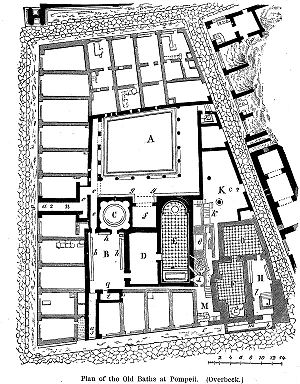
By way of illustration, this article will describe the layout of Pompeii
Pompeii
The city of Pompeii is a partially buried Roman town-city near modern Naples in the Italian region of Campania, in the territory of the comune of Pompei. Along with Herculaneum, Pompeii was destroyed and completely buried during a long catastrophic eruption of the volcano Mount Vesuvius spanning...
's Old Baths adjoining the forum
Forum (Roman)
A forum was a public square in a Roman municipium, or any civitas, reserved primarily for the vending of goods; i.e., a marketplace, along with the buildings used for shops and the stoas used for open stalls...
, which are among some of the best-preserved Roman baths. The references are to the floor plan pictured to the right.
The whole building comprises a double set of baths, one for men and the other for women. It has six different entrances from the street, one of which (b) gives admission to the smaller women's set only. Five other entrances lead to the men's department, of which two (c and c2), communicate directly with the furnaces, and the other three (a3, a2, a) with the bathing apartments.
Atrium
Passing through the principal entrance, a, which is removed from the street by a narrow footway surrounding the building and after descending three steps, the bather finds a small chamber on his left (x) which contained a water closet (latrina), and proceeds into a covered porticoPortico
A portico is a porch leading to the entrance of a building, or extended as a colonnade, with a roof structure over a walkway, supported by columns or enclosed by walls...
(g, g), which ran round three sides of an open court (atrium
Atrium (architecture)
In modern architecture, an atrium is a large open space, often several stories high and having a glazed roof and/or large windows, often situated within a larger multistory building and often located immediately beyond the main entrance doors...
, A). These together formed the vestibule
Vestibule (architecture)
A vestibule is a lobby, entrance hall, or passage between the entrance and the interior of a building.The same term can apply to structures in modern or ancient roman architecture. In modern architecture vestibule typically refers to a small room or hall between an entrance and the interior of...
of the baths (vestibulum balnearum), in which the servants waited.
Use of the atrium
This atrium was the exercise ground for the young men, or perhaps served as a promenade for visitors to the baths. Within this court the keeper of the baths (balneator), who exacted the quadransQuadrans
The quadrans was a low-value Roman bronze coin worth one quarter of an as. The quadrans was issued from the beginning of cast bronze coins during the Roman Republic with three pellets representing three unciae as a mark of value...
paid by each visitor, was also stationed. The room f, which runs back from the portico, might have been appropriated to him; but most probably it was an oecus
Oecus
Oecus, the Latinized form of Gr. oikos, house, used by Vitruvius for the principal hall or salon in a Roman house, which was used occasionally as a triclinium for banquets....
or exedra
Exedra
In architecture, an exedra is a semicircular recess or plinth, often crowned by a semi-dome, which is sometimes set into a building's facade. The original Greek sense was applied to a room that opened onto a stoa, ringed with curved high-backed stone benches, a suitable place for a philosophical...
, for the convenience of the better classes while awaiting the return of their acquaintances from the interior. In this court, advertisements for the theatre, or other announcements of general interest, were posted up, one of which, announcing a gladiator
Gladiator
A gladiator was an armed combatant who entertained audiences in the Roman Republic and Roman Empire in violent confrontations with other gladiators, wild animals, and condemned criminals. Some gladiators were volunteers who risked their legal and social standing and their lives by appearing in the...
ial show, still remains. At the sides of the entrance were seats (scholae).
Apodyterium and frigidarium

Apodyterium
In ancient Rome, the apodyterium was the primary entry in the public baths, composed of a large changing room with cubicles or shelves where citizens could store clothing and other belongings while bathing....
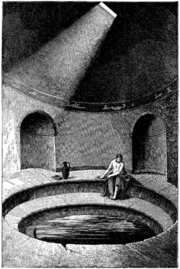
(B), a room for undressing in which all visitors must have met before entering the baths proper. Here, the bathers removed their clothing, which was taken in charge by slaves known as capsarii, notorious in ancient times for their dishonesty. The apodyterium was a spacious chamber, with stone seats along two sides of the wall (h, h). Holes are still visible on the walls, and probably mark the places where the pegs for the bathers' clothes were set. The chamber was lighted by a glass window, and had six doors. One of these led to the tepidarium
Tepidarium
The tepidarium was the warm bathroom of the Roman baths heated by a hypocaust or underfloor heating system.The specialty of a tepidarium is the pleasant feeling of constant radiant heat which directly affects the human body from the walls and floor.There is an interesting example at Pompeii; this...
(D) and another to the frigidarium (C), with its cold plunge-bath (referred to as loutron, natatio, natatorium
Natatorium
A natatorium is a term given for a building containing a swimming pool. In Latin, a cella natatoria was a swimming pool in its own building, although it is sometimes also used to refer to any indoor pool even if not housed in a dedicated building...
, piscina
Piscina
A piscina is a shallow basin placed near the altar of a church, used for washing the communion vessels. The sacrarium is the drain itself. Anglicans usually refer to the basin, calling it a piscina. Roman Catholics usually refer to the drain, and by extension, the basin, as the sacrarium...
, baptisterium
Baptisterium
In classical antiquity, a baptisterium was a large basin installed in private or public baths into which bathers could plunge, or even swim about. It is more commonly called natatorium or piscina....
or puteus; the terms "natatio" and "natatorium" suggest that some of those baths were also swimming pool
Swimming pool
A swimming pool, swimming bath, wading pool, or simply a pool, is a container filled with water intended for swimming or water-based recreation. There are many standard sizes; the largest is the Olympic-size swimming pool...
s). The bath in this chamber is of white marble, approached by two marble steps.
Tepidarium
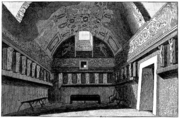
Tepidarium
The tepidarium was the warm bathroom of the Roman baths heated by a hypocaust or underfloor heating system.The specialty of a tepidarium is the pleasant feeling of constant radiant heat which directly affects the human body from the walls and floor.There is an interesting example at Pompeii; this...
(D). It did not contain water either at Pompeii or at the baths of Hippias, but was merely heated with warm air of an agreeable temperature, in order to prepare the body for the great heat of the vapour and warm baths, and, upon returning, to prevent a too-sudden transition to the open air. In the baths at Pompeii this chamber also served as an apodyterium for those who took the warm bath. The walls feature a number of separate compartments or recesses for receiving the garments when taken off. The compartments are divided from each other by figures of the kind called Atlantes
Atlas (architecture)
In the classical European architectural tradition an atlas is a support sculpted in the form of a man, which may take the place of a column, a pier or a pilaster...
or Telamones, which project from the walls and support a rich cornice above them.
Three bronze benches were also found in the room, which was heated as well by its contignity to the hypocaust
Hypocaust
A hypocaust was an ancient Roman system of underfloor heating, used to heat houses with hot air. The word derives from the Ancient Greek hypo meaning "under" and caust-, meaning "burnt"...
of the adjoining chamber, as by a brazier
Brazier
A brazier is a container for fire, generally taking the form of an upright standing or hanging metal bowl or box. Used for holding burning coal as well as fires, a brazier allows for a source of light, heat, or cooking...
of bronze (foculus), in which the charcoal ashes were still remaining when the excavation was made. Sitting and perspiring beside such a brazier was called ad flammam sudare.
Use of the tepidarium
The tepidarium is generally the most highly ornamented room in baths. It was merely a room to sit in and be anointed in. In the Old Baths at Pompeii the floor is mosaic, the arched ceiling adorned with stucco and painting on a coloured ground, the walls red.Anointing was performed by slaves called unctores and aliptae. It sometimes took place before going to the hot bath, and sometimes after the cold bath, before putting on the clothes, in order to check the perspiration. Some baths had a special room (destrictarium or unctorium) for this purpose.
Caldarium
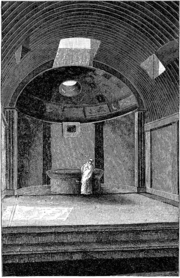
Mosaic
Mosaic is the art of creating images with an assemblage of small pieces of colored glass, stone, or other materials. It may be a technique of decorative art, an aspect of interior decoration, or of cultural and spiritual significance as in a cathedral...
floor was directly above the furnace or hypocaust
Hypocaust
A hypocaust was an ancient Roman system of underfloor heating, used to heat houses with hot air. The word derives from the Ancient Greek hypo meaning "under" and caust-, meaning "burnt"...
. Its walls also were hollow, forming a great flue filled with heated air. At one end was a round basin (labrum), and at the other a quadrangular bathingplace (puelos, alveus, solium, calida piscina), approached from the platform (schola) by steps. The labrum held cold water, for pouring upon the bather's head before he left the room. These basins are of marble in the Old Baths, but we hear of alvei of solid silver. Because of the great heat of the room, the caldarium was but slightly ornamented.
Laconicum
The Old Baths have no laconicumLaconicum
Laconicum , the dry sweating room of the Roman thermae, contiguous to the caldarium or hot room. The name was given to it as being the only form of warm bath that the Spartans admitted...
, which was a chamber still hotter than the caldarium, and used simply as a sweating-room, having no bath. It was said to have been introduced at Rome by Agrippa and was also called sudatorium
Sudatorium
In architecture, a sudatorium is a vaulted sweating-room of the Roman baths or thermae. The Roman architectural writer Vitruvius In architecture, a sudatorium is a vaulted sweating-room (sudor, sweat) of the Roman baths or thermae. The Roman architectural writer Vitruvius In architecture, a...
and assa
ASSA
ASSA can refer to:* Academy of the Social Sciences in Australia* Actuarial Society of South Africa* Allied Social Sciences Association* Armed Services Security Agency, UK* Assa Abloy - Swedish manufacturer of locks and security doors...
.
Service areas

Boiler
A boiler is a closed vessel in which water or other fluid is heated. The heated or vaporized fluid exits the boiler for use in various processes or heating applications.-Materials:...
s containing the water.
There were three boilers, one of which (caldarium vas) held the hot water; a second, the tepid (tepidarium); and the third, the cold (frigidarium). The warm water was turned into the warm bath by a pipe through the wall, marked on the plan. Underneath the hot chamber was set the circular furnace d, of more than 7 ft. in diameter, which heated the water and poured hot air into the hollow cells of the hypocaustum. It passed from the furnace under the first and last of the caldrons by two flues, which are marked on the plan. The boiler containing hot water was placed immediately over the furnace; and, as the water was drawn out from there, it was supplied from the next, the tepidarium, which was raised a little higher and stood a little way off from the furnace. It was already considerably heated from its contiguity to the furnace and the hypocaust below it, so that it supplied the deficiency of the former without materially diminishing its temperature; and the vacuum in this last was again filled up from the farthest removed, which contained the cold water received directly from the square reservoir seen behind them. The boilers themselves no longer remain, but the impressions which they have left in the mortar in which they were imbedded are clearly visible, and enable us to determine their respective positions and dimensions. Such coppers or boilers appear to have been called miliaria, from their similarity of shape to a milestone
Milestone
A milestone is one of a series of numbered markers placed along a road or boundary at intervals of one mile or occasionally, parts of a mile. They are typically located at the side of the road or in a median. They are alternatively known as mile markers, mileposts or mile posts...
.
Behind the boilers, another corridor leads into the court or atrium (K) appropriated to the servants of the bath.
Women's bath
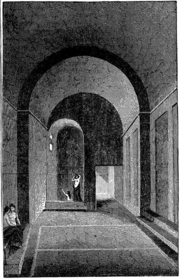
Opposite to the door of entrance into the apodyterium is another doorway which leads to the tepidarium (G), which also communicates with the thermal chamber (F), on one side of which is a warm bath in a square recess, and at the farther extremity the labrum. The floor of this chamber is suspended, and its walls perforated for flues, like the corresponding one in the men's baths. The tepidarium in the women's baths had no brazier, but it had a hanging or suspended floor.
Purpose
The baths often included, aside from the three main rooms listed above, a palaestraPalaestra
The palaestra was the ancient Greek wrestling school. The events that did not require a lot of space, such as boxing and wrestling, were practised there...
, or outdoor gymnasium where men would engage in various ball games and exercises. There, among other things, weights were lifted and the discus thrown. Men would oil themselves (as soap
Soap
In chemistry, soap is a salt of a fatty acid.IUPAC. "" Compendium of Chemical Terminology, 2nd ed. . Compiled by A. D. McNaught and A. Wilkinson. Blackwell Scientific Publications, Oxford . XML on-line corrected version: created by M. Nic, J. Jirat, B. Kosata; updates compiled by A. Jenkins. ISBN...
was still a luxury good and thus not widely available), shower
Shower
A shower is an area in which one bathes underneath a spray of water.- History :...
, and remove the excess with a strigil
Strigil
A strigil was a small, curved, metal tool used in ancient Greece and Rome to scrape dirt and sweat from the body before effective soaps became available. First perfumed oil was applied to the skin, and then it would be scraped off, along with the dirt. For wealthier people, this process was often...
(cf. the well known Apoxyomenus of Lysippus from the Vatican Museum). Often wealthy bathers would bring a capsarius, a slave that carried his master's towels, oils, and strigils to the baths and then watched over them once in the baths, as thieves and pickpockets were known to frequent the baths.
The changing room was known as the apodyterium
Apodyterium
In ancient Rome, the apodyterium was the primary entry in the public baths, composed of a large changing room with cubicles or shelves where citizens could store clothing and other belongings while bathing....
(Greek apodyterion, apo + duo "to take off" here of clothing).
Cultural significance
In many ways, baths were the ancient Roman equivalent of community centers. Because the bathing process took so long, conversation was necessary. Many Romans would use the baths as a place to invite their friends to dinner parties, and many politicians would go to the baths to convince fellow Romans to join their causes. The thermae had many attributes in addition to the baths. There were libraries, rooms for poetry readings, and places to buy and eat food. The modern equivalent would be a combination of a library, art gallery, mall, restaurant, gym, and spa.When asked by a foreigner why he bathed once a day, a Roman emperor is said to have replied "Because I do not have the time to bathe twice a day."
Emperors often built baths to gain favor for themselves and to create a lasting monument of their generosity. If a rich Roman wished to gain the favor of the people, he might arrange for a free admission day in his name. For example, a senator hoping to become a Tribune
Tribune
Tribune was a title shared by elected officials in the Roman Republic. Tribunes had the power to convene the Plebeian Council and to act as its president, which also gave them the right to propose legislation before it. They were sacrosanct, in the sense that any assault on their person was...
might pay all admission fees at a particular bath on his birthday to become well known to the people of the area.
Location
Baths sprung up all over the empire. Where natural hot springHot spring
A hot spring is a spring that is produced by the emergence of geothermally heated groundwater from the Earth's crust. There are geothermal hot springs in many locations all over the crust of the earth.-Definitions:...
s existed (as in Bath, England, Băile Herculane
Baile Herculane
Băile Herculane is a town in Romanian Banat, in Caraş-Severin County, situated in the valley of the Cerna River, between the Mehedinţi Mountains to the east and the Cerna Mountains to the west, elevation 168 meters. Its current population is approximately 6,000...
, Romania
Romania
Romania is a country located at the crossroads of Central and Southeastern Europe, on the Lower Danube, within and outside the Carpathian arch, bordering on the Black Sea...
or Serdica, Bulgaria
Bulgaria
Bulgaria , officially the Republic of Bulgaria , is a parliamentary democracy within a unitary constitutional republic in Southeast Europe. The country borders Romania to the north, Serbia and Macedonia to the west, Greece and Turkey to the south, as well as the Black Sea to the east...
) thermae were built around them. Alternatively, a system of hypocaust
Hypocaust
A hypocaust was an ancient Roman system of underfloor heating, used to heat houses with hot air. The word derives from the Ancient Greek hypo meaning "under" and caust-, meaning "burnt"...
a (Greek hypocauston < hypo "below" + kaio "to burn") were utilized to heat the piped water from a furnace (praefurnium).
Remains of Roman public baths
A number of Roman public baths survive, either as ruins or in varying degrees of conservation. Among the more notable are the Roman baths of Bath in EnglandEngland
England is a country that is part of the United Kingdom. It shares land borders with Scotland to the north and Wales to the west; the Irish Sea is to the north west, the Celtic Sea to the south west, with the North Sea to the east and the English Channel to the south separating it from continental...
as well as the Baths of Caracalla
Baths of Caracalla
The Baths of Caracalla in Rome, Italy were Roman public baths, or thermae, built in Rome between AD 212 and 216, during the reign of the Emperor Caracalla.- History :...
, of Diocletian
Baths of Diocletian
The Baths of Diocletian in Rome were the grandest of the public baths, or thermae built by successive emperors. Diocletian's Baths, dedicated in 306, were the largest and most sumptuous of the imperial baths. The baths were built between the years 298 AD and 306 AD...
, of Titus
Baths of Titus
The Baths of Titus were public baths built in Rome in 81 by Emperor Titus.The baths sat in the base of the Esquiline hill, an area of parkland and luxury estates which had been taken over by Nero for his Golden House or Domus Aurea...
, of Trajan
Baths of Trajan
The Baths of Trajan were a massive thermae, a bathing and leisure complex, built in ancient Rome starting from 104 AD and dedicated during the Kalends of July in 109...
in Rome
Rome
Rome is the capital of Italy and the country's largest and most populated city and comune, with over 2.7 million residents in . The city is located in the central-western portion of the Italian Peninsula, on the Tiber River within the Lazio region of Italy.Rome's history spans two and a half...
and the baths of Varna
Varna
Varna is the largest city and seaside resort on the Bulgarian Black Sea Coast and third-largest in Bulgaria after Sofia and Plovdiv, with a population of 334,870 inhabitants according to Census 2011...
.
Other thermae attractions
Visitors to the bath house could also play on the playing grounds, look at books from the libraries, visit the exhibition halls, and admire the covered walkways with fountains and landscaped gardens. They could go to the barber for a trim, the beautician for a relaxing afternoon, the gym for a quick workout, or get a snack.See also
- Aqueducts
- Roman culture
- Roman aqueducts
- Roman architectureRoman architectureAncient Roman architecture adopted certain aspects of Ancient Greek architecture, creating a new architectural style. The Romans were indebted to their Etruscan neighbors and forefathers who supplied them with a wealth of knowledge essential for future architectural solutions, such as hydraulics...
- Roman engineeringRoman engineeringRomans are famous for their advanced engineering accomplishments, although some of their own inventions were improvements on older ideas, concepts and inventions. Technology for bringing running water into cities was developed in the east, but transformed by the Romans into a technology...
- Roman technologyRoman technologyRoman technology is the engineering practice which supported Roman civilization and made the expansion of Roman commerce and Roman military possible over nearly a thousand years....
- Spa townSpa townA spa town is a town situated around a mineral spa . Patrons resorted to spas to "take the waters" for their purported health benefits. The word comes from the Belgian town Spa. In continental Europe a spa was known as a ville d'eau...
- HygieneHygieneHygiene refers to the set of practices perceived by a community to be associated with the preservation of health and healthy living. While in modern medical sciences there is a set of standards of hygiene recommended for different situations, what is considered hygienic or not can vary between...
- Diocletian windowDiocletian windowDiocletian windows, also called thermal windows, are large semicircular windows characteristic of the enormous public baths of Ancient Rome...
(thermal window) - SaunaSaunaA sauna is a small room or house designed as a place to experience dry or wet heat sessions, or an establishment with one or more of these and auxiliary facilities....
- Turkish Bath
External links
- William Smith Roman Baths (Balneae) from "A Dictionary of Greek and Roman Antiquities", pub. John Murray, London, 1875.
- ThermeMuseum (Museum of the Thermae) in Heerlen
- Traianus – Technical investigation of Roman public works
- Roman Bath: a day at the baths An interactive site using the Baths of Caracalla as an example
- Barbara F. McManus Roman baths and bathing
- 3d reconstruction of a roman baths Limes in Austria
- Roman Baths of Weissenburg Digital Media Archive (creative commonsCreative CommonsCreative Commons is a non-profit organization headquartered in Mountain View, California, United States devoted to expanding the range of creative works available for others to build upon legally and to share. The organization has released several copyright-licenses known as Creative Commons...
-licensed photos, laser scans, panoramas) with data from a City of Weissenburg/CyArkCyArkCyArk is a 501 nonprofit organization located in Oakland, California, United States. The company's website refers to it as a "digital archive of the world’s heritage sites for preservation and education"...
research partnership - The so-called Victorian Turkish bath was actually a 19th century version of the Roman bath, and was much closer to it than it was to the Islamic hammam (which is far more humid).