
All Topics  
Ostrogothic Kingdom


   Email Print
   Bookmark   Link


Ostrogothic Kingdom


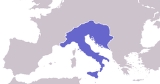
The Ostrogothic Kingdom established by the Ostrogoths in Italy
Italian Peninsula

The Italian Peninsula or Apennine Peninsula is one of the three peninsulas of Southern Europe , spanning 1,000 km from the Po Valley in the north to the central Mediterranean Sea in the south....
 and neighbouring areas lasted from 493
493

Events...
 to 553
553

Events...
. In Italy the Ostrogoths replaced Odoacer
Odoacer

Odoacer , also known as Odovacar , was a Germanic general and the first non-Roman King of Italy after 476. He deposed the last Western Roman Emperor, Romulus Augustus, that year, but continued to rule first as a nominal client of Julius Nepos and, after Nepos' death in AD 480, as a client of the Eastern Roman Emperor....
, the de facto ruler of Italy who had deposed the last emperor of the Western Roman Empire
Western Roman Empire

The Western Roman Empire refers to the western half of the Roman Empire, from its division by Diocletian in 285; the other half of the Roman Empire was the Eastern Roman Empire, today widely known as the Byzantine Empire....
 in 476. The Gothic kingdom reached its zenith under the rule of its first king, Theodoric the Great
Theodoric the Great

File:Theodoric bronze weight inlaid with silver issued by prefect Catulinus Rome 493 526.jpg'Theodoric the Great' , known in Latin as 'Flavius Theodericus' and in Greek sources, was king of the Ostrogoths , ruler of Italy , and regent of the Visigoths ....
. Most of the social institutions in the late Western Roman Empire
Western Roman Empire

The Western Roman Empire refers to the western half of the Roman Empire, from its division by Diocletian in 285; the other half of the Roman Empire was the Eastern Roman Empire, today widely known as the Byzantine Empire....
 were preserved during his rule.

Starting in 535, the Eastern Roman Empire invaded Italy.


Discussion
Ask a question about 'Ostrogothic Kingdom'
Start a new discussion about 'Ostrogothic Kingdom'
Answer questions from other users
Full Discussion Forum


Encyclopedia


The Ostrogothic Kingdom established by the Ostrogoths in Italy
Italian Peninsula

The Italian Peninsula or Apennine Peninsula is one of the three peninsulas of Southern Europe , spanning 1,000 km from the Po Valley in the north to the central Mediterranean Sea in the south....
 and neighbouring areas lasted from 493
493

Events...
 to 553
553

Events...
. In Italy the Ostrogoths replaced Odoacer
Odoacer

Odoacer , also known as Odovacar , was a Germanic general and the first non-Roman King of Italy after 476. He deposed the last Western Roman Emperor, Romulus Augustus, that year, but continued to rule first as a nominal client of Julius Nepos and, after Nepos' death in AD 480, as a client of the Eastern Roman Emperor....
, the de facto ruler of Italy who had deposed the last emperor of the Western Roman Empire
Western Roman Empire

The Western Roman Empire refers to the western half of the Roman Empire, from its division by Diocletian in 285; the other half of the Roman Empire was the Eastern Roman Empire, today widely known as the Byzantine Empire....
 in 476. The Gothic kingdom reached its zenith under the rule of its first king, Theodoric the Great
Theodoric the Great

File:Theodoric bronze weight inlaid with silver issued by prefect Catulinus Rome 493 526.jpg'Theodoric the Great' , known in Latin as 'Flavius Theodericus' and in Greek sources, was king of the Ostrogoths , ruler of Italy , and regent of the Visigoths ....
. Most of the social institutions in the late Western Roman Empire
Western Roman Empire

The Western Roman Empire refers to the western half of the Roman Empire, from its division by Diocletian in 285; the other half of the Roman Empire was the Eastern Roman Empire, today widely known as the Byzantine Empire....
 were preserved during his rule.

Starting in 535, the Eastern Roman Empire invaded Italy. The Ostrogothic ruler at that time, Witiges
Witiges

Witiges or Vitiges was King of the Ostrogoths in Italy from 536 to 540.He succeeded to the throne of Italy in the early stages of the Gothic War , as Belisarius had quickly captured Sicily the previous year and was currently in southern Italy at the head of the forces of Justinian I, the Byzantine Empire....
, could not defend successfully and was finally captured when the capital Ravenna
Ravenna

Ravenna is a city and comune in the Emilia-Romagna region of Italy. The city is inland, but is connected to the Adriatic Sea by a canal. Ravenna once served as the seat of the Western Roman Empire and later the Ostrogoths and the Exarchate of Ravenna....
 fell. The Ostrogoths rallied around a new leader, Totila
Totila

Totila was king of the Ostrogoths from 541 until his death. He waged the Gothic War against the Byzantine Empire for the mastery of Italy. Most of the historical evidence for Totila consists of chronicles by the Byzantine historian Procopius, who accompanied the Byzantine general Belisarius during the Gothic War....
, and largely managed to reverse the conquest, but were eventually defeated. The last king of the Ostrogothic Kingdom was Teia.

History


Background


The Ostrogoths
The Ostrogoths were the eastern branch of the Goths
Goths

The Goths were East Germanic tribes who, in the 3rd and 4th centuries, invasion the Roman Empire and later adopted Arian Christianity. In the 5th and 6th centuries, divided as the Visigoths and the Ostrogoths, they established powerful successor-states of the Roman Empire in the Iberian peninsula and Italy....
. They settled and established a powerful state in Dacia
Dacia

In ancient geography, Dacia was the land of the Dacians. It was named by the ancient Greeks "Getae". Dacia was a large district of East-Central Europe, bounded on the north by the Carpathian Mountains, on the south by the Danube, on the west by the Tisia or Tisza, on the east by the Tyras or Dniester, now in eastern Moldova....
, but during the late 4th century, they came under the dominion of the Huns
Huns

The Huns were a confederation of Central Asian Eurasian nomads or semi-nomads, who had established an empire in Eurasia. The Huns may have stimulated the Migration Period, a contributing factor in the collapse of the Roman Empire....
. After the collapse of the Hunnic empire in 454, large numbers of Ostrogoths were settled by Emperor Marcian
Marcian

Flavius Marcianus, known in English as Marcian, was the List of Byzantine Emperors of the Byzantine Empire from 450 until his death. Marcian's rule marked a recovery of the Eastern Empire, which the emperor protected from external menaces and reformed economically and financially....
 in the Roman province of Pannonia
Pannonia

Pannonia is an ancient province of the Roman Empire bounded north and east by the Danube, coterminous westward with Noricum and upper Italy, and southward with Dalmatia and upper Moesia....
 as foederati
Foederati

Foederatus is a Latin term whose definition and usage drifted in the time between the early Roman Republic and the end of the Western Roman Empire....
. But in 460, during the reign of Leo I
Leo I (emperor)

Flavius Valerius Leo , known in English as Leo the Thracian or Leo I, was a Byzantine Emperor who ruled from 457 to 474. He was known as Magnus Thrax by his supporters, and Leo the Butcher by his enemies....
, because the payment of annual sums had ceased, they ravaged Illyricum
Illyricum

Illyricum can refer to:* Illyricum * Diocese of Illyricum* Praetorian prefecture of Illyricum...
. Peace was concluded in 461, whereby the young Theodoric Amal
Theodoric the Great

File:Theodoric bronze weight inlaid with silver issued by prefect Catulinus Rome 493 526.jpg'Theodoric the Great' , known in Latin as 'Flavius Theodericus' and in Greek sources, was king of the Ostrogoths , ruler of Italy , and regent of the Visigoths ....
, son of Theodemir
Theodemir

Theodemir was king of the Ostrogoths of the Amal Dynasty, and father of Theodoric the Great. He had an elder brother named Valamir and a younger named Vidimir....
 of the Amals, was sent as a hostage to Constantinople, where he received a Roman education. In previous years, a large number of Goths, first under Aspar
Aspar

Flavius Ardabur Aspar , an Alans, was patrician and magister militum of the Eastern Roman Empire.Son of the magister Ardaburius, Aspar played a crucial role in his father's expedition in 424 to defeat the western roman usurper, Joannes of Ravenna, and to install Galla Placidia and her son, Valentinian III, in his place....
 and then under Theodoric Strabo
Theodoric Strabo

Theodoric Strabo was an Ostrogoth chieftain who was involved in the politics of the Byzantine Empire during the reigns of Byzantine Emperors Leo I , Zeno and Basiliscus....
, had entered service in the Roman army and were a significant political and military power in the court of Constantinople. The period 477-483 saw a complex three-way struggle among Theodoric the Amal, who had succeeded his father in 474, Theodoric Strabo, and the new Eastern Emperor Zeno
Zeno (emperor)

Flavius Zeno Perpetuus, original name Tarasicodissa or Trascalissaeus, Eastern Roman Empire was one of the more prominent of the early Byzantine Emperors....
. In this conflict, alliances shifted regularly, and large parts of the Balkans
Balkans

The Balkans is the historical name of a geographic subregion of southeastern Europe. The region takes its name from the Balkan Mountains, which run through the centre of Bulgaria into eastern Serbia....
 were devastated by it. In the end, after Strabo's death in 481, Zeno came to terms with Theodoric. Parts of Moesia
Moesia

Moesia was an ancient region and Roman province situated in the areas of modern Serbia, Bulgaria and Romania along the south bank of the Danube River....
 and Dacia ripensis
Roman Dacia

The Roman province of Dacia on the Balkans included the modern Romanian regions of Transylvania, Banat and Oltenia, and temporarily Muntenia and southern Moldova, but not the nearby regions of Moesia....
 were ceded to the Goths, and Theodoric was named magister militum
Magister militum

Magister militum was a top-level military command used in the later Roman Empire, dating from the reign of Constantine I . Used alone, the term referred to the senior military officer of the Empire....
 praesentalis
and consul
Roman consul

Consul was the highest elected political office of the Roman Republic and the Roman Empire.During the time of ancient Rome as a Republic, the Consuls were the highest civil and military magistrates, serving as the head of government for the Republic....
 for 484. However, barely a year later, Theodoric and Zeno fell out, and again Theodoric's Goths ravaged Thrace
Thrace

Thrace is a historical and geographic area in southeast Europe. Today the name Thrace designates a region spread over southern Bulgaria , northeastern Greece , and European Turkey ....
. It was then that the thought occurred to Zeno and his advisors to kill two birds with one stone, and direct Theodoric against another troublesome neighbour of the Empire - the Italian kingdom of Odoacer
Odoacer

Odoacer , also known as Odovacar , was a Germanic general and the first non-Roman King of Italy after 476. He deposed the last Western Roman Emperor, Romulus Augustus, that year, but continued to rule first as a nominal client of Julius Nepos and, after Nepos' death in AD 480, as a client of the Eastern Roman Emperor....
.

Odoacer's kingdom
In 476, Odoacer
Odoacer

Odoacer , also known as Odovacar , was a Germanic general and the first non-Roman King of Italy after 476. He deposed the last Western Roman Emperor, Romulus Augustus, that year, but continued to rule first as a nominal client of Julius Nepos and, after Nepos' death in AD 480, as a client of the Eastern Roman Emperor....
, a Germanic magister militum, deposed the Western Emperor Romulus Augustulus and declared himself rex Italiae ("King of Italy
King of Italy

King of Italy is a title adopted by many rulers of the Italian peninsula after the fall of the Roman Empire. Until 1870, however, no ?King of Italy? ruled the whole peninsula, though some pretended to such authority....
"), while still nominally remaining under Imperial suzerainty. This fact was recognized by Zeno in 477, when he appointed Odoacer to the rank of patrician
Patrician

The term "patrician" originally referred to a group of elitism citizens in ancient Rome, including both their natural and adopted members. In the late Roman empire, the class was broadened to include high council officials, and after the fall of the Western Empire became a term for Byzantine Imperial governors in the West....
. Odoacer retained the Roman administrative system, cooperated actively with the Roman Senate
Roman Senate

The Senate of the Roman Republic was a political institution in the ancient Roman Republic. According to the Greek historian Polybius, our principal source on the Constitution of the Roman Republic, the Roman Senate was the predominant branch of government....
, and his rule was efficient and successful. He evicted the Vandals
Vandals

The Vandals were an East Germanic tribe that entered the late Roman Empire during the 5th century. The Goths Theodoric the Great, king of the Ostrogoths and regent of the Visigoths, was allied by marriage with the Vandals as well as with the Burgundians and the Franks under Clovis I....
 from Sicily
Sicily

Sicily is an Autonomous regions with special statute of Italy. Of all the regions of Italy, Sicily covers the largest land area at 25,708 km? and currently has just over five million inhabitants....
 in 477, and in 480 he conquered Dalmatia
Dalmatia

Dalmatia is a region on the eastern coast of the Adriatic Sea, situated mostly in modern Croatia and spreading between the island of Rab in the northwest and the Bay of Kotor in the southeast....
 after the murder of Julius Nepos
Julius Nepos

Flavius Julius Nepos was a Roman Emperor of the West during the Roman Emperor of the Western Roman Empire. Some historians consider him to be the last De jure Western Emperor, others consider the western line to have ended with Romulus Augustus in 476....
.

The conquest of Italy by the Goths

An agreement was reached between Zeno and Theodoric, stipulating that Theodoric, if victorious, was to rule in Italy as the emperor's representative. Theodoric with his people set out from Moesia in the autumn of 488, passed through Dalmatia and crossed the Julian Alps into Italy in late August 489. The first confrontation with the army of Odoacer was at the river Isonzo (the battle of Isonzo
Battle of Isonzo (489)

The Battle of Isonzo is the name given to the battle fought on August 28, 489 C.E. on the banks of the Isontius River, not far away from Aquileia....
) on August 28. Odoacer was defeated and withdrew towards Verona
Verona

Verona is a city in Veneto, northern Italy, one of the seven provincial capitals in the region. It is one of the main tourist destinations in north-eastern Italy, thanks to its artistic heritage, several annual fairs, shows and operas, such as the lyrical season in the Arena, the ancient amphitheatre built by the Romans....
, where a month later another battle was fought, resulting in a bloody, but crushing, Gothic victory. Odoacer fled to his capital at Ravenna
Ravenna

Ravenna is a city and comune in the Emilia-Romagna region of Italy. The city is inland, but is connected to the Adriatic Sea by a canal. Ravenna once served as the seat of the Western Roman Empire and later the Ostrogoths and the Exarchate of Ravenna....
, while the larger part of his army under Tufa surrendered to the Goths. Theodoric then sent Tufa and his men against Odoacer, but he changed his allegiance again and returned to Odoacer. In 490, Odoacer was thus able to campaign against Theodoric, take Milan
Milan

Milan is the second largest city of Italy, located in the plains of Lombardy. It is the capital in the Province of Milan, as well as the Regions of Italy capital of Lombardy....
 and Cremona
Cremona

Cremona is a city in northern Italy, situated in Lombardy, on the left shore of the Po River in the middle of the Pianura Padana . It is the capital of the province of Cremona and the seat of the local City and Province governments....
 and besiege the main Gothic base at Ticinum (Pavia
Pavia

Pavia , the ancient Ticinum, is a town and comune of south-western Lombardy, northern Italy, 35 km south of Milan on the lower Ticino river near its confluence with the Po River....
). At that point, however, the Visigoths intervened, the siege of Ticinum was lifted, and Odoacer decisively defeated at the river Adda
Adda River

The Adda is a river in North Italy, a tributary of the Po River. It rises in the Alps near the border with Switzerland and flows through Lake Como....
 on 11 August 490
490

Events...
. Odoacer fled again to Ravenna, while the Senate and many Italian cities declared themselves for Theodoric.

The Goths now turned to besiege Ravenna, but since they lacked a fleet and the city could be resupplied by sea, the siege could be endured almost indefinitely, despite privations. It was not until 492 that Theodoric was able to procure a fleet and capture Ravenna's harbours, thus entirely cutting off communication with the outside world. The effects of this appeared six months later, when, with the mediation of the city's bishop, negotiations started between the two parties. An agreement was reached on 25 February 493
493

Events...
, whereby the two should divide Italy between them. A banquet was organised in order to celebrate this treaty. It was at this banquet, on March 15, that Theodoric, after making a toast, killed Odoacer with his own hands. A general massacre of Odoacer's soldiers and supporters followed. Theodoric and his Goths were now masters of Italy.

The reign of Theodoric the Great


The nature of Theodoric's rule
"... Theoderic was a man of great distinction and of good-will towards all men, and he ruled for thirty-three years. In his times Italy for thirty years enjoyed such good fortune that his successors also inherited peace. For whatever he did was good. He so governed two races at the same time, Romans and Goths, that although he himself was of the Arian sect, he nevertheless made no assault on the Catholic religion; he gave games in the circus and the amphitheatre
Amphitheatre

An amphitheatre is an open-air venue for spectator sports, concerts, rallies, or theatrical performances. There are two similar, but distinct types of amphitheatres: Ancient amphitheatres, built by the ancient Rome, were large central performance spaces surrounded by ascending seating, and were commonly used for spectator sports; these comp...
, so that even by the Romans he was called a Trajan
Trajan

Marcus Ulpius Nerva Traianus, commonly known as Trajan , was a Roman Emperors who reigned from 98 until his death in 117. Born Marcus Ulpius Traianus into a nonpatrician family in the Hispania Baetica province , Trajan rose to prominence during the reign of emperor Domitian, serving as a general in the Roman army along the Limes G...
 or a Valentinian
Valentinian I

Flavius Valentinianus, known in English as Valentinian I, was Roman Emperor from 364 until his death. Valentinian is often referred to as the "last great western emperor"....
, whose times he took as a model; and by the Goths, because of his edict, in which he established justice, he was judged to be in all respects their best king."
Anonymus Valesianus, Excerpta II 59-60
Like Odoacer, Theodoric was ostensibly a patricius
Patrician

The term "patrician" originally referred to a group of elitism citizens in ancient Rome, including both their natural and adopted members. In the late Roman empire, the class was broadened to include high council officials, and after the fall of the Western Empire became a term for Byzantine Imperial governors in the West....
 and subject of the emperor in Constantinople, acting as his viceroy for Italy, a position recognized by the new Emperor Anastasius
Anastasius I (emperor)

Flavius Anastasius or Anastasius I was Byzantine Emperor from 11 April 491 until his death. He was born at Dyrrhachium not later than 430/431....
 in 497. At the same time, he was the king of his own people, who were not Roman citizens. In reality, he acted as an independent ruler, although unlike Odoacer, he meticulously preserved the outward forms of his subordinate position. The administrative machinery of Odoacer's kingdom, in essence that of the former Empire, was retained and continued to be staffed exclusively by Romans, such as the articulate and literate Cassiodorus
Cassiodorus

Flavius Magnus Aurelius Cassiodorus Senator , commonly known as Cassiodorus, was a Roman Empire statesman and writer, serving in the administration of Theodoric the Great, king of the Ostrogoths....
. The Senate continued to function normally and was consulted on civil appointments, and the laws of the Empire were still recognized as ruling the Roman population, though Goths were ruled under their own traditional laws. Indeed, as a subordinate ruler, Theodoric did not possess the right to issue his own laws (leges) in the system of Roman law
Roman law

Roman law is the law system of ancient Rome. As used in the West the term commonly refers to legal developments prior to the Roman/Byzantine state's adopting Greek language as its official language in the 7th century....
, but merely edicts (edicta), or clarifications on certain details. The continuity in administration is illustrated by the fact that several senior ministers of Odoacer, like Liberius
Liberius (praetorian prefect)

Petrus Marcellinus Felix Liberius was a Late Roman aristocrat and official, whose career spanned seven decades in the highest offices of both the Ostrogothic Kingdom and the Eastern Roman Empire....
 and Cassiodorus the Elder, were retained in the new kingdom's top positions. The close cooperation between Theodoric and the Roman elite began to break down in later years, especially after the healing of the ecclesiastical rift between Rome and Constantinople (see below), as leading senators conspired with the Emperor. This resulted in the arrest and execution of the magister officiorum
Magister officiorum

In Late antiquity, the Ancient Rome position of magister officiorum can first be traced to the rule of Roman Emperor Constantine I, but may have been first established by Diocletian....
 Boethius and his father-in-law, Symmachus, in 524.

On the other hand, the army and all military offices remained the exclusive preserve of the Goths. The Goths were settled mostly in northern Italy, and kept themselves largely apart from the Roman population, a tendency reinforced by their different faiths: the Goths were mostly Arian
Arianism

Arianism is the theological teaching of Arius , a Christian priest, who was first ruled a heresy at the First Council of Nicea, later exonerated and then pronounced a heretic again after his death....
s, while the people they ruled over were following Chalcedonian Christianity
Chalcedonian Creed

The Confession of Chalcedon , also known as the "Doctrine of the Hypostatic Union" or the "2-Nature Doctrine", was adopted at the Council of Chalcedon in 451 in Asia Minor....
. Nevertheless, and unlike the Visigoths or the Vandals
Vandals

The Vandals were an East Germanic tribe that entered the late Roman Empire during the 5th century. The Goths Theodoric the Great, king of the Ostrogoths and regent of the Visigoths, was allied by marriage with the Vandals as well as with the Burgundians and the Franks under Clovis I....
, there was considerable religious tolerance, which was also extended towards Jews. Theodoric's view was clearly expressed in his letters to the Jews of Genoa
Genoa

Genoa is a city and an important seaport in northern Italy, the capital of the Province of Genoa and of the region of Liguria. The city has a population of about 610,000 and the urban area has a population of about 900,000....
: "The true mark of civilitas is the observance of law. It is this which makes life in communities possible, and which separates man from the brutes. We therefore gladly accede to your request that all the privileges which the foresight of antiquity conferred upon the Jewish customs shall be renewed to you..." and "We cannot order a religion, because no one can be forced to believe against his will."

Relations with the Germanic states of the West

It is in his foreign policy rather than domestic affairs that Theodoric appeared and acted as an independent ruler. By means of marriage alliances, he sought, to establish a central position among the barbarian states of the West. As Jordanes states: "...there was no race left in the western realms which Theoderic had not befriended or brought into subjection during his lifetime." This was in part meant as a defensive measure, and in part as a counterbalance to the influence of the Empire. His daughters were wedded to the Visigothic king Alaric II
Alaric II

File:Alaric II 484 507 gold 1470mg reverse.jpgAlaric II, also known as Alarik, Alarich, and Alarico in Spanish language and Portuguese language or Alaricus in Latin succeeded his father Euric in 485 and became eighth king of the Visigoths....
 and the Burgundian prince Sigismund
Sigismund of Burgundy

File:Herma of Saint Sigismund in Plock Cathedral.PNGSigismund was king of the Burgundians from 516 to his death. He was the son of king Gundobad, whom he succeeded in 516....
, his sister Amalfrida married the Vandal king Thrasamund
Thrasamund

Thrasamund , King of the Vandals and Alans , was the fourth king of the north African Kingdom of the Vandals, and reigned longer than any other Vandal king in Africa other than his grandfather, Geiseric....
, while he himself married Audofleda, sister of the Frankish king Clovis I
Clovis I

Clovis was the first King of the Franks to unite all the Franks under one king. He succeeded his father Childeric I in 481 as King of the Salian Franks, one of the Frankish tribes who were then occupying the area west of the lower Rhine, with their centre around Tournai and Cambrai along the modern frontier between France and Belgium, in an...
.

These policies were not always successful in maintaining peace: Theodoric found himself at war with Clovis when the latter attacked the Visigoth dominions in Gaul
Gaul

Gaul is the name used for the region of Western Europe comprising part of present day northern Italy, France, Belgium, western Switzerland and the parts of the Netherlands and Germany on the west bank of the River Rhine....
 in 506. The Franks were rapidly successful, killing Alaric in the Battle of Vouillé
Battle of Vouillé

The Battle of Vouill? or Campus Vogladensis was fought in the northern marches of Visigothic territory, at a small place near Poitiers , in the spring of 507 between the Franks commanded by Clovis I and the Visigoths of Alaric II, the conqueror of Spain....
 and subduing Aquitania
Aquitania

Aquitania may refer to:*the territory of the Aquitani* Gallia Aquitania, a province of the Roman Empire* 387 Aquitania, a fairly large main belt asteroid...
 by 507. However, starting in 508, Theodoric's generals campaigned in Gaul, and were successful in saving Septimania
Septimania

Septimania was the western region of the Roman province of Gallia Narbonensis that passed under the control of the Visigoths in 462, when Septimania was ceded to their king, Theodoric II....
 for the Visigoths, as well as extending Ostrogothic rule into southern Gaul (Provence
Provence

Provence is a region of southeastern France on the Mediterranean adjacent to Italy. It is part of the administrative regions of France of Provence-Alpes-C?te d'Azur....
) at the expense of the Burgundians. There in 510 Theodoric reestablished the defunct praetorian prefecture of Gaul
Praetorian prefecture of Gaul

The praetorian prefecture of the Gauls was one of four large praetorian prefectures into which the Late Roman Empire was divided....
. Now Theodoric had a common border with the Visigothic kingdom, where, after Alaric's death, he also ruled as regent of his infant grandson Amalaric
Amalaric

Amalaric, or in Spanish language and Portuguese language, Amalarico, was a son of king Alaric II and of Theodegotho, daughter of Theodoric the Great and his first wife....
.

Family bonds also served little with Sigismund, who as a staunch Chalcedonian Catholic cultivated close ties to Constantinople. Theodoric perceived this as a threat and intended to campaign against him, but the Franks acted first and invaded Burgundy in 523, quickly subduing it. Theodoric could only react by expanding his domains in the Provence north of the river Durance
Durance

The Durance is a river in south-eastern France.Its source is in the south-western Alps, in the ski resort of Montgen?vre near Brian?on. The main tributaries of the Durance are the rivers Bl?one and Verdon River....
 up to the Isère River
Isère River

The Is?re is a 286 km long river in southeastern France, in the Rh?ne-Alpes R?gion in France. Its source is in the Alps on the border with Italy, near the ski resort Val d'Is?re....
.

The peace with the Vandals, secured in 500 with the marriage alliance with Thrasamund, and their common interests as Arian powers against Constantinople, collapsed after Thrasamund's death in 523. His successor Hilderic
Hilderic

Hilderic, King of the Vandals and Alans was the pentultimate ruler of the North Africa during the Classical Period Kingdom of the Vandals. Although dead by the time the Vandal Kingdom was overthrown in 534, he nevertheless played a key role in that event....
 showed favour to the Nicaean Catholics, and when Amalfrida protested, he had her and her entourage murdered. Theodoric was preparing an expedition against him when he died.

Relations with the Empire
"It behoves us, most clement Emperor, to seek for peace, since there are no causes for anger between us. [...] Our royalty is an imitation of yours, modelled on your good purpose, a copy of the only Empire; and insofar as we follow you do we excel all other nations. Often you have exhorted me to love the senate, to accept cordially the laws of past emperors, to join together in one all the members of Italy. [...] There is moreover that noble sentiment, love for the city of Rome, from which two princes, both of whom govern in her name, should never be disjoined."
Letter of Theodoric to Anastasius
Cassiodorus, Variae I.1
Theodoric's relations with his nominal suzerain, the Eastern Roman Emperor, were always strained, for political as well as for religious reasons. Especially during the reign of Anastasius, these led to several collisions, none of which however escalated into general warfare. In 504-505, Theodoric's forces launched a campaign to recover Pannonia and the strategically important town of Sirmium
Sirmium

Sirmium was an ancient city in Roman Pannonia. Sirmium originally was an Illyrians town conquered by the Ancient Rome in the 1st century BC. It was a very important town in the later Roman Empire, being the economic capital of Roman Pannonia and one of the four capital cities of the Roman Empire....
, formerly parts of the praetorian prefecture of Italy
Praetorian prefecture of Italy

The praetorian prefecture of Italy was one of four large Praetorian prefectures into which the Late Roman Empire was divided. It comprised the Italian peninsula, the Western Balkans, the Danubian provinces and parts of North Africa....
, which were now occupied by the Gepids. The campaign was successful, but it also led to a brief conflict with imperial troops, where the Goths and their allies were victorious. Domestically, the Acacian schism
Acacian schism

The Acacian schism between the Eastern and Western Christian Churches lasted thirty-five years, from 484-519 AD. It resulted from a drift in the leaders of Eastern Christianity toward Monophysitism, and the Emperor Zeno's unsuccessful attempt to reconcile the parties with the Henotikon....
 between the patriarchates of Rome and Constantinople, caused by imperial support for the Henotikon
Henotikon

The Henotikon was issued by Byzantine emperor Zeno in 482, in an unsuccessful attempt to reconcile the differences between the supporters of the Council of Chalcedon and the miaphysitism....
, as well as Anastasius' Monophysite beliefs, played into Theodoric's hands, since the clergy and the Roman aristocracy of Italy, headed by Pope Symmachus
Pope Symmachus

Pope Saint Symmachus was pope from 498 to 514.He was born on Sardinia, the son of Fortunatus. He was baptized in Rome, where he became archdeacon of the Church under Pope Anastasius II....
, vigorously opposed them. Thus, for a time, Theodoric could count on their support. The war between the Franks and Visigoths led to renewed friction between Theodoric and the Emperor, as Clovis successfully portrayed himself as the champion of the Catholic Church against the "heretical" Arian Goths, gaining the Emperor's support. This even led to the dispatch of a fleet by Anastasius in 508, which ravaged the coasts of Apulia
Apulia

Apulia is a region in southeastern Italy bordering the Adriatic Sea in the east, the Ionian Sea to the southeast, and the Strait of Otranto and Gulf of Taranto in the south....
.

With the ascension of Justin I
Justin I

Flavius Iustinus , known in English as Justin I, was a List of Byzantine Emperors , who rose through the ranks of the army of the Byzantine Empire and ultimately became its emperor, in spite of the fact he was illiterate and almost seventy years old at the time of accession....
 in 518, a more harmonious relationship seemed to be restored. Eutharic, Theodoric's son-in-law and designated successor, was appointed consul
Roman consul

Consul was the highest elected political office of the Roman Republic and the Roman Empire.During the time of ancient Rome as a Republic, the Consuls were the highest civil and military magistrates, serving as the head of government for the Republic....
 for the year 519, while in 522, to celebrate the healing of the Acacian schism, Justin allowed both consuls to be appointed by Theodoric. Soon, however, renewed tension would result from Justin's anti-Arian legislation, and tensions grew between the Goths and the Senate, whose members, as Chalcedonians, now shifted their support to the Emperor. The suspicions of Theodoric were confirmed by the interception of compromising letters between leading senators and Constantinople, which led to the imprisonment and execution of Boethius in 524. Pope John I
Pope John I

Pope Saint John I was Pope from 523 to 526. He was a native of Tuscany , and was very old and frail by the time he was elected to the papacy....
 was sent to Constantinople to mediate on the Arians' behalf, and, although he achieved his mission, on his return he was imprisoned and died shortly after. These events further stirred popular sentiment against the Goths.

Death of Theodoric and dynastic disputes


After the death of Theodoric on 30 August 526
526

Events...
, his achievements began to collapse. Since Eutharic had died in 523, Theodoric was succeeded by his infant grandson Athalaric
Athalaric

Athalaric was the King of the Ostrogoths in Italy. The grandson of Theodoric the Great, he became king upon his grandfather's death in 526.As Athalaric was only ten years old, the regency was assumed by his mother, Amalasuntha....
, supervised by his mother, Amalasuntha
Amalasuntha

Amalasuntha was a queen of the Ostrogoths from 516 to 534.A daughter of Ostrogothic king Theodoric the Great, she secretly married a slave named Traguilla....
, as regent. The lack of a strong heir caused the network of alliances that surrounded the Ostrogothic state to disintegrate: the Visigothic kingdom regained its autonomy under Amalaric, the relations with the Vandals turned increasingly hostile, and the Franks embarked again on expansion, subduing the Thuringians and the Burgundians
Burgundians

File:Roman Empire 125.svgThe Burgundians were an East Germanic language Germanic tribes which may have emigrated from mainland Scandinavia to the island of Bornholm, whose old form in Old Norse still was Burgundarholmr , and from there to mainland Europe....
 and almost evicting the Visigoths from their last holdings in southern Gaul. The position of predominance which the Ostrogothic Kingdom had enjoyed under Theodoric in the West now passed irrevocably to the Franks.

This dangerous external climate was exacerbated by the regency's weak domestic position. Amalasuntha was Roman-educated and intended to continue her father's policies of conciliation between Goths and Romans. To that end, she actively courted the support of the Senate and the newly ascended Emperor Justinian I
Justinian I

Flavius Petrus Sabbatius Iustinianus , AD 482 or 483 ? 13 or 14 November 565, was the second member of the Justinian Dynasty and List of Roman Emperors from 527 until his death....
, even providing him with bases in Sicily during the Vandalic War
Vandalic War

The Vandalic War was a war fought in North Africa, in the areas of modern Tunisia and eastern Algeria, in 533-534, between the forces of the Eastern Roman Empire and the Vandals....
. However, these ideas did not find much favour with the Gothic nobles, who in addition resented being ruled by a woman. They protested when she resolved to give her son a Roman education, preferring that Athalaric be raised as a warrior. She was forced to discharge his Roman tutors, but instead Athalaric turned to a life of dissipation and excess, which would send him to a premature death.

"[Amalasuntha] feared she might be despised by the Goths on account of the weakness of her sex. So after much thought she decided [...] to summon her cousin Theodahad from Tuscany, where he led a retired life at home, and thus she established him on the throne. But he was unmindful of their kinship and, after a little time, had her taken from the palace at Ravenna to an island of the Bulsinian lake
Lake Bolsena

Lake Bolsena is a crater lake of central Italy, of volcano origin, which was formed 370,000 years ago following the collapse of a caldera of the Vulsini volcanic complex ....
 where he kept her in exile. After spending a very few days there in sorrow, she was strangled in the bath by his hirelings."
Jordanes, Getica 306


Eventually, a conspiracy started among the Goths to overthrow her. Amalasuntha resolved to move against them, but as a precaution, she also made preparations to flee to Constantinople, and even wrote to Justinian asking for protection. In the event she managed to execute the three leading conspirators, and her position remained relatively secure until, in 533, Athalaric's health began to seriously decline. Amalasuntha then turned for support to her only relative, her cousin Theodahad
Theodahad

File:Theodahad.jpgFile:Theodahad_534_536_Ostrogoth_minted_in_Rome.jpgTheodahad was the King of the Ostrogoths from 534 to 536 and a nephew of Theodoric the Great through his sister....
, while at the same time sending ambassadors to Justinian and proposing to cede Italy to him. Justinian indeed sent an able agent of his, Peter of Thessalonica, to carry out the negotiations, but before he had even crossed into Italy, Athalaric had died (on 2 October 534
534

Events...
), Amalasuntha had crowned Theodahad as king in an effort to secure his support, and he had deposed and imprisoned her. Theodahad, who was of a peaceful disposition, immediately sent envoys to announce his ascension to Justinian and to reassure him of Amalasuntha's safety.

Justinian immediately reacted by offering his support to the deposed queen, but in early May 535, she was executed. This crime served as a perfect excuse for Justinian, fresh from his forces' victory over the Vandals, to invade the Gothic realm in retaliation. Theodahad tried to prevent the war, sending his envoys to Constantinople, but Justinian was already resolved to reclaim Italy. Only by renouncing his throne in the Empire's favour could Theodahad hope to avert war.

The Gothic War and end of the Ostrogothic Kingdom


Rulers of the Ostrogothic Kingdom

  • Theodoric the Great
    Theodoric the Great

    File:Theodoric bronze weight inlaid with silver issued by prefect Catulinus Rome 493 526.jpg'Theodoric the Great' , known in Latin as 'Flavius Theodericus' and in Greek sources, was king of the Ostrogoths , ruler of Italy , and regent of the Visigoths ....
     (Thiudoric) 489
    489

    Events...
    -526
    526

    Events...
  • Athalaric
    Athalaric

    Athalaric was the King of the Ostrogoths in Italy. The grandson of Theodoric the Great, he became king upon his grandfather's death in 526.As Athalaric was only ten years old, the regency was assumed by his mother, Amalasuntha....
     (Atthalaric) 526
    526

    Events...
    -534
    534

    Events...
  • Theodahad
    Theodahad

    File:Theodahad.jpgFile:Theodahad_534_536_Ostrogoth_minted_in_Rome.jpgTheodahad was the King of the Ostrogoths from 534 to 536 and a nephew of Theodoric the Great through his sister....
     (Thiudahad) 534
    534

    Events...
    -536
    536

    Events...
  • Witiges
    Witiges

    Witiges or Vitiges was King of the Ostrogoths in Italy from 536 to 540.He succeeded to the throne of Italy in the early stages of the Gothic War , as Belisarius had quickly captured Sicily the previous year and was currently in southern Italy at the head of the forces of Justinian I, the Byzantine Empire....
     (Wittigeis) 536
    536

    Events...
    -540
    540

    Events...
  • Ildibad
    Ildibad

    Ildibad was a king of the Ostrogoths in Italy, being chosen to replace Witiges, who had been engaged in complicated schemes with Belisarius and had left Ravenna....
     (Hildibad) 540
    540

    Events...
    -541
    541

    Events...
  • Eraric the Rugian
    Eraric

    Eraric was briefly King of the Ostrogoths. He was killed by a member of his royal guard....
     (Heraric, Ariaric) 541
    541

    Events...
  • Totila
    Totila

    Totila was king of the Ostrogoths from 541 until his death. He waged the Gothic War against the Byzantine Empire for the mastery of Italy. Most of the historical evidence for Totila consists of chronicles by the Byzantine historian Procopius, who accompanied the Byzantine general Belisarius during the Gothic War....
     (Baduila) 541
    541

    Events...
    -552
    552

    Events...
  • Teia
    Teia

    Teia , also known as Teja, Theia, Thila, Thela, Teias, was the last Ostrogothic king in Italian_Peninsula.Apparently a military officer serving under Totila, Teia was chosen as successor after Totila was slain in the Battle of Taginae in July 552....
     (Theia, Teja) 552
    552

    Events...
    -553
    553

    Events...


Culture


Architecture

Palazzo
Because of the kingdom's short history, no fusion of the two peoples and their art was achieved. However, under the patronage of Theodoric and Amalasuntha, large-scale restoration of ancient Roman buildings was undertaken, and the tradition of Roman civic architecture continued. In Ravenna, new churches and monumental buildings were erected, several of which survive. The Basilica of Sant'Apollinare Nuovo
Basilica of Sant'Apollinare Nuovo

The Basilica of Sant' Apollinare Nuovo is a church in Ravenna, Emilia-Romagna . It was erected by the Arianism King Theodoric as his palace chapel, during the first quarter of the 6th century ....
, its baptistry
Arian Baptistry

The Arian Baptistry in Ravenna, Italy was erected by Ostrogothic King Theodoric the Great between the end of the 5th century and the beginning of the sixth century....
, and the Archiepiscopal Chapel
Archiepiscopal Chapel

Archiepiscopal Chapel is a chapel on the first floor of the bishops' palace in Ravenna, Italy. It is a private Oratory of Trinity bishops dating from the turn of the 6th century....
 follow the typical late Roman architectural and decorative motifs, but the Mausoleum of Theodoric
Mausoleum of Theodoric

The Mausoleum of Theodoric is an ancient monument just outside Ravenna, Italy. It was built in 520 by Theodoric the Great as his future tomb....
 displays purely Gothic elements, such as its construction not from the usual brick
Brick

A brick is a block of ceramic material used in masonry construction, usually laid using mortar ....
, but of massive slabs of Istria
Istria

File:Istria Croatian Adriatic.pngIstria , formerly Histria , is the largest peninsula in the Adriatic Sea. The peninsula is located at the head of the Adriatic between the Gulf of Trieste and the Bay of Kvarner....
n limestone, or the 300-ton single-piece roof stone.

Literature

All of the surviving literature written in the Ostrogothic kingdom is in Latin, though some older works were copied in Greek and Gothic (e.g. the Codex Argenteus
Codex Argenteus

The 'Codex Argenteus' is a 6th century manuscript, originally containing bishop Ulfilas's 4th century translation of the Bible into the Gothic language....
), and the literature is solidly in the Greco-Roman tradition. Cassiodorus
Cassiodorus

Flavius Magnus Aurelius Cassiodorus Senator , commonly known as Cassiodorus, was a Roman Empire statesman and writer, serving in the administration of Theodoric the Great, king of the Ostrogoths....
, hailing from a distinguished background, and himself entrusted with high offices (consul and magister officiorum) represents the Roman ruling class. Like many others of his background, he served Theodoric and his heirs loyally and well, something expressed in the writings of the period. In his Chronica, used later by Jordanes
Jordanes

Jordanes , was a 6th century Roman bureaucrat , who turned his hand to history later in life.Though he also wrote Romana , a book about the history of Rome, his most known work is his Getica, written in Constantinople about AD 551 ....
 in his Getica, as well as in the various panegyric
Panegyric

A panegyric is a formal public speech , or written verse, delivered in high praise of a person or object , a generally highly studied and discriminating eulogy, not expected to be critical....
s written by him and other prominent Romans of the time for the Gothic kings, Roman literary and historical tradition is put in the service of their Gothic overlords. His privileged position enabled him to compile the Variae Epistolae, a collection of state correspondence, which gives great insight into the inner workings of the Gothic state. Boethius is another prominent figure of the period. Well-educated and also from a distinguished family, he wrote works on mathematics, music and philosophy. His most famous work, Consolatio philosophiae
Consolation of Philosophy

Consolation of Philosophy is a philosophy work by Anicius Manlius Severinus Boethius, written in about the year 524. It has been described as the single most important and influential work in the West on Medieval and early Renaissance Christianity, and is also the last great Western work that can be called Classical....
, was written while imprisoned on charges of treason.

In popular culture

  • The 1876 historical novel
    Historical novel

    A historical novel is a novel in which the story is set among historical events, or more generally, in which the time of the action predates the lifetime of the author....
     A Struggle for Rome
    A Struggle for Rome

    Struggle for Rome is a historical novel written by Felix Dahn ....
     by Felix Dahn
    Felix Dahn

    Felix Ludwig Julius Dahn was a Germany lawyer, author and historian....
     (and its two-part screen adaptation in and ) focuses on the struggle between the Byzantines, the Ostrogoths and the native Italians over control of Italy after Theodoric's death.
  • In the 1941 alternate history novel Lest Darkness Fall
    Lest Darkness Fall

    Lest Darkness Fall is an alternate history science fiction novel written in 1939 by author L. Sprague de Camp. It was first published as a short story in Unknown #10, December 1939....
     by L. Sprague de Camp
    L. Sprague de Camp

    Lyon Sprague de Camp, was an USA science fiction authors and fantasy authors and biographer. In a writing career spanning sixty years he wrote over one hundred books, including novels and notable works of nonfiction, such as biographies of other important fantasy authors....
    , a modern archaeologist is transported through time to Ostrogothic Italy, helps to stabilise it after Theodoric's death and averts its conquest by Justinian.
  • Guy Gavriel Kay
    Guy Gavriel Kay

    Guy Gavriel Kay is a Canada author of fantasy fiction. Many of his novels are set in fictional realms that resemble real places during real historical periods, such as Constantinople during the reign of Justinian I or Spain during the time of El Cid....
    's Sarantine Mosaic
    The Sarantine Mosaic

    The Sarantine Mosaic is a historical fantasy duology by Guy Gavriel Kay, comprising Sailing to Sarantium and Lord of Emperors. The titles of the novels are an allusion to poet W.B....
     series takes place in a setting based on Ostrogothic Italy and the East Roman Empire, just before the Gothic War.
  • Gary Jennings
    Gary Jennings

    Gary Jennings was a USA author who wrote children's and adult novels. In 1980, after the successful novel Aztec , he specialized in writing adult historical fiction novels....
    ' 1993 novel Raptor
    Raptor (book)

    Raptor is a 1993 historical novel written by Gary Jennings....
     documents the rise of Theodoric the Great and the Ostrogothic Kingdom through the eyes of his hermaphrodite
    Hermaphrodite

    A hermaphrodite is an organism having both male and female reproductive organs. In many species, hermaphroditism is a common part of the life-cycle, enabling a form of sexual reproduction in which partners are not separated into distinct male and female types of individual....
     confidant Thorn.


Footnotes


Sources


Primary sources

  • Procopius
    Procopius

    Procopius of Caesarea was a prominent Byzantine Empire scholar of the family Procopius . A participant himself in the wars of the Emperor Justinian I, he was the major historian of the 6th century, writing the Wars of Justinian, the Buildings of Justinian and the celebrated Secret History....
    , De Bello Gothico, Volumes I-IV
  • Jordanes
    Jordanes

    Jordanes , was a 6th century Roman bureaucrat , who turned his hand to history later in life.Though he also wrote Romana , a book about the history of Rome, his most known work is his Getica, written in Constantinople about AD 551 ....
    , , translated by Charles C. Mierow.
  • Cassiodorus
    Cassiodorus

    Flavius Magnus Aurelius Cassiodorus Senator , commonly known as Cassiodorus, was a Roman Empire statesman and writer, serving in the administration of Theodoric the Great, king of the Ostrogoths....
    , Chronica
  • Cassiodorus
    Cassiodorus

    Flavius Magnus Aurelius Cassiodorus Senator , commonly known as Cassiodorus, was a Roman Empire statesman and writer, serving in the administration of Theodoric the Great, king of the Ostrogoths....
    , , at the Project Gutenberg
    Project Gutenberg

    Project Gutenberg, abbreviated as PG, is a volunteer effort to digitize, archive and distribute cultural works, as founder Michael Hart said "To encourage the creation and distribution of eBooks."....
  • Anonymus Valesianus,


Secondary sources

  • Edward Gibbon
    Edward Gibbon

    Edward Gibbon was an English historian and Member of Parliament. His most important work, The History of the Decline and Fall of the Roman Empire, was published in six volumes between 1776 and 1788....
    ,
    History of the Decline and Fall of the Roman Empire Vol. IV, Chapters & ***