
Encyclopedia
Houston is the largest city in the state of
Texas and the fourth-largest in the
United States. The city covers more than 600 square miles and is the county seat of
Harris County—the third-most populous county in the country. As of the 2005 U.S. Census estimate, Houston had a population of more than 2 million. The city is at the heart of the
Houston–Sugar Land–Baytown metropolitan area, the seventh-largest
metropolitan area in the U.S. with a population of 5.3 million in 10 counties.
Houston is world-renowned for its energy and aeronautics industries, and for its ship channel. The area is also the world's leading center for building oilfield equipment. The
Port of Houston ranks first in the country in international commerce and is the sixth-largest port in the world. Second only to New York City in Fortune 500 headquarters, Houston is the seat of the internationally-renowned
Texas Medical Center, which contains the world's largest concentration of research and healthcare institutions.
Houston is ranked as a Gamma
world-class city by the Globalization and World Cities Study Group & Network. The city has a vibrant visual and performing arts scene as Houston is one of the five U.S. cities that offer world-class, year-round resident companies in all major performing arts.
History
Houston's founding
In the mid-1800s, two brothers—John Kirby Allen and Augustus Chapman Allen—who were New York real estate promoters sought a location where they could begin building "a great center of government and commerce." In August 1836, they purchased 6,642 acres of land from T. F. L. Parrot, John Austin's widow, for $9,428. The Allen brothers named their town after
Sam Houston.
Houston started out as a
hamlet. Gail and Thomas H. Borden surveyed and mapped the town in typical grid fashion, with wide streets running parallel and perpendicular to the area's system of
bayous. The city was granted incorporation on June 5, 1837 and James S. Holman became the first mayor. That same year, Houston also became the county seat of Harrisburg County, which was renamed Harris County in 1839. At this time, the
Texas Legislature designated Houston as the temporary capital of the new
Republic of Texas. The capital was later moved to
Austin, then known as Waterloo on January 14, 1839.
Early settlers
Early settlers used
lumber to build frame houses, ditches for drainage, and relied on pigs to clean the streets. Lawlessness, epidemics, and financial problems prompted the people of the community to establish a Chamber of Commerce, chartered by the Congress of the Republic on November 26, 1838. Because many of the first settlers were from the
South, Houston endorsed the
slavery-
plantation system. Slaves lived scattered through the neighborhoods, though there were few free blacks in the city. During this period,
yellow fever struck periodically—in 1839 the disease devastated the fledgling city, killing about 12 percent of its population.
In 1840, the Allen brothers began to promote Houston as a place to live while the
Republic of Texas started promoting colonization of Texas. By 1860, Houston began to emerge as a commercial and railroad hub for the export of cotton. Railroad spurs from the Texas inland converged in Houston, where they met rail lines to the ports of Galveston and Beaumont. During the
Civil War, Houston served as a headquarters for General
John Bankhead Magruder, who used Houston as an organization point for the Battle of Galveston. Houston saloon keeper Dick Dowling became the city's first famous personality after his victory at the battle of
Sabine Pass in 1863. After the Civil War, Houston businessmen initiated efforts to widen the city's extensive system of bayous so the city could accept more commerce between downtown and the nearby port of Galveston.
Early 20th century
In 1900, Houston's population was about 45,000—the 85th-largest city in the United States. Oil discovery at
Spindletop in Beaumont in 1901 prompted the development of the oil industry, which eventually would transform Houston into a large city. In 1902,
Theodore Roosevelt approved a $1 million improvement project for the Houston Ship Channel. By 1910, the population of Houston was larger than that of
Galveston. President
Woodrow Wilson opened the Port of Houston in 1914, 74 years after digging started. By 1914, the Houston Ship Channel was dredged to give Houston a deep-water port, outpacing Galveston's port which was devastated by the
Galveston Hurricane of 1900.
By the end of the 1930s, Houston began having growing pains—the city was no longer a frontier town, and its air service was inadequate for its needs. By 1939, Houston was Texas's most populous city. Educational facilities for minority groups, including
Wiley College, opened in this time period. April 1940 saw
streetcar service replaced by buses.
When
World War II started, tonnage levels fell and five shipping lines ended service to Houston, but the war did have some economic benefits for the city.
Ellington Field, initially built during
World War I, was revitalized as a training center for bombardiers, and aircraft and shipbuilding became large industries statewide. The M. D. Anderson Foundation formed the
Texas Medical Center in 1945. The banking industry also rose to prominence in the late 1940s. After the war, Houston's economy reverted back to a healthy, port driven economy. In 1948, several unincorporated areas were annexed into the city limits, and Houston proper began to spread across the
prairie.
Decades of growth
Shipbuilding during World War II spurred Houston's growth, as well as the establishment in 1961 of NASA's "Manned Spacecraft Center" , which created the city's aerospace industry. September 1961 saw
Hurricane Carla, a very destructive storm that hit the city head on. The
Astrodome , the first indoor, domed sports stadium, opened in 1965 and was quickly nicknamed the
"Eighth Wonder of the World."The late 1970s saw a population boom due to the
Arab Oil Embargo as people from
Rust Belt states moved en masse into Texas, which benefited from the oil crunch. But Houston's reliance on petroleum as the base of its industry led to its downfall when oil prices collapsed in the 1980s. Since then, Houston has made efforts to diversify its economy by focusing on aerospace and biotechnology, and reducing its dependence on petroleum.
In 1981, Kathryn J. Whitmire became the city's first female mayor and held that position for 10 years. August 18, 1983 saw
Hurricane Alicia—a Category 3 storm—hit Galveston and downtown Houston, causing massive damage. The population boom calmed down when oil prices fell in 1986 due to the embargo being lifted. The space industry also took a blow that year with the
Space Shuttle Challenger disaster. The 1980s was a decade of recession for the Houston economy—the first nine months of 1987 saw the death of 11 banks—though its arts and culture expanded.
The year 1990 saw the Mickey Leland International Airlines building of
Houston Intercontinental Airport open. The 12-gate terminal was named after Mickey Leland. In that same year, the
G8 Summit was held in Houston.
Lee P. Brown, Houston's first African American mayor, was elected in 1997.
The new millennium
In 2001,
Tropical Storm Allison dumped up to 39 inches of rain on parts of the city, causing billions of dollars in damage and killing 43 people. To date, the flooding caused by Allison was the worst in the city's history. Many neighborhoods and communities have changed since the storm; older houses in some affected neighborhoods have been torn down and replaced with larger houses with higher foundations.
In the wake of
Hurricane Katrina in August 2005, Houston provided shelter to more than 150,000 people from New Orleans in various facilities around the city, including about 24,000 who were sheltered in the infrequently-used
Reliant Astrodome stadium. This unprecedented situation involved Houston-area public school systems, which provided education for child evacuees.
Approximately 2.5 million Houston area residents evacuated when
Hurricane Rita approached the
Gulf Coast one month after Hurricane Katrina. Hurricane Rita left little damage to Houston and the surrounding areas. Critical traffic congestion and gas shortages were rampant during the evacuation. This event marked the largest evacuation in the history of the United States.
Geography
According to the
United States Census Bureau, the city has a total area of 601.7 square miles — 579.4 square miles of it is land and 22.3 square miles of it is water. The total area is 3.7 percent water.
Most of Houston is located in the gulf coastal biome plains, and its vegetation is classified as temperate grassland and forest. Much of the city was built on
forested land,
marshes,
swamp, or
prairie—all of which can still be seen in surrounding areas.
Much of Houston is very flat, making flooding a recurring problem for its residents. Downtown stands about 50 feet above sea level—with most of the city less than 100 feet in elevation. The city once relied on
groundwater for its water needs, but land subsidence forced the city to turn to ground-level water sources such as Lake Houston and
Lake Conroe.
Houston has four major bayous passing through the city:
Buffalo Bayou, which runs into downtown and the
Houston Ship Channel; and three of its tributaries: Brays Bayou, which runs along the
Texas Medical Center; White Oak Bayou, which runs through the Heights and near the northwest area; and Sims Bayou, which runs through the south of Houston and downtown Houston. The ship channel goes past
Galveston and into the
Gulf of Mexico.
Geology
Underpinning Houston's land surface are unconsolidated
clays, clay
shales, and poorly-cemented
sands up to several miles deep. The region's
geology developed from stream deposits formed from the erosion of the
Rocky Mountains. These
sediments consist of a series of sands and clays deposited on decaying organic matter that, over time, transformed into oil and natural gas. Beneath these tiers is a water-deposited layer of
halite, a rock salt. The porous layers were compressed over time and forced upward. As it pushed upward, the salt dragged surrounding sediments into dome shapes, often trapping oil and gas that seeped from the surrounding porous sands. This thick rich soil also provides a good environment for rice farming in suburban outskirts that the city continues to grow into near
Katy. Evidence of past rice farming is even still evident in developed areas as there is an abundance of rich dark loamy top soil.
The Houston region is generally
earthquake-free. While the city of Houston contains over 150 active surface
faults with an aggregate length of up to 310
miles , the clay below the surface precludes the buildup of friction that produces ground shaking in earthquakes. These faults generally move at a smooth rate in what is termed "fault creep."
Cityscape
When Houston was established in 1837, the city's founders—John Kirby Allen and Augustus Chapman Allen—divided it into political geographic districts called "wards." The ward designation is the progenitor of the current-day Houston City Council districts—there are nine in all.
Locations in Houston are generally classified as either being inside or outside
Interstate 610, known as the "610 Loop" or "the Loop." Inside the loop encompasses the central business district and many residential neighborhoods that pre-date World War II. More recently, new higher-density residential development has resulted in an urban lifestyle and state of mind. The appellation “inner loop Houston” carries with it the expectations of cosmopolitan-style city life.
The outlying areas of Houston, the airports and the city's suburbs and enclaves are outside the loop. Another ring road, State Highway Beltway 8 , encircles the city another 5 miles farther out. The third ring road, State Highway 99 , is under construction.
Houston, being the largest city in the United States without zoning laws, has grown in an unusual manner. Rather than a single "
downtown" as the center of the city's employment, five additional
business districts have grown throughout the inner-city—they are
Uptown,
Texas Medical Center,
Greenway Plaza,
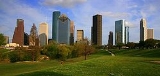
Westchase, and Greenspoint. If these business districts were combined, they would form the third-largest downtown in the United States. The city's skyline has been ranked fourth-most impressive in the US when ranked primarily by height, being the country's third-tallest skyline and one of the top ten in the world; however, because it is spread over a few miles, most pictures of the city show only the main downtown area.
Climate
Houston's climate is classified as humid subtropical . The city has excessive ozone levels and is ranked among the most ozone-polluted cities in the United States. The average yearly precipitation level is approximately 48
inches . Spring
supercell thunderstorms sometimes bring
tornadoes to the area. Prevailing winds are from the south and southeast during most of the year, bringing heat from the deserts of
Mexico and moisture from the
Gulf of Mexico.
During the summer months, the daily high temperature peaks at 94 °F at the end of July with an average of 99 days per year above 90 °F . The air tends to feel still and the humidity results in a heat index higher than the actual temperature. To cope with the heat, people use
air conditioning in nearly every car and building in the city.
Afternoon rains are common and for most summer days, Houston meteorologists predict at least some chance of rain.
The hottest temperature ever recorded in Houston was 109 °F on September 4, 2000.
Winters in Houston are cool and temperate. While the average high in January, the coldest month, is 61 °F , Houston sees an average of 18 days per year of 32 °F or less. Snowfall is rare, and typically does not accumulate when it is seen. The last snowstorm to hit Houston was on December 24, 2004—the city's first recorded snowfall on Christmas Eve. The coldest temperature ever recorded in Houston was 5 °F on January 23, 1940.
Government and politics
Founded in 1836 and incorporated in 1837, Houston is one of the fastest growing major cities in the United States and the largest without strict
zoning laws. The city is the county seat of
Harris County. A portion of southwest Houston extends into
Fort Bend County and a small portion in the northeast extends into
Montgomery County.
The city of Houston has a strong mayor-council government. The City's elected officials, serving concurrent two year terms, are: the mayor, the city controller and 14 members of the city council.
Under the strong mayor-council government, the mayor serves as the executive officer of the city. As the city's chief administrator and official representative, the mayor is responsible for the general management of the city and for seeing that all laws and ordinances are enforced.
As of 2006, the mayor of Houston is Bill White, who is serving his second term. City council members are elected from nine districts in the city, along with five at-large positions. At-large council members represent the entire city. The current city council lineup was based on a U.S. Justice Department mandate which took effect in 1979. Houston is a home rule city and all municipal elections in the state of Texas are nonpartisan.
Many local lawmakers have been impacted by the city's term limits. Several former city officials—Anthony Hall, Rodney Ellis,
Sheila Jackson Lee, Sylvia Garcia, Martha Wong, Chris Bell, and Annise Parker—had to run for another elected position once their term expired.
Former mayor
Lee P. Brown denounced the term limits, saying they prevented incumbents from gaining enough experience in city government. A proposal to double the current two-year term of office has been debated—as of 2005, several candidates for the city council have brought up the issue of whether term limits should be amended or eliminated.
Some elected officials from the Greater Houston area within the
Texas Legislature—primarily
Garnet Coleman and Sylvester Turner—have also spoken against term limits.
Houston is best considered to be a politically divided city whose balance of power often sways between Republicans and Democrats. The heavily affluent western portions of Houston, such as River Oaks and the Spring Branch/Memorial area, consistently vote Republican, while many of the neighborhoods to the north, east and south of downtown Houston are dominated by black and Hispanic populations and are heavily Democratic. The
Kingwood and
Clear Lake City master-planned communities in the northeast and southeast portions of the city, respectively, are heavily Republican. Houston's suburbs, especially in the western and northern areas of
Harris County and in
Fort Bend and
Montgomery counties, are heavily Republican.
According to the 2005 Houston Area Survey, 67 percent of non-Hispanic whites in the city are declared or favor Republicans while 88 percent of non-Hispanic blacks in the city are declared or favor Democrats. About 58 percent Hispanics in the city are declared or favor Democrats. In 2005, 54 percent of Houston area residents oppose abortion and 49 percent believe "homosexuality is morally wrong."
In presidential elections, Democrats tend to have the edge, with Democratic candidate
John Kerry having won the city of Houston in 2004, while
George W. Bush carried Harris County and the other surrounding counties in the
Houston area. Bush's victory in Harris County can largely be attributed to unincorporated areas in the northern and western portions of the county, such as the Cypress-Fairbanks area.
Economy
Houston is second to New York City in Fortune 500 headquarters. Among the 10 most populous metro areas, Houston ranked second in employment growth rate and fourth in nominal employment growth. In 2006, the Houston metropolitan area ranked first in Texas and third in the U.S. within the category of "Best Places for Business and Careers" by
Forbes.
Houston's energy industry is a world powerhouse , but biomedical research, aeronautics, and the ship channel are also large parts of the city's
industrial base. The area is also the world's leading center for building
oilfield equipment. Much of Houston's success as a petrochemical complex is due to its busy man-made ship channel, the
Port of Houston. The port ranks first in the country in international commerce and is the sixth-largest port in the world. Unlike most places, where high gas prices are seen as harmful to the economy, they are generally seen as beneficial for Houston as many are employed in the energy industry.
Historically, Houston has had several growth spurts related to the oil industry. The discovery of oil near Houston in 1901 led to its first growth spurt—by the 1920s, Houston had grown to almost 140,000 people. The city's burgeoning aerospace industry heralded its second growth spurt, which solidified with the
1973 oil crisis. Demand on Texas oil increased, and many people from the northeast moved to Houston to profit from the trade. When the embargo was lifted, the growth mostly stopped.
The Houston–Sugar Land–Baytown MSA's Gross Area Product in 2005 was $308.7 billion, up 5.4 percent from 2004 in constant dollars—slightly larger than
Austria's Gross Domestic Product . Only 28 nations other than the United States have a GDP exceeding Houston's GAP.
Mining, which in Houston is almost entirely oil and gas exploration and production, accounts for 11 percent of Houston's GAP—down from 21 percent as recently as 1985. The reduced role of oil and gas in Houston's GAP reflects the rapid growth of other sectors—such as engineering services, health services, and manufacturing.
Forty foreign governments maintain trade and commercial offices here and the city has 23 active foreign chambers of commerce and trade associations. Twenty foreign banks representing 10 nations operate in Houston and provide financial assistance to the international community.
Demographics
City of Houston Past censuses |
| Year | Population | Rank |
|---|
| 1850 | 2,396 |
| 1860 | 4,845 |
| 1870 | 9,332 |
| 1880 | 16,513 |
| 1890 | 27,557 |
| 1900 | 44,633 | 85 |
| 1910 | 78,800 | 68 |
| 1920 | 138,276 | 45 |
| 1930 | 292,352 | 26 |
| 1940 | 384,514 | 21 |
| 1950 | 596,163 | 14 |
| 1960 | 938,219 | 7 |
| 1970 | 1,232,802 | 6 |
| 1980 | 1,595,138 | 5 |
| 1990 | 1,630,553 | 4 |
| 2000 | 1,953,631 | 4 |
As of the
census of 2000, there were 1,953,631 people, 717,945 households, and 457,330 families residing in the city. The
population density was 3,371.7 people per square mile . There were 782,009 housing units at an average density of 1,349.6 per square mile . If the city of Houston were a U.S. state, it would rank 36th in population—its 2.01 million residents in 2004 would place it behind
Nevada and ahead of
New Mexico.
There were 717,945 households out of which 33.1 percent had children under the age of 18 living with them, 43.2 percent were married couples living together, 15.3 percent had a
female householder with no husband present, and 36.3 percent were non-families. Twenty-nine percent of all households were made up of individuals and 6.2 percent had someone living alone who was 65 years of age or older. The average household size was 2.67 and the average family size was 3.39.
In the city, the population was spread out with 27.5 percent under the age of 18, 11.2 percent from 18 to 24, 33.8 percent from 25 to 44, 19.1 percent from 45 to 64, and 8.4 percent who were 65 years of age or older. The median age was 31 years. For every 100 females there were 99.7 males. For every 100 females age 18 and over, there were 97.8 males.
The median income for a household in the city was $36,616, and the median income for a family was $40,443. Males had a median income of $32,084 versus $27,371 for females. The per capita income for the city was $20,101. Nineteen percent of the population and 16 percent of families were below the
poverty line. Out of the total population, 26.1 percent of those under the age of 18 and 14.3 percent of those 65 and older were living below the poverty line.
Race and ethnic origins
Houston is a diverse and an international city, in part because of its many academic institutions and strong biomedical, energy, manufacturing and aerospace industries. According to the U.S. Census 2000, the racial makeup of the city was 49.27 percent
White, 25.31 percent
Black or
African American, 0.44 percent Native American, 5.31 percent Asian, 0.06 percent Pacific Islander, 16.46 percent from
other races, and 3.15 percent from two or more races. Thirty-seven percent of the population was
Hispanic or Latino of any race.
The Hispanic population in Houston is increasing as more immigrants from
Latin American countries—primarily from Mexico—look for work in Houston. The city has the third-largest Hispanic population in the United States. It is estimated that about 400,000 immigrants reside in the Houston area illegally. This influx of immigrants is partially responsible for Houston having a population younger than the national average.
Houston also has large populations of immigrants from
Asia—most notably
China,
Vietnam, the
Philippines,
Taiwan,
South Korea,
Japan,
India, and
Pakistan. In addition, the city has the largest
Vietnamese American population in Texas and third-largest in the United States.
Crime
Houston recorded 336 murders in 2005, in comparison to 272 in 2004. According to the
Houston Police Department, murders in Houston peaked at 702 back in 1981. Despite the rise in homicides of 23.5 percent, overall crime in the city dropped by 2 percent in 2005 compared to 2004. Most of the homicides that occurred in the last quarter of 2005 occurred in the city's apartment complexes—primarily in the southwest and north-central areas of Houston.
Houston is, as of 2006, going through a spike in crime due in part to an influx of people from
New Orleans into the city following
Hurricane Katrina. These hurricane victims seeking refuge are believed to have been involved in nearly 17 percent of all homicides. Houston's murder rate increased 70 percent in November and December of 2005 compared to 2004's levels. At least 35 percent of the city's December 2005 increase in homicides—five of 14 over last year’s level—have been directly attributed to the presence of hurricane victims from New Orleans.
Culture
Officially, Houston is nicknamed the
"Space City" as it is home to
NASA's
Lyndon B. Johnson Space Center, where
Mission Control Center is located. Because of this, "Houston" was the first word spoken on the
moon. Many locals, however, prefer to call it the
"Bayou City." Other nicknames include
"H-Town," "Clutch City," and
"Magnolia City".
About 90 languages are frequently spoken in the Houston area. Some neighborhoods with high populations of Vietnamese and Chinese residents have
Chinese and
Vietnamese street signs in addition to English ones. Houston has two
Chinatowns—the original located in Downtown and the more recent one developed is along Bellaire Boulevard in the southwest area of the city. The city also has a
Little Saigon in
Midtown and Vietnamese businesses located in the southwest Houston Chinatown.
There are many popular events held in the city celebrating cultures of Houstonians. The largest and longest running is the annual
Houston Livestock Show and Rodeo that is held over 20 days from late February through early March. The event begins with trail rides that originate from several points throughout the state, all of which convene at
Reliant Park for a barbeque cook-off. The rodeo includes typical rodeo events, as well as concert performances from major artists and carnival rides. Another large celebration is the annual night-time
Houston Pride Parade held at the end of June held along Westheimer Road in
Neartown—home to many 1950s-style restaurants, vintage shops, tattoo parlors, bars,
nightclubs,
coffeehouses, and gay entertainment. Other events held annually include the Houston Greek festival, Art Car Parade, and Houston International Festival.
Arts and theatre
Known for the vibrancy of its
visual and
performing arts, Houston's
Theater District is ranked second in the country in the number of theatre seats in a concentrated downtown area with 12,948 seats for live performances and 1,480 movie seats. The Theater District is located in the heart of downtown and is home to nine of Houston's
performing arts