

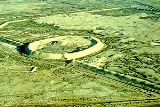
Merv

Encyclopedia
Merv formerly Achaemenid Satrap
y of Margiana, and later Alexandria and Antiochia in Margiana , was a major oasis
-city
in Central Asia
, on the historical Silk Road
, located near today's Mary
in Turkmenistan
. Several cities have existed on this site, which is significant for the interchange of culture and politics at a site of major strategic value. It is claimed that Merv was briefly the largest city in the world in the 12th century. The site of ancient Merv has been listed by UNESCO
as a World Heritage Site
. (See List of World Heritage Sites in Turkmenistan)
) in the geography of the Zend-Avesta (commentaries on the Avesta
). Under the Achaemenid dynasty Merv is mentioned as being a place of some importance: under the name of Margu it occurs as part of one of the satrap
ies in the Behistun inscriptions (ca 515 BC) of the Persian monarch Darius Hystaspis. The ancient city appears to have been re-founded by Cyrus the Great
(559 - 530 BC), but the Achaemenid levels are deeply covered by later strata at the site. (See also Bactria-Margiana Archaeological Complex
.)
Alexander the Great's visit to Merv is merely legendary, but the city was named Alexandria for a time. After Alexander's death, Merv became the chief city of the province of Margiana of the Seleucid, Parthia
n and Sassanid states. Merv was re-named Antiochia Margiana, by the Seleucid ruler Antiochus Soter, who rebuilt and expanded the city at the site presently known as Gyaur Gala (Turkish Gayur Kala) (Fortress).
After the Sassanid Ardashir I (220-240 AD) took Merv, the study of numismatics
picks up the thread: a long unbroken direct Sassanian rule of four centuries is documented from the unbroken series of coins originally minted at Merv. During this period Merv was home to practitioners of a wide range of different religions beside the official Zoroastrianism
of the Sassanids, including many Buddhists
, Manichaeans
, and East Syrian Christians. Between the 6th (553) and 11th centuries AD, Merv was the seat of an East Syrian
metropolitan province
.
, and became the capital of the Umayyad
province of Khorasan
. In 671, Ziyad ibn Abi Sufyan
sent 50,000 Arab troops to Merv as a colony. This colony retained its native Kufan sympathies and became the nucleus of Khurasan. Using this city as their base, the Arabs, led by Qutayba ibn Muslim, brought under subjection large parts of Central Asia, including Balkh
, Bokhara
, Fergana
and Kashgar
ia, and penetrated into China
as far as the province of Gansu
early in the 8th century. Merv, and Khorasan
in general was to become one of the first parts of the Persian
-speaking world to become majority-Muslim
. Arab immigration to the area was substantial. A Chinese captured at Talas, Du Huan
, was brought to Baghdad
and toured the caliphate. He observed that in Merv, Khurasan
, Arabs and Persians lived in mixed concentrations.
Merv reached renewed importance in February of 748 when the Iranian general Abu Muslim
(d. 755) declared a new Abbasid dynasty at Merv, expanding and re-founding the city, and, in the name of the Abbasid
line, used the city as a base of rebellion against the Umayyad
caliphate. After the Abbasids were established in Baghdad
Abu Muslim continued to rule Merv as a semi-independent prince until his eventual assassination. Indeed, Merv was the center of Abbasid
partisanship for the duration of the Abbasid revolution, and later on became a consistent source of political support for the Abbasid rulers in Baghdad
, and the governorship of Khurasan at Merv was considered one of the most important political figures of the Caliphate
. The influential Barmakid family, for example, was based in Merv and played an important part in transferring Greek knowledge (established in Merv since the days of the Seleucids and Greco-Bactrians) into the Arab world.
Throughout the Abbasid era, Merv remained the capital and most important city of Khurasan
. During this time, the Arab historian Al-Muqaddasi
called Merv “delightful, fine, elegant, brilliant, extensive, and pleasant.” Merv's architecture perhaps provided the inspiration for the Abbasid re-planning of Baghdad
. The city was notable for being a home for immigrants from the Arab lands as well as from Sogdia and elsewhere in Central Asia (Herrmann 1999). Merv's importance to the Abbasids was highlighted in the period from 813 to 818 when the temporary residency of the caliph al-Ma'mun
effectively made Merv the capital of the Muslim world. Merv was also the center of a major 8th-century Neo-Mazdakite movement led by al-Muqanna
, the “Veiled Prophet”, who gained many followers by claiming to be an incarnation of God and heir to Abu Muslim; the Khurramiyya inspired by him persisted in Merv until the 12th century.
During this period Merv, like Samarkand
and Bukhara, was one of the great cities of Muslim scholarship; the celebrated historian Yaqut studied in its libraries. Merv produced a number of scholars in various branches of knowledge, such as Islamic law
, hadith
, history, and literature. Several scholars have the name Marwazi المروزي designating them as hailing from Merv, including the famous Ahmad Ibn Hanbal
. The city continued to have a substantial Christian community. In 1009 the Archbishop of Merv sent a letter to the Patriarch at Baghdad asking that the Keraits be allowed to fast less than other Nestorian Christians.
As the caliphate weakened, Arab rule in Merv was replaced by that of the Persian general Tahir b. al -Husayn and his Tahirid dynasty in 821. The Tahirids were in turn replaced in Merv by the Samanids and then the Ghaznavids.
moving from the steppes east of the Aral Sea
, peacefully took over Merv under the leadership of Toghril Beg - the Ghaznavid sultan Masud was extremely unpopular in the city. Togrul's brother Çagry stayed in Merv as the Seljuk domains grew to include the rest of Khurasan and Iran, and it subsequently became a favorite city of the Seljuk leadership. Alp Arslan
and his descendant Sultan Sanjar were both buried
at Merv.
It is during this period that Merv expanded to its greatest size – Arab and Persian geographers termed it “the mother of the world”, the “rendezvous of great and small”, the “chief city of Khurasan” and the capital of the eastern Islamic world. Written sources also attest to a large library and madrasa founded by Nizam al-Mulk
, as well as many other major cultural institutions. Perhaps most importantly, Merv was said to have a market that is “the best of the major cities of Iran and Khurasan” (Herrmann 1999). It is believed that Merv was the largest city in the world from 1145 to 1153, with a population of 200,000.http://geography.about.com/library/weekly/aa011201a.htm.
Sanjar's rule, marked by conflict with the Kara-Khitai and Khwarazmians, ended in 1153 when the Turkish Ghuzz
nomads from beyond the Amu Darya
pillaged the city. Subsequently Merv changed hands between the Khwarazmians of Khiva, the Ghuzz, and the Ghurids, and began to lose importance relative to Khurasan's other major city, Nishapur
.
, son of Genghis Khan
, chief of the Mongols
, on which occasion most of the inhabitants are said to have been butchered. The Persian historian Juvayni
, writing a generation after the destruction of Merv, wrote
Some historians believe that over one million people died in the aftermath of the city's capture, including hundreds of thousands of refugees from elsewhere, making it one of the most bloody captures of a city in world history.
Excavations revealed drastic rebuilding of the city's fortifications in the aftermath, but the prosperity of the city was over. The Mongol invasion was to spell the end for Merv and indeed other major centres for more than a century. In the early part of the 14th century, the town was made the seat of a Christian archbishopric of the Eastern Church. By 1380 Merv belonged to the empire of Timur
(Tamerlane).
, who five years later were expelled by Shah Ismail, the founder of the Safavid dynasty of Persia. It was in this period that a large dam (the 'Soltanbent') on the river Murghab
was restored by a Persian nobleman, and the settlement which grew up in the area thus irrigated became known as 'Baýramaly', by which name it is referred to in some 19th-century texts. Merv remained in the hands of Persia until 1787, when it was captured by the Emir of Bokhara. Seven years later, the Bukharans razed the city to the ground, broke down the dams, and converted the district into a waste. The entire population of the city and the surrounding area of about 100,000 were then deported in several stages to the Bukharan oasis. Being nearly all Persian-speaking Shi'as, they resisted assimilation into the Sunni population of Bukhara, although they spoke the same language. These Marvis survive today, and were listed as "Iran
is/Iranians" in Soviet censuses through the 1980s, and locate them in Samarkand
as well as Bukhara
and the area in between on the Zarafshan
river.
When Sir Alexander Burnes
traversed the country in 1832, Merv belonged to the Khanate of Khiva
. About this time, the Tekke Turkomans, then living on the Tejen River, were forced by the Persians to migrate northward. Khiva contested the advance of the Tekkes, but ultimately, about 1856, the latter became the sovereign power in the country, and remained so until the Russians
occupied the oasis in 1883. The arrival of Russians triggered the Panjdeh Incident
of the Great Game
between the British Empire
and Imperial Russia.
, and a German archaeologist, Hubert Schmidt.
Merv is currently the focus of the Ancient Merv Project (initially as the International Merv Project). From 1992 to 2000, a joint team of archaeologists from Turkmenistan and the UK have made remarkable discoveries. In 2001, a new collaboration was started between the Institute of Archaeology
, University College London
and the Turkmen authorities. This Ancient Merv Project is concerned with the complex conservation and management issues posed by this remarkable site, furthering our understanding of the site through archaeological research, and disseminating the results of the work to the widest possible audience.
take from Persian
"Gabr
Qala" ("Fortress of the Zoroastrians") occurred in the early Hellenistic era under the rule of the Seleucid king Antiochus I. The city was continuously inhabited under a series of Hellenistic rulers, by the Parthians, and subsequently under the Sassanids, who made it the capital of a satrapy. Gäwürgala was the capital of the Umayyad
province of Khurasan
and grew in importance as Khurasan became the most loyally Muslim part of the Iranian world during Islam's first two centuries.
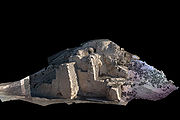 Gäwürgala's most visible remaining structures are its defensive installations. Three walls, one built atop the next, are in evidence. A Seleucid wall, graduated in the interior and straight on the exterior, forms a platform for the second, larger wall, built of mudbricks and stepped on the interior. The form of this wall is similar to other Hellenistic fortresses found in Anatolia
, though this unique for being made of mud-brick instead of stone. The third wall is possibly Sassanian and is built of larger bricks (Williams 2002). Surrounding the wall was a variety of pottery sherds, particularly Parthian ones. The size of these fortifications are evidence of Merv's importance during the pre-Islamic era; no pre-Islamic fortifications of comparable size have been found anywhere in the Garagum. Gäwürgala is also important for the vast amount of numismatic data that it has revealed; an unbroken series of Sassanian coins has been found there, hinting the extraordinary political stability of this period.
Even after the foundation of Soltangala by Abu Muslim at the start of the Abbasid dynasty, Gäwürgala persisted as a suburb of the larger Soltangala. In Gäwürgala are concentrated many Abbasid-era “industrial” buildings: pottery kilns, steel, iron and copper-working workshops and so on. A well-preserved pottery kiln has an intact vaulted arch support and a square firepit. Gyaur Gala seems to have been the craftsmens' quarters throughout the Abbasid and pre-Seljuk periods (Herrmann, “Seventh Season” 13) .
, the leader of the Abbasid
rebellion, who symbolized the beginning of the new Caliphate by commissioning monumental structures to the west of the Gäwürgala walls, in what then became Soltangala. The area was quickly walled and became the core of medieval Merv; centuries of prosperity which followed are attested to by the many Abbasid-era köshks discovered in and outside of Soltangala. Kushks (Persian
, Kushk, "pavilion", "kiosk"), which comprise the chief remains of Abbasid Merv, are a building type unique to Central Asia during this period. A kind of semi-fortified two-story palace whose corrugated walls give it a unique and striking appearance, köshks were the residences of Merv's elite. The second story of these structures comprised living quarters; the first story may have been used for storage. Parapets lined the roof, which was often used for living quarters as well. Merv's largest and best-preserved Abbasid köşk is the Greater Gyzgala (Turkmen, "maiden's fortress"), located just outside the Soltangala's western wall; this structure consisted of 17 rooms surrounding a central courtyard. The nearby Lesser Gyzgala had extraordinarily thick walls with deep corrugations, as well as multiple interior stairways leading to second-story living quarters. All of Merv's kushks are in precarious states of preservation (Herrmann 1999).
However, the most important of Soltangala's surviving buildings are Seljuk constructions. In the 11th century CE, the nomadic Oghuz Turks, formerly vassals of the Khwarazmshah in the northern steppes, began to move southward under the leadership of the Seljuk clan and its ruler Togrul Beg. Togrul's conquest of Merv in 1037 revitalized the city; under his descendants, especially Sanjar, who made it his residence, Merv found itself at the center of a large multicultural empire.
Evidence of this prosperity is found throughout the Soltangala. Many of these are concentrated in Soltangala's citadel, the Shahryar Ark (Persian, "the Sovereign's citadel") of the , located on its east side. In the center of the Sharhryar Ark is located the Seljuk palace probably built by Sanjar. The surviving mud brick walls lead to the conclusion that this palace, relatively small, was composed of tall single-story rooms surrounding a central court along with four axial iwan
s at the entrance to each side (Ettinghausen 276). Low areas nearby seem to indicate a large garden which included an artificial lake; similar gardens were found in other Central Asian palaces (Williams 2002). Unfortunately, any remnants of interior or exterior decoration have been lost due to erosion or theft.
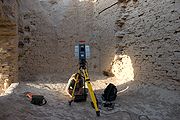
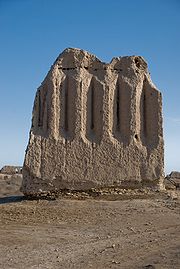 Another notable Seljuk structure within the Shahryar Ark is the kepderihana (from Persian
, "Kaftar Khana, or “pigeon house”, i.e., the columbarium
). This mysterious building, among the best-preserved in the whole Merv oasis, comprises one long and narrow windowless room with many tiers of niches across the walls. It is believed by some [sources] that the kepter khana (there are more elsewhere in Merv and Central Asia) was indeed a pigeon roost used to raise pigeons, in order to collect their dung which is used in growing the melons for which Merv was famous. Others, just as justifiably (Herrmann 1999), see the kepderihanas as libraries or treasuries, due to their location in high status areas next to important structures.
The best-preserved of all the structures in Merv is the 12th-century mausoleum
of Sultan Sanjar, also in Sultan Gala. It is the largest of Seljuk mausoleums and is also the first dated mosque-mausoleum complex, a form which was later to become common. It is square, 27 meters per side, with two entrances on opposite sides; a large central dome supported by an octagonal system of ribs and arches covers the interior (Ettinghausen 270). The dome's exterior was turquoise, and its height made it quite imposing; it was said that approaching caravans could see the mausoleum while still a day's march from the city. The mausoleum's decoration, in typical early Seljuk style, was conservative, with interior stucco work and geometric brick decoration, now mainly lost, on the outside (Ettinghausen 271). With the exception of the exterior decoration, the mausoleum is largely intact, and remains, just as is in the 12th century, Merv's main tourist attraction.
A final set of Seljuk
remains are the walls of the Soltangala. These fortifications, which in large part still remain, began as 8 to 9 meter high mud brick structures, inside of which were chambers for defenders to shoot arrows from. There were horseshoe-shaped towers every 15 to 35 meters. These walls, however, did not prove to be effective because they were not of adequate thickness to withstand catapults and other artillery. By the mid-12th century, the galleries were filled in, and the wall was greatly strengthened. A secondary, smaller wall was built in front of the Soltangala's main wall, and finally the medieval city's suburbs – known today as Isgendergala – were enclosed by a 5 meter thick wall. The three walls sufficed to hold off the Mongol army for at least one of its offensives, before ultimately succumbing in 1221 (Herrmann 2000).
Many ceramics have also been recovered from the Abbasid and Seljuk eras, primarily from Gäwürgala, the city walls of Soltangala, and the Shahryar Ark. The Gäwürgala ware was primarily late Abbasid
, and it consisted primarily of red slip-painted bowls with geometric designs. The pottery recovered from the Sultan Gala walls is dominated by 11th–12th-century color-splashed yellow and green pottery, similar to contemporary styles common in Nishapur
(Herrmann 2000). Turquoise and black bowls were discovered in the Shahryar Ark palace, as well as an interesting deposit of Mongol-style pottery perhaps related to the city's unsuccessful re-foundation under the Il-khans. Also from this era is a ceramic mask used for decorating walls found among the ruins of what is believed – not without controversy – to be a Mongol-built Buddhist temple in the southern suburbs of Sultan Gala (Herrmann 1999).
, on the southern edge of the Karakum Desert
, at 37°30’N and 62°E, about 230 miles (370.1 km) north of Herat
, and 280 miles (450.6 km) south of Khiva
. Its area is about 1900 square miles (4,921 km²). The great chain of mountains which, under the names of Paropamisade and Hindu Kush
, extends from the Caspian Sea
to the Pamir Mountains
is interrupted some 180 miles (289.7 km) south of Merv. Through or near this gap flow northwards in parallel courses the Tejen and Murgab rivers, until they lose themselves in the Karakum Desert. Thus they make Merv a sort of watch tower over the entrance into Afghanistan on the north-west and at the same time create a stepping-stone or étape between north-east Persia
and the states of Bokhara
and Samarkand
.
Merv is advantageously situated in the inland delta of the Murghab River, which flows from its source in the Hindu Kush northwards through the Garagum desert. The Murghab delta region, known to the Greeks as Margiana, gives Merv two distinct advantages: first, it provides an easy southeast-northwest route from the Afghan highlands towards the lowlands of Karakum, the Amu Darya
valley and Khwarezm
. Second, the Murgab delta, being a large well-watered zone in the midst of the dry Karakum, serves as a natural stopping-point for the routes from northwest Iran towards Transoxiana
– the Silk Road
s. The delta, and thus Merv, lies at the junction of these two important routes: the northwest-southeast route to Herat
and Balkh
(and thus to the Indus and beyond) and the southwest-northeast route from Tus and Nishapur
to Bukhara and Samarkand.
of the Teke tribe and Tajiks. Other minorities include the Beluch
/Baluch and the Brahui
.
was being produced, confirming in detail contemporary Islamic reports: a major achievement in the history of technology.
Carpet
s from the region of Merv are sometimes considered superior to the Persian. They also make felts and a rough cloth of sheep's wool.
, Afghanistan
Nishapur
, Iran
Bukhara
, Uzbekistan
Samarkand
, Uzbekistan
Satrap
Satrap was the name given to the governors of the provinces of the ancient Median and Achaemenid Empires and in several of their successors, such as the Sassanid Empire and the Hellenistic empires....
y of Margiana, and later Alexandria and Antiochia in Margiana , was a major oasis
Oasis
In geography, an oasis or cienega is an isolated area of vegetation in a desert, typically surrounding a spring or similar water source...
-city
City
A city is a relatively large and permanent settlement. Although there is no agreement on how a city is distinguished from a town within general English language meanings, many cities have a particular administrative, legal, or historical status based on local law.For example, in the U.S...
in Central Asia
Central Asia
Central Asia is a core region of the Asian continent from the Caspian Sea in the west, China in the east, Afghanistan in the south, and Russia in the north...
, on the historical Silk Road
Silk Road
The Silk Road or Silk Route refers to a historical network of interlinking trade routes across the Afro-Eurasian landmass that connected East, South, and Western Asia with the Mediterranean and European world, as well as parts of North and East Africa...
, located near today's Mary
Mary, Turkmenistan
Mary is the capital city of Mary Province in Turkmenistan. Former names include Merv, Meru and Margiana. It is located at . The city is an oasis in the Karakum Desert, located on the Murghab river. In 2009, Mary had a population of 123,000 , up from 92,000 in the 1989 census.-History:The ancient...
in Turkmenistan
Turkmenistan
Turkmenistan , formerly also known as Turkmenia is one of the Turkic states in Central Asia. Until 1991, it was a constituent republic of the Soviet Union, the Turkmen Soviet Socialist Republic . Turkmenistan is one of the six independent Turkic states...
. Several cities have existed on this site, which is significant for the interchange of culture and politics at a site of major strategic value. It is claimed that Merv was briefly the largest city in the world in the 12th century. The site of ancient Merv has been listed by UNESCO
UNESCO
The United Nations Educational, Scientific and Cultural Organization is a specialized agency of the United Nations...
as a World Heritage Site
World Heritage Site
A UNESCO World Heritage Site is a place that is listed by the UNESCO as of special cultural or physical significance...
. (See List of World Heritage Sites in Turkmenistan)
History
Merv's origins are prehistoric: archaeological surveys have revealed many survivals of village life as far back as the 3rd millennium BC. Under the name of Mouru, Merv is mentioned with Bakhdi (BalkhBalkh
Balkh , was an ancient city and centre of Zoroastrianism in what is now northern Afghanistan. Today it is a small town in the province of Balkh, about 20 kilometers northwest of the provincial capital, Mazar-e Sharif, and some south of the Amu Darya. It was one of the major cities of Khorasan...
) in the geography of the Zend-Avesta (commentaries on the Avesta
Avesta
The Avesta is the primary collection of sacred texts of Zoroastrianism, composed in the Avestan language.-Early transmission:The texts of the Avesta — which are all in the Avestan language — were composed over the course of several hundred years. The most important portion, the Gathas,...
). Under the Achaemenid dynasty Merv is mentioned as being a place of some importance: under the name of Margu it occurs as part of one of the satrap
Satrap
Satrap was the name given to the governors of the provinces of the ancient Median and Achaemenid Empires and in several of their successors, such as the Sassanid Empire and the Hellenistic empires....
ies in the Behistun inscriptions (ca 515 BC) of the Persian monarch Darius Hystaspis. The ancient city appears to have been re-founded by Cyrus the Great
Cyrus the Great
Cyrus II of Persia , commonly known as Cyrus the Great, also known as Cyrus the Elder, was the founder of the Achaemenid Empire. Under his rule, the empire embraced all the previous civilized states of the ancient Near East, expanded vastly and eventually conquered most of Southwest Asia and much...
(559 - 530 BC), but the Achaemenid levels are deeply covered by later strata at the site. (See also Bactria-Margiana Archaeological Complex
Bactria-Margiana Archaeological Complex
The Bactria–Margiana Archaeological Complex is the modern archaeological designation for a Bronze Age culture of Central Asia, dated to ca. 2300–1700 BC, located in present day Turkmenistan, northern Afghanistan and northeastern Iran, southern Uzbekistan and western Tajikistan, centered on...
.)
Alexander the Great's visit to Merv is merely legendary, but the city was named Alexandria for a time. After Alexander's death, Merv became the chief city of the province of Margiana of the Seleucid, Parthia
Parthia
Parthia is a region of north-eastern Iran, best known for having been the political and cultural base of the Arsacid dynasty, rulers of the Parthian Empire....
n and Sassanid states. Merv was re-named Antiochia Margiana, by the Seleucid ruler Antiochus Soter, who rebuilt and expanded the city at the site presently known as Gyaur Gala (Turkish Gayur Kala) (Fortress).
After the Sassanid Ardashir I (220-240 AD) took Merv, the study of numismatics
Numismatics
Numismatics is the study or collection of currency, including coins, tokens, paper money, and related objects. While numismatists are often characterized as students or collectors of coins, the discipline also includes the broader study of money and other payment media used to resolve debts and the...
picks up the thread: a long unbroken direct Sassanian rule of four centuries is documented from the unbroken series of coins originally minted at Merv. During this period Merv was home to practitioners of a wide range of different religions beside the official Zoroastrianism
Zoroastrianism
Zoroastrianism is a religion and philosophy based on the teachings of prophet Zoroaster and was formerly among the world's largest religions. It was probably founded some time before the 6th century BCE in Greater Iran.In Zoroastrianism, the Creator Ahura Mazda is all good, and no evil...
of the Sassanids, including many Buddhists
Buddhism
Buddhism is a religion and philosophy encompassing a variety of traditions, beliefs and practices, largely based on teachings attributed to Siddhartha Gautama, commonly known as the Buddha . The Buddha lived and taught in the northeastern Indian subcontinent some time between the 6th and 4th...
, Manichaeans
Manichaeism
Manichaeism in Modern Persian Āyin e Māni; ) was one of the major Iranian Gnostic religions, originating in Sassanid Persia.Although most of the original writings of the founding prophet Mani have been lost, numerous translations and fragmentary texts have survived...
, and East Syrian Christians. Between the 6th (553) and 11th centuries AD, Merv was the seat of an East Syrian
Nestorianism
Nestorianism is a Christological doctrine advanced by Nestorius, Patriarch of Constantinople from 428–431. The doctrine, which was informed by Nestorius's studies under Theodore of Mopsuestia at the School of Antioch, emphasizes the disunion between the human and divine natures of Jesus...
metropolitan province
Merv (East Syrian Ecclesiastical Province)
Merv was a metropolitan province of the Church of the East between the fifth and eleventh centuries, with several known suffragan dioceses.- Background :...
.
Arab occupation and influence
Sassanian rule came to an end when the last Sassanian ruler, Yazdegerd III (632-651) was murdered not far from the city and the Sassanian military governor surrendered to the approaching Arab army. The city was occupied by lieutenants of the caliph UmarUmar
`Umar ibn al-Khattāb c. 2 November , was a leading companion and adviser to the Islamic prophet Muhammad who later became the second Muslim Caliph after Muhammad's death....
, and became the capital of the Umayyad
Umayyad
The Umayyad Caliphate was the second of the four major Arab caliphates established after the death of Muhammad. It was ruled by the Umayyad dynasty, whose name derives from Umayya ibn Abd Shams, the great-grandfather of the first Umayyad caliph. Although the Umayyad family originally came from the...
province of Khorasan
Greater Khorasan
Greater Khorasan or Ancient Khorasan is a historical region of Greater Iran mentioned in sources from Sassanid and Islamic eras which "frequently" had a denotation wider than current three provinces of Khorasan in Iran...
. In 671, Ziyad ibn Abi Sufyan
Ziyad ibn Abi Sufyan
Ziyad ibn Abeeh where 'Abeeh' means 'his father' since his ancestry is disputed. was a Muslim general and administrator and a member of the clan of the Umayyads.-Biography:...
sent 50,000 Arab troops to Merv as a colony. This colony retained its native Kufan sympathies and became the nucleus of Khurasan. Using this city as their base, the Arabs, led by Qutayba ibn Muslim, brought under subjection large parts of Central Asia, including Balkh
Balkh
Balkh , was an ancient city and centre of Zoroastrianism in what is now northern Afghanistan. Today it is a small town in the province of Balkh, about 20 kilometers northwest of the provincial capital, Mazar-e Sharif, and some south of the Amu Darya. It was one of the major cities of Khorasan...
, Bokhara
Bukhara
Bukhara , from the Soghdian βuxārak , is the capital of the Bukhara Province of Uzbekistan. The nation's fifth-largest city, it has a population of 263,400 . The region around Bukhara has been inhabited for at least five millennia, and the city has existed for half that time...
, Fergana
Fergana
Fergana is a city , the capital of Fergana Province in eastern Uzbekistan, at the southern edge of the Fergana Valley in southern Central Asia, cutting across the borders of Kyrgyzstan, Tajikistan, and Uzbekistan...
and Kashgar
Kashgar
Kashgar or Kashi is an oasis city with approximately 350,000 residents in the western part of the Xinjiang Uyghur Autonomous Region of the People's Republic of China. Kashgar is the administrative centre of Kashgar Prefecture which has an area of 162,000 km² and a population of approximately...
ia, and penetrated into China
China
Chinese civilization may refer to:* China for more general discussion of the country.* Chinese culture* Greater China, the transnational community of ethnic Chinese.* History of China* Sinosphere, the area historically affected by Chinese culture...
as far as the province of Gansu
Gansu
' is a province located in the northwest of the People's Republic of China.It lies between the Tibetan and Huangtu plateaus, and borders Mongolia, Inner Mongolia, and Ningxia to the north, Xinjiang and Qinghai to the west, Sichuan to the south, and Shaanxi to the east...
early in the 8th century. Merv, and Khorasan
Greater Khorasan
Greater Khorasan or Ancient Khorasan is a historical region of Greater Iran mentioned in sources from Sassanid and Islamic eras which "frequently" had a denotation wider than current three provinces of Khorasan in Iran...
in general was to become one of the first parts of the Persian
Persian language
Persian is an Iranian language within the Indo-Iranian branch of the Indo-European languages. It is primarily spoken in Iran, Afghanistan, Tajikistan and countries which historically came under Persian influence...
-speaking world to become majority-Muslim
Muslim
A Muslim, also spelled Moslem, is an adherent of Islam, a monotheistic, Abrahamic religion based on the Quran, which Muslims consider the verbatim word of God as revealed to prophet Muhammad. "Muslim" is the Arabic term for "submitter" .Muslims believe that God is one and incomparable...
. Arab immigration to the area was substantial. A Chinese captured at Talas, Du Huan
Du Huan
Du Huan was a Chinese travel writer born in Chang'an during the Tang Dynasty. He was one of a few Chinese captured in the Battle of Talas along with artisans Fan Shu and Liu Ci and fabric weavers Le Wei and Lu Li, as mentioned in his writings. After a long journey through Arab countries, he...
, was brought to Baghdad
Baghdad
Baghdad is the capital of Iraq, as well as the coterminous Baghdad Governorate. The population of Baghdad in 2011 is approximately 7,216,040...
and toured the caliphate. He observed that in Merv, Khurasan
Greater Khorasan
Greater Khorasan or Ancient Khorasan is a historical region of Greater Iran mentioned in sources from Sassanid and Islamic eras which "frequently" had a denotation wider than current three provinces of Khorasan in Iran...
, Arabs and Persians lived in mixed concentrations.
Merv reached renewed importance in February of 748 when the Iranian general Abu Muslim
Abu Muslim
- External links :* *...
(d. 755) declared a new Abbasid dynasty at Merv, expanding and re-founding the city, and, in the name of the Abbasid
Abbasid
The Abbasid Caliphate or, more simply, the Abbasids , was the third of the Islamic caliphates. It was ruled by the Abbasid dynasty of caliphs, who built their capital in Baghdad after overthrowing the Umayyad caliphate from all but the al-Andalus region....
line, used the city as a base of rebellion against the Umayyad
Umayyad
The Umayyad Caliphate was the second of the four major Arab caliphates established after the death of Muhammad. It was ruled by the Umayyad dynasty, whose name derives from Umayya ibn Abd Shams, the great-grandfather of the first Umayyad caliph. Although the Umayyad family originally came from the...
caliphate. After the Abbasids were established in Baghdad
Baghdad
Baghdad is the capital of Iraq, as well as the coterminous Baghdad Governorate. The population of Baghdad in 2011 is approximately 7,216,040...
Abu Muslim continued to rule Merv as a semi-independent prince until his eventual assassination. Indeed, Merv was the center of Abbasid
Abbasid
The Abbasid Caliphate or, more simply, the Abbasids , was the third of the Islamic caliphates. It was ruled by the Abbasid dynasty of caliphs, who built their capital in Baghdad after overthrowing the Umayyad caliphate from all but the al-Andalus region....
partisanship for the duration of the Abbasid revolution, and later on became a consistent source of political support for the Abbasid rulers in Baghdad
Baghdad
Baghdad is the capital of Iraq, as well as the coterminous Baghdad Governorate. The population of Baghdad in 2011 is approximately 7,216,040...
, and the governorship of Khurasan at Merv was considered one of the most important political figures of the Caliphate
Caliphate
The term caliphate, "dominion of a caliph " , refers to the first system of government established in Islam and represented the political unity of the Muslim Ummah...
. The influential Barmakid family, for example, was based in Merv and played an important part in transferring Greek knowledge (established in Merv since the days of the Seleucids and Greco-Bactrians) into the Arab world.
Throughout the Abbasid era, Merv remained the capital and most important city of Khurasan
Greater Khorasan
Greater Khorasan or Ancient Khorasan is a historical region of Greater Iran mentioned in sources from Sassanid and Islamic eras which "frequently" had a denotation wider than current three provinces of Khorasan in Iran...
. During this time, the Arab historian Al-Muqaddasi
Al-Muqaddasi
Muhammad ibn Ahmad Shams al-Din Al-Muqaddasi , also transliterated as Al-Maqdisi and el-Mukaddasi, was a medieval Arab geographer, author of Ahsan at-Taqasim fi Ma`rifat il-Aqalim .-Biography:Al-Muqaddasi, "the Hierosolomite" was born in Jerusalem in 946 AD...
called Merv “delightful, fine, elegant, brilliant, extensive, and pleasant.” Merv's architecture perhaps provided the inspiration for the Abbasid re-planning of Baghdad
Baghdad
Baghdad is the capital of Iraq, as well as the coterminous Baghdad Governorate. The population of Baghdad in 2011 is approximately 7,216,040...
. The city was notable for being a home for immigrants from the Arab lands as well as from Sogdia and elsewhere in Central Asia (Herrmann 1999). Merv's importance to the Abbasids was highlighted in the period from 813 to 818 when the temporary residency of the caliph al-Ma'mun
Al-Ma'mun
Abū Jaʿfar Abdullāh al-Māʾmūn ibn Harūn was an Abbasid caliph who reigned from 813 until his death in 833...
effectively made Merv the capital of the Muslim world. Merv was also the center of a major 8th-century Neo-Mazdakite movement led by al-Muqanna
Al-Muqanna
Al-Muqanna‘ was a Persian man who claimed to be a prophet and is viewed as a heretic by mainstream Muslims.- Biography : Al-Muqanna‘ was an ethnic Persian from Merv named Hashim ibn Hakim, originally a clothes pleater. He became a commander for Abū Muslim of Khorasan...
, the “Veiled Prophet”, who gained many followers by claiming to be an incarnation of God and heir to Abu Muslim; the Khurramiyya inspired by him persisted in Merv until the 12th century.
During this period Merv, like Samarkand
Samarkand
Although a Persian-speaking region, it was not united politically with Iran most of the times between the disintegration of the Seleucid Empire and the Arab conquest . In the 6th century it was within the domain of the Turkic kingdom of the Göktürks.At the start of the 8th century Samarkand came...
and Bukhara, was one of the great cities of Muslim scholarship; the celebrated historian Yaqut studied in its libraries. Merv produced a number of scholars in various branches of knowledge, such as Islamic law
Sharia
Sharia law, is the moral code and religious law of Islam. Sharia is derived from two primary sources of Islamic law: the precepts set forth in the Quran, and the example set by the Islamic prophet Muhammad in the Sunnah. Fiqh jurisprudence interprets and extends the application of sharia to...
, hadith
Hadith
The term Hadīth is used to denote a saying or an act or tacit approval or criticism ascribed either validly or invalidly to the Islamic prophet Muhammad....
, history, and literature. Several scholars have the name Marwazi المروزي designating them as hailing from Merv, including the famous Ahmad Ibn Hanbal
Ahmad ibn Hanbal
Ahmad bin Muhammad bin Hanbal Abu `Abd Allah al-Shaybani was an important Muslim scholar and theologian. He is considered the founder of the Hanbali school of fiqh...
. The city continued to have a substantial Christian community. In 1009 the Archbishop of Merv sent a letter to the Patriarch at Baghdad asking that the Keraits be allowed to fast less than other Nestorian Christians.
As the caliphate weakened, Arab rule in Merv was replaced by that of the Persian general Tahir b. al -Husayn and his Tahirid dynasty in 821. The Tahirids were in turn replaced in Merv by the Samanids and then the Ghaznavids.
Turks in Merv
In 1037, the Seljuks, a clan of Oghuz TurksOghuz Turks
The Turkomen also known as Oghuz Turks were a historical Turkic tribal confederation in Central Asia during the early medieval Turkic expansion....
moving from the steppes east of the Aral Sea
Aral Sea
The Aral Sea was a lake that lay between Kazakhstan in the north and Karakalpakstan, an autonomous region of Uzbekistan, in the south...
, peacefully took over Merv under the leadership of Toghril Beg - the Ghaznavid sultan Masud was extremely unpopular in the city. Togrul's brother Çagry stayed in Merv as the Seljuk domains grew to include the rest of Khurasan and Iran, and it subsequently became a favorite city of the Seljuk leadership. Alp Arslan
Alp Arslan
Alp Arslan was the third sultan of the Seljuq dynasty and great-grandson of Seljuk, the eponymous founder of the dynasty...
and his descendant Sultan Sanjar were both buried
Tomb of Ahmed Sanjar
Tomb of Ahmed Sanjar was built in Merv in 1157, following the death of Ahmed Sanjar, sultan of the Great Seljuk Empire. It is reported that his tomb was the site of pilgrimages.-Tomb:...
at Merv.
It is during this period that Merv expanded to its greatest size – Arab and Persian geographers termed it “the mother of the world”, the “rendezvous of great and small”, the “chief city of Khurasan” and the capital of the eastern Islamic world. Written sources also attest to a large library and madrasa founded by Nizam al-Mulk
Nizam al-Mulk
Abu Ali al-Hasan al-Tusi Nizam al-Mulk, better known as Khwaja Nizam al-Mulk Tusi ; born in 1018 – 14 October 1092) was a Persian scholar and vizier of the Seljuq Empire...
, as well as many other major cultural institutions. Perhaps most importantly, Merv was said to have a market that is “the best of the major cities of Iran and Khurasan” (Herrmann 1999). It is believed that Merv was the largest city in the world from 1145 to 1153, with a population of 200,000.http://geography.about.com/library/weekly/aa011201a.htm.
Sanjar's rule, marked by conflict with the Kara-Khitai and Khwarazmians, ended in 1153 when the Turkish Ghuzz
Oghuz Turks
The Turkomen also known as Oghuz Turks were a historical Turkic tribal confederation in Central Asia during the early medieval Turkic expansion....
nomads from beyond the Amu Darya
Amu Darya
The Amu Darya , also called Oxus and Amu River, is a major river in Central Asia. It is formed by the junction of the Vakhsh and Panj rivers...
pillaged the city. Subsequently Merv changed hands between the Khwarazmians of Khiva, the Ghuzz, and the Ghurids, and began to lose importance relative to Khurasan's other major city, Nishapur
Nishapur
Nishapur or Nishabur , is a city in the Razavi Khorasan province in northeastern Iran, situated in a fertile plain at the foot of the Binalud Mountains, near the regional capital of Mashhad...
.
Mongols in Merv
In 1221, Merv opened its gates to TuleTolui
Tolui, was the youngest son of Genghis Khan by his chief khatun Börte...
, son of Genghis Khan
Genghis Khan
Genghis Khan , born Temujin and occasionally known by his temple name Taizu , was the founder and Great Khan of the Mongol Empire, which became the largest contiguous empire in history after his death....
, chief of the Mongols
Mongols
Mongols ) are a Central-East Asian ethnic group that lives mainly in the countries of Mongolia, China, and Russia. In China, ethnic Mongols can be found mainly in the central north region of China such as Inner Mongolia...
, on which occasion most of the inhabitants are said to have been butchered. The Persian historian Juvayni
Ata al-Mulk Juvayni
Atâ-Malek Jovayni was a Persian historian who wrote an account of the Mongol Empire entitled Ta' rīkh-i jahān-gushā .He was born in Juvain, a city in Khorasan in northeastern Iran...
, writing a generation after the destruction of Merv, wrote
- “The Mongols ordered that, apart from four hundred artisans. .., the whole population, including the women and children, should be killed, and no one, whether woman or man, be spared. To each [Mongol soldier] was allotted the execution of three or four hundred Persians. So many had been killed by nightfall that the mountains became hillocks, and the plain was soaked with the blood of the mighty.”
Some historians believe that over one million people died in the aftermath of the city's capture, including hundreds of thousands of refugees from elsewhere, making it one of the most bloody captures of a city in world history.
Excavations revealed drastic rebuilding of the city's fortifications in the aftermath, but the prosperity of the city was over. The Mongol invasion was to spell the end for Merv and indeed other major centres for more than a century. In the early part of the 14th century, the town was made the seat of a Christian archbishopric of the Eastern Church. By 1380 Merv belonged to the empire of Timur
Timur
Timur , historically known as Tamerlane in English , was a 14th-century conqueror of West, South and Central Asia, and the founder of the Timurid dynasty in Central Asia, and great-great-grandfather of Babur, the founder of the Mughal Dynasty, which survived as the Mughal Empire in India until...
(Tamerlane).
Uzbeks in Merv
In 1505, the city was occupied by the UzbeksUzbeks
The Uzbeks are a Turkic ethnic group in Central Asia. They comprise the majority population of Uzbekistan, and large populations can also be found in Afghanistan, Tajikstan, Kyrgyzstan, Turkmenistan, Kazakhstan, Russia, Pakistan, Mongolia and the Xinjiang Uyghur Autonomous Region of China...
, who five years later were expelled by Shah Ismail, the founder of the Safavid dynasty of Persia. It was in this period that a large dam (the 'Soltanbent') on the river Murghab
Murgab River (Afghanistan)
The Morghāb River , also transliterated as Murgab from Russian Мургаб, is an 850 km long river in Central Asia...
was restored by a Persian nobleman, and the settlement which grew up in the area thus irrigated became known as 'Baýramaly', by which name it is referred to in some 19th-century texts. Merv remained in the hands of Persia until 1787, when it was captured by the Emir of Bokhara. Seven years later, the Bukharans razed the city to the ground, broke down the dams, and converted the district into a waste. The entire population of the city and the surrounding area of about 100,000 were then deported in several stages to the Bukharan oasis. Being nearly all Persian-speaking Shi'as, they resisted assimilation into the Sunni population of Bukhara, although they spoke the same language. These Marvis survive today, and were listed as "Iran
Iran
Iran , officially the Islamic Republic of Iran , is a country in Southern and Western Asia. The name "Iran" has been in use natively since the Sassanian era and came into use internationally in 1935, before which the country was known to the Western world as Persia...
is/Iranians" in Soviet censuses through the 1980s, and locate them in Samarkand
Samarkand
Although a Persian-speaking region, it was not united politically with Iran most of the times between the disintegration of the Seleucid Empire and the Arab conquest . In the 6th century it was within the domain of the Turkic kingdom of the Göktürks.At the start of the 8th century Samarkand came...
as well as Bukhara
Bukhara
Bukhara , from the Soghdian βuxārak , is the capital of the Bukhara Province of Uzbekistan. The nation's fifth-largest city, it has a population of 263,400 . The region around Bukhara has been inhabited for at least five millennia, and the city has existed for half that time...
and the area in between on the Zarafshan
Zarafshan
Zarafshan is a city of over 65,000 inhabitants in the center of Uzbekistan's Navoiy Province. Located in the Kyzylkum desert, it receives water from the Amudarya by a 220-km pipeline....
river.
When Sir Alexander Burnes
Alexander Burnes
Captain Sir Alexander Burnes was a Scottish traveller and explorer who took part in The Great Game. He was nicknamed Bokhara Burnes for his role in establishing contact with and exploring Bukhara, which made his name.-Early life:He was born in Montrose, Scotland, to the son of the local provost,...
traversed the country in 1832, Merv belonged to the Khanate of Khiva
Khanate of Khiva
The Khanate of Khiva was the name of a Uzbek state that existed in the historical region of Khwarezm from 1511 to 1920, except for a period of Persian occupation by Nadir Shah between 1740–1746. It was the patrilineal descendants of Shayban , the fifth son of Jochi and grandson of Genghis Khan...
. About this time, the Tekke Turkomans, then living on the Tejen River, were forced by the Persians to migrate northward. Khiva contested the advance of the Tekkes, but ultimately, about 1856, the latter became the sovereign power in the country, and remained so until the Russians
Russians
The Russian people are an East Slavic ethnic group native to Russia, speaking the Russian language and primarily living in Russia and neighboring countries....
occupied the oasis in 1883. The arrival of Russians triggered the Panjdeh Incident
Panjdeh Incident
The Panjdeh Incident or Panjdeh Scare was a battle that occurred in 1885 when Russian forces seized Afghan territory south of the Oxus River around an oasis at Panjdeh . The incident created a diplomatic crisis between Russia and Great Britain...
of the Great Game
The Great Game
The Great Game or Tournament of Shadows in Russia, were terms for the strategic rivalry and conflict between the British Empire and the Russian Empire for supremacy in Central Asia. The classic Great Game period is generally regarded as running approximately from the Russo-Persian Treaty of 1813...
between the British Empire
British Empire
The British Empire comprised the dominions, colonies, protectorates, mandates and other territories ruled or administered by the United Kingdom. It originated with the overseas colonies and trading posts established by England in the late 16th and early 17th centuries. At its height, it was the...
and Imperial Russia.
Remains
Some exploratory excavations at Merv were conducted in 1885 by the Russian general A.V. Komarov, the governor of the Transcaspian oblast, 1883–89; Komarov employed his Tsarist troops as excavators and published his collection of trophy artifacts and coins from the area in 1900. The first fully professional dig was directed by Valentin Alekseevich Zhukovsky of the Imperial Archaeological Commission, in 1890 and published in 1894. The American Carnegie Institute's excavations were under the direction of a geologist, Raphael PumpellyRaphael Pumpelly
Raphael Pumpelly was an American geologist and explorer.-Early life and ancestors:He was born on September 8, 1837 in Oswego, New York, into a family with deep New England roots that trace back to Thomas Welles , who arrived in Massachusetts in 1635 and was the only man in Connecticut's history to...
, and a German archaeologist, Hubert Schmidt.
Merv is currently the focus of the Ancient Merv Project (initially as the International Merv Project). From 1992 to 2000, a joint team of archaeologists from Turkmenistan and the UK have made remarkable discoveries. In 2001, a new collaboration was started between the Institute of Archaeology
Institute of Archaeology
The UCL Institute of Archaeology is an academic department of the Social & Historical Sciences Faculty of University College London , England. It is one of the largest departments of archaeology in the world, with over 80 members of academic staff and 500 students...
, University College London
University College London
University College London is a public research university located in London, United Kingdom and the oldest and largest constituent college of the federal University of London...
and the Turkmen authorities. This Ancient Merv Project is concerned with the complex conservation and management issues posed by this remarkable site, furthering our understanding of the site through archaeological research, and disseminating the results of the work to the widest possible audience.
Organization of remains
Merv consists of a few discrete walled cities very near to each other, each of which was constructed on uninhabited land by builders of different eras, used, and then abandoned and never rebuilt. Four walled cities correspond to the chief periods of Merv's importance: the oldest, Erkgala, corresponds to Achaemenid Merv, and is the smallest of the three. Gäwürgala, which surrounds Erkgala, comprises the Hellenistic and Sassanian metropolis and also served as an industrial suburb to the Abbasid/Seljuk city, Soltangala – by far the largest of the three. The smaller Timurid city was founded a short distance to the south and is now called Abdyllahangala. Various other ancient buildings are scattered between and around these four cities; all of the sites are preserved in the “Ancient Merv Archaeological Park” just north of the modern village of Baýramaly and thirty kilometers west of the large Soviet-built city of Mary (Herrmann 1993).Gäwürgala
The foundation of Gäwürgala (TurkmenTurkmen people
The Turkmen are a Turkic people located primarily in the Central Asian states of Turkmenistan, Afghanistan, and northeastern Iran. They speak the Turkmen language, which is classified as a part of the Western Oghuz branch of the Turkic languages family together with Turkish, Azerbaijani, Qashqai,...
take from Persian
Persian language
Persian is an Iranian language within the Indo-Iranian branch of the Indo-European languages. It is primarily spoken in Iran, Afghanistan, Tajikistan and countries which historically came under Persian influence...
"Gabr
Gabr
Gabr is a New Persian term originally used to denote a Zoroastrian.Historically, gabr was a technical term synonymous with mōg, "magus", denoting a follower of Zoroastrianism, and it is with this meaning that the term is attested in very early New Persian texts such as the Shahnameh...
Qala" ("Fortress of the Zoroastrians") occurred in the early Hellenistic era under the rule of the Seleucid king Antiochus I. The city was continuously inhabited under a series of Hellenistic rulers, by the Parthians, and subsequently under the Sassanids, who made it the capital of a satrapy. Gäwürgala was the capital of the Umayyad
Umayyad
The Umayyad Caliphate was the second of the four major Arab caliphates established after the death of Muhammad. It was ruled by the Umayyad dynasty, whose name derives from Umayya ibn Abd Shams, the great-grandfather of the first Umayyad caliph. Although the Umayyad family originally came from the...
province of Khurasan
Greater Khorasan
Greater Khorasan or Ancient Khorasan is a historical region of Greater Iran mentioned in sources from Sassanid and Islamic eras which "frequently" had a denotation wider than current three provinces of Khorasan in Iran...
and grew in importance as Khurasan became the most loyally Muslim part of the Iranian world during Islam's first two centuries.
Anatolia
Anatolia is a geographic and historical term denoting the westernmost protrusion of Asia, comprising the majority of the Republic of Turkey...
, though this unique for being made of mud-brick instead of stone. The third wall is possibly Sassanian and is built of larger bricks (Williams 2002). Surrounding the wall was a variety of pottery sherds, particularly Parthian ones. The size of these fortifications are evidence of Merv's importance during the pre-Islamic era; no pre-Islamic fortifications of comparable size have been found anywhere in the Garagum. Gäwürgala is also important for the vast amount of numismatic data that it has revealed; an unbroken series of Sassanian coins has been found there, hinting the extraordinary political stability of this period.
Even after the foundation of Soltangala by Abu Muslim at the start of the Abbasid dynasty, Gäwürgala persisted as a suburb of the larger Soltangala. In Gäwürgala are concentrated many Abbasid-era “industrial” buildings: pottery kilns, steel, iron and copper-working workshops and so on. A well-preserved pottery kiln has an intact vaulted arch support and a square firepit. Gyaur Gala seems to have been the craftsmens' quarters throughout the Abbasid and pre-Seljuk periods (Herrmann, “Seventh Season” 13) .
Soltangala
Soltangala (from Sultan Qala," the sultan's fortress) is by far the largest of Merv's cities. Textual sources (Herrmann 1999) establish that it was Abu MuslimAbu Muslim
- External links :* *...
, the leader of the Abbasid
Abbasid
The Abbasid Caliphate or, more simply, the Abbasids , was the third of the Islamic caliphates. It was ruled by the Abbasid dynasty of caliphs, who built their capital in Baghdad after overthrowing the Umayyad caliphate from all but the al-Andalus region....
rebellion, who symbolized the beginning of the new Caliphate by commissioning monumental structures to the west of the Gäwürgala walls, in what then became Soltangala. The area was quickly walled and became the core of medieval Merv; centuries of prosperity which followed are attested to by the many Abbasid-era köshks discovered in and outside of Soltangala. Kushks (Persian
Persian language
Persian is an Iranian language within the Indo-Iranian branch of the Indo-European languages. It is primarily spoken in Iran, Afghanistan, Tajikistan and countries which historically came under Persian influence...
, Kushk, "pavilion", "kiosk"), which comprise the chief remains of Abbasid Merv, are a building type unique to Central Asia during this period. A kind of semi-fortified two-story palace whose corrugated walls give it a unique and striking appearance, köshks were the residences of Merv's elite. The second story of these structures comprised living quarters; the first story may have been used for storage. Parapets lined the roof, which was often used for living quarters as well. Merv's largest and best-preserved Abbasid köşk is the Greater Gyzgala (Turkmen, "maiden's fortress"), located just outside the Soltangala's western wall; this structure consisted of 17 rooms surrounding a central courtyard. The nearby Lesser Gyzgala had extraordinarily thick walls with deep corrugations, as well as multiple interior stairways leading to second-story living quarters. All of Merv's kushks are in precarious states of preservation (Herrmann 1999).
However, the most important of Soltangala's surviving buildings are Seljuk constructions. In the 11th century CE, the nomadic Oghuz Turks, formerly vassals of the Khwarazmshah in the northern steppes, began to move southward under the leadership of the Seljuk clan and its ruler Togrul Beg. Togrul's conquest of Merv in 1037 revitalized the city; under his descendants, especially Sanjar, who made it his residence, Merv found itself at the center of a large multicultural empire.
Evidence of this prosperity is found throughout the Soltangala. Many of these are concentrated in Soltangala's citadel, the Shahryar Ark (Persian, "the Sovereign's citadel") of the , located on its east side. In the center of the Sharhryar Ark is located the Seljuk palace probably built by Sanjar. The surviving mud brick walls lead to the conclusion that this palace, relatively small, was composed of tall single-story rooms surrounding a central court along with four axial iwan
Iwan
An iwan is a rectangular hall or space, usually vaulted, walled on three sides, with one end entirely open. The formal gateway to the iwan is called pishtaq, a Persian term for a portal projecting from the facade of a building, usually decorated with calligraphy bands, glazed tilework, and...
s at the entrance to each side (Ettinghausen 276). Low areas nearby seem to indicate a large garden which included an artificial lake; similar gardens were found in other Central Asian palaces (Williams 2002). Unfortunately, any remnants of interior or exterior decoration have been lost due to erosion or theft.
Persian language
Persian is an Iranian language within the Indo-Iranian branch of the Indo-European languages. It is primarily spoken in Iran, Afghanistan, Tajikistan and countries which historically came under Persian influence...
, "Kaftar Khana, or “pigeon house”, i.e., the columbarium
Columbarium
A columbarium is a place for the respectful and usually public storage of cinerary urns . The term comes from the Latin columba and originally referred to compartmentalized housing for doves and pigeons .The Columbarium of Pomponius Hylas is a particularly fine ancient Roman example, rich in...
). This mysterious building, among the best-preserved in the whole Merv oasis, comprises one long and narrow windowless room with many tiers of niches across the walls. It is believed by some [sources] that the kepter khana (there are more elsewhere in Merv and Central Asia) was indeed a pigeon roost used to raise pigeons, in order to collect their dung which is used in growing the melons for which Merv was famous. Others, just as justifiably (Herrmann 1999), see the kepderihanas as libraries or treasuries, due to their location in high status areas next to important structures.
The best-preserved of all the structures in Merv is the 12th-century mausoleum
Mausoleum
A mausoleum is an external free-standing building constructed as a monument enclosing the interment space or burial chamber of a deceased person or persons. A monument without the interment is a cenotaph. A mausoleum may be considered a type of tomb or the tomb may be considered to be within the...
of Sultan Sanjar, also in Sultan Gala. It is the largest of Seljuk mausoleums and is also the first dated mosque-mausoleum complex, a form which was later to become common. It is square, 27 meters per side, with two entrances on opposite sides; a large central dome supported by an octagonal system of ribs and arches covers the interior (Ettinghausen 270). The dome's exterior was turquoise, and its height made it quite imposing; it was said that approaching caravans could see the mausoleum while still a day's march from the city. The mausoleum's decoration, in typical early Seljuk style, was conservative, with interior stucco work and geometric brick decoration, now mainly lost, on the outside (Ettinghausen 271). With the exception of the exterior decoration, the mausoleum is largely intact, and remains, just as is in the 12th century, Merv's main tourist attraction.
A final set of Seljuk
Seljuq dynasty
The Seljuq ; were a Turco-Persian Sunni Muslim dynasty that ruled parts of Central Asia and the Middle East from the 11th to 14th centuries...
remains are the walls of the Soltangala. These fortifications, which in large part still remain, began as 8 to 9 meter high mud brick structures, inside of which were chambers for defenders to shoot arrows from. There were horseshoe-shaped towers every 15 to 35 meters. These walls, however, did not prove to be effective because they were not of adequate thickness to withstand catapults and other artillery. By the mid-12th century, the galleries were filled in, and the wall was greatly strengthened. A secondary, smaller wall was built in front of the Soltangala's main wall, and finally the medieval city's suburbs – known today as Isgendergala – were enclosed by a 5 meter thick wall. The three walls sufficed to hold off the Mongol army for at least one of its offensives, before ultimately succumbing in 1221 (Herrmann 2000).
Many ceramics have also been recovered from the Abbasid and Seljuk eras, primarily from Gäwürgala, the city walls of Soltangala, and the Shahryar Ark. The Gäwürgala ware was primarily late Abbasid
Abbasid
The Abbasid Caliphate or, more simply, the Abbasids , was the third of the Islamic caliphates. It was ruled by the Abbasid dynasty of caliphs, who built their capital in Baghdad after overthrowing the Umayyad caliphate from all but the al-Andalus region....
, and it consisted primarily of red slip-painted bowls with geometric designs. The pottery recovered from the Sultan Gala walls is dominated by 11th–12th-century color-splashed yellow and green pottery, similar to contemporary styles common in Nishapur
Nishapur
Nishapur or Nishabur , is a city in the Razavi Khorasan province in northeastern Iran, situated in a fertile plain at the foot of the Binalud Mountains, near the regional capital of Mashhad...
(Herrmann 2000). Turquoise and black bowls were discovered in the Shahryar Ark palace, as well as an interesting deposit of Mongol-style pottery perhaps related to the city's unsuccessful re-foundation under the Il-khans. Also from this era is a ceramic mask used for decorating walls found among the ruins of what is believed – not without controversy – to be a Mongol-built Buddhist temple in the southern suburbs of Sultan Gala (Herrmann 1999).
Geography
The oasis of Merv is situated on the Murghab River that flows down from AfghanistanAfghanistan
Afghanistan , officially the Islamic Republic of Afghanistan, is a landlocked country located in the centre of Asia, forming South Asia, Central Asia and the Middle East. With a population of about 29 million, it has an area of , making it the 42nd most populous and 41st largest nation in the world...
, on the southern edge of the Karakum Desert
Karakum Desert
The Karakum Desert, also spelled Kara-Kum and Gara Gum is a desert in Central Asia. It occupies about 70 percent, or 350,000 km², of the area of Turkmenistan....
, at 37°30’N and 62°E, about 230 miles (370.1 km) north of Herat
Herat
Herāt is the capital of Herat province in Afghanistan. It is the third largest city of Afghanistan, with a population of about 397,456 as of 2006. It is situated in the valley of the Hari River, which flows from the mountains of central Afghanistan to the Karakum Desert in Turkmenistan...
, and 280 miles (450.6 km) south of Khiva
Khiva
Khiva is a city of approximately 50,000 people located in Xorazm Province, Uzbekistan. It is the former capital of Khwarezmia and the Khanate of Khiva...
. Its area is about 1900 square miles (4,921 km²). The great chain of mountains which, under the names of Paropamisade and Hindu Kush
Hindu Kush
The Hindu Kush is an mountain range that stretches between central Afghanistan and northern Pakistan. The highest point in the Hindu Kush is Tirich Mir in the Chitral region of Khyber-Pakhtunkhwa, Pakistan.It is the westernmost extension of the Pamir Mountains, the Karakoram Range, and is a...
, extends from the Caspian Sea
Caspian Sea
The Caspian Sea is the largest enclosed body of water on Earth by area, variously classed as the world's largest lake or a full-fledged sea. The sea has a surface area of and a volume of...
to the Pamir Mountains
Pamir Mountains
The Pamir Mountains are a mountain range in Central Asia formed by the junction or knot of the Himalayas, Tian Shan, Karakoram, Kunlun, and Hindu Kush ranges. They are among the world’s highest mountains and since Victorian times they have been known as the "Roof of the World" a probable...
is interrupted some 180 miles (289.7 km) south of Merv. Through or near this gap flow northwards in parallel courses the Tejen and Murgab rivers, until they lose themselves in the Karakum Desert. Thus they make Merv a sort of watch tower over the entrance into Afghanistan on the north-west and at the same time create a stepping-stone or étape between north-east Persia
Iran
Iran , officially the Islamic Republic of Iran , is a country in Southern and Western Asia. The name "Iran" has been in use natively since the Sassanian era and came into use internationally in 1935, before which the country was known to the Western world as Persia...
and the states of Bokhara
Bukhara
Bukhara , from the Soghdian βuxārak , is the capital of the Bukhara Province of Uzbekistan. The nation's fifth-largest city, it has a population of 263,400 . The region around Bukhara has been inhabited for at least five millennia, and the city has existed for half that time...
and Samarkand
Samarkand
Although a Persian-speaking region, it was not united politically with Iran most of the times between the disintegration of the Seleucid Empire and the Arab conquest . In the 6th century it was within the domain of the Turkic kingdom of the Göktürks.At the start of the 8th century Samarkand came...
.
Merv is advantageously situated in the inland delta of the Murghab River, which flows from its source in the Hindu Kush northwards through the Garagum desert. The Murghab delta region, known to the Greeks as Margiana, gives Merv two distinct advantages: first, it provides an easy southeast-northwest route from the Afghan highlands towards the lowlands of Karakum, the Amu Darya
Amu Darya
The Amu Darya , also called Oxus and Amu River, is a major river in Central Asia. It is formed by the junction of the Vakhsh and Panj rivers...
valley and Khwarezm
Khwarezm
Khwarezm, or Chorasmia, is a large oasis region on the Amu Darya river delta in western Central Asia, which borders to the north the Aral Sea, to the east the Kyzylkum desert, to the south the Karakum desert and to the west the Ustyurt Plateau...
. Second, the Murgab delta, being a large well-watered zone in the midst of the dry Karakum, serves as a natural stopping-point for the routes from northwest Iran towards Transoxiana
Transoxiana
Transoxiana is the ancient name used for the portion of Central Asia corresponding approximately with modern-day Uzbekistan, Tajikistan, southern Kyrgystan and southwest Kazakhstan. Geographically, it is the region between the Amu Darya and Syr Darya rivers...
– the Silk Road
Silk Road
The Silk Road or Silk Route refers to a historical network of interlinking trade routes across the Afro-Eurasian landmass that connected East, South, and Western Asia with the Mediterranean and European world, as well as parts of North and East Africa...
s. The delta, and thus Merv, lies at the junction of these two important routes: the northwest-southeast route to Herat
Herat
Herāt is the capital of Herat province in Afghanistan. It is the third largest city of Afghanistan, with a population of about 397,456 as of 2006. It is situated in the valley of the Hari River, which flows from the mountains of central Afghanistan to the Karakum Desert in Turkmenistan...
and Balkh
Balkh
Balkh , was an ancient city and centre of Zoroastrianism in what is now northern Afghanistan. Today it is a small town in the province of Balkh, about 20 kilometers northwest of the provincial capital, Mazar-e Sharif, and some south of the Amu Darya. It was one of the major cities of Khorasan...
(and thus to the Indus and beyond) and the southwest-northeast route from Tus and Nishapur
Nishapur
Nishapur or Nishabur , is a city in the Razavi Khorasan province in northeastern Iran, situated in a fertile plain at the foot of the Binalud Mountains, near the regional capital of Mashhad...
to Bukhara and Samarkand.
Demographics
The present inhabitants of the oasis are TurkomansTurkmen people
The Turkmen are a Turkic people located primarily in the Central Asian states of Turkmenistan, Afghanistan, and northeastern Iran. They speak the Turkmen language, which is classified as a part of the Western Oghuz branch of the Turkic languages family together with Turkish, Azerbaijani, Qashqai,...
of the Teke tribe and Tajiks. Other minorities include the Beluch
Beluch
Beluch or the Baluch of Turkmenistan are a small part of the greater Baloch people who live primarily in Pakistan, Iran and Afghanistan. They immigrated into the Merv and the Murghab River inland delta from the areas west and north of Herat, Afghanistan and Iran in the mid 19th century...
/Baluch and the Brahui
Brahui people
The Brahui or Brohi are ethnic Baloch group of about 2.2 million people with the majority found in Kalat, Baluchistan, Pakistan, but they are also found in smaller numbers in neighboring Afghanistan and Iran. The Brahuis are almost entirely Sunni Muslims.-Origins:The ethnonym "Brahui" is a very...
.
Economy
The oasis is irrigated by an elaborate system of canals cut from the Murghab. The country has at all times been renowned throughout the East for its fertility. Every kind of cereal and many fruits grow in great abundance, e.g. wheat, millet, barley and melons, also rice and cotton. Cotton seeds from archaeological levels as far back as the 5th century are the first indication that cotton textiles were already an important economic component of the Sassanian city. Silkworms have been bred. The Turkomans possess a famous breed of horses and keep camels, sheep, cattle, asses and mules. Turkomans are excellent workers in silver and noted as armourers. One of the discoveries of the 1990s excavations was a 9th- to 10th-century workshop where crucible steelCrucible steel
Crucible steel describes a number of different techniques for making steel in a crucible. Its manufacture is essentially a refining process which is dependent on preexisting furnace products...
was being produced, confirming in detail contemporary Islamic reports: a major achievement in the history of technology.
Carpet
Carpet
A carpet is a textile floor covering consisting of an upper layer of "pile" attached to a backing. The pile is generally either made from wool or a manmade fibre such as polypropylene,nylon or polyester and usually consists of twisted tufts which are often heat-treated to maintain their...
s from the region of Merv are sometimes considered superior to the Persian. They also make felts and a rough cloth of sheep's wool.
Climate
Merv is dry and hot in summer and cold in winter. The heat of summer is oppressive. The wind raises clouds of fine dust which fill the air, rendering it opaque, almost obscuring the noonday sun. These clouds make breathing difficult. In winter the climate is pleasant. Snow falls rarely, and when it does, it melts at once. The annual rainfall rarely exceeds 5 in., and there is often no rain from June until October. While in summer temperatures can reach 45 °C (113 °F), in winter it they can be as low as -7 °C. The average yearly temperature is 16 °C (60.8 °F).Sister cities
BalkhBalkh
Balkh , was an ancient city and centre of Zoroastrianism in what is now northern Afghanistan. Today it is a small town in the province of Balkh, about 20 kilometers northwest of the provincial capital, Mazar-e Sharif, and some south of the Amu Darya. It was one of the major cities of Khorasan...
, Afghanistan
Afghanistan
Afghanistan , officially the Islamic Republic of Afghanistan, is a landlocked country located in the centre of Asia, forming South Asia, Central Asia and the Middle East. With a population of about 29 million, it has an area of , making it the 42nd most populous and 41st largest nation in the world...
Nishapur
Nishapur
Nishapur or Nishabur , is a city in the Razavi Khorasan province in northeastern Iran, situated in a fertile plain at the foot of the Binalud Mountains, near the regional capital of Mashhad...
, Iran
Iran
Iran , officially the Islamic Republic of Iran , is a country in Southern and Western Asia. The name "Iran" has been in use natively since the Sassanian era and came into use internationally in 1935, before which the country was known to the Western world as Persia...
Bukhara
Bukhara
Bukhara , from the Soghdian βuxārak , is the capital of the Bukhara Province of Uzbekistan. The nation's fifth-largest city, it has a population of 263,400 . The region around Bukhara has been inhabited for at least five millennia, and the city has existed for half that time...
, Uzbekistan
Uzbekistan
Uzbekistan , officially the Republic of Uzbekistan is a doubly landlocked country in Central Asia and one of the six independent Turkic states. It shares borders with Kazakhstan to the west and to the north, Kyrgyzstan and Tajikistan to the east, and Afghanistan and Turkmenistan to the south....
Samarkand
Samarkand
Although a Persian-speaking region, it was not united politically with Iran most of the times between the disintegration of the Seleucid Empire and the Arab conquest . In the 6th century it was within the domain of the Turkic kingdom of the Göktürks.At the start of the 8th century Samarkand came...
, Uzbekistan
External links
- British Museum Research Project
- Hazlitt's Classical Gazetteer
- Ancient Merv Project UCL
- Merv Digital Media Archive (creative commons-licensed photos, laser scans, panoramas), particularly focusing on Sultan Kala (Gala), with data from a University College LondonUniversity College LondonUniversity College London is a public research university located in London, United Kingdom and the oldest and largest constituent college of the federal University of London...
/CyArkCyArkCyArk is a 501 nonprofit organization located in Oakland, California, United States. The company's website refers to it as a "digital archive of the world’s heritage sites for preservation and education"...
research partnership - Tahmuras, the mythical father and founder of MervTahmurasTahmuras or Tahmures , New Persian transliteration ', older Persian Tahmurat or Tahmurath, from Avestan Taxma Urupa, is the third Shāh of the world according to Ferdowsi's Shāhnāma. He is considered as the builder of Merv; we have no proof for his existing as an earlier Aryan chief.-Tahmuras in the...