
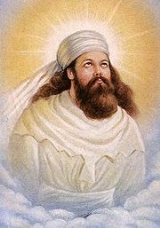
Zoroastrianism ˌ is a
religionReligion is a collection of cultural systems, belief systems, and worldviews that establishes symbols that relate humanity to spirituality and, sometimes, to moral values. Many religions have narratives, symbols, traditions and sacred histories that are intended to give meaning to life or to...
and philosophy based on the teachings of prophet
ZoroasterZoroaster , also known as Zarathustra , was a prophet and the founder of Zoroastrianism who was either born in North Western or Eastern Iran. He is credited with the authorship of the Yasna Haptanghaiti as well as the Gathas, hymns which are at the liturgical core of Zoroastrianism...
(also known as Zarathustra, in
AvestanAvestan is an East Iranian language known only from its use as the language of Zoroastrian scripture, i.e. the Avesta, from which it derives its name...
) and was formerly among the world's largest religions. It was probably founded some time before the
6th century BCEThe 6th century BC started the first day of 600 BC and ended the last day of 501 BC.Pāṇini, in India, composed a grammar for Sanskrit, in this century or slightly later...
in
Greater IranGreater Iran refers to the regions that have significant Iranian cultural influence. It roughly corresponds to the territory on the Iranian plateau and its bordering plains, stretching from Iraq, the Caucasus, and Turkey in the west to the Indus River in the east...
.
In Zoroastrianism, the
CreatorA creator deity is a deity responsible for the creation of the world . In monotheism, the single God is often also the creator deity, while polytheistic traditions may or may not have creator deities...
Ahura MazdaAhura Mazdā is the Avestan name for a divinity of the Old Iranian religion who was proclaimed the uncreated God by Zoroaster, the founder of Zoroastrianism...
is all good, and no
evilEvil is the violation of, or intent to violate, some moral code. Evil is usually seen as the dualistic opposite of good. Definitions of evil vary along with analysis of its root motive causes, however general actions commonly considered evil include: conscious and deliberate wrongdoing,...
originates from
HimGod is the English name given to a singular being in theistic and deistic religions who is either the sole deity in monotheism, or a single deity in polytheism....
. Thus, in Zoroastrianism good and evil have distinct sources, with evil (
druj) trying to destroy the creation of Mazda (
ashaAsha is the Avestan language term for a concept of cardinal importance to Zoroastrian theology and doctrine. In the moral sphere, aša/arta represents what has been called "the decisive confessional concept of Zoroastrianism." ...
), and good trying to sustain it. Mazda is not
immanentImmanence refers to philosophical and metaphysical theories of divine presence, in which the divine is seen to be manifested in or encompassing of the material world. It is often contrasted with theories of transcendence, in which the divine is seen to be outside the material world...
in the world, and His creation is represented by the
Amesha Spenta' is an Avestan language term for a class of divine entities in Zoroastrianism, and literally means "Bounteous Immortal" The noun is amesha "immortal", and spenta "furthering, strengthening, bounteous, holy" is an adjective of it...
s and the host of other
YazataYazata is the Avestan language word for a Zoroastrian concept. The word has a wide range of meanings but generally signifies a divinity...
s, through whom the works of God are evident to humanity, and through whom worship of Mazda is ultimately directed. The most important texts of the religion are those of the
AvestaThe Avesta is the primary collection of sacred texts of Zoroastrianism, composed in the Avestan language.-Early transmission:The texts of the Avesta — which are all in the Avestan language — were composed over the course of several hundred years. The most important portion, the Gathas,...
, of which a significant portion has been lost, and mostly only the liturgies of which have survived. The lost portions are known of only through references and brief quotations in the later works, primarily from the 9th to 11th centuries.
In some form, it served as the
nationA nation may refer to a community of people who share a common language, culture, ethnicity, descent, and/or history. In this definition, a nation has no physical borders. However, it can also refer to people who share a common territory and government irrespective of their ethnic make-up...
al or
state religionA state religion is a religious body or creed officially endorsed by the state...
of a significant portion of the Iranian people for many centuries. The religion first dwindled when the
Achaemenid EmpireThe Achaemenid Empire , sometimes known as First Persian Empire and/or Persian Empire, was founded in the 6th century BCE by Cyrus the Great who overthrew the Median confederation...
was invaded by Alexander III of Macedon, after which it collapsed and disintegrated and it was further gradually marginalized by
IslamIslam . The most common are and . : Arabic pronunciation varies regionally. The first vowel ranges from ~~. The second vowel ranges from ~~~...
from the 7th century onwards with the decline of the
Sassanid EmpireThe Sassanid Empire , known to its inhabitants as Ērānshahr and Ērān in Middle Persian and resulting in the New Persian terms Iranshahr and Iran , was the last pre-Islamic Persian Empire, ruled by the Sasanian Dynasty from 224 to 651...
. The political power of the pre-Islamic Iranian dynasties lent Zoroastrianism immense prestige in ancient times, and some of its leading doctrines were adopted by other religious systems. It has no major theological divisions (the only significant schism is based on calendar differences), but it is not uniform. Modern-era influences have a significant impact on individual and local beliefs, practices, values and vocabulary, sometimes complementing tradition and enriching it, but sometimes also displacing tradition entirely.
Terminology
The term
Zoroastrianism was first attested by the
Oxford English DictionaryThe Oxford English Dictionary , published by the Oxford University Press, is the self-styled premier dictionary of the English language. Two fully bound print editions of the OED have been published under its current name, in 1928 and 1989. The first edition was published in twelve volumes , and...
in 1874, in
Archibald Sayce'sThe Rev. Archibald Henry Sayce , was a pioneer British Assyriologist and linguist, who held a chair as Professor of Assyriology at the University of Oxford from 1891 to 1919.- Life :...
Principles of Comparative Philology. The first surviving reference to Zoroaster in Western scholarship is attributed to
Thomas BrowneSir Thomas Browne was an English author of varied works which reveal his wide learning in diverse fields including medicine, religion, science and the esoteric....
(1605–1682), who briefly refers to the prophet in his 1643
Religio MediciReligio Medici is a book by Sir Thomas Browne, which sets out his spiritual testament as well as being an early psychological self-portrait. In its day, the book was a European best-seller and brought its author fame and respect throughout the continent...
. The OED records 1743 (Warburton,
Pope's Essay) as the earliest reference to Zoroaster.
The term
Mazdaism ˈ is a typical 19th century construct, taking
Mazda- from the name
Ahura MazdaAhura Mazdā is the Avestan name for a divinity of the Old Iranian religion who was proclaimed the uncreated God by Zoroaster, the founder of Zoroastrianism...
and adding the suffix
-ism to suggest a belief system. The March 2001 draft edition of the
OED also records an alternate form,
Mazdeism, perhaps derived from the French
Mazdéisme, which first appeared in 1871. The Zoroastrian name of the religion is
Mazdayasna, which combines
Mazda- with the
Avestan languageAvestan is an East Iranian language known only from its use as the language of Zoroastrian scripture, i.e. the Avesta, from which it derives its name...
word
yasnaYasna is the name of the primary liturgical collection of texts of the Avesta as well as the name of the principal Zoroastrian act of worship at which those verses are recited. The Yasna, or Izeshne, is primarily the name of the ceremony in which the entire book is recited and appropriate...
, meaning "worship, devotion".
In
EnglishEnglish is a West Germanic language that arose in the Anglo-Saxon kingdoms of England and spread into what was to become south-east Scotland under the influence of the Anglian medieval kingdom of Northumbria...
, an adherent of the faith commonly refers to himself or herself as a Zoroastrian or, less commonly, a Zarathustrian. An older, but still widespread expression is
Behdin, meaning "follower of
Daena", for which "Good Religion" is one translation. In the Zoroastrian
liturgyLiturgy is either the customary public worship done by a specific religious group, according to its particular traditions or a more precise term that distinguishes between those religious groups who believe their ritual requires the "people" to do the "work" of responding to the priest, and those...
, the term
Behdin is also used as a title for an individual who has been formally inducted into the religion in a
NavjoteThe Navjote ceremony is the ritual through which an individual is inducted into the Zoroastrian religion and begins to wear the Sedreh and Kushti. The term navjote is used primarily by the Zoroastrians of India , while sedreh pushi is used primarily by the Zoroastrians of Iran...
ceremony.
Basic beliefs
Zoroastrians believe that there is one universal and
transcendentIn religion transcendence refers to the aspect of God's nature which is wholly independent of the physical universe. This is contrasted with immanence where God is fully present in the physical world and thus accessible to creatures in various ways...
God,
Ahura MazdaAhura Mazdā is the Avestan name for a divinity of the Old Iranian religion who was proclaimed the uncreated God by Zoroaster, the founder of Zoroastrianism...
. He is said to be the one uncreated Creator to whom all worship is ultimately directed. Ahura Mazda's creation—evident as
ashaAsha is the Avestan language term for a concept of cardinal importance to Zoroastrian theology and doctrine. In the moral sphere, aša/arta represents what has been called "the decisive confessional concept of Zoroastrianism." ...
, truth and order—is the
antithesisAntithesis is a counter-proposition and denotes a direct contrast to the original proposition...
of chaos, which is evident as
druj, falsehood and disorder. The resulting conflict involves the entire universe, including humanity, which has an active role to play in the conflict.
The religion states that active participation in life through good thoughts, good words, and good deeds is necessary to ensure happiness and to keep chaos at bay. This active participation is a central element in Zoroaster's concept of
free will"To make my own decisions whether I am successful or not due to uncontrollable forces" -Troy MorrisonA pragmatic definition of free willFree will is the ability of agents to make choices free from certain kinds of constraints. The existence of free will and its exact nature and definition have long...
, and Zoroastrianism rejects all forms of
monasticismMonasticism is a religious way of life characterized by the practice of renouncing worldly pursuits to fully devote one's self to spiritual work...
. Ahura Mazda will ultimately prevail over the evil
Angra MainyuAngra Mainyu is the Avestan-language name of Zoroastrianism's hypostasis of the "destructive spirit". The Middle Persian equivalent is Ahriman.-In Zoroaster's revelation:...
or Ahriman, at which point the universe will undergo a cosmic renovation and time will end. In the final renovation, all of creation—even the souls of the dead that were initially banished to "darkness"—will be reunited in Ahura Mazda, returning to life in the undead form. At the end of time, a savior-figure (a
SaoshyantSaoshyant is a figure of Zoroastrian eschatology who brings about the final renovation of the world, the Frashokereti. The Avestan language name literally means "one who brings benefit," and is also used as common noun.-In scripture:...
) will bring about a final renovation of the world (
frasho.keretiFrashokereti is the Avestan language term for the Zoroastrian doctrine of a final renovation of the universe, when evil will be destroyed, and everything else will be then in perfect unity with God...
), in which the dead will be revived.
In Zoroastrian tradition, the malevolent is represented by Angra Mainyu (also referred to as "Ahriman"), the "Destructive Principle", while the benevolent is represented through Ahura Mazda's
Spenta Mainyu' is an Avestan language term for a class of divine entities in Zoroastrianism, and literally means "Bounteous Immortal" The noun is amesha "immortal", and spenta "furthering, strengthening, bounteous, holy" is an adjective of it...
, the instrument or "Bounteous Principle" of the act of creation. It is through Spenta Mainyu that transcendental Ahura Mazda is
immanentImmanence refers to philosophical and metaphysical theories of divine presence, in which the divine is seen to be manifested in or encompassing of the material world. It is often contrasted with theories of transcendence, in which the divine is seen to be outside the material world...
in humankind, and through which the Creator interacts with the world. According to Zoroastrian
cosmologyCosmology is the discipline that deals with the nature of the Universe as a whole. Cosmologists seek to understand the origin, evolution, structure, and ultimate fate of the Universe at large, as well as the natural laws that keep it in order...
, in articulating the
Ahuna VairyaAhuna Vairya is the Avestan language name of the most sacred of the Gathic hymns of the Avesta, the revered texts of Zoroastrianism....
formula, Ahura Mazda made His ultimate triumph evident to Angra Mainyu. As expressions and aspects of Creation, Ahura Mazda emanated the
Amesha Spenta' is an Avestan language term for a class of divine entities in Zoroastrianism, and literally means "Bounteous Immortal" The noun is amesha "immortal", and spenta "furthering, strengthening, bounteous, holy" is an adjective of it...
s ("Bounteous Immortals"), that are each the
hypostasisHypostasis may refer to:* Hypostatic abstraction * Hypostasis , personification of entities* Hypostatic gene* Hypostasis , an Australian-based not-for-profit organization...
and representative of one aspect of that Creation. These Amesha Spenta are in turn assisted by a league of lesser principles, the
YazataYazata is the Avestan language word for a Zoroastrian concept. The word has a wide range of meanings but generally signifies a divinity...
s, each "Worthy of Worship" and each again a hypostasis of a moral or physical aspect of creation.
Other characteristics
In Zoroastrianism, water (
apoApas is the Avestan language term for "the waters", which—in its innumerable aggregate states—is represented by the Apas, the hypostases of the waters....
,
aban) and fire (
atarAtar is the Zoroastrian concept of holy fire, sometimes described in abstract terms as "burning and unburning fire" or "visible and invisible fire" ....
,
adar) are agents of ritual purity, and the associated purification ceremonies are considered the basis of ritual life. In Zoroastrian
cosmogonyCosmogony, or cosmogeny, is any scientific theory concerning the coming into existence or origin of the universe, or about how reality came to be. The word comes from the Greek κοσμογονία , from κόσμος "cosmos, the world", and the root of γίνομαι / γέγονα "to be born, come about"...
, water and fire are respectively the second and last primordial elements to have been created, and scripture considers fire to have its origin in the waters. Both water and fire are considered life-sustaining, and both water and fire are represented within the precinct of a
fire templeA fire temple in Zoroastrianism is the place of worship for Zoroastrians. Zoroastrians revere fire in any form. In the Zoroastrian religion, fire , together with clean water , are agents of ritual purity...
. Zoroastrians usually pray in the presence of some form of fire (which can be considered evident in any source of light), and the
culminating riteThe Ab-Zohr is the culminating rite of the greater Yasna service, the principal Zoroastrian act of worship that accompanies the recitation of the Yasna liturgy....
of the principle act of worship constitutes a "strengthening of the waters". Fire is considered a medium through which spiritual insight and wisdom is gained, and water is considered the source of that wisdom.
While the
ParseesParsi or Parsee refers to a member of the larger of the two Zoroastrian communities in South Asia, the other being the Irani community....
in India have traditionally been opposed to proselytizing, probably for historical reasons, and even considered it a crime for which the culprit may face expulsion, Iranian Zoroastrians have never been opposed to conversion, and the practice has been endorsed by the Council of Mobeds of
TehranTehran , sometimes spelled Teheran, is the capital of Iran and Tehran Province. With an estimated population of 8,429,807; it is also Iran's largest urban area and city, one of the largest cities in Western Asia, and is the world's 19th largest city.In the 20th century, Tehran was subject to...
. While the Iranian authorities do not permit proselytizing within Iran, Iranian Zoroastrians in exile have actively encouraged missionary activities, with The Zarathushtrian Assembly in
Los AngelesLos Ángeles is the capital of the province of Biobío, in the commune of the same name, in Region VIII , in the center-south of Chile. It is located between the Laja and Biobío rivers. The population is 123,445 inhabitants...
and the International Zoroastrian Centre in
ParisParis is the capital and largest city in France, situated on the river Seine, in northern France, at the heart of the Île-de-France region...
as two prominent centres.
As in many other faiths, Zoroastrians are strongly encouraged to marry others of the same faith, but this is not a requirement of the religion itself. Rather, it is a creation of those in India. Some members of the Indian Zoroastrian community (the Parsis) contend that a child must have a Parsi father to be eligible for introduction into the faith, but this assertion is considered by most to be a violation of the Zoroastrian tenets of gender equality, and may be a remnant of an old Indian legal definition (since overruled) of
Parsi. This issue is a matter of debate within the Parsi community, but with the increasingly global nature of modern society and the dwindling number of Zoroastrians, such opinions are less vociferous than they were previously.
In Zoroastrian tradition, life is a temporary state in which a mortal is expected to actively participate in the continuing battle between truth and falsehood. Prior to being born, the soul (
urvan) of an individual is still united with its
fravashiA fravashi is the guardian spirit mentioned in the Avesta of an individual, who sends out the urvan into the material world to fight the battle of good versus evil...
, of which there are very many, and which have existed since Mazda created the universe. During life, the
fravashi acts as a guardian and protector. On the fourth day after death, the soul is reunited with its
fravashi, in which the experiences of life in the material world are collected for the continuing battle in the spiritual world. For the most part, Zoroastrianism does not have a notion of
reincarnationReincarnation best describes the concept where the soul or spirit, after the death of the body, is believed to return to live in a new human body, or, in some traditions, either as a human being, animal or plant...
, at least not until the final renovation of the world. Despite this, followers of
Ilm-e-KshnoomIlm-e-Khshnoom is a school of Zoroastrian philosophy, practiced by a very small minority of the Indian Zoroastrians , based on a mystic and esoteric, rather than literal, interpretation of religious texts.-Principal belief:At the core of the philosophy is the belief that faith facilitates a...
in India believe in reincarnation and practice vegetarianism, two principles unknown to Orthodox Zoroastrianism.
In Zoroastrian scripture and tradition, a corpse is a host for decay, i.e., of
druj. Consequently, scripture enjoins the "safe" disposal of the dead in a manner such that a corpse does not pollute the "good" creation. These injunctions are the doctrinal basis of the fast-fading traditional practice of "ritual exposure", most commonly identified with the so-called "Towers of Silence" for which there is no standard technical term in either scripture or tradition. The practice of ritual exposure is only practised by Zoroastrian communities of the
Indian subcontinentThe Indian subcontinent, also Indian Subcontinent, Indo-Pak Subcontinent or South Asian Subcontinent is a region of the Asian continent on the Indian tectonic plate from the Hindu Kush or Hindu Koh, Himalayas and including the Kuen Lun and Karakoram ranges, forming a land mass which extends...
, where it is not illegal, but where alternative disposal methods are desperately sought after
diclofenacDiclofenac is a non-steroidal anti-inflammatory drug taken to reduce inflammation and as an analgesic reducing pain in certain conditions....
poisoning has led to the virtual extinction of scavenger birds. Other Zoroastrian communities either
cremateCremation is the process of reducing bodies to basic chemical compounds such as gasses and bone fragments. This is accomplished through high-temperature burning, vaporization and oxidation....
their dead, or bury them in graves that are cased with
lime mortarLime mortar is a type of mortar composed of lime and an aggregate such as sand, mixed with water. It is one of the oldest known types of mortar, dating back to the 4th century BC and widely used in Ancient Rome and Greece, when it largely replaced the clay and gypsum mortars common to Ancient...
.
Origins
Zoroastrianism emerged out of a common prehistoric Indo-Iranian religious system dating back to the early 2nd millennium BCE. According to Zoroastrian tradition,
ZoroasterZoroaster , also known as Zarathustra , was a prophet and the founder of Zoroastrianism who was either born in North Western or Eastern Iran. He is credited with the authorship of the Yasna Haptanghaiti as well as the Gathas, hymns which are at the liturgical core of Zoroastrianism...
was a reformer who exalted the deity of Wisdom,
Ahura MazdaAhura Mazdā is the Avestan name for a divinity of the Old Iranian religion who was proclaimed the uncreated God by Zoroaster, the founder of Zoroastrianism...
, to the status of Supreme Being and Creator, while demoting various other deities and rejecting certain rituals.
Classical antiquity
Although older, Zoroastrianism only enters recorded history in the mid-5th century BCE.
HerodotusHerodotus was an ancient Greek historian who was born in Halicarnassus, Caria and lived in the 5th century BC . He has been called the "Father of History", and was the first historian known to collect his materials systematically, test their accuracy to a certain extent and arrange them in a...
'
The HistoriesThe Histories of Herodotus is considered one of the seminal works of history in Western literature. Written from the 450s to the 420s BC in the Ionic dialect of classical Greek, The Histories serves as a record of the ancient traditions, politics, geography, and clashes of various cultures that...
(completed
c. 440 BCE) includes a description of
Greater IranGreater Iran refers to the regions that have significant Iranian cultural influence. It roughly corresponds to the territory on the Iranian plateau and its bordering plains, stretching from Iraq, the Caucasus, and Turkey in the west to the Indus River in the east...
ian society with what may be recognizably Zoroastrian features, including exposure of the dead.
The Histories is a primary source of information on the early period of the
Achaemenid eraThe Achaemenid Empire , sometimes known as First Persian Empire and/or Persian Empire, was founded in the 6th century BCE by Cyrus the Great who overthrew the Median confederation...
(648–330 BCE), in particular with respect to the role of the
MagiMagi is a term, used since at least the 4th century BC, to denote a follower of Zoroaster, or rather, a follower of what the Hellenistic world associated Zoroaster with, which...
. According to Herodotus i.101, the Magi were the sixth tribe of the
Medians
(until the unification of the Persian empire under
Cyrus the GreatCyrus II of Persia , commonly known as Cyrus the Great, also known as Cyrus the Elder, was the founder of the Achaemenid Empire. Under his rule, the empire embraced all the previous civilized states of the ancient Near East, expanded vastly and eventually conquered most of Southwest Asia and much...
, all Iranians were referred to as "Mede" or "Mada" by the peoples of the Ancient World), who appear to have been the priestly caste of the Mesopotamian-influenced branch of Zoroastrianism today known as
ZurvanismZurvanism is a now-extinct branch of Zoroastrianism that had the divinity Zurvan as its First Principle . Zurvanism is also known as Zurvanite Zoroastrianism....
, and who wielded considerable influence at the courts of the Median emperors.
Following the unification of the Median and Persian empires in 550 BCE, Cyrus the Great and, later, his son Cambyses II curtailed the powers of the Magi after they had attempted to sow dissent following their loss of influence. In 522 BCE, the Magi revolted and set up a rival claimant to the throne. The usurper, pretending to be Cyrus' younger son Smerdis, took power shortly thereafter. Owing to the
despotic ruleDespotism is a form of government in which a single entity rules with absolute power. That entity may be an individual, as in an autocracy, or it may be a group, as in an oligarchy...
of
CambysesCambyses can refer to two ancient rulers and two plays:-*Cambyses I, King of Anshan 600 to 559 BCE*Cambyses II, King of Persia 530 to 522 BCE*Cambyses, a tragedy by Thomas Preston...
and his long absence in Egypt, "the whole people, Persians, Medes and all the other nations" acknowledged the usurper, especially as he granted a remission of taxes for three years (Herodotus iii. 68).
According to the
Behistun InscriptionThe Behistun Inscription The Behistun Inscription The Behistun Inscription (also Bistun or Bisutun, Modern Persian: بیستون The Behistun Inscription (also Bistun or Bisutun, Modern Persian: بیستون...
, pseudo-Smerdis ruled for seven months before being overthrown by Darius I in 521 BCE. The "Magi", though persecuted, continued to exist. A year following the death of the first pseudo-Smerdis (named Gaumata), a second pseudo-Smerdis (named Vahyazdāta) attempted a coup. The coup, though initially successful, failed.
Whether Cyrus II was a Zoroastrian is subject to debate. It did, however, influence him to the extent that it became the non-imposing religion of his empire, and its beliefs later allowed Cyrus to free the Jews and allow them to return to
JudeaJudea or Judæa was the name of the mountainous southern part of the historic Land of Israel from the 8th century BCE to the 2nd century CE, when Roman Judea was renamed Syria Palaestina following the Jewish Bar Kokhba revolt.-Etymology:The...
when the emperor took
BabylonBabylon was an Akkadian city-state of ancient Mesopotamia, the remains of which are found in present-day Al Hillah, Babil Province, Iraq, about 85 kilometers south of Baghdad...
in 539 BCE. Darius I was a devotee of
Ahura MazdaAhura Mazdā is the Avestan name for a divinity of the Old Iranian religion who was proclaimed the uncreated God by Zoroaster, the founder of Zoroastrianism...
, as attested to several times in the Behistun inscription. However, whether he was a follower of Zoroaster has not been conclusively established, since devotion to Ahura Mazda was (at the time) not necessarily an indication of an adherence to Zoroaster's teaching.
Darius I and later Achaemenid emperors, though acknowledging their devotion to Ahura Mazda in inscriptions, appear to have permitted religions to coexist. Nonetheless, it was during the Achaemenid period that Zoroastrianism gained momentum. A number of the Zoroastrian texts that today are part of the greater compendium of the
AvestaThe Avesta is the primary collection of sacred texts of Zoroastrianism, composed in the Avestan language.-Early transmission:The texts of the Avesta — which are all in the Avestan language — were composed over the course of several hundred years. The most important portion, the Gathas,...
have been attributed to that period. It was also during the later Achaemenid era that many of the divinities and divine concepts of proto-Indo-Iranian religion(s) were incorporated in Zoroastrianism, in particular those to whom the days of the month of the
Zoroastrian calendarThis article treats of the reckoning of days, months and years in the calendar used by adherents of the Zoroastrian faith. Zoroastrian religious festivals are discussed elsewhere, but have a fixed relationship to Nawruz, the New Year festival, whose timing is discussed below...
are dedicated. This calendar is still used today, a fact that is attributed to the Achaemenid period. Additionally, the divinities, or
yazataYazata is the Avestan language word for a Zoroastrian concept. The word has a wide range of meanings but generally signifies a divinity...
s, are present-day Zoroastrian
angelAngels are mythical beings often depicted as messengers of God in the Hebrew and Christian Bibles along with the Quran. The English word angel is derived from the Greek ἄγγελος, a translation of in the Hebrew Bible ; a similar term, ملائكة , is used in the Qur'an...
s (Dhalla, 1938).
Almost nothing is known of the status of Zoroastrianism under the Seleucids and Parthians, who ruled over Persia following
Alexander the Great's invasion in 330 BCE. According to later Zoroastrian legend (
DenkardThe Dēnkard or Dēnkart is a 10th century compendium of the Mazdaen Zoroastrian beliefs and customs. The Denkard is to a great extent an "Encyclopedia of Mazdaism" and is a most valuable source of information on the religion...
and the
Book of Arda VirafThe Book of Arda Viraf is a Zoroastrian religious text of Sassanid era in Middle Persian language,contains about 8,800 words. It describes the dream-journey of a devout Zoroastrian through the next world. Due to the ambiguity inherent to Pahlavi script, 'Viraf' may also be transliterated as...
), many sacred texts were lost when Alexander's troops invaded
PersepolisPerspolis was the ceremonial capital of the Achaemenid Empire . Persepolis is situated northeast of the modern city of Shiraz in the Fars Province of modern Iran. In contemporary Persian, the site is known as Takht-e Jamshid...
and subsequently destroyed the royal library there.
Diodorus Siculus'sDiodorus Siculus was a Greek historian who flourished between 60 and 30 BC. According to Diodorus' own work, he was born at Agyrium in Sicily . With one exception, antiquity affords no further information about Diodorus' life and doings beyond what is to be found in his own work, Bibliotheca...
Bibliotheca historica, which was completed
c. 60 BCE, appears to substantiate this Zoroastrian legend (Diod. 17.72.2–17.72.6). According to one archaeological examination, the ruins of the palace of Xerxes bear traces of having been burned (Stolze, 1882). Whether a vast collection of (semi-)religious texts "written on parchment in gold ink", as suggested by the
Denkard, actually existed remains a matter of speculation, but is unlikely. Given that many of the
Denkards statements-as-fact have since been refuted among scholars, the tale of the library is widely accepted to be fictional (Kellens, 2002)
Late antiquity
When the Sassanid dynasty came into power in 228 CE, they aggressively promoted the Zurvanite form of Zoroastrianism and, in some cases, persecuted
ChristiansChristianity is a monotheistic religion based on the life and teachings of Jesus as presented in canonical gospels and other New Testament writings...
. When the Sassanids captured territory, they often built fire temples there to promote their religion. After Constantine, the Sassanids were suspicious of Christians, not least because of their perceived ties to the Christian
Roman EmpireThe Roman Empire was the post-Republican period of the ancient Roman civilization, characterised by an autocratic form of government and large territorial holdings in Europe and around the Mediterranean....
. As such the Persian Church (the
Church of the EastThe Church of the East tāʾ d-Maḏnḥāʾ), also known as the Nestorian Church, is a Christian church, part of the Syriac tradition of Eastern Christianity. Originally the church of the Persian Sassanid Empire, it quickly spread widely through Asia...
) officially broke with Roman Christianity, and was tolerated and even sometimes favored by the Sassanids.
A form of Zoroastrianism was also prominent in the pre-Christian
CaucasusThe Caucasus, also Caucas or Caucasia , is a geopolitical region at the border of Europe and Asia, and situated between the Black and the Caspian sea...
region (especially modern-day
AzerbaijanAzerbaijan , officially the Republic of Azerbaijan is the largest country in the Caucasus region of Eurasia. Located at the crossroads of Western Asia and Eastern Europe, it is bounded by the Caspian Sea to the east, Russia to the north, Georgia to the northwest, Armenia to the west, and Iran to...
). During the periods of their
suzeraintySuzerainty occurs where a region or people is a tributary to a more powerful entity which controls its foreign affairs while allowing the tributary vassal state some limited domestic autonomy. The dominant entity in the suzerainty relationship, or the more powerful entity itself, is called a...
over the Caucasus, the Sassanids made attempts to promote the religion there as well.
Well before the 6th century CE, Zoroastrianism had spread to northern
ChinaChinese civilization may refer to:* China for more general discussion of the country.* Chinese culture* Greater China, the transnational community of ethnic Chinese.* History of China* Sinosphere, the area historically affected by Chinese culture...
via the
Silk RoadThe Silk Road or Silk Route refers to a historical network of interlinking trade routes across the Afro-Eurasian landmass that connected East, South, and Western Asia with the Mediterranean and European world, as well as parts of North and East Africa...
, gaining official status in a number of Chinese states. Remains of Zoroastrian temples have been found in
KaifengKaifeng , known previously by several names , is a prefecture-level city in east-central Henan province, Central China. Nearly 5 million people live in the metropolitan area...
and
ZhenjiangZhenjiang is a prefecture-level city in the southwest of Jiangsu province in the eastern People's Republic of China . Sitting on the southern bank of the Yangtze River, it borders the provincial capital of Nanjing to the west, Changzhou to the east, and Yangzhou across the river to the north.Once...
. By the 13th century, the religion had faded from prominence in China. However, Zoroastrianism (as well as later Manicheism) may still have influenced elements of Buddhism, especially in terms of light symbolism.
Middle Ages
In the 7th century, and over the course of at least 16 years (several decades in the case of some provinces), the Sassanid Empire was overthrown by the Arabs. Although the administration of the state was rapidly Islamicized and subsumed under the Umayyad Caliphate, "there was little serious pressure" exerted on newly subjected people to adopt Islam. Islamic jurists considered only Muslims to be perfectly moral, and "unbelievers might as well be left to their inequities, so long as these did not vex their overlords."
There were also practical considerations: "because of their sheer numbers, the conquered Zoroastrians had to be treated as
dhimmiA , is a non-Muslim subject of a state governed in accordance with sharia law. Linguistically, the word means "one whose responsibility has been taken". This has to be understood in the context of the definition of state in Islam...
s (despite doubts [of the validity of this identification] that persisted down the centuries)," which made them eligible for protection. Thus, in the main, once the conquest was over and "local terms were agreed on", the Arab governors protected the local populations in exchange for tribute. The Arabs adopted the Sassanid tax-system, both the land-tax levied on land owners and the poll-tax levied on individuals. This is called
jizyaUnder Islamic law, jizya or jizyah is a per capita tax levied on a section of an Islamic state's non-Muslim citizens, who meet certain criteria...
, a tax levied on non-Muslims living in Muslim Caliphates (i.e., the
dhimmis). In time, this poll-tax came to be used as a means to humble the non-Muslims, and a number of laws and restrictions evolved to emphasize their inferior status. Under the early orthodox caliphs, as long as the non-Muslims paid their taxes and adhered to the
dhimmi laws, administrators were enjoined to leave non-Muslims "in their religion and their land." (
Caliph Abu Bakr Abu Bakr was a senior companion and the father-in-law of the Islamic prophet Muhammad. He ruled over the Rashidun Caliphate from 632-634 CE when he became the first Muslim Caliph following Muhammad's death...
, qtd. in ).
Thus, though subject to a new leadership and harassed, once the horrors of conquest were over, the Zoroastrians were able to continue in their former ways. There was, however, a slow but steady social and economic pressure to convert. The nobility and city-dwellers were the first to convert, with Islam more slowly being accepted among the peasantry and landed gentry. "Power and worldly-advantage" now lay with followers of Islam, and although the "official policy was one of aloof contempt, there were individual Muslims eager to proselytize and ready to use all sorts of means to do so."
In time, a tradition evolved by which Islam was made to appear as a partly Iranian religion. One example of this was a legend that
HusaynHussein ibn ‘Alī ibn Abī Ṭālib was the son of ‘Alī ibn Abī Ṭālib and Fātimah Zahrā...
, son the fourth caliph Ali and grandson of Islam's prophet
MuhammadMuhammad |ligature]] at U+FDF4 ;Arabic pronunciation varies regionally; the first vowel ranges from ~~; the second and the last vowel: ~~~. There are dialects which have no stress. In Egypt, it is pronounced not in religious contexts...
, had married a captive Sassanid princess named
ShahrbanuShahrbānū , is a personage described to have been one of the daughters of Yazdegerd III, the last Emperor of the Sassanid dynasty of Persia/Iran...
. This "wholly fictitious figure" was said to have borne Husayn a son, the historical fourth Shi'a
imamImāmah is the Shia doctrine of religious, spiritual and political leadership of the Ummah. The Shīa believe that the A'immah are the true Caliphs or rightful successors of Muḥammad, and further that Imams are possessed of divine knowledge and authority as well as being part of the Ahl al-Bayt,...
, who claimed that the
caliphateThe term caliphate, "dominion of a caliph " , refers to the first system of government established in Islam and represented the political unity of the Muslim Ummah...
rightly belonged to him and his descendants, and that the
UmayyadThe Umayyad Caliphate was the second of the four major Arab caliphates established after the death of Muhammad. It was ruled by the Umayyad dynasty, whose name derives from Umayya ibn Abd Shams, the great-grandfather of the first Umayyad caliph. Although the Umayyad family originally came from the...
s had wrongfully wrested it from him. The alleged descent from the Sassanid house counterbalanced the Arab nationalism of the Umayyads, and the Iranian national association with a Zoroastrian past was disarmed. Thus, according to scholar Mary Boyce, "it was no longer the Zoroastrians alone who stood for patriotism and loyalty to the past." The "damning indictment" that becoming Muslim was equivalent to becoming
Un-IranianAnīrān or Anērān is an ethno-linguistic term that signifies "non-Iranian" or "non-Iran." Thus, in a general sense, 'Aniran' signifies lands where Iranian languages are not spoken...
only remained an idiom in Zoroastrian texts.
With Iranian (especially Persian) support, the Abbasids overthrew the Ummayads in 750, and in the subsequent caliphate government—that nominally lasted until 1258—Muslim Iranians received marked favor in the new government, both in Iran and at the capital in
BaghdadBaghdad is the capital of Iraq, as well as the coterminous Baghdad Governorate. The population of Baghdad in 2011 is approximately 7,216,040...
. This mitigated the antagonism between Arabs and Iranians, but sharpened the distinction between Muslims and non-Muslims. The Abbasids zealously persecuted heretics, and although this was directed mainly at Muslim sectarians, it also created a harsher climate for non-Muslims. Although the Abbasids were deadly foes of Zoroastrianism, the brand of Islam they propagated throughout Iran became in turn ever more "Zoroastrianized", making it easier for Iranians to embrace Islam.
The 9th century was the last in which Zoroastrians had the means to engage in creative work on a great scale, and the 9th century has come to define the great number of Zoroastrian texts that were composed or re-written during the 8th to 10th centuries (excluding copying and lesser amendments, which continue for some time thereafter). All of these works are in the
Middle PersianMiddle Persian , indigenously known as "Pârsig" sometimes referred to as Pahlavi or Pehlevi, is the Middle Iranian language/ethnolect of Southwestern Iran that during Sassanid times became a prestige dialect and so came to be spoken in other regions as well. Middle Persian is classified as a...
dialect of that period (free of Arabic words), and written in the difficult Pahlavi script (hence the adoption of the term "Pahlavi" as the name of the variant of the language, and of the genre, of those Zoroastrian books). If read aloud, these books would still have been intelligible to the
laityIn religious organizations, the laity comprises all people who are not in the clergy. A person who is a member of a religious order who is not ordained legitimate clergy is considered as a member of the laity, even though they are members of a religious order .In the past in Christian cultures, the...
. Many of these texts are responses to the tribulations of the time, and all of them include exhortations to stand fast in their religious beliefs. Some, such as the "
DenkardThe Dēnkard or Dēnkart is a 10th century compendium of the Mazdaen Zoroastrian beliefs and customs. The Denkard is to a great extent an "Encyclopedia of Mazdaism" and is a most valuable source of information on the religion...
", are doctrinal defenses of the religion, while others are explanations of theological aspects (such as the
BundahishnBundahishn, meaning "Primal Creation", is the name traditionally given to an encyclopædiaic collections of Zoroastrian cosmogony and cosmology written in Book Pahlavi. The original name of the work is not known....
's) or practical aspects (e.g., explanation of rituals) of it. About sixty such works are known to have existed, of which some are known only from references to them in other works.
Two decrees in particular encouraged the transition to a preponderantly Islamic society. The first edict, adapted from a Arsacid and Sassanid one (but in those to the advantage of Zoroastrians), was that only a Muslim could own Muslim slaves or
indentured servantIndentured servitude refers to the historical practice of contracting to work for a fixed period of time, typically three to seven years, in exchange for transportation, food, clothing, lodging and other necessities during the term of indenture. Usually the father made the arrangements and signed...
s. Thus, a bonded individual owned by a Zoroastrian could automatically become a freeman by converting to Islam. The other edict was that if one male member of a Zoroastrian family converted to Islam, he instantly inherited all its property.
Under Abbasid rule, Muslim Iranians (who by then were in the majority) increasingly found ways to taunt Zoroastrians, and distressing them became a popular sport. For example, in the 9th century, a deeply venerated cypress tree in
KhorasanGreater Khorasan or Ancient Khorasan is a historical region of Greater Iran mentioned in sources from Sassanid and Islamic eras which "frequently" had a denotation wider than current three provinces of Khorasan in Iran...
(which Parthian-era legend supposed had been planted by Zoroaster himself) was felled for the construction of a palace in Baghdad, 2000 miles (3,218.7 km) away. In the 10th century, on the day that a Tower of Silence had been completed at much trouble and expense, a Muslim official contrived to get up onto it, and to call the
adhanThe adhān is the Islamic call to prayer, recited by the muezzin at prescribed times of the day. The root of the word is meaning "to permit"; another derivative of this word is , meaning "ear"....
(the Muslim call to prayer) from its walls. This was made a pretext to annex the building. Another popular means to distress Zoroastrians was to maltreat dogs, as these animals are sacred in Zoroastrianism. Such baiting, which was to continue down the centuries, was indulged in by all; not only by high officials, but by the general uneducated population as well.
Despite these economic and social incentives to convert, Zoroastrianism remained strong in some regions, particularly in those furthest away from the Caliphate capital at Baghdad. In
BukharaBukhara , from the Soghdian βuxārak , is the capital of the Bukhara Province of Uzbekistan. The nation's fifth-largest city, it has a population of 263,400 . The region around Bukhara has been inhabited for at least five millennia, and the city has existed for half that time...
(in present-day Uzbekistan), resistance to Islam required the 9th century Arab commander Qutaiba to convert his province four times. The first three times the citizens reverted to their old religion. Finally, the governor made their religion "difficult for them in every way", turned the local fire temple into a mosque, and encouraged the local population to attend Friday prayers by paying each attendee two dirhams. The cities where Arab governors resided were particularly vulnerable to such pressures, and in these cases the Zoroastrians were left with no choice but to either conform or migrate to regions that had a more amicable administration.
Among these migrations were those to cities in (or on the margins of) the great salt deserts, in particular to
YazdYazd is the capital of Yazd Province in Iran, and a centre of Zoroastrian culture. The city is located some 175 miles southeast of Isfahan. At the 2006 census, the population was 423,006, in 114,716 families....
and
Kerman- Geological characteristics :For the Iranian paleontologists, Kerman has always been considered a fossil paradise. Finding new dinosaur footprints in 2005 has now revealed new hopes for paleontologists to better understand the history of this area.- Economy :...
, which remain centers of Iranian Zoroastrianism to this day. Yazd became the seat of the Iranian high priests during
Mongol Il-KhanateThe Ilkhanate, also spelled Il-khanate , was a Mongol khanate established in Azerbaijan and Persia in the 13th century, considered a part of the Mongol Empire...
rule, when the "best hope for survival [for a non-Muslim] was to be inconspicuous." Crucial to the present-day survival of Zoroastrianism was a migration from the northeastern Iranian town of
"Sanjan in south-western Khorasan"Sanjan is an ancient city on the southern edge of the Kara-kum Desert, in the vicinity of the historically eminent oasis-city of Merv. Topographically, Sanjan is located in the Greater Khorasan region of Central Asia...
, to
Gujarat, in western India. The descendants of that group are today known as the
ParsiParsi or Parsee refers to a member of the larger of the two Zoroastrian communities in South Asia, the other being the Irani community....
s—"as the
GujaratisGujarati people , or Gujaratis are an ethnic group that is traditionally Gujarati-speaking and can trace their ancestry to the state of Gujarat in western India...
, from long tradition, called anyone from Iran"—who today represent the larger of the two groups of Zoroastrians.
Also in
KhorasanGreater Khorasan or Ancient Khorasan is a historical region of Greater Iran mentioned in sources from Sassanid and Islamic eras which "frequently" had a denotation wider than current three provinces of Khorasan in Iran...
in the northeastern Iran, a 10th century Iranian nobleman brought together four Zoroastrian priests to transcribe a Sassanid-era Middle Persian work titled
Book of the Lord (
Khwaday Namag) from Pahlavi script into Arabic script. This transcription, which remained in Middle Persian prose (an Arabic version, by
al-MuqaffaAbū-Muhammad Abd-Allāh Rūzbeh ibn Dādūya/Dādōē , known as Ibn al-Muqaffaʿ , Ibn Muqaffa/Ebn-e Moghaffa , or Rūzbeh pūr-e Dādūya , was a Persian thinker and a Zoroastrian convert to Islam.-Biography:...
, also exists), was completed in 957 and subsequently became the basis for Firdausi's
Book of KingsThe Shahnameh or Shah-nama is a long epic poem written by the Persian poet Ferdowsi between c.977 and 1010 AD and is the national epic of Iran and related societies...
. It became enormously popular among both Zoroastrians and Muslims, and also served to propagate the Sassanid justification for overthrowing the Arsacids (i.e., that the Sassanids had restored the faith to its "orthodox" form after the Hellenistic Arsacids had allowed Zoroastrianism to become corrupt).
The struggle between Zoroastrianism and Islam declined in the 10th and 11th centuries, as, by then, most of the country was Islamic. Local Iranian dynasties, "all vigorously Muslim," had emerged as largely independent vassals of the Caliphs. In the 16th century, in one of the early letters between Iranian Zoroastrians and their co-religionists in India, the priests of Yazd lamented that "no period [in human history], not even
that of AlexanderThe Hellenistic period or Hellenistic era describes the time which followed the conquests of Alexander the Great. It was so named by the historian J. G. Droysen. During this time, Greek cultural influence and power was at its zenith in Europe and Asia...
, had been more grievous or troublesome for the faithful than 'this millennium of the
demon of WrathAeshma is the Younger Avestan name of Zoroastrianism's demon of "wrath." As a hypostatic entity, Aeshma is variously interpreted as "wrath," "rage," and "fury." His standard epithet is "of the bloody mace."...
'."
Relation to other religions and cultures
It is believed that key concepts of Zoroastrian eschatology and
demonologyDemonology is the systematic study of demons or beliefs about demons. It is the branch of theology relating to superhuman beings who are not gods. It deals both with benevolent beings that have no circle of worshippers or so limited a circle as to be below the rank of gods, and with malevolent...
have had influence on the Abrahamic religions. On the other hand, Zoroastrianism itself inherited ideas from other belief systems and, like other "practiced" religions, accommodates some degree of
syncretismSyncretism is the combining of different beliefs, often while melding practices of various schools of thought. The term means "combining", but see below for the origin of the word...
.
Many traits of Zoroastrianism can be traced back to the culture and beliefs of the prehistorical Indo-Iranian period, that is, to the time before the migrations that led to the
IndiansIndo-Aryan is an ethno-linguistic term referring to the wide collection of peoples united as native speakers of the Indo-Aryan branch of the Indo-Iranian family of Indo-European languages...
and
IraniansThe Iranian peoples are an Indo-European ethnic-linguistic group, consisting of the speakers of Iranian languages, a major branch of the Indo-European language family, as such forming a branch of Indo-European-speaking peoples...
becoming distinct peoples. Zoroastrianism consequently shares elements with the
historical Vedic religionThe religion of the Vedic period is a historical predecessor of Hinduism. Its liturgy is reflected in the mantra portion of the four Vedas, which are compiled in Sanskrit. The religious practices centered on a clergy administering rites...
that also has its origins in that era. An example is the relation of the Zoroastrian word
Ahura (Ahura Mazda) and the Vedic word
Asura (meaning demon). They are therefore thought to have descended from a common Proto-Indo-Iranian religion. However, Zoroastrianism was also strongly affected by the later culture of the Iranian
Heroic AgeIn 20th century studies of oral poetry and traditional literature, the Heroic Age was postulated as a stage in the development of human societies likely to give rise to legends about heroic deeds. According to some theorists, oral epic poetry would be created at the same period, and would be...
(1500 BCE onwards), an influence to which the Indic religions were not subject. Moreover, the other culture groups that the respective peoples came to interact with were different, for instance in 6th–4th century BCE Western Iran with
Fertile CrescentThe Fertile Crescent, nicknamed "The Cradle of Civilization" for the fact the first civilizations started there, is a crescent-shaped region containing the comparatively moist and fertile land of otherwise arid and semi-arid Western Asia. The term was first used by University of Chicago...
culture, with each side absorbing ideas from the other. Such inter-cultural influences notwithstanding, Zoroastrian "scripture" is essentially a product of (Indo-) Iranian culture, and representing the oldest and largest corpus pre-Islamic Iranian ideology—is considered a reflection of that culture. Then, together with the
VedasThe Vedas are a large body of texts originating in ancient India. Composed in Vedic Sanskrit, the texts constitute the oldest layer of Sanskrit literature and the oldest scriptures of Hinduism....
, which represent the oldest texts of the Indian branch of Indo-Iranian culture, it is possible to reconstruct some facets of prototypical Indo-Iranian beliefs. Since these two groups of sources also represent the oldest non-fragmentary evidence of
Indo-European languagesThe Indo-European languages are a family of several hundred related languages and dialects, including most major current languages of Europe, the Iranian plateau, and South Asia and also historically predominant in Anatolia...
, the analysis of them also motivated attempts to characterize an even earlier
Proto-Indo-European religionProto-Indo-European religion is the hypothesized religion of the Proto-Indo-European peoples based on the existence of similarities among the deities, religious practices and mythologies of the Indo-European peoples. Reconstruction of the hypotheses below is based on linguistic evidence using the...
, and in turn influenced various unifying hypotheses like those of Carl Gustav Jung or James George Frazer. Although these unifying notions deeply influenced the
modernistsModernism, in its broadest definition, is modern thought, character, or practice. More specifically, the term describes the modernist movement, its set of cultural tendencies and array of associated cultural movements, originally arising from wide-scale and far-reaching changes to Western society...
of the late 19th and early 20th century, they have not fared well under the scrutiny of more recent interdisciplinary peer review. The study of pre-Islamic Iran has itself undergone a radical change in direction since the 1950s, and the field is today disinclined to speculation.
Zoroastrianism is often compared with the
ManichaeismManichaeism in Modern Persian Āyin e Māni; ) was one of the major Iranian Gnostic religions, originating in Sassanid Persia.Although most of the original writings of the founding prophet Mani have been lost, numerous translations and fragmentary texts have survived...
, which is nominally an Iranian religion but has its origins in the Middle-Eastern
GnosticismGnosticism is a scholarly term for a set of religious beliefs and spiritual practices common to early Christianity, Hellenistic Judaism, Greco-Roman mystery religions, Zoroastrianism , and Neoplatonism.A common characteristic of some of these groups was the teaching that the realisation of Gnosis...
. Superficially, such a comparison may be apt, as both are uncompromisingly dualistic, and Manichaeism nominally adopted many of the
YazataYazata is the Avestan language word for a Zoroastrian concept. The word has a wide range of meanings but generally signifies a divinity...
s for its own pantheon. Gherardo Gnoli, in
The Encyclopaedia of Religion, says that "we can assert that Manichaeism has its roots in the Iranian religious tradition and that its relationship to Mazdaism, or Zoroastrianism, is more or less like that of Christianity to Judaism". As religious types, they are, however, quite different: Manichaeism equated evil with matter and good with spirit, and was therefore particularly suitable as a doctrinal basis for every form of asceticism and many forms of mysticism. Zoroastrianism, on the other hand, rejects every form of asceticism, has no dualism of matter and spirit (only of good and evil), and sees the spiritual world as not very different from the natural one, and the word "paradise" (via Latin and Greek from Avestan
pairi.daeza, literally "stone-bounded enclosure") applies equally to both. Manichaeism's basic doctrine was that the world and all corporeal bodies were constructed from the substance of Satan, an idea that is fundamentally at odds with the Zoroastrian notion of a world that was created by God and that is all good, and any corruption of it is an effect of the bad. From what may be inferred from many Manichean texts and a few Zoroastrian sources, the adherents of the two religions (or at least their respective priesthoods) despised each other intensely.
Many aspects of Zoroastrianism are present in the culture and mythologies of the peoples of the
Greater IranGreater Iran refers to the regions that have significant Iranian cultural influence. It roughly corresponds to the territory on the Iranian plateau and its bordering plains, stretching from Iraq, the Caucasus, and Turkey in the west to the Indus River in the east...
, not least because Zoroastrianism was a dominant influence on the people of the cultural continent for a thousand years. Even after the rise of Islam and the loss of direct influence, Zoroastrianism remained part of the cultural heritage of the
Iranian languageThe Iranian languages form a subfamily of the Indo-Iranian languages which in turn is a subgroup of Indo-European language family. They have been and are spoken by Iranian peoples....
-speaking world, in part as festivals and customs, but also because
FerdowsiFerdowsi was a highly revered Persian poet. He was the author of the Shahnameh, the national epic of Iran and related societies.The Shahnameh was originally composed by Ferdowsi for the princes of the Samanid dynasty, who were responsible for a revival of Persian cultural traditions after the...
incorporated a number of the figures and stories from the
AvestaThe Avesta is the primary collection of sacred texts of Zoroastrianism, composed in the Avestan language.-Early transmission:The texts of the Avesta — which are all in the Avestan language — were composed over the course of several hundred years. The most important portion, the Gathas,...
in his epic
ShāhnāmeThe Shahnameh or Shah-nama is a long epic poem written by the Persian poet Ferdowsi between c.977 and 1010 AD and is the national epic of Iran and related societies...
, which in turn is pivotal to Iranian identity.
Zoroastrianism is a tradition that has nourished and sustained the lives of its adherents for countless generations. It combines cosmogonic dualism and escathological monotheism in a manner unique to itself among the religions of the world. Zoroastrianism proclaims a movement through time from dualism to monotheism.
Avestan
The Avesta is the religious book of Zoroastrians that contains a collection of sacred texts. The history of the Avesta is found in many
Pahlavi textsPahlavi or Pahlevi denotes a particular and exclusively written form of various Middle Iranian languages. The essential characteristics of Pahlavi are*the use of a specific Aramaic-derived script, the Pahlavi script;...
. The twenty-one nasks were created by
Ahura MazdaAhura Mazdā is the Avestan name for a divinity of the Old Iranian religion who was proclaimed the uncreated God by Zoroaster, the founder of Zoroastrianism...
and brought by
ZoroasterZoroaster , also known as Zarathustra , was a prophet and the founder of Zoroastrianism who was either born in North Western or Eastern Iran. He is credited with the authorship of the Yasna Haptanghaiti as well as the Gathas, hymns which are at the liturgical core of Zoroastrianism...
to
VishtaspaVishtaspa is the Avestan-language name of a figure of Zoroastrian scripture and tradition, portrayed as an early follower of Zoroaster, and his patron, and instrumental in the diffusion of the prophet's message...
. Here, two copies were created, one which was put in the house of archives, and the other put in the Imperial treasury. During Alexander's conquest of Persia, the Avesta was burned, and the scientific sections that the Greeks could use were dispersed among themselves. Under the reign of King Valax of the Arsacis Dynasty, an attempt was made to restore the Avesta. During the
Sassanid EmpireThe Sassanid Empire , known to its inhabitants as Ērānshahr and Ērān in Middle Persian and resulting in the New Persian terms Iranshahr and Iran , was the last pre-Islamic Persian Empire, ruled by the Sasanian Dynasty from 224 to 651...
, Ardeshir ordered Tansar,
his high priestA dastūr is a Zoroastrian high priest who has authority in religious matters and ranks higher than a Mobad or Herbad.In modern usage the term dastūr refers mostly to Parsi priests in India.-References:...
, to finish the work that King Valax had started.
Shapur IShapur I or also known as Shapur I the Great was the second Sassanid King of the Second Persian Empire. The dates of his reign are commonly given as 240/42 - 270/72, but it is likely that he also reigned as co-regent prior to his father's death in 242 .-Early years:Shapur was the son of Ardashir I...
sent priests to locate the scientific text portions of the Avesta that were in the possession of the Greeks. Under
Shapur IIShapur II the Great was the ninth King of the Persian Sassanid Empire from 309 to 379 and son of Hormizd II. During his long reign, the Sassanid Empire saw its first golden era since the reign of Shapur I...
, Arderbad Mahrespandand revised the canon to ensure its orthodox character, while under Khosrow I, the Avesta was translated into Pahlavi.
The compilation of these ancient texts was successfully established underneath the Mazdean priesthood and the Sassanian emperors. Only a fraction of the texts survive today. The later manuscripts all date from this millennium, the latest being from 1288, 590 years after the fall of the Sassanian Empire. The texts that remain today are the
GathasThe Gathas are 17 hymns believed to have been composed by Zarathusthra himself. They are the most sacred texts of the Zoroastrian faith.-Structure and organization:...
,
YasnaYasna is the name of the primary liturgical collection of texts of the Avesta as well as the name of the principal Zoroastrian act of worship at which those verses are recited. The Yasna, or Izeshne, is primarily the name of the ceremony in which the entire book is recited and appropriate...
,
VisperadVisperad or Visprad is either a particular Zoroastrian religious ceremony, or the name given to a passage collection within the greater Avesta compendium of texts....
and the
VendidadThe Vendidad or Videvdat is a collection of texts within the greater compendium of the Avesta. However, unlike the other texts of the Avesta, the Vendidad is an ecclesiastical code, not a liturgical manual.-Name:...
. Along with these texts is the communal household prayer book called the
Khordeh AvestaKhordeh Avesta may refer to either:* a formal category of certain short Avestan language texts. For a list of nineteen texts included in this category, see Khordeh Avesta texts....
, which contains the
YashtThe s are a collection of twenty-one hymns in Younger Avestan. Each of these hymns invokes a specific Zoroastrian divinity or concept. Yasht chapter and verse pointers are traditionally abbreviated as Yt....
s and the Siroza. The rest of the materials from the Avesta are called "Avestan fragments".
Middle Persian/Pahlavi
Middle Persian and Pahlavi works created in the 9th and 10th century contain many religious Zoroastrian books, as most of the writers and copyists were part of the Zoroastrian clergy. The most significant and important books of this era include the
DenkardThe Dēnkard or Dēnkart is a 10th century compendium of the Mazdaen Zoroastrian beliefs and customs. The Denkard is to a great extent an "Encyclopedia of Mazdaism" and is a most valuable source of information on the religion...
,
BundahishnBundahishn, meaning "Primal Creation", is the name traditionally given to an encyclopædiaic collections of Zoroastrian cosmogony and cosmology written in Book Pahlavi. The original name of the work is not known....
,
Menog-i KhradMenog-i Khrad is one of the most important secondary texts in Zoroastrianism written in Middle Persian....
, Selections of Zadspram, Jamasp Namag, Epistles of Manucher, Rivayats, Dadestan-i-Denig, and Arda Viraf Namag. All Middle Persian texts written on Zoroastrianism during this time period are considered secondary works on the religion, and not scripture. Nonetheless, these texts have a strong influence on the religion.
The Prophet Zoroaster
Zoroastrianism was founded by the Prophet
ZoroasterZoroaster , also known as Zarathustra , was a prophet and the founder of Zoroastrianism who was either born in North Western or Eastern Iran. He is credited with the authorship of the Yasna Haptanghaiti as well as the Gathas, hymns which are at the liturgical core of Zoroastrianism...
(or Zarathustra) in ancient Iran. However, it is debated to exactly when he lived, as estimates range from 1700 BCE to 500 BCE. The precise date of the founding of Zoroastrianism is uncertain. An approximate date of 1500–1200 BCE has been established through archaeological evidence and linguistic comparisons with the
HinduHindu refers to an identity associated with the philosophical, religious and cultural systems that are indigenous to the Indian subcontinent. As used in the Constitution of India, the word "Hindu" is also attributed to all persons professing any Indian religion...
text, the Rig Veda. However there is no way of knowing exactly when Zoroaster lived, as he lived in what, to his people, were prehistoric times.
Zoroaster was born in either Northeast Iran or Southwest Afghanistan. He was born into a
Bronze AgeThe Bronze Age is a period characterized by the use of copper and its alloy bronze as the chief hard materials in the manufacture of some implements and weapons. Chronologically, it stands between the Stone Age and Iron Age...
culture with a
polytheisticPolytheism is the belief of multiple deities also usually assembled into a pantheon of gods and goddesses, along with their own mythologies and rituals....
religion, which included
animal sacrificeAnimal sacrifice is the ritual killing of an animal as part of a religion. It is practised by many religions as a means of appeasing a god or gods or changing the course of nature...
and the ritual use of intoxicants. This religion was quite similar to the early forms of
HinduismHinduism is the predominant and indigenous religious tradition of the Indian Subcontinent. Hinduism is known to its followers as , amongst many other expressions...
in India.
The name
Zoroaster is a Greek rendering of the name
Zarathustra. He is known as
Zarathusti in
PersianPersian is an Iranian language within the Indo-Iranian branch of the Indo-European languages. It is primarily spoken in Iran, Afghanistan, Tajikistan and countries which historically came under Persian influence...
and
Zaratosht in
GujaratiGujarati is an Indo-Aryan language, and part of the greater Indo-European language family. It is derived from a language called Old Gujarati which is the ancestor language of the modern Gujarati and Rajasthani languages...
.
Zoroaster's birth and early life are little documented. What is known is recorded in the
GathasThe Gathas are 17 hymns believed to have been composed by Zarathusthra himself. They are the most sacred texts of the Zoroastrian faith.-Structure and organization:...
—the core of the Avesta, which contains hymns thought to be composed by Zoroaster himself. Born into the Spitama clan, he worked as a priest. He had a wife, three sons, and three daughters.
Zoroaster rejected the religion of the Bronze Age Iranians, with their many gods and oppressive class structure, in which the Karvis and Karapans (princes and priests) controlled the ordinary people. He also opposed animal sacrifices and the use of the hallucinogenic
HaomaHaoma is the Avestan language name of a plant and its divinity, both of which play a role in Zoroastrian doctrine and in later Persian culture and mythology. The Middle Persian form of the name is hōm, which continues to be the name in Modern Persian and other living Iranian languages.Sacred haoma...
plant (possibly a species of
ephedraEphedra is a genus of gymnosperm shrubs, the only genus in its family, Ephedraceae, and order, Ephedrales. Ephedra grows in dry climates over wide areas of the northern hemisphere, including southwestern North America, Europe, north Africa, and southwest and central Asia, and, in the southern...
) in rituals.
The vision of Zoroaster
According to Zoroastrian belief, when Zoroaster was 30 years old, he went into the Daiti river to draw water for a
HaomaHaoma is the Avestan language name of a plant and its divinity, both of which play a role in Zoroastrian doctrine and in later Persian culture and mythology. The Middle Persian form of the name is hōm, which continues to be the name in Modern Persian and other living Iranian languages.Sacred haoma...
ceremony; when he emerged, he received a vision of Vohu Manah. After this, Vohu Manah took him to the other six Amesha Spentas, where he received the completion of his vision. This vision radically transformed his view of the world, and he tried to teach this view to others.
Zoroaster believed in one creator God, teaching that only one God was worthy of worship. Furthermore, some of the deities of the old religion, the
Daevas (
Devas in Sanskrit), appeared to delight in war and strife. Zoroaster said that these were evil spirits and were workers of Angra Mainyu, God's adversary.
Zoroaster's ideas did not take off quickly, and, at first, he only had one convert: his cousin Maidhyoimanha.
The local religious authorities opposed his ideas. They felt their own faiths, power, and particularly their rituals, were threatened because Zoroaster taught against over-ritualising religious ceremonies. Many ordinary people did not like Zoroaster's downgrading of the Daevas to evil spirits. After 12 years, Zoroaster left his home to find somewhere more open to new ideas. He found such a place in the country of King
VishtaspaVishtaspa is the Avestan-language name of a figure of Zoroastrian scripture and tradition, portrayed as an early follower of Zoroaster, and his patron, and instrumental in the diffusion of the prophet's message...
(in
BactriaBactria and also appears in the Zend Avesta as Bukhdi. It is the ancient name of a historical region located between south of the Amu Darya and west of the Indus River...
). The King and his queen, Hutosa, heard Zoroaster debating with the religious leaders of his land, and decided to accept Zoroaster's ideas and make them the official religion of their kingdom. Zoroaster died in his late 70s. Very little is known of the time between Zoroaster and the Achaemenian period, except that, during this period, Zoroastrianism spread to Western Iran. By the time of the founding of the Achaemenid Empire, Zoroastrianism was already a well-established religion.
Principal beliefs
In Zoroastrianism,
Ahura MazdaAhura Mazdā is the Avestan name for a divinity of the Old Iranian religion who was proclaimed the uncreated God by Zoroaster, the founder of Zoroastrianism...
is the beginning and the end, the creator of everything that can and cannot be seen, the Eternal, the Pure and the only Truth. In the
GathasThe Gathas are 17 hymns believed to have been composed by Zarathusthra himself. They are the most sacred texts of the Zoroastrian faith.-Structure and organization:...
, the most sacred texts of Zoroastrianism thought to have been composed by Zoroaster himself, the prophet acknowledged devotion to no other divinity besides Ahura Mazda.
Daena (
din in modern
PersianPersian is an Iranian language within the Indo-Iranian branch of the Indo-European languages. It is primarily spoken in Iran, Afghanistan, Tajikistan and countries which historically came under Persian influence...
) is the eternal Law, whose order was revealed to humanity through the
Mathra-Spenta ("Holy Words").
Daena has been used to mean religion, faith, law, and even as a translation for the Hindu and Buddhist term
DharmaDharma means Law or Natural Law and is a concept of central importance in Indian philosophy and religion. In the context of Hinduism, it refers to one's personal obligations, calling and duties, and a Hindu's dharma is affected by the person's age, caste, class, occupation, and gender...
. The latter is often interpreted as "duty" but can also mean social order, right conduct, or virtue. The metaphor of the "path" of
Daena is represented in Zoroastrianism by the
muslinMuslin |sewing patterns]], such as for clothing, curtains, or upholstery. Because air moves easily through muslin, muslin clothing is suitable for hot, dry climates.- Etymology and history :...
undershirt
Sudra, the "Good/Holy Path", and the 72-thread
KushtiKushti is the sacred girdle worn by Zoroastrians around their waists. Along with the Sedreh, the Kushti is part of the ritual dress of the Zoroastrians....
girdle, the "Pathfinder".
Daena should not be confused with the fundamental principle
ashaAsha is the Avestan language term for a concept of cardinal importance to Zoroastrian theology and doctrine. In the moral sphere, aša/arta represents what has been called "the decisive confessional concept of Zoroastrianism." ...
(Vedic
rta), the equitable law of the universe, which governed the life of the ancient Indo-Iranians. For these,
asha was the course of everything observable — the motion of the planets and astral bodies; the progression of the seasons; and the pattern of daily nomadic herdsman life, governed by regular metronomic events such as sunrise and sunset. All physical creation (
geti) was thus determined to run according to a master plan — inherent to Ahura Mazda — and violations of the order (
druj) were violations against creation, and thus violations against Ahura Mazda. This concept of
asha versus the
druj should not be confused with the good-versus-evil battle evident in western religions, for although both forms of opposition express moral conflict, the
asha versus
druj concept is more systemic and less personal, representing, for instance, chaos (that opposes order); or "uncreation", evident as natural decay (that opposes creation); or more simply "the lie" (that opposes truth and righteousness). Moreover, in his role as the one uncreated creator of all, Ahura Mazda is not the creator of
druj, which is "nothing", anti-creation, and thus (likewise) uncreated. Thus, in Zoroaster's revelation, Ahura Mazda was perceived to be the creator of only the good (Yasna 31.4), the "supreme benevolent providence" (Yasna 43.11), that will ultimately triumph (Yasna 48.1).
In this schema of
asha versus
druj, mortal beings (both humans and animals) play a critical role, for they too are created. Here, in their lives, they are active participants in the conflict, and it is their
duty to defend order, which would decay without counter
action. Throughout the
GathasThe Gathas are 17 hymns believed to have been composed by Zarathusthra himself. They are the most sacred texts of the Zoroastrian faith.-Structure and organization:...
, Zoroaster emphasizes deeds and actions, and accordingly
asceticismAsceticism describes a lifestyle characterized by abstinence from various sorts of worldly pleasures often with the aim of pursuing religious and spiritual goals...
is frowned upon in Zoroastrianism. In later Zoroastrianism, this was explained as fleeing from the experiences of life, which was the very purpose that the
urvan (most commonly translated as the "soul") was sent into the mortal world to collect. The avoidance of any aspect of life, which includes the avoidance of the pleasures of life, is a shirking of the responsibility and duty to oneself, one's
urvan, and one's family and social obligations.
Central to Zoroastrianism is the emphasis on moral choice, to choose the responsibility and duty for which one is in the mortal world, or to give up this duty and so facilitate the work of
druj. Similarly,
predestinationPredestination, in theology is the doctrine that all events have been willed by God. John Calvin interpreted biblical predestination to mean that God willed eternal damnation for some people and salvation for others...
is rejected in Zoroastrian teaching. Humans bear responsibility for all situations they are in, and in the way they act toward one another. Reward, punishment, happiness, and grief all depend on how individuals live their lives.
In Zoroastrianism, good transpires for those who do righteous deeds. Those who do evil have themselves to blame for their ruin. Zoroastrian morality is then to be summed up in the simple phrase, "good thoughts, good words, good deeds" (
Humata,
Hukhta,
Hvarshta in
AvestanAvestan is an East Iranian language known only from its use as the language of Zoroastrian scripture, i.e. the Avesta, from which it derives its name...
), for it is through these that
asha is maintained and
druj is kept in check.
Through accumulation, several other beliefs were introduced to the religion that, in some instances, supersede those expressed in the
GathasThe Gathas are 17 hymns believed to have been composed by Zarathusthra himself. They are the most sacred texts of the Zoroastrian faith.-Structure and organization:...
. In the late 19th century, the moral and immoral forces came to be represented by
Spenta Mainyu and its
antithesisAntithesis is a counter-proposition and denotes a direct contrast to the original proposition...
Angra MainyuAngra Mainyu is the Avestan-language name of Zoroastrianism's hypostasis of the "destructive spirit". The Middle Persian equivalent is Ahriman.-In Zoroaster's revelation:...
, the "good spirit" and "evil spirit" emanations of Ahura Mazda, respectively. Although the names are old, this opposition is a modern Western-influenced development popularized by
Martin HaugMartin Haug was a German orientalist.-Biography:Haug was born at Ostdorf , Württemberg. He became a pupil in the gymnasium at Stuttgart at a comparatively late age, and in 1848 he entered the Eberhard Karls University of Tübingen, where he studied oriental languages, especially Sanskrit...
in the 1880s, and was, in effect, a realignment of the precepts of
ZurvanismZurvanism is a now-extinct branch of Zoroastrianism that had the divinity Zurvan as its First Principle . Zurvanism is also known as Zurvanite Zoroastrianism....
(Zurvanite Zoroastrianism), which had invented a
third deity,
Zurvan, to explain a mention of twinship (
Yasna 30.3) between the moral and immoral. Although Zurvanism had died out by the 10th century, the critical question of the "twin brothers" mentioned in
Yasna 30.3 remained, and Haug's explanation provided a convenient defence against Christian missionaries, who disparaged the Parsis for their "
dualismDualism denotes a state of two parts. The term 'dualism' was originally coined to denote co-eternal binary opposition, a meaning that is preserved in metaphysical and philosophical duality discourse but has been diluted in general or common usages. Dualism can refer to moral dualism, Dualism (from...
". Haug's concept was subsequently disseminated as a Parsi interpretation, thus corroborating Haug's theory, and the idea became so popular that it is now almost universally accepted as doctrine.
Achaemenid era (648–330 BCE) Zoroastrianism developed the abstract concepts of heaven and hell, as well as personal and final judgment, all of which are only alluded to in the
GathasThe Gathas are 17 hymns believed to have been composed by Zarathusthra himself. They are the most sacred texts of the Zoroastrian faith.-Structure and organization:...
.
Yasna 19 (which has only survived in a Sassanid era (
[–650 CE
] Zend commentary on the
Ahuna VairyaAhuna Vairya is the Avestan language name of the most sacred of the Gathic hymns of the Avesta, the revered texts of Zoroastrianism....
invocation), prescribes a Path to
JudgmentA judgment , in a legal context, is synonymous with the formal decision made by a court following a lawsuit. At the same time the court may also make a range of court orders, such as imposing a sentence upon a guilty defendant in a criminal matter, or providing a remedy for the plaintiff in a civil...
known as the
Chinvat Peretum or
Chinvat bridgeThe Chinvat Bridge in Zoroastrianism is the bridge which separates the world of the living from the world of the dead. All souls must cross the bridge upon death....
(
cf: As-Sirāt in Islam), which all souls had to cross, and judgment (over thoughts, words, and deeds performed during a lifetime) was passed as they were doing so. However, the Zoroastrian personal judgment is not final. At the end of time, when evil is finally defeated, all souls will be ultimately reunited with their
FravashiA fravashi is the guardian spirit mentioned in the Avesta of an individual, who sends out the urvan into the material world to fight the battle of good versus evil...
. Thus, Zoroastrianism can be said to be a
universalistUniversalism in its primary meaning refers to religious, theological, and philosophical concepts with universal application or applicability...
religion with respect to salvation.
In addition, and strongly influenced by Babylonian and Akkadian practices, the Achaemenids popularized shrines and temples, hitherto alien forms of worship. In the wake of Achaemenid expansion, shrines were constructed throughout the empire and particularly influenced the role of
MithraMithra is the Zoroastrian divinity of covenant and oath. In addition to being the divinity of contracts, Mithra is also a judicial figure, an all-seeing protector of Truth, and the guardian of cattle, the harvest and of The Waters....
, Aredvi Sura Anahita,
VerethregnaVerethragna is an Avestan language neuter noun literally meaning "smiting of resistance" . Representing this concept is the divinity Verethragna, who is the hypostasis of "victory", and "as a giver of victory Verethragna plainly enjoyed the greatest popularity of old" .The neuter noun verethragna...
and
TishtryaTishtrya is the Avestan language name of an Zoroastrian benevolent divinity associated with life-bringing rainfall and fertility. Tishtrya is Tir in Middle- and Modern Persian...
, all of which, in addition to their original (proto-)Indo-Iranian functions, now also received Perso-Babylonian functions.
Creation of the universe
According to the Zoroastrian story of creation,
Ahura MazdaAhura Mazdā is the Avestan name for a divinity of the Old Iranian religion who was proclaimed the uncreated God by Zoroaster, the founder of Zoroastrianism...
existed in light in goodness above, while
Angra MainyuAngra Mainyu is the Avestan-language name of Zoroastrianism's hypostasis of the "destructive spirit". The Middle Persian equivalent is Ahriman.-In Zoroaster's revelation:...
existed in darkness and ignorance below. They have existed independently of each other for all time, and manifest contrary substances. Ahura Mazda first created seven abstract heavenly beings called
Amesha Spenta' is an Avestan language term for a class of divine entities in Zoroastrianism, and literally means "Bounteous Immortal" The noun is amesha "immortal", and spenta "furthering, strengthening, bounteous, holy" is an adjective of it...
s, who support him and represent beneficent aspects, along with numerous
yazads, lesser beings worthy of worship. He then created the universe itself in order to ensnare evil. Ahura Mazda created the floating, egg-shaped universe in two parts: first the spiritual (
menog) and 3,000 years later, the physical (
getig). Ahura Mazda then created
Gayomard, the archetypical perfect man, and the first bull.
While Ahura Mazda created the universe and mankind, Angra Mainyu, whose instinct is to destroy, miscreated demons, evil
yazads, and noxious creatures (
khrafstar) such as snakes, ants, and flies. Angra Mainyu created an opposite, evil being for each good being, except for humans, which he found he could not match. Angra Mainyu invaded the universe through the base of the sky, inflicting
Gayomard and the bull with suffering and death. However, the evil forces were trapped in the universe and could not retreat. The dying primordial man and bull emitted seeds. From the bull's seed grew all beneficial plants and animals of the world, and from the man's seed grew a plant whose leaves became the first human couple. Man thus struggles in a two-fold universe trapped with evil. The evils of this physical world are not products of an inherent weakness, but are the fault of Angra Mainyu's assault on creation. This assault turned the perfectly flat, peaceful, and ever day-lit world into a mountainous, violent place that is half night.
Renovation and judgment
Zoroastrianism also includes beliefs about the
renovation of the worldEschatology is a part of theology, philosophy, and futurology concerned with what are believed to be the final events in history, or the ultimate destiny of humanity, commonly referred to as the end of the world or the World to Come...
and individual judgment (cf.
generalGeneral judgment is the Christian theological concept of a judgment of the dead by nation and as a whole. It is related closely to Judgment day and often is just another phrase for the Last judgment, but is not necessarily part of any eschatology...
and
particular judgmentParticular judgment, according to Christian eschatology, is the judgment given by God that a departed person undergoes immediately after death, in contradistinction to the General judgment of all people at the end of the world....
), including the
resurrection of the deadResurrection of the Dead is a belief found in a number of eschatologies, most commonly in Christian, Islamic, Jewish and Zoroastrian. In general, the phrase refers to a specific event in the future; multiple prophesies in the histories of these religions assert that the dead will be brought back to...
.
Individual judgment at death is by the Bridge of Judgment, which each human must cross, facing a spiritual judgment. Humans' actions under their free will determine the outcome. One is either greeted at the bridge by a beautiful, sweet-smelling maiden or by an ugly, foul-smelling old woman. The maiden leads the dead safely across the bridge to the
Amesha Spenta' is an Avestan language term for a class of divine entities in Zoroastrianism, and literally means "Bounteous Immortal" The noun is amesha "immortal", and spenta "furthering, strengthening, bounteous, holy" is an adjective of it...
Good Mind, who carries the dead to paradise. The old woman leads the dead down a bridge that narrows until the departed falls off into the abyss of hell.
Zoroastrian hell is reformative; punishments fit the crimes, and souls do not rest in eternal damnation. Hell contains foul smells and evil food, and souls are packed tightly together although they believe they are in total isolation.
In
Zoroastrian eschatologyFrashokereti is the Avestan language term for the Zoroastrian doctrine of a final renovation of the universe, when evil will be destroyed, and everything else will be then in perfect unity with God...
, a 3,000-year struggle between good and evil will be fought, punctuated by evil's final assault. During the final assault, the sun and moon will darken and mankind will lose its reverence for religion, family, and elders. The world will fall into winter, and Angra Mainyu's most fearsome miscreant, Azi Dahaka, will break free and terrorize the world.
The final savior of the world,
SaoshyantSaoshyant is a figure of Zoroastrian eschatology who brings about the final renovation of the world, the Frashokereti. The Avestan language name literally means "one who brings benefit," and is also used as common noun.-In scripture:...
, will be born to a virgin impregnated by the seed of Zoroaster while bathing in a lake. Saoshyant will raise the dead – including those in both heaven and hell – for final judgment, returning the wicked to hell to be purged of bodily sin. Next, all will wade through a river of molten metal in which the righteous will not burn. Heavenly forces will ultimately triumph over evil, rendering it forever impotent. Saoshyant and Ahura Mazda will offer a bull as a final sacrifice for all time, and all men will become immortal. Mountains will again flatten and valleys will rise; heaven will descend to the moon, and the earth will rise to meet them both.
Man requires two judgments because there are as many aspects to his being: spiritual (
menog) and physical (
getig).
Adherents
India is considered to be home to the largest Zoroastrian population in the world. When the Islamic armies, under the first Caliphs, invaded Persia, those locals who were unwilling to convert to Islam sought refuge, first in the mountains of Northern Iran, then the regions of Yazd and its surrounding villages. Later, in the ninth century CE, a group sought refuge in the western coastal region of India, and also scattered to other regions of the world. In recent years, the United States has become a significant destination of Zoroastrian populations, holding the second largest population of Zoroastrians after India.
Small Zoroastrian communities may be found all over the world, with a continuing concentration in Western India, Central Iran, and Southern Pakistan. Zoroastrians of the
diasporaA diaspora is "the movement, migration, or scattering of people away from an established or ancestral homeland" or "people dispersed by whatever cause to more than one location", or "people settled far from their ancestral homelands".The word has come to refer to historical mass-dispersions of...
are primarily located in
Great BritainGreat Britain or Britain is an island situated to the northwest of Continental Europe. It is the ninth largest island in the world, and the largest European island, as well as the largest of the British Isles...
and the former British colonies—in particular
CanadaCanada is a North American country consisting of ten provinces and three territories. Located in the northern part of the continent, it extends from the Atlantic Ocean in the east to the Pacific Ocean in the west, and northward into the Arctic Ocean...
and
AustraliaAustralia , officially the Commonwealth of Australia, is a country in the Southern Hemisphere comprising the mainland of the Australian continent, the island of Tasmania, and numerous smaller islands in the Indian and Pacific Oceans. It is the world's sixth-largest country by total area...
. Zoroastrian communities comprised two main groups of people: those of South Asian Zoroastrian background known as Parsis (or Parsees), and those of Central Asian background.
Iran and Central Asia
Communities exist in
TehranTehran , sometimes spelled Teheran, is the capital of Iran and Tehran Province. With an estimated population of 8,429,807; it is also Iran's largest urban area and city, one of the largest cities in Western Asia, and is the world's 19th largest city.In the 20th century, Tehran was subject to...
, as well as in
YazdYazd is the capital of Yazd Province in Iran, and a centre of Zoroastrian culture. The city is located some 175 miles southeast of Isfahan. At the 2006 census, the population was 423,006, in 114,716 families....
,
Kerman- Geological characteristics :For the Iranian paleontologists, Kerman has always been considered a fossil paradise. Finding new dinosaur footprints in 2005 has now revealed new hopes for paleontologists to better understand the history of this area.- Economy :...
and
KermanshahKermanshah is a city in and the capital of Kermanshah Province, Iran. At the 2006 census, its population was 784,602, in 198,117 families.The overwhelming majority of Kermanshahi people are Shi'a Muslims...
, where many still speak an Iranian language distinct from the usual
PersianPersian is an Iranian language within the Indo-Iranian branch of the Indo-European languages. It is primarily spoken in Iran, Afghanistan, Tajikistan and countries which historically came under Persian influence...
. They call their language
DariDari is a Northwestern Iranian ethnolect spoken as a first language by an estimated 8,000 to 15,000 Zoroastrians in and around the cities of Yazd and Kerman in central Iran...
(not to be confused with the
Dari of AfghanistanDari or Fārsī-ye Darī in historical terms refers to the Persian court language of the Sassanids. In contemporary usage, the term refers to the dialects of modern Persian language spoken in Afghanistan, and hence known as Afghan Persian in some Western sources. It is the term officially recognized...
). Their language is also called
Gabri or
Bahdinan (also the name of a modern
KurdishKurdish is a dialect continuum spoken by the Kurds in western Asia. It is part of the Iranian branch of the Indo-Iranian group of Indo-European languages....
dialect), literally "of the Good Religion". Sometimes their language is named for the cities in which it is spoken, such as
Yazdi or
Kermani. Iranian Zoroastrians were historically called
GabrsGabr is a New Persian term originally used to denote a Zoroastrian.Historically, gabr was a technical term synonymous with mōg, "magus", denoting a follower of Zoroastrianism, and it is with this meaning that the term is attested in very early New Persian texts such as the Shahnameh...
, originally without a pejorative connotation but in the present-day derogatorily applied to all non-Muslims.
There is some interest among Iranians, as well as people in various Central Asian countries such as
TajikistanTajikistan , officially the Republic of Tajikistan , is a mountainous landlocked country in Central Asia. Afghanistan borders it to the south, Uzbekistan to the west, Kyrgyzstan to the north, and China to the east....
and
UzbekistanUzbekistan , officially the Republic of Uzbekistan is a doubly landlocked country in Central Asia and one of the six independent Turkic states. It shares borders with Kazakhstan to the west and to the north, Kyrgyzstan and Tajikistan to the east, and Afghanistan and Turkmenistan to the south....
, in their ancient Zoroastrian heritage; some people in these countries take notice of their Zoroastrian past. At the instigation of the government of
TajikistanTajikistan , officially the Republic of Tajikistan , is a mountainous landlocked country in Central Asia. Afghanistan borders it to the south, Uzbekistan to the west, Kyrgyzstan to the north, and China to the east....
,
UNESCOThe United Nations Educational, Scientific and Cultural Organization is a specialized agency of the United Nations...
declared 2003 a year to celebrate the "3000th anniversary of Zoroastrian culture", with special events throughout the world.
In South Asia
Following the fall of the
Sassanid EmpireThe Sassanid Empire , known to its inhabitants as Ērānshahr and Ērān in Middle Persian and resulting in the New Persian terms Iranshahr and Iran , was the last pre-Islamic Persian Empire, ruled by the Sasanian Dynasty from 224 to 651...
in 651 CE, many Zoroastrians migrated. Among them were several groups who ventured to
Gujarat on the western shores of the
Indian subcontinentThe Indian subcontinent, also Indian Subcontinent, Indo-Pak Subcontinent or South Asian Subcontinent is a region of the Asian continent on the Indian tectonic plate from the Hindu Kush or Hindu Koh, Himalayas and including the Kuen Lun and Karakoram ranges, forming a land mass which extends...
, where they finally settled. The descendants of those refugees are today known as the Parsis. The year of arrival on the subcontinent cannot be precisely established, and Parsi legend and tradition assigns various dates to the event.
In the Indian subcontinent, these Zoroastrians enjoyed tolerance and even admiration from other religious communities. From the 19th century onward, the Parsis gained a reputation for their education and widespread influence in all aspects of society, partly due to the divisive strategy of
British colonialismThe British Empire comprised the dominions, colonies, protectorates, mandates and other territories ruled or administered by the United Kingdom. It originated with the overseas colonies and trading posts established by England in the late 16th and early 17th centuries. At its height, it was the...
, which favored certain minorities. Parsis are generally more affluent than other Indians and are stereotypically viewed as among the most Anglicised and "Westernised" of the various minority groups. They have also played an instrumental role in the economic development of the region over many decades; several of the best-known business conglomerates of India are run by Parsi-Zoroastrians, including
TataTata Group is an Indian multinational conglomerate company headquartered in Mumbai, Maharashtra, India. Tata Group is one of the largest companies in India by market capitalization and revenue. It has interests in communications and information technology, engineering, materials, services, energy,...
,
GodrejGodrej may refer to:* Godrej family, a wealthy business family in India* Godrej Group, a group of companies founded by the Godrej family* Godrej Infotech Ltd, a group company of Godrej Group* Godrej Industries Ltd, a group company of Godrej Group...
, and Wadia families.
Demographics
In 2004, the number of Zoroastrians worldwide was estimated at between 145,000 and 210,000. India's 2001 Census found 69,601 Parsi Zoroastrians. In
PakistanPakistan , officially the Islamic Republic of Pakistan is a sovereign state in South Asia. It has a coastline along the Arabian Sea and the Gulf of Oman in the south and is bordered by Afghanistan and Iran in the west, India in the east and China in the far northeast. In the north, Tajikistan...
, they number 5,000, mostly living in
KarachiKarachi is the largest city, main seaport and the main financial centre of Pakistan, as well as the capital of the province of Sindh. The city has an estimated population of 13 to 15 million, while the total metropolitan area has a population of over 18 million...
; they have been reinforced in recent years with a number of Zoroastrian refugees from Iran.
North AmericaNorth America is a continent wholly within the Northern Hemisphere and almost wholly within the Western Hemisphere. It is also considered a northern subcontinent of the Americas...
is thought to be home to 18,000–25,000 Zoroastrians of both South Asian and
IranIran , officially the Islamic Republic of Iran , is a country in Southern and Western Asia. The name "Iran" has been in use natively since the Sassanian era and came into use internationally in 1935, before which the country was known to the Western world as Persia...
ian background. A further 3,500 live in
AustraliaAustralia , officially the Commonwealth of Australia, is a country in the Southern Hemisphere comprising the mainland of the Australian continent, the island of Tasmania, and numerous smaller islands in the Indian and Pacific Oceans. It is the world's sixth-largest country by total area...
(mainly in
SydneySydney is the most populous city in Australia and the state capital of New South Wales. Sydney is located on Australia's south-east coast of the Tasman Sea. As of June 2010, the greater metropolitan area had an approximate population of 4.6 million people...
). Iran's figures of Zoroastrians have ranged widely; the last census (1974) before the
revolution of 1979The Iranian Revolution refers to events involving the overthrow of Iran's monarchy under Shah Mohammad Reza Pahlavi and its replacement with an Islamic republic under Ayatollah Ruhollah Khomeini, the leader of the...
revealed 21,400 Zoroastrians.
Some 10,000 adherents remain in the
Central AsiaCentral Asia is a core region of the Asian continent from the Caspian Sea in the west, China in the east, Afghanistan in the south, and Russia in the north...
n regions that were once considered the traditional stronghold of Zoroastrianism, i.e.,
BactriaBactria and also appears in the Zend Avesta as Bukhdi. It is the ancient name of a historical region located between south of the Amu Darya and west of the Indus River...
(see also
BalkhBalkh , was an ancient city and centre of Zoroastrianism in what is now northern Afghanistan. Today it is a small town in the province of Balkh, about 20 kilometers northwest of the provincial capital, Mazar-e Sharif, and some south of the Amu Darya. It was one of the major cities of Khorasan...
), which is in Northern Afghanistan;
SogdianaSogdiana or Sogdia was the ancient civilization of an Iranian people and a province of the Achaemenid Empire, eighteenth in the list on the Behistun Inscription of Darius the Great . Sogdiana is "listed" as the second of the "good lands and countries" that Ahura Mazda created...
; Margiana; and other areas close to Zoroaster's homeland.
In the Indian census of 2001, the Parsis numbered 69,601, representing about 0.006% of the total population of India, with a concentration in and around the city of
MumbaiMumbai , formerly known as Bombay in English, is the capital of the Indian state of Maharashtra. It is the most populous city in India, and the fourth most populous city in the world, with a total metropolitan area population of approximately 20.5 million...
. Due to a low birth rate and high rate of
emigrationEmigration is the act of leaving one's country or region to settle in another. It is the same as immigration but from the perspective of the country of origin. Human movement before the establishment of political boundaries or within one state is termed migration. There are many reasons why people...
, demographic trends project that by 2020 the Parsis will number only about 23,000 or 0.002% of the total population of India. The Parsis would then cease to be called a community and will be labeled a "tribe". By 2008, the birth-to-death ratio was 1:5; 200 births per year to 1,000 deaths.
In Iran, emigration, out-marriage and low birth rates are likewise leading to a decline in the Zoroastrian population, which is currently estimated at under 20,000.
External links
(includes a list of Zoroastrian organizations)