
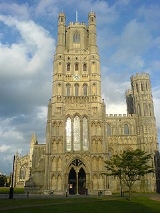
Ely Cathedral (in full,
The Cathedral Church of the Holy and Undivided Trinity of Ely) is the principal church of the
Diocese of ElyThe Diocese of Ely is a Church of England diocese in the Province of Canterbury. It is headed by the Bishop of Ely, who sits at Ely Cathedral in Ely. There is one suffragan bishop, the Bishop of Huntingdon. The diocese now covers Cambridgeshire and western Norfolk...
, in
CambridgeshireCambridgeshire is a county in England, bordering Lincolnshire to the north, Norfolk to the northeast, Suffolk to the east, Essex and Hertfordshire to the south, and Bedfordshire and Northamptonshire to the west...
,
EnglandEngland is a country that is part of the United Kingdom. It shares land borders with Scotland to the north and Wales to the west; the Irish Sea is to the north west, the Celtic Sea to the south west and the North Sea to the east, with the English Channel to the south separating it from continental...
, and the seat of the
Bishop of ElyThe Bishop of Ely is the Ordinary of the Church of England Diocese of Ely in the Province of Canterbury.The diocese roughly covers the county of Cambridgeshire , together with a section of north-west Norfolk and has its see in the City of Ely, Cambridgeshire, where the seat is located at the...
. It is known locally as "the ship of the
FensThe Fens, also known as the Fenland, is a geographic area in eastern England, in the United Kingdom.The Fenland primarily lies around the coast of the Wash; it reaches into two Government regions , four ceremonial counties , 11 District Councils and six postcode areas The Fens, also known as the...
", because of its prominent shape that towers above the surrounding flat and watery landscape.
The first Christian building on the site was founded by
St. ÆthelthrythÆthelthryth, or Æðelþryð, is the proper name for the popular Anglo-Saxon saint often known, particularly in a religious context, as Etheldreda or by the pet form of Audrey...
(romanised as "Etheldreda"), daughter of the
Anglo-SaxonAnglo-Saxons is the term usually used to describe the invading Germanic tribes in the south and east of Great Britain from the early 5th century AD, and their creation of the English nation, to the Norman conquest of 1066...
King Anna of East AngliaAnna was a mid-7th century King of East Anglia. He was the nephew of Raedwald of East Anglia, and probably the second of the sons of Eni, Raedwald's brother, to hold the kingdom, ruling .-Family:...
, who was born in 630 at
ExningExning is a village in Suffolk, England.It lies just off the A14 trunk road, roughly east-northeast of Cambridge, and south-south-east of Ely...
near Newmarket.
Ely Cathedral (in full,
The Cathedral Church of the Holy and Undivided Trinity of Ely) is the principal church of the
Diocese of ElyThe Diocese of Ely is a Church of England diocese in the Province of Canterbury. It is headed by the Bishop of Ely, who sits at Ely Cathedral in Ely. There is one suffragan bishop, the Bishop of Huntingdon. The diocese now covers Cambridgeshire and western Norfolk...
, in
CambridgeshireCambridgeshire is a county in England, bordering Lincolnshire to the north, Norfolk to the northeast, Suffolk to the east, Essex and Hertfordshire to the south, and Bedfordshire and Northamptonshire to the west...
,
EnglandEngland is a country that is part of the United Kingdom. It shares land borders with Scotland to the north and Wales to the west; the Irish Sea is to the north west, the Celtic Sea to the south west and the North Sea to the east, with the English Channel to the south separating it from continental...
, and the seat of the
Bishop of ElyThe Bishop of Ely is the Ordinary of the Church of England Diocese of Ely in the Province of Canterbury.The diocese roughly covers the county of Cambridgeshire , together with a section of north-west Norfolk and has its see in the City of Ely, Cambridgeshire, where the seat is located at the...
. It is known locally as "the ship of the
FensThe Fens, also known as the Fenland, is a geographic area in eastern England, in the United Kingdom.The Fenland primarily lies around the coast of the Wash; it reaches into two Government regions , four ceremonial counties , 11 District Councils and six postcode areas The Fens, also known as the...
", because of its prominent shape that towers above the surrounding flat and watery landscape.
Previous buildings
The first Christian building on the site was founded by
St. ÆthelthrythÆthelthryth, or Æðelþryð, is the proper name for the popular Anglo-Saxon saint often known, particularly in a religious context, as Etheldreda or by the pet form of Audrey...
(romanised as "Etheldreda"), daughter of the
Anglo-SaxonAnglo-Saxons is the term usually used to describe the invading Germanic tribes in the south and east of Great Britain from the early 5th century AD, and their creation of the English nation, to the Norman conquest of 1066...
King Anna of East AngliaAnna was a mid-7th century King of East Anglia. He was the nephew of Raedwald of East Anglia, and probably the second of the sons of Eni, Raedwald's brother, to hold the kingdom, ruling .-Family:...
, who was born in 630 at
ExningExning is a village in Suffolk, England.It lies just off the A14 trunk road, roughly east-northeast of Cambridge, and south-south-east of Ely...
near Newmarket. She may have acquired land at Ely from her first husband Tondberht, described by
BedeBede , also Saint Bede, the Venerable Bede, or Beda , was a monk at the Northumbrian monastery of Saint Peter at Monkwearmouth, today part of Sunderland, England, and of its companion monastery, Saint Paul's, in modern Jarrow , both in the Kingdom of Northumbria.He is well known as an author and...
as a "prince" of the South Gyrwas. After the end of her second marriage to
EcgfrithEcgfrith was the King of Northumbria from 670 until his death. He ruled over Northumbria when it was at the height of its power, but his reign ended with a disastrous defeat in which he lost his life....
, a prince of
NorthumbriaNorthumbria or Northhumbria was a medieval kingdom of the Angles, in what is now north-east England and southern Scotland, becoming subsequently an earldom in a united Anglo-Saxon kingdom of England. The name reflects the approximate southern limit to the kingdom's territory: the Humber...
, she set up and ruled a monastery at Ely in 673, and, when she died, a shrine was built there to her memory. The monastery is traditionally believed to have been destroyed in the Danish invasions of the late 9th century, together with what is now the city. However, while the
layIn religious organizations, the laity comprises all persons who are not clergy. A person who is a member of a religious order who is not ordained clergy is considered as a member of the laity, even though they are members of a religious order .In the past in Christian cultures, the term lay priest...
settlement of the time would have been a minor one, it is likely that a church survived there until its refoundation in the 10th century.
A new Benedictine monastery was built and endowed on the site by
AthelwoldSaint Æthelwold of Winchester was a 10th century Bishop of Winchester and leader of the monastic reform movement in Anglo-Saxon England.-Life:...
,
Bishop of WinchesterThe Bishop of Winchester is the head of the Church of England diocese of Winchester, with his cathedra at Winchester Cathedral in Hampshire.The bishop is one of five Church of England bishops to be among the Lords Spiritual regardless of their length of service. His diocese is one of the oldest and...
, in 970, in a wave of monastic refoundations which locally included
PeterboroughPeterborough Cathedral, or the Cathedral Church of St Peter, St Paul and St Andrew – also known as Saint Peter's Cathedral – the seat of the Bishop of Peterborough, is dedicated to Saint Peter, Saint Paul and Saint Andrew whose statues look down from the three high gables of the famous...
and
RamseyRamsey Abbey is a former Benedictine abbey located in Ramsey, Cambridgeshire, England, southeast of Peterborough and north of Huntingdon.-History:...
. This became a cathedral in 1109, after a new
Diocese of ElyThe Diocese of Ely is a Church of England diocese in the Province of Canterbury. It is headed by the Bishop of Ely, who sits at Ely Cathedral in Ely. There is one suffragan bishop, the Bishop of Huntingdon. The diocese now covers Cambridgeshire and western Norfolk...
was created out of land taken from the
Diocese of LincolnThe Diocese of Lincoln forms part of the Province of Canterbury in England.It traces its roots in an unbroken line to the Diocese of Lindine founded in 678. Nowadays it is much diminished in size since it was the largest diocese in Europe...
.
The present building
The present cathedral was started by
Abbot SimeonSimeon was a relative of William I and the brother of Walkelin, through whose influence he was made prior of Winchester, then in 1082 Abbot of Ely, where he began work on the present building. He recovered for the monastery of Ely the lands which had been allotted to the Normans during their siege...
(1082-1094, brother of
WalkelinWalkelin or Walchelin was the first Norman bishop of Winchester .-Life:He was of noble birth and related to William the Conqueror, whom he served as a royal chaplain. Prior to the Norman Conquest he had probably been a canon at Rouen Cathedral...
, the then
bishop of WinchesterThe Bishop of Winchester is the head of the Church of England diocese of Winchester, with his cathedra at Winchester Cathedral in Hampshire.The bishop is one of five Church of England bishops to be among the Lords Spiritual regardless of their length of service. His diocese is one of the oldest and...
) under
William IWilliam I , better known as William the Conqueror, was Duke of Normandy from AD 1035 and King of England from late 1066 to his death. William is sometimes also referred to as "William II" in relation to his position as the second Duke of Normandy of that name...
in 1083. Building continued under Simeon's successor, Abbot Richard (1100-1107). The Anglo-Saxon church was demolished, but some of its relics, such as the remains of its benefactors, were moved to the cathedral. The main transepts were built early on, crossing the nave below a central tower, and are the oldest surviving part of the cathedral. The West Tower was built between 1174 and 1197, and the
RomanesqueRomanesque architecture is an architectural style of Medieval Europe, characterised by semi-circular arches, and evolving into the Gothic style, characterised by pointed arches, beginning in the 12th century...
style of the west front overall shows that it was built in the 12th century, with the later addition of the Galilee porch (1198-1215). The west tower is 66m high (215ft). The unique Octagon 'Lantern Tower' was constructed during the 1300s and replaced the old central tower which collapsed. 'The Lantern' is 23m (74ft) wide and is 52m (170ft) high. From the floor to central roof boss 'The Lantern' is 43m (142ft) high.
The cathedral is built from stone quarried from
BarnackBarnack is a village and civil parish in the City of Peterborough unitary authority of Cambridgeshire, England. It is located in the north-west of the district, only four miles south-east from Stamford in Lincolnshire. According to the 2001 census, it had a population of 851 people. Barnack's...
in
NorthamptonshireNorthamptonshire is a landlocked county in the English East Midlands, with a population of 629,676 as at the 2001 census...
(bought from Peterborough Abbey, whose lands included the quarries, for 8000 eels a year), with decorations in
Purbeck MarblePurbeck Marble is a fossiliferous limestone quarried in the Isle of Purbeck, a peninsula in south-east Dorset, England.It is one of many kinds of Purbeck Limestone, deposited in the late Jurassic or early Cretaceous periods....
and local
clunchClunch is a traditional building material used mainly in eastern England and Normandy. It is a term which encompasses a wide variety of materials, often locally variable....
. The plan of the building is cruciform (cross-shaped), with the
altarAn altar is any structure upon which offerings such as sacrifices and votive offerings are made for religious purposes, or some other sacred place where ceremonies take place. Altars are usually found at a shrines, and they can be located in temples, churches and other places of worship...
at the east end. The total length is 537 feet (163.7 m), and with the nave at over 75 m long (250ft), remains the longest in Britain.
Attached to the north transept is the Lady Chapel (built 1321-1349 in the Decorated style) by the sacrist
Alan of WalsinghamAlan of Walsingham, died c. 1364; a celebrated architect, first heard of in 1314 as a junior monk at Ely, distinguished by his skill in goldsmith's work, and for his acquaintance with the principles of mechanics....
. It was to his plans, too, that the octagonal tower or octagon (1322-1328) was built after Simeon's original crossing tower collapsed in 1322, injuring nobody but destroying the
choirArchitecturally, the choir is the area of a church or cathedral, usually in the western part of the chancel between the nave and the sanctuary . The choir is occasionally located in the eastern part of the nave...
. This central octagon rises from the whole breadth of the building and towers up until its roof, a wooden lantern, forms the only Gothic dome in existence. The north-west transept collapsed in the 15th century and was never rebuilt, leaving a scar on the outside of that corner that can still be seen. Dating from the early 16th century, is a set of 44
misericordA misericord is a small wooden shelf underneath folding seats in churches installed to provide some level of comfort for those standing during long periods of prayer....
s.
Later history
In 1539, during
Henry VIIIHenry VIII was King of England from 21 April 1509 until his death. He was also Lord of Ireland and claimant to the Kingdom of France. Henry was the second monarch of the House of Tudor, succeeding his father, Henry VII.Henry VIII was a significant figure in the history of the English monarchy...
's
Dissolution of the MonasteriesThe Dissolution of the Monasteries, sometimes referred to as the Suppression of the Monasteries, denotes the administrative and legal processes between 1536 and 1541 by which Henry VIII disbanded monasteries, nunneries and friaries in England, Wales and Ireland; appropriated their income, disposed...
, the cathedral suffered only minor damage, but St Etheldreda's shrine was destroyed. The cathedral was soon refounded in 1541, although many of the statues in the lady chapel were severely damaged.
The Bishop of Ely in the mid 17th century was
Matthew WrenMatthew Wren was an influential English clergyman and scholar.-Life:He attended Pembroke College, Cambridge, where he was a protegé of Lancelot Andrewes. He became a Fellow in 1605 and later President. He was Master of Peterhouse from 1625 to 1634. From this point, his rise was rapid...
and in connection with this, his nephew
Christopher WrenSir Christopher Wren was one of the best known and highest acclaimed English architects in history,...
was responsible for a rather splendid Gothic door, dating from the 1650s, on the north face of the cathedral.
The building has been the subject of several major restoration projects:
- in the 18th century, under James Essex
- in 1839, under George Peacock, with the architect George Gilbert Scott
Sir George Gilbert Scott was an English architect of the Victorian Age, chiefly associated with the design, building and renovation of churches, cathedrals and workhouses....
(the architect Basevi died in a fall from the west tower). A painted wooden ceiling was added to the nave in this restoration.
- from 1986 to 2000
The building is still in active use, and also houses a collection of
stained glassThe term stained glass can refer to the material of coloured glass or the craft of working with it. Throughout its thousand-year history, the term "stained glass" has been applied almost exclusively to the windows of churches, cathedrals, chapels, and other significant buildings...
from the 13th century to the present that is of national importance and includes works from notable contemporary artists like
Ervin BossanyiErvin Bossányi was a Hungarian artist, who worked mainly in northern Germany until his emigration in 1934. He then started a new career as a notable stained glass artist in England.-Biography:Bossányi was born in a small village in southern Hungary and educated in Budapest...
and others.
Music
Ely has a cathedral
choirA choir, chorale, or chorus is a musical ensemble of singers. Choral music, in turn, is the music written specifically for such an ensemble to perform.A body of singers who perform together is called a choir or chorus...
of boys and men, which has recently attracted international attention because of its association with
The ChoirboysThe Choirboys are an English boyband, made up of cathedral choristers, so the members have only a brief time in the group before the inevitable voice-change. The first group comprised: Charles John "CJ" Porter-Thaw from Sheffield, Patrick Aspbury from Chelmsford, and Ben Inman, from Yorkshire...
: two of its members, Patrick Aspbury and CJ Porter-Thaw, are choristers at the cathedral. Boys are educated in the junior department of
The King's School, ElyThe King's School, Ely, is a coeducational independent day and boarding school in the small city of Ely, Cambridgeshire, England. It was founded circa 970 making it one of the oldest schools in the world. The school consists of a nursery, a reception class, junior school, senior school, and an...
.
In a new development breaking thousands of years of tradition, The Ely Cathedral Girls' Choir was also launched in 2006, comprising 18 girl choristers. The ECGC debut CD, ("Sing reign of fair maid: Music for Christmas and the New Year", under the direction of Sarah MacDonald) is available from Regent Records.
The cathedral community has an adult voluntary choir, the Octagon Singers, and a children's choir, the Ely Imps.
Organ
Details of the organ from the National Pipe Organ Register
Organists
- 1453 William Kyng
- 1535 Thomas Barcroft
- 1541 Christopher Tye
Christopher Tye was an English composer and organist, who studied at Cambridge University and in 1545 became a Doctor of Music both there and at Oxford.He was choirmaster of Ely Cathedral from about 1543 and also organist there from 1559...
- 1562 Robert White
Robert White English composer whose liturgical music to Latin texts is considered particularly fine. His surviving works include a setting of verses from Lamentations, and instrumental music for viols....
- 1567 John Farrant
- 1572 William Fox
- 1579 George Barcroft
- 1610 John Amner
John Amner was an English composer.A composer of sacred works, John Amner had a close association with Ely Cathedral—even before his employment there as Informator choristarum —through his relatives, Michael and Ralph Amner, who were both lay clerks there...
- 1641 Robert Claxton
- 1662 John Ferrabosco
- 1681 James Hawkins
- 1729 Thomas Kempton
- 1762 John Elbonn
- 1768 David Wood
- 1774 James Rogers
- 1777 Richard Langdon
- 1778 Highmore Skeats (sen.)
- 1804 Highmore Skeats (jun.)
- 1830 Robert Janes
- 1867 Edmund Thomas Chipp
- 1887 Basil Harwood
Basil Harwood was an English organist and composer.-Life:Basil Harwood was born in Woodhouse, Gloucestershire on 11 April 1859. His mother died in 1867 when Basil was eight. His parents were Quakers but his elder sister Ada, on reaching 21 in 1867, converted to the Anglican Church...
- 1892 Thomas Tertius Noble
- 1898 Hugh Allen
- 1901 Archibald Wilson
- 1919 Noel Ponsonby
- 1926 Hubert Middleton
- 1931 Marmaduke Conway
Marmaduke Percy Conway, Mus.D, FRCO, ARCM , was an English organist and writer.-Education:Conway was educated at Bedford Grammar School and the Royal College of Music, obtaining a B.Mus in Oxford and a Mus.D in Dublin.-Organist:...
- 1949 Sidney Campbell
Sidney Campbell, born in 1909 in London and died on 4 June 1974 in Windsor, was an English Organist.-Education:He studied organ under Ernest Bullock and Harold Darke. In 1931 he was awarded his FRCO-Career:He was*organist of St...
- 1953 Michael Howard
Michael Stockwin Howard ) was an English choral conductor, organist and composer. He was an important part of the Early Music movement in the middle of the last century, in particular as a celebrated interpreter of 16th century polyphony...
- 1958 Arthur Wills
Dr. Arthur Wills is a musician, composer, and professor. He was Director of Music at Ely Cathedral from 1958 to 1990, and also held a Professorship at the Royal Academy of Music in London from 1964 until 1992...
- 1990 Paul Trepte
Assistant organists
- George Legge
- William George Price (later organist to the City of Melbourne)
- Harold Carpenter Lumb Stocks 1906 - 1909
- Edwin Alec Collins 1911 - 1915
- Guillaume Ormond 1927 - 1929 (afterwards organist of Truro Cathedral
The Cathedral of the Blessed Virgin Mary, Truro is an Anglican cathedral located in the city of Truro, Cornwall, in the United Kingdom. It was built in the Gothic Revival architectural style fashionable during the period, and is one of only three cathedrals in the United Kingdom with three spires.-...
)
- Frederick Chubb
- William Bean
- Russell Missin 1945 - 1949
- Arthur Wills 1949 - 1958
- Michael Dudman 1961 - 1964
- Anthony Greening 1964
- Roger Judd
- Gerald Gifford 1973 - 1976
- Stephen Le Prevost 1977 - 1989
- Jeremy Filsell 1989 - 1991
- David Price 1991 - 1996
- Sean Farrell 1996 - 1998
- Scott Farrell 1999 - 2002
- Jonathan Lilley 2002 -
- Edward Taylor (assistant for the Girls' Choir now Assistant Organist at Carlisle Cathedral
The Cathedral Church of the Holy and Undivided Trinity, otherwise called Carlisle Cathedral, is the seat of the Anglican Bishop of Carlisle. It is located in Carlisle, in Cumbria, North West England. It was founded as an Augustinian monastery and became a cathedral in 1133.Carlisle, because of...
)
- Oliver Hancock (current assistant for the Girls' Choir)
See also the List of Organ Scholars at Ely Cathedral.
Honorary Canons
- 1989 John Beer
- 1994 Brian Watchorn
- 1999 Timothy Elbourne
- 2001 Jonathan Young
- 2003 Vanessa Herrick
- 2004 Margaret Guite
- 2004 Richard Longfoot
- 2004 Hugh McCurdy
- 2004 Les Oglesby
- 2004 Owen Spencer-Thomas
Owen Robert Spencer-Thomas MBE was born into a farming family on 3 March 1940 in Braughing, Hertfordshire, England. He is perhaps best known as a television and radio news journalist over three decades, but he has also done a wide range of philanthropric work as volunteer charity fundraiser,...
- 2005 Fiona Brampton
- 2005 Andrew Greany
- 2005 Jane Keiller
- 2005 Stephen Leeke
- 2005 Shamus Williams
- 2005 Francis Woolley
- 2007 Peter Baxendall
- 2007 John Binns
- 2007 Stephen Earl
- 2007 Wim Zwalf
- 2008 Richard Darmody
- 2008 Malcolm Griffith
- 2008 Martin Seeley
- 2008 Fraser Watts
- 2008 David Thomson
In popular culture
- The cathedral features prominently on the cover of Pink Floyd
Pink Floyd were an English rock band who, in the late 1960s, earned recognition for their psychedelic and space rock music, and in the 1970s, as they evolved, for their progressive rock music. Pink Floyd's work is marked by philosophical lyrics, sonic experimentation, innovative album cover art,...
's 1994 album The Division BellThe Division Bell is the final studio album by Pink Floyd, released in 1994 , and their second album without Roger Waters. It was recorded at a number of studios, including guitarist/vocalist David Gilmour's houseboat studio called The Astoria...
.
- A number of John Rutter
John Milford Rutter CBE is an English composer, choral conductor, editor, arranger and record producer.Born in London, he was educated at Highgate School, where a fellow pupil was John Tavener. He then read music at Clare College, Cambridge, where he was a member of the choir and then director of...
's choral albums feature the cathedral, a reference to early recordings of his music being performed and recorded in the Lady Chapel.
- Direct references to Ely Cathedral appear in the children's book Tom's Midnight Garden
Tom's Midnight Garden is a children's novel by Philippa Pearce. It is considered a masterpiece of English children's literature, and won the Carnegie Medal in 1958, the year of its publication...
by Philippa Pearce. A full-length movie with the same title was released in 1999.
- A section of the film Elizabeth: The Golden Age was filmed at the Cathedral.
- Filming for The Other Boleyn Girl
The Other Boleyn Girl is a historical fiction novel by Philippa Gregory. Two film adaptions of the novel have been produced:* The Other Boleyn Girl , television drama film produced by the BBC...
took place at the Cathedral in August 2007.
- Parts of the novel Floodland
Floodland is a children's fantasy novel by Marcus Sedgwick, published on March 2, 2000 by Orion Children's Books and aimed at children. Floodland won the Branford Boase Award in 2001 for an outstanding first published novel.- Plot introduction :...
, by Marcus SedgwickMarcus Sedgwick was born in Kent, England. Marcus is a British author and illustrator as well as a musician. He used to play for two bands namely playing the drums for Garrett and as the guitarist in an ABBA tribute group...
, take place at the Cathedral after the sea has consumed the land around it turning ElyEly is a cathedral city in Cambridgeshire, England. It is 14 miles north-northeast of Cambridge.Ely has been informally accounted a city by virtue of being the seat of a diocese. Its status was confirmed by Royal Charter in 1974, when the parish council of the single civil parish that makes up...
into an island.
- Direct references to Ely Cathedral are made in Jill Dawson's novel 'Watch Me Disappear'
See also
- List of cathedrals in the United Kingdom
- Architecture of the medieval cathedrals of England
The medieval cathedrals of England, dating from between approximately 1040 and 1540, are a group of twenty-five buildings which together constitute a major aspect of the country’s artistic heritage and are among the most significant material symbols of Christianity. Though diversified in style,...
- St Etheldreda's Church
St. Etheldreda's Church is located in Ely Place, off Charterhouse Street, Holborn, London. It is dedicated to Æthelthryth, or Etheldreda, an Anglo-Saxon saint. It consists of a chapel, or Upper Church, and a crypt, or undercroft. It is the second oldest Catholic church in England, and one of only...
- English Gothic architecture
English Gothic is the name of the architectural style that flourished in England from about 1180 until about 1520.-Introduction:As with the Gothic architecture of other parts of Europe, English Gothic is defined by its pointed arches, vaulted roofs, buttresses, large windows, and spires...
- Romanesque architecture
Romanesque architecture is an architectural style of Medieval Europe, characterised by semi-circular arches, and evolving into the Gothic style, characterised by pointed arches, beginning in the 12th century...
- Church of England
The Church of England is the officially established Christian church in England, the Mother Church of the worldwide Anglican Communion and the oldest among the communion's thirty-eight independent national and regional churches...
External links