


Roman concrete

Encyclopedia
Roman Republic
The Roman Republic was the period of the ancient Roman civilization where the government operated as a republic. It began with the overthrow of the Roman monarchy, traditionally dated around 508 BC, and its replacement by a government headed by two consuls, elected annually by the citizens and...
through the whole history of the Roman Empire
Roman Empire
The Roman Empire was the post-Republican period of the ancient Roman civilization, characterised by an autocratic form of government and large territorial holdings in Europe and around the Mediterranean....
. Roman concrete
Concrete
Concrete is a composite construction material, composed of cement and other cementitious materials such as fly ash and slag cement, aggregate , water and chemical admixtures.The word concrete comes from the Latin word...
was based on a hydraulic-setting cement with many material qualities similar to modern Portland cement
Portland cement
Portland cement is the most common type of cement in general use around the world because it is a basic ingredient of concrete, mortar, stucco and most non-specialty grout...
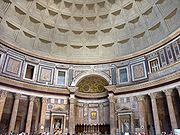
. By the middle of the 1st century, the material was used frequently as brick-faced concrete, although variations in aggregate allowed different arrangements of materials. Further innovative developments in the material, coined the Concrete Revolution, contributed to structurally complicated forms, such as the Pantheon
Pantheon, Rome
The Pantheon ,Rarely Pantheum. This appears in Pliny's Natural History in describing this edifice: Agrippae Pantheum decoravit Diogenes Atheniensis; in columnis templi eius Caryatides probantur inter pauca operum, sicut in fastigio posita signa, sed propter altitudinem loci minus celebrata.from ,...
dome.
Historic references
Vitruvius
Marcus Vitruvius Pollio was a Roman writer, architect and engineer, active in the 1st century BC. He is best known as the author of the multi-volume work De Architectura ....
, writing around 25 BC
25 BC
Year 25 BC was either a common year starting on Wednesday, Thursday or Friday or a leap year starting on Wednesday or Thursday of the Julian calendar and a leap year starting on Tuesday of the Proleptic Julian calendar...
in his Ten Books on Architecture
De architectura
' is a treatise on architecture written by the Roman architect Vitruvius and dedicated to his patron, the emperor Caesar Augustus, as a guide for building projects...
, distinguished types of aggregate appropriate for the preparation of lime mortar
Lime mortar
Lime mortar is a type of mortar composed of lime and an aggregate such as sand, mixed with water. It is one of the oldest known types of mortar, dating back to the 4th century BC and widely used in Ancient Rome and Greece, when it largely replaced the clay and gypsum mortars common to Ancient...
s. For structural mortars, he recommended pozzolana
Pozzolana
Pozzolana, also known as pozzolanic ash , is a fine, sandy volcanic ash. Pozzolanic ash was first discovered and dug in Italy, at Pozzuoli. It was later discovered at a number of other sites as well...
, which were volcanic sands from the sandlike beds of Puteoli brownish-yellow-gray in color near Naples
Naples
Naples is a city in Southern Italy, situated on the country's west coast by the Gulf of Naples. Lying between two notable volcanic regions, Mount Vesuvius and the Phlegraean Fields, it is the capital of the region of Campania and of the province of Naples...
and reddish-brown at Rome
Rome
Rome is the capital of Italy and the country's largest and most populated city and comune, with over 2.7 million residents in . The city is located in the central-western portion of the Italian Peninsula, on the Tiber River within the Lazio region of Italy.Rome's history spans two and a half...
. Vitruvius specifies a ratio of 1 part lime to 3 parts pozzolana for cements used in buildings and a 1:2 ratio of lime to pulvis Puteolanus for underwater work, essentially the same ratio mixed today for concrete used at sea.
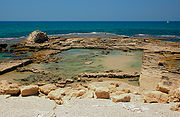
By the middle of the 1st century, the principles of underwater construction in concrete were well known to Roman builders. The City of Caesarea was the earliest known example to have made use of underwater Roman concrete technology on such a large scale.
Rebuilding Rome after the fire in 64 AD
Great Fire of Rome
The Great Fire of Rome was an urban fire that occurred beginning July 19, AD 64.-Background:According to Tacitus, the fire spread quickly and burned for six days. Only four of the fourteen districts of Rome escaped the fire; three districts were completely destroyed and the other seven suffered...
, which destroyed large portions of the city, the new building code by Nero
Nero
Nero , was Roman Emperor from 54 to 68, and the last in the Julio-Claudian dynasty. Nero was adopted by his great-uncle Claudius to become his heir and successor, and succeeded to the throne in 54 following Claudius' death....
consisted of largely brick-faced concrete. This appears to have encouraged the development of the brick and concrete industries.
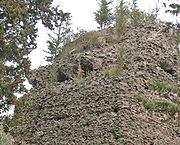
- Opus incertumOpus incertumthumb|280px|Layers of opus incertum on the left side of the Temple of Iovis Anxur in [[Terracina]], [[Italy]].Opus incertum was an ancient Roman construction technique, using irregular shaped and random placed uncut stones or fist-sized tuff blocks inserted in a core of Opus caementicium.Initially...
: small irregular stones. - Opus reticulatumOpus reticulatumOpus reticulatum is a form of brickwork used in ancient Roman architecture. It consists of diamond-shaped bricks of tuff placed around a core of opus caementicium...
: small squared tuffTuffTuff is a type of rock consisting of consolidated volcanic ash ejected from vents during a volcanic eruption. Tuff is sometimes called tufa, particularly when used as construction material, although tufa also refers to a quite different rock. Rock that contains greater than 50% tuff is considered...
blocks laid in a diamond pattern. - Opus quadratumOpus quadratumOpus quadratum is an ancient Roman construction technique, in which squared blocks of stone of the same height were set in parallel courses, often without the use of mortar.-Technique:...
: regularly laid courses of ashlarAshlarAshlar is prepared stone work of any type of stone. Masonry using such stones laid in parallel courses is known as ashlar masonry, whereas masonry using irregularly shaped stones is known as rubble masonry. Ashlar blocks are rectangular cuboid blocks that are masonry sculpted to have square edges...
s. - Opus latericiumOpus latericiumthumb|250px|Example of opus latericium on a tomb of the ancient [[Appian Way]] in [[Rome]].Opus latericium is an ancient Roman form of construction in which coarse-laid brickwork is used to face a core of opus caementicium....
: regularly laid courses of brickBrickA brick is a block of ceramic material used in masonry construction, usually laid using various kinds of mortar. It has been regarded as one of the longest lasting and strongest building materials used throughout history.-History:...
. - Opus spicatumOpus spicatumOpus spicatum, literally "spiked work," is a type of masonry construction used in Roman and medieval times. It consists of bricks, tiles or cut stone laid in a herringbone pattern.-Uses:...
: brick laid in a herringbone pattern. - Opus vittatumOpus vittatum250px|thumb|Theatre of [[Augustus]] in [[Augusta Raurica]]. The steps are in opus vittatum.Opus vittatum was an ancient Roman construction technique, sometimes square with tuff blocks intersected by one or more brick-bands at regular or irregular distances, and Opus caementicium.This technique was...
: square tuffTuffTuff is a type of rock consisting of consolidated volcanic ash ejected from vents during a volcanic eruption. Tuff is sometimes called tufa, particularly when used as construction material, although tufa also refers to a quite different rock. Rock that contains greater than 50% tuff is considered...
blocks intersected by brick bands at regular and irregular distances. - Opus africanumOpus africanumOpus africanum is a form of ashlar masonry used in Carthaginian and ancient Roman architecture, characterized by pillars of vertical blocks of stone alternating with horizontal blocks, filled in with smaller blocks in between....
: vertical chains of upright blocks with alternating horizontal blocks. - Opus testaceum: thick horizontal brick work.
Material properties
Roman concrete, like any concreteConcrete
Concrete is a composite construction material, composed of cement and other cementitious materials such as fly ash and slag cement, aggregate , water and chemical admixtures.The word concrete comes from the Latin word...
, consists of an aggregate
Construction Aggregate
Construction aggregate, or simply "aggregate", is a broad category of coarse particulate material used in construction, including sand, gravel, crushed stone, slag, recycled concrete and geosynthetic aggregates. Aggregates are the most mined material in the world...
and hydraulic mortar
Mortar (masonry)
Mortar is a workable paste used to bind construction blocks together and fill the gaps between them. The blocks may be stone, brick, cinder blocks, etc. Mortar becomes hard when it sets, resulting in a rigid aggregate structure. Modern mortars are typically made from a mixture of sand, a binder...
– a binder mixed with water that hardens over time. The aggregate varied, and included pieces of rock, ceramic tile, and brick rubble from the remains of previously demolished buildings. Reinforcing elements, such as steel
Steel
Steel is an alloy that consists mostly of iron and has a carbon content between 0.2% and 2.1% by weight, depending on the grade. Carbon is the most common alloying material for iron, but various other alloying elements are used, such as manganese, chromium, vanadium, and tungsten...
rebar
Rebar
A rebar , also known as reinforcing steel, reinforcement steel, rerod, or a deformed bar, is a common steel bar, and is commonly used as a tensioning device in reinforced concrete and reinforced masonry structures holding the concrete in compression...
, were not used.
Gypsum
Gypsum
Gypsum is a very soft sulfate mineral composed of calcium sulfate dihydrate, with the chemical formula CaSO4·2H2O. It is found in alabaster, a decorative stone used in Ancient Egypt. It is the second softest mineral on the Mohs Hardness Scale...
and lime
Calcium oxide
Calcium oxide , commonly known as quicklime or burnt lime, is a widely used chemical compound. It is a white, caustic, alkaline crystalline solid at room temperature....
were used as binders. Volcanic
Volcano
2. Bedrock3. Conduit 4. Base5. Sill6. Dike7. Layers of ash emitted by the volcano8. Flank| 9. Layers of lava emitted by the volcano10. Throat11. Parasitic cone12. Lava flow13. Vent14. Crater15...
dusts, called Pozzolana or "pit sand", were favored where they could be obtained. The pozzolanic mortar used had a high content of alumina and silica.
Concrete, and in particular, the hydraulic mortar responsible for its cohesion, was a type of structural ceramic whose utility derived largely from its rheological plasticity in the paste state. The setting and hardening of hydraulic cements derived from hydration of materials and the subsequent chemical and physical interaction of these hydration products. This differed from the setting of slaked lime mortars
Lime mortar
Lime mortar is a type of mortar composed of lime and an aggregate such as sand, mixed with water. It is one of the oldest known types of mortar, dating back to the 4th century BC and widely used in Ancient Rome and Greece, when it largely replaced the clay and gypsum mortars common to Ancient...
, the most common cements of the pre-Roman world. Once set, Roman concrete exhibited little plasticity, although it retained some resistance to tensile stresses.
The setting of pozzolanic cements has much in common with setting of their modern counterpart, Portland cement. The high silica composition of Roman pozzolana cements is very close to that of modern cement to which blast furnace slag
Slag
Slag is a partially vitreous by-product of smelting ore to separate the metal fraction from the unwanted fraction. It can usually be considered to be a mixture of metal oxides and silicon dioxide. However, slags can contain metal sulfides and metal atoms in the elemental form...
, fly ash
Fly ash
Fly ash is one of the residues generated in combustion, and comprises the fine particles that rise with the flue gases. Ash which does not rise is termed bottom ash. In an industrial context, fly ash usually refers to ash produced during combustion of coal...
, or silica fume
Silica fume
Silica fume, also known as microsilica, is a fine-grain, thin, and very high surface area silica.It is sometimes confused with fumed silica and colloidal silica...
have been added.
Compressive strengths for modern Portland cements are typically at the 50 MPa level and have improved almost ten-fold since 1860. There are no comparable mechanical data for ancient mortars, although some information about tensile strength may be inferred from the cracking of Roman concrete domes. These tensile strengths vary substantially from the water/cement ratio used in the initial mix. At present, there is no way of ascertaining what water/cement ratios the Romans used, nor are there extensive data for the effects of this ratio on the strengths of pozzolanic cements.
Seismic technology
For an environment as prone to earthquakeEarthquake
An earthquake is the result of a sudden release of energy in the Earth's crust that creates seismic waves. The seismicity, seismism or seismic activity of an area refers to the frequency, type and size of earthquakes experienced over a period of time...
s as the Italian peninsula
Italian Peninsula
The Italian Peninsula or Apennine Peninsula is one of the three large peninsulas of Southern Europe , spanning from the Po Valley in the north to the central Mediterranean Sea in the south. The peninsula's shape gives it the nickname Lo Stivale...
, interruptions and internal constructions within walls and domes created discontinuities in the concrete mass. Portions of the building could then shift slightly when there was movement of the earth to accommodate such stresses, enhancing the overall strength of the structure. It was in this sense that bricks and concrete were flexible. It may have been precisely for this reason that, although many buildings sustained serious cracking from a variety of causes, they continue to stand to this day.
Another technology used to improve the strength
Strength
- Physical ability :*Physical strength, as in people or animals*Superhuman strength, as in fictional characters*A common character attribute in role-playing gamesConflict between persons or groups:*Virtue and moral uprightness...
and stability of concrete was its gradation in domes. One example included the Pantheon
Pantheon, Rome
The Pantheon ,Rarely Pantheum. This appears in Pliny's Natural History in describing this edifice: Agrippae Pantheum decoravit Diogenes Atheniensis; in columnis templi eius Caryatides probantur inter pauca operum, sicut in fastigio posita signa, sed propter altitudinem loci minus celebrata.from ,...
, where the aggregate of the upper dome region consisted of alternating layers of light tuff and pumice, giving the concrete a density of 1350 kg/m3. The foundation of the structure used travertine
Travertine
Travertine is a form of limestone deposited by mineral springs, especially hot springs. Travertine often has a fibrous or concentric appearance and exists in white, tan, and cream-colored varieties. It is formed by a process of rapid precipitation of calcium carbonate, often at the mouth of a hot...
as an aggregate, having a much higher density of 2200 kg/m3.
Literature
- Jean-Pierre Adam, Anthony Mathews, Roman Building, 1994
- Lynne C. Lancaster, Concrete Vaulted Construction in Imperial Rome, Cambridge University Press, 2005
- Heather N. Lechtman & Linn W. Hobbs, “Roman Concrete and the Roman Architectural Revolution,” Ceramics and Civilization Volume 3: High Technology Ceramics: Past, Present, Future, edited by W.D. Kingery and published by the American Ceramics Society, 1986
- W. L. MacDonald, The Architecture of the Roman Empire, rev. ed. Yale University Press, New Haven, 1982