

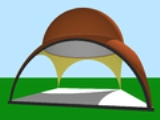
Pendentive

Encyclopedia

Dome
A dome is a structural element of architecture that resembles the hollow upper half of a sphere. Dome structures made of various materials have a long architectural lineage extending into prehistory....
over a square room or an elliptical
Ellipse
In geometry, an ellipse is a plane curve that results from the intersection of a cone by a plane in a way that produces a closed curve. Circles are special cases of ellipses, obtained when the cutting plane is orthogonal to the cone's axis...
dome
Dome
A dome is a structural element of architecture that resembles the hollow upper half of a sphere. Dome structures made of various materials have a long architectural lineage extending into prehistory....
over a rectangular room. The pendentives, which are triangular segments of a sphere
Sphere
A sphere is a perfectly round geometrical object in three-dimensional space, such as the shape of a round ball. Like a circle in two dimensions, a perfect sphere is completely symmetrical around its center, with all points on the surface lying the same distance r from the center point...
, taper to points at the bottom and spread at the top to establish the continuous circular or elliptical base needed for the dome. In masonry the pendentives thus receive the weight of the dome, concentrating it at the four corners where it can be received by the piers
Pier (architecture)
In architecture, a pier is an upright support for a superstructure, such as an arch or bridge. Sections of wall between openings function as piers. The simplest cross section of the pier is square, or rectangular, although other shapes are also common, such as the richly articulated piers of Donato...
beneath.
Prior to the pendentive's development, the device of corbelling
Corbel
In architecture a corbel is a piece of stone jutting out of a wall to carry any superincumbent weight. A piece of timber projecting in the same way was called a "tassel" or a "bragger". The technique of corbelling, where rows of corbels deeply keyed inside a wall support a projecting wall or...
or the use of the squinch
Squinch
A squinch in architecture is a construction filling in the upper angles of a square room so as to form a base to receive an octagonal or spherical dome...
in the corners of a room had been employed. Pendentives were commonly used in Orthodox
Eastern Orthodox church architecture
An Orthodox church as a church building of Eastern Orthodoxy has a distinct, recognizable style among church architectures.-History:While sharing many traditions, East and West in Christianity began to diverge from each other from an early date...
, Renaissance
Renaissance
The Renaissance was a cultural movement that spanned roughly the 14th to the 17th century, beginning in Italy in the Late Middle Ages and later spreading to the rest of Europe. The term is also used more loosely to refer to the historical era, but since the changes of the Renaissance were not...
, and Baroque
Baroque
The Baroque is a period and the style that used exaggerated motion and clear, easily interpreted detail to produce drama, tension, exuberance, and grandeur in sculpture, painting, literature, dance, and music...
churches, with a drum
Tholobate
A tholobate or drum, in architecture, is the upright part of a building on which a dome is raised. It is generally in the shape of a cylinder or a polygonal prism....
with windows often inserted between the pendentives and the dome. The first experimentation with pendentives were made in Roman dome construction beginning in the 2nd–3rd century AD, while full development of the form was achieved in the 6th century Eastern Roman
Byzantine Empire
The Byzantine Empire was the Eastern Roman Empire during the periods of Late Antiquity and the Middle Ages, centred on the capital of Constantinople. Known simply as the Roman Empire or Romania to its inhabitants and neighbours, the Empire was the direct continuation of the Ancient Roman State...
Hagia Sophia
Hagia Sophia
Hagia Sophia is a former Orthodox patriarchal basilica, later a mosque, and now a museum in Istanbul, Turkey...
at Constantinople
Constantinople
Constantinople was the capital of the Roman, Eastern Roman, Byzantine, Latin, and Ottoman Empires. Throughout most of the Middle Ages, Constantinople was Europe's largest and wealthiest city.-Names:...
. The diameter of its central dome remained unsurpassed anywhere in the world until the Renaissance Florence Cathedral, itself not a pendentive dome.