
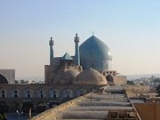
Imam Mosque, is a
mosqueA mosque is a place of worship for followers of Islam. The word is likely to have entered the English language through French , from Portuguese , from Spanish , and from Berber , ultimately originating in — . The Arabic word masjid literally means a place of prostration...
in
IsfahanIsfahan , historically also rendered in English as Ispahan, Sepahan or Hispahan, is the capital of Isfahan Province in Iran, located about 340 km south of Tehran. It has a population of 1,583,609, Iran's third largest city after Tehran and Mashhad...
,
IranIran , officially the Islamic Republic of Iran , is a country in Southern and Western Asia. The name "Iran" has been in use natively since the Sassanian era and came into use internationally in 1935, before which the country was known to the Western world as Persia...
standing in south side of
Naghsh-i Jahan SquareNaqsh-e Jahan Square , known as Imam Square , formerly known as Shah Square , is a square situated at the center of Isfahan city, Iran. Constructed between 1598 and 1629, it is now an important historical site, and one of UNESCO's World Heritage Sites...
.
Built during the Safavid period, it is an excellent example of
Islamic architectureIslamic architecture encompasses a wide range of both secular and religious styles from the foundation of Islam to the present day, influencing the design and construction of buildings and structures in Islamic culture....
of Iran, and regarded as one of the masterpieces of
Persian ArchitectureIranian architecture or Persian architecture is the architecture of Iran . It has a continuous history from at least 5000 BCE to the present, with characteristic examples distributed over a vast area from Turkey to North India and the borders of China and from the Caucasus to Zanzibar...
. The Shah Mosque of Esfahan is one of the everlasting masterpieces of architecture in Iran. It is registered, along with the Naghsh-i Jahan Square, as a
UNESCOThe United Nations Educational, Scientific and Cultural Organization is a specialized agency of the United Nations...
World Heritage SiteA UNESCO World Heritage Site is a place that is listed by the UNESCO as of special cultural or physical significance...
. Its construction began in 1611, and its splendor is mainly due to the beauty of its seven-colour mosaic tiles and
calligraphicCalligraphy is a type of visual art. It is often called the art of fancy lettering . A contemporary definition of calligraphic practice is "the art of giving form to signs in an expressive, harmonious and skillful manner"...
inscriptions.
The
mosqueA mosque is a place of worship for followers of Islam. The word is likely to have entered the English language through French , from Portuguese , from Spanish , and from Berber , ultimately originating in — . The Arabic word masjid literally means a place of prostration...
is one of the treasures featured on
Around the World in 80 TreasuresAround the World in 80 Treasures is a 10 episode art and travel documentary series by the BBC, presented by Dan Cruickshank, and originally aired in February, March, and April 2005...
presented by the architecture historian
Dan CruickshankDan Cruickshank is an art historian and BBC television presenter.-Early life:As a young child he lived for some years in Poland...
.
The mosque is depicted on the
reverseObverse and its opposite, reverse, refer to the two flat faces of coins and some other two-sided objects, including paper money, flags , seals, medals, drawings, old master prints and other works of art, and printed fabrics. In this usage, obverse means the front face of the object and reverse...
of the Iranian 20,000
rialsThe rial is the currency of Iran. It is subdivided into 100 dinar but, because of the very low current value of the rial, no fraction of the rial is used in accounting....
banknote.
History
In 1598, when
Shah AbbasShāh ‘Abbās the Great was Shah of Iran, and generally considered the greatest ruler of the Safavid dynasty. He was the third son of Shah Mohammad....
decided to move the capital of his Persian empire from the northwestern city of
QazvinQazvin is the largest city and capital of the Province of Qazvin in Iran. At the 2006 census, its population was 349,821, in 96,420 families....
to the central city of Isfahan, he initiated what would become one of the greatest programmes in Persian history; the complete remaking of this ancient city. By choosing the central city of Isfahan, fertilized by the Zāyande roud ("The
life-giving river"), lying as an oasis of intense cultivation in the midst of a vast area of arid landscape, he both distanced his capital from any future assaults by the Ottomans and the
UzbeksThe Uzbeks are a Turkic ethnic group in Central Asia. They comprise the majority population of Uzbekistan, and large populations can also be found in Afghanistan, Tajikstan, Kyrgyzstan, Turkmenistan, Kazakhstan, Russia, Pakistan, Mongolia and the Xinjiang Uyghur Autonomous Region of China...
, and at the same time gained more control over the
Persian GulfThe Persian Gulf, in Southwest Asia, is an extension of the Indian Ocean located between Iran and the Arabian Peninsula.The Persian Gulf was the focus of the 1980–1988 Iran-Iraq War, in which each side attacked the other's oil tankers...
, which had recently become an important trading route for the Dutch and British
East India CompaniesThe East India Company was an early English joint-stock company that was formed initially for pursuing trade with the East Indies, but that ended up trading mainly with the Indian subcontinent and China...
.
The chief architect of this colossal task of urban planning was
Shaykh BahaiMuhammad ibn Thalib ibn Abd Allah ibn Ni`mat Allah ibn Sadr ad-Din ibn Shaykh Baha' ad-Din ash-Shirazi was a 15th century Persian physician from Shiraz, Iran....
(Baha' ad-Din al-`Amili), who focused the programme on two key features of Shah Abbas's master plan: the
Chahar BaghChahar Bagh is an avenue in Isfahan constructed in the Safavid era of Iran. Shah Abbas I was the king who changed his capital from Qazvin to Esfahan and decided to pour all the countries artistic wealth into that central spot which has been dubbed for centuries nisfi jahan or "Half the...
avenue, flanked at either side by all the prominent institutions of the city, such as the residences of all foreign dignitaries, and the Naqsh-e Jahan Square ("
Examplar of the World"). Prior to the Shah's ascent to power, Persia had a decentralized power structure, in which different institutions battled for power, including both the military (the Qizilbash) and governors of the different provinces making up the empire. Shah Abbas wanted to undermine this political structure, and the recreation of Isfahan, as a Grand capital of Persia, was an important step in centralizing the power. The ingenuity of the square, or
Maidān, was that, by building it, Shah Abbas would gather the three main components of power in Persia in his own backyard; the power of the clergy, represented by the Masjed-e Shah, the power of the merchants, represented by the The Imperial Bazaar, and of course, the power of the Shah himself, residing in the
Ali QapuĀlī Qāpū is a grand palace in Isfahan, Iran. It is located on the western side of the Naghsh-i Jahan Square opposite to Sheikh lotf allah mosque, and had been originally designed as a vast portal. It is forty-eight meters high and there are seven floors, each accessible by a difficult spiral...
Palace.
The crown jewel in this project was the Masjed-e Shah, which would replace the much older Jameh Mosque in conducting the Friday prayers. To achieve this, the Shah Mosque was constructed not only with vision of grandeur, having the largest dome in the city, but Shaykh Bahai also planned the construction of two religious schools and a winter mosque clamped at either side of it.
Because of the Shah's desire to have the building completed during his lifetime, shortcuts were taken in the construction; for example, the Shah ignored warnings by one of the architects Abu'l Qāsim regarding the danger of subsidence in the foundations of the mosque, and he pressed ahead with the construction. The architect proved to have been justified, as in 1662 the building had to undergo major repairs. Also, the Persians invented a new style of tile mosaic (the Seven-colour) that was both cheaper and quicker, and that eventually speed up the construction. This job was masterly done by some of the best craftsmen in the country, and the whole work was supervised by Master calligrapher,
Reza AbbasiRiza Abbasi, Riza yi-Abbasi or Reza-e Abbasi, رضا عباسی in Persian, usually "Riza" or Reza Abbasi also Aqa Riza or Āqā Riżā Kāshānī was the leading Persian miniaturist of the Isfahan School during the later Safavid period, spending most of his career working for Shah Abbas I...
. In the end, the final touches on the mosque were made in late 1629, few months after the death of the Shah.
Also, many historians have wondered about the peculiar orientation of The Royal square (The Maidān). Unlike most buildings of importance, this square did not lie in alignment with
MeccaMecca is a city in the Hijaz and the capital of Makkah province in Saudi Arabia. The city is located inland from Jeddah in a narrow valley at a height of above sea level...
, so that when entering the entrance-portal of the mosque, one makes, almost without realising it, the half-right turn, which enables the main court within to face Mecca.
Donald WilberDonald Newton Wilber , American writer and spy.Wilber was the architect of the CIA project "Operation Ajax", a successful plot to overthrow the government of Iranian Prime Minister Mohammad Mossadeq. The plot replaced Iran's first democratically elected leader with a brutal dictator and monarch...
gives the most plausible explanation to this; the vision of Shaykh Bahai was for the mosque to be visible wherever in the maydān a person was situated. Had the axis of the maydān coincided with the axis of Mecca, the dome of the mosque would have been concealed from view by the towering entrance portal leading to it. By creating an angle between them, the two parts of the building, the entrance portal and the dome, are in perfect view for everyone within the square to admire.
Architecture and design
Design – the four-iwan style
The Safavids founded the Shah Mosque as a channel through which they could express themselves with their numerous architectural techniques. The four-iwan format, finalized by the
Seljuq dynastyThe Seljuq ; were a Turco-Persian Sunni Muslim dynasty that ruled parts of Central Asia and the Middle East from the 11th to 14th centuries...
, and inherited by the Safavids, firmly established the courtyard facade of such mosques, with the towering gateways at every side, as more important than the actual building themselfs. During Seljuq rule, as Islamic mysticism was on the rise and Persians were looking for a new type of architectural design that emphasized an
IranianTo best understand Iran, Afghanistan, their related societies and their people, one must first attempt to acquire an understanding of their culture. It is in the study of this area where the Persian identity optimally expresses itself...
identity, the four-iwan arrangement took form. The Persians already had a rich architectural legacy, and the distinct shape of the iwan was actually taken from earlier, Sassanid palace-designs, such as The
Palace of ArdashirCastle of Ardeshir e Babakan , also known as the Atash-kadeh آتشکده, is a castle located on the slopes of the mountain on which Ghal'eh Dokhtar is situated on. Built in AD 224 by Ardashir I of the Sassanian Empire, it is located two kilometres north of the ancient city of Gor, i.e...
. Thus,
Islamic architectureIslamic architecture encompasses a wide range of both secular and religious styles from the foundation of Islam to the present day, influencing the design and construction of buildings and structures in Islamic culture....
witnessed the emergence of a new brand that differed from the
hypostyleIn architecture, a hypostyle hall has a roof which is supported by columns, as in the Great Hypostyle Hall at Karnak. The word hypostyle comes from the Ancient Greek hypóstȳlos meaning "under columns"...
design of the early, Arab mosques, such as the
Umayyad MosqueThe Umayyad Mosque, also known as the Great Mosque of Damascus or formerly the Basilica of Saint John the Baptist , is located in the old city of Damascus, is one of the largest and oldest mosques in the world...
. The four-iwan format typically took the form of a square shaped, central courtyard with large entrances at each side, giving the impression of being
gateways to the spiritual world.
Standing in the public square, or Maidan, the entrance-iwan (gateway) to the mosque takes the form of a semicircle, resembling a recessed half-moon and measuring 27 meters in height, the arch framed by turquoise ornament and decorated with rich
stalactiteA stalactite , "to drip", and meaning "that which drips") is a type of speleothem that hangs from the ceiling of limestone caves. It is a type of dripstone...
tilework, a distinct feature of Persian Islamic architecture. At the sides rise two minarets, 42 meters high, topped by beautifully carved, wooden balconies with stalactites running down the sides. Master calligrapher of the Royal court,
Reza AbbasiRiza Abbasi, Riza yi-Abbasi or Reza-e Abbasi, رضا عباسی in Persian, usually "Riza" or Reza Abbasi also Aqa Riza or Āqā Riżā Kāshānī was the leading Persian miniaturist of the Isfahan School during the later Safavid period, spending most of his career working for Shah Abbas I...
, inscribed the date of the groundbreaking of the construction, and besides it, verses praising Muhammad and Ali. In the middle, in front of the entrance, stood a small pool and a resting place for the horses, and inside the worshippers found a large marble basin set on a pedestal, filled with fresh water or lemonade. This basin still stands as it has for four hundred years, but no longer serves the function of providing refreshments to the worshipers at the Friday prayers.
When passing through the entrance portal, one reaches the main courtyard, centered around a large pool. The two gateways (iwans) on the sides leads ones attention to the main gateway at the far end, the only one with minarets, and behind it the lofty dome, with its colorful ornamentation.
The distinct feature of any mosque is the
minaretA minaret مناره , sometimes مئذنه) is a distinctive architectural feature of Islamic mosques, generally a tall spire with an onion-shaped or conical crown, usually either free standing or taller than any associated support structure. The basic form of a minaret includes a base, shaft, and gallery....
, and the Masjed-e Shah has got four. Still, in Persian mosques, tall minarets were considered unsuitable for the call to prayer, and they would add an aedicule, known in Persian as a
goldast (bouquet) for this particular purpose, which in the Masjed-e Shah stands on top of the west iwan.
The Religious Buildings
Inside, the acoustic properties and reflections at the central point under the dome is an amusing interest for many visitors, as the ingenuity of the architects, when creating the dome, enables the Imam to speak with a subdued voice and still be heard clearly by everyone inside the building.
The
mihrabA mihrab is semicircular niche in the wall of a mosque that indicates the qibla; that is, the direction of the Kaaba in Mecca and hence the direction that Muslims should face when praying...
, a large marble tablet ten feet tall and three feet wide on the southwestern wall, indicated the direction of Mecca. Above it the Shah's men had placed a gold-encrusted cupboard of allow wood. It held two relics: a Quran, said to have been copied by Imam Reza, and the bloodstained robe of Imam Hussain. Although never displayed, the robe was said to have magical powers; lifted on the end of a pike in the battle field, the belief was that it could rout an enemy.
From the main courtyard, the iwan pointing to east contained a religious school, or madrasa. It contains an inscription by calligrapher Muhammad Riza Imami praising the Fourteen Immaculate Ones (i.e., Muhammad,
FatimahFatimah was a daughter of the Islamic prophet Muhammad from his first wife Khadijah bint Khuwaylid. She is regarded by Muslims as an exemplar for men and women. She remained at her father's side through the difficulties suffered by him at the hands of the Quraysh of Mecca...
and The Twelve Imams). The iwan in the western corner leads to another madrasa and a winter mosque. In its own, private courtyard, one can find the famous
sundialA sundial is a device that measures time by the position of the Sun. In common designs such as the horizontal sundial, the sun casts a shadow from its style onto a surface marked with lines indicating the hours of the day. The style is the time-telling edge of the gnomon, often a thin rod or a...
made by
Shaykh BahaiMuhammad ibn Thalib ibn Abd Allah ibn Ni`mat Allah ibn Sadr ad-Din ibn Shaykh Baha' ad-Din ash-Shirazi was a 15th century Persian physician from Shiraz, Iran....
.
The dome
As with iwans, the introduction of
domeA dome is a structural element of architecture that resembles the hollow upper half of a sphere. Dome structures made of various materials have a long architectural lineage extending into prehistory....
s into
Islamic architectural designsIslamic architecture encompasses a wide range of both secular and religious styles from the foundation of Islam to the present day, influencing the design and construction of buildings and structures in Islamic culture....
was done by the Persians. The oldest such building is the Grand Mosque of
ZavarehZavareh is a city in and the capital of Zavareh District, in Ardestan County, Isfahan Province, Iran. At the 2006 census, its population was 7,806, in 2,197 families....
, dating 1135. The Persians had constructed such domes for centuries before, and some of the earliest known examples of large-scale domes in the World are found in Iran, an example being the
The Maiden CastleGhal'eh Dokhtar or Qala-e-Dokhtar, also known as The Maiden Castle, is a castle made by Ardashir I, in present day Fars, Iran, in 209 AD. It is located on a mountain slope near the Firouzabad-Shiraz road....
. So, the Safavid muslims borrowed heavily from pre-Islamic knowledge in dome-building, i.e. the use of
squinchA squinch in architecture is a construction filling in the upper angles of a square room so as to form a base to receive an octagonal or spherical dome...
es to create a transition from an octagonal structure, into a circular dome. To cover up these transition zones, the Persians built rich networks of
stalactiteA stalactite , "to drip", and meaning "that which drips") is a type of speleothem that hangs from the ceiling of limestone caves. It is a type of dripstone...
s. Thus, came also the introduction of this feature into Persian mosques.
A renaissance in Persian dome building was initiated by the Safavids. The distinct feature of Persian domes, which separates them from those domes created in the Christian world or the
OttomanThe Ottoman EmpireIt was usually referred to as the "Ottoman Empire", the "Turkish Empire", the "Ottoman Caliphate" or more commonly "Turkey" by its contemporaries...
and
Mughal empireThe Mughal Empire , or Mogul Empire in traditional English usage, was an imperial power from the Indian Subcontinent. The Mughal emperors were descendants of the Timurids...
s, was the colorful tiles, with which they covered the
exterior of their domes, as they would on the interior. These domes soon numbered dozens in Isfahan, and the distinct, blue-colored shape would dominate the skyline of the city. Reflecting the light of the sun, these domes appeared like glittering
turquoise gemTurquoise is an opaque, blue-to-green mineral that is a hydrous phosphate of copper and aluminium, with the chemical formula CuAl648·4. It is rare and valuable in finer grades and has been prized as a gem and ornamental stone for thousands of years owing to its unique hue...
and could be seen from miles away by travelers following the
Silk roadThe Silk Road or Silk Route refers to a historical network of interlinking trade routes across the Afro-Eurasian landmass that connected East, South, and Western Asia with the Mediterranean and European world, as well as parts of North and East Africa...
through Persia. Reaching 53 meters in height, the dome of the Masjed-e Shah would become the tallest in the city when it was finished in 1629. It was built as a double-shelled dome, with 14 meters spanning between the two layers, and resting on an octagonal dome chamber.
Art
The Masjed-e Shah was a huge structure, said to contain 18 million bricks and 475,000 tiles, having cost the Shah 60,000
tomanThe toman , is a superunit of the official currency of Iran, the rial. Toman, derived from a Mongolian word meaning ten thousand , was the currency of Iran until 1932. It was divided into 10,000 dinar. Between 1798 and 1825, the toman was also subdivided into 8 rial, each of 1250 dinar...
s to build. It employed the new
haft rangi (seven-colour) style of tile
mosaicMosaic is the art of creating images with an assemblage of small pieces of colored glass, stone, or other materials. It may be a technique of decorative art, an aspect of interior decoration, or of cultural and spiritual significance as in a cathedral...
. In earlier Iranian mosques the tiles had been maid of faience mosaic, a slow and expensive process where tiny pieces are cut from monochrome tiles and assembled to create intricate designs. In the
haft rangi method, artisans put on all the colors at once, then fired the tile. Cheaper and quicker, the new procedure allowed a wider range of colors to be used, creating richer patterns, sweeter to the eye. According to
Jean ChardinJean Chardin , born Jean-Baptiste Chardin, and also known as Sir John Chardin, was a French jeweller and traveller whose ten-volume book The Travels of Sir John Chardin is regarded as one of the finest works of early Western scholarship on Persia and the Near East.-Life and work:Chardin was born in...
, it was the low humidity in the air in Persia that made the colors so much more vivid and the contrasts between the different patterns so much stronger than what could be achieved in Europe, where the colors of tiles turned dull and lost its appearance. Still, most contemporary and modern writers regard the tile work of the Masjed-e Shah as inferior in both quality and beauty compared to those covering the
Lotfallah MosqueSheikh Lotf Allah Mosque is one of the architectural masterpieces of Safavid Iranian architecture, standing on the eastern side of Naghsh-i Jahan Square, Isfahan, Iran.Construction of the mosque started in 1603 and was finished in 1618...
, the latter often referred to by contemporary Persian historians, such as
Iskandar MunshiIskandar Beg Munshi — was a Persian historian, the court historian of the Safavid emperor Shah Abbas I. Iskandar Beg began as an accountant in the bureaucracy, but later became a privileged secretary of the Shahs. He wrote one of the greatest works of Persian historiography,...
, as
the mosque of great purity and beauty.
The architects also employed a great deal of marble, which they gathered from a marble quarry in nearby
ArdestanArdestan is a city in and the capital of Ardestan County, Isfahan Province, Iran. At the 2006 census, its population was 14,698, in 4,077 families....
. Throughout the building, from the entrance portal and to the main building, the lower two meters of the walls are covered with beige
marbleMarble is a metamorphic rock composed of recrystallized carbonate minerals, most commonly calcite or dolomite.Geologists use the term "marble" to refer to metamorphosed limestone; however stonemasons use the term more broadly to encompass unmetamorphosed limestone.Marble is commonly used for...
, with beautifully carved poles at each side of every doorway and carved inscriptions throughout. Above this level beggins the mosaic tiles that cover the rest of the building.
The entrance portal of the mosque displays the finest tile decoration in the building. It is entirely executed in tile mosaic in a full palette of seven colors (dark
Persian blue, light
Turkish blue, white, black, yellow, green and bisquit). A wide inscription band with religious texts written in white
thuluthThuluth is a script variety of Islamic calligraphy invented by the Persian Ibn Muqlah Shirazi, which made its first appearance in the 11th century CE . The straight angular forms of Kufic were replaced in the new script by curved and oblique lines. In Thuluth, one-third of each letter slopes, from...
script on a dark blue ground frames the iwan. The tiles in the Masjed-e Shah are predominantly blue, except in the covered halls of the building, which were later revetted in tiles of cooler, yellowy-green shades.
Facing northwards, the mosque’s portal to the
MaidanMaidan or Maydan is a Persian word meaning "town square". It may refer to:- Squares and parks :* Maidan , a park in Kolkata, India* Maidan Nezalezhnosti, "Independence Square", the central square of Kiev, capital of Ukraine...
is usually under shadow but since it has been coated with radiant tile mosaics it glitters with a predominantly blue light of extraordinary intensity. The ornamentation of the structures is utterly traditional, as it recaptures the classic Iranian motifs of symbolic appeal for fruitfulness and effectiveness. Within the symmetrical arcades and the balanced iwans, one is drowned by the endless waves of intricate
arabesqueThe arabesque is a form of artistic decoration consisting of "surface decorations based on rhythmic linear patterns of scrolling and interlacing foliage, tendrils" or plain lines, often combined with other elements...
in golden yellow and dark blue, which bless the spectator with a space of internal serenity.
Architects
The architects of the mosque are reported to be the following masters:
- Muhibb Ali Beg (Supervisor of the project, and also the imperial treasurer)
- Ostad Shaykh Bahai (Chief architect)
- Ostad Ali Beg Isfahani
- Ostad Badi al-Zaman
- Ostad Abu'l Qāsim
Measurements
The port of the mosque measures 27 m (89 ft) high, crowned with two minarets 42 m (138 ft) tall.
The Mosque is surrounded with four
iwanAn iwan is a rectangular hall or space, usually vaulted, walled on three sides, with one end entirely open. The formal gateway to the iwan is called pishtaq, a Persian term for a portal projecting from the facade of a building, usually decorated with calligraphy bands, glazed tilework, and...
s and
arcadeAn arcade is a succession of arches, each counterthrusting the next, supported by columns or piers or a covered walk enclosed by a line of such arches on one or both sides. In warmer or wet climates, exterior arcades provide shelter for pedestrians....
s. All the walls are ornamented with seven-color mosaic tile. The most magnificent iwan of the mosque is the one facing the
QiblaThe Qiblah , also transliterated as Qibla, Kiblah or Kibla, is the direction that should be faced when a Muslim prays during salah...
measuring 33 m (108 ft) high. Behind this iwan is a space which is roofed with the largest dome in the city at 52 m (171 ft) height. The dome is double layered. The whole of the construction measures 100 by 130 m (328.1 by 426.5 ), with the central courtyard measuring 70 by 70 m (229.7 by 229.7 ).
Panoramic view
Further reading
- Half the World. The Social Architecture of Safavid Isfahan, 1590–1722; by Stephen P. Blake
- Iran Under the Safavids; by Roger Savory
- A journey to Persia. Jean Chardin's Portrait of a Seventeenth-century Empire; by R. W. Ferrier
- Iran: Empire of the Mind; by Michael Axworthy