


Seljuq dynasty

Encyclopedia
Muslim
A Muslim, also spelled Moslem, is an adherent of Islam, a monotheistic, Abrahamic religion based on the Quran, which Muslims consider the verbatim word of God as revealed to prophet Muhammad. "Muslim" is the Arabic term for "submitter" .Muslims believe that God is one and incomparable...
dynasty that ruled parts of Central Asia
Central Asia
Central Asia is a core region of the Asian continent from the Caspian Sea in the west, China in the east, Afghanistan in the south, and Russia in the north...
and the Middle East
Middle East
The Middle East is a region that encompasses Western Asia and Northern Africa. It is often used as a synonym for Near East, in opposition to Far East...
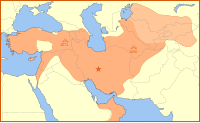
from the 11th to 14th centuries. They established an empire, the Great Seljuq Empire
Great Seljuq Empire
The Great Seljuq Empire was a medieval Persianate, Turko-Persian Sunni Muslim empire, originating from the Qynyq branch of Oghuz Turks. The Seljuq Empire controlled a vast area stretching from the Hindu Kush to eastern Anatolia and from Central Asia to the Persian Gulf...
, which at its height stretched from Anatolia
Anatolia
Anatolia is a geographic and historical term denoting the westernmost protrusion of Asia, comprising the majority of the Republic of Turkey...
through Persia and which was the target of the First Crusade
First Crusade
The First Crusade was a military expedition by Western Christianity to regain the Holy Lands taken in the Muslim conquest of the Levant, ultimately resulting in the recapture of Jerusalem...
. The dynasty had its origins in the Turcoman
Oghuz Turks
The Turkomen also known as Oghuz Turks were a historical Turkic tribal confederation in Central Asia during the early medieval Turkic expansion....
tribal confederations of Central Asia. After arriving in Persia
Greater Iran
Greater Iran refers to the regions that have significant Iranian cultural influence. It roughly corresponds to the territory on the Iranian plateau and its bordering plains, stretching from Iraq, the Caucasus, and Turkey in the west to the Indus River in the east...
, the Seljuqs adopted the Persian culture
Persianate
A Persianate/Persified society is a society that is either based on, or strongly influenced by the Persian language, culture, literature, art, and/or identity....
adopting the Persian language
Persian language
Persian is an Iranian language within the Indo-Iranian branch of the Indo-European languages. It is primarily spoken in Iran, Afghanistan, Tajikistan and countries which historically came under Persian influence...
as the official language of the government and language, and played an important role in the development of the Turko-Persian tradition
Turko-Persian tradition
The composite Turko-Persian tradition was a variant of Islamic culture. It was Persianate in that it was centered on a lettered tradition of Iranian origin; it was Turkic insofar as it was for many generations patronized by rulers of Turkic background; it was Islamic in that Islamic notions of...
which features "Persian culture patronized by Turkic rulers." Today, they are remembered as great patrons of Persian culture, art, literature
Persian literature
Persian literature spans two-and-a-half millennia, though much of the pre-Islamic material has been lost. Its sources have been within historical Persia including present-day Iran as well as regions of Central Asia where the Persian language has historically been the national language...
, and language
Persian language
Persian is an Iranian language within the Indo-Iranian branch of the Indo-European languages. It is primarily spoken in Iran, Afghanistan, Tajikistan and countries which historically came under Persian influence...
and are regarded as the cultural ancestors of the Western Turks
Oghuz Turks
The Turkomen also known as Oghuz Turks were a historical Turkic tribal confederation in Central Asia during the early medieval Turkic expansion....
– the present-day inhabitants of Azerbaijan
Azerbaijan
Azerbaijan , officially the Republic of Azerbaijan is the largest country in the Caucasus region of Eurasia. Located at the crossroads of Western Asia and Eastern Europe, it is bounded by the Caspian Sea to the east, Russia to the north, Georgia to the northwest, Armenia to the west, and Iran to...
, Turkey
Turkey
Turkey , known officially as the Republic of Turkey , is a Eurasian country located in Western Asia and in East Thrace in Southeastern Europe...
, and Turkmenistan
Turkmenistan
Turkmenistan , formerly also known as Turkmenia is one of the Turkic states in Central Asia. Until 1991, it was a constituent republic of the Soviet Union, the Turkmen Soviet Socialist Republic . Turkmenistan is one of the six independent Turkic states...
.
Origins
Prior to the ninth century, hordesOrda (organization)
An orda or horde was an historical sociopolitical and military structure found on the Eurasian Steppe, usually associated with the Mongols. This entity can be seen as regional equivalent of a clan or a tribe...
of Turks had crossed the Volga River
Volga River
The Volga is the largest river in Europe in terms of length, discharge, and watershed. It flows through central Russia, and is widely viewed as the national river of Russia. Out of the twenty largest cities of Russia, eleven, including the capital Moscow, are situated in the Volga's drainage...
into the Black Sea
Black Sea
The Black Sea is bounded by Europe, Anatolia and the Caucasus and is ultimately connected to the Atlantic Ocean via the Mediterranean and the Aegean seas and various straits. The Bosphorus strait connects it to the Sea of Marmara, and the strait of the Dardanelles connects that sea to the Aegean...
steppes. Originally, the House of Seljuq was a branch of the Qinik (Kınık) Oghuz Turks
Oghuz Turks
The Turkomen also known as Oghuz Turks were a historical Turkic tribal confederation in Central Asia during the early medieval Turkic expansion....
who in the 9th century lived on the periphery of the Muslim world, north of the Caspian
Caspian Sea
The Caspian Sea is the largest enclosed body of water on Earth by area, variously classed as the world's largest lake or a full-fledged sea. The sea has a surface area of and a volume of...
and Aral
Aral Sea
The Aral Sea was a lake that lay between Kazakhstan in the north and Karakalpakstan, an autonomous region of Uzbekistan, in the south...
seas in their Yabghu Khaganate of the Oghuz confederacy, in the Kazakh Steppe
Kazakh Steppe
The Kazakh Steppe or Kirghiz Steppe ecoregion, of the Palearctic Temperate grasslands, savannas, and shrublands Biome, is a vast region of open grassland in northern Kazakhstan and adjacent portions of Russia, extending to the east of the Pontic steppe and to the west of the Emin Valley steppe,...
of Turkestan
Turkestan
Turkestan, spelled also as Turkistan, literally means "Land of the Turks".The term Turkestan is of Persian origin and has never been in use to denote a single nation. It was first used by Persian geographers to describe the place of Turkish peoples...
. In the 10th century the Seljuqs migrated from their ancestral homelands into mainland Persia, in the province of Khurasan
Greater Khorasan
Greater Khorasan or Ancient Khorasan is a historical region of Greater Iran mentioned in sources from Sassanid and Islamic eras which "frequently" had a denotation wider than current three provinces of Khorasan in Iran...
, where they mixed with the local population and adopted the Persian culture and language
Persian language
Persian is an Iranian language within the Indo-Iranian branch of the Indo-European languages. It is primarily spoken in Iran, Afghanistan, Tajikistan and countries which historically came under Persian influence...
in the following decades.
Rulers of the Seljuq Dynasty
The "Great Seljuqs" were heads of the family; in theory their authority extended over all the other Seljuq lines, although in practice this often was not the case. Turkish custom called for the senior member of the family to be the Great Seljuq, although usually the position was associated with the ruler of western Persia.- Tugrul I (Tugrul Beg) 1037–1063
- Alp ArslanAlp ArslanAlp Arslan was the third sultan of the Seljuq dynasty and great-grandson of Seljuk, the eponymous founder of the dynasty...
bin ÇağrıÇağrı BeyChaghri Beg/Bey was the co-ruler of the early Seljuq empire. His name means "merlin" or "falcon".-Background:...
1063–1072 - Jalal ad-Dawlah Malik Shah IMalik Shah IJalāl al-Dawlah Malik-shāh was born in 1055, succeeded Alp Arslan as the Seljuq Sultan in 1072, and reigned until his death in 1092....
1072–1092 - Nasir ad-Din Mahmud I 1092–1093
- Rukn ad-Din BarkiyaruqBarkiyaruqAbu al-Muzaffar Rukn ud-Dīn Barkyāruq bin Malikšāh was the sultan of Great Seljuq from 1094-1105.He was a son of Malik Shah I and participated in the succession wars against his three brothers, Mahmud I, Ahmed Sanjar, and Mehmed I....
1093–1104 - Mu'izz ad-Din Malik Shah IIMalik Shah IIMu'izz ad-Din Malik Shah II Was Seljuq Sultan in Baghdad during 1105. He was the grandson of Malik Shah I, and was theoretically the head of the dynasty, although his relative Ahmed Sanjar in Khorasan probably held more effective power....
1105 - Ghiyath ad-Din Mehmet Tapar 1105–1118
Muhammad's son Mahmud II
Mahmud II of Great Seljuk
Mahmud II was the Seljuq sultan of Baghdad in 1118 following the death of his father Mehmed I. At the time Mahmud was fourteen, and ruled over Iraq and Persia....
succeeded him in western Persia, but Sanjar, the governor of Khurasan
Greater Khorasan
Greater Khorasan or Ancient Khorasan is a historical region of Greater Iran mentioned in sources from Sassanid and Islamic eras which "frequently" had a denotation wider than current three provinces of Khorasan in Iran...
from 1097 and the senior member of the family, became the Great Seljuq sultan
- Mu'izz ad-Din Ahmed SanjarAhmed SanjarAhmad Sanjar Ahmad Sanjar Ahmad Sanjar (Mu'iz ud-Dīn Ahmad-e Sanjar; was the sultan of the Great Seljuq Empire from 1118 to 1153. He was initially the sultan of Khorasan until he gained the rest of the territory upon the death of Muhammad I....
1118–1157
From 1157, the Oghuz took control of much of Khurasan, with the remainder in the hands of former Seljuq emirs.
Seljuq sultans of Hamadan
The rulers of western Persia, who maintained a very loose grip on the Abbasids of BaghdadBaghdad
Baghdad is the capital of Iraq, as well as the coterminous Baghdad Governorate. The population of Baghdad in 2011 is approximately 7,216,040...
. Several Turkish emirs gained a strong level of influence in the region, such as the Eldiduzids
Atabegs of Azerbaijan
The Ildegizids, Eldiguzids or Ildenizids, also known as Atabegs of Azerbaijan were a Turkic dynasty of Kipchak origin which controlled most of northwestern Persia/eastern Transcaucasia, including Arran, most of Azerbaijan, and Djibal...
.
- Mahmud II 1118–1131
- 1131-1134 - Disputed
- Dawud
- Mas'ud (in JibalJibalJibāl was a short-lived Arab-ruled province located in western Iran, under the Abbasid Caliphate of Baghdad. It was roughly coterminous with the ancient country of the Medes. In 10th century it came back under Persian rule ....
and Iranian Azerbaijan) 1131 - Toghrul II 1132–1134
- Mas'ud 1133–1152
- Malik Shah III 1152–1153
- Muhammad II
- Suleiman Shah 1160–1161
- Arslan Shah 1161–1174
- Toghrul III 1174–1194
In 1194, Tugrul III was killed in battle with the Khwarezm Shah, who annexed Hamadan.
Seljuq rulers of Kerman
Kerman was a province in southern Persia. Between 1053 and 1154, the territory also included UmmanOman
Oman , officially called the Sultanate of Oman , is an Arab state in southwest Asia on the southeast coast of the Arabian Peninsula. It is bordered by the United Arab Emirates to the northwest, Saudi Arabia to the west, and Yemen to the southwest. The coast is formed by the Arabian Sea on the...
.
- Qawurd 1041–1073
- Kerman Shah 1073–1074
- Sultan Shah 1074–1075
- Hussain Omar 1075–1084
- Turan Shah I 1084–1096
- Iran Shah 1096–1101
- Arslan Shah IArslan Shah IArslan Shah I was Sultan of Kerman , a city in Iran situated at the center of Kerman province. Located in a large and flat plain, this city is placed 1,076 km south of the Iranian capital, Tehran....
1101–1142 - Mehmed I (Muhammad) 1142–1156
- Toğrül Shah 1156–1169
- Bahram Shah 1169–1174
- Arslan Shah II 1174–1176
- Turan Shah II 1176–1183
- Muhammad ShahMuhammad-Shah ibn Bahram-ShahMuhammad-Shah was the last Seljuq amir of Kerman, from 1183 until 1186.-Biography:The son of Bahram-Shah, Muhammad-Shah succeeded his uncle Turan-Shah to the throne of Kerman in 1183. By the time of his ascension Kerman had been overrun by bands of Ghuzz Turks...
1183–1187
Muhammad abandoned Kerman, which fell into the hands of the Oghuz chief Malik Dinar
Malik Dinar (Oghuz Chief)
Malik Dinar was the Ghuzz ruler of Sarakhs from c. 1153 until 1179. He was also the ruler of the province of Kerman from 1186 until his death.-Ruler of Sarakhs:...
. Kerman was eventually annexed by the Khwarezmid Empire
Khwarezmian
The name Khwarezmian may refer to:* Khwarezm, a series of states in what is now known as Greater Iran...
in 1196.
Seljuq rulers in Syria
- Abu Sa'id Taj ad-Dawla Tutush ITutush IAbu Sa'id Taj ad-Dawla Tutush I was the Seljuq ruler of Damascus from 1079 to 1095, succeeding Abaaq al-Khwarazmi. He finished the construction of the Citadel of Damascus, a project that had begun under the direction of Abaaq al Khwarizmi...
1085–1086 - Jalal ad-Dawlah Malik Shah IMalik Shah IJalāl al-Dawlah Malik-shāh was born in 1055, succeeded Alp Arslan as the Seljuq Sultan in 1072, and reigned until his death in 1092....
of Great Seljuq 1086–1087 - Qasim ad-Dawla Abu Said Aq Sunqur al-HajibAq Sunqur al-HajibQasim ad-Dawla Abu Said Aq Sunqur al-Hajib was the Seljuk governor of Aleppo under Sultan Malik Shah I. He probably enjoyed some independence from his lord and was from 1087 the de-facto ruler of most of Syria...
1087–1094 - Abu Sa'id Taj ad-Dawla Tutush ITutush IAbu Sa'id Taj ad-Dawla Tutush I was the Seljuq ruler of Damascus from 1079 to 1095, succeeding Abaaq al-Khwarazmi. He finished the construction of the Citadel of Damascus, a project that had begun under the direction of Abaaq al Khwarizmi...
(second time) 1094–1095 - Fakhr al-Mulk Radwan 1095–1113
- Tadj ad-Dawla Alp Arslan al-Akhras 1113–1114
- Sultan Shah 1114–1123
To the Artuqids
Sultan
Sultan
Sultan is a title with several historical meanings. Originally, it was an Arabic language abstract noun meaning "strength", "authority", "rulership", and "dictatorship", derived from the masdar سلطة , meaning "authority" or "power". Later, it came to be used as the title of certain rulers who...
s/Emir
Emir
Emir , meaning "commander", "general", or "prince"; also transliterated as Amir, Aamir or Ameer) is a title of high office, used throughout the Muslim world...
s of Damascus
Damascus
Damascus , commonly known in Syria as Al Sham , and as the City of Jasmine , is the capital and the second largest city of Syria after Aleppo, both are part of the country's 14 governorates. In addition to being one of the oldest continuously inhabited cities in the world, Damascus is a major...
:
- Aziz ibn Abaaq al-KhwarazmiAbaaq al-KhwarazmiAziz ibn Abaaq al-Khwarazmi was a commander under Malik Shah I and later became the first Seljuk ruler to gain independence from the Great Seljuk Empire. He founded a state in Damascus in 1076, where he commenced the construction of the Citadel of Damascus. His successor was the brother of Malik...
1076–1079 - Abu Sa'id Taj ad-Dawla Tutush ITutush IAbu Sa'id Taj ad-Dawla Tutush I was the Seljuq ruler of Damascus from 1079 to 1095, succeeding Abaaq al-Khwarazmi. He finished the construction of the Citadel of Damascus, a project that had begun under the direction of Abaaq al Khwarizmi...
1079–1095 - Abu Nasr Shams al-Muluk DuqaqDuqaqAbu Nasr Shams al-Muluk Duqaq was the Seljuq ruler of Damascus from 1095 to 1104.Duqaq was a son of the Seljuq ruler of Syria, Tutush I, and Khatun Safwat al-Mulk, He was the brother of Radwan. When their father died in 1095, Radwan claimed Syria for himself, and Duqaq initially inherited...
1095–1104 - Tutush II 1104
- Muhi ad-Din Baqtash 1104
Damascus seized by the Burid Toghtekin
Toghtekin
Zahir ad-Din Toghtekin was a Turkic military leader, who was atabeg of Damascus from 1104 to 1128. He was the founder of the Burid dynasty of Damascus.-Biography:...
Seljuq sultans of Rûm (Anatolia)
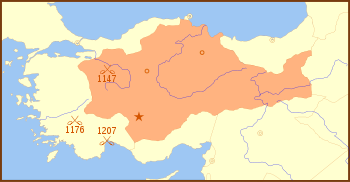
The Seljuq line, already having been deprived of any significant power, effectively ends in the early 14th century
- Kutalmish 1060–1077
- Suleyman I (Suleiman) 1077–1086
- Dawud Kilij Arslan IKilij Arslan IKilij Arslan was the Seljuq Sultan of Rûm from 1092 until his death in 1107. He ruled the Sultanate during the time of the First Crusade and thus faced the brunt of the entire attack...
1092–1107 - Malik ShahMalik Shah IJalāl al-Dawlah Malik-shāh was born in 1055, succeeded Alp Arslan as the Seljuq Sultan in 1072, and reigned until his death in 1092....
1107–1116 - Rukn ad-Din Mesud I 1116–1156
- Izz ad-Din Kilij Arslan IIKilij Arslan IIKilij Arslan II was a Seljuk Sultan of Rûm from 1156 until his death in 1192.As Arnold of Lübeck reports in his Chronica Slavorum, he was present at the meeting of Henry the Lion with Kilij-Arslan during the former's pilgrimage to Jerusalem in 1172...
1156–1192 - Ghiyath ad-Din Kaykhusraw I 1192–1196
- Suleyman II (Suleiman) 1196–1204
- Kilij Arslan IIIKilij Arslan IIIKilij Arslan III was the Seljuq Sultan of Rûm for a short period in 1204 and 1205....
1204–1205 - Ghiyath ad-Din Kaykhusraw I (second time) 1205–1211
- Izz ad-Din Kaykaus IKaykaus IKaykaus I or Kayka'us I or Keykavus I was the Sultanate of Rum from 1211 until his death in 1220. He was the eldest son of Kaykhusraw I.-Succession:...
1211–1220 - Ala ad-Din Kayqubad I 1220–1237
- Ghiyath ad-Din Kaykhusraw IIKaykhusraw IIGhiyath al-Din Kaykhusraw II was the sultan of the Seljuqs of Rûm from 1237 until his death in 1246. He ruled at the time of the Babai uprising and the Mongol invasion of Anatolia. He led the Seljuq army with its Christian allies at the Battle of Köse Dağ in 1243...
1237–1246 - Izz ad-Din Kaykaus IIKaykaus IIKaykaus II or Kayka'us II was the eldest of three sons of Kaykhusraw II. He was a youth at the time of his father’s death in 1246 and could do little to prevent the Mongol subjugation of Anatolia. For most of his tenure as the Seljuq Sultan of Rûm, he shared the throne with one or both of his...
1246–1260 - Rukn ad-Din Kilij Arslan IVKilij Arslan IVKilij Arslan IV was Seljuq Sultan of Rûm after the death of his father Kaykhusraw II in 1246. For part of his tenure as sultan he ruled with his two brothers Kaykaus II and Kayqubad II. He was executed in 1266 by the Pervane Mu‘in al-Din Suleyman.-Sources:...
1248–1265 - Ala ad-Din Kayqubad IIKayqubad IIKayqubad II was the youngest of the three sons of the Seljuq Sultan of Rûm Kaykhusraw II. As son of the sultan’s favorite wife, the Georgian princess Tamar, he was designated heir. He had a weak constitution and was likely seven years old at the time of his father’s death in 1246, being born ca...
1249–1257 - Ghiyath ad-Din Kaykhusraw IIIKaykhusraw IIIKaykhusraw III was between two and six years old when in 1265 he was named Seljuq Sultan of Rûm...
1265–1282 - Ghiyath ad-Din Mesud IIMesud IIMasud II or Mas'ud II bore the title of Sultanate of Rum at various times between 1284 and 1308. He was a vassal of the Mongols and exercised no real authority. History does not record his ultimate fate....
1282–1284 - Ala ad-Din Kayqubad IIIKayqubad IIIKayqubad III was briefly sultan of the Sultanate of Rum between the years of 1298 and 1302. He was a nephew of the deposed Kaykaus II and had strong support among the Turkmen. As sultan he was a vassal of the Mongols and exercised no real power....
1284 - Ghiyath ad-Din Mesud IIMesud IIMasud II or Mas'ud II bore the title of Sultanate of Rum at various times between 1284 and 1308. He was a vassal of the Mongols and exercised no real authority. History does not record his ultimate fate....
(second time) 1284–1293 - Ala ad-Din Kayqubad IIIKayqubad IIIKayqubad III was briefly sultan of the Sultanate of Rum between the years of 1298 and 1302. He was a nephew of the deposed Kaykaus II and had strong support among the Turkmen. As sultan he was a vassal of the Mongols and exercised no real power....
(second time) 1293–1294 - Ghiyath ad-Din Mesud IIMesud IIMasud II or Mas'ud II bore the title of Sultanate of Rum at various times between 1284 and 1308. He was a vassal of the Mongols and exercised no real authority. History does not record his ultimate fate....
(third time) 1294–1301 - Ala ad-Din Kayqubad IIIKayqubad IIIKayqubad III was briefly sultan of the Sultanate of Rum between the years of 1298 and 1302. He was a nephew of the deposed Kaykaus II and had strong support among the Turkmen. As sultan he was a vassal of the Mongols and exercised no real power....
(third time) 1301–1303 - Ghiyath ad-Din Mesud IIMesud IIMasud II or Mas'ud II bore the title of Sultanate of Rum at various times between 1284 and 1308. He was a vassal of the Mongols and exercised no real authority. History does not record his ultimate fate....
(fourth time) 1303–1307
See also
- Great Seljuq EmpireGreat Seljuq EmpireThe Great Seljuq Empire was a medieval Persianate, Turko-Persian Sunni Muslim empire, originating from the Qynyq branch of Oghuz Turks. The Seljuq Empire controlled a vast area stretching from the Hindu Kush to eastern Anatolia and from Central Asia to the Persian Gulf...
- Sultanate of RûmSultanate of RûmThe Sultanate of Rum , also known as the Anatolian Seljuk State , was a Turkic state centered in in Anatolia, with capitals first at İznik and then at Konya. Since the court of the sultanate was highly mobile, cities like Kayseri and Sivas also functioned at times as capitals...
- Ottoman dynastyOttoman DynastyThe Ottoman Dynasty ruled the Ottoman Empire from 1299 to 1922, beginning with Osman I , though the dynasty was not proclaimed until Orhan Bey declared himself sultan...
- List of Sunni Muslim dynasties
Further reading
- Peacock, A.C.S, Early Seljuq History : A New Interpretation; New York, NY ; Routledge; 2010