

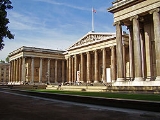
British Museum

Encyclopedia
Museum
A museum is an institution that cares for a collection of artifacts and other objects of scientific, artistic, cultural, or historical importance and makes them available for public viewing through exhibits that may be permanent or temporary. Most large museums are located in major cities...
of human history and culture in London. Its collections, which number more than seven million objects, are amongst the largest and most comprehensive in the world and originate from all continents, illustrating and documenting the story of human culture from its beginnings to the present.
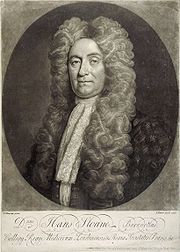
The British Museum was established in 1753, largely based on the collections of the physician and scientist Sir Hans Sloane
Hans Sloane
Sir Hans Sloane, 1st Baronet, PRS was an Ulster-Scot physician and collector, notable for bequeathing his collection to the British nation which became the foundation of the British Museum...
. The museum first opened to the public on 15 January 1759 in Montagu House
Montagu House, Bloomsbury
Montagu House was a late 17th-century mansion in Great Russell Street in the Bloomsbury district of London, which became the first home of the British Museum....
in Bloomsbury
Bloomsbury
-Places:* Bloomsbury is an area in central London.* Bloomsbury , related local government unit* Bloomsbury, New Jersey, New Jersey, USA* Bloomsbury , listed on the NRHP in Maryland...
, on the site of the current museum building. Its expansion over the following two and a half centuries was largely a result of an expanding British colonial footprint and has resulted in the creation of several branch institutions, the first being the British Museum (Natural History)
Natural History Museum
The Natural History Museum is one of three large museums on Exhibition Road, South Kensington, London, England . Its main frontage is on Cromwell Road...
in South Kensington
South Kensington
South Kensington is a district in the Royal Borough of Kensington and Chelsea in London. It is a built-up area located 2.4 miles west south-west of Charing Cross....
in 1887. Some objects in the collection, most notably the Elgin Marbles
Elgin Marbles
The Parthenon Marbles, forming a part of the collection known as the Elgin Marbles , are a collection of classical Greek marble sculptures , inscriptions and architectural members that originally were part of the Parthenon and other buildings on the Acropolis of Athens...
from the Parthenon
Parthenon
The Parthenon is a temple on the Athenian Acropolis, Greece, dedicated to the Greek goddess Athena, whom the people of Athens considered their virgin patron. Its construction began in 447 BC when the Athenian Empire was at the height of its power. It was completed in 438 BC, although...
, are the objects of intense controversy and of calls for restitution to their countries of origin.
Until 1997, when the British Library
British Library
The British Library is the national library of the United Kingdom, and is the world's largest library in terms of total number of items. The library is a major research library, holding over 150 million items from every country in the world, in virtually all known languages and in many formats,...
(previously centred on the Round Reading Room
British Museum Reading Room
The British Museum Reading Room, situated in the centre of the Great Court of the British Museum, used to be the main reading room of the British Library. In 1997, this function moved to the new British Library building at St Pancras, London, but the Reading Room remains in its original form inside...
) moved to a new site, the British Museum was unique in that it housed both a national museum of antiquities
Antiquities
Antiquities, nearly always used in the plural in this sense, is a term for objects from Antiquity, especially the civilizations of the Mediterranean: the Classical antiquity of Greece and Rome, Ancient Egypt and the other Ancient Near Eastern cultures...
and a national library
National library
A national library is a library specifically established by the government of a country to serve as the preeminent repository of information for that country. Unlike public libraries, these rarely allow citizens to borrow books...
in the same building. The museum is a non-departmental public body
Non-departmental public body
In the United Kingdom, a non-departmental public body —often referred to as a quango—is a classification applied by the Cabinet Office, Treasury, Scottish Government and Northern Ireland Executive to certain types of public bodies...
sponsored by the Department for Culture, Media and Sport
Department for Culture, Media and Sport
The Department for Culture, Media and Sport is a department of the United Kingdom government, with responsibility for culture and sport in England, and some aspects of the media throughout the whole UK, such as broadcasting and internet....
, and as with all other national museums in the United Kingdom
United Kingdom
The United Kingdom of Great Britain and Northern IrelandIn the United Kingdom and Dependencies, other languages have been officially recognised as legitimate autochthonous languages under the European Charter for Regional or Minority Languages...
it charges no admission fee. Since 2002 the director of the museum
Director of the British Museum
The Director of the British Museum is the head of the British Museum in London, a post currently held by Neil MacGregor. He is responsible for that institution's general administration and reports its accounts to the British Government...
has been Neil MacGregor
Neil MacGregor
Robert Neil MacGregor, OM, FSA is an art historian and museum director. He was the Editor of the Burlington Magazine from 1981 to 1987, the Director of the National Gallery, London, from 1987 to 2002, and was appointed Director of the British Museum in 2002...
.
Sir Hans Sloane, founder of the British Museum
Ancient history
Ancient history is the study of the written past from the beginning of recorded human history to the Early Middle Ages. The span of recorded history is roughly 5,000 years, with Cuneiform script, the oldest discovered form of coherent writing, from the protoliterate period around the 30th century BC...
today, the British Museum was founded as a "universal museum". Its foundations lie in the will of the physician and naturalist Sir Hans Sloane
Hans Sloane
Sir Hans Sloane, 1st Baronet, PRS was an Ulster-Scot physician and collector, notable for bequeathing his collection to the British nation which became the foundation of the British Museum...
(1660–1753). During the course of his lifetime Sloane gathered an enviable collection of curiosities
Cabinet of curiosities
A cabinet of curiosities was an encyclopedic collection in Renaissance Europe of types of objects whose categorical boundaries were yet to be defined. They were also known by various names such as Cabinet of Wonder, and in German Kunstkammer or Wunderkammer...
and, not wishing to see his collection broken up after death, he bequeathed it to King George II
George II of Great Britain
George II was King of Great Britain and Ireland, Duke of Brunswick-Lüneburg and Archtreasurer and Prince-elector of the Holy Roman Empire from 11 June 1727 until his death.George was the last British monarch born outside Great Britain. He was born and brought up in Northern Germany...
, for the nation, for the princely sum of £20,000.
At that time, Sloane's collection consisted of around 71,000 objects of all kinds including some 40,000 printed books, 7,000 manuscript
Manuscript
A manuscript or handwrite is written information that has been manually created by someone or some people, such as a hand-written letter, as opposed to being printed or reproduced some other way...
s, extensive natural history specimens including 337 volumes of dried plants, prints
Old master print
An old master print is a work of art produced by a printing process within the Western tradition . A date of about 1830 is usually taken as marking the end of the period whose prints are covered by this term. The main techniques concerned are woodcut, engraving and etching, although there are...
and drawings including those by Albrecht Dürer
Albrecht Dürer
Albrecht Dürer was a German painter, printmaker, engraver, mathematician, and theorist from Nuremberg. His prints established his reputation across Europe when he was still in his twenties, and he has been conventionally regarded as the greatest artist of the Northern Renaissance ever since...
and antiquities from Egypt
Ancient Egypt
Ancient Egypt was an ancient civilization of Northeastern Africa, concentrated along the lower reaches of the Nile River in what is now the modern country of Egypt. Egyptian civilization coalesced around 3150 BC with the political unification of Upper and Lower Egypt under the first pharaoh...
, Greece
Ancient Greece
Ancient Greece is a civilization belonging to a period of Greek history that lasted from the Archaic period of the 8th to 6th centuries BC to the end of antiquity. Immediately following this period was the beginning of the Early Middle Ages and the Byzantine era. Included in Ancient Greece is the...
, Rome
Ancient Rome
Ancient Rome was a thriving civilization that grew on the Italian Peninsula as early as the 8th century BC. Located along the Mediterranean Sea and centered on the city of Rome, it expanded to one of the largest empires in the ancient world....
, the Ancient Near
Ancient Near East
The ancient Near East was the home of early civilizations within a region roughly corresponding to the modern Middle East: Mesopotamia , ancient Egypt, ancient Iran The ancient Near East was the home of early civilizations within a region roughly corresponding to the modern Middle East: Mesopotamia...
and Far East
East Asia
East Asia or Eastern Asia is a subregion of Asia that can be defined in either geographical or cultural terms...
and the Americas
History of the Americas
The history of the Americas is the collective history of the American landmass, which includes North and South America, as well as Central America and the Caribbean. It begins with people migrating to these areas from Asia during the height of an Ice Age...
.
Foundation (1753)
On 7 June 1753, King George II gave his formal assent to the Act of ParliamentAct of Parliament
An Act of Parliament is a statute enacted as primary legislation by a national or sub-national parliament. In the Republic of Ireland the term Act of the Oireachtas is used, and in the United States the term Act of Congress is used.In Commonwealth countries, the term is used both in a narrow...
which established the British Museum. The Foundation Act, added two other libraries to the Sloane collection. The Cottonian Library
Cotton library
The Cotton or Cottonian library was collected privately by Sir Robert Bruce Cotton M.P. , an antiquarian and bibliophile, and was the basis of the British Library...
, assembled by Sir Robert Cotton
Robert Bruce Cotton
Sir Robert Bruce Cotton, 1st Baronet was an English antiquarian and Member of Parliament, founder of the important Cotton library....
, dated back to Elizabethan
Elizabethan era
The Elizabethan era was the epoch in English history of Queen Elizabeth I's reign . Historians often depict it as the golden age in English history...
times and the Harleian library
Robert Harley, 1st Earl of Oxford and Mortimer
Robert Harley, 1st Earl of Oxford and Earl Mortimer KG was a British politician and statesman of the late Stuart and early Georgian periods. He began his career as a Whig, before defecting to a new Tory Ministry. Between 1711 and 1714 he served as First Lord of the Treasury, effectively Queen...
, the collection of the Earls of Oxford
Earl of Oxford
Earl of Oxford is a dormant title in the Peerage of England, held for several centuries by the de Vere family from 1141 until the death of the 20th earl in 1703. The Veres were also hereditary holders of the office of master or Lord Great Chamberlain from 1133 until the death of the 18th Earl in 1625...
. They were joined in 1757 by the Royal Library, assembled by various British monarchs
British monarchy
The monarchy of the United Kingdom is the constitutional monarchy of the United Kingdom and its overseas territories. The present monarch, Queen Elizabeth II, has reigned since 6 February 1952. She and her immediate family undertake various official, ceremonial and representational duties...
. Together these four "foundation collections" included many of the most treasured books now in the British Library including the Lindisfarne Gospels
Lindisfarne Gospels
The Lindisfarne Gospels is an illuminated Latin manuscript of the gospels of Matthew, Mark, Luke and John in the British Library...
and the sole surviving copy of Beowulf
Beowulf
Beowulf , but modern scholars agree in naming it after the hero whose life is its subject." of an Old English heroic epic poem consisting of 3182 alliterative long lines, set in Scandinavia, commonly cited as one of the most important works of Anglo-Saxon literature.It survives in a single...
.
The British Museum was the first of a new kind of museum – national, belonging to neither church nor king, freely open to the public and aiming to collect everything. Sloane's collection, whilst including a vast miscellany of objects, tended to reflect his scientific interests. The addition of the Cotton
Robert Bruce Cotton
Sir Robert Bruce Cotton, 1st Baronet was an English antiquarian and Member of Parliament, founder of the important Cotton library....
and Harley manuscripts
Robert Harley, 1st Earl of Oxford and Mortimer
Robert Harley, 1st Earl of Oxford and Earl Mortimer KG was a British politician and statesman of the late Stuart and early Georgian periods. He began his career as a Whig, before defecting to a new Tory Ministry. Between 1711 and 1714 he served as First Lord of the Treasury, effectively Queen...
introduced a literary and antiquarian
Antiquarian
An antiquarian or antiquary is an aficionado or student of antiquities or things of the past. More specifically, the term is used for those who study history with particular attention to ancient objects of art or science, archaeological and historic sites, or historic archives and manuscripts...
element and meant that the British Museum now became both national museum and library.
Cabinet of curiosities (1753–78)

Montagu House, Bloomsbury
Montagu House was a late 17th-century mansion in Great Russell Street in the Bloomsbury district of London, which became the first home of the British Museum....
, as a location for the museum, which it bought from the Montagu family
Ralph Montagu, 1st Duke of Montagu
Ralph Montagu, 1st Duke of Montagu was an English courtier and diplomat.-Life:He was the second son of Edward Montagu, 2nd Baron Montagu of Boughton and Anne Winwood, daughter of the Secretary of State Ralph Winwood...
for £20,000. The Trustees rejected Buckingham House, on the site now occupied by Buckingham Palace
Buckingham Palace
Buckingham Palace, in London, is the principal residence and office of the British monarch. Located in the City of Westminster, the palace is a setting for state occasions and royal hospitality...
, on the grounds of cost and the unsuitability of its location.
With the acquisition of Montagu House the first exhibition galleries and reading room
Library
In a traditional sense, a library is a large collection of books, and can refer to the place in which the collection is housed. Today, the term can refer to any collection, including digital sources, resources, and services...
for scholars opened on 15 January 1759. In 1757 King George II gave the Old Royal Library
Royal Library, Windsor
The office of Royal Librarian, in the Royal Collection Department of the Royal Household of the Sovereign of the United Kingdom, is responsible for the care and maintenance of the royal collection of books and manuscripts owned by the Sovereign in an official capacity, as distinct from those owned...
and with it the right to a copy of every book published in the country, thereby ensuring that the Museum's library would expand indefinitely. The predominance of natural history, books and manuscripts began to lessen when in 1772 the Museum acquired its first antiquities of note; Sir William Hamilton
William Hamilton (diplomat)
Sir William Hamilton KB, PC, FRS was a Scottish diplomat, antiquarian, archaeologist and vulcanologist. After a short period as a Member of Parliament, he served as British Ambassador to the Kingdom of Naples from 1764 to 1800...
's collection of Greek vases
Pottery of Ancient Greece
As the result of its relative durability, pottery is a large part of the archaeological record of Ancient Greece, and because there is so much of it it has exerted a disproportionately large influence on our understanding of Greek society...
. During the few years after its foundation the British Museum received several further gifts, including the Thomason Collection of Civil War Tracts and David Garrick
David Garrick
David Garrick was an English actor, playwright, theatre manager and producer who influenced nearly all aspects of theatrical practice throughout the 18th century and was a pupil and friend of Dr Samuel Johnson...
's library of 1,000 printed plays, but yet contained few ancient relic
Relic
In religion, a relic is a part of the body of a saint or a venerated person, or else another type of ancient religious object, carefully preserved for purposes of veneration or as a tangible memorial...
s recognisable to visitors of the modern museum.
Indolence and energy (1778–1800)
From 1778 a display of objects from the South SeaPacific Ocean
The Pacific Ocean is the largest of the Earth's oceanic divisions. It extends from the Arctic in the north to the Southern Ocean in the south, bounded by Asia and Australia in the west, and the Americas in the east.At 165.2 million square kilometres in area, this largest division of the World...
s brought back from the round-the-world voyages of Captain James Cook
James Cook
Captain James Cook, FRS, RN was a British explorer, navigator and cartographer who ultimately rose to the rank of captain in the Royal Navy...
and the travels of other explorers fascinated visitors with a glimpse of previously unknown lands. The bequest of a collection of books, engraved gems, coins, prints and drawings by Clayton Mordaunt Cracherode
Clayton Mordaunt Cracherode
Clayton Mordaunt Cracherode was an English book and old master print collector, and a major benefactor of the British Museum.-Life:...
in 1800 did much to raise the Museum's reputation; but Montagu House became increasingly crowded and decrepit and it was apparent that it would be unable to cope with further expansion.
The museum’s first notable addition towards its collection of antiquities, since its foundation, was by Sir William Hamilton
William Hamilton (diplomat)
Sir William Hamilton KB, PC, FRS was a Scottish diplomat, antiquarian, archaeologist and vulcanologist. After a short period as a Member of Parliament, he served as British Ambassador to the Kingdom of Naples from 1764 to 1800...
(1730–1803), British Ambassador to Naples
Naples
Naples is a city in Southern Italy, situated on the country's west coast by the Gulf of Naples. Lying between two notable volcanic regions, Mount Vesuvius and the Phlegraean Fields, it is the capital of the region of Campania and of the province of Naples...
, who sold his collection of Greek and Roman artefacts to the museum in 1784 together with a number of other antiquities and natural history specimens. A list of donations to the Museum, dated 31 January 1784 refers to the Hamilton bequest of a "Colossal Foot of an Apollo
Apollo
Apollo is one of the most important and complex of the Olympian deities in Greek and Roman mythology...
in Marble". It was one of two antiquities of Hamilton's collection drawn for him by Francesco Progenie, a pupil of Pietro Fabris, who also contributed a number of drawings of Mount Vesuvius sent by Hamilton to the Royal Society
Royal Society
The Royal Society of London for Improving Natural Knowledge, known simply as the Royal Society, is a learned society for science, and is possibly the oldest such society in existence. Founded in November 1660, it was granted a Royal Charter by King Charles II as the "Royal Society of London"...
in London
London
London is the capital city of :England and the :United Kingdom, the largest metropolitan area in the United Kingdom, and the largest urban zone in the European Union by most measures. Located on the River Thames, London has been a major settlement for two millennia, its history going back to its...
.
Growth and change (1800–25)
In the early 19th century the foundations for the extensive collection of sculpture began to be laid and Greek, Roman and Egyptian artefacts dominated the antiquities displays. After the defeat of the French CampaignFrench Revolutionary Wars: Campaigns of 1799
By 1799, the French Revolutionary Wars had resumed after a period of relative peace in 1798. The Second Coalition had organized against France, with Great Britain allying with Russia, Austria, the Ottoman Empire, and several of the minor German and Italian states...
in the Battle of the Nile
Battle of the Nile
The Battle of the Nile was a major naval battle fought between British and French fleets at Aboukir Bay on the Mediterranean coast of Egypt from 1–3 August 1798...
, in 1801, the British Museum acquired more Egyptian sculpture and in 1802 King George III
George III of the United Kingdom
George III was King of Great Britain and King of Ireland from 25 October 1760 until the union of these two countries on 1 January 1801, after which he was King of the United Kingdom of Great Britain and Ireland until his death...
presented the Rosetta Stone
Rosetta Stone
The Rosetta Stone is an ancient Egyptian granodiorite stele inscribed with a decree issued at Memphis in 196 BC on behalf of King Ptolemy V. The decree appears in three scripts: the upper text is Ancient Egyptian hieroglyphs, the middle portion Demotic script, and the lowest Ancient Greek...
– key to the deciphering of hieroglyphs. Gifts and purchases from Henry Salt
Henry Salt (Egyptologist)
Henry Salt was an English artist, traveller, diplomat, and Egyptologist.-Biography:Salt, the son of a physician, was born in Lichfield. He trained as a portrait painter, first in Lichfield and then in London under Joseph Farington and John Hoppner. In 1802 he was appointed secretary and...
, British Consul General in Egypt, beginning with the Colossal bust of Ramesses II
Younger Memnon
The Younger Memnon statue is one of two colossal granite heads from the Ancient Egyptian mortuary temple called the Ramesseum at Thebes, depicting the pharaoh Ramesses II wearing the nemes head-dress with a cobra diadem on top. This incomplete statue has lost its body and lower legs; it is one of a...
in 1818, laid the foundations of the collection of Egyptian Monumental Sculpture. Many Greek sculptures followed, notably the first purpose-built exhibition space, the Charles Towneley collection
Charles Towneley
Charles Townley was an English country gentleman, antiquary and collector of the Townley Marbles ....
, much of it Roman Sculpture, in 1805. In 1806, Thomas Bruce, 7th Earl of Elgin
Thomas Bruce, 7th Earl of Elgin
Thomas Bruce, 7th Earl of Elgin and 11th Earl of Kincardine was a Scottish nobleman and diplomat, known for the removal of marble sculptures from the Parthenon in Athens. Elgin was the second son of Charles Bruce, 5th Earl of Elgin and his wife Martha Whyte...
, ambassador to the Ottoman Empire
Ottoman Empire
The Ottoman EmpireIt was usually referred to as the "Ottoman Empire", the "Turkish Empire", the "Ottoman Caliphate" or more commonly "Turkey" by its contemporaries...
from 1799 to 1803 removed the large collection of marble sculptures from the Parthenon
Parthenon
The Parthenon is a temple on the Athenian Acropolis, Greece, dedicated to the Greek goddess Athena, whom the people of Athens considered their virgin patron. Its construction began in 447 BC when the Athenian Empire was at the height of its power. It was completed in 438 BC, although...
, on the Acropolis
Acropolis of Athens
The Acropolis of Athens or Citadel of Athens is the best known acropolis in the world. Although there are many other acropoleis in Greece, the significance of the Acropolis of Athens is such that it is commonly known as The Acropolis without qualification...
in Athens
Athens
Athens , is the capital and largest city of Greece. Athens dominates the Attica region and is one of the world's oldest cities, as its recorded history spans around 3,400 years. Classical Athens was a powerful city-state...
and transferred them to the UK. In 1816 these masterpieces of western art, were acquired by The British Museum by Act of Parliament and deposited in the museum thereafter. The collections were supplemented by the Bassae
Bassae
Bassae or Bassai, Vassai or Vasses , meaning "little vale in the rocks", is an archaeological site in the northeastern part of Messinia Prefecture that was a part of Arcadia in ancient times. Bassae lies near the village of Skliros, northeast of Figaleia, south of Andritsaina and west of Megalopolis...
frieze from Phigaleia
Phigalia
Phigalia or Phigaleia is an ancient Greek city in the south-west corner of Arcadia. It is also the present name of a nearby modern village, known up to the early 20th century as Pavlitsa . In modern geography it is located in the southeastern Elis Prefecture...
, Greece
Greece
Greece , officially the Hellenic Republic , and historically Hellas or the Republic of Greece in English, is a country in southeastern Europe....
in 1815. The Ancient Near Eastern collection also had its beginnings in 1825 with the purchase of Assyria
Assyria
Assyria was a Semitic Akkadian kingdom, extant as a nation state from the mid–23rd century BC to 608 BC centred on the Upper Tigris river, in northern Mesopotamia , that came to rule regional empires a number of times through history. It was named for its original capital, the ancient city of Assur...
n and Babylonia
Babylonia
Babylonia was an ancient cultural region in central-southern Mesopotamia , with Babylon as its capital. Babylonia emerged as a major power when Hammurabi Babylonia was an ancient cultural region in central-southern Mesopotamia (present-day Iraq), with Babylon as its capital. Babylonia emerged as...
n antiquities from the widow of Claudius James Rich
Claudius James Rich
Claudius James Rich , British business agent, traveller and antiquarian scholar,-Biography:Rich was born near Dijon....
.
In 1802 a Buildings Committee was set up to plan for expansion of the museum, and further highlighted by the donation in 1822 of the King's Library
King's Library
The King's Library was one of the most important collections of books and pamphlets of the Age of Enlightenment. Assembled by George III, this scholarly library of over 65,000 volumes was subsequently given to the British nation by George IV. It was housed in a specially built gallery in the...
, personal library of King George III's, comprising 65,000 volumes, 19,000 pamphlet
Pamphlet
A pamphlet is an unbound booklet . It may consist of a single sheet of paper that is printed on both sides and folded in half, in thirds, or in fourths , or it may consist of a few pages that are folded in half and saddle stapled at the crease to make a simple book...
s, maps, charts and topographical drawing
Topographic map
A topographic map is a type of map characterized by large-scale detail and quantitative representation of relief, usually using contour lines in modern mapping, but historically using a variety of methods. Traditional definitions require a topographic map to show both natural and man-made features...
. The neoclassical
Neoclassical architecture
Neoclassical architecture was an architectural style produced by the neoclassical movement that began in the mid-18th century, manifested both in its details as a reaction against the Rococo style of naturalistic ornament, and in its architectural formulas as an outgrowth of some classicizing...
architect, Sir Robert Smirke
Robert Smirke (architect)
Sir Robert Smirke was an English architect, one of the leaders of Greek Revival architecture his best known building in that style is the British Museum, though he also designed using other architectural styles...
, was asked to draw up plans for an eastern extension to the Museum "... for the reception of the Royal Library
Royal Library, Windsor
The office of Royal Librarian, in the Royal Collection Department of the Royal Household of the Sovereign of the United Kingdom, is responsible for the care and maintenance of the royal collection of books and manuscripts owned by the Sovereign in an official capacity, as distinct from those owned...
, and a Picture Gallery over it ..." and put forward plans for today's quadrangular building, much of which can be seen today. The dilapidated Old Montagu House
Montagu House, Bloomsbury
Montagu House was a late 17th-century mansion in Great Russell Street in the Bloomsbury district of London, which became the first home of the British Museum....
was demolished and work on the King's Library
King's Library
The King's Library was one of the most important collections of books and pamphlets of the Age of Enlightenment. Assembled by George III, this scholarly library of over 65,000 volumes was subsequently given to the British nation by George IV. It was housed in a specially built gallery in the...
Gallery began in 1823. The extension, the East Wing, was completed by 1831. However, following the founding of the National Gallery, London
National Gallery, London
The National Gallery is an art museum on Trafalgar Square, London, United Kingdom. Founded in 1824, it houses a collection of over 2,300 paintings dating from the mid-13th century to 1900. The gallery is an exempt charity, and a non-departmental public body of the Department for Culture, Media...
in 1824, the proposed Picture Gallery was no longer needed, and the space on the upper floor was given over to the Natural History
Natural history
Natural history is the scientific research of plants or animals, leaning more towards observational rather than experimental methods of study, and encompasses more research published in magazines than in academic journals. Grouped among the natural sciences, natural history is the systematic study...
collections.
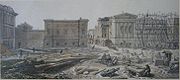
The largest building site in Europe (1825–50)
.jpg)
Robert Smirke (architect)
Sir Robert Smirke was an English architect, one of the leaders of Greek Revival architecture his best known building in that style is the British Museum, though he also designed using other architectural styles...
's grand neo-classical
Neoclassical architecture
Neoclassical architecture was an architectural style produced by the neoclassical movement that began in the mid-18th century, manifested both in its details as a reaction against the Rococo style of naturalistic ornament, and in its architectural formulas as an outgrowth of some classicizing...
building gradually arose. The King's Library
King's Library
The King's Library was one of the most important collections of books and pamphlets of the Age of Enlightenment. Assembled by George III, this scholarly library of over 65,000 volumes was subsequently given to the British nation by George IV. It was housed in a specially built gallery in the...
, on the ground floor of the East Wing, was handed over in 1827, and was described as one of the finest rooms in London
London
London is the capital city of :England and the :United Kingdom, the largest metropolitan area in the United Kingdom, and the largest urban zone in the European Union by most measures. Located on the River Thames, London has been a major settlement for two millennia, its history going back to its...
although it was not fully open to the general public until 1857, however, special openings were arranged during The Great Exhibition
The Great Exhibition
The Great Exhibition of the Works of Industry of all Nations or The Great Exhibition, sometimes referred to as the Crystal Palace Exhibition in reference to the temporary structure in which it was held, was an international exhibition that took place in Hyde Park, London, from 1 May to 15 October...
of 1851. In spite of dirt and disruption the collections grew, outpacing the new building.
Archaeological excavations
In 1840 the Museum became involved in its first overseas excavations, Charles Fellows
Charles Fellows
Sir Charles Fellows was a British archaeologist.-Bigography:Fellows was born at Nottingham, where his family had an estate. When fourteen he drew sketches to illustrate a trip to the ruins of Newstead Abbey, which afterwards appeared on the title-page of Moore's Life of Lord Byron...
's expedition to Xanthos
Xanthos
Xanthos was the name of a city in ancient Lycia, the site of present day Kınık, Antalya Province, Turkey, and of the river on which the city is situated...
, in Asia Minor
Anatolia
Anatolia is a geographic and historical term denoting the westernmost protrusion of Asia, comprising the majority of the Republic of Turkey...
, whence came remains of the tombs of the rulers of ancient Lycia
Lycia
Lycia Lycian: Trm̃mis; ) was a region in Anatolia in what are now the provinces of Antalya and Muğla on the southern coast of Turkey. It was a federation of ancient cities in the region and later a province of the Roman Empire...
, among them the Nereid
Nereid Monument
The Nereid Monument is a sculptured tomb from Xanthos in classical period Lycia, close to present-day Kinik in Antalya Province, Turkey. It took the form of a Greek temple on top of a base decorated with sculpted friezes, and is thought to have been built in the early fourth century BCE as a tomb...
and Payava
Tomb of Payava
The Tomb of Payava is a Lycian tall rectangular free-standing barrel-vaulted stone sarcophagus built for Payava who was probably the ruler of Xanthos, Lycia in around 360 BC. The tomb was discovered in 1838 and brought to England in 1844 by the explorer Sir Charles Fellows...
monuments. In 1857 Charles Newton
Charles Thomas Newton
Sir Charles Thomas Newton was a British archaeologist. He was made KCB in 1887.Newton was born at Bredwardine in Herefordshire, and educated at Shrewsbury School and Christ Church, Oxford. He entered the British Museum in 1840 as an assistant in the Antiquities Department...
was to discover the 4th-century BC Mausoleum of Halikarnassos
Mausoleum of Maussollos
The Mausoleum at Halicarnassus or Tomb of Mausolus was a tomb built between 353 and 350 BC at Halicarnassus for Mausolus, a satrap in the Persian Empire, and Artemisia II of Caria, his wife and sister....
, one of the Seven Wonders of the Ancient World. In the 1840s and 1850s the Museum supported excavations in Assyria
Assyria
Assyria was a Semitic Akkadian kingdom, extant as a nation state from the mid–23rd century BC to 608 BC centred on the Upper Tigris river, in northern Mesopotamia , that came to rule regional empires a number of times through history. It was named for its original capital, the ancient city of Assur...
by A.H. Layard
Austen Henry Layard
Sir Austen Henry Layard GCB, PC was a British traveller, archaeologist, cuneiformist, art historian, draughtsman, collector, author, politician and diplomat, best known as the excavator of Nimrud.-Family:...
and others at sites such as Nimrud
Nimrud
Nimrud is an ancient Assyrian city located south of Nineveh on the river Tigris in modern Ninawa Governorate Iraq. In ancient times the city was called Kalḫu. The Arabs called the city Nimrud after the Biblical Nimrod, a legendary hunting hero .The city covered an area of around . Ruins of the city...
and Nineveh
Nineveh
Nineveh was an ancient Assyrian city on the eastern bank of the Tigris River, and capital of the Neo Assyrian Empire. Its ruins are across the river from the modern-day major city of Mosul, in the Ninawa Governorate of Iraq....
. Of particular interest to curators was the eventual discovery of Ashurbanipal
Ashurbanipal
Ashurbanipal |Ashur]] is creator of an heir"; 685 BC – c. 627 BC), also spelled Assurbanipal or Ashshurbanipal, was an Assyrian king, the son of Esarhaddon and the last great king of the Neo-Assyrian Empire...
's great library of cuneiform
Cuneiform script
Cuneiform script )) is one of the earliest known forms of written expression. Emerging in Sumer around the 30th century BC, with predecessors reaching into the late 4th millennium , cuneiform writing began as a system of pictographs...
tablets
Clay tablet
In the Ancient Near East, clay tablets were used as a writing medium, especially for writing in cuneiform, throughout the Bronze Age and well into the Iron Age....
, which helped to make the Museum a focus for Assyrian studies
Assyriology
Assyriology is the archaeological, historical, and linguistic study of ancient Mesopotamia and the related cultures that used cuneiform writing. The field covers the Akkadian sister-cultures of Assyria and Babylonia, together with their cultural predecessor; Sumer...
.
Sir Thomas Grenville
Thomas Grenville
Thomas Grenville PC was a British politician and bibliophile.-Background and education:Grenville was the second son of Prime Minister George Grenville and Elizabeth, daughter of Sir William Wyndham, 3rd Baronet...
(1755–1846), a Trustee of The British Museum from 1830, assembled a fine library of 20,240 volumes, which he left to the Museum in his will. The books arrived in January 1847 in twenty-one horse-drawn vans. The only vacant space for this large library was a room originally intended for manuscripts, between the Front Entrance Hall and the Manuscript Saloon. The books remained here until the British Library moved to St Pancras
St Pancras, London
St Pancras is an area of London. For many centuries the name has been used for various officially-designated areas, but now is used informally and rarely having been largely superseded by several other names for overlapping districts.-Ancient parish:...
in 1998.
Collecting from the wider world (1850–75)
The opening of the forecourt in 1852 marked the completion of Robert SmirkeRobert Smirke (architect)
Sir Robert Smirke was an English architect, one of the leaders of Greek Revival architecture his best known building in that style is the British Museum, though he also designed using other architectural styles...
's 1823 plan, but already adjustments were having to be made to cope with the unforeseen growth of the collections. Infill galleries were constructed for Assyria
Assyria
Assyria was a Semitic Akkadian kingdom, extant as a nation state from the mid–23rd century BC to 608 BC centred on the Upper Tigris river, in northern Mesopotamia , that came to rule regional empires a number of times through history. It was named for its original capital, the ancient city of Assur...
n sculptures and Sydney Smirke
Sydney Smirke
Sydney Smirke, architect, was born in London, England, the younger brother of Sir Robert Smirke, also an architect. Their father, also Robert Smirke, had been a well-known 18th Century painter.Sydney Smirke's works include:...
's Round Reading Room
British Museum Reading Room
The British Museum Reading Room, situated in the centre of the Great Court of the British Museum, used to be the main reading room of the British Library. In 1997, this function moved to the new British Library building at St Pancras, London, but the Reading Room remains in its original form inside...
, with space for a million books, opened in 1857. Because of continued pressure on space the decision was taken to move natural history to a new building in South Kensington
South Kensington
South Kensington is a district in the Royal Borough of Kensington and Chelsea in London. It is a built-up area located 2.4 miles west south-west of Charing Cross....
, which would later become the British Museum of Natural History
Natural History Museum
The Natural History Museum is one of three large museums on Exhibition Road, South Kensington, London, England . Its main frontage is on Cromwell Road...
.
Roughly contemporary with the construction of the new building was the career of a man sometimes called the "second founder" of the British Museum, the Italian librarian Anthony Panizzi
Anthony Panizzi
Sir Antonio Genesio Maria Panizzi , better known as Anthony Panizzi, was a naturalized British librarian of Italian birth and an Italian patriot.-Early life in Italy:...
. Under his supervision, the British Museum Library (now the British Library
British Library
The British Library is the national library of the United Kingdom, and is the world's largest library in terms of total number of items. The library is a major research library, holding over 150 million items from every country in the world, in virtually all known languages and in many formats,...
) quintupled in size and became a well-organised institution worthy of being called a national library, the largest library in the world after the National Library of Paris. The quadrangle
Quadrangle (architecture)
In architecture, a quadrangle is a space or courtyard, usually rectangular in plan, the sides of which are entirely or mainly occupied by parts of a large building. The word is probably most closely associated with college or university campus architecture, but quadrangles may be found in other...
at the centre of Smirke's design proved to be a waste of valuable space and was filled at Panizzi's request by a circular Reading Room of cast iron, designed by Smirke's brother, Sydney Smirke.
Until the mid-19th century, the Museum's collections were relatively circumscribed but, in 1851, with the appointment to the staff of Augustus Wollaston Franks
Augustus Wollaston Franks
Sir Augustus Wollaston Franks KCB was an English antiquary and museum administrator. Franks was described by Marjorie Caygill, historian of the British Museum, as "arguably the most important collector in the history of the British Museum, and one of the greatest collectors of his age".-Early...
to curate the collections, the Museum began for the first time to collect British and European medieval antiquities, prehistory
Prehistory
Prehistory is the span of time before recorded history. Prehistory can refer to the period of human existence before the availability of those written records with which recorded history begins. More broadly, it refers to all the time preceding human existence and the invention of writing...
, branching out into Asia and diversifying its holdings of ethnography
Ethnography
Ethnography is a qualitative method aimed to learn and understand cultural phenomena which reflect the knowledge and system of meanings guiding the life of a cultural group...
. Overseas excavations continued and John Turtle Wood
John Turtle Wood
John Turtle Wood was a British architect, engineer and archaeologist.-Biography:Wood was born at Hackney, the son of John Wood of Shropshire and his wife Elizabeth Wood, née Turtle. He was educated at Rossall School, Fleetwood, and later studied architecture, under private tutors, at Cambridge and...
discovered the remains of the 4th century BC Temple of Artemis
Temple of Artemis
The Temple of Artemis , also known less precisely as the Temple of Diana, was a Greek temple dedicated to a goddess Greeks identified as Artemis and was one of the Seven Wonders of the Ancient World. It was situated at Ephesus , and was completely rebuilt three times before its eventual destruction...
at Ephesos
Ephesus
Ephesus was an ancient Greek city, and later a major Roman city, on the west coast of Asia Minor, near present-day Selçuk, Izmir Province, Turkey. It was one of the twelve cities of the Ionian League during the Classical Greek era...
, another Wonder of the Ancient World.
Scholarship and legacies (1875–1900)
The natural history collections were an integral part of the British Museum until their removal to the new British Museum of Natural History, now the Natural History MuseumNatural History Museum
The Natural History Museum is one of three large museums on Exhibition Road, South Kensington, London, England . Its main frontage is on Cromwell Road...
, in 1887. With the departure and the completion of the new White Wing (fronting Montague Street) in 1884, more space was available for antiquities and ethnography
Ethnography
Ethnography is a qualitative method aimed to learn and understand cultural phenomena which reflect the knowledge and system of meanings guiding the life of a cultural group...
and the library could further expand. This was a time of innovation as electric lighting was introduced in the Reading Room and exhibition galleries.
In 1882 the Museum was involved in the establishment of the independent Egypt Exploration Fund (now Society) the first British body to carry out research in Egypt. A bequest from Miss Emma Turner in 1892 financed excavations in Cyprus. In 1897 the death of the great collector and curator, A.W. Franks
Augustus Wollaston Franks
Sir Augustus Wollaston Franks KCB was an English antiquary and museum administrator. Franks was described by Marjorie Caygill, historian of the British Museum, as "arguably the most important collector in the history of the British Museum, and one of the greatest collectors of his age".-Early...
, was followed by an immense bequest of 3,300 finger rings
Ring (finger)
A finger ring is a circular band worn as a type of ornamental jewelry around a finger; it is the most common current meaning of the word ring. Other types of metal bands worn as ornaments are also called rings, such as arm rings and neck rings....
, 153 drinking vessels, 512 pieces of continental porcelain, 1,500 netsuke
Netsuke
Netsuke are miniature sculptures that were invented in 17th-century Japan to serve a practical function...
, 850 inro
Inro
An is a traditional Japanese case for holding small objects. Because traditional Japanese garb lacked pockets, objects were often carried by hanging them from the obi, or sash. Most types of these sagemono were created for specialized contents, such as tobacco, pipes, writing brush and ink, but...
, over 30,000 bookplates and miscellaneous items of jewellery and plate, among them the Oxus Treasure
Oxus Treasure
The Oxus treasure is a collection of 170 gold and silver items from the Achaemenid Persian period which were found by the Oxus river. Pieces from it are located in the Victoria and Albert Museum and in the British Museum , with many items bequeathed to the nation by Augustus Wollaston...
.
In 1898 Baron Ferdinand de Rothschild
Ferdinand James von Rothschild
Ferdinand James Anselm Freiherr von Rothschild was an English art collector, and a member of the prominent Rothschild family of bankers...
bequeathed the glittering contents from his New Smoking Room at Waddesdon Manor
Waddesdon Manor
Waddesdon Manor is a country house in the village of Waddesdon, in Buckinghamshire, England. The house was built in the Neo-Renaissance style of a French château between 1874 and 1889 for Baron Ferdinand de Rothschild . Since this was the preferred style of the Rothschilds it became also known as...
as the Waddesdon Bequest. This consisted of almost 300 pieces of objets d'art et de vertu which included exquisite examples of jewellery, plate, enamel, carvings, glass and maiolica
Maiolica
Maiolica is Italian tin-glazed pottery dating from the Renaissance. It is decorated in bright colours on a white background, frequently depicting historical and legendary scenes.-Name:...
, among them the Holy Thorn Reliquary
Holy Thorn Reliquary
The Holy Thorn Reliquary was probably created in the 1390s in Paris for John, Duke of Berry, to house a relic of the Crown of Thorns. The reliquary was bequeathed to the British Museum in 1898 by Ferdinand de Rothschild as part of the Waddesdon Bequest...
, probably created in the 1390s in Paris for John, Duke of Berry
John, Duke of Berry
John of Valois or John the Magnificent was Duke of Berry and Auvergne and Count of Poitiers and Montpensier. He was the third son of King John II of France and Bonne of Luxemburg; his brothers were King Charles V of France, Duke Louis I of Anjou and Duke Philip the Bold of Burgundy...
. The collection was in the tradition of a schatzkammer
Schatzkammer
Schatzkammer is a German word which translates as Treasure Room, and is a term also used in English for the collection of treasures, especially those in precious metals and jewels, of a ruler or other collector, kept in a secure room, often in the basement of a palace or castle...
or treasure house such as those formed by the Renaissance
Renaissance
The Renaissance was a cultural movement that spanned roughly the 14th to the 17th century, beginning in Italy in the Late Middle Ages and later spreading to the rest of Europe. The term is also used more loosely to refer to the historical era, but since the changes of the Renaissance were not...
princes of Europe. Baron Ferdinand's will was most specific, and failure to observe the terms would make it void, the collection should be
These terms are still observed, and the collection occupies room 45.
New century, new building (1900–25)
.2.jpg)
All the while, the collections kept growing. Emily Torday collected in Central Africa, Aurel Stein
Marc Aurel Stein
Sir Marc Aurel Stein KCIE, FBA was a Hungarian archaeologist, primarily known for his explorations and archaeological discoveries in Central Asia. He was also a professor at various Indian universities.-Early life:Stein was born in Budapest into a Jewish family...
in Central Asia, D.G. Hogarth
David George Hogarth
David George Hogarth was a British archaeologist and scholar associated with T. E. Lawrence and Arthur Evans.-Archaeological career:...
, Leonard Woolley
Leonard Woolley
Sir Charles Leonard Woolley was a British archaeologist best known for his excavations at Ur in Mesopotamia...
and T. E. Lawrence
T. E. Lawrence
Lieutenant Colonel Thomas Edward Lawrence, CB, DSO , known professionally as T. E. Lawrence, was a British Army officer renowned especially for his liaison role during the Arab Revolt against Ottoman Turkish rule of 1916–18...
excavated at Carchemish
Carchemish
Carchemish or Kargamış was an important ancient city of the Mitanni, Hittite and Neo Assyrian Empires, now on the frontier between Turkey and Syria. It was the location of an important battle between the Babylonians and Egyptians, mentioned in the Bible...
. In 1918, because of the threat of wartime bombing, some objects were evacuated to a Postal Tube Railway at Holborn, the National Library of Wales (Aberystwyth)
National Library of Wales
The National Library of Wales , Aberystwyth, is the national legal deposit library of Wales; one of the Welsh Government sponsored bodies.Welsh is its main medium of communication...
and a country house near Malvern
Malvern, Worcestershire
Malvern is a town and civil parish in Worcestershire, England, governed by Malvern Town Council. As of the 2001 census it has a population of 28,749, and includes the historical settlement and commercial centre of Great Malvern on the steep eastern flank of the Malvern Hills, and the former...
. On the return of antiquities from wartime storage in 1919 some objects were found to have deteriorated. A temporary conservation laboratory was set up in May 1920 and became a permanent department in 1931. It is today the oldest in continuous existence. In 1923 the British Museum welcomed over one million visitors.
Disruption and reconstruction (1925–50)
New mezzanineMezzanine (architecture)
In architecture, a mezzanine or entresol is an intermediate floor between main floors of a building, and therefore typically not counted among the overall floors of a building. Often, a mezzanine is low-ceilinged and projects in the form of a balcony. The term is also used for the lowest balcony in...
floors were constructed and book stacks rebuilt in an attempt to cope with the flood of books. In 1931 the art dealer Sir Joseph Duveen
Joseph Duveen, 1st Baron Duveen of Millbank
Joseph Duveen, 1st Baron Duveen , known as Sir Joseph Duveen, Bt, between 1927 and 1933, was a British art dealer, considered one of the most influential art dealers of all time.-Life and career:...
offered funds to build a gallery for the Parthenon sculptures
Elgin Marbles
The Parthenon Marbles, forming a part of the collection known as the Elgin Marbles , are a collection of classical Greek marble sculptures , inscriptions and architectural members that originally were part of the Parthenon and other buildings on the Acropolis of Athens...
. Designed by the American architect John Russell Pope
John Russell Pope
John Russell Pope was an architect most known for his designs of the National Archives and Records Administration building , the Jefferson Memorial and the West Building of the National Gallery of Art in Washington, DC.-Biography:Pope was born in New York in 1874, the son of a successful...
, it was completed in 1938. The appearance of the exhibition galleries began to change as dark Victorian reds gave way to modern pastel shades. However, in August 1939, due to the imminence of war and the likelihood of air-raids the Parthenon Sculptures along with Museum's most valued collections were dispersed to secure basements, country houses, Aldwych tube station
Aldwych tube station
Aldwych is a closed London Underground station in the City of Westminster, originally opened as Strand in 1907. It was the terminus and only station on the short Piccadilly line branch from Holborn that was a relic of the merger of two railway schemes. The disused station building is close to the...
, the National Library of Wales
National Library of Wales
The National Library of Wales , Aberystwyth, is the national legal deposit library of Wales; one of the Welsh Government sponsored bodies.Welsh is its main medium of communication...
and a quarry. The evacuation was timely, for in 1940 the Duveen Gallery was severely damaged by bombing. The Museum continued to collect from all countries and all centuries: among the most spectacular additions were the 2600 BC Mesopotamia
Mesopotamia
Mesopotamia is a toponym for the area of the Tigris–Euphrates river system, largely corresponding to modern-day Iraq, northeastern Syria, southeastern Turkey and southwestern Iran.Widely considered to be the cradle of civilization, Bronze Age Mesopotamia included Sumer and the...
n treasure from Ur
Ur
Ur was an important city-state in ancient Sumer located at the site of modern Tell el-Muqayyar in Iraq's Dhi Qar Governorate...
, discovered during Leonard Woolley's
Leonard Woolley
Sir Charles Leonard Woolley was a British archaeologist best known for his excavations at Ur in Mesopotamia...
1922–34 excavations. Gold, silver and garnet
Garnet
The garnet group includes a group of minerals that have been used since the Bronze Age as gemstones and abrasives. The name "garnet" may come from either the Middle English word gernet meaning 'dark red', or the Latin granatus , possibly a reference to the Punica granatum , a plant with red seeds...
grave goods from the Anglo-Saxon
Anglo-Saxons
Anglo-Saxon is a term used by historians to designate the Germanic tribes who invaded and settled the south and east of Great Britain beginning in the early 5th century AD, and the period from their creation of the English nation to the Norman conquest. The Anglo-Saxon Era denotes the period of...
ship burial at Sutton Hoo
Sutton Hoo
Sutton Hoo, near to Woodbridge, in the English county of Suffolk, is the site of two 6th and early 7th century cemeteries. One contained an undisturbed ship burial including a wealth of Anglo-Saxon artefacts of outstanding art-historical and archaeological significance, now held in the British...
(1939) and late Roman silver tableware from Mildenhall
Mildenhall Treasure
The West Row Treasure is a major hoard of highly decorated Roman silver tableware from the fourth-century AD, found at West Row, near Mildenhall in the English county of Suffolk...
, Suffolk
Suffolk
Suffolk is a non-metropolitan county of historic origin in East Anglia, England. It has borders with Norfolk to the north, Cambridgeshire to the west and Essex to the south. The North Sea lies to the east...
(1946). The immediate post-war
Post-war
A post-war period or postwar period is the interval immediately following the ending of a war and enduring as long as war does not resume. A post-war period can become an interwar period or interbellum when a war between the same parties resumes at a later date...
years were taken up with the return of the collections from protection and the restoration of the museum after the blitz
The Blitz
The Blitz was the sustained strategic bombing of Britain by Nazi Germany between 7 September 1940 and 10 May 1941, during the Second World War. The city of London was bombed by the Luftwaffe for 76 consecutive nights and many towns and cities across the country followed...
. Work also began on restoring the damaged Duveen Gallery.
A new public face (1950–75)
.jpg)
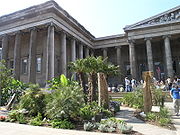
200 (number)
200 is the natural number following 199 and preceding 201.The number appears in the Padovan sequence, preceded by 86, 114, 151 ....
. Many changes followed: the first full time in house designer and publications officer were appointed in 1964, A Friends
The British Museum Friends
The British Museum Friends is a registered charitable organisation in the UK with close links to the British Museum, and was set up in 1968...
organization was set up in 1968, an Education Service established in 1970 and publishing house in 1973. In 1963 a new Act of Parliament introduced administrative reforms. It became easier to lend objects, the constitution
Constitution
A constitution is a set of fundamental principles or established precedents according to which a state or other organization is governed. These rules together make up, i.e. constitute, what the entity is...
of the Board of Trustees changed and the Natural History Museum
Natural History Museum
The Natural History Museum is one of three large museums on Exhibition Road, South Kensington, London, England . Its main frontage is on Cromwell Road...
became fully independent. By 1959 the Coins and Medals office suite, completely destroyed during the war, was rebuilt and re-opened, attention turned towards the gallery work with new tastes in design leading to the remodelling of Robert Smirke's
Robert Smirke (architect)
Sir Robert Smirke was an English architect, one of the leaders of Greek Revival architecture his best known building in that style is the British Museum, though he also designed using other architectural styles...
Classical and Near Eastern galleries. In 1962 the Duveen Gallery was finally restored and the Parthenon Sculptures were moved back into it, once again at the heart of the museum.
By the 1970s the Museum was again expanding. More services for the public were introduced; visitor numbers soared, with the temporary exhibition "Treasures of Tutankhamun
Tutankhamun
Tutankhamun , Egyptian , ; approx. 1341 BC – 1323 BC) was an Egyptian pharaoh of the 18th dynasty , during the period of Egyptian history known as the New Kingdom...
" in 1972, attracting 1,694,117 visitors, the most successful in British history. In the same year the Act of Parliament establishing the British Library was passed, separating the collection of manuscripts and printed books from the British Museum. This left the Museum with antiquities; coins, medals and paper money; prints & drawings; and ethnography
Ethnography
Ethnography is a qualitative method aimed to learn and understand cultural phenomena which reflect the knowledge and system of meanings guiding the life of a cultural group...
. A pressing problem was finding space for additions to the library which now required an extra 1 1/4 miles of shelving each year. The Government suggested a site at St Pancras
St Pancras, London
St Pancras is an area of London. For many centuries the name has been used for various officially-designated areas, but now is used informally and rarely having been largely superseded by several other names for overlapping districts.-Ancient parish:...
for the new British Library but the books did not leave the museum until 1997.
The Great Court emerges (1975–2000)
The departure of the British Library to a new site at St Pancras, finally achieved in 1998, provided the space needed for the books. It also created the opportunity to redevelop the vacant space in Robert Smirke'sRobert Smirke (architect)
Sir Robert Smirke was an English architect, one of the leaders of Greek Revival architecture his best known building in that style is the British Museum, though he also designed using other architectural styles...
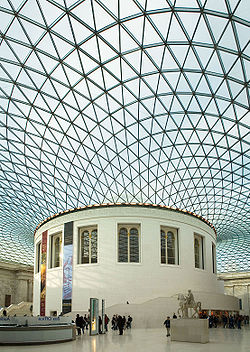
19th-century central quadrangle into the Queen Elizabeth II Great Court
Queen Elizabeth II Great Court
The central quadrangle of the British Museum in London was redeveloped to a design by Foster and Partners, from a 1970s design by Colin St John Wilson, to become the Queen Elizabeth II Great Court, commonly referred to simply as the Great Court, during the late 1990s...
– the largest covered square in Europe – which opened in 2000.
The ethnography collections, which had been housed in the short-lived Museum of Mankind at 6 Burlington Gardens from 1970, were returned to new purpose-built galleries.
The Museum again readjusted its collecting policies as interest in "modern" objects: prints, drawings, medals and the decorative arts reawakened. Ethnographical fieldwork was carried out in places as diverse as New Guinea
New Guinea
New Guinea is the world's second largest island, after Greenland, covering a land area of 786,000 km2. Located in the southwest Pacific Ocean, it lies geographically to the east of the Malay Archipelago, with which it is sometimes included as part of a greater Indo-Australian Archipelago...
, Madagascar
Madagascar
The Republic of Madagascar is an island country located in the Indian Ocean off the southeastern coast of Africa...
, Romania
Romania
Romania is a country located at the crossroads of Central and Southeastern Europe, on the Lower Danube, within and outside the Carpathian arch, bordering on the Black Sea...
, Guatemala
Guatemala
Guatemala is a country in Central America bordered by Mexico to the north and west, the Pacific Ocean to the southwest, Belize to the northeast, the Caribbean to the east, and Honduras and El Salvador to the southeast...
and Indonesia
Indonesia
Indonesia , officially the Republic of Indonesia , is a country in Southeast Asia and Oceania. Indonesia is an archipelago comprising approximately 13,000 islands. It has 33 provinces with over 238 million people, and is the world's fourth most populous country. Indonesia is a republic, with an...
and there were excavations in the Near East
Near East
The Near East is a geographical term that covers different countries for geographers, archeologists, and historians, on the one hand, and for political scientists, economists, and journalists, on the other...
, Egypt, Sudan and the UK. The Weston
Weston family
The Weston family of Canada and the United Kingdom are prominent businesspeople with global interests in food and clothing businesses. The family operations began with the founding of a bakery in Toronto, Ontario by George Weston....
Gallery of Roman Britain, opened in 1997, displayed a number of recently discovered hoard
Hoard
In archaeology, a hoard is a collection of valuable objects or artifacts, sometimes purposely buried in the ground. This would usually be with the intention of later recovery by the hoarder; hoarders sometimes died before retrieving the hoard, and these surviving hoards may be uncovered by...
s which demonstrated the richness of what had been considered an unimportant part of the Roman Empire. The Museum turned increasingly towards private funds for buildings, acquisitions and other purposes.
The Museum today
Today it no longer houses collections of natural historyNatural history
Natural history is the scientific research of plants or animals, leaning more towards observational rather than experimental methods of study, and encompasses more research published in magazines than in academic journals. Grouped among the natural sciences, natural history is the systematic study...
, and the books and manuscripts it once held now form part of the independent British Library. The Museum nevertheless preserves its universality in its collections of artefacts representing the cultures of the world, ancient and modern. The original 1753 collection has grown to over thirteen million objects at the British Museum, 70 million at the Natural History Museum
Natural History Museum
The Natural History Museum is one of three large museums on Exhibition Road, South Kensington, London, England . Its main frontage is on Cromwell Road...
and 150 million at the British Library.
The Round Reading Room
British Museum Reading Room
The British Museum Reading Room, situated in the centre of the Great Court of the British Museum, used to be the main reading room of the British Library. In 1997, this function moved to the new British Library building at St Pancras, London, but the Reading Room remains in its original form inside...
, which was designed by the architect Sydney Smirke
Sydney Smirke
Sydney Smirke, architect, was born in London, England, the younger brother of Sir Robert Smirke, also an architect. Their father, also Robert Smirke, had been a well-known 18th Century painter.Sydney Smirke's works include:...
, opened in 1857. For almost 150 years researchers came here to consult the Museum's vast library. The Reading Room closed in 1997 when the national library (the British Library) moved to a new building at St Pancras
St Pancras, London
St Pancras is an area of London. For many centuries the name has been used for various officially-designated areas, but now is used informally and rarely having been largely superseded by several other names for overlapping districts.-Ancient parish:...
. Today it has been transformed into the Walter and Leonore Annenberg
Annenberg Foundation
The Annenberg Foundation is a private foundation that provides funding and support to non-profit organizations in the United States and around the world...
Centre. This contains the Paul Hamlyn
Paul Hamlyn
Paul Hamlyn, Baron Hamlyn of Edgeworth, CBE , was a German-born British publisher and philanthropist.-Family:...
Library of books about the Museum's collections, which is open to all visitors.
With the bookstacks in the central courtyard of the museum empty, the process of demolition for Lord Foster's glass-roofed Great Court
Queen Elizabeth II Great Court
The central quadrangle of the British Museum in London was redeveloped to a design by Foster and Partners, from a 1970s design by Colin St John Wilson, to become the Queen Elizabeth II Great Court, commonly referred to simply as the Great Court, during the late 1990s...
could begin. The Great Court, opened in 2000, while undoubtedly improving circulation around the museum, was criticised for having a lack of exhibition space at a time when the museum was in serious financial difficulties and many galleries were closed to the public. At the same time the African and Oceanic collections that had been temporarily housed in 6 Burlington Gardens were given a new gallery in the North Wing funded by the Sainsbury
David Sainsbury, Baron Sainsbury of Turville
David John Sainsbury, Baron Sainsbury of Turville, FRS , is a British businessman and politician. From 1992 to 1997, he served as the Chairman of Sainsbury's . He was made a life peer in 1997, and currently sits in the House of Lords as a member of the Labour Party...
family - with the donation valued at £25 million.
Governance
In technical terms, the British Museum is a non-departmental public bodyNon-departmental public body
In the United Kingdom, a non-departmental public body —often referred to as a quango—is a classification applied by the Cabinet Office, Treasury, Scottish Government and Northern Ireland Executive to certain types of public bodies...
sponsored by the Department for Culture, Media and Sport
Department for Culture, Media and Sport
The Department for Culture, Media and Sport is a department of the United Kingdom government, with responsibility for culture and sport in England, and some aspects of the media throughout the whole UK, such as broadcasting and internet....
through a three-year funding agreement. Its head is the Director. The British Museum was run from its inception by a 'Principal Librarian' (when the book collections were still part of the Museum), a role that was renamed 'Director and Principal Librarian' in 1898, and 'Director' in 1973 (on the separation of the British Library).
A board of 25 trustee
Trustee
Trustee is a legal term which, in its broadest sense, can refer to any person who holds property, authority, or a position of trust or responsibility for the benefit of another...
s (with the Director as their accounting officer for the purposes of reporting to Government) is responsible for the general management and control of the Museum, in accordance with the British Museum Act of 1963 and the Museums and Galleries Act of 1992. Prior to the 1963 Act, it was chaired by the Archbishop of Canterbury
Archbishop of Canterbury
The Archbishop of Canterbury is the senior bishop and principal leader of the Church of England, the symbolic head of the worldwide Anglican Communion, and the diocesan bishop of the Diocese of Canterbury. In his role as head of the Anglican Communion, the archbishop leads the third largest group...
, the Lord Chancellor
Lord Chancellor
The Lord High Chancellor of Great Britain, or Lord Chancellor, is a senior and important functionary in the government of the United Kingdom. He is the second highest ranking of the Great Officers of State, ranking only after the Lord High Steward. The Lord Chancellor is appointed by the Sovereign...
and the Speaker of the House of Commons
Speaker of the British House of Commons
The Speaker of the House of Commons is the presiding officer of the House of Commons, the United Kingdom's lower chamber of Parliament. The current Speaker is John Bercow, who was elected on 22 June 2009, following the resignation of Michael Martin...
. The board was formed on the Museum's inception to hold its collections in trust
Trust law
In common law legal systems, a trust is a relationship whereby property is held by one party for the benefit of another...
for the nation without actually owning them themselves, and now fulfil a mainly advisory role. Trustee appointments are governed by the regulatory framework set out in the code of practice on public appointments issued by the Office of the Commissioner for Public Appointments. For a list of current trustees, see here.
Building
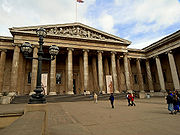
Greek Revival architecture
The Greek Revival was an architectural movement of the late 18th and early 19th centuries, predominantly in Northern Europe and the United States. A product of Hellenism, it may be looked upon as the last phase in the development of Neoclassical architecture...
façade facing Great Russell Street is a characteristic building of Sir Robert Smirke
Robert Smirke (architect)
Sir Robert Smirke was an English architect, one of the leaders of Greek Revival architecture his best known building in that style is the British Museum, though he also designed using other architectural styles...
, with 44 columns in the Ionic order
Ionic order
The Ionic order forms one of the three orders or organizational systems of classical architecture, the other two canonic orders being the Doric and the Corinthian...
45 ft (13.7 m) high, closely based on those of the temple of Athena Polias
Athena
In Greek mythology, Athena, Athenê, or Athene , also referred to as Pallas Athena/Athene , is the goddess of wisdom, courage, inspiration, civilization, warfare, strength, strategy, the arts, crafts, justice, and skill. Minerva, Athena's Roman incarnation, embodies similar attributes. Athena is...
at Priene
Priene
Priene was an ancient Greek city of Ionia at the base of an escarpment of Mycale, about north of the then course of the Maeander River, from today's Aydin, from today's Söke and from ancient Miletus...
in Asia Minor
Asia Minor
Asia Minor is a geographical location at the westernmost protrusion of Asia, also called Anatolia, and corresponds to the western two thirds of the Asian part of Turkey...
. The pediment
Pediment
A pediment is a classical architectural element consisting of the triangular section found above the horizontal structure , typically supported by columns. The gable end of the pediment is surrounded by the cornice moulding...
over the main entrance is decorated by sculptures by Sir Richard Westmacott
Richard Westmacott
Sir Richard Westmacott, Jr., RA was a British sculptor.-Life and career:He studied under his father, Richard Westmacott the Elder, before going to Rome in 1793 to study under Antonio Canova...
depicting The Progress of Civilisation, consisting of fifteen allegorical
Allegory
Allegory is a demonstrative form of representation explaining meaning other than the words that are spoken. Allegory communicates its message by means of symbolic figures, actions or symbolic representation...
figures, installed in 1852.
The construction commenced around the courtyard with the East Wing (The King's Library
King's Library
The King's Library was one of the most important collections of books and pamphlets of the Age of Enlightenment. Assembled by George III, this scholarly library of over 65,000 volumes was subsequently given to the British nation by George IV. It was housed in a specially built gallery in the...
) in 1823–1828, followed by the North Wing in 1833–1838, which originally housed among other galleries a reading room, now the Wellcome Gallery. Work was also progressing on the northern half of the West Wing (The Egyptian Sculpture Gallery) 1826–1831, with Montagu House
Montagu House, Bloomsbury
Montagu House was a late 17th-century mansion in Great Russell Street in the Bloomsbury district of London, which became the first home of the British Museum....
demolished in 1842 to make room for the final part of the West Wing, completed in 1846, and the South Wing with its great colonnade, initiated in 1843 and completed in 1847, when the Front Hall and Great Staircase were opened to the public. The Museum is faced with Portland stone
Portland stone
Portland stone is a limestone from the Tithonian stage of the Jurassic period quarried on the Isle of Portland, Dorset. The quarries consist of beds of white-grey limestone separated by chert beds. It has been used extensively as a building stone throughout the British Isles, notably in major...
, but the perimeter walls and other parts of the building were built using Haytor granite from Dartmoor in South Devon, transported via the unique Haytor Granite Tramway
Haytor Granite Tramway
The Haytor Granite Tramway was a unique granite-railed tramway running down from Haytor Down, Dartmoor, Devon. The tramway was built in 1820 to carry Haytor granite, which was of fine grain and high quality, down from the heights of Dartmoor for the construction of houses, bridges and other...
.
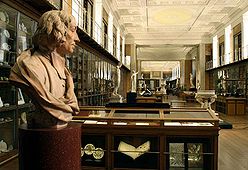
Sydney Smirke
Sydney Smirke, architect, was born in London, England, the younger brother of Sir Robert Smirke, also an architect. Their father, also Robert Smirke, had been a well-known 18th Century painter.Sydney Smirke's works include:...
, whose major addition was the Round Reading Room
British Museum Reading Room
The British Museum Reading Room, situated in the centre of the Great Court of the British Museum, used to be the main reading room of the British Library. In 1997, this function moved to the new British Library building at St Pancras, London, but the Reading Room remains in its original form inside...
1854–1857; at 140 feet (42.7 m) in diameter it was then the second widest dome in the world, the Pantheon
Pantheon, Rome
The Pantheon ,Rarely Pantheum. This appears in Pliny's Natural History in describing this edifice: Agrippae Pantheum decoravit Diogenes Atheniensis; in columnis templi eius Caryatides probantur inter pauca operum, sicut in fastigio posita signa, sed propter altitudinem loci minus celebrata.from ,...
in Rome
Rome
Rome is the capital of Italy and the country's largest and most populated city and comune, with over 2.7 million residents in . The city is located in the central-western portion of the Italian Peninsula, on the Tiber River within the Lazio region of Italy.Rome's history spans two and a half...
being slightly wider.
The next major addition was the White Wing 1882–1884 added behind the eastern end of the South Front, the architect being Sir John Taylor
John Taylor (architect)
Sir John Taylor, KCB, FRIBA was a British architect...
.
In 1895, Parliament gave the Museum Trustees a loan of £200,000 to purchase from the Duke of Bedford all 69 houses which backed onto the Museum building in the five surrounding streets - Great Russell Street, Montague Street, Montague Place, Bedford Square and Bloomsbury Street. The Trustees planned to demolish these houses and to build around the West, North and East sides of the Museum new galleries that would completely fill the block on which the Museum stands. The architect Sir John James Burnet
John James Burnet
Sir John James Burnet was a Scottish Edwardian architect who was noted for a number of prominent buildings in Glasgow, Scotland and London, England...
was petitioned to put forward ambitious long-term plans to extend the building on all three sides. Most of the houses in Montague Place were knocked down a few years after the sale. Of this grand plan only the Edward VII galleries in the centre of the North Front were ever constructed, these were built 1906-14 to the design by J.J. Burnet, and opened by King George V
George V of the United Kingdom
George V was King of the United Kingdom and the British Dominions, and Emperor of India, from 6 May 1910 through the First World War until his death in 1936....
and Queen Mary
Mary of Teck
Mary of Teck was the queen consort of the United Kingdom and the British Dominions, and Empress of India, as the wife of King-Emperor George V....
in 1914. They now house the Museum's collections of Prints and Drawings and Oriental Antiquities. There was not enough money to put up more new buildings, and so the houses in the other streets are nearly all still standing.
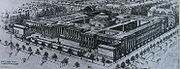
Joseph Duveen, 1st Baron Duveen of Millbank
Joseph Duveen, 1st Baron Duveen , known as Sir Joseph Duveen, Bt, between 1927 and 1933, was a British art dealer, considered one of the most influential art dealers of all time.-Life and career:...
Gallery, sited to the west of the Egyptian, Greek & Assyrian sculpture galleries, was designed to house the Elgin Marbles by the American Beaux-Arts architect John Russell Pope
John Russell Pope
John Russell Pope was an architect most known for his designs of the National Archives and Records Administration building , the Jefferson Memorial and the West Building of the National Gallery of Art in Washington, DC.-Biography:Pope was born in New York in 1874, the son of a successful...
. Although completed in 1938, it was hit by a bomb in 1940 and remained semi-derelict for 22 years, before reopening in 1962. Other areas damaged during World War II
World War II
World War II, or the Second World War , was a global conflict lasting from 1939 to 1945, involving most of the world's nations—including all of the great powers—eventually forming two opposing military alliances: the Allies and the Axis...
bombing included: in September 1940 two unexploded bombs hit the Edward VII galleries, the King's Library received a direct hit from a high explosive bomb, incendiaries fell on the dome of the Round Reading Room but did little damage; on the night of 10 to 11 May 1941 several incendiaries fell on the south west corner of the Museum, destroying the book stack and 150,000 books in the courtyard and the galleries around the top of the Great Staircase – this damage was not fully repaired until the early 1960s.
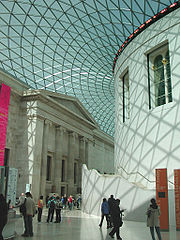
Elizabeth II of the United Kingdom
Elizabeth II is the constitutional monarch of 16 sovereign states known as the Commonwealth realms: the United Kingdom, Canada, Australia, New Zealand, Jamaica, Barbados, the Bahamas, Grenada, Papua New Guinea, the Solomon Islands, Tuvalu, Saint Lucia, Saint Vincent and the Grenadines, Belize,...
Great Court is a covered square at the centre of the British Museum designed by the engineers Buro Happold
Buro Happold
Buro Happold is a professional services firm providing engineering consultancy, design, planning, project management and consulting services for all aspects of buildings, infrastructure and the environment, with its head office in Bath, Somerset...
and the architects Foster and Partners
Foster and Partners
Foster + Partners is an architectural firm based in London. The practice is led by its founder and Chairman, Norman Foster, and has constructed many high-profile glass-and-steel buildings....
. The Great Court opened in December 2000 and is the largest covered square in Europe. The roof is a glass and steel construction, built by an Austrian steelwork company, with 1,656 uniquely shaped panes of glass. At the centre of the Great Court is the Reading Room vacated by the British Library, its functions now moved to St Pancras. The Reading Room is open to any member of the public who wishes to read there.
Today, the British Museum has grown to become one of the largest Museums in the world, covering an area of over 75,000 m2 of exhibition space, showcasing approximately 50,000 items from its collection. There are nearly one hundred galleries open to the public, representing 2 miles (3.2 km) of exhibition space, although the less popular ones have restricted opening times. However, the lack of a large temporary exhibition space has led to the £100 million World Conservation and Exhibition Centre to provide one and to concentrate all the Museum's conservation facilities into one Conservation Centre. This project was announced in July 2007, with the architects Rogers Stirk Harbour and Partners
Richard Rogers
Richard George Rogers, Baron Rogers of Riverside CH Kt FRIBA FCSD is a British architect noted for his modernist and functionalist designs....
. It was granted planning permission in December 2009 and is expected for completion by 2013.
Blythe House
Blythe House
Blythe House is a listed building located at 23 Blythe Road, West Kensington, London Borough of Hammersmith and Fulham, UK. Originally built as the headquarters of the Post Office Savings Bank, it is now used as a store and archive by the Victoria and Albert, Science and British Museums.-Post...
in West Kensington is used by the Museum for off-site storage of small and medium-sized artefacts.
Department of Ancient Egypt and Sudan
.2.jpg)
Art of Ancient Egypt
Ancient Egyptian art is the painting, sculpture, architecture and other arts produced by the civilization in the lower Nile Valley from 5000 BC to 300 AD. Ancient Egyptian art reached a high level in painting and sculpture, and was both highly stylized and symbolic...
outside the Egyptian Museum
Egyptian Museum
The Museum of Egyptian Antiquities, known commonly as the Egyptian Museum, in Cairo, Egypt, is home to an extensive collection of ancient Egyptian antiquities. It has 120,000 items, with a representative amount on display, the remainder in storerooms....
in Cairo
Cairo
Cairo , is the capital of Egypt and the largest city in the Arab world and Africa, and the 16th largest metropolitan area in the world. Nicknamed "The City of a Thousand Minarets" for its preponderance of Islamic architecture, Cairo has long been a centre of the region's political and cultural life...
. A collection of immense importance for its range and quality, it includes objects of all periods from virtually every site of importance in Egypt
Ancient Egypt
Ancient Egypt was an ancient civilization of Northeastern Africa, concentrated along the lower reaches of the Nile River in what is now the modern country of Egypt. Egyptian civilization coalesced around 3150 BC with the political unification of Upper and Lower Egypt under the first pharaoh...
and the Sudan
History of Sudan
The history of Sudan extends from antiquity, and is intertwined with the history of Egypt, with which it was united politically over several periods. It is marked by influences on Sudan from neighboring areas and world powers...
. Together they illustrate every aspect of the cultures of the Nile Valley
Nile
The Nile is a major north-flowing river in North Africa, generally regarded as the longest river in the world. It is long. It runs through the ten countries of Sudan, South Sudan, Burundi, Rwanda, Democratic Republic of the Congo, Tanzania, Kenya, Ethiopia, Uganda and Egypt.The Nile has two major...
(including Nubia
Nubia
Nubia is a region along the Nile river, which is located in northern Sudan and southern Egypt.There were a number of small Nubian kingdoms throughout the Middle Ages, the last of which collapsed in 1504, when Nubia became divided between Egypt and the Sennar sultanate resulting in the Arabization...
), from the Predynastic
Predynastic Egypt
The Prehistory of Egypt spans the period of earliest human settlement to the beginning of the Early Dynastic Period of Egypt in ca. 3100 BC, starting with King Menes/Narmer....
Neolithic
Neolithic
The Neolithic Age, Era, or Period, or New Stone Age, was a period in the development of human technology, beginning about 9500 BC in some parts of the Middle East, and later in other parts of the world. It is traditionally considered as the last part of the Stone Age...
period (c. 10,000 BC
Anno Domini
and Before Christ are designations used to label or number years used with the Julian and Gregorian calendars....
) through to the Coptic (Christian) times (12th century AD
Anno Domini
and Before Christ are designations used to label or number years used with the Julian and Gregorian calendars....
), a time-span over 11,000 years.
Egyptian antiquities
Art of Ancient Egypt
Ancient Egyptian art is the painting, sculpture, architecture and other arts produced by the civilization in the lower Nile Valley from 5000 BC to 300 AD. Ancient Egyptian art reached a high level in painting and sculpture, and was both highly stylized and symbolic...
have formed part of the British Museum collection ever since its foundation in 1753 after receiving 160 Egyptian objects from Sir Hans Sloane
Hans Sloane
Sir Hans Sloane, 1st Baronet, PRS was an Ulster-Scot physician and collector, notable for bequeathing his collection to the British nation which became the foundation of the British Museum...
. After the defeat of the French
French Revolutionary Wars: Campaigns of 1799
By 1799, the French Revolutionary Wars had resumed after a period of relative peace in 1798. The Second Coalition had organized against France, with Great Britain allying with Russia, Austria, the Ottoman Empire, and several of the minor German and Italian states...
forces under Napoleon
Napoleon I of France
Napoleon Bonaparte was a French military and political leader during the latter stages of the French Revolution.As Napoleon I, he was Emperor of the French from 1804 to 1815...
at the Battle of the Nile
Battle of the Nile
The Battle of the Nile was a major naval battle fought between British and French fleets at Aboukir Bay on the Mediterranean coast of Egypt from 1–3 August 1798...
in 1801, the Egyptian antiquities collected were confiscated by the British army
British Army
The British Army is the land warfare branch of Her Majesty's Armed Forces in the United Kingdom. It came into being with the unification of the Kingdom of England and Scotland into the Kingdom of Great Britain in 1707. The new British Army incorporated Regiments that had already existed in England...
and presented to the British Museum in 1803. These works, which included the famed Rosetta Stone
Rosetta Stone
The Rosetta Stone is an ancient Egyptian granodiorite stele inscribed with a decree issued at Memphis in 196 BC on behalf of King Ptolemy V. The decree appears in three scripts: the upper text is Ancient Egyptian hieroglyphs, the middle portion Demotic script, and the lowest Ancient Greek...
, were the first important group of large sculptures to be acquired by the Museum. Thereafter, the UK appointed Henry Salt
Henry Salt (Egyptologist)
Henry Salt was an English artist, traveller, diplomat, and Egyptologist.-Biography:Salt, the son of a physician, was born in Lichfield. He trained as a portrait painter, first in Lichfield and then in London under Joseph Farington and John Hoppner. In 1802 he was appointed secretary and...
as consul in Egypt
Egypt
Egypt , officially the Arab Republic of Egypt, Arabic: , is a country mainly in North Africa, with the Sinai Peninsula forming a land bridge in Southwest Asia. Egypt is thus a transcontinental country, and a major power in Africa, the Mediterranean Basin, the Middle East and the Muslim world...
who amassed a huge collection of antiquities. Most of the antiquities Salt collected were purchased by the British Museum and the Musée du Louvre. By 1866 the collection consisted of some 10,000 objects. Antiquities from excavations started to come to the Museum in the later 19th century as a result of the work of the Egypt Exploration Fund
Egypt Exploration Society
The Egypt Exploration Society is the foremost learned society in the United Kingdom promoting the field of Egyptology....
under the efforts of E.A. Wallis Budge
E. A. Wallis Budge
Sir Ernest Alfred Thompson Wallis Budge was an English Egyptologist, Orientalist, and philologist who worked for the British Museum and published numerous works on the ancient Near East.-Earlier life:...
. The collection stood at 57,000 objects by 1924. Active support by the Museum for excavations in Egypt continued to result in useful acquisitions throughout the 20th century until changes in antiquities laws in Egypt led to the suspension of policies allowing finds to be exported. The size of the Egyptian collections now stands at over 110,000 objects.
In autumn 2001 the eight million objects forming the Museum's permanent collection were further expanded by the addition of six million objects from the Wendorf Collection of Egyptian
Predynastic Egypt
The Prehistory of Egypt spans the period of earliest human settlement to the beginning of the Early Dynastic Period of Egypt in ca. 3100 BC, starting with King Menes/Narmer....
and Sudanese
History of Sudan
The history of Sudan extends from antiquity, and is intertwined with the history of Egypt, with which it was united politically over several periods. It is marked by influences on Sudan from neighboring areas and world powers...
Prehistory
Prehistory
Prehistory is the span of time before recorded history. Prehistory can refer to the period of human existence before the availability of those written records with which recorded history begins. More broadly, it refers to all the time preceding human existence and the invention of writing...
. These were donated by Professor Fred Wendorf of Southern Methodist University
Southern Methodist University
Southern Methodist University is a private university in Dallas, Texas, United States. Founded in 1911 by the Methodist Episcopal Church, South, SMU operates campuses in Dallas, Plano, and Taos, New Mexico. SMU is owned by the South Central Jurisdiction of the United Methodist Church...
in Texas
Texas
Texas is the second largest U.S. state by both area and population, and the largest state by area in the contiguous United States.The name, based on the Caddo word "Tejas" meaning "friends" or "allies", was applied by the Spanish to the Caddo themselves and to the region of their settlement in...
, and comprise the entire collection of artefacts and environmental remains from his excavations between 1963 and 1997. They are in the care of the Department of Ancient Egypt and Sudan.
The seven permanent Egyptian galleries at the British Museum, which include its largest exhibition space (Room 4, for monumental sculpture), can display only 4% of its Egyptian holdings. The second-floor galleries have a selection of the Museum's collection of 140 mummies
Mummy
A mummy is a body, human or animal, whose skin and organs have been preserved by either intentional or incidental exposure to chemicals, extreme coldness , very low humidity, or lack of air when bodies are submerged in bogs, so that the recovered body will not decay further if kept in cool and dry...
and coffins, the largest outside Cairo
Egyptian Museum
The Museum of Egyptian Antiquities, known commonly as the Egyptian Museum, in Cairo, Egypt, is home to an extensive collection of ancient Egyptian antiquities. It has 120,000 items, with a representative amount on display, the remainder in storerooms....
. A high proportion of the collection comes from tombs or contexts associated with the cult of the dead, and it is these pieces, in particular the mummies, that remain among the most eagerly sought after exhibits by visitors to the Museum.
Key highlights of the collections include:
- The Rosetta StoneRosetta StoneThe Rosetta Stone is an ancient Egyptian granodiorite stele inscribed with a decree issued at Memphis in 196 BC on behalf of King Ptolemy V. The decree appears in three scripts: the upper text is Ancient Egyptian hieroglyphs, the middle portion Demotic script, and the lowest Ancient Greek...
(196 BC) - The Battlefield PaletteBattlefield PaletteThe Battlefield Palette is the earliest "battle scene" representation of the dozen or more "ceremonial" or "ornamental" cosmetic palettes of ancient Egypt...
, (circa ~3500 to 3000 BC). - Limestone statue of a husband and wife (1300 BC)
- Colossal bust of Ramesses IIRamesses IIRamesses II , referred to as Ramesses the Great, was the third Egyptian pharaoh of the Nineteenth dynasty. He is often regarded as the greatest, most celebrated, and most powerful pharaoh of the Egyptian Empire...
, the "Younger MemnonMemnon (mythology)In Greek mythology, Memnon was an Ethiopian king and son of Tithonus and Eos. As a warrior he was considered to be almost Achilles' equal in skill. During the Trojan War, he brought an army to Troy's defense. The death of Memnon echoes that of Hector, another defender of Troy whom Achilles also...
" (1250 BC) - Colossal red granite statue of Amenhotep IIIColossal red granite statue of Amenhotep IIIThe 18th Dynasty Ancient Egyptian colossal red granite statue of Amenhotep III, dating from c.1370 BC was found in the temple enclosure of Mut at Karnak in Egypt. Two parts of the broken colossal statue are known: the head and an arm...
(1350 BC) - Colossal head from a statue of Amenhotep IIIColossal quartzite statue of Amenhotep IIIThe 18th Dynasty Ancient Egyptian colossal quartzite statue of Amenhotep III, dating from c.1350 BC, was found in the massive mortuary temple of the pharaoh Amenhotep III on the West Bank of the River Nile at Thebes in Egypt. Only the head of the broken colossal statue survives...
(1350 BC) - Colossal limestone bust of Amenhotep III (1350 BC)
- Saite Sarcophagus of Satsobek
- Mummy of 'Ginger' which dates to about 3300 BC
- List of the kings of Egypt from the Temple of Ramesses IIAbydos, EgyptAbydos is one of the most ancient cities of Upper Egypt, and also of the eight Upper Nome, of which it was the capital city. It is located about 11 kilometres west of the Nile at latitude 26° 10' N, near the modern Egyptian towns of el-'Araba el Madfuna and al-Balyana...
(1250 BC) - Limestone false door of PtahshepsesPtahshepsesPtahshepses was the vizier and son-in-law of the fifth dynasty king Niuserre. His mastaba complex in Abusir is considered by many to be the most extensive and architecturally unique non-royal tomb of the Old Kingdom...
(2380 BC) - Granite statue of Senwosret III (1850 BC)
- Mummy of Cleopatra from ThebesThebes, EgyptThebes is the Greek name for a city in Ancient Egypt located about 800 km south of the Mediterranean, on the east bank of the river Nile within the modern city of Luxor. The Theban Necropolis is situated nearby on the west bank of the Nile.-History:...
(100 AD) - Amarna tabletsAmarna lettersThe Amarna letters are an archive of correspondence on clay tablets, mostly diplomatic, between the Egyptian administration and its representatives in Canaan and Amurru during the New Kingdom...
(Collection of 95 out of 382 tabletsClay tabletIn the Ancient Near East, clay tablets were used as a writing medium, especially for writing in cuneiform, throughout the Bronze Age and well into the Iron Age....
found, second greatest in the world after the Vorderasiatisches Museum, BerlinBerlinBerlin is the capital city of Germany and is one of the 16 states of Germany. With a population of 3.45 million people, Berlin is Germany's largest city. It is the second most populous city proper and the seventh most populous urban area in the European Union...
(203 tablets) (1350 BC) - Obelisk of Pharaoh Nectanebo IINectanebo IINectanebo II was the third and last pharaoh of the Thirtieth dynasty, as well as the last native ruler of Ancient Egypt. Under Nectanebo II Egypt prospered...
(360–343 BC) - Gayer-Anderson catGayer-Anderson catThe Gayer-Anderson Cat is an Ancient Egyptian statue of a cat made out of bronze, from the Late Period, about 664-332 BC.-Style and detail:...
Department of Greek and Roman Antiquities
The Department of GreekAncient Greece
Ancient Greece is a civilization belonging to a period of Greek history that lasted from the Archaic period of the 8th to 6th centuries BC to the end of antiquity. Immediately following this period was the beginning of the Early Middle Ages and the Byzantine era. Included in Ancient Greece is the...
and Roman
Roman Empire
The Roman Empire was the post-Republican period of the ancient Roman civilization, characterised by an autocratic form of government and large territorial holdings in Europe and around the Mediterranean....
Antiquities of the British Museum has one of the world's largest and most comprehensive collections of antiquities from the Classical world
Classical antiquity
Classical antiquity is a broad term for a long period of cultural history centered on the Mediterranean Sea, comprising the interlocking civilizations of ancient Greece and ancient Rome, collectively known as the Greco-Roman world...
, with over 100,000 objects. These mostly range in date from the beginning of the Greek Bronze Age
Bronze Age
The Bronze Age is a period characterized by the use of copper and its alloy bronze as the chief hard materials in the manufacture of some implements and weapons. Chronologically, it stands between the Stone Age and Iron Age...
(about 3200 BC) to the reign of the Roman Emperor
Roman Emperor
The Roman emperor was the ruler of the Roman State during the imperial period . The Romans had no single term for the office although at any given time, a given title was associated with the emperor...
Constantine I
Constantine I
Constantine the Great , also known as Constantine I or Saint Constantine, was Roman Emperor from 306 to 337. Well known for being the first Roman emperor to convert to Christianity, Constantine and co-Emperor Licinius issued the Edict of Milan in 313, which proclaimed religious tolerance of all...
in the 4th century AD, with some pagan
Paganism
Paganism is a blanket term, typically used to refer to non-Abrahamic, indigenous polytheistic religious traditions....
survivals.
The Cycladic
Cyclades
The Cyclades is a Greek island group in the Aegean Sea, south-east of the mainland of Greece; and a former administrative prefecture of Greece. They are one of the island groups which constitute the Aegean archipelago. The name refers to the islands around the sacred island of Delos...
, Minoan
Minoan civilization
The Minoan civilization was a Bronze Age civilization that arose on the island of Crete and flourished from approximately the 27th century BC to the 15th century BC. It was rediscovered at the beginning of the 20th century through the work of the British archaeologist Arthur Evans...
and Mycenaean
Mycenaean Greece
Mycenaean Greece was a cultural period of Bronze Age Greece taking its name from the archaeological site of Mycenae in northeastern Argolis, in the Peloponnese of southern Greece. Athens, Pylos, Thebes, and Tiryns are also important Mycenaean sites...
cultures are represented, and the Greek
Ancient Greece
Ancient Greece is a civilization belonging to a period of Greek history that lasted from the Archaic period of the 8th to 6th centuries BC to the end of antiquity. Immediately following this period was the beginning of the Early Middle Ages and the Byzantine era. Included in Ancient Greece is the...
collection includes important sculpture from the Parthenon
Parthenon
The Parthenon is a temple on the Athenian Acropolis, Greece, dedicated to the Greek goddess Athena, whom the people of Athens considered their virgin patron. Its construction began in 447 BC when the Athenian Empire was at the height of its power. It was completed in 438 BC, although...
in Athens
Athens
Athens , is the capital and largest city of Greece. Athens dominates the Attica region and is one of the world's oldest cities, as its recorded history spans around 3,400 years. Classical Athens was a powerful city-state...
, as well as elements of two of the Seven Wonders of the Ancient World
Seven Wonders of the Ancient World
The Seven Wonders of the World refers to remarkable constructions of classical antiquity listed by various authors in guidebooks popular among the ancient Hellenic tourists, particularly in the 1st and 2nd centuries BC...
, the Mausoleum at Halicarnassus and the Temple of Artemis
Temple of Artemis
The Temple of Artemis , also known less precisely as the Temple of Diana, was a Greek temple dedicated to a goddess Greeks identified as Artemis and was one of the Seven Wonders of the Ancient World. It was situated at Ephesus , and was completely rebuilt three times before its eventual destruction...
at Ephesos
Ephesus
Ephesus was an ancient Greek city, and later a major Roman city, on the west coast of Asia Minor, near present-day Selçuk, Izmir Province, Turkey. It was one of the twelve cities of the Ionian League during the Classical Greek era...
.
The Department also houses one of the widest-ranging collections of Italic
Ancient Italic peoples
Ancient people of Italy are all those people that lived in Italy before the Roman domination.Not all of these various people are linguistically or ethnically closely related...
and Etruscan
Etruscan civilization
Etruscan civilization is the modern English name given to a civilization of ancient Italy in the area corresponding roughly to Tuscany. The ancient Romans called its creators the Tusci or Etrusci...
antiquities and extensive groups of material from Cyprus
Ancient history of Cyprus
The ancient history of Cyprus, also known as Classical Antiquity, dates from the 8th century BC to the Middle Ages. The earliest written records relating to Cyprus date to the Middle Bronze Age , see Alasiya.-Assyrian Period:...
. The collections of ancient jewellery and bronzes, Greek vases
Pottery of Ancient Greece
As the result of its relative durability, pottery is a large part of the archaeological record of Ancient Greece, and because there is so much of it it has exerted a disproportionately large influence on our understanding of Greek society...
and Roman glass
Glass
Glass is an amorphous solid material. Glasses are typically brittle and optically transparent.The most familiar type of glass, used for centuries in windows and drinking vessels, is soda-lime glass, composed of about 75% silica plus Na2O, CaO, and several minor additives...
and silver are particularly important.
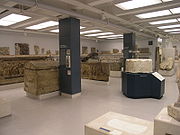
-
- Athenian AkropolisAcropolis of AthensThe Acropolis of Athens or Citadel of Athens is the best known acropolis in the world. Although there are many other acropoleis in Greece, the significance of the Acropolis of Athens is such that it is commonly known as The Acropolis without qualification...
- Athenian Akropolis
- The Parthenon Gallery (Elgin Marbles)Elgin MarblesThe Parthenon Marbles, forming a part of the collection known as the Elgin Marbles , are a collection of classical Greek marble sculptures , inscriptions and architectural members that originally were part of the Parthenon and other buildings on the Acropolis of Athens...
- Erechtheion
- One of six remaining CaryatidCaryatidA caryatid is a sculpted female figure serving as an architectural support taking the place of a column or a pillar supporting an entablature on her head. The Greek term karyatides literally means "maidens of Karyai", an ancient town of Peloponnese...
s - Surviving Column
- One of six remaining Caryatid
- Athena NikeAthena NikeNike means "victory" in Greek, and Athena was worshiped in this form, as goddess of victory in war and wisdom, on the Acropolis in Athens, Greece. Her temple was the earliest fully ionic temple on the Acropolis, compensated by its prominent position on a steep bastion at the south west corner of...
- Surviving FriezeFriezethumb|267px|Frieze of the [[Tower of the Winds]], AthensIn architecture the frieze is the wide central section part of an entablature and may be plain in the Ionic or Doric order, or decorated with bas-reliefs. Even when neither columns nor pilasters are expressed, on an astylar wall it lies upon...
Slabs
- Surviving Frieze
-
- BassaeBassaeBassae or Bassai, Vassai or Vasses , meaning "little vale in the rocks", is an archaeological site in the northeastern part of Messinia Prefecture that was a part of Arcadia in ancient times. Bassae lies near the village of Skliros, northeast of Figaleia, south of Andritsaina and west of Megalopolis...
Sculptures- Twenty three surviving blocks of the frieze from the interior of the temple are exhibited on an upper level.
- Bassae
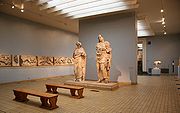
-
- Mausoleum at Halicarnassus
- One of the Seven Wonders of the Ancient WorldSeven Wonders of the Ancient WorldThe Seven Wonders of the World refers to remarkable constructions of classical antiquity listed by various authors in guidebooks popular among the ancient Hellenic tourists, particularly in the 1st and 2nd centuries BC...
- Two colossal free-standing figures identified as Maussollos and his wife ArtemisiaArtemisia I of CariaArtemisia I of Caria became the ruler, after the death of her husband, as a client of the Persians – who in the 5th century BC ruled as the overlords of Ionia....
. - Part of an impressive horse from the chariotChariotThe chariot is a type of horse carriage used in both peace and war as the chief vehicle of many ancient peoples. Ox carts, proto-chariots, were built by the Proto-Indo-Europeans and also built in Mesopotamia as early as 3000 BC. The original horse chariot was a fast, light, open, two wheeled...
group adorning the summit of the MausoleumMausoleumA mausoleum is an external free-standing building constructed as a monument enclosing the interment space or burial chamber of a deceased person or persons. A monument without the interment is a cenotaph. A mausoleum may be considered a type of tomb or the tomb may be considered to be within the... - The AmazonomachyAmazonomachyAn Amazonomachy was a portrayal of legendary battle between Greeks and Amazons...
frieze - A long section of relief frieze showing the battle between Greeks and AmazonsAmazonsThe Amazons are a nation of all-female warriors in Greek mythology and Classical antiquity. Herodotus placed them in a region bordering Scythia in Sarmatia...
- Two colossal free-standing figures identified as Maussollos and his wife Artemisia
-
- Temple of Artemis at Ephesos
- One of the Seven Wonders of the Ancient World
-
- Asia MinorAsia MinorAsia Minor is a geographical location at the westernmost protrusion of Asia, also called Anatolia, and corresponds to the western two thirds of the Asian part of Turkey...
- Asia Minor
- Nereid MonumentNereid MonumentThe Nereid Monument is a sculptured tomb from Xanthos in classical period Lycia, close to present-day Kinik in Antalya Province, Turkey. It took the form of a Greek temple on top of a base decorated with sculpted friezes, and is thought to have been built in the early fourth century BCE as a tomb...
- Partial reconstruction of the Monument, a large and elaborate Lykian tomb from the site of XanthosXanthosXanthos was the name of a city in ancient Lycia, the site of present day Kınık, Antalya Province, Turkey, and of the river on which the city is situated...
in south-west TurkeyTurkeyTurkey , known officially as the Republic of Turkey , is a Eurasian country located in Western Asia and in East Thrace in Southeastern Europe... - Payava Tomb from Xanthos in south west Turkey
- Partial reconstruction of the Monument, a large and elaborate Lykian tomb from the site of Xanthos
-
- Wider Museum Collection
- Material from the Palace of KnossosKnossosKnossos , also known as Labyrinth, or Knossos Palace, is the largest Bronze Age archaeological site on Crete and probably the ceremonial and political centre of the Minoan civilization and culture. The palace appears as a maze of workrooms, living spaces, and store rooms close to a central square...
- Portland VasePortland VaseThe Portland Vase is a Roman cameo glass vase, currently dated to between AD 5 and AD 25, which served as an inspiration to many glass and porcelain makers from about the beginning of the 18th century onwards. Since 1810 the vase has been kept almost continuously in the British Museum in London...
- The Warren CupWarren CupThe Warren Cup is an ancient Roman silver drinking cup decorated in relief with two images of homosexual acts. The cup is named after its first modern owner, the collector and writer Edward Perry Warren, and was acquired by the British Museum in 1999...
- Discus-thrower (Discobolos)DiscobolusThe Discobolus of Myron is a famous Greek sculpture that was completed towards the end of the Severe period, circa 460-450 BC. The original Greek bronze is lost...
- Towneley SculpturesCharles TowneleyCharles Townley was an English country gentleman, antiquary and collector of the Townley Marbles ....
- Material from the Palace of Knossos
- Wider Museum Collection
Department of the Middle East
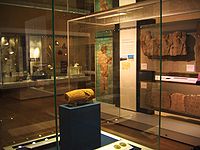
With approximately 330,000 objects in the collection, the British Museum has the greatest collection of Mesopotamia
Mesopotamia
Mesopotamia is a toponym for the area of the Tigris–Euphrates river system, largely corresponding to modern-day Iraq, northeastern Syria, southeastern Turkey and southwestern Iran.Widely considered to be the cradle of civilization, Bronze Age Mesopotamia included Sumer and the...
n antiquities outside Iraq
Iraq
Iraq ; officially the Republic of Iraq is a country in Western Asia spanning most of the northwestern end of the Zagros mountain range, the eastern part of the Syrian Desert and the northern part of the Arabian Desert....
. The holdings of Assyria
Assyria
Assyria was a Semitic Akkadian kingdom, extant as a nation state from the mid–23rd century BC to 608 BC centred on the Upper Tigris river, in northern Mesopotamia , that came to rule regional empires a number of times through history. It was named for its original capital, the ancient city of Assur...
n, Babylonia
Babylonia
Babylonia was an ancient cultural region in central-southern Mesopotamia , with Babylon as its capital. Babylonia emerged as a major power when Hammurabi Babylonia was an ancient cultural region in central-southern Mesopotamia (present-day Iraq), with Babylon as its capital. Babylonia emerged as...
n and Sumer
Sumer
Sumer was a civilization and historical region in southern Mesopotamia, modern Iraq during the Chalcolithic and Early Bronze Age....
ian antiquities are among the most comprehensive in the world.
The collections represent the civilisations of the ancient Near East and its adjacent areas. These include Mesopotamia
Mesopotamia
Mesopotamia is a toponym for the area of the Tigris–Euphrates river system, largely corresponding to modern-day Iraq, northeastern Syria, southeastern Turkey and southwestern Iran.Widely considered to be the cradle of civilization, Bronze Age Mesopotamia included Sumer and the...
, Persia, the Arabian Peninsula
Arabian Peninsula
The Arabian Peninsula is a land mass situated north-east of Africa. Also known as Arabia or the Arabian subcontinent, it is the world's largest peninsula and covers 3,237,500 km2...
, Anatolia
Anatolia
Anatolia is a geographic and historical term denoting the westernmost protrusion of Asia, comprising the majority of the Republic of Turkey...
, the Caucasus
Caucasus
The Caucasus, also Caucas or Caucasia , is a geopolitical region at the border of Europe and Asia, and situated between the Black and the Caspian sea...
, parts of Central Asia
Central Asia
Central Asia is a core region of the Asian continent from the Caspian Sea in the west, China in the east, Afghanistan in the south, and Russia in the north...
, Syria
Syria
Syria , officially the Syrian Arab Republic , is a country in Western Asia, bordering Lebanon and the Mediterranean Sea to the West, Turkey to the north, Iraq to the east, Jordan to the south, and Israel to the southwest....
, Palestine
Palestine
Palestine is a conventional name, among others, used to describe the geographic region between the Mediterranean Sea and the Jordan River, and various adjoining lands....
and Phoenicia
Phoenicia
Phoenicia , was an ancient civilization in Canaan which covered most of the western, coastal part of the Fertile Crescent. Several major Phoenician cities were built on the coastline of the Mediterranean. It was an enterprising maritime trading culture that spread across the Mediterranean from 1550...
n settlements in the western Mediterranean
Mediterranean Sea
The Mediterranean Sea is a sea connected to the Atlantic Ocean surrounded by the Mediterranean region and almost completely enclosed by land: on the north by Anatolia and Europe, on the south by North Africa, and on the east by the Levant...
from the prehistoric period
Prehistory
Prehistory is the span of time before recorded history. Prehistory can refer to the period of human existence before the availability of those written records with which recorded history begins. More broadly, it refers to all the time preceding human existence and the invention of writing...
until the beginning of Islam
Islam
Islam . The most common are and . : Arabic pronunciation varies regionally. The first vowel ranges from ~~. The second vowel ranges from ~~~...
in the 7th century. The collection includes six iconic winged human-headed statues
Lamassu
A Lamassu , is a protective deity, often depicted with a bull or lion's body, eagle's wings, and human's head. In some writings, it is portrayed to represent a female deity...
from Nimrud
Nimrud
Nimrud is an ancient Assyrian city located south of Nineveh on the river Tigris in modern Ninawa Governorate Iraq. In ancient times the city was called Kalḫu. The Arabs called the city Nimrud after the Biblical Nimrod, a legendary hunting hero .The city covered an area of around . Ruins of the city...
and Khorsabad. Stone bas-reliefs, including the famous Royal Lion Hunt relief's (Room 10), that were found in the palaces of the Assyrian kings at Nimrud
Nimrud
Nimrud is an ancient Assyrian city located south of Nineveh on the river Tigris in modern Ninawa Governorate Iraq. In ancient times the city was called Kalḫu. The Arabs called the city Nimrud after the Biblical Nimrod, a legendary hunting hero .The city covered an area of around . Ruins of the city...
and Nineveh
Nineveh
Nineveh was an ancient Assyrian city on the eastern bank of the Tigris River, and capital of the Neo Assyrian Empire. Its ruins are across the river from the modern-day major city of Mosul, in the Ninawa Governorate of Iraq....
. The Royal Library of Ashurbanipal
Library of Ashurbanipal
-External links:. In our time discussion programme. 45 minutes....
at Nineveh and Sumer
Sumer
Sumer was a civilization and historical region in southern Mesopotamia, modern Iraq during the Chalcolithic and Early Bronze Age....
ian treasures found in Royal Cemetery's at Ur of the Chaldees
Ur Kasdim
Ur Kaśdim or Ur of the Chaldees is a biblical place mentioned in the Book of Genesis that refers to a location that the Patriarch Abraham may have been from...
.
The earliest Mesopotamian objects to enter collections purchased by the British Museum in 1772 from Sir William Hamilton
William Hamilton (diplomat)
Sir William Hamilton KB, PC, FRS was a Scottish diplomat, antiquarian, archaeologist and vulcanologist. After a short period as a Member of Parliament, he served as British Ambassador to the Kingdom of Naples from 1764 to 1800...
. The Museum also acquired at this early date a number of sculptures from Persepolis
Persepolis
Perspolis was the ceremonial capital of the Achaemenid Empire . Persepolis is situated northeast of the modern city of Shiraz in the Fars Province of modern Iran. In contemporary Persian, the site is known as Takht-e Jamshid...
. The next significant addition (in 1825) was from the collection of Claudius James Rich
Claudius James Rich
Claudius James Rich , British business agent, traveller and antiquarian scholar,-Biography:Rich was born near Dijon....
. The collection was dramatically enlarged by the excavations of A. H. Layard
Austen Henry Layard
Sir Austen Henry Layard GCB, PC was a British traveller, archaeologist, cuneiformist, art historian, draughtsman, collector, author, politician and diplomat, best known as the excavator of Nimrud.-Family:...
at the Assyria
Assyria
Assyria was a Semitic Akkadian kingdom, extant as a nation state from the mid–23rd century BC to 608 BC centred on the Upper Tigris river, in northern Mesopotamia , that came to rule regional empires a number of times through history. It was named for its original capital, the ancient city of Assur...
n sites of Nimrud
Nimrud
Nimrud is an ancient Assyrian city located south of Nineveh on the river Tigris in modern Ninawa Governorate Iraq. In ancient times the city was called Kalḫu. The Arabs called the city Nimrud after the Biblical Nimrod, a legendary hunting hero .The city covered an area of around . Ruins of the city...
and Nineveh
Nineveh
Nineveh was an ancient Assyrian city on the eastern bank of the Tigris River, and capital of the Neo Assyrian Empire. Its ruins are across the river from the modern-day major city of Mosul, in the Ninawa Governorate of Iraq....
between 1845–1851.
At Nimrud, Layard discovered the North-West Palace of Ashurnasirpal II, as well as three other palaces and various temples. He also opened in the Palace of Sennacherib
Sennacherib
Sennacherib |Sîn]] has replaced brothers for me"; Aramaic: ) was the son of Sargon II, whom he succeeded on the throne of Assyria .-Rise to power:...
at Nineveh with 'no less than seventy-one halls'. As a result a large numbers of Lamassu
Lamassu
A Lamassu , is a protective deity, often depicted with a bull or lion's body, eagle's wings, and human's head. In some writings, it is portrayed to represent a female deity...
's, bas-reliefs, stelae
Stele
A stele , also stela , is a stone or wooden slab, generally taller than it is wide, erected for funerals or commemorative purposes, most usually decorated with the names and titles of the deceased or living — inscribed, carved in relief , or painted onto the slab...
, including the Black Obelisk
Black Obelisk
The "Black Obelisk of Shalmaneser III" is a black limestone Neo-Assyrian bas-relief sculpture from Nimrud , in northern Iraq, commemorating the deeds of King Shalmaneser III . It is the most complete Assyrian obelisk yet discovered, and is historically significant because it displays the earliest...
of Shalmaneser III
Shalmaneser III
Shalmaneser III was king of Assyria , and son of the previous ruler, Ashurnasirpal II....
were brought to the British Museum. Layard's work was continued by his assistant, Hormuzd Rassam
Hormuzd Rassam
Hormuzd Rassam , was a native Assyrian Assyriologist, British diplomat and traveller who made a number of important discoveries, including the clay tablets that contained the Epic of Gilgamesh, the world's oldest literature...
and in 1852–1854 he went on to discover the North Palace of Ashurbanipal at Nineveh with many magnificent reliefs, including the famous Royal Lion Hunt scenes. He also discovered the Royal Library of Ashurbanipal
Library of Ashurbanipal
-External links:. In our time discussion programme. 45 minutes....
, a large collection of cuneiform
Cuneiform script
Cuneiform script )) is one of the earliest known forms of written expression. Emerging in Sumer around the 30th century BC, with predecessors reaching into the late 4th millennium , cuneiform writing began as a system of pictographs...
tablets
Clay tablet
In the Ancient Near East, clay tablets were used as a writing medium, especially for writing in cuneiform, throughout the Bronze Age and well into the Iron Age....
of enormous importance. W. K. Loftus
William Loftus
William Kennett Loftus was a British geologist, naturalist, explorer and archaeological excavator. He discovered the ancient Sumerian city of Uruk in 1849.-Biography:...
excavated in Nimrud between 1850–1855 and found a remarkable hoard of ivories
Ivory carving
Ivory carving is the carving of ivory, that is to say animal tooth or tusk, by using sharp cutting tools, either mechanically or manually. The ancient craft has now virtually ceased, as since CITES it is illegal under most circumstances throughout the world....
in the Burnt Palace. Between 1878–1882 Rassam greatly improved the Museum's holdings with exquisite objects including the Cyrus Cylinder
Cyrus cylinder
The Cyrus Cylinder is an ancient clay cylinder, now broken into several fragments, on which is written a declaration in Akkadian cuneiform script in the name of the Achaemenid king Cyrus the Great. It dates from the 6th century BC and was discovered in the ruins of Babylon in Mesopotamia in 1879...
from Babylon
Babylon
Babylon was an Akkadian city-state of ancient Mesopotamia, the remains of which are found in present-day Al Hillah, Babil Province, Iraq, about 85 kilometers south of Baghdad...
, the bronze gates from Balawat
Balawat
Balawat is a historical location in Ninawa Governorate, Iraq, southeast from the city of Mosul and to the south of the modern Assyrian town of Bakhdida. It was the site of the ancient Neo-Assyrian city of Imgur-Enlil...
, and a fine collection of Urartian bronzes. Rassam collected thousands of cuneiform tablets, today with the acquisition of further tablets in the 20th century, the collection now numbers around 130,000 pieces. In the 20th century excavations were carried out at Carchemish
Carchemish
Carchemish or Kargamış was an important ancient city of the Mitanni, Hittite and Neo Assyrian Empires, now on the frontier between Turkey and Syria. It was the location of an important battle between the Babylonians and Egyptians, mentioned in the Bible...
, Turkey
Turkey
Turkey , known officially as the Republic of Turkey , is a Eurasian country located in Western Asia and in East Thrace in Southeastern Europe...
, between 1911–1914 and in 1920 by D. G. Hogarth
David George Hogarth
David George Hogarth was a British archaeologist and scholar associated with T. E. Lawrence and Arthur Evans.-Archaeological career:...
and Leonard Woolley
Leonard Woolley
Sir Charles Leonard Woolley was a British archaeologist best known for his excavations at Ur in Mesopotamia...
, the latter assisted by T. E. Lawrence
T. E. Lawrence
Lieutenant Colonel Thomas Edward Lawrence, CB, DSO , known professionally as T. E. Lawrence, was a British Army officer renowned especially for his liaison role during the Arab Revolt against Ottoman Turkish rule of 1916–18...
. The Mesopotamian collections were greatly augmented by excavations in southern Iraq
Iraq
Iraq ; officially the Republic of Iraq is a country in Western Asia spanning most of the northwestern end of the Zagros mountain range, the eastern part of the Syrian Desert and the northern part of the Arabian Desert....
after the First World War. From Tell al-Ubaid
Ubaid period
The Ubaid period is a prehistoric period of Mesopotamia. The tell of al-`Ubaid west of nearby Ur in southern Iraq's Dhi Qar Governorate has given its name to the prehistoric Pottery Neolithic to Chalcolithic culture, which represents the earliest settlement on the alluvial plain of southern...
in 1919 and 1923–1924, directed by H. R. Hall
Henry Hall (Egyptologist)
Dr Henry Reginald Holland Hall MBE, FBA, FSA was an English Egyptologist and historian. In life, he was normally referred to as Harry Reginald Hall.-Early life:...
came the bronze furnishings of a Sumer
Sumer
Sumer was a civilization and historical region in southern Mesopotamia, modern Iraq during the Chalcolithic and Early Bronze Age....
ian temple, including life-sized lions and a panel featuring the lion-headed eagle Indugud. Woolley went onto to excavate Ur
Ur
Ur was an important city-state in ancient Sumer located at the site of modern Tell el-Muqayyar in Iraq's Dhi Qar Governorate...
between 1922–1934, discovering the 'Royal Cemeteries' of the 3rd millennium BC. Some of the masterpieces include the 'Standard of Ur
Standard of Ur
The Standard of Ur is a Sumerian artifact excavated from what had been the Royal Cemetery in the ancient city of Ur .-History:...
', the 'Ram in a Thicket', the 'Royal Game of Ur
Royal Game of Ur
The Royal Game of Ur, also known as the Game of Twenty Squares, refers to two game boards found in the Royal Tombs of Ur in Iraq by Sir Leonard Woolley in the 1920s. The two boards date from the First Dynasty of Ur, before 2600 BC, thus making the Royal Game of Ur probably the oldest set of board...
', and two bull-headed lyres.
Although the collections centre on Mesopotamia most of the surrounding areas are well-represented. The Achaemenid collection was enhanced with the addition of the Oxus Treasure
Oxus Treasure
The Oxus treasure is a collection of 170 gold and silver items from the Achaemenid Persian period which were found by the Oxus river. Pieces from it are located in the Victoria and Albert Museum and in the British Museum , with many items bequeathed to the nation by Augustus Wollaston...
in 1897, by acquisition from the German scholar Ernst Herzfeld
Ernst Herzfeld
Ernst Emil Herzfeld was a German archaeologist and Iranologist.-Life:Herzfeld was born in Celle, Province of Hanover...
, and then by the work of Sir Aurel Stein
Marc Aurel Stein
Sir Marc Aurel Stein KCIE, FBA was a Hungarian archaeologist, primarily known for his explorations and archaeological discoveries in Central Asia. He was also a professor at various Indian universities.-Early life:Stein was born in Budapest into a Jewish family...
. From Palmyra
Palmyra
Palmyra was an ancient city in Syria. In the age of antiquity, it was an important city of central Syria, located in an oasis 215 km northeast of Damascus and 180 km southwest of the Euphrates at Deir ez-Zor. It had long been a vital caravan city for travellers crossing the Syrian desert...
there is a large collection of nearly forty funerary busts, acquired in the 19th century. A group of stone reliefs from the excavations of Max von Oppenheim
Max von Oppenheim
Max Freiherr von Oppenheim was a German ancient historian, and archaeologist, "the last of the great amateur archaeological explorers of the Near East."....
at Tell Halaf
Tell Halaf
Tell Halaf is an archaeological site in the Al Hasakah governorate of northeastern Syria, near the Turkish border, just opposite Ceylanpınar. It was the first find of a Neolithic culture, subsequently dubbed the Halaf culture, characterized by glazed pottery painted with geometric and animal designs...
, purchased in 1920. More excavated material from the excavations of Max Mallowan
Max Mallowan
Sir Max Edgar Lucien Mallowan, CBE was a prominent British archaeologist, specialising in ancient Middle Eastern history, and the second husband of Dame Agatha Christie.-Life and work:...
at Chagar Bazar
Chagar Bazar
Chagar Bazar is an ancient site in northern Syria, about 35 kilometers north of Al-Hasakah, occupied from the sixth to the second millennium BC. It is situated by the small river Dara, a tributary to the Khabur River. Alternative spellings are Tell Chagar Bazar, or Šagir Bazar.-History:Chagar...
and Tell Brak in 1935–1938, and from Woolley at Alalakh
Alalakh
Alalakh is the name of an ancient city-state near modern Antakya in the Amuq River valley of Turkey's Hatay Province.Now represented by an extensive mound, the name of the modern archaeological site is Tell Atchana.-History:...
in the years just before and after the Second World War
World War II
World War II, or the Second World War , was a global conflict lasting from 1939 to 1945, involving most of the world's nations—including all of the great powers—eventually forming two opposing military alliances: the Allies and the Axis...
. The collection of Palestinian
Palestinian people
The Palestinian people, also referred to as Palestinians or Palestinian Arabs , are an Arabic-speaking people with origins in Palestine. Despite various wars and exoduses, roughly one third of the world's Palestinian population continues to reside in the area encompassing the West Bank, the Gaza...
material was strengthened with the acquisition in 1980 of around 17,000 objects found at Lachish
Lachish
Lachish was an ancient Near East town located at the site of modern Tell ed-Duweir in the Shephelah, a region between Mount Hebron and the maritime plain of Philistia . The town was first mentioned in the Amarna letters as Lakisha-Lakiša...
by the Wellcome-Marston expedition of 1932–1938.
A representative selection, including the most important pieces, are on display in 13 galleries and total some 4500 objects. The remainder form the study collection which ranges in size from beads to large sculptures. They include approximately 130,000 cuneiform
Cuneiform script
Cuneiform script )) is one of the earliest known forms of written expression. Emerging in Sumer around the 30th century BC, with predecessors reaching into the late 4th millennium , cuneiform writing began as a system of pictographs...
tablets
Clay tablet
In the Ancient Near East, clay tablets were used as a writing medium, especially for writing in cuneiform, throughout the Bronze Age and well into the Iron Age....
from Mesopotamia.
The museum's collection of Islamic art, including archaeological material, numbers about 40,000 objects, one of the largest of its kind in the world. As such, it contains a broad range of Islamic pottery, paintings, tiles, metalwork, glass, seals, and inscriptions.
Key highlights of the collections include:
Nimrud
Nimrud
Nimrud is an ancient Assyrian city located south of Nineveh on the river Tigris in modern Ninawa Governorate Iraq. In ancient times the city was called Kalḫu. The Arabs called the city Nimrud after the Biblical Nimrod, a legendary hunting hero .The city covered an area of around . Ruins of the city...
:
Alabaster bas-reliefs from:
- The North-West Palace of Ashurnasirpal IIAshur-nasir-pal IIAshur-nasir-pal II was king of Assyria from 883 to 859 BC.Ashurnasipal II succeeded his father, Tukulti-Ninurta II, in 883 BC...
- Central- Palace of Tiglath-Pileser IIITiglath-Pileser IIITiglath-Pileser III was a prominent king of Assyria in the eighth century BC and is widely regarded as the founder of the Neo-Assyrian Empire. Tiglath-Pileser III seized the Assyrian throne during a civil war and killed the royal family...
- South-West Palace of EsarhaddonEsarhaddonEsarhaddon , was a king of Assyria who reigned 681 – 669 BC. He was the youngest son of Sennacherib and the Aramean queen Naqi'a , Sennacherib's second wife....
- Palace of Adad-Nirari IIIAdad-nirari IIIAdad-nirari III was King of Assyria from 811 to 783 BC. He was the son and successor of Shamshi-Adad V, and was apparently quite young at the time of his accession, because for the first five years of his reign his mother Shammuramat acted as regent, which may have given rise to the legend of...
- South-East Palace ('Burnt Palace')
- The NabuNabuNabu is the Assyrian and Babylonian god of wisdom and writing, worshipped by Babylonians as the son of Marduk and his consort, Sarpanitum, and as the grandson of Ea. Nabu's consort was Tashmetum....
Temple (Ezida) - The Sharrat-Niphi Temple
- Temple of NinurtaNinurtaNinurta in Sumerian and Akkadian mythology was the god of Lagash, identified with Ningirsu with whom he may always have been identical...
Sculptures:
- Pair of Human Headed 'LamassuLamassuA Lamassu , is a protective deity, often depicted with a bull or lion's body, eagle's wings, and human's head. In some writings, it is portrayed to represent a female deity...
' Lions (883-859 BC) - Human Headed 'Lamassu' Bull (883-859 BC), sister piece in The Metropolitan Museum of ArtMetropolitan Museum of ArtThe Metropolitan Museum of Art is a renowned art museum in New York City. Its permanent collection contains more than two million works, divided into nineteen curatorial departments. The main building, located on the eastern edge of Central Park along Manhattan's Museum Mile, is one of the...
- Human Headed 'Lamassu' Lion (883-859 BC), sister piece in The Metropolitan Museum of ArtMetropolitan Museum of ArtThe Metropolitan Museum of Art is a renowned art museum in New York City. Its permanent collection contains more than two million works, divided into nineteen curatorial departments. The main building, located on the eastern edge of Central Park along Manhattan's Museum Mile, is one of the...
- Colossal Statue of a Lion (883-859 BC)
- Rare Head of Human Headed 'Lamassu', recovered from the South-West Palace of EsarhaddonEsarhaddonEsarhaddon , was a king of Assyria who reigned 681 – 669 BC. He was the youngest son of Sennacherib and the Aramean queen Naqi'a , Sennacherib's second wife....
- The Black ObeliskBlack ObeliskThe "Black Obelisk of Shalmaneser III" is a black limestone Neo-Assyrian bas-relief sculpture from Nimrud , in northern Iraq, commemorating the deeds of King Shalmaneser III . It is the most complete Assyrian obelisk yet discovered, and is historically significant because it displays the earliest...
of Shalmaneser IIIShalmaneser IIIShalmaneser III was king of Assyria , and son of the previous ruler, Ashurnasirpal II....
(858-824 BC)
Nineveh
Nineveh
Nineveh was an ancient Assyrian city on the eastern bank of the Tigris River, and capital of the Neo Assyrian Empire. Its ruins are across the river from the modern-day major city of Mosul, in the Ninawa Governorate of Iraq....
:
Alabaster bas-reliefs from:
- North-Palace of AshurbanipalAshurbanipalAshurbanipal |Ashur]] is creator of an heir"; 685 BC – c. 627 BC), also spelled Assurbanipal or Ashshurbanipal, was an Assyrian king, the son of Esarhaddon and the last great king of the Neo-Assyrian Empire...
- Royal Lion Hunt Scenes
- The 'Dying Lion', long been acclaimed as a masterpiece
- The 'Garden Party' Relief
- South-West Palace of SennacheribSennacheribSennacherib |Sîn]] has replaced brothers for me"; Aramaic: ) was the son of Sargon II, whom he succeeded on the throne of Assyria .-Rise to power:...
Royal Library
Library of Ashurbanipal
-External links:. In our time discussion programme. 45 minutes....
of Ashurbanipal
Ashurbanipal
Ashurbanipal |Ashur]] is creator of an heir"; 685 BC – c. 627 BC), also spelled Assurbanipal or Ashshurbanipal, was an Assyrian king, the son of Esarhaddon and the last great king of the Neo-Assyrian Empire...
:
- A large collection of cuneiformCuneiform scriptCuneiform script )) is one of the earliest known forms of written expression. Emerging in Sumer around the 30th century BC, with predecessors reaching into the late 4th millennium , cuneiform writing began as a system of pictographs...
tabletsClay tabletIn the Ancient Near East, clay tablets were used as a writing medium, especially for writing in cuneiform, throughout the Bronze Age and well into the Iron Age....
of enormous importance approximately 22,000 inscribed clay tablets - The Flood Tablet, relating part of the famous Epic of GilgameshEpic of GilgameshEpic of Gilgamesh is an epic poem from Mesopotamia and is among the earliest known works of literature. Scholars believe that it originated as a series of Sumerian legends and poems about the protagonist of the story, Gilgamesh king of Uruk, which were fashioned into a longer Akkadian epic much...
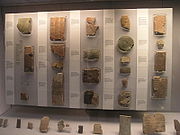
Khorsabad:
- Alabaster bas-reliefs from the Palace of Sargon IISargon IISargon II was an Assyrian king. Sargon II became co-regent with Shalmaneser V in 722 BC, and became the sole ruler of the kingdom of Assyria in 722 BC after the death of Shalmaneser V. It is not clear whether he was the son of Tiglath-Pileser III or a usurper unrelated to the royal family...
- Pair of Human Headed Winged 'LamassuLamassuA Lamassu , is a protective deity, often depicted with a bull or lion's body, eagle's wings, and human's head. In some writings, it is portrayed to represent a female deity...
' Bulls
Wider Collection:
- Cyrus CylinderCyrus cylinderThe Cyrus Cylinder is an ancient clay cylinder, now broken into several fragments, on which is written a declaration in Akkadian cuneiform script in the name of the Achaemenid king Cyrus the Great. It dates from the 6th century BC and was discovered in the ruins of Babylon in Mesopotamia in 1879...
, from BabylonBabylonBabylon was an Akkadian city-state of ancient Mesopotamia, the remains of which are found in present-day Al Hillah, Babil Province, Iraq, about 85 kilometers south of Baghdad... - The Balawat GatesBalawatBalawat is a historical location in Ninawa Governorate, Iraq, southeast from the city of Mosul and to the south of the modern Assyrian town of Bakhdida. It was the site of the ancient Neo-Assyrian city of Imgur-Enlil...
of Shalmaneser IIIShalmaneser IIIShalmaneser III was king of Assyria , and son of the previous ruler, Ashurnasirpal II.... - A fine collection of Urartian bronzes, which now form the core of the AnatoliaAnatoliaAnatolia is a geographic and historical term denoting the westernmost protrusion of Asia, comprising the majority of the Republic of Turkey...
n collection - The Oxus TreasureOxus TreasureThe Oxus treasure is a collection of 170 gold and silver items from the Achaemenid Persian period which were found by the Oxus river. Pieces from it are located in the Victoria and Albert Museum and in the British Museum , with many items bequeathed to the nation by Augustus Wollaston...
- The Standard of UrStandard of UrThe Standard of Ur is a Sumerian artifact excavated from what had been the Royal Cemetery in the ancient city of Ur .-History:...
- The 'Ram in a ThicketRam in a ThicketThe Ram in a Thicket is one of a pair of figures excavated in Ur, in southern Iraq, and which date from about 2600-2400 BC. One is currently exhibited in the Mesopotamia Gallery in Room 56 in the British Museum in London; the other is in the University of Pennsylvania Museum in Philadelphia,...
' - The Royal Game of UrRoyal Game of UrThe Royal Game of Ur, also known as the Game of Twenty Squares, refers to two game boards found in the Royal Tombs of Ur in Iraq by Sir Leonard Woolley in the 1920s. The two boards date from the First Dynasty of Ur, before 2600 BC, thus making the Royal Game of Ur probably the oldest set of board...
- Queen's LyreLyres of UrThe Lyres of Ur or Harps of Ur are considered to be the worlds oldest surviving stringed instruments. In 1929, archaeologists discovered pieces of three lyres and one harp in Ur, located in what was Ancient Mesopotamia and is contemporary Iraq...
Department of Prints and Drawings
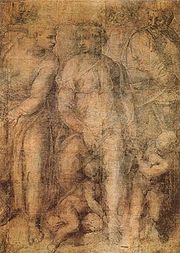
Old master print
An old master print is a work of art produced by a printing process within the Western tradition . A date of about 1830 is usually taken as marking the end of the period whose prints are covered by this term. The main techniques concerned are woodcut, engraving and etching, although there are...
and Drawing
Drawing
Drawing is a form of visual art that makes use of any number of drawing instruments to mark a two-dimensional medium. Common instruments include graphite pencils, pen and ink, inked brushes, wax color pencils, crayons, charcoal, chalk, pastels, markers, styluses, and various metals .An artist who...
s holds the national collection of Western
Western art history
Western art is the art of the North American and European countries, and art created in the forms accepted by those countries.Written histories of Western art often begin with the art of the Ancient Middle East, Ancient Egypt and the Ancient Aegean civilisations, dating from the 3rd millennium BC...
Prints and Drawings. It ranks as one of the largest and best print room
Print room
A print room is either a room or industrial building where printing takes place, or a room in an art gallery or museum, where a collection of old master and modern prints, usually together with drawings, watercolours and photographs, are held and viewed. The latter meaning is the subject of this...
collections in existence alongside the Albertina
Albertina, Vienna
The Albertina is a museum in the Innere Stadt of Vienna, Austria. It houses one of the largest and most important print rooms in the world with approximately 65,000 drawings and approximately 1 million old master prints, as well as more modern graphic works, photographs and architectural drawings...
in Vienna
Vienna
Vienna is the capital and largest city of the Republic of Austria and one of the nine states of Austria. Vienna is Austria's primary city, with a population of about 1.723 million , and is by far the largest city in Austria, as well as its cultural, economic, and political centre...
, the Paris collections and the Hermitage
Hermitage Museum
The State Hermitage is a museum of art and culture in Saint Petersburg, Russia. One of the largest and oldest museums of the world, it was founded in 1764 by Catherine the Great and has been opened to the public since 1852. Its collections, of which only a small part is on permanent display,...
. The holdings are easily accessible to the general public in the Study Room, unlike many such collections. The Department also has its own exhibition gallery in Room 90, where the displays and exhibitions change several times a year.
Since its foundation in 1808 the Prints and Drawings collection has grown to international renown as one of the richest and most representative collections in the world. There are approximately 50,000 drawings and over two million prints. The collection of drawings covers the period from the 14th century to the present, and includes many works of the highest quality by the leading artists of the European schools
Western art history
Western art is the art of the North American and European countries, and art created in the forms accepted by those countries.Written histories of Western art often begin with the art of the Ancient Middle East, Ancient Egypt and the Ancient Aegean civilisations, dating from the 3rd millennium BC...
. The collection of prints covers the tradition of fine printmaking
Printmaking
Printmaking is the process of making artworks by printing, normally on paper. Printmaking normally covers only the process of creating prints with an element of originality, rather than just being a photographic reproduction of a painting. Except in the case of monotyping, the process is capable...
from its beginnings in the 15th century up to the present, with near complete holdings of most of the great names before the 19th century.
There are magnificent groups of drawings by Leonardo da Vinci
Leonardo da Vinci
Leonardo di ser Piero da Vinci was an Italian Renaissance polymath: painter, sculptor, architect, musician, scientist, mathematician, engineer, inventor, anatomist, geologist, cartographer, botanist and writer whose genius, perhaps more than that of any other figure, epitomized the Renaissance...
, Raphael
Raphael
Raffaello Sanzio da Urbino , better known simply as Raphael, was an Italian painter and architect of the High Renaissance. His work is admired for its clarity of form and ease of composition and for its visual achievement of the Neoplatonic ideal of human grandeur...
, Michelangelo
Michelangelo
Michelangelo di Lodovico Buonarroti Simoni , commonly known as Michelangelo, was an Italian Renaissance painter, sculptor, architect, poet, and engineer who exerted an unparalleled influence on the development of Western art...
, (including his only surviving full-scale cartoon), Dürer
Albrecht Dürer
Albrecht Dürer was a German painter, printmaker, engraver, mathematician, and theorist from Nuremberg. His prints established his reputation across Europe when he was still in his twenties, and he has been conventionally regarded as the greatest artist of the Northern Renaissance ever since...
(a collection of 138 drawings is one of the finest in existence), Peter Paul Rubens, Rembrandt, Claude
Claude Lorrain
Claude Lorrain, , traditionally just Claude in English Claude Lorrain, , traditionally just Claude in English (also Claude Gellée, his real name, or in French Claude Gellée, , dit le Lorrain) Claude Lorrain, , traditionally just Claude in English (also Claude Gellée, his real name, or in French...
and Watteau
Antoine Watteau
Jean-Antoine Watteau was a French painter whose brief career spurred the revival of interest in colour and movement...
, and largely complete collections of the works of all the great printmakers including Dürer
Albrecht Dürer
Albrecht Dürer was a German painter, printmaker, engraver, mathematician, and theorist from Nuremberg. His prints established his reputation across Europe when he was still in his twenties, and he has been conventionally regarded as the greatest artist of the Northern Renaissance ever since...
(99 engraving
Engraving
Engraving is the practice of incising a design on to a hard, usually flat surface, by cutting grooves into it. The result may be a decorated object in itself, as when silver, gold, steel, or glass are engraved, or may provide an intaglio printing plate, of copper or another metal, for printing...
s, 6 etching
Etching
Etching is the process of using strong acid or mordant to cut into the unprotected parts of a metal surface to create a design in intaglio in the metal...
s and most of his 346 woodcut
Woodcut
Woodcut—occasionally known as xylography—is a relief printing artistic technique in printmaking in which an image is carved into the surface of a block of wood, with the printing parts remaining level with the surface while the non-printing parts are removed, typically with gouges...
s), Rembrandt and Goya
Francisco Goya
Francisco José de Goya y Lucientes was a Spanish romantic painter and printmaker regarded both as the last of the Old Masters and the first of the moderns. Goya was a court painter to the Spanish Crown, and through his works was both a commentator on and chronicler of his era...
. More than 30,000 British drawings and watercolours
Watercolor painting
Watercolor or watercolour , also aquarelle from French, is a painting method. A watercolor is the medium or the resulting artwork in which the paints are made of pigments suspended in a water-soluble vehicle...
include important examples of work by Hogarth
William Hogarth
William Hogarth was an English painter, printmaker, pictorial satirist, social critic and editorial cartoonist who has been credited with pioneering western sequential art. His work ranged from realistic portraiture to comic strip-like series of pictures called "modern moral subjects"...
, Sandby
Paul Sandby
Paul Sandby was an English map-maker turned landscape painter in watercolours, who, along with his older brother Thomas, became one of the founding members of the Royal Academy in 1768.-Life and work:...
, Turner
J. M. W. Turner
Joseph Mallord William Turner RA was an English Romantic landscape painter, watercolourist and printmaker. Turner was considered a controversial figure in his day, but is now regarded as the artist who elevated landscape painting to an eminence rivalling history painting...
, Girtin
Thomas Girtin
Thomas Girtin was an English painter and etcher. A friend and rival of J. M. W. Turner, Girtin played a key role in establishing watercolour as a reputable art form.-Biography:...
, Constable
John Constable
John Constable was an English Romantic painter. Born in Suffolk, he is known principally for his landscape paintings of Dedham Vale, the area surrounding his home—now known as "Constable Country"—which he invested with an intensity of affection...
, Cotman
John Sell Cotman
John Sell Cotman was an English marine and landscape painter, etcher, illustrator and author, one of the leading lights of the Norwich school of artists.-Early life and work:...
, Cox
David Cox (artist)
- David Cox Junior :David Cox had a son of the same name who followed his calling as a watercolour painter. He was born in Dulwich, but educated in Hereford. He exhibited in London from 1827, although today he is known mainly through association with his father. He died in Streatham on 4 December...
, Gillray
James Gillray
James Gillray , was a British caricaturist and printmaker famous for his etched political and social satires, mainly published between 1792 and 1810.- Early life :He was born in Chelsea...
, Rowlandson
Thomas Rowlandson
Thomas Rowlandson was an English artist and caricaturist.- Biography :Rowlandson was born in Old Jewry, in the City of London. He was the son of a tradesman or city merchant. On leaving school he became a student at the Royal Academy...
and Cruikshank
George Cruikshank
George Cruikshank was a British caricaturist and book illustrator, praised as the "modern Hogarth" during his life. His book illustrations for his friend Charles Dickens, and many other authors, reached an international audience.-Early life:Cruikshank was born in London...
, as well as all the great Victorians
Victorian era
The Victorian era of British history was the period of Queen Victoria's reign from 20 June 1837 until her death on 22 January 1901. It was a long period of peace, prosperity, refined sensibilities and national self-confidence...
. There are about a million British prints including more than 20,000 satire
Satire
Satire is primarily a literary genre or form, although in practice it can also be found in the graphic and performing arts. In satire, vices, follies, abuses, and shortcomings are held up to ridicule, ideally with the intent of shaming individuals, and society itself, into improvement...
s and outstanding collections of works by William Blake
William Blake
William Blake was an English poet, painter, and printmaker. Largely unrecognised during his lifetime, Blake is now considered a seminal figure in the history of both the poetry and visual arts of the Romantic Age...
and Thomas Bewick
Thomas Bewick
Thomas Bewick was an English wood engraver and ornithologist.- Early life and apprenticeship :Bewick was born at Cherryburn House in the village of Mickley, in the parish of Ovingham, Northumberland, England, near Newcastle upon Tyne on 12 August 1753...
.
Department of Asia
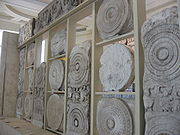
Key highlights of the collections include:
- The most comprehensive collection of sculpture from the Indian subcontinent in the world, including the celebrated BuddhistBuddhismBuddhism is a religion and philosophy encompassing a variety of traditions, beliefs and practices, largely based on teachings attributed to Siddhartha Gautama, commonly known as the Buddha . The Buddha lived and taught in the northeastern Indian subcontinent some time between the 6th and 4th...
limestone reliefs from Amaravati - An outstanding collection of Chinese antiquities, paintings, and porcelain, lacquer, bronze, jade, and other applied arts
- A fine collection of Buddhist paintings from DunhuangDunhuangDunhuang is a city in northwestern Gansu province, Western China. It was a major stop on the ancient Silk Road. It was also known at times as Shāzhōu , or 'City of Sands', a name still used today...
and the Admonitions ScrollAdmonitions ScrollThe Admonitions Scroll is a Chinese narrative painting on silk that is traditionally ascribed to Gu Kaizhi , but which modern scholarship regards as a 5th to 8th century work that may or may not be a copy of an original Jin Dynasty court painting by Gu Kaizhi. The full title of the painting is...
by Chinese artist Gu KaizhiGu KaizhiGu Kaizhi , is a celebrated painter of ancient China. His style name was 'Changkang' . He was born in Wuxi, Jiangsu province and first painted at Nanjing in 364. In 366, he became an officer . Later he was promoted to royal officer . He was also a talented poet and calligrapher...
(344–406 AD) - The most comprehensive collection of Japanese pre-20th century artJapanese artJapanese art covers a wide range of art styles and media, including ancient pottery, sculpture in wood and bronze, ink painting on silk and paper and more recently manga, cartoon, along with a myriad of other types of works of art...
in the Western world
Department of Africa, Oceania and the Americas
The British Museum houses one of the world's greatest and most comprehensive collections of Ethnographic material from AfricaAfrica
Africa is the world's second largest and second most populous continent, after Asia. At about 30.2 million km² including adjacent islands, it covers 6% of the Earth's total surface area and 20.4% of the total land area...
, Oceania
Oceania
Oceania is a region centered on the islands of the tropical Pacific Ocean. Conceptions of what constitutes Oceania range from the coral atolls and volcanic islands of the South Pacific to the entire insular region between Asia and the Americas, including Australasia and the Malay Archipelago...
and the Americas
Americas
The Americas, or America , are lands in the Western hemisphere, also known as the New World. In English, the plural form the Americas is often used to refer to the landmasses of North America and South America with their associated islands and regions, while the singular form America is primarily...
, representing the cultures of indigenous peoples
Indigenous peoples
Indigenous peoples are ethnic groups that are defined as indigenous according to one of the various definitions of the term, there is no universally accepted definition but most of which carry connotations of being the "original inhabitants" of a territory....
throughout the world. Over 350,000 objects spanning two million years tells the story of the history of man, from three major continents and many rich and diverse cultures.
.jpg)
Highlights of the African collection include the Benin Bronzes
Benin Bronzes
The Benin Bronzes are a collection of more than 3000 brass plaques from the royal palace of the Kingdom of Benin . They were seized by a British force in the Punitive Expedition of 1897 and given to the British Foreign Office...
, a magnificent brass head of a Yoruba ruler from Ife, Nigeria; Asante goldwork from Ghana and the Torday collection of Central African sculpture, textiles and weaponry.
The Americas collection mainly consists of 19th and 20th century items although the Inca, Aztec
Aztec
The Aztec people were certain ethnic groups of central Mexico, particularly those groups who spoke the Nahuatl language and who dominated large parts of Mesoamerica in the 14th, 15th and 16th centuries, a period referred to as the late post-classic period in Mesoamerican chronology.Aztec is the...
, Maya
Maya civilization
The Maya is a Mesoamerican civilization, noted for the only known fully developed written language of the pre-Columbian Americas, as well as for its art, architecture, and mathematical and astronomical systems. Initially established during the Pre-Classic period The Maya is a Mesoamerican...
and other early cultures are well represented; collecting of modern artefacts is ongoing.
Department of Coins and Medals
The British Museum is home to one of the world's finest numismaticNumismatics
Numismatics is the study or collection of currency, including coins, tokens, paper money, and related objects. While numismatists are often characterized as students or collectors of coins, the discipline also includes the broader study of money and other payment media used to resolve debts and the...
collections, comprising about a million objects. The collection spans the entire history of coinage from its origins in the 7th century BC to the present day. There are approximately 9,000 coins, medals and banknotes on display around the British Museum. More than half of these can be found in the HSBC Money Gallery (Gallery 68), while the remainder form part of the permanent displays throughout the Museum. Items from the full collection can be seen by the general public in the Study Room by appointment.
Department of Prehistory and Europe
The Department of Prehistory and Europe is responsible for collections that cover a vast expanse of time and geography. It includes the some of the earliest objects made by humans 2 million years ago; the art and archaeology of Europe from the earliest times to the present day, including the history of Britain under Roman occupation. It also includes the national collection of clocks and watches.Key highlights of the collections include:
- The Sutton HooSutton HooSutton Hoo, near to Woodbridge, in the English county of Suffolk, is the site of two 6th and early 7th century cemeteries. One contained an undisturbed ship burial including a wealth of Anglo-Saxon artefacts of outstanding art-historical and archaeological significance, now held in the British...
treasure - The Lewis chessmenLewis chessmenThe Lewis Chessmen are a group of 78 12th-century chess pieces, most of which are carved in walrus ivory...
- The Ringlemere CupRinglemere CupThe Ringlemere Gold Cup is a Bronze Age vessel found in the Ringlemere barrow near Sandwich in the English county of Kent in 2001 by metal detectorist Cliff Bradshaw. Although badly crushed by recent plough damage it can be seen to have been 14 cm high with corrugated sides...
- Vindolanda TabletsVindolanda tabletsThe Vindolanda tablets are "the oldest surviving handwritten documents in Britain". They are also probably our best source of information about life on Hadrian's Wall. Written on fragments of thin, post-card sized wooden leaf-tablets with carbon-based ink, the tablets date to the 1st and 2nd...
- Lycurgus CupLycurgus cupThe Lycurgus Cup is a Roman glass cage cup now in the British Museum, made of a dichroic glass, which shows a different colour depending on whether or not light is passing through it; red when lit from behind and green when lit from in front...
- Royal Gold CupRoyal Gold CupThe Royal Gold Cup or Saint Agnes Cup is a solid gold covered cup lavishly decorated with enamel and pearls. It was made for the French royal family at the end of the 14th century, and later belonged to several English monarchs before spending nearly 300 years in Spain...
- Holy Thorn ReliquaryHoly Thorn ReliquaryThe Holy Thorn Reliquary was probably created in the 1390s in Paris for John, Duke of Berry, to house a relic of the Crown of Thorns. The reliquary was bequeathed to the British Museum in 1898 by Ferdinand de Rothschild as part of the Waddesdon Bequest...
- Franks CasketFranks CasketThe Franks Casket is a small Anglo-Saxon whalebone chest from the seventh century, now in the British Museum. The casket is densely decorated with knife-cut narrative scenes in flat two-dimensional low-relief and with inscriptions mostly in Anglo-Saxon runes...
The many hoards of treasure include the Mildenhall Treasure
Mildenhall Treasure
The West Row Treasure is a major hoard of highly decorated Roman silver tableware from the fourth-century AD, found at West Row, near Mildenhall in the English county of Suffolk...
, Water Newton Treasure
Water Newton Treasure
The Water Newton Treasure is a hoard of fourth-century Roman silver, discovered near the Roman town of Durobrivae at Water Newton in the English county of Cambridgeshire. The hoard consisted of 27 silver items and one small gold plaque...
, Hoxne Hoard
Hoxne Hoard
The Hoxne Hoard is the largest hoard of late Roman silver and gold discovered in Britain, and the largest collection of gold and silver coins of the fourth and fifth century found anywhere within the Roman Empire...
, and Vale of York Hoard.
Department of Conservation and Scientific Research
This department was founded in 1920. Conservation has six specialist areas: ceramics & glass; metals; organic material (including textiles); stone, wall paintings and mosaics; Eastern pictorial art and Western pictorial art. The science department has and continues to develop techniques to date artefacts, analyse and identify the materials used in their manufacture, to identify the place an artefact originated and the techniques used in their creation. The department also publishes its findings and discoveries.Libraries and Archives
This department covers all levels of education, from casual visitors, schools, degree level and beyond. The Museum's various libraries hold in excess of 350,000 books, journals and pamphlets covering all areas of the museum's collection. Also the general Museum archives which date from its foundation in 1753 are overseen by this department; the individual departments have their own separate archives covering their various areas of responsibility. However, the Paul Hamlyn Library, the central reference library of the British Museum and primary public library, will be permanently closed from 13 August 2011.British Museum Press
British Museum Press (BMP) is the publishing business of British Museum Company (BMCo), a registered charity established in 1973 to encompass all commercial activity undertaken.The British Museum Company employs staff to fulfill a number of roles including publishing, wholesale and retail activities, licensing, merchandise development and marketing. Its office is on the northern corner of the museum site at 38 Russell Square, London WC1B 3QQ.
Controversy
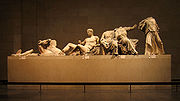
Elgin Marbles
The Parthenon Marbles, forming a part of the collection known as the Elgin Marbles , are a collection of classical Greek marble sculptures , inscriptions and architectural members that originally were part of the Parthenon and other buildings on the Acropolis of Athens...
, Benin Bronzes
Benin Bronzes
The Benin Bronzes are a collection of more than 3000 brass plaques from the royal palace of the Kingdom of Benin . They were seized by a British force in the Punitive Expedition of 1897 and given to the British Foreign Office...
and the Rosetta Stone
Rosetta Stone
The Rosetta Stone is an ancient Egyptian granodiorite stele inscribed with a decree issued at Memphis in 196 BC on behalf of King Ptolemy V. The decree appears in three scripts: the upper text is Ancient Egyptian hieroglyphs, the middle portion Demotic script, and the lowest Ancient Greek...
are among the most disputed objects in its collections, and organisations have been formed demanding the return of these artefacts to their native countries of Greece
Greece
Greece , officially the Hellenic Republic , and historically Hellas or the Republic of Greece in English, is a country in southeastern Europe....
, Nigeria
Nigeria
Nigeria , officially the Federal Republic of Nigeria, is a federal constitutional republic comprising 36 states and its Federal Capital Territory, Abuja. The country is located in West Africa and shares land borders with the Republic of Benin in the west, Chad and Cameroon in the east, and Niger in...
and Egypt
Egypt
Egypt , officially the Arab Republic of Egypt, Arabic: , is a country mainly in North Africa, with the Sinai Peninsula forming a land bridge in Southwest Asia. Egypt is thus a transcontinental country, and a major power in Africa, the Mediterranean Basin, the Middle East and the Muslim world...
respectively.
The British Museum has refused to return these artefacts, stating that the "restitutionist premise, that whatever was made in a country must return to an original geographical site, would empty both the British Museum and the other great museums of the world". The Museum has also argued that the British Museum Act of 1963 legally prevents any object from leaving its collection once it has entered it. Nevertheless, it has returned items such as the Tasmanian Ashes after a 20 year long battle with Australia.
The British Museum continues to assert that it is an appropriate custodian and has an inalienable right to its disputed artefacts under British law.
Disputed items in the collection
- Elgin MarblesElgin MarblesThe Parthenon Marbles, forming a part of the collection known as the Elgin Marbles , are a collection of classical Greek marble sculptures , inscriptions and architectural members that originally were part of the Parthenon and other buildings on the Acropolis of Athens...
- claimed by GreeceGreeceGreece , officially the Hellenic Republic , and historically Hellas or the Republic of Greece in English, is a country in southeastern Europe....
and backed by UNESCOUNESCOThe United Nations Educational, Scientific and Cultural Organization is a specialized agency of the United Nations...
among others for restitution - Benin BronzesBenin BronzesThe Benin Bronzes are a collection of more than 3000 brass plaques from the royal palace of the Kingdom of Benin . They were seized by a British force in the Punitive Expedition of 1897 and given to the British Foreign Office...
- claimed by NigeriaNigeriaNigeria , officially the Federal Republic of Nigeria, is a federal constitutional republic comprising 36 states and its Federal Capital Territory, Abuja. The country is located in West Africa and shares land borders with the Republic of Benin in the west, Chad and Cameroon in the east, and Niger in...
, 30 pieces sold already by The British Museum privately in the 1960s - Ethiopian TabotTabotTabot , is a Ge'ez word referring to a replica of the Tablets of Law, onto which the Biblical Ten Commandments were inscribed, used in the practices of the Ethiopian Orthodox Church. Tabot can also refer to a replica of the Ark of the Covenant...
s - claimed by EthiopiaEthiopiaEthiopia , officially known as the Federal Democratic Republic of Ethiopia, is a country located in the Horn of Africa. It is the second-most populous nation in Africa, with over 82 million inhabitants, and the tenth-largest by area, occupying 1,100,000 km2... - 4 stolen drawings (Nazi plunderNazi plunderNazi plunder refers to art theft and other items stolen as a result of the organized looting of European countries during the time of the Third Reich by agents acting on behalf of the ruling Nazi Party of Germany. Plundering occurred from 1933 until the end of World War II, particularly by military...
) - Compensation paid to Uri Peled in the amount of £175,000 by the British Museum - Achaemenid empire gold and silver artefacts from the Oxus TreasureOxus TreasureThe Oxus treasure is a collection of 170 gold and silver items from the Achaemenid Persian period which were found by the Oxus river. Pieces from it are located in the Victoria and Albert Museum and in the British Museum , with many items bequeathed to the nation by Augustus Wollaston...
- claimed by TajikistanTajikistanTajikistan , officially the Republic of Tajikistan , is a mountainous landlocked country in Central Asia. Afghanistan borders it to the south, Uzbekistan to the west, Kyrgyzstan to the north, and China to the east.... - AboriginalTasmanian AboriginesThe Tasmanian Aborigines were the indigenous people of the island state of Tasmania, Australia. Before British colonisation in 1803, there were an estimated 3,000–15,000 Parlevar. A number of historians point to introduced disease as the major cause of the destruction of the full-blooded...
human remains - returned to TasmaniaTasmaniaTasmania is an Australian island and state. It is south of the continent, separated by Bass Strait. The state includes the island of Tasmania—the 26th largest island in the world—and the surrounding islands. The state has a population of 507,626 , of whom almost half reside in the greater Hobart...
by the British Museum - Mold's Golden CapeMold capeThe Mold Cape is a solid sheet-gold object dating from about 1900-1600 BC in the European Bronze Age. It was found at Mold in Flintshire, Wales, in 1833.The cape is thought to have formed part of a ceremonial dress, perhaps with religious connections...
- claimed by WalesWalesWales is a country that is part of the United Kingdom and the island of Great Britain, bordered by England to its east and the Atlantic Ocean and Irish Sea to its west. It has a population of three million, and a total area of 20,779 km²... - Rosetta StoneRosetta StoneThe Rosetta Stone is an ancient Egyptian granodiorite stele inscribed with a decree issued at Memphis in 196 BC on behalf of King Ptolemy V. The decree appears in three scripts: the upper text is Ancient Egyptian hieroglyphs, the middle portion Demotic script, and the lowest Ancient Greek...
- claimed by EgyptEgyptEgypt , officially the Arab Republic of Egypt, Arabic: , is a country mainly in North Africa, with the Sinai Peninsula forming a land bridge in Southwest Asia. Egypt is thus a transcontinental country, and a major power in Africa, the Mediterranean Basin, the Middle East and the Muslim world... - Some 24,000+ scrolls, manuscripts, paintings, scriptures, and relics from the Mogao CavesMogao CavesThe Mogao Caves or Mogao Grottoes , also known as the Caves of the Thousand Buddhas , form a system of 492 temples southeast of the center of Dunhuang, an oasis strategically located at a religious and cultural crossroads on the Silk Road, in Gansu province, China...
, including the Diamond SutraDiamond SutraThe Diamond Sūtra , is a short and well-known Mahāyāna sūtra from the Prajñāpāramitā, or "Perfection of Wisdom" genre, and emphasizes the practice of non-abiding and non-attachment...
- claimed by the People's Republic of ChinaPeople's Republic of ChinaChina , officially the People's Republic of China , is the most populous country in the world, with over 1.3 billion citizens. Located in East Asia, the country covers approximately 9.6 million square kilometres...
Upper floor
| Level 5 | Level 4 | Level 3 |
|---|---|---|
| Rooms 92-94 Japan | Room 90 Prints and Drawings Room 91 EXHIBITION: Ancient Egyptian Book of the Dead. 4 November 2010- 6 March 2011 |
Room 38-9 Clocks and Watches Room 40 Medieval Europe Room 41 Europe AD 300-1100 Room 45 The Waddesdon Bequest Room 46 Europe 1400-1800 Room 47 Europe 1800-1900 Room 48 Europe 1900 to the present Room 49 Roman Britain Room 50 Britain and Europe 800 BC-AD 43 Room 51 Ancient Europe 4000-800 BC Room 52 Ancient Iran Room 53 Ancient South Arabia Room 54 Ancient Turkey Room 55 Mesopotamia 1500-539 BC Room 56 Mesopotamia 6000 - 1500 BC Room 57-9 Ancient Levant Room 68 Money Room 69 Greek and Roman life Room 69a EXHIBITION: Ruin and rebellion: uncovering the past at Tutbury Castle 9 July 2009 – 21 March 2010 Room 70 Roman Empire Room 71 Etruscan world Room 72 Ancient Cyprus Room 73 Greeks in Italy |
Ground floor
| Level 2 | Level 1 | Level 0 |
|---|---|---|
| Room 67 Korea Room 95 Chinese ceramics |
Room 33 China, India, South Asia and Southeast Asia Room 33a Amaravati |
Room 1 Enlightenment Room 2 The Changing Museum Room 3 EXHIBITION: The Asahi Shimbun Displays: Objects in focus Room 4 Egyptian sculpture Room 6 Assyrian sculpture and Balawat Gates Rooms 7-8 Assyria: Nimrud Room 9 Assyria: Nineveh Room 10 Assyria: Lion hunts Room 11 Cycladic Islands Room 12 Greece: Minoans and Mycenaeans Room 13 Greece 1050-520 BC Room 14 Greek vases Room 15 Athens and Lycia Room 16 Greece: Bassae Sculptures Room 17 Nereid Monument Room 18 Greece: Parthenon Room 19 Greece: Athens Room 20 Greeks and Lycians 400-325 BC Room 21 Mausoleum of Kalikarnassos Room 22 The world of Alexander Room 23 Greek and Roman sculpture Room 24 Living and Dying Stairs down to Room 25 Africa Room 26 North America Room 27 Mexico Room 33b Chinese jade |
Lower floor
| Level -1 | Level -2 Room 25 and Clore Education Centre only |
|---|---|
| Ford Centre for Young Visitors | Clore Education Centre Room 25 Africa Room 77 Greek and Roman architecture Room 78 Classical Inscriptions Room 82 Early Ephesus Room 83-4 Roman sculpture Room 85 Roman portraits |
Transport connections
| Service | Station/Stop | Lines/Routes served | Distance from British Museum |
|---|---|---|---|
| London Buses | British Museum | 7 London Buses route 7 London Buses route 7 is a Transport for London contracted bus route in London, England, United Kingdom. The service is currently contracted to Metroline.-History:... |
|
| Great Russell Street | 10 London Buses route 10 London Buses route 10 is a Transport for London contracted bus route in London, England, United Kingdom. The service is currently contracted to London United.-History:... , 14 London Buses route 14 London Buses route 14 is a Transport for London contracted bus route in London, England. The service is currently contracted to Go-Ahead London.-History:... , 24 London Buses route 24 London Buses route 24 is a Transport for London contracted bus route in London, United Kingdom. The service is currently contracted to Go-Ahead London.-History:This route dates back to 1910, when it ran between Hampstead Heath and Victoria... , 29 London Buses route 29 London Buses route 29 is a Transport for London contracted bus route in London, United Kingdom. The service is currently contracted to Arriva London.-History:... , 73 London Buses route 73 London Buses route 73 is a Transport for London contracted bus route in London, United Kingdom. The service is currently contracted to Arriva London... , 134 London Buses route 134 London Buses route 134 is a Transport for London contracted bus route in London, United Kingdom. The service is currently contracted to Metroline.-History:... , 390 |
0.1 mile walk | |
| Museum Street | 1 London Buses route 1 London Buses route 1 is a Transport for London contracted bus route in London, England. The service is currently contracted to Go-Ahead London.-History:... , 8 London Buses route 8 London Buses route 8 is a Transport for London contracted bus route in London, England, United Kingdom. The service is currently contracted to Stagecoach London.-History:... , 19 London Buses route 19 London Buses route 19 is a Transport for London contracted bus route in London, England, United Kingdom. The service is currently contracted to Arriva London.-History:... , 25 London Buses route 25 London Buses route 25 is a Transport for London contracted bus route in London, United Kingdom. The service is currently contracted to First Capital.-History:... , 38 London Buses route 38 London Buses route 38 is a Transport for London contracted bus route in London, United Kingdom. The service is currently contracted to Arriva London.... , 55 London Buses route 55 London Buses route 55 is a Transport for London contracted bus route in London, United Kingdom. The service is currently contracted to Stagecoach London.-History:... , 98, 242 |
0.1 mile walk | |
| Tottenham Court Road Station | 14 London Buses route 14 London Buses route 14 is a Transport for London contracted bus route in London, England. The service is currently contracted to Go-Ahead London.-History:... , 24 London Buses route 24 London Buses route 24 is a Transport for London contracted bus route in London, United Kingdom. The service is currently contracted to Go-Ahead London.-History:This route dates back to 1910, when it ran between Hampstead Heath and Victoria... , 29 London Buses route 29 London Buses route 29 is a Transport for London contracted bus route in London, United Kingdom. The service is currently contracted to Arriva London.-History:... , 134 London Buses route 134 London Buses route 134 is a Transport for London contracted bus route in London, United Kingdom. The service is currently contracted to Metroline.-History:... |
0.3 mile walk | |
| London Underground | Tottenham Court Road Tottenham Court Road tube station Tottenham Court Road is a London Underground station in central London. It is an interchange between the Central line and the branch of the Northern line.On the Central line it is between and , and on the Northern line it is between and... |
0.3 mile walk | |
| Holborn Holborn tube station Holborn is a station of the London Underground in Holborn in London, located at the junction of High Holborn and Kingsway. Situated on the Piccadilly Line and on the Central Line , it is the only station common to the two lines, although the two lines cross each other three times elsewhere... |
|
0.3 mile walk | |
| Goodge Street Goodge Street tube station Goodge Street is a London Underground station on Tottenham Court Road. It is on the Northern Line between Tottenham Court Road and Warren Street, and is in Travelcard Zone 1.-History:... |
0.5 mile walk |
Galleries
BuildingFloor Plans
Museum Galleries
Department of Ancient Egypt and Sudan
Department of the Ancient Near East
Department of Greek and Roman Antiquities
Exhibitions
Forgotten Empire Exhibition (October 2005 - January 2006)
See also
- A History of the World in 100 ObjectsA History of the World in 100 ObjectsA History of the World in 100 Objects was a joint project of BBC Radio 4 and the British Museum, comprising a 100-part radio series written and presented by British Museum director Neil MacGregor...
- Employees of the British Museum
- People associated with the British Museum
- The British Museum FriendsThe British Museum FriendsThe British Museum Friends is a registered charitable organisation in the UK with close links to the British Museum, and was set up in 1968...
Further reading
- Anderson, Robert (2005). The Great Court and the British Museum. London: The British Museum Press
- Arrowsmith, Rupert Richard. Modernism and the Museum: Asian, African and Pacific Art and the London Avant Garde. Oxford University Press, 2011, pp. 103–164. ISBN 978-0-19-959369-9.
- Arrowsmith, Rupert Richard. "The Transcultural Roots of Modernism: Imagist Poetry, Japanese Visual Culture, and the Western Museum System", Modernism/modernityModernism/modernityModernism/modernity is a peer-reviewed academic journal founded in 1994 by Lawrence Rainey and Robert van Hallberg. Since 2001 it has been the official publication of the Modernist Studies Association and each September issue presents papers from their annual conference.The journal is...
Volume 18, Number 1, January 2011, pp. 27–42. ISSN: 1071-6068. - Caygill, Marjorie (2006). The British Museum: 250 Years. London: The British Museum Press
- Caygill, Marjorie (2002). The Story of the British Museum. London: The British Museum Press
- Cook, B. F. (2005). The Elgin Marbles. London: The British Museum Press
- Esdaile, Arundell (1946) The British Museum Library: a Short History and Survey. London: Allen & Unwin
- Jenkins, Ian (2006). Greek Architecture and its Sculpture in The British Museum. London: The British Museum Press
- Francis, FrankFrank FrancisSir Frank Chalton Francis KCB was an English academic librarian and curator. Almost all his working life was at the British Museum, first as an assistant keeper in the department of printed books, and later as secretary of the museum, keeper of printed books and, between 1959 and 1968, director...
, ed. (1971) Treasures of the British Museum. London: Thames & Hudson (rev. ed., 1975)t*Moser, Stephanie (2006). Wondrous Curiosities: Ancient Egypt at The British Museum. Chicago: The University of Chicago Press - Reade, Julian (2004). Assyrian Sculpture. London: The British Museum Press
- Reeve, John (2003). The British Museum: Visitor's Guide. London: The British Museum Press
- Wilson, David M. (2002). The British Museum: a history. London: The British Museum Press