
All Topics  
Tutankhamun

 
Tutankhamun

   Email Print
   Bookmark   Link


Tutankhamun


Tutankhamun (alternately spelled with Tutenkh-, -amen, -amon), Egyptian
Egyptian language

Egyptian is a branch of the Afro-Asiatic languages language family along with the Chadic languages, Berber languages, Semitic languages, Cushitic languages and possibly Omotic languages languages....
  (1341 BC – 1323 BC) was an Egyptian
Ancient Egypt

Ancient Egypt was an Ancient history civilization in eastern North Africa, concentrated along the lower reaches of the Nile in what is now the modern nation of Egypt....
 Pharaoh
Pharaoh

Pharaoh is a title used in many modern discussions of the ancient Egyptian rulers of all periods. In antiquity this title began to be used for the ruler who was the religious and political leader of united ancient Egypt, only during the New Kingdom, specifically, during the middle of the Eighteenth dynasty of Egypt....
 of the Eighteenth dynasty
Eighteenth dynasty of Egypt

The Eighteenth Dynasty is perhaps the best known of all the dynasties of ancient Egypt. As well as a number of Egypt's most powerful pharaohs, it included Tutankhamun, whose tomb, uncovered by Howard Carter in 1922, was one of the greatest of all archaeological discoveries, being completely undisturbed by tomb robbers....
 (ruled 1333 BC – 1324 BC in the conventional chronology), during the period of Egyptian history
History of Egypt

The history of Egypt is the longest continuous history, as a unified state, of any country in the world. The Nile valley forms a natural geographic and economic unit, bounded to the east and west by deserts, to the north by the sea and to the south by the Cataracts of the Nile....
 known as the New Kingdom
New Kingdom

The New Kingdom, sometimes referred to as the Egyptian Empire, is the period in ancient Egyptian History of Ancient Egypt between the 16th century BC and the 11th century BC, covering the Eighteenth dynasty of Egypt, Nineteenth dynasty of Egypt, and Twentieth dynasty of Egypt....
. His original name, Tutankhaten, means "Living Image of Aten
Aten

Aten was the disk of the sun in ancient Egyptian mythology, and originally an aspect of Ra. He became the deity of the monotheism ? in fact, monism ? religion Atenism of Amenhotep IV, who took the name Akhenaten....
", while Tutankhamun means "Living Image of Amun
Amun

Amun, reconstructed Egyptian language Yamanu , was the name of a deity in Egyptian mythology who gradually rose from being an abstract concept to the patron deity of Thebes, Egypt and one of the most important deities in Ancient Egypt before fading into obscurity....
". Often the name Tutankhamun was written Amen-tut-ankh, meaning "living image of Amun
Amun

Amun, reconstructed Egyptian language Yamanu , was the name of a deity in Egyptian mythology who gradually rose from being an abstract concept to the patron deity of Thebes, Egypt and one of the most important deities in Ancient Egypt before fading into obscurity....
", due to scribal custom which most often placed the divine name at the beginning of the phrase in order to honor the divine being. He is possibly also the Nibhurrereya of the Amarna letters
Amarna letters

The Amarna letters are an archive of correspondence on clay tablets, mostly diplomatic, between the Ancient Egypt administration and its representatives in Canaan and Amurru during the New Kingdom....
.


Discussion
Ask a question about 'Tutankhamun'
Start a new discussion about 'Tutankhamun'
Answer questions from other users
Full Discussion Forum


Encyclopedia


Tutankhamun (alternately spelled with Tutenkh-, -amen, -amon), Egyptian
Egyptian language

Egyptian is a branch of the Afro-Asiatic languages language family along with the Chadic languages, Berber languages, Semitic languages, Cushitic languages and possibly Omotic languages languages....
  (1341 BC – 1323 BC) was an Egyptian
Ancient Egypt

Ancient Egypt was an Ancient history civilization in eastern North Africa, concentrated along the lower reaches of the Nile in what is now the modern nation of Egypt....
 Pharaoh
Pharaoh

Pharaoh is a title used in many modern discussions of the ancient Egyptian rulers of all periods. In antiquity this title began to be used for the ruler who was the religious and political leader of united ancient Egypt, only during the New Kingdom, specifically, during the middle of the Eighteenth dynasty of Egypt....
 of the Eighteenth dynasty
Eighteenth dynasty of Egypt

The Eighteenth Dynasty is perhaps the best known of all the dynasties of ancient Egypt. As well as a number of Egypt's most powerful pharaohs, it included Tutankhamun, whose tomb, uncovered by Howard Carter in 1922, was one of the greatest of all archaeological discoveries, being completely undisturbed by tomb robbers....
 (ruled 1333 BC – 1324 BC in the conventional chronology), during the period of Egyptian history
History of Egypt

The history of Egypt is the longest continuous history, as a unified state, of any country in the world. The Nile valley forms a natural geographic and economic unit, bounded to the east and west by deserts, to the north by the sea and to the south by the Cataracts of the Nile....
 known as the New Kingdom
New Kingdom

The New Kingdom, sometimes referred to as the Egyptian Empire, is the period in ancient Egyptian History of Ancient Egypt between the 16th century BC and the 11th century BC, covering the Eighteenth dynasty of Egypt, Nineteenth dynasty of Egypt, and Twentieth dynasty of Egypt....
. His original name, Tutankhaten, means "Living Image of Aten
Aten

Aten was the disk of the sun in ancient Egyptian mythology, and originally an aspect of Ra. He became the deity of the monotheism ? in fact, monism ? religion Atenism of Amenhotep IV, who took the name Akhenaten....
", while Tutankhamun means "Living Image of Amun
Amun

Amun, reconstructed Egyptian language Yamanu , was the name of a deity in Egyptian mythology who gradually rose from being an abstract concept to the patron deity of Thebes, Egypt and one of the most important deities in Ancient Egypt before fading into obscurity....
". Often the name Tutankhamun was written Amen-tut-ankh, meaning "living image of Amun
Amun

Amun, reconstructed Egyptian language Yamanu , was the name of a deity in Egyptian mythology who gradually rose from being an abstract concept to the patron deity of Thebes, Egypt and one of the most important deities in Ancient Egypt before fading into obscurity....
", due to scribal custom which most often placed the divine name at the beginning of the phrase in order to honor the divine being. He is possibly also the Nibhurrereya of the Amarna letters
Amarna letters

The Amarna letters are an archive of correspondence on clay tablets, mostly diplomatic, between the Ancient Egypt administration and its representatives in Canaan and Amurru during the New Kingdom....
. He was likely the eighteenth dynasty king 'Rathotis', who according to Manetho
Manetho

Manetho was an Egyptian historian and priest from Sebennytos who lived during the Ptolemaic dynasty, ca. 3rd century BC. Manetho wrote the Aegyptiaca ....
, an ancient historian, had reigned for nine years - a figure which conforms with Flavius Josephus'
Josephus

Josephus , also known as Yosef Ben Matityahu and, after he became a Roman citizenship, as Titus Flavius Josephus, was a first-century Jewish historian and apologist of priestly and royal ancestry who survived and recorded the destruction of Jerusalem in AD 70....
 version of Manetho's Epitome.

The 1922 discovery by Howard Carter
Howard Carter (archaeologist)

Howard Carter was an English archaeologist and Egyptology, noted as a primary discoverer of the tomb of Tutankhamun.In 1891, at the age of 17, Carter began studying inscriptions and paintings in Egypt....
 of Tutankhamun's intact tomb received worldwide press coverage and sparked a renewed public interest in ancient Egypt
Ancient Egypt

Ancient Egypt was an Ancient history civilization in eastern North Africa, concentrated along the lower reaches of the Nile in what is now the modern nation of Egypt....
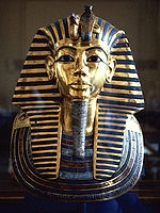
, for which Tutankhamun's burial mask remains the popular face.

Life


Significance

Tutankhamun was eight or nine years old when he became pharaoh and reigned for approximately ten years. In historical terms, Tutankhamun's significance stems from his rejection of the radical religious innovations introduced by his predecessor Akhenaten
Akhenaten

Akhenaten , was a Pharaoh of the Eighteenth dynasty of Egypt, who died 1336 BC or 1334 BC. He is especially noted for attempting to compel the Egyptian population in the monotheism worship of Aten, although there are doubts as to how successful he was at this....
 and that his tomb in the Valley of the Kings
Valley of the Kings

The Valley of the Kings is a valley in Egypt where, for a period of nearly 500 years from the 16th century BC to 11th century BC, tombs were constructed for the Pharaoh and powerful nobles of the Conventional Egyptian chronology#New Kingdom ....
 was discovered by Carter almost completely intact — the most complete Ancient Egyptian tomb ever found. As Tutankhamun began his reign at such an early age, his vizier and eventual successor Ay
Ay

Ay was the penultimate Pharaoh of Ancient Egypt's Eighteenth dynasty of Egypt. He held the throne of Egypt for a brief four-year period , although he was a close advisor to two and perhaps three of the pharaohs who ruled before him and was the power behind the throne during Tutankhamun's reign....
 was probably making most of the important political decisions during Tutankhamun's reign.

Parentage and lineage

Tutankhamun's parentage is uncertain. An inscription calls him a king's son, but it is not clear which king was meant.

He was originally thought to be a son of Amenhotep III
Amenhotep III

Amenhotep III was the ninth pharaoh of the Eighteenth dynasty of Egypt. According to different authors, he ruled Egypt from June 1391 BC-December 1353 BC or June 1388 BC to December 1351 BC/1350 BC after his father Thutmose IV died....
 and his Great Royal Wife
Great Royal Wife

File:Ah hotep.jpgGreat Royal Wife or Chief King's Wife is the term used to refer to the chief wife of a male pharaoh of Ancient Egypt on the day of his coronation, as her status in the royal lineage was essential to gaining the position of pharaoh....
 Queen Tiye
Tiye

File:Memnon 082005 06.jpgTiye was the daughter of Yuya and Tjuyu . She became the Great Royal Wife of the Ancient Egypt pharaoh Amenhotep III and matriarch of the Amarna family from which many members of the royal family of Ancient Egypt were born....
. Later research claimed that he may have been a son of Amenhotep III
Amenhotep III

Amenhotep III was the ninth pharaoh of the Eighteenth dynasty of Egypt. According to different authors, he ruled Egypt from June 1391 BC-December 1353 BC or June 1388 BC to December 1351 BC/1350 BC after his father Thutmose IV died....
, although not by Queen Tiye
Tiye

File:Memnon 082005 06.jpgTiye was the daughter of Yuya and Tjuyu . She became the Great Royal Wife of the Ancient Egypt pharaoh Amenhotep III and matriarch of the Amarna family from which many members of the royal family of Ancient Egypt were born....
, since Tiye would have been more than fifty years old at the time of Tutankhamun's birth.

At present, the most common hypothesis holds that Tutankhamun was the son of Akhenaten
Akhenaten

Akhenaten , was a Pharaoh of the Eighteenth dynasty of Egypt, who died 1336 BC or 1334 BC. He is especially noted for attempting to compel the Egyptian population in the monotheism worship of Aten, although there are doubts as to how successful he was at this....
, also known as Amenhotep IV, and his minor wife Queen Kiya
Kiya

Kiya was a wife of Egyptian Pharaoh Akhenaten. Little is known about her, and her actions and roles are poorly documented in the historical record in contrast to Akhenaten's first royal wife, Nefertiti....
. Queen Kiya's title was "Greatly Beloved Wife of Akhenaten" so it is possible that she could have borne him an heir. Supporting this theory, images on the tomb wall in the tomb of Akhenaten show a royal fan bearer standing next to Kiya's death bed, fanning someone who is either a princess or more likely, a wet nurse holding a baby, considered to be the wet nurse and the boy, king-to-be.

Professor James Allen argues that Tutankhamun was more likely to be a son of the short-lived king Smenkhkare
Smenkhkare

Smenkhkare is an ephemeral Pharaoh of the late Eighteenth dynasty of Egypt of whom very little is know for certain. Traditionally he is seen as Akhenaten's co-regent and immediate successor and predecessor of Tutankhamun and is assumed to be a close, male relative of those two kings ....
 rather than Akhenaten
Akhenaten

Akhenaten , was a Pharaoh of the Eighteenth dynasty of Egypt, who died 1336 BC or 1334 BC. He is especially noted for attempting to compel the Egyptian population in the monotheism worship of Aten, although there are doubts as to how successful he was at this....
. Allen argues that Akhenaten consciously chose a female co-regent named Neferneferuaten
Neferneferuaten

Ankhkheperure Neferneferuaten was a woman who reigned as pharaoh toward the end of the Amarna era during the Eighteenth dynasty of Egypt. The royal succession of this period is very unclear....
 as his successor, rather than Tutankhamun, which would have been unlikely if the latter had been his son.

Another theory is that Tutankhamun was the son of Smenkhkare
Smenkhkare

Smenkhkare is an ephemeral Pharaoh of the late Eighteenth dynasty of Egypt of whom very little is know for certain. Traditionally he is seen as Akhenaten's co-regent and immediate successor and predecessor of Tutankhamun and is assumed to be a close, male relative of those two kings ....
 and Meritaten
Meritaten

Meritaten also spelled Merytaten or Meryetaten was an Ancient Egypt queen of the 18th dynasty, who held the position of Great Royal Wife to Pharaoh Smenkhkare, who may have been a brother or son of Akhenaten....
 (one of the six daughters of Akhenaten
Akhenaten

Akhenaten , was a Pharaoh of the Eighteenth dynasty of Egypt, who died 1336 BC or 1334 BC. He is especially noted for attempting to compel the Egyptian population in the monotheism worship of Aten, although there are doubts as to how successful he was at this....
 and Nefertiti
Nefertiti

Nefertiti was the Great Royal Wife of the Egyptian Pharaoh Akhenaten. Nefertiti and her husband were known for changing Egypt's religion from a polytheistic religion to a monotheistic religion....
). Smenkhkare appears when Akhenaten entered year 14 of his reign and it is thought that during this time Meritaten married Smenkhkare. Smenkhkare, as the father of Tutankhamun, needed at least a three year reign to bring Tutankhamun to the right age to have inherited the throne. However, if there had been lengthy co-regency between Amenhotep III and Akhenaten, Amenhotep definitely could be Tutankhamun's father.

Tutankhamun was married to Ankhesenpaaten
Ankhesenpaaten

Born as Ankhesenpaaten, and later renamed, Ankhesenamen, which means. She who lives through the Amun, was the third of six known daughters of the Egyptian Pharaoh Akhenaten and his Great Royal Wife Nefertiti....
 (possibly his half-sister, since Ankhesenpaaten is unequivocally recorded as another of the six daughters of Akhenaten
Akhenaten

Akhenaten , was a Pharaoh of the Eighteenth dynasty of Egypt, who died 1336 BC or 1334 BC. He is especially noted for attempting to compel the Egyptian population in the monotheism worship of Aten, although there are doubts as to how successful he was at this....
 and Nefertiti
Nefertiti

Nefertiti was the Great Royal Wife of the Egyptian Pharaoh Akhenaten. Nefertiti and her husband were known for changing Egypt's religion from a polytheistic religion to a monotheistic religion....
), and after the re-establishment of the traditional Egyptian religion the couple changed the –aten ending of their names to the –amun ending, becoming Ankhesenamun and Tutankhamun. It is assumed they had two children, both girls, whose mummies were discovered in Tutankhamun's tomb - they both died as babies, and medical evidence suggests they may have been stillborn. DNA testing began in August 2008 on the two fetuses to determine whether they were indeed his children or not.

Reign

During Tutankhamun's reign, Akhenaten's Amarna
Amarna

The site of Amarna is located on the east bank of the Nile River in the modern Egyptian province of Minya Governorate, some 58 km south of the city of al-Minya, 312 km south of the Egyptian capital Cairo and 402 km north of Luxor....
 revolution (Atenism
Atenism

Atenism is one of the earliest known, well-documented, monotheistic religions, associated with the Eighteenth dynasty of Egypt Pharaoh Amenhotep IV, better known under his adopted name, Akhenaten....
) was being reversed. Akhenaten had attempted to supplant the traditional priesthood and deities with a god who was until then considered minor, Aten
Aten

Aten was the disk of the sun in ancient Egyptian mythology, and originally an aspect of Ra. He became the deity of the monotheism ? in fact, monism ? religion Atenism of Amenhotep IV, who took the name Akhenaten....
. In Year 3 of Tutankhamnen's reign (1331), when he was probably about 11, and under the influence of two older advisors (Akhenaten's vizier
Vizier

A Vizier , is a term for a high-ranking political advisor or minister, often to a Muslim monarch such as a Caliph, or Sultan. It sometimes refers to ministers and advisors of the Persian Empire's Shahs....
 Ay
Ay

Ay was the penultimate Pharaoh of Ancient Egypt's Eighteenth dynasty of Egypt. He held the throne of Egypt for a brief four-year period , although he was a close advisor to two and perhaps three of the pharaohs who ruled before him and was the power behind the throne during Tutankhamun's reign....
 and perhaps Nefertiti
Nefertiti

Nefertiti was the Great Royal Wife of the Egyptian Pharaoh Akhenaten. Nefertiti and her husband were known for changing Egypt's religion from a polytheistic religion to a monotheistic religion....
), the ban on the old pantheon of deities and their temple
Temple

A temple is a structure reserved for religious or spiritual activities, such as prayer and sacrifice, or analogous rites. A ??templum?? constituted a sacred precinct as defined by a priest, or augur....
s was lifted, the traditional privileges were restored to their priesthoods, and the capital was moved back to Thebes
Thebes, Egypt

Thebes was a city in Ancient Egypt located about 800 km south of the Mediterranean, on the east bank of the river Nile . It was the capital of Waset, the fourth Upper Egyptian Nome ....
. The young pharaoh adopted the name Tutankhamun, changing it from his birth name Tutankhaten. Because of his age at the time responsibility for these decisions can be attributed to his advisors. King Tutankhamun restored all of the traditional deities, and restored order to the chaos created by his uncle Akhenaten. In addition, temples devoted to Amun-Ra were built during this period. Although Tutankhamun's wooden box depicts him going to war against Hittites
Hittites

The Hittites were an ancient Anatolian people who spoke a Hittite language of the Anatolian languages of the Indo-European languages family, and established a kingdom centered at Hattusa in north-central Anatolia ca....
 and Nubians
Nubians

The Nubians are an ethnic group originally from northern Sudan, now inhabiting East Africa and some parts of Northeast Africa, such as southern Egypt....
, and he is shown wearing the blue war crown, it is doubtful that he ever went to war since scrutiny of the period's extensive written evidence does not yield records of him participating in any wars or battles.

Events following Tutankhamun's death

In a letter (preserved in Hittite
Hittite

Hittite may refer to:*Hittites, ancient Anatolian people*Neo-Hittite states, Iron Age successors to the Hittite people located in modern Turkey and Syria...
 annals) to the Hittite king Suppiluliuma I
Suppiluliuma I

Suppiluliuma I was king of the Hittites . He achieved fame as a great warrior and statesman, successfully challenging the then-dominant New Kingdom for control of the lands between the Mediterranean and the Euphrates....
  a recently widowed queen of Egypt named Dakhamunzu
Dakhamunzu

Dakhamunzu is the name of an Ancient Egypt queen known from the Hittite annals The Deeds of Suppiluliuma, which were composed by Suppiluliuma I's son Mursili II....
 asks for one of Suppiluliuma's sons as a husband. The royal lineage of Egypt was carried by its women. Marriage to a woman of the royal line was essential for a male pharaoh, even if he came from outside the lineage. Suspicious of this good fortune, Suppiluliumas I first sent a messenger to make inquiries about the truth of the queen's story. After receiving reports that the situation was as related he sent his son, Zannanza
Zannanza

Prince Zannanza was a son of Suppiluliuma I, king of the Hittites. He is best known for almost becoming the Pharaoh of Egypt and because his death caused a diplomatic incident between the Hittite Empire and Egypt, that resulted in warfare....
, accepting Dakhamunzu's offer. However, Zannanza got no further than the border before he was killed, according to the Hittite archives. Ankhesenamun is one of the possible candidates to be identified as this queen. If this identification is correct, and if Zannanza's death was a strategic murder, it was probably at the orders of either Horemheb
Horemheb

Horemheb was the last Pharaoh of the Eighteenth dynasty of Egypt from 1319 BC to late 1292 BC, although he was not related to the preceding royal family and is believed to have been of common birth....
 or Ay
Ay

Ay was the penultimate Pharaoh of Ancient Egypt's Eighteenth dynasty of Egypt. He held the throne of Egypt for a brief four-year period , although he was a close advisor to two and perhaps three of the pharaohs who ruled before him and was the power behind the throne during Tutankhamun's reign....
, who both had the opportunity and the motive to kill him.

Name


He is depicted only once as a prince, on a block from Hermopolis
Hermopolis

Hermopolis Magna or simply Hermopolis or Hermopolis Megale or Hermupolis is the site of ancient Khmun, and is located near the modern Egyptian town of El Ashmunein in Al Minya governorate....
, where he is called Tutankwhaten (twt-?n?w-?tn), but when his reign started, he was known as Tutankhaten (twt-?n?-?tn), which in Egyptian hieroglyphs
Egyptian hieroglyphs

Egyptian hieroglyphs was a formal writing system used by the ancient Egyptians that contained a combination of logographic and alphabetic elements....
 is: <-i-t:n:ra-t:w:t-anx->

At the reintroduction of traditional religious practise, his name changed. It is transliterated as twt-?n?-?mn ?q3-?wnw-šm?, and often realized as Tutankhamun Hekaiunushema, meaning "Living image of Amun
Amun

Amun, reconstructed Egyptian language Yamanu , was the name of a deity in Egyptian mythology who gradually rose from being an abstract concept to the patron deity of Thebes, Egypt and one of the most important deities in Ancient Egypt before fading into obscurity....
, ruler of Upper Heliopolis
Heliopolis (ancient)

Heliopolis , meaning sun-city, was one of the most ancient cities of Egypt, and capital of the 13th Lower Egyptian Nome . Its name also refers to an unrelated Heliopolis of Cairo, also known as ??? ???????, Masr al-gidedah ....
". On his ascension to the throne, Tutankhamun took a praenomen. This is translated as nb-?prw-r?, and realized as Nebkheperure, meaning "Lord of the forms of Re
Ra

Ra is an ancient Egyptian Solar deity . By the Fifth dynasty of Egypt he became a major deity in ancient Egyptian religion, identified primarily with the noon, with other deities representing other positions of the sun....
". The name Nibhurrereya in the Amarna letters
Amarna letters

The Amarna letters are an archive of correspondence on clay tablets, mostly diplomatic, between the Ancient Egypt administration and its representatives in Canaan and Amurru during the New Kingdom....
 may be a variation of this praenomen.

Cause of death

The cause of Tutankhamun's death is unclear, and is still the root of much speculation. In early 2005 the results of a set of CT scans on the mummy were released.

The body originally was inspected by Howard Carter
Howard Carter (archaeologist)

Howard Carter was an English archaeologist and Egyptology, noted as a primary discoverer of the tomb of Tutankhamun.In 1891, at the age of 17, Carter began studying inscriptions and paintings in Egypt....
's team in the early 1920s, although they were primarily interested in recovering the jewelry and amulets from the body. To remove these objects from the body, which often were stuck fast by the hardened embalming resin
Resin

Resin is a hydrocarbon secretion of many plants, particularly Pinophyta. It is valued for its chemical constituents and uses, such as varnishes and adhesives, as an important source of raw materials for organic synthesis, or for incense and perfume....
s used, Carter's team cut up the mummy into various pieces: the arms and legs were detached, the torso cut in half and the head was severed. Hot knives were used to remove it from the golden mask to which it was cemented by resin.

Since 1926, the mummy has been X-rayed three times: first in 1968 by a group from the University of Liverpool
University of Liverpool

The University of Liverpool is a university in the city of Liverpool, England. It is a member of the Russell Group, and founded in 1881 it is also one of the six original "red brick university" civic universities....
 led by Dr. R. G. Harrison, then in 1978 by a group from the University of Michigan
University of Michigan

The University of Michigan, Ann Arbor, Michigan is a public university research university located in the state of Michigan. It is the state's oldest university and the flagship campus of the University of Michigan, which also includes two regional campuses in University of Michigan-Flint and University of Michigan-Dearborn....
, and finally in 2005 a team of Egyptian scientists led by Secretary General of the Egyptian Supreme Council of Antiquities
Supreme Council of Antiquities

The Supreme Council of Antiquities is part of the Egypt Ministry of Culture and is responsible for the conservation, protection and regulation of all antiquities and archaeological excavations in Egypt....
, Dr. Zahi Hawass
Zahi Hawass

Zahi Hawass is an Egyptians archaeology and List of Egyptologists and the current Secretary General of the Egyptian Supreme Council of Antiquities....
, who conducted a CT scan
Computed tomography

Computed tomography is a medical imaging method employing tomography. Geometry Processing is used to generate a stereoscopy of the inside of an object from a large series of two-dimensional X-ray images taken around a single axis of rotation....
 on the mummy.

X-ray
X-ray

X-radiation is a form of electromagnetic radiation. X-rays have a wavelength in the range of 10 to 0.01 nanometers, corresponding to frequency in the range 30 Hertz to 30 Hertz and energies in the range 120 Electron volt to 120 keV....
s of Tutankhamun's mummy
Mummy

A mummy is a corpse whose skin and organs have been preserved by either intentional or incidental exposure to chemicals, extreme coldness, very high humidity, or lack of air when bodies are submerged in bogs....
, taken in 1968, revealed a dense spot at the lower back of the skull
Skull

The skull is a bone structure found in the head of many animals. The skull supports the structures of the face and protects the head against injury....
 interpreted as a subdural hematoma
Subdural hematoma

A subdural hematoma is a form of traumatic brain injury in which blood gathers within the inner meningeal layer of the dura mater . Unlike in epidural hematomas, which are usually caused by tears in artery, subdural bleeding usually results from tears in veins that cross the subdural space....
. Such an injury could have been the result of an accident, but it also had been suggested that the young pharaoh was murdered. A trauma specialist from Long Island University
Long Island University

Long Island University is a Private university, coeducational, nonsectarian institution of higher education in the State of New York in the United States....
 at C. W. Post Campus insisted that this injury could not have been from a natural cause. The specialist stated that the blow was to a protected area at the back of the head which is not easily injured in an accident. . Theories as to who was responsible for the death include Tutankhamun's immediate successor Ay
Ay

Ay was the penultimate Pharaoh of Ancient Egypt's Eighteenth dynasty of Egypt. He held the throne of Egypt for a brief four-year period , although he was a close advisor to two and perhaps three of the pharaohs who ruled before him and was the power behind the throne during Tutankhamun's reign....
, his wife, and his chariot-driver. Calcification
Calcification

Calcification is the process in which the mineral calcium builds up in soft tissue, causing it to harden. Calcifications may be classified on whether there is mineral balance or not, and the location of the calcification....
 within the supposed injury indicates Tutankhamun lived for a fairly extensive period of time (on the order of several months) after the injury was inflicted.

A small, loose, sliver of bone was discovered within the upper cranial cavity, which was discovered from the same X-ray analysis. In fact, since Tutankhamun's brain
Brain

The brain is the center of the nervous system in all vertebrate, and most invertebrate, animals. Some primitive animals such as cnidarian and echinoderm have a decentralized nervous system without a brain, while sponges lack any nervous system at all....
 was removed post mortem in the mummification process, and considerable quantities of now-hardened resin
Resin

Resin is a hydrocarbon secretion of many plants, particularly Pinophyta. It is valued for its chemical constituents and uses, such as varnishes and adhesives, as an important source of raw materials for organic synthesis, or for incense and perfume....
 introduced into the skull
Skull

The skull is a bone structure found in the head of many animals. The skull supports the structures of the face and protects the head against injury....
 on at least two separate occasions after that, had the fragment resulted from a pre-mortem injury, some scholars, including the 2005 CT scan team, say it almost certainly would not still be loose in the cranial cavity. But other scientists suggested, that the loose sliver of bone was loosened by the embalmers during mummification
Mummy

A mummy is a corpse whose skin and organs have been preserved by either intentional or incidental exposure to chemicals, extreme coldness, very high humidity, or lack of air when bodies are submerged in bogs....
, but it had been broken before. A blow to the back of the head (from a fall or an actual blow), caused the brain to move forward, hitting the front of the skull, breaking small pieces of the bone right above the eyes.

2005 findings
On March 8, 2005, Egyptian
Egyptians

Egyptians is the name of the nationality and Mediterranean North African ethnic group native to Egypt.Egyptian identity is closely tied to the Geography of Egypt, dominated by the lower Nile Valley, the small strip of cultivable land stretching from the Cataracts of the Nile to the Mediterranean Sea and enclosed by desert both to the Easte...
 archaeologist Zahi Hawass
Zahi Hawass

Zahi Hawass is an Egyptians archaeology and List of Egyptologists and the current Secretary General of the Egyptian Supreme Council of Antiquities....
 revealed the results of a CT scan performed on the pharaoh's mummy. The scan uncovered no evidence of a blow to the back of the head and no evidence suggesting foul play
Foul Play

Foul Play is a 1978 in film film by Colin Higgins starring Goldie Hawn and Chevy Chase. They are supported by Burgess Meredith, Brian Dennehy, Billy Barty and Dudley Moore in one of his first American feature film appearances....
. There was a hole in the head, but it appeared to have been drilled, presumably by embalmers. A fracture to Tutankhamun's left thighbone was interpreted as evidence that the pharaoh badly broke his leg shortly before he died and his leg became severely infected; however, members of the Egyptian-led research team recognized, as a less likely possibility, that the fracture was caused by the embalmers. Altogether 1,700 images were produced of Tutankhamun's mummy during the 15-minute CT scan.

Much was learned about the young king's life. His age at death was estimated at nineteen years, based on physical developments that set upper and lower limits to his age. The king had been in general good health and there were no signs of any major infectious disease or malnutrition during his childhood. He was slight of build, and was roughly 170 cm (5 ft 7 in) tall. He had large front incisor
Incisor

Incisors are the first kind of tooth in heterodont mammals. They are located in the premaxilla above and mandible below....
 teeth and the overbite
Malocclusion

A malocclusion is a misalignment of teeth and/or incorrect relation between the teeth of the two dental arches. The upper arch is called the maxilla and the lower is called the mandible....
 characteristic of the Thutmosid royal line to which he belonged. He also had a pronounced dolichocephalic (elongated) skull, although it was within normal bounds and highly unlikely to have been pathological. Given the fact that many of the royal depictions of Akhenaten
Akhenaten

Akhenaten , was a Pharaoh of the Eighteenth dynasty of Egypt, who died 1336 BC or 1334 BC. He is especially noted for attempting to compel the Egyptian population in the monotheism worship of Aten, although there are doubts as to how successful he was at this....
 (possibly his father, certainly a relative), often featured such an elongated head, it is likely an exaggeration of a family trait, rather than a distinct abnormality. The research also showed that the pharaoh had "a slightly cleft palate". A slight bend to his spine also was found, but the scientists agreed that there was no associated evidence to suggest that it was pathological in nature, and that it was much more likely to have been caused by the embalming process. This ended speculation based on the previous X-rays that Tutankhamun had suffered from scoliosis
Scoliosis

Scoliosis is a medical condition in which a person's Vertebral column is curved from side to side, shaped like a "s", and may also be rotated....
. (However, it was subsequently noted by Dr. Zahi Hawass that the mummy found in KV55
KV55

KV55 is a tomb in the Valley of the Kings , it was discovered by Edward R. Ayrton in 1907 while he was working in the Valley for Theodore M. Davis....
, provisionally identified as Tutankhamun's father, exhibited several similarities to that of Tutankhamun — a cleft palate, a dolichocephalic skull and slight scoliosis
Scoliosis

Scoliosis is a medical condition in which a person's Vertebral column is curved from side to side, shaped like a "s", and may also be rotated....
 (also found on one of her stillborns), the first and third elements being a common defect on people suffering from Klippel-Feil syndrome
Klippel-Feil syndrome

Klippel-Feil syndrome is a rare disease, initially reported in 1912 by Maurice Klippel and Andre Feil from France, characterized by the congenital fusion of any 2 of the 7 cervical vertebrae....
, which incapacitated him and might have played a role in his accidental death.)

The 2005 conclusion by a team of Egyptian scientists, based on the CT scan findings, is that Tutankhamun died of gangrene
Gangrene

For the American football team nicknamed "Gang Green," see New York Jets.Gangrene is a complication of necrosis characterized by the decay of biological tissues, which become black and malodorous....
 after breaking his leg. After consultations with Italian
Italy

Italy , officially the Italian Republic , is a country located on the Italian Peninsula in Southern Europe and on the two largest islands in the Mediterranean Sea, Sicily and Sardinia....
 and Swiss experts, the Egyptian scientists found that the fracture in Tutankhamun's left leg most likely occurred only days before his death, which had then become gangrenous and led directly to his death. The fracture in their opinion was not sustained during the mummification process or as a result of some damage to the mummy as claimed by Howard Carter
Howard Carter (archaeologist)

Howard Carter was an English archaeologist and Egyptology, noted as a primary discoverer of the tomb of Tutankhamun.In 1891, at the age of 17, Carter began studying inscriptions and paintings in Egypt....
. The Egyptian scientists also have found no evidence that he had been struck on the head and no other indication that he was murdered, as had been speculated previously. Further investigation of the fracture led to the conclusion that it was severe, most likely caused by a fall from some height — possibly a chariot riding accident due to the absence of pelvis
Pelvis

The pelvis or pelvic girdle is the irregular bone structure located at the base of the spine . In the adult human, it is formed by the sacrum and the coccyx, the caudal part of the axial skeleton, and a pair of hip bones, part of the appendicular skeleton or human leg....
 injuries — and may have been fatal within hours

Despite the relatively poor condition of the mummy, the Egyptian team found evidence that great care had been given to the body of Tutankhamun during the embalming process. They found five distinct embalming materials, which were applied to the body at various stages of the mummification process. This counters previous assertions that the king’s body had been prepared carelessly and in a hurry. In November 2006, at the annual meeting of the Radiological Society of North America
Radiological Society of North America

The Radiological Society of North America, Inc. is a professional membership society committed to excellence in patient care through education and research....
, Egyptian radiologists stated that CT images and scans of the king's mummy revealed Tutankhamun's height to be 180 centimetres or 5 feet 11 inches tall, a revision upward from the earlier estimates.

Michael R. King continues to dispute these findings, claiming that the king was murdered. He argues that the loose sliver of bone was loosened by the embalmers during mummification
Mummy

A mummy is a corpse whose skin and organs have been preserved by either intentional or incidental exposure to chemicals, extreme coldness, very high humidity, or lack of air when bodies are submerged in bogs....
, but that it had been broken before. He argues that a blow to the back of the head (from a fall or an actual blow) may have caused the brain to move forward, hitting the front of the skull, breaking small pieces of the bone right above the eyes.

Discovery of KV62

Egypt
Tutankhamun seems to have faded from public consciousness in Ancient Egypt within a short time after his death, and he remained virtually unknown until the early twentieth century. His tomb was robbed at least twice in antiquity, but based on the items taken (including perishable oils and perfumes) and the evidence of restoration of the tomb after the intrusions, it seems clear that these robberies took place within several months at most of the initial burial. Eventually the location of the tomb was lost because it had come to be buried by stone chips from subsequent tombs, either dumped there or washed there by floods. In the years that followed, some huts for workers were built over the tomb entrance, clearly not knowing what lay beneath. When at the end of the twentieth dynasty the Valley of the Kings burials were systematically dismantled, the burial of Tutankhamun was overlooked, presumably because knowledge of it had been lost and his name may have been forgotten.

For many years, rumors of a "Curse of the Pharaohs
Curse of the Pharaohs

The Curse of the Pharaohs refers to the belief that any person who disturbs the mummy of an Ancient Egyptian pharaoh is placed under a curse whereby they will shortly die....
" (probably fueled by newspapers seeking sales at the time of the discovery) persisted, emphasizing the early death of some of those who had first entered the tomb. However, a recent study of journals and death records indicates no statistical
Statistics

Statistics is a Mathematics pertaining to the collection, analysis, interpretation or explanation, and presentation of data. It also provides tools for prediction and forecasting based on data....
 difference between the age of death of those who entered the tomb and those on the expedition who did not. Indeed, most lived past seventy.

Ancient Egypt
Ancient Egypt

Ancient Egypt was an Ancient history civilization in eastern North Africa, concentrated along the lower reaches of the Nile in what is now the modern nation of Egypt....
ian senet
Senet

Senet , a Board game from Predynastic Egypt and Ancient Egypt, is the oldest board game whose ancient existence has been confirmed, dating to circa 3500 BC....
 games similar to the one displayed at the right, were found in the tomb.

Some of the treasures in Tutankhamun's tomb are noted for their apparent departure from traditional depictions of the boy king. Certain cartouches where a king's name should appear have been altered, as if to reuse the property of a previous pharaoh—as often occurred. However, this instance may simply be the product of "updating" the artifacts to reflect the shift from Tutankhaten to Tutankhamun. Other differences are less easy to explain, such as the older, more angular facial features of the middle coffin and canopic coffinettes. The most widely accepted theory for these latter variations is that the items were originally intended for Smenkhkare
Smenkhkare

Smenkhkare is an ephemeral Pharaoh of the late Eighteenth dynasty of Egypt of whom very little is know for certain. Traditionally he is seen as Akhenaten's co-regent and immediate successor and predecessor of Tutankhamun and is assumed to be a close, male relative of those two kings ....
, who may or may not be the mysterious KV55 mummy. Said mummy, according to craniological examinations, bears a striking first-order (father-to-son, brother-to-brother) relationship to Tutankhamun.

2007 discoveries in Tutankhamun's tomb

On September 24, 2007, it was announced that a team of Egyptian archaeologists, led by Zahi Hawass, discovered eight baskets of 3,000 year old doum fruit in the treasury of Tutankhamun's tomb. Doum comes from a type of palm tree native to the Nile Valley. The doum fruit are traditionally offered at funerals.

Fifty clay pots bearing Tutankhamun's official seal were also discovered. According to Dr Hawas, the containers probably contained money that were destined to travel with the pharaoh to the afterlife. He said the containers will soon be opened. The objects were originally discovered, but not opened or removed from the tomb, by Howard Carter
Howard Carter

Howard Carter may refer to:* Howard Carter , English archaeologist who discovered Tutankhamun's tomb* Howard O'Neal Carter , American basketball player...
.

King Tutankhamun still rests in his tomb in the Valley of the Kings
Valley of the Kings

The Valley of the Kings is a valley in Egypt where, for a period of nearly 500 years from the 16th century BC to 11th century BC, tombs were constructed for the Pharaoh and powerful nobles of the Conventional Egyptian chronology#New Kingdom ....
, in a temperature-controlled glass case. On November 4, 2007, 85 years to the day since Howard Carter's discovery, the actual face of the 19-year-old pharaoh was put on view in his underground tomb at Luxor
Luxor

Luxor is a city in Upper Egypt and the capital of Luxor Governorate. Its population numbers 376,022 , and its area is about . As the site of the ancient Egyptian city of Thebes, Egypt, Luxor has frequently been characterized as the "world's greatest open air museum", the ruins of the temple complexes at Karnak and Luxor Temple standing wi...
, when the linen-wrapped mummy was removed from its golden sarcophagus for display in a climate-controlled glass box. This was done to prevent the heightened rate of decomposition caused by the humidity and warmth from tourists visiting the tomb.

Tutankhamun's appearance

National Geographic   King Tut Face


In 2005, three teams of scientists (Egyptian, French, and American), in partnership with the National Geographic Society
National Geographic Society

The National Geographic Society , headquartered in Washington, D.C. in the United States, is one of the largest non-profit scientific and educational institutions in the world....
, developed a new facial likeness of Tutankhamun. The Egyptian team worked from 1,700 three-dimensional
Dimension

In mathematics, the dimension of a space is roughly defined as the minimum number of coordinates needed to specify every point within it. For example: a point on the unit circle in the plane can be specified by two Cartesian coordinates but one can make do with a single coordinate , so the circle is 1-dimensional even though it exists in...
 CT scans of the pharaoh's skull. The French and American teams worked plastic moulds created from these—but the Americans were never told who the subject of the reconstruction was. All three teams created silicone
Silicone

Silicones are largely inert, man-made compounds with a wide variety of forms and uses. Typically heat-resistant, nonstick, and rubberlike, they are commonly used in cookware, medicine, sealants, adhesives, lubricants, and insulation....
 busts of their interpretation of what the young monarch looked like.

Skin tone

Although modern technology can reconstruct Tutankhamun's facial structure with a high degree of accuracy based on CT data from his mummy, correctly determining his skin tone is impossible. The problem is not a lack of skill on the part of Ancient Egyptians. Egyptian artisans distinguished quite accurately among different ethnicities, as can be seen clearly in the image, above at "Reign", where the enemies being vanquished are displayed under the rampant lioness with Tutankhamun's head. Sometimes they depicted their subjects in totally unreal colors, the purpose of which is not completely understood. The colours may have had ritual significance. There is no consensus on Tutankhamun's skin tone.

Terry Garcia, National Geographics executive vice president for mission programs, said, in response to some protesters of the Tutankhamun reconstruction:

Zahi Hawass, the head of Egypt's Supreme Council of Antiquities
Supreme Council of Antiquities

The Supreme Council of Antiquities is part of the Egypt Ministry of Culture and is responsible for the conservation, protection and regulation of all antiquities and archaeological excavations in Egypt....
, however, rejects the claims of Afrocentrists that Tutankhamun himself was black. According to Dr. Hawass: "Tutankhamun was not black, and the portrayal of ancient Egyptian civilization as black has no element of truth to it;" Hawass further observed that "[Ancient] Egyptians are not Arabs and are not Africans despite the fact that Egypt is in Africa."

Exhibitions

The splendors of Tutankhamun's tomb are among the most traveled artifacts in the world. They have been to many countries, but probably the best-known exhibition tour was the
Treasures of Tutankhamun tour, which ran from 1972-1979. This exhibition was first shown in London at the British Museum
British Museum

The British Museum is a museum of human history and culture situated in London. Its collections, which number more than 7 million Object , are amongst the largest and most comprehensive in the world and originate from all continents, illustrating and documenting the story of human culture from its beginning to the present....
 from March 30 until September 30, 1972. More than 1.6 million visitors came to see the exhibition, some queueing for up to eight hours and it was the most popular exhibition ever in the Museum. The exhibition moved on to many other countries, including the USA, USSR, Japan, France, Canada, and West Germany. The exhibition in the United States was organized by the Metropolitan Museum of Art
Metropolitan Museum of Art

The Metropolitan Museum of Art is an art museum located on the eastern edge of Central Park, along what is known as Museum Mile, New York City in New York City, USA....
 and ran from November 17, 1976 through April 15, 1979. It was attended by more than eight million people in the United States.

An excerpt from the site of the American National Gallery of Art
National Gallery of Art

The National Gallery of Art is a national art museum, located on the National Mall in Washington, D.C. The museum was established in 1938 by the United States Congress, with funds for construction and a substantial art collection donated by Andrew W....
:

"...55 objects from the tomb of Tutankhamun included the boy-king's solid gold funeral mask, a gilded wood figure of the goddess Selket, lamps, jars, jewelry, furniture, and other objects for the afterlife. This exhibition established the term 'blockbuster.' A combination of the age-old fascination with ancient Egypt, the legendary allure of gold and precious stones, and the funeral trappings of the boy-king created an immense popular response. Visitors waited up to 8 hours before the building opened to view the exhibition. At times the line completely encircled the West Building."


In 2004, the tour of Tutenkhamen funerary objects entitled "Tutenkhamen: The Golden Hereafter" made up of fifty artifacts from Tutenkhamun’s tomb and seventy funerary goods from other 18th Dynasty tombs began in Basle, Switzerland, went to Bonn Germany, the second leg of the tour, and from there toured the United States . The exhibition returned to Europe and to London. The European tour was organised by the Art and Exhibition Hall of the Federal Republic of Germany, the Supreme Council of Antiquities (SCA), and the Egyptian Museum in cooperation with the Antikenmuseum Basel and Sammlung Ludwig. Deutsche Telekom sponsored the Bonn exhibition.

In 2005, Egypt's Supreme Council of Antiquities, in partnership with Arts and Exhibitions International and the National Geographic Society, launched the U.S. tour of the Tutenkahamun treasures and other 18th Dynasty funerary objects this time called "Tutankhamun and the Golden Age of the Pharaohs." It was expected to draw more than three million people.

The exhibition started in Los Angeles, California
Los Angeles, California

Los Angeles is the largest city in the U.S. state of California and the List of United States cities by population in the United States. Often abbreviated as L.A. and nicknamed The City of Angels, Los Angeles is rated as a beta global city, has an estimated population of 3.8 million and spans over in Southern California....
, then moved to Fort Lauderdale, Florida
Fort Lauderdale, Florida

Fort Lauderdale, known as the "Venice of America" due to its expansive and intricate canal system, is a city in Broward County, Florida, United States....
, Chicago
Chicago

Chicago is the largest city in the U.S. state of Illinois and the Midwestern United States, as well as the List of United States cities by population city in the United States with more than 2.8 million residents....
 and Philadelphia. The exhibition then moved to London
London

London is the capital of both England and the United Kingdom, and the most populous municipality in the European Union. An important settlement for two millennia, History of London goes back to its founding by the Roman Empire....
 before finally returning to Egypt in August 2008. Subsequent events have propelled an encore of the exhibition in the United States, beginning with the Dallas Museum of Art
Dallas Museum of Art

The Dallas Museum of Art is an art museum located in the Arts District, Dallas, Texas of downtown Dallas Dallas, Texas, United States along Texas State Highway Spur 366 between St....
 in October 2008 which will host the exhibition until May 2009. The tour will continue to two other U.S. cities, the second of which has yet to be named, but after Dallas the exhibition will continue to the de Young Museum in San Francisco.

The exhibition includes 80 exhibits from the reigns of Tutankhamun's immediate predecessors in the eighteenth dynasty, such as Hatshepsut
Hatshepsut

Hatshepsut , meaning, Foremost of Noble Ladies, was the fifth pharaoh of the Eighteenth dynasty of Egypt of Ancient Egypt. She is generally regarded by Egyptologists as one of the most successful pharaohs, reigning longer than any other woman of an Indigenous peoples Egyptian dynasty....
, whose trade policies greatly increased the wealth of that dynasty and enabled the lavish wealth of Tutankhamun's burial artifacts, as well as 50 from Tutankhamun's tomb. The exhibition does not include the gold mask that was a feature of the 1972-1979 tour, as the Egyptian government has determined that the mask is too fragile to withstand travel and will never again leave the country.

A separate exhibition called "Tutankhamun and the World of the Pharaohs" began at the Ethnological Museum in Vienna from March 9 to September 28, 2008 showing a further 140 treasures from the tomb. This exhibition continued to Atlanta and will continue to Indianapolis.

Tutankhamun in popular culture


If Tutankhamun is the world's best known pharaoh, it is partly because his tomb is among the best preserved, and his image and associated artifacts the most-exhibited. He also has entered popular culture—he has, for example, been commemorated in the whimsical 1978 song "King Tut
King Tut (song)

King Tut is a novelty song performed by Steve Martin and the Toot Uncommons . It was released as a single in 1978 and reached number 17 on the Billboard Hot 100 chart in August of that year....
" by the American comedian Steve Martin
Steve Martin

Stephen Glenn "Steve" Martin is an Emmy Award-winning United States actor, comedian, writer, playwright, Film producer, musician, and composer....
 with a backup group he called "The Toot Uncommons". He was also the namesake of one of Batman's arch enemies played by Victor Buono
Victor Buono

Charles Victor Buono was an Academy Award- and Golden Globe-nominated United States actor and comic....
 in the 1960s American television series "Batman
Batman (TV series)

Batman is a 1960s United States television series, based on the DC Comics comic book Batman. It aired on the American Broadcasting Company network for two and a half seasons from January 12, 1966 in television to March 14, 1968 in television....
" with Adam West
Adam West

Adam West is an United States actor who played the role of Batman on the 1960s TV series Batman , which was also adapted to a Batman . He is currently known for his voice work on animated series such as Fairly Oddparents and Family Guy....
.

In 1939, slapstick comedy trio the Three Stooges
Three Stooges

The Three Stooges was an American vaudeville and comedy act of the early to mid?20th century best known for their numerous short subject films....
 filmed
We Want Our Mummy
We Want Our Mummy

We Want Our Mummy is the 37th short subject starring American slapstick team the Three Stooges. The trio made a total of 190 shorts for Columbia Pictures between 1934 in film and 1959 in film....
, in which they explored the tomb
Tomb

For the New York prison see The Tombs.A tomb is a repository for the remains of the death. The term generally refers to any structurally enclosed interment space or burial chamber, of varying sizes....
 of the midget
Midget

Midget is a term used to describe an exceptionally short person. The terms "midget" and "dwarf" are often used synonymously, as both terms mean someone who has been short in stature since birth, but those terms were not originally synonyms....
 King Rutentuten (pronounced "rootin'-tootin'") and his Queen, Hotsy Totsy. A decade later, they were crooked used-chariot
Chariot

The chariot is the earliest and simplest type of carriage, used in both peace and war as the chief vehicle of many ancient peoples. Chariots were built in Mesopotamia by the Mesopotamians as early as 3000 BC and in China during the 2nd millennium BC....
 salesmen in
Mummy's Dummies
Mummy's Dummies

Mummy's Dummies is the 111th short subject starring American slapstick comedy team the Three Stooges. The trio made a total of 190 shorts for Columbia Pictures between 1934 in film and 1959 in film....
, in which they ultimately assist a different King Rootentootin (Vernon Dent
Vernon Dent

Vernon Bruce Dent was a comic actor who co-starred in many short films for Columbia Pictures. He was frequently cast as the irascible foil to the Three Stooges' comic antics....
) with a toothache.

As a side effect, the interest in this tomb and its alleged "curse" led to horror movies featuring a vengeful mummy. As Jon Manchip White writes, in his forward to the 1977 edition of Carter's
The Discovery of the Tomb of Tutankhamun, "The pharaoh who in life was one of the least esteemed of Egypt's kings has become in death the most renowned."

In fiction

King Tut
King Tut (Batman)

King Tut is an enemy of Batman created for the 19661968 Batman television series....
, as played by Victor Buono
Victor Buono

Charles Victor Buono was an Academy Award- and Golden Globe-nominated United States actor and comic....
, was a villain on the Batman TV series
Batman (TV series)

Batman is a 1960s United States television series, based on the DC Comics comic book Batman. It aired on the American Broadcasting Company network for two and a half seasons from January 12, 1966 in television to March 14, 1968 in television....
 aired in 1966-1968. Mild-mannered Egyptologist William Omaha McElroy, after suffering a concussion, came to believe he was the reincarnation of Tutankhamun. His response to this knowledge was to embark upon a crime spree that required him to fight against the "Caped Crusaders", Batman
Batman

Batman is a Character , a comic book superhero co-created by artist Bob Kane and writer Bill Finger , appearing in publications by DC Comics. The character first appeared in Detective Comics #27 in May 1939....
 and Robin
Robin (comics)

Robin is the name of several fictional characters appearing in comic books published by DC Comics, originally created by Bob Kane, Bill Finger and Jerry Robinson, as a junior counterpart to DC Comics superhero Batman....
.

The Discovery Kids
Discovery Kids

Discovery Kids / is an United States digital cable television channel, owned by Discovery Communications with programming for education of children....
 animated series
Tutenstein
Tutenstein

Tutenstein is an Emmy Award winning animated television series, produced by PorchLight Entertainment for Discovery Kids. It also airs on Jetix in Turkey....
stars a fictional mummy based on Tutankhamun, named Tutankhensetamun and nicknamed Tutenstein in his afterlife. He is depicted as a lazy and spoiled 10-year-old mummy boy who must guard a magical artifact called the Scepter of Was from the evil Egyptian god of Set
Set (mythology)

In Ancient Egyptian religion, Set is an ancient god, who was originally the god of the desert, Storms, Darkness, and Chaos. Because of the developments in the Egyptian language over the 3,000 years that Set was worshipped, by the Greek period, the t in Seth was pronounced so indistinguishably from th that the Greeks spelled it a...
.

The video game Sphinx and the Cursed Mummy
Sphinx and the Cursed Mummy

Sphinx and the Cursed Mummy is an original 3rd person Action-adventure game video game inspired by the mythology of Ancient Egypt for the Xbox, PlayStation 2 and Nintendo GameCube consoles....
 stars the cursed mummy, who is a fictional representation of Prince Tutankhamen. Tutankhamen is the victim of an unnamed magical ritual which results in the almost instantaneous mummification and extraction of what appears to be his 'life force'. The Mummy is described as young, inexperienced and naive within the self-proclaimed 'Instruction Manual.'

Gallery depicting kin of Tutankhamun


Further reading

  • Howard Carter, Arthur C. Mace, . Courier Dover Publications, June 1, 1977, ISBN 0-486-23500-9 The semi-popular account of the discover and opening of the tomb written by the archaeologist responsible
  • C. Nicholas Reeves, The Complete Tutankhamun: The King, the Tomb, the Royal Treasure. London: Thames & Hudson, November 1, 1990, ISBN 0-500-05058-9 (hardcover)/ISBN 0-500-27810-5 (paperback) Fully covers the complete contents of his tomb
  • T. G. H. James, Tutankhamun. New York: Friedman/Fairfax, September 1, 2000, ISBN 1-58663-032-6 (hardcover) A large-format volume by the former Keeper of Egyptian Antiquities at the British Museum
    British Museum

    The British Museum is a museum of human history and culture situated in London. Its collections, which number more than 7 million Object , are amongst the largest and most comprehensive in the world and originate from all continents, illustrating and documenting the story of human culture from its beginning to the present....
    , filled with colour illustrations of the funerary furnishings of Tutankhamun, and related objects
  • Christiane Desroches-Noblecourt, Sarwat Okasha (Preface), Tutankhamun: Life and Death of a Pharaoh. New York: New York Graphic Society, 1963, ISBN 0-8212-0151-4 (1976 reprint, hardcover) /ISBN 0-14-011665-6 (1990 reprint, paperback)
  • Thomas Hoving, The search for Tutankhamun: The untold story of adventure and intrigue surrounding the greatest modern archeological find. New York: Simon & Schuster, October 15, 1978, ISBN 0-671-24305-5 (hardcover)/ISBN 0-8154-1186-3 (paperback) This book details a number of interesting anecdotes about the discovery and excavation of the tomb
  • Bob Brier, The Murder of Tutankhamun: A True Story. Putnam Adult, April 13, 1998, ISBN 0-425-16689-9 (paperback)/ISBN 0-399-14383-1 (hardcover)/ISBN 0-613-28967-6 (School & Library Binding)
  • Iorwerth Eiddon Stephen Edwards, Treasures of Tutankhamun. New York: Metropolitan Museum of Art
    Metropolitan Museum of Art

    The Metropolitan Museum of Art is an art museum located on the eastern edge of Central Park, along what is known as Museum Mile, New York City in New York City, USA....
    , 1976, ISBN 0-345-27349-4 (paperback)/ISBN 0-670-72723-7 (hardcover)
  • Egyptian Supreme Council of Antiquities, The Mummy of Tutankhamun: the CT Scan Report, as printed in Ancient Egypt, June/July 2005.
  • Michael Haag, "The Rough Guide to Tutankhamun: The King: The Treasure: The Dynasty". London 2005. ISBN 1-84353-554-8.
  • John Andritsos, Social Studies of ancient Egypt: Tutankhamun. Australia 2006
  • Renzo Rossi, Tutankhamun. Cincinnati (Ohio) 2007 ISBN 978-0-7153-2763-0, a work all illustrated and coloured.


External links

  • by Dennis Forbes (KMT 8:3 . FALL 1997, KMT Communications)
  • (Mark R Nelson, British Medical Journal 2002;325:1482
  • at the Griffith Institute
    Griffith Institute

    The Griffith Institute is an institution based in the Ashmolean Museum of the University of Oxford for the advancement of Egyptology as a discipline....
    , Oxford University
  • . See also video at