


Paul Sandby

Encyclopedia
Paul Sandby was an English
map
-maker turned landscape painter
in watercolours, who, along with his older brother Thomas
, became one of the founding members of the Royal Academy
in 1768.
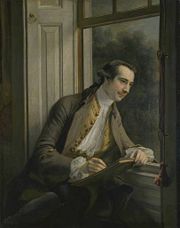 Born in Nottingham
, Sandby joined the topographical
drawing room of the Board of Ordnance
at the Tower of London
in the early 1740s and in 1747 was tasked as chief draughtsman with mapping the remote Scottish Highlands
- a "compleat and accurate survey of Scotland". While undertaking this commission, which included preparing designs for new bridges and fortifications, he began producing watercolour landscapes documenting the changes in Scotland after the 1745 rebellion, and sketches of Scottish events such as the hanging in Edinburgh
of soldier-turned-forger John Young in 1751. News of his talent soon spread.
In 1752, he took up a post with his brother producing landscapes of the royal estates at Windsor
(the royal collection includes over 500 images by the Sandby brothers). His skills were applauded by fellow artists such as Thomas Gainsborough
: if one wanted "real Views from Nature in this Country", declared Gainsborough in 1764, there was no better artist than Sandby, who frequently "employ'd his pencil that way." He also drew some caricatures ridiculing William Hogarth
.
In 1768, he was appointed chief drawing master to the Royal Military Academy at Woolwich
, a position he retained until 1799.
Sandby made his first recorded visit to Wales
in 1770, later (1773) touring south Wales with Sir Joseph Banks
, resulting in the 1775 publication of XII Views in South Wales and a further 12 views the following year, part of a 48-plate series of aquatint
engraving
s depicting Welsh
scenery commissioned by Banks.
He died in London
in 1809 and was described in his obituaries as 'the father of modern landscape painting in watercolors'.
Water-colours.
England
England is a country that is part of the United Kingdom. It shares land borders with Scotland to the north and Wales to the west; the Irish Sea is to the north west, the Celtic Sea to the south west, with the North Sea to the east and the English Channel to the south separating it from continental...
map
Map
A map is a visual representation of an area—a symbolic depiction highlighting relationships between elements of that space such as objects, regions, and themes....
-maker turned landscape painter
Landscape art
Landscape art is a term that covers the depiction of natural scenery such as mountains, valleys, trees, rivers, and forests, and especially art where the main subject is a wide view, with its elements arranged into a coherent composition. In other works landscape backgrounds for figures can still...
in watercolours, who, along with his older brother Thomas
Thomas Sandby
Thomas Sandby was an English draughtsman, watercolour artist, architect and teacher. Along with his younger brother Paul, he became one of the founding members of the Royal Academy in 1768, and was its first professor of architecture...
, became one of the founding members of the Royal Academy
Royal Academy
The Royal Academy of Arts is an art institution based in Burlington House on Piccadilly, London. The Royal Academy of Arts has a unique position in being an independent, privately funded institution led by eminent artists and architects whose purpose is to promote the creation, enjoyment and...
in 1768.
Life and work
Nottingham
Nottingham is a city and unitary authority in the East Midlands of England. It is located in the ceremonial county of Nottinghamshire and represents one of eight members of the English Core Cities Group...
, Sandby joined the topographical
Topography
Topography is the study of Earth's surface shape and features or those ofplanets, moons, and asteroids...
drawing room of the Board of Ordnance
Board of Ordnance
The Board of Ordnance was a British government body responsible for the supply of armaments and munitions to the Royal Navy and British Army. It was also responsible for providing artillery trains for armies and maintaining coastal fortresses and, later, management of the artillery and engineer...
at the Tower of London
Tower of London
Her Majesty's Royal Palace and Fortress, more commonly known as the Tower of London, is a historic castle on the north bank of the River Thames in central London, England. It lies within the London Borough of Tower Hamlets, separated from the eastern edge of the City of London by the open space...
in the early 1740s and in 1747 was tasked as chief draughtsman with mapping the remote Scottish Highlands
Scottish Highlands
The Highlands is an historic region of Scotland. The area is sometimes referred to as the "Scottish Highlands". It was culturally distinguishable from the Lowlands from the later Middle Ages into the modern period, when Lowland Scots replaced Scottish Gaelic throughout most of the Lowlands...
- a "compleat and accurate survey of Scotland". While undertaking this commission, which included preparing designs for new bridges and fortifications, he began producing watercolour landscapes documenting the changes in Scotland after the 1745 rebellion, and sketches of Scottish events such as the hanging in Edinburgh
Edinburgh
Edinburgh is the capital city of Scotland, the second largest city in Scotland, and the eighth most populous in the United Kingdom. The City of Edinburgh Council governs one of Scotland's 32 local government council areas. The council area includes urban Edinburgh and a rural area...
of soldier-turned-forger John Young in 1751. News of his talent soon spread.
In 1752, he took up a post with his brother producing landscapes of the royal estates at Windsor
Windsor, Berkshire
Windsor is an affluent suburban town and unparished area in the Royal Borough of Windsor and Maidenhead in Berkshire, England. It is widely known as the site of Windsor Castle, one of the official residences of the British Royal Family....
(the royal collection includes over 500 images by the Sandby brothers). His skills were applauded by fellow artists such as Thomas Gainsborough
Thomas Gainsborough
Thomas Gainsborough was an English portrait and landscape painter.-Suffolk:Thomas Gainsborough was born in Sudbury, Suffolk. He was the youngest son of John Gainsborough, a weaver and maker of woolen goods. At the age of thirteen he impressed his father with his penciling skills so that he let...
: if one wanted "real Views from Nature in this Country", declared Gainsborough in 1764, there was no better artist than Sandby, who frequently "employ'd his pencil that way." He also drew some caricatures ridiculing William Hogarth
William Hogarth
William Hogarth was an English painter, printmaker, pictorial satirist, social critic and editorial cartoonist who has been credited with pioneering western sequential art. His work ranged from realistic portraiture to comic strip-like series of pictures called "modern moral subjects"...
.
In 1768, he was appointed chief drawing master to the Royal Military Academy at Woolwich
Woolwich
Woolwich is a district in south London, England, located in the London Borough of Greenwich. The area is identified in the London Plan as one of 35 major centres in Greater London.Woolwich formed part of Kent until 1889 when the County of London was created...
, a position he retained until 1799.
Sandby made his first recorded visit to Wales
Wales
Wales is a country that is part of the United Kingdom and the island of Great Britain, bordered by England to its east and the Atlantic Ocean and Irish Sea to its west. It has a population of three million, and a total area of 20,779 km²...
in 1770, later (1773) touring south Wales with Sir Joseph Banks
Joseph Banks
Sir Joseph Banks, 1st Baronet, GCB, PRS was an English naturalist, botanist and patron of the natural sciences. He took part in Captain James Cook's first great voyage . Banks is credited with the introduction to the Western world of eucalyptus, acacia, mimosa and the genus named after him,...
, resulting in the 1775 publication of XII Views in South Wales and a further 12 views the following year, part of a 48-plate series of aquatint
Aquatint
Aquatint is an intaglio printmaking technique, a variant of etching.Intaglio printmaking makes marks on the matrix that are capable of holding ink. The inked plate is passed through a printing press together with a sheet of paper, resulting in a transfer of the ink to the paper...
engraving
Engraving
Engraving is the practice of incising a design on to a hard, usually flat surface, by cutting grooves into it. The result may be a decorated object in itself, as when silver, gold, steel, or glass are engraved, or may provide an intaglio printing plate, of copper or another metal, for printing...
s depicting Welsh
Wales
Wales is a country that is part of the United Kingdom and the island of Great Britain, bordered by England to its east and the Atlantic Ocean and Irish Sea to its west. It has a population of three million, and a total area of 20,779 km²...
scenery commissioned by Banks.
He died in London
London
London is the capital city of :England and the :United Kingdom, the largest metropolitan area in the United Kingdom, and the largest urban zone in the European Union by most measures. Located on the River Thames, London has been a major settlement for two millennia, its history going back to its...
in 1809 and was described in his obituaries as 'the father of modern landscape painting in watercolors'.
Further reading
- Julian Faigan, Paul Sandby RA. The Collection in the City of Hamilton Art Gallery (University of Melbourne MA Thesis, 1984).
- L. Herrmann. Paul and Thomas Sandby (Batsford, 1986).
- Andrew Wilton & Anne Lyles. The Great Age of British Watercolours (1750–1880) (Prestel, 1993). ISBN 3-7913-1254-5
- Anne Lyles & Robin Hamlyn. British watercolours from the Oppé Collection (Tate Gallery Publishing, 1997). ISBN 1-85437-240-8
External links
- Paul Sandby online (aercyclopedia.com).
- Picturing Britain: Paul Sandby (1731-1809) (Daily Telegraph - 27 July 2009).
- Paul Sandby, Unlikely Founder of Dazzling School of European Art, Souren Melikian, New York Times, 16 April 2010
- A detailed Paul Sandby biography Edited by Charles Holme. Text by Alexander J Finberg & E A Taylor. The Development of British Landscape Painting in
Water-colours.