


Portland Vase

Encyclopedia
Roman glass
Roman glass objects have been recovered across the Roman Empire in domestic, industrial and funerary contexts. Glass was used primarily for the production of vessels, although mosaic tiles and window glass were also produced. Roman glass production developed from Hellenistic technical traditions,...
cameo glass
Cameo Glass
Cameo glass is a luxury form of glass art produced by etching and carving through fused layers of differently colored glass to produce designs, usually with white opaque glass figures and motifs on a dark-colored background...
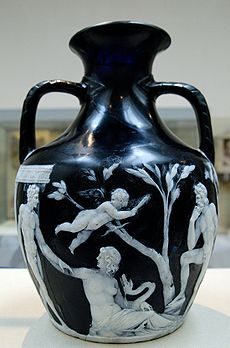
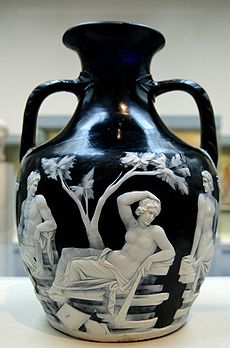
vase, currently dated to between AD 5 and AD 25, which served as an inspiration to many glass and porcelain
Porcelain
Porcelain is a ceramic material made by heating raw materials, generally including clay in the form of kaolin, in a kiln to temperatures between and...
makers from about the beginning of the 18th century onwards. Since 1810 the vase has been kept almost continuously in the British Museum
British Museum
The British Museum is a museum of human history and culture in London. Its collections, which number more than seven million objects, are amongst the largest and most comprehensive in the world and originate from all continents, illustrating and documenting the story of human culture from its...
in London
London
London is the capital city of :England and the :United Kingdom, the largest metropolitan area in the United Kingdom, and the largest urban zone in the European Union by most measures. Located on the River Thames, London has been a major settlement for two millennia, its history going back to its...
. It was bought by the museum in 1945 (reference - GR 1945,0927.1) ; on display in Room 70, Rome: City & Empire).
The vase is about 25 centimeters high and 56 in circumference. It is made of violet-blue glass, and surrounded with a single continuous white glass cameo depicting seven figures (humans and gods).
On the bottom was a cameo glass disc, also in blue and white, showing a head, presumed to be of Paris
Paris (mythology)
Paris , the son of Priam, king of Troy, appears in a number of Greek legends. Probably the best-known was his elopement with Helen, queen of Sparta, this being one of the immediate causes of the Trojan War...
or Priam
Priam
Priam was the king of Troy during the Trojan War and youngest son of Laomedon. Modern scholars derive his name from the Luwian compound Priimuua, which means "exceptionally courageous".- Marriage and issue :...
on the basis of the Phrygian cap
Phrygian cap
The Phrygian cap is a soft conical cap with the top pulled forward, associated in antiquity with the inhabitants of Phrygia, a region of central Anatolia. In the western provinces of the Roman Empire it came to signify freedom and the pursuit of liberty, perhaps through a confusion with the pileus,...
it wears. This roundel clearly does not belong to the vase, and has been displayed separately since 1845. It may have been added to mend a break in antiquity or after, or the result of a conversion from an original amphora
Amphora
An amphora is a type of vase-shaped, usually ceramic container with two handles and a long neck narrower than the body...
form (paralleled by a similar blue-glass cameo vessel from Pompeii
Pompeii
The city of Pompeii is a partially buried Roman town-city near modern Naples in the Italian region of Campania, in the territory of the comune of Pompei. Along with Herculaneum, Pompeii was destroyed and completely buried during a long catastrophic eruption of the volcano Mount Vesuvius spanning...
) - it was definitely attached to the bottom from at least 1826.
Iconography
The meaning of the images on the vase is unclear and controversial. Interpretations of the portrayals have included that of a marine setting (due to the presence of a ketos or sea-snake), and of a marriage theme/context (i.e. as a wedding gift). Many scholars (even Charles TowneleyCharles Towneley
Charles Townley was an English country gentleman, antiquary and collector of the Townley Marbles ....
) have concluded that the figures do not fit into a single iconographic set.
Some interpretations of the 2 main scenes are:
| Scene 1 | Scene 2 |
| The story of the Emperor Augustus Augustus Augustus ;23 September 63 BC – 19 August AD 14) is considered the first emperor of the Roman Empire, which he ruled alone from 27 BC until his death in 14 AD.The dates of his rule are contemporary dates; Augustus lived under two calendars, the Roman Republican until 45 BC, and the Julian... ' supposed siring by the god Apollo in the form of a snake |
A divinatory dream by Hecuba Hecuba Hecuba was a queen in Greek mythology, the wife of King Priam of Troy during the Trojan War, with whom she had 19 children. These children included several major characters of Homer's Iliad such as the warriors Hector and Paris, and the prophetess Cassandra... that the Judgement of Paris Judgement of Paris thumb |right |460px |[[The Judgment of Paris |The Judgment of Paris]], [[Peter Paul Rubens]], ca 1636... would lead to the destruction of Troy Troy Troy was a city, both factual and legendary, located in northwest Anatolia in what is now Turkey, southeast of the Dardanelles and beside Mount Ida... |
| Peleus Peleus In Greek mythology, Pēleus was a hero whose myth was already known to the hearers of Homer in the late 8th century BCE. Peleus was the son of Aeacus, king of the island of Aegina, and Endeïs, the oread of Mount Pelion in Thessaly; he was the father of Achilles... and Thetis Thetis Silver-footed Thetis , disposer or "placer" , is encountered in Greek mythology mostly as a sea nymph or known as the goddess of water, one of the fifty Nereids, daughters of the ancient one of the seas with shape-shifting abilities who survives in the historical vestiges of most later Greek myths... , maritime deities |
Ariadne Ariadne Ariadne , in Greek mythology, was the daughter of King Minos of Crete, and his queen Pasiphaë, daughter of Helios, the Sun-titan. She aided Theseus in overcoming the Minotaur and was the bride of the god Dionysus.-Minos and Theseus:... languishing on Naxos |
| The younger man is Mark Antony Mark Antony Marcus Antonius , known in English as Mark Antony, was a Roman politician and general. As a military commander and administrator, he was an important supporter and loyal friend of his mother's cousin Julius Caesar... being lured by the wiles of the reclining woman (who is Cleopatra, with the snake being an asp Asp Asp may refer to:Snakes:* Asp , an archaic term for a venomous snake.* Vipera aspis, a venomous viper found in Europe.* Cerastes cerastes, a venomous viper found in the Sahara desert.... ) into losing his manly romanitas Romanitas Romanità also termed Romanitas in English referring to "Roman-ness" or the Roman ideal the refers to an immiscibly Latin culture of the Roman Empire. Cicero contributed much to the notion.... and becoming decadent, with the bearded elder male figure being his mythical ancestor Anton Anton - Places :Bulgaria*Anton, BulgariaPanama*Antón, PanamaUnited States*Anton, Colorado*Anton, Texas*Anton, Wisconsin, an unincorporated community- Technology :*Anton , a highly parallel supercomputer for molecular dynamics simulations... looking on. |
The woman languishing is Octavia Minor Octavia Minor Octavia the Younger , also known as Octavia Minor or simply Octavia, was the sister of the first Roman Emperor, Augustus , half-sister of Octavia the Elder, and fourth wife of Mark Antony... , abandoned by Mark Antony, between her brother Augustus (left, as a god, as on the contemporary Sword of Tiberius http://www.thebritishmuseum.ac.uk/explore/highlights/highlight_objects/gr/t/the_sword_of_tiberius.aspx) and Venus Genetrix Venus Genetrix Venus Genetrix may be:*An epithet of the goddess Venus*Venus Genetrix , the name for a type of sculptural depiction of the goddess thought to represent her under this epithet.... , the ancestor of Augustus and Octavia's Julian gens Julius The gens Julia was one of the most ancient patrician families at Ancient Rome. Members of the gens attained the highest dignities of the state in the earliest times of the Republic. The first of the family to obtain the consulship was Gaius Julius Iulus in 489 BC... . |
Manufacture
Minerva (disambiguation)
Minerva is the Roman goddess of crafts and wisdom, but the name may also refer to:-People:* Josephine Blatt aka Minerva , strongwoman* Minerva Urecal , American film and television actress...
that the vase was produced in the 16th century AD and not antiquity, because the iconography is incoherent, but this theory has not been widely accepted.
Cameo-glass vessels were probably all made within about two generations as experiments when the blowing technique (discovered in about 50 BC) was still in its infancy. Recent research has shown that the Portland vase, like the majority of cameo-glass vessels, was made by the dip-overlay method, whereby an elongated bubble of glass was partially dipped into a crucible (fire-resistant container) of white glass, before the two were blown together. After cooling the white layer was cut away to form the design.
The work towards making a 19th century copy proved to be incredibly painstaking, and based on this it is believed that the Portland Vase must have taken its original artisan no less than two years to produce.
The cutting was probably performed by a skilled gem-cutter. It is believed that the cutter may have been Dioskourides, as gems cut by him of a similar period and signed by him, (Vollenweider 1966, see
Gem in the collection of the Duke of Devonshire
Duke of Devonshire
Duke of Devonshire is a title in the peerage of England held by members of the Cavendish family. This branch of the Cavendish family has been one of the richest and most influential aristocratic families in England since the 16th century, and have been rivalled in political influence perhaps only...
"Diomedes stealing the Palladium"), are extant. This is confirmed by the Corning Museum in their 190-page study of the vase—see above.)
Discovery
Legend has it that it was discovered by Fabrizio Lazzaro in the sepulchre of the Emperor Alexander SeverusAlexander Severus
Severus Alexander was Roman Emperor from 222 to 235. Alexander was the last emperor of the Severan dynasty. He succeeded his cousin Elagabalus upon the latter's assassination in 222, and was ultimately assassinated himself, marking the epoch event for the Crisis of the Third Century — nearly fifty...
, at Monte del Grano near Rome
Rome
Rome is the capital of Italy and the country's largest and most populated city and comune, with over 2.7 million residents in . The city is located in the central-western portion of the Italian Peninsula, on the Tiber River within the Lazio region of Italy.Rome's history spans two and a half...
, and excavated some time around 1582.
The first possible historical reference to the vase is in a 1601 letter from the French scholar Nicolas Claude Fabri de Peiresc
Nicolas-Claude Fabri de Peiresc
Nicolas-Claude Fabri de Peiresc was a French astronomer, antiquary and savant who maintained a wide correspondence with scientists and was a successful organizer of scientific inquiry...
to the painter Peter Paul Rubens, where it is recorded as in the collection of Cardinal Francesco Maria Del Monte in Italy. It then passed to the Barberini
Barberini
The Barberini are a family of the Italian nobility that rose to prominence in 17th century Rome. Their influence peaked with the election of Cardinal Maffeo Barberini to the papal throne in 1623, as Pope Urban VIII...
family collection (which also included sculptures such as the Barberini Faun
Barberini Faun
The life-size marble statue known as the Barberini Faun or Drunken Satyr is located in the Glyptothek in Munich, Germany. A Faun is the Roman equivalent of a Greek Satyr. In Greek mythology, satyrs were human-like male woodland spirits with several animal features, often a goat-like tail, hooves,...
and Barberini Apollo) where it remained for some two hundred years, being one of the treasures of Maffeo Barberini, later Pope Urban VIII
Pope Urban VIII
Pope Urban VIII , born Maffeo Barberini, was pope from 1623 to 1644. He was the last pope to expand the papal territory by force of arms, and was a prominent patron of the arts and reformer of Church missions...
(1623–1644).
1778 to present
Sir William HamiltonWilliam Hamilton (diplomat)
Sir William Hamilton KB, PC, FRS was a Scottish diplomat, antiquarian, archaeologist and vulcanologist. After a short period as a Member of Parliament, he served as British Ambassador to the Kingdom of Naples from 1764 to 1800...
, British ambassador in Naples, purchased it in 1778 from James Byres. Byres, a Scottish art dealer, had acquired it after it was sold by Donna Cornelia Barberini-Colonna, Princess of Palestrina. She had inherited the vase from the Barberini family. Hamilton brought it to England on his next leave, after the death of his first wife, Catherine. In 1784, with the assistance of his niece, Mary, he arranged a private sale to Margaret Cavendish-Harley, widow of William Bentinck, 2nd Duke of Portland
William Bentinck, 2nd Duke of Portland
William Bentinck, 2nd Duke of Portland KG , styled Viscount Woodstock from 1709 to 1715 and Marquess of Titchfield from 1715 to 1726, was a British peer....
and so dowager Duchess of Portland http://www.harleygallery.co.uk/event.php?pg_id=3&range=0. She passed it to her son William Cavendish-Bentinck, 3rd Duke of Portland
William Cavendish-Bentinck, 3rd Duke of Portland
William Henry Cavendish-Bentinck, 3rd Duke of Portland, KG, PC was a British Whig and Tory statesman, Chancellor of the University of Oxford and Prime Minister. He was known before 1762 by the courtesy title Marquess of Titchfield. He held a title of every degree of British nobility—Duke,...
in 1786.
The 3rd Duke loaned the original vase to Josiah Wedgwood
Josiah Wedgwood
Josiah Wedgwood was an English potter, founder of the Wedgwood company, credited with the industrialization of the manufacture of pottery. A prominent abolitionist, Wedgwood is remembered for his "Am I Not A Man And A Brother?" anti-slavery medallion. He was a member of the Darwin–Wedgwood family...
(see below) and then to the British Museum for safe-keeping, at which point it was dubbed the "Portland Vase". It was deposited there permanently by the fourth Duke
William Bentinck, 4th Duke of Portland
William Henry Cavendish Cavendish-Scott-Bentinck, 4th Duke of Portland PC, FRS, FSA , styled Marquess of Titchfield until 1809, was a British politician who served in various positions in the governments of George Canning and Lord Goderich.-Background and education:Portland was the eldest son of...
in 1810, after a friend of his broke its base. The original Roman vase has remained in the British Museum ever since 1810, apart from three years (1929–32) when William Cavendish-Bentinck, 6th Duke of Portland
William Cavendish-Bentinck, 6th Duke of Portland
William John Arthur Charles James Cavendish-Bentinck, 6th Duke of Portland KG, GCVO, PC, TD, DL , known as William Cavendish-Bentinck until 1879, was a British landowner, courtier and Conservative politician...
put it up for sale at Christie's
Christie's
Christie's is an art business and a fine arts auction house.- History :The official company literature states that founder James Christie conducted the first sale in London, England, on 5 December 1766, and the earliest auction catalogue the company retains is from December 1766...
where it failed to reach its reserve. It was purchased by the Museum from William Cavendish-Bentinck, 7th Duke of Portland
William Cavendish-Bentinck, 7th Duke of Portland
William Arthur Henry Cavendish-Bentinck, 7th Duke of Portland KG , known as Marquess of Titchfield until 1943, was a British Conservative Party politician....
in 1945 with the aid of a bequest from James Rose Vallentin.
In 1951 Arthur C. Clarke
Arthur C. Clarke
Sir Arthur Charles Clarke, CBE, FRAS was a British science fiction author, inventor, and futurist, famous for his short stories and novels, among them 2001: A Space Odyssey, and as a host and commentator in the British television series Mysterious World. For many years, Robert A. Heinlein,...
mentioned the Vase as having been rescued by time travellers from the future just before the destruction of the Earth
Earth
Earth is the third planet from the Sun, and the densest and fifth-largest of the eight planets in the Solar System. It is also the largest of the Solar System's four terrestrial planets...
, in his science fiction
Science fiction
Science fiction is a genre of fiction dealing with imaginary but more or less plausible content such as future settings, futuristic science and technology, space travel, aliens, and paranormal abilities...
short story "All the Time in the World."
Copies
The 3rd Duke lent the vase to Josiah WedgwoodJosiah Wedgwood
Josiah Wedgwood was an English potter, founder of the Wedgwood company, credited with the industrialization of the manufacture of pottery. A prominent abolitionist, Wedgwood is remembered for his "Am I Not A Man And A Brother?" anti-slavery medallion. He was a member of the Darwin–Wedgwood family...
, who had already had it described to him as "the finest production of Art that has been brought to England and seems to be the very apex of perfection to which you are endeavouring" by the sculptor John Flaxman
John Flaxman
John Flaxman was an English sculptor and draughtsman.-Early life:He was born in York. His father was also named John, after an ancestor who, according to family tradition, had fought for Parliament at the Battle of Naseby, and afterwards settled as a carrier or farmer in Buckinghamshire...
. Wedgwood devoted four years of painstaking trials at duplicating the vase - not in glass but in black and white jasperware
Jasperware
Jasperware, or jasper ware, is a type of stoneware first developed by Josiah Wedgwood, although some authorities have described it as a type of porcelain...
. He had problems with his copies ranging from cracking and blistering (clearly visible on the example at the Victoria and Albert Museum
Victoria and Albert Museum
The Victoria and Albert Museum , set in the Brompton district of The Royal Borough of Kensington and Chelsea, London, England, is the world's largest museum of decorative arts and design, housing a permanent collection of over 4.5 million objects...
) to the reliefs 'lifting' during the firing, and in 1786 he feared that he could never apply the Jasper relief thinly enough to match the glass original's subtlety and delicacy. He finally managed to perfect it in 1790, with the issue of the "first-edition" of copies (with some of this edition, including the V&A one, copying the cameo's delicacy by a combination of undercutting and shading the reliefs in grey), and it marks his last major achievement.
Wedgwood put the first edition on private show between April and May 1790, with that exhibition proving so popular that visitor numbers had to be restricted by only printing 1900 tickets, before going on show in his public London showrooms. (One ticket to the private exhibition, illustrated by Samuel Alkin and printed with 'Admission to see Mr Wedgwood's copy of The Portland Vase, Greek Street, Soho, between 12 o'clock and 5', was bound into the Wedgwood catalogue on view in the Victoria and Albert Museum
Victoria and Albert Museum
The Victoria and Albert Museum , set in the Brompton district of The Royal Borough of Kensington and Chelsea, London, England, is the world's largest museum of decorative arts and design, housing a permanent collection of over 4.5 million objects...
's British Galleries.) As well as the V&A copy (said to have come from the collection of Wedgwood's grandson, the naturalist Charles Darwin
Charles Darwin
Charles Robert Darwin FRS was an English naturalist. He established that all species of life have descended over time from common ancestry, and proposed the scientific theory that this branching pattern of evolution resulted from a process that he called natural selection.He published his theory...
)
, others are held at the Fitzwilliam Museum
Fitzwilliam Museum
The Fitzwilliam Museum is the art and antiquities museum of the University of Cambridge, located on Trumpington Street opposite Fitzwilliam Street in central Cambridge, England. It receives around 300,000 visitors annually. Admission is free....
(this is the copy sent by Wedgwood to Erasmus Darwin
Erasmus Darwin
Erasmus Darwin was an English physician who turned down George III's invitation to be a physician to the King. One of the key thinkers of the Midlands Enlightenment, he was also a natural philosopher, physiologist, slave trade abolitionist,inventor and poet...
which his descendants loaned to the Museum in 1963 and later sold to them); the Indianapolis Museum of Art
Indianapolis Museum of Art
The Indianapolis Museum of Art is an encyclopedic art museum located in Indianapolis, Indiana, United States. The museum, which underwent a $74 million expansion in 2005, is located on a campus on the near northwest area outside downtown Indianapolis, northwest of Crown Hill Cemetery.The...
and the Department of Prehistory and Europe at the British Museum
British Museum
The British Museum is a museum of human history and culture in London. Its collections, which number more than seven million objects, are amongst the largest and most comprehensive in the world and originate from all continents, illustrating and documenting the story of human culture from its...
.
The Vase also inspired a 19th century competition to duplicate its cameo-work in glass, with Benjamin Richardson offering a £1000 prize to anyone who could achieve that feat. Taking three years, glass maker Philip Pargeter made a copy and John Northwood engraved it, to win the prize. This copy is in the Corning Museum of Glass
Corning Museum of Glass
The Corning Museum of Glass, in Corning, New York, explores every facet of glass, including art, history, culture, science and technology, craft, and design....
in Corning, New York.
The Wedgwood Museum, in Barlaston, Near Stoke-on-Trent, UK, contains a display describing the trials of replicating the vase, and several examples of the early experiments are shown.
Vandalism and reconstruction
- On February 7, 1845, the vase was shattered by William Lloyd, who, after drinking all the previous week, threw a nearby sculpture on top of the case smashing both it and the vase.
- He was arrested and charged with the crime of Wilful Damage. When his lawyer pointed out an error in the wording of the act which seemed to limit its application to cases of the destruction of objects worth no more than five pounds, he was convicted instead of the destruction of the glass case in which the vase had sat. He was ordered to pay a fine of three pounds or spend two months in prison. He remained in prison until an anonymous benefactor paid the fine by mail.
- The name William Lloyd is thought to be a pseudonym. He had been living under this name in London. He claimed to be a student at Trinity College, Dublin. Investigators hired by the British Museum concluded that he was actually William Mulcahy, a student who had gone missing from Trinity College. Detectives reported that the Mulcahy family was impoverished. The owner of the vase declined to bring a civil action against William Mulcahy because he did not want his family to suffer for "an act of folly or madness which they could not control".
- The vase was pieced together with fair success, though the restorer was unable to replace all of the pieces and thirty-seven small fragments were left when he was done. It appears they had been put into a box and forgotten. In 1948, the keeper Bernard Ashmole received thirty-seven fragments in a box from Mr. Croker of Putney, who did not know what they were. In 1845 Mr. Doubleday, the first restorer, had not been able to figure out where these fragments went. A colleague took them to Mr. Gabb, a box maker, who was asked to make a box with thirty seven compartments, one for each fragment. The colleague died, the box was never collected, Mr. Gabb died and his executrix Miss Revees asked Croker to ask the museum if they could identify them.
- By 1948, the restoration appeared aged and it was decided to restore the vase again, but the restorer was only successful in replacing three fragments. The adhesive from this weakened, by 1986 the joints rattled when the vase was gently tapped.
- The third and current reconstruction took place from 1 June 1988 and was completed on 1 October 1989 by Nigel Williams and Sandra Smith (and overseen by David Akehurst (CCO of Glass and Ceramics) who had assessed the vase's condition during its appearance as the focal piece of an international exhibition of Roman glass and, at the conclusion of the exhibition, it was decided to go ahead with reconstruction and stabilisation. The treatment had scholarly attention and press coverage. The vase was photographed and drawn to record the position of fragments before dismantling; the BBC filmed the conservation process. All the adhesives used in previous restorations had deteriorated, so to find one that would last, conservation scientists at the museum tested many adhesives for long term stability. Finally, an epoxy resin with excellent ageing properties was chosen. Reassembly of the vase was made more difficult as the edges of some fragments were found to have been filed down during the restorations. Nevertheless, all of the fragments were replaced except for a few small splinters. Areas that were still missing were gap-filled with a blue or white resin.
The newly conserved Portland Vase was returned to display. Little sign of the original damage is visible and, except for light cleaning, the vase should not require major conservation work for many years.
External links
- British Museum - catalogue entry for the vase
- British Museum - conservation history of the vase
- Bulstrode Park (where the Duchess of Portland kept the Vase) entry from The DiCamillo Companion to British & Irish Country Houses
- The Corning Museum of Glass (which owns several replicas of the Portland Vase) - information on cameo and Roman glass