
All Topics  
History of Sudan

 
History of Sudan

   Email Print
   Bookmark   Link


History of Sudan


The history of Sudan is marked by influences (military and cultural) on Sudan
Sudan

Sudan is a country in northeastern Africa. It is the largest in the African continent and the Arab World, and List of countries and outlying territories by total area by area....
 from neighboring areas (e.g. Egypt
Egypt

Egypt is a country mainly in North Africa, with the Sinai Peninsula forming a land bridge in Western Asia. Covering an area of about , Egypt borders the Mediterranean Sea to the north, the Gaza Strip and Israel to the northeast, the Red Sea to the east, Sudan to the south and Libya to the west....
, Arabian Peninsula
Arabian Peninsula

The Arabian Peninsula , Arabia, Arabistan, and the Arabian subcontinent is a peninsula in Southwest Asia at the junction of Africa and Asia. The area is an important part of the Middle East and plays a critically important geopolitics role because of its vast reserves of petroleum and natural gas....
, Ethiopia
Ethiopia

Ethiopia , officially the Federal Democratic Republic of Ethiopia, is a landlocked country situated in the Horn of Africa. Ethiopia is bordered by Eritrea to the north, Sudan to the west, Kenya to the south, Somalia to the east and Djibouti to the northeast....
, Congo
Democratic Republic of the Congo

The Democratic Republic of the Congo , is a country in central Africa with a small length of Atlantic coastline. It is the third largest list of African countries in order of geographical area....
, Chad
Chad

Chad , officially known as the Republic of Chad, is a landlocked country in central Africa. It is bordered by Libya to the north, Sudan to the east, the Central African Republic to the south, Cameroon and Nigeria to the southwest, and Niger to the west....
) and world powers (e.g. United Kingdom
United Kingdom

The United Kingdom of Great Britain and Northern Ireland, commonly known as the United Kingdom , the UK or Britain,is a sovereign state located off the northwestern coast of continental Europe....
, United States
United States

The United States of America is a Federal government constitutional republic comprising U.S. state and a federal district. The country is situated mostly in central North America, where its Contiguous United States and Washington, D.C., the Capital districts and territories, lie between the Pacific Ocean and Atlantic Oceans, Borders of the U...
). The territory of Sudan combines the lands of several ancient kingdoms, including Kush, Darfur
Darfur

Darfur is a region in Sudan. An independent sultanate for several hundred years, it was incorporated into Sudan by History of the Anglo-Egyptian co-dominium....
, and three Nubian kingdoms.

lass="link1" onMouseover='showByLink("m1666862",this)' onMouseout='hide("m1666862")'href="http://www.absoluteastronomy.com/topics/Excavation">Excavation
Excavation

The term archaeological excavation has a double meaning.# Excavation is the best known and most commonly used within the science of archaeology....
 of archaeological site
Archaeological site

An archaeological site is a place in which evidence of past activity is preserved , and which has been, or may be, investigated using the discipline of archaeology and represents a part of the archaeological record...
s on the Nile
Nile

The Nile is a major north-flowing river in Africa, generally regarded as the List of rivers by length in the world.The Nile has two major tributary, the White Nile and Blue Nile, the latter being the source of most of the Nile's water and silt, but the former being the longer of the two....
 above Aswan
Aswan

Aswan , Egyptian language: Swenet , Coptic language: Swan; Greek language: Syene; ) is a city in the south of Egypt, the capital of the Aswan Governorate....
 has confirmed human habitation in the river valley during the Paleolithic period that spanned more than sixty thousand years of Sudanese history.


Discussion
Ask a question about 'History of Sudan'
Start a new discussion about 'History of Sudan'
Answer questions from other users
Full Discussion Forum


Recent Posts


Encyclopedia


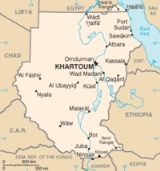
Su Map
The history of Sudan is marked by influences (military and cultural) on Sudan
Sudan

Sudan is a country in northeastern Africa. It is the largest in the African continent and the Arab World, and List of countries and outlying territories by total area by area....
 from neighboring areas (e.g. Egypt
Egypt

Egypt is a country mainly in North Africa, with the Sinai Peninsula forming a land bridge in Western Asia. Covering an area of about , Egypt borders the Mediterranean Sea to the north, the Gaza Strip and Israel to the northeast, the Red Sea to the east, Sudan to the south and Libya to the west....
, Arabian Peninsula
Arabian Peninsula

The Arabian Peninsula , Arabia, Arabistan, and the Arabian subcontinent is a peninsula in Southwest Asia at the junction of Africa and Asia. The area is an important part of the Middle East and plays a critically important geopolitics role because of its vast reserves of petroleum and natural gas....
, Ethiopia
Ethiopia

Ethiopia , officially the Federal Democratic Republic of Ethiopia, is a landlocked country situated in the Horn of Africa. Ethiopia is bordered by Eritrea to the north, Sudan to the west, Kenya to the south, Somalia to the east and Djibouti to the northeast....
, Congo
Democratic Republic of the Congo

The Democratic Republic of the Congo , is a country in central Africa with a small length of Atlantic coastline. It is the third largest list of African countries in order of geographical area....
, Chad
Chad

Chad , officially known as the Republic of Chad, is a landlocked country in central Africa. It is bordered by Libya to the north, Sudan to the east, the Central African Republic to the south, Cameroon and Nigeria to the southwest, and Niger to the west....
) and world powers (e.g. United Kingdom
United Kingdom

The United Kingdom of Great Britain and Northern Ireland, commonly known as the United Kingdom , the UK or Britain,is a sovereign state located off the northwestern coast of continental Europe....
, United States
United States

The United States of America is a Federal government constitutional republic comprising U.S. state and a federal district. The country is situated mostly in central North America, where its Contiguous United States and Washington, D.C., the Capital districts and territories, lie between the Pacific Ocean and Atlantic Oceans, Borders of the U...
). The territory of Sudan combines the lands of several ancient kingdoms, including Kush, Darfur
Darfur

Darfur is a region in Sudan. An independent sultanate for several hundred years, it was incorporated into Sudan by History of the Anglo-Egyptian co-dominium....
, and three Nubian kingdoms.

Prehistory


Sudan Meroe Pyramids 2001
Excavation
Excavation

The term archaeological excavation has a double meaning.# Excavation is the best known and most commonly used within the science of archaeology....
 of archaeological site
Archaeological site

An archaeological site is a place in which evidence of past activity is preserved , and which has been, or may be, investigated using the discipline of archaeology and represents a part of the archaeological record...
s on the Nile
Nile

The Nile is a major north-flowing river in Africa, generally regarded as the List of rivers by length in the world.The Nile has two major tributary, the White Nile and Blue Nile, the latter being the source of most of the Nile's water and silt, but the former being the longer of the two....
 above Aswan
Aswan

Aswan , Egyptian language: Swenet , Coptic language: Swan; Greek language: Syene; ) is a city in the south of Egypt, the capital of the Aswan Governorate....
 has confirmed human habitation in the river valley during the Paleolithic period that spanned more than sixty thousand years of Sudanese history. A prehistoric
Prehistory

Prehistory is a term often used to describe the period before Recorded history. Paul Tournal originally coined the term Pr?-historique in describing the finds he had made in the caves of southern France....
 burial discovered in northern Sudan
Sudan

Sudan is a country in northeastern Africa. It is the largest in the African continent and the Arab World, and List of countries and outlying territories by total area by area....
, known as Cemetery 117
Cemetery 117

Cemetery 117 is an ancient cemetery discovered in 1964 by a team led by Fred Wendorf near the northern border of Sudan. The remains discovered there were determined to be between approximately 13,140 and 14,340 years old....
, reveals what is believed to be the world's earliest indication of warfare, dating to the twelfth millennium BC . By the eighth millennium BC, people of a Neolithic
Neolithic

The Neolithic period was a period in the development of human technology, beginning about 9500 Before the Christian Era in the Middle East that is traditionally considered the last part of the Stone Age....
 culture had settled into a sedentary way of life there in fortified mud-brick villages, where they supplemented hunting
Hunting

Hunting is the practice of pursuing living animals for food, recreation, or trade. In present-day use, the term refers to lawful hunting, as distinguished from poaching, which is the killing, trapping or capture of the hunted species contrary to law....
 and fishing
Fishing

Fishing is the activity of catching fish. Fishing techniques include Fish net, Fish trap, Spearfishing, angling and Gathering seafood by hand. The term fishing may be applied to catching other aquatic animals such as different types of shellfish, squid, octopus, turtles, Edible frog and some edible marine invertebrates....
 on the Nile with grain
GRAIN

GRAIN is an international non-governmental organization based in Barcelona, Spain, which works toward sustainable agriculture. It was formed upon the realization that the genetic diversity of the world's food crops are being drastically eliminated....
 gathering and cattle
Cattle

Cattle, colloquially referred to as cows, are domestication ungulates, a member of the subfamily Bovinae of the family Bovidae. They are raised as livestock for meat , dairy products , leather and as draft animals ....
 herding. Anthropological and archaeological research indicate that during the predynastic period Nubia and Nagadan Upper Egypt were ethnically, and culturally nearly identical, and thus, simultaneously evolved systems of pharaonic kingship by 3300 BC.  But during the close of the Nagada III period, Nagada, in its bid to conquer and unify the whole nile valley, seems to have conquered their southern neighbors and "Egyptianized" them. . The result appears to have been the depopulation of the entire Lower Nubian area, either by the genocidal efforts of the First Dynasty Egyptian kings, or by the migration (forced or voluntary) of the nubians to areas north and south.

Kush

Southern Sudan's earliest historical record comes from Egyptian sources, which described the land upstream from the First Cataract, called Kush, as "wretched." For more than two thousand years after the Old Kingdom
Old Kingdom

The Old Kingdom is the name commonly given to that period in the 3rd millennium BCE when Ancient Egypt attained its first continuous peak of civilization in complexity and achievement ? this was the first of three so-called "Kingdom" periods, which mark the high points of civilization in the lower Nile Valley ....
 (c.
Circa

Circa means "in approximately", generally referring to a year. It is widely used in genealogy and historical writing, when the dates of events are approximately known....
2700-2180 BC), Egyptian political and economic activities determined the course of the central Nile region's history. Even during intermediate periods when Egyptian political power in Kush waned, Egypt exerted a profound cultural and religious influence on the Kushite people.

Over the centuries, trade developed. Egyptian caravans carried grain to Kush and returned to Aswan with ivory
Ivory

File:Ivory decoration.jpgIvory is formed from dentine and constitutes the bulk of the teeth and tusks of animals such as the elephant, hippopotamus, walrus, mammoth and narwhal....
, incense
Incense

Incense is composed of aromatic Biotic material materials. It releases fragrant smoke when burned. The term incense refers to the substance itself, rather than to the odor that it produces....
, hides
Hides

Hides are skins obtained from animals for human use. Examples of animal hide sources are deer and cattle typically used for producing leather, alligator skins, snake skins for shoes and fashion accessories and wild cats, minks and bears, whose skins are primarily sought for their fur....
, and carnelian
Carnelian

Carnelian is a reddish-brown mineral which is commonly used as a semi-precious gemstone. Similar to carnelian is sard, which is generally harder and darker....
 (a stone prized both as jewelry and for arrowhead
Arrowhead

An arrowhead is point of an arrow, or a shape resembling such a point; as archaeological artifacts arrowheads are a subclass of projectile points....
s) for shipment downriver. Egyptian traders particularly valued gold
Gold

Gold is a chemical element with the symbol Au and atomic number 79. It is a highly sought-after precious metal, having been used as money, as a store of value, in jewelry, in sculpture, and for ornamentation since the beginning of recorded history....
 and slave
Slavery

Slavery is a form of forced labor where a person is compelled to Labor for another . Slaves are held against their will from the time of their capture, purchase, or birth, and are deprived of the right to leave, to refuse to work, or to receive Remuneration in return for their labor....
s, who served as domestic servants, concubines, and soldiers in the pharaoh
Pharaoh

Pharaoh is a title used in many modern discussions of the ancient Egyptian rulers of all periods. In antiquity this title began to be used for the ruler who was the religious and political leader of united ancient Egypt, only during the New Kingdom, specifically, during the middle of the Eighteenth dynasty of Egypt....
's army. Egyptian military expeditions penetrated Kush periodically during the Old Kingdom. Yet there was no attempt to establish a permanent presence in the area until the Middle Kingdom
Middle Kingdom

The Middle Kingdom may refer to*China*The Middle Kingdom of Egypt*A group of midwest U.S. states associated with the Society for Creative Anachronism...
 (c.2100-1720 BC), when Egypt constructed a network of forts along the Nile as far south as Samnah, in southern Egypt, to guard the flow of gold from mines in Wawat.

Around 1720 BC, Asian nomads named Hyksos
Hyksos

The Hyksos were an Asiatic people who invaded the eastern Nile Delta, in the Twelfth dynasty of Egypt initiating the Second Intermediate Period of Ancient Egypt....
 took over Egypt, ended the Middle Kingdom, severed links with Kush, and destroyed the forts along the Nile River. To fill the vacuum left by the Egyptian withdrawal, a culturally distinct indigenous kingdom emerged at Karmah
Karmah

Karmah may refer to:*Al-Karmah, a city in Iraq near Fallujah*Karmah , an Italian duo...
, near present-day Dunqulah. After Egyptian power revived during the New Kingdom
New Kingdom

The New Kingdom, sometimes referred to as the Egyptian Empire, is the period in ancient Egyptian History of Ancient Egypt between the 16th century BC and the 11th century BC, covering the Eighteenth dynasty of Egypt, Nineteenth dynasty of Egypt, and Twentieth dynasty of Egypt....
 (c.1570-1100 BC), the pharaoh Ahmose I
Ahmose I

Ahmose I was a pharaoh of ancient Egypt and the founder of the Eighteenth dynasty of Egypt. He was a member of the Thebes, Egypt royal house, the son of pharaoh Tao II the Brave and brother of the last pharaoh of the Seventeenth dynasty of Egypt, King Kamose....
 incorporated Kush as an Egyptian province governed by a viceroy
Viceroy

A viceroy is a royal official who governs a country or province in the name of and as representative of the monarch. The term derives from the Latin prefix vice-, meaning "in the place of" and the French word roi, meaning king....
. Although Egypt's administrative control of Kush extended only down to the fourth cataract
Cataracts of the Nile

The cataracts of the Nile River are shallow stretches between Aswan and Khartoum where the water's surface is broken by numerous small boulders and stones lying on the river bed, as well as many small rocky islets....
, Egyptian sources list tributary districts reaching to the Red Sea
Red Sea

The Red Sea is a salt water inlet of the Indian Ocean between Africa and Asia. The connection to the ocean is in the south through the Bab el Mandeb sound and the Gulf of Aden....
 and upstream to the confluence of the Blue Nile
Blue Nile

The Blue Nile is a river originating at Lake Tana in Ethiopia. Sometimes in Ethiopia the river?especially the upper reaches?is called the Abbai....
 and White Nile
White Nile

The White Nile is a river of Africa, one of the two main tributary of the Nile, the other being the Blue Nile. In the strict meaning, "White Nile" refers to the river formed at Lake No at the confluence of the Bahr al Jabal and Bahr el Ghazal rivers....
 rivers. Egyptian authorities ensured the loyalty of local chiefs by drafting their children to serve as pages at the pharaoh's court. Egypt also expected tribute in gold and slaves from local chiefs.

Once Egypt had established political control over Kush, officials and priests joined military personnel, merchants, and artisans and settled in the region. The Egyptian language
Egyptian language

Egyptian is a branch of the Afro-Asiatic languages language family along with the Chadic languages, Berber languages, Semitic languages, Cushitic languages and possibly Omotic languages languages....
 became widely used in everyday activities. Many rich Kushites worshipped Egyptian gods and built temples for them. The temples remained centers of official religious worship until the coming of Christianity
Christianity

Christianity is a Monotheistic religion #Christian view religion centered on the life and teachings of Jesus as New Testament view on Jesus' life....
 to the region during the sixth century. When Egyptian influence declined or succumbed to foreign domination, the Kushite elite regarded themselves as central powers and believed themselves as idols of Egyptian culture and religion.

By the eleventh century BC, the authority of the New Kingdom dynasties had diminished, allowing divided rule in Egypt, and ending Egyptian control of Kush. There is no information about the region's activities over the next three hundred years. In the eighth century BC, however, Kush emerged as an independent kingdom ruled from Napata
Napata

Napata was a city-state on the west bank of the Blue Nile River, some 400 km north of Khartoum, the present capital of Sudan. It was built around 1345 BC by the Nubians....
 by an aggressive line of monarchs who slowly extended their influence into Egypt. Around 750 BC, a Kushite king called Kashta
Kashta

Kashta was a king of the Kushite Dynasty. His name names translates literally as "The Kushite"....
 conquered Upper Egypt
Upper Egypt

File:Ancient Egypt map-en.svgUpper Egypt is a narrow strip of land that extends from the Cataracts of the Nile section of Upper Egypt, between El-Ayait and Asyut is sometimes known as Middle Egypt....
 and became ruler of Thebes until approximately 740 BC. His successor, Piankhy, subdued the delta
Nile Delta

The Nile Delta is the River delta formed in Northern Egypt where the Nile River spreads out and drains into the Mediterranean Sea. It is one of the world's largest river deltas?from Alexandria in the west to Port Said in the east, it covers some 240 km of Mediterranean coastline?and is a rich agricultural region....
, reunited Egypt under the Twenty-fifth Dynasty
Twenty-fifth dynasty of Egypt

The Twenty-Fifth Dynasty of Egypt, also known as the Ethiopian or Nubian dynasty, was a line of rulers originating in the Kingdom of Kush. They reigned in part or all of Ancient Egypt from 760 BC to 656 BC.....
, and founded a line of kings who ruled Kush and Thebes for about a hundred years. The dynasty's intervention in the area of modern Syria
Syria

Syria , officially the Syrian Arab Republic , is an Arab-majority country in Southwest Asia, bordering Lebanon and the Mediterranean Sea to the west, Israel to the southwest, Jordan to the south, Iraq to the east, and Turkey to the north....
 caused a confrontation between Egypt and Assyria
Assyria

Assyria was a political state centered on the Upper Tigris river, in Mesopotamia , that came to rule regional empires a number of times in history....
. When the Assyrians in retaliation invaded Egypt, Taharqa
Taharqa

Taharqa was a pharaoh of History of ancient Egypt and a member of the Nubian or Twenty-fifth dynasty of Egypt. His reign can be dated from 690 BC to 664 BC....
 (688-663 BC), the last Kushite pharaoh, discontinued his rule there and returned the dynasty to Napata, where it continued to rule Kush and extended its dominions to the south and east.

Meroe

Egypt's succeeding dynasty failed to reassert control over Kush. Around 590 BC, however, an Egyptian army sacked Napata, compelling the Kushite court to move to a more secure location at Meroe near the Sixth Cataract. For several centuries thereafter, the Meroitic kingdom developed independently of Egypt, which passed successively under Persian, Greek
Ancient Greece

The term Ancient Greece refers to the period of History of Greece lasting from the Greek Dark Ages ca. 1100 BC and the Dorian invasion, to 146 BC and the Roman Republic conquest of Greece after the Battle of Corinth ....
, and, finally, Roman
Ancient Rome

Ancient Rome was a civilization that grew out of a small agricultural community founded on the Italian Peninsula as early as the 10th century BC....
 domination. During the height of its power in the second and third centuries BC, Meroe extended over a region from the third cataract in the north to Soba
Soba

File:Preparing Soba 06 cutting.jpg is a type of thin Japanese cuisine noodle made from buckwheat flour. It is served either chilled with a dipping sauce, or in hot broth as a noodle soup....
, near present-day Khartoum
Khartoum

Khartoum is the Capital of Sudan and of Khartoum . It is located at the confluence point of the White Nile flowing north from Lake Victoria, and the Blue Nile flowing west from Ethiopia....
, in the south. The pharaonic tradition persisted among a line of rulers at Meroe, who raised stelae to record the achievements of their reigns and erected pyramid
Pyramid

A pyramid is a building where the outer surfaces are triangular and converge at a point. The base of pyramids are usually quadrilateral or trilateral , meaning that a pyramid usually has four or five faces....
s to contain their tombs. These objects and the ruins of palaces, temples, and baths at Meroe attest to a centralized political system that employed artisan
Artisan

An artisan is a skilled manual labor worker who crafts items that may be functional or strictly decorative, including furniture, clothing, jewelry, household items, and tools....
s' skills and commanded the labor of a large work force. A well-managed irrigation
Irrigation

Irrigation is an artificial application of water to the soil usually for assisting in growing crops. In crop production it is mainly used in dry areas and in periods of rainfall shortfalls, but also to protect plants against frost....
 system allowed the area to support a higher population density than was possible during later periods. By the first century BC, the use of hieroglyph
Egyptian hieroglyphs

Egyptian hieroglyphs was a formal writing system used by the ancient Egyptians that contained a combination of logographic and alphabetic elements....
s gave way to a Meroitic script that adapted the Egyptian writing system to an indigenous, Nubian-related language spoken later by the region's people. Meroe's succession system was not necessarily hereditary; the matriarchal royal family member deemed most worthy often became king. The queen mother's role in the selection process was crucial to a smooth succession. The crown appears to have passed from brother to brother (or sister) and only when no siblings remained from father to son. Although Napata remained Meroe's religious center, northern Kush eventually fell into disorder as it came under pressure from the Blemmyes
Blemmyes

The Blemmyes were a nomadic Nubian tribe described in Ancient Rome histories of the later empire. From the late third century on, along with another tribe, the Nobatia, they repeatedly fought the Romans....
, predatory nomads from east of the Nile. However, the Nile continued to give the region access to the Mediterranean world. Additionally, Meroe maintained contact with Arab and India
India

India, officially the Republic of India , is a country in South Asia. It is the List of countries and outlying territories by total area country by geographical area, the List of countries by population country, and the most populous liberal democracy in the world....
n traders along the Red Sea coast and incorporated Hellenistic
Hellenistic civilization

File:Diadochen1.pngHellenistic civilization represents the zenith of Ancient Greece influence in the Classical Antiquity from 323 BC to about 146 BC ....
 and Hindu cultural influences into its daily life. Inconclusive evidence suggests that metallurgical technology may have been transmitted westward across the savanna
Savanna

A savanna, or savannah, is a tropical, subtropical or temperate woodland ecosystem characterized by the trees being sufficiently small or widely spaced so that the Canopy does not close....
 belt to West Africa
West Africa

West Africa or Western Africa is the westernmost region of the African continent. Geopolitically, the United Nations subregion of Western Africa includes the following 16 countries distributed over an area of approximately 5 million square km:...
 from Meroe's iron smelteries. Relations between Meroe and Egypt were not always peaceful. As a response to Meroe's incursions into Upper Egypt, a Roman army
Roman army

The Roman Army was employed by the Roman Kingdom, the Roman Republic and later the Roman Empire, as part of the Roman military. Its most important infantry constituent for much of its history was the Roman legion....
 moved south and razed Napata in 23 BC. The Roman commander quickly abandoned the area, however, as too poor to warrant colonization. In the second century AD, the Nobatae occupied the Nile's west bank in northern Kush. They are believed to have been one of several well-armed bands of horse- and camel-borne warriors who sold their vagility to the Meroitic Population for protection; eventually they intermarried and established themselves among the Meroitic people as a military aristocracy. Until nearly the fifth century, Rome subsidized the Nobatae and used Meroe as a buffer between Egypt and the Blemmyes. Meanwhile, the old Meroitic kingdom contracted because of the expansion of the powerful Ethiopia
Ethiopia

Ethiopia , officially the Federal Democratic Republic of Ethiopia, is a landlocked country situated in the Horn of Africa. Ethiopia is bordered by Eritrea to the north, Sudan to the west, Kenya to the south, Somalia to the east and Djibouti to the northeast....
n Kingdom of Aksum to the east. By AD 350, King Ezana of Axum
Ezana of Axum

Ezana of Axum , was ruler of the Axumite Kingdom located in present-day in Tigray, northern Ethiopia, Eritrea, Yemen, southern Saudi Arabia, northern Somalia, Djibouti, northern Sudan, and southern Egypt; he himself employed the style "king of Sabaeans and Salhen, Himyar and Dhu-Raydan."....
 had captured and destroyed Meroe city, ending the kingdom's independent existence, and conquering its territory into modern-day southern Egypt.

Christian Nubia

Christian Nubia
By the sixth century, three states had emerged as the political and cultural heirs of the Meroitic kingdom. Nobatia
Nobatia

Nobatia also known as Nobadia was an ancient African Christian kingdom in Lower Nubia and subsequently a region of the larger Nubian kingdom of Makuria....
 in the north, had its capital at Faras
Faras

Faras, known in ancient times as Pachoras, was a major city in Lower Nubia in modern Egypt. The site of the city was flooded by Lake Nasser in the 1960s, and is now permanently underwater....
, in what is now Egypt; the central kingdom, Muqurra, was centered at Dunqulah, the old city on the Nile about 150 kilometers south of modern Dunqulah; and Alwa, in the heartland of old Meroe in the south, had its capital at Sawba. In all three kingdoms, warrior aristocracies ruled Meroitic populations from royal courts where functionaries bore Greek titles in emulation of the Byzantine
Byzantium

Byzantium was an Ancient Greece city, which was founded by Greeks colonists from Megara in 667 BC and named after their king Byzas or Byzantas ....
 court.

The earliest references to Nubia's successor kingdoms are contained in accounts by Greek and Coptic authors of the conversion of Nubian kings to Christianity in the sixth century. According to tradition, a missionary sent by Byzantine empress Theodora
Theodora (6th century)

Theodora , was empress of the Byzantine Empire and the wife of Emperor Justinian I. Like her husband, she is a saint in the Eastern Orthodoxy, commemorated on November 14....
 arrived in Nobatia and started preaching the gospel about 540. It is possible that the conversion process began earlier, however, under the aegis of Coptic missionaries from Egypt. The Nubian kings accepted the Monophysite Christianity practiced in Egypt and acknowledged the spiritual authority of the Coptic patriarch of Alexandria over the Nubian church. A hierarchy of bishops named by the Coptic patriarch and consecrated in Egypt directed the church's activities and wielded considerable secular power. The church sanctioned a sacerdotal kingship, confirming the royal line's legitimacy. In turn the monarch protected the church's interests. The queen mother's role in the succession process paralleled that of Meroe's matriarchal tradition. Because women transmitted the right to succession, a renowned warrior not of royal birth might be nominated to become king through marriage to a woman in line of succession.

The emergence of Christianity reopened channels to Mediterranean civilization and renewed Nubia's cultural and ideological ties to Egypt. The church encouraged literacy in Nubia through its Egyptian-trained clergy and in its monastic and cathedral schools. The use of Greek
Greek language

Greek is an Indo-European languages native to the southern Balkan peninsula, the language of the Greek people. It forms an independent branch within Indo-European....
 in liturgy eventually gave way to the Nubian language, which was written using an indigenous alphabet that combined elements of the old Meroitic and Coptic scripts. Coptic, however, often appeared in ecclesiastical and secular circles. Additionally, early inscriptions have indicated a continuing knowledge of colloquial Greek in Nubia as late as the twelfth century. After the seventh century, Arabic gained importance in the Nubian kingdoms, especially as a medium for commerce.

The Christian Nubian kingdoms, which survived for many centuries, achieved their peak of prosperity and military power in the ninth and tenth centuries. However, Muslim
Muslim

:A Muslim , , is an adherent of the religion of Islam. The feminine form is Muslimah . Literally, the word means "one who submits "....
 Arab invaders, who in 640 had conquered Egypt, posed a threat to the Christian Nubian kingdoms. Nobatia and Muqurra merged into the kingdom of Dunqulah sometime before 700. Although the Arabs soon abandoned attempts to reduce Nubia by force, Muslim domination of Egypt often made it difficult to communicate with the Coptic patriarch or to obtain Egyptian-trained clergy. As a result, the Nubian church became isolated from the rest of the Christian world.

The coming of Islam

Islam
Islam

Islam is a Monotheism, Abrahamic religion originating with the teachings of the Prophets of Islam Muhammad, a 7th century Arab religious and political figure....
 came to Egypt in the 640s, and pressed southward; around 651 the governor of Egypt raided as far south as Dongola. The Muslims or the Arabs met with stiff resistance and found little wealth worth capturing. They thus ceased their offensive and a treaty known as the baqt was signed between the Arabs and Makuria. This treaty held for some seven hundred years. The area between the Nile and the Red Sea
Red Sea

The Red Sea is a salt water inlet of the Indian Ocean between Africa and Asia. The connection to the ocean is in the south through the Bab el Mandeb sound and the Gulf of Aden....
 was a source of gold
Gold

Gold is a chemical element with the symbol Au and atomic number 79. It is a highly sought-after precious metal, having been used as money, as a store of value, in jewelry, in sculpture, and for ornamentation since the beginning of recorded history....
 and emerald
Emerald

Emeralds are a variety of the mineral beryl colored green by trace amounts of chromium and sometimes vanadium. Beryl has a Hardness of 7.5 - 8 on the 10 point Mohs scale of mineral hardness....
s, and Arab
Arab

An Arab is a person who Identity as such on linguistic or cultural grounds. The plural form, Arabs , refers to the Ethnocultural group at large....
 miners gradually moved in. Around the 970s an Arabic envoy Ibn Sulaym went to Dongola and wrote an account afterwards; it is now our most important source for this period. Despite the baqt northern Sudan became steadily Islamicized and Arabized; Makuria collapsed in the fourteenth century with Alodia disappearing somewhat later.

Far less is known about the history of southern Sudan. It seems as though it was home to a variety of semi-nomadic tribes. In the 16th century one of these tribes, known as the Funj, moved north and united Nubia forming the Kingdom of Sennar. The Funj sultans quickly converted to Islam and that religion steadily became more entrenched. At the same time, the Darfur
Darfur

Darfur is a region in Sudan. An independent sultanate for several hundred years, it was incorporated into Sudan by History of the Anglo-Egyptian co-dominium....
 Sultanate arose in the west. Between them, the Taqali
Taqali

Taqali was a state in the Nuba Hills, in modern day central Sudan. Unlike the surrounding Kordofan the uplands of the hills were quite moist and suitable to agriculture and a dense population....
 established a state in the Nuba Hills.

The economy of Sudan was feudally based, with a large number of slave
Slavery

Slavery is a form of forced labor where a person is compelled to Labor for another . Slaves are held against their will from the time of their capture, purchase, or birth, and are deprived of the right to leave, to refuse to work, or to receive Remuneration in return for their labor....
s supporting the ruling Funj class.They traded across the region, and brought much wealth to their kingdom. 

Nineteenth century


Turkish Sudan

In 1820–21, an Ottoman
Ottoman Empire

The Ottoman Empire , also known by its contemporaries as the Turkish Empire or Turkey , was an empire that lasted from 1299?1923. It was Treaty of Lausanne by the Republic of Turkey, which was officially proclaimed on October 29, 1923....
 force conquered and unified the northern portion of the country. The new government was known as the Turkiyah
Turkiyah

The History of Sudan under Muhammad Ali and his successors traces the period from Muhammad Ali of Egypt's invasion of Sudan in 1820 until the fall of Khartoum to Muhammad Ahmad, the self-proclaimed Mahdi....
 or Turkish regime. They were looking to open new markets and sources of natural resources. Historically, the pestilential swamps of the Sudd
Sudd

The Sudd also called the Bahr el Jebel in Southern Sudan Sudan, is a vast swamp formed by the White Nile. The Sudd area is one of the largest wetland areas in the world and the largest freshwater wetland in the Nile basin....
 discouraged expansion into the deeper south of the country. Although Egypt claimed all of the present Sudan during most of the nineteenth century, and established a province Equatoria
Equatoria

Equatoria began as a province of Egypt, located in the extreme south of present-day Sudan along the upper reaches of the White Nile. It also contained most of Northern part of present day Uganda including Albert Lake....
 in southern Sudan to further this aim, it was unable to establish effective control over the area, which remained an area of fragmented tribes subject to frequent attacks by slave
Slavery

Slavery is a form of forced labor where a person is compelled to Labor for another . Slaves are held against their will from the time of their capture, purchase, or birth, and are deprived of the right to leave, to refuse to work, or to receive Remuneration in return for their labor....
 raiders. In the later years of the Turkiyah, the British missionaries traveled from what is now modern day Kenya in to the Sudd to convert the local tribes to Christianity.

During the 1870s, European initiatives against the slave trade caused an economic crisis in southern Sudan, precipitating the rise of Mahdist forces.

Mahdism and condominium

In 1881, a religious leader named Muhammad ibn Abdalla proclaimed himself the Mahdi
Mahdi

According to the Shia and Sunni versions of the Islamic eschatology the Mahdi is the prophesied redeemer of Islam who will stay on earth seven, nine, or nineteen years before the coming of the day, Qiyamah ....
 ("guided one") and began a war to unify the tribes in western and central Sudan. His followers took the name “Ansars” ("followers") which they continue to use today, in association with the single largest political grouping, the Umma Party (once led by a descendant of the Mahdi, Sadiq al Mahdi). Taking advantage of conditions resulting from Ottoman-Egyptian exploitation and maladministration, the Mahdi led a nationalist revolt culminating in the fall of Khartoum
Khartoum

Khartoum is the Capital of Sudan and of Khartoum . It is located at the confluence point of the White Nile flowing north from Lake Victoria, and the Blue Nile flowing west from Ethiopia....
 on 26 January 1885. The interim governor-general of the Sudan, the British Major-General Charles George Gordon
Charles George Gordon

Major-General , Order of the Bath , known as Chinese Gordon, Gordon Pasha, and Gordon of Khartoum, was a United Kingdom of Great Britain and Ireland army officer and administrator....
, and many of the fifty thousand inhabitants of Khartoum were massacred.

The Mahdi died in June 1885. He was followed by Khalifa Abdullah, who began an expansion of Sudan's area into Ethiopia.

An Anglo-Egyptian force under Lord Kitchener in 1898 was sent to Sudan. Sudan was proclaimed a condominium
Condominium (international law)

In international law, a condominium is a political territory in or over which two or more sovereign powers formally agree to share equally dominium and exercise their rights jointly, without dividing it up into 'national' zones....
 in 1899 under British-Egyptian administration. The Governor-General
Governor-General

The term governor general or governor-general refers to a Viceroy representative of a Monarch in an independent realm or a major colonial circonscription....
 of the Sudan, for example, was appointed by "Khedival Decree", rather than simply by the British Crown, but while maintaining the appearance of joint administration, the British Empire formulated policies, and supplied most of the top administrators.

European Colonialism

In 1892, a Belgian
Belgium

* A small German-speaking Community of Belgium exists in eastern Wallonia. Belgium's linguistic diversity and related political and cultural conflicts are reflected in the history of Belgium and a complex Communities and regions of Belgium....
 expedition claimed portions of southern Sudan that became known as the Lado Enclave
Lado Enclave

The Lado Enclave was an enclave of the Congo Free State that existed from 1894 until 1910, situated on the west bank of the Upper Nile in what is now southeast Sudan and northwest Uganda....
. The Lado Enclave was officially part of the Belgian Congo
Belgian Congo

The Belgian Congo was the formal title of present-day Democratic Republic of the Congo between King Leopold II of Belgium formal relinquishment of personal control over the state to Belgium on 15 November 1908, and the dawn of Congo Crisis on 30 June 1960....
. An 1896 agreement between the United Kingdom
United Kingdom

The United Kingdom of Great Britain and Northern Ireland, commonly known as the United Kingdom , the UK or Britain,is a sovereign state located off the northwestern coast of continental Europe....
 and Belgium saw the enclave turned over to the British after the death of King Léopold II
Leopold II of Belgium

Leopold II was King of the Belgians. Born in Brussels the second son of Leopold I of Belgium, he succeeded his father to the throne in 1865 and remained king until his death....
 in 1910.

At the same time the French
France

France , officially the French Republic , is a country whose Metropolitan France is located in Western Europe and that also comprises various Overseas departments and territories of France....
 claimed several areas: Bahr el Ghazal
Bahr el Ghazal

The Bahr el Ghazal is a region of southwestern Sudan. Its name comes from the river Bahr el Ghazal .The region consists of the States of Sudan of North Bahr al Ghazal, West Bahr al Ghazal, Lakes, Sudan, and Warab ....
, and the Western Upper Nile up to Fashoda. By 1896 they had a firm administrative hold on these areas and they planned on annexing them to French West Africa
French West Africa

File:AOFMap1936.jpgFile:Gor?ePalais.JPG French West Africa was a federation of eight French colonial empires#Second French colonial empire territories in Africa: Mauritania, Senegambia and Niger, French Sudan , French Guinea , C?te d'Ivoire, French Upper Volta and Dahomey ....
. An international conflict known as the Fashoda incident
Fashoda Incident

The Fashoda Incident was the climax of empire territorial disputes between the United Kingdom of Great Britain and Ireland and French Third Republic in East Africa....
 developed between France and the United Kingdom over these areas. In 1899, France agreed to cede the area to the UK.

From 1898, the United Kingdom and Egypt administered all of present day Sudan, but northern and southern Sudan were administered as separate colonies. In the very early 1920s, the British passed the Closed Districts Ordinances which stipulated that passports were required for travel between the two zones, permits were required to conduct business in the other zone, and totally separate administrations.

In the south, English
English language

English is a West Germanic language that originated in Anglo-Saxon England and has lingua franca status in many parts of the world as a result of the military, economic, scientific, political and cultural influence of the British Empire in the 18th, 19th and early 20th centuries and that of the United States from the mid 20th century onwa...
, Dinka
Dinka

The Dinka are a group of tribes of south Sudan, inhabiting the Bahr el Ghazal region of the Nile basin, Jonglei and parts of southern Kordufan and Upper Nile, Sudan regions....
, Bari
Barí language

Bar? is a Chibchan language spoken in Northwestern South America by the Motilones. Motilones are sometimes called "dobocubi", but this is a pejorative term....
, Nuer
Nuer language

The Nuer language is a Nilo-Saharan languages of the Western Nilotic languages group. It is spoken by the Nuer people of southern Sudan and in western Ethiopia....
, Latuko, Shilluk
Shilluk

The Shilluk prefer to be known as Chollo, rather than the more widely known term, Shilluk, and their language as dhok-Chollo, dhok being the Chollo word for mouth....
, Azande
Azande

The Azande are a tribe of north central Africa. Their number is estimated by various sources at between 1 and 4 million.They live primarily in the northeastern part of the Democratic Republic of the Congo, in southwestern Sudan, and in the southeastern Central African Republic....
 and Pari (Lafon) were official languages, while in the north Arabic
Arabic language

Arabic is a Central Semitic language, thus related to and classified alongside other Semitic languages languages such as Hebrew language and Aramaic language....
 and English were used as official languages. Islam was discouraged in the south, where Christian
Christian

A Christian is a person who adheres to Christianity, a Monotheism#Christian view religion centered on the life and teachings of Jesus and interpreted by Christians to have been prophesied in the Hebrew Bible/Old Testament....
 missionaries were permitted to work. Colonial governors of south Sudan attended colonial conferences in East Africa, not Khartoum, and the British hoped to add south Sudan to their East African colonies.

Most of the British focus was on developing the economy and infrastructure of the north. Southern political arrangements were left largely as they had been prior to the arrival of the British. Until the 1920s, the British had very little authority in the south.

In order to establish their authority in the north, the British promoted the power of Sayyid Ali al-Mirghani, head of the Khatmiyya
Khatmiyya

The Khatmiyya is a Sufi tariqa founded by Sayyid Mohammed Uthman al-Mirghani al-Khatim.The Khatmiyya is the largest Sufi order in Sudan, Eritrea and Ethiopia....
 sect and Sayyid Abd al-Rahman al-Mahdi, head of the Ansar sect. The Ansar sect essentially became the Umma party, and Khatmiyya became the Democratic Unionist Party (Sudan)
Democratic Unionist Party (Sudan)

For other political parties named Democratic Unionist Party, see Democratic Unionist Party .'The 'Democratic Unionist Party' is the oldest political party in Sudan....
.

In 1943, the British began preparing the north for self-rule, establishing a North Sudan Advisory Council to advise on the governance of the six North Sudan provinces: comprising of Khartoum, Kordofan, Darfur
Darfur

Darfur is a region in Sudan. An independent sultanate for several hundred years, it was incorporated into Sudan by History of the Anglo-Egyptian co-dominium....
, and Eastern, Northern and Blue Nile provinces.

Then, in 1946, the British colonial authority reversed its policy and decided to integrate north and south Sudan under one government. South Sudanese authorities were informed at the Juba Conference
Juba Conference

The Juba Conference was a June 1947 meeting attended by United Kingdom and Sudan delegates in the city of Juba, Sudan, regional capital of Equatoria Province in southern Sudan....
 of 1947 that they would now be governed by a common administrative authority with the north. From 1948, 13 delegates, picked by the British authorities represented the south on the Sudan Legislative Assembly.

Many southerners felt betrayed by the British because they were largely excluded from the new government. The language of the new government was Arabic, but the bureaucrats and politicians from southern Sudan had, for the most part, been trained in English. Of the eight hundred new governmental positions vacated by the British in 1953, only four were given to southerners.

Also, the political structure in the south was not as organized in the north, so political groupings and parties from the south were not represented at the various conferences and talks that established the modern state of Sudan. As a result, many southerners do not consider Sudan to be a legitimate state.

Independence and the First Civil War

In February 1953, the United Kingdom
United Kingdom

The United Kingdom of Great Britain and Northern Ireland, commonly known as the United Kingdom , the UK or Britain,is a sovereign state located off the northwestern coast of continental Europe....
 and Egypt concluded an agreement providing for Sudanese self-government and self-determination. The transitional period toward independence began with the inauguration of the first parliament in 1954. With the consent of the British and Egyptian Governments, Sudan achieved independence on 1 January, 1956, under a provisional constitution. The United States
United States

The United States of America is a Federal government constitutional republic comprising U.S. state and a federal district. The country is situated mostly in central North America, where its Contiguous United States and Washington, D.C., the Capital districts and territories, lie between the Pacific Ocean and Atlantic Oceans, Borders of the U...
 was among the first foreign powers to recognize the new state. However, the Arab
Arab

An Arab is a person who Identity as such on linguistic or cultural grounds. The plural form, Arabs , refers to the Ethnocultural group at large....
-led Khartoum government reneged on promises to southerners to create a federal
Federal republic

A federal republic is a federation of states with a republic form of government. A federation is the central government. The states in a federation also maintain all sovereignty that they do not yield to the federation....
 system, which led to a mutiny by southern army officers that sparked seventeen years of civil war (1955-1972). In the early period of the war, hundreds of northern bureaucrats, teachers, and other officials, serving in the south were massacred.

The National Unionist Party (NUP), under Prime Minister Ismail al-Azhari
Ismail al-Azhari

Ismail al-Azhari was a Sudanese nationalist and political figure. He served as the prime minister of Sudan between 1954 and 1956, and as president of Sudan from 1964 until he was overthrown by Gaafar Nimeiry in 1969....
, dominated the first cabinet, which was soon replaced by a coalition of conservative political forces. In 1958, following a period of economic difficulties and political maneuvering that paralyzed public administration, Chief of Staff Lt. Gen. Ibrahim Abboud
Ibrahim Abboud

El Ferik Ibrahim Abboud was a Sudanese dictator, general, and political figure. Abboud, a career soldier, served in World War Two in Eritrea and Ethiopia....
 overthrew the parliamentary regime in a bloodless coup d'état
Coup d'état

A coup d??tat , often simply called a coup, is the sudden unconstitutional overthrow of a government by a part of the state establishment – usually the military – to replace the branch of the stricken government, either with another civil government or with a military government....
.

Gen. Abboud did not carry out his promises to return Sudan to civilian government, however, and popular resentment against army rule led to a wave of riots and strikes in late October 1964 that forced the military to relinquish power.

The Abboud regime was followed by a provisional government until parliamentary elections in April 1965 led to a coalition government of the Umma and National Unionist Parties under Prime Minister Muhammad Ahmad Mahjoub. Between 1966 and 1969, Sudan had a series of governments that proved unable either to agree on a permanent constitution or to cope with problems of factionalism
Political faction

A political faction is a grouping of individuals, especially within a political organization, such as a political party, a trade union, or other group with a political purpose....
, economic stagnation, and ethnic dissidence. The succession of early post-independence governments were dominated by Arab Muslims who viewed Sudan as a Muslim Arab state. Indeed, the Umma/NUP proposed 1968 constitution was arguably Sudan’s first Islamic-oriented constitution.

The Nimeiry Era

Dissatisfaction culminated in a second coup d'état on May 25, 1969. The coup leader, Col. Gaafar Nimeiry
Gaafar Nimeiry

Gaafar Muhammad an-Nimeiry was the President of Sudan from 1969 to 1985. He was born in Wad Nubawi Omdurman in central Sudan, and was the son of a postman and the great grandson of a local tribal leader from the Wad Nimeiry region in Dongola, ash-Shamaliyah the Northern State....
, became prime minister, and the new regime abolished parliament and outlawed all political parties.

Disputes between Marxist and non-Marxist elements within the ruling military coalition resulted in a briefly successful coup in July 1971, led by the Sudanese Communist Party
Sudanese Communist Party

The Sudanese Communist Party is a Communist political party in the Republic of Sudan. Founded in 1946, it was a major force in Sudanese politics until 1971, when military ruler Gaafar al-Nimeiry launched a wave of repression against the party after a failed coup implicated the involvement of some Communist officers....
. Several days later, anti-communist military elements restored Nimeiry to power.

In 1972, the Addis Ababa Agreement
Addis Ababa Agreement

The Addis Ababa Agreement, also known as the Addis Ababa Accord, was a series of compromises in 1972, aimed at appeasing the leaders of the insurgency in southern Sudan after the first Sudanese Civil War proved costly to the government in the North....
 led to a cessation of the north-south civil war and a degree of self-rule. This led to ten years hiatus in the civil war.

Until the early 1970s, Sudan's agricultural output was mostly dedicated to internal consumption. In 1972, the Sudanese government became more pro-Western, and made plans to export food and cash crop
Cash crop

In agriculture, a cash crop is a crop which is grown for money.The term is used to differentiate from Subsistence agriculture, which are those fed to the producer's own livestock or grown as food for the producer's family....
s. However, commodity prices declined throughout the 1970s causing economic problems for Sudan. At the same time, debt servicing costs, from the money spent mechanizing agriculture, rose. In 1978, the IMF negotiated a Structural Adjustment Program with the government. This further promoted the mechanized export agriculture sector. This caused great economic problems for the pastoralists of Sudan (See Nuba Peoples
Nuba

Nuba is a collective term used here for the peoples who inhabit the Nuba Mountains, in Kordofan province, Sudan, Africa. Although the term is used to describe them as if they composed a single group, the Nuba are multiple distinct strains and use different forms of speech....
).

In 1976, the Ansars mounted a bloody but unsuccessful coup attempt. In July 1977, President Nimeiry met with Ansar leader Sadiq al-Mahdi, opening the way for reconciliation. Hundreds of political prisoners were released, and in August a general amnesty was announced for all opponents of Nimeiry’s government.

Arms suppliers

Sudan relied on a variety of countries for its arms supplies. Since independence the army had been trained and supplied by the British, but relations were cut off after the Arab-Israel Six-Day War
Six-Day War

In the Six-Day War of June 5-10, 1967, Israel defeated the armies of the neighboring states of Egypt, Jordan, and Syria. In Arabic, the war is called ....
 in 1967. At this time relations with the USA and West Germany
West Germany

West Germany was the common English name for the Germany , from its formation in May 1949 to German reunification in October 1990, when East Germany was dissolved and its States of Germany became part of the Federal Republic, ending the more than 40-year division of Germany....
 were also cut off.

From 1968 to 1972, the Soviet Union
Soviet Union

The Union of Soviet Socialist Republics was a Constitution of the Soviet Union socialist state that existed in Eurasia from 1922 to 1991.The name is a translation of the , romanization of Russian Soyuz Sovetskikh Sotsialisticheskikh Respublik, abbreviated ????, SSSR....
 and eastern bloc nations sold large numbers of weapons and provided technical assistance and training to Sudan. At this time the army grew from a strength of 18,000 to roughly 50,000 men. Large numbers of tanks, aircraft, and artillery were acquired at this time, and they dominated the army until the late 1980s.

Relations cooled between the two sides after the coup in 1972, and the Khartoum government sought to diversify its suppliers. The USSR continued to supply weapons until 1977, when their support of Marxist elements in Ethiopia angered the Sudanese sufficiently to cancel their deals. China
China

China is a Culture of China, an ancient civilization, and, depending on perspective, a national or multinational entity extending over a large area in East Asia....
 was the main supplier in the late 1970s.

Egypt was the most important military partner in the 1970s, providing missile
Missile

A guided missile is a self-propelled projectile used as a weapon. Missiles are typically propelled by rockets or jet engines. Missiles generally have one or more explosive warheads, although other weapon types may also be used....
s, personnel carriers, and other military hardware. At the same time military cooperation between the two countries was important.

Western countries began supplying Sudan again in the mid 1970s. The United States began selling Sudan a great deal of equipments around 1976, hoping to counteract Soviet support of Marxist Ethiopians and Libya
Libya

Libya , officially the Great Socialist People's Libyan Arab Jamahiriya , is a country located in North Africa. Bordering the Mediterranean Sea to the north, Libya lies between Egypt to the east, Sudan to the southeast, Chad and Niger to the south, and Algeria and Tunisia to the west....
ns. Military sales peaked in 1982 at US$101 million. After the start of the second civil war, American assistance dropped, and was eventually all but cancelled in 1987. 

Second Civil War

In 1983 the civil war was reignited following the government's Islamicization policy which would have instituted Islamic law
Sharia

Sharia is the body of Islamic religious law. The term means "way" or "path to the water source"; it is the legal framework within which the public and private aspects of life are regulated for those living in a legal system based on Fiqh and for Muslims living outside the domain....
, among other things. After several years of fighting, the government compromised with southern groups.

On April 6, 1985, a group of military officers, led by Lieutenant General Abd ar Rahman Siwar adh Dhahab, overthrew Nimeiri, who took refuge in Egypt. Three days later, Dhahab authorized the creation of a fifteen-man Transitional Military Council (TMC) to rule Sudan.

In June 1986, Sadiq al Mahdi formed a coalition government with the Umma, the DUP, the NIF, and four southern parties. Unfortunately, however, Sadiq proved to be a weak leader and incapable of governing Sudan. Party factionalism, corruption, personal rivalries, scandals, and political instability characterized the Sadiq regime. After less than a year in office, Sadiq al Mahdi dismissed the government because it had failed to draft a new penal code to replace the sharia, reach an agreement with the IMF, end the civil war in the south, or devise a scheme to attract remittances from Sudanese expatriates. To retain the support of the DUP and the southern political parties, Sadiq formed another ineffective coalition government.

In 1989, it appeared the war would end, but a coup d'état
Coup d'état

A coup d??tat , often simply called a coup, is the sudden unconstitutional overthrow of a government by a part of the state establishment – usually the military – to replace the branch of the stricken government, either with another civil government or with a military government....
 brought a military junta into power which was not interested in compromise. Since that time the war raged across Sudan.

The civil war has displaced more than 4 million southerners. Some fled into southern cities, such as Juba; others trekked as far north as Khartoum and even into Ethiopia, Kenya, Uganda, Egypt, and other neighboring countries. These people were unable to grow food or earn money to feed themselves, and malnutrition and starvation became widespread. The lack of investment in the south resulted as well in what international humanitarian organizations call a “lost generation” who lack educational opportunities, access to basic health care services, and little prospects for productive employment in the small and weak economies of the south or the north.

Peace talks between the southern rebels and the government made substantial progress in 2003 and early 2004, although skirmishes in parts of the south have reportedly continued. The two sides have agreed that, following a final peace treaty, southern Sudan will enjoy autonomy for six years, and after the expiration of that period, the people of southern Sudan will be able to vote in a referendum
Referendum

A referendum , ballot question, or plebiscite is a direct vote in which an entire Constituency is asked to either accept or reject a particular proposal....
 on independence. Furthermore, oil revenues will be divided equally between the government and rebels during the six-year interim period. The ability or willingness of the government to fulfill these promises has been questioned by some observers, however, and the status of three central and eastern provinces was a point of contention in the negotiations. Some observers wondered whether hard line elements in the north would allow the treaty to proceed.

A final peace treaty was signed on 9 January 2005 in Nairobi. The terms of the peace treaty are as follows:
  • The south will have autonomy for six years, followed by a referendum on secession.
  • Both sides of the conflict will merge their armed forces
    Armed forces

    The armed forces of a country are its government-sponsored defense, fighting forces, and organizations. They exist to further the foreign and domestic policies of their governing body, and to defend that body and the nation it represents from external and internal aggressors....
     into a 39,000-strong force after six years, if the secession referendum should turn out negative.
  • Income from oilfields is to be shared evenly between north and south.
  • Jobs are to be split according to varying ratios (central administration: 70 to 30, Abyei/Blue Nile State/Nuba mountains: 55 to 45, both in favour of the government).
  • Islamic law is to remain in the north, while continued use of the sharia in the south is to be decided by the elected assembly.


Darfur

Darfur Map
In early 2003, a new rebellion in the western region of Darfur
Darfur

Darfur is a region in Sudan. An independent sultanate for several hundred years, it was incorporated into Sudan by History of the Anglo-Egyptian co-dominium....
 began. The rebels accuse the central government of neglecting the Darfur region, although there is uncertainty regarding the objectives of the rebels and whether they merely seek an improved position for Darfur within Sudan or outright secession. Both the government and the rebels have been accused of atrocities in this war, although most of the blame has fallen on Arab militias (Janjaweed
Janjaweed

The Janjaweed is a blanket term used to describe mostly armed gunmen in Darfur, western Sudan, and now eastern Chad. Using the United Nations definition, the Janjaweed comprised nomadic Arabic-speaking African tribes , the core of whom are from the Abbala background with significant Lambo recruitment from the Baggara people....
) allied with the government. The rebels have alleged that these militias have been engaging in ethnic cleansing
Ethnic cleansing

Ethnic cleansing is a euphemism referring to the persecution through imprisonment, expulsion, or killing of members of an ethnic minority by a majority to achieve ethnic homogeneity in majority-controlled territory....
 in Darfur, and the fighting has displaced hundreds of thousands of people, many of them seeking refuge in neighboring Chad. The government claimed victory over the rebels after capturing Tine, a town on the border with Chad, in early 2004, but violence continues and as of 2005 the humanitarian situation remains very poor.

Chadian-Sudanese conflict

The Chadian-Sudanese conflict
Chadian-Sudanese conflict

The current civil war in Chad began in December 2005. The conflict involved Chadian government forces and several Chadian rebel groups. These include the United Front for Democratic Change, Union of Forces for Democracy, Gathering of Forces for Change and the National Accord of Chad....
 officially started on December 23, 2005, when the government of Chad
Government of Chad

The Government of Chad has been ruled and controlled by Idriss D?by and his Patriotic Salvation Movement since December 2, 1990, and officially since February 28, 1991....
 declared a state of war
State of War

State of war may refer to:*a state of war is the situation when two or more states are at war with each other, with or without a real armed conflict...
 with Sudan
Sudan

Sudan is a country in northeastern Africa. It is the largest in the African continent and the Arab World, and List of countries and outlying territories by total area by area....
 and called for the citizens of Chad
Chad

Chad , officially known as the Republic of Chad, is a landlocked country in central Africa. It is bordered by Libya to the north, Sudan to the east, the Central African Republic to the south, Cameroon and Nigeria to the southwest, and Niger to the west....
 to mobilize themselves against the which the Chadian government sees as the Rally for Democracy and Liberty
Rally for Democracy and Liberty

The Rally for Democracy and Liberty, abbreviated as R.D.L. is a Chadian rebel group that was formed in August of 2005 by former members of the Military of Chad who deserted and united under their founder and current leader, Mohammed Nour....
 (RDL) militants, Chadian rebels, backed by the Sudanese government, and Sudanese militiamen. Militants have attacked villages and towns in eastern Chad, stealing cattle, murdering citizens, and burning houses. Over 200,000 refugees from the Darfur
Darfur

Darfur is a region in Sudan. An independent sultanate for several hundred years, it was incorporated into Sudan by History of the Anglo-Egyptian co-dominium....
 region of northwestern Sudan currently claim asylum in eastern Chad. Chadian president Idriss Déby
Idriss Déby

Lieutenant General Idriss D?by Itno is the List of Presidents of Chad and the head of the Patriotic Salvation Movement. D?by is of the Bidayat clan of the Zaghawa ethnic group....
 accuses Sudanese President Omar Hasan Ahmad al-Bashir of trying to "destabilize our country, to drive our people into misery, to create disorder and export the war from Darfur to Chad."

An attack on the Chadian town of Adré
Adre

Adre can refer to:* Adre, the name of one of the Enochian angels* Adr?, a town in Chad* Battle of Adr?, a 2005 battle during the Second Chadian Civil War...
 near the Sudanese border led to the deaths of between one hundred and three hundred rebels based upon conflicting news reports. The Sudanese government was blamed for the attack, which was the , but Sudanese foreign ministry spokesman Jamal Mohammed Ibrahim
Jamal Mohammed Ibrahim

Jamal Mohammed Ibrahim is the foreign ministry spokesman for Sudan....
 denies any Sudanese involvement, "We are not for any escalation with Chad. We technically deny involvement in Chadian internal affairs." This attack was the final straw that led to the declaration of war by Chad and the alleged deployment of the .