

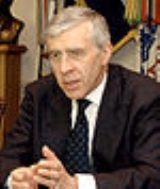
Lord Chancellor

Encyclopedia
The Lord High Chancellor of Great Britain, or Lord Chancellor, is a senior and important functionary in the government of the United Kingdom
. He is the second highest ranking of the Great Officers of State
, ranking only after the Lord High Steward
. The Lord Chancellor is appointed by the Sovereign
on the advice of the Prime Minister
. Prior to the Union
there were separate Lord Chancellors of England and Scotland.
The Lord Chancellor is a member of the Cabinet
and, by law, is responsible for the efficient functioning and independence of the court
s. Formerly he was also the presiding officer of the House of Lords
, and the head of the judiciary
in England and Wales, but the Constitutional Reform Act 2005
transferred these roles to the Lord Speaker
and the Lord Chief Justice respectively. The current Lord Chancellor is Kenneth Clarke
, who, as with his predecessor Jack Straw
, is also Secretary of State for Justice. Clarke holds the position, as did Straw, while serving as a Member of Parliament
in the House of Commons; Straw was the first Lord Chancellor since the 17th century not to be a peer
. Straw's predecessor, Lord Falconer of Thoroton served as Secretary of State for Constitutional Affairs
before that post was superseded by the post of Secretary of State for Justice in 2007.
One of the Lord Chancellor's responsibilities is to act as the custodian of the Great Seal
. A Lord Keeper of the Great Seal
may be appointed instead of a Lord Chancellor. The two offices entail exactly the same duties; the only distinction is in the mode of appointment. Furthermore, the office of Lord Chancellor may be exercised by a committee of individuals known as "Lords Commissioners of the Great Seal", usually when there is a delay between an outgoing Chancellor and his replacement. The seal is then said to be "in commission". Since the 19th century, however, only Lord Chancellors have been appointed, the other offices having fallen into disuse.
, in which a Chancellor acted as the keeper of the royal seal. In England, the office dates at least as far back as the Norman Conquest (1066), and possibly earlier. Some give the first Chancellor of England as Angmendus
, in 605. Other sources suggest that the first to appoint a Chancellor was Edward the Confessor
, who is said to have adopted the practice of sealing documents instead of personally signing them. A clerk of Edward's, Regenbald
, was named "chancellor" in some documents from Edward's reign. In any event, the office has been continuously occupied since the Norman Conquest. The chancellor headed the writing office, or chancery
.
Formerly, the Lord Chancellor was almost always a churchman
, as during the Middle Ages
the clergy were amongst the few literate men of the realm. The Lord Chancellor performed multiple functions—he was the Keeper of the Great Seal, the chief royal chaplain
, and adviser in both spiritual and temporal matters. Thus, the position emerged as one of the most important ones in government. He was only outranked in government by the Justiciar
(now obsolete).
 As one of the King's ministers, the Lord Chancellor attended the Curia Regis
, or Royal Court. If a bishop
, the Lord Chancellor received a writ of summons; if an ecclesiastic of a lower degree, or if a layman, he attended without any summons. The Curia Regis would later evolve into Parliament
, the Lord Chancellor becoming the prolocutor
of its upper house, the House of Lords. As was confirmed by a statute
passed during the reign of Henry VIII, a Lord Chancellor could preside over the House of Lords even if not a Lord himself.
The Lord Chancellor's judicial duties also evolved through his role in the Curia Regis. Petitions for justice were normally addressed to the King and the Curia, but in 1280, Edward I
instructed his justices to examine and deal with petitions themselves as the Court of King's Bench. Important petitions were to be sent to the Lord Chancellor for his decision; the more significant of these were also to be brought to the King's attention. By the reign of Edward III
, this chancellery function developed into a separate tribunal for the Lord Chancellor. In this body, which became known as the High Court of Chancery
, the Lord Chancellor would determine cases according to fairness (or "equity") instead of according to the strict principles of common law
. The Lord Chancellor also became known as the "Keeper of the King's Conscience." Churchmen continued to dominate the Chancellorship until the 16th century. In 1529, after Cardinal
Thomas Wolsey, who was Lord Chancellor and Archbishop of York
, was dismissed for failing to procure the annulment of Henry VIII's first marriage, laymen tended to be more favoured for appointment to the office. Ecclesiastics made a brief return during the reign of Mary I
, but thereafter, almost all Lord Chancellors have been laymen.
became Queen, Parliament passed an Act
providing that a Lord Keeper of the Great Seal
would be entitled to "like place, pre-eminence, jurisdiction, execution of laws, and all other customs, commodities, and advantages" as a Lord Chancellor. The only difference between the two offices is the mode of appointment—a Lord Chancellor is appointed by formal letters patent
, but a Lord Keeper is appointed by the delivery of the Great Seal into his custody.
Formerly, it was customary to appoint commoners to the office of Lord Keeper, and peers to the office of Lord Chancellor. A Lord Keeper who acquired a peerage dignity would subsequently be appointed Lord Chancellor. The last Lord Keeper was Robert Henley
, who was created a Baron in 1760 and was appointed Lord Chancellor in 1761. Since then, commoners as well as peers have been appointed to the post of Lord Chancellor; however, until the 21st-century changes to the office, a commoner would normally have been created a peer shortly after his appointment.
It is also possible to put the office of Lord Chancellor into commission (that is to say, to entrust the office to a group of individuals rather than a single person). The individuals who exercise the office become known as "Lords Commissioners of the Great Seal." Lords Commissioners of the Great Seal have not been appointed since 1836.
Formerly, there were separate Chancellors of England, Scotland and Ireland. When the Kingdom of England
and the Kingdom of Scotland
united to form the Kingdom of Great Britain
under the Act of Union 1707 the offices of the Chancellor of England and the Lord Chancellor of Scotland
were combined to form a single office of Lord Chancellor for the new state
. Similar provision was not made when Great Britain and Ireland merged into the United Kingdom under the Act of Union 1800
. Thus, the separate office of Lord Chancellor of Ireland
continued to exist until the formation of the Irish Free State
in 1922. The office of Lord Chancellor of Ireland was abolished, and its duties transferred to the Governor of Northern Ireland
, and later the Secretary of State for Northern Ireland
. Thus, the Lord Chancellor remains "Lord High Chancellor of Great Britain", and not "Lord High Chancellor of the United Kingdom."
. The Constitutional Reform Act 2005
removed this function, leaving the choice of a presiding officer to the House of Lords itself. Ultimately, the Lords chose to elect a Lord Speaker
, which title was already used in the Standing Orders.
Whenever the Sovereign appoints Lords Commissioners
to perform certain actions on his or her behalf (for example, to formally declare in Parliament that the Royal Assent
has been granted, or to prorogue or dissolve Parliament), the Lord Chancellor usually served as the principal or senior Lord Commissioner. The other Lords Commissioners, by convention, are members of the House of Lords who are Privy Counsellors
(generally the leaders of the three main parties and the Convenor of the Crossbenches). In this role the Lord Chancellor wears Parliamentary Robes—a full-length scarlet wool gown decorated with miniver
fur. The Lord Chancellor wears a tricorne hat
, but the other Lords Commissioners wear bicorne hats
. During the period that Jack Straw
, an MP, was Lord Chancellor, he was officially named as one of the Lords Commissioners, but did not take part in the formal ceremonies of granting Royal Assent and proroguing Parliament. The Lord Speaker has been appointed a Lord Commissioner and does take part in the ceremonies. The role of principal Lord Commissioner during this period has been taken by the Leader of the House of Lords
. (There was only one exception: when John Bercow was presented for Royal Approbation for the office of Speaker of the House of Commons in 2009, Straw was the principal Lord Commissioner, and the Lord Speaker was not in the Commission.) This precedent has continued under the current Lord Chancellor, Kenneth Clarke. It is unclear how these arrangements would change if a future Lord Chancellor were appointed from the House of Lords.
. The office he heads was known as the Lord Chancellor's Office between 1885 and 1971 and the Lord Chancellor's Department
between 1971 and 2003. In 2003 the Department was renamed the Department for Constitutional Affairs
and the Lord Chancellor was appointed Secretary of State for Constitutional Affairs
. In 2007 this post was renamed Secretary of State for Justice and the department became the Ministry of Justice
.
The Department headed by the Lord Chancellor has many responsibilities, such as the administration of the courts. Furthermore, the Lord Chancellor has a role in appointing many judges in the courts of England and Wales
. Senior judges (Justices
of the Supreme Court of the United Kingdom
, Lords Justices of Appeal
and the Heads of the Divisions of the High Court) are officially appointed by the Sovereign on the advice of the Lord Chancellor, but since 2005 the Lord Chancellor has been advised by an independent Judicial Appointments Commission
and can only choose whether to accept or reject its recommendations. Similarly the Lord Chancellor no longer determines which barrister
s are to be raised to the rank of Queen's Counsel
but merely supervises the process of selection by an independent panel.
Custody of the Great Seal of the Realm
is entrusted to the Lord Chancellor. Documents to which the Great Seal is affixed include letters patent, writ
s and royal proclamations. The sealing is actually performed under the supervision of the Clerk of the Crown in Chancery
(who holds the additional office of Permanent Secretary
to the Lord Chancellor). The Lord Chancellor does not maintain custody of the Great Seal of Scotland (which is kept by the First Minister of Scotland
) or of the Great Seal of Northern Ireland (which is kept by the Secretary of State for Northern Ireland).
Formerly, the Lord Chancellor performed several different judicial roles. He sat as a Judge in the Judicial Committee of the House of Lords (the highest domestic Court in the United Kingdom), and was a member of the Judicial Committee of the Privy Council
(the senior tribunal of the British Empire (except for the United Kingdom) and, latterly, parts of the Commonwealth). He was the President of the Supreme Court of England and Wales
, and therefore supervised the Court of Appeal of England and Wales, the High Court of Justice of England and Wales and the Crown Court of England and Wales
. He was also, ex officio, a judge in the Court of Appeal and the President of the Chancery Division. In modern times, these judicial functions were exercised very sparingly. The functions in relation to the House of Lords and the Judicial Committee of the Privy Council were usually delegated to the Senior Lord of Appeal in Ordinary. The task of presiding over the Chancery Division was delegated to the Vice-Chancellor, a senior judge (now known as the Chancellor of the High Court
). Most Lord Chancellors by the end of the twentieth century gave judgments only in cases reaching the House of Lords. The last Lord Chancellor to preside as a Judge was Lord Irvine of Lairg, who did so as a member of the Judicial Committee of the House of Lords. However, concerns were already being expressed, including by the judiciary, at the propriety of a Cabinet Minister sitting as a professional Judge, and his successor, Lord Falconer, never performed such a role, even before his right to do so was abolished.
Formerly, when peers had the right to be tried for felonies
or for high treason
by other peers in the House of Lords (instead of commoners on juries
), the Lord High Steward
, instead of the Lord Chancellor, would preside. This also occurred in impeachment
trials. (The office of Lord High Steward has generally remained vacant since 1421. Whenever a peer was to be tried in the House of Lords, a Lord High Steward would be appointed pro hac vice [for this occasion]). In many cases, the Lord Chancellor would merely be elevated to the office of Lord High Steward temporarily. Trials of peers in the House of Lords were abolished in 1948, and impeachment is obsolete, so this is unlikely to occur again.
At the beginning of the legal year
, the Lord Chancellor officiates at a ceremony in Westminster Abbey
in front of all the judges. The ceremony is followed by a reception known as the Lord Chancellor's breakfast which is held in Westminster Hall.
From 1867 to 1875, the Lord Chancellor was the highest court officer for Canada until the creation of the Supreme Court of Canada
and the office of Chief Justice of the Supreme Court of Canada.
. He appoints clergymen in such of the ecclesiastical livings under the patronage of the Crown as are officially listed as being worth less than £20 per annum. Furthermore, he exercises the same prerogative in regard to the less valuable livings in the Duchy of Cornwall
when there is no Duke of Cornwall, or when the Duke of Cornwall is a minor. (The heir-apparent to the Crown, if he is the Sovereign's eldest son, is automatically Duke of Cornwall.) Finally, the Lord Chancellor is in some cases the patron of an ecclesiastical living in his own right. Thus, in total, he appoints clergymen in over four hundred parish
es and twelve cathedral
canon
ries.
By law, the Lord Chancellor must be consulted before appointments may be made to certain ecclesiastical court
s. Judges of Consistory Court
s, the Arches Court of Canterbury
, the Chancery Court of York and the Court of Ecclesiastical Causes Reserved
are appointed only after consultation with the Lord Chancellor.
The Lord Chancellor is, ex officio, one of the thirty-three Church Commissioners
, who manage the assets of the Church of England.
Formerly, Roman Catholics were thought to be ineligible for the office of Lord Chancellor, as the office entailed functions relating to the Church of England. Most legal restrictions on Roman Catholics were lifted by the Catholic Relief Act 1829
, which, however, provides, "nothing herein contained shall ... enable any Person, otherwise than as he is now by Law enabled, to hold or enjoy the Office of Lord High Chancellor, Lord Keeper or Lord Commissioner of the Great Seal". The words "as he is now by Law enabled", however, caused considerable doubt, as it was unclear if Roman Catholics were disqualified from holding the office in the first place. For the removal of all doubt, Parliament passed an Act in 1974, declaring that there was never any impediment to the appointment of a Roman Catholic. The Act nevertheless provided that, if a Roman Catholic were appointed to the office, then the Sovereign may temporarily transfer the Lord Chancellor's ecclesiastical functions to the Prime Minister or another minister.
and the Master of the Rolls
. If any three or more of these individuals, based on evidence that, as required by statute, shall include evidence provided by physicians, determine and declare by an instrument in writing, lodged with the Privy Council, that the Sovereign suffers from a mental or physical infirmity that prevents him or her from personally discharging the duties of Head of State, the royal functions are transferred to a Regent
, who discharges them in the name and on behalf of the monarch.
The Lord Chancellor is also the Keeper of the Queen's Conscience. As Keeper of the Queen's Conscience, the Lord Chancellor was once also the chief judge of the Court of Chancery
in London, dispensing equity to soften the harshness of the law.
The Lord Chancellor acts as the Visitor
of many universities, colleges, schools, hospitals and other charitable organisations throughout the United Kingdom. When the rules of the organisation do not designate a Visitor, or when a vacancy in the office arises, the Sovereign serves as Visitor, but delegates the functions to the Lord Chancellor. Furthermore, some organisations explicitly provide that the Lord Chancellor is to act as Visitor; these bodies include St. George's Chapel, Windsor, the Royal Institution
, Newcastle University and three colleges of the University of Oxford
(namely St. Antony's College
, Worcester College
, and University College
).
The power to appoint members of certain organisations is vested in the Lord Chancellor. These organisations include the governing bodies of Harrow School
, Rugby School
and Charterhouse School
.
, which has generally been vacant since the 15th century. Under modern conventions, the office of Lord High Steward is only filled on the day of a new monarch's coronation; thus, at all other times, the Lord Chancellor remains the highest ranking Great Officer. The importance of the office is reflected by the Treason Act 1351
, which makes it high treason
to slay the Lord Chancellor. A Lord High Treasurer
would be entitled to the same protection—but the office is now held in commission—as would a judge whilst actually in court, determining a case.
The Lord Chancellor's position in the modern order of precedence
is an extremely high one; generally, he is outranked only by the Royal Family
and high ecclesiastics. In England, the Lord Chancellor precedes all non-royal individuals except the Archbishop of Canterbury
. In Scotland, he precedes all non-royal individuals except the Lord High Commissioner
to the General Assembly of the Church of Scotland
. Although Lord Chancellor "of Great Britain", he maintains a position in the order of precedence in Northern Ireland; there, he outranks all non-royal individuals with the exception of the Anglican and Roman Catholic Archbishops of Armagh, the Anglican and Roman Catholic Archbishops of Dublin
and the Moderator of the Presbyterian Church in Ireland
. Throughout the United Kingdom, the Lord Chancellor technically outranks the Prime Minister, although the latter generally possesses more power. The precedence of a Lord Keeper of the Great Seal is equivalent to that of a Lord Chancellor. The precedence of Lords Commissioners of the Great Seal is much lower (see United Kingdom order of precedence
).
The Lord Chancellor is entitled to an annual emolument of £227,736 and to an annual pension
of £106,868. The Lord Chancellor's salary is higher than that of any other public official, including even the Prime Minister, although sometimes the officeholder may voluntarily decide to receive a reduced salary.
as put forward by Montesquieu (where no one should reside in any more than one of the three branches of government; the Lord Chancellor stood in all three). It was also considered as possibly inconsistent with the European Convention on Human Rights
. At the same time, proposals by the Blair Government simply to abolish the office met with opposition from those who felt that such an official is necessary to speak on the judiciary's behalf in the Cabinet, as well as from those who opposed the sudden abolition of such an ancient office. In 2003, Tony Blair
chose his close friend and former flatmate Lord Falconer of Thoroton to be Lord Chancellor and Secretary of State for Constitutional Affairs. At the same time, he announced his intention to abolish the office of Lord Chancellor and to make many other constitutional reforms. After much surprise and confusion, it became clear that the ancient office of Lord Chancellor could not be abolished without an Act of Parliament. Lord Falconer of Thoroton duly appeared in the House of Lords to preside from the Woolsack on the next day. The Lord Chancellor's Department, however, was renamed the Department for Constitutional Affairs.
 In January 2004, the Department of Constitutional Affairs published a concordat, outlining the division of authority between Lord Chancellor and Lord Chief Justice and which was intended as the basis of reform. The Government introduced the Constitutional Reform Bill in the House of Lords in February 2004. The Bill sought to abolish the office of Lord Chancellor, and to transfer his functions to other officials: legislative functions to a Speaker of the House of Lords, executive functions to the Secretary of State for Constitutional Affairs and judicial functions to the Lord Chief Justice. The Bill also made other constitutional reforms, such as transferring the judicial duties of the House of Lords to a Supreme Court.
In March 2004, however, the Lords upset the Government's plans by sending the bill to a Select Committee. Although initially seen as a move to kill the bill, the Government and Opposition agreed to permit the Bill to proceed through the parliamentary process, subject to any amendments made by the Committee. On 13 July 2004, the House amended the Constitutional Reform Bill such that the title of Lord Chancellor would be retained, although the Government's other proposed reforms were left intact. Then, in November 2004, the Government introduced an amendment in the Lords which wholly removed references to the Secretary of State for Constitutional Affairs, changing them to ones about the Lord Chancellor, with the positions of Secretary of State and Lord Chancellor envisaged as being held by the same person. The final Constitutional Reform Act
received royal assent on March 24, 2005 and the major transfers of the historical functions of the Lord Chancellor to others (such as the Lord Chief Justice and Lord Speaker
) were complete by mid-2006. However the Lord Chancellor and Secretary of State for Constitutional Affairs retained his place as a member of the Cabinet and certain special statutory functions.
Unlike the responsibilities of other Secretaries of State, which can be transferred from one department to another by an order-in-council, several functions of the Lord Chancellor are linked to the office of Lord Chancellor as a matter of statute law, even after the adoption of the Constitutional Reform Act. Those "protected functions" of the Lord Chancellor can only be transferred to other ministers by Act of Parliament.
In May 2007, the Department of Constitutional Affairs ceased to exist, and its functions were transferred to a newly created Ministry of Justice, that also took charge of certain responsibilities that were transferred to it from the Home Office. Lord Falconer, the Lord Chancellor, while retaining that title and office, was appointed the first Secretary of State for Justice.
In the past, if a person who was not a peer was to be appointed to the office of Lord Chancellor, he would be raised to the peerage upon receiving the appointment, though provision was made in 1539 for non-peers who hold the Great Offices of State to sit in between the benches in the House. With enactment of the Constitutional Reform Act, 2005 and the subsequent separation of the roles of Lord Chancellor and Speaker of the House of Lords, it is no longer necessary for the Lord Chancellor to be a peer. In June 2007, Jack Straw
, an MP, was appointed as Secretary of State for Justice and Lord Chancellor, thus becoming the first Lord Chancellor to be a member of the House of Commons, rather than the House of Lords or its predecessor, the Curia Regis, since Sir Christopher Hatton
in 1578.
, the comic opera
by W. S. Gilbert
and Arthur Sullivan
. The Lord Chancellor is the central character in the work but is identified only by his title. The action concerns a group of fairies
who become romantically involved with members of the House of Lords. The Lord Chancellor, who serves as guardian to wards of the Court of Chancery, is worried, because he has developed feelings for a ward of court. The character sings a patter song
, "The Nightmare Song", about his mental anguish caused by unrequited love. In dialogue, the Lord Chancellor, in another reference to his romantic dilemma, complains "ah, my Lords, it is indeed painful to have to sit upon a Woolsack
stuffed with such thorns as these!"
William H. Rehnquist, late Chief Justice of the United States
, was inspired to add four golden stripes to the sleeves of his judicial robes after seeing the costume of the Lord Chancellor in a production of Iolanthe
. The current Chief Justice, John G. Roberts Jr., has not continued the practice.
A fictional Lord Chancellor also appears in Charles Dickens
' novel Bleak House
(also identified only by title), presiding over the interminable chancery case of Jarndyce and Jarndyce
.
King Hilary and the Beggarman, a children's poem by A.A. Milne, relates the story of a fictional Lord High Chancellor, "Proud Lord Willoughby", who is dismissed for refusing to obey his king.
Government of the United Kingdom
Her Majesty's Government is the central government of the United Kingdom of Great Britain and Northern Ireland. The Government is led by the Prime Minister, who selects all the remaining Ministers...
. He is the second highest ranking of the Great Officers of State
Great Officer of State
In the United Kingdom, the Great Officers of State are traditional Crown ministers, who either inherit their positions or are appointed to exercise certain largely ceremonial functions. Separate Great Officers exist for England and Scotland, and formerly for Ireland...
, ranking only after the Lord High Steward
Lord High Steward
The position of Lord High Steward of England is the first of the Great Officers of State. The office has generally remained vacant since 1421, except at coronations and during the trials of peers in the House of Lords, when the Lord High Steward presides. In general, but not invariably, the Lord...
. The Lord Chancellor is appointed by the Sovereign
British monarchy
The monarchy of the United Kingdom is the constitutional monarchy of the United Kingdom and its overseas territories. The present monarch, Queen Elizabeth II, has reigned since 6 February 1952. She and her immediate family undertake various official, ceremonial and representational duties...
on the advice of the Prime Minister
Prime Minister of the United Kingdom
The Prime Minister of the United Kingdom of Great Britain and Northern Ireland is the Head of Her Majesty's Government in the United Kingdom. The Prime Minister and Cabinet are collectively accountable for their policies and actions to the Sovereign, to Parliament, to their political party and...
. Prior to the Union
Acts of Union 1707
The Acts of Union were two Parliamentary Acts - the Union with Scotland Act passed in 1706 by the Parliament of England, and the Union with England Act passed in 1707 by the Parliament of Scotland - which put into effect the terms of the Treaty of Union that had been agreed on 22 July 1706,...
there were separate Lord Chancellors of England and Scotland.
The Lord Chancellor is a member of the Cabinet
Cabinet of the United Kingdom
The Cabinet of the United Kingdom is the collective decision-making body of Her Majesty's Government in the United Kingdom, composed of the Prime Minister and some 22 Cabinet Ministers, the most senior of the government ministers....
and, by law, is responsible for the efficient functioning and independence of the court
Court
A court is a form of tribunal, often a governmental institution, with the authority to adjudicate legal disputes between parties and carry out the administration of justice in civil, criminal, and administrative matters in accordance with the rule of law...
s. Formerly he was also the presiding officer of the House of Lords
House of Lords
The House of Lords is the upper house of the Parliament of the United Kingdom. Like the House of Commons, it meets in the Palace of Westminster....
, and the head of the judiciary
Judiciary
The judiciary is the system of courts that interprets and applies the law in the name of the state. The judiciary also provides a mechanism for the resolution of disputes...
in England and Wales, but the Constitutional Reform Act 2005
Constitutional Reform Act 2005
The Constitutional Reform Act 2005 is an Act of the Parliament of the United Kingdom. It provided for a Supreme Court of the United Kingdom to take over the existing role of the Law Lords as well as some powers of the Judicial Committee of the Privy Council, and removed the functions of Speaker of...
transferred these roles to the Lord Speaker
Lord Speaker
The Lord Speaker is the speaker of the House of Lords in the Parliament of the United Kingdom. The office is analogous to the Speaker of the House of Commons: the Lord Speaker is elected by the members of the House of Lords and is expected to be politically impartial.Until July 2006, the role of...
and the Lord Chief Justice respectively. The current Lord Chancellor is Kenneth Clarke
Kenneth Clarke
Kenneth Harry "Ken" Clarke, QC, MP is a British Conservative politician, currently Member of Parliament for Rushcliffe, Lord Chancellor and Secretary of State for Justice. He was first elected to Parliament in 1970; and appointed a minister in Edward Heath's government, in 1972, and is one of...
, who, as with his predecessor Jack Straw
Jack Straw
Jack Straw , British politician.Jack Straw may also refer to:* Jack Straw , English* "Jack Straw" , 1971 song by the Grateful Dead* Jack Straw by W...
, is also Secretary of State for Justice. Clarke holds the position, as did Straw, while serving as a Member of Parliament
Member of Parliament
A Member of Parliament is a representative of the voters to a :parliament. In many countries with bicameral parliaments, the term applies specifically to members of the lower house, as upper houses often have a different title, such as senate, and thus also have different titles for its members,...
in the House of Commons; Straw was the first Lord Chancellor since the 17th century not to be a peer
Peerage
The Peerage is a legal system of largely hereditary titles in the United Kingdom, which constitute the ranks of British nobility and is part of the British honours system...
. Straw's predecessor, Lord Falconer of Thoroton served as Secretary of State for Constitutional Affairs
Secretary of State for Constitutional Affairs
The Secretary of State for Justice is a senior position in the cabinet of the United Kingdom. It was created in 2007 replacing the abolished Secretary of State for Constitutional Affairs, which was originally intended to fulfil those functions of the office of Lord Chancellor which related to the...
before that post was superseded by the post of Secretary of State for Justice in 2007.
One of the Lord Chancellor's responsibilities is to act as the custodian of the Great Seal
Great Seal of the Realm
The Great Seal of the Realm or Great Seal of the United Kingdom is a seal that is used to symbolise the Sovereign's approval of important state documents...
. A Lord Keeper of the Great Seal
Lord Keeper of the Great Seal
The Lord Keeper of the Great Seal of England, and later of Great Britain, was formerly an officer of the English Crown charged with physical custody of the Great Seal of England. This evolved into one of the Great Officers of State....
may be appointed instead of a Lord Chancellor. The two offices entail exactly the same duties; the only distinction is in the mode of appointment. Furthermore, the office of Lord Chancellor may be exercised by a committee of individuals known as "Lords Commissioners of the Great Seal", usually when there is a delay between an outgoing Chancellor and his replacement. The seal is then said to be "in commission". Since the 19th century, however, only Lord Chancellors have been appointed, the other offices having fallen into disuse.
History
The office of Lord Chancellor may trace its origins to the Carolingian monarchyCarolingian
The Carolingian dynasty was a Frankish noble family with origins in the Arnulfing and Pippinid clans of the 7th century AD. The name "Carolingian", Medieval Latin karolingi, an altered form of an unattested Old High German *karling, kerling The Carolingian dynasty (known variously as the...
, in which a Chancellor acted as the keeper of the royal seal. In England, the office dates at least as far back as the Norman Conquest (1066), and possibly earlier. Some give the first Chancellor of England as Angmendus
Angmendus
Angmendus may have held the role of the first Lord Chancellor of England, being appointed in 605, during the reign of Æthelberht of Kent . Other sources suggest that the first ruler to appoint a Chancellor was Edward the Confessor, who is said to have adopted the practice of sealing documents...
, in 605. Other sources suggest that the first to appoint a Chancellor was Edward the Confessor
Edward the Confessor
Edward the Confessor also known as St. Edward the Confessor , son of Æthelred the Unready and Emma of Normandy, was one of the last Anglo-Saxon kings of England and is usually regarded as the last king of the House of Wessex, ruling from 1042 to 1066....
, who is said to have adopted the practice of sealing documents instead of personally signing them. A clerk of Edward's, Regenbald
Regenbald
Regenbald was a priest and royal official in Anglo-Saxon England under King Edward the Confessor. His name suggests that he was not a native Englishman, and perhaps was German or Norman...
, was named "chancellor" in some documents from Edward's reign. In any event, the office has been continuously occupied since the Norman Conquest. The chancellor headed the writing office, or chancery
Chancery (medieval office)
Chancery is a general term for a medieval writing office, responsible for the production of official documents. The title of chancellor, for the head of the office, came to be held by important ministers in a number of states, and remains the title of the heads of government in modern Germany,...
.
Formerly, the Lord Chancellor was almost always a churchman
Clergy
Clergy is the generic term used to describe the formal religious leadership within a given religion. A clergyman, churchman or cleric is a member of the clergy, especially one who is a priest, preacher, pastor, or other religious professional....
, as during the Middle Ages
Middle Ages
The Middle Ages is a periodization of European history from the 5th century to the 15th century. The Middle Ages follows the fall of the Western Roman Empire in 476 and precedes the Early Modern Era. It is the middle period of a three-period division of Western history: Classic, Medieval and Modern...
the clergy were amongst the few literate men of the realm. The Lord Chancellor performed multiple functions—he was the Keeper of the Great Seal, the chief royal chaplain
Chaplain
Traditionally, a chaplain is a minister in a specialized setting such as a priest, pastor, rabbi, or imam or lay representative of a religion attached to a secular institution such as a hospital, prison, military unit, police department, university, or private chapel...
, and adviser in both spiritual and temporal matters. Thus, the position emerged as one of the most important ones in government. He was only outranked in government by the Justiciar
Justiciar
In medieval England and Ireland the Chief Justiciar was roughly equivalent to a modern Prime Minister as the monarch's chief minister. Similar positions existed on the Continent, particularly in Norman Italy. The term is the English form of the medieval Latin justiciarius or justitiarius In...
(now obsolete).
Curia Regis
Curia regis is a Latin term meaning "royal council" or "king's court."- England :The Curia Regis, in the Kingdom of England, was a council of tenants-in-chief and ecclesiastics that advised the king of England on legislative matters...
, or Royal Court. If a bishop
Bishop
A bishop is an ordained or consecrated member of the Christian clergy who is generally entrusted with a position of authority and oversight. Within the Catholic Church, Eastern Orthodox, Oriental Orthodox Churches, in the Assyrian Church of the East, in the Independent Catholic Churches, and in the...
, the Lord Chancellor received a writ of summons; if an ecclesiastic of a lower degree, or if a layman, he attended without any summons. The Curia Regis would later evolve into Parliament
Parliament of the United Kingdom
The Parliament of the United Kingdom of Great Britain and Northern Ireland is the supreme legislative body in the United Kingdom, British Crown dependencies and British overseas territories, located in London...
, the Lord Chancellor becoming the prolocutor
Prolocutor
A prolocutor is one who speaks for others ; specifically the chairman of the lower house of convocation in the two provinces of the Church of England, who presides in that house and acts as representative and spokesman in the upper house...
of its upper house, the House of Lords. As was confirmed by a statute
Statute
A statute is a formal written enactment of a legislative authority that governs a state, city, or county. Typically, statutes command or prohibit something, or declare policy. The word is often used to distinguish law made by legislative bodies from case law, decided by courts, and regulations...
passed during the reign of Henry VIII, a Lord Chancellor could preside over the House of Lords even if not a Lord himself.
The Lord Chancellor's judicial duties also evolved through his role in the Curia Regis. Petitions for justice were normally addressed to the King and the Curia, but in 1280, Edward I
Edward I of England
Edward I , also known as Edward Longshanks and the Hammer of the Scots, was King of England from 1272 to 1307. The first son of Henry III, Edward was involved early in the political intrigues of his father's reign, which included an outright rebellion by the English barons...
instructed his justices to examine and deal with petitions themselves as the Court of King's Bench. Important petitions were to be sent to the Lord Chancellor for his decision; the more significant of these were also to be brought to the King's attention. By the reign of Edward III
Edward III of England
Edward III was King of England from 1327 until his death and is noted for his military success. Restoring royal authority after the disastrous reign of his father, Edward II, Edward III went on to transform the Kingdom of England into one of the most formidable military powers in Europe...
, this chancellery function developed into a separate tribunal for the Lord Chancellor. In this body, which became known as the High Court of Chancery
Court of Chancery
The Court of Chancery was a court of equity in England and Wales that followed a set of loose rules to avoid the slow pace of change and possible harshness of the common law. The Chancery had jurisdiction over all matters of equity, including trusts, land law, the administration of the estates of...
, the Lord Chancellor would determine cases according to fairness (or "equity") instead of according to the strict principles of common law
Common law
Common law is law developed by judges through decisions of courts and similar tribunals rather than through legislative statutes or executive branch action...
. The Lord Chancellor also became known as the "Keeper of the King's Conscience." Churchmen continued to dominate the Chancellorship until the 16th century. In 1529, after Cardinal
Cardinal (Catholicism)
A cardinal is a senior ecclesiastical official, usually an ordained bishop, and ecclesiastical prince of the Catholic Church. They are collectively known as the College of Cardinals, which as a body elects a new pope. The duties of the cardinals include attending the meetings of the College and...
Thomas Wolsey, who was Lord Chancellor and Archbishop of York
Archbishop of York
The Archbishop of York is a high-ranking cleric in the Church of England, second only to the Archbishop of Canterbury. He is the diocesan bishop of the Diocese of York and metropolitan of the Province of York, which covers the northern portion of England as well as the Isle of Man...
, was dismissed for failing to procure the annulment of Henry VIII's first marriage, laymen tended to be more favoured for appointment to the office. Ecclesiastics made a brief return during the reign of Mary I
Mary I of England
Mary I was queen regnant of England and Ireland from July 1553 until her death.She was the only surviving child born of the ill-fated marriage of Henry VIII and his first wife Catherine of Aragon. Her younger half-brother, Edward VI, succeeded Henry in 1547...
, but thereafter, almost all Lord Chancellors have been laymen.
The office
Formerly, when the office was held by ecclesiastics, a "Keeper of the Great Seal" acted in the Lord Chancellor's absence. Keepers were also appointed when the office of Lord Chancellor fell vacant, and discharged the duties of the office until an appropriate replacement could be found. When Elizabeth IElizabeth I of England
Elizabeth I was queen regnant of England and Ireland from 17 November 1558 until her death. Sometimes called The Virgin Queen, Gloriana, or Good Queen Bess, Elizabeth was the fifth and last monarch of the Tudor dynasty...
became Queen, Parliament passed an Act
Act of Parliament
An Act of Parliament is a statute enacted as primary legislation by a national or sub-national parliament. In the Republic of Ireland the term Act of the Oireachtas is used, and in the United States the term Act of Congress is used.In Commonwealth countries, the term is used both in a narrow...
providing that a Lord Keeper of the Great Seal
Lord Keeper of the Great Seal
The Lord Keeper of the Great Seal of England, and later of Great Britain, was formerly an officer of the English Crown charged with physical custody of the Great Seal of England. This evolved into one of the Great Officers of State....
would be entitled to "like place, pre-eminence, jurisdiction, execution of laws, and all other customs, commodities, and advantages" as a Lord Chancellor. The only difference between the two offices is the mode of appointment—a Lord Chancellor is appointed by formal letters patent
Letters patent
Letters patent are a type of legal instrument in the form of a published written order issued by a monarch or president, generally granting an office, right, monopoly, title, or status to a person or corporation...
, but a Lord Keeper is appointed by the delivery of the Great Seal into his custody.
Formerly, it was customary to appoint commoners to the office of Lord Keeper, and peers to the office of Lord Chancellor. A Lord Keeper who acquired a peerage dignity would subsequently be appointed Lord Chancellor. The last Lord Keeper was Robert Henley
Robert Henley, 1st Earl of Northington
Robert Henley, 1st Earl of Northington PC , was the Lord Chancellor of Great Britain. He was a member of the Whig Party in the parliament and was known for his wit and writing.-Family:...
, who was created a Baron in 1760 and was appointed Lord Chancellor in 1761. Since then, commoners as well as peers have been appointed to the post of Lord Chancellor; however, until the 21st-century changes to the office, a commoner would normally have been created a peer shortly after his appointment.
It is also possible to put the office of Lord Chancellor into commission (that is to say, to entrust the office to a group of individuals rather than a single person). The individuals who exercise the office become known as "Lords Commissioners of the Great Seal." Lords Commissioners of the Great Seal have not been appointed since 1836.
Formerly, there were separate Chancellors of England, Scotland and Ireland. When the Kingdom of England
Kingdom of England
The Kingdom of England was, from 927 to 1707, a sovereign state to the northwest of continental Europe. At its height, the Kingdom of England spanned the southern two-thirds of the island of Great Britain and several smaller outlying islands; what today comprises the legal jurisdiction of England...
and the Kingdom of Scotland
Kingdom of Scotland
The Kingdom of Scotland was a Sovereign state in North-West Europe that existed from 843 until 1707. It occupied the northern third of the island of Great Britain and shared a land border to the south with the Kingdom of England...
united to form the Kingdom of Great Britain
Kingdom of Great Britain
The former Kingdom of Great Britain, sometimes described as the 'United Kingdom of Great Britain', That the Two Kingdoms of Scotland and England, shall upon the 1st May next ensuing the date hereof, and forever after, be United into One Kingdom by the Name of GREAT BRITAIN. was a sovereign...
under the Act of Union 1707 the offices of the Chancellor of England and the Lord Chancellor of Scotland
Lord Chancellor of Scotland
The Lord Chancellor of Scotland was a Great Officer of State in pre-Union Scotland.Holders of the office are known from 1123 onwards, but its duties were occasionally performed by an official of lower status with the title of Keeper of the Great Seal...
were combined to form a single office of Lord Chancellor for the new state
Sovereign state
A sovereign state, or simply, state, is a state with a defined territory on which it exercises internal and external sovereignty, a permanent population, a government, and the capacity to enter into relations with other sovereign states. It is also normally understood to be a state which is neither...
. Similar provision was not made when Great Britain and Ireland merged into the United Kingdom under the Act of Union 1800
Act of Union 1800
The Acts of Union 1800 describe two complementary Acts, namely:* the Union with Ireland Act 1800 , an Act of the Parliament of Great Britain, and...
. Thus, the separate office of Lord Chancellor of Ireland
Lord Chancellor of Ireland
The office of Lord Chancellor of Ireland was the highest judicial office in Ireland until the establishment of the Irish Free State in 1922. From 1721 to 1801 it was also the highest political office of the Irish Parliament.-13th century:...
continued to exist until the formation of the Irish Free State
Irish Free State
The Irish Free State was the state established as a Dominion on 6 December 1922 under the Anglo-Irish Treaty, signed by the British government and Irish representatives exactly twelve months beforehand...
in 1922. The office of Lord Chancellor of Ireland was abolished, and its duties transferred to the Governor of Northern Ireland
Governor of Northern Ireland
The Governor of Northern Ireland was the principal officer and representative in Northern Ireland of the British monarch. The office was established on 9 December 1922 and abolished on 18 July 1973.-Overview:...
, and later the Secretary of State for Northern Ireland
Secretary of State for Northern Ireland
The Secretary of State for Northern Ireland, informally the Northern Ireland Secretary, is the principal secretary of state in the government of the United Kingdom with responsibilities for Northern Ireland. The Secretary of State is a Minister of the Crown who is accountable to the Parliament of...
. Thus, the Lord Chancellor remains "Lord High Chancellor of Great Britain", and not "Lord High Chancellor of the United Kingdom."
Legislative functions
The Lord Chancellor used to be the presiding officer of the House of Lords by right of prescriptionTime immemorial
Time immemorial is a phrase meaning time extending beyond the reach of memory, record, or tradition, indefinitely ancient, "ancient beyond memory or record"...
. The Constitutional Reform Act 2005
Constitutional Reform Act 2005
The Constitutional Reform Act 2005 is an Act of the Parliament of the United Kingdom. It provided for a Supreme Court of the United Kingdom to take over the existing role of the Law Lords as well as some powers of the Judicial Committee of the Privy Council, and removed the functions of Speaker of...
removed this function, leaving the choice of a presiding officer to the House of Lords itself. Ultimately, the Lords chose to elect a Lord Speaker
Lord Speaker
The Lord Speaker is the speaker of the House of Lords in the Parliament of the United Kingdom. The office is analogous to the Speaker of the House of Commons: the Lord Speaker is elected by the members of the House of Lords and is expected to be politically impartial.Until July 2006, the role of...
, which title was already used in the Standing Orders.
Whenever the Sovereign appoints Lords Commissioners
Lords Commissioners
The Lords Commissioners are Privy Counsellors appointed by the Monarch of the United Kingdom to exercise, on his or her behalf, certain functions relating to Parliament which would otherwise require the monarch's attendance at the Palace of Westminster...
to perform certain actions on his or her behalf (for example, to formally declare in Parliament that the Royal Assent
Royal Assent
The granting of royal assent refers to the method by which any constitutional monarch formally approves and promulgates an act of his or her nation's parliament, thus making it a law...
has been granted, or to prorogue or dissolve Parliament), the Lord Chancellor usually served as the principal or senior Lord Commissioner. The other Lords Commissioners, by convention, are members of the House of Lords who are Privy Counsellors
Privy Council of the United Kingdom
Her Majesty's Most Honourable Privy Council, usually known simply as the Privy Council, is a formal body of advisers to the Sovereign in the United Kingdom...
(generally the leaders of the three main parties and the Convenor of the Crossbenches). In this role the Lord Chancellor wears Parliamentary Robes—a full-length scarlet wool gown decorated with miniver
Stoat
The stoat , also known as the ermine or short-tailed weasel, is a species of Mustelid native to Eurasia and North America, distinguished from the least weasel by its larger size and longer tail with a prominent black tip...
fur. The Lord Chancellor wears a tricorne hat
Tricorne
The tricorne or tricorn is a style of hat that was popular during the 18th century, falling out of style by 1800. At the peak of its popularity, the tricorne was worn as civilian dress and as part of military and naval uniforms...
, but the other Lords Commissioners wear bicorne hats
Bicorne
The bicorne or bicorn is an archaic form of hat widely adopted in the 1790s as an item of uniform by European and American military and naval officers...
. During the period that Jack Straw
Jack Straw
Jack Straw , British politician.Jack Straw may also refer to:* Jack Straw , English* "Jack Straw" , 1971 song by the Grateful Dead* Jack Straw by W...
, an MP, was Lord Chancellor, he was officially named as one of the Lords Commissioners, but did not take part in the formal ceremonies of granting Royal Assent and proroguing Parliament. The Lord Speaker has been appointed a Lord Commissioner and does take part in the ceremonies. The role of principal Lord Commissioner during this period has been taken by the Leader of the House of Lords
Leader of the House of Lords
The Leader of the House of Lords is a member of the Cabinet of the United Kingdom who is responsible for arranging government business in the House of Lords. The role is always held in combination with a formal Cabinet position, usually one of the sinecure offices of Lord President of the Council,...
. (There was only one exception: when John Bercow was presented for Royal Approbation for the office of Speaker of the House of Commons in 2009, Straw was the principal Lord Commissioner, and the Lord Speaker was not in the Commission.) This precedent has continued under the current Lord Chancellor, Kenneth Clarke. It is unclear how these arrangements would change if a future Lord Chancellor were appointed from the House of Lords.
Executive functions
The Lord Chancellor is a member of the Privy Council and of the CabinetCabinet of the United Kingdom
The Cabinet of the United Kingdom is the collective decision-making body of Her Majesty's Government in the United Kingdom, composed of the Prime Minister and some 22 Cabinet Ministers, the most senior of the government ministers....
. The office he heads was known as the Lord Chancellor's Office between 1885 and 1971 and the Lord Chancellor's Department
Lord Chancellor's Department
The Lord Chancellor's Department was a United Kingdom government department answerable to the Lord Chancellor with jurisdiction over England and Wales....
between 1971 and 2003. In 2003 the Department was renamed the Department for Constitutional Affairs
Department for Constitutional Affairs
The Department for Constitutional Affairs was a United Kingdom government department. Its creation was announced on 12 June 2003 with the intention of replacing the Lord Chancellor's Department...
and the Lord Chancellor was appointed Secretary of State for Constitutional Affairs
Secretary of State for Constitutional Affairs
The Secretary of State for Justice is a senior position in the cabinet of the United Kingdom. It was created in 2007 replacing the abolished Secretary of State for Constitutional Affairs, which was originally intended to fulfil those functions of the office of Lord Chancellor which related to the...
. In 2007 this post was renamed Secretary of State for Justice and the department became the Ministry of Justice
Ministry of Justice (United Kingdom)
The Ministry of Justice is a ministerial department of the UK Government headed by the Secretary of State for Justice and Lord Chancellor, who is responsible for improvements to the justice system so that it better serves the public...
.
The Department headed by the Lord Chancellor has many responsibilities, such as the administration of the courts. Furthermore, the Lord Chancellor has a role in appointing many judges in the courts of England and Wales
Courts of England and Wales
Her Majesty's Courts of Justice of England and Wales are the civil and criminal courts responsible for the administration of justice in England and Wales; they apply the law of England and Wales and are established under Acts of the Parliament of the United Kingdom.The United Kingdom does not have...
. Senior judges (Justices
Justice of the Supreme Court of the United Kingdom
Justices of the Supreme Court of the United Kingdom are the judges of the Supreme Court of the United Kingdom other than the President and Deputy President. The Supreme Court is the highest in the United Kingdom for civil matters, and for criminal matters from England and Wales and Northern Ireland...
of the Supreme Court of the United Kingdom
Supreme Court of the United Kingdom
The Supreme Court of the United Kingdom is the supreme court in all matters under English law, Northern Ireland law and Scottish civil law. It is the court of last resort and highest appellate court in the United Kingdom; however the High Court of Justiciary remains the supreme court for criminal...
, Lords Justices of Appeal
Court of Appeal of England and Wales
The Court of Appeal of England and Wales is the second most senior court in the English legal system, with only the Supreme Court of the United Kingdom above it...
and the Heads of the Divisions of the High Court) are officially appointed by the Sovereign on the advice of the Lord Chancellor, but since 2005 the Lord Chancellor has been advised by an independent Judicial Appointments Commission
Judicial Appointments Commission
The Judicial Appointments Commission is responsible for selecting judges in England and Wales. It is a non-departmental public body which was created on 3 April 2006 as part of the reforms following the Constitutional Reform Act 2005...
and can only choose whether to accept or reject its recommendations. Similarly the Lord Chancellor no longer determines which barrister
Barrister
A barrister is a member of one of the two classes of lawyer found in many common law jurisdictions with split legal professions. Barristers specialise in courtroom advocacy, drafting legal pleadings and giving expert legal opinions...
s are to be raised to the rank of Queen's Counsel
Queen's Counsel
Queen's Counsel , known as King's Counsel during the reign of a male sovereign, are lawyers appointed by letters patent to be one of Her [or His] Majesty's Counsel learned in the law...
but merely supervises the process of selection by an independent panel.
Custody of the Great Seal of the Realm
Great Seal of the Realm
The Great Seal of the Realm or Great Seal of the United Kingdom is a seal that is used to symbolise the Sovereign's approval of important state documents...
is entrusted to the Lord Chancellor. Documents to which the Great Seal is affixed include letters patent, writ
Writ
In common law, a writ is a formal written order issued by a body with administrative or judicial jurisdiction; in modern usage, this body is generally a court...
s and royal proclamations. The sealing is actually performed under the supervision of the Clerk of the Crown in Chancery
Clerk of the Crown in Chancery
In the Government of the United Kingdom, the Clerk of the Crown in Chancery is a senior civil servant who is the head of the Crown Office. The Crown Office, a section of the Ministry of Justice, has custody of the Great Seal of the Realm, and has certain administrative functions in connection with...
(who holds the additional office of Permanent Secretary
Permanent Secretary
The Permanent secretary, in most departments officially titled the permanent under-secretary of state , is the most senior civil servant of a British Government ministry, charged with running the department on a day-to-day basis...
to the Lord Chancellor). The Lord Chancellor does not maintain custody of the Great Seal of Scotland (which is kept by the First Minister of Scotland
First Minister of Scotland
The First Minister of Scotland is the political leader of Scotland and head of the Scottish Government. The First Minister chairs the Scottish Cabinet and is primarily responsible for the formulation, development and presentation of Scottish Government policy...
) or of the Great Seal of Northern Ireland (which is kept by the Secretary of State for Northern Ireland).
Former judicial functions
The judicial functions of the Lord Chancellor (as opposed to his role in the administration of the court system) were removed by the Constitutional Reform Act 2005.Formerly, the Lord Chancellor performed several different judicial roles. He sat as a Judge in the Judicial Committee of the House of Lords (the highest domestic Court in the United Kingdom), and was a member of the Judicial Committee of the Privy Council
Judicial Committee of the Privy Council
The Judicial Committee of the Privy Council is one of the highest courts in the United Kingdom. Established by the Judicial Committee Act 1833 to hear appeals formerly heard by the King in Council The Judicial Committee of the Privy Council (JCPC) is one of the highest courts in the United...
(the senior tribunal of the British Empire (except for the United Kingdom) and, latterly, parts of the Commonwealth). He was the President of the Supreme Court of England and Wales
Courts of England and Wales
Her Majesty's Courts of Justice of England and Wales are the civil and criminal courts responsible for the administration of justice in England and Wales; they apply the law of England and Wales and are established under Acts of the Parliament of the United Kingdom.The United Kingdom does not have...
, and therefore supervised the Court of Appeal of England and Wales, the High Court of Justice of England and Wales and the Crown Court of England and Wales
Crown Court
The Crown Court of England and Wales is, together with the High Court of Justice and the Court of Appeal, one of the constituent parts of the Senior Courts of England and Wales...
. He was also, ex officio, a judge in the Court of Appeal and the President of the Chancery Division. In modern times, these judicial functions were exercised very sparingly. The functions in relation to the House of Lords and the Judicial Committee of the Privy Council were usually delegated to the Senior Lord of Appeal in Ordinary. The task of presiding over the Chancery Division was delegated to the Vice-Chancellor, a senior judge (now known as the Chancellor of the High Court
Chancellor of the High Court
The Chancellor of the High Court is the head of the Chancery Division of the High Court of Justice of England and Wales. Before October 2005, when certain provisions of the Constitutional Reform Act 2005 took effect, the office was known as the Vice-Chancellor...
). Most Lord Chancellors by the end of the twentieth century gave judgments only in cases reaching the House of Lords. The last Lord Chancellor to preside as a Judge was Lord Irvine of Lairg, who did so as a member of the Judicial Committee of the House of Lords. However, concerns were already being expressed, including by the judiciary, at the propriety of a Cabinet Minister sitting as a professional Judge, and his successor, Lord Falconer, never performed such a role, even before his right to do so was abolished.
Formerly, when peers had the right to be tried for felonies
Felony
A felony is a serious crime in the common law countries. The term originates from English common law where felonies were originally crimes which involved the confiscation of a convicted person's land and goods; other crimes were called misdemeanors...
or for high treason
High treason
High treason is criminal disloyalty to one's government. Participating in a war against one's native country, attempting to overthrow its government, spying on its military, its diplomats, or its secret services for a hostile and foreign power, or attempting to kill its head of state are perhaps...
by other peers in the House of Lords (instead of commoners on juries
Trial by Jury
Trial by Jury is a comic opera in one act, with music by Arthur Sullivan and libretto by W. S. Gilbert. It was first produced on 25 March 1875, at London's Royalty Theatre, where it initially ran for 131 performances and was considered a hit, receiving critical praise and outrunning its...
), the Lord High Steward
Lord High Steward
The position of Lord High Steward of England is the first of the Great Officers of State. The office has generally remained vacant since 1421, except at coronations and during the trials of peers in the House of Lords, when the Lord High Steward presides. In general, but not invariably, the Lord...
, instead of the Lord Chancellor, would preside. This also occurred in impeachment
Impeachment
Impeachment is a formal process in which an official is accused of unlawful activity, the outcome of which, depending on the country, may include the removal of that official from office as well as other punishment....
trials. (The office of Lord High Steward has generally remained vacant since 1421. Whenever a peer was to be tried in the House of Lords, a Lord High Steward would be appointed pro hac vice [for this occasion]). In many cases, the Lord Chancellor would merely be elevated to the office of Lord High Steward temporarily. Trials of peers in the House of Lords were abolished in 1948, and impeachment is obsolete, so this is unlikely to occur again.
At the beginning of the legal year
Legal year
In English law, the legal year is the calendar during which the judges sit in court. The year is divided into four terms:* Michaelmas term - from October to December* Hilary term - from January to April* Easter term - from April to May, and...
, the Lord Chancellor officiates at a ceremony in Westminster Abbey
Westminster Abbey
The Collegiate Church of St Peter at Westminster, popularly known as Westminster Abbey, is a large, mainly Gothic church, in the City of Westminster, London, United Kingdom, located just to the west of the Palace of Westminster. It is the traditional place of coronation and burial site for English,...
in front of all the judges. The ceremony is followed by a reception known as the Lord Chancellor's breakfast which is held in Westminster Hall.
From 1867 to 1875, the Lord Chancellor was the highest court officer for Canada until the creation of the Supreme Court of Canada
Supreme Court of Canada
The Supreme Court of Canada is the highest court of Canada and is the final court of appeals in the Canadian justice system. The court grants permission to between 40 and 75 litigants each year to appeal decisions rendered by provincial, territorial and federal appellate courts, and its decisions...
and the office of Chief Justice of the Supreme Court of Canada.
Ecclesiastical functions
The Lord Chancellor performs various functions relating to the established Church of EnglandChurch of England
The Church of England is the officially established Christian church in England and the Mother Church of the worldwide Anglican Communion. The church considers itself within the tradition of Western Christianity and dates its formal establishment principally to the mission to England by St...
. He appoints clergymen in such of the ecclesiastical livings under the patronage of the Crown as are officially listed as being worth less than £20 per annum. Furthermore, he exercises the same prerogative in regard to the less valuable livings in the Duchy of Cornwall
Duke of Cornwall
The Duchy of Cornwall was the first duchy created in the peerage of England.The present Duke of Cornwall is The Prince of Wales, the eldest son of Queen Elizabeth II, the reigning British monarch .-History:...
when there is no Duke of Cornwall, or when the Duke of Cornwall is a minor. (The heir-apparent to the Crown, if he is the Sovereign's eldest son, is automatically Duke of Cornwall.) Finally, the Lord Chancellor is in some cases the patron of an ecclesiastical living in his own right. Thus, in total, he appoints clergymen in over four hundred parish
Parish
A parish is a territorial unit historically under the pastoral care and clerical jurisdiction of one parish priest, who might be assisted in his pastoral duties by a curate or curates - also priests but not the parish priest - from a more or less central parish church with its associated organization...
es and twelve cathedral
Cathedral
A cathedral is a Christian church that contains the seat of a bishop...
canon
Canon (priest)
A canon is a priest or minister who is a member of certain bodies of the Christian clergy subject to an ecclesiastical rule ....
ries.
By law, the Lord Chancellor must be consulted before appointments may be made to certain ecclesiastical court
Ecclesiastical court
An ecclesiastical court is any of certain courts having jurisdiction mainly in spiritual or religious matters. In the Middle Ages in many areas of Europe these courts had much wider powers than before the development of nation states...
s. Judges of Consistory Court
Consistory court
The consistory court is a type of ecclesiastical court, especially within the Church of England. They were established by a charter of King William I of England, and still exist today, although since about the middle of the 19th century consistory courts have lost much of their subject-matter...
s, the Arches Court of Canterbury
Arches Court
The Arches Court, presided over by the Dean of Arches, is an ecclesiastical court of the Church of England covering the Province of Canterbury. Its equivalent in the Province of York is the Chancery Court.-Provincial Court:...
, the Chancery Court of York and the Court of Ecclesiastical Causes Reserved
Court of Ecclesiastical Causes Reserved
The Court of Ecclesiastical Causes Reserved is an appellate court within the hierarchy of ecclesiastical courts of the Church of England. Hearing cases involving church doctrine, ceremony, or ritual, the Court has jurisdiction over both the Province of Canterbury and the Province of York...
are appointed only after consultation with the Lord Chancellor.
The Lord Chancellor is, ex officio, one of the thirty-three Church Commissioners
Church Commissioners
The Church Commissioners is a body managing the historic property assets of the Church of England. It was set up in 1948 combining the assets of Queen Anne's Bounty, a fund dating from 1704 for the relief of poor clergy, and of the Ecclesiastical Commissioners formed in 1836...
, who manage the assets of the Church of England.
Formerly, Roman Catholics were thought to be ineligible for the office of Lord Chancellor, as the office entailed functions relating to the Church of England. Most legal restrictions on Roman Catholics were lifted by the Catholic Relief Act 1829
Catholic Emancipation
Catholic emancipation or Catholic relief was a process in Great Britain and Ireland in the late 18th century and early 19th century which involved reducing and removing many of the restrictions on Roman Catholics which had been introduced by the Act of Uniformity, the Test Acts and the penal laws...
, which, however, provides, "nothing herein contained shall ... enable any Person, otherwise than as he is now by Law enabled, to hold or enjoy the Office of Lord High Chancellor, Lord Keeper or Lord Commissioner of the Great Seal". The words "as he is now by Law enabled", however, caused considerable doubt, as it was unclear if Roman Catholics were disqualified from holding the office in the first place. For the removal of all doubt, Parliament passed an Act in 1974, declaring that there was never any impediment to the appointment of a Roman Catholic. The Act nevertheless provided that, if a Roman Catholic were appointed to the office, then the Sovereign may temporarily transfer the Lord Chancellor's ecclesiastical functions to the Prime Minister or another minister.
Other functions
Under the Regency Act 1937, the Lord Chancellor is one of the five persons who participate in determining the capacity of the Sovereign to discharge his or her royal duties—the other individuals so empowered are the Sovereign's spouse, the Speaker of the House of Commons, the Lord Chief Justice of England and WalesLord Chief Justice of England and Wales
The Lord Chief Justice of England and Wales is the head of the judiciary and President of the Courts of England and Wales. Historically, he was the second-highest judge of the Courts of England and Wales, after the Lord Chancellor, but that changed as a result of the Constitutional Reform Act 2005,...
and the Master of the Rolls
Master of the Rolls
The Keeper or Master of the Rolls and Records of the Chancery of England, known as the Master of the Rolls, is the second most senior judge in England and Wales, after the Lord Chief Justice. The Master of the Rolls is the presiding officer of the Civil Division of the Court of Appeal...
. If any three or more of these individuals, based on evidence that, as required by statute, shall include evidence provided by physicians, determine and declare by an instrument in writing, lodged with the Privy Council, that the Sovereign suffers from a mental or physical infirmity that prevents him or her from personally discharging the duties of Head of State, the royal functions are transferred to a Regent
Regent
A regent, from the Latin regens "one who reigns", is a person selected to act as head of state because the ruler is a minor, not present, or debilitated. Currently there are only two ruling Regencies in the world, sovereign Liechtenstein and the Malaysian constitutive state of Terengganu...
, who discharges them in the name and on behalf of the monarch.
The Lord Chancellor is also the Keeper of the Queen's Conscience. As Keeper of the Queen's Conscience, the Lord Chancellor was once also the chief judge of the Court of Chancery
Court of Chancery
The Court of Chancery was a court of equity in England and Wales that followed a set of loose rules to avoid the slow pace of change and possible harshness of the common law. The Chancery had jurisdiction over all matters of equity, including trusts, land law, the administration of the estates of...
in London, dispensing equity to soften the harshness of the law.
The Lord Chancellor acts as the Visitor
Visitor
A Visitor, in United Kingdom law and history, is an overseer of an autonomous ecclesiastical or eleemosynary institution , who can intervene in the internal affairs of that institution...
of many universities, colleges, schools, hospitals and other charitable organisations throughout the United Kingdom. When the rules of the organisation do not designate a Visitor, or when a vacancy in the office arises, the Sovereign serves as Visitor, but delegates the functions to the Lord Chancellor. Furthermore, some organisations explicitly provide that the Lord Chancellor is to act as Visitor; these bodies include St. George's Chapel, Windsor, the Royal Institution
Royal Institution
The Royal Institution of Great Britain is an organization devoted to scientific education and research, based in London.-Overview:...
, Newcastle University and three colleges of the University of Oxford
University of Oxford
The University of Oxford is a university located in Oxford, United Kingdom. It is the second-oldest surviving university in the world and the oldest in the English-speaking world. Although its exact date of foundation is unclear, there is evidence of teaching as far back as 1096...
(namely St. Antony's College
St Antony's College, Oxford
St Antony's College is one of the constituent colleges of the University of Oxford in England.St Antony's is the most international of the seven all-graduate colleges of the University of Oxford, specialising in international relations, economics, politics, and history of particular parts of the...
, Worcester College
Worcester College, Oxford
Worcester College is one of the constituent colleges of the University of Oxford in England. The college was founded in the eighteenth century, but its predecessor on the same site had been an institution of learning since the late thirteenth century...
, and University College
University College, Oxford
.University College , is a constituent college of the University of Oxford in England. As of 2009 the college had an estimated financial endowment of £110m...
).
The power to appoint members of certain organisations is vested in the Lord Chancellor. These organisations include the governing bodies of Harrow School
Harrow School
Harrow School, commonly known simply as "Harrow", is an English independent school for boys situated in the town of Harrow, in north-west London.. The school is of worldwide renown. There is some evidence that there has been a school on the site since 1243 but the Harrow School we know today was...
, Rugby School
Rugby School
Rugby School is a co-educational day and boarding school located in the town of Rugby, Warwickshire, England. It is one of the oldest independent schools in Britain.-History:...
and Charterhouse School
Charterhouse School
Charterhouse School, originally The Hospital of King James and Thomas Sutton in Charterhouse, or more simply Charterhouse or House, is an English collegiate independent boarding school situated at Godalming in Surrey.Founded by Thomas Sutton in London in 1611 on the site of the old Carthusian...
.
Precedence and privileges
The Lord High Chancellor outranks all other Great Officers of State, with the exception of the Lord High StewardLord High Steward
The position of Lord High Steward of England is the first of the Great Officers of State. The office has generally remained vacant since 1421, except at coronations and during the trials of peers in the House of Lords, when the Lord High Steward presides. In general, but not invariably, the Lord...
, which has generally been vacant since the 15th century. Under modern conventions, the office of Lord High Steward is only filled on the day of a new monarch's coronation; thus, at all other times, the Lord Chancellor remains the highest ranking Great Officer. The importance of the office is reflected by the Treason Act 1351
Treason Act 1351
The Treason Act 1351 is an Act of the Parliament of England which codified and curtailed the common law offence of treason. No new offences were created by the statute. It is one of the earliest English statutes still in force, although it has been very significantly amended. It was extended to...
, which makes it high treason
High treason
High treason is criminal disloyalty to one's government. Participating in a war against one's native country, attempting to overthrow its government, spying on its military, its diplomats, or its secret services for a hostile and foreign power, or attempting to kill its head of state are perhaps...
to slay the Lord Chancellor. A Lord High Treasurer
Lord High Treasurer
The post of Lord High Treasurer or Lord Treasurer was an English government position and has been a British government position since the Act of Union of 1707. A holder of the post would be the third highest ranked Great Officer of State, below the Lord High Chancellor and above the Lord President...
would be entitled to the same protection—but the office is now held in commission—as would a judge whilst actually in court, determining a case.
The Lord Chancellor's position in the modern order of precedence
Order of precedence
An order of precedence is a sequential hierarchy of nominal importance of items. Most often it is used in the context of people by many organizations and governments...
is an extremely high one; generally, he is outranked only by the Royal Family
British Royal Family
The British Royal Family is the group of close relatives of the monarch of the United Kingdom. The term is also commonly applied to the same group of people as the relations of the monarch in her or his role as sovereign of any of the other Commonwealth realms, thus sometimes at variance with...
and high ecclesiastics. In England, the Lord Chancellor precedes all non-royal individuals except the Archbishop of Canterbury
Archbishop of Canterbury
The Archbishop of Canterbury is the senior bishop and principal leader of the Church of England, the symbolic head of the worldwide Anglican Communion, and the diocesan bishop of the Diocese of Canterbury. In his role as head of the Anglican Communion, the archbishop leads the third largest group...
. In Scotland, he precedes all non-royal individuals except the Lord High Commissioner
Lord High Commissioner
Lord High Commissioner is the style of High Commissioners, i.e. direct representatives of the monarch, in three cases in the Kingdom of Scotland and the United Kingdom, two of which are no longer extant...
to the General Assembly of the Church of Scotland
Church of Scotland
The Church of Scotland, known informally by its Scots language name, the Kirk, is a Presbyterian church, decisively shaped by the Scottish Reformation....
. Although Lord Chancellor "of Great Britain", he maintains a position in the order of precedence in Northern Ireland; there, he outranks all non-royal individuals with the exception of the Anglican and Roman Catholic Archbishops of Armagh, the Anglican and Roman Catholic Archbishops of Dublin
Primate of Ireland
The Primacy of Ireland was historically disputed between the Archbishop of Armagh and the Archbishop of Dublin until finally settled by Pope Innocent VI. Primate is a title of honour denoting ceremonial precedence in the Church, and in the Middle Ages there was an intense rivalry between the two...
and the Moderator of the Presbyterian Church in Ireland
Moderator of the Presbyterian Church in Ireland
The Moderator of the General Assembly of the Presbyterian Church in Ireland is the most senior office-bearer within the Presbyterian Church in Ireland, which is Northern Ireland's largest Protestant denomination....
. Throughout the United Kingdom, the Lord Chancellor technically outranks the Prime Minister, although the latter generally possesses more power. The precedence of a Lord Keeper of the Great Seal is equivalent to that of a Lord Chancellor. The precedence of Lords Commissioners of the Great Seal is much lower (see United Kingdom order of precedence
United Kingdom order of precedence
The Order of precedence in the United Kingdom is the sequential hierarchy for nobility, clergy and holders of the various Orders of Chivalry in the constituent countries of the United Kingdom:* England and Wales* Scotland* Northern Ireland...
).
The Lord Chancellor is entitled to an annual emolument of £227,736 and to an annual pension
Pension
In general, a pension is an arrangement to provide people with an income when they are no longer earning a regular income from employment. Pensions should not be confused with severance pay; the former is paid in regular installments, while the latter is paid in one lump sum.The terms retirement...
of £106,868. The Lord Chancellor's salary is higher than that of any other public official, including even the Prime Minister, although sometimes the officeholder may voluntarily decide to receive a reduced salary.
Reform
In the early 21st Century the combined executive, legislative and judicial functions of the historical office of Lord Chancellor began to be viewed as untenable, as it infringed on the idea of the separation of powersSeparation of powers
The separation of powers, often imprecisely used interchangeably with the trias politica principle, is a model for the governance of a state. The model was first developed in ancient Greece and came into widespread use by the Roman Republic as part of the unmodified Constitution of the Roman Republic...
as put forward by Montesquieu (where no one should reside in any more than one of the three branches of government; the Lord Chancellor stood in all three). It was also considered as possibly inconsistent with the European Convention on Human Rights
European Convention on Human Rights
The Convention for the Protection of Human Rights and Fundamental Freedoms is an international treaty to protect human rights and fundamental freedoms in Europe. Drafted in 1950 by the then newly formed Council of Europe, the convention entered into force on 3 September 1953...
. At the same time, proposals by the Blair Government simply to abolish the office met with opposition from those who felt that such an official is necessary to speak on the judiciary's behalf in the Cabinet, as well as from those who opposed the sudden abolition of such an ancient office. In 2003, Tony Blair
Tony Blair
Anthony Charles Lynton Blair is a former British Labour Party politician who served as the Prime Minister of the United Kingdom from 2 May 1997 to 27 June 2007. He was the Member of Parliament for Sedgefield from 1983 to 2007 and Leader of the Labour Party from 1994 to 2007...
chose his close friend and former flatmate Lord Falconer of Thoroton to be Lord Chancellor and Secretary of State for Constitutional Affairs. At the same time, he announced his intention to abolish the office of Lord Chancellor and to make many other constitutional reforms. After much surprise and confusion, it became clear that the ancient office of Lord Chancellor could not be abolished without an Act of Parliament. Lord Falconer of Thoroton duly appeared in the House of Lords to preside from the Woolsack on the next day. The Lord Chancellor's Department, however, was renamed the Department for Constitutional Affairs.
In March 2004, however, the Lords upset the Government's plans by sending the bill to a Select Committee. Although initially seen as a move to kill the bill, the Government and Opposition agreed to permit the Bill to proceed through the parliamentary process, subject to any amendments made by the Committee. On 13 July 2004, the House amended the Constitutional Reform Bill such that the title of Lord Chancellor would be retained, although the Government's other proposed reforms were left intact. Then, in November 2004, the Government introduced an amendment in the Lords which wholly removed references to the Secretary of State for Constitutional Affairs, changing them to ones about the Lord Chancellor, with the positions of Secretary of State and Lord Chancellor envisaged as being held by the same person. The final Constitutional Reform Act
Constitutional Reform Act 2005
The Constitutional Reform Act 2005 is an Act of the Parliament of the United Kingdom. It provided for a Supreme Court of the United Kingdom to take over the existing role of the Law Lords as well as some powers of the Judicial Committee of the Privy Council, and removed the functions of Speaker of...
received royal assent on March 24, 2005 and the major transfers of the historical functions of the Lord Chancellor to others (such as the Lord Chief Justice and Lord Speaker
Lord Speaker
The Lord Speaker is the speaker of the House of Lords in the Parliament of the United Kingdom. The office is analogous to the Speaker of the House of Commons: the Lord Speaker is elected by the members of the House of Lords and is expected to be politically impartial.Until July 2006, the role of...
) were complete by mid-2006. However the Lord Chancellor and Secretary of State for Constitutional Affairs retained his place as a member of the Cabinet and certain special statutory functions.
Unlike the responsibilities of other Secretaries of State, which can be transferred from one department to another by an order-in-council, several functions of the Lord Chancellor are linked to the office of Lord Chancellor as a matter of statute law, even after the adoption of the Constitutional Reform Act. Those "protected functions" of the Lord Chancellor can only be transferred to other ministers by Act of Parliament.
In May 2007, the Department of Constitutional Affairs ceased to exist, and its functions were transferred to a newly created Ministry of Justice, that also took charge of certain responsibilities that were transferred to it from the Home Office. Lord Falconer, the Lord Chancellor, while retaining that title and office, was appointed the first Secretary of State for Justice.
In the past, if a person who was not a peer was to be appointed to the office of Lord Chancellor, he would be raised to the peerage upon receiving the appointment, though provision was made in 1539 for non-peers who hold the Great Offices of State to sit in between the benches in the House. With enactment of the Constitutional Reform Act, 2005 and the subsequent separation of the roles of Lord Chancellor and Speaker of the House of Lords, it is no longer necessary for the Lord Chancellor to be a peer. In June 2007, Jack Straw
Jack Straw
Jack Straw , British politician.Jack Straw may also refer to:* Jack Straw , English* "Jack Straw" , 1971 song by the Grateful Dead* Jack Straw by W...
, an MP, was appointed as Secretary of State for Justice and Lord Chancellor, thus becoming the first Lord Chancellor to be a member of the House of Commons, rather than the House of Lords or its predecessor, the Curia Regis, since Sir Christopher Hatton
Christopher Hatton
Sir Christopher Hatton was an English politician, Lord Chancellor of England and a favourite of Elizabeth I of England.-Early days:...
in 1578.
Fictional depictions
The most celebrated fictional depiction of a Lord Chancellor occurs in IolantheIolanthe
Iolanthe; or, The Peer and the Peri is a comic opera with music by Arthur Sullivan and libretto by W. S. Gilbert. It is one of the Savoy operas and is the seventh collaboration of the fourteen between Gilbert and Sullivan....
, the comic opera
Comic opera
Comic opera denotes a sung dramatic work of a light or comic nature, usually with a happy ending.Forms of comic opera first developed in late 17th-century Italy. By the 1730s, a new operatic genre, opera buffa, emerged as an alternative to opera seria...
by W. S. Gilbert
W. S. Gilbert
Sir William Schwenck Gilbert was an English dramatist, librettist, poet and illustrator best known for his fourteen comic operas produced in collaboration with the composer Sir Arthur Sullivan, of which the most famous include H.M.S...
and Arthur Sullivan
Arthur Sullivan
Sir Arthur Seymour Sullivan MVO was an English composer of Irish and Italian ancestry. He is best known for his series of 14 operatic collaborations with the dramatist W. S. Gilbert, including such enduring works as H.M.S. Pinafore, The Pirates of Penzance and The Mikado...
. The Lord Chancellor is the central character in the work but is identified only by his title. The action concerns a group of fairies
Fairy
A fairy is a type of mythical being or legendary creature, a form of spirit, often described as metaphysical, supernatural or preternatural.Fairies resemble various beings of other mythologies, though even folklore that uses the term...
who become romantically involved with members of the House of Lords. The Lord Chancellor, who serves as guardian to wards of the Court of Chancery, is worried, because he has developed feelings for a ward of court. The character sings a patter song
Patter song
The patter song is characterized by a moderately fast to very fast tempo with a rapid succession of rhythmic patterns in which each syllable of text corresponds to one note...
, "The Nightmare Song", about his mental anguish caused by unrequited love. In dialogue, the Lord Chancellor, in another reference to his romantic dilemma, complains "ah, my Lords, it is indeed painful to have to sit upon a Woolsack
Woolsack
The Woolsack is the seat of the Lord Speaker in the House of Lords, the Upper House of the Parliament of the United Kingdom. From the Middle Ages until 2006, the presiding officer in the House of Lords was the Lord Chancellor and the Woolsack was usually mentioned in association with the office of...
stuffed with such thorns as these!"
William H. Rehnquist, late Chief Justice of the United States
Chief Justice of the United States
The Chief Justice of the United States is the head of the United States federal court system and the chief judge of the Supreme Court of the United States. The Chief Justice is one of nine Supreme Court justices; the other eight are the Associate Justices of the Supreme Court of the United States...
, was inspired to add four golden stripes to the sleeves of his judicial robes after seeing the costume of the Lord Chancellor in a production of Iolanthe
Iolanthe
Iolanthe; or, The Peer and the Peri is a comic opera with music by Arthur Sullivan and libretto by W. S. Gilbert. It is one of the Savoy operas and is the seventh collaboration of the fourteen between Gilbert and Sullivan....
. The current Chief Justice, John G. Roberts Jr., has not continued the practice.
A fictional Lord Chancellor also appears in Charles Dickens
Charles Dickens
Charles John Huffam Dickens was an English novelist, generally considered the greatest of the Victorian period. Dickens enjoyed a wider popularity and fame than had any previous author during his lifetime, and he remains popular, having been responsible for some of English literature's most iconic...
' novel Bleak House
Bleak House
Bleak House is the ninth novel by Charles Dickens, published in twenty monthly installments between March 1852 and September 1853. It is held to be one of Dickens's finest novels, containing one of the most vast, complex and engaging arrays of minor characters and sub-plots in his entire canon...
(also identified only by title), presiding over the interminable chancery case of Jarndyce and Jarndyce
Jarndyce and Jarndyce
Jarndyce and Jarndyce is a fictional court case in Chancery in the novel Bleak House by Charles Dickens.The case concerns the fate of a large inheritance. It has dragged on for many generations prior to the action of the novel, so that, by the time it is resolved late in the narrative, legal costs...
.
King Hilary and the Beggarman, a children's poem by A.A. Milne, relates the story of a fictional Lord High Chancellor, "Proud Lord Willoughby", who is dismissed for refusing to obey his king.
See also
- List of Lord Chancellors and Lord Keepers
- List of Lord Chancellors of Scotland
- Lord Keeper of the Privy SealLord Privy SealThe Lord Privy Seal is the fifth of the Great Officers of State in the United Kingdom, ranking beneath the Lord President of the Council and above the Lord Great Chamberlain. The office is one of the traditional sinecure offices of state...
- Alienation OfficeAlienation OfficeThe Alienation Office was a British Government body charged with regulating the 'alienation' or transfer of feudal lands without a licence from the Government....