


Elgin Marbles

Encyclopedia
The Parthenon Marbles, forming a part of the collection known as the Elgin Marbles (icon ), are a collection of classical Greek
marble sculpture
s (mostly by Phidias
and his pupils), inscriptions and architectural members that originally were part of the Parthenon
and other buildings on the Acropolis of Athens
. Thomas Bruce, 7th Earl of Elgin
, the British ambassador to the Ottoman Empire
from 1799–1803, had obtained a controversial permit from the Ottoman authorities to remove pieces from the Acropolis.
From 1801 to 1812 Elgin's agents removed about half of the surviving sculptures of the Parthenon, as well as architectural members and sculpture from the Propylaea
and Erechtheum
. The Marbles were transported by sea to Britain. In Britain, the acquisition of the collection was supported by some, while other critics compared Elgin's actions to vandalism or looting.
Following a public debate in Parliament and subsequent exoneration of Elgin's actions, the marbles were purchased by the British government in 1816 and placed on display in the British Museum
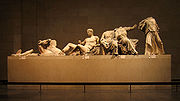
, where they stand now on view in the purpose-built Duveen Gallery. The debate continues as to whether the Marbles should remain in the British Museum or be returned to Athens.
, was appointed as "Ambassador Extraordinary and Minister Plenipotentiary of His Britannic Majesty to the Sublime Porte of Selim III
, Sultan of Turkey
". Prior to his departure to take up the post he had approached at least three officials of the British government to inquire if they would be interested in employing artists to take casts and drawings of the sculptured portions of the Parthenon. According to Lord Elgin, "the answer of the Government... was entirely negative."
Lord Elgin decided to carry out the work at his own expense and employed artists to take casts and drawings under the supervision of the Neapolitan
court painter Giovani Lusieri. However, while conducting surveys, he found that Parthenon statuary that had been documented in a 17th-century survey was now missing, and so he investigated. According to a Turkish local, marble
sculptures that fell were burned to obtain lime for building. Although the original intention was only to document the sculptures, in 1801 Lord Elgin began to remove material from the Parthenon and its surrounding structures under the supervision of Lusieri.
The excavation and removal was completed in 1812 at a personal cost of around £70,000. Elgin intended the marbles for display in the British Museum, selling them to the British government for less than the cost of bringing them to Britain and declining higher offers from other potential buyers, including Napoleon.
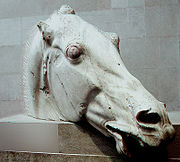
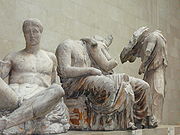 The Elgin Marbles include some 17 figures from the statuary from the east and west pediment
s, 15 (of an original 92) of the metope
panels depicting battles between the Lapiths and the Centaur
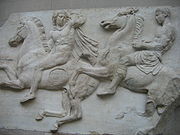
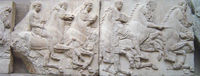
s, as well as 247 feet (or 75 m of an original 524 ft or 159.7 m) of the Parthenon Frieze
which decorated the horizontal course set above the interior architrave of the temple. As such, they represent more than half of what now remains of the surviving sculptural decoration of the Parthenon. Elgin's acquisitions also included objects from other buildings on the Athenian Acropolis
: a Caryatid
from Erechtheum
; four slabs from the parapet frieze of the Temple of Athena Nike; and a number of other architectural
fragments of the Parthenon, Propylaia, Erechtheum
, the Temple of Athena Nike and the Treasury of Atreus.
 As the Acropolis was still an Ottoman
military fort, Elgin required permission to enter the site, including the Parthenon and the surrounding buildings. He allegedly obtained from the Sultan
a firman to allow his artists access to the site. The original document is now lost, but what is said to be a translated Italian
copy made at the time still survives. Vassilis Demetriades, Professor of Turkish Studies at the University of Crete, has argued that "any expert in Ottoman diplomatic language can easily ascertain that the original of the document which has survived was not a firman", and its authenticity has been challenged.
The document was recorded in an appendix of an 1816 parliamentary committee report. The committee had convened to examine a request by Elgin asking the British government to purchase the marbles. The report claimed that the document in the appendix was an accurate translation in English of an Ottoman firman dated in July 1801. In Elgin's view it amounted to an Ottoman authorization to remove the marbles. The committee was told that the original document was given to Ottoman officials in Athens in 1801, but researchers have so far failed to locate any traces of it despite the fact that the Ottoman archives still hold an outstanding number of similar documents dating from the same period. Moreover the parliamentary record shows that the Italian copy of the firman was not presented to the committee by Elgin himself but by one of his associates, the clergyman Rev. Philip Hunt. Hunt, who at the time resided in Bedford, was the last witness to appear before the committee and claimed that he had in his possession an Italian translation of the Ottoman original. He went on to explain that he had not brought the document, because, upon leaving Bedford, he was not aware that he was to testify as a witness. The English document in the parliamentary report was filed by Hunt, but the committee was not presented with the Italian translation purportedly in his possession. William St. Clair, a contemporary biographer of Lord Elgin, claimed to possess Hunt's Italian document and "vouches for the accuracy of the English translation". In addition, the committee report states on page 69 "(Signed with a signet.) Seged Abdullah Kaimacan". But the document presented to the committee was "an English translation of this purported translation into Italian of the original firman", and had neither signet nor signature on it, a fact corroborated by St. Clair. The lines pertaining to the removal of the marbles allowed Elgin and his team to fix scaffolding
, make drawings, make mouldings in chalk
or gypsum
, measure the remains of the ruined buildings and excavate the foundations which may have become covered in the [ghiaja]; and "...that when they wish to take away [qualche(meaning 'a few')] pieces of stone with old inscriptions or figures thereon, that no opposition be made thereto". The interpretation of these lines has been questioned even by non-restitutionalists, particularly the word qualche, which in modern language should be translated as a few. According to non-restitutionalists, further evidence that the removal of the sculptures by Elgin was approved by the Ottoman authorities is shown by a second firman which was required for the shipping of the marbles from the Piraeus.
Despite the controversial firman, many have questioned the legality of Elgin's actions. A study by Professor David Rudenstine
of the Benjamin N. Cardozo School of Law
concluded that the premise that Elgin obtained legal title to the marbles, which he then transferred to the British government, "is certainly not established and may well be false". Rudenstine's argumentation is partly based on a translation discrepancy he noticed between the surviving Italian document and the English text submitted by Hunt to the parliamentary committee. The text from the committee report reads "We therefore have written this Letter to you, and expedited it by Mr. Philip Hunt, an English Gentleman, Secretary of the aforesaid Ambassador" but according to the St. Clair Italian document the actual wording is "We therefore have written this letter to you and expedited it by N.N.". In Rudenstine's view, this substitution of "Mr. Philip Hunt" with the initials "N.N." can hardly be a simple mistake. He further argues that the document was presented after the committee's insistence that some form of Ottoman written authorization for the removal of the marbles was provided, a fact known to Hunt by the time he testified. Thus, according to Rudenstine, "Hunt put himself in a position in which he could simultaneously vouch for the authenticity of the document and explain why he alone had a copy of it fifteen years after he surrendered the original to Ottoman officials in Athens". On two earlier occasions, Elgin stated that the Ottomans gave him written permissions more than once, but that he had "retained none of them." Hunt testified on March 13, and one of the questions asked was "Did you ever see any of the written permissions which were granted to [Lord Elgin] for removing the Marbles from the Temple of Minerva?" to which Hunt answered "yes", adding that he possessed an Italian translation of the original firman. Nonetheless, he did not explain why he had retained the translation for 15 years, whereas Elgin, who had testified two weeks earlier, knew nothing about the existence of any such document.
In contrast, Professor John Merryman, Sweitzer Professor of Law and also Professor of Art at Stanford University
, putting aside the discrepancy presented by Rudenstine, argues that since the Ottomans had controlled Athens since 1460, their claims to the artefacts were legal and recognizable. The Ottoman sultan
was grateful to the British for repelling Napoleonic expansion, and the Parthenon marbles had no sentimental value to him. Further, that written permission exists in the form of the firman, which is the most formal kind of permission available from that government, and that Elgin had further permission to export the marbles, legalizes his (and therefore the British Museum's) claim to the Marbles. He does note, though, that the clause concerning the extent of Ottoman authorization to remove the marbles "is at best ambiguous", adding that the document "provides slender authority for the massive removals from the Parthenon... The reference to 'taking away any pieces of stone' seems incidental, intended to apply to objects found while excavating. That was certainly the interpretation privately placed on the firman by several of the Elgin party, including Lady Elgin. Publicly, however, a different attitude was taken, and the work of dismantling the sculptures on the Parthenon and packing them for shipment to England began in earnest. In the process, Elgin's party damaged the structure, leaving the Parthenon not only denuded of its sculptures but further ruined by the process of removal. It is certainly arguable that Elgin exceeded the authority granted in the firman in both respects".
Lord Byron did not care for the sculptures, calling them "misshapen monuments". He strongly objected to their removal from Greece
, denouncing Elgin as a vandal. His point of view about the removal of the Marbles from Athens is also reflected in his poem "Childe Harold's Pilgrimage
":
Byron was not the only one to protest against the removal at the time:
A parliamentary committee investigating the situation concluded that the monuments were best given "asylum" under a "free government" such as the British one. In 1810, Elgin published a defence of his actions which silenced most of his detractors, although the subject remained controversial. John Keats
was one of those who saw them privately exhibited in London, hence his two sonnet
s about the marbles. Notable supporters of Elgin included the painter Benjamin Robert Haydon.
A public debate in Parliament followed Elgin's publication, and Elgin's actions were again exonerated. Parliament purchased the marbles for the nation in 1816 by a vote of 82-30 for £35,000. They were deposited in the British Museum, where they were displayed in the Elgin Saloon (constructed in 1832), until the Duveen Gallery was completed in 1939. Crowds packed the British Museum to view the sculptures, setting attendance records for the museum. William Wordsworth
viewed the marbles at the museum and commented favourably on their aesthetics.
, after Constantinople
, Ephesos and Thessalonica. The temple's use as a Christian church constitutes the single longest period of its history (ca. 500–1450 AD) and its importance as a church and Christian pilgrimage was greater than that it enjoyed in Ancient Greece. During this period, frescoes and inscriptions were added to the marble walls and columns as it was a custom of the era's pilgrim to mark their visit. Altogether some 220 funerary inscriptions survive for the years 600-1200, though many more were probably lost due to structural damage to the building and erosion of the surface. Similar inscriptions were found in the Propylaia as well as on the church of St. George in the Keramykos, which in antiquity was a temple of Hephaistos and is today called the Theseion. From 1205 to 1456 Athens was ruled by Western Crusaders and the church was converted into a Latin cathedral, although the stream of pilgrims continued.
 Another example of prior damage is that sustained during wars. It is during these periods that the Parthenon and its artwork have sustained by far the most extensive damage. In particular, an explosion ignited by Venetian gun and cannon fire bombardment in 1687, whilst the Parthenon was used as a munitions store during the Ottoman
rule, destroyed or damaged many pieces of Parthenon art including some of those later taken by Lord Elgin. In particular this explosion sent the marble roof, most of the cella walls, 14 columns from the north and south peristyles and carved metopes and frieze blocks flying and crashing to the ground and thus destroyed much of the artwork. Further damage was made to the art of the Parthenon by the Venetian general Francesco Morosini
when he subsequently looted the site of its larger sculptures. His tackle was faulty and snapped, dropping an over life-sized Poseidon and the horses of Athena's chariot from the west pediment to the rock of the Acropolis forty feet below.
was used as a munitions store by the Ottomans during the Greek War of Independence
(1821–1833) which ended the 350-year Ottoman rule of Athens.
The Acropolis was besieged twice during the Greek War of Independence
, once by the Greek
and once by the Ottoman
forces. During the siege the Greeks
were aware of the dilemma and chose to offer the besieged Ottoman forces, who were attempting to melt the lead in the columns to cast bullets, bullets of their own if they would leave the Parthenon undamaged.
in 1803 about how best to restore the marbles. Canova was considered by some to be the world's best sculptural restorer of the time; Elgin wrote that Canova declined to work on the marbles for fear of damaging them further.
To facilitate transport by Elgin, the column capital of the Parthenon and many metopes and slabs were either hacked off the main structure or sawn and sliced into smaller sections causing irreparable damage to the Parthenon itself to which these Marbles were connected. One shipload of marbles on board the British brig Mentor was caught in a storm off Cape Matapan
and sank near Kythera, but was salvaged at the Earl's personal expense; it took two years to bring them to the surface.
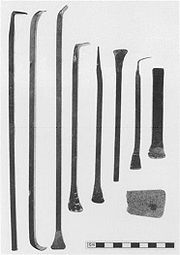 The artefacts held in London suffered from 19th century pollution—which persisted until the mid-20th century — and Greek conservators have asserted that they have been irrevocably damaged by previous cleaning methods employed by British Museum staff.
As early as 1838, scientist Michael Faraday
was asked to provide a solution to the problem of the deteriorating surface of the marbles. The outcome is described in the following excerpt from the letter he sent to Henry Milman, a commissioner for the National Gallery
.
A further effort to clean the marbles ensued in 1858. Richard Westmacott, who was appointed superintendent of the "moving and cleaning the sculptures" in 1857, in a letter approved by the British Museum Standing Committee on 13 March 1858 concluded
Yet another effort to clean the marbles occurred in the years 1937–38. This time the incentive was provided by the construction of a new Gallery to house the collection. The Pentelic marble, from which the sculptures are made, naturally acquires a tan colour similar to honey when exposed to air; this colouring is often known as the marble's "patina" but Lord Duveen, who financed the whole undertaking, acting under the misconception that the marbles were originally white probably arranged for the team of masons working in the project to remove discoloration from some of the sculptures. The tools used were seven scrapers, one chisel and a piece of carborundum stone. They are now deposited in the British Museum's Department of Preservation. The cleaning process scraped away some of the detailed tone of many carvings. According to Harold Plenderleith, the surface removed in some places may have been as much as one-tenth of an inch (2.5 mm).
The British Museum has responded to these allegations with the statement that "mistakes were made at that time." On another occasion it was said that "the damage had been exaggerated for political reasons" and that "the Greeks were guilty of excessive cleaning of the marbles before they were brought to Britain." During the international symposium on the cleaning of the marbles, organised by the British Museum, Dr Ian Jenkins
, deputy keeper of Greek and Roman antiquities, remarked that "The British Museum is not infallible, it is not the Pope. Its history has been a series of good intentions marred by the occasional cock-up, and the 1930s cleaning was such a cock-up". Nonetheless, he pointed out that the prime cause for the damage inflicted upon the marbles was the 2000 year long weathering on the Acropolis
Dorothy King
, in a newspaper article, claimed that techniques similar to the ones used in 1937-1938 were applied by Greeks as well in more recent decades than the British, and maintained that Italians still find them acceptable. Attention has been drawn by the British Museum to a purportedly similar cleaning of the temple of Hephaistos in the Athenian Agora
carried out by the conservation team of the American School of Classical Studies at Athens with steel chisels and brass wire in 1953. According to the Greek ministry of Culture, the cleaning was carefully limited to surface salt crusts. The 1953 American report concluded that the techniques applied were aimed at removing the black deposit formed by rain-water and "brought out the high technical quality of the carving" revealing at the same time "a few surviving particles of colour".
According to documents released by the British Museum under the Freedom of Information Act
, a series of minor accidents, thefts and acts of vandalism
by visitors have inflicted further damage to the sculptures. This includes an incident in 1961 when two schoolboys knocked off a part of a centaur
's leg. In June 1981, a west pediment figure was slightly chipped by a falling glass skylight, and in 1966 four shallow lines were scratched on the back of one of the figures by vandals. During a similar mishap in 1970, letters were scratched on to the upper right thigh of another figure. Four years later, the dowel hole in a centaur's hoof was damaged by thieves trying to extract pieces of lead.
have caused damage to marble and stonework at the Parthenon. The last remaining slabs from the western section of the Parthenon frieze were removed from the monument in 1993 for fear of further damage. They have now been transported to the New Acropolis Museum
.
Until cleaning of the remaining marbles was completed in 2005, black crusts and coatings were present on the marble surface. The laser
technique applied on the 14 slabs that Elgin did not remove revealed a surprising array of original details such as the original chisel marks and the veins on the horses' bellies. Similar features in the British Museum collection have been scraped and scrubbed with chisels to make the marbles look white. Between January 20 and the end of March 2008, 4200 items (sculptures, inscriptions small terracotta objects), including some 80 artefacts dismantled from the monuments in recent years, were removed from the old museum on the Acropolis to the new Parthenon Museum. Natural disasters have also affected the Parthenon. In 1981, an earthquake
caused damage to the east façade.
Since 1975, Greece has been restoring the Acropolis. This restoration has included replacing the thousands of rusting iron clamps and supports that had previously been used, with non-corrosive titanium rods; removing surviving artwork from the building into storage and subsequently into a new museum built specifically for the display of the Parthenon art; and replacing the artwork with high-quality replicas. This process has come under fire from some groups as some buildings have been completely dismantled, including the dismantling of the Temple of Athena Nike and for the unsightly nature of the site due to the necessary cranes
and scaffolding
. But the hope is to restore the site to some of its former glory, which may take another 20 years and 70 million euros, though the prospect of the Acropolis being "able to withstand the most extreme weather conditions — earthquakes" is "little consolation to the tourists visiting the Acropolis" according to The Guardian
. Directors of the British Museum have not ruled out temporarily loaning the marbles to the new museum, but state that it would be under the condition of Greece acknowledging British ownership.
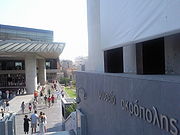 Defenders of the request for the Marbles' return claim that the marbles should be returned to Athens on moral and artistic grounds. The arguments include:
 A range of different arguments have been presented by scholars, political-leaders and British Museum spokespersons over the years in defence of retention of the Elgin Marbles within the British Museum. The main points include:
The last was tested in the British High Court in May 2005 in relation to Nazi-looted Old Master artworks held at the museum; it was ruled that these could not be returned. The judge, Sir Andrew Morritt, ruled that the British Museum Act – which protects the collections for posterity – cannot be overridden by a "moral obligation" to return works known to have been plundered. It has been argued, however, that connections between the legal ruling and the Elgin Marbles were more tenuous than implied by the Attorney General. However, despite the British Museum's charter preventing the repatriation of items within its collection, a 2005 bill concerning the repatriation of ancestral remains allowed for the return of Aboriginal
human remains to Tasmania
after a 20-year battle with Australia.
Another argument for maintaining their location within the UK has been made by J. H. Merryman, Sweitzer Professor of Law at Stanford University
and co-operating professor in the Stanford Art Department. He argued that if the Parthenon were actually being restored, there would be a moral argument for returning the Marbles to the temple whence they came, and thus restoring its integrity. The Guardian has written that many repatrionists imply that the marbles would be displayed in their original position on the Parthenon. However, the Greek plan is to transfer them from a museum in London to one in Athens. The sculptures which Elgin spared have been taken down and put in the New Acropolis Museum
. "Is it more spiritually satisfying to see the Marbles in an Athenian museum gallery than one in London?" Other voices, this time in the House of Lords, have raised more acute concerns about the fate of the Elgin Marbles if they were to be returned to Greece. In an exchange on 19 May 1997, Lord Wyatt
, asked:
A more recent opinion poll in 2002 (again carried out by MORI) showed similar results, with 40% in favour of returning the marbles to Greece, 16% in favour of keeping them within Britain and the remainder either having no opinion or would not vote. When asked how they would vote if a number of conditions were met (including, but not limited to, a long-term loan whereby the British maintained ownership and joint control over maintenance) the number responding in favour of return increased to 56% and those in favour of keeping them dropped to 7%.
Both MORI poll results have been characterised by proponents of the return of the Marbles to Greece as representing a groundswell of public opinion supporting return, since the proportion explicitly supporting return to Greece significantly exceeds the number who are explicitly in favour of keeping the Marbles at the British Museum.
aims to consolidate support for the return of the Elgin Marbles to the New Acropolis Museum in Athens.
The collection held in the British Museum includes the following material from the Acropolis:
Ancient Greek
Ancient Greek is the stage of the Greek language in the periods spanning the times c. 9th–6th centuries BC, , c. 5th–4th centuries BC , and the c. 3rd century BC – 6th century AD of ancient Greece and the ancient world; being predated in the 2nd millennium BC by Mycenaean Greek...
marble sculpture
Marble sculpture
Marble sculpture is the art of creating three-dimensional forms from marble. Sculpture is among the oldest of the arts. Even before painting cave walls, early humans fashioned shapes from stone. From these beginnings, artifacts have evolved to their current complexity...
s (mostly by Phidias
Phidias
Phidias or the great Pheidias , was a Greek sculptor, painter and architect, who lived in the 5th century BC, and is commonly regarded as one of the greatest of all sculptors of Classical Greece: Phidias' Statue of Zeus at Olympia was one of the Seven Wonders of the Ancient World...
and his pupils), inscriptions and architectural members that originally were part of the Parthenon
Parthenon
The Parthenon is a temple on the Athenian Acropolis, Greece, dedicated to the Greek goddess Athena, whom the people of Athens considered their virgin patron. Its construction began in 447 BC when the Athenian Empire was at the height of its power. It was completed in 438 BC, although...
and other buildings on the Acropolis of Athens
Acropolis of Athens
The Acropolis of Athens or Citadel of Athens is the best known acropolis in the world. Although there are many other acropoleis in Greece, the significance of the Acropolis of Athens is such that it is commonly known as The Acropolis without qualification...
. Thomas Bruce, 7th Earl of Elgin
Thomas Bruce, 7th Earl of Elgin
Thomas Bruce, 7th Earl of Elgin and 11th Earl of Kincardine was a Scottish nobleman and diplomat, known for the removal of marble sculptures from the Parthenon in Athens. Elgin was the second son of Charles Bruce, 5th Earl of Elgin and his wife Martha Whyte...
, the British ambassador to the Ottoman Empire
Ottoman Empire
The Ottoman EmpireIt was usually referred to as the "Ottoman Empire", the "Turkish Empire", the "Ottoman Caliphate" or more commonly "Turkey" by its contemporaries...
from 1799–1803, had obtained a controversial permit from the Ottoman authorities to remove pieces from the Acropolis.
From 1801 to 1812 Elgin's agents removed about half of the surviving sculptures of the Parthenon, as well as architectural members and sculpture from the Propylaea
Propylaea
A Propylaea, Propylea or Propylaia is any monumental gateway based on the original Propylaea that serves as the entrance to the Acropolis in Athens...
and Erechtheum
Erechtheum
The Erechtheion is an ancient Greek temple on the north side of the Acropolis of Athens in Greece.-Architecture:The temple as seen today was built between 421 and 406 BC. Its architect may have been Mnesicles, and it derived its name from a shrine dedicated to the legendary Greek hero Erichthonius...
. The Marbles were transported by sea to Britain. In Britain, the acquisition of the collection was supported by some, while other critics compared Elgin's actions to vandalism or looting.
Following a public debate in Parliament and subsequent exoneration of Elgin's actions, the marbles were purchased by the British government in 1816 and placed on display in the British Museum
British Museum
The British Museum is a museum of human history and culture in London. Its collections, which number more than seven million objects, are amongst the largest and most comprehensive in the world and originate from all continents, illustrating and documenting the story of human culture from its...
, where they stand now on view in the purpose-built Duveen Gallery. The debate continues as to whether the Marbles should remain in the British Museum or be returned to Athens.
Acquisition
In December of 1798, Thomas Bruce, 7th Earl of ElginThomas Bruce, 7th Earl of Elgin
Thomas Bruce, 7th Earl of Elgin and 11th Earl of Kincardine was a Scottish nobleman and diplomat, known for the removal of marble sculptures from the Parthenon in Athens. Elgin was the second son of Charles Bruce, 5th Earl of Elgin and his wife Martha Whyte...
, was appointed as "Ambassador Extraordinary and Minister Plenipotentiary of His Britannic Majesty to the Sublime Porte of Selim III
Selim III
Selim III was the reform-minded Sultan of the Ottoman Empire from 1789 to 1807. The Janissaries eventually deposed and imprisoned him, and placed his cousin Mustafa on the throne as Mustafa IV...
, Sultan of Turkey
Turkey
Turkey , known officially as the Republic of Turkey , is a Eurasian country located in Western Asia and in East Thrace in Southeastern Europe...
". Prior to his departure to take up the post he had approached at least three officials of the British government to inquire if they would be interested in employing artists to take casts and drawings of the sculptured portions of the Parthenon. According to Lord Elgin, "the answer of the Government... was entirely negative."
Lord Elgin decided to carry out the work at his own expense and employed artists to take casts and drawings under the supervision of the Neapolitan
Parthenopaean Republic
The Parthenopean Republic was a French-supported republic in the territory of the Kingdom of Naples, formed during the French Revolutionary Wars after King Ferdinand IV fled before advancing French troops...
court painter Giovani Lusieri. However, while conducting surveys, he found that Parthenon statuary that had been documented in a 17th-century survey was now missing, and so he investigated. According to a Turkish local, marble
Marble
Marble is a metamorphic rock composed of recrystallized carbonate minerals, most commonly calcite or dolomite.Geologists use the term "marble" to refer to metamorphosed limestone; however stonemasons use the term more broadly to encompass unmetamorphosed limestone.Marble is commonly used for...
sculptures that fell were burned to obtain lime for building. Although the original intention was only to document the sculptures, in 1801 Lord Elgin began to remove material from the Parthenon and its surrounding structures under the supervision of Lusieri.
The excavation and removal was completed in 1812 at a personal cost of around £70,000. Elgin intended the marbles for display in the British Museum, selling them to the British government for less than the cost of bringing them to Britain and declining higher offers from other potential buyers, including Napoleon.
Description
Pediment
A pediment is a classical architectural element consisting of the triangular section found above the horizontal structure , typically supported by columns. The gable end of the pediment is surrounded by the cornice moulding...
s, 15 (of an original 92) of the metope
Metope (architecture)
In classical architecture, a metope is a rectangular architectural element that fills the space between two triglyphs in a Doric frieze, which is a decorative band of alternating triglyphs and metopes above the architrave of a building of the Doric order...
panels depicting battles between the Lapiths and the Centaur
Centaur
In Greek mythology, a centaur or hippocentaur is a member of a composite race of creatures, part human and part horse...
s, as well as 247 feet (or 75 m of an original 524 ft or 159.7 m) of the Parthenon Frieze
Parthenon Frieze
The Parthenon frieze is the low relief, pentelic marble sculpture created to adorn the upper part of the Parthenon’s naos. It was sculpted between ca. 443 and 438 BC, most likely under the direction of Pheidias. Of the of the original frieze, survives—some 80 percent...
which decorated the horizontal course set above the interior architrave of the temple. As such, they represent more than half of what now remains of the surviving sculptural decoration of the Parthenon. Elgin's acquisitions also included objects from other buildings on the Athenian Acropolis
Acropolis of Athens
The Acropolis of Athens or Citadel of Athens is the best known acropolis in the world. Although there are many other acropoleis in Greece, the significance of the Acropolis of Athens is such that it is commonly known as The Acropolis without qualification...
: a Caryatid
Caryatid
A caryatid is a sculpted female figure serving as an architectural support taking the place of a column or a pillar supporting an entablature on her head. The Greek term karyatides literally means "maidens of Karyai", an ancient town of Peloponnese...
from Erechtheum
Erechtheum
The Erechtheion is an ancient Greek temple on the north side of the Acropolis of Athens in Greece.-Architecture:The temple as seen today was built between 421 and 406 BC. Its architect may have been Mnesicles, and it derived its name from a shrine dedicated to the legendary Greek hero Erichthonius...
; four slabs from the parapet frieze of the Temple of Athena Nike; and a number of other architectural
Architecture
Architecture is both the process and product of planning, designing and construction. Architectural works, in the material form of buildings, are often perceived as cultural and political symbols and as works of art...
fragments of the Parthenon, Propylaia, Erechtheum
Erechtheum
The Erechtheion is an ancient Greek temple on the north side of the Acropolis of Athens in Greece.-Architecture:The temple as seen today was built between 421 and 406 BC. Its architect may have been Mnesicles, and it derived its name from a shrine dedicated to the legendary Greek hero Erichthonius...
, the Temple of Athena Nike and the Treasury of Atreus.
Legality of the removal from Athens
Ottoman Empire
The Ottoman EmpireIt was usually referred to as the "Ottoman Empire", the "Turkish Empire", the "Ottoman Caliphate" or more commonly "Turkey" by its contemporaries...
military fort, Elgin required permission to enter the site, including the Parthenon and the surrounding buildings. He allegedly obtained from the Sultan
Sultan
Sultan is a title with several historical meanings. Originally, it was an Arabic language abstract noun meaning "strength", "authority", "rulership", and "dictatorship", derived from the masdar سلطة , meaning "authority" or "power". Later, it came to be used as the title of certain rulers who...
a firman to allow his artists access to the site. The original document is now lost, but what is said to be a translated Italian
Italian language
Italian is a Romance language spoken mainly in Europe: Italy, Switzerland, San Marino, Vatican City, by minorities in Malta, Monaco, Croatia, Slovenia, France, Libya, Eritrea, and Somalia, and by immigrant communities in the Americas and Australia...
copy made at the time still survives. Vassilis Demetriades, Professor of Turkish Studies at the University of Crete, has argued that "any expert in Ottoman diplomatic language can easily ascertain that the original of the document which has survived was not a firman", and its authenticity has been challenged.
The document was recorded in an appendix of an 1816 parliamentary committee report. The committee had convened to examine a request by Elgin asking the British government to purchase the marbles. The report claimed that the document in the appendix was an accurate translation in English of an Ottoman firman dated in July 1801. In Elgin's view it amounted to an Ottoman authorization to remove the marbles. The committee was told that the original document was given to Ottoman officials in Athens in 1801, but researchers have so far failed to locate any traces of it despite the fact that the Ottoman archives still hold an outstanding number of similar documents dating from the same period. Moreover the parliamentary record shows that the Italian copy of the firman was not presented to the committee by Elgin himself but by one of his associates, the clergyman Rev. Philip Hunt. Hunt, who at the time resided in Bedford, was the last witness to appear before the committee and claimed that he had in his possession an Italian translation of the Ottoman original. He went on to explain that he had not brought the document, because, upon leaving Bedford, he was not aware that he was to testify as a witness. The English document in the parliamentary report was filed by Hunt, but the committee was not presented with the Italian translation purportedly in his possession. William St. Clair, a contemporary biographer of Lord Elgin, claimed to possess Hunt's Italian document and "vouches for the accuracy of the English translation". In addition, the committee report states on page 69 "(Signed with a signet.) Seged Abdullah Kaimacan". But the document presented to the committee was "an English translation of this purported translation into Italian of the original firman", and had neither signet nor signature on it, a fact corroborated by St. Clair. The lines pertaining to the removal of the marbles allowed Elgin and his team to fix scaffolding
Scaffolding
Scaffolding is a temporary structure used to support people and material in the construction or repair of buildings and other large structures. It is usually a modular system of metal pipes or tubes, although it can be from other materials...
, make drawings, make mouldings in chalk
Chalk
Chalk is a soft, white, porous sedimentary rock, a form of limestone composed of the mineral calcite. Calcite is calcium carbonate or CaCO3. It forms under reasonably deep marine conditions from the gradual accumulation of minute calcite plates shed from micro-organisms called coccolithophores....
or gypsum
Gypsum
Gypsum is a very soft sulfate mineral composed of calcium sulfate dihydrate, with the chemical formula CaSO4·2H2O. It is found in alabaster, a decorative stone used in Ancient Egypt. It is the second softest mineral on the Mohs Hardness Scale...
, measure the remains of the ruined buildings and excavate the foundations which may have become covered in the [ghiaja]; and "...that when they wish to take away [qualche(meaning 'a few')] pieces of stone with old inscriptions or figures thereon, that no opposition be made thereto". The interpretation of these lines has been questioned even by non-restitutionalists, particularly the word qualche, which in modern language should be translated as a few. According to non-restitutionalists, further evidence that the removal of the sculptures by Elgin was approved by the Ottoman authorities is shown by a second firman which was required for the shipping of the marbles from the Piraeus.
Despite the controversial firman, many have questioned the legality of Elgin's actions. A study by Professor David Rudenstine
David Rudenstine
David Rudenstine is the Benjamin N. Cardozo School of Law's Sheldon H. Solow Professor of Law. He teaches United States constitutional law.Dean Rudenstine has been teaching at Cardozo since 1979 and is the author of The Day the Presses Stopped: A History of the Pentagon Papers Case. He served as...
of the Benjamin N. Cardozo School of Law
Benjamin N. Cardozo School of Law
The Benjamin N. Cardozo School of Law is the law school of Yeshiva University, located in the New York City borough of Manhattan. The school is named for Supreme Court Justice Benjamin N. Cardozo. Cardozo's success as a young school has been remarkable, leading some to characterize Cardozo as a...
concluded that the premise that Elgin obtained legal title to the marbles, which he then transferred to the British government, "is certainly not established and may well be false". Rudenstine's argumentation is partly based on a translation discrepancy he noticed between the surviving Italian document and the English text submitted by Hunt to the parliamentary committee. The text from the committee report reads "We therefore have written this Letter to you, and expedited it by Mr. Philip Hunt, an English Gentleman, Secretary of the aforesaid Ambassador" but according to the St. Clair Italian document the actual wording is "We therefore have written this letter to you and expedited it by N.N.". In Rudenstine's view, this substitution of "Mr. Philip Hunt" with the initials "N.N." can hardly be a simple mistake. He further argues that the document was presented after the committee's insistence that some form of Ottoman written authorization for the removal of the marbles was provided, a fact known to Hunt by the time he testified. Thus, according to Rudenstine, "Hunt put himself in a position in which he could simultaneously vouch for the authenticity of the document and explain why he alone had a copy of it fifteen years after he surrendered the original to Ottoman officials in Athens". On two earlier occasions, Elgin stated that the Ottomans gave him written permissions more than once, but that he had "retained none of them." Hunt testified on March 13, and one of the questions asked was "Did you ever see any of the written permissions which were granted to [Lord Elgin] for removing the Marbles from the Temple of Minerva?" to which Hunt answered "yes", adding that he possessed an Italian translation of the original firman. Nonetheless, he did not explain why he had retained the translation for 15 years, whereas Elgin, who had testified two weeks earlier, knew nothing about the existence of any such document.
In contrast, Professor John Merryman, Sweitzer Professor of Law and also Professor of Art at Stanford University
Stanford University
The Leland Stanford Junior University, commonly referred to as Stanford University or Stanford, is a private research university on an campus located near Palo Alto, California. It is situated in the northwestern Santa Clara Valley on the San Francisco Peninsula, approximately northwest of San...
, putting aside the discrepancy presented by Rudenstine, argues that since the Ottomans had controlled Athens since 1460, their claims to the artefacts were legal and recognizable. The Ottoman sultan
Sultan
Sultan is a title with several historical meanings. Originally, it was an Arabic language abstract noun meaning "strength", "authority", "rulership", and "dictatorship", derived from the masdar سلطة , meaning "authority" or "power". Later, it came to be used as the title of certain rulers who...
was grateful to the British for repelling Napoleonic expansion, and the Parthenon marbles had no sentimental value to him. Further, that written permission exists in the form of the firman, which is the most formal kind of permission available from that government, and that Elgin had further permission to export the marbles, legalizes his (and therefore the British Museum's) claim to the Marbles. He does note, though, that the clause concerning the extent of Ottoman authorization to remove the marbles "is at best ambiguous", adding that the document "provides slender authority for the massive removals from the Parthenon... The reference to 'taking away any pieces of stone' seems incidental, intended to apply to objects found while excavating. That was certainly the interpretation privately placed on the firman by several of the Elgin party, including Lady Elgin. Publicly, however, a different attitude was taken, and the work of dismantling the sculptures on the Parthenon and packing them for shipment to England began in earnest. In the process, Elgin's party damaged the structure, leaving the Parthenon not only denuded of its sculptures but further ruined by the process of removal. It is certainly arguable that Elgin exceeded the authority granted in the firman in both respects".
Contemporary reaction
When the marbles were shipped to England, they were "an instant success among many" who admired the sculptures and supported their arrival, but both the sculptures and Elgin also received criticism from detractors. Lord Elgin began negotiations for the sale of the collection to the British Museum in 1811, but negotiations failed despite the support of British artists after the government showed little interest. Many Britons opposed the statues because they were in bad condition and therefore did not display the "ideal beauty" found in other sculpture collections. The following years marked an increased interest in classical Greece, and in June 1816, after parliamentary hearings, the House of Commons offered £35,000 in exchange for the sculptures. Even at the time the acquisition inspired much debate, although it was supported by "many persuasive calls" for the purchase.Lord Byron did not care for the sculptures, calling them "misshapen monuments". He strongly objected to their removal from Greece
Greece
Greece , officially the Hellenic Republic , and historically Hellas or the Republic of Greece in English, is a country in southeastern Europe....
, denouncing Elgin as a vandal. His point of view about the removal of the Marbles from Athens is also reflected in his poem "Childe Harold's Pilgrimage
Childe Harold's Pilgrimage
Childe Harold's Pilgrimage is a lengthy narrative poem in four parts written by Lord Byron. It was published between 1812 and 1818 and is dedicated to "Ianthe". The poem describes the travels and reflections of a world-weary young man who, disillusioned with a life of pleasure and revelry, looks...
":
- Dull is the eye that will not weep to see
- Thy walls defaced, thy mouldering shrines removed
- By British hands, which it had best behoved
- To guard those relics ne'er to be restored.
- Curst be the hour when from their isle they roved,
- And once again thy hapless bosom gored,
- And snatch'd thy shrinking gods to northern climes abhorred!
Byron was not the only one to protest against the removal at the time:
- "The Honourable Lord has taken advantage of the most unjustifiable means and has committed the most flagrant pillages. It was, it seems, fatal that a representative of our country loot those objects that the Turks and other barbarians had considered sacred," said Sir John Newport.
A parliamentary committee investigating the situation concluded that the monuments were best given "asylum" under a "free government" such as the British one. In 1810, Elgin published a defence of his actions which silenced most of his detractors, although the subject remained controversial. John Keats
John Keats
John Keats was an English Romantic poet. Along with Lord Byron and Percy Bysshe Shelley, he was one of the key figures in the second generation of the Romantic movement, despite the fact that his work had been in publication for only four years before his death.Although his poems were not...
was one of those who saw them privately exhibited in London, hence his two sonnet
Sonnet
A sonnet is one of several forms of poetry that originate in Europe, mainly Provence and Italy. A sonnet commonly has 14 lines. The term "sonnet" derives from the Occitan word sonet and the Italian word sonetto, both meaning "little song" or "little sound"...
s about the marbles. Notable supporters of Elgin included the painter Benjamin Robert Haydon.
A public debate in Parliament followed Elgin's publication, and Elgin's actions were again exonerated. Parliament purchased the marbles for the nation in 1816 by a vote of 82-30 for £35,000. They were deposited in the British Museum, where they were displayed in the Elgin Saloon (constructed in 1832), until the Duveen Gallery was completed in 1939. Crowds packed the British Museum to view the sculptures, setting attendance records for the museum. William Wordsworth
William Wordsworth
William Wordsworth was a major English Romantic poet who, with Samuel Taylor Coleridge, helped to launch the Romantic Age in English literature with the 1798 joint publication Lyrical Ballads....
viewed the marbles at the museum and commented favourably on their aesthetics.
Use as a Christian church
After the conversion of the Greek people to Christianity the Parthenon was eventually converted from a temple of the Virgin (Parthenos) Athena to a holy temple (hieros naos) of the Virgin Mary. The church of the Parthenon and Athens in general was considered the fourth most important pilgrimage in the Byzantine EmpireByzantine Empire
The Byzantine Empire was the Eastern Roman Empire during the periods of Late Antiquity and the Middle Ages, centred on the capital of Constantinople. Known simply as the Roman Empire or Romania to its inhabitants and neighbours, the Empire was the direct continuation of the Ancient Roman State...
, after Constantinople
Constantinople
Constantinople was the capital of the Roman, Eastern Roman, Byzantine, Latin, and Ottoman Empires. Throughout most of the Middle Ages, Constantinople was Europe's largest and wealthiest city.-Names:...
, Ephesos and Thessalonica. The temple's use as a Christian church constitutes the single longest period of its history (ca. 500–1450 AD) and its importance as a church and Christian pilgrimage was greater than that it enjoyed in Ancient Greece. During this period, frescoes and inscriptions were added to the marble walls and columns as it was a custom of the era's pilgrim to mark their visit. Altogether some 220 funerary inscriptions survive for the years 600-1200, though many more were probably lost due to structural damage to the building and erosion of the surface. Similar inscriptions were found in the Propylaia as well as on the church of St. George in the Keramykos, which in antiquity was a temple of Hephaistos and is today called the Theseion. From 1205 to 1456 Athens was ruled by Western Crusaders and the church was converted into a Latin cathedral, although the stream of pilgrims continued.
Morosini
Ottoman Greece
Most of Greece gradually became part of the Ottoman Empire from the 15th century until its declaration of independence in 1821, a historical period also known as Tourkokratia ....
rule, destroyed or damaged many pieces of Parthenon art including some of those later taken by Lord Elgin. In particular this explosion sent the marble roof, most of the cella walls, 14 columns from the north and south peristyles and carved metopes and frieze blocks flying and crashing to the ground and thus destroyed much of the artwork. Further damage was made to the art of the Parthenon by the Venetian general Francesco Morosini
Francesco Morosini
Francesco Morosini was the Doge of Venice from 1688 to 1694, at the height of the Great Turkish War...
when he subsequently looted the site of its larger sculptures. His tackle was faulty and snapped, dropping an over life-sized Poseidon and the horses of Athena's chariot from the west pediment to the rock of the Acropolis forty feet below.
War of Independence
The ErechtheumErechtheum
The Erechtheion is an ancient Greek temple on the north side of the Acropolis of Athens in Greece.-Architecture:The temple as seen today was built between 421 and 406 BC. Its architect may have been Mnesicles, and it derived its name from a shrine dedicated to the legendary Greek hero Erichthonius...
was used as a munitions store by the Ottomans during the Greek War of Independence
Greek War of Independence
The Greek War of Independence, also known as the Greek Revolution was a successful war of independence waged by the Greek revolutionaries between...
(1821–1833) which ended the 350-year Ottoman rule of Athens.
The Acropolis was besieged twice during the Greek War of Independence
Greek War of Independence
The Greek War of Independence, also known as the Greek Revolution was a successful war of independence waged by the Greek revolutionaries between...
, once by the Greek
Greeks
The Greeks, also known as the Hellenes , are a nation and ethnic group native to Greece, Cyprus and neighboring regions. They also form a significant diaspora, with Greek communities established around the world....
and once by the Ottoman
Ottoman Empire
The Ottoman EmpireIt was usually referred to as the "Ottoman Empire", the "Turkish Empire", the "Ottoman Caliphate" or more commonly "Turkey" by its contemporaries...
forces. During the siege the Greeks
Greeks
The Greeks, also known as the Hellenes , are a nation and ethnic group native to Greece, Cyprus and neighboring regions. They also form a significant diaspora, with Greek communities established around the world....
were aware of the dilemma and chose to offer the besieged Ottoman forces, who were attempting to melt the lead in the columns to cast bullets, bullets of their own if they would leave the Parthenon undamaged.
Elgin
Elgin consulted with sculptor Antonio CanovaAntonio Canova
Antonio Canova was an Italian sculptor from the Republic of Venice who became famous for his marble sculptures that delicately rendered nude flesh...
in 1803 about how best to restore the marbles. Canova was considered by some to be the world's best sculptural restorer of the time; Elgin wrote that Canova declined to work on the marbles for fear of damaging them further.
To facilitate transport by Elgin, the column capital of the Parthenon and many metopes and slabs were either hacked off the main structure or sawn and sliced into smaller sections causing irreparable damage to the Parthenon itself to which these Marbles were connected. One shipload of marbles on board the British brig Mentor was caught in a storm off Cape Matapan
Cape Matapan
Cape Tainaron , also known as Cape Matapan , is situated at the end of the Mani, Laconia, Greece. Cape Matapan is the southernmost point of mainland Greece. It separates the Messenian Gulf in the west from the Laconian Gulf in the east.-History:...
and sank near Kythera, but was salvaged at the Earl's personal expense; it took two years to bring them to the surface.
British Museum
As early as 1838, scientist Michael Faraday
Michael Faraday
Michael Faraday, FRS was an English chemist and physicist who contributed to the fields of electromagnetism and electrochemistry....
was asked to provide a solution to the problem of the deteriorating surface of the marbles. The outcome is described in the following excerpt from the letter he sent to Henry Milman, a commissioner for the National Gallery
National Gallery, London
The National Gallery is an art museum on Trafalgar Square, London, United Kingdom. Founded in 1824, it houses a collection of over 2,300 paintings dating from the mid-13th century to 1900. The gallery is an exempt charity, and a non-departmental public body of the Department for Culture, Media...
.
The marbles generally were very dirty ... from a deposit of dust and soot. ... I found the body of the marble beneath the surface white. ... The application of water, applied by a sponge or soft cloth, removed the coarsest dirt. ... The use of fine, gritty powder, with the water and rubbing, though it more quickly removed the upper dirt, left much imbedded in the cellular surface of the marble. I then applied alkalis, both carbonated and caustic; these quickened the loosening of the surface dirt ... but they fell far short of restoring the marble surface to its proper hue and state of cleanliness. I finally used dilute nitric acid, and even this failed. ... The examination has made me despair of the possibility of presenting the marbles in the British Museum in that state of purity and whiteness which they originally possessed.
A further effort to clean the marbles ensued in 1858. Richard Westmacott, who was appointed superintendent of the "moving and cleaning the sculptures" in 1857, in a letter approved by the British Museum Standing Committee on 13 March 1858 concluded
'I think it my duty to say that some of the works are much damaged by ignorant or careless moulding — with oil and lard — and by restorations in wax, and wax and resin. These mistakes have caused discolouration. I shall endeavour to remedy this without, however, having recourse to any composition that can injure the surface of the marble
Yet another effort to clean the marbles occurred in the years 1937–38. This time the incentive was provided by the construction of a new Gallery to house the collection. The Pentelic marble, from which the sculptures are made, naturally acquires a tan colour similar to honey when exposed to air; this colouring is often known as the marble's "patina" but Lord Duveen, who financed the whole undertaking, acting under the misconception that the marbles were originally white probably arranged for the team of masons working in the project to remove discoloration from some of the sculptures. The tools used were seven scrapers, one chisel and a piece of carborundum stone. They are now deposited in the British Museum's Department of Preservation. The cleaning process scraped away some of the detailed tone of many carvings. According to Harold Plenderleith, the surface removed in some places may have been as much as one-tenth of an inch (2.5 mm).
The British Museum has responded to these allegations with the statement that "mistakes were made at that time." On another occasion it was said that "the damage had been exaggerated for political reasons" and that "the Greeks were guilty of excessive cleaning of the marbles before they were brought to Britain." During the international symposium on the cleaning of the marbles, organised by the British Museum, Dr Ian Jenkins
Ian Jenkins (curator)
Ian Dennis Jenkins OBE is a Senior Curator at the British Museum and is an expert on Ancient Greece and specializes in Ancient Greek sculpture. Jenkins has a number of books published, and over a hundred articles...
, deputy keeper of Greek and Roman antiquities, remarked that "The British Museum is not infallible, it is not the Pope. Its history has been a series of good intentions marred by the occasional cock-up, and the 1930s cleaning was such a cock-up". Nonetheless, he pointed out that the prime cause for the damage inflicted upon the marbles was the 2000 year long weathering on the Acropolis
Dorothy King
Dorothy King
Dorothy King is an American archaeologist and historian who lives and works in England. Described as someone who "breaks the mould of the dusty academic", she is the author of a 2006 book on the Elgin Marbles defending the British retention of the Marbles against Greek claims, and a former Fellow...
, in a newspaper article, claimed that techniques similar to the ones used in 1937-1938 were applied by Greeks as well in more recent decades than the British, and maintained that Italians still find them acceptable. Attention has been drawn by the British Museum to a purportedly similar cleaning of the temple of Hephaistos in the Athenian Agora
Ancient Agora of Athens
The Ancient Agora of Athens is the best-known example of an ancient Greek agora, located to the northwest of the Acropolis and is bounded on the south by the hill of the Areopagus and on the west by the hill known as the Colonus Agoraeus.-History:The agora in Athens had private housing, until it...
carried out by the conservation team of the American School of Classical Studies at Athens with steel chisels and brass wire in 1953. According to the Greek ministry of Culture, the cleaning was carefully limited to surface salt crusts. The 1953 American report concluded that the techniques applied were aimed at removing the black deposit formed by rain-water and "brought out the high technical quality of the carving" revealing at the same time "a few surviving particles of colour".
According to documents released by the British Museum under the Freedom of Information Act
Freedom of Information Act 2000
The Freedom of Information Act 2000 is an Act of Parliament of the Parliament of the United Kingdom that creates a public "right of access" to information held by public authorities. It is the implementation of freedom of information legislation in the United Kingdom on a national level...
, a series of minor accidents, thefts and acts of vandalism
Vandalism
Vandalism is the behaviour attributed originally to the Vandals, by the Romans, in respect of culture: ruthless destruction or spoiling of anything beautiful or venerable...
by visitors have inflicted further damage to the sculptures. This includes an incident in 1961 when two schoolboys knocked off a part of a centaur
Centaur
In Greek mythology, a centaur or hippocentaur is a member of a composite race of creatures, part human and part horse...
's leg. In June 1981, a west pediment figure was slightly chipped by a falling glass skylight, and in 1966 four shallow lines were scratched on the back of one of the figures by vandals. During a similar mishap in 1970, letters were scratched on to the upper right thigh of another figure. Four years later, the dowel hole in a centaur's hoof was damaged by thieves trying to extract pieces of lead.
Athens
While the levels of nitrogen oxide, nitrogen dioxide, and particulate matter pollution in Athens are average compared to other European cites, air pollution and acid rainAcid rain
Acid rain is a rain or any other form of precipitation that is unusually acidic, meaning that it possesses elevated levels of hydrogen ions . It can have harmful effects on plants, aquatic animals, and infrastructure. Acid rain is caused by emissions of carbon dioxide, sulfur dioxide and nitrogen...
have caused damage to marble and stonework at the Parthenon. The last remaining slabs from the western section of the Parthenon frieze were removed from the monument in 1993 for fear of further damage. They have now been transported to the New Acropolis Museum
New Acropolis Museum
The Acropolis Museum is an archaeological museum focused on the findings of the archaeological site of the Acropolis of Athens. The museum was built to house every artifact found on the rock and on its feet, from the Greek Bronze Age to Roman and Byzantine Greece...
.
Until cleaning of the remaining marbles was completed in 2005, black crusts and coatings were present on the marble surface. The laser
Laser
A laser is a device that emits light through a process of optical amplification based on the stimulated emission of photons. The term "laser" originated as an acronym for Light Amplification by Stimulated Emission of Radiation...
technique applied on the 14 slabs that Elgin did not remove revealed a surprising array of original details such as the original chisel marks and the veins on the horses' bellies. Similar features in the British Museum collection have been scraped and scrubbed with chisels to make the marbles look white. Between January 20 and the end of March 2008, 4200 items (sculptures, inscriptions small terracotta objects), including some 80 artefacts dismantled from the monuments in recent years, were removed from the old museum on the Acropolis to the new Parthenon Museum. Natural disasters have also affected the Parthenon. In 1981, an earthquake
Earthquake
An earthquake is the result of a sudden release of energy in the Earth's crust that creates seismic waves. The seismicity, seismism or seismic activity of an area refers to the frequency, type and size of earthquakes experienced over a period of time...
caused damage to the east façade.
Since 1975, Greece has been restoring the Acropolis. This restoration has included replacing the thousands of rusting iron clamps and supports that had previously been used, with non-corrosive titanium rods; removing surviving artwork from the building into storage and subsequently into a new museum built specifically for the display of the Parthenon art; and replacing the artwork with high-quality replicas. This process has come under fire from some groups as some buildings have been completely dismantled, including the dismantling of the Temple of Athena Nike and for the unsightly nature of the site due to the necessary cranes
Crane (machine)
A crane is a type of machine, generally equipped with a hoist, wire ropes or chains, and sheaves, that can be used both to lift and lower materials and to move them horizontally. It uses one or more simple machines to create mechanical advantage and thus move loads beyond the normal capability of...
and scaffolding
Scaffolding
Scaffolding is a temporary structure used to support people and material in the construction or repair of buildings and other large structures. It is usually a modular system of metal pipes or tubes, although it can be from other materials...
. But the hope is to restore the site to some of its former glory, which may take another 20 years and 70 million euros, though the prospect of the Acropolis being "able to withstand the most extreme weather conditions — earthquakes" is "little consolation to the tourists visiting the Acropolis" according to The Guardian
The Guardian
The Guardian, formerly known as The Manchester Guardian , is a British national daily newspaper in the Berliner format...
. Directors of the British Museum have not ruled out temporarily loaning the marbles to the new museum, but state that it would be under the condition of Greece acknowledging British ownership.
Rationale for returning to Athens
- The main stated aim of the Greek campaign is to reunite the Parthenon sculptures around the world in order to restore "organic elements" which "at present remain without cohesion, homogeneity and historicity of the monument to which they belong" and allow visitors to better appreciate them as a whole;
- Presenting all the extant Parthenon Marbles in their original historical and cultural environment would permit their "fuller understanding and interpretation";
- Precedents have been set with the return of fragments of the monument by SwedenSwedenSweden , officially the Kingdom of Sweden , is a Nordic country on the Scandinavian Peninsula in Northern Europe. Sweden borders with Norway and Finland and is connected to Denmark by a bridge-tunnel across the Öresund....
, the University of Heidelberg, GermanyGermanyGermany , officially the Federal Republic of Germany , is a federal parliamentary republic in Europe. The country consists of 16 states while the capital and largest city is Berlin. Germany covers an area of 357,021 km2 and has a largely temperate seasonal climate...
, the Getty Museum in Los AngelesLos ÁngelesLos Ángeles is the capital of the province of Biobío, in the commune of the same name, in Region VIII , in the center-south of Chile. It is located between the Laja and Biobío rivers. The population is 123,445 inhabitants...
. and the VaticanHoly SeeThe Holy See is the episcopal jurisdiction of the Catholic Church in Rome, in which its Bishop is commonly known as the Pope. It is the preeminent episcopal see of the Catholic Church, forming the central government of the Church. As such, diplomatically, and in other spheres the Holy See acts and...
; - That the marbles may have been obtained illegally and hence should be returned to their rightful owner;
- Returning the Elgin Marbles would not set a precedent for other restitution claims because of the distinctively "universal value" of the Parthenon.
- Safekeeping of the marbles would be ensured at the New Acropolis MuseumNew Acropolis MuseumThe Acropolis Museum is an archaeological museum focused on the findings of the archaeological site of the Acropolis of Athens. The museum was built to house every artifact found on the rock and on its feet, from the Greek Bronze Age to Roman and Byzantine Greece...
, situated to the south of the Acropolis hill. It was built to hold the Parthenon sculpture in natural sunlight that characterises the Athenian climate, arranged in the same way as they would have been on the Parthenon. The museum's facilities have been equipped with state-of-the-art technology for the protection and preservation of exhibits
Rationale for retaining in London
- the maintenance of a single worldwide-oriented cultural collection, all viewable in one location, thereby serving as a world heritage centre. The British Museum is a creative and living achievement of the EnlightenmentAge of EnlightenmentThe Age of Enlightenment was an elite cultural movement of intellectuals in 18th century Europe that sought to mobilize the power of reason in order to reform society and advance knowledge. It promoted intellectual interchange and opposed intolerance and abuses in church and state...
, while the Parthenon, on the other hand, is a ruin that can never now be restored. - the assertion that fulfilling all restitution claims would empty most of the world's great museums – this has also caused concerns among other European and American museums, with one potential target being the famous bust of NefertitiNefertiti BustThe Nefertiti Bust is a 3300-year-old painted limestone bust of Nefertiti, the Great Royal Wife of the Egyptian Pharaoh Akhenaten and is one of the most copied works of ancient Egypt. Due to the bust, Nefertiti has become one of the most famous women from the ancient world as well as an icon of...
in BerlinBerlinBerlin is the capital city of Germany and is one of the 16 states of Germany. With a population of 3.45 million people, Berlin is Germany's largest city. It is the second most populous city proper and the seventh most populous urban area in the European Union...
's Neues MuseumNeues MuseumThe ' is a museum in Berlin, Germany, located to the north of the Altes Museum on Museum Island.It was built between 1843 and 1855 according to plans by Friedrich August Stüler, a student of Karl Friedrich Schinkel. The museum was closed at the beginning of World War II in 1939, and was heavily...
; in addition, portions of Parthenon marbles are kept by many other European museums, so the Greeks would then establish a precedent to claim these other artworks; - some scholars argue that the marbles were saved from what would have been severe damage from pollution and other factors, which could have perhaps destroyed the marbles, if they had been located in Athens the past few hundred years;
- experts agree that Greece could mount no court case because Elgin was granted permission by what was then Greece's ruling government and a legal principle of limitation would apply, i.e. the ability to pursue claims expires after a period of time prescribed by law;
- more than half the original marbles are lost and therefore the return of the Elgin Marbles could never complete the collection in Greece. In addition, many of the marbles are too fragile to travel from London to Athens;
- display in the British museum puts the sculptures in a European artistic context, alongside the work of art which both influenced and was influenced by Greek sculpture. This allows parallels to be drawn with the art of other cultures;
- the notion that the Parthenon sculptures are an item of global rather than solely Greek significance strengthens the argument that they should remain in a museum which is both free to visit, and located in one of Europe's most visited cities. The government of Greece intends to charge visitors of the New Acropolis Museum, where they can view the marbles (as of 2011 the price is €5).
- a legal position that the museum is banned by charter from returning any part of its collection.
The last was tested in the British High Court in May 2005 in relation to Nazi-looted Old Master artworks held at the museum; it was ruled that these could not be returned. The judge, Sir Andrew Morritt, ruled that the British Museum Act – which protects the collections for posterity – cannot be overridden by a "moral obligation" to return works known to have been plundered. It has been argued, however, that connections between the legal ruling and the Elgin Marbles were more tenuous than implied by the Attorney General. However, despite the British Museum's charter preventing the repatriation of items within its collection, a 2005 bill concerning the repatriation of ancestral remains allowed for the return of Aboriginal
Tasmanian Aborigines
The Tasmanian Aborigines were the indigenous people of the island state of Tasmania, Australia. Before British colonisation in 1803, there were an estimated 3,000–15,000 Parlevar. A number of historians point to introduced disease as the major cause of the destruction of the full-blooded...
human remains to Tasmania
Tasmania
Tasmania is an Australian island and state. It is south of the continent, separated by Bass Strait. The state includes the island of Tasmania—the 26th largest island in the world—and the surrounding islands. The state has a population of 507,626 , of whom almost half reside in the greater Hobart...
after a 20-year battle with Australia.
Another argument for maintaining their location within the UK has been made by J. H. Merryman, Sweitzer Professor of Law at Stanford University
Stanford University
The Leland Stanford Junior University, commonly referred to as Stanford University or Stanford, is a private research university on an campus located near Palo Alto, California. It is situated in the northwestern Santa Clara Valley on the San Francisco Peninsula, approximately northwest of San...
and co-operating professor in the Stanford Art Department. He argued that if the Parthenon were actually being restored, there would be a moral argument for returning the Marbles to the temple whence they came, and thus restoring its integrity. The Guardian has written that many repatrionists imply that the marbles would be displayed in their original position on the Parthenon. However, the Greek plan is to transfer them from a museum in London to one in Athens. The sculptures which Elgin spared have been taken down and put in the New Acropolis Museum
New Acropolis Museum
The Acropolis Museum is an archaeological museum focused on the findings of the archaeological site of the Acropolis of Athens. The museum was built to house every artifact found on the rock and on its feet, from the Greek Bronze Age to Roman and Byzantine Greece...
. "Is it more spiritually satisfying to see the Marbles in an Athenian museum gallery than one in London?" Other voices, this time in the House of Lords, have raised more acute concerns about the fate of the Elgin Marbles if they were to be returned to Greece. In an exchange on 19 May 1997, Lord Wyatt
Woodrow Wyatt
Woodrow Lyle Wyatt, Baron Wyatt of Weeford , was a British politician, published author, journalist and broadcaster, close to the Queen Mother, Margaret Thatcher and Rupert Murdoch...
, asked:
My Lords, is the Minister aware that it would be dangerous to return the marbles to Athens because they were under attack by Turkish and Greek fire in the Parthenon when they were rescued and the volatile Greeks might easily start hurling bombs around again?
Opinion polls
Despite the British Museum's position on its ownership of the marbles, in 1998, a poll carried out by Ipsos MORI asking "If there were a referendum on whether or not the Elgin Marbles should be returned to Greece, how would you vote?" returned these values from the general adult population:- 40% in favour of returning the marbles to Greece
- 15% in favour of keeping them at the British Museum
- 18% would not vote
- 27% had no opinion
A more recent opinion poll in 2002 (again carried out by MORI) showed similar results, with 40% in favour of returning the marbles to Greece, 16% in favour of keeping them within Britain and the remainder either having no opinion or would not vote. When asked how they would vote if a number of conditions were met (including, but not limited to, a long-term loan whereby the British maintained ownership and joint control over maintenance) the number responding in favour of return increased to 56% and those in favour of keeping them dropped to 7%.
Both MORI poll results have been characterised by proponents of the return of the Marbles to Greece as representing a groundswell of public opinion supporting return, since the proportion explicitly supporting return to Greece significantly exceeds the number who are explicitly in favour of keeping the Marbles at the British Museum.
Popular support for restitution
An internet campaign site, in part sponsored by MetaxaMetaxa
Metaxa is a Greek distilled spirit invented by Spyros Metaxas in 1888. It is a blend of brandy and wine made from sun-dried Savatiano, Sultana and Black Corinth grape varieties. It is then blended with an aged Muscat wine from the Greek islands of Samos and Lemnos. It is exported to over 60...
aims to consolidate support for the return of the Elgin Marbles to the New Acropolis Museum in Athens.
Other displaced Parthenon art
The remainder of the surviving sculptures that are not in museums or storerooms in Athens are held in museums in various locations across Europe. The British Museum also holds additional fragments from the Parthenon sculptures acquired from various collections that have no connection with Lord Elgin.The collection held in the British Museum includes the following material from the Acropolis:
- Parthenon: 247 ft (75.3 m) of the original 524 ft (159.7 m) of frieze
- 15 of the 92 metopes
- 17 pedimental figures; various pieces of architecture
- Erechtheion: a CaryatidCaryatidA caryatid is a sculpted female figure serving as an architectural support taking the place of a column or a pillar supporting an entablature on her head. The Greek term karyatides literally means "maidens of Karyai", an ancient town of Peloponnese...
, a column and other architectural members - Propylaia: Architectural members
- Temple of Athena Nike: 4 slabs of the frieze and architectural members
Further reading
- Mary BeardMary Beard (classicist)Winifred Mary Beard is Professor of Classics at the University of Cambridge and a fellow of Newnham College. She is the Classics editor of the Times Literary Supplement, and author of the blog "", which appears in The Times as a regular column...
, The Parthenon (Profile Books, 2004) ISBN 978-1-86197-301-6 - Marc Fehlmann, "Casts and Connoisseurs. The Early Reception of the Elgin Marbles" (Apollo, June 2007, pp. 44–51)
- Jeanette Greenfield 'The Return of Cultural Treasures'(Cambridge University Press 2007)
- Christopher HitchensChristopher HitchensChristopher Eric Hitchens is an Anglo-American author and journalist whose books, essays, and journalistic career span more than four decades. He has been a columnist and literary critic at The Atlantic, Vanity Fair, Slate, World Affairs, The Nation, Free Inquiry, and became a media fellow at the...
, Imperial Spoils: The Curious Case of the Elgin Marbles (with essays by Robert Browning and Graham Binns) (Verso, March 1998) - Ian Jenkins, The Parthenon Frieze (British Museum Press, 2002)
- Dorothy KingDorothy KingDorothy King is an American archaeologist and historian who lives and works in England. Described as someone who "breaks the mould of the dusty academic", she is the author of a 2006 book on the Elgin Marbles defending the British retention of the Marbles against Greek claims, and a former Fellow...
, The Elgin Marbles (Hutchinson, January 2006) - François Queyrel, Le Parthénon, Un monument dans l'Histoire (Bartillat, 2008) ISBN 978-2-84100-435-5.
- William St ClairWilliam St ClairWilliam St Clair FBA, FRSL, is an academic and author. His research interests lie, in large part, in the history of books and reading, ancient Greece and biography. His work has contributed significantly to his fields of study...
, Lord Elgin and the Marbles (Oxford University Press, 1998)
See also
- Acropolis MuseumAcropolis MuseumThe Old Acropolis Museum was an archaeological museum located in Athens, Greece on the archeological site of Acropolis. It is built in a niche at the eastern edge of the rock and most of it lies beneath the level of the hilltop, making it largely invisible. It was considered one of the major...
- Greece – United Kingdom relations
- Persepolis Fortification ArchivePersepolis Fortification ArchiveThe Persepolis Fortification Archive and Persepolis Treasury Archive are two groups of clay administrative archives — sets of records physically stored together - found in Persepolis dating to the Persian Achaemenid Empire...
- University of Chicago Persian antiquities crisis
External links
- Acropolis Museum
- The British Museum Parthenon pages
- An interpretation of the meaning of the Marbles
- Location of the parts of the Parthenon around the world
- Greek pupils demand return of Elgin Marbles BBC
Pros and cons of restitution
- The Restitution of the Parthenon Marbles
- Acropolis of Athens — One monument, one heritage
- British Committee for the Reunification of the Parthenon Marbles' site
- Marbles Reunited: Friends of the British Committee for the Reunification of the Parthenon Marbles
- The International Association for the Reunification of the Parthenon Sculptures
- Elginism — Collection of news articles relating to the Elgin Marbles
- A guide to the case for the restitution of the Parthenon Marbles
- Eight Reasons: Why the Parthenon Sculptures must be returned to Greece
- Gillen Wood, "The strange case of Lord Elgin's nose": the cultural context of the early 19th century debate over the marbles, the politics and the aesthetics, imperialism and hellenism
- Information about arguments for the marbles to be returned to Greece
- Marbles with an Attitude — a different approach to the cause of reuniting the Parthenon Marbles
- An argument for keeping the marbles at the British Museum
- Two memorandums submitted to the UK Parliamentary Select Committee on Culture, Media and Sport in 2000.
- Should the Elgin Marbles be Returned to Athens? by Sean Gabb
- Virtual Representation of The Parthenon Frieze