
All Topics  
Knossos

 
Knossos

   Email Print
   Bookmark   Link


Knossos


Knossos (alternative spellings Knossus, Cnossus, Greek
Greek language

Greek is an Indo-European languages native to the southern Balkan peninsula, the language of the Greek people. It forms an independent branch within Indo-European....
 ???s?? ), also known as the Knossos Palace is the largest Bronze Age
Bronze Age

The Bronze Age is, with respect to a given prehistory, the period in that society when the most advanced metalworking included smelting copper and tin from naturally-occurring outcroppings of copper and tin ores, creating a bronze alloy by melting those metals together, and casting them into bronze artifact s....
 archaeological site
Archaeological site

An archaeological site is a place in which evidence of past activity is preserved , and which has been, or may be, investigated using the discipline of archaeology and represents a part of the archaeological record...
 on Crete
Crete

Crete is the largest of the Greek islands and the List of islands in the Mediterranean largest island in the Mediterranean Sea at 8,336 km? ....
 and probably the ceremonial and political center of the Minoan civilization
Minoan civilization

The Minoan civilization was a Bronze Age civilization which arose on the island of Crete. The Minoan culture flourished from approximately 27th century BC to 1450 BC; afterwards, Mycenaean Greece culture became dominant at Minoan sites in Crete....
 and culture. It is also a tourist destination today, as it is near the main city of Heraklion
Heraklion

Heraklion or Iraklion , is the largest city and capital city of Crete. It is also the fourth largest city in Greece. Its name is also spelled Herakleion, a transliteration of the ancient Greek and Katharevousa name, , or Iraklio, among other variants....
 and has been substantially, if imaginatively "restored", making the site more comprehensible to the visitor than a field of unmarked ruins
Ruins

Ruins is a term used to describe the remains of man-made architecture: structures that were once complete but which have fallen into a state of partial or complete disrepair, due to lack of Maintenance, repair and operations or deliberate acts of destruction....
.

The city of Knossos remained important through the Classical and Roman periods, but its population shifted to the new town of Handaq (modern Heraklion
Heraklion

Heraklion or Iraklion , is the largest city and capital city of Crete. It is also the fourth largest city in Greece. Its name is also spelled Herakleion, a transliteration of the ancient Greek and Katharevousa name, , or Iraklio, among other variants....
) during the 9th century AD.


Discussion
Ask a question about 'Knossos'
Start a new discussion about 'Knossos'
Answer questions from other users
Full Discussion Forum


Recent Posts


Encyclopedia


Knossos (alternative spellings Knossus, Cnossus, Greek
Greek language

Greek is an Indo-European languages native to the southern Balkan peninsula, the language of the Greek people. It forms an independent branch within Indo-European....
 ???s?? ), also known as the Knossos Palace is the largest Bronze Age
Bronze Age

The Bronze Age is, with respect to a given prehistory, the period in that society when the most advanced metalworking included smelting copper and tin from naturally-occurring outcroppings of copper and tin ores, creating a bronze alloy by melting those metals together, and casting them into bronze artifact s....
 archaeological site
Archaeological site

An archaeological site is a place in which evidence of past activity is preserved , and which has been, or may be, investigated using the discipline of archaeology and represents a part of the archaeological record...
 on Crete
Crete

Crete is the largest of the Greek islands and the List of islands in the Mediterranean largest island in the Mediterranean Sea at 8,336 km? ....
 and probably the ceremonial and political center of the Minoan civilization
Minoan civilization

The Minoan civilization was a Bronze Age civilization which arose on the island of Crete. The Minoan culture flourished from approximately 27th century BC to 1450 BC; afterwards, Mycenaean Greece culture became dominant at Minoan sites in Crete....
 and culture. It is also a tourist destination today, as it is near the main city of Heraklion
Heraklion

Heraklion or Iraklion , is the largest city and capital city of Crete. It is also the fourth largest city in Greece. Its name is also spelled Herakleion, a transliteration of the ancient Greek and Katharevousa name, , or Iraklio, among other variants....
 and has been substantially, if imaginatively "restored", making the site more comprehensible to the visitor than a field of unmarked ruins
Ruins

Ruins is a term used to describe the remains of man-made architecture: structures that were once complete but which have fallen into a state of partial or complete disrepair, due to lack of Maintenance, repair and operations or deliberate acts of destruction....
.

The city of Knossos remained important through the Classical and Roman periods, but its population shifted to the new town of Handaq (modern Heraklion
Heraklion

Heraklion or Iraklion , is the largest city and capital city of Crete. It is also the fourth largest city in Greece. Its name is also spelled Herakleion, a transliteration of the ancient Greek and Katharevousa name, , or Iraklio, among other variants....
) during the 9th century AD. By the 13th century, it was called Makryteikhos 'Long Wall'; the bishops of Gortyn
Gortyn

Gortyn or Gortyna is an archaeological site on the Mediterranean island of Crete, 45 km away from the modern capital Heraklion. Gortyn, the Ancient Rome capital of Crete, was first inhabited around 3200 BC, and was a flourishing Minoan civilization town between 1600-1100 BC....
 continued to call themselves Bishops of Knossos until the 19th century. Today, the name is used only for the archaeological site situated in the suburb
Suburb

Suburbs are commonly defined as the residential areas which surround the central area of the urban area of a town or city. In the United States, suburbs have a prevalence of usually detached single-family homes.....
s of Heraklion.

Discovery and excavation


The ruins at Knossos were discovered in 1878 by Minos Kalokairinos, a Cretan merchant and antiquarian
Antiquarian

An antiquarian or antiquary is an aficionado of antiquities or things of the past. Also, and most often in modern usage, an antiquarian is a person who deals with or collects rare and ancient "Antiquarian book trade in the United States"....
. He conducted the first excavations at Kephala
Kephala

Kephala is a hill landform in northern Crete, Greece. This locus was chosen by ancient settlers for the site of the Knossos; the footprint of the Neolithic settlement at Kephala Hill was actually larger than the Bronze Age Palace of Knossos....
 Hill, which brought to light part of the storage magazines in the west wing and a section of the west facade. After Kalokairinos, several people attempted to continue the excavations, but it was not until March 16, 1900 that archeologist Arthur Evans
Arthur Evans

Sir Arthur John Evans was a British archaeologist most famous for unearthing the palace of Knossos on the Greece island of Crete at Kephala Hill and for creating the concept of Minoan civilization from the structures and artifacts there and elsewhere in Crete and the eastern Mediterranean....
, an English
England

native_name =|conventional_long_name = England|common_name = England|image_flag = Flag of England.svg|image_coat = England COA.svg|symbol_type = Royal Coat of Arms...
 gentleman
Gentleman

The term gentleman , in its original and strict signification, denoted a man of good family, analogous to the Latin generosus . In this sense the word equates with the French gentilhomme , which latter term was in Great Britain long confined to the peerage....
 of independent means, was able to purchase the entire site and conduct massive excavations. The excavation and restoration of Knossos, and the discovery of the culture he labeled Minoan, is inseparable from the individual Evans. Nowadays archeology is a field of academic teamwork and scientific prestige, but a century ago a project could be driven by one wealthy and self-taught person. Assisted by Dr. Duncan Mackenzie, who had already distinguished himself by his excavations on the island of Melos, and Mr. Fyfe, the British School at Athens
British School at Athens

The British School at Athens is one of the 17 List of Foreign Archaeological Institutes in Greece in Athens, Greece....
 architect, Evans employed a large staff of local labourers as excavators and within a few months had uncovered a substantial portion of what he named the Palace of Minos. The term 'palace
Palace

A palace is a grand residence, especially a royal residence or the home of a head of state or some other high-ranking dignitary, such as a bishop or archbishop....
' may be misleading: in modern English, it usually refers to an elegant building used to house a head of state or similar. Knossos was an intricate collection of over 1000 interlocking rooms, some of which served as artisans' workrooms and food processing centres (e.g. wine presses). It served as a central storage point, and a religious and administrative centre. The throne room was repainted by artists at Arthur Evans
Arthur Evans

Sir Arthur John Evans was a British archaeologist most famous for unearthing the palace of Knossos on the Greece island of Crete at Kephala Hill and for creating the concept of Minoan civilization from the structures and artifacts there and elsewhere in Crete and the eastern Mediterranean....
' command, so the frescoes are close to what they would be because Evans based them off of art from the correct period, but they are not exact replicas of other art in the palace.

The site has had a very long history of human habitation, beginning with the founding of the first Neolithic
Neolithic

The Neolithic period was a period in the development of human technology, beginning about 9500 Before the Christian Era in the Middle East that is traditionally considered the last part of the Stone Age....
 settlement circa 7000 BC. Over time and during several different phases that had their own social dynamic, Knossos grew until, by the 19th to 16th centuries BC (during the 'Old Palace' and the succeeding 'Neo-palatial' periods), the settlement possessed not only a monumental administrative and religious center (i.e., the Palace
Palace

A palace is a grand residence, especially a royal residence or the home of a head of state or some other high-ranking dignitary, such as a bishop or archbishop....
), but also a surrounding population of 5000-8000 people.

Legend

Bronze Ax Messara Crete
The palace is about 130 meters on a side and since the Roman period has been suggested as the source of the myth of the Labyrinth
Labyrinth

In Greek mythology, the Labyrinth was an elaborate structure designed and built by the legendary artificer Daedalus for King Minos of Crete at Knossos....
, an elaborate maze
Maze

A maze is a complex tour puzzle in the form of a complex branching passage through which the solver must find a route. In everyday speech, both maze and labyrinth denote a complex and confusing series of pathways, but technically the maze is distinguished from the labyrinth....
like structure constructed for King Minos
Minos

In Greek mythology, Minos was a mythical king of Crete, son of Zeus and Europa . After his death, Minos became a judge of the dead in Greek Underworld....
 of Crete
Crete

Crete is the largest of the Greek islands and the List of islands in the Mediterranean largest island in the Mediterranean Sea at 8,336 km? ....
 and designed by the legendary artificer Daedalus
Daedalus

In Greek mythology, Daedalus was a most skillful artificer, or craftsman, so skillful that he was said to have invented images that seemed to move about....
 to hold the Minotaur
Minotaur

In Greek mythology, the Minotaur was a creature that was part man and part Bull . It dwelt at the center of the Labyrinth, which was an elaborate maze-like construction built for King Minos of Crete and designed by the architect Daedalus and his son Icarus who were ordered to build it to hold the Minotaur....
, a creature that was half man and half bull
Bull (mythology)

Appearances of the Bull in mythology and worship are widespread in the ancient world. It is the subject of various cultural and Religion incarnations, as well as modern mentions in new age cultures....
 and was eventually killed by the Athenian hero
Hero

A hero , in Greek mythology and folklore, was originally a demigod, the offspring of a mortal and a deity,their Greek hero cult being one of the most distinctive features of Religion in ancient Greece....
 Theseus
Theseus

For other uses, see Theseus Theseus was a legendary king of Athens, son of Aethra , and fathered by Aegeus and Poseidon, with whom Aethra lay in one night....
.

Labyrinth comes from the word labrys
Labrys

Labrys is the term for a symmetrical doubleheaded axe, known to the Classical Greeks as pelekus or sagaris, and to the Romans as a bipennis....
, referring to a double, or two-bladed, axe. Its representation had religious and probably magical significance. It was used throughout the Mycenaean
Mycenaean

Mycenaean may refer to:* Mycenae, coming from or belonging to this ancient town in Peloponnese in Greece* Mycenaean Greece, the Greek-speaking regions of the Aegean Sea as of the Late Bronze Age, named after the Mycenae of the Trojan War epics...
 world as an apotropaic symbol; that is, the presence of the symbol on an object would prevent it from being "killed." Axes were scratched on many of the stones of the palace. It appears in pottery decoration and is a motif of the Shrine of the Double Axes at the palace, as well as of many shrines throughout Crete and the Aegean
Aegean Sea

The Aegean Sea is an elongated embayment of the Mediterranean Sea located between the southern Balkans and Anatolian peninsulas, i.e., between the mainlands of Greece and Turkey respectively....
. The etymology of the name is not known; it is probably not Greek. The form labyr-inthos uses a suffix generally considered to be pre-Greek.

The location of the labyrinth of legend has long been a question for Minoan studies. It might have been the name of the palace or of some portion of the palace. Throughout most of the 20th century the intimations of human sacrifice
Human sacrifice

Human sacrifice is the act of killing human beings as part of a religious ritual . Its typology closely parallels the various practices of ritual slaughter of animals and of religious sacrifice in general....
 in the myth puzzled Bronze Age
Bronze Age

The Bronze Age is, with respect to a given prehistory, the period in that society when the most advanced metalworking included smelting copper and tin from naturally-occurring outcroppings of copper and tin ores, creating a bronze alloy by melting those metals together, and casting them into bronze artifact s....
 scholars, because evidence for human sacrifice on Crete had never been discovered and so it was vigorously denied. The practice was finally confirmed archaeologically (see under Minoan civilization
Minoan civilization

The Minoan civilization was a Bronze Age civilization which arose on the island of Crete. The Minoan culture flourished from approximately 27th century BC to 1450 BC; afterwards, Mycenaean Greece culture became dominant at Minoan sites in Crete....
). It is possible that the palace was a great sacrificial center and could have been named the Labyrinth. Its layout certainly is labyrinthine, in the sense of intricate and confusing.

Many other possibilities have been suggested. The modern meaning of labyrinth as a twisting maze is based on the myth.

Several out-of-epoch advances in the construction of the palace is thought to have originated the myth of Atlantis
Atlantis

Atlantis is a legendary island first mentioned in Plato's dialogues Timaeus and Critias .In Plato's account, Atlantis was a naval power lying "in front of the Pillars of Hercules" that conquered many parts of Western Europe and Africa 9,000 years before the time of Solon, or approximately 9600 BC....


Art and architecture


Description of Palace

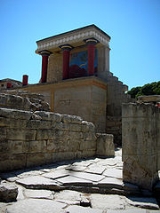
Cnosso98
The great palace was built gradually between 1700 and 1400 BC, with periodic rebuildings after destruction. Structures preceded it on Kephala hill. The features currently most visible date mainly to the last period of habitation, which Evans termed Late Minoan
Minoan chronology

Minoan chronology refers to the relative dating scheme developed by Sir Arthur Evans for the Bronze Age in Crete based on the excavations initiated and managed by him at the site of the ancient city of Knossos....
. The palace has an interesting layout - the original plan can no longer be seen because of the subsequent modifications. The 1300 rooms are connected with corridors of varying sizes and direction, which is different than other palaces of the time period which connected the rooms via several main hallways. The of the palace included a theatre, a main entrance on each of its four cardinal faces, and extensive storerooms (also called magazines). The storerooms contained pithoi (large clay vases) that held oil, grains, dried fish, beans, and olives. Many of the items were created at the palace itself, which had grain mills, oil presses, and wine presses. Beneath the pithoi were stone holes used to store more valuable objects, such as gold. The palace used advanced architectural techniques; for example, part of it was built up to five stories high.

Liquid management

The palace had at least three separate liquid management systems, one for supply, one for drainage of runoff, and one for drainage of waste water.

Aqueducts brought fresh water to Kephala hill from springs
Spring (hydrosphere)

A spring is a point where groundwater flows out from the ground, and is thus where the aquifer surface meets the ground surface.Dependent upon the constancy of the water source , a spring may be ephemeral or Perennial stream ....
 at Archanes
Archanes

Archanes is a municipality in the Heraklion Prefecture, Crete, Greece. Population 4,548 . It is also the archaeological site of an ancient Minoan civilization human settlement in central Crete....
, about 10 km away. Springs there are the source of the Kairatos
Amnisos

Amnisos, also Amnissos and Amnisus, is a Bronze Age settlement on the north shore of Crete used as a port to the palace city of Knossos....
 river, in the valley of which Kephala is located. The aqueduct branched to the palace and to the town. Water was distributed at the palace by gravity feed through terra cotta
Terra cotta

Terra cotta, Terracotta or Terra-cotta is a clay-based unglazed ceramic. Its uses include vessels, water & waste water pipes and surface embellishment in building construction, along with sculpture such as the Terracotta Army and Greek terracotta figurines....
 pipes to fountains and spigots. The pipes were tapered at one end to make a pressure fit, with rope for sealing. The water supply system would have been manifestly easy to attack. No hidden springs have been discovered as at Mycenae
Mycenae

Mycenae , is an archaeology in Greece, located about 90 km south-west of Athens, in the north-eastern Peloponnese. Argos is 6 km to the south; Corinth, 48 km to the north....
.

Sanitation drainage was through a closed system leading to a sewer
Sanitary sewer

A sanitary sewer is a type of underground carriage system for transporting sewage from houses or industry to sewage treatment or disposal....
 apart from the hill. The Queen's Megaron contained an example of the first water flushing system toilet
Toilet

A toilet is a plumbing fixture and disposal system primarily intended for the disposal of the excretory system: urine and feces. Additionally, vomit and menstrual waste is sometimes disposed in toilets in western societies....
 adjoining the bathroom. This toilet was a seat over drain flushed by pouring water from a jug. The bathtub located in the adjoining bathroom similarly had to be filled by someone heating, carrying, and pouring water, and must have been drained by overturning into a floor drain
Floor drain

A floor drain is a plumbing fixture that is installed in the floor of a structure, mainly designed to remove any Water stagnation near it. They are usually round, but can also be square or rectangular....
 or by bailing. This toilet and bathtub were exceptional structures within the 1300-room complex.

As the hill was periodically drenched by torrential rains, a runoff system was a necessity. It began with channels in the flat surfaces, which were zig-zag and contained catchment basins to control the water velocity. Probably the upper system was open. Manholes provided access to parts that were covered.

Some links to photographs of parts of the water collection management system follow.
  • . Sloped channels lead from a catchment basin.
  • Note the zig-zags and the catchment basin.


Ventilation

Due to its placement on the hill, the palace received sea breezes during the summer. It had portico
Portico

A portico is a porch that is leading to the entrance of a building, or extended as a colonnade, with a roof structure over a walkway, supported by columns or enclosed by walls....
es and airshafts.

Lighting and heating

The palace was designed to take best advantage of natural lighting during the long days of the summer season. The suites of rooms were arranged around courtyards
Courtyard

For alternative meanings of the word "court", see: Court .A court or courtyard is an enclosed area, often a space enclosed by a building that is open to the sky....
 to provide more window openings, the doors were ("multiple-door") to provide more door opening area, wound around the periphery of light wells, and corridors were open wherever possible. One cannot imagine that the palace shut down at night for lack of light, however. Minoan Crete had a long tradition of ceramic , which consisted of a reservoir of olive oil surrounded by niches for one or more wicks. The better lamps multiplied the niches and wicks to provide more candle-power
Candela

The candela is the SI base unit of luminous intensity; that is, power emitted by a light source in a particular direction, weighted by the luminosity function ....
.

Winter must have presented the Palace of Minos with as much of a heating problem as its architecture solved the lighting problem. The wind would have swept through the open palace, increasing the chill factor, unless the openings were blocked. The door openings must have been provided with doors of wood or bronze, as in later Classical times. The , a depiction of houses on faience
Faience

Faience or fa?ence is the conventional name in English language for fine tin-glazed pottery on a delicate pale buff body. The invention of a white pottery glaze suitable for painted decoration, by the addition of an stannous oxide to the slip of a lead glaze, was a major advance in the history of pottery....
 found at Knossos, shows windows with cross-members and four panes, suggesting that some translucent substance was used to block the openings. There is no sign of glass panes.

No central heating
Central heating

File:Boiler and Cylinder.jpgFile:Panna.jpgA central heating system provides warmth to the whole interior of a building from one point to multiple room s....
 is in evidence. The rooms must have been heated individually. Fixed hearths were used to some degree but there is long tradition of portable ceramic hearths as well. The Minoans never made the transition from a portable hearth to a closed metal stove, which would have been technologically within their grasp and are much more efficient radiators.

Fires within the palace were for the most part of charcoal, probably lit with olive oil, in hearths or brazier
Brazier

A brazier is a container for fire, generally taking the form of an upright standing or hanging metal bowl or box. Used for holding burning coal as well as fires, a brazier allows for a source of light, heat, or cooking....
s. The tall drafty rooms, probably with smoke openings at the top (the roofs did not survive), were designed to keep the smoke away from the humans and evacuate it as quickly as possible. The palace undoubtedly reeked of smoke within and gave a pillar of it without. Odor issues would have been mitigated with incense
Incense

Incense is composed of aromatic Biotic material materials. It releases fragrant smoke when burned. The term incense refers to the substance itself, rather than to the odor that it produces....
 and perfumed unguents kept in pyx
Pyx

A pyx or pix is a small container used in the Roman Catholic, Old Catholic and Anglican Churches to carry the consecrated Host , to the sick or invalid or those otherwise unable to come to a church in order to receive Holy Communion....
es.

The emphasis of palace civilizations in colder climes on home production of textiles is understandable. The open vests of the women and the loin cloths of the nearly nude men could only have been summer attire. No frescos of snow-clad mountains and frosty plains are in evidence, such as appear in Crete in the winter. Over such a length of time, no perishables, such as boots or winter robes, have survived, but the frescos cannot depict year-round ordinary life in Crete.

Minoan Columns

The palace also includes the Minoan Column, a structure notably different from other Greek columns. Unlike the stone columns characteristic of other Greek architecture, the Minoan column was constructed from the trunk of a cypress
Cypress

Cypress is the name applied to many plants in the Pinophyta family Cupressaceae . Most plants which bear the common name cypress are in the genera Cupressus and Chamaecyparis, but several other genera in the family also carry the name, including:...
 tree, common to the Mediterranean. While most Greek columns are smaller at the top and wider at the bottom to create the illusion of greater height, the Minoan columns are smaller at the bottom and wider at the top, a result of inverting the cypress trunk to prevent sprouting once in place. The columns at the Palace of Minos
Minos

In Greek mythology, Minos was a mythical king of Crete, son of Zeus and Europa . After his death, Minos became a judge of the dead in Greek Underworld....
 were painted red and mounted on stone bases with round, pillow-like capitals
Capital (architecture)

In several traditions of architecture including Classical architecture, the capital forms the crowning member of a column or a pilaster. The capital projects on each side as it rises, in order to support the abacus and unite the form of the latter with the circular shaft of the column....
.

Frescoes

Knossos Bull
Fresco
Fresco

Fresco is any of several related painting types, done on plaster on walls or ceilings. The word fresco comes from the Italian word affresco which derives from the adjective fresco , which has Latin origins....
es decorated the walls. As the remains were only fragments, fresco reconstruction and placement by the artist Piet de Jong is not without controversy. These sophisticated, colorful paintings portray a society which, in comparison to the roughly contemporaneous art of Middle
Middle Kingdom of Egypt

The middle kingdom is the period in the history of ancient Egypt stretching from the establishment of the Eleventh dynasty of Egypt to the end of the Fourteenth dynasty of Egypt, roughly between 2040 BC and 1640 BC....
 and New Kingdom
New Kingdom

The New Kingdom, sometimes referred to as the Egyptian Empire, is the period in ancient Egyptian History of Ancient Egypt between the 16th century BC and the 11th century BC, covering the Eighteenth dynasty of Egypt, Nineteenth dynasty of Egypt, and Twentieth dynasty of Egypt....
 Egypt
Egypt

Egypt is a country mainly in North Africa, with the Sinai Peninsula forming a land bridge in Western Asia. Covering an area of about , Egypt borders the Mediterranean Sea to the north, the Gaza Strip and Israel to the northeast, the Red Sea to the east, Sudan to the south and Libya to the west....
, was either conspicuously non-militaristic or did not choose to portray military themes anywhere in their art. (See Minoan civilisation) One remarkable feature of their art is the colour-coding of the sexes: the men are depicted with ruddy skin, the women as milky white. Almost all their pictures are of young or ageless adults, with few children or elders depicted. In addition to scenes of men and women linked to activities such as fishing and flower gathering, the murals also portray athletic feats. The most notable of these is bull-leaping
Bull-leaping

Bull-leaping is a motif of Middle Bronze Age figurative art, notably of Minoan Crete, but also found in Hittite Empire, the Levant, BMAC and the Indus Valley Civilization....
, in which an athlete grasps the bull's horns and vaults over the animal's back. The question remains as to whether this activity was a religious ritual
Ritual

A ritual is a set of repeated actions, often thought to have symbolic value, the performance of which is usually prescribed by a religion or by the traditions of a community by religious or political laws because of the perceived efficacy of those actions....
, possibly a sacrificial activity, or a sport
Sport

Sport is an activity that is governed by a set of regulation of sport or traditions and often engaged in competitively. Sports commonly refer to activities where the physical capabilities of the competitor are the sole or primary determinant of the outcome , but the term is also used to include activities such as mind sports and motor...
, perhaps a form of bullfighting
Bullfighting

Bullfighting or tauromachy , is a traditional spectacle of Spain, Portugal, some cities in southern France, and several Latin American countries, in which one or more live bulls are ritually killed as a public spectacle....
. Many people have questioned if this activity is even possible; the fresco might represent a mythological dance with the Great Bull
Bull (mythology)

Appearances of the Bull in mythology and worship are widespread in the ancient world. It is the subject of various cultural and Religion incarnations, as well as modern mentions in new age cultures....
. The most famous example is the Toreador Fresco, painted around 1550-1450 BC, in which a young man, flanked by two women, apparently leaps onto and over a charging bull's back. It is now located in the Archaeological Museum of Herakleion in Crete.

Throne Room

Knossos Throne
The centerpiece of the "Mycenaean" palace was the so-called Throne Room
Throne room

Throne Room redirects here, for the album by CeCe Winans see Throne Room A throne room is the room, often rather a hall, in the official residence of the crown, either a palace or a fortified castle, where the throne of a senior figure is set up with elaborate pomp? usually raised, often with steps, and under a baldachin, both of which...
 or Little Throne Room, dated to LM II
Minoan chronology

Minoan chronology refers to the relative dating scheme developed by Sir Arthur Evans for the Bronze Age in Crete based on the excavations initiated and managed by him at the site of the ancient city of Knossos....
. This chamber has an alabaster
Alabaster

Alabaster is a name applied to varieties of two distinct minerals: gypsum and calcite . The former is the alabaster of the present day; the latter is generally the alabaster of the ancients....
 seat identified by Evans as a "throne
Throne

A throne is the official chair or seat upon which a monarch is seated on state or ceremonial occasions. "Throne" in an abstract sense can also refer to the monarchy or the Crown itself, an instance of metonymy, and is also used in many terms such as "power behind the throne"....
" built into the north wall. On three sides of the room are gypsum
Gypsum

Gypsum is a very soft mineral composed of calcium sulfate dihydrate, with the chemical formula calciumsulfuroxygen4?2water....
 benches. A sort of tub area is opposite the throne, behind the benches, termed a lustral basin, meaning that Evans and his team saw it as a place for ceremonial purification.

The room was accessed from an anteroom through two double doors. The anteroom in turn connected to the central court, which was four broad steps up through four doors. The anteroom had gypsum benches also, with carbonized remains between two of them thought to be a possible wooden throne. Both rooms are located in the ceremonial complex on the west of the central court.

The throne is flanked by the Griffin Fresco, with two griffins couchant (lying down) facing the throne, one on either side. Griffins were important mythological creatures, also appearing on seal rings
Seal (device)

A seal can mean a wax seal bearing an impressed figure, or an embossed figure in paper, with the purpose of authenticating a document, but the term can also mean any device for making such impressions or embossments, essentially being a Molding that has the mirror image of the figure in counter-relief, such as mounted on rings known a...
, which were used to stamp the identity of the bearer into pliable material, such as clay or wax.

The actual use of the room and the throne is unclear. The two main theories are:

  • The seat of a priest-king or his consort
    Queen consort

    A queen consort is the title given to the wife of a reigning Monarch. Queens consort usually share their husbands' Royal and noble ranks and hold the feminine equivalent of their husbands' monarchical titles....
    , the queen. This is the older theory, originating with Evans. In that regard Matz speaks of the "heraldic
    Heraldry

    Heraldry is the profession, study, or art of devising, granting, and blazoning Coat of arms and ruling on questions of rank or protocol, as exercised by an officer of arms....
     arrangement" of the griffins, meaning that they are more formal and monumental than previous Minoan decorative styles. In this theory, the Mycenaean
    Mycenaean

    Mycenaean may refer to:* Mycenae, coming from or belonging to this ancient town in Peloponnese in Greece* Mycenaean Greece, the Greek-speaking regions of the Aegean Sea as of the Late Bronze Age, named after the Mycenae of the Trojan War epics...
     Greeks would have held court in this room, as they came to power in Knossos at about 1450. The "lustral basin" and the location of the room in a sanctuary complex cannot be ignored; hence, "priest-king."
  • A room reserved for the epiphany of a goddess, who would have sat in the throne, either in effigy
    Effigy

    An effigy is a representation of a person, especially in the form of sculpture.The term is usually associated with full-length figures of a deceased person depicted in stone or wood on church monuments....
    , or in the person of a priestess, or in imagination only. In that case the griffins would have been purely a symbol of divinity
    Divinity

    Divinity and divine are broadly applied but loosely defined terms, used variously within different faiths and belief systems ? and even by different individuals within a given faith ? to refer to some transcendent or transcendental power, or its attributes or manifestations in the world....
     rather than a heraldic motif.


The lustral basin was originally thought to have had a ritual washing use, but the lack of drainage has more recently brought some scholars to doubt this theory. It is now speculated that the tank was used as an aquarium.

Society

A long-standing debate between archaeologists concerns the main function of the palace, whether it acted primarily as an administrative center, a religious center -- or both, in a theocratic
Theocracy

Theocracy is a form of government in which a god or deity is recognized as the state's supreme civil ruler, or in a broader sense, a form of government in which a state is governed by immediate divine guidance or by officials who are regarded as divinely guided....
 manner. Other important debates consider the role of Knossos in the administration of Bronze Age
Bronze Age

The Bronze Age is, with respect to a given prehistory, the period in that society when the most advanced metalworking included smelting copper and tin from naturally-occurring outcroppings of copper and tin ores, creating a bronze alloy by melting those metals together, and casting them into bronze artifact s....
 Crete
Crete

Crete is the largest of the Greek islands and the List of islands in the Mediterranean largest island in the Mediterranean Sea at 8,336 km? ....
, and whether Knossos acted as the primary center, or was on equal footing with the several other contemporary palaces that have been discovered on Crete. Many of these palaces were destroyed and abandoned in the early part of the 15th century BC, possibly by the Mycenaeans, although Knossos remained in use until destroyed by fire about one hundred years later. It is worth noting that Knossos showed no signs of being a military site -- no fortifications or stores of weapons, for example. Minoan civilization
Minoan civilization

The Minoan civilization was a Bronze Age civilization which arose on the island of Crete. The Minoan culture flourished from approximately 27th century BC to 1450 BC; afterwards, Mycenaean Greece culture became dominant at Minoan sites in Crete....
 was a remarkably unmilitaristic society. Likewise, the position of Minoan women was unusual compared to any other contemporary society in the aspect that it was matriarchal.

Notable people

  • Chersiphron
    Chersiphron

    Chersiphron , an architect of Knossos in Crete, was the builder of the Temple of Artemis at Ephesus, on the Ionia. The temple had been begun about 600 BC, and was completed by other architects....
     (6th century BC) architect
  • Metagenes
    Metagenes

    Metagenes son of the Cretan architect Chersiphron, also was an architect. He was co-author, along with his father, of the construction of the Temple of Artemis at Ephesus, one of the Seven Wonders of the Ancient World....
     (6th century BC) architect


See also


  • The Palace of Knossos was selected as the main motif of a recent commemorative coin, the Greek €100 Palace of Knossos commemorative coin
    Euro gold and silver commemorative coins (Greece)

    Euro gold and silver commemorative coins are special euro coins Mint and issued by member states of the Eurozone, mainly in gold and silver, although other precious metals are also used in rare occasions....
    , minted in 2003. This coins was issued in a series of coins celebrating the 2004 Summer Olympics
    2004 Summer Olympics

    The 2004 Summer Olympic Games, officially known as the Games of the XXVIII Olympiad, was a premier international multi-sport event held in Athens, Greece from August 13 to August 29, 2004 with the motto Welcome Home. 10,625 athletes competed, some 600 more than expected, accompanied by 5,501 team officials from 201 countries....
    . In the obverse a view of the palace can be seen.


  • Linear A
    Linear A

    Linear A is one of two linear scripts used in ancient Crete before Mycenaean Greek language Linear B. In Minoan Civilization times, before the Greek Mycenaean dominion, Linear A was the official script for the palaces and the cult and Cretan Hieroglyphs were mainly used on seals....
  • Linear B
    Linear B

    Linear B is a script that was used for writing Mycenaean language, an early form of Greek language. It predated the Greek alphabet by several centuries and seems to have died out with the fall of Mycenaean Greece civilization....
  • Magasa
    Magasa, Crete

    This article is about a Neolithic settlement in Crete; for the town in Italy, see Magasa, Italy.Magasa is a Neolithic human settlement on the eastern part of the island of Crete in present day Greece....
  • Minoan civilization
    Minoan civilization

    The Minoan civilization was a Bronze Age civilization which arose on the island of Crete. The Minoan culture flourished from approximately 27th century BC to 1450 BC; afterwards, Mycenaean Greece culture became dominant at Minoan sites in Crete....
  • Trapeza
    Trapeza, Crete

    Trapeza, Crete is a Neolithic and Bronze Age human settlement on the island of Crete in Greece. Some of the Bronze Age pottery finds at Trapeza are similar to specimens recovered at Knossos and Vasiliki....


Sources

  • Benton, Janetta Rebold and Robert DiYanni.Arts and Culture: An introduction to the Humanities, Volume 1. Prentice Hall. New Jersey, 1998. [Pages 64-70]
  • Bourbon, F. Lost Civilizations Barnes and Noble, Inc. New York, 1998. [Pages 30-35]
  • CALENDAR HOUSE: Secrets of Time, Life & Power in Ancient Crete's Great Year. 2007: researched/written/published (CD) by Dr. Jack Dempsey.


External links

  • . This site contains an Activex tour with moving panoramas through the palace.