
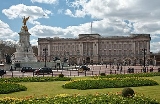
Buckingham Palace is the official
London[]London is the capital of England and the United Kingdom. It has been a major settlement for two millennia, and the history of London goes back to its founding by the Romans, when it was named Londinium. London's core, the ancient City of London, the 'square mile', retains its medieval boundaries...
residence of the British monarch. Located in the
City of WestminsterThe City of Westminster is a borough of London with city status. It is located west of the City of London and north of the River Thames, and forms part of Inner London and the bulk of London's central area....
, the
palaceA palace is a grand residence, especially a royal residence or the home of a head of state or some other high-ranking dignitary, such as a bishop or archbishop. The word itself is derived from the Latin name Palātium, for Palatine Hill, one of the seven hills in Rome...
is a setting for state occasions and royal hospitality. It has been a rallying point for the British people at times of national rejoicing and crisis.
Originally known as
Buckingham House, the building which forms the core of today's palace was a large
townhouseHistorically in the United Kingdom, Ireland and in many other countries, a townhouse was a residence of a peer or member of the aristocracy in the capital or major city. Most such figures owned one or more country houses in which they lived for much of the year...
built for the
Duke of BuckinghamJohn Sheffield, 1st Duke of Buckingham and Normanby, KG, PC , English statesman and poet, was the son of Edmund Sheffield, 2nd Earl of Mulgrave, and succeeded to that title on his father’s death in 1658....
in 1703 on a site which had been in private ownership for at least 150 years. It was subsequently acquired by
George IIIGeorge III was King of Great Britain and King of Ireland from 25 October 1760 until the union of these two countries on 1 January 1801, after which he was King of the United Kingdom of Great Britain and Ireland until his death...
in 1761 as a private
residenceA house is generally a shelter, building or structure that is a dwelling or place for habitation by human beings. The term includes many kinds of dwellings ranging from rudimentary huts of nomadic tribes to high-rise apartment buildings...
for Queen Charlotte, and known as "The Queen's House". During the 19th century it was enlarged, principally by
architectAn architect is trained and licensed in planning and designing buildings, and participates in supervising the construction of a building. Etymologically, architect derives from the Latin architectus, itself derived from the Greek arkhitekton , i.e. chief builder...
s
John NashJohn Nash was an Anglo-Welsh architect responsible for much of the layout of Regency London.-Early life:Born in Lambeth, London, as the son of a Welsh millwright, Nash trained with architect Sir Robert Taylor, but his own career was initially unsuccessful and short-lived...
and
Edward BloreEdward Blore was a 19th century British architect and antiquary. He was born in Edinburgh, Scotland....
, forming three wings around a central courtyard. Buckingham Palace finally became the official royal palace of the British monarch on the accession of
Queen VictoriaVictoria was the Queen of the United Kingdom of Great Britain and Ireland from 20 June 1837, and the first Empress of India of the British Raj from 1 May 1876, until her death...
in 1837. The last major structural additions were made in the late 19th and early 20th centuries, including the East front which contains the well-known balcony on which the Royal Family traditionally congregate to greet crowds outside. However, the palace chapel was destroyed by a German bomb in World War II; the
Queen's GalleryThe Queen's Gallery is a public art gallery located at Buckingham Palace, home of the British monarch, in London. It exhibits works of art from the Royal Collection The Queen's Gallery is a public art gallery located at Buckingham Palace, home of the British monarch, in London. It exhibits works of...
was built on the site and opened to the public in 1962 to exhibit works of art from the
Royal CollectionThe Royal Collection is the art collection of the British Royal Family. It is property of the monarch as sovereign, but is held in trust for her successors and the nation. It contains over 7,000 paintings, 40,000 watercolours and drawings, and about 150,000 old master prints, as well as...
.
The original early 19th-century interior designs, many of which still survive, included widespread use of brightly coloured
scagliolaScagliola , is a technique for producing stucco columns, sculptures, and other architectural elements that resemble inlays in marble and semi-precious stones...
and blue and pink
lapisLapis lazuli is a relatively rare, semi-precious stone that has been prized since antiquity for its intense blue color....
, on the advice of Sir Charles Long.
King Edward VIIEdward VII was King of the United Kingdom and the British Dominions and Emperor of India from 22 January 1901 until his death on 6 May 1910...
oversaw a partial redecoration in a
Belle epoqueThe Belle Époque was a period in European social history that began during the late 19th century and lasted until World War I...
cream and gold colour scheme. Many smaller reception rooms are furnished in the
ChineseChina is a cultural region, an ancient civilization, and, depending on perspective, a national or multinational entity extending over a large area in East Asia....
regencyChinoiserie, a French term, signifying "Chinese-esque", refers to a recurring theme in European artistic styles since the seventeenth century, which reflect Chinese artistic influences...
style with furniture and fittings brought from the
Royal PavilionThe Royal Pavilion is a former royal residence located in Brighton, England. It was built in the early 19th Century as a seaside retreat for the then Prince Regent. It is often referred to as the Brighton Pavilion...
at
BrightonBrighton is a town in the city of Brighton and Hove in East Sussex on the south coast of Great Britain...
and from Carlton House. The Buckingham Palace Garden is the largest private garden in London.
The state rooms, used for official and state entertaining, are open to the public each year for most of August and September, as part of the Palace's Summer Opening.
History
The site
In the
Middle AgesThe Middle Ages of European history is a period of European history covering roughly a millennium in the 5th century through 16th centuries. More specific starting and ending points are sometimes adopted by scholars to suit their respective specializations or current focus...
, Buckingham Palace's site formed part of the Manor of Ebury (also called Eia). The marshy ground was watered by the river
TyburnThe Tyburn is a stream in London, which runs underground from South Hampstead through St. James's Park to meet the River Thames at Pimlico near Vauxhall Bridge. It is not to be confused with the Tyburn Brook which is a tributary of the River Westbourne....
, which still flows below the courtyard and south wing of the palace. Where the river was fordable (at Cow Ford), the village of Eye Cross grew. Ownership of the site changed hands many times; owners included
Edward the ConfessorEdward the confessor , son of Æthelred the Unready and Emma of Normandy, was one of the last English kings of England and is usually regarded as the last king of the House of Wessex, ruling from 1042 to 1066 Edward the confessor ...
and his
queen consortA queen consort is the wife of a reigning king. A queen consort usually shares her husband's rank and holds the feminine equivalent of the king's monarchical titles...
Edith of WessexEdith of Wessex, , married King Edward the Confessor of England in 1045. The marriage produced no children. Later ecclesiastical writers claimed that this was either because Edward took a vow of celibacy, or because he refused to consummate the marriage because of his antipathy to Edith's family,...
in late Saxon times, and, after the
Norman ConquestThe Norman conquest of England began in 1066 with the invasion of the Kingdom of England by the troops of William, Duke of Normandy, and his victory at the Battle of Hastings. This resulted in Norman control of England, which was firmly established during the subsequent few years. The Norman...
,
William the ConquerorWilliam I , better known as William the Conqueror, was Duke of Normandy from AD 1035 and King of England from late 1066 to his death. William is sometimes also referred to as "William II" in relation to his position as the second Duke of Normandy of that name...
. William gave the site to
Geoffrey de MandevilleGeoffrey de Mandeville was Constable of the Tower of London. His surname comes from the town of Manneville or Magna Villa near Valognes in Manche on the Cotentin Peninsula....
, who bequeathed it to the monks of
Westminster AbbeyThe Collegiate Church of St Peter at Westminster, which is almost always referred to popularly and informally as Westminster Abbey, is a large, mainly Gothic church, in Westminster, London, just to the west of the Palace of Westminster...
.
In 1531,
Henry VIIIHenry VIII was King of England from 21 April 1509 until his death. He was also Lord of Ireland and claimant to the Kingdom of France. Henry was the second monarch of the House of Tudor, succeeding his father, Henry VII.Henry VIII was a significant figure in the history of the English monarchy...
acquired the Hospital of St James (later
St. James's PalaceSt. James's Palace is one of London's oldest palaces. It is situated in Pall Mall, just north of St. James's Park. Although no sovereign has resided there for almost two centuries, it is considered the most senior royal palace in the UK and gives its name to the Royal Court St. James's Palace is...
) from
Eton CollegeEton College, often referred to simply as Eton, is a British independent boarding school for boys aged approx. 13 to 19. It was founded in 1440 by King Henry VI as "The King's College of Our Lady of Eton besides Wyndsor"....
, and in 1536 he took the Manor of Ebury from Westminster Abbey. These transfers brought the site of Buckingham Palace back into royal hands for the first time since William the Conqueror had given it away almost 500 years earlier.
Various owners leased it from royal landlords and the
freeholdA fee simple is an estate in land. It is the most common way real estate is owned in common law countries, and is ordinarily the most complete ownership interest that can be had in real property short of allodial title, which is often reserved for governments...
was the subject of frenzied speculation during the 17th century. By then, the old village of Eye Cross had long since fallen into decay, and the area was mostly wasteland. Needing money,
James IJames VI & I was King of Scots as James VI from 1567 to 1625, and King of England and Ireland as James I from 1603 to 1625....
sold off part of the Crown freehold but retained part of the site on which he established a mulberry garden for the production of silk. (This is at the northwest corner of today's palace.)
Clement WalkerClement Walker was an English lawyer, official and politician. As a member of the Long Parliament, he became an outspoken critic of the conduct of its affairs, and allied himself to William Prynne...
in
Anarchia Anglicana (1649) refers to "new-erected sodoms and spintries at the Mulberry Garden at S. James's"; this suggests it may have been a place of debauchery. Eventually, in the late 17th century, the freehold was inherited from the property tycoon Sir
Hugh AudleyHugh Audley was an English moneylender, lawyer and philosopher. Following his death, he was the feature of a popular 17th century pamphlet titled The way to be rich according to the practice of the Great Audley, which compared his humble beginnings to his ultimate fortune.The first recorded date of...
by the great heiress Mary Davies.
Goring House
Possibly the first house erected within the site was that of a Sir William Blake, around 1624. The next owner was
Lord GoringGeorge Goring, 1st Earl of Norwich was an English soldier.He was the son of George Goring of Hurstpierpoint and Ovingdean, Sussex, and of Anne Denny, sister of Edward Denny, Earl of Norwich. He matriculated from Sidney Sussex College, Cambridge in 1600, and may subsequently have spent some time in...
, who from 1633 extended Blake's house and developed much of today's garden, then known as Goring Great Garden. He did not, however, manage to obtain freehold interest in the mulberry garden. Unbeknown to Goring, in 1640 the document "failed to pass the
Great SealThe Great Seal of the Realm or Great Seal of the United Kingdom is a seal that is used to symbolise the monarch's approval of important state documents...
before
King Charles ICharles I, , the second son of James VI of Scotland and I of England, was King of England, Scotland and Ireland from 27 March 1625 until his execution. Charles famously engaged in a struggle for power with the Parliament of England...
fled London, which it needed to do for
legal executionCapital punishment or the death penalty, is the execution of a person by judicial process as a punishment for an offense. Crimes that can result in a death penalty are known as capital crimes or capital offences....
". (It was this critical omission that helped the British royal family regain the freehold under
King George IIIGeorge III was King of Great Britain and King of Ireland from 25 October 1760 until the union of these two countries on 1 January 1801, after which he was King of the United Kingdom of Great Britain and Ireland until his death...
.)
Arlington House
The improvident Goring defaulted on his rents;
Henry Bennet, 1st Earl of ArlingtonHenry Bennet, 1st Earl of Arlington KG, PC , was an English statesman.He was the son of Sir John Bennet of Dawley, Middlesex, and of Dorothy Crofts, was the younger brother of John Bennet, 1st Baron Ossulston, was baptized at Little Saxham, Suffolk, in 1618, and was educated at Westminster School...
obtained the mansion and was occupying it, now known as Goring House, when it burned down in 1674. Arlington House rose on the site—the southern wing of today's palace—the next year, and its freehold was bought in 1702.
Buckingham House
The house which forms the architectural core of the present palace was built for the first
Duke of Buckingham and NormanbyJohn Sheffield, 1st Duke of Buckingham and Normanby, KG, PC , English statesman and poet, was the son of Edmund Sheffield, 2nd Earl of Mulgrave, and succeeded to that title on his father’s death in 1658....
in 1703 to the design of
William WindeCaptain William Winde was an English gentleman architect, whose Royalist military career, resulting in fortifications and topographical surveys, and his later career, as designer or simply "conductor" of the works of country houses, has been epitomised by Howard Colvin, who said that "Winde ranks...
. The style chosen was of a large, three-floored central block with two smaller flanking service wings. Buckingham House was eventually sold by Buckingham's descendant, Sir Charles Sheffield, in 1761 to
George IIIGeorge III was King of Great Britain and King of Ireland from 25 October 1760 until the union of these two countries on 1 January 1801, after which he was King of the United Kingdom of Great Britain and Ireland until his death...
for
£The pound, a unit of currency, originated in England as the value of a pound mass of silver. Historically, £1 worth of silver coins were a troy pound in mass; as of October 2009 this amount of silver is worth approximately £130....
21,000.
Like his grandfather, George II, George III refused to sell the mulberry garden interest, so that Sheffield had been unable to purchase the full freehold of the site. When Sheffield sold Buckingham House it came into the hands of the Royal Family.
From Queen's House to palace
The house was originally intended as a private retreat, and in particular for
Queen CharlotteCharlotte of Mecklenburg-Strelitz was the queen-consort of the United Kingdom as wife of King George III.Queen Charlotte was a patroness of the arts, known to Johann Christian Bach and Wolfgang Amadeus Mozart, among others. She was also an amateur botanist who helped establish Kew Gardens...
, and was known as The Queen's House—14 of their 15 children were born there.
St. James's PalaceSt. James's Palace is one of London's oldest palaces. It is situated in Pall Mall, just north of St. James's Park. Although no sovereign has resided there for almost two centuries, it is considered the most senior royal palace in the UK and gives its name to the Royal Court St. James's Palace is...
remained the official and ceremonial royal residence.
Remodelling of the structure began in 1762. After his accession to the throne in 1820,
George IVGeorge IV was the king of Hanover and the United Kingdom of Great Britain and Ireland from the death of his father, George III, on 29 January 1820 until his own death ten years later...
continued the renovation with the idea in mind of a small, comfortable home. While the work was in progress, in 1826, the King decided to modify the house into a palace with the help of his architect
John NashJohn Nash was an Anglo-Welsh architect responsible for much of the layout of Regency London.-Early life:Born in Lambeth, London, as the son of a Welsh millwright, Nash trained with architect Sir Robert Taylor, but his own career was initially unsuccessful and short-lived...
. Some furnishings were transferred from Carlton House, and others had been bought in France after the French Revolution. The external facade was designed in the French neo-classical influence preferred by George IV. The cost of the renovations grew exponentially and by 1829, the extravagance of Nash's designs resulted in his removal as architect. On the death of George IV in 1830, his younger brother
William IVWilliam IV may refer to:* William IV of Aquitaine .* William IV of Provence .* William, Margrave of Meissen , also William IV of Weimar.* William IV of Toulouse William IV may refer to:* William IV of Aquitaine (937–994).* William IV of Provence (died 1030).* William, Margrave of Meissen (died...
hired
Edward BloreEdward Blore was a 19th century British architect and antiquary. He was born in Edinburgh, Scotland....
to finish the work. At one stage, William considered converting the palace into the new Houses of Parliament, after the destruction of the
existing namesakeThe Palace of Westminster, also known as the Houses of Parliament, is the seat of the two houses of the Parliament of the United Kingdom—the House of Lords and the House of Commons...
by fire in 1834.
Home of the monarch
Buckingham Palace finally became the principal royal residence in 1837, on the accession of
Queen VictoriaVictoria was the Queen of the United Kingdom of Great Britain and Ireland from 20 June 1837, and the first Empress of India of the British Raj from 1 May 1876, until her death...
, who was the first monarch to reside there as her predecessor William IV had died before its completion. While the
state roomA state room in a large European mansion is usually one of a suite of very grand rooms which were designed to impress. The term was most widely used in the 17th and 18th centuries. They were the most lavishly decorated in the house and contained the finest works of art...
s were a riot of gilt and colour, the necessities of the new palace were somewhat less luxurious. For one thing, it was reported the chimneys smoked so much that the fires had to be allowed to die down, and consequently the court shivered in icy magnificence. Ventilation was so bad that the interior smelled, and when a decision was taken to install gas lamps, there was a serious worry about the build-up of gas on the lower floors. It was also said that the staff were lax and lazy and the palace was dirty. Following the Queen's marriage in 1840, her husband, Prince Albert, concerned himself with a reorganisation of the
householdThe Royal Household in all the early medieval monarchies of Western Europe formed the basis for the general government of the country. In the modern period in Europe, royal households have become increasingly separate from government, where they still exist....
offices and staff, and with the design faults of the palace. The problems were all rectified by the close of 1840. However, the builders were to return within the decade.
By 1847, the couple had found the palace too small for court life and their growing family, and consequently the new wing, designed by
Edward BloreEdward Blore was a 19th century British architect and antiquary. He was born in Edinburgh, Scotland....
, was built by
Thomas CubittThomas Cubitt , born Buxton, Norfolk, was the leading master builder in London in the second quarter of the 19th century, and also carried out several projects in other parts of England.-Background:...
, enclosing the central quadrangle. The large East Front facing The Mall is today the "public face" of Buckingham Palace and contains the balcony from which the
Royal FamilyA royal family is the extended family of a king or queen regnant. The term "imperial family" more appropriately describes the extended family of an emperor or empress regnant, while the terms "ducal family", "grand ducal family" or "princely family" are more appropriate in reference to the...
acknowledge the crowds on momentous occasions and annually after
Trooping the ColourTrooping the Colour is a ceremony performed by regiments of the Commonwealth and the British Army. It has been a tradition of British infantry regiments since the 17th century, although the roots go back much earlier. On battlefields, a regiment's colours, or flags, were used as rallying points...
. The
ballroomA ballroom is a large room inside a building, the designated purpose of which is holding formal dances called balls. Traditionally, most balls were held in private residences; many mansions contain one or more ballrooms...
wing and a further suite of state rooms were also built in this period, designed by Nash's student
Sir James PennethorneSir James Pennethorne was a notable 19th century English architect and planner, particularly associated with buildings and parks in central London....
.
Before Prince Albert's death, the palace was frequently the scene of musical entertainments, and the greatest contemporary musicians entertained at Buckingham Palace. The composer
Felix MendelssohnJakob Ludwig Felix Mendelssohn Bartholdy, born, and generally known in English-speaking countries, as Felix Mendelssohn was a German composer, pianist, organist and conductor of the early Romantic period....
is known to have played there on three occasions.
Johann Strauss IIJohann Strauss II was an Austrian composer of light music, particularly dance music and operettas...
and his
orchestraAn orchestra is an instrumental ensemble, usually fairly large with string, brass, woodwind sections, and possibly a percussion section as well. The term orchestra derives from the name for the area in front of an ancient Greek stage reserved for the Greek chorus...
played there when in England. Strauss's "Alice Polka" was first performed at the palace in 1849 in honour of the Queen's daughter, Princess Alice. Under Victoria, Buckingham Palace was frequently the scene of lavish costume balls, in addition to the routine royal ceremonies, investitures and presentations.
Widowed in 1861, the grief-stricken Queen withdrew from public life and left Buckingham Palace to live at
Windsor CastleWindsor Castle, in Windsor in the English country of Berkshire, is the largest inhabited castle in the world and, dating back to the time of William the Conqueror, is the oldest in continuous occupation...
,
Balmoral CastleBalmoral Castle is a large estate house situated in the area of Aberdeenshire, Scotland, known as Royal Deeside. The estate was purchased by Queen Victoria's consort Prince Albert, and remains a favourite summer royal residence....
, and
Osborne HouseOsborne House is a former royal residence in East Cowes, Isle of Wight, UK. The house was built between 1845 and 1851 for Queen Victoria and Prince Albert as a summer home and rural retreat....
. For many years the palace was seldom used, and even neglected. Eventually, public opinion forced her to return to London, though even then she preferred to live elsewhere whenever possible. Court functions were still held at Windsor Castle rather than at the palace, presided over by the sombre Queen habitually dressed in mourning black while Buckingham Palace remained shuttered for most of the year.
Interior
The palace contains 77,000 square metres of floorspace (828,818 sq ft). The principal rooms of the palace are contained on the
piano nobileThe piano nobile is the principal floor of a large house, usually built in one of the styles of classical renaissance architecture...
behind the west-facing garden facade at the rear of the palace. The centre of this ornate suite of state rooms is the Music Room, its large bow the dominant feature of the facade. Flanking the Music Room are the Blue and the White Drawing rooms. At the centre of the suite, serving as a corridor to link the state rooms, is the Picture Gallery, which is top-lit and 55 yards (50 m) long. The Gallery is hung with numerous works including some by
RembrandtRembrandt Harmenszoon van Rijn was a Dutch painter and etcher. He is generally considered one of the greatest painters and printmakers in European art history and the most important in Dutch history...
,
van DyckSir Anthony van Dyck was a Flemish Baroque artist who became the leading court painter in England. He is most famous for his portraits of King Charles I of England and Scotland and his family and court, painted with a relaxed elegance that was to be the dominant influence on English...
,
RubensSir Peter Paul Rubens was a prolific seventeenth-century Flemish Baroque painter, and a proponent of an exuberant Baroque style that emphasized movement, color, and sensuality...
and
VermeerJohannes, Jan or Johan Vermeer was a Dutch Baroque painter who specialized in exquisite, domestic interior scenes of middle class life. Vermeer was a moderately successful provincial genre painter in his lifetime...
; other rooms leading from the Picture Gallery are the
Throne RoomA throne room is the room, often rather a hall, in the official residence of the crown, either a palace or a fortified castle, where the throne of a senior figure is set up with elaborate pomp— usually raised, often with steps, and under a canopy, both of which are part of the original notion of...
and the Green Drawing Room. The Green Drawing room serves as a huge anteroom to the Throne Room, and is part of the ceremonial route to the
throneA throne is the official chair or seat upon which a monarch is seated on state or ceremonial occasions. "Throne" in an abstract sense can also refer to the monarchy or the Crown itself, an instance of metonymy, and is also used in many terms such as "the power behind the throne".-Thrones in ancient...
from the Guard Room at the top of the Grand staircase. The Guard Room contains white marble statues of Queen Victoria and Prince Albert, in Roman costume, set in a
tribuneTribune is an ambiguous often misused architectural term which can have several meanings.The word stems from medieval Latin tribuna, from classical Latin tribunal, the elevated placing of a Tribune or other Roman magistrate's seat for official functions such as throne.In architecture, the term...
lined with tapestries. These very formal rooms are used only for ceremonial and official entertaining, but are open to the public every summer.
Directly underneath the
State ApartmentsA state room in a large European mansion is usually one of a suite of very grand rooms which were designed to impress. The term was most widely used in the 17th and 18th centuries. They were the most lavishly decorated in the house and contained the finest works of art...
is a suite of slightly less grand rooms known as the semi-state apartments. Opening from the Marble Hall, these rooms are used for less formal entertaining, such as luncheon parties and private
audiencesHead of state is the generic term for the individual or collective office that serves as the chief public representative of a monarchy, republic, federation, commonwealth or other kind of state...
. Some of the rooms are named and decorated for particular visitors, such as the
1844 Room, which was decorated in that year for the State visit of
EmperorTsar or czar , occasionally spelled csar or Tzar in English, is a Slavic term with Bulgarian origins used to designate certain monarchs...
Nicholas INicholas I , , was the Emperor of Russia from 1825 until 1855, known as one of the most reactionary of the Russian monarchs. On the eve of his death, the Russian Empire reached its historical zenith spanning over 20 million square kilometres.Nicholas I was born in Gatchina to Emperor Paul I and...
of
RussiaRussia , officially known as both Russia and the Russian Federation , is a country in northern Eurasia . It is a semi-presidential republic, comprising 83 federal subjects...
, and, on the other side of the Bow Room, the
1855 Room, in honour of the visit of Emperor
Napoleon III of FranceNapoleon III , Charles-Louis-Napoléon Bonaparte, was the first President of the French Republic and the last monarch of France. He was also Napoleon I's nephew. Made president by popular vote in 1848, Napoleon III ascended to the throne on 2 December 1852, the forty-eighth anniversary of Napoleon...
. At the centre of this suite is the Bow Room, through which thousands of guests pass annually to the Queen's
Garden PartiesA garden party is a social gathering with food provided, in the open in a park or a garden.Unlike a picnic or barbecue, which are informal, a garden party can be a prestigious event...
in the Gardens beyond. The Queen uses privately a smaller suite of rooms in the North wing.
Between 1847 and 1850, when Blore was building the new east wing, the
Brighton PavilionThe Royal Pavilion is a former royal residence located in Brighton, England. It was built in the early 19th Century as a seaside retreat for the then Prince Regent. It is often referred to as the Brighton Pavilion...
was once again plundered of its fittings. As a result, many of the rooms in the new wing have a distinctly oriental atmosphere. The red and blue Chinese Luncheon Room is made up from parts of the Brighton banqueting and music rooms, but has a chimney piece designed by W.M. Feetham. The Yellow Drawing Room has wall paper which had been supplied in 1817 for the Brighton Saloon, and the chimney piece in this room is a European vision of what the Chinese equivalent would look like, complete with nodding
mandarinsA Mandarin was a bureaucrat in imperial China, and also in the monarchist days of Vietnam where the system of Imperial examinations and scholar-bureaucrats was adopted under Chinese influence....
in
nicheA niche in classical architecture is an exedra or an apse that has been reduced in size, retaining the half-dome heading usual for an apse. Nero's Domus Aurea was the first semi-private dwelling that possessed rooms that were given richly varied floor plans, shaped with niches and exedras;...
s and fearsome winged
dragonsChinese dragons are legendary creatures in Chinese mythology and folklore, with mythic counterparts among Japanese, Korean, Vietnamese and Turkic dragons. In Chinese art, dragons are typically portrayed as long, scaled, serpentine creatures with four legs...
, designed by Robert Jones.
At the centre of this wing is the famous balcony, with the Centre Room behind its glass doors. This is a Chinese-style saloon enhanced by Queen Mary, who, working with the designer
Sir Charles AllomSir Charles Carrick Allom was an eminent British architect and decorator, knighted for his work on Buckingham Palace. Among his American clients in the years preceding World War I was Henry Clay Frick, for whom Allom furnished houses in cooperation with Sir Joseph Duveen, the eminent paintings...
, created a more "binding" Chinese theme in the late 1920s, although the
lacquerIn a general sense, lacquer is a clear or coloured varnish that dries by solvent evaporation and often a curing process as well that produces a hard, durable finish, in any sheen level from ultra matte to high gloss and that can be further polished as required.The term lacquer originates from the...
doors were brought from Brighton in 1873. Running the length of the
piano nobile of the east wing is the great gallery, modestly known as the Principal Corridor, which runs the length of the eastern side of the quadrangle. It has mirrored doors, and mirrored cross walls reflecting
porcelainPorcelain is a ceramic material made by heating raw materials, generally including clay in the form of kaolin, in a kiln to temperatures between and...
pagodas and other oriental furniture from Brighton. The Chinese Luncheon Room and Yellow Drawing Room are situated at each end of this gallery, with the Centre Room obviously placed in the centre.
The original early 19th-century interior designs, many of which still survive, included widespread use of brightly coloured
scagliolaScagliola , is a technique for producing stucco columns, sculptures, and other architectural elements that resemble inlays in marble and semi-precious stones...
and blue and pink
lapisLapis lazuli is a relatively rare, semi-precious stone that has been prized since antiquity for its intense blue color....
, on the advice of Sir Charles Long.
King Edward VIIEdward VII was King of the United Kingdom and the British Dominions and Emperor of India from 22 January 1901 until his death on 6 May 1910...
oversaw a partial redecoration in a
Belle epoqueThe Belle Époque was a period in European social history that began during the late 19th century and lasted until World War I...
cream and gold colour scheme.
When paying a state visit to Britain, foreign
heads of stateHead of state is the generic term for the individual or collective office that serves as the chief public representative of a monarchy, republic, federation, commonwealth or other kind of state...
are usually entertained by the Queen at Buckingham Palace. They are allocated a large suite of rooms known as the Belgian suite, situated at the foot of the Minister's Staircase, on the ground floor of the North-facing garden wing. The rooms of the suite are linked by narrow corridors, one given extra height and perspective by
saucer domeA dome is a structural element of architecture that resembles the hollow upper half of a sphere. Dome structures made of various materials have a long architectural lineage extending into prehistory....
s designed by Nash in the style of Soane. A second corridor in the suite has Gothic influenced
cross over vaultingA Vault is an architectural term for an arched form used to provide a space with a ceiling or roof. The parts of a vault exert a thrust that require a counter resistance. When vaults are built underground, the ground gives all the resistance required...
. The Belgian rooms themselves, were decorated in their present style, and named after, Prince Albert's uncle
Léopold ILeopold I was from 21 July 1831 the first King of the Belgians. He was the founder of the Belgian line of the House of Saxe-Coburg-Gotha...
, first King of the Belgians. However, at this time the suite was not reserved exclusively for foreign heads of state; in 1936, the suite briefly became the private apartments of the palace when they were occupied by
Edward VIIIEdward VIII was King of the United Kingdom and the British dominions, and Emperor of India from 20 January 1936 until his abdication on 11 December 1936, after which he was immediately succeeded by his younger brother, George VI...
.
Court ceremonies
Court dress
Formerly, men not wearing
military uniformMilitary uniforms comprises standardised dress worn by members of the armed forces and paramilitaries of various nations. Military dress and military styles have gone through great changes over the centuries from colourful and elaborate to extremely utilitarian...
would wear knee
breechesBreeches are an item of male clothing covering the body from the waist down, with separate coverings for each leg, usually stopping just below the knee, though in some cases reaching to the ankles.The breeches were normally closed and fastened about the leg, along its open seams at varied lengths,...
of an 18th-century design. Women's evening dress included obligatory trains and
tiaraA tiara is a form of crown. There are two possible types of crown that this word can refer to....
s or feathers in their hair (or both).
The dress code governing formal
court uniform and dress- Court dress :On formal royal occasions in monarchies the dress worn by those present has in the past been prescribed by official regulations.Court dress is worn by all men not entitled to court uniform or military uniform on all occasions of state where such are customarily worn...
has progressively relaxed. After
World War IWorld War I , also known as the First World War, the Great War, and the War to End All Wars, was a global military conflict which involved most of the world's great powers, assembled in two opposing alliances: the Triple Entente and the Triple Alliance...
, when Queen Mary wished to follow
fashionFashion is the style and custom prevalent at a given time. In its most common usage however, "fashion" describes the popular clothing style. Many fashions are popular in many cultures at any given time. Important is the idea that the course of design and fashion will change more rapidly than the...
by raising her skirts a few inches from the ground, she requested a
Lady-in-WaitingA lady-in-waiting is a female personal assistant at a noble court, attending to a queen, a princess or other noblewoman. A lady-in-waiting is often a noblewoman of lower rank than the one she attends to, and is not considered a servant. Their duties varied from court to court...
to shorten her own skirt first to gauge the King's reaction. King George V was horrified and her hemline remained unfashionably low. Subsequently,
King George VIGeorge VI was King of the United Kingdom and the British Dominions from 11 December 1936 until his death...
and his consort,
Queen ElizabethElizabeth Bowes-Lyon was Queen of the United Kingdom and the British Dominions from 1936 until 1952 as the wife of King George VI. After her husband's death, she was known as Queen Elizabeth The Queen Mother, to avoid confusion with her daughter, Queen Elizabeth II...
, allowed daytime skirts to rise.
Today, there is no official dress code. Most men invited to Buckingham Palace in the daytime choose to wear
service uniformA uniform is a set of standard clothing worn by members of an organization while participating in that organization's activity. Modern uniforms are worn by armed forces and paramilitary organisations such as police, emergency services, security guards, in some workplaces and schools and by inmates...
or
morning coatsA tailcoat is a coat with the front of the skirt cut away, so as to leave only the rear section of the skirt, known as the tails. The historical reason coats were cut this way was to make it easier for the wearer to ride a horse, but over the years tailcoats of varying types have evolved into forms...
, and in the evening, depending on the formality of the occasion,
black tieBlack tie is a dress code for semi-formal evening events, and is worn to many types of social functions. For a man, the major component is a jacket, known as a dinner jacket or tuxedo , which is usually black but is also seen in midnight blue...
or
white tieWhite tie is the most formal evening dress code. It is worn to events such as balls, the opera, and formal dinners...
. If the occasion is "white tie" then women, if they possess one, wear a tiara.
Presentation of debutantes
Court presentations of
aristocratAristocracy is a form of government, in which a few of the most prominent citizens rule. This may be a hereditary elite, or it may be by a system of cooption where a council of prominent citizens add leading soldiers, merchants, land owners, priests, and lawyers to their number...
ic girls as to the monarch took place in the
Throne RoomA throne room is the room, often rather a hall, in the official residence of the crown, either a palace or a fortified castle, where the throne of a senior figure is set up with elaborate pomp— usually raised, often with steps, and under a canopy, both of which are part of the original notion of...
. These girls were known as
débutanteA débutante is a young lady from an aristocratic or upper class family who has reached the age of maturity, and as a new adult, is introduced to society at a formal presentation known as her "début"...
s, and the occasion – termed their "coming out" – represented their first entrée into society. Débutantes wore full court dress, with three tall ostrich feathers in their hair. They entered, curtsied, performed a choreographed backwards walk and a further curtsy, while manoeuvring a dress train of prescribed length. (The ceremony, known as evening courts, corresponded to the "
court drawing roomsA drawing room is a room in a house where visitors may be entertained. The name is derived from the sixteenth-century terms "withdrawing room" and "withdrawing chamber," which remained in use through the seventeenth century, and made its first written appearance in 1642...
" of earlier reigns.)
In 1958, the Queen abolished the presentation parties for débutantes,, replacing them with Garden Parties in Buckingham Palace Garden. Today, the Throne Room is used for the reception of formal addresses such as those given to the Queen on her Jubilees. It is here on the throne
daisDais is any raised platform located either within or without a room or enclosure, often for dignified occupancy, as at the front of a lecture hall or sanctuary....
that royal wedding portraits and family photographs are taken.
Investitures
InvestitureInvestiture, from the Latin is a rather general term for the formal installation of an incumbent in public office, especially by taking possession of its insignia...
s, which include the conferring of
knightA knight was a "gentleman soldier" or member of the warrior class of the Middle Ages in Europe. In other Indo-European languages, cognates of cavalier or rider are more prevalent suggesting a connection to the knight's mode of transport...
hoods by dubbing with a sword, and other awards take place in the palace's Victorian Ballroom, built in 1854. At 123 by 60 feet (37 by 20 m), this is the largest room in the palace. It has replaced the throne room in importance and use. During investitures, the Queen stands on the throne dais beneath a giant, domed velvet canopy, which is known as a shamiana or a
baldachinA baldachin, or baldaquin , is a canopy of state over an altar or throne. It had its beginnings as a cloth canopy, but in other cases it is a sturdy, permanent architectural feature, particularly over high altars in cathedrals, where such a structure may be called a ciborium when it is sufficiently...
and was used at the coronation
DurbarThe Delhi Durbar, meaning, "Court of Delhi", was a mass assembly at Coronation Park, Delhi, India to commemorate the coronation of a King and Queen of the United Kingdom. Also known as the Imperial Durbar, it was held three times in 1877, 1903, and 1911 at the height of the British Empire...
in
DelhiDelhi, known locally as Dilli , and also by the official name National Capital Territory of Delhi , is the largest metropolis by area and the second-largest metropolis by population in India...
in 1911. A military band plays in the musicians' gallery as award recipients approach the Queen and receive their
honourHonour or Honor , is the evaluation of a person's trustworthiness and social status based on that individual's espousals and actions. Honour is deemed exactly what determines a person's character: whether or not the person reflects honesty, respect, integrity, or fairness...
s, watched by their families and friends.
State Banquets
State
banquetA banquet is a large public meal or feast, complete with main courses and desserts. It usually serves a purpose, such as a charitable gathering, a ceremony, or a celebration, often preceded or followed by speeches in honor of someone....
s also take place in the Ballroom; these formal dinners take place on the first evening of a state visit by a visiting Head of State. On these occasions, 150 or more guests in formal "white tie and decorations", including tiaras for women, may dine off gold plate. The largest and most formal reception at Buckingham Palace takes place every November, when the Queen entertains members of the foreign diplomatic corps resident in London. On this occasion, all the state rooms are in use, as the Royal Family proceed through them beginning through the great north doors of the Picture Gallery. As Nash had envisaged, all the large, double-mirrored doors stand open, reflecting the numerous crystal chandeliers and sconces, causing a deliberate optical illusion of space and light.
Other ceremonies and functions
Smaller ceremonies such as the reception of new ambassadors take place in the "1844 Room". Here too the Queen holds small lunch parties, and often meetings of the Privy Council. Larger lunch parties often take place in the curved and domed Music Room, or the State Dining Room. On all formal occasions the ceremonies are attended by the
Yeomen of the GuardThe Queen's Body Guard of the Yeomen of the Guard are a bodyguard of the British Monarch. The oldest British military corps still in existence, it was created by Henry VII in 1485 at the Battle of Bosworth Field. As a token of this venerability, the Yeomen still wear red and gold uniforms of Tudor...
in their historic uniforms, and other officers of the court such as the
Lord ChamberlainThe Lord Chamberlain or Lord Chamberlain of the Household is one of the chief officers of the Royal Household in the United Kingdom and is to be distinguished from the Lord Great Chamberlain, one of the Great Officers of State....
.
Since the bombing of the palace chapel in World War II, royal christenings have sometimes taken place in the Music Room. The Queen's first three children were all baptised here in a special gold font.
Prince WilliamPrince William of Wales , KG, is the elder son of Prince Charles, Prince of Wales, and the late Diana, Princess of Wales, and grandson of Queen Elizabeth II and Prince Philip, Duke of Edinburgh...
was also christened in the Music Room; however, his brother, Prince Harry, was christened at St George's Chapel, Windsor.
The largest functions of the year are the Queen's Garden Parties for up to 8,000 invitees in the Garden.
Modern history
In 1901 the accession of
Edward VIIEdward VII was King of the United Kingdom and the British Dominions and Emperor of India from 22 January 1901 until his death on 6 May 1910...
saw new life breathed into the palace. The new King and his wife
Queen AlexandraAlexandra of Denmark was Queen of the United Kingdom and the British Dominions and Empress of India from 1901 to 1910 as the consort of Edward VII....
had always been at the forefront of London high society, and their friends, known as "the
Marlborough HouseMarlborough House is a mansion in Westminster, London, in Pall Mall just east of St James's Palace. It was built for Sarah Churchill, Duchess of Marlborough, the favourite and confidante of Queen Anne. The Duchess wanted her new house to be "strong, plain and convenient"...
Set", were considered to be the most eminent and fashionable of the age. Buckingham Palace—the Ballroom, Grand Entrance, Marble Hall, Grand Staircase, vestibules and galleries redecorated in the Belle epoque cream and gold colour scheme they retain today—once again became a setting for entertaining on a majestic scale. Many people feel King Edward's heavy redecoration of the palace does not complement Nash's original work. However, it has been allowed to remain for over one hundred years.
The last major building work took place during the reign of
King George VGeorge V was King of the United Kingdom and the British Dominions, and Emperor of India, from 1910 through World War I until his death in 1936...
when, in 1913,
Sir Aston WebbSir Aston Webb, RA, FRIBA was an English architect, active in the late 19th century and at the beginning of the 20th century...
redesigned Blore's 1850 East Front to resemble in part
Giacomo LeoniGiacomo Leoni was an Italian architect, born in Venice. He was a devotee of the work of Florentine Renaissance architect Leon Battista Alberti, who had also been the chief inspiration of Andrea Palladio. Leoni thus served as a prominent exponent of Palladianism in English architecture, beginning...
's
Lyme ParkLyme Park is a large estate located south of Disley, Cheshire, England . It consists of a mansion house surrounded by formal gardens, in a deer park in the Peak District National Park. The house is the largest in Cheshire, and a Grade I listed building....
in
CheshireCheshire ; also known, archaically, as the County of Chester) is a ceremonial county in North West England. The traditional county town is the city of Chester, although Cheshire's largest town is Warrington. Other major towns include Congleton, Crewe, Ellesmere Port, Widnes, Runcorn, Macclesfield,...
. This new, refaced principal facade (of
Portland stonePortland stone is a limestone from the Tithonian stage of the Jurassic period quarried on the Isle of Portland, Dorset. The quarries consist of beds of white-grey limestone separated by chert beds. It has been used extensively as a building stone throughout the British Isles, notably in major...
) was designed to be the backdrop to the
Victoria MemorialThe Victoria Memorial is a sculpture in London, placed at the centre of Queen's Gardens in front of Buckingham Palace.It was completed in 1911, the sculptor being Sir Thomas Brock. The surround was constructed by the architect Sir Aston Webb, from 2,300 tons of white marble...
, a large memorial statue of Queen Victoria, placed outside the main gates. George V, who had succeeded Edward VII in 1910, had a more serious personality than his father; greater emphasis was now placed on official entertaining and royal duties than on lavish parties. George V's wife
Queen MaryMary of Teck was Queen of the United Kingdom and the British Dominions and Empress of India as the consort of King-Emperor George V. By birth, she was a princess of Teck, in the Kingdom of Württemberg, with the style Serene Highness...
was a
connoisseurA connoisseur is a person who has a great deal of knowledge about the fine arts, or an expert judge in matters of taste.Modern connoisseurship must be seen along with museums, art galleries and "the cult of originality"...
of the arts, and took a keen interest in the
Royal CollectionThe Royal Collection is the art collection of the British Royal Family. It is property of the monarch as sovereign, but is held in trust for her successors and the nation. It contains over 7,000 paintings, 40,000 watercolours and drawings, and about 150,000 old master prints, as well as...
of furniture and art, both restoring and adding to it. Queen Mary also had many new fixtures and fittings installed, such as the pair of marble Empire-style chimneypieces by Benjamin Vulliamy, dating from 1810, which the Queen had installed in the ground floor Bow Room, the huge low room at the centre of the garden facade. Queen Mary was also responsible for the decoration of the Blue Drawing Room. This room, 69 feet (21 m) long, previously known as the South Drawing Room, has a ceiling designed specially by Nash, coffered with huge gilt console brackets.
A 1999 book published by the
Royal Collection DepartmentThe Royal Collection is the art collection of the British Royal Family. It is property of the monarch as sovereign, but is held in trust for her successors and the nation. It contains over 7,000 paintings, 40,000 watercolours and drawings, and about 150,000 old master prints, as well as...
reported that the palace contained 19 state rooms, 52 principal bedrooms, 188 staff bedrooms, 92 offices, and 78 bathrooms. While this may seem large, it is small when compared to the
Russian imperialThe Russian Empire was a state that existed from 1721 until the Russian Revolution of 1917. It was the successor to the Tsardom of Russia, and the predecessor of the Soviet Union...
palaces in
Saint PetersburgSaint Petersburg is a city and a federal subject of Russia located on the Neva River at the head of the Gulf of Finland on the Baltic Sea. The city's other names were Petrograd and Leningrad...
and at
Tsarskoe SeloTsarskoye Selo is a former Russian residence of the imperial family and visiting nobility, located south from the center of St. Petersburg. It is now part of the town of Pushkin and of the World Heritage Site Saint Petersburg and Related Groups of Monuments.-History:In the 17th century, the...
, the
Papal PalaceThe Apostolic Palace, also called the Sacred Palace, the Papal Palace or the Palace of the Vatican, is the official residence of the Pope in the Vatican City. It adjoins St...
in
RomeRome is the capital of Italy and the country's largest and most populated municipality , with over 2.7 million residents in , while the population of the urban area is estimated by Eurostat to be 3.46 million. The metropolitan area of Rome is estimated by OECD to have a population of 3.7 million...
, the
Royal Palace of MadridThe Palacio Real de Madrid , also known as the Palacio de Oriente , is the official residence of the King of Spain in the city of Madrid and it is only used for State Ceremonies....
, the
Stockholm PalaceThe Stockholm Palace is the official residence and major royal palace of the Swedish monarch. . Stockholm Palace is located on Stadsholmen , in Gamla Stan in the capital, Stockholm...
, or indeed the former
Palace of WhitehallThe Palace of Whitehall was the main residence of the English monarchs in London from 1530 until 1698 when all except Inigo Jones's 1622 Banqueting House was destroyed by fire...
, and tiny compared to the
Forbidden CityThe Forbidden City was the Chinese imperial palace from the Ming Dynasty to the end of the Qing Dynasty. It is located in the middle of Beijing, China, and now houses the Palace Museum...
and
Potala PalaceThe Potala Palace is located in Lhasa, Tibet Autonomous Region. It was named after Mount Potala, the abode of Chenresig or Avalokitesvara. The Potala Palace was the chief residence of the Dalai Lama until the 14th Dalai Lama fled to Dharamsala, India, after an invasion and failed uprising in 1959...
. The relative smallness of the palace may be best appreciated from within, looking out over the inner quadrangle. A minor change was made in 1938, in which the north-west pavilion, designed by Nash as a conservatory and altered in 1911-13 to a racquets court, was converted into a swimming pool.
During
World War IWorld War I , also known as the First World War, the Great War, and the War to End All Wars, was a global military conflict which involved most of the world's great powers, assembled in two opposing alliances: the Triple Entente and the Triple Alliance...
the palace, then the home of King George V and Queen Mary, escaped unscathed. Its more valuable contents were evacuated to Windsor but the Royal family remained
in situ. The largest change to court life at this time was that the Government persuaded the King to ostentatiously and publicly lock the wine cellars and refrain from alcohol for the duration of the war, to set a good example to the supposedly inebriated lower classes. The lower classes continued to imbibe and the King was left reputedly furious at his enforced abstinence. The King's children were photographed at this time serving tea to wounded officers in the adjacent Royal Mews.
The palace fared worse during
World War IIWorld War II, or the Second World War , was a global military conflict which involved a majority of the world's nations, including all great powers, organized into two opposing military alliances: the Allies and the Axis...
; it was bombed no less than seven times, the most serious and publicised of which resulted in the destruction of the palace chapel in 1940. Coverage of this event was played in cinemas all over the UK to show the common suffering of rich and poor. One bomb fell in the palace quadrangle while King George VI and Queen Elizabeth were in residence, and many windows were blown in and the chapel destroyed. War-time coverage of such incidents was severely restricted, however. The King and Queen were filmed inspecting their bombed home, the smiling Queen, as always, immaculately dressed in a hat and matching coat seemingly unbothered by the damage around her. It was at this time the Queen famously declared: "I'm glad we have been bombed. Now I can look the
East EndThe East End of London, known vernacularly as the East End, is the area of London, England, east of the medieval walled City of London and north of the River Thames, although it is not defined by universally accepted formal boundaries...
in the face". The Royal family were seen as sharing their subjects' hardship, as
The Sunday GraphicThe Sunday Graphic was an English tabloid newspaper, which published in Fleet Street.The newspaper was founded in 1915 as the Sunday Herald, and was later renamed the Illustrated Sunday Herald. In 1927, it changed its name to the Sunday Graphic, becoming the sister paper of the Daily Graphic. In...
reported:
On 15 September 1940, an RAF pilot,
Ray HolmesRaymond Towers "Ray" Holmes was a British fighter pilot who was feted as a war hero who saved Buckingham Palace from being severely damaged by German bombing during the Battle of Britain....
, rammed a German plane attempting to bomb the palace. Holmes had run out of ammunition and made the quick choice to ram it. Both planes crashed and their pilots survived, and the incident was captured on film. The plane's engine was later exhibited at the
Imperial War MuseumThe Imperial War Museum is a British national museum organisation with branches at five locations in England, three of which are in London. The museum was founded during the First World War in 1917 and intended as a record of the war effort and sacrifice of Britain and her Empire...
in London. The British pilot became a
King's MessengerThe Corps of Queen's Messengers are couriers employed by the British Foreign and Commonwealth Office. They hand-carry secret and important documents to British embassies and consulates around the world. Many Queen's Messengers are retired Army officers...
following the war, and died at the age of 90 in 2005.
On
VE DayVictory in Europe Day was on 8 May 1945, the date when the World War II Allies formally accepted the unconditional surrender of the armed forces of Nazi Germany and the end of Adolf Hitler's Third Reich...
—8 May 1945—the palace was the centre of British celebrations, with the King, Queen and the Princess Elizabeth, the future Queen, and
Princess MargaretThe Princess Margaret, Countess of Snowdon was the younger sister of Queen Elizabeth II....
appearing on the balcony, with the palace's blacked-out windows behind them, to the cheers from a vast crowd in the Mall.
The boy JonesEdward Jones , or the boy Jones, as he was called by the British newspapers of the early Victorian era, was a notorious intruder into Buckingham Palace between 1838 and 1841.-Notoriety:...
was an intruder who gained entry to the palace on three occasions between 1838 and 1841 as recorded by
Charles DickensCharles John Huffam Dickens FRSA , pen-name "Boz", was the most popular English novelist of the Victorian era and one of the most popular of all time. He created some of literature's most memorable characters. His novels and short stories have never gone out of print...
some 40 years later. In 1982,
Michael FaganMichael Fagan was an intruder who broke into Buckingham Palace and entered Queen Elizabeth II's bedchamber in the early hours of July 9 1982. The unemployed father of four children managed to evade electronic alarms as well as both palace and police guards....
, was able to break into the palace twice, and conversed with the Queen on one of these Reportedly, Her Majesty maintained her composure while the palace police were en route and Fagan made no threatening motions towards the Queen.
The Garden, the Royal Mews and the Mall
At the rear of the palace, is the large and park-like garden which, together with its lake, is the largest private garden in London. Here the Queen hosts her annual garden parties each summer, and also holds large functions to celebrate royal milestones, such as jubilees. Originally landscaped by Capability Brown, it was redesigned by
William Townsend AitonWilliam Townsend Aiton was a Scottish botanist.He brought out a second and enlarged edition of the Hortus Kewensis in 1810–1813, a catalogue of the plants at Kew Gardens, the first edition of which was written by his father William Aiton...
of
Kew GardensThe Royal Botanic Gardens, Kew, usually referred to simply as Kew Gardens, are 121 hectares of gardens and botanical glasshouses between Richmond and Kew in southwest London, England. The director is Professor Stephen D. Hopper, who succeeded Professor Sir Peter Crane...
and John Nash. The artificial lake was completed in 1828 and is supplied with water from the
SerpentineThe River Westbourne is a river in London, England. It flows from Hampstead down through Hyde Park to Sloane Square and into the River Thames at Chelsea...
, a river which runs through
Hyde ParkHyde Park is one of the largest parks in central London, England and one of the Royal Parks of London, famous for its Speakers' Corner.The park is divided in two by the Serpentine...
.
Adjacent to the palace is the
Royal MewsThe Royal Mews is the mews of the British Royal Family in London. They have occupied two main sites, formerly at Charing Cross, and since the 1820s at Buckingham Palace.-Charing Cross:...
, also designed by Nash, where the royal carriages, including the
Gold State CoachThe Gold State Coach is an enclosed, eight horse-drawn carriage used by the British Royal Family. It was built in Dublin in 1762 and has been used at every coronation of the British monarch since George IV...
, are housed. This
rococoRococo is a style of 18th century French art and interior design. Rococo rooms were designed as total works of art with elegant and ornate furniture, small sculptures, ornamental mirrors, and tapestry complementing architecture, reliefs, and wall paintings...
giltGold is a chemical element with the symbol Au and an atomic number of 79. It has been a highly sought-after precious metal for coinage, jewelry, and other arts since the beginning of recorded history. The metal occurs as nuggets or grains in rocks, in veins and in alluvial deposits. Gold is...
coach, designed by Sir William Chambers in 1760, has painted panels by
G. B. CiprianiGiovanni Battista Cipriani , Italian painter and engraver, Pistoiese by descent, was born in Florence.-History:His first lessons were given him by a Florentine of English descent, Ignatius Hugford, and then under Anton Domenico Gabbiani...
. It was first used for the State Opening of Parliament by George III in 1762 and is used by the monarch only for
coronationA coronation is a ceremony marking the investiture of a monarch or their consort with regal power, specifically involving the placement of a crown upon his or her head, and the presentation of other items of regalia...
s or jubilee celebrations. Also housed in the Mews are the carriage horses used in royal ceremonial processions.
The Mall, a ceremonial approach route to the palace, was designed by Sir
Aston WebbSir Aston Webb, RA, FRIBA was an English architect, active in the late 19th century and at the beginning of the 20th century...
and completed in 1911 as part of a grand memorial to
Queen VictoriaVictoria was the Queen of the United Kingdom of Great Britain and Ireland from 20 June 1837, and the first Empress of India of the British Raj from 1 May 1876, until her death...
. It extends from
Admiralty ArchAdmiralty Arch is a large office building in London which incorporates an archway providing road and pedestrian access between The Mall, which extends to the southwest, and Trafalgar Square to the northeast. It was designed by Sir Aston Webb, constructed by John Mowlem & Co and completed in 1912...
, up around the
Victoria MemorialThe Victoria Memorial is a sculpture in London, placed at the centre of Queen's Gardens in front of Buckingham Palace.It was completed in 1911, the sculptor being Sir Thomas Brock. The surround was constructed by the architect Sir Aston Webb, from 2,300 tons of white marble...
to the palace
forecourtIn architecture a forecourt is an open area in front of a structure's entrance.In archaeology, forecourt is the name given to the area in front of certain types of chamber tomb...
. This route is used by the cavalcades and motorcades of all visiting heads of state, and by the Royal Family on state occasions such as the annual
State Opening of ParliamentIn the United Kingdom, the State Opening of Parliament is an annual event that marks the commencement of a session of the Parliament of the United Kingdom. It is held in the House of Lords Chamber, usually in November or December, or in a General Election year, when the new Parliament first assembles...
as well as
Trooping the ColourTrooping the Colour is a ceremony performed by regiments of the Commonwealth and the British Army. It has been a tradition of British infantry regiments since the 17th century, although the roots go back much earlier. On battlefields, a regiment's colours, or flags, were used as rallying points...
each year.
21st century: Royal use and public access
Every year some 50,000 invited guests are entertained at garden parties, receptions, audiences, and banquets. The
Garden PartiesA garden party is a social gathering with food provided, in the open in a park or a garden.Unlike a picnic or barbecue, which are informal, a garden party can be a prestigious event...
, usually three, are held in the summer, usually in July. The Forecourt of Buckingham Palace is used for Changing of the Guard, a major ceremony and tourist attraction (daily during the summer months; every other day during the winter).
The palace, like
Windsor CastleWindsor Castle, in Windsor in the English country of Berkshire, is the largest inhabited castle in the world and, dating back to the time of William the Conqueror, is the oldest in continuous occupation...
, is owned by the British state. It is not the monarch's personal property, unlike
Sandringham HouseSandringham House is a country house on of land near the village of Sandringham in Norfolk, England. The house is privately owned by the British Royal Family and is located on the royal Sandringham Estate, which lies within the Norfolk Coast Area of Outstanding Natural Beauty.-History and current...
and
Balmoral CastleBalmoral Castle is a large estate house situated in the area of Aberdeenshire, Scotland, known as Royal Deeside. The estate was purchased by Queen Victoria's consort Prince Albert, and remains a favourite summer royal residence....
. Many of the contents from Buckingham Palace, Windsor Castle,
Kensington PalaceKensington Palace is a royal residence set in Kensington Gardens in the Royal Borough of Kensington and Chelsea in London, England. It has been a residence of the British Royal Family since the 17th century. Today it is the official residence of The Duke and Duchess of Gloucester; the Duke and...
and
St. James's PalaceSt. James's Palace is one of London's oldest palaces. It is situated in Pall Mall, just north of St. James's Park. Although no sovereign has resided there for almost two centuries, it is considered the most senior royal palace in the UK and gives its name to the Royal Court St. James's Palace is...
are known collectively as the
Royal CollectionThe Royal Collection is the art collection of the British Royal Family. It is property of the monarch as sovereign, but is held in trust for her successors and the nation. It contains over 7,000 paintings, 40,000 watercolours and drawings, and about 150,000 old master prints, as well as...
; owned by the nation, they can, on occasions, be viewed by the public at the
Queen's GalleryThe Queen's Gallery is a public art gallery located at Buckingham Palace, home of the British monarch, in London. It exhibits works of art from the Royal Collection The Queen's Gallery is a public art gallery located at Buckingham Palace, home of the British monarch, in London. It exhibits works of...
, near the Royal Mews. Unlike the palace and the castle, the gallery is open continually and displays a changing selection of items from the collection. The rooms containing the Queen's Gallery are on the site of the former chapel, which was damaged by one of the seven bombs to fall on the palace during World War II. The palace's
state roomA state room in a large European mansion is usually one of a suite of very grand rooms which were designed to impress. The term was most widely used in the 17th and 18th centuries. They were the most lavishly decorated in the house and contained the finest works of art...
s have been open to the public during August and September since 1993. The money raised in entry fees was originally put towards the rebuilding of
Windsor CastleWindsor Castle, in Windsor in the English country of Berkshire, is the largest inhabited castle in the world and, dating back to the time of William the Conqueror, is the oldest in continuous occupation...
following the 1992 fire which destroyed many of its state rooms.
In May 2009, in response to a request from the Royal Family to the government for money for a backlog of repairs to the palace, a group of MPs on the Public Accounts Committee proposed that in return for the extra £4 million in annual funds requested, the palace should be open to the public more than the 60 days it is now, as well as when members of the Royal Family are in residence. The British Government currently provides £15 million yearly for the palace's upkeep.
Thus, Buckingham Palace is a symbol and home of the British monarchy, an art gallery and tourist attraction. Behind the gilded railings and gates which were made by the
Bromsgrove GuildThe Bromsgrove Guild of Applied Arts was a company of modern artists and designers associated with the Arts and Crafts Movement, founded by Walter Gilbert. The guild worked in metal, wood, plaster, bronze, tapestry, glass and other mediums....
and Webb's famous facade which has been described as looking "like everybody's idea of a palace"; is not only the weekday home of the
QueenElizabeth II is the queen regnant of sixteen independent states known informally as the Commonwealth realms: the United Kingdom, Canada, Australia, New Zealand, Jamaica, Barbados, the Bahamas, Grenada, Papua New Guinea, the Solomon Islands, Tuvalu, Saint Lucia, Saint Vincent and the Grenadines,...
and
Prince PhilipThe Prince Philip, Duke of Edinburgh is the husband of Queen Elizabeth II. Philip was originally a royal prince of Greece and Denmark, and thus a member of the Danish-German House of Schleswig-Holstein-Sonderburg-Glücksburg, but renounced these titles shortly before his marriage and adopted the...
but also the London residence of the
Duke of YorkThe Prince Andrew, Duke of York , is the second son and third child of Queen Elizabeth II and Prince Philip, Duke of Edinburgh...
and the
EarlThe Prince Edward, Earl of Wessex is the third son and fourth child of Queen Elizabeth II and Prince Philip, Duke of Edinburgh...
and Countess of Wessex. The palace also houses the offices of the
Royal HouseholdThe Royal Household in all the early medieval monarchies of Western Europe formed the basis for the general government of the country. In the modern period in Europe, royal households have become increasingly separate from government, where they still exist....
and is the workplace of 450 people.
See also
External links
- Buckingham Palace, Official website of the British monarchy
- The State Rooms, Buckingham Palace, Royal Collection: Opening times and tickets
- Historic photos of Buckingham Palace
- Account of Buckingham Palace, with prints of Arlington House and Buckingham House, from Edward Walford, Old and New London, Vol 4, Chap. VI (1878)
- Account of the acquisition of the Manor of Ebury, from F.H.W. Sheppard (ed.), Survey of London, vol. 39, "The Grosvenor Estate in Mayfair", part 1 (1977)
- Interactive Panorama: Buckingham Palace