

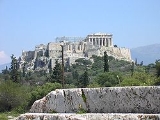
Acropolis of Athens

Encyclopedia

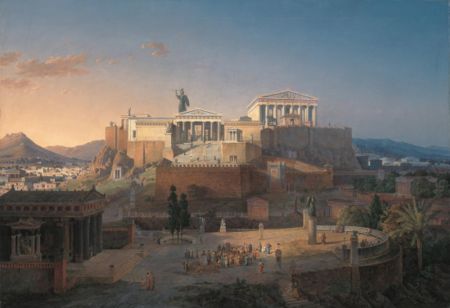
Athens
Athens , is the capital and largest city of Greece. Athens dominates the Attica region and is one of the world's oldest cities, as its recorded history spans around 3,400 years. Classical Athens was a powerful city-state...
or Citadel of Athens is the best known acropolis
Acropolis
Acropolis means "high city" in Greek, literally city on the extremity and is usually translated into English as Citadel . For purposes of defense, early people naturally chose elevated ground to build a new settlement, frequently a hill with precipitous sides...
(Gr. akros, akron, edge, extremity + polis, city, pl. acropoleis) in the world. Although there are many other acropoleis in Greece
Greece
Greece , officially the Hellenic Republic , and historically Hellas or the Republic of Greece in English, is a country in southeastern Europe....
, the significance of the Acropolis of Athens is such that it is commonly known as The Acropolis without qualification. The Acropolis was formally proclaimed as the preeminent monument on the European Cultural Heritage list of monuments on 26 March 2007. The Acropolis is a flat-topped rock that rises 150 m (492.1 ft) above sea level in the city of Athens
Athens
Athens , is the capital and largest city of Greece. Athens dominates the Attica region and is one of the world's oldest cities, as its recorded history spans around 3,400 years. Classical Athens was a powerful city-state...
, with a surface area of about 3 hectare
Hectare
The hectare is a metric unit of area defined as 10,000 square metres , and primarily used in the measurement of land. In 1795, when the metric system was introduced, the are was defined as being 100 square metres and the hectare was thus 100 ares or 1/100 km2...
s. It was also known as Cecropia, after the legendary serpent
Snake
Snakes are elongate, legless, carnivorous reptiles of the suborder Serpentes that can be distinguished from legless lizards by their lack of eyelids and external ears. Like all squamates, snakes are ectothermic, amniote vertebrates covered in overlapping scales...
-man, Cecrops
Cecrops I
Cecrops was a mythical king of Athens who is said to have reigned for fifty-six years. The name is not of Greek origin according to Strabo, or it might mean 'face with a tail': it is said that, born from the earth itself, he had his top half shaped like a man and the bottom half in serpent or...
, the first Athenian king.
Early settlement
While the earliest artifacts date to the Middle NeolithicNeolithic
The Neolithic Age, Era, or Period, or New Stone Age, was a period in the development of human technology, beginning about 9500 BC in some parts of the Middle East, and later in other parts of the world. It is traditionally considered as the last part of the Stone Age...
era, there have been documented habitations in Attica
Attica
Attica is a historical region of Greece, containing Athens, the current capital of Greece. The historical region is centered on the Attic peninsula, which projects into the Aegean Sea...
from the Early Neolithic (6th millennium BC). There is little doubt that a Mycenaean
Mycenaean Greece
Mycenaean Greece was a cultural period of Bronze Age Greece taking its name from the archaeological site of Mycenae in northeastern Argolis, in the Peloponnese of southern Greece. Athens, Pylos, Thebes, and Tiryns are also important Mycenaean sites...
megaron
Megaron
The megaron is the great hall of the Grecian palace complexes. It was a rectangular hall, fronted by an open, two-columned porch, and a more or less central, open hearth vented though an oculus in the roof above it and surrounded by four columns. It is the architectural predecessor of the...
stood upon the hill during the late Bronze Age
Aegean civilization
Aegean civilization is a general term for the Bronze Age civilizations of Greece around the Aegean Sea. There are three distinct but communicating and interacting geographic regions covered by this term: Crete, the Cyclades and the Greek mainland. Crete is associated with the Minoan civilization...
. Nothing of this megaron
Megaron
The megaron is the great hall of the Grecian palace complexes. It was a rectangular hall, fronted by an open, two-columned porch, and a more or less central, open hearth vented though an oculus in the roof above it and surrounded by four columns. It is the architectural predecessor of the...
survives except, probably, a single limestone column-base and pieces of several sandstone steps. Soon after the palace was constructed, a Cyclopean massive circuit wall was built, 760 meters long, up to 10 meters high, and ranging from 3.5 to 6 meters thick. This wall would serve as the main defense for the acropolis until the 5th century. The wall consisted of two parapet
Parapet
A parapet is a wall-like barrier at the edge of a roof, terrace, balcony or other structure. Where extending above a roof, it may simply be the portion of an exterior wall that continues above the line of the roof surface, or may be a continuation of a vertical feature beneath the roof such as a...
s built with large stone blocks and cemented with an earth mortar called emplekton (Greek: ἔμπλεκτον). The wall follows typical Mycenaean convention in that it followed the natural contour of the terrain and its gate was arranged obliquely, with a parapet and tower overhanging the incomers' right-hand side, thus facilitating defense. There were two lesser approaches up the hill on its north side, consisting of steep, narrow flights of steps cut in the rock. Homer
Homer
In the Western classical tradition Homer , is the author of the Iliad and the Odyssey, and is revered as the greatest ancient Greek epic poet. These epics lie at the beginning of the Western canon of literature, and have had an enormous influence on the history of literature.When he lived is...
is assumed to refer to this fortification when he mentions the "strong-built House of Erechtheus
Erechtheus
Erechtheus in Greek mythology was the name of an archaic king of Athens, the re-founder of the polis and a double at Athens for Poseidon, as "Poseidon Erechtheus"...
" (Odyssey
Odyssey
The Odyssey is one of two major ancient Greek epic poems attributed to Homer. It is, in part, a sequel to the Iliad, the other work ascribed to Homer. The poem is fundamental to the modern Western canon, and is the second—the Iliad being the first—extant work of Western literature...
7.81). At some point before the 13th century an earthquake caused a fissure near the northeastern edge of the acropolis. This fissure extended some thirty five meters to a bed of soft marl in which a well was dug. An elaborate set of stairs were built and the well served as an invaluable, protected source of drinking water during times of siege for some portion of the Mycenaean period.
The Dark Ages
There is no conclusive evidence for the existence of a Mycenean palace on top of the Athenian Acropolis. However, if there was such a palace, it seems to have been supplanted by later building activity on the Acropolis. Not much is known as to the architectural appearance of the Acropolis until the archaic era. In the 7th and the 6th centuries BC, the site was taken over by Kylon during the failed Kylonian revolt, and twice by PisistratusPeisistratos (Athens)
Peisistratos was a tyrant of Athens from 546 to 527/8 BC. His legacy lies primarily in his institution of the Panathenaic Festival and the consequent first attempt at producing a definitive version for Homeric epics. Peisistratos' championing of the lower class of Athens, the Hyperakrioi, can be...
: all attempts directed at seizing political power by coups d' etat. Nevertheless, it seems that a nine-gate wall, the Enneapylon, had been built around the biggest water spring, the "Clepsydra
Clepsydra
Clepsydra may refer to:*Clepsydra , the Greek word for water clock. Also, in ancient Greece, a device for drawing liquids from vats too large to pour, which utilized the principles of air pressure to transport the liquid from one container to another.* Clepsydra Geyser in the Lower Geyser Basin of...
", at the northwestern foot.
Archaic Acropolis
A temple sacred to "Athena Polias" (Protectress of the City) was quickly erected by mid-6th century BC. This DoricDoric order
The Doric order was one of the three orders or organizational systems of ancient Greek or classical architecture; the other two canonical orders were the Ionic and the Corinthian.-History:...
limestone building, from which many relics survive, is referred to as the "Bluebeard" temple, named after the pedimental three-bodied man-serpent sculpture, whose beards were painted dark blue. Whether this temple replaced an older one, or a mere sacred precinct or altar, is not known. In the late 6th century BC yet another temple was built, usually referred to as the Archaios Naos (Old Temple). This temple of Athena Polias was built upon the Doerpfeld foundations. It is unknown where the "Bluebeard" temple was built. There are two popular theories (1) the "Bluebeard" temple was built upon the Doerpfeld foundations, (2) the "Bluebeard" temple was built where the Parthenon now stands. That being said it is unknown if the "Bluebeard" temple and the Archaios Naos coexisted.
To confuse matters, by the time the "Bluebeard" Temple had been dismantled, a newer and grander marble building, the "Older Parthenon
Older Parthenon
The Older Parthenon or Pre‐Parthenon, as it is frequently referred to, constitutes the first endeavour to build a sanctuary for Athena Parthenos on the site of the present Parthenon, Athens, Greece. It was begun shortly after the battle of Marathon upon a massive limestone foundation that extended...
" (often called the "Ur-Parthenon", German
German language
German is a West Germanic language, related to and classified alongside English and Dutch. With an estimated 90 – 98 million native speakers, German is one of the world's major languages and is the most widely-spoken first language in the European Union....
for "Early Parthenon"), was started following the victory at Marathon
Battle of Marathon
The Battle of Marathon took place in 490 BC, during the first Persian invasion of Greece. It was fought between the citizens of Athens, aided by Plataea, and a Persian force commanded by Datis and Artaphernes. It was the culmination of the first attempt by Persia, under King Darius I, to subjugate...
in 490 BC. To accommodate it, the south part of the summit was cleared of older remnants, made level by adding some 8,000 two-ton blocks of Piraeus
Piraeus
Piraeus is a city in the region of Attica, Greece. Piraeus is located within the Athens Urban Area, 12 km southwest from its city center , and lies along the east coast of the Saronic Gulf....
limestone, a foundation 11 m (36 ft) deep at some points, and the rest filled with earth kept in place by the retaining wall.
The Older Parthenon was still under construction when the Persians sacked the city in 480 BC. The building was burned and looted, along with the Archaios Naos and practically everything else on the rock. After the Persian crisis had subsided, the Athenians incorporated many of the unfinished temple's architectural members (unfluted column drums, triglyphs, metopes, etc.) into the newly built northern curtain wall
Curtain wall
A curtain wall is an outer covering of a building in which the outer walls are non-structural, but merely keep out the weather. As the curtain wall is non-structural it can be made of a lightweight material reducing construction costs. When glass is used as the curtain wall, a great advantage is...
of the Acropolis, where they serve as a prominent "war memorial" and can still be seen today. The devastated site was cleared of debris. Statuary, cult objects, religious offerings and unsalvageable architectural members were buried ceremoniously in several deeply dug pits on the hill, serving conveniently as a fill for the artificial plateau created around the classic Parthenon. This "Persian debris"
Perserschutt
The Perserschutt, a German term meaning "Persian debris", or "Persian rubble", refers to the bulk of architectural and votive sculptures that were damaged by the invading Persian army on the Acropolis of Athens in 480 BC....
is the richest archaeological deposit excavated on the Acropolis.
The Periclean building program
Most of the major temples were rebuilt under the leadership of PericlesPericles
Pericles was a prominent and influential statesman, orator, and general of Athens during the city's Golden Age—specifically, the time between the Persian and Peloponnesian wars...
during the Golden Age of Athens
Age of Pericles
Fifth-century Athens refers to the Greek city-state of Athens in the period of roughly 480 BC-404 BC. This was a period of Athenian political hegemony, economic growth and cultural flourishing formerly known as the Golden Age of Athens or The Age of Pericles. The period began in 480 BC when an...
(460–430 BC). Phidias
Phidias
Phidias or the great Pheidias , was a Greek sculptor, painter and architect, who lived in the 5th century BC, and is commonly regarded as one of the greatest of all sculptors of Classical Greece: Phidias' Statue of Zeus at Olympia was one of the Seven Wonders of the Ancient World...
, a great Athenian sculptor, and Ictinus and Callicrates, two famous architects, were responsible for the reconstruction. During the 5th century BC, the Acropolis gained its final shape. After winning at Eurymedon
Battle of the Eurymedon
The Battle of the Eurymedon was a double battle, taking place both on water and land, between the Delian League of Athens and her Allies, and the Persian Empire of Xerxes I. It took place in either 469 or 466 BC, in the vicinity of the mouth of the Eurymedon River in Pamphylia, Asia Minor...
in 468 BC, Cimon and Themistocles
Themistocles
Themistocles ; c. 524–459 BC, was an Athenian politician and a general. He was one of a new breed of politicians who rose to prominence in the early years of the Athenian democracy, along with his great rival Aristides...
ordered the reconstruction of southern and northern walls, and Pericles entrusted the building of the Parthenon
Parthenon
The Parthenon is a temple on the Athenian Acropolis, Greece, dedicated to the Greek goddess Athena, whom the people of Athens considered their virgin patron. Its construction began in 447 BC when the Athenian Empire was at the height of its power. It was completed in 438 BC, although...
to Ictinus and Callicrates.
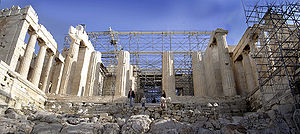
In 437 BC, Mnesicles started building the Propylaea
Propylaea
A Propylaea, Propylea or Propylaia is any monumental gateway based on the original Propylaea that serves as the entrance to the Acropolis in Athens...
, monumental gates with columns of Pentelic marble
Marble
Marble is a metamorphic rock composed of recrystallized carbonate minerals, most commonly calcite or dolomite.Geologists use the term "marble" to refer to metamorphosed limestone; however stonemasons use the term more broadly to encompass unmetamorphosed limestone.Marble is commonly used for...
, partly built upon the old propylaea of Pisistratus. These colonnades were almost finished in 432 BC and had two wings, the northern one serving as picture gallery. At the same time, south of the propylaea, building of the small Ionic Temple of Athena Nike commenced. After an interruption caused by the Peloponnesian War
Peloponnesian War
The Peloponnesian War, 431 to 404 BC, was an ancient Greek war fought by Athens and its empire against the Peloponnesian League led by Sparta. Historians have traditionally divided the war into three phases...
, the temple was finished in the time of Nicias
Nicias
Nicias or Nikias was an Athenian politician and general during the period of the Peloponnesian War. Nicias was a member of the Athenian aristocracy because he had inherited a large fortune from his father, which was invested into the silver mines around Attica's Mt. Laurium...
' peace, between 421 BC and 415 BC.
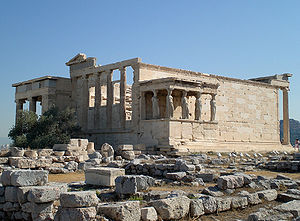
During the same period as the building of the Erechtheum
Erechtheum
The Erechtheion is an ancient Greek temple on the north side of the Acropolis of Athens in Greece.-Architecture:The temple as seen today was built between 421 and 406 BC. Its architect may have been Mnesicles, and it derived its name from a shrine dedicated to the legendary Greek hero Erichthonius...
, a combination of sacred precincts including the temples of Athena Polias, Poseidon
Poseidon
Poseidon was the god of the sea, and, as "Earth-Shaker," of the earthquakes in Greek mythology. The name of the sea-god Nethuns in Etruscan was adopted in Latin for Neptune in Roman mythology: both were sea gods analogous to Poseidon...
, Erechtheus
Erechtheus
Erechtheus in Greek mythology was the name of an archaic king of Athens, the re-founder of the polis and a double at Athens for Poseidon, as "Poseidon Erechtheus"...
, Cecrops
Cecrops
This name may refer to two legendary kings of Athens:* Cecrops I* Cecrops IIIt more often refers to Cecrops I, who was the better known....
, Herse
Herse
Herse is a figure in Greek mythology, daughter of Cecrops, sister to Aglauros and Pandrosos.According to Apollodorus, when Hephaestus unsuccessfully attempted to rape Athena, she wiped his semen off her leg with wool and threw it on the ground, impregnating Gaia...
, Pandrosos and Aglauros, with its so-called the Kore Porch (or Caryatid
Caryatid
A caryatid is a sculpted female figure serving as an architectural support taking the place of a column or a pillar supporting an entablature on her head. The Greek term karyatides literally means "maidens of Karyai", an ancient town of Peloponnese...
s' balcony), was begun.
Between the temple of Athena Nike and the Parthenon, there was the temenos
Temenos
Temenos is a piece of land cut off and assigned as an official domain, especially to kings and chiefs, or a piece of land marked off from common uses and dedicated to a god, a sanctuary, holy grove or holy precinct: The Pythian race-course is called a temenos, the sacred valley of the Nile is the ...
of Artemis
Artemis
Artemis was one of the most widely venerated of the Ancient Greek deities. Her Roman equivalent is Diana. Some scholars believe that the name and indeed the goddess herself was originally pre-Greek. Homer refers to her as Artemis Agrotera, Potnia Theron: "Artemis of the wildland, Mistress of Animals"...
Brauronia or Brauroneion
Brauroneion
The Brauroneion was the sanctuary of Artemis Brauronia on the Athenian Acropolis, located in the southwest corner of the Acropolis plateau, between the Chalkotheke and the Propylaia in Greece. It was originally dedicated during the reign of Peisistratos...
, the goddess represented as a bear and worshipped in the deme
Deme
In Ancient Greece, a deme or demos was a subdivision of Attica, the region of Greece surrounding Athens. Demes as simple subdivisions of land in the countryside seem to have existed in the 6th century BC and earlier, but did not acquire particular significance until the reforms of Cleisthenes in...
of Brauron. The archaic xoanon
Xoanon
A xoanon was an Archaic wooden cult image of Ancient Greece. Classical Greeks associated such cult objects, whether aniconic or effigy, with the legendary Daedalus. Many such cult images were preserved into historical times, though none have survived to the modern day, except where their image...
of the goddess
Goddess
A goddess is a female deity. In some cultures goddesses are associated with Earth, motherhood, love, and the household. In other cultures, goddesses also rule over war, death, and destruction as well as healing....
and a statue made by Praxiteles
Praxiteles
Praxiteles of Athens, the son of Cephisodotus the Elder, was the most renowned of the Attic sculptors of the 4th century BC. He was the first to sculpt the nude female form in a life-size statue...
in the 4th century BC were both in the sanctuary.
Behind the Propylaea, Phidias' gigantic bronze statue of Athena Promachos
Athena Promachos
The Athena Promachos was a colossal bronze statue of Athena sculpted by Pheidias, which stood between the Propylaea and the Parthenon on the Acropolis of Athens. Athena was the goddess of wisdom and warriors and the protectress of Athens...
("she who fights in the front line"), built between 450 BC and 448 BC, dominated. The base was 1.5 m (5 ft) high, while the total height of the statue was 9 m (30 ft). The goddess held a lance whose gilt tip could be seen as a reflection by crews on ships rounding Cape Sounion
Sounion
Cape Sounion is a promontory located SSE of Athens, at the southernmost tip of the Attica peninsula in Greece.Cape Sounion is noted as the site of ruins of an ancient...
, and a giant shield on the left side, decorated by Mys
MYS
MYS could refer to:* Malaysia; ISO 3166-1 country code MYS.* Masisa S.A.; New York Stock Exchange symbol MYS.* Minnesota Youth Symphonies* Monaco Yacht Show* Mysore Junction, Karnataka, India; Indian Railways station code MYS....
with images of the fight between the Centaur
Centaur
In Greek mythology, a centaur or hippocentaur is a member of a composite race of creatures, part human and part horse...
s and the Lapiths. Other monuments that have left almost nothing visible to the present day are the Chalkotheke
Chalkotheke
The Chalkotheke was a structure on the Athenian Acropolis. Its name and function are only known from 4th century BC inscriptions...
, the Pandroseion
Pandroseion
The Pandroseion was a sanctuary dedicated to Pandrosus, one of the daughters of Cecrops I, the first king of AtticaGreece, located on the Acropolis of Athens...
, Pandion's sanctuary, Athena's altar, Zeus Polieus's sanctuary and, from Roman times, the circular temple of Augustus
Augustus
Augustus ;23 September 63 BC – 19 August AD 14) is considered the first emperor of the Roman Empire, which he ruled alone from 27 BC until his death in 14 AD.The dates of his rule are contemporary dates; Augustus lived under two calendars, the Roman Republican until 45 BC, and the Julian...
and Rome
Roma (mythology)
In traditional Roman religion, Roma was a female deity who personifed the city of Rome and more broadly, the Roman state. Her image appears on the base of the column of Antoninus Pius.-Problems in earliest attestation:...
.
Hellenistic and Roman period
During the Hellenistic and Roman periods, many of the existing buildings in the area of the Acropolis were repaired, due to damage from age, and occasionally, war. Monuments to foreign kings were erected, notably those of the Attalid kings of Pergamon Attalos II (in front of the NW corner of the Parthenon), and Eumenes II, in front of the Propylaia. These were rededicated during the early Roman Empire to Augustus (or perhaps Cladius), and AgrippaMarcus Vipsanius Agrippa
Marcus Vipsanius Agrippa was a Roman statesman and general. He was a close friend, son-in-law, lieutenant and defense minister to Octavian, the future Emperor Caesar Augustus...
, respectively. Eumenes was also responsible for constructing a stoa
Stoa of Eumenes
The Stoa of Eumenes is a stoa on the acropolis of Athens, sited between the Odeion of Herodes Atticus and the Theater of Dionysos. It was built against the slope of the hill The Stoa of Eumenes is a stoa on the acropolis of Athens, sited between the Odeion of Herodes Atticus and the Theater of...
on the South slope, not unlike that of Attalos
Stoa of Attalos
The Stoa of Attalos is recognised as one of the most impressive stoæ in the Athenian Agora. It was built by and named after King Attalos II of Pergamon who ruled between 159 BC and 138 BC.-Description:...
in the Agora below.
During the Julio-Claudian period
Julio-Claudian Dynasty
The Julio-Claudian dynasty normally refers to the first five Roman Emperors: Augustus, Tiberius, Caligula , Claudius, and Nero, or the family to which they belonged; they ruled the Roman Empire from its formation, in the second half of the 1st century BC, until AD 68, when the last of the line,...
, the Temple of Rome and Augustus, a small, round edifice, about 23 meters from the Parthenon, was to be the last significant ancient construction on the summit of the rock. Around the same time, on the North slope, in a cave next to the one dedicated to Pan since the classical period, a sanctuary was founded where the archons dedicated to Apollo
Apollo
Apollo is one of the most important and complex of the Olympian deities in Greek and Roman mythology...
on taking office. In the following century, on the South slope, Herodes Atticus built his grand odeon
Odeon of Herodes Atticus
The Odeon of Herodes Atticus is a stone theatre structure located on the south slope of the Acropolis of Athens. It was built in 161 AD by Herodes Atticus in memory of his wife, Aspasia Annia Regilla...
.

Byzantine, Latin and Ottoman period
In the ByzantineByzantine
Byzantine usually refers to the Roman Empire during the Middle Ages.Byzantine may also refer to:* A citizen of the Byzantine Empire, or native Greek during the Middle Ages...
period, the Parthenon was turned into a church, dedicated to the Virgin Mary. Under the Latin Duchy of Athens
Duchy of Athens
The Duchy of Athens was one of the Crusader States set up in Greece after the conquest of the Byzantine Empire during the Fourth Crusade, encompassing the regions of Attica and Boeotia, and surviving until its conquest by the Ottoman Empire in the 15th century....
, the Acropolis functioned as the city's administrative center, with the Parthenon as its cathedral, and the Propylaia as part of the Ducal Palace
Palace
A palace is a grand residence, especially a royal residence or the home of a head of state or some other high-ranking dignitary, such as a bishop or archbishop. The word itself is derived from the Latin name Palātium, for Palatine Hill, one of the seven hills in Rome. In many parts of Europe, the...
. A large tower was added, the "Frankopyrgos" (Tower of the Franks), demolished in the 19th century.
After the Ottoman conquest of Greece
Ottoman Greece
Most of Greece gradually became part of the Ottoman Empire from the 15th century until its declaration of independence in 1821, a historical period also known as Tourkokratia ....
, the Parthenon was used as the garrison headquarters of the Turkish army, and the Erechtheum
Erechtheum
The Erechtheion is an ancient Greek temple on the north side of the Acropolis of Athens in Greece.-Architecture:The temple as seen today was built between 421 and 406 BC. Its architect may have been Mnesicles, and it derived its name from a shrine dedicated to the legendary Greek hero Erichthonius...
was turned into the Governor
Governor
A governor is a governing official, usually the executive of a non-sovereign level of government, ranking under the head of state...
's private Harem
Harem
Harem refers to the sphere of women in what is usually a polygynous household and their enclosed quarters which are forbidden to men...
. The buildings of the Acropolis suffered significant damage during the 1687 siege by the Venetians in the Morean War
Morean War
The Morean War is the better known name for the Sixth Ottoman–Venetian War. The war was fought between 1684–1699, as part of the wider conflict known as the "Great Turkish War", between the Republic of Venice and the Ottoman Empire...
. The Parthenon, which was being used as a gunpowder magazine
Magazine (artillery)
Magazine is the name for an item or place within which ammunition is stored. It is taken from the Arabic word "makahazin" meaning "warehouse".-Ammunition storage areas:...
, was hit by artillery
Artillery
Originally applied to any group of infantry primarily armed with projectile weapons, artillery has over time become limited in meaning to refer only to those engines of war that operate by projection of munitions far beyond the range of effect of personal weapons...
fire and severely damaged.
In subsequent years, the Acropolis was a site of bustling human activity with many Byzantine, Frankish, and Ottoman structures. The dominant feature during the Ottoman period was a mosque inside the Parthenon, complete with a minaret. Following the Greek War of Independence
Greek War of Independence
The Greek War of Independence, also known as the Greek Revolution was a successful war of independence waged by the Greek revolutionaries between...
, most post-Byzantine features were cleared from the site as part of a Hellenizing
Hellenization
Hellenization is a term used to describe the spread of ancient Greek culture, and, to a lesser extent, language. It is mainly used to describe the spread of Hellenistic civilization during the Hellenistic period following the campaigns of Alexander the Great of Macedon...
project that swept the new nation-state.

Archaeological remains
The entrance to the Acropolis was a monumental gateway called the PropylaeaPropylaea
A Propylaea, Propylea or Propylaia is any monumental gateway based on the original Propylaea that serves as the entrance to the Acropolis in Athens...
. To the south of the entrance is the tiny Temple of Athena Nike. A bronze statue of Athena, sculpted by Phidias
Phidias
Phidias or the great Pheidias , was a Greek sculptor, painter and architect, who lived in the 5th century BC, and is commonly regarded as one of the greatest of all sculptors of Classical Greece: Phidias' Statue of Zeus at Olympia was one of the Seven Wonders of the Ancient World...
, originally stood at its centre. At the centre of the Acropolis is the Parthenon
Parthenon
The Parthenon is a temple on the Athenian Acropolis, Greece, dedicated to the Greek goddess Athena, whom the people of Athens considered their virgin patron. Its construction began in 447 BC when the Athenian Empire was at the height of its power. It was completed in 438 BC, although...
or Temple of Athena Parthenos (Athena the Virgin). East of the entrance and north of the Parthenon is the temple known as the Erechtheum
Erechtheum
The Erechtheion is an ancient Greek temple on the north side of the Acropolis of Athens in Greece.-Architecture:The temple as seen today was built between 421 and 406 BC. Its architect may have been Mnesicles, and it derived its name from a shrine dedicated to the legendary Greek hero Erichthonius...
. South of the platform that forms the top of the Acropolis there are also the remains of an outdoor theatre called Theatre of Dionysus
Theatre of Dionysus
The Theatre of Dionysus is a major open-air theatre and one of the earliest preserved in Athens. It was used for festivals in honor of the god Dionysus...
. A few hundred metres away, there is the now partially reconstructed Theatre of Herodes Atticus.
All the valuable ancient artifacts are situated in the Acropolis Museum
Acropolis Museum
The Old Acropolis Museum was an archaeological museum located in Athens, Greece on the archeological site of Acropolis. It is built in a niche at the eastern edge of the rock and most of it lies beneath the level of the hilltop, making it largely invisible. It was considered one of the major...
, which resides on the southern slope of the same rock, 280 metres from the Parthenon.
Site plan
Site plan of the Acropolis at Athens showing the major archaeological remainsImage:AcropolisatathensSitePlan.png|right|600px|alt=Site plan of the Acropolis at Athens
poly 332 198 447 158 468 217 352 254 Parthenon
Parthenon
The Parthenon is a temple on the Athenian Acropolis, Greece, dedicated to the Greek goddess Athena, whom the people of Athens considered their virgin patron. Its construction began in 447 BC when the Athenian Empire was at the height of its power. It was completed in 438 BC, although...
poly 305 130 374 115 385 146 314 167 Old Temple of Athena
Old Temple of Athena
The Old Temple of Athena was an Archaic temple located on the Acropolis of Athens. Until its destruction by the Persians in 480 BC, it was the shrine of Athena Polias, the patron deity of the city of Athens. It was located at the centre of the Acropolis plateau, probably on the remains of a...
poly 346 116 389 108 375 71 334 82 Erechtheum
Erechtheum
The Erechtheion is an ancient Greek temple on the north side of the Acropolis of Athens in Greece.-Architecture:The temple as seen today was built between 421 and 406 BC. Its architect may have been Mnesicles, and it derived its name from a shrine dedicated to the legendary Greek hero Erichthonius...
poly 248 137 266 160 252 168 243 151 Statue of Athena Promachos
Athena Promachos
The Athena Promachos was a colossal bronze statue of Athena sculpted by Pheidias, which stood between the Propylaea and the Parthenon on the Acropolis of Athens. Athena was the goddess of wisdom and warriors and the protectress of Athens...
poly 104 164 193 115 225 200 158 224 Propylaea
Propylaea
A Propylaea, Propylea or Propylaia is any monumental gateway based on the original Propylaea that serves as the entrance to the Acropolis in Athens...
poly 132 223 152 226 150 257 136 255 Temple of Athena Nike
poly 168 256 193 261 188 278 166 277 Eleusinion
Eleusinion
An Athenian temple to Demeter, the Eleusinion was the place where all sacred objects associated with the Eleusinian Mysteries were kept between ceremonies. It was located at the base of the Acropolis....
poly 191 213 258 199 245 259 185 246 Sanctuary of Artemis Brauronia or Brauroneion
Brauroneion
The Brauroneion was the sanctuary of Artemis Brauronia on the Athenian Acropolis, located in the southwest corner of the Acropolis plateau, between the Chalkotheke and the Propylaia in Greece. It was originally dedicated during the reign of Peisistratos...
poly 248 260 315 276 321 245 255 231 Chalkotheke
Chalkotheke
The Chalkotheke was a structure on the Athenian Acropolis. Its name and function are only known from 4th century BC inscriptions...
poly 322 78 337 97 343 111 310 122 304 108 Pandroseion
Pandroseion
The Pandroseion was a sanctuary dedicated to Pandrosus, one of the daughters of Cecrops I, the first king of AtticaGreece, located on the Acropolis of Athens...
poly 258 81 281 73 288 96 266 102 Arrephorion
Arrephorion
The Arrephorion was a small building sited beside the north wall of the Acropolis of Athens. It provided the lodgings for the arrephores, the girls who worked for a whole year just below the acropolis weaving the new peplos for Panathenaic procession. It was identified in 1920 by the German...
poly 402 102 428 100 435 120 408 127 Altar of Athena
poly 462 120 500 96 540 96 533 136 506 146 464 149 Sanctuary of Zeus Polieus
Sanctuary of Zeus Polieus
The Sanctuary of Zeus Polieus was a no walled open-air sanctuary dedicated to Zeus Polieus around 500 BC on the Acropolis of Athens, sited to the Erechtheion's east. None of its foundations have been discovered and its trapezoid plan and many entrances have been worked out from rock cuttings on...
poly 574 155 641 184 628 212 564 183 Sanctuary of Pandion
Sanctuary of Pandion
The Sanctuary of Pandion was an open-air sanctuary or shrine at the south-east corner of the Acropolis of Athens, dedicated to Pandion I or Pandion II.-Sources:*http://www.maquettes-historiques.net/P161.html...
poly 26 384 56 336 88 314 129 313 160 337 174 370 175 399 139 416 72 417 25 402 Odeon of Herodes Atticus
Odeon of Herodes Atticus
The Odeon of Herodes Atticus is a stone theatre structure located on the south slope of the Acropolis of Athens. It was built in 161 AD by Herodes Atticus in memory of his wife, Aspasia Annia Regilla...
poly 182 381 462 384 460 419 179 415 Stoa of Eumenes
Stoa of Eumenes
The Stoa of Eumenes is a stoa on the acropolis of Athens, sited between the Odeion of Herodes Atticus and the Theater of Dionysos. It was built against the slope of the hill The Stoa of Eumenes is a stoa on the acropolis of Athens, sited between the Odeion of Herodes Atticus and the Theater of...
poly 395 325 469 309 478 356 406 372 Sanctuary of Asclepius or Asclepieion
Asclepieion
In ancient Greece and Rome, an asclepeion was a healing temple, sacred to the god Asclepius....
poly 484 397 492 356 516 323 555 297 596 293 642 300 670 311 650 345 683 389 540 457 Theatre of Dionysus Eleuthereus
Theatre of Dionysus
The Theatre of Dionysus is a major open-air theatre and one of the earliest preserved in Athens. It was used for festivals in honor of the god Dionysus...
poly 655 343 738 276 807 356 722 425 Odeon of Pericles
poly 564 460 678 414 684 442 627 505 586 515 Temenos of Dionysus Eleuthereus
Theatre of Dionysus
The Theatre of Dionysus is a major open-air theatre and one of the earliest preserved in Athens. It was used for festivals in honor of the god Dionysus...
poly 300 32 332 42 323 67 296 64 Aglaureion
Aglaureion
The Aglaureion was a shrine to Aglauros on the acropolis of Athens....
- ParthenonParthenonThe Parthenon is a temple on the Athenian Acropolis, Greece, dedicated to the Greek goddess Athena, whom the people of Athens considered their virgin patron. Its construction began in 447 BC when the Athenian Empire was at the height of its power. It was completed in 438 BC, although...
- Old Temple of AthenaOld Temple of AthenaThe Old Temple of Athena was an Archaic temple located on the Acropolis of Athens. Until its destruction by the Persians in 480 BC, it was the shrine of Athena Polias, the patron deity of the city of Athens. It was located at the centre of the Acropolis plateau, probably on the remains of a...
- ErechtheumErechtheumThe Erechtheion is an ancient Greek temple on the north side of the Acropolis of Athens in Greece.-Architecture:The temple as seen today was built between 421 and 406 BC. Its architect may have been Mnesicles, and it derived its name from a shrine dedicated to the legendary Greek hero Erichthonius...
- Statue of Athena PromachosAthena PromachosThe Athena Promachos was a colossal bronze statue of Athena sculpted by Pheidias, which stood between the Propylaea and the Parthenon on the Acropolis of Athens. Athena was the goddess of wisdom and warriors and the protectress of Athens...
- PropylaeaPropylaeaA Propylaea, Propylea or Propylaia is any monumental gateway based on the original Propylaea that serves as the entrance to the Acropolis in Athens...
- Temple of Athena Nike
- EleusinionEleusinionAn Athenian temple to Demeter, the Eleusinion was the place where all sacred objects associated with the Eleusinian Mysteries were kept between ceremonies. It was located at the base of the Acropolis....
- Sanctuary of Artemis Brauronia or BrauroneionBrauroneionThe Brauroneion was the sanctuary of Artemis Brauronia on the Athenian Acropolis, located in the southwest corner of the Acropolis plateau, between the Chalkotheke and the Propylaia in Greece. It was originally dedicated during the reign of Peisistratos...
- ChalkothekeChalkothekeThe Chalkotheke was a structure on the Athenian Acropolis. Its name and function are only known from 4th century BC inscriptions...
- PandroseionPandroseionThe Pandroseion was a sanctuary dedicated to Pandrosus, one of the daughters of Cecrops I, the first king of AtticaGreece, located on the Acropolis of Athens...
- ArrephorionArrephorionThe Arrephorion was a small building sited beside the north wall of the Acropolis of Athens. It provided the lodgings for the arrephores, the girls who worked for a whole year just below the acropolis weaving the new peplos for Panathenaic procession. It was identified in 1920 by the German...
- Altar of Athena
- Sanctuary of Zeus PolieusSanctuary of Zeus PolieusThe Sanctuary of Zeus Polieus was a no walled open-air sanctuary dedicated to Zeus Polieus around 500 BC on the Acropolis of Athens, sited to the Erechtheion's east. None of its foundations have been discovered and its trapezoid plan and many entrances have been worked out from rock cuttings on...
- Sanctuary of PandionSanctuary of PandionThe Sanctuary of Pandion was an open-air sanctuary or shrine at the south-east corner of the Acropolis of Athens, dedicated to Pandion I or Pandion II.-Sources:*http://www.maquettes-historiques.net/P161.html...
- Odeon of Herodes AtticusOdeon of Herodes AtticusThe Odeon of Herodes Atticus is a stone theatre structure located on the south slope of the Acropolis of Athens. It was built in 161 AD by Herodes Atticus in memory of his wife, Aspasia Annia Regilla...
- Stoa of EumenesStoa of EumenesThe Stoa of Eumenes is a stoa on the acropolis of Athens, sited between the Odeion of Herodes Atticus and the Theater of Dionysos. It was built against the slope of the hill The Stoa of Eumenes is a stoa on the acropolis of Athens, sited between the Odeion of Herodes Atticus and the Theater of...
- Sanctuary of Asclepius or AsclepieionAsclepieionIn ancient Greece and Rome, an asclepeion was a healing temple, sacred to the god Asclepius....
- Theatre of Dionysus EleuthereusTheatre of DionysusThe Theatre of Dionysus is a major open-air theatre and one of the earliest preserved in Athens. It was used for festivals in honor of the god Dionysus...
- Odeon of Pericles
- Temenos of Dionysus EleuthereusTheatre of DionysusThe Theatre of Dionysus is a major open-air theatre and one of the earliest preserved in Athens. It was used for festivals in honor of the god Dionysus...
- AglaureionAglaureionThe Aglaureion was a shrine to Aglauros on the acropolis of Athens....
The Acropolis Restoration Project
The Project began in 1975 and is now nearing completion. The aim of the restoration was to reverse the decay of centuries of attrition, pollution, destruction by acts of war, and misguided past restorations. The project included collection and identification of all stone fragments, even small ones, from the Acropolis and its slopes and the attempt was made to restore as much as possible using reassembled original material - with new marble from Mount Penteli used sparingly. All restoration was made using titaniumTitanium
Titanium is a chemical element with the symbol Ti and atomic number 22. It has a low density and is a strong, lustrous, corrosion-resistant transition metal with a silver color....
dowels and is designed to be completely reversible, in case future experts decide to change things. A combination of cutting-edge modern technology and extensive research and reinvention of ancient techniques were used.
The Parthenon colonnades, largely destroyed by Venetian bombardment in the 17th century, were restored, with many wrongly assembled columns now properly placed. The roof and floor of the Propylaea were partly restored, with sections of the roof made of new marble and decorated with blue and gold inserts, as in the original. The temple of Athena Nike is the only edifice still unfinished, pending proper reassembly of its parts, all of which survive practically intact.
A total of 2,675 tons of architectural members were restored, with 686 stones reassembled from fragments of the originals, 905 patched with new marble, and 186 parts made entirely of new marble. A total of 530 cubic meters of new Pentelic marble were used.
Cultural significance
Every four years, the Athenians held a festival called the Panathenaea that rivalled the Olympic GamesOlympic Games
The Olympic Games is a major international event featuring summer and winter sports, in which thousands of athletes participate in a variety of competitions. The Olympic Games have come to be regarded as the world’s foremost sports competition where more than 200 nations participate...
in popularity. During the festival, a procession moved through Athens up to the Acropolis and into the Parthenon
Parthenon
The Parthenon is a temple on the Athenian Acropolis, Greece, dedicated to the Greek goddess Athena, whom the people of Athens considered their virgin patron. Its construction began in 447 BC when the Athenian Empire was at the height of its power. It was completed in 438 BC, although...
(Suggested to be depicted on the Parthenon frieze). There, a vast robe of woven wool (peplos
Peplos
A peplos is a body-lengthGreek garment worn by women before 500 BC. The peplos is a tubular cloth folded inside-out from the top about halfway down, altering what was the top of the tube to the waist and the bottom of the tube to ankle-length. The garment is then gathered about the waist and the...
) was ceremoniously placed on Phidias' massive ivory and gold statue of Athena
Athena
In Greek mythology, Athena, Athenê, or Athene , also referred to as Pallas Athena/Athene , is the goddess of wisdom, courage, inspiration, civilization, warfare, strength, strategy, the arts, crafts, justice, and skill. Minerva, Athena's Roman incarnation, embodies similar attributes. Athena is...
.
External links
- The Acropolis of Athens (Greek Government website)
- The Acropolis Restoration Project (Greek Government website)
- The Acropolis Museum and the Goddess Athena
- The Restitution of the Parthenon Marbles
- UNESCO World Heritage Centre — Acropolis, Athens
- Ancient Athens 3D
- The Parthenon Frieze
- Excerpt on the geology of Athens from: A Geological Companion to Greece and the Aegean by Michael and Reynold Higgins, Cornell University Press, 1996
- The Acropolis of Athens: photo album and description
- Acropolis of Athens, Full Reconstruction, animation by the Technological Research Institute, University of Santiago de Compostela, on YouTube
- Timelapse video of Acropolis during Earth Hour 2010 Timelapse showing how the Acropolis of Athens switched off & on the lights during Earth Hour 2010