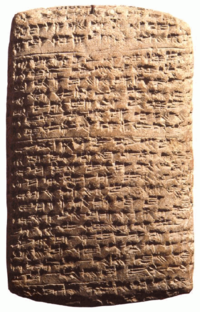
Amarna letters

Encyclopedia
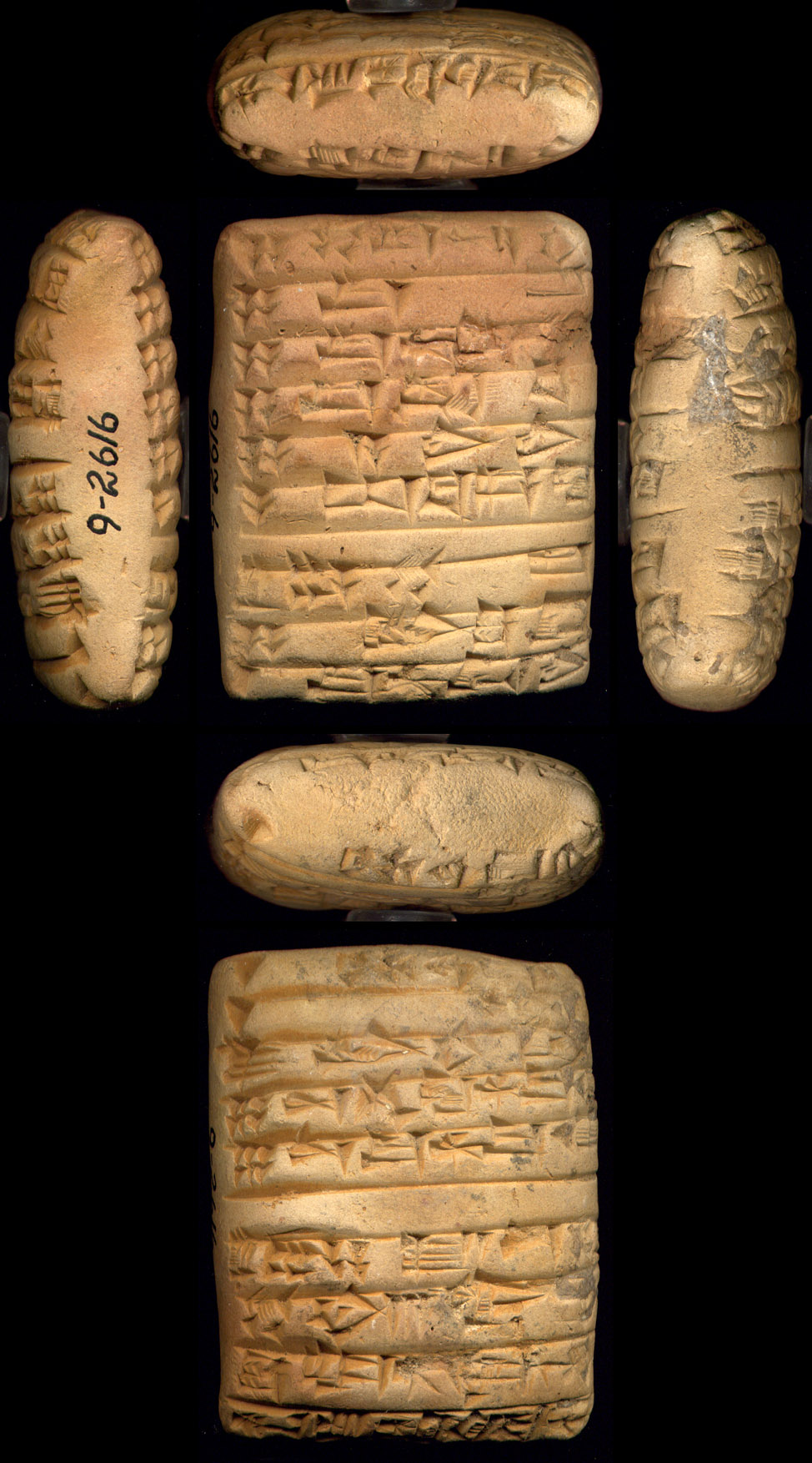
Clay tablet
In the Ancient Near East, clay tablets were used as a writing medium, especially for writing in cuneiform, throughout the Bronze Age and well into the Iron Age....
s, mostly diplomatic, between the Egyptian
Ancient Egypt
Ancient Egypt was an ancient civilization of Northeastern Africa, concentrated along the lower reaches of the Nile River in what is now the modern country of Egypt. Egyptian civilization coalesced around 3150 BC with the political unification of Upper and Lower Egypt under the first pharaoh...
administration and its representatives in Canaan
Canaan
Canaan is a historical region roughly corresponding to modern-day Israel, Palestine, Lebanon, and the western parts of Jordan...
and Amurru
Amurru kingdom
Amurru was an Amorite kingdom located at the territory of modern Lebanon during the 14th–12th centuries BCThe first documented leader of Amurru was Abdi-Ashirta, under whose leadership Amurru was part of the Egyptian empire...
during the New Kingdom
New Kingdom
The New Kingdom of Egypt, also referred to as the Egyptian Empire is the period in ancient Egyptian history between the 16th century BC and the 11th century BC, covering the Eighteenth, Nineteenth, and Twentieth Dynasties of Egypt....
. The letters were found in Upper Egypt
Upper Egypt
Upper Egypt is the strip of land, on both sides of the Nile valley, that extends from the cataract boundaries of modern-day Aswan north to the area between El-Ayait and Zawyet Dahshur . The northern section of Upper Egypt, between El-Ayait and Sohag is sometimes known as Middle Egypt...
at Amarna
Amarna
Amarna is an extensive Egyptian archaeological site that represents the remains of the capital city newly–established and built by the Pharaoh Akhenaten of the late Eighteenth Dynasty , and abandoned shortly afterwards...
, the modern name for the Egyptian capital of Akhetaten, founded by pharaoh Akhenaten
Akhenaten
Akhenaten also spelled Echnaton,Ikhnaton,and Khuenaten;meaning "living spirit of Aten") known before the fifth year of his reign as Amenhotep IV , was a Pharaoh of the Eighteenth dynasty of Egypt who ruled for 17 years and died perhaps in 1336 BC or 1334 BC...
(1350s – 1330s BC) during the Eighteenth dynasty of Egypt
Eighteenth dynasty of Egypt
The eighteenth dynasty of ancient Egypt is perhaps the best known of all the dynasties of ancient Egypt...
. The Amarna letters are unusual in Egyptological research, being mostly written in Akkadian
Akkadian language
Akkadian is an extinct Semitic language that was spoken in ancient Mesopotamia. The earliest attested Semitic language, it used the cuneiform writing system derived ultimately from ancient Sumerian, an unrelated language isolate...
cuneiform, the writing system of ancient Mesopotamia
Mesopotamia
Mesopotamia is a toponym for the area of the Tigris–Euphrates river system, largely corresponding to modern-day Iraq, northeastern Syria, southeastern Turkey and southwestern Iran.Widely considered to be the cradle of civilization, Bronze Age Mesopotamia included Sumer and the...
rather than ancient Egypt. The known tablets currently total 382 in number, 24 further tablets having been recovered since the Norwegian Assyriologist Jørgen Alexander Knudtzon
Jørgen Alexander Knudtzon
Jørgen Alexander Knudtzon was a Norwegian linguist and historian. He was a professor of Semitic Languages at the University of Oslo from 1907....
's landmark edition of the Amarna correspondence, Die El-Amarna-Tafeln in two volumes (1907 and 1915). The correspondence spans a period of at most thirty years.
The letters
These letters, consisting of cuneiformCuneiform script
Cuneiform script )) is one of the earliest known forms of written expression. Emerging in Sumer around the 30th century BC, with predecessors reaching into the late 4th millennium , cuneiform writing began as a system of pictographs...
tablets mostly written in Akkadian
Akkadian language
Akkadian is an extinct Semitic language that was spoken in ancient Mesopotamia. The earliest attested Semitic language, it used the cuneiform writing system derived ultimately from ancient Sumerian, an unrelated language isolate...
– the regional language of diplomacy for this period – were first discovered in around 1887 by local Egyptians who secretly dug most of them from the ruined city (they were originally stored in an ancient building archaeologists have since called the Bureau of Correspondence of Pharaoh
Bureau of Correspondence of Pharaoh
The building known as the Bureau of Correspondence of Pharaoh is located in the 'Central City' area of the Ancient Egyptian city of Amarna, Akhetaten, the short-lived capital of Akhenaten.-History:...
) and then sold them on the antiquities market. Once the location where they were found was determined, the ruins were explored for more. The first archaeologist who successfully recovered more tablets was William Matthew Flinders Petrie
William Matthew Flinders Petrie
William Matthew Flinders Petrie FRS , commonly known as Flinders Petrie, was an English Egyptologist and a pioneer of systematic methodology in archaeology and preservation of artifacts...
in 1891–92, who found 21 fragments. Émile Chassinat, then director of the French Institute for Oriental Archaeology in Cairo
Cairo
Cairo , is the capital of Egypt and the largest city in the Arab world and Africa, and the 16th largest metropolitan area in the world. Nicknamed "The City of a Thousand Minarets" for its preponderance of Islamic architecture, Cairo has long been a centre of the region's political and cultural life...
, acquired two more tablets in 1903. Since Knudtzon's edition, some 24 more tablets, or fragments of tablets, have been found, either in Egypt, or identified in the collections of various museums.
The tablets originally recovered by local Egyptians have been scattered among museums in Cairo, Europe and the United States: 202 or 203 are at the Vorderasiatisches Museum in Berlin
Berlin
Berlin is the capital city of Germany and is one of the 16 states of Germany. With a population of 3.45 million people, Berlin is Germany's largest city. It is the second most populous city proper and the seventh most populous urban area in the European Union...
; 80 in the British Museum
British Museum
The British Museum is a museum of human history and culture in London. Its collections, which number more than seven million objects, are amongst the largest and most comprehensive in the world and originate from all continents, illustrating and documenting the story of human culture from its...
; 49 or 50 at the Egyptian Museum
Egyptian Museum
The Museum of Egyptian Antiquities, known commonly as the Egyptian Museum, in Cairo, Egypt, is home to an extensive collection of ancient Egyptian antiquities. It has 120,000 items, with a representative amount on display, the remainder in storerooms....
in Cairo; seven at the Louvre
Louvre
The Musée du Louvre – in English, the Louvre Museum or simply the Louvre – is one of the world's largest museums, the most visited art museum in the world and a historic monument. A central landmark of Paris, it is located on the Right Bank of the Seine in the 1st arrondissement...
; 3 at the Pushkin Museum
Pushkin Museum
The Pushkin Museum of Fine Arts is the largest museum of European art in Moscow, located in Volkhonka street, just opposite the Cathedral of Christ the Saviour....
; and 1 is currently in the collection of the Oriental Institute
Oriental Institute, Chicago
The Oriental Institute , established in 1919, is the University of Chicago's archeology museum and research center for ancient Near Eastern studies.- History and purpose:James Henry Breasted built up the collection of the Haskell Oriental Museum...
in Chicago
Chicago
Chicago is the largest city in the US state of Illinois. With nearly 2.7 million residents, it is the most populous city in the Midwestern United States and the third most populous in the US, after New York City and Los Angeles...
.
The full archive, which includes correspondence from the preceding reign of Amenhotep III
Amenhotep III
Amenhotep III also known as Amenhotep the Magnificent was the ninth pharaoh of the Eighteenth dynasty. According to different authors, he ruled Egypt from June 1386 to 1349 BC or June 1388 BC to December 1351 BC/1350 BC after his father Thutmose IV died...
as well, contained over three hundred diplomatic letters; the remainder are a miscellany of literary or educational materials. These tablets shed much light on Egyptian relations with Babylonia
Babylonia
Babylonia was an ancient cultural region in central-southern Mesopotamia , with Babylon as its capital. Babylonia emerged as a major power when Hammurabi Babylonia was an ancient cultural region in central-southern Mesopotamia (present-day Iraq), with Babylon as its capital. Babylonia emerged as...
, Assyria
Assyria
Assyria was a Semitic Akkadian kingdom, extant as a nation state from the mid–23rd century BC to 608 BC centred on the Upper Tigris river, in northern Mesopotamia , that came to rule regional empires a number of times through history. It was named for its original capital, the ancient city of Assur...
, the Mitanni
Mitanni
Mitanni or Hanigalbat was a loosely organized Hurrian-speaking state in northern Syria and south-east Anatolia from ca. 1500 BC–1300 BC...
, the Hittites
Hittites
The Hittites were a Bronze Age people of Anatolia.They established a kingdom centered at Hattusa in north-central Anatolia c. the 18th century BC. The Hittite empire reached its height c...
, Syria
Syria
Syria , officially the Syrian Arab Republic , is a country in Western Asia, bordering Lebanon and the Mediterranean Sea to the West, Turkey to the north, Iraq to the east, Jordan to the south, and Israel to the southwest....
, Canaan
Canaan
Canaan is a historical region roughly corresponding to modern-day Israel, Palestine, Lebanon, and the western parts of Jordan...
, and Alashiya
Alashiya
Alashiya or Alasiya was a state which existed in the Middle and Late Bronze Ages, and was situated somewhere in the Eastern Mediterranean. It was a major source of goods, especially copper, for Ancient Egypt and other states in the Ancient Near East. It is referred to in a number of the surviving...
(Cyprus
Cyprus
Cyprus , officially the Republic of Cyprus , is a Eurasian island country, member of the European Union, in the Eastern Mediterranean, east of Greece, south of Turkey, west of Syria and north of Egypt. It is the third largest island in the Mediterranean Sea.The earliest known human activity on the...
). They are important for establishing both the history and chronology of the period. Letters from the Babylonian king Kadashman-Enlil I
Kadashman-Enlil I
Kadašman-Enlil ITypically rendered mka-dáš-man-dEN.LÍL in contemporary inscriptions. was a Kassite King of Babylon from ca. 1374 BC to 1360 BC , perhaps the 18th of the dynasty. He is known to have been a contemporary of Amenhotep III of Egypt, with whom he corresponded...
anchor the timeframe of Akhenaten's reign to the mid-14th century BC. Here was also found the first mention of a Near Eastern group known as the Habiru
Habiru
Habiru or Apiru or ˁpr.w was the name given by various Sumerian, Egyptian, Akkadian, Hittite, Mitanni, and Ugaritic sources to a group of people living as nomadic invaders in areas of the Fertile Crescent from Northeastern Mesopotamia and Iran to the borders of Egypt in Canaan...
, whose possible connection with the Hebrews
Hebrews
Hebrews is an ethnonym used in the Hebrew Bible...
remains debated. Other rulers include Tushratta
Tushratta
Tushratta was a king of Mitanni at the end of the reign of Amenhotep III and throughout the reign of Akhenaten -- approximately the late 14th century BC. He was the son of Shuttarna II...
of Mittani, Lib'ayu of Shechem, Abdi-Heba
Abdi-Heba
Abdi-Heba was a local chieftain of Jerusalem during the Amarna period . Abdi-Heba's name can be translated as "servant of Hebat", a Hurrian goddess. Some scholars believe the correct reading is Ebed-Nob...
of Jerusalem and the quarrelsome king Rib-Hadda
Rib-Hadda
Rib-Hadda was king of Byblos during the mid fourteenth century BCE. He is the author of some sixty of the Amarna letters all to Akhenaten...
of Byblos
Byblos
Byblos is the Greek name of the Phoenician city Gebal . It is a Mediterranean city in the Mount Lebanon Governorate of present-day Lebanon under the current Arabic name of Jubayl and was also referred to as Gibelet during the Crusades...
, who in over 58 letters continuously pleads for Egyptian military help.
Letter summary
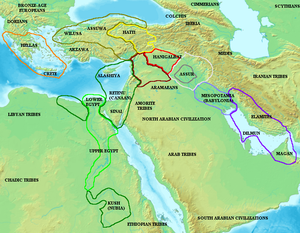
- 001–014 Babylonia
- 015–016 Assyria
- 017–030 Mittani
- 031–032 Arzawa
- 033–040 Alasia
- 041–044 Hatti
- 045–380+ Syria/Lebanon/Canaan
Amarna Letters from Syria/Lebanon/Canaan are distributed roughly:
- 045–067 Syria
- 068–227 Lebanon (where 68–140 are from Gubla aka Byblos)
- 227–380 Canaan (written mostly in the Canaano–Akkadian language).
Amarna letters list
Note: Many assignments are tentative; spellings vary widely. This is just a guide.Chronology
William L. MoranWilliam L. Moran
William Lambert Moran was an American Assyriologist. He was born in Chicago, United States.In 1939, Moran joined the Jesuit order. He then attended Loyola University in Chicago, where he received his B.A. in 1944. After this, he taught Latin and Greek in a high school in Cincinnati between 1946...
summarizes the state of the chronology
Chronology
Chronology is the science of arranging events in their order of occurrence in time, such as the use of a timeline or sequence of events. It is also "the determination of the actual temporal sequence of past events".Chronology is part of periodization...
of these tablets as follows:
From the internal evidence, the earliest possible date for this correspondence is the final decade of the reign of Amenhotep III
Amenhotep III
Amenhotep III also known as Amenhotep the Magnificent was the ninth pharaoh of the Eighteenth dynasty. According to different authors, he ruled Egypt from June 1386 to 1349 BC or June 1388 BC to December 1351 BC/1350 BC after his father Thutmose IV died...
, who ruled from 1388 (or 1391) BC to 1351 (or 1353) BC, possibly as early as this king's 30th regnal year
Regnal year
A regnal year is a year of the reign of a sovereign, from the Latin regnum meaning kingdom, rule.The oldest dating systems were in regnal years, and considered the date as an ordinal, not a cardinal number. For example, a monarch could have a first year of rule, a second year of rule, a third, and...
; the latest date any of these letters were written is the desertion of the city of Amarna
Amarna
Amarna is an extensive Egyptian archaeological site that represents the remains of the capital city newly–established and built by the Pharaoh Akhenaten of the late Eighteenth Dynasty , and abandoned shortly afterwards...
, commonly believed to have happened in the second year of the reign of Tutankhamun
Tutankhamun
Tutankhamun , Egyptian , ; approx. 1341 BC – 1323 BC) was an Egyptian pharaoh of the 18th dynasty , during the period of Egyptian history known as the New Kingdom...
later in the same century in 1332 BC. Moran notes that some scholars believe one tablet, EA 16, may have been addressed to Tutankhamun's successor Ay
Ay
Ay was the penultimate Pharaoh of Ancient Egypt's 18th dynasty. He held the throne of Egypt for a brief four-year period , although he was a close advisor to two and perhaps three of the pharaohs who ruled before him and was the power behind the throne during Tutankhamun's reign...
. However, this speculation appears improbable because the Amarna archives were closed by Year 2 of Tutankhamun
Tutankhamun
Tutankhamun , Egyptian , ; approx. 1341 BC – 1323 BC) was an Egyptian pharaoh of the 18th dynasty , during the period of Egyptian history known as the New Kingdom...
, when this king transferred Egypt's capital from Amarna to Thebes.
See also
- Abdi-HebaAbdi-HebaAbdi-Heba was a local chieftain of Jerusalem during the Amarna period . Abdi-Heba's name can be translated as "servant of Hebat", a Hurrian goddess. Some scholars believe the correct reading is Ebed-Nob...
- LabayaLabayaLabaya was a Habiru, possibly Canaanite, warlord who lived contemporaneously with Pharaoh Akhenaten . Labaya is mentioned in several of the Amarna Letters , which is practically all scholars know about him...
- Ashur-uballit IAshur-uballit IAshur-uballit I , was king of the Assyrian empire . His reign marks Assyria's independence from the kingdom of Mitanni, by defeating Shuttarna II; and the beginning of Assyria's emergence as a powerful empire...
- MutbaalMutbaalMutbaal was a Canaanite king of the Amarna Period. He is identified in the Amarna letters as a son of Labaya, the ruler of the hill country north of Jerusalem, including the territory in the vicinity of the city of Shachmu .Mutbaal may be the son whose association with the Habiru raiders Labaya...
- SuwardataŠuwardataŠuwardata, also Šuardatu, was the 'mayor' of Qiltu, during the 1350-1335 BC Amarna letters correspondence...
- See the town of "Lakiša", LachishLachishLachish was an ancient Near East town located at the site of modern Tell ed-Duweir in the Shephelah, a region between Mount Hebron and the maritime plain of Philistia . The town was first mentioned in the Amarna letters as Lakisha-Lakiša...
, for "find" of one tablet, EA 333. - Amarna letters–localities and their rulersAmarna letters–localities and their rulersThis is a list of the "Amarna letters" –Text corpus, categorized by: Amarna letters–localities and their rulers. It includes countries, regions, and the cities/or 'city-states' ...
- List of artifacts significant to the Bible
- Mari Tablets
- David RohlDavid RohlNew Chronology is the term used to describe an alternative Chronology of the ancient Near East developed by English Egyptologist David Rohl and other researchers beginning with A Test of Time: The Bible - from Myth to History in 1995...
- New Chronology (Rohl)
Research and analysis
- Goren, Y., FinkelsteinIsrael FinkelsteinIsrael Finkelstein is an Israeli archaeologist and academic. He is currently the Jacob M. Alkow Professor of the Archaeology of Israel in the Bronze Age and Iron Ages at Tel Aviv University and is also the co-director of excavations at Megiddo in northern Israel...
, I. & Na'aman, N., Inscribed in Clay - Provenance Study of the Amarna Tablets and Other Ancient Near Eastern Texts, Tel Aviv: Sonia and Marco Nadler Institute of Archaeology, Tel Aviv University, 2004. ISBN 965-266-020-5