
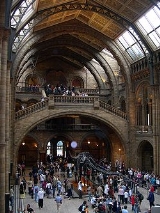
The Natural History Museum is one of three large
museumA museum is an institution that cares for a collection of artifacts and other objects of scientific, artistic, cultural, or historical importance and makes them available for public viewing through exhibits that may be permanent or temporary. Most large museums are located in major cities...
s on
Exhibition RoadExhibition Road is a street in South Kensington, London, forming a semi-border between the Royal Borough of Kensington and Chelsea and the City of Westminster...
,
South KensingtonSouth Kensington is a district in the Royal Borough of Kensington and Chelsea in London. It is a built-up area located 2.4 miles west south-west of Charing Cross....
,
LondonLondon is the capital city of :England and the :United Kingdom, the largest metropolitan area in the United Kingdom, and the largest urban zone in the European Union by most measures. Located on the River Thames, London has been a major settlement for two millennia, its history going back to its...
,
EnglandEngland is a country that is part of the United Kingdom. It shares land borders with Scotland to the north and Wales to the west; the Irish Sea is to the north west, the Celtic Sea to the south west, with the North Sea to the east and the English Channel to the south separating it from continental...
(the others are the
Science MuseumThe Science Museum is one of the three major museums on Exhibition Road, South Kensington, London in the Royal Borough of Kensington and Chelsea. It is part of the National Museum of Science and Industry. The museum is a major London tourist attraction....
, and the
Victoria and Albert MuseumThe Victoria and Albert Museum , set in the Brompton district of The Royal Borough of Kensington and Chelsea, London, England, is the world's largest museum of decorative arts and design, housing a permanent collection of over 4.5 million objects...
). Its main frontage is on
Cromwell RoadCromwell Road is a major road in the Royal Borough of Kensington and Chelsea, London, and is designated part of the A4. It was created in the 19th century and is named after Oliver Cromwell....
. The museum is an
exempt charityAn exempt charity is an institution established in England and Wales for charitable purposes which is exempt from registration with, and oversight by, the Charity Commission....
, and a
non-departmental public bodyIn the United Kingdom, a non-departmental public body —often referred to as a quango—is a classification applied by the Cabinet Office, Treasury, Scottish Government and Northern Ireland Executive to certain types of public bodies...
sponsored by the
Department for Culture, Media and SportThe Department for Culture, Media and Sport is a department of the United Kingdom government, with responsibility for culture and sport in England, and some aspects of the media throughout the whole UK, such as broadcasting and internet....
.
The museum is home to life and earth science specimens comprising some 70 million items within five main collections:
BotanyBotany, plant science, or plant biology is a branch of biology that involves the scientific study of plant life. Traditionally, botany also included the study of fungi, algae and viruses...
,
EntomologyEntomology is the scientific study of insects, a branch of arthropodology...
,
MineralogyMineralogy is the study of chemistry, crystal structure, and physical properties of minerals. Specific studies within mineralogy include the processes of mineral origin and formation, classification of minerals, their geographical distribution, as well as their utilization.-History:Early writing...
, Palaeontology and
ZoologyZoology |zoölogy]]), is the branch of biology that relates to the animal kingdom, including the structure, embryology, evolution, classification, habits, and distribution of all animals, both living and extinct...
. The museum is a world-renowned centre of research, specialising in
taxonomyTaxonomy is the science of identifying and naming species, and arranging them into a classification. The field of taxonomy, sometimes referred to as "biological taxonomy", revolves around the description and use of taxonomic units, known as taxa...
, identification and conservation. Given the age of the institution, many of the collections have great historical as well as scientific value, such as specimens collected by
DarwinCharles Robert Darwin FRS was an English naturalist. He established that all species of life have descended over time from common ancestry, and proposed the scientific theory that this branching pattern of evolution resulted from a process that he called natural selection.He published his theory...
. The Natural History Museum Library contains extensive books, journals, manuscripts, and artwork collections linked to the work and research of the scientific departments. Access to the library is by appointment only.
The museum is particularly famous for its exhibition of
dinosaurDinosaurs are a diverse group of animals of the clade and superorder Dinosauria. They were the dominant terrestrial vertebrates for over 160 million years, from the late Triassic period until the end of the Cretaceous , when the Cretaceous–Paleogene extinction event led to the extinction of...
skeletons, and ornate architecture — sometimes dubbed a
cathedral of nature — both exemplified by the large
DiplodocusDiplodocus , or )is a genus of diplodocid sauropod dinosaur whose fossils were first discovered in 1877 by S. W. Williston. The generic name, coined by Othniel Charles Marsh in 1878, is a Neo-Latin term derived from Greek "double" and "beam", in reference to its double-beamed chevron bones...
cast which dominates the vaulted central hall.
Originating from collections within the
British MuseumThe British Museum is a museum of human history and culture in London. Its collections, which number more than seven million objects, are amongst the largest and most comprehensive in the world and originate from all continents, illustrating and documenting the story of human culture from its...
, the landmark
Alfred WaterhouseAlfred Waterhouse was a British architect, particularly associated with the Victorian Gothic Revival architecture. He is perhaps best known for his design for the Natural History Museum in London, and Manchester Town Hall, although he also built a wide variety of other buildings throughout the...
building was built and opened by 1881, and later incorporated the
Geological MuseumThe Geological Museum is one of the oldest single science museums in the world and now part of the Natural History Museum in London...
. The Darwin Centre is a more recent addition, partly designed as a modern facility for storing the valuable collections.
Like other publicly funded national museums in the United Kingdom, the Natural History Museum does not levy an admission charge.
History and architecture
The foundation of the collection was that of the Ulster doctor Sir
Hans SloaneSir Hans Sloane, 1st Baronet, PRS was an Ulster-Scot physician and collector, notable for bequeathing his collection to the British nation which became the foundation of the British Museum...
(1660–1753), who allowed his significant collections to be purchased by the British Government at a price well below their market value at the time. This purchase was funded by a lottery. Sloane's collection, which included dried plants, and animal and human skeletons, was initially housed in Montague House in
Bloomsbury-Places:* Bloomsbury is an area in central London.* Bloomsbury , related local government unit* Bloomsbury, New Jersey, New Jersey, USA* Bloomsbury , listed on the NRHP in Maryland...
in 1756, which was the home of the
British MuseumThe British Museum is a museum of human history and culture in London. Its collections, which number more than seven million objects, are amongst the largest and most comprehensive in the world and originate from all continents, illustrating and documenting the story of human culture from its...
.
Most of the Sloane collection had disappeared by the early decades of the nineteenth century. Sir
George ShawGeorge Shaw was an English botanist and zoologist.Shaw was born at Bierton, Buckinghamshire and was educated at Magdalen Hall, Oxford, receiving his M.A. in 1772. He took up the profession of medical practitioner. In 1786 he became the assistant lecturer in botany at Oxford University...
(Keeper of Zoology 1806-13) sold many specimens to the
Royal College of SurgeonsThe Royal College of Surgeons of England is an independent professional body and registered charity committed to promoting and advancing the highest standards of surgical care for patients, regulating surgery, including dentistry, in England and Wales...
. His successor
William Elford LeachWilliam Elford Leach FRS was an English zoologist and marine biologist.Leach was born at Hoe Gate, Plymouth, the son of a solicitor. At the age of twelve he went to school in Exeter, studying anatomy and chemistry. By this time he was already collecting marine samples from Plymouth Sound and along...
made periodical
bonfires in the grounds of the museum. In 1833 the Annual Report states that, of the 5,500 insects listed in the Sloane catalogue, none remained. The inability of the natural history departments to conserve its specimens became notorious: the Treasury refused to entrust it with specimens collected at the government's expense. Appointments of staff were bedevilled by gentlemanly favoritism; in 1862 a nephew of the mistress of a Trustee was appointed Entomological Assistant despite not knowing the difference between a butterfly and a moth.
J.E. Gray (Keeper of Zoology 1840-74) complained of the incidence of mental illness amongst staff: George Shaw threatened to put his foot on any shell not in the
12th editionThe 12th edition of was the last edition of to be overseen by its author, Carl Linnaeus. It was published in three volumes, with parts appearing from 1766 to 1768...
of Linnaeus'
Systema NaturaeThe book was one of the major works of the Swedish botanist, zoologist and physician Carolus Linnaeus. The first edition was published in 1735...
; another had removed
all the labelsA museum label or caption is a label describing an object exhibited in a museum, or one introducing a room or area, or the whole museum.-Introduction labels:...
and registration numbers from entomological cases arranged by a rival. The huge collection of conchologist
Hugh CumingHugh Cuming was an English collector who was interested in natural history, particularly in conchology and botany. He has been described as the "Prince of Collectors"....
was acquired by the museum, and Gray's own wife had carried the open trays across the courtyard in a gale: all the labels blew away. That collection is said never to have recovered.
The Principal Librarian at the time was Antonio Panizzi; his contempt for the natural history departments and for science in general was total. The general public was not encouraged to visit the Museum's natural history exhibits. In 1835 to a Select Committee of Parliament, Sir
Henry EllisSir Henry Ellis was an English librarian.He was born in London and educated at the Mercers' School and St John's College, Oxford, where he acted as an assistant at the Bodleian Library...
said this policy was fully approved by the Principal Librarian and his senior colleagues.
Many of these faults were corrected by
Richard OwenSir Richard Owen, FRS KCB was an English biologist, comparative anatomist and palaeontologist.Owen is probably best remembered today for coining the word Dinosauria and for his outspoken opposition to Charles Darwin's theory of evolution by natural selection...
, appointed Superintendent of the natural history departments of the British Museum in 1856. His changes led
Bill BrysonWilliam McGuire "Bill" Bryson, OBE, is a best-selling American author of humorous books on travel, as well as books on the English language and on science. Born an American, he was a resident of Britain for most of his adult life before moving back to the US in 1995...
to write that "by making the Natural History Museum an institution for everyone, Owen transformed our expectations of what museums are for".
Owen saw that the natural history departments needed more space, and that implied a separate building as the British Museum site was limited. Land in South Kensington was purchased, and in 1864 a competition was held to design the new museum. The winning entry was submitted by civil engineer Captain
Francis FowkeFrancis Fowke RE was a British engineer and architect, and a Captain in the Corps of Royal Engineers. Most of his architectural work was executed in the Renaissance style, although he made use of relatively new technologies to create iron framed buildings, with large open galleries and...
who died shortly afterwards. The scheme was taken over by
Alfred WaterhouseAlfred Waterhouse was a British architect, particularly associated with the Victorian Gothic Revival architecture. He is perhaps best known for his design for the Natural History Museum in London, and Manchester Town Hall, although he also built a wide variety of other buildings throughout the...
who substantially revised the agreed plans, and designed the façades in his own idiosyncratic
RomanesqueRomanesque architecture is an architectural style of Medieval Europe characterised by semi-circular arches. There is no consensus for the beginning date of the Romanesque architecture, with proposals ranging from the 6th to the 10th century. It developed in the 12th century into the Gothic style,...
style which was inspired by his frequent visits to the Continent. The original plans included wings on either side of the main building, but these plans were soon abandoned for budgetary reasons. The space these would have occupied are now taken by the Earth Galleries and Darwin Centre.
Work began in 1873 and was completed in 1880. The new museum opened in 1881, although the move from the old museum was not fully completed until 1883.
Both the interiors and exteriors of the Waterhouse building make extensive use of terracotta tiles to resist the sooty climate of
VictorianThe Victorian era of British history was the period of Queen Victoria's reign from 20 June 1837 until her death on 22 January 1901. It was a long period of peace, prosperity, refined sensibilities and national self-confidence...
London, manufactured by the Tamworth-based company of
Gibbs and Canning LimitedGibbs and Canning Limited was an English manufacturer of terracotta and, in particular, architectural terracotta, based in Glascote, Tamworth and founded in 1847....
. The tiles and bricks feature many relief sculptures of flora and fauna, with living and extinct species featured within the west and east wings respectively. This explicit separation was at the request of Owen, and has been seen as a statement of his contemporary rebuttal of
Darwin'sCharles Robert Darwin FRS was an English naturalist. He established that all species of life have descended over time from common ancestry, and proposed the scientific theory that this branching pattern of evolution resulted from a process that he called natural selection.He published his theory...
attempt to link present species with past through the theory of
natural selectionNatural selection is the nonrandom process by which biologic traits become either more or less common in a population as a function of differential reproduction of their bearers. It is a key mechanism of evolution....
http://www.nhm.ac.uk/visit-us/history-architecture/architecture-tour/design/decoration/index.html.
The central axis of the museum is aligned with the tower of
Imperial College LondonImperial College London is a public research university located in London, United Kingdom, specialising in science, engineering, business and medicine...
(formerly the Imperial Institute) and the
Royal Albert HallThe Royal Albert Hall is a concert hall situated on the northern edge of the South Kensington area, in the City of Westminster, London, England, best known for holding the annual summer Proms concerts since 1941....
and
Albert MemorialThe Albert Memorial is situated in Kensington Gardens, London, England, directly to the north of the Royal Albert Hall. It was commissioned by Queen Victoria in memory of her beloved husband, Prince Albert who died of typhoid in 1861. The memorial was designed by Sir George Gilbert Scott in the...
further north. These all form part of the complex known colloquially as
AlbertopolisAlbertopolis is the area centred on South Kensington, Kensington & Chelsea, London, England, between Cromwell Road and Kensington Gore, which contains a large number of educational and cultural sites, including:*Imperial College London...
.
Separation from the British Museum
Even after the opening, the NHM legally remained a department of the British Museum with the formal name British Museum (Natural History), usually abbreviated in the
scientific literatureScientific literature comprises scientific publications that report original empirical and theoretical work in the natural and social sciences, and within a scientific field is often abbreviated as the literature. Academic publishing is the process of placing the results of one's research into the...
as B.M.(N.H.) or BMNH. A petition to the
Chancellor of the ExchequerThe Chancellor of the Exchequer is the title held by the British Cabinet minister who is responsible for all economic and financial matters. Often simply called the Chancellor, the office-holder controls HM Treasury and plays a role akin to the posts of Minister of Finance or Secretary of the...
was made in 1866, signed by the heads of the
RoyalThe Royal Society of London for Improving Natural Knowledge, known simply as the Royal Society, is a learned society for science, and is possibly the oldest such society in existence. Founded in November 1660, it was granted a Royal Charter by King Charles II as the "Royal Society of London"...
, Linnean and
ZoologicalThe Zoological Society of London is a charity devoted to the worldwide conservation of animals and their habitats...
Societies as well as naturalists including
DarwinCharles Robert Darwin FRS was an English naturalist. He established that all species of life have descended over time from common ancestry, and proposed the scientific theory that this branching pattern of evolution resulted from a process that he called natural selection.He published his theory...
,
WallaceAlfred Russel Wallace, OM, FRS was a British naturalist, explorer, geographer, anthropologist and biologist...
and Huxley, asking that the museum gain independence from the board of the British Museum, and heated discussions on the matter continued for nearly one hundred years.
Finally, with the
British Museum Act 1963The British Museum Act 1963 is an Act of the Parliament of the United Kingdom. It replaced the British Museum Act 1902. The act forbids the Museum from disposing of its holdings, except in a small number of special circumstances. The amendment of the act would, therefore, be a necessary precursor...
, the British Museum (Natural History) became an independent museum with its own Board of Trustees, although – despite a proposed amendment to the act in the
House of LordsThe House of Lords is the upper house of the Parliament of the United Kingdom. Like the House of Commons, it meets in the Palace of Westminster....
– the former name remained. Only with the
Museums and Galleries Act 1992The Museums and Galleries Act 1992 is an Act of the Parliament of the United Kingdom the long title of which is "An Act to establish Boards of Trustees of the National Gallery, the Tate Gallery, the National Portrait Gallery and the Wallace Collection; to transfer property to them and confer...
did the Museum's formal title finally change to the Natural History Museum.
Geological Museum
In 1986, the museum absorbed the adjacent
Geological MuseumThe Geological Museum is one of the oldest single science museums in the world and now part of the Natural History Museum in London...
of the
British Geological SurveyThe British Geological Survey is a partly publicly funded body which aims to advance geoscientific knowledge of the United Kingdom landmass and its continental shelf by means of systematic surveying, monitoring and research. The BGS headquarters are in Keyworth, Nottinghamshire, but other centres...
, which had long competed for the limited space available in the area. The Geological Museum became world-famous for exhibitions including an active volcano model and an earthquake machine (designed by James Gardiner), and housed the world's first computer-enhanced exhibition (
Treasures of the Earth). The museum's galleries were completely rebuilt and relaunched in 1996 as
The Earth Galleries, with the other exhibitions in the Waterhouse building retitled
The Life Galleries. The Natural History Museum's own Mineralogy displays remain largely unchanged as an example of the 19th-century display techniques of the Waterhouse building.
The central atrium design by Neal Potter overcame visitors' reluctance to visit the upper galleries by "pulling" them through a model of the Earth made up of random plates on an escalator. The new design covered the walls in recycled slate and sandblasted the major stars and planets onto the wall. The Museums 'star' geological exhibits are displayed within the walls. Six iconic figures are the backdrop to discussing how previous generations have viewed Earth.
The Darwin Centre
The newly-developed
Darwin Centre (named after
Charles DarwinCharles Robert Darwin FRS was an English naturalist. He established that all species of life have descended over time from common ancestry, and proposed the scientific theory that this branching pattern of evolution resulted from a process that he called natural selection.He published his theory...
) is designed as a new home for the museum's collection of tens of millions of preserved specimens, as well as new work spaces for the museum's scientific staff, and new educational visitor experiences. Built in two distinct phases, with two new buildings adjacent to the main Waterhouse building, it is the most significant new development project in the museum's history.
Phase one of the Darwin Centre houses the Zoological department's 'spirit collections' — organisms preserved in
alcoholIn chemistry, an alcohol is an organic compound in which the hydroxy functional group is bound to a carbon atom. In particular, this carbon center should be saturated, having single bonds to three other atoms....
. Phase Two was unveiled in September 2008 and opened to the general public in September 2009. It was designed by
DanishDenmark is a Scandinavian country in Northern Europe. The countries of Denmark and Greenland, as well as the Faroe Islands, constitute the Kingdom of Denmark . It is the southernmost of the Nordic countries, southwest of Sweden and south of Norway, and bordered to the south by Germany. Denmark...
architecture practice
C. F. Møller ArchitectsArkitektfirmaet C. F. Møller, internationally also known as C. F. Møller Architects, is an architectural firm based in Århus, Denmark. Founded in 1924 by C. F. Møller, it is today the largest architectural firm in Denmark based on number of employed architects. About half the revenue is earned...
in the shape of a giant, eight-story cocoon and houses the
entomologyEntomology is the scientific study of insects, a branch of arthropodology...
and botanical collections — the 'dry collections'.
Arguably the most famous creature in the centre is the 8.62 metre long
Giant SquidThe giant squid is a deep-ocean dwelling squid in the family Architeuthidae, represented by as many as eight species...
, affectionately named Archie (
http://www.nhm.ac.uk/about-us/news/2006/feb/news_5255.html).
The Attenborough Studio
As part of the museum's remit to communicate science education and conservation work, a new multimedia studio will form an important part of Darwin Centre Phase 2. In collaboration with the
BBC's Natural History UnitThe BBC Natural History Unit is a department of the BBC dedicated to making television and radio programmes with a natural history or wildlife theme, especially nature documentaries...
(holder of the largest archive of natural history footage) the Attenborough Studio – named after the venerable broadcaster and presenter Sir
David AttenboroughSir David Frederick Attenborough OM, CH, CVO, CBE, FRS, FZS, FSA is a British broadcaster and naturalist. His career as the face and voice of natural history programmes has endured for more than 50 years...
– provides a multimedia environment for educational events. The studio plans to continue the daily lectures and demonstrations.
Major specimens and exhibits
One of the most famous and certainly most prominent of the exhibits — affectionately known as Dippy — is a 105 feet (32 m) long replica
Diplodocus carnegii skeleton, situated within the central hall. The cast was given as a gift by the Scottish American industrialist
Andrew CarnegieAndrew Carnegie was a Scottish-American industrialist, businessman, and entrepreneur who led the enormous expansion of the American steel industry in the late 19th century...
, after a discussion with King Edward VII, then a keen trustee of the British Museum. Carnegie arranged for the cast to be created at his own considerable expense of £2,000, copying the original held at the Carnegie Museum. The pieces were sent to London in 36 crates, and on 12 May 1905, the exhibit was unveiled, to great public and media interest (the real fossil had yet to be mounted, as the
Carnegie Museum of Natural HistoryCarnegie Museum of Natural History, located at 4400 Forbes Avenue in the Oakland neighborhood of Pittsburgh, Pennsylvania, USA, was founded by the Pittsburgh-based industrialist Andrew Carnegie in 1896...
in Pittsburgh,
PennsylvaniaThe Commonwealth of Pennsylvania is a U.S. state that is located in the Northeastern and Mid-Atlantic regions of the United States. The state borders Delaware and Maryland to the south, West Virginia to the southwest, Ohio to the west, New York and Ontario, Canada, to the north, and New Jersey to...
, was still being constructed to house it). As word of "Dippy" spread, Mr Carnegie paid to have additional copies made for display in most of the major European capitals and in
LatinLatin America is a region of the Americas where Romance languages – particularly Spanish and Portuguese, and variably French – are primarily spoken. Latin America has an area of approximately 21,069,500 km² , almost 3.9% of the Earth's surface or 14.1% of its land surface area...
and
South AmericaSouth America is a continent situated in the Western Hemisphere, mostly in the Southern Hemisphere, with a relatively small portion in the Northern Hemisphere. The continent is also considered a subcontinent of the Americas. It is bordered on the west by the Pacific Ocean and on the north and east...
, making Dippy the most-seen dinosaur skeleton in the world. The dinosaur quickly became an iconic representation of the museum, and has featured in many cartoons and other media, including the 1975 Disney
comedyComedy , as a popular meaning, is any humorous discourse or work generally intended to amuse by creating laughter, especially in television, film, and stand-up comedy. This must be carefully distinguished from its academic definition, namely the comic theatre, whose Western origins are found in...
One of Our Dinosaurs Is MissingOne of Our Dinosaurs is Missing is a 1975 British comedy film, which is set in the early 1920s, about the theft of a dinosaur skeleton from the Natural History Museum. The film was produced by Walt Disney Productions and released by Buena Vista Distribution Company. The title is a parody of the...
.
Another iconic display is the parallel skeleton and model of a
blue whaleThe blue whale is a marine mammal belonging to the suborder of baleen whales . At in length and or more in weight, it is the largest known animal to have ever existed....
. The display of the skeleton, weighing 10 tons and some 25 m long, was only made possible in 1934 with the building of the New Whale Hall (now the Large Mammals Hall), though it had been in storage for 42 years since its stranding on sandbanks at
Wexford BayWexford is the county town of County Wexford, Ireland. It is situated near the southeastern corner of Ireland, close to Rosslare Europort. The town is connected to Dublin via the M11/N11 National Primary Route, and the national rail network...
. Discussion of the idea of a life-size model also began around this time, and work was undertaken within the Whale Hall itself. Since taking a cast of such a large animal was deemed prohibitively expensive, scale models were used to meticulously piece the structure together. During construction, workmen left a trapdoor within the whale's stomach, which they would use for surreptitious cigarette breaks. Before the door was closed and sealed forever, some coins and a telephone directory were placed inside — this soon growing to an urban myth that a
time capsuleA time capsule is an historic cache of goods or information, usually intended as a method of communication with future people and to help future archaeologists, anthropologists, or historians...
was left inside. The work was completed — entirely within the hall and in full view of the public — in 1938. At the time it was the largest such model in the world, at 28.3 m in length, though the construction details were later borrowed by several American museums, who scaled the plans further.
The Darwin Centre is host to Archie, an 8 metre long
giant squidThe giant squid is a deep-ocean dwelling squid in the family Architeuthidae, represented by as many as eight species...
taken alive in a
fishing netA fishing net or fishnet is a net that is used for fishing. Fishing nets are meshes usually formed by knotting a relatively thin thread. Modern nets are usually made of artificial polyamides like nylon, although nets of organic polyamides such as wool or silk thread were common until recently and...
near the
Falkland IslandsThe Falkland Islands are an archipelago in the South Atlantic Ocean, located about from the coast of mainland South America. The archipelago consists of East Falkland, West Falkland and 776 lesser islands. The capital, Stanley, is on East Falkland...
in 2004. The squid is not on general display, but stored in the large tank room in the basement of the Phase 1 building. On arrival at the museum, the specimen was immediately frozen while preparations commenced for its permanent storage. Since few complete and reasonably fresh examples of the species exist, ‘wet storage’ was chosen, leaving the squid undissected. A 9.45 m acrylic tank was constructed (by the same team that provide tanks to Damian Hirst), and the body preserved using a mixture of formalin and saline solution.
The museum holds the remains and bones of the
River Thames WhaleThe River Thames whale was a juvenile female Northern Bottlenose whale which was discovered swimming in the River Thames in central London on Friday 20 January 2006. According to the BBC, she was five metres long and weighed about seven tonnes...
that lost its way on 20 January 2006 and swam into the Thames. Although primarily used for research purposes, and held at the museum's storage site at
WandsworthWandsworth is a district of south London, England, in the London Borough of Wandsworth. It is situated southwest of Charing Cross. The area is identified in the London Plan as one of 35 major centres in Greater London.-Toponymy:...
, the skeleton has been put on temporary public display.
http://www.nhm.ac.uk/about-us/news/2007/january/news_10254.html
DinocochleaDinocochlea ingens is a trace fossil specimen held in the Natural History Museum of London. It is a symmetrical helicospiral several metres in length that was famously unexplained until shown in 2009 to be a concretion formed around the burrow of a worm....
, one of the longer-standing mysteries of paleontology (originally thought to be a giant
gastropod shellThe gastropod shell is a shell which is part of the body of a gastropod or snail, one kind of mollusc. The gastropod shell is an external skeleton or exoskeleton, which serves not only for muscle attachment, but also for protection from predators and from mechanical damage...
, then a
coproliteA coprolite is fossilized animal dung. Coprolites are classified as trace fossils as opposed to body fossils, as they give evidence for the animal's behaviour rather than morphology. The name is derived from the Greek words κοπρος / kopros meaning 'dung' and λιθος / lithos meaning 'stone'. They...
and now a
concretionA concretion is a volume of sedimentary rock in which a mineral cement fills the porosity . Concretions are often ovoid or spherical in shape, although irregular shapes also occur. The word 'concretion' is derived from the Latin con meaning 'together' and crescere meaning 'to grow'...
of a worm's tunnel), has been part of the collection since its discover in 1921.
The museum keeps a wildlife garden on its west lawn, on which a potentially new species of insect resembling
Arocatus roeseliiArocatus roeselii is a species of lygaeid bug about a centimetre long and is found in Europe.The insect is similar to Arocatus roeselii, which is somewhat rare in central Europe...
was discovered in 2007.
Galleries
Red Zone
This is the zone that can be entered from Exhibition Road, on the East side of the building. It is a gallery themed around the changing history of the
EarthEarth is the third planet from the Sun, and the densest and fifth-largest of the eight planets in the Solar System. It is also the largest of the Solar System's four terrestrial planets...
.
The
Earth Lab is a gallery that centres around
geologyGeology is the science comprising the study of solid Earth, the rocks of which it is composed, and the processes by which it evolves. Geology gives insight into the history of the Earth, as it provides the primary evidence for plate tectonics, the evolutionary history of life, and past climates...
, and contains specimens of fossils, minerals and rocks. The "Lab Area" is only open to reserved groups and allows an interactive approach to the gallery, allowing the use of microscopes. It is currently the only gallery in the red-zone without step free access.
Earth's Treasury shows specimens of rocks, minerals and gemstones behind glass in a dimly lit gallery.
Lasting Impressions is a small gallery containing speciments of rocks, plants and minerals, of which most can be touched.
- Earth Lab
- Earth's Treasury
- Lasting Impressions
- Restless Surface
- Earth Today and Tomorrow
- From the Beginning
- The Power Within
- Visions of Earth
Green zone
- Birds
- Creepy Crawlies
- Ecology
- Fossil Marine Reptiles
- Giant Sequoia and Central Hall
- Minerals
- The Vault
- Our Place in Evolution
- Plant Power
- Primates
- Investigate
Blue zone
- Dinosaurs
- Fishes, Amphibians and Reptiles
- Human Biology
- Jerwood
- Marine Invertebrates
- Mammals
- Mammals (Blue Whale
The blue whale is a marine mammal belonging to the suborder of baleen whales . At in length and or more in weight, it is the largest known animal to have ever existed....
)
- Nature Live
Orange zone
- Wildlife Garden
- Darwin Centre
Education and public engagement
The museum runs a series of
educationalMuseum education is an important part of the role of museums.- Introduction :A museum's collection can be used to support education in a variety of ways...
and public engagement programmes. These include for example a highly praised "How Science Works" hands on workshop for school students demonstrating the use of microfossils in geological research. The museum also played a major role in securing designation of the Jurassic Coast of Devon and Dorset as a UNESCO World Heritage site and has subsequently been a lead partner in the Lyme Regis Fossil Festivals.
In 2005, the museum launched a project to develop notable gallery characters to patrol display cases, including 'facsimiles' of luminaries such as Carl Linnaeus,
Mary AnningMary Anning was a British fossil collector, dealer and palaeontologist who became known around the world for a number of important finds she made in the Jurassic age marine fossil beds at Lyme Regis where she lived...
,
Dorothea BateDorothea Minola Alice Bate FGS , also known as Dorothy Bate, was a British palaeontologist, a pioneer of archaeozoology...
and
William SmithWilliam 'Strata' Smith was an English geologist, credited with creating the first nationwide geological map. He is known as the "Father of English Geology" for collating the geological history of England and Wales into a single record, although recognition was very slow in coming...
. They tell stories and anecdotes of their lives and discoveries and aim to surprise visitors.
In 2010 a six-part
BBCThe British Broadcasting Corporation is a British public service broadcaster. Its headquarters is at Broadcasting House in the City of Westminster, London. It is the largest broadcaster in the world, with about 23,000 staff...
documentary series was filmed at the museum entitled
Museum of LifeMuseum of Life is a 2010 BBC2 documentary, that takes a look behind the scenes at the British Museum of Natural History. It is introduced and co-presented by Jimmy Doherty, who was a volunteer at the Natural History Museum ten years previously...
exploring the history and
behind the scenes aspects of the museum.
Nature Live
Formerly called Darwin Centre Live, the
Nature Live programme of free events gives visitors an opportunity to meet and talk with the scientists who work behind the scenes at the museum. Live events take place every day at 14.30 GMT, with subjects from evolution and climate change, to biodiversity and space. Visitors can ask questions, see specimens that are not normally on public display, and participate in video link-ups to laboratory spaces and field work sites around the world. The events are also webcast live on the museum's website, and online viewers can participate by emailing in questions or comments. Previous events are archived online.
Location and access
| Service | Station/Stop | Lines/Routes served |
| London Buses |
Kensington Museums |
360London Buses route 360 is a Transport for London contracted bus route in London, United Kingdom. The service is currently contracted to Go-Ahead London.-History:...
|
| Victoria & Albert Museum |
14London Buses route 14 is a Transport for London contracted bus route in London, England. The service is currently contracted to Go-Ahead London.-History:... , 74London Buses route 74 is a Transport for London contracted bus route in London, United Kingdom. The service is currently contracted to Go-Ahead London.-History:... , 414, C1London Buses route C1 is a Transport for London contracted bus route in London, United Kingdom. The service is currently contracted to London United.-History:The route has always been operated by minibuses since London Transport operation...
|
| London Underground |
South KensingtonSouth Kensington is a London Underground station in Kensington, west London. It is served by the District, Circle and Piccadilly lines. On the District and Circle lines, the station is between Gloucester Road and Sloane Square, and on the Piccadilly Line, it is between Gloucester Road and...
|
|
The closest
London UndergroundThe London Underground is a rapid transit system serving a large part of Greater London and some parts of Buckinghamshire, Hertfordshire and Essex in England...
station is
South KensingtonSouth Kensington is a London Underground station in Kensington, west London. It is served by the District, Circle and Piccadilly lines. On the District and Circle lines, the station is between Gloucester Road and Sloane Square, and on the Piccadilly Line, it is between Gloucester Road and...
— there is a tunnel from the station that emerges close to the entrances of all three museums. Admission is free, though there are donation boxes in the foyer.
Museum LaneMuseum Lane runs between two of London's leading museums in South Kensington, namely the Science Museum to the north and the Natural History Museum to the south. It runs to the west off Exhibition Road. Opposite is the Henry Cole Wing of the Victoria and Albert Museum.Museum Lane provides disabled...
immediately to the north provides disabled access to the museum.
Times and dates
The Natural History Museum is a National Museum and has offered free entry since 2001. However, there is an entry charge for some temporary exhibitions.
The Museum is open every day (except 24–26 December) from 10:00am. Last entry is at 5:30pm and the Museum closes at 5:50pm.
Natural History Museum at Tring
The NHM also has a sister museum, located at
TringTring is a small market town and also a civil parish in the Chiltern Hills in Hertfordshire, England. Situated north-west of London and linked to London by the old Roman road of Akeman Street, by the modern A41, by the Grand Union Canal and by rail lines to Euston Station, Tring is now largely a...
,
HertfordshireHertfordshire is a ceremonial and non-metropolitan county in the East region of England. The county town is Hertford.The county is one of the Home Counties and lies inland, bordered by Greater London , Buckinghamshire , Bedfordshire , Cambridgeshire and...
. Built by local eccentric
Lionel Walter Rothschild, the NHM took ownership in 1938. In 2007, the museum announced the name would be changed to the Natural History Museum at Tring, though the older name, the Walter Rothschild Zoological Museum is still in widespread use.
In fiction
The Museum is a prominent setting in
Charlie FletcherCharlie Fletcher is a British screenwriter and author.After many years writing for film and television, he is now probably best known for his children's novel, Stoneheart.-Biography:...
's children's book about unLondon
StoneheartStoneheart is a children's novel by Charlie Fletcher, published in 2006. It is part of the Stoneheart Trilogy. Stoneheart is followed by "Ironhand", which is itself followed by "Silver Tongue"...
. George Chapman, the hero, sneaks outside when punished on a school trip; he breaks off a small dragon's stone head from a relief and is chased by a pterodactyl which comes to life from a statue on the roof.
The museum also features in the Anthony Horowitz Power of Five book,
Ravens Gate.
The Museum plays an important role in the London-based Disney live-action feature
One of Our Dinosaurs Is MissingOne of Our Dinosaurs is Missing is a 1975 British comedy film, which is set in the early 1920s, about the theft of a dinosaur skeleton from the Natural History Museum. The film was produced by Walt Disney Productions and released by Buena Vista Distribution Company. The title is a parody of the...
; the eponymous skeleton is stolen from the museum, and a group of intrepid
nanniesA nanny, childminder or child care provider, is an individual who provides care for one or more children in a family as a service...
hide inside the mouth of what is supposed to be the Blue Whale model (in fact a specially-created prop - the nannies peer out from behind the whale's teeth, but a real Blue Whale is a
baleen whaleThe Baleen whales, also called whalebone whales or great whales, form the Mysticeti, one of two suborders of the Cetacea . Baleen whales are characterized by having baleen plates for filtering food from water, rather than having teeth. This distinguishes them from the other suborder of cetaceans,...
and has no teeth). Additionally, the film is set in the 1920s, before the Blue Whale model was built.
BritishThe United Kingdom of Great Britain and Northern IrelandIn the United Kingdom and Dependencies, other languages have been officially recognised as legitimate autochthonous languages under the European Charter for Regional or Minority Languages...
fantasyFantasy is a genre of fiction that commonly uses magic and other supernatural phenomena as a primary element of plot, theme, or setting. Many works within the genre take place in imaginary worlds where magic is common...
author
China MievilleChina Tom Miéville is an award-winning English fantasy fiction writer. He is fond of describing his work as "weird fiction" , and belongs to a loose group of writers sometimes called New Weird. He is also active in left-wing politics as a member of the Socialist Workers Party...
based the plot of his 2010 novel Kraken: An Anatomy around the theft of "Archie" from the Darwin Centre by a mysterious squid cult.
BritishThe United Kingdom of Great Britain and Northern IrelandIn the United Kingdom and Dependencies, other languages have been officially recognised as legitimate autochthonous languages under the European Charter for Regional or Minority Languages...
detective series
New Tricks (TV series) featured the museum in the first episode of its eighth series,
Old Fossils.
See also
- Walter Rothschild Zoological Museum
The Natural History Museum at Tring was the private museum of Lionel Walter, 2nd Baron Rothschild, today it is under the control of the Natural History Museum. It houses one of the finest collections of stuffed mammals, birds, reptiles and insects in the United Kingdom...
- Notable employees of the Natural History Museum
External links