
All Topics  
Woodcut


   Email Print
   Bookmark   Link


Woodcut


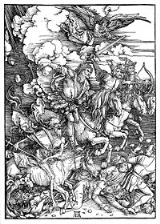
Woodcut - formally known as Xylography - is a relief print
Relief print

A relief print is an image created by a printmaking process, such as woodcut, where the areas of the matrix that are to show printed black are on the original surface; the parts of the matrix that are to be blank having been cut away, or otherwise removed....
ing artistic technique in printmaking
Printmaking

Printmaking is the process of making artworks by printing, normally on paper. Except in the case of monotyping, the process is capable of producing multiples of the same piece, which is called a 'print....
 in which an image is carved into the surface of a block of wood, with the printing parts remaining level with the surface while the non-printing parts are removed, typically with gouges. The areas to show 'white' are cut away with a knife or chisel, leaving the characters or image to show in 'black' at the original surface level.


Discussion
Ask a question about 'Woodcut'
Start a new discussion about 'Woodcut'
Answer questions from other users
Full Discussion Forum


Encyclopedia


Woodcut - formally known as Xylography - is a relief print
Relief print

A relief print is an image created by a printmaking process, such as woodcut, where the areas of the matrix that are to show printed black are on the original surface; the parts of the matrix that are to be blank having been cut away, or otherwise removed....
ing artistic technique in printmaking
Printmaking

Printmaking is the process of making artworks by printing, normally on paper. Except in the case of monotyping, the process is capable of producing multiples of the same piece, which is called a 'print....
 in which an image is carved into the surface of a block of wood, with the printing parts remaining level with the surface while the non-printing parts are removed, typically with gouges. The areas to show 'white' are cut away with a knife or chisel, leaving the characters or image to show in 'black' at the original surface level. The block is cut along the grain of the wood (unlike wood engraving
Wood engraving

Wood engraving is a relief printing technique, where the end grain of wood is used as a medium for engraving, thus differing from the older technique of woodcut, where the softer side grain is used....
 where the block is cut in the end-grain). In Europe beech
Beech

Beech is a genus of ten species of deciduous trees in the family Fagaceae, native to temperate Europe and North America.The leaf of beech trees are entire or sparsely toothed, from 5–15 cm long and 4–10 cm broad....
wood was most commonly used; in Japan, a special type of cherry
Cherry

The word cherry refers to a fleshy fruit that contains a single stony seed. The cherry belongs to the family Rosaceae, genus Prunus, along with almonds, peaches, plums, apricots and bird cherry ....
 wood was used.

The surface is covered with ink by rolling over the surface with an ink-covered roller (brayer
Brayer

A brayer is a hand roller used in printmaking techniques to spread ink or to offset an image from a plate to paper. They can be made of rubber, sponge, Polymethyl methacrylate, or leather....
), leaving ink upon the flat surface but not in the non-printing areas.

Multiple colors can be printed by keying the paper to a frame around the woodblocks (where a different block is used for each color). The art of carving the woodcut can be called "xylography", but this is rarely used in English for images alone, although that and "xylographic" are used in connection with blockbooks
Woodblock printing

Woodblock printing is a technique for printing text, or patterns used widely throughout East Asia and originating in China in antiquity as a method of printing on textiles and later paper....
, which contain text.

Division of labour

In both Europe and Japan, traditionally the artist only designed the woodcut, and the block-carving was left to specialist craftsmen, called block-cutters, or formschneider in Germany, some of whom became well-known in their own right - among the best known are the 16th century Hieronymus Andreae
Hieronymus Andreae

Hieronymus Andreae, or Andre?, or Hieronymus Formschneider, was a German woodblock cutter , printer, publisher and typographer closely associated with Albrecht D?rer....
 (who also used "Formschneider" as his surname), Hans Lützelburger
Hans Lützelburger

File:L?tzelburger Hohlbein K?mpfende Bauern.jpgFile:The Abbot, from The Dance of Death, by Hans Holbein the Younger.jpgHans L?tzelburger , also known as Hans Franck, was a Germany blockcutter for woodcuts, regarded as one of the finest of his day....
 and Jost de Negker
Jost de Negker

File:Hans Burgkmair the Elder - Lovers Surprised by Death.jpgFile:Quaterionenadler David de Negker.jpgJost de Negker was a cutter of woodcuts and also a printer and publisher of old master prints during the early 16th century, mostly in Augsburg, Germany....
, all of whom ran workshops and also operated as printers and publishers. The formschneider in turn handed the block on to specialist printers. There were further specialists who made the blank blocks.

There were various methods of transferring the artist's drawn design onto the block for the cutter to follow. Either the drawing would be made directly onto the block (often whitened first), or a drawing
Drawing

Drawing is a visual art that makes use of any number of drawing instruments to mark a two-dimensional medium. Common instruments include graphite pencils, pen and ink, inked brushes, wax color pencils, crayons, charcoals, chalk, pastels, marker pens, stylus, or various metals like silverpoint....
 on paper was glued to the block. Either way, the artist's drawing was destroyed during the cutting process. Other methods were used, including tracing.

This is why woodcuts are sometimes described by museums or books as "designed by" rather than "by" an artist; but most authorities do not use this distinction. The division of labour had the advantage that a trained artist could adapt to the medium relatively easily, without needing to learn the use of woodworking
Woodworking

Woodworking is the process of building, making or carving something using wood....
 tools.

In both Europe and Japan, in the early twentieth century some artists began to do the whole process themselves. In Japan, this movement was called Sosaku hanga
Sosaku hanga

The art movement in early 20th century Japan, during the Taisho period and Showa period periods advocated the principles of "self-drawn" , "self-carved" and "self-printed" , according to which the artist, with the desire of expressing the self, is the sole creator of art....
, as opposed to the Shin hanga
Shin hanga

The shin hanga art movement in early 20th century Japan, during the Taisho period and Showa periods, revitalized traditional ukiyo-e art which had its roots in the Edo period and Meiji periods ....
 movement, which retained the traditional methods. In the West, many artists used the easier technique of linocut
Linocut

Linocut is a printmaking technique, a variant of woodcut in which a sheet of linoleum is used for the relief surface. A design is cut into the linoleum surface with a sharp knife, V-shaped chisel or gouge, with the raised areas representing a reversal of the parts to show printed....
 instead.

Methods of printing

Compared to intaglio
Intaglio (printmaking)

Intaglio is a family of printmaking techniques in which the image is incised into a surface, known as the matrix or plate. Normally, copper or zinc plates are used as a surface, and the incisions are created by etching, engraving, drypoint, aquatint or mezzotint....
 techniques like etching
Etching

Etching is the process of using strong acid or mordant to cut into the unprotected parts of a metal surface to create a design in intaglio in the metal ....
 and engraving
Engraving

Engraving is the practice of incising a design onto a hard, usually flat surface, by cutting grooves into it. The result may be a decorated object in itself, as when silver, gold, steel, or glass engraving are engraved, or may provide an intaglio printing plate, of copper or another metal, for printing images on paper as prints or illustra...
, only low pressure is required to print. As a relief method, it is only necessary to ink the block and bring it into firm and even contact with the paper or cloth to achieve an acceptable print.

There are three methods of printing to consider:

  • Stamping: Used for many fabrics and most early European woodcuts (1400-40). These were printed by putting the paper/fabric on a table or other flat surface with the block on top, & pressing or hammering the back of the block


  • Rubbing: Apparently the most common method for Far Eastern printing on paper at all times. Used for European woodcuts and block-books later in the fifteenth century, and very widely for cloth. Also used for many Western woodcuts from about 1910 to the present. The block goes face up on a table, with the paper or fabric on top. The back is rubbed with a "hard pad, a flat piece of wood, a burnisher, or a leather frotton". A modern tool used for this is called a baren
    Baren

    Baren is a Japan tool used in printmaking processes such as woodcut or linoleum. The baren is a disk like device with a flat bottom and on the reverse side, a knotted handle....
    . Later in Japan, complex wooden mechanisms were used to help hold the woodblock perfectly still and to apply proper pressure in the printing process. This was especially helpful once multiple colors began to be introduced, and needed to be applied with precision atop previous ink layers.


  • Printing in a press: presses only seem to have been used in Asia in relatively recent times. Printing-presses were used from about 1480 for European prints and block-books, and before that for woodcut book illustrations. Simple weighted presses may have been used in Europe before the print-press, but firm evidence is lacking. A deceased Abbess of Mechelen
    Mechelen

    Mechelen is a Dutch-speaking city and municipality in the province of Antwerp , Flanders, Belgium. The municipality comprises the city of Mechelen proper, some quarters at its outskirts, the hamlets of Nekkerspoel and Battel , as well as the villages of Walem, Heffen, Leest, Hombeek, and Muizen....
     in 1465 had "unum instrumentum ad imprintendum scripturas et ymagines ... cum 14 aliis lapideis printis" - "an instrument for printing texts and pictures ... with 14 stones for printing" which is probably too early to be a Gutenberg
    Johannes Gutenberg

    Johannes Gensfleisch zur Laden zum Gutenberg was a Germany goldsmith and printer who is credited with being the first European to use movable type printing, in around 1439, and the global inventor of the mechanical printing press....
    -type printing press in that location.


History

Main articles Old master print
Old master print

An old master print is a work of art produced by a printing process within the Western tradition . A date of about 1830 is usually taken as marking the end of the period whose prints are covered by this term....
 for Europe, Woodblock printing in Japan
Woodblock printing in Japan

Woodblock printing in Japan is a technique best known for its use in the ukiyo-e artistic genre; however, it was also used very widely for printing books in the same period....
 for Japan, and Lubok
Lubok

In Russian language, Lubok or more exactly, lubok picture means a variety of Russian folk art such as prints in woodcut, characterized by simple graphics and narratives derived from the oral tradition and written folklore....
 for Russia


Woodcut first appeared in ancient China, where it is called Banhua
Banhua

Banhua is the Chinese umbrella term for any printmaking art objects, and especially for those made by woodblock printing, the term used for woodcuts from Asia....
, but has been most widely practised in Japan and Europe. In China, from the 6th century onwards, woodcut icon
Icon

An 'icon' is a religious work of art, most commonly a painting, from Eastern Christianity. More broadly the term is used in a wide number of contexts for an image, picture, or representation; it is a sign or likeness that stands for an object by signifying or representing it either concretely or by analogy, as in semiotics; by extension, ...
s became popular in Buddhist texts. Since the 10th century, woodcut pictures illustrated some Chinese literature, and some banknote
Banknote

A banknote is a kind of negotiable instrument, a promissory note made by a bank payable to the bearer on demand, used as money, and in many jurisdictions is legal tender....
s, such as Jiaozi
Jiaozi (currency)

Jiaozi is a form of banknote which appeared in 10th century Sichuan. Most numismatists generally regard it as the first paper money in history, a development of the Chinese Song Dynasty ....
.

In China printed images mostly remained tied as illustrations to accompanying text until the modern period. The earliest woodblock printed book, the Diamond Sutra
Diamond Sutra

The Buddhist text known around the world as the Diamond Sutra is a short Mahayana sutra of the Perfection of Wisdom genre, which teaches the practice of the avoidance of abiding in extremes of mental attachment....
 contains a large image as frontispiece, and many Buddhist texts contain some images. Later some notable Chinese artists designed woodcuts for books, but the individual print did not develop in China as an art-form in the way it did in Europe and Japan. Woodcuts in the form of New Year picture
New Year picture

A New Year picture , is an important and popular Banhua in China. Its original form was a picture of a door god fashioned during the Qin Dynasty....
s, given to friends like Christmas card
Christmas card

A Christmas card is a greeting card sent as part of the traditional celebration of Christmas in order to convey between people a range of sentiments related to the Christmas season....
s, were popular, but not significant artistically.

In Europe, Woodcut is the oldest technique used for old master print
Old master print

An old master print is a work of art produced by a printing process within the Western tradition . A date of about 1830 is usually taken as marking the end of the period whose prints are covered by this term....
s, developing about 1400, by using on paper existing techniques for printing on cloth. The explosion of sales of cheap woodcuts in the middle of the century led to a fall in standards, and many popular prints were very crude. The development of hatching
Hatching

Hatching is an artistic technique used to create tonal or shading effects by drawing closely spaced parallel lines. When lines are placed at an angle to one another, it is called cross-hatching....
 followed on rather later than in engraving
Engraving

Engraving is the practice of incising a design onto a hard, usually flat surface, by cutting grooves into it. The result may be a decorated object in itself, as when silver, gold, steel, or glass engraving are engraved, or may provide an intaglio printing plate, of copper or another metal, for printing images on paper as prints or illustra...
. Michael Wolgemut
Michael Wolgemut

Michael Wolgemut , Germany Painting and printmaker, was born and died in Nuremberg....
 was significant in making German woodcut more sophisticated from about 1475, and Erhard Reuwich
Erhard Reuwich

Erhard Reuwich was a Netherlands artist, as a designer of woodcuts, and a printer , who came from Utrecht but then worked in Mainz. His dates and places of birth and death are unknown, but he was active in the 1480s....
 was the first to use cross-hatching (far harder to do than in engraving or etching
Etching

Etching is the process of using strong acid or mordant to cut into the unprotected parts of a metal surface to create a design in intaglio in the metal ....
). Both of these produced mainly book-illustrations, as did various Italian artists who were also raising standards there at the same period. At the end of the century Albrecht Dürer
Albrecht Dürer

'Albrecht D?rer' was a Germans Painting, printmaker and theorist from Nuremberg. His still-famous works include the Apocalypse woodcuts, commons:Image:Duerer - Ritter, Tod und Teufel .jpg , St....
 brought the Western woodcut to a level that has never been surpassed, and greatly increased the status of the single-leaf (ie an image sold separately) woodcut.

As woodcut can be easily printed together with movable type
Movable Type

Movable Type is a blog software developed by the company Six Apart. It was publicly announced on 3 September 2001, and version 1.0 was publicly released on 8 October 2001....
, because both are relief-printed, it was the main medium for book illustrations until the late-sixteenth century. The first woodcut book illustration dates to about 1461, only a few years after the beginning of printing with movable type, printed by Albrecht Pfister in Bamberg
Bamberg

Bamberg is a town in Bavaria, Germany. It is located in Upper Franconia on the river Regnitz, close to its confluence with the river Main. Bamberg is one of the few cities in Germany that was not destroyed by World War II bombings because of a nearby Artillery Factory that prevented planes from getting near to Bamberg....
. Woodcut was used less often for individual ("single-leaf") fine-art prints from about 1550 until the late nineteenth-century, when interest revived. It continued to be important for popular prints until the nineteenth century in most of Europe, and later in some places.

The art reached a high level of technical and artistic development in East Asia
East Asia

East Asia is a subregion of Asia that can be defined in either Geography or cultural terms. Geography and geopolitically, it covers about 12,000,000 km?, or about 28 percent of the Asian continent, about 15 percent bigger than the area of Europe, though some categorize Tibet, Xinjiang, and Mongolia as Central Asia....
 and Iran
Iran

Iran , officially the Islamic Republic of Iran and formerly known internationally as Persian Empire until 1935, is a country in Central Eurasia, located on the northeastern shore of the Persian Gulf and the southern shore of the Caspian Sea....
. In Japan
Japan

Japan is an island country in East Asia. Located in the Pacific Ocean, it lies to the east of the Sea of Japan, People's Republic of China, North Korea, South Korea and Russia, stretching from the Sea of Okhotsk in the north to the East China Sea and Taiwan in the south....
 woodblock printing is called "moku hanga", and was introduced in the seventeenth century for both books and art. The popular "floating world" genre of ukiyo-e
Ukiyo-e

, "pictures of the floating world", is a genre of Japanese woodblock printing and paintings produced between the 17th and the 20th centuries, featuring motifs of landscapes, tales from history, the theatre and pleasure quarters....
 originated in the second half of the seventeenth century, with prints in monocrome or two colours. Sometimes these were hand-coloured after printing. Later prints with many colours were developed. Japanese woodcut became a major artistic form, although at the time it was accorded a much lower status than painting. It continued to develop through to the twentieth century.

White-line woodcut

This technique just carves the image in mostly thin lines, not unlike a rather crude engraving. The block is printed in the normal way, so that most of the print is black with the image created by white lines. This process was invented by the sixteenth-century Swiss artist Urs Graf
Urs Graf

Urs Graf was a Swiss Renaissance Painting and printmaker , as well as a Swiss mercenaries. He only produced two etchings, one of which dates from 1513 - the earliest known etching for which a date has been established....
, but became most popular in the nineteenth and twentieth century, often in a modified form where images used large areas of white-line contasted with areas in the normal black-line style. This was pioneered by Félix Vallotton
Félix Vallotton

F?lix Edouard Vallotton was a Switzerland painter and printmaking associated with Les Nabis. He was an important figure in the development of the modern woodcut....
.

Japonisme

In the 1860s, just as the Japanese themselves were becoming aware of Western art in general, Japanese prints began to reach Europe in considerable numbers, and became very fashionable, especially in France. They had a great influence on many artists, notably Edouard Manet
Édouard Manet

?douard Manet , 23 January 1832 – 30 April 1883, was a French Painting. One of the first nineteenth century artists to approach modern-life subjects, he was a pivotal figure in the transition from realism to Impressionism....
, Pierre Bonnard
Pierre Bonnard

Pierre Bonnard was a French Painting and printmaker, a founding member of Les Nabis....
, Henri de Toulouse-Lautrec
Henri de Toulouse-Lautrec

Henri Marie Raymond de Toulouse-Lautrec-Monfa or simply Henri de Toulouse-Lautrec was a French Painting, printmaking, drawing, and illustrator, whose immersion in the colourful and theatrical life of fin de si?cle Paris yielded an oeuvre of exciting, elegant and provocative images of the modern and sometimes decadent life of thos...
, Edgar Degas
Edgar Degas

Edgar Degas , born Hilaire-Germain-Edgar Degas , was a French artist famous for his work in painting, sculpture, printmaking and drawing. He is regarded as one of the founders of Impressionism although he rejected the term, and preferred to be called a realist....
, Paul Gauguin
Paul Gauguin

Eug?ne Henri Paul Gauguin was a leading Post-Impressionism Painting. His bold experimentation with coloring led directly to the Synthetism style of modern art while his expression of the inherent meaning of the subjects in his paintings, under the influence of the cloisonnist style, paved the way to Primitivism and the return to the pastoral...
, Félix Vallotton
Félix Vallotton

F?lix Edouard Vallotton was a Switzerland painter and printmaking associated with Les Nabis. He was an important figure in the development of the modern woodcut....
 and Mary Cassatt
Mary Cassatt

Mary Stevenson Cassatt was an United States painter and printmaker. She lived much of her adult life in France, where she first befriended Edgar Degas and later exhibited among the Impressionists....
. In 1872 Jules Claretie dubbed the trend "Le Japonisme".

Though the Japanese influence was reflected in many artistic media, including painting, it did lead to a revival of the woodcut in Europe, which had been in danger of extinction as a serious art medium. Most of the artists above, except for Félix Vallotton and Paul Gauguin, in fact used lithography
Lithography

Lithography is a method for printing using a stone or a metal plate with a completely smooth surface. By contrast, in intaglio a plate is engraving, etching or mezzotint to make cavities to contain the printing ink, and in woodblock printing and letterpress ink is applied to the raised surfaces of letters or images....
, especially for coloured prints.

Artists, notably Edvard Munch
Edvard Munch

Edvard Munch was a Norway Symbolism Painting, printmaker, and an important forerunner of Expressionism. His best-known composition, The Scream is one of the pieces in a series titled The Frieze of Life, in which Munch explored the themes of life, love, fear, death, and melancholy....
 and Franz Masereel, continued to use the medium, which in Modernism
Modernism

Modernism, in its broadest definition, is modern thought, character, or practice. More specifically, the term describes both a set of cultural tendencies and an array of associated cultural movements, originally arising from wide-scale and far-reaching changes to Western culture in the late nineteenth and early twentieth century....
 came to appeal because it was relatively easy to complete the whole process, including printing, in a studio with little special equipment. The German Expressionists used woodcut a good deal.

Colour


Coloured woodcut first appeared in ancient China. The oldest known colored woodcuts are three Buddhist images dating back to the 10th century.

European woodcut prints with coloured blocks were invented in Germany in 1508 and are known as chiaroscuro
Chiaroscuro

Chiaroscuro is a term in art for a contrast between light and dark. The term is usually applied to bold contrasts affecting a whole composition, but is also more technically used by artists and art historians for the use of effects representing contrasts of light, not necessarily strong, to achieve a sense of volume in modeling three-di...
 woodcuts (see below). However colour did not become the norm, as it did in Japan. In Europe and Japan, colour woodcuts were normally only used for prints rather than book illustrations.

In China, where the individual print did not develop until the nineteenth century, the reverse is true, and early colour woodcuts mostly occur in luxury books about art, especially the more prestigious medium of painting. The first known example is a book on ink-cakes printed in 1606, and colour technique reached its height in books on painting published in the seventeenth century. Notable examples are the Treatise on the Paintings and Writings of the Ten Bamboo Studio of 1633, and the Mustard Seed Garden Painting Manual published in 1679 and 1701.

In Japan colour technique, called nishiki-e
Nishiki-e

refers to Japanese multi-colored woodblock printing; this technique is used primarily in ukiyo-e. It was invented in the 1760s, and perfected and popularized by the printmaker Suzuki Harunobu, who produced a great many nishiki-e prints between 1765 and his death five years later....
 in its fully developed form, spread more widely, and was used for prints, from the 1760s on. Text was nearly always monochrome, as were images in books, but the growth of the popularity of ukiyo-e brought with it demand for ever increasing numbers of colors and complexity of techniques. By the nineteenth century most artists worked in colour. The stages of this development were:

  • Sumizuri-e (????, "ink printed pictures") - monochrome printing using only black ink
  • Benizuri-e
    Benizuri-e

    Benizuri-e are a type of ?primitive? ukiyo-e style woodblock printing in Japan. They are usually printed in pink and green, occasionally with the addition of another color, either printed or added by hand....
     (????, "crimson printed pictures") - red ink details or highlights added by hand after the printing process;green was sometimes used as well
  • Tan-e - orange highlights using a red pigment called tan
  • Aizuri-e
    Aizuri-e

    Aizuri-e literally means ?blue printed picture?. The term usually refers to woodblock printing in Japan that are printed entirely or predominantly in blue....
     (????, "indigo printed pictures"), Murasaki-e (??, "purple pictures"), and other styles in which a single color would be used in addition to, or instead of, black ink
  • Urushi-e
    Urushi-e

    Urushi-e , literally meaning "lacquer picture," refers to two types of Japanese artworks: paintings painted with actual lacquer, and particular woodblock printing in Japan styles which use regular ink but are said to resemble the darkness and thickness of black lacquer....
    - a method in which glue was used to thicken the ink, emboldening the image; gold, mica and other substances were often used to enhance the image further. Urushi-e can also refer to paintings using lacquer
    Lacquer

    In a general sense, lacquer is a clear or coloured varnish that dries by solvent evaporation and often a curing process as well that produces a hard, durable finish, in any sheen level from ultra matte to high Gloss and that can be further polished as required....
     instead of paint; lacquer was very rarely if ever used on prints.
  • Nishiki-e
    Nishiki-e

    refers to Japanese multi-colored woodblock printing; this technique is used primarily in ukiyo-e. It was invented in the 1760s, and perfected and popularized by the printmaker Suzuki Harunobu, who produced a great many nishiki-e prints between 1765 and his death five years later....
     (??, "brocade pictures") - a method in which multiple blocks were used for separate portions of the image, allowing a number of colors to be utilized to achieve incredibly complex and detailed images; a separate block would be carved to apply only to the portion of the image designated for a single color. Registration marks called kento were used to ensure correspondence between the application of each block.


Gallery of Asian woodcuts


Chiaroscuro woodcuts

Chiaroscuro
Chiaroscuro

Chiaroscuro is a term in art for a contrast between light and dark. The term is usually applied to bold contrasts affecting a whole composition, but is also more technically used by artists and art historians for the use of effects representing contrasts of light, not necessarily strong, to achieve a sense of volume in modeling three-di...
 woodcuts do not necessarily feature strong contrasts of light and dark, but are old master print
Old master print

An old master print is a work of art produced by a printing process within the Western tradition . A date of about 1830 is usually taken as marking the end of the period whose prints are covered by this term....
s in woodcut using two or more blocks printed in different colours. They were first invented by Hans Burgkmair
Hans Burgkmair

Hans Burgkmair the elder was a German Painting and printmaker in woodcut.Burgkmair was born in Augsburg, the son of painter Thomas Burgkmair and his son, Hans the Younger, became one too....
 in Germany in 1508, and first made in Italy by Ugo da Carpi
Ugo da Carpi

Ugo da Carpi was an Italy painter and printmaker who worked in woodcut, once thought to be the inventor of the Chiaroscuro#Chiaroscuro_woodcuts woodcut technique in printmaking--it is now believed that he adapted earlier Germany examples, and that he coined the term chiaroscuro....
 a few years later. Other printmakers to use the technique include Cranach, Hans Baldung Grien and Parmigianino
Parmigianino

Girolamo Francesco Maria Mazzola , also known as Francesco Mazzola or more commonly as Parmigianino or sometimes "Parmigiano", was a prominent Italy Mannerism Painting and printmaker active in Florence, Rome, Bologna, and his native city of Parma....
. In Germany the technique was only in use for a few years, but Italians continued to use it throughout the sixteenth century, and later artists like Goltzius sometimes made use of it. In the German style, one block usually had only lines and is called the "line block", whilst the other block or blocks had flat areas of colour and are called "tone blocks". The Italians usually used only tone blocks, for a very different effect, much closer to the drawings the term was originally used for, or watercolours.

Modern variant

In modern printmaking, a quick method of separating printing from non-printing areas is to cover the printing areas with a shield, and then blasting the whole surface, either by sandblasting
Sandblasting

Sandblasting or bead blasting is a generic term for the process of smoothing, shaping and cleaning a hard surface by forcing solid particles across that surface at high speeds; the effect is similar to that of using sandpaper, but provides a more even finish with no problems at corners or crannies....
 or shotblasting. The shield may be a metal outline, or a thick coat of rubber cement
Rubber cement

Rubber cement is an adhesive made from elastic polymers mixed in a solvent such as acetone, hexane, heptane or benzene to keep them fluid enough to be used....
 or similar compound.

Examples

Carleugenkeel Bar
Europe
  • Dürer's Rhinoceros
    Dürer's Rhinoceros

    D?rer's Rhinoceros is the name commonly given to a woodcut created by Germany Painting and printmaker Albrecht D?rer in 1515. The image was based on a written description and brief sketch by an unknown artist of an Indian Rhinoceros that had arrived in Lisbon earlier that year....
  • Emblem book
    Emblem book

    Emblem books are a particular style of illustrated book developed in Europe during the 16th and 17th century in literature, normally containing about one hundred combinations of pictures and text....
  • Four horsemen of the Apocalypse
    Four Horsemen of the Apocalypse

    The "Four Horsemen of the Apocalypse" is a term used to describe four horsemen that appear in the Christian Bible in chapter six of the Book of Revelation....
  • Hypnerotomachia Poliphili
    Hypnerotomachia Poliphili

    Hypnerotomachia Poliphili is a romance by Francesco Colonna and a famous example of early printing. First published in Venice, 1499, in an elegant page layout, with refined woodcut illustrations in an Early Renaissance style, Hypnerotomachia Poliphili presents a mysterious arcane allegory in which Poliphilo pursues his love Polia thr...
  • Just So Stories
    Just So Stories

    The Just So Stories for Little Children were written by United Kingdom author Rudyard Kipling. They are highly fantasized Pourquoi story and are among Kipling's best known works....
  • Ars moriendi
    Ars moriendi

    Ars moriendi is the name of two related Latin texts dating from about 1415 and 1450 which offer advice on the protocols and procedures of a good death and on how to "die well", according to Christianity precepts of the late Middle Ages....
  • Lubok
    Lubok

    In Russian language, Lubok or more exactly, lubok picture means a variety of Russian folk art such as prints in woodcut, characterized by simple graphics and narratives derived from the oral tradition and written folklore....
     prints
Japan
  • 36 Views of Mount Fuji (Hokusai)
    36 Views of Mount Fuji (Hokusai)

    File:Tsunami by hokusai 19th century.jpg is an ukiyo-e series of 46 large, color Woodblock printing in Japan by the Japanese artist Katsushika Hokusai ....
  • The Dream of the Fisherman's Wife
    The Dream of the Fisherman's Wife

    is an erotic woodcut of the ukiyo-e genre made around 1820 by the Japanese artist Hokusai. Perhaps the first instance of tentacle erotica, it depicts a woman entwined sexually with a pair of octopuses, the smaller of which wraps one of its tentacles around the woman's nipple and kisses her, while the larger one performs cunnilingus....
  • Ukiyo-e
    Ukiyo-e

    , "pictures of the floating world", is a genre of Japanese woodblock printing and paintings produced between the 17th and the 20th centuries, featuring motifs of landscapes, tales from history, the theatre and pleasure quarters....


Artists

  • Hans Baldung
    Hans Baldung

    Hans Baldung, known as Hans Baldung Grien/Gr?n . Germany Renaissance artist as Painting and printmaker in woodcut. He was considered the most gifted student of Albrecht D?rer....
  • Leonard Baskin
    Leonard Baskin

    Leonard Baskin was an American sculptor, book illustrator, printmaker, graphic artist, writer and teacher....
  • Max Beckmann
    Max Beckmann

    Max Beckmann was a Germany Painting, drawing, printmaker, sculpture, and writer. Although he is usually classified as an Expressionist artist, he rejected both the term and the movement....
  • Carroll Thayer Berry
    Carroll Thayer Berry

    Carroll Thayer Berry is one of the most distinctive wood engravers from the United States. A native Mainer who created a body of work that is distinctively emblematic of New England, especially the Maine seacoast, Berry also worked in woodcut, linoleum block, oil paint and illustration....
  • Hans Burgkmair
    Hans Burgkmair

    Hans Burgkmair the elder was a German Painting and printmaker in woodcut.Burgkmair was born in Augsburg, the son of painter Thomas Burgkmair and his son, Hans the Younger, became one too....
  • Domenico Campagnola
    Domenico Campagnola

    Domenico Campagnola was an Italy painter and printmaker in engraving and woodcut of the Venice Renaissance, but whose most influential works were his drawings of landscapes....
  • Ugo da Carpi
    Ugo da Carpi

    Ugo da Carpi was an Italy painter and printmaker who worked in woodcut, once thought to be the inventor of the Chiaroscuro#Chiaroscuro_woodcuts woodcut technique in printmaking--it is now believed that he adapted earlier Germany examples, and that he coined the term chiaroscuro....
  • Gustave Doré
    Gustave Doré

    Paul Gustave Dor? was a France artist, engraver, illustrator and sculpture. Dor? worked primarily with wood engraving and steel engraving....
  • Werner Drewes
    Werner Drewes

    Werner Drewes was a German-American painter and printmaker, born in 1899 in Canig, Germany. Since his death in 1985, recognition of Drewes's important role and impact on twentieth century American art has steadily grown among collectors and curators....
  • Albrecht Dürer
    Albrecht Dürer

    'Albrecht D?rer' was a Germans Painting, printmaker and theorist from Nuremberg. His still-famous works include the Apocalypse woodcuts, commons:Image:Duerer - Ritter, Tod und Teufel .jpg , St....
  • M. C. Escher
    M. C. Escher

    Maurits Cornelis Escher , usually referred to as M.C. Escher , was a Netherlands Graphic arts. He is known for his often mathematically-inspired woodcuts, lithography, and mezzotints....
  • Urs Graf
    Urs Graf

    Urs Graf was a Swiss Renaissance Painting and printmaker , as well as a Swiss mercenaries. He only produced two etchings, one of which dates from 1513 - the earliest known etching for which a date has been established....
  • Suzuki Harunobu
    Suzuki Harunobu

    was a Japanese woodblock print artist, one of the most famous in the Ukiyo-e style. He was an innovator, the first to produce full-color prints in 1765, rendering obsolete the former modes of two- and three-color prints....
  • Hiroshige
    Hiroshige

    was a Japanese ukiyo-e artist, and one of the last great artists in that tradition. He was also referred to as Ando Hiroshige and by the art name of Ichiyusai Hiroshige ....
  • Hokusai
    Hokusai

    was a Japanese artist, ukiyo-e Painting and printmaker of the Edo period. In his time, he was Japan's leading expert on Chinese painting. Born in Edo , Hokusai is best-known as author of the woodblock printing in Japan series 36 Views of Mount Fuji which includes the iconic and internationally recognized print, The Great Wave off Kanagawa...
  • Ernst Ludwig Kirchner
    Ernst Ludwig Kirchner

    Ernst Ludwig Kirchner was a Germany Expressionism Painting and printmaker and one of the founders of the artists group Die Br?cke or "The Bridge", a key group leading to the foundation of Expressionism in 20th century art....
  • Kathe Kollwitz
  • Frans Masereel
    Frans Masereel

    Frans Masereel was a Flemish people painter and is considered one of the greatest woodcut artists of the twentieth century. He was educated by the Ghent painter Jean Delvin at the Ghent Academy of Fine Art....
  • Hishikawa Moronobu
    Hishikawa Moronobu

    Hishikawa Moronobu was a Japanese painter and printmaker known for his advancement of the ukiyo-e woodcut style starting in the 1670s....
  • Edvard Munch
    Edvard Munch

    Edvard Munch was a Norway Symbolism Painting, printmaker, and an important forerunner of Expressionism. His best-known composition, The Scream is one of the pieces in a series titled The Frieze of Life, in which Munch explored the themes of life, love, fear, death, and melancholy....
  • Giovanni Battista Palumba
  • J. G. Posada
  • Utamaro
    Utamaro

    File:Ase o fuku onna2.jpg was a Japanese printmaker and painter, and is considered one of the greatest artists of woodcut prints . He is known especially for his masterfully composed studies of women, known as bijinga....
  • Félix Vallotton
    Félix Vallotton

    F?lix Edouard Vallotton was a Switzerland painter and printmaking associated with Les Nabis. He was an important figure in the development of the modern woodcut....


See also

  • Carving
    Carving

    Carving can mean*Bone carving*Chip carving*EQ carving, an application of equalization in audio mixing*Gourd art*Ice sculpture*Ivory carving...
  • Wood carving
    Wood carving

    Wood carving is a form of Woodworking by means of a cutting tool held in the hand , resulting in a wooden figure or figurine or in the sculpture ornamentation of a wooden object....
  • Scandinavian flat-plane style of woodcarving
    Scandinavian flat-plane style of woodcarving

    The Scandinavian flat-plane style of woodcarving is a style of figure carving. The figures are carved in large flat planes, created primarily using a carving knife....
  • Woodblock printing
    Woodblock printing

    Woodblock printing is a technique for printing text, or patterns used widely throughout East Asia and originating in China in antiquity as a method of printing on textiles and later paper....
     - Overview of history, including non-artistic uses
  • Printmaking
    Printmaking

    Printmaking is the process of making artworks by printing, normally on paper. Except in the case of monotyping, the process is capable of producing multiples of the same piece, which is called a 'print....
     - main article covering all techniques
  • Relief print
    Relief print

    A relief print is an image created by a printmaking process, such as woodcut, where the areas of the matrix that are to show printed black are on the original surface; the parts of the matrix that are to be blank having been cut away, or otherwise removed....
  • Ukiyo-e
    Ukiyo-e

    , "pictures of the floating world", is a genre of Japanese woodblock printing and paintings produced between the 17th and the 20th centuries, featuring motifs of landscapes, tales from history, the theatre and pleasure quarters....
     - main article on Japanese woodcut prints
  • Shin hanga
    Shin hanga

    The shin hanga art movement in early 20th century Japan, during the Taisho period and Showa periods, revitalized traditional ukiyo-e art which had its roots in the Edo period and Meiji periods ....
     - C20 "New Prints" movement in Japan
  • Sosaku hanga
    Sosaku hanga

    The art movement in early 20th century Japan, during the Taisho period and Showa period periods advocated the principles of "self-drawn" , "self-carved" and "self-printed" , according to which the artist, with the desire of expressing the self, is the sole creator of art....
    - C20 "Creative Prints" movement in Japan
  • old master print
    Old master print

    An old master print is a work of art produced by a printing process within the Western tradition . A date of about 1830 is usually taken as marking the end of the period whose prints are covered by this term....
     - Social and Art History of the woodcut and other print techniques
  • blockbooks - Medieval European books with both text and pictures in woodcut
  • wood engraving
    Wood engraving

    Wood engraving is a relief printing technique, where the end grain of wood is used as a medium for engraving, thus differing from the older technique of woodcut, where the softer side grain is used....
     - invented by Bewick; much used in C19
  • Linocut
    Linocut

    Linocut is a printmaking technique, a variant of woodcut in which a sheet of linoleum is used for the relief surface. A design is cut into the linoleum surface with a sharp knife, V-shaped chisel or gouge, with the raised areas representing a reversal of the parts to show printed....
  • metalcut
    Metalcut

    Metalcut is a relief printmaking technique, belonging to the category of old master prints. It was almost entirely restricted to the fifteenth century, and mostly in Northern Europe, mainly Germany and France....
     - C15 woodcuts from metal plates
  • Cordel literature
    Cordel literature

    Cordel literature are popular and inexpensively printed booklets pamphlets containing folklore novels, poems and songs, which are produced and sold in fairs and by sidestreet vendors in the northeast of Brazil....
     - Popular Brazilian woodcut books
  • Rubber stamp
    Rubber stamp

    Rubber stamping, also called stamping, is a craft in which some type of ink made of dye or pigment is applied to an or pattern that has been carving, molded, laser engraved or Vulcanization, onto a sheet of rubber....
  • Chiaroscuro
    Chiaroscuro

    Chiaroscuro is a term in art for a contrast between light and dark. The term is usually applied to bold contrasts affecting a whole composition, but is also more technically used by artists and art historians for the use of effects representing contrasts of light, not necessarily strong, to achieve a sense of volume in modeling three-di...
     - Western woodcuts in colour
  • O'Reilly Media
    O'Reilly Media

    O'Reilly Media is an American Mass media company established by Tim O'Reilly that publishes books and web sites and produces conferences on computer technology topics....
     uses a woodcut technics for their book covers
  • Flammarion woodcut
    Flammarion woodcut

    The Flammarion woodcut is an anonymous wood engraving , so named because its first documented appearance is in Camille Flammarion's 1888 book L'atmosph?re: m?t?orologie populaire ....


External links

  • (online exhibition from the Library of Congress
    Library of Congress

    The Library of Congress is the de facto national library of the United States and the research arm of the United States Congress. Located in three buildings in Washington, D.C., it is the largest library in the world by shelf space and holds the largest number of books....
    )