
All Topics  
Battle of the Nile

 
Battle of the Nile

   Email Print
   Bookmark   Link


Battle of the Nile


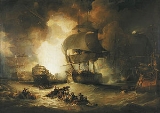
At the Battle of the Nile or Aboukir Bay (August 1-2, 1798), a British
Kingdom of Great Britain

The Kingdom of Great Britain, also known as the United Kingdom of Great Britain, was a country in North-West Europe, in existence from 1707 to 1801....
 fleet under Rear-Admiral Horatio Nelson surprised and largely destroyed a French
France

France , officially the French Republic , is a country whose Metropolitan France is located in Western Europe and that also comprises various Overseas departments and territories of France....
 fleet under François-Paul Brueys D'Aigalliers
François-Paul Brueys d'Aigalliers

Vice-Admiral Fran?ois-Paul Brueys d'Aigalliers, Comte de Brueys, was the French commander in the Battle of the Nile, in which the French Navy was defeated by Royal Navy forces under Admiral Horatio Nelson....
 anchored near Alexandria, stranding Napoleon's army in Egypt.


Discussion
Ask a question about 'Battle of the Nile'
Start a new discussion about 'Battle of the Nile'
Answer questions from other users
Full Discussion Forum


Encyclopedia


Battle of Aboukir Bay
At the Battle of the Nile or Aboukir Bay (August 1-2, 1798), a British
Kingdom of Great Britain

The Kingdom of Great Britain, also known as the United Kingdom of Great Britain, was a country in North-West Europe, in existence from 1707 to 1801....
 fleet under Rear-Admiral Horatio Nelson surprised and largely destroyed a French
France

France , officially the French Republic , is a country whose Metropolitan France is located in Western Europe and that also comprises various Overseas departments and territories of France....
 fleet under François-Paul Brueys D'Aigalliers
François-Paul Brueys d'Aigalliers

Vice-Admiral Fran?ois-Paul Brueys d'Aigalliers, Comte de Brueys, was the French commander in the Battle of the Nile, in which the French Navy was defeated by Royal Navy forces under Admiral Horatio Nelson....
 anchored near Alexandria, stranding Napoleon's army in Egypt. French losses have been estimated as high as 1,700 dead (including Vice-Admiral Brueys) and 3,000 captured. British losses were 218 dead.

Background

Still on the rise but not yet the primary enemy of Britain, commanding General Napoleon Bonaparte
Napoleon I of France

Napoleon Bonaparte later known as Emperor Napoleon I, was a military and political leader of France whose actions shaped European politics in the early 19th century....
 intended to threaten the British position in India
India

India, officially the Republic of India , is a country in South Asia. It is the List of countries and outlying territories by total area country by geographical area, the List of countries by population country, and the most populous liberal democracy in the world....
 via the invasion and conquest of Egypt
Egypt

Egypt is a country mainly in North Africa, with the Sinai Peninsula forming a land bridge in Western Asia. Covering an area of about , Egypt borders the Mediterranean Sea to the north, the Gaza Strip and Israel to the northeast, the Red Sea to the east, Sudan to the south and Libya to the west....
. The expedition was also cultural and included many scientists, educators, and technical specialists — including a surveying party, as French intellectuals had long debated the feasibility of cutting a ship-canal between the Red and Mediterranean Sea
Mediterranean Sea

The Mediterranean Sea is a sea or Ocean off the Atlantic Ocean surrounded by the Mediterranean region and almost completely enclosed by land: on the north by Europe, on the south by Africa, and on the east by Asia....
s. Previously, Napoleon spread misinformation about a planned invasion of Ireland, with the French Mediterranean fleet first leaving the Mediterranean to meet up with the remainder of the French fleet. This tricked the British into guarding the western Mediterranean Sea, and allowed Napoleon to launch his Egypt expedition without opposition. About three weeks after his landing in Egypt, a British fleet of 14 ships under Horatio Nelson finally came upon the 15 French ships being used to support the invasion of Egypt.

Preparations

The fleets met close to sunset on August 1. The French were at anchor in Abu Qir Bay
Abu Qir Bay

The Abu Qir Bay is a spacious bay on the Mediterranean Sea in Egypt, lying between Abu Qir and the Rosetta mouth of the Nile. It contains a natural gas field, discovered in the 1970s....
, in shallow water near a shoal less than 7 fathom
Fathom

A fathom is a Units of measurement of length in the Imperial unit , used especially for measuring the depth of water.There are 2 yards in a fathom....
s (14 m) deep. They were using the shoal to protect the southwestern, port side of their fleet, while the starboard side faced the northeast and the open sea. French Admiral Brueys had studied Nelson's tactics at the Battle of Cape St Vincent
Battle of Cape St. Vincent (1797)

In the Battle of Cape St Vincent a Royal Navy fleet under John Jervis, 1st Earl of St Vincent defeated a larger Spain fleet under Jos? de C?rdoba near Cabo de S?o Vicente, Portugal....
 and other engagements. As a consequence, Brueys had his line of battle chained together at anchor to prevent the British from cutting the line. Brueys expected the battle to begin the next morning as he did not expect the British to risk a night encounter in shallow, uncharted waters. The French began only leisurely preparations for combat, or possibly were preparing to try to escape during the night.

Battle

Nelson had confidence in his captains and let each act on his own initiative. As the British fleet approached the French, Thomas Foley of the Goliath observed the gap between the first ship of the French fleet and the closest land. He judged that the chains anchoring the French vessels to the shore lay deep enough for the Goliath to pass over. The Goliath separated from the line of attack and slipped round to the other side of the French fleet. Other British ships followed, allowing the British to attack the French from both sides. Culloden
HMS Culloden (1783)

HMS Culloden was a 74-gun third rate ship of the line of the Royal Navy, launched on 16 June 1783 at Rotherhithe. She took part in some of the most famous battles of the French Revolutionary Wars and the Napoleonic Wars....
 ran aground, but the rest of the British ships began taking the French fleet apart, one by one, down the line. Because the wind was from the north, unengaged French ships could not come up to help their fellows.

The French flagship Orient
French ship Orient (1791)

The Dauphin-Royal was a Oc?an type 118-gun ship of the line 118-gun ship of the line of the French Navy.During the French Revolution, she was renamed Sans-Culotte in September 1792, and eventually Orient in May 1795....
 came under fire, first from Bellerophon
HMS Bellerophon (1786)

The first HMS Bellerophon of the Royal Navy was a 74-gun third rate ship of the line launched on 6 October 1786 at Frindsbury on the River Medway, near Chatham, England....
, which received a battering and drifted away dismasted, and then from Alexander
HMS Alexander (1778)

HMS Alexander was a 74-gun third-rate ship of the line of the Royal Navy, launched from Deptford on 8 October 1778. During her career she was captured by the French, and later recaptured by the British....
 and Swiftsure
HMS Swiftsure (1787)

HMS Swiftsure was a 74-gun third rate ship of the line of the Royal Navy. She spent most of her career serving with the British, except for a brief period when she was captured by the French during the Napoleonic Wars....
. By 21:00, Orient was ablaze, and the battle paused as ships tried to distance themselves from the anticipated explosion. All of the men on both sides ceased fire and watched mouths agape for thirty minutes as the French flagship burst apart in a spectacular explosion. At about 22:00, the fire reached the magazine and the flagship exploded, hurling crew and blazing parts of ship hundreds of metres into the air. About a hundred of Orient's crew of a thousand survived by swimming from the burning ship. Only two French ships towards the end of the line, Généreux and Guillaume Tell
French ship Guillaume Tell (1795)

Guillaume Tell was a 80-gun Tonnant class ship of the line ship of the line of the French Navy She was named for William Tell. She fought at the Battle of the Nile and was one of only two French ships to escape the fleet's destruction there....
, together with the two frigates Diane and Justice, were able to escape. The rest were burned or captured by morning.

A grazing shot struck Nelson on his forehead, exposing his skull, while he was standing on the quarterdeck
Deck (ship)

A deck is a permanent covering over a compartment or a hull of a ship. On a deck #Glossary or deck #Glossary, the primary deck is the horizontal structure which forms the 'roof' for the hull, which both strengthens the hull and serves as the primary working surface....
. Surgeon Jefferson pronounced the wound superficial, but Nelson could not believe it was not fatal and sent for his chaplain, Stephen Comyn
Stephen George Comyn

Stephen George Comyn was an English naval chaplain who served with Lord Nelson at the Battle of the Nile and Battle of Copenhagen. He was a close friend of Nelson and is said to have been his favourite chaplain....
. Crew moved Nelson to the breadroom, where he and the chaplain would not be disturbed. Nelson recovered and, following the victory, issued a memorandum to his fleet, "Almighty God having blessed His Majesty's arms with victory, the Admiral intends returning public thanksgiving for the same at 2 o'clock this day and he recommends every ship doing the same as soon as convenient." Reverend Comyn conducted the service from the quarterdeck of the Vanguard, which greatly impressed a group of captured French officers.

Aftermath

News of the victory was delayed in reaching Britain. The surviving French 74-gun Le Généreux had captured Leander
HMS Leander (1780)

HMS Leander was a fourth-rate 50-gun ship of the Royal Navy, launched at Chatham on 1 July 1780. She took part in the Battle of the Nile, where commanded by Captain Sir Thomas Thompson, 1st Baronet she was able to exploit a gap in the French line and anchor between French ship Souverain and French ship Franklin and rake both enemy ships...
, the ship carrying Nelson's envoy Captain Edward Berry
Edward Berry

Rear Admiral Sir Edward Berry, 1st Baronet, Order of the Bath , was an officer in Britain's Royal Navy primarily known for his role as flag captain of Horatio Nelson ship HMS Vanguard at the Battle of the Nile, prior to his knighthood in 1798....
 and returning home with the dispatches, in a fierce battle.

Nelson headed for Italy, where Vanguard
HMS Vanguard (1787)

HMS Vanguard was a 74-gun third-rate ship of the line of the Royal Navy, launched on 6 March 1787 at Deptford. She was the fifth vessel to bear the name....
 was stranded at the Bay of Palermo
Palermo

Palermo is a historic city in southern Italy, the Capital of the autonomous region Sicily and the province of Palermo. The city is noted for its rich history, culture, architecture and gastronomy, playing an important role throughout much of its existence; it is over 2,700 years old....
. It was there that Sir William Hamilton
William Hamilton (diplomat)

Sir William Hamilton, Order of the Bath was a Scotland diplomacy, antiquarian, archaeology and volcanology.Hamilton was the fourth son of Lord Archibald Hamilton, governor of Jamaica....
 and his wife Emma were living. It was also the occasion of a less glorious incident of Nelson’s career, the execution of Prince Francesco Caracciolo
Francesco Caracciolo

Prince Francesco Caracciolo was a Naples admiral and revolutionist....
.

Napoleon, who had already landed with his army, finished his conquest of Egypt and went on to conquer much of Syria. However, the political situation in Paris soon changed, leading Napoleon to abandon his troops and leave for France
France

France , officially the French Republic , is a country whose Metropolitan France is located in Western Europe and that also comprises various Overseas departments and territories of France....
 to take charge of a coup to overthrow the constitution and secure his own election as First Consul. Napoleon then crowned himself as Emperor on 2 December 1804.

The battle established British naval superiority for the remainder of the French Revolutionary Wars
French Revolutionary Wars

The French Revolutionary Wars were a series of major conflicts, from 1792 until 1802, fought between the French Revolutionary government and several European states....
. It is also well-known for literary reasons: Felicia D. Hemans' poem "Casabianca"
Casabianca (poem)

Casabianca is a poem by United Kingdom poet Felicia Hemans, first published in the Monthly Magazine for August 1826.The poem opens:...
, perhaps known better by its first line, "The boy stood on the burning deck", is about the son of Luc-Julien-Joseph Casabianca
Luc-Julien-Joseph Casabianca

See Casabianca for other meaningsLuc-Julien-Joseph Casabianca was a France Navy officer.He attended the military school in June 1775 and joined the Naval Guards in July 1778....
, who died in the explosion of the French flagship L'Orient during this battle.

The "Band of Brothers"

The battle brought the term "Band of Brothers" into popular use to indicate an unusually close-knit team of fighting men. The phrase originates in Shakespeare
William Shakespeare

William Shakespeare was an English people poet and playwright, widely regarded as the greatest writer in the English language and the world's preeminent dramatist....
's Henry V
Henry V (play)

Henry V is a history play by William Shakespeare, believed to be written in 1599. It is based on the life of King Henry V of England, and focuses on events immediately before and after the Battle of Agincourt during the Hundred Years' War....
, and Nelson used it to describe his fifteen Nile captains in letters about the battle to Earl St. Vincent
John Jervis, 1st Earl of St Vincent

Admiral of the Fleet John Jervis, 1st Earl of St Vincent Order of the Bath Privy Council of the United Kingdom Royal Navy was an Admiral in the Royal Navy....
 on 25 September 1798, to his wife on 1 October, and most famously to Earl Howe on 8 January 1799: "I had the happiness to command a Band of Brothers...". Although the term has sometimes been extended to other officers who served under Nelson at various times, Nelson used it specifically for those captains, listed below, who were with him during the Nile campaign and the battle itself.

British fleet


ShipGunsCommanderNotes
Vanguard
HMS Vanguard (1787)

HMS Vanguard was a 74-gun third-rate ship of the line of the Royal Navy, launched on 6 March 1787 at Deptford. She was the fifth vessel to bear the name....
 
74 Capt. Edward Berry
Edward Berry

Rear Admiral Sir Edward Berry, 1st Baronet, Order of the Bath , was an officer in Britain's Royal Navy primarily known for his role as flag captain of Horatio Nelson ship HMS Vanguard at the Battle of the Nile, prior to his knighthood in 1798....
Nelson's flag-ship
Alexander
HMS Alexander (1778)

HMS Alexander was a 74-gun third-rate ship of the line of the Royal Navy, launched from Deptford on 8 October 1778. During her career she was captured by the French, and later recaptured by the British....
 
74 Capt. Alexander Ball
Alexander Ball

Sir Alexander John Ball, 1st Baronet , was a Admiral and governor of Malta. He was born in Ebworth Park, Sheepscombe, Gloucestershire. He was the fourth son of Robert and Mary Ball....
 
Audacious
HMS Audacious (1785)

HMS Audacious was a 74-gun third rate ship of the line of the Royal Navy, launched on 23 July 1785 at Rotherhithe. She was the first ship to bear the name....
 
74 Capt. Davidge Gould
Davidge Gould

Sir Davidge Gould Order of the Bath was an officer of the Royal Navy. He served during the American Revolutionary War, French Revolutionary Wars and the Napoleonic Wars, eventually rising to the rank of Admiral ....
 
Bellerophon
HMS Bellerophon (1786)

The first HMS Bellerophon of the Royal Navy was a 74-gun third rate ship of the line launched on 6 October 1786 at Frindsbury on the River Medway, near Chatham, England....
 
74 Capt. Henry D'Esterre Darby
Henry D'Esterre Darby

Admiral Sir Henry D'Esterre Darby, Order of the Bath, was an officer in the Royal Navy. He was the second son of Jonathan Darby IV Esq., of Leap Castle, in King's County, Ireland....
Dismasted
Culloden
HMS Culloden (1783)

HMS Culloden was a 74-gun third rate ship of the line of the Royal Navy, launched on 16 June 1783 at Rotherhithe. She took part in some of the most famous battles of the French Revolutionary Wars and the Napoleonic Wars....
 
74 Capt. Thomas Troubridge
Sir Thomas Troubridge, 1st Baronet

Sir Thomas Troubridge, 1st Baronet was a British naval commander and politician.Troubridge was educated at St Paul's School , London. He entered the Royal Navy in 1773 and, together with Nelson, served in the East Indies in the frigate HMS Seahorse ....
Ran aground, took no part
Defence
HMS Defence (1763)

HMS Defence was a 74-gun third rate ship of the line of the Royal Navy, launched on 31 March 1763 at HMNB Devonport Dockyard. She was one of the most famous ships of the period, taking part in several of the most important naval battles of the French Revolutionary War and Napoleonic wars....
 
74 Capt. John Peyton 
Goliath
HMS Goliath (1781)

HMS Goliath was a 74-gun third rate ship of the line of the Royal Navy, launched on 19 October 1781 at Deptford Dockyard. She was present at the Battle of the Nile....
 
74 Capt. Thomas Foley 
Majestic
HMS Majestic (1785)

HMS Majestic was a 74-gun third rate ship of the line launched on 11 December 1785 at Deptford. She fought at the Battle of the Nile, where she engaged the French ships HMS Tonnant and French ship Heureux , helping to force their surrenders....
 
74 Capt. George Blagdon Westcott
George Blagdon Westcott

George Blagdon Westcott was an officer of the Royal Navy. He served during the American Revolutionary War and the French Revolutionary Wars, eventually rising to the rank of Captain ....
Captain killed
Minotaur
HMS Minotaur (1793)

HMS Minotaur was a 74-gun third-rate ship of the line of the Royal Navy, launched on 6 November 1793 at Woolwich. She was named after the mythological Minotaur of Crete....
 
74 Capt. Thomas Louis
Thomas Louis

Rear-Admiral Sir Thomas Louis, 1st Baronet was an experienced and highly respected officer of the British Royal Navy who served in three wars and saw numerous actions, notably as one of Horatio Nelson's "Nelson's Band of Brothers" in the Mediterranean in 1798 who commanded ships at the Battle of the Nile....
 
Orion
HMS Orion (1787)

HMS Orion was a 74-gun third rate ship of the line of the Royal Navy, launched at Deptford on 1 June 1787 to the design of the , by William Bately....
 
74 Capt. Sir James Saumarez
James Saumarez, 1st Baron de Saumarez

James Saumarez, 1st Baron de Saumarez or Sausmarez, Order of the Bath was an admiral of the British Royal Navy, notable for his victory at the Battle of Algeciras....
2nd in command
Swiftsure
HMS Swiftsure (1787)

HMS Swiftsure was a 74-gun third rate ship of the line of the Royal Navy. She spent most of her career serving with the British, except for a brief period when she was captured by the French during the Napoleonic Wars....
 
74 Capt. Benjamin Hallowell
Benjamin Hallowell Carew

Admiral Sir Benjamin Hallowell Carew Order of the Bath, was a senior officer in the Royal Navy. He was one of the select group of officers, referred to by Nelson as his "Nelson's Band of Brothers", who served with him at the Battle of the Nile....
 
Theseus
HMS Theseus (1786)

HMS Theseus was a 74-gun third-rate ship of the line of the Royal Navy.One of the eight Culloden class ship of the line ships designed by Thomas Slade, she was built at Perry, Blackwall, London, London and launched on 25 September 1786....
 
74 Capt. Ralph Willet Miller 
Zealous
HMS Zealous (1785)

HMS Zealous was a 74-gun third rate ship of the line of the Royal Navy, built by Barnard of Deptford and launched on 25 June 1785.She served in a number of battles of the French Revolutionary Wars and the Napoleonic Wars, notably the Battle of the Nile, where she engaged the French ship French ship Guerrier, helping to force her surrend...
 
74 Capt. Samuel Hood
Samuel Hood (admiral)

Vice-Admiral Sir Samuel Hood, 1st Baronet Knight Companion of the Order of the Bath Royal Navy was an officer of the Royal Navy and the cousin once removed of the more famous Admiral Samuel Hood, 1st Viscount Hood....
 
Leander
HMS Leander (1780)

HMS Leander was a fourth-rate 50-gun ship of the Royal Navy, launched at Chatham on 1 July 1780. She took part in the Battle of the Nile, where commanded by Captain Sir Thomas Thompson, 1st Baronet she was able to exploit a gap in the French line and anchor between French ship Souverain and French ship Franklin and rake both enemy ships...
 
50 Capt. Thomas Boulden Thompson
Sir Thomas Thompson, 1st Baronet

Sir Thomas Boulden Thompson, 1st Baronet Order of the Bath was an officer of the Royal Navy. He served during the American Revolutionary War, French Revolutionary Wars and Napoleonic Wars, eventually rising to the rank of Admiral ....
 
Mutine
HMS Mutine (1797)

HMS Mutine was a 16-gun brig of the Royal Navy, captured from the French First Republic on 29 May 1797 at the Battle of Santa Cruz de Tenerife ....
 
16 Lt. Thomas HardyAssisted Culloden, took no part


French fleet


ShipGunsNotes
Line of Battle
Orient
French ship Orient (1791)

The Dauphin-Royal was a Oc?an type 118-gun ship of the line 118-gun ship of the line of the French Navy.During the French Revolution, she was renamed Sans-Culotte in September 1792, and eventually Orient in May 1795....
 
118 Flagship, Capt. Casabianca
Luc-Julien-Joseph Casabianca

See Casabianca for other meaningsLuc-Julien-Joseph Casabianca was a France Navy officer.He attended the military school in June 1775 and joined the Naval Guards in July 1778....
, Blew up 1 August
Franklin
French ship Franklin (1797)

The Franklin was a French Tonnant class ship of the line 80-gun ship of the line designed by engineer Jacques-No?l San?, and named after the American scientist and politician Benjamin Franklin....
 
80 Captured 2 August
Tonnant
HMS Tonnant (1792)

Tonnant was a 80-gun ship of the line of the French Navy, lead ship of Tonnant class ship of the line....
80 Aristide Aubert Du Petit Thouars
Aristide Aubert Du Petit Thouars

Aristide Aubert Du Petit Thouars was a French naval officer, and a hero of the Battle of the Nile, where he died.He was born on August 31 1760, in the castle of Boumais, near Saumur....
, Captured 3 August
Aquilon
French ship Aquilon (1789)

The Aquilon was a T?m?raire class ship of the line 74-gun List of ships of the line of France of the French Navy.She served off Italy under Brueys, and took part in the Battle of the Nile, where she fought HMS Vanguard , HMS Minotaur and HMS Theseus ....
 
74 Captured
Guerrier
French ship Guerrier (1754)

The Guerrier was a Magnifique class ship of the line 74-gun List of ships of the line of France of the French Navy.She took part in the Battle of Minorca and in the Battle of Lagos....
 
74 Captured 2 August, scuttled (burnt) 18 August
Heureux
French ship Heureux (1783)

The Heureux was a Centaure class ship of the line 74-gun List of ships of the line of France of the French Navy.She cruised in the Mediterranean in 1794 and 1795....
 
74 Captured 3 August, scuttled (burnt) 16 August
Spartiate 74 Captured
Peuple Souverain 74 Captured
Mercure
French ship Mercure (1783)

The Mercure was a 74-gun S?duisant class ship of the line List of ships of the line of France of the French Navy.She took part in the Battle of the Nile under captain Cambon....
 
74 Captured 3 August, scuttled (burnt) 18 August
Conquérant
French ship Conquérant (1747)

The Conqu?rant was a Citoyen class ship of the line 74-gun List of ships of the line of France of the French Navy.She took part in the Battle of the Nile, where she was captured by HMS Audacious ....
 
74 Captured
Généreux 74 Escaped
Guillaume Tell
French ship Guillaume Tell (1795)

Guillaume Tell was a 80-gun Tonnant class ship of the line ship of the line of the French Navy She was named for William Tell. She fought at the Battle of the Nile and was one of only two French ships to escape the fleet's destruction there....
 
80 Escaped
Timoléon
French ship Commerce de Bordeaux (1785)

The Commerce de Bordeaux was a T?m?raire class ship of the line 74-gun List of ships of the line of France of the French Navy.She took part in the Battle of the Nile where she ran aground and was burnt by her crew....
 
74 Run aground and scuttled (blown up) 3 August
Frigates
Artémise
French frigate Artémise (1794)

The Art?mise was a Magicienne class frigate frigate of the French Navy.She was under construction as Aurore in Toulon when the British seized the city, and was finished after it was retaken by the French on 24 July 1794....
 
36 Surrendered but run aground and scuttled (blown up) 3 August
Justice
French frigate Justice (1794)

The Justice was a Virginie class frigate frigate of the French Navy.She took part in the Expedition to Egypt. After the French frigate Junon ran agroung in Aboukir, the Justice escorted her to Alexandria for repairs....
 
44 Escaped
Diane
French frigate Diane (1796)

The Diane was a 38-gun List of frigates of France of the French Navy.She took part in the Battle of the Nile, managing to escape to Malta with the French frigate Justice ....
 
38 Escaped
Sérieuse
French frigate Sérieuse (1779)

The S?rieuse was a Magicienne class frigate frigate of the French Navy.In 1781, she ferried soldiers after the Invasion of Minorca, 1781....
 
36 Sunk by Orion 1 August, later burnt
Brigs
Alerte 12  
Railleur 14 Escaped
Hercule 7 Scuttled
Salamine 18 Escaped
Also several Gunboats


Firsthand account

Aboukir2
Aboukir
John Nicol, a sailor aboard HMS Goliath, writes this account:

The Goliath led the van. There was a French frigate right in our way. Captain Foley cried, "Sink that brute, what does he there?" In a moment she went to the bottom and her crew were seen running into her rigging. The sun was just setting as we went into the bay, and a red and fiery sun it was. I would, if had I had my choice, been on the deck. There I would have seen what was passing and the time would not have hung so heavy, but every man does his duty with spirit, whether his station be in the slaughterhouse or the magazine.


I saw as little of this action as I did of the one on 14 February off Cape St Vincent. My station was in the powder magazine with the gunner. As we entered the bay we stripped to our trousers, opened our ports, cleared, and every ship we passed gave them a broadside and three cheers. Any information we got was from the boys and women who carried the powder. The women behaved as well as the men, and got a present for their bravery from the grand signior.


When the French Admiral's ship blew up, the Goliath got such a shake we thought the after-part of her had blown up until the boys told us what it was. They brought us every now and then the cheering news of another French ship having struck [surrendered], and we answered the cheers on deck with heartfelt joy. In the heat of the action a shot came right into the magazine but did no harm as the carpenters plugged it up and stopped the water that was rushing in.


I was much indebted to the gunner's wife who gave her husband and me a drink of wine every now and then, which lessened our fatigue much. There were some of the women wounded, and one woman belonging to Leith died of her wounds and was buried on a small island in the bay. One woman bore a son in the heat of the action. She belonged to Edinburgh.


When we ceased firing I went on deck to view the state of the fleets, and an awful sight it was. The whole bay was covered with dead bodies, mangled, wounded, and scorched, not a bit of clothes on them except their trousers. There were a number of French, belonging to the French Admiral's ship, the L'Orient, who had swam to the Goliath, and were cowering under her forecastle. Poor fellows! they were brought on board, and Captain Foley ordered them down to the steward's room, to get provisions and clothing. One thing I observed in these Frenchmen quite different from anything I had before observed. In the American War, when we took a French ship, the Duke de Chartres, the prisoners were as merry as if they had taken us, only saying, `Fortune de guerre - you take me today, I take you tomorrow.' Those we now had on board were thankful for our kindness, but were sullen and as downcast as if each had lost a ship of his own.


The only incidents I heard of are two. One lad who was stationed by a salt-box, on which he sat to give out cartridges, and keep the lids closed - it is a trying berth - when asked for a cartridge, he gave none, yet he sat upright; his eyes were open. One of the men gave him a push; he fell all his length on the deck. There was not a blemish on his body, yet he was quite dead, and was thrown overboard. The other, a lad who had the match in his hand to fire his gun. In the act of applying it, a shot took off his arm; it hung by a small piece of skin. The match fell to the deck. He looked to his arm, and seeing what had happened, seized the match in his left hand, and fired off the gun before he went to the cockpit to have it dressed. They were in our mess, or I might never have heard of it. Two of the mess were killed, and I knew not of it until the day after. Thus terminated the glorious first of August, the busiest night in my life.


Soon after the action the whole fleet set sail with the prizes, and left the Goliath as guard ship. We remained here until we were relieved by the Tigre, seventy-four, when we sailed for Naples to refit. After refitting we sailed for Malta to join the blockade, where we remained eight months without any occurrence worthy of notice.


Recent archaeology

In 2000, Italian
Italy

Italy , officially the Italian Republic , is a country located on the Italian Peninsula in Southern Europe and on the two largest islands in the Mediterranean Sea, Sicily and Sardinia....
 archaeologist
Archaeology

Archaeology, archeology, or arch?ology is the science that studies Homo cultures through the recovery, documentation, analysis, and interpretation of material remains and environmental data, including architecture, Artifact , features, Biofact s, and cultural landscape....
 Dr. Paolo Gallo discovered a burial site on Nelson's Island
Nelson's Island

Nelson's Island is an island located in Abu Qir Bay, off the coast of Alexandria, Egypt. It is a local site for picnics and recreation, and is the location of a group of United Kingdom graves dating from the Napoleonic Wars....
 in Abu Qir Bay. The graves contained the remains of sailors, officers, marines, women - some of whom may have disguised their appearance to serve in the all-male navy - and surprisingly, three infants. Subsequent work with British historian and archaeologist Nick Slope determined that some of the graves dated to shortly after the battle, while others dated from another battle in 1801.

On 18 April 2005, thirty of the British sailors and officers killed in the 1801 skirmish were given a military funeral in Alexandria
Alexandria

Alexandria , with a population of 4.1 million, is the second-largest city in Egypt, and is the country's largest seaport, serving about 80% of Egypt's imports and exports....
, attended by the crew of the visiting HMS Chatham
HMS Chatham (F87)

HMS Chatham is a Type 22 frigate of the Royal Navy. She was guardship to the Royal Yacht Britannia when she withdrew from Hong Kong in 1997 ....
. Only one of the bodies, that of Commodore James Russell, was positively identified. One of his descendants attended the ceremony, and was presented with a flag.

Memorials

One of the most unusual memorials to any naval battle lies just a few miles from Stonehenge
Stonehenge

Stonehenge is a prehistoric monument located in the England county of Wiltshire, about west of Amesbury and north of Salisbury. One of the most famous sites in the world, Stonehenge is composed of Earthworks surrounding a circular setting of large standing stones and sits at the centre of the densest complex of Neolithic and Bronze Age mon...
 on Salisbury Plain
Salisbury Plain

Salisbury Plain is a chalk plateau in central southern England covering . It is part of the Southern England Chalk Formation and largely lies within the county of Wiltshire, with a little in Hampshire....
, in Wiltshire
Wiltshire

Wiltshire is a Ceremonial counties of England in the South West England of England. It is landlocked and borders the counties of Dorset, Somerset, Hampshire, Gloucestershire, Oxfordshire and Berkshire....
. The memorial is composed of numerous clumps of beech
Beech

Beech is a genus of ten species of deciduous trees in the family Fagaceae, native to temperate Europe and North America.The leaf of beech trees are entire or sparsely toothed, from 5–15 cm long and 4–10 cm broad....
 trees, which had been planted on otherwise arable farmland. These clumps are known as the Nile Clumps
Nile Clumps

The Nile Clumps are a collection of tree clumps near Amesbury on Salisbury Plain in Wiltshire, England, purportedly planted to commemorate the Battle of the Nile....
, because it is believed they were shaped from a larger piece of woodland (forest) after the Battle of the Nile, to represent the positions of French and British ships. Many of the "ships" have "sunk" over the years, but several still survive, and work is underway to replant some of them.

The story behind their construction is that Emma Hamilton, mistress of Nelson, in her declining years became friends with the Marquess of Queensbury, owner of much of the land around the town of Amesbury
Amesbury

Amesbury is a town and civil parish in the England county of Wiltshire, eight miles north of Salisbury, Wiltshire. It is most famous for the prehistoric monument of Stonehenge which is in its parish, and for the discovery of the Amesbury Archer ? dubbed the King of Stonehenge in the press ? in 2002....
, including Stonehenge
Stonehenge

Stonehenge is a prehistoric monument located in the England county of Wiltshire, about west of Amesbury and north of Salisbury. One of the most famous sites in the world, Stonehenge is composed of Earthworks surrounding a circular setting of large standing stones and sits at the centre of the densest complex of Neolithic and Bronze Age mon...
; and, together with Captain Thomas Hardy, Nelson's flag captain at the Battle of Trafalgar
Battle of Trafalgar

The Battle of Trafalgar was a sea battle fought between the United Kingdom Royal Navy and the combined fleets of the French Navy and Spanish Navy , during the War of the Third Coalition of the Napoleonic Wars ....
, persuaded the Marquess to create the unique memorial. Most of the surviving clumps now stand on land owned by the National Trust's
National Trust for Places of Historic Interest or Natural Beauty

The National Trust for Places of Historic Interest or Natural Beauty, usually known as the National Trust, is a conservation organization in England, Wales and Northern Ireland....
 Stonehenge Landscape estate.

Nelson's friend and sometime agent Alexander Davidson erected an obelisk
Nelson Memorial, Swarland

A relatively obscure memorial to Horatio Nelson, 1st Viscount Nelson, victor of the Battle of Trafalgar, is situated by the old A1 road , at Swarland in north Northumberland, England....
 on his estate at Swarland in Northumberland to commemorate the victory. Davidson also planted trees just to the west of the obelisk to represent the coastline of the Nile Delta and some of the ships that took part in the Battle of the Nile.

A number of ships of the Royal Navy have been named after the battle. Four have been named HMS Aboukir
HMS Aboukir

Four ships of the Royal Navy have borne the name HMS Aboukir, after Abu Qir Bay, the site of the Battle of the Nile:*HMS Aboukir was a 74-gun third rate ship of the line, formerly the French ship Aquilon ....
, the first being the French ship Aquilon
French ship Aquilon (1789)

The Aquilon was a T?m?raire class ship of the line 74-gun List of ships of the line of France of the French Navy.She served off Italy under Brueys, and took part in the Battle of the Nile, where she fought HMS Vanguard , HMS Minotaur and HMS Theseus ....
 captured in the battle. Another two ships have been named HMS Nile
HMS Nile

Three ships of the Royal Navy have borne the name HMS Nile, after the Battle of the Nile in 1798:* was a 12-gun Cutter purchased in 1806....
.

External links