


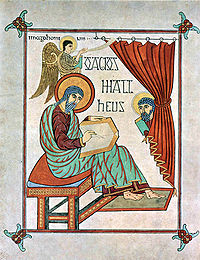
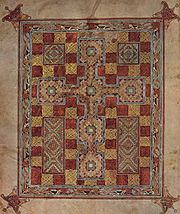
Lindisfarne Gospels

Encyclopedia

Illuminated manuscript
An illuminated manuscript is a manuscript in which the text is supplemented by the addition of decoration, such as decorated initials, borders and miniature illustrations...
Latin
Latin
Latin is an Italic language originally spoken in Latium and Ancient Rome. It, along with most European languages, is a descendant of the ancient Proto-Indo-European language. Although it is considered a dead language, a number of scholars and members of the Christian clergy speak it fluently, and...
manuscript of the gospels of Matthew
Gospel of Matthew
The Gospel According to Matthew is one of the four canonical gospels, one of the three synoptic gospels, and the first book of the New Testament. It tells of the life, ministry, death, and resurrection of Jesus of Nazareth...
, Mark
Gospel of Mark
The Gospel According to Mark , commonly shortened to the Gospel of Mark or simply Mark, is the second book of the New Testament. This canonical account of the life of Jesus of Nazareth is one of the three synoptic gospels. It was thought to be an epitome, which accounts for its place as the second...
, Luke
Gospel of Luke
The Gospel According to Luke , commonly shortened to the Gospel of Luke or simply Luke, is the third and longest of the four canonical Gospels. This synoptic gospel is an account of the life and ministry of Jesus of Nazareth. It details his story from the events of his birth to his Ascension.The...
and John
Gospel of John
The Gospel According to John , commonly referred to as the Gospel of John or simply John, and often referred to in New Testament scholarship as the Fourth Gospel, is an account of the public ministry of Jesus...
in the British Library
British Library
The British Library is the national library of the United Kingdom, and is the world's largest library in terms of total number of items. The library is a major research library, holding over 150 million items from every country in the world, in virtually all known languages and in many formats,...
. The manuscript was produced on Lindisfarne
Lindisfarne
Lindisfarne is a tidal island off the north-east coast of England. It is also known as Holy Island and constitutes a civil parish in Northumberland...
in Northumbria
Northumbria
Northumbria was a medieval kingdom of the Angles, in what is now Northern England and South-East Scotland, becoming subsequently an earldom in a united Anglo-Saxon kingdom of England. The name reflects the approximate southern limit to the kingdom's territory, the Humber Estuary.Northumbria was...
in the late 7th century or early 8th century, and is generally regarded as the finest example of the kingdom's unique style of religious art, a style that combined Anglo-Saxon
Anglo-Saxon
Anglo-Saxon may refer to:* Anglo-Saxons, a group that invaded Britain** Old English, their language** Anglo-Saxon England, their history, one of various ships* White Anglo-Saxon Protestant, an ethnicity* Anglo-Saxon economy, modern macroeconomic term...
and Celtic themes, what is now called Hiberno-Saxon art, or Insular art
Insular art
Insular art, also known as Hiberno-Saxon art, is the style of art produced in the post-Roman history of Ireland and Great Britain. The term derives from insula, the Latin term for "island"; in this period Britain and Ireland shared a largely common style different from that of the rest of Europe...
. The manuscript is complete (though lacking its original cover), and is astonishingly well-preserved considering its great age.
History
The Lindisfarne Gospels are presumed to be the work of a monk named EadfrithEadfrith of Lindisfarne
Eadfrith of Lindisfarne , also known as Saint Eadfrith, was Bishop of Lindisfarne, probably from 698 onwards. By the twelfth century it was believed that Eadfrith succeeded Eadberht and nothing in the surviving records contradicts this belief...
, who became Bishop of Lindisfarne in 698 and died in 721. Current scholarship indicates a date around 715, and it is believed they were produced in honour of St. Cuthbert
Cuthbert of Lindisfarne
Saint Cuthbert was an Anglo-Saxon monk, bishop and hermit associated with the monasteries of Melrose and Lindisfarne in the Kingdom of Northumbria, at that time including, in modern terms, northern England as well as south-eastern Scotland as far as the Firth of Forth...
. However, it is also possible that Eadfrith produced them prior to 698, in order to commemorate the elevation of Cuthbert's relics in that year. The Gospels are richly illustrated in the insular style, and were originally encased in a fine leather binding covered with jewels and metals made by Billfrith
Billfrith
Billfrith is an obscure Northumbrian saint credited with providing the jewel and metalwork encrusting the former binding of the Lindisfarne Gospels...
the Anchorite
Anchorite
Anchorite denotes someone who, for religious reasons, withdraws from secular society so as to be able to lead an intensely prayer-oriented, ascetic, and—circumstances permitting—Eucharist-focused life...
in the 8th century. During the Viking
Viking
The term Viking is customarily used to refer to the Norse explorers, warriors, merchants, and pirates who raided, traded, explored and settled in wide areas of Europe, Asia and the North Atlantic islands from the late 8th to the mid-11th century.These Norsemen used their famed longships to...
raids on Lindisfarne, however, this cover was lost, and a replacement made in 1852.Let Gospels come home Sunderland Echo, 2006-09-22. Retrieved 2008-03-21 The text is written in insular script
Insular script
Insular script was a medieval script system originally used in Ireland, then Great Britain, that spread to continental Europe under the influence of Celtic Christianity. Irish missionaries also took the script to continental Europe, where they founded monasteries such as Bobbio. The scripts were...
.
In the 10th century an Old English
Old English language
Old English or Anglo-Saxon is an early form of the English language that was spoken and written by the Anglo-Saxons and their descendants in parts of what are now England and southeastern Scotland between at least the mid-5th century and the mid-12th century...
translation of the Gospels was made: a word-for-word gloss
Gloss
A gloss is a brief notation of the meaning of a word or wording in a text. It may be in the language of the text, or in the reader's language if that is different....
inserted between the lines of the Latin text by Aldred
Aldred the Scribe
Aldred the Scribe is the name by which scholars identify a tenth-century priest, otherwise known only as Aldred, who was a provost of the monastic community of St. Cuthbert at Chester-le-Street in 970....
, Provost of Chester-le-Street
Chester-le-Street
Chester-le-Street is a town in County Durham, England. It has a history going back to Roman times when it was called Concangis. The town is located south of Newcastle upon Tyne and west of Sunderland on the River Wear...
. This is the oldest extant translation of the Gospels into the English language
English language
English is a West Germanic language that arose in the Anglo-Saxon kingdoms of England and spread into what was to become south-east Scotland under the influence of the Anglian medieval kingdom of Northumbria...
.
The Gospels may have been taken from Durham Cathedral
Durham Cathedral
The Cathedral Church of Christ, Blessed Mary the Virgin and St Cuthbert of Durham is a cathedral in the city of Durham, England, the seat of the Anglican Bishop of Durham. The Bishopric dates from 995, with the present cathedral being founded in AD 1093...
during the dissolution of the monasteries
Dissolution of the Monasteries
The Dissolution of the Monasteries, sometimes referred to as the Suppression of the Monasteries, was the set of administrative and legal processes between 1536 and 1541 by which Henry VIII disbanded monasteries, priories, convents and friaries in England, Wales and Ireland; appropriated their...
, ordered by Henry VIII
Henry VIII of England
Henry VIII was King of England from 21 April 1509 until his death. He was Lord, and later King, of Ireland, as well as continuing the nominal claim by the English monarchs to the Kingdom of France...
, and were acquired in the early 17th century by Sir Robert Cotton
Robert Bruce Cotton
Sir Robert Bruce Cotton, 1st Baronet was an English antiquarian and Member of Parliament, founder of the important Cotton library....
from Thomas Walker
Thomas Walker
Thomas or Tom Walker may refer to:*Thomas Walker , English academic at Oxford University*Thomas Walker , American explorer*Thomas Walker , English ancestor of Bush family...
, Clerk of the Parliaments
Clerk of the Parliaments
The Clerk of the Parliaments is the chief clerk of the House of Lords in the Parliament of the United Kingdom. The position has existed since at least 1315, and duties include preparing the minutes of Lords proceedings, advising on proper parliamentary procedure and pronouncing the Royal Assent...
. Cotton's library
Cotton library
The Cotton or Cottonian library was collected privately by Sir Robert Bruce Cotton M.P. , an antiquarian and bibliophile, and was the basis of the British Library...
came to the British Museum
British Museum
The British Museum is a museum of human history and culture in London. Its collections, which number more than seven million objects, are amongst the largest and most comprehensive in the world and originate from all continents, illustrating and documenting the story of human culture from its...
in the 18th century, and from there to the British Library
British Library
The British Library is the national library of the United Kingdom, and is the world's largest library in terms of total number of items. The library is a major research library, holding over 150 million items from every country in the world, in virtually all known languages and in many formats,...
in London
London
London is the capital city of :England and the :United Kingdom, the largest metropolitan area in the United Kingdom, and the largest urban zone in the European Union by most measures. Located on the River Thames, London has been a major settlement for two millennia, its history going back to its...
when this was separated from the British Museum.
Campaign to relocate
A campaign exists to have the gospels housed in the North East of England, a move vigorously opposed by the British Library and condemned by international scholars. Several possible locations have been mooted, including Durham CathedralDurham Cathedral
The Cathedral Church of Christ, Blessed Mary the Virgin and St Cuthbert of Durham is a cathedral in the city of Durham, England, the seat of the Anglican Bishop of Durham. The Bishopric dates from 995, with the present cathedral being founded in AD 1093...
, Lindisfarne
Lindisfarne
Lindisfarne is a tidal island off the north-east coast of England. It is also known as Holy Island and constitutes a civil parish in Northumberland...
itself or one of the museums in Newcastle upon Tyne
Newcastle upon Tyne
Newcastle upon Tyne is a city and metropolitan borough of Tyne and Wear, in North East England. Historically a part of Northumberland, it is situated on the north bank of the River Tyne...
or Sunderland
City of Sunderland
The City of Sunderland is a local government district of Tyne and Wear, in North East England, with the status of a city and metropolitan borough...
. A modern facsimile copy of the Gospels is now housed in the Durham Cathedral
Durham Cathedral
The Cathedral Church of Christ, Blessed Mary the Virgin and St Cuthbert of Durham is a cathedral in the city of Durham, England, the seat of the Anglican Bishop of Durham. The Bishopric dates from 995, with the present cathedral being founded in AD 1093...
Treasury, where it can be seen by visitors.
 |
 |
See also
- Illuminated manuscriptIlluminated manuscriptAn illuminated manuscript is a manuscript in which the text is supplemented by the addition of decoration, such as decorated initials, borders and miniature illustrations...
- List of Hiberno-Saxon illustrated manuscripts
- Old English Bible translationsOld English Bible translationsA number of Old English Bible translations were prepared in medieval England, rendering parts of the Bible into the Old English language....
Further reading
- Brown, Michelle P., The Lindisfarne Gospels: Society, Spirituality and the Scribe. London: The British Library, 2003
- Brown, Michelle P., The Lindisfarne Gospels and the Early Medieval World. London: The British Library, 2010
External links
- British Library Digitised Manuscripts Digital facsimile of the entire manuscript
- Turning the Pages Leaf through the Lindisfarne Gospels online using the British Library's Turning the Pages software (requires Shockwave plugin)
- The Lindisfarne Gospels, a free online seminar from the British LibraryBritish LibraryThe British Library is the national library of the United Kingdom, and is the world's largest library in terms of total number of items. The library is a major research library, holding over 150 million items from every country in the world, in virtually all known languages and in many formats,...
. - Lindisfarne Gospels: information, zoomable image British Library website
- British Library Digital Catalogue of Illuminated Manuscripts entry
- Lindisfarne Gospels, from the Northumbrian Association.