

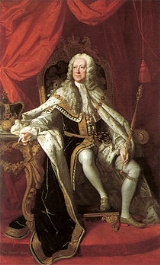
George II of Great Britain

Encyclopedia
George II was King of Great Britain
and Ireland
, Duke of Brunswick-Lüneburg
(Hanover
) and Archtreasurer and Prince-elector
of the Holy Roman Empire
from 11 June 1727 (O.S.) until his death.
George was the last British monarch born outside Great Britain. He was born and brought up in Northern Germany. In 1701, his grandmother, Sophia of Hanover
, became second-in-line to the British throne after about fifty Catholics higher in line were excluded by the Act of Settlement
, which restricted the succession to Protestants. After the deaths of Sophia and Anne, Queen of Great Britain, in 1714, his father George I
, Elector of Hanover, inherited the British throne. In the first years of his father's reign as king, George was associated with opposition politicians, until they re-joined the governing party in 1720.
As king from 1727, George exercised little control over British domestic policy, which was largely controlled by Great Britain's parliament
. As elector, he spent 12 summers in Hanover, where he had more direct control over government policy. He had a difficult relationship with his eldest son, Frederick
, who supported the parliamentary opposition. During the War of the Austrian Succession
, George participated at the Battle of Dettingen
in 1743, and thus became the last British monarch to lead an army in battle. In 1745, supporters of the Catholic claimant to the British throne, James Francis Edward Stuart
, attempted and failed to depose George in the last of the Jacobite rebellions. Frederick died unexpectedly in 1751, leaving George's grandson, George III
, as heir apparent
and ultimately king.
For two centuries after his death, history tended to view George II with disdain, concentrating on his mistresses, short-temper, and boorishness. Since then, some scholars have re-assessed his legacy and conclude that he held and exercised influence in foreign policy and military appointments.
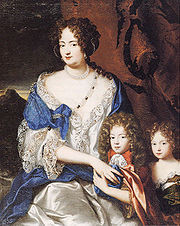 George was born in the city of Hanover
in Germany, and was the son of George Louis, Hereditary Prince of Brunswick-Lüneburg
(later King George I of Great Britain
), and his wife, Sophia Dorothea of Celle
. Both of George's parents committed adultery, and in 1694 their marriage was dissolved on the pretext that Sophia had abandoned her husband. She was confined to Ahlden House and denied access to her two children, George and his sister Sophia Dorothea of Hanover
, whom she probably never saw again.
Until the age of four, George spoke only French, the language of diplomacy and the court, but he was thereafter taught German by one of his tutors, Johann Hilmar Holstein. He was also schooled in English and Italian, and studied genealogy, military history and battle tactics with particular diligence.
George's second cousin once removed, Queen Anne, ascended the thrones of England
, Scotland
and Ireland
in 1702. She had no surviving children, and by the Act of Settlement 1701
the English Parliament
designated Anne's closest Protestant
blood relations, George's grandmother Sophia
and her descendants, as Anne's heirs in England and Ireland. Consequently, after his grandmother and father, George was third in line to succeed Anne in two of her realms. He was naturalized as an English subject in 1705 by the Sophia Naturalization Act, and in 1706 he was made a Knight of the Garter and created Duke and Marquess of Cambridge
, Earl of Milford Haven, Viscount Northallerton and Baron Tewkesbury in the Peerage of England
. England and Scotland united in 1707
to form the Kingdom of Great Britain
, and jointly accepted the succession as laid down by the Act of Settlement.
, Dowager Duchess and regent of Holstein-Gottorp
, came to nothing. In June 1705, under the false name of "Monsieur de Busch", George visited the Ansbach
court at their summer residence in Triesdorf to investigate incognito a marriage prospect: Caroline of Ansbach
, the former ward of his aunt Queen Sophia Charlotte of Prussia
. The English envoy to Hanover, Edmund Poley, reported that George was so taken by "the good character he had of her that he would not think of anybody else". A marriage contract was concluded by the end of July. On 22 August / 2 September 1705 Caroline arrived in Hanover for her wedding, which was held the same evening in the chapel at Herrenhausen
.
George was keen to participate in the war against France
in Flanders
, but his father refused permission for him to join the army in an active role until he had a son and heir. In early 1707, George's hopes were fulfilled when Caroline gave birth to a son, Frederick
. In July, Caroline fell seriously ill with smallpox
, and George caught the infection himself after staying by her side devotedly during her illness. They both recovered. In 1708, George participated in the Battle of Oudenarde
in the vanguard of the Hanoverian cavalry; his horse and a colonel immediately beside him were killed, but George survived unharmed. The British commander, Marlborough
, wrote that George "distinguished himself extremely, charging at the head of and animating by his example [the Hanoverian] troops, who played a good part in this happy victory". Between 1709 and 1713 George and Caroline had three more children, all girls: Anne
, Amelia, and Caroline.
By 1714, Queen Anne's health had declined, and British Whigs
, politicians who supported the Hanoverian succession, thought it prudent for one of the Hanoverians to live in England, to safeguard the Protestant succession on Anne's death. As George was a peer of the realm
(as Duke of Cambridge), it was suggested that he be summoned to Parliament to sit in the House of Lords
. Both Anne and George's father refused to support the plan, though George, Caroline and Sophia were all in favour. George did not go. Within the year both Sophia and Anne were dead, and George's father was king.
on 16/27 September and arrived at Greenwich
two days later. The following day, they formally entered London in a ceremonial procession. George was given the title of Prince of Wales
. Caroline followed her husband to Britain in October with their daughters, while Frederick remained in Hanover to be brought up by private tutors. London was like nothing George had seen before: it was 50 times larger than Hanover, and the crowd was estimated at up to one and half million spectators. George courted popularity with voluble expressions of praise for the English, and claimed that he had no drop of blood that was not English.
In July 1716, the king returned to Hanover for six months, and George was given limited powers, as "Guardian and Lieutenant of the Realm", to govern in his father's absence. He made a royal progress through Chichester
, Havant
, Portsmouth
and Guildford
in southern England. Spectators were allowed to see him dine in public at Hampton Court Palace
. An attempt on his life at Drury Lane Theatre
, in which one person was shot dead before the assailant was brought under control, boosted his high public profile.
His father distrusted or was jealous of George's popularity, which contributed to the development of a poor relationship between them. The birth of George's second son, Prince George William, in 1717 proved to be a catalyst for a family quarrel; the king, supposedly following custom, appointed the Lord Chamberlain
, the Duke of Newcastle
, as one of the baptism
al sponsors of the child. The king was angered when George, who disliked Newcastle, verbally insulted the duke at the christening, which the duke misunderstood as a challenge to a duel. George and Caroline were temporarily confined to their apartments on the order of the king, who subsequently banished his son from St. James's Palace
, the king's residence. The Prince and Princess of Wales left court, but their children remained in the care of the king.
George and Caroline missed their children, and were desperate to see them. On one occasion they secretly visited the palace without the approval of the king; Caroline fainted and George "cried like a child". The king partially relented and permitted them to visit once a week, though he later allowed Caroline unconditional access. The following February, George William died, with his father by his side.
's policies, which included measures designed to increase religious freedom in Great Britain and expand Hanover's German territories at the expense of Sweden. His new London residence, Leicester House
, became a frequent meeting place for his father's political opponents, including Sir Robert Walpole and Viscount Townshend
, who had left the government in 1717.
The king visited Hanover again from May to November 1719. Instead of appointing George to the guardianship, he established a regency council. In 1720, Walpole encouraged the king and his son to reconcile, for the sake of public unity, which they did half-heartedly. Walpole and Townshend returned to political office, and rejoined the ministry. George was soon disillusioned with the terms of the reconciliation; his three daughters who were in the care of the king were not returned and he was still barred from becoming regent during the king's absences. He came to believe that Walpole had tricked him into the rapprochement as part of a scheme to regain power. Over the next few years, he and Caroline lived quietly, avoiding overt political activity. They had three more children: William, Mary
and Louisa
, who were brought up at Leicester House and Richmond Lodge, George's summer residence.
In 1721, the economic disaster of the South Sea Bubble allowed Walpole to rise to the pinnacle of government. Walpole and his Whig
Party were dominant in politics, as the king feared that the Tories
would not support the succession laid down in the Act of Settlement
. The power of the Whigs was so great that the Tories would not come to hold power for another half-century.
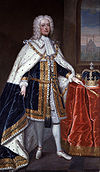 George II succeeded as king and elector on his father's death on 11/22 June 1727 during one of George I's visits to Hanover. His father was buried at Hanover, but George II decided not to go to the funeral, which far from bringing criticism led to praise from the English who considered it proof of the new king's fondness for England. He suppressed his father's will because it attempted to split the Hanoverian succession between George II's grandsons rather than vest all the domains (both Britain and Hanover) in a single person. Both British and Hanoverian ministers considered the will unlawful, as George I did not have the legal power to determine the succession personally. Critics supposed that George hid the will to avoid paying out his father's legacies.
George II was crowned at Westminster Abbey
on 11/22 October 1727. The composer George Frideric Handel
was commissioned to write four new anthems for the coronation, including Zadok the Priest
.
It was widely believed that George would dismiss Walpole, who had distressed him by joining his father's government, and replace him with Sir Spencer Compton
. George asked Compton, rather than Walpole, to write his first speech for him, but Compton asked Walpole to draft it for him. Caroline advised George to retain Walpole, who continued to gain royal favour by securing a generous civil list
(a fixed annual amount set by Parliament for the king's official expenditure) of £800,000. Walpole commanded a substantial majority in Parliament and George had little choice but to retain him or risk ministerial instability. Compton was ennobled as Lord Wilmington the following year.
Walpole directed domestic policy, and after the resignation of his brother-in-law Townshend in 1730 also controlled George's foreign policy. Historians generally believe that George played an honorific role in Britain, and closely followed the advice of Walpole and senior ministers who made the major decisions. Although the king was eager for war in Europe, his ministers were more cautious. The Anglo-Spanish War was brought to an end, and George unsuccessfully pressed Walpole to join the War of the Polish Succession
on the side of the German states. In April 1733, Walpole withdrew an unpopular excise
bill that had gathered strong opposition, including from within his own party. George lent support to Walpole by dismissing the bill's opponents from their court offices.
, worsened during the 1730s. Frederick had been left behind in Germany when his parents came to England, and they had not met for 14 years. In 1728, he was brought to England, and swiftly became a figurehead of the political opposition. When George visited Hanover in the summers of 1729, 1732 and 1735, he left his wife to chair the regency council in Britain rather than his son. Meanwhile, rivalry between George II and his brother-in-law Frederick William I of Prussia
led to tension along the Prussian–Hanoverian border, which eventually culminated in the mobilization of troops in the border zone and suggestions of a duel between the two kings. Negotiations for a marriage between the Prince of Wales and Frederick William's daughter Wilhelmine dragged on for years but neither side would make the concessions demanded of the other, and the idea was shelved. Instead, the prince married Princess Augusta of Saxe-Gotha
in April 1736.
In May 1736, George returned to Hanover, which resulted in unpopularity in England; a satirical notice was even pinned to the gates of St James's Palace decrying his absence. "Lost or strayed out of this house", it read, "a man who has left a wife and six children on the parish
." The king made plans to return in the face of inclement December weather; when his ship was caught in a storm, gossip swept London that he had drowned. Eventually, in January 1737, he arrived back in England. Immediately he fell ill, with piles and a fever, and withdrew to his bed. The Prince of Wales put it about that the king was dying, with the result that George insisted on getting up and attending a social event to disprove the gossip-mongers.
When the Prince of Wales applied to Parliament for an increase in his allowance, an open quarrel broke out. The king, who had a reputation for meanness, offered a private settlement, which Frederick rejected. Parliament voted against the measure, but George reluctantly increased his son's allowance on the advice of Walpole. Further friction between them followed when Frederick excluded the king and queen from the birth of his daughter in July 1737 by bundling his wife, who was in labour, into a coach and driving off in the middle of the night. George banished him and his family from the royal court, much like the punishment his own father had brought upon him with the exception that he allowed Frederick to retain custody of his children.
Soon after banishing his son, George's wife Caroline died on 20 November 1737 (O.S.). He was deeply affected by her death, and to the surprise of many displayed "a tenderness of which the world thought him before utterly incapable". On her deathbed she told her sobbing husband to remarry, to which he replied, "Non, j'aurai des maîtresses!" (French for "No, I shall have mistresses!"). It was common knowledge that George had already had mistresses during his marriage, and he had kept Caroline informed about them. Henrietta Howard
, later Countess of Suffolk, had moved to Hanover with her husband during the reign of Queen Anne, and she had been one of Caroline's women of the bedchamber
. She was his mistress from before the accession of George I until November 1734. She was followed by Amalie von Wallmoden
, later Countess of Yarmouth, with whom George had an illegitimate son, Johann Ludwig von Wallmoden. Johann Ludwig was born while Amalie was still married to her husband, and so George did not acknowledge him publicly as his own son.
, with Spain in 1739. Britain's war with Spain became part of the War of the Austrian Succession
when a major European war broke out upon the death of the Holy Roman Emperor Charles VI
in 1740. At dispute was the right of Charles's daughter, Maria Theresa
, to succeed to his Austrian dominions. George spent the summers of 1740 and 1741 in Hanover, where he was more able to intervene directly in European diplomatic moves in his capacity as elector.
Prince Frederick campaigned actively for the opposition in the British general election, 1741
, and Walpole was unable to secure a stable majority. Walpole attempted to buy off the prince with the promise of an increased allowance and offered to pay off his debts, but Frederick refused. With his support eroded, Walpole retired in 1742 after over twenty years in office. He was replaced by Spencer Compton, Lord Wilmington
, whom George had originally considered for the premiership in 1727. Lord Wilmington, however, was a figurehead; actual power was held by others, such as Lord Carteret
, George's favourite minister after Walpole. When Wilmington died in 1743, Henry Pelham
took his place at the head of the government.
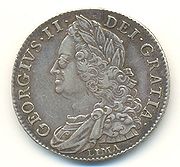 The pro-war faction was led by Carteret, who claimed that French power would increase if Maria Theresa failed to succeed to the Austrian throne. George agreed to send 12,000 hired Hessian and Danish mercenaries to Europe, ostensibly to support Maria Theresa. Without conferring with his British ministers, George stationed them in Hanover to prevent enemy French troops from marching into the electorate. The British army had not fought in a major European war in over twenty years, and the government had badly neglected its upkeep. George had pushed for greater professionalism in the ranks, and promotion by merit rather than by sale of commissions
, but without much success. An allied force of Austrian, British, Dutch, Hanoverian and Hessian troops engaged the French at the Battle of Dettingen
on 16/27 June 1743. George personally accompanied them, leading them to victory, thus becoming the last British monarch to lead troops into battle. Though his actions in the battle were admired, the war became unpopular with the British public, who felt that the king and Carteret were subordinating British interests to Hanoverian ones. Carteret lost support, and to George's dismay resigned in 1744.
Tension grew between the Pelham ministry and George, as George continued to take advice from Carteret and rejected pressure to include William Pitt the Elder
, who would have broadened the government's support base, in the Cabinet. The king disliked Pitt because he had previously opposed government policy and attacked measures seen as pro-Hanoverian. In February 1746, Pelham and his followers resigned. George asked Lord Bath
and Carteret to form an administration, but after less than 48 hours they returned the seals of office, unable to secure sufficient parliamentary support. Pelham returned to office triumphant, and George was forced to appoint Pitt to the ministry.
George's French opponents encouraged rebellion by the Jacobites
, the supporters of the Roman Catholic claimant to the British throne, James Francis Edward Stuart
, often known as the Old Pretender. Stuart was the son of James II
, who had been deposed in 1688 and replaced by his Protestant relations. Two prior rebellions in 1715
and 1719
had failed. In July 1745, the Old Pretender's son, Charles Edward Stuart
, popularly known as Bonnie Prince Charlie or the Young Pretender, landed in Scotland, where support for his cause was highest. George, who was summering in Hanover, returned to London at the end of August. The Jacobites defeated British forces in September at the Battle of Prestonpans
, and then moved south into England. The Jacobites failed to gain further support, and the French reneged on a promise of help. Losing morale, the Jacobites retreated back into Scotland. On 16/27 April 1746, Charles faced George's military-minded son Prince William, Duke of Cumberland, in the Battle of Culloden
, the last pitched battle fought on British soil. The ravaged Jacobite troops were routed by the government army. Charles escaped to France, but many of his supporters were caught and executed. Jacobitism was all but crushed; no further serious attempt was made at restoring the House of Stuart
. The War of the Austrian Succession continued until 1748, when Maria Theresa was recognized as Archduchess of Austria. The peace was celebrated by a fête in Green Park, London, for which Handel composed Music for the Royal Fireworks.
the Prince of Wales again actively campaigned for the opposition but Pelham's party won easily. Like his father before him, the Prince entertained opposition figures at his house in Leicester Square
. When the Prince of Wales died suddenly in 1751, his eldest son, Prince George
, became heir apparent. The king commiserated with the Dowager Princess of Wales and wept with her. As her son would not reach the age of majority until 1756, a new British Regency Act made her regent, assisted by a council led by the Duke of Cumberland, in case of George II's death. The king also made a new will, which provided for Cumberland to be sole regent in Hanover. After the death of his daughter Louisa at the end of the year, George lamented, "This has been a fatal year for my family. I lost my eldest son – but I am glad of it. ... Now [Louisa] is gone. I know I did not love my children when they were young: I hated to have them running into my room; but now I love them as well as most fathers."
in 1756. Public disquiet over British failures at the start of the conflict led to the resignation of Newcastle and the appointment of the Duke of Devonshire
as prime minister, and William Pitt the Elder
as Secretary of State for the Southern Department
. In April the following year, George dismissed Pitt, in an attempt to construct an administration more to his liking. Over the succeeding three months attempts to form another stable ministerial combination failed. In June, James Waldegrave, 2nd Earl Waldegrave
, held the seals of office for only four days. By the start of July, Pitt was recalled, and the Duke of Newcastle returned as prime minister. As Secretary of State, Pitt guided policy relating to the war. Great Britain, Hanover and Prussia and their allies Hesse-Kassel
and Brunswick-Wolfenbüttel were pitted against other European powers, including France, Austria, Russia, Sweden and Saxony
. The war involved multiple theatres from Europe to North America and India, where British dominance increased with the victories of Robert Clive
over French forces and their allies at the Battle of Arcot
and the Battle of Plassey
.
George's son the Duke of Cumberland commanded the king's troops in Northern Germany. In 1757, Hanover was invaded
, and George gave Cumberland full powers to conclude a separate peace. By September, however, he was furious at Cumberland's negotiated settlement
, which he felt greatly favoured the French. George said his son had "ruined me and disgraced himself". Cumberland, by his own choice, resigned his military offices, and George revoked the peace deal on the grounds that the French had infringed it by disarming Hessian troops after the ceasefire.
In the annus mirabilis
of 1759 British forces captured Quebec
and Guadeloupe. A French plan to invade Britain
was defeated following naval battles at Lagos
and Quiberon Bay
, and a resumed French advance on Hanover was halted by a joint British–Hanoverian force at the Battle of Minden
.
, alone. After a few minutes, his valet heard a loud crash. He entered the room to find the king on the floor. The king was lifted into his bed, and Princess Amelia was sent for, but before she reached him, he was dead. At the age of nearly 77, he had lived longer than any of his English predecessors. The right ventricle of the king's heart had ruptured as the result of an incipient aortic aneurysm
.
George II was succeeded by his grandson George III
, and was buried on 11 November in Westminster Abbey
. He left instructions for the sides of his and his wife's coffins to be removed so that their remains could mingle.
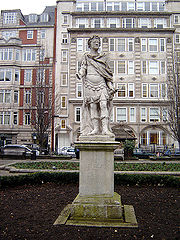 George donated the royal library to the British Museum
in 1757, four years after the museum's foundation. He had no interest in reading, or in the arts and sciences, and preferred to spend his leisure hours stag-hunting on horseback or playing cards. In 1737, he founded the Georg August University of Göttingen, the first university in the Electorate of Hanover
, and visited it in 1748. The asteroid
359 Georgia
was named in his honour at the University in 1902. He served as the Chancellor of Trinity College, Dublin
, between 1716 and 1727, and in 1754 issued the charter for King's College in New York City, which later become Columbia University
. The province of Georgia
, founded by royal charter in 1732, was named after George.
During George II's reign British interests expanded throughout the world, the Jacobite challenge to the Hanoverian dynasty was extinguished, and the power of ministers and Parliament in Britain became well-established. Nevertheless, in the memoirs of contemporaries such as Lord Hervey and Horace Walpole, George is depicted as a weak buffoon, governed by his wife and ministers. Biographies of George written during the nineteenth and first part of the twentieth century relied on these biased accounts. Since the last quarter of the twentieth century, scholarly analysis of surviving correspondence has indicated that George was not as ineffective as previously thought. Letters from ministers are annotated by George with pertinent remarks and demonstrate that he had a grasp of and interest in foreign policy in particular. He was often able to prevent the appointment of ministers or commanders he disliked, or sideline them into lesser offices. This academic re-assessment of George II, however, has not totally eliminated the popular perception of him as a "faintly ludicrous king". His parsimony, for example, may have opened him to ridicule, but his biographers observe that parsimony is preferable to extravagance. Lord Charlemont
excused George's short-temper by explaining that sincerity of feeling is better than deception, "His temper was warm and impetuous, but he was good-natured and sincere. Unskilled in the royal talent of dissimulation, he always was what he appeared to be. He might offend, but he never deceived." Lord Waldegrave
wrote, "I am thoroughly convinced that hereafter, when time shall have wore away those specks and blemishes which sully the brightest characters, and from which no man is totally exempt, he will be numbered amongst those patriot kings, under whose government the people have enjoyed the greatest happiness". George may not have played a strong role in history, but he was influential at times and he upheld constitutional government. Elizabeth Montagu
said of him, "With him our laws and liberties were safe, he possessed in a great degree the confidence of his people and the respect of foreign governments; and a certain steadiness of character made him of great consequence in these unsettled times … His character would not afford subject for epic poetry, but will look well in the sober page of history."
George II's full style was "George the Second, by the Grace of God, King of Great Britain, France and Ireland, Defender of the Faith
, Duke of Brunswick-Lüneburg, Archtreasurer and Prince-Elector of the Holy Roman Empire". France was included in the title out of tradition as English claims to the French throne
were made in the medieval period.
with an inescutcheon of gules
plain in the Hanoverian quarter differenced overall by a label
of three points argent
. The arms included the royal crest with the single arched coronet
of his rank, and the royal supporters charged on the shoulder with a similar label
. As king, he used the royal arms as used by his father undifferenced.
|-
Kingdom of Great Britain
The former Kingdom of Great Britain, sometimes described as the 'United Kingdom of Great Britain', That the Two Kingdoms of Scotland and England, shall upon the 1st May next ensuing the date hereof, and forever after, be United into One Kingdom by the Name of GREAT BRITAIN. was a sovereign...
and Ireland
Kingdom of Ireland
The Kingdom of Ireland refers to the country of Ireland in the period between the proclamation of Henry VIII as King of Ireland by the Crown of Ireland Act 1542 and the Act of Union in 1800. It replaced the Lordship of Ireland, which had been created in 1171...
, Duke of Brunswick-Lüneburg
Brunswick-Lüneburg
The Duchy of Brunswick-Lüneburg , or more properly Duchy of Brunswick and Lüneburg, was an historical ducal state from the late Middle Ages until the late Early Modern era within the North-Western domains of the Holy Roman Empire of the German Nation, in what is now northern Germany...
(Hanover
Electorate of Hanover
The Electorate of Brunswick-Lüneburg was the ninth Electorate of the Holy Roman Empire of the German Nation...
) and Archtreasurer and Prince-elector
Prince-elector
The Prince-electors of the Holy Roman Empire were the members of the electoral college of the Holy Roman Empire, having the function of electing the Roman king or, from the middle of the 16th century onwards, directly the Holy Roman Emperor.The heir-apparent to a prince-elector was known as an...
of the Holy Roman Empire
Holy Roman Empire
The Holy Roman Empire was a realm that existed from 962 to 1806 in Central Europe.It was ruled by the Holy Roman Emperor. Its character changed during the Middle Ages and the Early Modern period, when the power of the emperor gradually weakened in favour of the princes...
from 11 June 1727 (O.S.) until his death.
George was the last British monarch born outside Great Britain. He was born and brought up in Northern Germany. In 1701, his grandmother, Sophia of Hanover
Sophia of Hanover
Sophia of the Palatinate was an heiress to the crowns of England and Ireland and later the crown of Great Britain. She was declared heiress presumptive by the Act of Settlement 1701...
, became second-in-line to the British throne after about fifty Catholics higher in line were excluded by the Act of Settlement
Act of Settlement 1701
The Act of Settlement is an act of the Parliament of England that was passed in 1701 to settle the succession to the English throne on the Electress Sophia of Hanover and her Protestant heirs. The act was later extended to Scotland, as a result of the Treaty of Union , enacted in the Acts of Union...
, which restricted the succession to Protestants. After the deaths of Sophia and Anne, Queen of Great Britain, in 1714, his father George I
George I of Great Britain
George I was King of Great Britain and Ireland from 1 August 1714 until his death, and ruler of the Duchy and Electorate of Brunswick-Lüneburg in the Holy Roman Empire from 1698....
, Elector of Hanover, inherited the British throne. In the first years of his father's reign as king, George was associated with opposition politicians, until they re-joined the governing party in 1720.
As king from 1727, George exercised little control over British domestic policy, which was largely controlled by Great Britain's parliament
Parliament of Great Britain
The Parliament of Great Britain was formed in 1707 following the ratification of the Acts of Union by both the Parliament of England and Parliament of Scotland...
. As elector, he spent 12 summers in Hanover, where he had more direct control over government policy. He had a difficult relationship with his eldest son, Frederick
Frederick, Prince of Wales
Frederick, Prince of Wales was a member of the House of Hanover and therefore of the Hanoverian and later British Royal Family, the eldest son of George II and father of George III, as well as the great-grandfather of Queen Victoria...
, who supported the parliamentary opposition. During the War of the Austrian Succession
War of the Austrian Succession
The War of the Austrian Succession – including King George's War in North America, the Anglo-Spanish War of Jenkins' Ear, and two of the three Silesian wars – involved most of the powers of Europe over the question of Maria Theresa's succession to the realms of the House of Habsburg.The...
, George participated at the Battle of Dettingen
Battle of Dettingen
The Battle of Dettingen took place on 27 June 1743 at Dettingen in Bavaria during the War of the Austrian Succession. It was the last time that a British monarch personally led his troops into battle...
in 1743, and thus became the last British monarch to lead an army in battle. In 1745, supporters of the Catholic claimant to the British throne, James Francis Edward Stuart
James Francis Edward Stuart
James Francis Edward, Prince of Wales was the son of the deposed James II of England...
, attempted and failed to depose George in the last of the Jacobite rebellions. Frederick died unexpectedly in 1751, leaving George's grandson, George III
George III of the United Kingdom
George III was King of Great Britain and King of Ireland from 25 October 1760 until the union of these two countries on 1 January 1801, after which he was King of the United Kingdom of Great Britain and Ireland until his death...
, as heir apparent
Heir apparent
An heir apparent or heiress apparent is a person who is first in line of succession and cannot be displaced from inheriting, except by a change in the rules of succession....
and ultimately king.
For two centuries after his death, history tended to view George II with disdain, concentrating on his mistresses, short-temper, and boorishness. Since then, some scholars have re-assessed his legacy and conclude that he held and exercised influence in foreign policy and military appointments.
Early life
Hanover
Hanover or Hannover, on the river Leine, is the capital of the federal state of Lower Saxony , Germany and was once by personal union the family seat of the Hanoverian Kings of Great Britain, under their title as the dukes of Brunswick-Lüneburg...
in Germany, and was the son of George Louis, Hereditary Prince of Brunswick-Lüneburg
Electorate of Hanover
The Electorate of Brunswick-Lüneburg was the ninth Electorate of the Holy Roman Empire of the German Nation...
(later King George I of Great Britain
George I of Great Britain
George I was King of Great Britain and Ireland from 1 August 1714 until his death, and ruler of the Duchy and Electorate of Brunswick-Lüneburg in the Holy Roman Empire from 1698....
), and his wife, Sophia Dorothea of Celle
Sophia Dorothea of Celle
Sophia Dorothea of Brunswick and Lunenburg was the wife and cousin of George Louis, Elector of Hanover, later George I of Great Britain, and mother of George II through an arranged marriage of state, instigated by the machinations of Duchess Sophia of Hanover...
. Both of George's parents committed adultery, and in 1694 their marriage was dissolved on the pretext that Sophia had abandoned her husband. She was confined to Ahlden House and denied access to her two children, George and his sister Sophia Dorothea of Hanover
Sophia Dorothea of Hanover
Sophia Dorothea of Hanover was a Queen consort in Prussia as wife of Frederick William I. She was the sister of George II of Great Britain and the mother of Frederick the Great.- Biography :...
, whom she probably never saw again.
Until the age of four, George spoke only French, the language of diplomacy and the court, but he was thereafter taught German by one of his tutors, Johann Hilmar Holstein. He was also schooled in English and Italian, and studied genealogy, military history and battle tactics with particular diligence.
George's second cousin once removed, Queen Anne, ascended the thrones of England
Kingdom of England
The Kingdom of England was, from 927 to 1707, a sovereign state to the northwest of continental Europe. At its height, the Kingdom of England spanned the southern two-thirds of the island of Great Britain and several smaller outlying islands; what today comprises the legal jurisdiction of England...
, Scotland
Kingdom of Scotland
The Kingdom of Scotland was a Sovereign state in North-West Europe that existed from 843 until 1707. It occupied the northern third of the island of Great Britain and shared a land border to the south with the Kingdom of England...
and Ireland
Kingdom of Ireland
The Kingdom of Ireland refers to the country of Ireland in the period between the proclamation of Henry VIII as King of Ireland by the Crown of Ireland Act 1542 and the Act of Union in 1800. It replaced the Lordship of Ireland, which had been created in 1171...
in 1702. She had no surviving children, and by the Act of Settlement 1701
Act of Settlement 1701
The Act of Settlement is an act of the Parliament of England that was passed in 1701 to settle the succession to the English throne on the Electress Sophia of Hanover and her Protestant heirs. The act was later extended to Scotland, as a result of the Treaty of Union , enacted in the Acts of Union...
the English Parliament
Parliament of England
The Parliament of England was the legislature of the Kingdom of England. In 1066, William of Normandy introduced a feudal system, by which he sought the advice of a council of tenants-in-chief and ecclesiastics before making laws...
designated Anne's closest Protestant
Protestantism
Protestantism is one of the three major groupings within Christianity. It is a movement that began in Germany in the early 16th century as a reaction against medieval Roman Catholic doctrines and practices, especially in regards to salvation, justification, and ecclesiology.The doctrines of the...
blood relations, George's grandmother Sophia
Sophia of Hanover
Sophia of the Palatinate was an heiress to the crowns of England and Ireland and later the crown of Great Britain. She was declared heiress presumptive by the Act of Settlement 1701...
and her descendants, as Anne's heirs in England and Ireland. Consequently, after his grandmother and father, George was third in line to succeed Anne in two of her realms. He was naturalized as an English subject in 1705 by the Sophia Naturalization Act, and in 1706 he was made a Knight of the Garter and created Duke and Marquess of Cambridge
Duke of Cambridge
Duke of Cambridge is a title which has been conferred upon members of the British royal family several times. It was first used as a designation for Charles Stuart , the eldest son of James, Duke of York , though he was never formally created Duke of Cambridge...
, Earl of Milford Haven, Viscount Northallerton and Baron Tewkesbury in the Peerage of England
Peerage of England
The Peerage of England comprises all peerages created in the Kingdom of England before the Act of Union in 1707. In that year, the Peerages of England and Scotland were replaced by one Peerage of Great Britain....
. England and Scotland united in 1707
Acts of Union 1707
The Acts of Union were two Parliamentary Acts - the Union with Scotland Act passed in 1706 by the Parliament of England, and the Union with England Act passed in 1707 by the Parliament of Scotland - which put into effect the terms of the Treaty of Union that had been agreed on 22 July 1706,...
to form the Kingdom of Great Britain
Kingdom of Great Britain
The former Kingdom of Great Britain, sometimes described as the 'United Kingdom of Great Britain', That the Two Kingdoms of Scotland and England, shall upon the 1st May next ensuing the date hereof, and forever after, be United into One Kingdom by the Name of GREAT BRITAIN. was a sovereign...
, and jointly accepted the succession as laid down by the Act of Settlement.
Marriage
George's father did not want his son to enter into a loveless arranged marriage as he had, and wanted his son to have the opportunity of meeting his bride before any formal arrangements were made. Negotiations from 1702 for the hand of Princess Hedvig Sophia of SwedenHedvig Sophia of Sweden
Princess Hedvig Sophia Augusta of Sweden was a Swedish princess and a Duchess Consort of Holstein-Gottorp, the eldest child of King Charles XI of Sweden, and his spouse Queen Ulrica Eleanor. She was heir presumptive to the Swedish throne until her death and the Regent of the duchy of...
, Dowager Duchess and regent of Holstein-Gottorp
Holstein-Gottorp
Holstein-Gottorp or Schleswig-Holstein-Gottorp is the historiographical name, as well as contemporary shorthand name, for the parts of the duchies of Schleswig and Holstein that were ruled by the dukes of Schleswig-Holstein-Gottorp. Other parts of the duchies were ruled by the kings of Denmark. The...
, came to nothing. In June 1705, under the false name of "Monsieur de Busch", George visited the Ansbach
Principality of Ansbach
The Principality of Ansbach or Brandenburg-Ansbach was a reichsfrei principality in the Holy Roman Empire centered on the Bavarian city of Ansbach...
court at their summer residence in Triesdorf to investigate incognito a marriage prospect: Caroline of Ansbach
Caroline of Ansbach
Caroline of Brandenburg-Ansbach was the queen consort of King George II of Great Britain.Her father, John Frederick, Margrave of Brandenburg-Ansbach, was the ruler of a small German state...
, the former ward of his aunt Queen Sophia Charlotte of Prussia
Sophia Charlotte of Hanover
Sophia Charlotte of Hanover was the Queen consort of Prussia as wife of Frederick I of Prussia. She was the daughter of Ernst August, Elector of Hanover, and Sophia of the Palatinate...
. The English envoy to Hanover, Edmund Poley, reported that George was so taken by "the good character he had of her that he would not think of anybody else". A marriage contract was concluded by the end of July. On 22 August / 2 September 1705 Caroline arrived in Hanover for her wedding, which was held the same evening in the chapel at Herrenhausen
Herrenhausen Gardens
The Herrenhausen Gardens , located in Lower Saxony's capital of Hanover are made up of the Great Garden , the Berggarten, the Georgengarten and the Welfengarten. The gardens are a heritage of the Kings of Hanover.The Great Garden has always been one of the most distinguished baroque formal gardens...
.
George was keen to participate in the war against France
War of the Spanish Succession
The War of the Spanish Succession was fought among several European powers, including a divided Spain, over the possible unification of the Kingdoms of Spain and France under one Bourbon monarch. As France and Spain were among the most powerful states of Europe, such a unification would have...
in Flanders
Flanders
Flanders is the community of the Flemings but also one of the institutions in Belgium, and a geographical region located in parts of present-day Belgium, France and the Netherlands. "Flanders" can also refer to the northern part of Belgium that contains Brussels, Bruges, Ghent and Antwerp...
, but his father refused permission for him to join the army in an active role until he had a son and heir. In early 1707, George's hopes were fulfilled when Caroline gave birth to a son, Frederick
Frederick, Prince of Wales
Frederick, Prince of Wales was a member of the House of Hanover and therefore of the Hanoverian and later British Royal Family, the eldest son of George II and father of George III, as well as the great-grandfather of Queen Victoria...
. In July, Caroline fell seriously ill with smallpox
Smallpox
Smallpox was an infectious disease unique to humans, caused by either of two virus variants, Variola major and Variola minor. The disease is also known by the Latin names Variola or Variola vera, which is a derivative of the Latin varius, meaning "spotted", or varus, meaning "pimple"...
, and George caught the infection himself after staying by her side devotedly during her illness. They both recovered. In 1708, George participated in the Battle of Oudenarde
Battle of Oudenarde
The Battle of Oudenaarde was a key battle in the War of the Spanish Succession fought on 11 July 1708 between the forces of Great Britain, the Dutch Republic and the Holy Roman Empire on the one side and the French on the other...
in the vanguard of the Hanoverian cavalry; his horse and a colonel immediately beside him were killed, but George survived unharmed. The British commander, Marlborough
John Churchill, 1st Duke of Marlborough
John Churchill, 1st Duke of Marlborough, Prince of Mindelheim, KG, PC , was an English soldier and statesman whose career spanned the reigns of five monarchs through the late 17th and early 18th centuries...
, wrote that George "distinguished himself extremely, charging at the head of and animating by his example [the Hanoverian] troops, who played a good part in this happy victory". Between 1709 and 1713 George and Caroline had three more children, all girls: Anne
Anne, Princess Royal and Princess of Orange
Anne, Princess Royal and Princess of Orange was the second child and eldest daughter of King George II of Great Britain and his consort, Caroline of Ansbach. She was the spouse of William IV, Prince of Orange, the first hereditary stadtholder of the Netherlands...
, Amelia, and Caroline.
By 1714, Queen Anne's health had declined, and British Whigs
British Whig Party
The Whigs were a party in the Parliament of England, Parliament of Great Britain, and Parliament of the United Kingdom, who contested power with the rival Tories from the 1680s to the 1850s. The Whigs' origin lay in constitutional monarchism and opposition to absolute rule...
, politicians who supported the Hanoverian succession, thought it prudent for one of the Hanoverians to live in England, to safeguard the Protestant succession on Anne's death. As George was a peer of the realm
Peer of the Realm
Peer of the Realm is a term for a member of the highest social order in a kingdom, notably:...
(as Duke of Cambridge), it was suggested that he be summoned to Parliament to sit in the House of Lords
House of Lords
The House of Lords is the upper house of the Parliament of the United Kingdom. Like the House of Commons, it meets in the Palace of Westminster....
. Both Anne and George's father refused to support the plan, though George, Caroline and Sophia were all in favour. George did not go. Within the year both Sophia and Anne were dead, and George's father was king.
Quarrel with the king
George and his father sailed for England from The HagueThe Hague
The Hague is the capital city of the province of South Holland in the Netherlands. With a population of 500,000 inhabitants , it is the third largest city of the Netherlands, after Amsterdam and Rotterdam...
on 16/27 September and arrived at Greenwich
Greenwich
Greenwich is a district of south London, England, located in the London Borough of Greenwich.Greenwich is best known for its maritime history and for giving its name to the Greenwich Meridian and Greenwich Mean Time...
two days later. The following day, they formally entered London in a ceremonial procession. George was given the title of Prince of Wales
Prince of Wales
Prince of Wales is a title traditionally granted to the heir apparent to the reigning monarch of the United Kingdom of Great Britain and Northern Ireland and the 15 other independent Commonwealth realms...
. Caroline followed her husband to Britain in October with their daughters, while Frederick remained in Hanover to be brought up by private tutors. London was like nothing George had seen before: it was 50 times larger than Hanover, and the crowd was estimated at up to one and half million spectators. George courted popularity with voluble expressions of praise for the English, and claimed that he had no drop of blood that was not English.
In July 1716, the king returned to Hanover for six months, and George was given limited powers, as "Guardian and Lieutenant of the Realm", to govern in his father's absence. He made a royal progress through Chichester
Chichester
Chichester is a cathedral city in West Sussex, within the historic County of Sussex, South-East England. It has a long history as a settlement; its Roman past and its subsequent importance in Anglo-Saxon times are only its beginnings...
, Havant
Havant
Havant is a town in south east Hampshire on the South coast of England, between Portsmouth and Chichester. It gives its name to the borough comprising the town and the surrounding area. The town has rapidly grown since the end of the Second World War.It has good railway connections to London,...
, Portsmouth
Portsmouth
Portsmouth is the second largest city in the ceremonial county of Hampshire on the south coast of England. Portsmouth is notable for being the United Kingdom's only island city; it is located mainly on Portsea Island...
and Guildford
Guildford
Guildford is the county town of Surrey. England, as well as the seat for the borough of Guildford and the administrative headquarters of the South East England region...
in southern England. Spectators were allowed to see him dine in public at Hampton Court Palace
Hampton Court Palace
Hampton Court Palace is a royal palace in the London Borough of Richmond upon Thames, Greater London; it has not been inhabited by the British royal family since the 18th century. The palace is located south west of Charing Cross and upstream of Central London on the River Thames...
. An attempt on his life at Drury Lane Theatre
Theatre Royal, Drury Lane
The Theatre Royal, Drury Lane is a West End theatre in Covent Garden, in the City of Westminster, a borough of London. The building faces Catherine Street and backs onto Drury Lane. The building standing today is the most recent in a line of four theatres at the same location dating back to 1663,...
, in which one person was shot dead before the assailant was brought under control, boosted his high public profile.
His father distrusted or was jealous of George's popularity, which contributed to the development of a poor relationship between them. The birth of George's second son, Prince George William, in 1717 proved to be a catalyst for a family quarrel; the king, supposedly following custom, appointed the Lord Chamberlain
Lord Chamberlain
The Lord Chamberlain or Lord Chamberlain of the Household is one of the chief officers of the Royal Household in the United Kingdom and is to be distinguished from the Lord Great Chamberlain, one of the Great Officers of State....
, the Duke of Newcastle
Thomas Pelham-Holles, 1st Duke of Newcastle-upon-Tyne
Thomas Pelham-Holles, 1st Duke of Newcastle-upon-Tyne and 1st Duke of Newcastle-under-Lyne, KG, PC was a British Whig statesman, whose official life extended throughout the Whig supremacy of the 18th century. He is commonly known as the Duke of Newcastle.A protégé of Sir Robert Walpole, he served...
, as one of the baptism
Baptism
In Christianity, baptism is for the majority the rite of admission , almost invariably with the use of water, into the Christian Church generally and also membership of a particular church tradition...
al sponsors of the child. The king was angered when George, who disliked Newcastle, verbally insulted the duke at the christening, which the duke misunderstood as a challenge to a duel. George and Caroline were temporarily confined to their apartments on the order of the king, who subsequently banished his son from St. James's Palace
St. James's Palace
St. James's Palace is one of London's oldest palaces. It is situated in Pall Mall, just north of St. James's Park. Although no sovereign has resided there for almost two centuries, it has remained the official residence of the Sovereign and the most senior royal palace in the UK...
, the king's residence. The Prince and Princess of Wales left court, but their children remained in the care of the king.
George and Caroline missed their children, and were desperate to see them. On one occasion they secretly visited the palace without the approval of the king; Caroline fainted and George "cried like a child". The king partially relented and permitted them to visit once a week, though he later allowed Caroline unconditional access. The following February, George William died, with his father by his side.
Political opposition
Banned from the palace and shunned by his own father, for the next several years the Prince of Wales was identified with opposition to George IGeorge I of Great Britain
George I was King of Great Britain and Ireland from 1 August 1714 until his death, and ruler of the Duchy and Electorate of Brunswick-Lüneburg in the Holy Roman Empire from 1698....
's policies, which included measures designed to increase religious freedom in Great Britain and expand Hanover's German territories at the expense of Sweden. His new London residence, Leicester House
Leicester Square
Leicester Square is a pedestrianised square in the West End of London, England. The Square lies within an area bound by Lisle Street, to the north; Charing Cross Road, to the east; Orange Street, to the south; and Whitcomb Street, to the west...
, became a frequent meeting place for his father's political opponents, including Sir Robert Walpole and Viscount Townshend
Charles Townshend, 2nd Viscount Townshend
Charles Townshend, 2nd Viscount Townshend Bt, KG, PC was a British Whig statesman. He served for a decade as Secretary of State, directing British foreign policy...
, who had left the government in 1717.
The king visited Hanover again from May to November 1719. Instead of appointing George to the guardianship, he established a regency council. In 1720, Walpole encouraged the king and his son to reconcile, for the sake of public unity, which they did half-heartedly. Walpole and Townshend returned to political office, and rejoined the ministry. George was soon disillusioned with the terms of the reconciliation; his three daughters who were in the care of the king were not returned and he was still barred from becoming regent during the king's absences. He came to believe that Walpole had tricked him into the rapprochement as part of a scheme to regain power. Over the next few years, he and Caroline lived quietly, avoiding overt political activity. They had three more children: William, Mary
Princess Mary of Great Britain
The Princess Mary was a member of the British Royal Family, a daughter of George II and Caroline of Ansbach.-Early life:...
and Louisa
Louise of Great Britain
Louise of Great Britain was the youngest surviving daughter of George II of Great Britain and Caroline of Ansbach, and became queen consort of Denmark and Norway.-Early life:...
, who were brought up at Leicester House and Richmond Lodge, George's summer residence.
In 1721, the economic disaster of the South Sea Bubble allowed Walpole to rise to the pinnacle of government. Walpole and his Whig
British Whig Party
The Whigs were a party in the Parliament of England, Parliament of Great Britain, and Parliament of the United Kingdom, who contested power with the rival Tories from the 1680s to the 1850s. The Whigs' origin lay in constitutional monarchism and opposition to absolute rule...
Party were dominant in politics, as the king feared that the Tories
Tory
Toryism is a traditionalist and conservative political philosophy which grew out of the Cavalier faction in the Wars of the Three Kingdoms. It is a prominent ideology in the politics of the United Kingdom, but also features in parts of The Commonwealth, particularly in Canada...
would not support the succession laid down in the Act of Settlement
Act of Settlement 1701
The Act of Settlement is an act of the Parliament of England that was passed in 1701 to settle the succession to the English throne on the Electress Sophia of Hanover and her Protestant heirs. The act was later extended to Scotland, as a result of the Treaty of Union , enacted in the Acts of Union...
. The power of the Whigs was so great that the Tories would not come to hold power for another half-century.
Early reign
George II was crowned at Westminster Abbey
Westminster Abbey
The Collegiate Church of St Peter at Westminster, popularly known as Westminster Abbey, is a large, mainly Gothic church, in the City of Westminster, London, United Kingdom, located just to the west of the Palace of Westminster. It is the traditional place of coronation and burial site for English,...
on 11/22 October 1727. The composer George Frideric Handel
George Frideric Handel
George Frideric Handel was a German-British Baroque composer, famous for his operas, oratorios, anthems and organ concertos. Handel was born in 1685, in a family indifferent to music...
was commissioned to write four new anthems for the coronation, including Zadok the Priest
Zadok the Priest
Zadok the Priest is a coronation anthem composed by George Frideric Handel using texts from the King James Bible. It is one of the four Coronation Anthems that Handel composed for the coronation of George II of Great Britain in 1727,The other Coronation Anthems Handel composed are: The King Shall...
.
It was widely believed that George would dismiss Walpole, who had distressed him by joining his father's government, and replace him with Sir Spencer Compton
Spencer Compton, 1st Earl of Wilmington
Spencer Compton, 1st Earl of Wilmington KG, KB, PC was a British Whig statesman who served continuously in government from 1715 until his death. He served as the nominal head of government from 1742 until his death in 1743, but was merely a figurehead for the true leader of the government, Lord...
. George asked Compton, rather than Walpole, to write his first speech for him, but Compton asked Walpole to draft it for him. Caroline advised George to retain Walpole, who continued to gain royal favour by securing a generous civil list
Civil list
-United Kingdom:In the United Kingdom, the Civil List is the name given to the annual grant that covers some expenses associated with the Sovereign performing their official duties, including those for staff salaries, State Visits, public engagements, ceremonial functions and the upkeep of the...
(a fixed annual amount set by Parliament for the king's official expenditure) of £800,000. Walpole commanded a substantial majority in Parliament and George had little choice but to retain him or risk ministerial instability. Compton was ennobled as Lord Wilmington the following year.
Walpole directed domestic policy, and after the resignation of his brother-in-law Townshend in 1730 also controlled George's foreign policy. Historians generally believe that George played an honorific role in Britain, and closely followed the advice of Walpole and senior ministers who made the major decisions. Although the king was eager for war in Europe, his ministers were more cautious. The Anglo-Spanish War was brought to an end, and George unsuccessfully pressed Walpole to join the War of the Polish Succession
War of the Polish Succession
The War of the Polish Succession was a major European war for princes' possessions sparked by a Polish civil war over the succession to Augustus II, King of Poland that other European powers widened in pursuit of their own national interests...
on the side of the German states. In April 1733, Walpole withdrew an unpopular excise
Excise
Excise tax in the United States is a indirect tax on listed items. Excise taxes can be and are made by federal, state and local governments and are far from uniform throughout the United States...
bill that had gathered strong opposition, including from within his own party. George lent support to Walpole by dismissing the bill's opponents from their court offices.
Family problems
George II's relationship with his son and heir apparent, Frederick, Prince of WalesFrederick, Prince of Wales
Frederick, Prince of Wales was a member of the House of Hanover and therefore of the Hanoverian and later British Royal Family, the eldest son of George II and father of George III, as well as the great-grandfather of Queen Victoria...
, worsened during the 1730s. Frederick had been left behind in Germany when his parents came to England, and they had not met for 14 years. In 1728, he was brought to England, and swiftly became a figurehead of the political opposition. When George visited Hanover in the summers of 1729, 1732 and 1735, he left his wife to chair the regency council in Britain rather than his son. Meanwhile, rivalry between George II and his brother-in-law Frederick William I of Prussia
Frederick William I of Prussia
Frederick William I of the House of Hohenzollern, was the King in Prussia and Elector of Brandenburg from 1713 until his death...
led to tension along the Prussian–Hanoverian border, which eventually culminated in the mobilization of troops in the border zone and suggestions of a duel between the two kings. Negotiations for a marriage between the Prince of Wales and Frederick William's daughter Wilhelmine dragged on for years but neither side would make the concessions demanded of the other, and the idea was shelved. Instead, the prince married Princess Augusta of Saxe-Gotha
Princess Augusta of Saxe-Gotha
Princess Augusta of Saxe-Gotha-Altenburg was Princess of Wales between 1736 and 1751, and Dowager Princess of Wales thereafter. She was one of only three Princesses of Wales who never became queen consort...
in April 1736.
In May 1736, George returned to Hanover, which resulted in unpopularity in England; a satirical notice was even pinned to the gates of St James's Palace decrying his absence. "Lost or strayed out of this house", it read, "a man who has left a wife and six children on the parish
Poor rate
In England and Wales, under the 1601 Elizabethan Poor Law the poor rate was a tax on property levied on the parish which was used to provide poor relief to the parish poor. The tax was collected by local magistrates or Overseers of the Poor, and later by Local Authorities....
." The king made plans to return in the face of inclement December weather; when his ship was caught in a storm, gossip swept London that he had drowned. Eventually, in January 1737, he arrived back in England. Immediately he fell ill, with piles and a fever, and withdrew to his bed. The Prince of Wales put it about that the king was dying, with the result that George insisted on getting up and attending a social event to disprove the gossip-mongers.
When the Prince of Wales applied to Parliament for an increase in his allowance, an open quarrel broke out. The king, who had a reputation for meanness, offered a private settlement, which Frederick rejected. Parliament voted against the measure, but George reluctantly increased his son's allowance on the advice of Walpole. Further friction between them followed when Frederick excluded the king and queen from the birth of his daughter in July 1737 by bundling his wife, who was in labour, into a coach and driving off in the middle of the night. George banished him and his family from the royal court, much like the punishment his own father had brought upon him with the exception that he allowed Frederick to retain custody of his children.
Soon after banishing his son, George's wife Caroline died on 20 November 1737 (O.S.). He was deeply affected by her death, and to the surprise of many displayed "a tenderness of which the world thought him before utterly incapable". On her deathbed she told her sobbing husband to remarry, to which he replied, "Non, j'aurai des maîtresses!" (French for "No, I shall have mistresses!"). It was common knowledge that George had already had mistresses during his marriage, and he had kept Caroline informed about them. Henrietta Howard
Henrietta Howard, Countess of Suffolk
Henrietta Howard was a mistress of King George II of Great Britain.She was the daughter of Sir Henry Hobart, 4th Baronet, a Norfolk landowner who was killed in a duel when Henrietta was aged eight...
, later Countess of Suffolk, had moved to Hanover with her husband during the reign of Queen Anne, and she had been one of Caroline's women of the bedchamber
Woman of the Bedchamber
In the Royal Household of the United Kingdom the term Woman of the Bedchamber is used to describe a woman attending either a queen regnant or queen consort, in the role of Lady-in-Waiting...
. She was his mistress from before the accession of George I until November 1734. She was followed by Amalie von Wallmoden
Amalie von Wallmoden, Countess of Yarmouth
Amalie Sophie Marianne von Wallmoden, 1st Countess of Yarmouth was the mistress of George II of Great Britain from the mid-1730s until his death in 1760. Born into one prominent family in Hanover and wed into another, she became a naturalised citizen of Britain in 1740 and was granted the life...
, later Countess of Yarmouth, with whom George had an illegitimate son, Johann Ludwig von Wallmoden. Johann Ludwig was born while Amalie was still married to her husband, and so George did not acknowledge him publicly as his own son.
War and rebellion
Against Walpole's wishes, but to George's delight, Britain once again entered into war, the War of Jenkins' EarWar of Jenkins' Ear
The War of Jenkins' Ear was a conflict between Great Britain and Spain that lasted from 1739 to 1748, with major operations largely ended by 1742. Its unusual name, coined by Thomas Carlyle in 1858, relates to Robert Jenkins, captain of a British merchant ship, who exhibited his severed ear in...
, with Spain in 1739. Britain's war with Spain became part of the War of the Austrian Succession
War of the Austrian Succession
The War of the Austrian Succession – including King George's War in North America, the Anglo-Spanish War of Jenkins' Ear, and two of the three Silesian wars – involved most of the powers of Europe over the question of Maria Theresa's succession to the realms of the House of Habsburg.The...
when a major European war broke out upon the death of the Holy Roman Emperor Charles VI
Charles VI, Holy Roman Emperor
Charles VI was the penultimate Habsburg sovereign of the Habsburg Empire. He succeeded his elder brother, Joseph I, as Holy Roman Emperor, King of Bohemia , Hungary and Croatia , Archduke of Austria, etc., in 1711...
in 1740. At dispute was the right of Charles's daughter, Maria Theresa
Maria Theresa of Austria
Maria Theresa Walburga Amalia Christina was the only female ruler of the Habsburg dominions and the last of the House of Habsburg. She was the sovereign of Austria, Hungary, Croatia, Bohemia, Mantua, Milan, Lodomeria and Galicia, the Austrian Netherlands and Parma...
, to succeed to his Austrian dominions. George spent the summers of 1740 and 1741 in Hanover, where he was more able to intervene directly in European diplomatic moves in his capacity as elector.
Prince Frederick campaigned actively for the opposition in the British general election, 1741
British general election, 1741
The British general election, 1741 returned members to serve in the House of Commons of the 9th Parliament of Great Britain to be held, after the merger of the Parliament of England and the Parliament of Scotland in 1707...
, and Walpole was unable to secure a stable majority. Walpole attempted to buy off the prince with the promise of an increased allowance and offered to pay off his debts, but Frederick refused. With his support eroded, Walpole retired in 1742 after over twenty years in office. He was replaced by Spencer Compton, Lord Wilmington
Spencer Compton, 1st Earl of Wilmington
Spencer Compton, 1st Earl of Wilmington KG, KB, PC was a British Whig statesman who served continuously in government from 1715 until his death. He served as the nominal head of government from 1742 until his death in 1743, but was merely a figurehead for the true leader of the government, Lord...
, whom George had originally considered for the premiership in 1727. Lord Wilmington, however, was a figurehead; actual power was held by others, such as Lord Carteret
John Carteret, 2nd Earl Granville
John Carteret, 2nd Earl Granville, 7th Seigneur of Sark, KG, PC , commonly known by his earlier title as Lord Carteret, was a British statesman and Lord President of the Council from 1751 to 1763.-Family:...
, George's favourite minister after Walpole. When Wilmington died in 1743, Henry Pelham
Henry Pelham
Henry Pelham was a British Whig statesman, who served as Prime Minister of Great Britain from 27 August 1743 until his death in 1754...
took his place at the head of the government.
Sale of commissions
The sale of commissions was a common practice in most European armies where wealthy and noble officers purchased their rank. Only the Imperial Russian Army and the Prussian Army never used such a system. While initially shunned in the French Revolutionary Army, it was eventually revived in the...
, but without much success. An allied force of Austrian, British, Dutch, Hanoverian and Hessian troops engaged the French at the Battle of Dettingen
Battle of Dettingen
The Battle of Dettingen took place on 27 June 1743 at Dettingen in Bavaria during the War of the Austrian Succession. It was the last time that a British monarch personally led his troops into battle...
on 16/27 June 1743. George personally accompanied them, leading them to victory, thus becoming the last British monarch to lead troops into battle. Though his actions in the battle were admired, the war became unpopular with the British public, who felt that the king and Carteret were subordinating British interests to Hanoverian ones. Carteret lost support, and to George's dismay resigned in 1744.
Tension grew between the Pelham ministry and George, as George continued to take advice from Carteret and rejected pressure to include William Pitt the Elder
William Pitt, 1st Earl of Chatham
William Pitt, 1st Earl of Chatham PC was a British Whig statesman who led Britain during the Seven Years' War...
, who would have broadened the government's support base, in the Cabinet. The king disliked Pitt because he had previously opposed government policy and attacked measures seen as pro-Hanoverian. In February 1746, Pelham and his followers resigned. George asked Lord Bath
William Pulteney, 1st Earl of Bath
William Pulteney, 1st Earl of Bath, PC was an English politician, a Whig, created the first Earl of Bath in 1742 by King George II; he is sometimes stated to have been Prime Minister, for the shortest term ever , though most modern sources reckon that he cannot be considered to have held the...
and Carteret to form an administration, but after less than 48 hours they returned the seals of office, unable to secure sufficient parliamentary support. Pelham returned to office triumphant, and George was forced to appoint Pitt to the ministry.
George's French opponents encouraged rebellion by the Jacobites
Jacobitism
Jacobitism was the political movement in Britain dedicated to the restoration of the Stuart kings to the thrones of England, Scotland, later the Kingdom of Great Britain, and the Kingdom of Ireland...
, the supporters of the Roman Catholic claimant to the British throne, James Francis Edward Stuart
James Francis Edward Stuart
James Francis Edward, Prince of Wales was the son of the deposed James II of England...
, often known as the Old Pretender. Stuart was the son of James II
James II of England
James II & VII was King of England and King of Ireland as James II and King of Scotland as James VII, from 6 February 1685. He was the last Catholic monarch to reign over the Kingdoms of England, Scotland, and Ireland...
, who had been deposed in 1688 and replaced by his Protestant relations. Two prior rebellions in 1715
Jacobite Rising of 1715
The Jacobite rising of 1715, often referred to as The 'Fifteen, was the attempt by James Francis Edward Stuart to regain the British throne for the exiled House of Stuart.-Background:...
and 1719
Battle of Glen Shiel
The Battle of Glen Shiel was a battle in Glen Shiel, in the West Highlands of Scotland on 10 June 1719, between British government troops and an alliance of Jacobites and Spaniards, resulting in a victory for the government forces. It was the last close engagement of British and foreign troops on...
had failed. In July 1745, the Old Pretender's son, Charles Edward Stuart
Charles Edward Stuart
Prince Charles Edward Louis John Casimir Sylvester Severino Maria Stuart commonly known as Bonnie Prince Charlie or The Young Pretender was the second Jacobite pretender to the thrones of Great Britain , and Ireland...
, popularly known as Bonnie Prince Charlie or the Young Pretender, landed in Scotland, where support for his cause was highest. George, who was summering in Hanover, returned to London at the end of August. The Jacobites defeated British forces in September at the Battle of Prestonpans
Battle of Prestonpans
The Battle of Prestonpans was the first significant conflict in the Jacobite Rising of 1745. The battle took place at 4 am on 21 September 1745. The Jacobite army loyal to James Francis Edward Stuart and led by his son Charles Edward Stuart defeated the government army loyal to the Hanoverian...
, and then moved south into England. The Jacobites failed to gain further support, and the French reneged on a promise of help. Losing morale, the Jacobites retreated back into Scotland. On 16/27 April 1746, Charles faced George's military-minded son Prince William, Duke of Cumberland, in the Battle of Culloden
Battle of Culloden
The Battle of Culloden was the final confrontation of the 1745 Jacobite Rising. Taking place on 16 April 1746, the battle pitted the Jacobite forces of Charles Edward Stuart against an army commanded by William Augustus, Duke of Cumberland, loyal to the British government...
, the last pitched battle fought on British soil. The ravaged Jacobite troops were routed by the government army. Charles escaped to France, but many of his supporters were caught and executed. Jacobitism was all but crushed; no further serious attempt was made at restoring the House of Stuart
House of Stuart
The House of Stuart is a European royal house. Founded by Robert II of Scotland, the Stewarts first became monarchs of the Kingdom of Scotland during the late 14th century, and subsequently held the position of the Kings of Great Britain and Ireland...
. The War of the Austrian Succession continued until 1748, when Maria Theresa was recognized as Archduchess of Austria. The peace was celebrated by a fête in Green Park, London, for which Handel composed Music for the Royal Fireworks.
Later life
In the general election of 1747British general election, 1747
The British general election, 1747 returned members to serve in the House of Commons of the 10th Parliament of Great Britain to be held, after the merger of the Parliament of England and the Parliament of Scotland in 1707. The election saw Henry Pelham's Whig government increase its majority and...
the Prince of Wales again actively campaigned for the opposition but Pelham's party won easily. Like his father before him, the Prince entertained opposition figures at his house in Leicester Square
Leicester Square
Leicester Square is a pedestrianised square in the West End of London, England. The Square lies within an area bound by Lisle Street, to the north; Charing Cross Road, to the east; Orange Street, to the south; and Whitcomb Street, to the west...
. When the Prince of Wales died suddenly in 1751, his eldest son, Prince George
George III of the United Kingdom
George III was King of Great Britain and King of Ireland from 25 October 1760 until the union of these two countries on 1 January 1801, after which he was King of the United Kingdom of Great Britain and Ireland until his death...
, became heir apparent. The king commiserated with the Dowager Princess of Wales and wept with her. As her son would not reach the age of majority until 1756, a new British Regency Act made her regent, assisted by a council led by the Duke of Cumberland, in case of George II's death. The king also made a new will, which provided for Cumberland to be sole regent in Hanover. After the death of his daughter Louisa at the end of the year, George lamented, "This has been a fatal year for my family. I lost my eldest son – but I am glad of it. ... Now [Louisa] is gone. I know I did not love my children when they were young: I hated to have them running into my room; but now I love them as well as most fathers."
Seven Years' War
In 1754, Pelham died, to be succeeded by his elder brother, the Duke of Newcastle. Hostility between France and Britain, particularly over the colonization of North America, continued. Fearing a French invasion of Hanover, George aligned himself with Prussia, the enemy of Austria. Russia and France allied with their former enemy Austria. A French invasion of the British-held island of Minorca lead to the outbreak of the Seven Years' WarSeven Years' War
The Seven Years' War was a global military war between 1756 and 1763, involving most of the great powers of the time and affecting Europe, North America, Central America, the West African coast, India, and the Philippines...
in 1756. Public disquiet over British failures at the start of the conflict led to the resignation of Newcastle and the appointment of the Duke of Devonshire
William Cavendish, 4th Duke of Devonshire
William Cavendish, 4th Duke of Devonshire, KG, PC , styled Lord Cavendish before 1729 and Marquess of Hartington between 1729 and 1755, was a British Whig statesman who was briefly nominal Prime Minister of Great Britain...
as prime minister, and William Pitt the Elder
William Pitt, 1st Earl of Chatham
William Pitt, 1st Earl of Chatham PC was a British Whig statesman who led Britain during the Seven Years' War...
as Secretary of State for the Southern Department
Secretary of State for the Southern Department
The Secretary of State for the Southern Department was a position in the cabinet of the government of Kingdom of Great Britain up to 1782.Before 1782, the responsibilities of the two British Secretaries of State were divided not based on the principles of modern ministerial divisions, but...
. In April the following year, George dismissed Pitt, in an attempt to construct an administration more to his liking. Over the succeeding three months attempts to form another stable ministerial combination failed. In June, James Waldegrave, 2nd Earl Waldegrave
James Waldegrave, 2nd Earl Waldegrave
James Waldegrave, 2nd Earl Waldegrave KG PC FRS was a British statesman.The eldest son of the 1st Earl Waldegrave, Waldegrave was educated at Westminster and Eton and he inherited his father's titles in 1741...
, held the seals of office for only four days. By the start of July, Pitt was recalled, and the Duke of Newcastle returned as prime minister. As Secretary of State, Pitt guided policy relating to the war. Great Britain, Hanover and Prussia and their allies Hesse-Kassel
Hesse-Kassel
The Landgraviate of Hesse-Kassel or Hesse-Cassel was a state in the Holy Roman Empire under Imperial immediacy that came into existence when the Landgraviate of Hesse was divided in 1567 upon the death of Philip I, Landgrave of Hesse. His eldest son William IV inherited the northern half and the...
and Brunswick-Wolfenbüttel were pitted against other European powers, including France, Austria, Russia, Sweden and Saxony
Saxony
The Free State of Saxony is a landlocked state of Germany, contingent with Brandenburg, Saxony Anhalt, Thuringia, Bavaria, the Czech Republic and Poland. It is the tenth-largest German state in area, with of Germany's sixteen states....
. The war involved multiple theatres from Europe to North America and India, where British dominance increased with the victories of Robert Clive
Robert Clive, 1st Baron Clive
Major-General Robert Clive, 1st Baron Clive, KB , also known as Clive of India, was a British officer who established the military and political supremacy of the East India Company in Bengal. He is credited with securing India, and the wealth that followed, for the British crown...
over French forces and their allies at the Battle of Arcot
Battle of Arcot
The Battle of Arcot took place on 14 November 1751 in Arcot, India between forces of the English East India Company led by Robert Clive and forces of the French East India Company under Joseph François Dupleix...
and the Battle of Plassey
Battle of Plassey
The Battle of Plassey , 23 June 1757, was a decisive British East India Company victory over the Nawab of Bengal and his French allies, establishing Company rule in South Asia which expanded over much of the Indies for the next hundred years...
.
George's son the Duke of Cumberland commanded the king's troops in Northern Germany. In 1757, Hanover was invaded
Invasion of Hanover (1757)
The Invasion of Hanover took place in 1757 during the Seven Years' War when a French army under Louis Charles César Le Tellier, duc d'Estrées advanced into Electorate of Hanover and neighbouring German states following the Battle of Hastenbeck. French forces overran most of Hanover forcing the Army...
, and George gave Cumberland full powers to conclude a separate peace. By September, however, he was furious at Cumberland's negotiated settlement
Convention of Klosterzeven
The Convention of Klosterzeven was a 1757 convention signed at Klosterzeven between France and the Electorate of Hanover during the Seven Years' War that led to Hanover's withdrawal from the war and partial occupation by French forces. It came in the wake of the Battle of Hastenbeck in which...
, which he felt greatly favoured the French. George said his son had "ruined me and disgraced himself". Cumberland, by his own choice, resigned his military offices, and George revoked the peace deal on the grounds that the French had infringed it by disarming Hessian troops after the ceasefire.
In the annus mirabilis
Annus Mirabilis of 1759
The Annus Mirabilis of 1759 took place in the context of the Seven Years' War and Great Britain's military success against French-led opponents on several continents...
of 1759 British forces captured Quebec
Battle of the Plains of Abraham
The Battle of the Plains of Abraham, also known as the Battle of Quebec, was a pivotal battle in the Seven Years' War...
and Guadeloupe. A French plan to invade Britain
Planned French Invasion of Britain (1759)
A French invasion of Great Britain was planned to take place in 1759 during the Seven Years' War, but due to various factors including naval defeats at the Battle of Lagos and the Battle of Quiberon Bay was never launched. The French planned to land 100,000 French soldiers in Britain to end British...
was defeated following naval battles at Lagos
Battle of Lagos
The naval Battle of Lagos between Britain and France took place on August 19, 1759 during the Seven Years' War off the coasts of Spain and Portugal, and is named after Lagos, Portugal. For the British, it was part of the Annus Mirabilis of 1759.-Origins:...
and Quiberon Bay
Battle of Quiberon Bay
The naval Battle of Quiberon Bay took place on 20 November 1759 during the Seven Years' War in Quiberon Bay, off the coast of France near St. Nazaire...
, and a resumed French advance on Hanover was halted by a joint British–Hanoverian force at the Battle of Minden
Battle of Minden
The Battle of Minden—or Thonhausen—was fought on 1 August 1759, during the Seven Years' War. An army fielded by the Anglo-German alliance commanded by Field Marshal Ferdinand, Duke of Brunswick, defeated a French army commanded by Marshal of France Louis, Marquis de Contades...
.
Death
By October 1760, the king was blind in one eye, and hard of hearing. On the morning of 25 October, he rose as usual at 6 a.m., drank a cup of hot chocolate, and went to his close stoolClose stool
A close stool, used from at least the sixteenth century until the introduction of indoor plumbing, was an enclosed cabinet or box at sitting height with an opening in the top, which might be disguised by a folding outer lid. The close stool contained a pewter or earthenware chamberpot to receive...
, alone. After a few minutes, his valet heard a loud crash. He entered the room to find the king on the floor. The king was lifted into his bed, and Princess Amelia was sent for, but before she reached him, he was dead. At the age of nearly 77, he had lived longer than any of his English predecessors. The right ventricle of the king's heart had ruptured as the result of an incipient aortic aneurysm
Aortic aneurysm
An aortic aneurysm is a general term for any swelling of the aorta to greater than 1.5 times normal, usually representing an underlying weakness in the wall of the aorta at that location...
.
George II was succeeded by his grandson George III
George III of the United Kingdom
George III was King of Great Britain and King of Ireland from 25 October 1760 until the union of these two countries on 1 January 1801, after which he was King of the United Kingdom of Great Britain and Ireland until his death...
, and was buried on 11 November in Westminster Abbey
Westminster Abbey
The Collegiate Church of St Peter at Westminster, popularly known as Westminster Abbey, is a large, mainly Gothic church, in the City of Westminster, London, United Kingdom, located just to the west of the Palace of Westminster. It is the traditional place of coronation and burial site for English,...
. He left instructions for the sides of his and his wife's coffins to be removed so that their remains could mingle.
Legacy
British Museum
The British Museum is a museum of human history and culture in London. Its collections, which number more than seven million objects, are amongst the largest and most comprehensive in the world and originate from all continents, illustrating and documenting the story of human culture from its...
in 1757, four years after the museum's foundation. He had no interest in reading, or in the arts and sciences, and preferred to spend his leisure hours stag-hunting on horseback or playing cards. In 1737, he founded the Georg August University of Göttingen, the first university in the Electorate of Hanover
Electorate of Hanover
The Electorate of Brunswick-Lüneburg was the ninth Electorate of the Holy Roman Empire of the German Nation...
, and visited it in 1748. The asteroid
Asteroid
Asteroids are a class of small Solar System bodies in orbit around the Sun. They have also been called planetoids, especially the larger ones...
359 Georgia
359 Georgia
359 Georgia is a typical Main belt asteroid. It is classified as an X-type asteroid.It was discovered by Auguste Charlois on March 10, 1893 in Nice. It was named by the daughter of Felix Klein at a meeting of the Astronomische Gesselschaft in 1902 held at the Georg August University of Göttingen,...
was named in his honour at the University in 1902. He served as the Chancellor of Trinity College, Dublin
University of Dublin
The University of Dublin , corporately designated the Chancellor, Doctors and Masters of the University of Dublin , located in Dublin, Ireland, was effectively founded when in 1592 Queen Elizabeth I issued a charter for Trinity College, Dublin, as "the mother of a university" – this date making it...
, between 1716 and 1727, and in 1754 issued the charter for King's College in New York City, which later become Columbia University
Columbia University
Columbia University in the City of New York is a private, Ivy League university in Manhattan, New York City. Columbia is the oldest institution of higher learning in the state of New York, the fifth oldest in the United States, and one of the country's nine Colonial Colleges founded before the...
. The province of Georgia
Province of Georgia
The Province of Georgia was one of the Southern colonies in British America. It was the last of the thirteen original colonies established by Great Britain in what later became the United States...
, founded by royal charter in 1732, was named after George.
During George II's reign British interests expanded throughout the world, the Jacobite challenge to the Hanoverian dynasty was extinguished, and the power of ministers and Parliament in Britain became well-established. Nevertheless, in the memoirs of contemporaries such as Lord Hervey and Horace Walpole, George is depicted as a weak buffoon, governed by his wife and ministers. Biographies of George written during the nineteenth and first part of the twentieth century relied on these biased accounts. Since the last quarter of the twentieth century, scholarly analysis of surviving correspondence has indicated that George was not as ineffective as previously thought. Letters from ministers are annotated by George with pertinent remarks and demonstrate that he had a grasp of and interest in foreign policy in particular. He was often able to prevent the appointment of ministers or commanders he disliked, or sideline them into lesser offices. This academic re-assessment of George II, however, has not totally eliminated the popular perception of him as a "faintly ludicrous king". His parsimony, for example, may have opened him to ridicule, but his biographers observe that parsimony is preferable to extravagance. Lord Charlemont
James Caulfeild, 1st Earl of Charlemont
James Caulfeild, 1st Earl of Charlemont KP PC was an Irish statesman.The son of the 3rd Viscount Charlemont, he was born in Dublin, and succeeded his father as 4th Viscount in 1734...
excused George's short-temper by explaining that sincerity of feeling is better than deception, "His temper was warm and impetuous, but he was good-natured and sincere. Unskilled in the royal talent of dissimulation, he always was what he appeared to be. He might offend, but he never deceived." Lord Waldegrave
James Waldegrave, 2nd Earl Waldegrave
James Waldegrave, 2nd Earl Waldegrave KG PC FRS was a British statesman.The eldest son of the 1st Earl Waldegrave, Waldegrave was educated at Westminster and Eton and he inherited his father's titles in 1741...
wrote, "I am thoroughly convinced that hereafter, when time shall have wore away those specks and blemishes which sully the brightest characters, and from which no man is totally exempt, he will be numbered amongst those patriot kings, under whose government the people have enjoyed the greatest happiness". George may not have played a strong role in history, but he was influential at times and he upheld constitutional government. Elizabeth Montagu
Elizabeth Montagu
Elizabeth Montagu was a British social reformer, patron of the arts, salonist, literary critic, and writer who helped organize and lead the bluestocking society...
said of him, "With him our laws and liberties were safe, he possessed in a great degree the confidence of his people and the respect of foreign governments; and a certain steadiness of character made him of great consequence in these unsettled times … His character would not afford subject for epic poetry, but will look well in the sober page of history."
Titles and styles
In Britain:- From 9 November 1706 (O.S.): Duke and Marquess of Cambridge, Earl of Milford Haven, Viscount Northallerton, and Baron of Tewkesbury
- 1 August 1714 (O.S.) – 27 September 1714 (O.S.): His Royal Highness George Augustus, Prince of Great Britain, Electoral Prince of Brunswick-Lüneburg, Duke of Cornwall and Rothesay, etc.
- 27 September 1714 (O.S.) – 11/22 June 1727: His Royal Highness The Prince of Wales, etc.
- 11/22 June 1727 – 25 October 1760: His Majesty The King
George II's full style was "George the Second, by the Grace of God, King of Great Britain, France and Ireland, Defender of the Faith
Fidei defensor
Fidei defensor is a Latin title which translates to Defender of the Faith in English and Défenseur de la Foi in French...
, Duke of Brunswick-Lüneburg, Archtreasurer and Prince-Elector of the Holy Roman Empire". France was included in the title out of tradition as English claims to the French throne
English claims to the French throne
The English claims to the French throne have a long and complex history between the 1340s and the 19th century.From 1340 to 1801, with only brief intervals in 1360-1369 and 1420–1422, the kings and queens of England, and after the Acts of Union in 1707 the kings and queens of Great Britain, also...
were made in the medieval period.
Arms
When George became Prince of Wales in 1714, he was granted the royal armsRoyal coat of arms of the United Kingdom
The Royal coat of arms of the United Kingdom is the official coat of arms of the British monarch, currently Queen Elizabeth II. These arms are used by the Queen in her official capacity as monarch of the United Kingdom, and are officially known as her Arms of Dominion...
with an inescutcheon of gules
Gules
In heraldry, gules is the tincture with the colour red, and belongs to the class of dark tinctures called "colours". In engraving, it is sometimes depicted as a region of vertical lines or else marked with gu. as an abbreviation....
plain in the Hanoverian quarter differenced overall by a label
Royal Labels of the United Kingdom
Heraldic labels are used to differentiate the personal coats of arms of members of the royal family of the United Kingdom from that of the monarch and from each other...
of three points argent
Argent
In heraldry, argent is the tincture of silver, and belongs to the class of light tinctures, called "metals". It is very frequently depicted as white and usually considered interchangeable with it...
. The arms included the royal crest with the single arched coronet
Coronet
A coronet is a small crown consisting of ornaments fixed on a metal ring. Unlike a crown, a coronet never has arches.The word stems from the Old French coronete, a diminutive of coronne , itself from the Latin corona .Traditionally, such headgear is – as indicated by the German equivalent...
of his rank, and the royal supporters charged on the shoulder with a similar label
Label (heraldry)
In heraldry, a label is a charge resembling the strap crossing the horse’s chest from which pendants are hung. It is usually a mark of difference, but has sometimes been borne simply as a charge in its own right....
. As king, he used the royal arms as used by his father undifferenced.
Issue
Caroline's ten pregnancies resulted in eight live births. One of her children died in infancy, and seven lived to adulthood.| Name | Birth | Death | Notes |
|---|---|---|---|
| Frederick, Prince of Wales Frederick, Prince of Wales Frederick, Prince of Wales was a member of the House of Hanover and therefore of the Hanoverian and later British Royal Family, the eldest son of George II and father of George III, as well as the great-grandfather of Queen Victoria... |
married 1736, Princess Augusta of Saxe-Gotha Princess Augusta of Saxe-Gotha Princess Augusta of Saxe-Gotha-Altenburg was Princess of Wales between 1736 and 1751, and Dowager Princess of Wales thereafter. She was one of only three Princesses of Wales who never became queen consort... ; had issue, including the later George III George III of the United Kingdom George III was King of Great Britain and King of Ireland from 25 October 1760 until the union of these two countries on 1 January 1801, after which he was King of the United Kingdom of Great Britain and Ireland until his death... |
||
| Anne, Princess Royal Anne, Princess Royal and Princess of Orange Anne, Princess Royal and Princess of Orange was the second child and eldest daughter of King George II of Great Britain and his consort, Caroline of Ansbach. She was the spouse of William IV, Prince of Orange, the first hereditary stadtholder of the Netherlands... |
married 1734, William IV, Prince of Orange William IV, Prince of Orange William IV, Prince of Orange-Nassau , born Willem Karel Hendrik Friso, was the first hereditary stadtholder of the Netherlands.-Early life:... ; had issue |
||
| Princess Amelia | |||
| Princess Caroline | |||
| Stillborn son | |||
| Prince George William | died in infancy | ||
| Prince William, Duke of Cumberland | |||
| Princess Mary Princess Mary of Great Britain The Princess Mary was a member of the British Royal Family, a daughter of George II and Caroline of Ansbach.-Early life:... |
married 1740, Frederick II, Landgrave of Hesse-Kassel; had issue | ||
| Princess Louisa Louise of Great Britain Louise of Great Britain was the youngest surviving daughter of George II of Great Britain and Caroline of Ansbach, and became queen consort of Denmark and Norway.-Early life:... |
married 1743, Frederick V, King of Denmark and Norway Frederick V of Denmark Frederick V was king of Denmark and Norway from 1746, son of Christian VI of Denmark and Sophia Magdalen of Brandenburg-Kulmbach.-Early life:... ; had issue |
||
| Old Style and New Style dates Old Style and New Style are used in English language historical studies either to indicate that the start of the Julian year has been adjusted to start on 1 January even though documents written at the time use a different start of year ; or to indicate that a date conforms to the Julian... |
|||
Ancestry
Further reading
- Dickinson, Harry T.; introduced by A. L. RowseA. L. RowseAlfred Leslie Rowse, CH, FBA , known professionally as A. L. Rowse and to friends and family as Leslie, was a British historian from Cornwall. He is perhaps best known for his work on Elizabethan England and his poetry about Cornwall. He was also a Shakespearean scholar and biographer...
(1973) Walpole and the Whig Supremacy. London: The English Universities Press. ISBN 0-340-11515-7 - Williams, Basil; revised by C. H. Stuart (1962) The Whig Supremacy 1714–1760. Second edition. Oxford: Oxford University Press
External links
- George II at BBCBBCThe British Broadcasting Corporation is a British public service broadcaster. Its headquarters is at Broadcasting House in the City of Westminster, London. It is the largest broadcaster in the world, with about 23,000 staff...
History - George II at the official website of the British Monarchy
|-